
















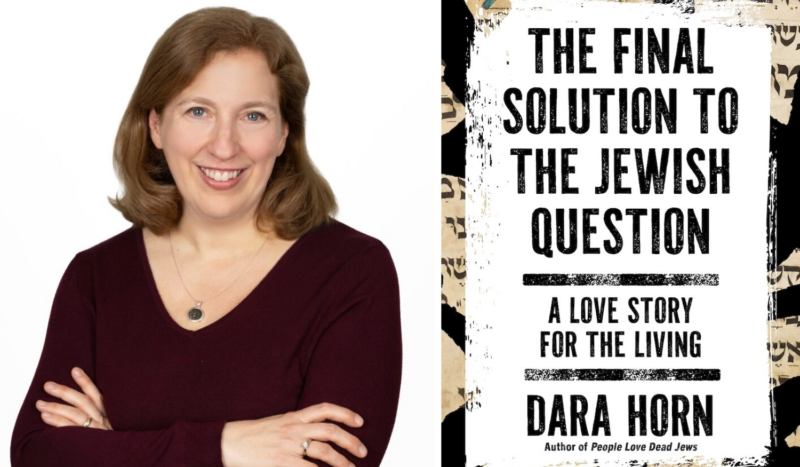
























Five years after 'People Love Dead Jews,' the novelist's new book reframes Jewish hatred as a lie about destruction — and tells Jews they don't have to accept it


 Add JewishInsider on Google
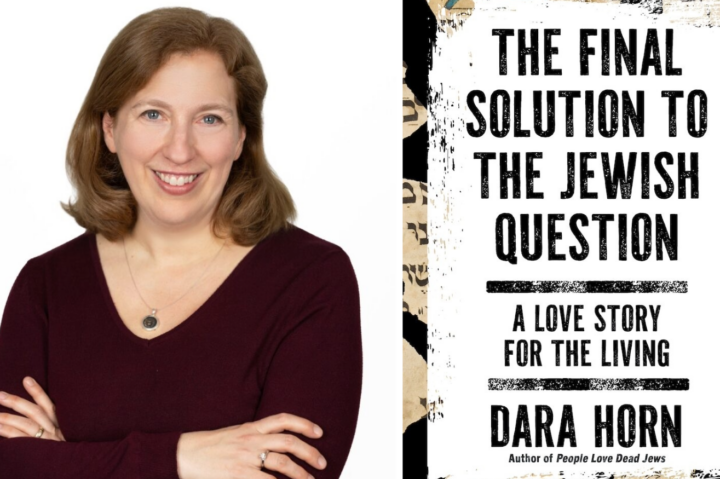
If you thought People Love Dead Jews — Dara Horn’s 2021 essay collection examining society’s reverence for remembering deceased Jews while failing to support the living ones — was an awkward book to read in public, just wait until you get your hands on Horn’s newest title: The Final Solution to the Jewish Question.
Horn, a celebrated novelist who has become the bard of contemporary antisemitism since Dead Jews was published five years ago, is in on the joke; she likes to say that both titles make great beach reads because no one will dare sit within several feet of you. (Her dad even made a custom People Love Dead Jews beach towel for her to test out the theory.)
But despite borrowing its title from the name of the Nazis’ infamous plan to rid Europe of its 11 million Jews during World War II, Horn’s latest book, which will be published on Sept. 1, is not a Nazi manifesto.
Instead, the title of Horn’s new book serves as an eye-catching, subversive dog whistle that is meant to pique the interest of antisemites — while also serving as a cheeky summary of Horn’s goal of actually trying to come up with a solution to the wave of antisemitism that has swept the world in recent years.
She just can’t believe that she is the one coming up with those solutions.
“I saw People Love Dead Jews as just a detour from my real work, which I see as writing novels,” Horn told Jewish Insider in an interview last week.
The genesis for Horn’s latest book came in the aftermath of Dead Jews. She spoke at public events often in 2021 and 2022, and she recalls becoming “the receptacle for everyone’s horror stories.” People would go up to Horn after she discussed the book and tell her about their own experiences of antisemitism. They often chalked up these incidents to jokes or misunderstandings or annoyances, such as a couple being ghosted by a longtime friend after the friend attended their son’s bar mitzvah or an actor turned down for roles in Hollywood because they looked “too Jewish.” But when taken together, they present a picture of a society that has learned to accept ambient anti-Jewish hate.
“This is going to sound really ridiculous,” Horn reflected on her previous book, “but I didn’t even really think it was a book about antisemitism. I saw it as a book about this weird historical phenomenon about the way we commemorate the past and how that affects the present.”
Many Horn acolytes felt that her thesis was borne out during the aftermath of the Oct. 7, 2023, Hamas terror attacks in Israel, the deadliest day for the Jewish people since the Holocaust, as they watched sympathy for Jewish victims turn to anger at Israel’s military response and even praise for Hamas’ actions.
“I’m not happy to have been right about this,” she said.
Horn became a sought-after expert on the willingness of many people to excuse contemporary hatred of Jews while insisting that they are not, actually, antisemitic. She was asked to serve on an antisemitism advisory group at Harvard, her alma mater, though the effort quickly fell apart. She testified to a congressional committee investigating antisemitism at Harvard. In early 2024, she wrote an essay in The Atlantic describing antisemitism as “the big lie,” and examined why so many smart people, including at Harvard, are willing to fall for it. Through all of it, American Jews — particularly young people on college campuses — wrote to her constantly, describing all the ways they had been excluded, shunned, cast out or harassed simply for being Jewish and declining to disavow Israel.
Horn is not, reflexively, a cynic. She does not think most people are out there looking to attack Jews. She summed up her understanding of non-Jews and how they relate to antisemitism by invoking the story of Purim, the holiday that celebrates the Jewish people’s courage in the face of a genocidal leader.
“Most people are not Haman,” Horn said, referring to the king’s advisor, who sought to exterminate the Jews of ancient Persia. “Most people are Ahashverosh.” That’s a reference to the bumbling king who pleaded ignorance at the malicious plans of his closest advisor but ultimately supported his ouster when the king’s wife, the Jewish Queen Esther, revealed her identity and asked for his help.
With her new book, Horn wanted something to offer the people who are ignorant rather than hate-filled, something to share with “your friend who doesn’t get it,” or “the principal of the school who is dealing with this,” she told JI.
“I am providing a solution. Not a solution in terms of, like, ‘Here’s 10 policy points we should implement,’” Horn explained. “It’s, ‘Here’s the story we need to be telling about who we are, to ourselves and to everyone else,’ and this is the story that is going to inspire people to imagine a better future.”
So what is that story? Horn wants the world to see Judaism as “a 3,000-year-old anti-tyrannical movement” that “is always going to piss off dominant societies.”
So the way to understand modern-day antisemitism, Horn argues, is not about “bias or bigotry or prejudice [or] conspiracy theory.” It’s about framing antisemitism as a lie.
“The lie,” Horn continued, “is always the same: Jews are destroying what you value the most.”
Since Dead Jews came out five years ago, and particularly after Oct. 7, Horn has watched many people freeze in the face of that assertion. She has observed a fatalism creep into the Jewish community, a sense that nothing can help, that this is our lot.
To those people, her answer is simple: “You don’t have to put up with this crap.”
Isakowitz’s memoir traces his father’s path from Auschwitz to America and his own journey from grief to growth
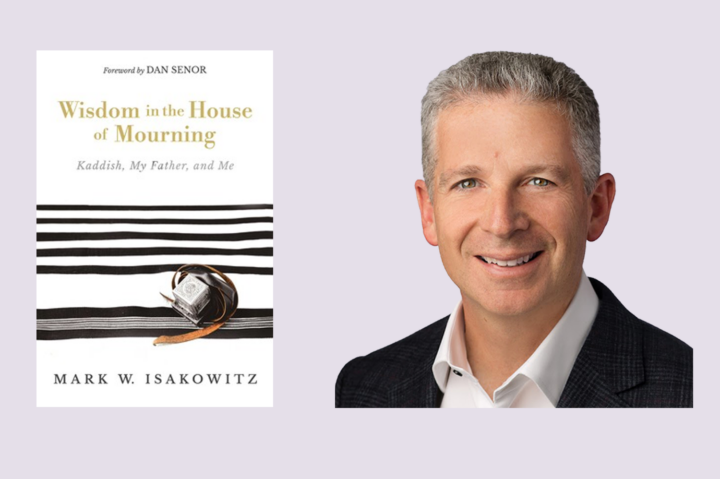
Mark Isakowitz's new book Wisdom in the house of Mourning
On Capitol Hill, it’s usually the senators who publish books, not their staffers.
The office of Sen. Dave McCormick (R-PA) has both: Last year, McCormick authored a book on leadership with his wife, Meta President Dina Powell McCormick. Now, McCormick’s chief of staff, Mark Isakowitz, is gearing up to release a book of his own.
Isakowitz’s book, a memoir, is titled Wisdom in the House of Mourning: Kaddish, My Father, and Me. It tells the story of Isakowitz grappling with the loss of his father, who immigrated to America after surviving Auschwitz, and Isakowitz’s daily practice of reciting the mourner’s prayer at a synagogue in Washington.
The book is described as a “father’s path from Auschwitz to America,” and “a son’s journey from grief to growth.” It will be published in January.
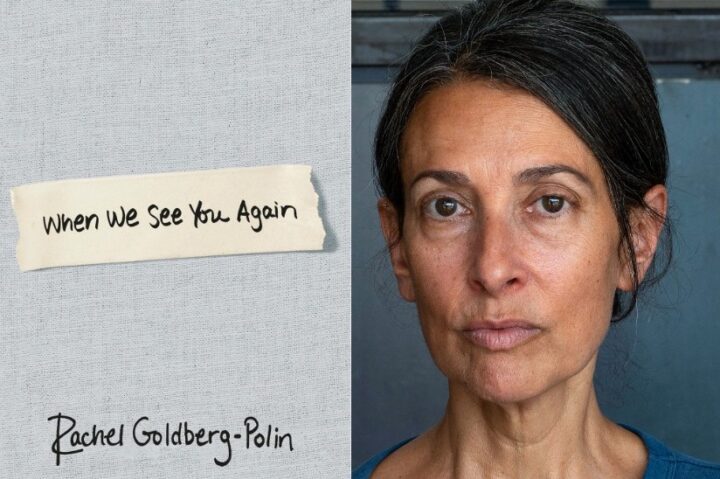
'When We See You Again,' Goldberg-Polin told JI, is ‘a pain-filled love story, or it's a love-filled pain story’
Amazon/AHIKAM SERI/AFP via Getty Images
Book cover/Rachel Goldberg-Polin
On Oct. 10, 2023, Rachel Goldberg, an American Israeli woman from Chicago, told a roomful of reporters in Tel Aviv about her last communications — two text messages — from her son, Hersh Goldberg-Polin, that she had received three days prior.
“The first one said, ‘I love you’ and immediately at 8:11 also it said, ‘I’m sorry,’” Goldberg said. “And so I knew immediately wherever he was, it was a terrible situation.” Hersh, she would soon learn, had been kidnapped by Hamas terrorists near the Nova Music Festival and taken into Gaza.
As Goldberg spoke about the text messages, a man speaking loudly at the back of the room was shushed by someone near him. It would be among the last times anyone would try to speak over Rachel Goldberg.
She would soon become known as Rachel Goldberg-Polin, or, almost as often: Hersh’s mom. And for more than 300 days, she and her husband, Jon, traversed the globe as they worked to secure their son’s freedom from captivity in Gaza before he was killed in August 2024 by his Hamas captors.
In the months after their son’s death, the Goldberg-Polins, who had for nearly a year been the faces of hope and persistence, became the faces of a unique kind of grief — one that they experienced in the public eye.
Goldberg-Polin recounts some of those moments in her new book, When We See You Again, a chronicle of her life before, during and after her son’s captivity and murder.
“I think people don’t know what to expect,” she told Jewish Insider days before the release of When We See You Again, which comes out on Tuesday. “I know that, because people are writing, ‘Oh my gosh, I’m so excited,’ and I’m thinking, ‘Oh gosh, you are not excited. This is, like, not a fun read.’”
When We See You Again is separated into five parts, beginning with “The Before” and “The After,” which follow the Goldberg-Polin family’s life in the U.S. and then in Israel, where they moved in 2008, through Hersh’s murder, until the final day of the shiva.
The later parts — “Lost in The After,” “Still in The After” and “Ever After,” which comprise the majority of the book — detail Goldberg-Polin’s life as a bereaved mother navigating the world as one of what she calls “The Broken.”
“I don’t think of this book at all as a memoir or a tell-all,” she told JI. “It’s like little Tupperware of pieces of a life that was, and then figuring out a life that is, and how do you do this? How do we do this, breathing in a world where we no longer have air?”
She had started writing because she found it therapeutic. “I couldn’t bear the intensity of the suffering that I was carrying; [it] was making my knees buckle and my soul buckle,” Goldberg-Polin explained. “And I just really couldn’t shoulder it on my own, and so I was just writing.” It felt, she said, like “when you’re just drowning because there’s too much [and you have] to just get it out, to spill it out.”
Between the stories and anecdotes from the nearly 11 months she and her husband spent advocating for the release of the hostages, followed by the year of mourning after Hersh’s death, Goldberg-Polin intersperses vignettes from her childhood in Chicago, details about the family’s life as they adjusted to life in Israel and the Jewish teachings that have guided her.
She even reflects on the decision to change her last name to match her son’s, comparing it to the moment the biblical Jacob’s name was changed to Israel, after a tussle with a mysterious figure that causes him to walk with a limp for the rest of his life.
“I think of Jacob becoming Israel as I limp forward,” Goldberg-Polin writes, “noting all of the ways I, too, have been transformed, but also searching for the blessing this crisis must give me, looking for opportunities for birth and light.”
Something that has touched her in the 20 months since Hersh’s death is the vast number of people who have experienced loss who have made contact with her.
“Since Hersh was killed, we’ve had thousands and thousands and thousands of people from all different backgrounds and all different faiths and all different brands and all different spectrums who have reached out to share their pain and not commiserate, but sort of to come together in this enterprise of the human condition of loss.”
She feels especially close to the families of the five others who were killed alongside Hersh in that tunnel in Gaza — a group of young people now referred to as the “Beautiful Six”: Eden Yerushalmi, Carmel Gat, Almog Sarusi, Alexander Lobanov and Ori Danino. When they were found after their executions, Yerushalmi’s body was leaning on Hersh’s lap.
“There are literally five families on earth who’ve walked the path we’ve walked, and I’m grateful that I know they just breathe the way I breathe, so I don’t even have to talk to them every day in order to know that they get it,” she said. “They they know my torture, they know my torment, they know my pain. They know my misery.”
As someone who spent the majority of her life as a private person, she has struggled with the fame that has come with her public fight, which often includes being recognized while out and about with her family. Sometimes it’s a wave from a stranger. Other times it’s a conversation.
“When people do approach us and say these heartfelt, gorgeous words of comfort and connection, I am truly thankful for the benevolence,” she said. “It’s me that’s broken. It’s not them. They’re being human. I am trying to figure out how to behave in a normal way.”
“When people say, like, ‘We’re with you,’ I literally act like a crazy person. Because I am a crazy person. I’m a crazy person. I actually thought, well, I have a disorder, and what is the etymology, the root of ‘disorder’? It is ‘not in order.’ I’m not in order. You know what? Burying Hersh was out of order for me. I didn’t want that order.”
Those who know Goldberg-Polin have known since Oct. 7, 2023, not to ask her, “How are you?” (In the book, she shares that she and her father will jokingly ask the other the question and prompt them, “Lie to me,” garnering the response, “Dandy!”)
For her, the book is the answer to that question. “This book is saying, ‘I know you don’t see it, and I really don’t blame you for not seeing it, and I didn’t see it.’ I haven’t seen it before. I’ve met people who are bereaved, who are grieving, who are suffering, who are mourning, and I didn’t say the right thing because I didn’t get it either.”
“If someone was born blind,” she continued, “they don’t know what the color blue is, and it’s very difficult for someone who knows what the color blue is to describe it to someone who has never seen it. And the book is my attempt to describe blue. It’s my attempt to describe pain.”
“This is simply me giving over my love and my pain, and I hope that maybe people just understand me a little bit more, maybe understand people who are suffering and really in grief and mourning more, and I don’t know that it has to do anything beyond that.”
Ultimately, Goldberg-Polin said, “I think that it’s a book about two things. I think it’s about love and pain. It’s a pain-filled love story, or it’s a love-filled pain story, and that’s what the book is.”
The New York Republican talked to JI about her leading role holding university presidents accountable

Kent Nishimura/Getty Images
Rep. Elise Stefanik (R-NY) testifies before the Senate Foreign Relations Committee on her nomination to be Ambassador to the United Nations on Capitol Hill on January 21, 2025 in Washington, D.C.
On Capitol Hill, Rep. Elise Stefanik (R-NY) has long been a vocal advocate for combating antisemitism and active on Middle East security issues. But it was her questioning at a December 2023 hearing that made her a household name in the American Jewish community and beyond, and drew her into the center of the unfolding fight on campus antisemitism.
“Does calling for the genocide of Jews violate [your school’s] code of conduct or rules regarding bullying and harassment?” Stefanik asked the presidents of Harvard, the University of Pennsylvania and the Massachusetts Institute of Technology.
Their equivocal responses, as disruptive and at times threatening anti-Israel protests were sweeping universities across the country, were a major factor in the resignations of two of those presidents and a slew of further hearings that put college presidents in the hot seat.
Now, as she prepares to leave Congress next year, Stefanik is out with a new book on campus antisemitism, Poisoned Ivies: The Inside Account of the Academic and Moral Rot at America’s Elite Universities.
More than two years after that first hearing — and after a tumultuous political period in which she saw her nomination as ambassador to the United Nations withdrawn before launching a short-lived New York gubernatorial campaign — Stefanik offered a mixed readout on how she sees the state of American higher education in an interview with Jewish Insider this week.
“In the year after the hearing, we saw that the universities failed to fix themselves and continued to dig deeper and deeper, and it was going to take significant administrative and legislative and frankly, appropriations action of withholding of funds, to force them to really reckon with what the American people saw loudly and clearly in that hearing, [which] is that there are deep-seated issues in higher education,” Stefanik said.
She said that there have also, however, been leadership changes at many of the universities that were probed by the House Committee on Education & the Workforce, in part because of those hearings, as well as overhauls such as the elimination of diversity, equity and inclusion programs at some schools.
“The other piece, I would say, is you’re seeing parents and students vote with their wallets and their feet,” such as the rising application and matriculation rates to schools like Vanderbilt University, which Stefanik has highlighted as having handled the post-Oct. 7, 2023, environment effectively.
The New York congresswoman argued that the hearings played a major factor in the reform efforts that followed. She also said that the Trump administration, even before it took office, has been sharply focused on the issue of campus antisemitism, coordinating closely with her office to help shape the administration’s lawsuits and executive orders on the issue.
Asked about anti-Israel and antisemitic voices in the Republican Party such as commentators Tucker Carlson and Candace Owens, Stefanik largely dismissed the idea that antisemitism was, or could become, a significant problem within the GOP.
“The difference between [New York City Mayor Zohran] Mamdani and those podcasters is Mamdani is elected to the most important city in the world as mayor, and those other names are not elected, and I think are often overstated [in] their influence,” Stefanik said. “They would not be elected to local office, to state office, to congressional office. That’s why I think it’s very important for actual elected officials, actual leaders, to speak out on issues of importance.”
She praised Trump for calling out Carlson and Owens and making clear that they don’t represent him or his voters, and argued that similar voices represent just a small fringe of Republican members in Congress.
Pressed on the fact that such voices represented a similarly small fringe of the Democratic Party in Congress a decade ago, Stefanik insisted that Republican voters would not embrace such voices.
“The Democrat[ic] Party — it’s a full blown takeover of Hasan Piker, of these voices that The New York Times is now embracing, and ‘Pod Save America’ is now embracing,” Stefanik said. “That is not the case on the Republican side. And as a candidate who actually has stood in front of the voters for the past decade-plus — yes, those voices can say what they want, you actually represent the people that elect you, and that’s not what voters in my district [want].”
Despite the relatively small share of Jewish voters in her district, Stefanik said that her work on campus antisemitism still receives some of the strongest praise from constituents.
Though the administration’s initial blitz of action on campus antisemitism has faded from the headlines, Stefanik said its efforts to address issues in higher education are ongoing, and that the issue also remains top-of-mind for the country at large.
“It’s not just about antisemitism,” she added. “This is broader higher education reform. … That was the canary in the coal mine issue that brought up so many broader issues that were wrong with higher education.”
In Congress, she said that more legislation should be brought to the floor on campus antisemitism, adding that she’s also hoping to work on reining in funding to colleges, cracking down on tax advantages and loopholes that benefit colleges and further limiting foreign funding and foreign student populations at U.S. institutions in her remaining months on the Hill.
She pointed to Qatar as one driver of antisemitism on campuses, and said that the U.S. should make clear to Doha that, if it wants to remain a military partner with the U.S., it “can’t foment and fund this anti-Americanism on college campuses, full stop.”
Stefanik isn’t yet sharing her next steps, but said she wrote her new book in part to serve as a historical record of antisemitism on college campuses, so that “mainstream media” can’t “brush this chapter under the rug.” She said she intends to continue shining a light on the issue.
Though she ultimately passed on a gubernatorial run, Stefanik seems to have longer-term plans in New York politics, and said that Republicans will be in a stronger position to win in the state in the coming years.
Regarding her decision to drop out of the governor’s race, Stefanik argued that the political environment is not currently ripe for a GOP victory, that Republicans need more time to build their statewide infrastructure and that Mamdani’s policies will grow more unpopular in the next few years.
“I think the Democrat Party is going to be increasingly taken over [by Mamdani-aligned socialists],” Stefanik said. “That, long-term, is where Republicans can win back those independents and traditional Democrats.”
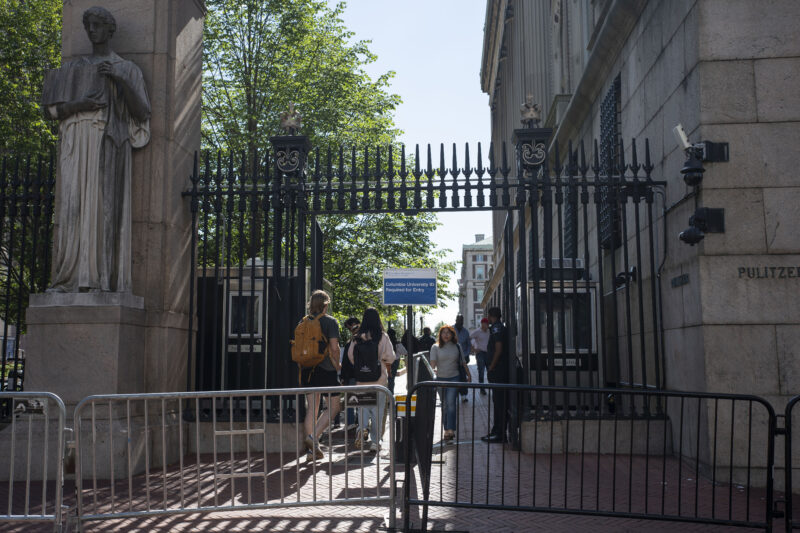
Stefanik drew a direct line between the anti-Israel encampment at Columbia University and Mamdani’s election — both because Mamdani’s father is “very much part of this antisemitic petri dish” at Columbia and because “the same people that were organizing the pro-Hamas encampment at Columbia directly were boots on the ground for [his] campaign.”
She called herself “the leader” among state Republicans in pushing back against “socialist and Democrat single-party rule of New York State,” and highlighted that she has her own statewide political apparatus — separate from the statewide GOP, which she said lacks infrastructure.
“There is going to be a long road in rebuilding that infrastructure to save the state,” she said.
She also said she wanted to spend more time with her four-year-old son at this stage of his life.
“My voice is not going anywhere. If anything, it’s more. I mean, we’re putting this [book] out in the world and helping set the tone for the type of leadership we need in New York and, frankly, across the country,” Stefanik said.
New Yorker reporter Jason Zengerle’s book, ‘Hated By All the Right People: Tucker Carlson and the Unraveling on the Conservative Mind,’ comes out Tuesday

Courtesy/Andrew Kornylak
Book cover/Jason Zengerle
In his richly reported new book, Hated by All the Right People: Tucker Carlson and the Unraveling of the Conservative Mind, Jason Zengerle tracks the evolution of the mainstream conservative journalist for The Weekly Standard, CNN and FOX News into a prominent figure in the far-right media ecosystem whose commentary increasingly descends into open antisemitism.
Zengerle, a veteran political reporter, ruminates over Carlson’s troubling transition from magazine writer to cable news pundit to his current position as a widely followed podcast host whose credulous interviews with Nazi sympathizers and Holocaust deniers, among others, have done little to dampen his influence in the MAGA movement he helped build.
In a recent interview with Jewish Insider, Zengerle, whose book will be published Tuesday, warned that Carlson’s efforts to smuggle antisemitic views into mainstream discourse should not be taken lightly.
“Tucker has credibility, and he comes across as a credible person,” Zengerle said. “That he’s giving voice to these really pretty fringe and dangerous sentiments is not to be underestimated, because people trust him.”
Whether Carlson personally believes the “awful things” he promotes, Zengerle writes in his book, “matters less than that he says them at all, and that millions of people — members of Congress, titans of industry, the president and just everyday Americans — listen to and take their cues from him.”
“What matters is that by saying these things, Carlson has finally achieved the fame, power and influence that for so long eluded him,” he adds.
Zengerle, 52, was recently hired as a staff writer for The New Yorker, and has previously contributed to The New York Times Magazine, GQ and The New Republic, among other publications. His book on Carlson is his first.
Speaking with JI last week, Zengerle discussed Carlson’s professional ascent, his motivations for demonizing Israel and why conservative Jews are so frightened by his potential role in shaping the future direction of the Republican Party after President Donald Trump leaves office, among other topics.
The conversation has been edited and condensed for clarity.
Jewish Insider: This book has been in the works for a while. How did the idea initially come about?
Jason Zengerle: It’s been a bit of a roller coaster. The initial idea sort of came from a conversation I was having with my agent about a book I didn’t want to write, about the Republican civil war that was about to unfold. This is not long after [the] Jan. 6 [2021 Capitol riot]. The people who are going to be vying to inherit Trump supporters, because Trump was obviously a finished product, would never be coming back. And I was sort of talking to my agent about the various characters, and explaining why I didn’t think, no matter how many positions [Sens.] Josh Hawley (R-MO) or Ted Cruz (R-TX) or Tom Cotton (R-AR) took that would seem to appeal to Trump’s base, there was no way they’re ever going to inherit those voters, because they just lacked the charisma and entertainment value that Trump obviously has.
Offhandedly, I said something like, ‘You know, the only guy who really can do that is Tucker Carlson.’ That was the genesis of the idea. Then, obviously, when I started the book, Tucker was at the height of his powers. He had the highest-rated show on Fox. Trump had kind of exited the stage. And Tucker, in a lot of ways, had sort of replaced Trump, just in terms of the headspace he was occupying among both liberals and conservatives. You had this weird Tucker economy of liberal journalists and people on Twitter who would clip his show, sort of like outrage bait.
For the first couple years I was working on the book, Tucker was sort of occupying that space. And then he got fired from Fox, and everyone was predicting that he would basically suffer the same fate all Fox stars suffer when they leave Fox, which is irrelevance. Like, who thinks about Bill O’Reilly these days, right? But I thought that wasn’t going to happen. I thought Tucker was going to stay in the picture. That might have been some motivated self-reasoning on my part, because I wanted the book to be relevant. My original publisher definitely thought he was going to fade away because they canceled my contract.
JI: It certainly seems you were right in suspecting that he would continue to be not only relevant, but extremely influential during the campaign and in influencing hiring decisions for key roles in the Trump administration, as you detail in the book. He’s had a circuitous and occasionally rocky career from print journalism to cable news and now to an independent podcast. How do you view his evolution? Is there a moment where you see a clear turning point toward the type of demagogic commentator he would become, or do you think it was more gradual?
JZ: I think there are definitely inflection points in his career, and you can point to a number of them. I think one was certainly the war in Iraq. I think that had a pretty profound impact on his thinking. You know, I think he harbored some private doubts about the wisdom of going to war there, but was not really comfortable expressing them publicly, for a couple of reasons. Today, he talks a lot about how Bill Kristol and all these guys kind of misled him, and that’s why he hates them so much. At the same time, his best friend and now business partner was Neil Patel, who was working for Scooter Libby [chief of staff to former Vice President Dick Cheney]. And if you want to look at the disinformation that was put out into the world that supported going into Iraq, that was coming from Dick Cheney’s office. And I think Neil played a role in that. The fact that his best friend was sort of making the case for war, I think, made it difficult for him to oppose it. Two, the job he had at CNN at the time, on “Crossfire,” was to represent the right and the Bush administration — so just from a practical standpoint, he had to kind of support the war.
But anyway, the fact that things went so badly for Tucker at CNN, I think, made him reexamine a number of his priors and a lot of his time in his early career, when he was at The Weekly Standard and even after he had started writing for Talk and Esquire. There was such an effort among people like Kristol to excommunicate Pat Buchanan from the conservative movement. I think what happened with Iraq made Tucker reconsider Buchanan a bit, and he sort of saw that, ‘OK, well, I actually think this guy was right about foreign policy, and maybe he’s right about some other stuff as well.’ I think that led him to become much more hawkish on immigration.
I think that what happened with Jon Stewart and CNN was a pretty big inflection point in the sense that the public humiliation he suffered, obviously, was difficult for him. But I also think he felt that his friends in the elite D.C. political and media circles didn’t come to his aid the way he would have liked. That started to breed a certain resentment he felt toward them that really grew as his career limped along. It made it a lot easier for him, when Trump came on the stage and started attacking the swamp and D.C. elites, to join in on those attacks, because I think he still nursed a grudge. So you can see things gradually, but you can also point to these crossroads moments, as well.
JI: You write that, while you didn’t know Carlson well, he often served as an “eager interview” subject and source for your stories over the years. Still, he didn’t agree to any interviews for your book. Why do you think that was?
JZ: I think it really is that Robert Novak expression: “a source, not a target.” I think he plays that game.
JI: There’s an interesting recollection in the prologue about your occasional interactions with Carlson when he would stop by the New Republic offices back in the late ’90s during your time as an intern there. You describe him then as a “hotshot young writer for The Weekly Standard,” and say he “seemed so much older, wiser and worldlier than we were.”
JZ: Maybe it didn’t take much to impress me. But the thing about him back then — and the thing I think others admired about him and looked up to him for — was that he was really courageous. The targets he picked, whether it was Grover Norquist or George W. Bush — it took guts to do that as a conservative journalist, and that was admirable.
JI: You write in the book that Carlson has “come a long way from the days when he described himself as a pro-Israel, Episcopalian neocon.” On his show now, he regularly promotes antisemitic tropes and conspiracy theories, incessantly attacks Israel and hosts neo-Nazis and Holocaust deniers for friendly interviews. Do you have insight into what sparked this openly antisemitic streak?
JZ: It’s funny, someone who’s close to him was telling me that they thought this basically started with his conclusion that all the people who were opposed to him and Trump, post-2016, were big Israel supporters. So Tucker’s like, ‘Alright, I’m just going to piss these people off by going after Israel,’ and that’s kind of where it started. I don’t know if that’s the case.
I mean, Bill Kristol looms so large in his mind and in his own story. The story that he tells people, and the story I think he tells himself, is he was misled and used and kind of exploited by the neocons, that he was this young, naive, innocent writer who got just basically used to get us into a war and support free trade deals and do all these things that hurt the white working class in America, and that what he’s doing now is his penance. And I think that’s not a true story. I don’t think that’s what happened.
Kristol is just such a huge figure in his own mythology. Even before Tucker went in this direction, he was really close to Kristol. He really looked up to him. He was his first boss, and I think he had a real impact on Tucker’s career. But now, Tucker wants that all to be a negative impact. He did an interview recently with his brother, Buckley Carlson, where he talked about how Kristol hates Christians. Bill Kristol, who hired Fred Barnes and took vacations with Gary Bauer. He’s recast all this stuff.
JI: Do you think Carlson’s hostility toward Israel and descent into nakedly antisemitic vitriol, such as when he called Ukrainian President Volodymyr Zelensky “ratlike” and “a persecutor of Christians,” is motivated by more than just resentment of those he believes have spurned him? There’s been a lot of attention recently about a generational turn away from Israel on the right, which raises a question of whether he’s opportunistically tapping into that or directly influencing it.
JZ: I guess it’s both. I do think he’s making the calculation that that is where the energy is, and therefore he wants to make sure he stays out in front of it. He has a very good political radar and good professional radar. I think the Nick Fuentes episode was him recognizing he was in this feud with this guy, and he was losing, and him sort of deciding you cannot be successful in conservative media or conservative politics these days unless you have the support of these neo-Nazis. Unfortunately, it’s not going to work for you, and so he needed to get back on their good side. I think that’s part of the calculus.
At the same time, I think he is influencing some of these people, maybe not the hardcore Nick Fuentes supporters, but young conservatives who, you look at what happened or what’s happening in Gaza and had questions and qualms and concerns. And then Tucker is out there — and Fuentes is out there as well — making the argument about how Gaza is wrong, but taking it so much further than that, and going into these really ugly corners of anti-Israel sentiment and taking them to those places.
Now, I don’t want to get too far afield here, but that JD Vance talk at Ole Miss, where the frat boy asked that question about Israel persecuting Christians — that was a real light bulb moment for me. That this stuff had penetrated that deep that you have this guy who appears to be your regular old SEC frat boy saying this stuff. And I think Tucker is responsible for a lot of that, because that’s something he did at Fox, and he continues to do. He’s really good at taking ideas and arguments and even just stories from extreme, far-right fringy areas, often on the internet, and smuggling them into the mainstream. I think he’s doing that with the Israel stuff and with the Jewish stuff.
JI: His interview in 2024 with Darryl Cooper, the self-proclaimed podcast historian and Holocaust revisionist who has described Winston Churchill as the “chief villain” of World War II, seems an early instance of that effort.
JZ: That’s a perfect example. You have to be really steeped in this stuff to see what this individual is saying and doing and the rhetorical tricks they’re playing. Tucker just brings and vouches for these people, and I think that’s pretty dangerous. Tucker has credibility, and he comes across as a credible person. The fact that he’s giving voice to these really pretty fringe and dangerous sentiments is not to be underestimated, because people trust him, and it validates them.
JI: There’s been some intermittent speculation about whether Carlson will run for president. Do you have any thoughts on that?
JZ: I don’t think he just wants to be a podcaster. I don’t think that’s his goal here. I think he has a real vision for what he wants this country to be, and he wants to achieve that vision, and if it turned out that running for office was the way to do that, I could see him doing it. I don’t think it’d be his first choice. I think right now, he has a nice, nice setup where he obviously has a president who listens to him. Maybe even more importantly, he has a vice president who I think he’s even closer to and more in alignment with. Just sort of thinking through the steps, as long as he thinks JD Vance and he are on the same page ideologically, and as long as he thinks JD Vance is capable of being elected president, that he has the political talent to pull that off, I can’t imagine him doing anything on his own.
But if one of those two things changes, and I think it’s quite possible that the latter becomes a sticking point — if Tucker at some point were to conclude that JD Vance actually isn’t capable of being elected president and that his his ideological project is in jeopardy — I could certainly see him taking a shot at it. The way you would run for president now, it’s so different from how you had to do it before. He could probably do a lot of it from his podcast studio. But I think what’s more important is just understanding why he would do it, which is sort of the bigger point. He really does have a project he’s working on, and I think he’ll do what he thinks is necessary in order to bring that project to fruition.
JI: How would you characterize that project?
JZ: He wants the United States to look like it did in the 1950s. I think he’s very much in alignment with Stephen Miller. Beyond the immigration stuff and us being a much whiter country, I think he wants to return to traditional gender roles.
JI: While some Republican lawmakers have spoken out against Carlson, it seems notable that Trump and Vance have both so far refrained from explicitly distancing themselves from him.
JZ: There’s this weird thing going on where certain Jewish conservatives feel like, as long as Trump’s there, everything’s going to be fine. You know, his grandchildren are Jewish, he might say some stuff, he might do some things, but at the end of the day, the worst-case scenario will never occur. They view Tucker as this bad influence on Vance, and if they can just get rid of the bad influence, Vance will be OK. But they’re really terrified of Tucker. They’re really terrified of what comes after Trump. And they’re terrified that Tucker will have a major influence on whatever comes after Trump. They’re worried about the influence he has on Vance. They want to believe that Vance would be OK, left to his own devices. They think Tucker is leading him in a bad direction, and therefore they need to take out Tucker.
I think it goes beyond Israel. I think it’s genuine fear about what it would mean to be Jewish in the United States. I’ve been talking to some of these folks recently. I think it’s a real, deep-seated fear about, in Tucker Carlson’s America, what would it be like to be Jewish here?
Izabella Tabarovsky’s ‘Be a Refusenik’ offers a productive mindset and practical ideas for Jewish students facing antisemitism
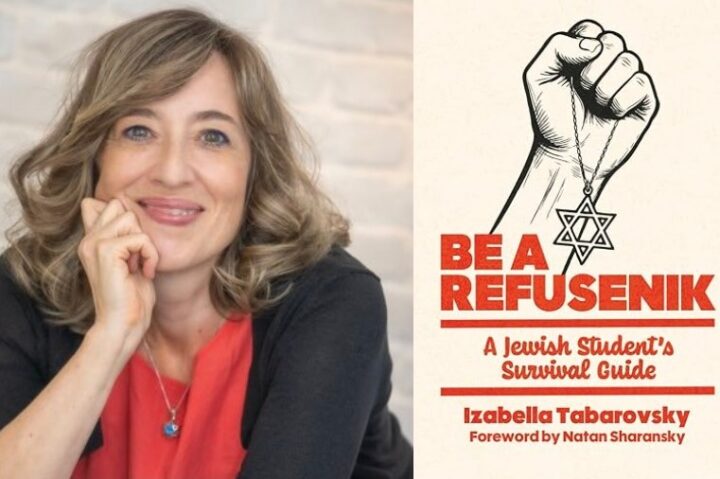
Izabella Tabarovsky
Pocket your kippah. Tuck your Star of David into your shirt. Keep your head down as you walk through the quad, That’s just some of the advice Jewish college students around the country told the Soviet-born writer and activist Izabella Tabarovsky they were given by the leaders of major Jewish organizations as a strategy to weather the anti-Israel and antisemitic storms that have raged on campus since Oct. 7, 2023.
Tabarovsky’s counter-message: Don’t hide. Reclaim your Zionism. And take inspiration from the Soviet refuseniks of the 1980s who stared down Communist Party strongman Leonid Brezhnev, held fast to their Judaism and eventually won their freedom.
Tabarovsky lays out some of these strategies for college students in a new book, Be a Refusenik: A Jewish Student’s Survival Guide, in which she argues that the anti-Israel sentiment on college campuses in recent decades, which has metastasized into antisemitism, mirrors Soviet anti-Jewish propaganda. In the book, Tabarovsky looks back to that era not only to understand the root causes of contemporary antisemitism, but to take inspiration on how to fight it.
The book features a history of Soviet anti-Zionist propaganda with its parallels to the rhetoric on college campuses today, interviews with refuseniks – Soviet Jews who were denied the right to emigrate to Israel, and often imprisoned for trying – and campus activists, and a foreword from the best-known refusenik, Natan Sharansky. Tabarovsky, who was born in the Soviet Union, emigrated to the U.S. in 1990 and now lives in Israel, also offers concrete strategies for students encountering antisemitism to stand proud and strong as Jews.
Tabarovsky told Jewish Insider that she saw a need for her book after many discussions with young Jews: “We’re in a bleak moment, and a lot of books diagnose the bleakness. … I saw a hunger for an inspirational message.”
In the near-decade that she has been writing about the subject, it has become “widely accepted among scholars and people involved in this [activism] that the patterns of anti-Zionist demonization and erasure are some of what Soviet Jews experienced in [former Soviet Union leader Leonid] Brezhnev’s USSR,” she said.
“If American Jews are today encountering the same language, the same explanatory logic and worldview … wouldn’t it make sense to look at how Soviet Jews responded?” Tabarovsky said. “We have this heroic story at the center of the Soviet Jewish story, which is really bleak, but had one really bright light that led to massive change.”
Tabarovsky clarified that, while the U.S. is a democracy and the Soviet Union was an oppressive totalitarian regime, “historic parallels are complex and nothing is ever exactly the same. I would never say that America today is like Brezhnev’s USSR, and the dangers that American Jews face are incomparable to what somebody like Sharansky faced.”
However, she said, “what is similar are the ideological echoes and anti-Zionist erasure. … In every society, there is a scale of punishments that’s different. What’s the worst thing that can happen in America? Your reputation is ruined; you lose your career, you’re ruined financially. All of these things can happen to people who declare themselves Zionists.”
While the refuseniks are remembered for their attempts to emigrate from the Soviet Union, Be a Refusenik focuses on their domestic dissident activity, especially their underground actions to strengthen Jewish identity, spread Jewish education, teach Hebrew and learn about Israel and Zionism. They were “crowdsourcing Jewish knowledge” when the Soviet party line was that “Zionism is racism, is Nazism,” Tabarovsky recounted.
Part of the strategy Tabarovsky suggests for young Jews on campus is modeled after “an inner journey the refuseniks took” in strengthening their Jewish identity.
“Some refuseniks told me this is how they viewed it,” Tabarovsky said, “the system refused to allow them something they wanted, but before that, they refused [to accept] something about the system itself. They refused [to accept] the antisemitism that the system demanded from them, that they erase their Jewish identity, that they give up their sense of peoplehood. … The refuseniks said ‘we don’t buy it; we refuse [to accept] this version of reality. We believe something different.’”
Tabarovsky noted that in her speaking engagement with young American Jews, she realized that many are unfamiliar with the refuseniks, and when she would ask for examples of Jewish heroes, they would usually mention the Warsaw Ghetto Uprising or the Maccabees.
“[Refuseniks] are a real example of Jewish courage and defiance. … They found each other and created a different reality. They wrote their own Jewish story and recreated the Jewish identity that had been taken away from them. … They are the role models we need,” she said.
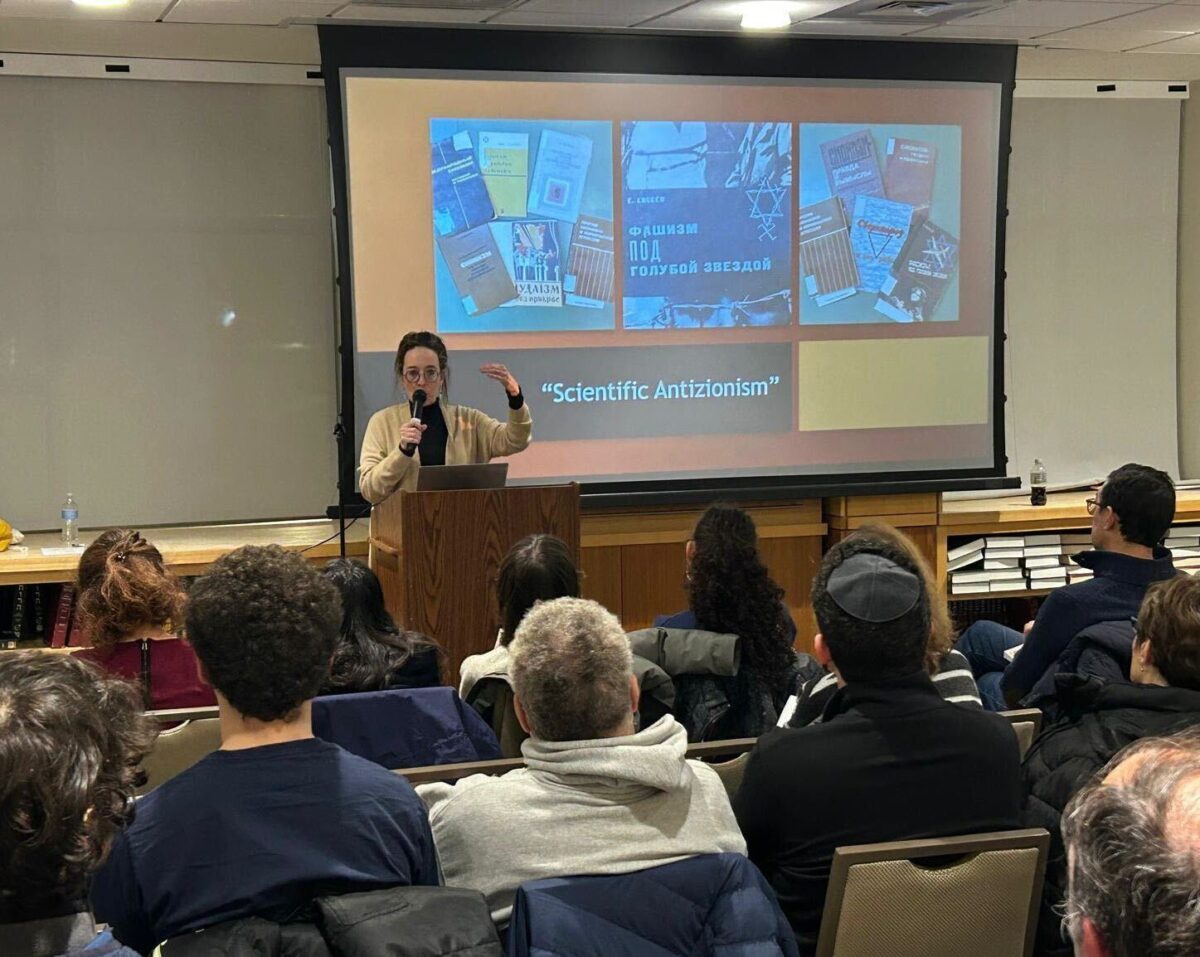
Izabella Tabarovsky speaking at a Be a Refusenik book talk in Needham, MA, organized by Jewish Alumni Strong and Association of Jewish Princeton Alumni. (Yelya Margolin)
Tabarovsky said that American Jews need to rebalance the narratives of Jewish victimhood and heroism, because victimhood has become too dominant.
“You read the horrible things refuseniks went through, but none of them talked about themselves as victims,” she said. “They felt like protagonists in their own story. They took responsibility; they took risks consciously. We need to think of ourselves in these terms, as well.”
Tabarovsky said she heard from many students who were told by large Jewish organizations to keep their heads down and try not to provoke or attract attention, or engage, and applauded those who did not take that advice.
To Jewish students, Tabarovsky suggests: “Reclaim your Zionism.”
“Build a community. Find other people like you. Re-empower yourself and think about your situation strategically,” she said. “The Jewish community has been improvising responses on the fly, while the other side is in the driver’s seat, creating all these propagandistic narratives. … We need to think strategically about how we need to organize ourselves.”
Once that happens, Tabarovsky said she is confident that Jewish students “will know how to act.” One example she cited was Lishi Baker, a rising senior at Columbia studying Middle East history, who she said saw American flags being defaced during anti-Israel protests at Columbia University and organized a counter-protest with American, not Israeli flags, to show that the protests are not only anti-Israel, but anti-American.
Tabarovsky called on students “to be more creative in the way they protest. The other side is doing all kinds of things to attract the media. The Soviet Jewry movement was so creative and knew how to attract attention.”
Tapper told JI that recent anti-Israel protests outside his home are not 'really an issue with my commentary as much as it’s an issue with my faith'
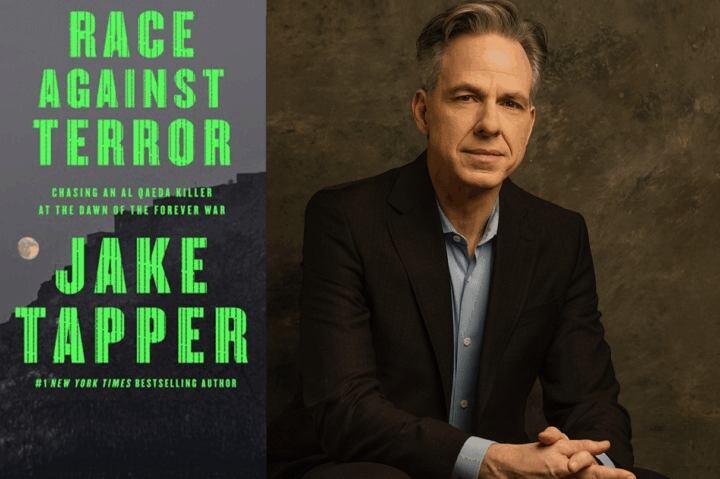
In his new book, Race Against Terror: Chasing an Al Qaeda Killer at the Dawn of the Forever War, released on Oct. 7, CNN anchor Jake Tapper uses novelistic flair to explore the little-known true story behind a high-stakes, globe-spanning effort to prosecute a jihadist who was ultimately convicted in federal court of killing American service members in Afghanistan.
The yearslong case constructed by a team of dogged federal prosecutors against Spin Ghul, a Saudi-born Al-Qaida operative who was sentenced to life in prison in 2018, represents what Tapper, in his meticulously reported account, calls “unique not only at the Florence Supermax but also in modern American history.”
“Spin Ghul is the only one who was tried and convicted for killing U.S. soldiers on the battlefield overseas,” he writes of the terrorist now serving his sentence in a federal prison in Colorado that has held some of the most dangerous criminals “from the modern era.”
In the briskly told story, Tapper, 56, also lingers on the broader legal and political issues that surround the case even years after its conclusion, highlighting how “the distinction between terrorism and warfare — and between criminal justice and the laws of war — was blurred” in the aftermath of the 9/11 attacks.
“My first goal for people who read the book is they’ll just enjoy the story and find it compelling,” Tapper told Jewish Insider in a recent interview. “I tried to write it almost like a novel in as compelling a way as possible.”
“But a second goal is for people to think about the war on terrorism and the best ways to keep us safe,” he added, noting “an argument to be made that the attempt to lock Spin Ghul up forever keeps us safer than if he had just been sent to Guantanamo, where by now he might have been freed.”
The book, which follows the recent publication of Original Sin, his best-selling book, co-written with Alex Thompson, on President Joe Biden’s “disastrous choice to run again,” is Tapper’s fourth nonfiction work. He has also written several novels and is now at work on a graphic nonfiction book about Nazi war criminal Klaus Barbie, marking a serious return to his early career dabbling in political cartoons and comic strips.
In the interview with JI last week, Tapper discussed his new book and the lessons he hopes readers will draw from it. The CNN host, who is Jewish, also shared how he balances side projects with his day job, weighed in on the Trump administration’s threats targeting the media industry and explained why he strongly feels that anti-Israel protesters who demonstrated outside his home last year are explicitly antisemitic, among other topics.
The conversation has been edited for length and clarity.
Jewish Insider: You say in the acknowledgements section of the book that you first learned about this story at a paintball birthday party for your son, where you spoke with Dave Bitkower, one of the lead prosecutors on the Spin Ghul case. What was it about the story that drew you to write a book about it?
Jake Tapper: I’m a big fan of police procedurals on TV — “Law & Order” and “CSI” and “Cold Case” and all that. I just find sleuthing really interesting, and this story that Dave Bitkower told me was just about the incredible sleuthing that he and these other prosecutors and FBI agents and other folks did to prove this case. It was just so interesting how they pulled together the case from all sorts of documents and testimonies, the methodical way they tracked down evidence and the hurdles that they faced. When he was all done telling me the story in Virginia that day at the paintball location, the first question I had was, has anyone written about this? Has anybody told this story? And he said no, that Spin Ghul’s prosecution was covered but that nobody had done the story about how the prosecution came into place. I was just lucky that I got there first.
JI: It’s quite a yarn. How did you find the time to write this book? On top of your day job at CNN, you recently co-wrote a widely read book about former President Biden. You’ve published several novels and have a number of other projects in the works as well.
JT: I love writing and I love reporting, and the writing and reporting I do for CNN is different than the writing and reporting I can do for the book. Just as a practical matter, when I have a project, I try to write for at least 15 minutes a day. Everybody can find 15 minutes, even if it’s 7:30 in the morning or 7:30 at night. If you do 15 minutes a day, at the end of the week, that’s an hour and 45 minutes you wrote, maybe three pages, and it adds up. But also, the nonfiction books that I write are about topics I’m really interested in and really, really want to write about. I’m writing them for myself as much as I’m writing them for anyone else.
JI: Beyond your interest in the procedural details of the case, you also draw a larger point about how, as you write in the book, “the distinction between terrorism and warfare — and between criminal justice and the laws of war was blurred” in the wake of the 9/11 attacks. What do you hope readers will draw from the book?
JT: My first goal for people who read the book is they’ll just enjoy the story and find it compelling. I tried to write it almost like a novel in as compelling a way as possible.
But a second goal is for people to think about the war on terrorism and the best ways to keep us safe. I think there’s an argument to be made that the attempt to lock Spin Ghul up forever keeps us safer than if he had just been sent to Guantanamo, where by now he might have been freed. As the lines of terrorism and war blur because of this opponent that we face, individual terrorists or terrorist groups, our way of addressing it as a country needs to adapt as well.
JI: How do you feel the Trump administration is approaching this ambiguity?
JT: There are two different ways to look at it. One is they are actually following in [former President Barack] Obama’s footsteps, because they have this terrorist from ISIS-Khorasan, [Mohammad Sharifullah, known as] ‘Jafar,’ who is in a Virginia prison or Virginia jail awaiting trial for conspiring to kill Americans in the Abbey Gate suicide bombing [in Afghanistan], and if they’re successful, then he will be the second foreign terrorist tried in U.S. Criminal Court for killing service members on a battlefield, which is interesting.
By the same token, the Trump team is also expanding the definition of what a terrorist group is by designating drug traffickers as terrorists and deploying the military against them in a way that previous presidents had only really used to deploy against groups like Al-Qaida or ISIS. So it’s both continuity and also pushing the envelope.
JI: Did you get the chance to exchange letters or speak directly with Spin Ghul during the course of writing this book?
JT: I reached out to him in prison, and I was told he was not going to cooperate. But I was lucky in the sense that he had participated in a multiday confession in Italy that I was able to use and tell his story. But no, he didn’t cooperate.
JI: In the book, you briefly relay an amusing anecdote about Susan Kellman, the Jewish defense attorney for Ghul who, as you note, came to roast “a kosher cornish game hen for an accused Al Qaeda terrorist,” as Ghul wouldn’t eat food that wasn’t halal. You write that there was a suspicion Ghul may have been reluctant to engage with Kellman because she was Jewish.
JT: All three of Spin Ghul’s defense attorneys are Jewish. Bitkower is Jewish as well. I don’t know how much Susan’s Judaism played a role versus how much her being a woman played a role versus how much her just being an American played a role. But I think it didn’t help. Susan says [Ghul] was initially happy to hear that she could bring him food that was halal.
But I think, ultimately, that he was not going to cooperate with the attorneys no matter what, because he just started to refuse to cooperate at all in what I refer to it at some point in the book as “the Jihad of Annoyance,” meaning he has nothing else he can do to fight the to fight the West other than be as uncooperative as possible — and so that’s what he did.
JI: You’ve previously said you are working on a fourth novel in your Marder family series of political thrillers, the last of which was published in 2023. Is that still in the works, and are there any other projects you’ve got going that you can mention?
JT: That novel morphed into a project that is not with the Marder family. I’m working on two other projects right now. One is a new novel, but it’s a whole new set of characters, because I wanted it to take place today, and the Marder family would be too old, so I just wanted to start fresh.
Then I’m also working on a graphic novel — though it’s not a novel, it’s a true story — on the Nazi Klaus Barbie, about how he escaped from Germany, how he thrived in Bolivia, how he was tracked down by Nazi hunters and journalists, how he was brought to justice in France, and all the rest. So I’m working on that right now.
JI: What piqued your interest in Barbie? And are you illustrating it yourself? I know you used to draw comics in college and early in your career.
JT: I am, I am, and I’m doing this for Top Shelf Comics, which did the John Lewis graphic novels and the George Takei graphic novels. What piqued my interest was my family and I went to France a couple summers ago, and my son and I went to the Museum of the Resistance, and I learned all about Jean Moulin, who was the hero of the Resistance. I had not known that Klaus Barbie had tortured and maybe killed John Moulin. I had heard of Klaus Barbie as a kid because he was brought to justice in France when I was like 13, but I didn’t really know much about his story.
When I just kind of started learning more about his story, and learning about all the details of it, it just was so interesting to me. In my 50s, if there’s a story about World War II I’m learning for the first time, I’ve got to believe a lot of people don’t know it either. I wanted to do it as a graphic novel because I miss drawing — I was an art minor in college — and also because I wanted it to be accessible to younger people.
JI: Interesting. Is there anything you can share about the other novel you’re writing that’s set in the present day?
JT: Oh, it’s too early to talk about it. It’s not fleshed out a lot. I don’t have a publisher for it or anything like that. It just exists in my head.
JI: With regard to your return to drawing, I can’t help but recall you mentioning on Seth Meyers’ show recently that, if President Trump continues his attacks on the news industry, “maybe you and I will be drawing comic books together.”
JT: [Laughs.] Well, I was just joking. I was just joking.
JI: You’ve criticized the Trump administration and the FCC over its interference in the media industry. What is it like for you working day in and day out with the knowledge of these increased threats from the Trump administration coming directly at news personalities and outlets?
JT: I mean, it’s unfortunate, but nothing great in life doesn’t come without a fight. And the fight for freedom of the press and the freedom to deliver a fact-based news broadcast, instead of just trying to appeal to one side of the aisle over the other, is vital to our democracy — and I think, ultimately, will win the day.
JI: You’ve also faced protests outside your home from anti-Israel demonstrators who have taken issue with your commentary on the war in Gaza.
JT: I don’t think that it’s really an issue with my commentary as much as it’s an issue with my faith.
JI: You think it’s directly antisemitic?
JT: Of course. There’s any number of journalists in Washington, D.C., and these people targeted me and Dana Bash. Maybe someday somebody can explain to me why they protested outside the house of [former Secretary of State] Antony Blinken but not outside the house of any secretary or Cabinet official in the Trump administration. It seems pretty obvious to me.
The journalist talked to JI about his new book, While Israel Slept, describing the failures leading up to the Oct. 7 attacks and what Israel can do to ensure they don’t happen again
Courtesy
Yaakov Katz/book cover
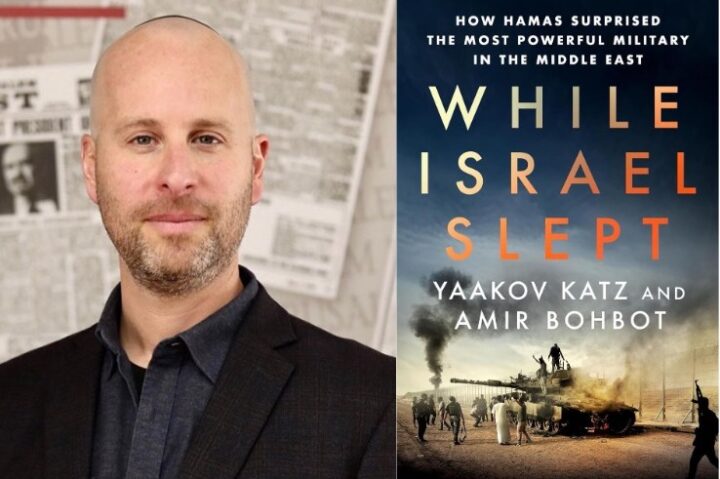
In the two years since the Oct. 7, 2023, attacks on Israel, there have been many books in multiple languages published on the topic — personal accounts, tales of heroism, a hostage memoir — but While Israel Slept: How Hamas Surprised the Most Powerful Military in the Middle East by Yaakov Katz and Amir Bohbot may be the most comprehensive.
In the book, Katz, the founder of the MEAD (Middle East-America Dialogue) and former editor-in-chief of The Jerusalem Post, and Bohbot, a veteran Israeli defense reporter, answer the biggest questions about that day, going through the events leading up to the attacks, including the fateful night before.
The book also dedicates chapters to stark warnings that an Oct. 7-style attack could happen again if Israel does not make necessary changes.
In an interview with Jewish Insider’s Lahav Harkov and Asher Fredman, the executive director of the Misgav Institute for National Security and Zionist Strategy, on the “Misgav Mideast Horizons” podcast last week, Katz said that his “deepest fear is that this could happen again.”
“Eventually, quiet will set in,” Katz said. “And I fear that Israel will fall back in love with the quiet and will neglect, to some extent, the vigilance that it will require to prevent Hamas from being able to … reconstitute itself.”
While Katz said he is skeptical Hamas could again launch attacks at the scale of Oct. 7, “to prevent them from rebuilding and reconstituting … will require a major effort that Israel has never really done.”
“Israel fought wars, we walked away and threw away the key, but we’ve never maintained the success … [except] in the West Bank, after Operation Defensive Shield in 2002. … Israel created operational freedom, and then it retained the operational freedom, so in the almost 24 years since, Israel goes in and out of the West Bank as it sees fit,” he said.
Katz noted that Israeli Prime Minister Benjamin Netanyahu has talked about creating a similar situation in Gaza.
“The proof will be in the pudding … If [the IDF] doesn’t do that and just says, ‘We’ll jot down the target, we’ll build up the target bank,’ that’s falling right back into the trap that led to Oct. 7,” he stated.
The IDF has also made structural changes to how it gathers intelligence, Katz said, and there is more coordination between intelligence bodies than before and a better flow of information to the decision-makers.
“I think there’s more vigilance today by the IDF in the way it watches the borders along Israel,” he said. “That preemptive policy, if you see just a rocket being moved or you see a bad guy driving in a car or you see a tunnel being dug — we’re now applying it very much in Lebanon … Israel continues to operate pretty freely in Lebanon. This is part of that new policy. I think that in the aftermath of however this war does end, that will be integral to keep Hamas from reconstituting itself in a way that it could pose another major strategic threat to Israel.”
While Israel Slept is meant to provide “a look at the entirety of what happened,” Katz said.
“What were the different alarm bells that we now know were sounding … in IDF headquarters and Shin Bet headquarters? What were the earlier signs that we know about?” Katz said. “How did Israel fall into a state of complacency? … How was the policy of containment created?”
Katz said both former Israeli Prime Minister Ehud Olmert and Netanyahu should have “refuse[d] to accept a reality that a genocidal terrorist group is living alongside our border.”
“If you look at the way Israel approached Hamas and approached Gaza, it was as if we’re stuck,” he said. “We don’t have an alternative … [to] this game of whack-a-mole every two years or so, where we hit them on the head.”
Israel viewed Hamas as “the bottom of the totem pole” of threats, far below Iran and Hezbollah, Katz said.
Another entrenched — and incorrect — belief in Israel’s political and military establishments was that helping Gaza economically would make Hamas less likely to attack Israel, Katz argued.
“When Naftali Bennett became prime minister in the summer of 2021, he was announcing to the whole world with great pride how he allowed in 10,000 [Gazan] workers” to Israel, said Katz, who was an advisor to Bennett from 2013-2016. “We now know that during his period as prime minister, they were preparing for this invasion and he just got lucky that it didn’t happen on his watch.”
In addition, Katz said that Israel’s general defense doctrine was not to launch preemptive wars in response to conventional military buildups, pointing to Hezbollah’s amassment of 150,000 missiles.
“That has changed,” he said. “The issue of preemption now seems like it’s setting in as the new policy for Israel, which is … the only way forward.”
Katz is also the author of Weapons Wizards, about Israel’s defense industry, and had been working on a follow-up book before Oct. 7. He now views the Israeli military’s reliance on technology as part of what allowed it to remain complacent for so long.
One such kind of technology was defensive. With the Iron Dome, Israel “was able to swat missiles out of the sky like they were mosquitoes. It made it seem like the missile threat is nothing … not a strategic threat.”
When Hamas fighters crossed into Israel via tunnels during 2014’s Operation Protective Edge, Israel sought to address that problem with technology as well, building a border fence with a deep underground element.
“They put these teams of the smartest soldiers and scientists together with sonar experts, seismic experts, geologists … They come up with a system that can detect where a tunnel is being dug, when it’s being dug. They’re so sensitive that they can tell what tool is being used to dig the tunnel: a jackhammer, a shovel, a bulldozer,” Katz said.
“How many people crossed into Israel on Oct. 7 in a tunnel? Zero.” he added. “They blew about 60 different points of entry in the border [fence] and that’s where they came in. … The technology created a false sense of security that we are impenetrable.”
Israel was also overreliant on intelligence technology, Katz said.
“There were hundreds of Hamas [terrorists] in the initial wave [into Israel on Oct. 7] and there wasn’t a single one who could call up his Israeli handler and say, ‘We’re coming,’” Katz said. “We had no agents or informants on the ground in Gaza. We thought we knew everything by listening to them, by watching them. We had neglected the basics of intelligence collection, which is human intelligence.”
Katz said the IDF and Shin Bet have invested in building up greater resources on that front since Oct. 7.
“Contrast Gaza with Lebanon, with the amazing pager attack, with what Israel did in Iran, taking out nuclear scientists and the top military leadership. You see that when Israel allocates the resources, the attention and the focus, it can do incredible things,” he said.
Katz also spoke out against the “huge distraction” of the government’s planned judicial reform that consumed the country in 2023, as well as the outsized public protests against it.
“The right will say that the left and the protesters, and especially those who were the reservists who threatened to not follow orders … weakened the military and the left, or the anti-judicial reform protesters would say the government, in its refusal to stop … and be willing to understand that dividing ourselves made us vulnerable, made us exposed. However you look at it, in the end, the responsibility is upon the government,” he said.
When Israel Slept includes several stories of senior defense officials warning the government that the deep divisions in Israel posed a security threat and Israel’s enemies would take advantage of the discord; though, Katz noted, no one specifically warned that Hamas was planning an invasion.
Katz said the weakening effect on Israel by the extremely tense political atmosphere should have been obvious to the country’s leaders: “We’re at each other’s throats. We’re ripping ourselves apart on the streets. … If we saw this division on the streets of Tehran or Damascus, would we not try to fan the flames just a bit to achieve our objectives in those countries and among our adversaries? Why would we think they would not do the same to us?”
In addition, Katz said, Hamas chose to launch its attack in October 2023 because Israel-Saudi normalization talks seemed to be coming to fruition, and because Hamas leader Yahya Sinwar believed “the alliance between Israel and the U.S. had been weakened and that the Americans under then-President [Joe] Biden would not stand with Israel. … He was wrong.”
In general, though, Katz pointed out, “they’re a genocidal terrorist group. They don’t need an excuse to want to kill us and attack us. It’s something they wake up to every single day. Terrorists like Hamas and Islamic Jihad seek our destruction.”
Hamas’ understanding of the Israeli psyche went beyond taking advantage of the divisions of early 2023, and was a part of its hostage-taking strategy.
“From day one … I could have said, ‘We’re going to win this war, because we’re going to bring down Hamas … but the hostages, we won’t get them back.’ And you would have looked at me and said ‘You’re crazy, that’s not a victory.’ And I could have said the opposite, we’ll win the war because we get the hostages back, but Hamas will remain in power, and you also would have said, legitimately, ‘What are you talking about? That’s not victory,’” Katz said.
“If there weren’t hostages, the war would have ended much earlier,” he said. “Part of this is because we the Israeli people — and I think this is something that the world does not recognize — are still very much hurting, are still very much in our trauma. And as long as the hostages remain in Gaza … the Israeli people will not be able to recover, rehabilitate and heal, and this will make this conflict, unfortunately, continue.”
The book imparts the lesson of teaching children there are consequences for taking things that don’t belong to them
Sarah L. Voisin/The Washington Post via Getty Images
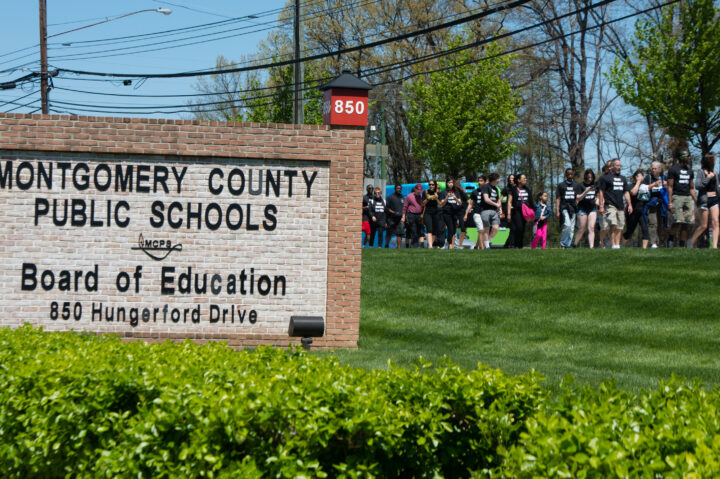
Montgomery County Public Schools building on April 27, 2014.
A book that centers on Palestinian identity is drawing controversy from some Jewish parents in the Montgomery County, Md., public school system after it was assigned to first grade students as required classroom reading, Jewish Insider has learned.
The book,“Tunjur! Tunjur! Tunjur! A Palestinian Folktale,” written by Margaret Read MacDonald, aims to convey a message to children that there are consequences for taking things that don’t belong to them. It tells the story of a woman who “prayed to Allah” for a child and received a pot as her child. The pot, too young to know right from wrong, had a tendency to steal honey from the marketplace and jewels from the king — until she got caught. As punishment, she was filled with muck. “I hope you’ve learned your lesson,” the pot’s mother tells her. “You cannot take things that do not belong to you.”
While the book does not mention Israel, local Jewish leaders and parents voiced concern that the required book’s subtext sends an anti-Israel message to elementary schoolers and that the reference to “Allah” does not belong in a public school setting.
A syllabus notes that students can receive supplemental reading materials if “any instructional material conflicts with your family’s sincerely held religious beliefs.”
The book’s lesson that “‘you cannot take things that do not belong to you’ echoes activist rhetoric that falsely casts Israel as an oppressor and the Jewish people as imperialist rather than indigenous,” Dana Stangel-Plowe, chief program officer at the North American Values Institute, a nonprofit that monitors antisemitism in K-12 schools, told JI.
“It reinforces a false narrative that erases the historic Jewish connection to Israel. It sends a troubling message to Jewish families during a time of rising antisemitism,” Stangel-Plowe told JI.
Not all Jewish communal leaders agreed that the book was problematic. Guila Franklin Siegel, chief operating officer of the Jewish Community Relations Council of Greater Washington, argued that Jewish families should embrace the book.
“If the only complaint about this book is that it’s sharing a Palestinian folktale that teaches children not to take things that don’t belong to them, I can’t see what the problem with the book is,” Franklin Siegel told JI. “It will be a shame if Jewish people wind up objecting to books only because they have protagonists who happen to be Palestinian.”
“There may well be books and materials that do misinform students about the Israeli-Palestinian conflict, and we always monitor that work,” said Franklin Siegel. “If we turn this into a back and forth where parents are requesting opt-outs for any material that they don’t see eye-to-eye with, we’ll wind up in a situation where we’re seeing a significant number of students whose parents are requesting opt-outs for things like Holocaust speakers.”
Meanwhile, Margery Smelkinson, a parent of four MCPS students, told JI that she would have preferred the district find a children’s book that teaches not to steal “without causing controversy.”
“The real problem is that MCPS chose a book that even requires an opt-out form — why not just pick another book?”
Smelkinson called on the school district to prioritize helping students get up to speed in reading, math and science instead of “creating more barriers to learning.”
“I’m concerned and curious if my child was introduced to [similar rhetoric] last year,” Diana Tung, the parent of an MCPS second grader and kindergartener, told JI. “I assume in a public school setting there’s going to be pretty diverse spiritual beliefs [but] the context of the tale itself [concerns me]. The themes should be taught using a different folktale, I’m pretty confident there are plenty.”
“Books and materials approved to be available for use in classrooms, beyond being in alignment with curriculum standards, are selected to be representative of our very diverse community,” Christopher Cram, a spokesperson for the suburban Washington school system, which is the 15th-largest school district in the country and educates a significant number of Jewish students, told JI. “Students and families expect to be able to see themselves in the materials we use.”
The school system has faced several antisemitic incidents since Hamas’ Oct. 7, 2023, terrorist attacks, leading to the school board president, Karla Silvestre, being subpoenaed to testify at a congressional hearing in May 2024. Weeks after the hearing, at least six MCPS school buildings — including three elementary schools — were vandalized with antisemitic graffiti.
The assignment of the Palestinian folktale as required reading comes two months after the Supreme Court ruled in Mahmoud v. Taylor that MCPS must allow parents to opt their children out of lessons and books that feature LGBTQ+ themes if the material conflicts with their religious beliefs.
‘Don’t Feed the Lion,’ written by Bianna Golodryga and Yonit Levi, opens a dialogue for kids and their communities on how to stand up to hate

The rise of antisemitism has dominated breaking news headlines, films and books in recent years. But two leading journalists noticed a void — a lack of resources in how to address the subject matter with young readers.
Concerned about what they observed, CNN anchor Bianna Golodryga and Yonit Levi, an anchor on Israel’s Channel 12, joined forces to write Don’t Feed the Lion, a new novel geared towards middle schoolers.
The book tells the story of three children in Chicago who experience antisemitism firsthand at school when a soccer star makes an antisemitic remark and a swastika appears on a locker. Theo, his sister Annie and their new friend Gabe each struggle with how to speak up and confront hate.
The book comes as antisemitism and anti-Israel sentiment has increasingly impacted K-12 classrooms nationwide in the aftermath of the Oct. 7, 2023, Hamas terror attacks on Israel and ensuing war in Gaza.
“We approached this project wearing three hats: as journalists who seek clarity, as Jews who feel the weight of history, and as mothers who want our children to live in a world that is kinder and more just,” Golodryga and Levi, both first time authors, told Jewish Insider in a joint statement.
“Empathy doesn’t happen in silence. We wrote this to help open dialogue between kids, parents, teachers, and communities, especially in times like these,” the veteran reporters said.
Don’t Feed the Lion, published by Arcadia Children’s Books, goes on sale Nov. 11.
All of the Senate minority leader’s events this week, to promote his new book ‘Antisemitism in America,’ were postponed because of security concerns

Drew Angerer/Getty Images
Senate Minority Leader Chuck Schumer (D-NY) speaks during a news conference at the U.S. Capitol on October 31, 2023 in Washington, DC.
A tour around Senate Minority Leader Chuck Schumer’s (D-NY) upcoming book, Antisemitism in America, has been postponed as the New York Democrat faces blowback over his recent vote to avert a government shutdown.
An event for Schumer moderated by Rep. Ritchie Torres (D-NY), slated for Tuesday night at New York’s Temple Emanu-El Streicker Center, was removed from the center’s events calendar over the weekend. A staffer for the Manhattan venue confirmed the event’s postponement to Jewish Insider on Monday morning.
A spokesperson for Schumer told Punchbowl News later Monday morning that the tour was postponed, citing security concerns.
The first event, originally scheduled for Monday night at the Enoch Pratt Free Library in Baltimore, was set to face protests organized by the far-left group Jewish Voice for Peace. An event at Washington’s Sixth and I synagogue on Wednesday was canceled Monday morning.
The postponement of the gatherings comes days after Schumer argued against forcing a government shutdown as a negotiating tool, saying it would further empower President Donald Trump and White House advisor Elon Musk.
Nine other Democrats joined Schumer in voting for a procedural cloture motion to break a filibuster of a GOP government funding bill and prevent a government shutdown. House Democrats vehemently opposed the move.
After the Senate vote, Torres criticized the Democrats who voted in favor of cloture, saying they “are making a strategic miscalculation that we as a party will live to regret.”
The event was removed from the Streicker Center’s website over the weekend. An archived version of the page saved on March 15 indicates that the event was posted through at least midday Saturday.
The event was also set to face protests from Jewish activists frustrated by Schumer’s failure to pass the Antisemitism Awareness Act in the last Congress.
Jewish Insider’s senior congressional correspondent Marc Rod contributed to this report.
“It I felt as if I was living the pages of testimony that I had spent years reading and researching for this book,” journalist and author Yardena Schwartz told JI

Courtesy
Yardena Schwartz
Journalist Yardena Schwartz had nearly finished the manuscript for her first book, focused on the 1929 Hebron pogrom in which dozens of Jews were killed and a community was destroyed, on the morning of Oct. 7, 2023.
As reports emerged in the following days of the atrocities that took place across southern Israeli communities and the Nova music festival, “it I felt as if I was living the pages of testimony that I had spent years reading and researching for this book,” Schwartz told Jewish Insider in a recent interview about her book, Ghosts of a Holy War: The 1929 Massacre in Palestine That Ignited the Arab-Israeli Conflict. “It felt like they were coming to life. I felt like it was exactly what happened in Hebron occurring today. And it was so chilling.”
Schwartz intended to write a book based on the letters and diaries written by a young Jewish American man named David Shainberg, who, inspired by his faith, moved to Hebron to study at a renowned yeshiva, when he was killed on Aug. 24, 1929. A niece of Shainberg’s found the writings in the family’s home in Tennessee, where they had been collecting dust, and reached out to author Yossi Klein Halevi, who in turn suggested Schwartz take on the challenge of giving life to the story of a young man whose life was cut short.
What Schwartz found was extensive, if scattered, documentation of the 1929 pogrom and its aftermath. There was no English-language compendium focused on the massacre that killed nearly 70 Jews and left more than 100 wounded.
“I felt that if I’m going to write the first book in English that really goes into detail about the massacre and its causes and its aftermath,” Schwartz, a former NBC News journalist, told JI, “I need to do justice to those victims by detailing in as much detail as I can what what happened to them, not only for future generations to know about it, but so that it can’t be denied.”
It was an unintentionally prescient concern that was validated last year, when denials about the extent of Hamas’ atrocities on Oct. 7 began to emerge in the days and weeks that followed. It was through that lens that Schwartz finished the final chapters of her book, which took on a new direction in the wake of last year’s attacks, to weave together the stories, separated by a century, of Jewish pain and resilience.
This interview has been edited and condensed for clarity.
Jewish Insider: You had not been planning to write a book, certainly on Hebron, and this story was just dropped on you. What was your first reaction when finding out about David and the letters?
Yardena Schwartz: So I had always dreamed of writing a book, but it always seemed like this fantasy. I had this hope in the back of my mind that something would just find me, but I never expected it would be this. I never expected it would be about Hebron, especially since I had only been to Hebron once before I was introduced to this family. I woke up on New Year’s Day in 2019 with an email from Yossi Klein Halevi, who was not yet my mentor, but would become my mentor. And it was very simple. [He said], ‘I met this family who found this box of letters in their attic. It’s a treasure trove of history, of Hebron and the massacre, and I think it would make a great book, but I can’t do it. Are you interested?’
JI: What was it like piecing together the history of Hebron?
YS: So much of the research involved going to Hebron itself and interviewing Israelis, settlers and Palestinians who live both on the Israeli side of Hebron and on the Palestinian side of Hebron. I spent hundreds of hours interviewing Palestinians and Israelis about life today in Hebron to understand, and also their stories of their families in Hebron, and then for the history part of it, hundreds of hours reading archival materials, reading books that were written by people who’d lived in Hebron at the time that David lived there, survivors of the massacre, eyewitness testimony from the massacre by survivors and victims, by British officials who testified before the Shaw Commission, which came to Palestine after the riots to investigate. I read the testimony of the British police chief who was in charge of Hebron, testimonies of people who stood before the trials that the British conducted after the riots, newspaper articles that were published in 1928 and 1929 about the lead-up to the massacre, [which] was actually a whole year of propaganda that was disseminated by the Grand Mufti, and not just propaganda, but also this campaign of trying to limit Jewish access to the Western Wall. So there was a lot of newspaper coverage of that, not just in publications like the Palestine Post, which would eventually become the Jerusalem Post, but also The New York Times, JTA, The Times of London. There was a lot of both primary source material from people who were living in Palestine at the time, and also newspaper reports from the time.
JI: What most surprised you over the course of your research and your interviews?
YS: Wow, there were so many moments in researching this book that I was just flabbergasted by how shocking some of these details were, yet so little known. First, the massacre itself, just the atrocities were so brutal and so hauntingly similar to the atrocities that were committed on Oct. 7. And yet I was shocked that such a massive event that made such an impact on the trajectory of Palestine, of Zionism, of the State of Israel, of the Jewish community in what was then Palestine — it had such a lasting impact on not just that land itself, but also the entire region, and yet we still know so little about it.
The fact that this conflict has been going on for a century, and yet so little has changed over the course of a century. One hundred years ago, when the Jews were massacred in what was then Palestine, that massacre was followed by widespread denials by Arab leaders and by the Arab populace. At the same time, the perpetrators of the massacre were celebrated as heroes, and at the same time, their attacks were blamed on their Jewish victims.
If that wasn’t mind boggling enough, after Oct. 7, I saw these same patterns emerge. When I was researching and writing about this massacre, I never once, not even once, for a second, imagined that something even remotely similar to that massacre could happen again on that scale — and that it happened again on a scale far greater than what happened in 1929 and was also being met by denials. And not just denials, but in 1929 the denials came from the Arab leadership. The victim-blaming was from the Arab leadership. And today, not only are those denials and victim-blaming coming from the Arab leaders, but from academia, from media, every respected avenue of society is denying that those atrocities were carried out, and simultaneously blaming the victims.
JI: Where were you in the book process on Oct. 7?
YS: I was pretty close to finishing the book. I was about three-quarters through, maybe two-thirds of the way. I was supposed to submit my manuscript in April of 2024, so I still had some time to finish the manuscript. After Oct. 7, I was pretty incapacitated. I would try to continue writing these chapters as I imagined them looking and I just couldn’t. It just didn’t make sense anymore. The plan I had for how these chapters would look, it just didn’t make sense anymore. The book before Oct. 7 was very much focused on Hebron itself and how it went from being this beacon of coexistence to the antithesis of peaceful coexistence that it is today, through the lens of this massacre and all the forces that it accelerated or galvanized. So when I sat down and tried to write based on that theme, the words weren’t flowing. So I took a break for a few months to go back to reporting because I had taken a long break from reporting to write this book, and I was reporting primarily on the hostage crisis and interviewing hostage family members, families who had lost loved ones and been in the kibbutzim on Oct. 7. And when I came back to writing the book, I understood that I had to just throw away entire chapters.
JI: I want to flip it, you just talked about the way that Oct. 7 influenced the book. When you wrote about the Hebron massacre, you got into the details. How did having just researched and written so deeply about the atrocities of 1929 affect how you experienced Oct. 7 and the weeks after?
YS: Of the chapters that I had finished writing, and I had considered final, the massacre chapter was the most polished. I had worked on that most. I had finished it long before Oct.7, and I was pretty far into writing the rest of the book when Oct. 7 happened. So when I woke up on Oct. 7, it was the most disorienting feeling, because I felt as if I was living the pages of testimony that I had spent years reading and researching for this book. It felt like they were coming to life. I felt like it was exactly what happened in Hebron occurring today. And it was so chilling. And I think the way that I wrote about the massacre of 1929, in this very detailed way, giving life to the people who were killed. I didn’t just mention the numbers of people killed, I really wanted to bring them to life and give them justice, give their lives justice by naming them, describing who they were before the massacre and what their lives were like before they were killed. And I think that helped inform the way I wrote about the atrocities on Oct. 7. I named the people. I went into great detail, how they experienced it, and what that day was like for them, from morning to night and both before the massacre and after, in both cases, both in 1929 and with the massacre of Oct. 7.
I did that because, in the case of 1929, when I was writing this chapter long before Oct. 7, I understood that so few people know about this massacre, including myself. And that’s because there has been so little written about it in English. In Hebrew and in Israeli culture, everybody knows about the massacre of 1929 and I think people know not just that it happened, but the scale and the brutality. And that’s because in Hebrew, there are so many books written. So I felt that if I’m going to write the first book in English that really goes into detail the massacre and its causes and its aftermath, I need to do justice to those victims by detailing in as much detail as I can what what happened to them, not only for future generations to know about it, but so that it can’t be denied. And that’s also why I sourced the book so extensively.
JI: It’s interesting that you bring up that there’s not an English-language accounting of what happened. But it seems like with your book and with Oren Kessler’s book last year, there has been kind of this renewed focus on how Israel’s pre-state years have shaped so much of what we see today. And so I wonder what other stories there are to be told.
YS: My hope is that this book, as well as Oren Kessler’s fantastic book, that this will help inform what has increasingly become this really disinformed conversation around the conflict. And I think a lot of it is because people’s attention spans are so short, and it’s very easy to just look at this conflict through the lens of what’s happening now. And if you look at what’s happening now, it’s a very simple story, there’s a right and a wrong, and when you look at just what’s happening today, it’s easy to come to conclusions, like maybe Ta-Nehisi Coates would like people to come to but you can’t erase the history of this conflict. It will never be solved either, if that history is ignored and if the context of this conflict is just brushed aside. Maybe it’ll be easier for you to make sense of it, or wrap your head around it, but it’s only going to push peace further into the distance if the true sources of this conflict are ignored, and the true sources of this conflict are very clear if you look at the history going back the last century.
JI: You had written very early on in the book, when you were talking about the propaganda that preceded the massacre, that the “truth had become irrelevant.” And as I read that sentence, I thought we could just as easily say this today.
YS: It’s the exact same playbook. And of all the things that have not changed over the last century, one very important thing has changed, and not for the better. If you look at the international media’s coverage of the riots of 1929, you see that the media was playing the role it needed to play, which was doing reporting and giving to readers a story that shows them what is the truth. That is the essential role of journalism: to get to the truth and give the truth to your readers. And today we look at the coverage of a massacre that was even larger, even worse, and yet that role is nowhere to be found. One hundred years after that massacre, we see the media not portraying these denials and victim-blaming for what they are, as lies, or these absurd claims of, for instance, the Al-Ahli Hospital, just parroting claims by terrorist organizations that are clearly false and and not portraying them as false or as lies, but giving them the same weight as truthful claims, or claims of the IDF, or of Israeli officials or of Israeli citizens. It’s all just portrayed as this, ‘He said, she said,’ rather than, ‘This is what happened.’ Why even publish these absurd claims? Because you’re giving truth to it when you publish it, and the media is leaving readers to decide what’s true and what’s false. Whereas, in 1929, 100 years ago, you think that over 100 years, the media would improve in its role — It’s only failed the true test of journalism.
I often wonder if the massacre of 1929 were to happen today, when Arab leadership put out those statements saying, ‘No atrocities were carried out in Hebron,’ the media in 1929 portrayed those denials as outright lies. The media in 1929 covered these wild claims that the atrocities were carried out by Jewish students, [but] they portrayed them as wild lies. It was very clear that these were lies, and yet today, I’d imagine that publications like The New York Times would publish those denials and victim-blaming as if they were true. And that is, I think, one of the greatest drivers of this conflict — the media’s failure to call out disinformation for what it is and to even recognize disinformation for what it is. I think a lot of journalists perpetuating these lies don’t even know their lies.
JI: In the book, when you go back to Hebron on a media tour and you’re in a meeting with the mayor, you observe that you are probably the only foreign journalist in that room who knew that he took part in the 1980 attack [in which six Jewish men, including two Americans, were killed in Hebron walking home from Shabbat services]. I’ve seen so many foreign correspondents who parachute in with no understanding about this conflict. I think it underscores the issue that we’re seeing with not just the big stuff, like the hospital, but the everyday reporting.
YS: I’m so glad you brought that up, because that’s such a great example of why knowing this history and having this contextual framework when you approach reporting on this conflict, why it’s so important. Because imagine I’m sitting in that room with this mayor who I have no idea perpetrated a deadly terror attack on civilians in 1980, the same terror attack that led the Israeli government to actually approve the renewal of the Jewish community in Hebron. And I’m sitting in this room and I hear him say, ‘The creation of this new Jewish residential building is a terrorist attack on the Palestinian people, and it will lead to the whole Palestinian population being evicted from this area,’ and I just take him at face value, I just publish what he says. But I don’t do that because I know that he actually served time for a terrorist attack. So it’s mind-boggling for him to call a building a terrorist attack. And I know that his claims of mass Palestinian evictions from this area are absolutely false, because I know that this building is being built on lands where no one lives, it’s an abandoned space. And I also know that when he tells this room full of journalists that already there’s been this mass exile of Palestinians from the Israeli side of Hebron, I know also that that’s false, because I know that the difference in the Palestinian population on that side of Hebron has decreased by maybe 1,000 over the course of 30 years, and that also, the Jewish population of that same area has remained stagnant since 1929. The people sitting in that room are just going to publish what he says without checking the facts. I don’t know if I blame journalists, because I think the reason there was this ability to discern fact from falsehood was because journalists had more time to report and to speak to people and to get the historical context into their stories. And I think today, journalists are churning out multiple stories a day. I’m not excusing their laziness or their failure to understand that you need the historical context and reporting on such an important issue like this, but I think that has a lot to do with it. There is no time, I think, for many journalists to do this historical research before publishing their stories, and so they just get lazy and report what they’re told without checking it themselves to make sure it’s accurate.
JI: What can we take from 1929 and from 2023? When you think about the Jewish future and in Israel, what lessons are there to take as you look to how the Jewish community reinvents and grows itself and rebuilds itself in the wake of such a catastrophe?
YS: Well, I think that my greatest lesson in writing this book, and I hope it’s clear to anyone who reads it, is that peace has always been possible, and I think that the only reason why we haven’t had peace for the last century is because leaders — corrupt leaders who benefit from disinformation and propaganda — have hijacked the future of Israelis and Palestinians to their own benefit and to the detriment of all of us, and too many innocent Palestinian lives and Israeli lives have suffered as a result of corrupt Arab leaders perpetuating the same propaganda and the same lies and weaponizing Islam and weaponizing Al Aqsa. I think that reversing that and ending that disinformation and that propaganda is the only way we will have peace. And I think that we see that going back to 1929, through today, moderate peace-seeking voices among the Arabs of Palestine and among Palestinians today have been silenced by intimidation or by assassination. People who are calling for peace today among Palestinians are labeled as collaborators, and if not silenced by intimidation, they’re killed. And I think that the only way we will have peace is if peace-seeking, moderate voices among Palestinians and the Arab public no longer have to fear for their lives, and those people need to be empowered, and those people need to be able to speak out without fearing for their lives. And if the people who seek peace continue to fail to see that and continue to allow Arab leaders to perpetuate the same disinformation and lies that have led to so much death, so much needless death and destruction, then we’re just going to be destined for another century of massacres. The people who are protesting against the war and for Palestinian lives, and in defense of Palestinian lives, they need to understand that Hamas and Hezbollah are only going to bring more destruction and more death and more wars, and if they really want peace, as all of us do, then it’s these peace-seeking voices within the Palestinian people who need to be elevated and empowered, not groups like Hamas and Hezbollah.
The Haaretz journalist digs into the experiences and histories of more than 100 civilians and interweaves Jewish and Israeli history as well as political analysis through the chapters

courtesy/URI BAREKET
10/7: 100 Human Stories/Lee Yaron
Just a few weeks after the Oct. 7 Hamas terror attacks in Israel, Haaretz journalist Lee Yaron began gathering testimonies from the massacres and learning the personal stories of their victims. Having been thousands of miles away on the day of the attacks, at Columbia University where the Israeli reporter was on a fellowship, Yaron seized the only tool she felt she had to help the victims — to tell their stories thoroughly and faithfully and ensure they are remembered. In her book, 10/7: 100 Human Stories, which was released in September, Yaron digs deep into the experiences and histories of more than 100 civilians — spanning the gamut of Israeli society as well as foreign victims — through interviews with survivors, the bereaved and first responders.
Interwoven through the personal stories Yaron, 30, provides Jewish and Israeli historical background as well as political analysis. “I wanted the book to be a way to understand — not just to get to know the victims — but understand Israel and the history of the conflict better,” Yaron said in an interview with Jewish Insider during which she also discussed the impact Oct.7 had on Israel’s peace camp, the reaction of the global left to the Hamas attacks and the gender aspect of Israel’s intelligence failure leading up to Oct. 7.
The following interview is lightly edited for clarity.
Jewish Insider: What made you decide to write this book?
Lee Yaron: I started very early, in the end of October, and I just felt I needed to do something. There’s not much you can do for the dead. So the thing I felt like I could do is to write, and I really wanted to tell the story of Oct. 7 from the bottom-up. I couldn’t hear the politicians anymore. You know, all of these people taking this innocent civilian’s life and just revealing and mistelling their stories. And I wanted to hear it, to learn about them first, to learn about their lives and their beliefs and their communities, and as you saw, I went really deep on the research of their families’ histories two and three generations back, because I tried to understand Israel again and the Israeli-Palestinian conflict through these victims to use their stories as a mirror for a bigger story. But it started just from, you know, we’re after Yom Kippur now, and I really felt like I wanted to ask them, “slicha” [sorry], and I wanted to do something for them, at least to make them remembered.
JI: Was there anything that shocked you that you hadn’t already known, that you hadn’t heard already in the stories already out there?
LY: There were a lot of, for example, in the Moshe Ridler story, the story of the Holocaust survivor, I knew a little bit about his story from what was published in Israeli media, but when I was doing the research, I learned about just how crazy is the story of how he survived the Holocaust and was saved by this Ukrainian family. And then afterward, it was amazing the discovery that he was deported from his home in Hertza on the very same day of Simchat Torah, when he was murdered 82 years later. When we began the interviews, the family didn’t know it. And then after two or three interviews, we stayed in touch, and they told me, ‘You wouldn’t believe it, we got a letter from another survivor that is now living in Israel, and she said she knew Moshe from this town, and she wanted us to know that the Nazis deported them on Simchat Torah.’ And they were like, ‘We don’t know if it’s true, you know, it’s like a very old lady, but check it.’ And then I went to the community’s yizkor [remembrance] books, and there are documentations from them, and I discovered it was true.
So a lot of the things were about how this day is not just part of Israeli history, but it’s part of Jewish history, and putting this day in the wider context of you know, understanding the Shahar Zemach story [the peace activist killed defending Kibbutz Beeri], and then understanding his grandmother’s story fleeing the Farhud pogrom in Iraq in Baghdad in ‘41 and this family of generations of fleeing persecution, trying to find a safe place. And how, in that matter, Oct. 7 is not just about our immediate pain and grief. It’s about the shattering of a dream of generations of Israel as a place of safety. And I think that was something that I discovered in so many stories, and a question that is still open now, when we see so many young people now leaving Israel, using the passports of their grandparents to go back to other countries, this feeling of if this place can fulfill its mission, its dream, what we were promised Zionism will be.
JI: I know you split your time between Israel and the U.S. Were you in Israel on Oct. 7?
LY: The day it happened I was doing a fellowship in Columbia University. So it started far from me. But my family lives in Ofakim. It’s one of these border towns. So from the first moments, we understood that there were 20 terrorists near their home shooting and 49 of their friends and neighbors were murdered in Ofakim. My family was luckily saved because they stayed home. It’s so important for me to share the story of Ofakim, because I feel like people outside of Israel do not always understand who were the communities that were harmed by [Oct. 7], and it’s many times very poor communities. In Ofakim, they’ve been suffering from rockets from Gaza for more than 20 years now, since 2001, and people just don’t have shelters in their homes because they can’t afford it. We in Tel Aviv, most of us have [bomb shelters] in our building, at least, but they’re so close, and so many people don’t have it. So when the sirens start [in Ofakim], people are usually running to the street and go to the public shelter for safety. And that morning, of course, they didn’t know terrorists were there, but it just made them easy targets.
JI: You mentioned you were at Columbia University. A lot has been said about the rise in antisemitism since Oct. 7 and the war in Gaza. Has that impacted you as an Israeli reporter and in your capacity there as a fellow?
LY: I think, like a lot of people on the Israeli left, I was feeling betrayed by the global left movement. … [I was] the first climate correspondent for Haaretz. I was fighting for climate justice for years, for LGBTQ rights, Black Lives Matter. I was revealing so much policies of discrimination against asylum seekers. Everything I believed was aligned with the goals of the global left. … On Oct. 7, I discovered that our lives as Jews and as Israelis are not as worthy to this movement as I thought, and as a woman as well. I understand these people wish for justice for Palestinians, and I share this will that we’ll find a way to live here altogether. But I feel like so many people are looking now for this perfect justice and wishing to change the past. And as a person who lived all my life and grew up in Israel, for me, intifada is [one of] my first memories, it’s not a chant for me, and I know that justice will always be a compromise. No one is going anywhere. Palestinians are not going anywhere. The Jews are not going anywhere. There are 2 million Palestinian Israelis that show us that we can do it and can live together. And I really, I wish this energy that we see in the campuses would go to fight together, people with people against these governments that are, I think we’re all victims, you know, of these governments that don’t care about any of us, Israelis and Palestinians, and to really seek together for a two-state solution, to demand our leaders to work for it. And, you know, so many of the victims of Oct. 7 were part of this peace community, or the people that did more than anyone for a two-state solution, donating money to families in Gaza, driving sick Palestinian kids to hospitals.
JI: What do you think Oct. 7 has done to the peace community? How do you think it looks today?
LY: I’m speaking with so many families from this community and so many of them say they feel like not only they lost their loved ones, but everything they believed in was destroyed because they chose to live near the Gaza border, because they believed in peace, and they feel foolish, many of them. We see it in the numbers. I mean, a decade ago, 60% of Israelis believed in a two-state solution. A month before the attack, it was about 50% and when you see the numbers a few weeks ago, it’s about 25 to 35% of Israelis. So we look at it now when we’re still in the midst of war, when we’re still all waiting for the hostages and in grief, people lost their faith in peace, and we need to remember that for you know, [Israeli Prime Minister Benjamin] Netanyahu’s 17 years in power, he is trying to weaken the peace community, saying we can’t solve this conflict, we can only manage it.
I come from the younger generation of Israelis that is 50% of the Israeli society, that we are 30 years old or younger, and that means that we were born with the murder of Yitzhak Rabin and the murder of the Oslo Accords. So we’ve never lived in a time of real hope for peace. It’s so important for people to understand that Israel is so young in that way, and of Palestine as well, more than half of the people are 18 years old in Gaza or younger. So we’re all people who were born to this violence. I hope that my generation will be the generation to end what the shot of [Rabin assassin] Yigal Amir finished when we were born. Rabin has his famous words in Oslo when he says, ‘I come to you as a soldier today, I came from war. I know the price of war. I come from the country where parents buried their children. And as a soldier, I say to you, enough. Enough with the tears, enough with the blood.’ Now it feels like the peace community in Israel is destroyed. It feels like Hamas helped to destroy what remained of the peace community. But as a young woman, as a person whose grandparents came to Israel after the Holocaust, after they were deported from so many places, and that’s my only home, I have to be optimistic, and I do believe that hope is action, and that my generation has the responsibility to act, especially after going through this.
JI: You picked 100 stories for your book. How did you choose them?
I had these three principles that I followed. One was to represent the diversity in Israeli society. The book is following 12 chapters of very different communities. There’s a chapter about the refugees from Ukraine, an overlooked community of people who fled the rockets of Putin on Feb. 22 only to flee, again, Hamas rockets and stories in this community; stories of the Bedouin community, part of the Arab Israeli community that’s 22% of the Israeli society. A Holocaust survivor, the kibbutzim, the poor cities on the border — very diverse because the victims were as diverse as Israeli society.
The second principle was to represent the underprivileged, or people that we didn’t hear their stories a lot, like the story of Sujud, this young woman whose baby was the youngest victim of the attack — a 10-hour-old baby girl, a Bedouin Muslim baby girl that was shot in her mother’s womb [and died 10 hours after she was born]. It’s like this unbelievable, painful story that wasn’t really told. Or the story of the bus of the elderly immigrants from the former Soviet Union, people that we don’t see every day in the news. They come from very mostly from very weak or families that are struggling to make a living. Same thing about the Ukrainians. So I tried to go deep and give respect to people we didn’t hear about.
And the third and maybe most important one was that I understood that I don’t want to tell individual stories, but to tell stories that are connected to one another. So I chose in the beginning, when I started a few stories in each community that seemed interesting to me, and I started reaching out to the families. I had very little time to write the book. … So I had a few amazing research assistants that helped me to reach the families and ask them if they want to be interviewed, to take the basic information from them for the first interviews. And then we started to, you know, some families didn’t want to speak. It was too painful for them. And the families I could go deep into interviews with were the ones that felt like that was what they could do for their children or for their family members, to at least remember them and to be the ones telling their stories. So after I had a few families in each community, I always asked them about the relationships their loved ones had with other victims or survivors. And then this way one story led me to another. And this web of connections is really the backbone of the book. I built a book around these relationships, and I think it’s important, because I feel like it represents Israel better, because we’re such a small country, these communities were very close-knit communities. And it’s not the tragedy of individuals, of a family mourning one person, it’s communities that are mourning their family, their friends, their neighbors, losing their homes. Kibbutz Beeri lost 10% of the population that was murdered or taken hostage.
JI: Your book is in some way an answer to the denialism and fake news out there surrounding Oct. 7. How did you go about verifying accounts?
LY: I spoke on every story with multiple people that were connected to one another, with governmental and the IDF and the police and getting the information they had, speaking with families and friends and going to archives, pictures, messages, so I always made sure I had enough sources to verify every piece of information.
And I think a lot of the beauty… I tried to write a book that is not only about death, but it’s about life, and it’s about really seeing these people not merely as victims but also as the people they were. So some chapters started in the ‘50s, in the ‘40s, and just you know this, getting to know their families and what they’ve been through from these family archives with, I always try to go deep on the personal story and then also research the bigger political and historical picture. And these two lines are woven together because I wanted the book to be a way to understand, not just to get to know the victims, but understand Israel and the history of the conflict better.
So, for example, there’s this story of Chaim Ben Ariyeh and a chapter about victims of grief. It’s a story that is also mostly overlooked in the international media, of people who just couldn’t bear the grief and ended their lives. There are so many cases like this in Israel today that is hard to speak about because the authorities don’t want to encourage more people to do so, and they feel like when you publish this data, it’s encouraging more people, but it’s true that so many people chose to end their lives, and one of the stories is the story of Chaim Ben Ariyeh, a man who was a settler in the Gaza Jewish settlements and was evacuated with the rest of these 21 settlements and the thousands of people who live there in 2005 in the engagement plan. And it’s a good example … the way that we get to know Chaim and the way he met his wife. You read that they are from the right wing so they’re meeting in a protest against the Oslo peace process with a bus that is taking them to their home in Gush Katif. And then we see their struggle to fight this decision in a year that looks a lot like 2023 what happened in Israel before the war, we had 39 weeks of Israelis protesting against Netanyahu, against the judicial overhaul, was very, very similar from the other side of the map, and then understanding that Chaim was post-traumatic from recognizing the bodies of his neighbors in one of the most horrible terror attacks that happened, and the Kissufim road in Gush Katif. And then we follow one of his last rides, when on Oct. 7, he is sent to save the kids of Beeri, the ones who survived and taken to the hotels in Yam Hamelach (the Dead Sea). And he is just so traumatized by the fact of what he saw and the fact that he couldn’t help them, that after two weeks, he committed suicide. So this is a story, for example, that is a lot about speaking with with his family, but also just going to the archives and finding the articles from 2004, 2005, where he’s giving interviews about how he felt after he found the Hatuel family, or going deep into the these years of the disengagement. And I’m writing in the book about people from the left wing, from the right wing, settlers, people who didn’t care about politics at all, all the Israeli spectrum. It was important for me to represent also these people and to show what the disengagement was for them, as such a critical moment to understand the present.
JI: Was your perspective at all impacted through the conversations you’ve had with the wide range of people that you interviewed?
LY: I tried to leave my perspective, out of the book as much as possible, and to. I felt like my mission was to tell the stories of the victims of this war from their perspectives … in the introductions that are a bit more political and historical where I give a bit more of how I see things.
For me personally this war and writing this book made my commitment to peace and to a two-state solution stronger. I lost a very dear friend of mine, Gal Eisenkot, who was the son of Gadi Eisenkot, who was the chief of the IDF and a minister. And the book is dedicated to Gal. His death was extremely painful, still is. We were good friends since childhood, he was a good friend of mine and my whole family. And he died on Dec. 7, two months after, exactly two months after it started. And I got the call in the middle of an interview with a mother who lost her son and daughter-in-law, and just this feeling of anger, of losing him and feeling that, you know, he died in a mission to save hostages. He was a student. He was a reserve soldier. He didn’t choose a military way like his father. He wanted to be a doctor. He treated Syrian refugees. He wanted to save people and he had so many dreams and hopes, and he was so talented and so kind. And I feel like, when you experience it personally, I feel like, you know, every family in Israel has their own Gal. We’re all and this endless shiva, one-year shiva, still mourning. And just losing him, I feel like you know nothing, nothing is worth it. I mean, of course, Israel needed to respond, of course, what happened to us was horrible, but I would do anything to bring Gal back. We lost so many young lives, and I believe that, we always say in Israel that we need to be worthy. I think being worthy is really working for the next generations not needing to experience what we’ve experienced.
JI: Is there anything else you want to mention that we haven’t discussed?
LY: I am really upset about the fact that people are ignoring the gender aspect of this war, the fact that women were the first and almost only ones to warn us that that was coming. The tatzpitaniyot [observers] sitting there on the border, reporting to their commanders that they’re seeing a suspected activity and being ignored and dismissed. And then thinking about the peace community that was led by Vivian Silver that just won, that her movement, Women Wage Peace just won this award this week. They led a huge peace march on Oct. 4, with their sister Palestinian movement, Women of the Sun, 2000 women, Israel and Palestinian marching together, speaking about their Mother’s Call. It’s a file they signed together about having more that unites us as mothers than separates us, and their call for their leadership of both sides to go back to the negotiation table. Then three days later, Vivian was murdered with three other members of Women Wage Peace and just thinking that it’s so crucial that we’ll speak about the gender aspect of this war, and that whatever leadership comes next in Israel and in Gaza, we have to have women’s voices in the decision-making process. We need to speak about it — that it’s only men making the decisions of the war and the hostages.
In a new book of essays, pro-Israel progressives tell the American left and conservative Zionists: we’re here, and we’re struggling

Courtesy
As rockets flew between Israel and Gaza last month, American Jews watched with alarm as anti-Israel rhetoric became the norm in some left-wing circles. Accusations of Israel’s alleged genocide, ethnic cleansing and apartheid spread widely, even reaching the halls of Congress.
“It’s become a very common experience for rabbis, and Jews of really any kind who lean to the left progressively, to find, at the very least, difficulties in progressive circles with the love for Israel,” said Rabbi Menachem Creditor, the Pearl and Ira Meyer Scholar-in-Residence at UJA-Federation of New York. Among people like him — American Jews who support progressive policies but also support Israel — “the language of being lonely has been getting louder.”
With Zioness founder Amanda Berman, Creditor is the editor of Fault Lines: Exploring the Complicated Place of Progressive American Jewish Zionism, a book of essays released this week. The idea behind the book was to allow members of the Jewish community to grapple, collectively, with the increasing difficulty of being a Zionist in progressive spaces. “Why should people continue to feel lonely when it’s a very obvious problem?” Creditor asked.
The book contains four dozen essays, half of which are original; the rest were reprinted from other publications or taken from speeches or sermons given by the book’s contributors over the past couple of years. Writers include rabbis, journalists, nonprofit professionals and activists; organizations represented include the American Jewish Committee, the National Council of Jewish Women and the pro-Israel LGBTQ organization A Wider Bridge, along with major Reform and Conservative congregations around the country.
The essays contend with what it means to be a Jew who supports Israel and who also supports progressive causes in the U.S., and to refute common misconceptions from people on both the political left and right. “The presumption from anti-Zionists in the progressive world is that you cannot be a good person and love Israel, and that’s just wrong,” Creditor told Jewish Insider.
The problem, he argued, is an “anti-Jewish fundamentalism at the fringes of progressive politics,” such as the recent removal of an Israeli food truck from an immigrant food festival in Philadelphia. “If it isn’t countered, it becomes the core of the progressive movement.” The response should be “to show up as loud, proud Jews,” Creditor said.
The idea to put together a volume of essays came after Creditor saw a Times of Israel blog post authored by Jeremy Burton, executive director of the Jewish Community Relations Council of Greater Boston. “The American left has embraced moral maps that, while they may provide helpful frameworks for understanding some of America’s foundational and ongoing issues, warp understanding and discourse when applied to other parts of the world,” Burton wrote, in a post published the day before Israel and Hamas agreed to a cease-fire.
“I found it to be one of the most important statements today, about how an American-left lens can get Israel wrong,” said Creditor. “It sparked my thinking that we could put together a collection relatively quickly because this is not a new question.”
Creditor has a history of progressive activism, including as founder of the Rabbis Against Gun Violence movement. But he sees himself first and foremost as a Jewish educator — so while he hopes the book might inspire progressive politicians to engage in dialogue on these topics, his desired audience is the Jewish community.
“I want to support those who are showing up with courage as Zionists in progressive spaces, for them to feel the camaraderie and community of those who are experiencing similar struggles,” said Creditor. He also wants to remind right-leaning pro-Israel advocates that progressives — including those who might criticize, but deeply love, the Jewish state — are, in fact, Zionists.
“As a Jewish community, we have to stop alienating each other when we disagree. We should not deem as anti-Zionist someone who is a progressive American voter who loves Israel. Within Israel, there’s robust debate about what building a better society looks like. That’s a healthy democracy,” Creditor explained. “The presumption that a critical voice is treasonous is itself incorrect.”
As Creditor sees it, progressive Zionists have their pro-Israel bona fides questioned by both the anti-Israel left and some in the Jewish community. “Progressive Jewish Zionists are not receiving the dignity they deserve in progressive circles, and they’re not receiving the dignity they deserve in conservative Zionist circles,” he argued. “Certain conservative Zionist circles typically judge progressive Zionists as naive or disloyal. Those are the same arguments, the same aspersions that progressive Zionists receive from progressive circles.”
Neither Creditor nor Berman define what the book means by “progressive,” but Creditor argues that this is by design. They did not want to limit participation in the project.
“I’m not quite sure what ‘progressive’ means, and there was no litmus test for the authors, because I’m not really sure how to define the word to begin with,” noted Creditor. “I just know how it generally lumps together people who favor LGBTQ equality, combat the American gun violence epidemic [and] who stand for criminal justice reform.”
Still, even though the editors did not set ideological boundaries about who could contribute, the book mostly falls within mainstream pro-Israel discourse. Numerous contributors wrote about trips to Israel with AIPAC, and one essay made the argument that progressives should attend AIPAC’s annual policy conference.
“There were no submissions rejected based on any institutional affiliation,” said Creditor. After putting out the call for submissions, Creditor and Berman did not receive any from people who affiliated with more left-wing Israel-focused organizations like J Street or IfNotNow.
The one requirement was that contributors consider themselves Zionist. “This is about how to navigate the world of progressive Zionism, not how to reject Zionism,” he noted.
In 'Revolt,' Nadav Eyal writes that the solution is a 'radical mainstream' preaching even more global cooperation

Nadav Eyal and his new book, 'Revolt.'
The Appalachian coal miner, a stand-in for the long-suffering white working class, looms large in American politics. Coal miners who lost their jobs as the U.S. moved away from using coal as a power source became a key target of Donald Trump’s “make America great again” mantra in 2016. News organizations reported on coal miners as a political class, with a typical CNN headline from a week before the 2016 election reading “Hillary Clinton might lose Ohio because she badmouthed coal.”
Now, an Israeli journalist suggests that the story of the American coal miner transcends electoral politics and is actually a powerful parable about our era of global turmoil. In Revolt: The Worldwide Uprising Against Globalization, Yediot Aharonot columnist and Channel 13 commentator Nadav Eyal argues that disillusioned coal miners in Pennsylvania are just one piece in a global puzzle of vulnerable people being crushed by globalization. The book, recently translated into English from its original Hebrew, argues that the solution is not nationalism — but a better, more cooperative globalization.
In a Zoom interview with Jewish Insider, Eyal explained why he believed he was so well-suited to predict Trump’s ascent before many American commentators and political insiders: an “outsider’s view,” he said. He leaned on that perspective in a Hebrew documentary about the former president’s rise that aired in Israel in June 2016, when his chance of winning the presidency still seemed like a longshot to many in the U.S.
It was this documentary, “Trumpland,” that led to a book deal for Eyal, but from the beginning, he decided that Trump would not be the centerpiece of his project. “The era of the revolt is too momentous, too consequential, to be defined by Trump or by the media’s addiction to him,” Eyal writes in the book’s introduction.
The English edition of Revolt, which was originally published in Hebrew in 2018, is not just a retelling of American political pundits’ conversations about the so-called “white working class.” He connects political discontentment among U.S. industrial workers to Syrian refugees fleeing to Europe and even to radical climate activists. Rather than making an argument about the recent rise of nationalist leaders like Trump or Jair Bolsonaro in Brazil, Eyal aims to focus on the people who feel they have been left behind in the global economy .
While many authoritarian leaders around the world have recently wooed their citizens with appeals to nationalism, Eyal posits that this energy could be cultivated for other ends.
“Speaking with my American friends, they want to believe that [Trump’s election was] an accident. It’s a fluke. I don’t think it is,” Eyal told JI. “I don’t want to say it’s a movement, but it’s a sentiment: Revolt. [But] it doesn’t need to go to the Trump side. It can go to positive stuff.”
The people, organizations and movements Eyal reports on in Revolt do not correspond to a specific political ideology, but rather reflect a general sentiment directed at systems and governments that people believe failed them. “What we’re seeing is a multi-layered, leaderless revolt of some sort against porous structures, which are deemed corrupt, hollow, or unrepresentative,” he explained.
The non-Hebrew editions of Revolt don’t include much reporting on Israel’s current political situation. Each version includes some local flavor: the German edition has a particular focus on the country’s neo-Nazi problem, while the Italian one has a lengthy section on COVID-19, the north of Italy having been devastated in the early days of the pandemic. The book will also be published and sold in local languages in countries including Brazil, Croatia, Spain, and the Netherlands.
The original Hebrew edition attempts to make the case to Israelis that, in the current moment, there is “only one [model] that is really successful within globalization, at least in the West, and that model is of a liberal democracy,” Eyal told JI. In his view, if Israel moves too far to the right or too far in the direction of the country’s ultra-Orthodox — in other words, if it abandons the tenets of what Eyal views as its liberal democracy — then Israel is “just going to destroy its own partnership with globalization.”
Eyal’s politics lean left, and his argument will make sense to progressives. He writes that growing the social safety net, and in turn increasing taxes, will help people like the Appalachian coal miners who are out of work and might not want to learn a new trade. But he also argues that labeling people who feel left behind by globalization as racist or backward is wrong. “It’s about not delegitimizing those people who are revolting, who feel that nothing works for them,” he said.
If the only people who lend legitimacy to those who feel left behind are radicals, then they will be drawn toward radical, authoritarian politicians. What Eyal wants to see is a “radical mainstream,” where more moderate politicians offer a solution to the very real problems of globalization, rather than “the radical sides of your party.”
The former national security advisor reflects on his time in the military and working on Middle East policy across several presidential administrations

Sgt. Mike Pryor/U.S. Army
Former National Security Advisor H.R. McMaster
In a new book looking back at his time in the military and in several presidential administrations, former national security advisor H.R. McMaster expounds on what he thought were “fundamental flaws” in the 2015 nuclear deal with Iran and why he tried to persuade President Donald Trump not to withdraw from the deal.
In Battlegrounds: The Fight to Defend the Free World, released on Tuesday, McMaster called the original JCPOA negotiated by former President Barack Obama “an extreme case of strategic narcissism based on wishful thinking” that led to “self-delusion and, ultimately the deception of the American people.”
Yet, when Trump wanted to make good on his campaign promise to leave the deal, McMaster made clear his opposition to withdrawing from the accord. In the book, McMaster explains that he wanted the U.S. to maintain leverage to punish Iran for its behavior on matters unrelated to the Iranian nuclear program and to get the parties in the agreement to fix the deal’s flaws. McMaster said he also wanted to avoid giving Tehran the opportunity to portray itself as a victim. But as he attempted to work on a comprehensive Iran strategy, McMaster wrote, Trump grew “impatient.”
McMaster details how he intervened in former Secretary of State Rex Tillerson’s efforts to certify the deal in April 2017, and how he successfully lobbied the president to recertify the agreement over the next two 90-day deadlines as required under the 2015 Iran Nuclear Agreement Review Act. “We had created a window of opportunity for our allies to demonstrate the viability of staying in the deal while imposing costs on Iran,” McMaster writes. “That window closed soon after I departed the White House.” A month after McMaster left the administration, Trump announced the U.S. withdrawal from the deal.
The former national security official accuses the Obama administration of ignoring Iran’s behavior in the region and avoiding confrontation in an effort to preserve the accord. According to McMaster, Obama officials “focused on selling the deal rather than subjecting it to scrutiny” by using a “red herring” talking point — the Iraq War — to pose “the false dilemma” of either supporting the deal or going to war with Iran.
McMaster also offers his view on the Israeli-Palestinian conflict and the Trump peace plan announced in early 2020. Trump’s moves on Israel, he writes, “communicated support for Israel, but also removed incentives that might have been crucial in a future agreement.” While he described the rollout of the peace plan as “dead on arrival” due to lack of participation from Palestinian leaders, McMaster posits that the plan itself may at some point “help resurrect the possibility of a two-state solution.”
The book itself is not a tell-all on the Trump administration. McMaster does not write about being excluded from Trump’s meeting with Israeli Prime Minister Benjamin Netanyahu during the president’s trip to Israel, or his disputes with Trump and Jared Kushner. “This is not the book that most people wanted me to write… a tell-all about my experience in the White House to confirm their opinions of Donald Trump,” McMaster writes in his preface. “Although writing such a book might be lucrative, I did not believe that it would be useful or satisfactory for most readers.”
McMaster accuses the Russians and the alt-right movement of leading a campaign against him, under the hashtag #FireMcMaster, because they viewed him as a threat to their agenda of undermining America’s national security. McMaster writes that the attacks against him were “often inconsistent” in nature. “For example, one caricature on social media portrayed me as a puppet of billionaire George Soros and the Rothschild family (both of whom were frequent targets of anti-Semitic conspiracy theories), while articles in the pseudo-media charged me and others on the NSC staff as being ‘anti-Israel’ and soft on Iran,” McMaster recalls.
In a new book, Anton warns the U.S. remains on the brink of disaster — if it doesn't reelect Trump

AP Photo/Pablo Martinez Monsivais
Michael Anton, National Security Adviser, waits in the East Room of the White House in Washington of the start of President Donald Trump's news conference, Thursday, Feb. 16, 2017.
Michael Anton, a former senior National Security Council official in the Trump administration, is “amazed” by what the administration has achieved in the president’s first term — but warns in a new book that the U.S. could careen into disaster if Donald Trump loses his reelection bid in November.
In his new book, The Stakes: America at the Point of No Return, which hit bookshelves last week, Anton argues that this situation has not fundamentally changed — America remains on the brink, and a Trump reelection is the only way to preserve the American way of life.
Although Anton served as the spokesman for Trump’s National Security Council, and left the administration just before former National Security Advisor John Bolton took office, foreign policy is not Anton’s top focus in the book.
However, he writes that the current international world order, with America at its helm, is “a voluntary alliance of neoliberal elites across nations to work together in their own interests.”
According to Anton, Trump’s foreign policy doctrine seeks to fight back against the current structure by rolling back decades of steadily expanding American foreign policy, which dictated that America needed to maintain a presence in every corner of the world.
Trump’s foreign policy has a more narrow focus, centered on defending national security, maintaining America’s economic and trading competitiveness, and maintaining America’s alliance structure, Anton continued.
“It’s a more focused doctrine than what Trumpism replaced. It’s seeing American interest through a more narrow lens,” he told Jewish Insider. “Once you define everything as a priority, nothing is a priority. Once you define everything as an interest, it means nothing is an interest.”
Anton explained that the Trump administration’s approach to the U.S.-Israel relationship fits within such a mold in part because of Israel’s critical position in the U.S.’s security strategy.
“But so many foreign relationships can’t be reduced to dollars and cents,” he added. “America has allies out of shared conviction and shared interests… Some of these alliances that you have are simply because of a natural affinity to democracies that share common values, and so on and so forth, and relationships built up over decades. And you don’t necessarily ask the question, ‘Hey, what am I getting out of this today?’ It’s not a calculation at every step of the way in foreign policy.”
Anton characterized the recent normalization of relations between Israel and the United Arab Emirates as one of a litany of major Trump administration foreign policy accomplishments.
He declined to say whether this move was in the works during his tenure in the White House, but indicated that it fits within the Trump administration’s broader Middle East strategy.
“We knew going in that a big part of Middle East diplomacy would have to be as much normalization as possible between Israel and other states,” Anton said. “We knew also that some of that normalization would take place below the radar. It wouldn’t be formal or it would take a while for it to become formal. But we certainly were seeking to achieve as much formal normalization as possible.”
Anton also boasted that the Trump administration had helped improve the Israeli-Saudi relationship.
“The fact that relations get better and a lot of quiet and not particularly visible cooperation takes place is also an accomplishment, even if you don’t see it and even if there’s no moment where people sit down and shake hands and sign something,” he said, adding that the Trump administration sees improving relationships between Israel and Arab states as a critical step in facilitating an Israeli-Palestinian peace process.
Anton acknowledged that the Trump administration’s peace proposal is not, and cannot be, a final peace deal, but laid blame on the Palestinians for the lack of progress — criticizing Palestinian leaders for walking away from the negotiating table after the U.S. moved its embassy from Tel Aviv to Jerusalem.
“What I had hoped for at the time was that it was a demonstration of displeasure… that would last a finite amount of time… and then the Palestinians would come back knowing that that recognition really didn’t change anything,” he said. “I don’t think that they’re helping themselves by staying away and not talking. I don’t see what that gains them.”
Anton said he does not believe there is anything specific the U.S. can do to incentivize the Palestinians to return to the table, but it can push Arab states to encourage the Palestinians to reengage in negotiations.
In a second term, Anton predicted that Trump would continue to work toward a Middle East peace deal — although he acknowledged that is contingent on the Palestinians returning to the negotiating table. Anton also suggested that the administration would continue to pursue talks with North Korea and focus on the U.S.-China relationship.
Anton’s broader argument in The Stakes — that America is on the brink — echoes his 2016 essay, “The Flight 93 Election,” which made waves in political and media spheres. In it, he argued that a Hillary Clinton victory would, essentially, mark the end of America as it has existed, and that a Trump victory was the only possibility to stave off a calamity.
Anton said that, despite four years of a Trump presidency, the U.S. remains in a precipitous situation because of the influence of the federal bureaucracy and other institutional powers like the media, academia and the corporate world. “Every other power center in the country is held by people who oppose the president’s agenda,” he said
And America will find itself on the brink of disaster every four years, Anton continued, “until and unless we can get back to something like a real politics of give and take in this country.”
Britain’s preeminent Jewish thinker releases a new book on restoring common values in an increasingly fragmented society

Kirsty Wigglesworth/AP
Rabbi Lord Jonathan Sacks speaks at a press conference in 2016.
Philosopher, writer, spiritual leader… soothsayer? Rabbi Lord Jonathan Sacks has filled many roles, but even he could not predict the timeliness of his latest book Morality: Restoring the Common Good in Divided Times.
“A free society is a moral achievement,” Sacks, formerly the chief rabbi of the United Hebrew Congregations of Great Britain, opens. “Over the past fifty years in the West this truth has been forgotten, ignored, or denied. That is why today liberal democracy is at risk.”
The last portion requires little further elaboration. Any casual glance at the current state of the Western world reveals the fragmentation of a society in an era of rising tensions. But rather than dwell only on describing the existence of these problems — as many recent authors have done — Sacks follows their historical and philosophical origins to understand how what he calls the “moral achievement” of creating a liberal society could become forgotten.
The book, which is released today for American audiences by Basic Book, examines what Sacks terms the “I” of self-interest and the “we” of shared values and responsibility, ultimately providing a pathway for moving from the former to the latter.
In doing so, Sacks provides as good an argument as any for moving forward productively and conscientiously.
Sacks — who studied philosophy at Oxford and Cambridge, including under the late Roger Scruton — mixes sociology, history, philosophy and theology, all the while writing with a perceptive clarity and underlying warmth that explains his status as one of the foremost Jewish thinkers of today.
Building his argument from the ground up, Sacks starts with the roots of free society in examining the political philosophies that not only informed the creation of modern democracy, but also developed the idea of individuality and personal liberties.
In his chapter “Democracy in Danger,” Sacks contrasts the two most influential definitions of the social contract that defines liberal democracy: Rousseau’s definition of rights as rendered by individuals against the state versus Locke and Hobbes’ definition of rights as a mutual protection from the state. He warns that a growing Anglo-American preference for the former belies the importance of shared responsibility in a democracy, writing that if communities “stop believing in the existence of a significant arena of individual responsibility, we will lose the sense of common morality that finds its natural home in families and communities.”
Sacks further connects this thread to Anglo-American society’s growing sense of separation and loneliness, joining a long list of thinkers — including Jonathan Haidt and Steven Pinker — in citing the twin processes of social media use and identity politics as driving factors in an epidemic of isolation and fragmentation that has increasingly transformed Western politics.
In an interview with Jewish Insider, Sacks cited the multiculturalism that began in the 1970s and more recent identity politics each as a wave that “fragments and destroys the idea of an overarching culture that turns disconnected individuals and communities into a cohesive society.”
While he reserves no criticism, Sacks treats these movements and their disciples with evident care, describing them as unfortunate products of postmodernism rather than simply the work of ill-intentioned radicals seeking disruption.
“The first country to introduce multiculturalism, and the first to regret it, was the Netherlands.” Sacks writes in his chapter on identity politics. “When asked why they were against it, the Dutch people interviewed said: because they were in favor of tolerance. When asked for their explanation of the difference between the two, they tended to reply that tolerance means ignoring differences; multiculturalism means making an issue of them at every stage.”
In most Western countries, that heightened focus on identity has coalesced into nationalism, the return of which has become especially apparent across Europe. As history shows, the products of such movements ultimately target the foundations of liberal democracy, while including a rise in antisemitism and other forms of hatred.
The way forward, Sacks argues, requires an acceptance of difference alongside a shared cause, more commonly and aptly called patriotism.
In conversation with JI, Sacks cited George Orwell’s differentiation of the two in his 1945 essay “Notes on Nationalism,” during which the English novelist wrote, “The abiding purpose of every nationalist is to secure more power and more prestige, not for himself but for the nation or other unit in which he has chosen to sink his own individuality.”
Patriotism, Sacks argues, is the best means to turn from “I’ to “we.” Inserting a shared commitment and shared values without erasing individuality or identity. Throughout his book, Sacks also refers to this commitment as a “covenant,” a permanent and powerful collaboration that turns individual “I”s seeking personal good into “we”s seeking common good.
Yet many of the examples of success that Sacks cites from the 19th and 20th centuries were precipitated by violence, including the Civil War and World War II.
Jonathan Sacks readily acknowledged this pitfall. “Violence is always a sign of political failure,” he said.”I would hope that wise political leadership will lean in to people suffering early enough to avoid the need for violence”
In his epilogue, Sacks touches on this subject, contrasting the different responses to World War I — which saw few changes and ultimately led to more chaos — and World War II — which saw a reformation of institutions and a commitment to shared values.
The latter saw a development of national narratives that inculcated a common morality and sense of commitment.
Now, 75 year later, these narratives are depleted. “Britain, like America, has recently become sort of ashamed of its national narrative,” Sacks remarked, noting that he has spent time working alongside numerous prime ministers in an effort to resurrect a respectable replacement. He cited the popular Broadway musical “Hamilton” as an important example of renewing old values by “[retelling] the national narrative in a thrilling way.”
But broader than hit musicals, Sacks argued that the most effective and immediate move towards reinstating a shared commitment lies in requiring mandatory national military service.
Citing Israel — which he called one of the best examples of a current Western-style democracy with a “we” culture — described national service as “the most sensible socially and financially way of engaging that generation and getting them to feel that this was something other than a black period in their lives.”
But Jonathan Sacks wisely advised that no quick fix exists.
“You don’t expect quick victories. When it comes to changing the mood, we expect to win a few cycles,” he said. “And then they generate disciples and before you know it, the world has changed. But it changes in very small steps at the beginning.”
The New York Times columnist says she is worried Jews in the United States could one day consider fleeing over antisemitism
Sam Bloom
New York Times editor Bari Weiss was gearing up to write a book about censorship and the policing of free speech in the 21st century. Then a gunman opened fire at a synagogue in Pittsburgh in October 2018, killing 11 Jewish worshippers.
Weiss, a native of Pittsburgh, had celebrated her bat mitzvah at the Tree of Life synagogue. The scourge of deadly antisemitic violence had hit closer to home than she ever thought possible. And that attack and its aftermath made it clear to Weiss that the book she really needed to be writing in this moment was How to Fight Anti-Semitism, which will be published tomorrow.
“Antisemitism is something that I had been following closely my whole life,” Weiss told Jewish Insider in a recent interview. “But it had sort of remained mostly something that was happening to other people in other places.”
The deadly shooting changed that view, and deeply affected Weiss. She opens her book in a very personal way, detailing her reactions and experiences in Pittsburgh in the days after the attack. It is hard not to hear despair, anger and fear in her opening words, after not just one but two deadly synagogue shootings in the span of six months.
“It was clear after the Poway attack [in April] that Jews — never mind everyone else living in a divided nation awash in weapons owned by people who could radicalize themselves in front of computer screens — had reason to be afraid in America,” Weiss wrote.
But by the book’s conclusion, Weiss sounds a much more optimistic note, championing a defiant, joyous Judaism that refuses to back down, and an unapologetic love for the State of Israel, flaws and all. The book’s final chapter exhorts Jews to “practice a Judaism of affirmation, not a Judaism of defensiveness” as a way to combat the dark forces of antisemitism, and to not being afraid to call out antisemitic sentiments from any part of the spectrum.
“My intent with the book was always for it to have a really energizing, positive message for people,” she said. “I think Jewish history teaches us nothing other than that.” And in the book’s opening, she said, “I really tried hard to take myself back to that morning [after the Pittsburgh shooting], and tried to help the reader go there with me.”
In just 200 pages, Weiss lays out a brief history of anti-Jewish bigotry, her classification of the three categories of antisemitism — from the right, the left and radical Islam — and her proposals for how Jews around the world can fight the ancient hatred.

While Weiss had always known about and studied antisemitism around the world, she was shocked when it reared its ugly head in the United States. Could Jews in the U.S. one day contemplate emigrating — the way many French and British Jews have in recent years?
“I wouldn’t have written this book if I didn’t think that was in some ways a possibility,” she told JI. “Does it worry me right now that if you are a man walking around Crown Heights with a kippa and tzitzit out, that you might be physically assaulted? That to me is a pretty wild state of affairs, and one that has been largely overlooked in the past.”
The New York Times columnist pulls no punches in calling out the insidious antisemitism on both the right and the left of the political spectrum, including that emanating from the White House.
“In the nearly three years he has been in office, Donald Trump has trashed — gleefully and shamelessly — the unwritten rules of our society that have kept American Jews and, therefore, America safe,” she writes. “He has, at every opportunity, turned the temperature up rather than down. And he has genuinely appeared to have relished his role as the fomenter of chaos and conflict.”
But Weiss still opines in her book that “anti-Semitism that originates on the political left is more insidious and perhaps more existentially dangerous… calling out politicians like Steve King is easy. Calling out Ilhan Omar is not. That is because Omar is herself targeted by racists and lunatics who wish her harm because of her faith, her gender, or the color of her skin.” She makes it clear that “two things can be true at once: Ilhan Omar can espouse bigoted ideas. And Ilhan Omar can herself be the hate object of bigots, including the president of the United States.”
While Weiss doesn’t believe she is entirely alone in calling out antisemitism across the political spectrum, she said it can be disheartening to watch people let one or the other slide.
“There are lots of people who are loath to look at the ugliness on their own side,” she told JI. “The reality is that 75% of Jewish Americans vote for Democrats. We live in blue states… what does it mean when the place we thought was our natural home starts to look less and less hospitable?”
Weiss has penned a book that is both personal and academic, and one that she hopes will appeal to Jews and non-Jews alike.
“I want people to have the sense that they’re listening into the conversations that our community has around our Shabbat dinner table,” she said. While she notes the core appeal of the book is to the Jewish community, “I think that anyone who knows anything about history understands that a society where antisemitism thrives is a society that is dead or dying. And there are lots of signs that America in its current state is in a sort of spiraling period.”
Dennis Ross and David Makovsky’s new book claims that past Israeli leaders have made brave moves, but Netanyahu prioritizes political considerations

Washington Institute
David Makovsky and Dennis Ross.
Former U.S. negotiators and veteran diplomats David Makovsky and Dennis Ross are out with a new book this week. During an in-depth conversation with Jewish Insider, the pair discussed their latest work titled Be Strong and of Good Courage: How Israel’s Most Important Leaders Shaped Its Destiny.
Makovsky and Ross focus on four Israeli prime ministers — David Ben-Gurion, Menachem Begin, Yitzchak Rabin and Ariel Sharon — who, the book says, “met the bar of history” by making courageous decisions that shaped the present and future of Israel.
Ross told JI that they decided to write the book out of a concern that Israel is on a path towards “one state for two peoples,” due to indecision by the Israeli government. “Historically, there have been Israeli leaders who always rose to the occasion and understood that when you face big stakes, you have to make a choice; realize that while there’s always a cost in making a decision, there’s also at times even a higher cost from not making a decision,” Ross said.
Another objective of the book, the authors wrote, was to provide U.S. leaders with ideas that would “make it easier for an Israeli prime minister, whoever it might be, to make a decision” by providing them “political tailwind” to convince the settler community to support an initiative that is of strategic value to Israel’s security.
According to Makovsky, the focus on Ben-Gurion, Begin, Rabin and Sharon was intended to highlight the successes of those leaders. While previous prime ministers — such as Ehud Barak and Ehud Olmert — also made far-reaching offers to move towards peace with the Palestinians, “for whatever reason there wasn’t a breakthrough,” he asserted.
“We thought it’s important for the public to understand that there are people who rose to extraordinary challenges and were successful’’ because they chose to deal with the issue and not kick the can down the road. “They were making a decision that was going to produce either high costs or a terrible political blowback and they were prepared to take that on anyway.”
Makovsky stressed that he and Ross wrote the book as “two centrists. There’s no discourse of polarization, no name-calling of anybody. We’re trying to drive some inspiration from the past in facing the challenges of the future. And, maybe, this book defies political gravity in Washington.”
The former journalist and diplomat said they are “trying to address an issue that is hyper-politicized in a very dispassionate way — because we don’t think that this issue was solved in the end zones of the political spectrum. We think we need to galvanize a consensus in the middle and we think the way to look at it is not to bash people over the head on either side of the parties — in this country or in Israel — but to look at the leaders who actually made a difference.”
Ross warned that Israel is approaching a tipping point at which the option of a two-state solution will no longer be viable. “We make the case that there is no two-state outcome anytime soon. I mean, if you ask me, we are talking 10 to 20 years at a minimum,” he said. “But it’s that tipping point that you have passed where you lose the ability to separate Israelis from the Palestinians, then your only outcome is one state.”
Both Ross and Makovsky agree that Israeli Prime Minister Benjamin Netanyahu’s lack of decision on this issue is driven by political convenience, not ideology or stubbornness. Makovsky is bothered that Netanyahu never made an effort to prepare his base for compromise.
“It is disappointing that someone who’s clearly very bright and is very capable — he’s certainly not shy in shaping the public’s response on Iran — when it comes to political survival, he is always focused on survival rather than changing the public’s attitude on this issue,” he said. “And I think that sets him apart from these other four leaders. These other four leaders found not just that they had to take a right course, but they had to explain it. They did not sugarcoat the problem, because they were problem-solvers. I think that when Netanyahu’s intellectual conclusions clash with his political imperatives, he tends to go with the political imperative.”
Ross echoed the last chapter of the book with regards to Netanyahu: “You don’t become prime minister unless you have political smarts and capability and insight. You certainly don’t become Israel’s longest-serving prime minister, as Netanyahu has, unless you also have an enormous amount of talent,” the former Mideast envoy said. “What we describe him as is someone that — when it comes to dealing with the Arabs, managing what was the Arab awakening, looking at the nature of the Iranian threat — he has been strategic in character and in policy. When it comes to dealing with the Palestinians, we describe him as being political, always trying to find a way to manage his political base even as he’s also trying to manage what he sees as pressures from the outside.”
Turning to the upcoming Israeli repeat election, Ross expressed concern that the Israeli-Palestinian issue is not even discussed as something that has a longterm effect on the Jewish and democratic future of Israel.
“I would love to see a discussion in the Israeli election on separation,” he said. “My guess is, if that actually was the discussion, you’d find most Israelis say, ‘yeah, we think we should separate from the Palestinians.’ The problem is that there isn’t a policy today that reflects that.”
Please log in if you already have a subscription, or subscribe to access the latest updates.
 Continue with Google
 Continue with Apple