

































































Plus, Heritage hires senior Gabbard aide

(Chitose Suzuki/The Dallas Morning News via Getty Images)
Voters walk to the polling location at Northway Christian Church during the first day of early voting for the Nov. 3 midterm elections, Monday, Oct. 19, 2026 in Dallas.


 Add JewishInsider on Google
Good Wednesday morning.
In today’s Daily Kickoff, we talk to experts about the possibility of renewed war with Iran before the upcoming Israeli and U.S. elections, report on the Heritage Foundation’s hiring of a critic of U.S. involvement in the Middle East and aide to former DNI Tulsi Gabbard, and cover a debate between former Israeli Ambassador to the U.S. Michael Oren and the Foundation for Defense of Democracies’ Jonathan Schanzer over U.S. aid for Israel. Also in today’s Daily Kickoff: Douglas Keith, Joel Kaplan and Lana Nusseibeh.
Today’s Daily Kickoff was curated by JI Executive Editor Melissa Weiss, with assists from Tamara Zieve and Danielle Cohen-Kanik.
Today’s Agenda
Talks between Israeli and Lebanese officials at CENTCOM’s Tampa, Fla., headquarters are underway as the parties attempt to get closer to an agreement on the disarmament of Hezbollah.
Michigan Senate candidates Mike Rogers and Abdul El-Sayed are slated to participate in a debate tonight hosted by Detroit’s WXYZ-TV.
Robert Kraft’s Blue Square Alliance Against Hate is holding its inaugural benefit tonight in New York City, where the group will honor Bank of America CEO Brian Moynihan.
A review commissioned by the British government and set to be delivered to Parliament today will call for schools and colleges to treat antisemitism as a distinct category of harm, dedicated teacher training on antisemitism, more consistent recording of incidents and better education about antisemitism and modern Jewish life, among its 27 recommendations that are all expected to be accepted.
In Israel, voting is underway at military polling stations around the country ahead of Election Day next week.
One Thing To Know
Analysis

The battle for the Senate majority is going down to the wire, and the outcome will be determined by two major questions.
How successful will Democrats be in picking off GOP-held seats in deeply red states, including several (such as Kansas and Texas), which haven’t elected a Democrat in a Senate race in decades?
And will Republicans be able to score a surprise in Maine, Michigan or Minnesota, where left-wing Democratic nominees are badly underperforming but are being bolstered by the very favorable national Democratic environment?
The Big Reads
WAR WORRIES
Escalating threats between Washington, Jerusalem and Tehran seem to have raised the prospect of another military confrontation with Iran — an October surprise that could reshape Israel’s political landscape, as the country is set to head to the polls next week, and complicate President Donald Trump’s political calculations ahead of the midterm elections in November. Yet former Trump administration officials suggest that renewed hostilities are unlikely ahead of the upcoming U.S. and Israeli elections, Jewish Insider’s Matthew Shea and Lahav Harkov report. “While President Trump has always used the perception of his unpredictability to advance American interests, the reality of the President’s successful economic strategy against Iran lends itself toward a delay in further kinetic operations,” said Alexander Gray, who served as National Security Council chief of staff during Trump’s first administration.
Regional responsibility: U.S. Ambassador to Turkey Tom Barrack said Tuesday at the Global Security Forum in Doha, Qatar, that it is “not America’s job” to resolve the threats posed by Iranian-backed terror groups and militias across the Middle East, arguing that regional governments must take greater responsibility for their own security rather than relying on U.S. military intervention, JI’s Matthew Shea reports.
AID ARGUMENTS
Former Israeli Ambassador to the U.S. Michael Oren and Foundation for Defense of Democracies Executive Director Jonathan Schanzer squared off Monday evening in New York over whether Israel would be better off weaning itself from U.S. military aid, Jewish Insider’s Matthew Shea reports. Oren argued that Jerusalem should shift toward a strategic partnership before political winds in Washington dictate more unfavorable terms, while Schanzer warned that abandoning the arrangement mid-war could leave Israel exposed. Audience members were unswayed by either argument: Polled before and after the debate, 39% still agreed that Israel would be better off without American aid, while 61% disagreed. The discussion, part of the 92nd Street Y’s Sapir Debates series, was moderated by Bret Stephens, editor-in-chief of Sapir and a New York Times columnist.
COMINGS AND GOINGS
The Heritage Foundation announced the hiring of Will Ruger, a critic of U.S. military engagement who served as a key deputy to former Director of National Intelligence Tulsi Gabbard, as a distinguished fellow, Jewish Insider’s Emily Jacobs reports. The conservative think tank announced on Monday that Ruger’s new role “will contribute to policy work, bringing the perspective of a scholar-practitioner” to the Heritage team. Ruger defended Israel’s war in Gaza as “justified” given Hamas’ Oct. 7, 2023, attacks but was also a vocal opponent of both the maximum pressure sanctions campaign against Iran and potential U.S. military operations against the regime.
The Rundown
campaign calculus
mail fail
sunshine state retreat
cancel calls
student safety
On Our Radar
● The Live Briefing. Word on the street, clips, podcasts and quick updates — the items we’re tracking all day in our Live Briefing on the app (on Apple and Android) and website.
The Financial Times reports that former Emirati Ambassador to the U.N. Lana Nusseibeh, who now serves as a minister of state at the UAE’s foreign ministry, is emerging as a potential candidate to succeed U.N. Secretary-General António Guterres when his term concludes at the end of this year, amid deadlock among U.N. Security Council permanent members — who hold veto power over secretary-general candidates…
Israeli Prime Minister Benjamin Netanyahu had reportedly instructed the military to prepare for an Israeli strike on Iranian civilian infrastructure, nuclear facilities and military sites earlier this month; the attack did not move forward amid President Donald Trump’s opposition to renewed strikes on Iran prior to the Nov. 3 midterms…
Former New York City Mayor Michael Bloomberg is donating approximately $80 million to help Democratic candidates around the country in the midterm elections, including $50 million for House races to ensure Democrats have a sizable majority; Bloomberg’s team said he is not directing money toward candidates aligned with the Democratic Socialists of America…
New York City Mayor Zohran Mamdani appointed Douglas Keith to oversee the Mayor’s Advisory Committee on the Judiciary, months after the mayor’s office faced criticism over the absence of any Jewish members of the 19-person committee…
Anti-Defamation League CEO Jonathan Greenblatt, speaking at the National Hispanic Christian Leadership Conference’s leadership summit on Tuesday, announced an expansion of the two groups’ partnership, including working together on federal buffer zone legislation, a bilingual Sunday school curriculum and new connections between churches and synagogues…
A New York man charged with manslaughter in the death of a Jewish pedestrian in Queens in May was indicted this week on hate crime charges tied to two incidents of vandalism at a local kosher bagel shop in the days before the hit-and-run accident that killed Cara Trager…
Counterterrorism officials in the U.K. rearrested two men on suspicion of working with Iran’s intelligence service; the men had previously been arrested in connection with a security incident near RAF Fairford last month and released on bail…
Germany’s Foreign Ministry summoned Iran’s envoy in Berlin after two men were convicted of spying on behalf of Tehran and plotting terror attacks on the head of the interfaith German-Israeli Society as well as a prominent Jewish leader in the country…
Mohsen Rezaei, the head of Iran’s Supreme National Security Council, ruled out the possibility of Tehran allowing its enriched nuclear material to be moved out of the country; Rezaei made the comments while meeting with Pakistani Army Chief Asim Munir…
Egyptian President Abdel Fattah El-Sisi is advancing efforts to send troops to Saudi Arabia to assist Riyadh as it fends off attacks from the Iran-backed Houthis in Yemen…
Meanwhile, the U.K. said it would send fighter jets to Saudi Arabia to defend against Houthi attacks…
Meta Chief Global Affairs Officer Joel Kaplan, who served as Meta’s conduit to conservatives, is departing the company after 15 years; Kaplan’s departure comes as Meta has begun donating to Democrats ahead of the midterms and 2028 presidential election…
Haitian-Jewish businessman Gilbert Bigio, the country’s first billionaire who also courted controversy over his ties to criminal gangs, died at 91…
Worthy Reads
Find more Worthy Reads in our Live Briefing via our app (on Apple and Android) and website.
Black Market Bust: In The Wall Street Journal, the Foundation for Defense of Democracies’ Miad Maleki, who served as a senior sanctions official at the Treasury Department until last year, considers how the U.S. can strategically counter Iran’s “shadow fleet” that illicitly transports oil out of the Islamic Republic. “In eight years at the Treasury’s Office of Foreign Assets Control, I learned that offering owners an exit can help enforce sanctions. We delisted ships and companies on a case-by-case basis when they changed hands. But we didn’t have a blockade that made the fleet’s Iranian business worthless. That lever exists now. … Washington should scale up this model and start recruiting buyers for the fleet: U.S.-aligned operators that would put these hulls to work on the Hormuz run.” [WSJ]
A House Divided: The Atlantic’s Vivian Salama and Ashley Parker look at how Donald Trump Jr.’s break with his father over the Iran war underscores tensions within the Republican Party and MAGA movement surrounding the issue. “The White House’s decision to ally with Israel against Tehran has exposed a deepening rift within MAGA — not just over Iran, but also over what ‘America First’ actually means. The divide pits nationalists who see foreign wars as a betrayal of domestic priorities against hawks who argue that American power must be wielded more aggressively against its adversaries. … ‘Don Jr. is the most MAGA of them all,’ one of the people who spoke with him about his opposition to the Iran war told us.” [TheAtlantic]
Picture of the Day

Israeli President Isaac Herzog (left) met on Tuesday in Budapest with Hungarian Prime Minister Péter Magyar. The trip is Herzog’s first to Hungary since Magyar, who during the meeting pledged to visit Israel, was elected earlier this year. Amos Ben-Gershom/GPO
Birthdays

Albert Bourla, chairman and CEO of Pfizer, he was born and raised in a Sephardic family in Thessaloniki, Greece, turns 65
Judith Sheindlin, Emmy Award-winning reality courtroom personality known as “Judge Judy,” turns 84
Larry Kane, news anchor who worked for 36 years in Philadelphia and author of three books on the Beatles, turns 84
Shaye Cohen, professor emeritus of Hebrew literature and philosophy at Harvard University, turns 78
Terri Smooke, commissioner of the Architectural and Design Review Commission of Beverly Hills
Benjamin Netanyahu, prime minister of Israel, turns 77
Amy Ephron, novelist, screenwriter, journalist and film producer, turns 74
Nieca Goldberg, cardiologist and clinical associate professor of medicine at NYU Grossman School of Medicine, turns 69
Brian Rosman, legislative analyst at InstaTrac, a leading Massachusetts legislative tracking and information service
Ari Bergmann, managing principal and chief investment officer at Penso Advisors, turns 65
Mitch Davis, Austin-based commercial insurance consultant
David L. Bernstein, founder and CEO of the North American Values Institute, formerly known as the Jewish Institute for Liberal Values, turns 60
Marci Klein, Emmy Award-winning television producer best known for her work on “Saturday Night Live” and “30 Rock,” turns 59
Ethan Daniel Davidson, folk and folk-rock musician, he serves as the treasurer of The William Davidson Foundation (founded by his father), turns 57
Dafna Linzer, former editorial director at U.S. News & World Report, now advisor to the CEO, turns 56
Ted Budd, U.S. senator (R-NC) since 2023, turns 55
Lera Auerbach, classical composer, conductor and pianist, she is a graduate of Juilliard, turns 53
Alison Barkoff, associate professor at The George Washington University
Kate Gallego, mayor of Phoenix, Ariz., turns 45
Ninet Tayeb, Israeli musician, model and actor, turns 43
Yael Applebaum, occupational therapist
Joshua Sayles, VP of external affairs at the Greater Miami Jewish Federation
Hari Nef, actor, model and writer, turns 34
Dan Hazony, consultant for nonprofits after stints at the Orthodox Union and then Aish Global
Eliana Rudee, manager of marketing and communications at the Union for Reform Judaism
Shimmy Jesin, internal medicine resident at Maimonides Hospital in NYC
Murphy, Qatar’s ‘reliable ally’ in the Senate, huddles with emir and chief Qatari negotiator in Doha
The Connecticut Democrat, who has called Qatar the ‘best partner’ in the Gulf, was lauded by a top Qatari diplomat for ‘consistently supporting closer U.S.-Qatar ties’

Jemal Countess/Getty Images for Fair Share America
Sen. Chris Murphy (D-CT) speaks at the U.S. Capitol on April 10, 2025 in Washington, DC.
Sen. Chris Murphy (D-CT), one of the most vocal opponents of the war with Iran, met with Qatari Emir Sheikh Tamim bin Hamad Al Thani and other senior officials in Doha over the weekend, days after Doha-brokered talks between the U.S. and Iran again hit an impasse.
After arriving in Doha on Saturday, Murphy said he was in the region “to view war damage, talk to our partners about the impact of the war, and meet with those who are working to end the conflict,” and claimed he was the “first Democrat to be in the region since the war began.” (Rep. Josh Gottheimer [D-NJ], who traveled in June to the United Arab Emirates, where he met with top officials, and then to Lebanon last week with Rep. Darin LaHood [R-IL], was the first.)
A readout from Al Thani’s office said that during his meeting with Murphy on Sunday, the two “exchanged views on a number of issues of mutual interest, particularly the developments in the region.”
Hamad Al Muftah, Qatar’s deputy chief of mission in Washington, on Sunday praised Murphy as “an honest and a reliable ally of Qatar, consistently supporting closer U.S.–Qatar ties and greater cooperation on shared strategic interests.”
Murphy also met with Ali Al Thawadi, a minister in the Prime Minister’s Office for Strategic Affairs who has served as a negotiator during talks with Hamas and Iran and holds a position as Doha’s representative to the Gaza Executive Board. Israeli Prime Minister Benjamin Netanyahu reportedly met with Al Thawadi at the White House last year, shortly after an Israeli attack targeting Hamas officials in Doha, where The Telegraph reported he played a key role in securing an apology from Netanyahu to Qatar’s leadership.
Al Thawadi, who also served as chief of staff to the brother of the Qatari emir, also factored into the U.S. government’s corruption case against former Sen. Bob Menendez (D-NJ), facilitating the transfer of Formula 1 tickets to the son of Menendez’s wife.
Israeli media reported last month that Al Thawadi met with Michael Eisenberg, an advisor to Netanyahu and a member of the Gaza Executive Board, on the sidelines of the U.N. General Assembly.
Al Thawadi also played a key role in Doha’s successful bid to host the 2022 World Cup. Murphy attended the World Cup in 2022 as part of the U.S.’ official delegation, later defending his participation in the trip — which faced criticism due to Qatar’s human rights abuses — by calling Doha an “imperfect partner.”
Of the meeting with Al Thawadi, Murphy said that the Qatari official pushed for continued diplomacy with Iran. Last week, talks between the U.S. and Iran on the sidelines of the U.N. General Assembly broke down, reportedly prompting the State Department to force the Iranian delegation to the conference to leave the country.
Murphy also met with Qatar Foundation CEO Sheikha Hind Al Thani, saying that the “presence of American universities in Qatar is an important way for the United States to promote U.S. values in the Middle East and create more lasting people-to-people connections.”
The Connecticut Democrat has praised Qatar as the U.S.’ “best partner” in the Gulf, but more recently opposed Doha’s gifting of a luxury jet to President Donald Trump and attempted to block arms sales to the Gulf state. In June, Murphy led an unsuccessful effort to force a vote on a joint resolution of disapproval to block weapons sales to Qatar and the United Arab Emirates.
In a Facebook post last week, Murphy shared a letter he received from the secretary of the Air Force in response to a July request for details regarding the cost of the Qatari jet to American taxpayers. “Today I got a reply. 100 words. Telling Congress to screw off,” Murphy said. “Can’t wait for a Democratic Senate!”
Democrats, and some Republicans skeptical of the war effort, have indicated that they’re hesitant if not outright opposed to voting for additional funding for the war

ATTA KENARE / AFP via Getty Images
Explosions erupt following strikes at Tehran Oil Refinery in Tehran on March 7, 2026.
The Trump administration on Wednesday formally sent an $87.6 billion supplemental funding request to replenish stockpiles and otherwise cover the costs of the war with Iran to Congress.
The official notification came in a letter from Office of Management and Budget Director Russell Vought on behalf of President Donald Trump to House Speaker Mike Johnson (R-LA), which was subsequently forwarded to Senate GOP leadership offices.
The defense supplemental request includes $67 billion for the Department of Defense to resupply munitions stocks and prevent the cost of the U.S. troop deployment to the Middle East during Operation Epic Fury, the operation conducted last summer against Iran, from cutting into the Pentagon’s budget.
The bill also requests some additional funding for the State Department and Coast Guard related to the operations.
Administration estimates for the cost of the war have fluctuated significantly: initial reports indicated the Pentagon wanted to ask Congress for $200 billion for the war alone, while officials testified that the munitions costs of the war were between $20 billion and $30 billion. Reconstruction costs for the U.S. bases damaged or destroyed during the war have not yet been accounted for.
Democrats, and some Republicans skeptical of the war effort, have indicated that they’re hesitant if not outright opposed to voting for additional funding for the war, meaning that the legislation might struggle to clear the 60-vote threshold necessary for passage in the Senate.
In addition to the Iran war funding, the supplemental includes a variety of other requests relating to a smorgasbord of other subjects from the Ebola outbreak to supporting farmers, construction projects in Washington, D.C., and New York’s Penn Station and others.
Sen. Roger Wicker (R-MS), the chairman of the Senate Armed Services Committee, released a statement expressing his full support for the supplemental request.
“I fully support the defense supplemental request submitted to Congress today and look forward to working with my colleagues to move it forward legislatively as soon as possible. We must ensure our service members have everything they need to face an increasingly dangerous world,” Wicker said in a statement. “This supplemental funding is essential in the near term to maintain readiness through training and military pay.”
He added that the “request would also accelerate immediate production of key capabilities, from exquisite munitions to low-cost hypersonics, strike weapons, and drones.”
Sen. Kevin Cramer (R-ND) told reporters that he supports the supplemental.
“I think there should be a lot of support for it — you don’t have to agree with the president’s decisions in Iran to understand we need to modernize, we need more munitions, we have some catching up to do in terms of our weapons systems,” Cramer said. “I, frankly, thought it was pretty modest.”
Sen. Susan Collins (R-ME), the chair of the Senate Appropriations Committee, told Jewish Insider that she hasn’t had a chance to review the request yet, but that the committee plans to hold a public hearing about it.
Collins said “I have no idea, I really don’t” as to whether Republicans will be able to secure the Democratic support that will be necessary to pass the bill, but she was skeptical.
“I haven’t looked at it, and it also depends on whether they’re going to play politics,” Collins added. “I was also not encouraged by Vice Chair [Patty] Murray’s comments.”
Sen. Bill Cassidy (R-LA), who lost the Republican primary contest for his reelection bid to a Trump-backed challenger last month and has since become one of the Senate’s leading swing votes, told JI that he will need to review the supplemental before deciding whether to support it.
Sen. Chris Coons (D-DE), the top Democrat on the Senate Appropriations Defense subcommittee, told JI he was skeptical of the request.
“I’m still reviewing it. My initial reaction is I’m opposed to the supplemental as it is,” Coons said. “I’m open to finding ways to provide the resources that our war fighters need and that will defend our country, but I’m not open to billions of dollars for things like the Golden Fleet or the Golden Dome.”
Coons said that “it’s hard for me to get too excited about a supplemental when we don’t yet have clarity about if reconciliation 3.0 is the only supplemental and, frankly most importantly, what’s the status of the war. I’m not going to vote for a backdoor authorization for the war in Iran.”
The Delaware senator told JI that he has “pressed in every conversation” with the Trump administration “the importance of funding for Ukraine and securing cutting-edge drone interceptor capability to defend the United States.”
Sen. Patty Murray (D-WA), the top Democrat on the Appropriations Committee, released a statement late Wednesday criticizing the president for launching “a reckless and costly war with Iran — without authorization from Congress or the support of the American people — that he should never have started, and now, instead of doing anything to help families get by, he is asking taxpayers to pick up the tab and give him billions more to wage wars overseas.”
Murray noted that the president “is making this request for more funding as the Pentagon already has a historic annual budget and sits on over $100 billion in unspent funding Republicans provided in their Big Ugly Bill.”
She also argued that the Trump administration “has failed to answer basic questions about its aims and justification for the Iran war and failed to provide the most basic information about its costs.”
And the Washington senator said that the bill is “an attempt to secure tens of billions of additional dollars for unrelated Pentagon priorities that should rightly be considered through the annual appropriations process.”
Murray did not explicitly commit to voting against the supplemental request. She instead vowed to “closely review” it and said she would “ensure we take care of our servicemembers,” though she warned that, “I will not rubber-stamp tens of billions more for this disastrous war of choice.”
Secretary of Defense Pete Hegseth briefed some House Republicans in a classified setting on the supplemental, and the White House’s request for a $350 billion reconciliation bill to provide additional Pentagon funding, at the Capitol on Wednesday. Some Senate Republicans have said the reconciliation bill is a nonstarter.
The meeting took place a few hours before Vought’s letter to Johnson, which was sent earlier in the day, was made public and came ahead of an expected fight over the funding request to replenish stockpiles and otherwise pay for the war in Iran.
Rep. Don Bacon (R-NE) emphasized after the meeting that the supplemental is necessary to restock the munitions the U.S. needs to counter its adversaries, and to take care of servicemembers.
He also offered support for the larger $350 billion request, which he said is just a first step toward bringing the U.S.’ defense budget in line with where it needs to be to ensure the country’s global status and take care of troops.
He also praised Hegseth’s discussion of the U.S. memorandum of understanding with Iran. Bacon said he has not always been impressed by Hegseth, but found that he was “more prepared” and had a “good grasp” of the details.
Rep. August Pfluger (R-TX), the chair of the Republican Study Committee, the GOP caucus that organized the briefing, also made the case for the reconciliation bill, arguing that we “have a once in a lifetime opportunity to have a generational impact on our military,” and argued that it’s going to be up to Republicans “to make sure the future generations have the resources, have the weapons systems, are trained and are outfitted to make sure that they defend this country.”
Rep. Rich McCormick (R-GA) said that Hegseth argued to lawmakers that, before the Iran war, the Iranians were not negotiating in good faith, and “now they are,” which is a sign of progress.
“So you could say they accomplished that mission. I think it wasn’t good enough at all. I think we could have had an unconditional surrender,” McCormick said, arguing that the U.S. should have struck Iran’s oil facilities and set back Iran’s economy by decades, and could have ended the war by now on its own terms.
“I just don’t see how they had any negotiation power at all,” McCormick said. He said that if Iran doesn’t make a deal, he expects a return to war.
He also argued that, even prior to the supplemental, the U.S. has sufficient munitions to “obliterate all of Iran, easily, and then some.”
Plus, Track AIPAC retracts

U.S. House of Representatives
Reps. Josh Gottheimer (D-NJ) and Jared Moskowitz (D-FL)
Good Thursday morning.
In today’s Daily Kickoff, we look at the diverging opinions in Jerusalem and Washington on restarting the war with Iran, and report on how the Obama Presidential Library is framing the 2015 Iran nuclear deal. We report on the criticism faced by Track AIPAC over its since-revoked endorsement of a Democratic congressional candidate in Texas who suggested imprisoning “American Zionists” in ICE facilities, and cover yesterday’s Capitol Hill hearing on antisemitism in the healthcare field. Also in today’s Daily Kickoff: Sarah Rogers, Michael Bay and Shay Shwartz.
Ed note: In observance of Shavuot and Memorial Day, the next Daily Kickoff will arrive on Tuesday, May 26. Check out JewishInsider.com for breaking news over the long weekend. Chag sameach!
Today’s Daily Kickoff was curated by JI Executive Editor Melissa Weiss and Israel Editor Tamara Zieve, with assists from Danielle Cohen-Kanik and Marc Rod. Have a tip? Email us here.
What We’re Watching
- Today is the one-year anniversary of the terror attack at the Capital Jewish Museum in which two Israeli Embassy staffers were killed outside of an American Jewish Committee event taking place inside the venue. In marking the day, the museum announced that it will be open to the public today “as a space of reflection and remembrance.”
- The House of Representatives is expected to hold a vote on an Iran war powers resolution today, after House GOP leadership postponed the vote, which was to take place yesterday, over Republican attendance issues.
- The Jewish Community Relations Council of Greater Washington is holding candidate forums today with D.C. mayoral candidates Kenyan McDuffie and Janeese Lewis George.
What You Should Know
A QUICK WORD WITH JI’S MELISSA WEISS
In Tel Aviv and Jerusalem, Netanya and Beersheva, the conversations are the same: When will the war with Iran resume? What contingency plans are in place? Do we need to temporarily rent an apartment with a shelter?
All over Israel, there is a looming feeling that the next round of fighting is just around the corner. The Israel Democracy Institute’s latest polling, conducted earlier this month, found that 62% of Israelis think that the war’s renewal is likely.
But in the U.S., a resumption of war appears increasingly unlikely. With gas prices rising and the midterms approaching, the White House has little appetite for prolonged conflict. A New York Times/Siena poll released earlier this week found that nearly two-thirds of Americans think that going to war against Iran in the first place was a bad idea. Though fresh off a series of primary and state-level wins, President Donald Trump appears cognizant of the uphill battle that comes with resuming an unpopular war, even as he told reporters earlier this week he didn’t factor “Americans’ financial situation” in his approach to the war.
There is also a question of funding. Rep. Tom Cole (R-OK), the chair of the House Appropriations Committee, said this week that the Pentagon would “probably” be out of money to fund the Iran war by August.
Those are key factors that have not penetrated the discourse in Israel. Across the U.S., gas prices are sky high. The midterms are less than six months away. And on Capitol Hill, even some of the president’s staunchest backers are signaling opposition to a resumption of the war.
“Generally speaking, Israelis are not really attuned to internal politics in the U.S. that could be affecting President Trump’s decisions,” Tamar Hermann, director of IDI’s Viterbi Center for Public Opinion, told Jewish Insider this morning. “Recent coverage in the Israeli media has tended to obscure the domestic political constraints Trump faces, creating the impression that he is operating without meaningful checks and is effectively able to do as he pleases.”
LIBRARY LOOK

The Barack Obama Presidential Center, slated to open in Chicago in mid-June, will feature an exhibit highlighting the former president’s “patient and principled diplomacy” and “strategic engagement with adversaries” in the lead-up to the 2015 Iran nuclear deal, asserting that he prevented Iran from developing a nuclear weapon, Jewish Insider’s Haley Cohen reports.
What it says: “Through diplomacy, the US forged a new treaty with Russia to reduce both countries’ nuclear stockpiles,” the exhibit reads, according to images obtained during the museum’s soft launch reviewed by JI. “The Obama administration prevented Iran from developing a nuclear weapon.” A dedication ceremony for the Obama Presidential Center is scheduled for June 18 followed by its opening to the public the next day.
Bonus: The Wall Street Journal does a deep dive into “how Iran got to the nuclear threshold on the watch of three U.S. presidents,” noting that the Obama administration’s 2015 Joint Comprehensive Plan of Action “delayed but didn’t shut the door on Iran’s potential pathway to a bomb.”
FACING THE HEAT
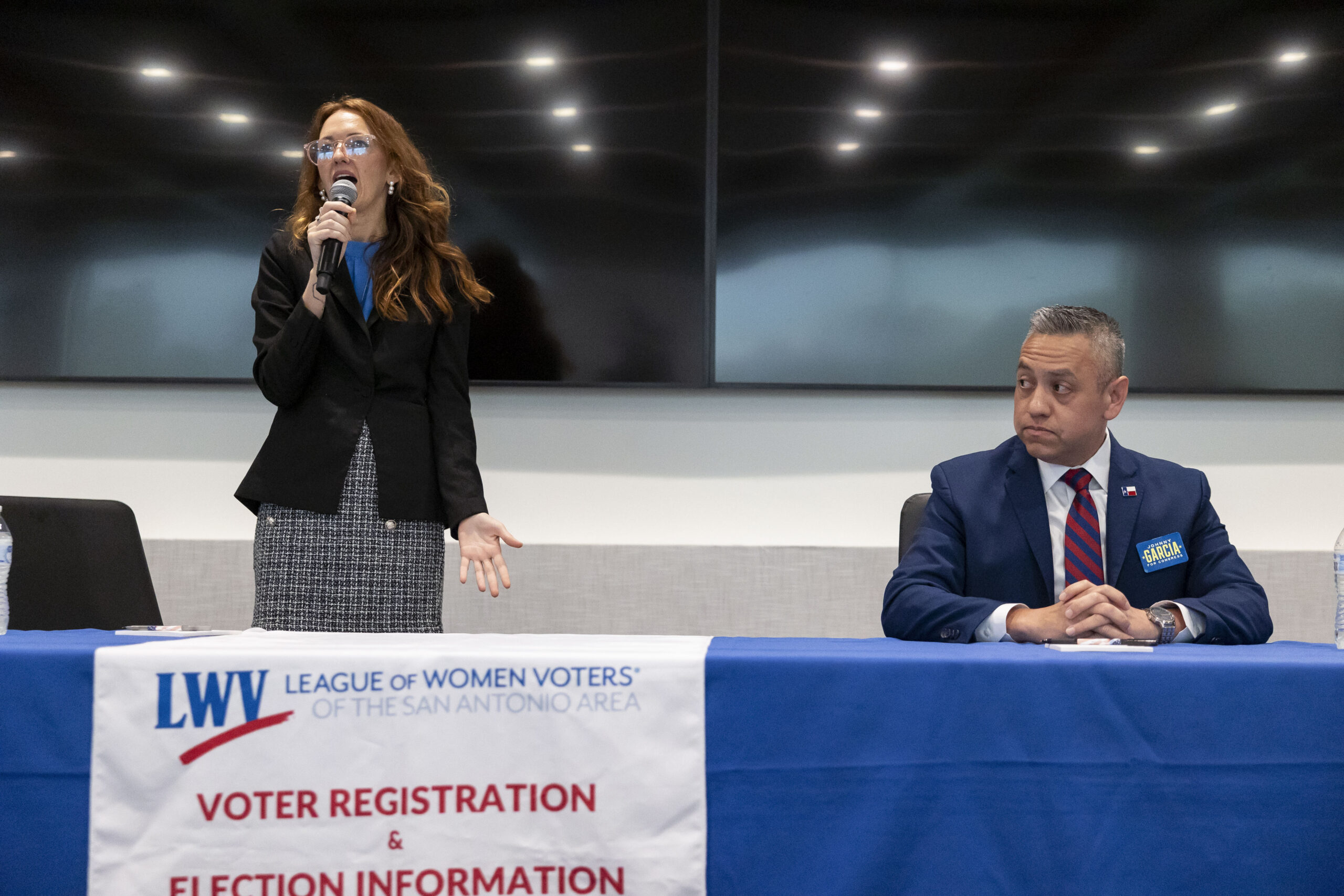
Track AIPAC, the social media account that has gained a growing audience among anti-Israel activists in recent years, found itself in an embarrassing position this week when a candidate it had championed for Congress faced bipartisan backlash over extreme antisemitic comments calling to imprison and castrate “American Zionists,” whom she accused of pedophilia, Jewish Insider’s Matthew Kassel reports. The account said on Tuesday it was “immediately revoking” its endorsement of Maureen Galindo, a San Antonio activist competing for an open swing seat in Texas next week.
Yes, but: The point at which Track AIPAC finally chose to draw a line over Galindo’s rhetoric underscored how the account’s ostensibly narrow focus on opposition to what it calls the “Israel lobby” has often obscured an indulgence of extreme views and positions. Brian Romick, the president of DMFI PAC, which is backing Galindo’s runoff opponent, Johnny Garcia, argued that “Track AIPAC embodies the very-online activist fringe: large social-media following, minimal real-world influence, and a political strategy based on vibes.”
Read the full story here.Dems denounce: Reps. Josh Gottheimer (D-NJ) and Jared Moskowitz (D-FL) said on Wednesday that they would seek to expel Galindo if she is elected — forcing daily votes if necessary. Their comments mark an escalation among Democrats condemning Galindo since her comment gained widespread attention, JI’s Marc Rod reports.
SPLITSCREEN

The Jewish Democratic Council of America announced a dual endorsement on Wednesday of Rep. Haley Stevens (D-MI) and state Sen. Mallory McMorrow in Michigan’s three-way Senate Democratic primary, saying “there are two candidates who stand with our community on issues of importance to Jewish voters, and there is one who does not,” Jewish Insider’s Matthew Kassel reports.
Reasoning: “It is because of this stark contrast of the views and values of Haley Stevens and Mallory McMorrow, compared to those of Abdul El-Sayed,” a vocal critic of Israel who has captured the enthusiasm of the far left, “that we are taking the distinct opportunity to endorse two candidates,” Halie Soifer, JDCA’s CEO, said in a statement.
Michigan matchup: In Michigan’s statewide election for two seats on the University of Michigan Board of Regents, Republican nominees Lena Epstein and Michael Schostak, who both identify as Jewish, told JI’s Gabby Deutch they’re campaigning on fighting antisemitism at the school.
ON THE HILL

Speaking at a House Education & Workforce subcommittee hearing on Wednesday, a doctor accused his union of engaging in systemic discrimination against Jewish and Israeli health providers, supporting terrorist sympathizers and making “its obsession with a single geopolitical conflict a defining future of its identity” — all while he’ll be forced by federal law to fund it, Jewish Insider’s Marc Rod reports.
Healthcare havoc: Jacob Agronin, a cardiology fellow at a major medical institution in Philadelphia, testified alongside several other experts on antisemitism at a hearing focused on anti-Jewish hate in the medical field — which both Jewish medical providers and patients report as a growing problem since Hamas’ Oct. 7, 2023, attacks on Israel. The hearing focused in particular on the role of healthcare worker unions, like the Committee of Interns and Residents, of which Agronin is set to be a member, in spreading antisemitism and their failures to stand up for Jewish union members.
Parents’ night: A group of Jewish parents from across Pennsylvania arrived at a virtual meeting with Sen. Dave McCormick (R-PA) with a plea: take note of antisemitism happening not just on college campuses but also in K-12 schools, and do something about it, JI’s Gabby Deutch reports.
BUFFER BATTLE

New York City Council Speaker Julie Menin will back fresh legislation to compel the NYPD to establish formal protocols for deploying buffer zones around schools during protests — a push Menin said will sail through the council with more than enough votes to beat any effort from Mayor Zohran Mamdani to block it, Jewish Insider’s Will Bredderman reports.
Bridging the gap: The move comes a month after Mamdani exercised his veto power in order to stop a similar bill from becoming law, citing concerns from unions that the blocked measure could interfere with their demonstrations around college facilities, even though the proposal contained an explicit labor carveout. In a press conference on Wednesday, Menin characterized this as a misunderstanding — one the new legislation will rectify by applying exclusively to early childhood education facilities and “most K-12 schools.”
Moreno moves: Sen. Bernie Moreno (R-OH) said Wednesday that he plans to call on the Senate to pass the SACRED Act, legislation imposing restrictions on protests around synagogues and other religious institutions, by unanimous consent, JI’s Marc Rod reports.
IN MEMORIAM
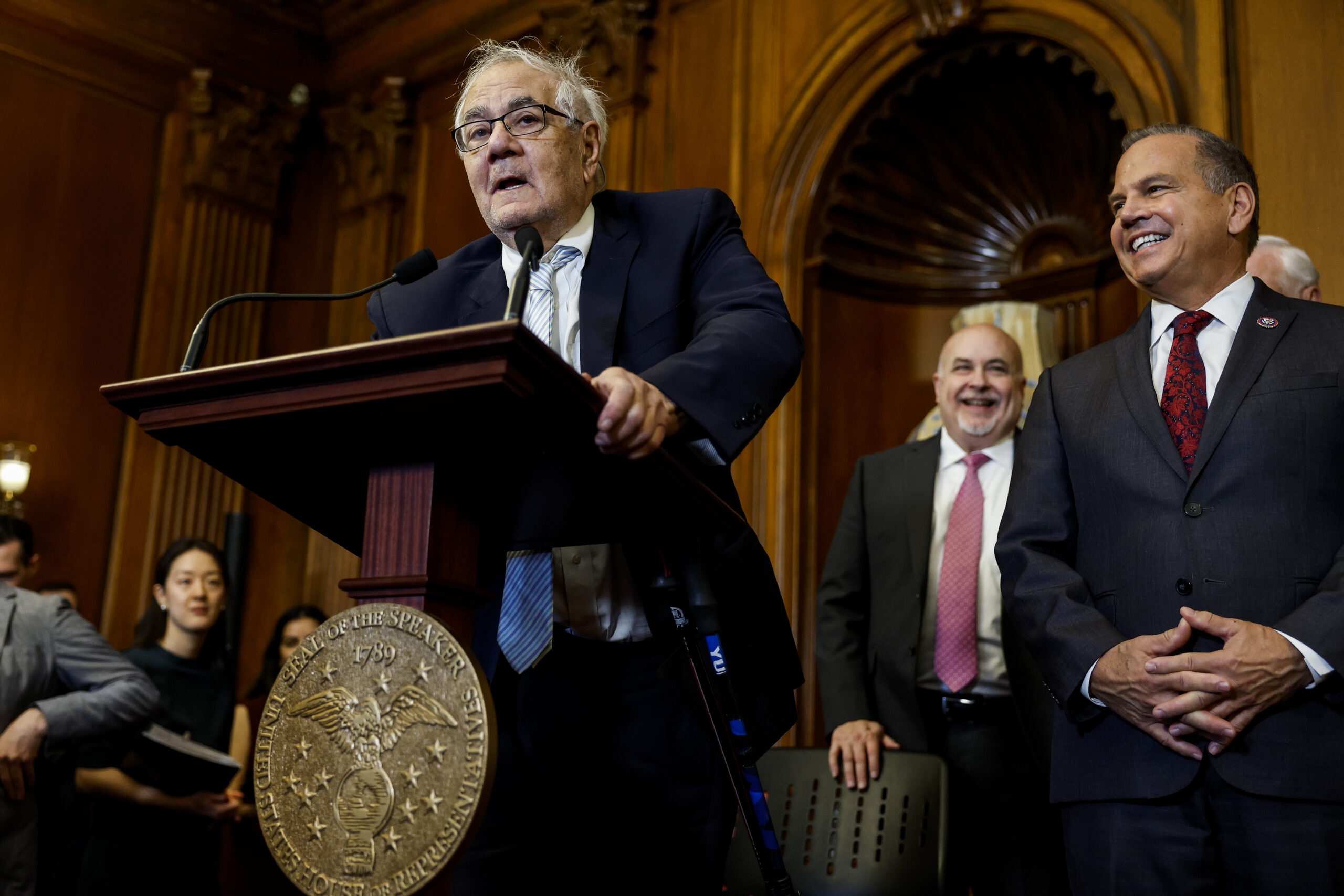
Known as a liberal firebrand, Frank’s most high-profile act in politics was drafting the legislation that tightened financial regulations in response to the 2008 financial crisis, a bill known as the Dodd-Frank Wall Street Reform and Consumer Protection Act, Jewish Insider’s Gabby Deutch reports.
Paving the way: Frank was widely considered a pioneer for the LGBTQ community after coming out publicly as gay in 1987. Frank grew up in a working-class Jewish family in Bayonne, N.J. His sister, Ann Lewis, also worked in politics, holding senior roles in the Clinton administration and later on Hillary Clinton’s presidential campaign. Frank said he was drawn to public service early, feeling in some way that he was an outsider who could challenge how things were done. “I’m a left-handed gay Jew,” Frank said. “I’ve never felt, automatically, a member of any majority.”
Worthy Reads
American Jews Under Siege: In The Atlantic, Israel Policy Forum co-founder Michael Sonnenfeldt considers the “untenable position” that many American Jews find themselves in amid rising domestic antisemitism alongside decreasing support among Americans for Israel. “Anti-Semitism is rising sharply in the United States at the same time that traditional alliances with progressive organizations are weakening, political identities are being reshuffled, and emotional ties to Israel are strained by policies that clash with deeply held democratic and ethical commitments. The simultaneity of these pressures — political, moral, and psychological — is what makes the present moment feel so destabilizing.” [TheAtlantic]
Middle Man: In The Wall Street Journal, Sadanand Dhume questions Pakistan’s ability to operate as a fair intermediary as it seeks to play a central role in U.S.-Iran talks. “Pakistan has attributes that make it a useful intermediary, but America shouldn’t forget that when it comes to Iran, Pakistan’s interests aren’t the same as those of the U.S. On the face of it, Pakistan might seem like an odd choice for mediator. During the war in Afghanistan, Pakistan was widely castigated for playing a ‘double game,’ accepting U.S. aid to fight terrorism while at the same time secretly aiding and abetting the Afghan Taliban.” [WSJ]
A Convert’s Burden: In Moment Magazine, JoJo Kalin, a convert to Judaism who organized the event at the Capital Jewish Museum in which two Israeli Embassy staffers were killed, reflects on her faith as she considers her interaction with the suspected assailant, to whom she offered water after the attack. “There is a version of the future in which my future children would not have to carry this particular kind of fear. I am aware of that. And I am choosing this one anyway. I choose it because what they would inherit is not only fear. It is also peoplehood, memory and a stubborn, enduring joy. … I still think about that glass of water, about the instinct to give it, about the fact that I did not hesitate. I don’t know what it means, fully. I’m not sure it resolves into something clean or instructive. But I know this: That moment belongs to my humanity, not to his violence.” [Moment]
Word on the Street
Jewish Insider’s Emily Jacobs talks to Leo Terrell, the senior counsel to the assistant attorney general for civil rights and chair of the Department of Justice’s antisemitism task force, about the creation of the DOJ’s Antisemitism Advisory Committee, which Terrell will oversee…
The Justice Department announced its indictment against a New Jersey man charged with making interstate threats to a Jewish institution in New York…
Sarah Rogers, the under secretary of state for public diplomacy, refuted accusations that the Trump administration has been ineffective in combating the spread of misinformation and hateful content on social media, arguing that free speech protections and efforts to combat disinformation are not mutually exclusive, in comments at the Hudson Institute on Tuesday, JI’s Emily Jacobs reports…
Reps. Frank Pallone (D-NJ), Debbie Wasserman Schultz (D-FL) and Steve Cohen (D-TN) introduced a resolution honoring the 130th anniversary of the Jewish War Veterans organization…
During a House hearing on Wednesday, Rep. Jared Moskowitz (D-FL) engaged in a heated back-and-forth with a witness, Carol Swain, an author and commentator, as Swain repeatedly dodged his question about whether neo-Nazis are a supremacist group. Two other witnesses answered the question with a simple “yes”…
Director Michael Bay is working with Universal Pictures to develop a feature-length film about the rescue of two American pilots who were shot down in Iran last month; the film will be based off an upcoming book on the event by Mitchell Zuckoff…
TechCrunch profiles Ocean founder Shay Shwartz, whose email security platform protects against AI-powered attacks and recently exited stealth mode with $28 million in a funding round led by Lightspeed Venture Partners that included an investment from Wiz’s Assaf Rappaport…
eJewishPhilanthropy’s Jay Deitcher looks at how Jewish groups are approaching the use of AI for Torah study…
Israeli Prime Minister Benjamin Netanyahu, along with other Israeli officials, issued a sharp condemnation of far-right National Security Minister Itamar Ben-Gvir after he released a video showing himself taunting detained flotilla activists, JI’s Matthew Shea reports…
Israeli prosecutors filed charges against a Jewish man accused of taking part in at least three attacks on Palestinians in the West Bank since February, including an April attack in which a poultry farm employee was hospitalized and remains in a coma…
The Wall Street Journal looks at Israeli efforts to track down all terrorists who took part in the Oct. 7, 2023, Hamas terror attacks…
The U.S. is pressuring Palestinian officials to drop an effort by the Palestinian Authority’s representative at the U.N. to seek the vice presidency of the U.N. General Assembly, warning that the State Department could revoke the visas of the Palestinian delegation should the bid proceed…
The Associated Press profiles Iranian Brig. Gen. Ahmad Vahidi, the head of the Islamic Revolutionary Guard Corps, describing the senior military official as a “longtime veteran of the ruling system” involved with the 1994 bombing of a Jewish community center in Argentina, who is believed to be one of few Iranian officials in contact with Iranian Supreme Leader Ayatollah Mojtaba Khamenei…
The New York Times spotlights the “intelligence fraternity” of former and current IRGC officials, including many with links to the country’s new supreme leader, positing that the group’s “shared backgrounds, careers and ideological outlook” are “one reason the war has neither collapsed the government nor paralyzed it”…
Wine of the Week

JI wine columnist Yitz Applbaum reviews the Warneke Valley Cabernet Sauvignon and the Gen VIII 2019 Cabernet:
After a 250th National Shabbat celebration at the White House, where candles were lit in the Indian Treaty Room, we walked over to nearby Decatur House, the historic 1818 mansion on Lafayette Square, for a meaningful and memorable Shabbat dinner. Kiddush was made over a cup recovered from one of the communities destroyed on Oct. 7, and each guest was given a challah cover embroidered with the presidential seal. For such a special and historic moment, my dear friend Pauly treated me to two of the finest and most important kosher wines from the Herzog family: The Warneke Valley Cabernet Sauvignon and the Gen VIII 2019 Cabernet. These wines perfectly matched the severity and grandeur of the dinner.
The 2023 Warneke Valley is a cab of remarkable poise, carrying a subtle maturity that belies its youth. The opening is pure silk, the mid-palate carries the traditional Herzog vanilla and the finish lingers with notes of parve dark chocolate. The Gen VIII, by contrast, is bold and brash, fruit-forward, with rough-and-tumble tannins that would not let me sleep at night. It has long been one of my favorites, but this vintage will surely overtake its predecessors as one of the greatest ever made. To drink them side by side was a true privilege. Not an inexpensive luxury, but one I would gladly forgo most other pleasures to repeat. Enjoy both alongside a juicy steak, and lay a few bottles down for a future milestone worth celebrating.
Pic of the Day

Former Pittsburgh police officer Daniel Mead, who was injured while responding to the October 2018 Tree of Life shooting, on Wednesday received the Justice Department’s Hometown Hero Award.
Birthdays

Actor, artist and playwright, Lisa Edelstein turns 60…
Former U.S. senator from Minnesota, he was previously a comedian, actor and writer, Al Franken turns 75… VP of the Swiss Federation of Jewish Communities, Ralph Lewin turns 73… Guitarist and composer, Marc Ribot turns 72… EVP of American Friends of Bar-Ilan University, Ron Solomon… Chief rabbi of Mitzpe Yericho (a yishuv located in the Judean desert) and dean of Hara’ayon Hayehudi yeshiva in Jerusalem, Rabbi Yehuda Kroizer turns 71… CEO of the Boston-based hedge fund Baupost Group, he is co-founder of Times of Israel, Seth Klarman turns 69… Northern California-based comedian, he celebrated his bar mitzvah at 52 in Israel, Josh Kornbluth turns 67… New York Times contributing Opinion writer, Jeffrey Toobin turns 66… Founder and publisher of City & State NY, Thomas Allon turns 64… Director of antisemitism education and associate director of the Israel Action Program, both at Hillel International, Tina Malka… Former head of Dewey Square’s sports business practice, now a freelance writer, Frederic J. Frommer… Author and journalist, she was a reporter with The New York Times for eight years, Amy Waldman turns 57… U.S. cyclist at the 2000 Summer Olympics in Sydney, she is now the executive director of the New England Mountain Bike Association, Nicole Freedman turns 54… President and CEO of the Michigan-based William Davidson Foundation, Darin McKeever… University chaplain for NYU and executive director of NYU’s Bronfman Center for Jewish Life, Rabbi Yehuda Sarna turns 48… Founder of Agora Global Advisory, Brandon Pollak… EVP and chief legal officer at Sinclair Inc., David Gibber… Professor of computer science at the University of Texas at Austin, Scott Joel Aaronson turns 45… President of Mo Digital, Mosheh Oinounou… Los Angeles-born, raised in Israel, international fashion model for Versace, Sharon Ganish turns 43… CEO of CreoStrat, Steve Miller… Windsurfer who represented Israel in the Olympics, she is now an energy management program manager at SolarEdge, Maayan Davidovich turns 38… Player on the USC team that won the 2016 NCAA National Soccer Championship, she is now an associate in the L.A. office of Foley & Lardner, Savannah Levin turns 31… Comedian, actor and writer, known for starring in the HBO Max series “Hacks,” Hannah Marie Einbinder turns 31… COO at the Yael Foundation, Naomi Kovitz…
With gas prices rising and the midterms approaching, the White House has little appetite for prolonged conflict
Win McNamee/Getty Images
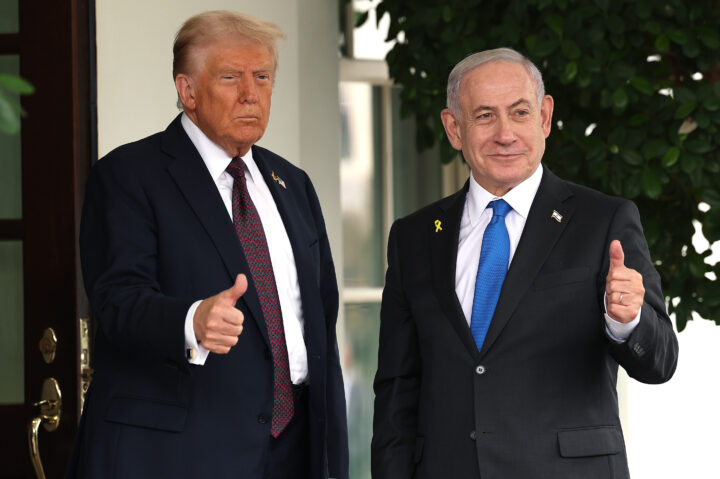
President Donald Trump (L) greets Israeli Prime Minister Benjamin Netanyahu as he arrives at the White House on September 29, 2025 in Washington, DC.
In Tel Aviv and Jerusalem, Netanya and Beersheva, the conversations are the same: When will the war with Iran resume? What contingency plans are in place? Do we need to temporarily rent an apartment with a shelter?
All over Israel, there is a looming feeling that the next round of fighting is just around the corner. The Israel Democracy Institute’s latest polling, conducted earlier this month, found that 62% of Israelis think that the war’s renewal is likely.
But in the U.S., a resumption of war appears increasingly unlikely. With gas prices rising and the midterms approaching, the White House has little appetite for prolonged conflict. A New York Times/Siena poll released earlier this week found that nearly two-thirds of Americans think that going to war against Iran in the first place was a bad idea. Though fresh off a series of primary and state-level wins, President Donald Trump appears cognizant of the uphill battle that comes with resuming an unpopular war, even as he told reporters earlier this week he didn’t factor “Americans’ financial situation” in his approach to the war.
There is also a question of funding. Rep. Tom Cole (R-OK), the chair of the House Appropriations Committee, said this week that the Pentagon would “probably” be out of money to fund the Iran war by August.
Those are key factors that have not penetrated the discourse in Israel. Across the U.S., gas prices are sky high. The midterms are less than six months away. And on Capitol Hill, even some of the president’s staunchest backers are signaling opposition to a resumption of the war.
“Generally speaking, Israelis are not really attuned to internal politics in the U.S. that could be affecting President Trump’s decisions,” Tamar Hermann, director of IDI’s Viterbi Center for Public Opinion, told Jewish Insider this morning. “Recent coverage in the Israeli media has tended to obscure the domestic political constraints Trump faces, creating the impression that he is operating without meaningful checks and is effectively able to do as he pleases.”
While legislatively, the Trump administration has demonstrated that it is willing — to some extent — to circumvent Congress and somewhat shuffle the system of checks and balances, the real factors constraining the president are the ones facing elected leaders around the world.
Trump and Israeli Prime Minister Benjamin Netanyahu spoke Tuesday night, in what Axios reported was a “difficult” call in which the two leaders diverged on how to proceed, with the president favoring negotiations and a potential deal and Netanyahu pushing for renewed active military operations in order to further degrade Tehran’s capabilities.
In recent days, both Jerusalem and Washington have acknowledged that Trump is the ultimate decision-maker on Iran. Trump told reporters on Wednesday morning that Netanyahu “will do whatever I want him to do” when it comes to the Islamic Republic, while earlier this week, Israeli Ambassador to the U.S. Yechiel Leiter told CNN’s Anderson Cooper that Israel is the “junior partner” to the U.S. vis-a-vis Iran.
But in the next six months, both men will face the court of public opinion in their countries’ respective elections, likely to be just weeks apart. One believes that a resumption of the war could boost his chances of staying in power. The other is cognizant that going back to battle could cost him the wins he’s amassed. And for now, Trump holds the cards.
The prime minister’s office said Netanyahu’s meeting with MBZ ‘resulted in a historic breakthrough’; the UAE called the report ‘entirely unfounded’
POOL/AFP via Getty Images
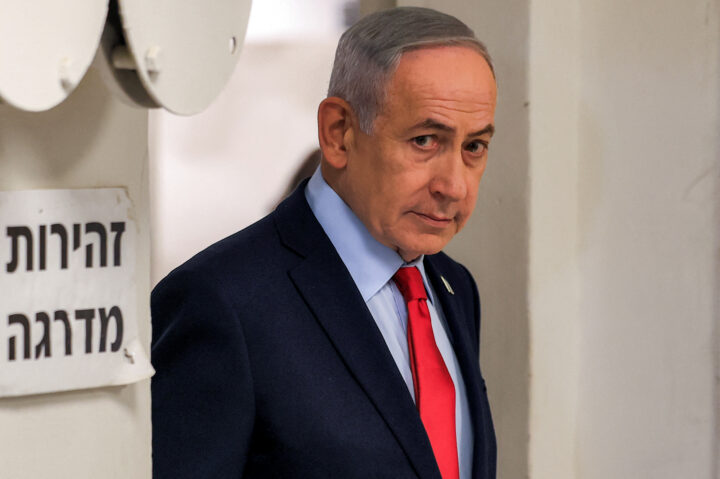
Israeli Prime Minister Benjamin Netanyahu arrives for a press conference in Jerusalem on March 19, 2026.
The United Arab Emirates denied a report by Israeli Prime Minister Benjamin Netanyahu’s office on Wednesday that the Israeli leader secretly traveled to the UAE during the war with Iran to meet with Emirati President Mohammed bin Zayed, which would have marked the first known meeting between the two leaders since the signing of the Abraham Accords in 2020.
The Prime Minister’s Office said that the meeting “resulted in a historic breakthrough in relations between Israel and the United Arab Emirates.” However, the UAE’s ministry of foreign affairs released a statement hours later calling the claims “entirely unfounded.”
“The United Arab Emirates denies reports circulating regarding an alleged visit by Israeli Prime Minister Benjamin Netanyahu to the UAE, or receiving any Israeli military delegation in the country,” the statement read. “The UAE reaffirms that its relations with Israel are public and conducted within the framework of the well-known and officially declared Abraham Accords, and are not based on non-transparent or unofficial arrangements.”
According to Ziv Agnon, who was Netanyahu’s chief of staff until early April, bin Zayed picked Netanyahu up in his own car and drove him to the palace.
During the conflict in Iran, Israel and the UAE have seen a marked increase in military and intelligence cooperation. Mossad chief David Barnea also quietly visited the UAE at least twice over the course of the war with Iran to directly coordinate regional security strategies, sources told The Wall Street Journal.
U.S. Ambassador to Israel Mike Huckabee confirmed this week that Jerusalem dispatched an Iron Dome missile-defense battery to the UAE along with Israeli military personnel to operate it in order to shield the Gulf nation from Iranian ballistic missile and drone attacks.
Two Israeli jets landed in the city of Al-Ain in Abu Dhabi in late March, according to flight radars, and headed back to Israel after an apparent four-hour visit.
The Israeli and Emirati leaders also reportedly met in secret in 2018, two years prior to the signing of the Abraham Accords.
‘As Israel continues to face threats from hostilities with Iran, the State Department cannot abandon American citizens abroad,’ the lawmakers wrote

GIL COHEN-MAGEN/AFP via Getty Images
The empty departures hall at Ben Gurion Airport near Tel Aviv on June 13, 2025 after Israel closed its air space to takeoff and landing.
A group of congressional Democrats is urging the State Department to restart chartered evacuation flights and take additional steps to help U.S. citizens who wish to leave Israel amid the ongoing war with Iran.
The lawmakers described the State Department’s current partnership with El Al, which launched on March 13 with a limited number of special evacuation flights for U.S. citizens, as insufficient. The Israeli airline has currently suspended registration for the flights, and government-imposed security restrictions are limiting passenger capacity on each flight and reducing airport operations.
“We were shocked to learn this week that as the military conflict in Iran escalates and continues to threaten the safety of U.S. citizens in the Middle East, the State Department has abruptly and effectively ended emergency evacuations for Americans out of Israel,” the lawmakers said in a letter to Secretary of State Marco Rubio on Thursday. “As Israel continues to face threats from hostilities with Iran, the State Department cannot abandon American citizens abroad. Failing to assist Americans in their time of need is totally unacceptable.”
The letter, led by Rep. Laura Gillen (D-NY), was co-signed by Senate Minority Leader Chuck Schumer (D-NY) and Reps. Yvette Clarke (D-NY), Don Davis (D-NC), Dan Goldman (D-NY), Josh Gottheimer (D-NJ), Julie Johnson (D-TX), Greg Landsman (D-OH), George Latimer (D-NY), Jared Moskowitz (D-FL), Jerry Nadler (D-NY), Pat Ryan (D-NY), Tom Suozzi (D-NY), Ritchie Torres (D-NY), John Mannion (D-NY), Haley Stevens (D-MI), Joe Morelle (D-NY) and Johnny Olszewski (D-MD).
According to the letter, the State Department is urging Americans to rely on commercial transportation or the Israeli Ministry of Tourism, and El Al lacks the capacity to carry all U.S. citizens who wish to depart, leaving Americans “without real options.” The information provided by the State Department, the letter reads, is “causing frustration, anxiety, and fear.”
“In the midst of a conflict, U.S. citizens should not have to wait weeks to be able to board a commercial flight or cross the Israeli border into another country to find their way home. It is unacceptable for the State Department to leave them on their own,” the letter continues.
In a press release Thursday, the State Department heralded its partnership with El Al, which it said has “already allowed more than 2,000 American citizens to return to the United States from Israel.”
The airline “will continue to reserve a percentage of seats on all regular U.S.-bound flights for Americans wishing to depart Israel” and has 28 flights scheduled over the next week “to the extent permitted by the Israeli authorities,” the State Department said. The release did not acknowledge that the registration form for the evacuation flights is currently closed.
Democrats have accused the administration of failing to adequately prepare to evacuate U.S. civilians, or government personnel, from the Middle East before launching the war in Iran.
The lawmakers called on the State Department to restart charter flights from Israel and elsewhere in the region; reopen the State Department’s crisis intake form, which helps citizens receive emergency information; activate a crisis task force to assist Americans attempting to leave Israel; and provide clearer information on commercial air travel options.
Thousands of Americans, currently in Israel, are unable to access flights home and are not being offered alternative travel options or any additional assistance by the State Department,” their letter reads. “Additionally, the Department’s inconsistent guidance and lack of responsiveness have added to uncertainty and fear, making the situation even more dire for impacted families.”
In its press release, the State Department defended its evacuation efforts: “After the launch of Operation Epic Fury, the Department offered charter flight options to thousands of Americans wishing to leave Israel to Athens and destinations in the United States, as well as ground transportation options to Egypt — with supply exceeding demand on nearly every chartered flight and bus.”
Plus, Gottheimer pans Newsom

Brian Stukes/Getty Images
State Sen. Sharif Street attends a rally outside the Philadelphia Criminal Justice Center on April 16, 2018 in Philadelphia, Pennsylvania.
👋 Good Monday morning!
In today’s Daily Kickoff, we report on the latest in the war with Iran, including a missile attack this morning in which at least one person in Israel were killed, and cover a move by Senate Democrats to introduce five additional war powers resolutions after a similar effort last week failed to get enough support. We profile Pennsylvania state Sen. Sharif Street as the pro-Israel Democrat, who is Black and Muslim, mounts a bid for Congress, and report on concerns from members of the House Education & Workforce Committee that Evanston, Ill., Mayor Daniel Biss, who is running for Congress, “severely downplayed antisemitism” at Northwestern University while in a briefing with committee members. Also in today’s Daily Kickoff: Qatari Prime Minister Sheikh Mohammed bin Abdulrahman al Thani, Gov. Josh Shapiro and Alon Penzel.
Today’s Daily Kickoff was curated by JI Executive Editor Melissa Weiss and Israel Editor Tamara Zieve, with assists from Danielle Cohen-Kanik and Marc Rod. Have a tip? Email us here.
What We’re Watching
- Secretary of State Marco Rubio is set to deliver remarks at 9 a.m. ET at a flag-raising ceremony at the State Department commemorating hostages and wrongful detainees.
- House Republicans are holding their annual policy retreat in Doral, Fla., with President Donald Trump slated to address the gathering at 5 p.m. ET. Also slated to speak at the retreat are Ben Shapiro and CNN’s Scott Jennings.
- EU Council President Antonio Costa and EU Commission President Ursula von der Leyen are holding a call today with Middle East leaders to discuss the ongoing war in the region.
- Team Israel faces off against the Dominican Republic in the World Baseball Classic at noon ET today in Miami. The Israeli team, which lost 11-3 on Saturday against Venezuela, came back to beat Nicaragua 5-0 on Sunday.
What You Should Know
A QUICK WORD WITH JI’S MELISSA WEISS
Recent days have offered a tale of two New York public officials’ wives and a revealing look at inconsistent standards from some mainstream media outlets on how they scrutinize the families of elected officials depending on the political viewpoints expressed.
The first was a New York Times story focused on the pro-Israel social media posts of Rep. Dan Goldman’s (D-NY) wife. Under the headline “Congressman Faces Questions About Wife’s Social Media Stances on Israel,” the Times wrote of the instances — believed to be 10 in all — that Corinne Goldman, who served as treasurer on her husband’s campaign, liked posts related to the Israel-Hamas war in the weeks after the Oct. 7, 2023, Hamas terror attacks, including one comparing “Jews for Palestine” to “Chickens for KFC.”
Days later, Jewish Insider uncovered the social media activity of Rama Duwaji, the Syrian-American wife of New York City Mayor Zohran Mamdani, in the days after the attacks. That activity included liking posts that unambiguously celebrated Hamas’ Oct. 7, 2023, attacks — as they were underway — and included still images from the attacks, in which more than 1,200 were killed and 251 taken hostage.
In his first public statement addressing JI’s reporting, Mamdani said his wife — who less than a month ago was the subject of a cover profile and photo shoot for The Cut — was a “private person.”
It was a response that was unsatisfactory to some. Deborah Lipstadt, the Biden administration’s special envoy to monitor and combat antisemitism, responded to Mamdani’s statement by rhetorically asking, “But Jessica Tisch has to apologize when her brother says something?” — referring to the NYPD commissioner’s recent apology over her brother’s assertion that Mamdani was an “enemy of the Jewish people.”
The Times, which covered Mamdani’s response, changed its headline on the story at least twice after publication, from “Mamdani Says His Wife’s Views on Gaza Are No One’s Business,” to “Mamdani Defends Wife Amid Criticism of her Support for Palestinian Cause,” before eventually landing on “After Social Media Scrutiny, Mamdani Says His Wife Is a ‘Private Person.’”
In response to the second headline, Tel Aviv-based research analyst Daniel Paul Rubenstein wrote on X that he “did not expect to see the New York Times refer to the October 7 Massacre as an expression of the ‘Palestinian Cause’ – but here we are.”
DEATH TOLL RISES

One person was killed in an Iranian missile attack that struck a construction site in the city of Yehud in central Israel, volunteer emergency service Magen David Adom reported on Monday. MDA pronounced the victim, a man who appeared to be about 40 years old, dead at the scene. Another man, believed to be around the same age, was evacuated to the nearest hospital in serious and unstable condition. Both were foreign workers, Jewish Insider’s Lahav Harkov reports.
Northern front: In Lebanon, two IDF soldiers were killed over the weekend by a missile fired by Hezbollah. The soldiers were retrieving a vehicle from a position in southern Lebanon at the time they were killed, the IDF Spokesperson’s Office said. One soldier, combat engineer Maher Hatar, 38, was the first Druze soldier killed in the war. The second soldier’s identity has not been cleared for publication.
On the bench: President Donald Trump and Israeli Prime Minister Benjamin Netanyahu pushed back on Saturday against reports that they were working with Kurdish leaders to launch a ground invasion of Iran, Jewish Insider’s Lahav Harkov reports.
WORD ON THE STREET
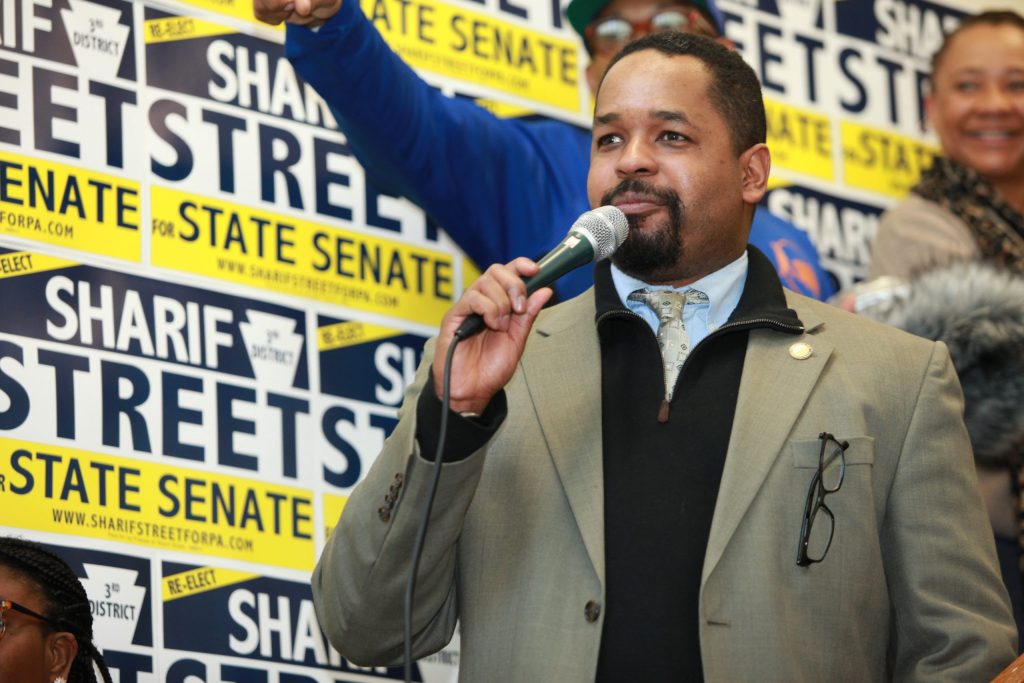
Sharif Street is walking a unique political path. The Pennsylvania state senator running for a House seat in the heart of deep-blue Philadelphia is Black and Muslim, and has staked out positions largely supportive of Israel, Jewish Insider’s Marc Rod reports.
What he said: Street traveled to Israel with the American Jewish Committee in 2017 “to gain some understanding” of the complexities facing Israelis and Palestinians. He has indicated that he would not support conditions on U.S. aid to Israel, saying that the two allies need an “open dialogue,” yet he refers to Israeli Prime Minister Benjamin Netanyahu as a war criminal. Street’s nuances on Israel — he backs a strong U.S.-Israel relationship, while also urging a compassionate approach to the Palestinians — offer a sharp contrast with his most prominent rival in the Democratic primary, a strident antagonist of Israel. Street also argues that media portrayals have flattened the American Muslim community and failed to accurately portray their diverse views on the Middle East and relationships with the Jewish community.
RENEWED SCRUTNIY

Brandon Herrera, the presumptive Republican nominee in Texas’ 23rd Congressional District, spoke on a podcast in 2024 — after his first run for the House — about owning a copy of Mein Kampf, Nazi leader Adolf Hitler’s manifesto, earning him a fresh rebuke from the Republican Jewish Coalition, Jewish Insider’s Marc Rod reports.
Podcast playback: During a 2024 appearance on the “Unsubscribe” podcast, another guest joked that he had been deeply involved in communism until he had read another book, producing a copy of Mein Kampf. Herrera, who appeared to immediately recognize the book when others on the podcast did not, promptly turned to his phone to produce a picture of his own copy of the Nazi manifesto. “That’s my copy at my house next to a bunch of the German stick grenades,” Herrera said. “I got the 1939 edition printed in English just because I thought it was wild that you couldn’t buy it on Amazon but you could buy The Communist Manifesto and Das Kapital,” he added, making a confused face.
ON DECK
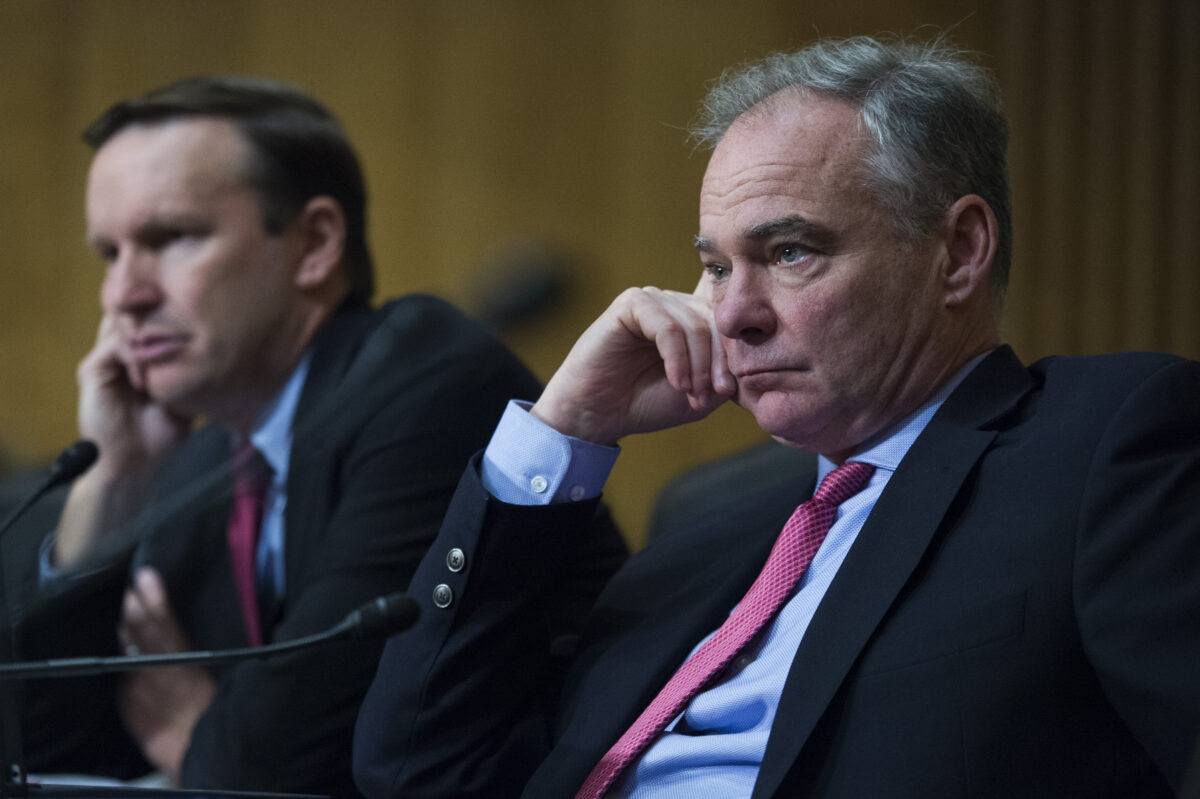
Senate Democrats introduced a series of five new war powers resolutions seeking to block military action in Iran on Thursday, a day after the Senate voted along mostly partisan lines to block an effort to immediately halt the operation, Jewish Insider’s Marc Rod reports.
The latest: Having a series of war powers resolutions already introduced could allow Democrats to continue teeing up a series of votes on the war, or allow them to have several resolutions in reserve to vote on as the situation in Iran evolves. War powers resolutions are subject to a 10-day waiting period between their introduction and when senators can force votes on them.
ON DEFENSE
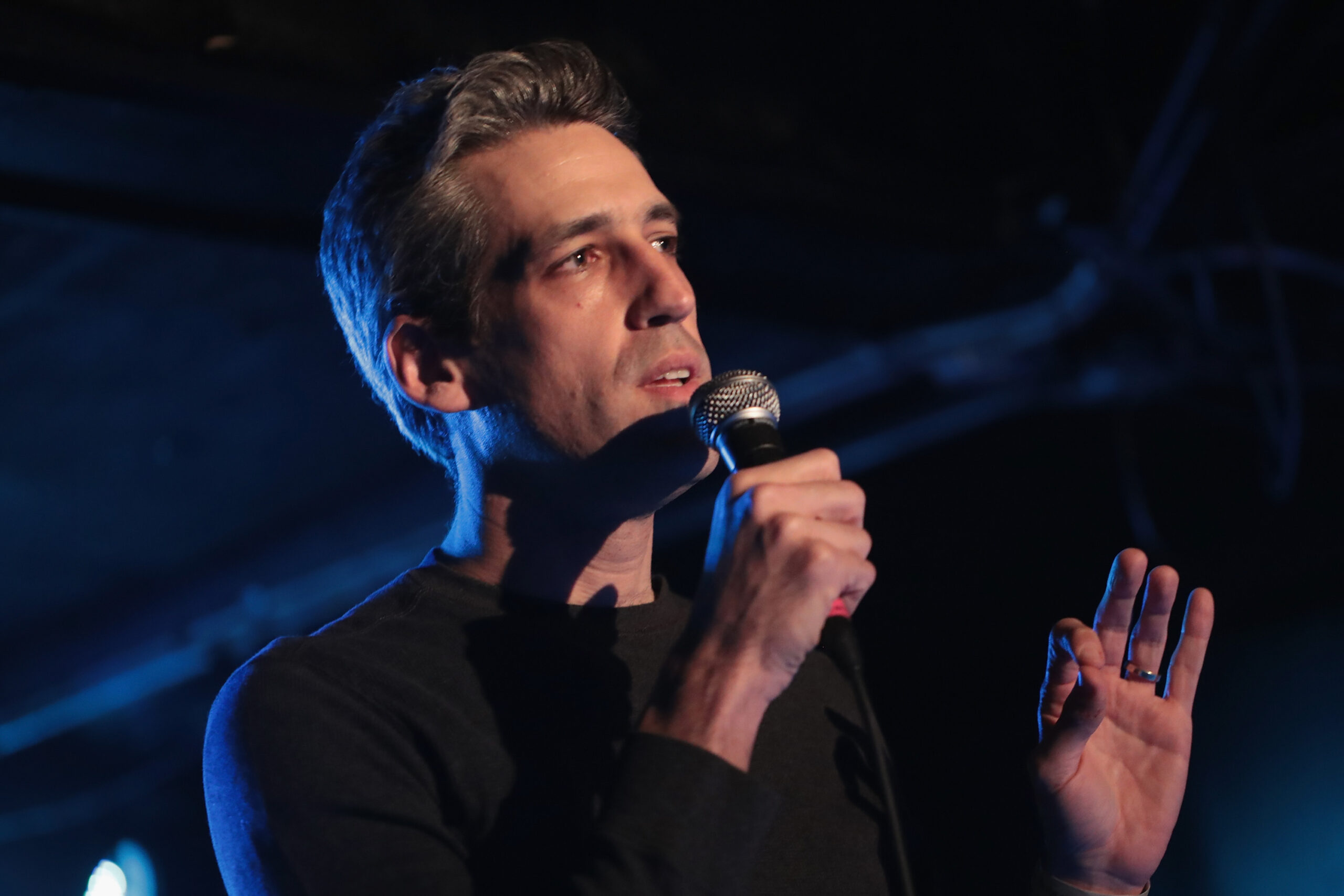
In a briefing for the House Education & Workforce Committee on his response to the anti-Israel protest encampment at Northwestern University in 2024, Evanston, Ill., Mayor Daniel Biss “severely downplayed” the situation on that campus and antisemitism across the country, the committee said, Jewish Insider’s Marc Rod reports.
Readout: “In his briefing with the Committee today, Mr. Biss severely downplayed antisemitism at Northwestern after October 7th. He told the Committee that the great majority of his Jewish friends in the Northwestern community had no concerns about it,” a committee spokesperson told JI. “He further stated that Northwestern should not have received an F on the Anti-Defamation League’s college report card. He even accused the Committee of alarmism that is not warranted by the facts when it comes to antisemitism at the university after the October 7th attacks.” Biss, meanwhile, has dismissed the committee’s questioning of him as a smear campaign. “From the start, this ‘briefing’ was a flimsy attempt to weaponize the very real threat of antisemitism to attack me and support my opponent. It failed,” Biss said in a statement.
sending signals

Dan Osborn, a Democratic-aligned independent candidate running for Senate in Nebraska, received and touted an endorsement from a lobbying group that aims to alter U.S. policy toward Israel, in part by electing candidates critical of the U.S.-Israel relationship, Jewish Insider’s Marc Rod reports.
What happened: A New Policy PAC was founded by Josh Paul, a former State Department official who left government in protest of U.S. support for Israel after Oct. 7, 2023, and since joined the anti-Israel group DAWN and become a vocal critic of Israel. A New Policy’s advocacy arm has accused Israel of genocide, urges cutting off and conditioning U.S. aid to Israel; and opposes the Antisemitism Awareness Act and the International Holocaust Remembrance Alliance’s working definition of antisemitism.
Worthy Reads
Risky Business: The Financial Times’ Jacob Judah, Bob Haslett and Alan Smith spotlight Iran’s dwindling number of “indispensable” ballistic-missile launchers and the crews who man them. “When an Iranian ballistic missile launcher breaks cover to dash towards a firing site, its tiny cabin suddenly becomes one of the world’s most perilous places. … Iranian ballistic missile crews are among the most ideologically committed within the Islamic Revolutionary Guard Corps. They operate from mountain hide-outs known in Iran as ‘missile cities’ whose cavernous networks of tunnels wind deep underground.” [FT]
Nobel or Not: In The Wall Street Journal, Joshua Muravchik argues that President Donald Trump’s foreign policy legacy could be solidified by his actions against U.S. adversaries, regardless of whether he is awarded the Nobel Peace Prize. “Reagan never won the Nobel, but in contrast to Mr. Obama and Carter, he greatly advanced world peace and Americans’ safety by bringing low the Soviet Union’s ‘evil empire.’ Mr. Trump could achieve an analogous triumph if he succeeds in undoing the regime in Iran and perhaps the one in Cuba, too. … The downfall of Iran’s regime would blow a gaping hole in this anti-American coalition. It would weaken radical Islam everywhere. Socialism, an idea that had bounced around for nearly a century, became a serious force only when Vladimir Lenin turned Russia into the world’s first socialist state.” [WSJ]
Beijing’s Bad Bet: In The Washington Post, the Hudson Institute’s Miles Yu posits that Beijing’s strategy of investing in Iran for more than a decade as it seeks to gain a foothold in the region has “collapsed” amid the U.S. and Israeli war against Tehran. “[Iran’s] capacity to destabilize the region on China’s behalf has been curtailed. Belt and Road projects tied to Iranian ports, rail corridors and energy infrastructure now face heightened instability and security risk. The vision of a secure overland energy corridor insulated from U.S. naval power has been reduced to uncertainty. China had bet on a confident, defiant and nuclear-ambitious Iran. Instead, it is left with a battered partner whose utility has sharply diminished.” [WashPost]
Word on the Street
In his first comments to the media since the start of the war with Iran, Qatari Prime Minister Sheikh Mohammed bin Abdulrahman al Thani said that Tehran’s decision to strike Arab countries was a “dangerous miscalculation” and that he felt “a big sense of betrayal” by the move…
In a leaked Telegram message, former Iranian Foreign Minister Mohammed Javad Zarif said that Israel and the United Arab Emirates are “one and the same” and that Tehran’s strategy should be to “focus on destroying the bridge between Saudi Arabia and Bahrain in order to create real deterrence against mischief in the island”…
Russia is reportedly providing intelligence to Iran to target U.S. troops in the Middle East…
Azerbaijan said it foiled an Islamic Revolutionary Guard Corps plot to sabotage a number of sites in the country, including the Israeli Embassy in Baku, a synagogue, the leader of a group known as the “Mountain Jews” and the country’s Baku-Tbilisi-Ceyhan oil pipeline…
Two ships owned by an Iranian company under U.S., European and British sanctions departed the Chinese port in Zhuhai known for its storage of chemicals used to make rocket fuel…
The New York Times looks at the concerns of Western officials and nuclear experts over the location and fate of 18-20 canisters of enriched uranium that are believed to still be intact and in Iran…
A Pakistani man was convicted in a U.S. federal court of plotting with Iran to assassinate U.S. officials, including President Donald Trump…
The U.S. began evacuation flights of U.S. citizens from Israel on Friday, Jewish Insider’s Haley Cohen reports…
Sens. Brian Schatz (D-HI), Patty Murray (D-WA), Jeanne Shaheen (D-NH), Jack Reed (D-RI), Mark Warner (D-VA) and Chris Coons (D-DE) released a statement calling on the Department of Defense to “fully and impartially” investigate a strike on an Iranian school on the first day of the war in which more than 100 people, including students, were killed…
The move comes as satellite images and footage increasingly indicate that the U.S. struck the school, which was located near an Islamic Revolutionary Guard Corps installation, despite Trump’s claim that Iran was responsible for the strike…
Rep. Greg Meeks (D-NY), the ranking member of the House Foreign Affairs Committee, again criticized the administration for bypassing normal congressional review processes to approve a $650 million sale of 20,000 bombs to Israel…
Rep. Maxine Waters (D-CA) and 17 Democratic co-sponsors, mostly progressives, introduced legislation requiring stronger oversight of and regular reporting to Congress and the public on the food supply for Palestinians in Gaza…
A group of House Democrats —Reps. Jared Moskowitz (D-FL), Debbie Wasserman Schultz (D-FL), Pramila Jayapal (D-WA), Val Hoyle (D-OR), Mike Thompson (D-CA), Norma Torres (D-CA), Ilhan Omar (D-MN), Sara Jacobs (D-CA), Chrissy Houlahan (D-PA) and Sam Liccardo (D-CA) — called on House Speaker Mike Johnson (R-LA) to cancel the House’s recess this week as long as the war in Iran is ongoing…
Rep. Josh Gottheimer (D-NJ) called out California Gov. Gavin Newsom, a leading 2028 presidential contender, for recent comments characterizing Israel as an apartheid state and questioning future military aid, Jewish Insider’s Marc Rod reports; “Is it really worth throwing Jews under the bus to advance your political ambitions?” Gottheimer said on X this weekend…
Pennsylvania Gov. Josh Shapiro wrote a letter to Attorney General Pam Bondi urging her office to investigate the death of a 19-year-old Palestinian American man who was killed last month in a confrontation with Israeli settlers in the West Bank…
A federal judge nullified a number of actions taken by the U.S. Agency for Global Media, which oversees Voice of America, ruling that Kari Lake was unlawfully serving as the agency’s head when the decisions, which included mass layoffs, were made…
Federal officials will lead the investigation into an incident at a weekend demonstration outside Gracie Mansion in which a homemade explosive device was flung into a crowd of protesters, allegedly by at least once person who told officials they were an ISIS sympathizer…
Two Toronto-area synagogues were damaged by gunfire late Friday and early Saturday following an earlier shooting at another area synagogue last week, Jewish Insider’s Haley Cohen reports…
Police in Liège, Belgium, are investigating an explosion that occurred at a local synagogue this morning, in what a local official called a “violent act of antisemitism”…
The U.K.’s Luton Airport apologized and will institute antisemitism awareness training after an incident in which Israeli author Alon Penzel, who was traveling back to Israel, encountered a member of airport security who made disparaging comments to him…
Authorities in the U.K. are investigating a report of antisemitism during a soccer match in which supporters of the Thorpe St Andrew School allegedly jeered the players from JFS, the U.K.’s largest Jewish school…
Pic of the Day

Team Israel bested the Nicaraguan national team 5-0 on Sunday in its first-ever shutout game at the 2026 World Baseball Classic in Miami. Former Red Sox infielder Kevin Youkilis (center) is serving at the team’s bench manager.
Birthdays

Rhodes scholar, Harvard Law graduate, author and political journalist, Michael Kinsley turns 75…
President at Adelson Family Foundation since 2007 and a board member of Prizmah, Michael Bohnen turns 79… Sag Harbor, L.I.,-based painter, sculptor and printmaker, Eric Fischl turns 78… Host of Public Radio International’s “Science Friday,” Ira Flatow turns 77… Member of the Knesset from 1989-2021, he has served in many cabinet roles and as chairman of Israel Aerospace Industries, Amir Peretz turns 74… President and CEO of NYC’s flagship public TV station WNET, Neal Shapiro turns 68… Professor emeritus of economics at NYU, nicknamed “Dr. Doom,” Nouriel Roubini turns 68… Susan Liebman… NYC-based attorney, Gordon Platt… Private equity and venture capital investor, Howie Fialkov… Founder and head of the Chabad house at Harvard University, Rabbi Hirschy Zarchi… Former Canadian minister of mental health and addictions, Ya’ara Saks turns 53… VP and head of global communications and public affairs for Meta / Facebook, David I. Ginsberg… Senior fellow at Harvard University’s Mossavar-Rahmani Center for Business and Government, Matthew Vogel… Former CEO of the Trevor Project, now CEO of the Malnutrition Advocacy Fund, Amit Paley… Co-founder and CEO at ImpactTechNation, he is also a co-founder of the political party Wake-Up Jerusalem (Hitorerut B’Yerushalayim), Hanan Rubin… Israeli-born singer, now one-half of the world music duo Shlomit & RebbeSoul, Shlomit Levi turns 43… News editor in the U.S. bureau of Jewish News Syndicate, Menachem Wecker… Partner in the Los Angeles law firm of Bocarsly Emden, Rachel Rosner… Political strategist for the Democratic Party, she is a co-host of “The Five” on the Fox News Channel, Jessica Tarlov turns 42… Senior advisor to North Carolina Gov. Josh Stein, Alissa “Sadie” Weiner… CEO at New Orleans-based QED Hospitality, Emery Whalen… Pitcher for Team Israel at the 2017 World Baseball Classic, he now plays in the Mexican League, Jared Lakind turns 34… Founding partner of Mothership Strategies, Jacob “Jake” Austin Lipsett… Manager of education and outreach at inSIGHT Through Education, Marla Topiol… First-round pick in the 2020 NHL Entry Draft, now playing for the NHL’s Nashville Predators, Ozzy Wiesblatt turns 24… Stephen Lent…
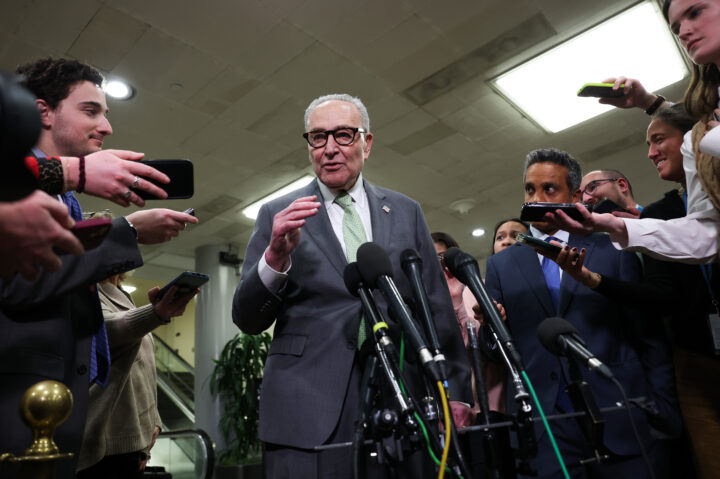
Republicans and some Democrats insisted Trump made the decision, while other Democrats said that the timing of the onset of hostilities was impacted by Israel’s plans
Anna Moneymaker/Getty Images
Senate Minority Leader Charles Schumer (D-NY) speaks to the media after briefings on Iran at the U.S. Capitol on March 3, 2026 in Washington, DC.
Following a classified briefing on Tuesday, Senate Republicans strongly rejected claims that Israel had effectively forced the U.S.’ hand into war with Iran or dictated the timeline of the conflict, claims that were fueled by comments on Monday by Secretary of State Marco Rubio and top lawmakers who were briefed on the Trump administration’s plans.
Sen. Rick Scott (R-FL) told Jewish Insider he had been in touch with the administration since the war began, and that no one in the administration had told him that Israel had triggered the U.S. to act.
“Anybody that thinks they’re going to get President Trump to do anything — talk to anybody that’s done business with him for his entire business career,” Sen. Markwayne Mullin (R-OK) told JI, calling the idea that Israel had forced Trump’s hand “a joke.”
Sen. John Hoeven (R-ND) added, ”We work very closely with our ally Israel for maximum effect to take out Iran’s capabilities when they are the weakest so we minimize the risk to our military and civilians in the region.”
Democrats also distanced themselves from the narrative that emerged on Monday.
Asked whether Israel had prompted the start of hostilities, Senate Minority Leader Chuck Schumer (D-NY), who was also briefed on Monday, told JI, “No one wants an endless war, but we certainly don’t want a nuclear Iran, that’s for sure.”
Sen. Andy Kim (D-NJ) said that the responsibility for the operation “always falls squarely on President Trump. Regardless of what other countries are doing, he is the one that owns this.”
“Look, I certainly have my concerns about how this all unfolded, but I think it’s very important for the American people to know that this was still Donald Trump’s decision,” Kim continued.
Other Democrats framed the narrative as one of several shifting explanations the administration has offered.
Sen. Cory Booker (D-NJ) said that the administration “jump[s] around until they think they found an explanation that could satisfy the most people. They have changed their justification for this time and time again, and we got nothing that even approached a justifiable reason for the president to commit an act of war.”
Rep. Greg Meeks (D-NY), the ranking member of the House Foreign Affairs Committee, also said that placing responsibility with Israel was one of just several shifting rationales. “Each day, sometimes twice a day, the rationale for doing this changes. That tells me it is not serious.”
Other Democrats, however, said that the timing of the onset of hostilities was impacted by Israel’s plans.
“The way we got into this war, I think, put the principal decision in another country’s hands, rather than ours, and did not lead to preparations in advance of the war starting that protected as many Americans as possible,” Sen. Chris Coons (D-DE) said.
Democrats supporting the war powers resolution set to come up for a vote in the Senate on Wednesday — which mandates the withdrawal of U.S. forces from combat with Iran — argued on Tuesday that the resolution would nevertheless allow some sort of wind-down of U.S. operations, as U.S. bases and embassies come under fire by Iran, though they did not offer specifics.
“I think they’d be allowed to conduct the completion of the operation,” Sen. Brian Schatz (D-HI) said.
Sen. Adam Schiff (D-CA), a cosponsor of the war powers resolution, said, “It would require an end to the use of force. I’m sure it would permit the safe drawdown of our forces in the region, but it would insist on the president coming to Congress to seek an authorization, to make the case — if indeed he believes there’s a case to be made.”
Though the resolution “terminate[s] the use of United States Armed Forces from hostilities against the Islamic Republic of Iran or any part of its government or military,” Meeks said that the resolution “does not say that the president has to move everybody out.”
“It says, though, that he has to come and talk to us and tell us what the end game, what the beginning game is. We just cannot get involved in the hostilities, as of right now,” Meeks told JI. “Israel will do what it’s doing, I would imagine. But the American people need to know where their members of Congress stand.” He’s supporting a similar resolution in the House.
Sen. Tim Kaine (D-VA), the lead sponsor of the war powers resolution, said that if it fails as expected, he can and may continue re-filing the resolution as the war continues, and as casualties and disruptions mount. He said that Democrats are also contemplating other measures, such as using the appropriations process or amendments to other legislation, to force lawmakers to vote on the war.
Several Democrats also said Congress should vote on an authorization for use of military force, in addition to the war powers resolution. Sen. Chris Murphy (D-CT) said that Senate Democrats should refuse to provide votes on any legislation until such a vote occurs.
Meeks said he expects that the conflict will still be ongoing in 60 days, the end of the period in which the administration is legally allowed to conduct unilateral operations without congressional authorization.
Lawmakers offered differing views on whether American ground operations inside Iran are likely.
Scott said that the U.S. shouldn’t take a ground invasion off the table but he was hopeful that the mission could be accomplished through airstrikes.
“You never take that off the table. That would be stupid. That’s what Obama did, and that’s what Biden did. We’d never do that,” Scott said. He said he did not think congressional authorization would be needed to send in troops on the ground, which others see as a significant escalation.
Sen. Josh Hawley (R-MO) said that Trump “hasn’t ruled it out, but I’d urge him to rule it out” and said that a congressional authorization would, in his view, be necessary to put boots on the ground.
Sen. Richard Blumenthal (D-CT) said his takeaway from the briefing is that U.S. ground forces “may be necessary to accomplish objectives that the administration seems to have.”
Trump reportedly spoke this weekend to Kurdish leaders about potentially launching an offensive against the Iranian regime, but Kim said that the subject did not come up in the briefing.
“You wouldn’t be having those conversations if you weren’t thinking about maybe getting different actors on the ground,” Kim told JI. “It very much feels like they are fomenting, potentially, different groups on the ground to start to get engaged in what will essentially be what happened in Syria before, what happened in Libya before. And so if they are trying to start a civil war, this is a very good way to go about it.”
Senators, particularly Democrats, also said after the briefing that Cabinet officials told them to expect stronger strikes going forward, and that the past few days have been the beginning of a much longer operation.
“This is the most significant military action this country has taken since the Iraq war. … They told us in there that this is an open-ended operation that hasn’t even really started in earnest yet,” Murphy said.
Sen. Lindsey Graham (R-SC) said that he believes the U.S. coalition against Iran is expanding, making the “demise of the regime far more likely” every day, adding, “Stay tuned … the liberation of Iran is at hand. The gateway to peace is about to open.” He predicted that normalization between Israel and additional Arab countries would be forthcoming.
Coons warned that the U.S. should be “careful” about how it addresses Iranian dissidents, emphasizing there was no plan he was aware of to send assistance, troops or arms to allow them to defend themselves from the Iranian security apparatus, which he said remains fully capable of repressing civilians. He said he’s “heard nothing that suggests” that enough of the regime has been eliminated to allow for a mass uprising.
Kim said that he is “very concerned” about the U.S.’ stockpiles of air defense interceptors, and “did not get a satisfactory answer,” though some Republicans said they believed U.S. munitions supplies are sufficient.
Kim said he believes that the interceptor stockpiles for both the U.S. and its Arab allies will be a “determining factor for the length of this war, as well as whether other countries are getting involved.”
The Senate hearing highlighted the tension between Colby’s preference for foreign policy restraint and the Trump administration’s military strikes in Iran
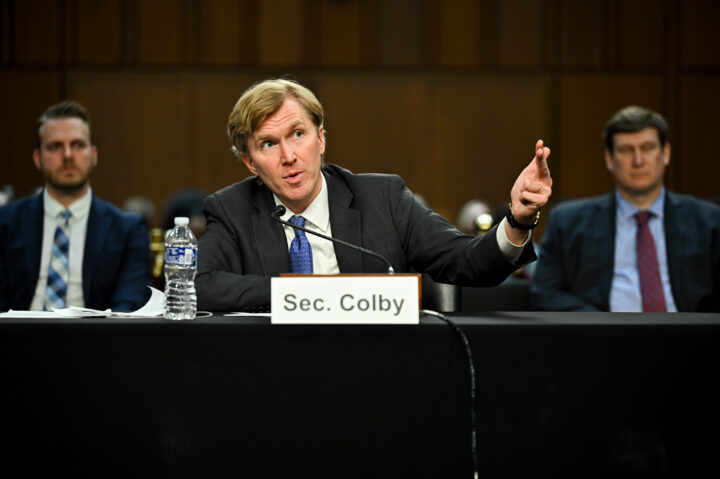
Graeme Sloan/Bloomberg via Getty Images
Elbridge Colby, under secretary of defense for policy, during a Senate Armed Services Committee hearing in Washington, DC, US, on Tuesday, March 3, 2026.
At a Senate Armed Services Committee hearing on Tuesday, a parade of Democratic senators pressed Under Secretary of Defense for Policy Elbridge Colby about the U.S.’ strategy and goals in the war with Iran, criticizing the campaign and its execution without congressional authorization.
Democrats also spotlighted what they said are contradictions between the war effort, the U.S. National Defense Strategy issued just weeks ago and Colby’s own past vociferous opposition to war with Iran. Lawmakers on both sides of the aisle raised concerns about the controversial defense strategy, which sets a high bar for foreign policy intervention, more broadly.
Colby told lawmakers that the U.S. aim in the war is to eliminate Iran’s missile capabilities and naval fleet, echoing the justification provided by Secretary of State Marco Rubio to lawmakers and reporters yesterday — though President Donald Trump’s publicly stated goals for the operation have shifted..
Colby also reiterated that the U.S. is not seeking regime change in Iran, and that operations focused on eliminating top Iranian officials. including the late Ayatollah Ali Khamenei, have been undertaken by Israel — consistent with the division of labor in the operation outlined by other officials as well.
“[Trump] has urged the Iranian people to take this unprecedented opportunity to supplant or overthrow this oppressive Islamic Republic,” Colby said. “But the military campaign, as detailed, that he has directed is focused on the power projection capabilities — and at the end of this campaign, yes, primarily relying on airspace and maritime forces that will have substantially set back a threat.”
Colby insisted that Trump will not “have the yips” and prematurely end the campaign, but will also “learn the lessons of the last 25 years and not make the same mistakes.” He also said that the campaign is in its “earliest stages” but “the results … have been favorable.”
Sen. Angus King (I-ME) warned that the administration is potentially putting the Iranian people in significant danger by urging them to rise up without the arms or necessary support to protect them from renewed regime massacres.
The National Defense Strategy issued by the administration in early December offered little on the Middle East, mentioning Iran just three times and highlighting largely economic interests in the region. Colby’s testimony was nominally focused on the strategy.
Sen. Roger Wicker (R-MS), the chair of the Armed Services Committee, highlighted that the strategy “says little about vital interests in the Middle East. This seems out of step with repeated military actions to deal with the ongoing threat of Iran.”
Democrats went further.
“The NDS is a flawed proposal, and it is now, in many respects, already obsolete,” Sen. Jack Reed (D-RI), the ranking member of the committee, said. “In taking these offensive military actions, President Trump has unilaterally started a conflict that is rapidly spreading throughout the Middle East.”
Colby argued there’s no contradiction between the strategy and the administration’s current actions.
“If you look at the strategy, it details specifically, not only the threat posed by Iran, ensuring that the president has the options to act against Iran,” Colby said, emphasizing that it highlights options for air and naval forces to act against Iran.
He added, “Our Israeli allies are really leaning in, and we see that from our Gulf partners right now, we see that from other partners in Europe,” though he stopped short of saying U.S. allies are taking “primary responsibility” for countering Iran as outlined in the strategy.
Sen. Mark Kelly (D-AZ) argued that the fact that the National Defense Strategy issued just weeks ago made no mention of the threat of Iran’s ballistic missile program belies the administration’s claims now that the growth of that program was a key factor necessitating U.S. strikes.
Colby, seen as a prominent voice of foreign policy restraint in the administration, had also previously vigorously argued against strikes on Iran, including saying that an Iranian nuclear weapon might be preferable to a war launched to eliminate Iran’s nuclear program.
On Tuesday, he offered support for the administration’s actions, both in last year’s strikes on Iranian nuclear facilities and the war that began last weekend.
“Operation Midnight Hammer did have a clear objective — that was something that distinguished it, often from the kinds of perspectives that I was writing about 15 years ago in a private capacity,” Colby said.
Democrats on the committee also continued to raise concerns about comments by Rubio and House Speaker Mike Johnson (R-LA) yesterday that the timing of the U.S. strike was driven by Israel’s determination to strike Iran, to which Iran would have responded by striking U.S. forces.
“I find it very disturbing that we’re committing this nation to war based upon a decision by — even though a staunch ally, and I’m a supporter of Israel, but I don’t think anybody should drive our decision to go to war but interests of the United States,” King said.
Rubio, Trump and other administration officials have subsequently argued that Israel did not force the U.S. to act, that the U.S. was responsible for its own decisions and that the operation was inevitable in the near future.
“The very rapid buildup and reconstitution of Iran’s ballistic missile, cruise missile and one-way attack drones” motivated the attack, Colby said. “There was a perception that this threat has been manifest. As the president said, they’ve been killing Americans for 47 years, and this is something where we can see [where] this is going and they’re going to be able to have … this kind of missile shield.”
He also said that “one of the goals” of the operation was to protect Israel, and that the operation also serves the U.S.’ own interests.
Colby also argued that U.S. operations in Venezuela and Iran have helped to disrupt the global axis of U.S. adversaries, as well as lessen the risk of a worst-case-scenario in which the U.S. faced simultaneous offensives by multiple adversaries including an attack on Taiwan by China and an offensive by Iran in the Middle East, which would stretch American resources thin.
Beyond questions about the war in Iran, Colby also faced off concerns from both sides of the aisle about the National Defense Strategy more broadly, which faced bipartisan criticism for downplaying or ignoring U.S. interests, allies and threats in Europe, the Middle East and the Indopacific, in order to focus on the Western Hemisphere.
“The strategy document fails to acknowledge the global nature of the threat posed by the axis of aggressors working together,” Wicker said, adding that the document ignores the threat from Russia, offers no clear plan for the Western Hemisphere and signals “equivocation” on Taiwan.
“The lack of any significant statement on these developments raises the question: are we ignoring the existential dangers that China, Russia and North Korea pose to our way of life?” Wicker said. “There’s much to like in this strategy, particularly its priorities and emphasis, but I still believe we have much work to do.”
Reed argued that the strategy is “littered with partisan commentary,” suggests U.S. deference to China, offers a clear “abdication of clear national security interests” by overlooking the threat from Russia and takes a harder line toward European partners than toward Beijing.
Colby, in his opening statement, argued that the strategy prioritizes an approach of “flexible realism” that focuses on the “interests of regular Americans,” and recognizes the U.S.’ inability to “do everything, everywhere, all the time.” He said that it charts a middle course between isolationism and interventionism.
“On one hand, isolationism that pretends that we can retreat from the world and a favorable stability will emerge. And on the other hand, an unfair use of military force for overly expansive ends that would drain the American people’s will and resources is unnecessary and over-ambitious conflict,” Colby said. “This strategy rather prudently adopts a middle course that will actually put us on a far firmer, more successful and thus more lasting course than either of these extreme alternatives.”
He said that the U.S. has no need to dominate the Indopacific, but only “prevent that vast and dynamic region from being dominated so that we can trade and interact with it on fair and reasonable terms for everyday Americans,” leading to a strategy of deterring China “through strength, not confrontation.”
Colby denied press reports that he had obstructed the transfers of weapons to Ukraine, claims which earned him bipartisan criticism on Capitol Hill. He claimed to have been directly involved in ensuring that such transfers occurred.
Please log in if you already have a subscription, or subscribe to access the latest updates.
 Continue with Google

 Continue with Apple