




























































Elbridge Colby defends Iran strikes amid criticism of National Defense Strategy
The Senate hearing highlighted the tension between Colby’s preference for foreign policy restraint and the Trump administration’s military strikes in Iran
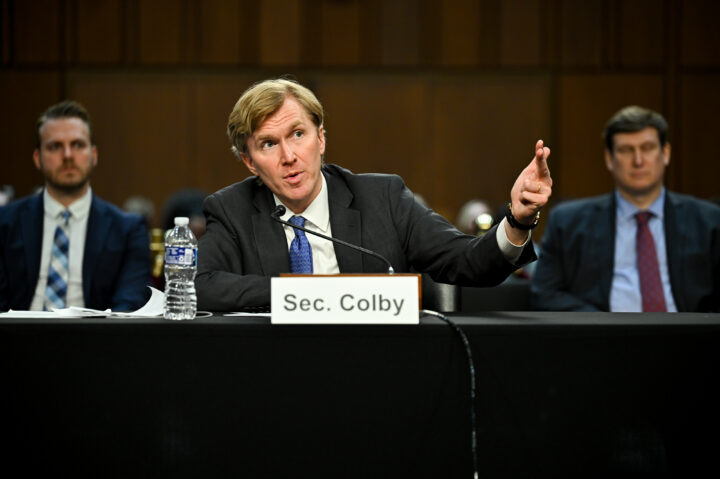
Graeme Sloan/Bloomberg via Getty Images
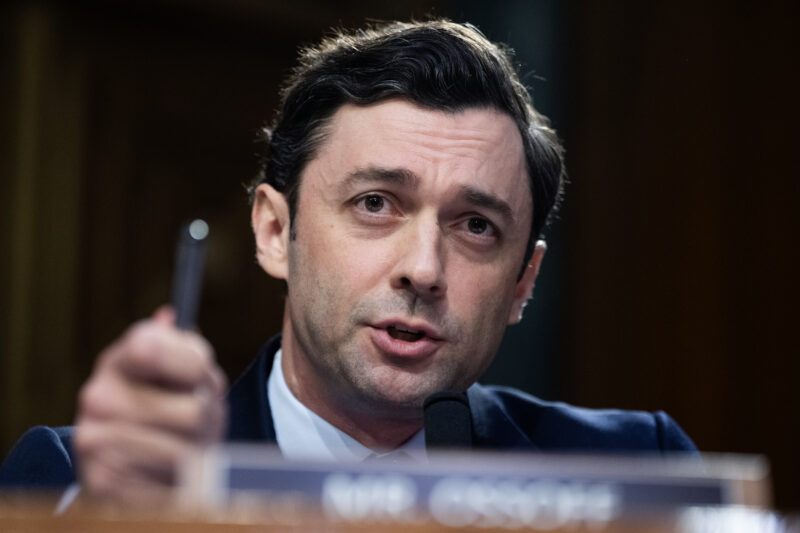
Elbridge Colby, under secretary of defense for policy, during a Senate Armed Services Committee hearing in Washington, DC, US, on Tuesday, March 3, 2026.


 Add JewishInsider on Google
At a Senate Armed Services Committee hearing on Tuesday, a parade of Democratic senators pressed Under Secretary of Defense for Policy Elbridge Colby about the U.S.’ strategy and goals in the war with Iran, criticizing the campaign and its execution without congressional authorization.
Democrats also spotlighted what they said are contradictions between the war effort, the U.S. National Defense Strategy issued just weeks ago and Colby’s own past vociferous opposition to war with Iran. Lawmakers on both sides of the aisle raised concerns about the controversial defense strategy, which sets a high bar for foreign policy intervention, more broadly.
Colby told lawmakers that the U.S. aim in the war is to eliminate Iran’s missile capabilities and naval fleet, echoing the justification provided by Secretary of State Marco Rubio to lawmakers and reporters yesterday — though President Donald Trump’s publicly stated goals for the operation have shifted..
Colby also reiterated that the U.S. is not seeking regime change in Iran, and that operations focused on eliminating top Iranian officials. including the late Ayatollah Ali Khamenei, have been undertaken by Israel — consistent with the division of labor in the operation outlined by other officials as well.
“[Trump] has urged the Iranian people to take this unprecedented opportunity to supplant or overthrow this oppressive Islamic Republic,” Colby said. “But the military campaign, as detailed, that he has directed is focused on the power projection capabilities — and at the end of this campaign, yes, primarily relying on airspace and maritime forces that will have substantially set back a threat.”
Colby insisted that Trump will not “have the yips” and prematurely end the campaign, but will also “learn the lessons of the last 25 years and not make the same mistakes.” He also said that the campaign is in its “earliest stages” but “the results … have been favorable.”
Sen. Angus King (I-ME) warned that the administration is potentially putting the Iranian people in significant danger by urging them to rise up without the arms or necessary support to protect them from renewed regime massacres.
The National Defense Strategy issued by the administration in early December offered little on the Middle East, mentioning Iran just three times and highlighting largely economic interests in the region. Colby’s testimony was nominally focused on the strategy.
Sen. Roger Wicker (R-MS), the chair of the Armed Services Committee, highlighted that the strategy “says little about vital interests in the Middle East. This seems out of step with repeated military actions to deal with the ongoing threat of Iran.”
Democrats went further.
“The NDS is a flawed proposal, and it is now, in many respects, already obsolete,” Sen. Jack Reed (D-RI), the ranking member of the committee, said. “In taking these offensive military actions, President Trump has unilaterally started a conflict that is rapidly spreading throughout the Middle East.”
Colby argued there’s no contradiction between the strategy and the administration’s current actions.
“If you look at the strategy, it details specifically, not only the threat posed by Iran, ensuring that the president has the options to act against Iran,” Colby said, emphasizing that it highlights options for air and naval forces to act against Iran.
He added, “Our Israeli allies are really leaning in, and we see that from our Gulf partners right now, we see that from other partners in Europe,” though he stopped short of saying U.S. allies are taking “primary responsibility” for countering Iran as outlined in the strategy.
Sen. Mark Kelly (D-AZ) argued that the fact that the National Defense Strategy issued just weeks ago made no mention of the threat of Iran’s ballistic missile program belies the administration’s claims now that the growth of that program was a key factor necessitating U.S. strikes.
Colby, seen as a prominent voice of foreign policy restraint in the administration, had also previously vigorously argued against strikes on Iran, including saying that an Iranian nuclear weapon might be preferable to a war launched to eliminate Iran’s nuclear program.
On Tuesday, he offered support for the administration’s actions, both in last year’s strikes on Iranian nuclear facilities and the war that began last weekend.
“Operation Midnight Hammer did have a clear objective — that was something that distinguished it, often from the kinds of perspectives that I was writing about 15 years ago in a private capacity,” Colby said.
Democrats on the committee also continued to raise concerns about comments by Rubio and House Speaker Mike Johnson (R-LA) yesterday that the timing of the U.S. strike was driven by Israel’s determination to strike Iran, to which Iran would have responded by striking U.S. forces.
“I find it very disturbing that we’re committing this nation to war based upon a decision by — even though a staunch ally, and I’m a supporter of Israel, but I don’t think anybody should drive our decision to go to war but interests of the United States,” King said.
Rubio, Trump and other administration officials have subsequently argued that Israel did not force the U.S. to act, that the U.S. was responsible for its own decisions and that the operation was inevitable in the near future.
“The very rapid buildup and reconstitution of Iran’s ballistic missile, cruise missile and one-way attack drones” motivated the attack, Colby said. “There was a perception that this threat has been manifest. As the president said, they’ve been killing Americans for 47 years, and this is something where we can see [where] this is going and they’re going to be able to have … this kind of missile shield.”
He also said that “one of the goals” of the operation was to protect Israel, and that the operation also serves the U.S.’ own interests.
Colby also argued that U.S. operations in Venezuela and Iran have helped to disrupt the global axis of U.S. adversaries, as well as lessen the risk of a worst-case-scenario in which the U.S. faced simultaneous offensives by multiple adversaries including an attack on Taiwan by China and an offensive by Iran in the Middle East, which would stretch American resources thin.
Beyond questions about the war in Iran, Colby also faced off concerns from both sides of the aisle about the National Defense Strategy more broadly, which faced bipartisan criticism for downplaying or ignoring U.S. interests, allies and threats in Europe, the Middle East and the Indopacific, in order to focus on the Western Hemisphere.
“The strategy document fails to acknowledge the global nature of the threat posed by the axis of aggressors working together,” Wicker said, adding that the document ignores the threat from Russia, offers no clear plan for the Western Hemisphere and signals “equivocation” on Taiwan.
“The lack of any significant statement on these developments raises the question: are we ignoring the existential dangers that China, Russia and North Korea pose to our way of life?” Wicker said. “There’s much to like in this strategy, particularly its priorities and emphasis, but I still believe we have much work to do.”
Reed argued that the strategy is “littered with partisan commentary,” suggests U.S. deference to China, offers a clear “abdication of clear national security interests” by overlooking the threat from Russia and takes a harder line toward European partners than toward Beijing.
Colby, in his opening statement, argued that the strategy prioritizes an approach of “flexible realism” that focuses on the “interests of regular Americans,” and recognizes the U.S.’ inability to “do everything, everywhere, all the time.” He said that it charts a middle course between isolationism and interventionism.
“On one hand, isolationism that pretends that we can retreat from the world and a favorable stability will emerge. And on the other hand, an unfair use of military force for overly expansive ends that would drain the American people’s will and resources is unnecessary and over-ambitious conflict,” Colby said. “This strategy rather prudently adopts a middle course that will actually put us on a far firmer, more successful and thus more lasting course than either of these extreme alternatives.”
He said that the U.S. has no need to dominate the Indopacific, but only “prevent that vast and dynamic region from being dominated so that we can trade and interact with it on fair and reasonable terms for everyday Americans,” leading to a strategy of deterring China “through strength, not confrontation.”
Colby denied press reports that he had obstructed the transfers of weapons to Ukraine, claims which earned him bipartisan criticism on Capitol Hill. He claimed to have been directly involved in ensuring that such transfers occurred.
More Stories

STUDENT SAFETY
Federal civil rights complaint accuses Montgomery County, Md., schools of ignoring antisemitic harassment

UNKNOWN HORIZON
Final Israeli polls point to stalemate ahead of Tuesday’s election
DEBATE DIGS
Rogers describes El-Sayed as a national security threat in final Michigan Senate debate

UNHOLY ALLIANCE
New El-Sayed ad features Tucker Carlson, far-right podcaster’s attack on Mike Rogers
ECONOMIC ANGST
Netanyahu predicts end of U.S. military aid, calls for plan to circumvent potential sanctions

FINAL SPRINT
DMFI to spend $7 million to support Reps. Don Davis, Shomari Figures
Please log in if you already have a subscription, or subscribe to access the latest updates.
 Continue with Google
 Continue with Apple