


































The school said the planning process ‘did not meet the necessary level of rigor’; the event listing had described Piker as ‘armed with sharp analysis and an irreverent wit’

Joshua Lott/Getty Images
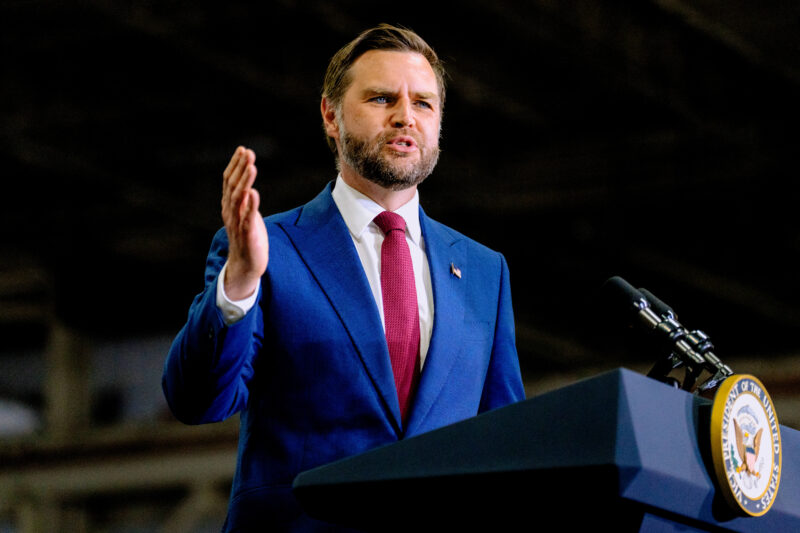
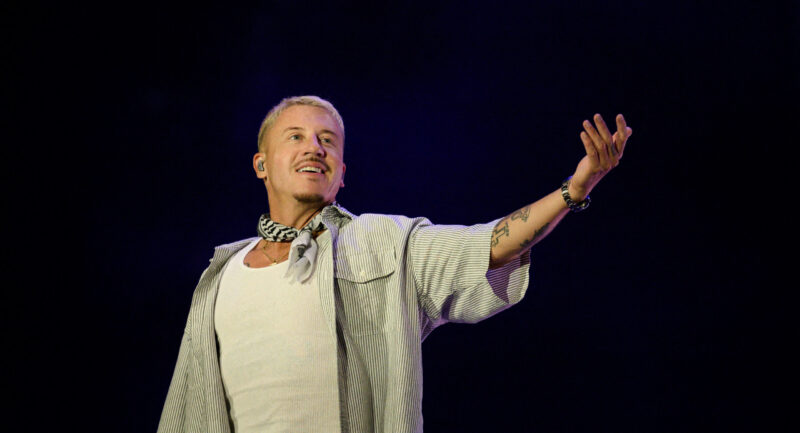
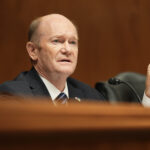
Hasan Piker speaks during a campaign rally for Wisconsin gubernatorial candidate Francesca Hong on August 2, 2026 in Milwaukee, Wisconsin.


 Add JewishInsider on Google
The University of Washington on Friday reversed its decision to host far-left, antisemitic influencer Hasan Piker, citing a flawed planning process.
Piker, who has an extensive history of antisemitic rhetoric — including justifying Hamas’ Oct. 7, 2023, terrorist attacks, calling Orthodox Jews “inbred” and asserting that America deserved 9/11 — was scheduled to appear in January as part of the school’s 2026-27 Speaker Series.
On Friday, however, the public university in Seattle said that “it was determined that the process for organizing this event did not meet the necessary level of rigor for University-hosted events in the Speaker Series. As a result, this event will not be held.”
“Going forward, procedures will be updated to ensure the standards we have for University-hosted events like the Speaker Series are met, particularly so that we can help elevate the level of dialogue on divisive topics during a polarized time in our country,” the statement said.
The event listing, which has since been removed from the university website, described Piker as a “journalist and wildly popular content creator,” who has “become an authoritative voice for millennials and Gen Z,” and as someone who is “armed with sharp analysis and an irreverent wit.” It also asserted that Piker “has built a massive daily audience on Twitch and become an unlikely but authoritative voice for a generation hungry for honest political engagement.”
The listing added that Piker has “sharp political insight and a characteristically irreverent sense of humor” and that he is “redefining what political commentary looks like in the digital age.” The university suggested attendees pay $10 per ticket, Jerusalem News Syndicate reported before the cancellation.
Miriam Elman, executive director of the Academic Engagement Network, a network of faculty and staff countering antisemitism on campus, told Jewish Insider that the school’s faculty and administration should work to ensure a similar incident does not occur in the future.
“In general, universities shouldn’t be in the business of canceling speakers, provided they are invited through established processes. University officials should use their own voice to distance the school from hateful speech and to reiterate school values,” said Elman. “However, in this case, the university has alleged that protocols weren’t followed properly in organizing the event. It’s reassuring to hear that moving forward the university will work to ensure that standards for such university events are met — as clearly they weren’t in this case.”
Elman called the description of the event, which lauded Piker, “an embarrassment.”
“In addition to tightening up standards and protocols for future guest speaker invitations, it’s also important for university officials to get to the bottom of the invite itself — who were the administrators and faculty who thought that Piker, a non-academic provocateur who has repeatedly supported U.S.-designated terror organizations, engaged in Holocaust trivialization and vilified Jewish-Zionist identity, would be the right speaker for this year’s series?”
“Guest speakers come and go — it’s the faculty and staff who are the permanent stakeholders,” said Elman.
Piker has recently been invited to speak at high-profile student events, including the Yale Political Union and the College Democrats of America’s convention.
The perpetrator was reportedly music student Alexander Stepnowsky, who is being charged with a hate crime and trespassing
Getty Images
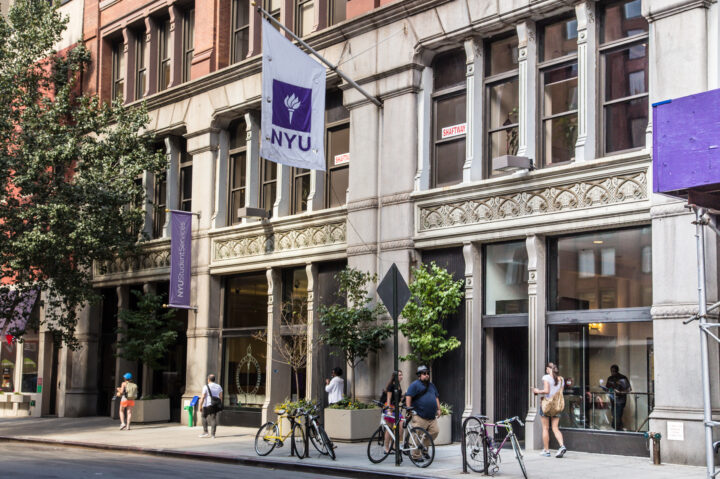
Street view of New York University NYU in Greenwich Village Manhattan.
The NYPD arrested an NYU student Wednesday for raising a flag that displayed swastikas and a Star of David atop a university building last month.
The perpetrator was a fourth-year NYU student at the time of the incident and has not yet received a diploma, a university spokesperson told Jewish Insider on Wednesday. The New York Times reported that the man is named Alexander Stepnowsky, a music technology student.
He was charged with a hate crime and trespassing, among other charges. NYU will carry out its own disciplinary measures, which could include expulsion or degree revocation, the spokesperson said.
Appearing near Washington Square Park on May 13, the flag mimicked the purple NYU banners seen across campus, yet it was emblazoned with a Star of David flanked by two swastikas. It was flown on the roof of the Steinhardt building, named in honor of its Jewish benefactors, Michael and Judy Steinhardt.
“The University cooperated fully with the NYPD. We are grateful for their exhaustive work and for the efforts of the Manhattan District Attorney in identifying the person responsible for this heinous crime,” Wiley Norvell, senior vice president for university relations and public affairs said in a statement.
“The symbols that were represented are antisemitic and hateful to every person of conscience; this appalling act violated our sense of community and solidarity. In addition to criminal proceedings, we will immediately pursue our disciplinary procedures, which carry the most severe consequences.”
“I commend NYU for its unequivocal condemnation of this hateful act, its cooperation with law enforcement, and its commitment to full accountability,” said Mark Treyger, CEO of the Jewish Community Relations Council of New York.
The report ‘makes clear that antisemitism and all other forms of discrimination and bigotry have no place at UCLA,’ said Chancellor Julio Frenk, who launched the task force
Myung J. Chun / Los Angeles Times via Getty Images
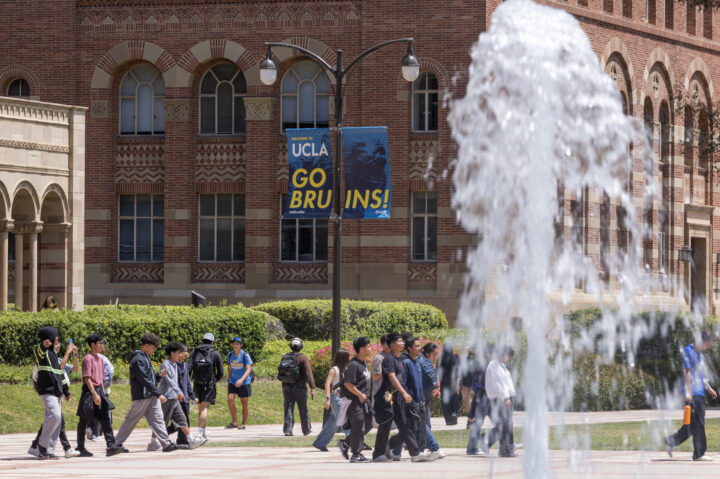
Campus of UCLA in Westwood, CA on Tuesday, May 5, 2026.
An antisemitism task force championed by UCLA Chancellor Julio Frenk released a report on Thursday urging the university to intensify its crackdown on anti-Jewish harassment, as the school continues to be enmeshed in legal battles with the Trump administration.
The 42-page set of recommendations, issued by the Initiative to Combat Antisemitism action group, suggested that UCLA set a deadline of 120 days to resolve disciplinary cases. It also said the university should more clearly define consequences for violations to Title VI of the Civil Rights Act of 1964.
The committee further urged UCLA to prevent faculty groups from using university resources or authority to express institutional support for anti-Zionism or the Boycott, Divestment and Sanctions movement and to implement the International Holocaust Remembrance Alliance’s working definition of antisemitism into rule enforcement and policy formation.
“The roadmap announced today turns our values into action. It makes clear that antisemitism and all other forms discrimination and bigotry have no place at UCLA,” said Frenk, who took over the school’s leadership last year.
UCLA’s Initiative to Combat Antisemitism was formed last year following recommendations of the 2024 Task Force to Combat Antisemitism and Anti-Israeli Bias. It is led by Stuart Gabriel, a professor in UCLA’s Anderson School of Management.
“Our work at UCLA is building a strong foundation for a campus free of discrimination, and we hope our initiative can serve as a blueprint for colleges and universities nationwide as they seek to build more inclusive campuses,” Gabriel said.
Daniel Gold, a member of the committee and executive director of UCLA Hillel, told Jewish Insider, “While initial work of our Initiative has concluded with the release of this important report, the work of everyone else at UCLA now begins to implement these changes and uphold the commitment towards a campus free of antisemitism.”
The report comes shortly after the school’s student government condemned a campus event featuring former Israeli hostage Omer Shem Tov, labeling the speaker selection as “selective platforming of narratives that obscure the broader reality of ongoing state violence” and “a troubling disregard for Palestinian life.”
UC Regent Jay Sures told JI at the time that UCLA’s student government was “shortsighted, antisemitic or both,” and called its members “lunatics” for condemning Shem Tov’s appearance. Sures, who is Jewish, had his home vandalized last year by UCLA Students for Justice in Palestine, which was since banned from campus.
The federal government has been in a monthslong legal battle with UCLA, including a February lawsuit alleging that the campus failed to protect Jewish and Israeli faculty and staff in accordance with Title VII of the Civil Rights Act of 1964, which prohibits employment discrimination.
The DOJ complaint alleges that since the Oct. 7, 2023, terrorist attacks in Israel, UCLA “has ignored, and continues to ignore, gross and repeated violations of viewpoint-neutral time, place, and manner restrictions. Jewish and Israeli faculty have been physically threatened, had their classrooms disrupted, and had their workplaces papered with disturbing images.”
Last year, UCLA settled a lawsuit with Jewish students who alleged that the university permitted antisemitic conduct during the spring 2024 anti-Israel encampments on the campus.
The new report does not specifically mention the Trump administration crackdown.
According to several university presidents who gathered last week at the Milken Institute Global Conference in Los Angeles, the task before universities is to win back the trust of skeptical Americans
GETTY IMAGES
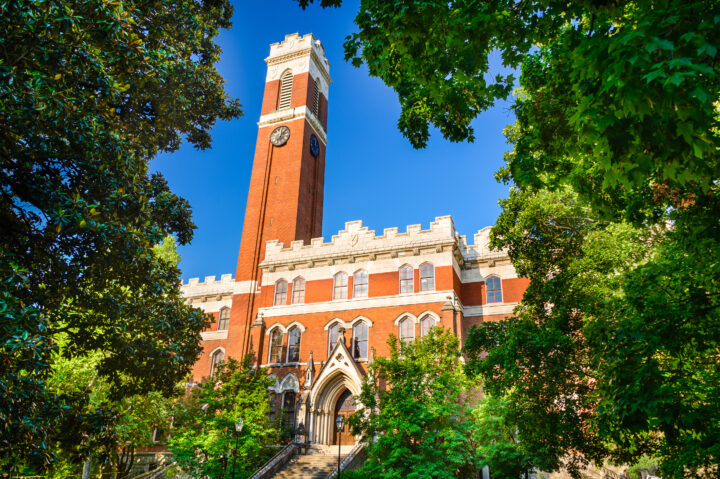
Campus of Vanderbilt Unversity in Nashville, Tennessee.
Over the last two years, the second semester of the academic year at American universities coincided with crisis and chaos.
In 2024, it was anti-Israel encampments overtaking campus quads across the country; last year, it was threats from the Trump administration to slash hundreds of millions of dollars in funding and ban foreign students.
By comparison, the spring of 2026 has been relatively smooth sailing for research universities, even with a bit of hubbub over graduation speakers scrutinized for their stance on Israel and Gaza at a few schools, including the University of Michigan and Georgetown Law.
But it’s not that things have gone back to the pre-Oct. 7, pre-Donald Trump normal. University administrators have just gotten better at managing an ambient sense of friction: Conflict between university leaders and activist faculty and students is still bubbling under the surface, and the threat of funding cuts at the federal level lingers.
According to several university presidents who gathered last week at the Milken Institute Global Conference in Los Angeles, the task before universities is to win back the trust of skeptical Americans.
“The world of higher education, I think, is still in turmoil,” Vanderbilt University Chancellor Daniel Diermeier told Jewish Insider in an interview at the Milken confab. “I think the time when a university does say that’s all overblown and everything is great, that’s over. At least the vast majority of university presidents know that there are challenges, and they want to take them on.”
While the leaders of many elite universities struggled to respond to anti-Israel activism that at times veered into antisemitism and violence, Diermeier was one of a handful of leaders at elite universities in 2023 to speak clearly about what constituted acceptable protest and what violated school rules. He has also been a forceful advocate for institutional neutrality, a position that many of Vanderbilt’s peer institutions — such as Harvard, Stanford and Columbia — have since adopted in the wake of that heady year.
“My sense is that higher education is moving overall,” said Diermeier. “You feel there is momentum there. … It’s gratifying to see that this is happening, and it must happen, because fundamentally we need to regain the trust of the American public.”
For American Jews, the post-Oct. 7 campus chaos has led some to rethink the kind of institution they want to attend.
“As a professor, as an educator, one of the most tragic dimensions of what’s happened on campus is it’s introduced this wedge between American Jews and the university,” Steven Weitzman, director of the Center of Advanced Judaic Studies at the University of Pennsylvania, said at a panel on antisemitism at Milken. “That relationship has been so important for Jewish success and also for the success of the university.”
That wedge has benefitted schools like Vanderbilt and Dartmouth College, each of which have pitched themselves as places where a multiplicity of voices can be found, without the disruptions that have plagued peer institutions.
“We have a culture that is very committed to creating an educational environment where these different voices can be heard, and where you don’t have to justify all the time that you went on a Birthright trip,” said Diermeier.
Dartmouth College President Sian Beilock started at the university in September 2023, and she said she has observed “a more robust, vibrant Jewish presence on our campus” since then. “It feels like something special is happening,” she told JI in an interview at Milken.
Both Beilock and Diermeier touted their cooperation with the campus Chabad and Hillel organizations. Earlier this month, the student government at The New School in New York City voted to defund and sever ties with Hillel over its connections to Israel. (The administration rejected the measure.) Beilock called the development “concerning,” and Diermeier said it is “awful.”
“It would never be tolerated for any other group. It is exactly what’s wrong. At that point, you are violating the fundamental principles of an institution,” Diermeier said. “They are terrible developments and it shows us that we still have a lot of work to do.”
Like Vanderbilt, Dartmouth took on the tumult of the post-Oct. 7 era forcefully and directly. Beilock said she was always clear about the university’s mission in a way that some of her colleagues at other schools were not, though that is beginning to change.
“We’ve called balls and strikes, and I actually think it’s led to a campus where we have some of the most diverse views portrayed on campus in a way that’s more respectful,” Beilock said. “I see a shift in presidents understanding that it’s important to call out the mission of an institution, to be clear about that, and important to ensure that people who are both receiving our education and benefiting from the impact, whether it’s our doctors or discoveries, see the power in what we do.”
In other words: universities need to do a much better job of telling their stories, and not acting like their worth is self-evident. Trust in higher education was higher last year than in 2023 or 2024 — 42%, according to a Gallup poll in 2025, up from 36% — but still down from 57% a decade before. University of Southern California President Beong-Soo Kim said at a Milken panel about the future of higher education that the problems facing the academy connect to a broader loss of public trust.
“There’s a larger breakdown in trust in other institutions, not just higher education, and I think that that’s something important to understand,” Kim said. “I think that there’s an opportunity for partnership among universities, between universities and the government, and the private sector.”
Making change on that front requires humility, a quality that is not always present among elite institutions.
“I think there’s a lot of institutional rigidity to prevent that from happening,” said Eric Gertler, CEO of U.S. News & World Report, which publishes annual college rankings.
Rebuilding that trust runs through Washington, university leaders have begun to realize. Prominent universities are building out satellite campuses — and lobbying shops — in the nation’s capital.
Diermeier and Beilock told JI that they have each decided to engage with Washington more than ever, including by traveling to the city regularly for meetings with members of Congress and administration officials. Vanderbilt and Dartmouth have for now managed to avoid the most severe of the civil rights investigations or funding cuts coming from the Trump administration, but shifts in funding priorities from the federal government still impact the schools.
“I spent a lot of time in D.C. in the last year. I’ve probably been there close to a dozen times, and I plan to continue it. It’s more than I did before, but really important,” Beilock said. “I think we have to be clear to our representatives what the value of the government-university partnership is and how important it is not to lose it. And part of that, to me, is being clear where we can do better.”
Professor Morton Schapiro withdrew as speaker for the law school’s graduation after students objected to his selection over his pro-Israel stances

Bill O'Leary/The Washington Post via Getty Images
A sign for Georgetown Law School, in front of the McDonough building in Washington, DC.
After a Jewish university leader withdrew as Georgetown University Law Center’s commencement speaker following backlash from anti-Israel student activists, the school replaced him with a professor who criticized congressional hearings on campus antisemitism as a form of “McCarthyism” aimed at chilling free speech.
In an email to law school students on Wednesday, Joshua Teitelbaum, the interim dean of Georgetown Law, wrote that “in the past week, a number of law students raised concerns” about the speaker selection of Morton Schapiro, an economist and the former president of Northwestern University for over 10 years. Teitelbaum said those concerns were “due primarily to opinion essays [Schapiro] published on Israel and Palestine in the aftermath of Oct. 7, 2023.”
Teitelbaum said he “listened carefully” to students’ concerns but had determined that withdrawing Schapiro’s invitation would be “inconsistent with Georgetown’s commitment to free and open inquiry.” Schapiro then independently “decided to decline our invitation to speak” after learning of the students’ concerns, Teitelbaum said.
Schapiro has written extensively for the Jewish Journal in the aftermath of the Oct. 7 attacks, including criticizing university presidents for failing to protect Jewish students and suggesting that progressive organizations abandoned Israel and the Jewish community after the attacks. Schapiro could not be reached for comment.
Teitelbaum announced in the email that Georgetown Law professor David Cole would replace Schapiro as commencement speaker. Cole, the former national legal director of the American Civil Liberties Union, last year spoke before the House Committee on Education and the Workforce in defense of First Amendment speech that “many of us find wrongheaded or deeply offensive, including anti-Israel advocacy and even antisemitic advocacy.” He also condemned Republican-led congressional hearings into the rise of campus antisemitism.
“It is beyond antisemitic of the university to do this. It’s extremely heartbreaking and devastating to the Jewish students that [Georgetown Law] respectfully asked [Schapiro] to step down because of his belief in a Jewish homeland,” Julia Wax Vanderwiel, a third-year law school student and founder of Georgetown Law Zionists, told Jewish Insider.
Georgetown University — and its law school — have been under scrutiny for alleged inaction against extremism and the more than $1 billion the school has received from Qatar. Liz Magill, who resigned as University of Pennsylvania president after facing criticism of inaction against campus antisemitism, was tapped in February as the dean of Georgetown’s law school. She will assume the role on Aug. 1.
Last year, the law school faced criticism for scheduling a discussion featuring a convicted member of the U.S.-designated terrorist organization Popular Front for the Liberation of Palestine. The event, which was organized by Georgetown Law Students for Justice in Palestine, was postponed indefinitely following pushback from both Israeli Prime Minister Benjamin Netanyahu and Rep. Ritchie Torres (D-NY). Weeks after the Oct. 7 attacks, Georgetown Law hosted Palestinian writer Mohammed El-Kurd, who celebrated Hamas as a “liberation movement” and called the massacre a “resistance tactic.”
“I have been fighting the university administration on antisemitism since I stepped foot on this law school,” Wax Vanderwiel told JI. “It feels like I’m arguing with a brick wall sometimes. [The administration] doesn’t have any interest in changing their behaviors as they claim to have for the past three years I’ve been here.”
Julio Frenk said the school has ‘a real problem with antisemitism’ but won’t compromise academic freedom
(Luke Johnson / Los Angeles Times via Getty Images
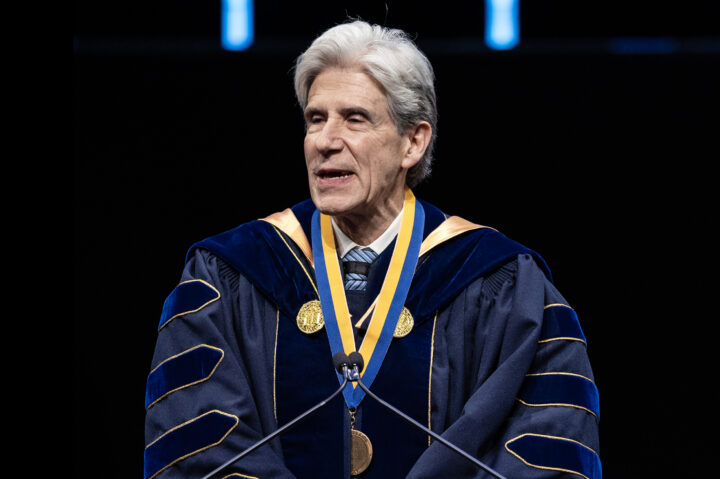
UCLA Chancellor Julio Frenk speaks during his inauguration ceremony at Royce Hall on Thursday, June 5, 2025 in Los Angeles, CA.
As UCLA works to restore $500 million in federal grant funding cut by the Trump administration earlier this year, the university’s chancellor, Julio Frenk, said on Thursday that there are three principles the campus must “safeguard” amid its negotiations with the government.
“We need to assure that there’s no government interference in who we hire, who we admit and what we teach or do research on,” Frenk told radio talk show host Larry Mantle. The two spoke during a virtual event on Thursday hosted by Jews United for Democracy and Justice, a group formed in response to President Donald Trump’s executive orders during his first term that prohibited travel and refugee resettlement from select, predominately Muslim, countries.
“That’s the core of academic freedom,” Frenk, who began his tenure as chancellor in January, said of the series of principles.
Earlier this month, the Trump administration sent a 28-page settlement proposal to UCLA, The Los Angeles Times reported. In addition to accusations that the university failed to address antisemitism on campus, the government said it was cutting funding over the school’s use of race in admissions and the school’s recognition of transgender identities. Frenk said that he is not directly participating in the negotiations.
Frenk, a Jewish physician whose grandparents settled in Mexico after fleeing Nazi Germany in the 1930s, admitted that UCLA has “a real problem with antisemitism” and said the university needs “to tackle it.”
But he criticized the Trump administration’s approach of “cutting funding for life-saving and life-transforming research,” saying it “doesn’t address the problem of antisemitism.”
Asked how he would handle an incident similar to last year’s demonstration in which pro-Palestinian protesters blocked campus access for some Jewish students, leading to a lawsuit and a $6 million settlement in July, Frenk responded that “if anything happens like that, we will act immediately, because we now have very clear rules” around demonstrations. The university released a new set of time, place and manner policies earlier this month.
Questioned whether UCLA would adopt the International Holocaust Remembrance Alliance’s working definition of antisemitism — as Harvard and Columbia have recently done while similarly under antisemitism investigations — Frenk declined to endorse or oppose the idea, which is supported by many pro-Israel students and faculty.
Soon after stepping into his new role at UCLA, Frenk suspended the undergraduate and graduate chapters of Students for Justice in Palestine after their members vandalized the home of UC Regent Jay Sures. In March, he announced an initiative to implement the recommendations of a task force that examined antisemitism and anti-Israel activity on campus. On Thursday, Frenk said that as part of the initiative, the university was “about to announce the recruitment of a Title VI officer” to enforce federal civil rights statutes and implement training for students and staff.
Frenk said that combating campus antisemitism will make all students on campus safer. “A reason to fight antisemitism is to also protect our non-Jewish, including our Muslim students. We cannot accept bigotry, discrimination, hatred against one group. History shows us that if one group is attacked, and we allow that to go on, everyone is unsafe. So, this applies to all of our students.”
Securing government payouts as the primary achievement for using state power to freeze a private university’s funds makes the whole enterprise seem like extortion
Mostafa Bassim/Anadolu via Getty Images
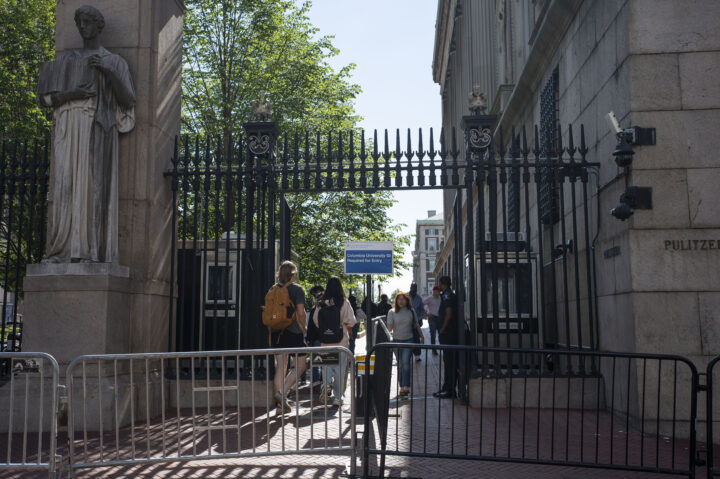
Students enter campus on the first day of the fall semester at Columbia University in New York City, United States on September 2, 2025.
Over the weekend, The New York Times published a story contending that the momentum for settlements with elite universities was stalling amid divisions between those in the Trump administration looking to make a deal and those looking for more meaningful reforms in combating antisemitism.
The story glossed over the related development we’ve been hearing from officials involved in the negotiating process: that a zeal for dealmaking from some officials is overshadowing the main reason the Trump administration was playing hardball with these schools in the first place — the rampant antisemitism that has been festering on campus.
In fact, the word “antisemitism” was hardly mentioned in the lengthy NYT story, a sign in itself of the administration’s flagging focus.
Indeed, many of the deals struck — along with the outlines of potential future deals — have focused on the dollar amounts in the settlement, without requiring many significant reforms that would deal with antisemitism at the elite schools.
Columbia University agreed in July, following a lengthy legal battle, to pay a $200 million settlement over three years to the federal government. In addition to the legal penalty, the Ivy League school — which did not admit to wrongdoing in the resolution agreement — pledged to implement a series of commitments aimed at protecting Jewish students.
These include further incorporating the International Holocaust Remembrance Alliance’s working definition of antisemitism by requiring its Office of Institutional Equity to embrace the definition; appointing a Title VI coordinator to review alleged violations of the Civil Rights Act; requiring antisemitism training for all students, faculty and staff; and refusing to recognize or meet with anti-Israel student coalition Columbia University Apartheid Divest.
On Columbia’s campus, some pro-Israel students expressed disappointment over those “largely symbolic” commitments, which diverged from a list of reforms initially demanded by the Trump administration.
Soon after Columbia, Brown University entered into an agreement with the Trump administration to restore hundreds of millions of dollars in federal funding. The settlement also primarily focused on money rather than reform, although unlike Columbia, Brown was not required to pay a fine directly to the federal government. The university instead agreed to pay $50 million over 10 years to workforce development organizations in Rhode Island. It also agreed to launch a third-party campus climate survey in an effort to protect Jewish students.
Meanwhile, the conversation surrounding a possible settlement with Harvard has increasingly centered on the significant size of the potential payment — a whopping half-billion dollars — over any of the institutional changes the university will need to make. Sources familiar with the dealmaking confirm to Jewish Insider that President Donald Trump himself is increasingly enamored with the size of the payment, which has led some of his advisors to focus less on reforms and more on the money.
“There’s growing dissatisfaction with the White House letting universities buy their way out of accountability with no meaningful change. It’s clear they’ve been totally out-negotiated,” said one source familiar with the negotiations.
Reading the Times story, the administration officials working to fight against the universities’ harassment of their Jewish students were caricatured as “ideologically driven aides,” whereas those looking to cut lucrative financial deals were portrayed as the pragmatists.
The reality is the opposite. Securing government payouts as the primary achievement for using state power to freeze a private university’s funds makes the whole enterprise seem like extortion. Putting in the work to make sure these abuses don’t happen again is what would make the exertion of government power more justifiable.
Indeed, the outcome of this showdown with elite universities — with negotiations with Cornell and Northwestern taking place now — will be a test of whether many of the systemic abuses that led to the extraordinary freeze on research funding will be rolled back, or whether the tolerance of anti-Jewish discrimination on campus could become the new normal.
The suggestions range from enforcing campus codes of conduct to holding faculty accountable for political coercion

Wesley Lapointe for The Washington Post via Getty Images
A row of tents line one side of a student encampment protesting the war in Gaza at the Johns Hopkins University Homewood Campus on Tuesday April 30, 2024, in Baltimore, MD.
As students return to school in the coming weeks, four leading Jewish organizations are encouraging university leaders to adopt a new set of recommendations, released on Monday, designed to curb the antisemitism that has overwhelmed many campuses since the Oct. 7, 2023, terrorist attacks in Israel, Jewish Insider has learned.
The guidelines — which call for increased safety measures as well as long-term structural reforms and build upon a four-page set of recommendations released last August — are a joint effort from the Anti-Defamation League, Conference of Presidents of Major American Jewish Organizations, Hillel International and Jewish Federations of North America.
The recommendations urge university leaders to “consistently enforce” codes of conduct around protests; appoint a coordinator to address Title VI discrimination complaints; reject academic boycotts of Israel; conduct annual student and faculty surveys in regard to campus antisemitism; crackdown on online harassment (in addition to physical safety concerns); and hold faculty accountable for political coercion and identity-based discrimination.
Some of the guidelines, such as the appointment of a Title VI coordinator, echo commitments that several university leaders have made in recent months amid battles with the Trump administration over federal funding. At Columbia University, some Jewish students expressed skepticism that the moves would have a significant impact on campus antisemitism.
“These recommendations aren’t just suggestions, they’re essential steps universities need to take to ensure Jewish students can learn without fear,” ADL CEO Jonathan Greenblatt said in a statement. “Jewish students are being forced to hide who they are, and that’s unacceptable — we need more administrators to step up.”
“We are encouraged by the universities that have taken prior recommendations seriously, implementing changes that have reduced the most severe types of incidents, creating safer and more welcoming environments as a result. But our work is far from complete,” Hillel International president and CEO Adam Lehman said in a statement. “These updated recommendations provide a roadmap for institutions to build on their progress and address the challenges Jewish students continue to face.”
The recommendations released last summer by the same groups, in addition to the American Jewish Committee, called for university leaders to “anticipate and mitigate disruptions” on the one-year anniversary of Oct. 7. Other suggestions included that universities clearly communicate campus rules, standards and policies, support Jewish students, ensure campus safety and reaffirm faculty responsibilities.
The leaders of Georgetown, CUNY and UC Berkeley condemned antisemitism generally at a Capitol Hill hearing, but struggled to criticize antisemitic professors

Win McNamee/Getty Images
Dr. Robert Groves, Interim President of Georgetown University, Dr. Félix Matos Rodríguez, Chancellor of The City University of New York, and Dr. Rich Lyons, Chancellor of the University of California, Berkeley, testify during a House Committee on Education and Workforce hearing in the Rayburn House Office Building on July 15, 2025 in Washington, DC.
When the leaders of Georgetown University, the City University of New York and the University of California, Berkeley sat down on Tuesday morning to testify at a congressional hearing about antisemitism, they clearly came prepared, having learned the lessons of the now-infamous December 2023 hearing with the presidents of Harvard, the University of Pennsylvania and MIT, each of whom refused to outright say that calls for genocide violated their schools’ codes of conduct.
Georgetown interim President Robert Groves, CUNY Chancellor Felix Matos Rodriguez and UC Berkeley Chancellor Rich Lyons were all quick to denounce antisemitism and even anti-Zionism at Tuesday’s House Education and Workforce Committee hearing examining the role of faculty, funding and ideology in campus antisemitism.
But while the university administrators readily criticized antisemitism broadly, they struggled to apply that commitment directly to their field of academia.
Lyons in particular offered a revealing look at the gulf between a university’s stated values and its difficulty in carrying them out.
He was asked to account for the promotion of Ussama Makdisi, a Berkeley history professor who described the Oct. 7, 2023, Hamas terror attacks as “resistance” and later wrote on X that he “could have been one of those who broke the siege on October 7.” Why, Lyons was asked by Reps. Randy Fine (R-FL) and Lisa McClain (R-MI), did Berkeley announce last September that Makdisi had been named the university’s inaugural chair of Palestinian and Arab studies?
Lyons first defended Makdisi: “Ussama Makdisi, Professor Makdisi, is a fine scholar. He was awarded that position from his colleagues based on academic standards,” Lyons said.
Later, when McClain followed Fine’s line of questioning, Lyons went to great lengths to avoid criticizing Makdisi.
“I want to separate the phrase from the person. If I heard some other person —” he said, before McClain cut him off. What, McClain asked, did Lyons think Makdisi meant with his tweet?
For five seconds, Lyons sat in silence.
“I believe it was a celebration of the terrorist attack on Oct. 7,” he replied slowly.
He shared that he had spoken to Makdisi about the social media post. Pressed to share what the conversation was like, Lyons returned to an earlier line: “He’s a fine scholar,” Lyons said.
Lyons, like Matos Rodriguez and Groves, acknowledged that antisemitism exists at his campus. But they all struggled to reckon with what Republican lawmakers alleged was an explosion in antisemitism at each of the three schools after Oct. 7.
“I believe that most Jewish students feel safe on our campus,” Lyons said, though he also said that he knows some do not feel safe. When asked why they may not feel safe, he demurred.
“Well, I think there are Jewish people that don’t feel safe in lots of parts —” he said, cut off again by McClain, who asked him to speak specifically about UC Berkeley.
“I think there is antisemitism in society,” Lyons said, before he was cut off again.
Lyons repeatedly attempted to make the same point: “I do believe that public universities are reflections of society, and I believe the antisemitism in society is present on our campus,” Lyons said. Asked whether the actions that he takes or that his faculty take can influence the campus environment, he said yes. McClain accused him of “avoiding the question,” and asked: Would he commit to act to make sure all Jewish students and all students feel safe?
“I’m committing to striving to reach that goal,” said Lyons.
Each of the university leaders was asked, at different occasions, to account for faculty members who had shared antisemitic or pro-Hamas rhetoric. Matos Rodriguez, the CUNY chancellor, did not deny that the New York City university system employs antisemitic faculty, though he did not specify whether any action would be taken against them.
“We have faculty that might conduct themselves in antisemitic behavior, and we have no tolerance for it, and we’re clear about the expectations to follow all our rules and policies,” Matos Rodriguez said. “If any individual breaks those rules, they will be investigated, and the appropriate disciplinary action will be taken if warranted.”
Presented with the cases of two faculty members who had shared pro-Hamas content on social media, Matos Rodriguez condemned Hamas, but did not say specifically if their rhetoric violated codes of conduct or led to any consequences.
“I have been very clear that Hamas is a horrible terrorist organization, and we have no tolerance at the City University of New York for anyone who would embrace that support of Hamas,” said Matos Rodriguez. “I clearly condemn the statements, and it’s been my testimony here, and our practice, that if any member of the City University community violates our policies and our code of conduct, we will conduct an investigation, and if discipline is warranted, we will take it, and we will not hesitate to do that, and we have done so.”
Groves, Georgetown’s president, shared early in the hearing that the university had taken action against Jonathan Brown, a tenured professor who faced criticism last month for a tweet calling for Iran to conduct a “symbolic strike” on a U.S. military base after Washington struck Iranian nuclear sites. Brown is no longer the chair of the university’s Arabic and Islamic studies program, Groves said, and he has been placed on leave pending an investigation.
Groves, who faced several questions about Georgetown’s ties to Qatar, pledged to commit to disclosing every dollar that Georgetown receives from foreign sources.
At the same time, he stood by Georgetown’s decision to award Sheikha Moza bint Nasser, the mother of the Qatari emir, with the university’s president’s medal in April. Sheikha Moza has a history of incendiary anti-Israel commentary on social media, including several posts praising the Oct. 7 attacks and Hamas leader Yahya Sinwar, who orchestrated the violence. Rep. Mark Harris (R-NC) asked Groves why Georgetown gave her a medal, given those posts.
The medal was awarded because of her “decades-long work for educating, getting access to education, to the poorest children around the world,” Groves said.
“I don’t support that tweet,” he added, when asked if Georgetown’s values include calls for the destruction of Israel. “That tweet is not consistent with Georgetown policy. We honored her for her decades of work in access to education to the poorest children of the world.” Georgetown would not consider revoking the award, he added.
Groves’ stated commitment to transparency about its sources of foreign funding — the university’s 20-year relationship with Qatar is well-documented and oft-criticized — stood in contrast to Lyons’ response to questions about whether he would disclose all foreign funding to Berkeley.
“As a public university, I am not ready to commit to that on the fly. There are different donors to the university who request anonymity,” Lyons said. “What I’d be very, very happy to be very transparent about is exactly what is our process for vetting those things. We say no to a lot of foreign money. I promise you that.”
He would not give an example of foreign money he had rejected.
Democrats at the hearing mostly used their time to criticize President Donald Trump’s approach to higher education, and his funding cuts that are affecting scientific and medical research at top universities. They highlighted his administration’s massive cuts to the Education Department, including at the Office for Civil Rights, the division tasked with investigating civil rights violations — including antisemitism — at American schools and universities.

Chip Somodevilla/Getty Images
U.S. Census Bureau Director Robert Groves holds a news conference at the National Press Club August 25, 2011, in Washington, D.C.
School may be out of session for the summer, but officials from Georgetown University, the University of California, Berkeley and the City University of New York will be in the hot seat this week when they testify on Tuesday before the House Education and Workforce Committee.
This is not the first time that university officials have appeared in front of Congress to account for the situations on their campuses, but this week’s hearing aims to focus on more than just the anti-Israel activism that has permeated many campuses since the Oct. 7, 2023, Hamas terror attacks on Israel and the ensuing war in Gaza to focus on root issues, including foreign funding in higher education as well as faculty anti-Israel organizing efforts.
With that as the backdrop, Georgetown’s interim president, Robert Groves, is likely to face hard-hitting questioning about the school’s donations from authoritarian regimes.
Nearly a decade ago, Georgetown took a $10 million donation from an organization connected to Beijing’s ruling Chinese Communist Party — more specifically, according to The Washington Post, to “the specific CCP organizations that manage overseas influence operations” — to establish the Initiative for U.S.-China Dialogue on Global Issues.
But that $10 million is a drop in the bucket compared to the amount of money Qatar is alleged to have sent to Georgetown. According to a study by the research institute ISGAP — which primarily focuses on progressive and Islamist antisemitism — Qatar has donated more than $1 billion dollars to the Jesuit school in recent decades. In addition, Qatar has long had a partnership with Georgetown that includes an outpost of the school in Doha. Earlier this year, the school extended its contract with Doha for another decade.
UC Berkeley’s own handling of foreign funding will be under the microscope during Tuesday’s hearing. Earlier this year, the Department Education launched an investigation into the school’s alleged failure to report hundreds of million dollars in foreign funding — including $220 million from China for the creation of a Berkeley-linked campus in the city of Shenzhen.
The CUNY system doesn’t receive foreign funding. But it is likely to face scrutiny for its handling of campus antisemitism issues, which date back long before the Oct. 7 attacks. A decade ago, CUNY’s graduate student union was one of the first to push an anti-Israel vote on Shabbat.
In the years since, the school has seen a number of issues across its campuses and disciplines. CUNY Law School’s 2022 commencement speaker, Nerdeen Kiswani, said from the lectern that she had been targeted by “well-funded organizations with ties to the Israeli government.”
Kiswani, one of the founders of the far-left anti-Israel Within Our Lifetime organization, was a national leader of Students for Justice in Palestine when she was an undergraduate attending both Hunter College and the College of Staten Island.
We also expect a number of committee members to grill Georgetown and Berkeley leaders on their handling of campus incidents, such as the Georgetown’s support for a professor earlier this year who was alleged to have ties to Hamas, as well as the more recent call last month by the chair of the school’s Islamic studies department to call for “symbolic” Iranian strikes on American bases in the Middle East.
Past hearings have proven to be significant moments for some of those testifying, as well as members of Congress. Rep. Elise Stefanik’s (R-NY) profile was elevated following her grilling of University of Pennsylvania, Massachusetts Institute of Technology and Harvard leaders — two of whom resigned shortly after appearing before the committee.
But they are perhaps most consequential for the Jewish students on those campuses — many of whom matriculated amid the COVID-19 pandemic after having lost out on key adolescent and teenage experiences. For some of these students, their desire to have a “normal” college experience was taken from them by the protests and anti-Israel activity that swept across campuses nearly two years ago. But still, many continue to apply to these schools, hopeful that the worst is in the past.
There’s a saying that has floated around many a conference, Jewish organizational board meeting and Shabbat dinner table in recent years: Jews endow buildings, their enemies endow what happens inside of them. Tomorrow’s hearing will see just how deeply those efforts have permeated.
Please log in if you already have a subscription, or subscribe to access the latest updates.
 Continue with Google
 Continue with Apple