























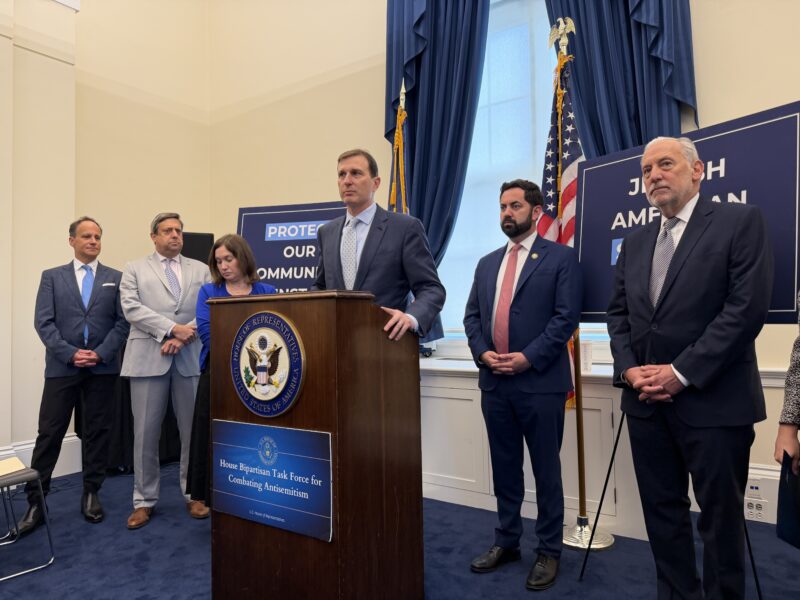













House Minority Leader Hakeem Jeffries and Sen. Mark Warner declined to defend the embattled Maine Senate candidate, but Rep. Ro Khanna said he’ll continue to support him
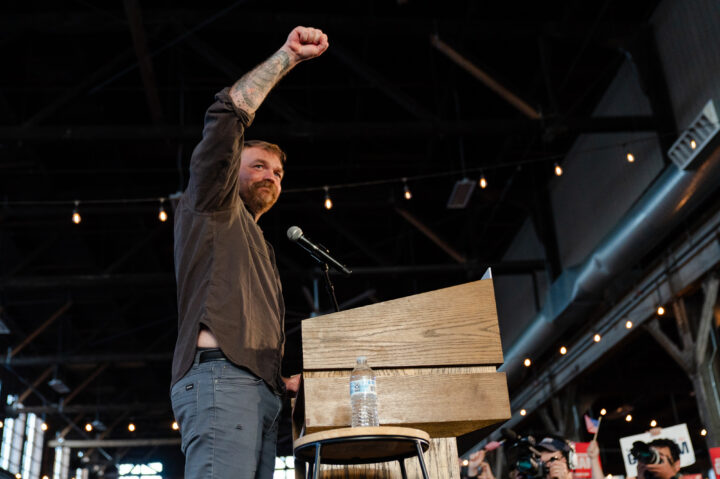
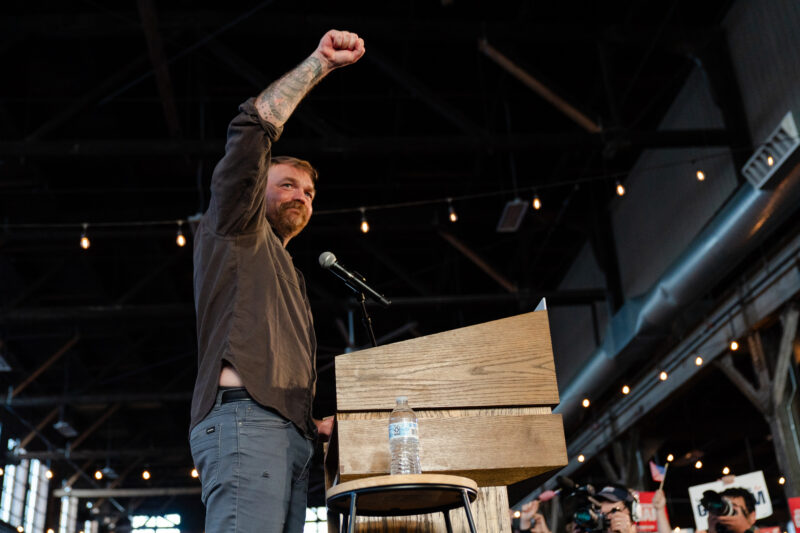
Sophie Park/Bloomberg via Getty Images
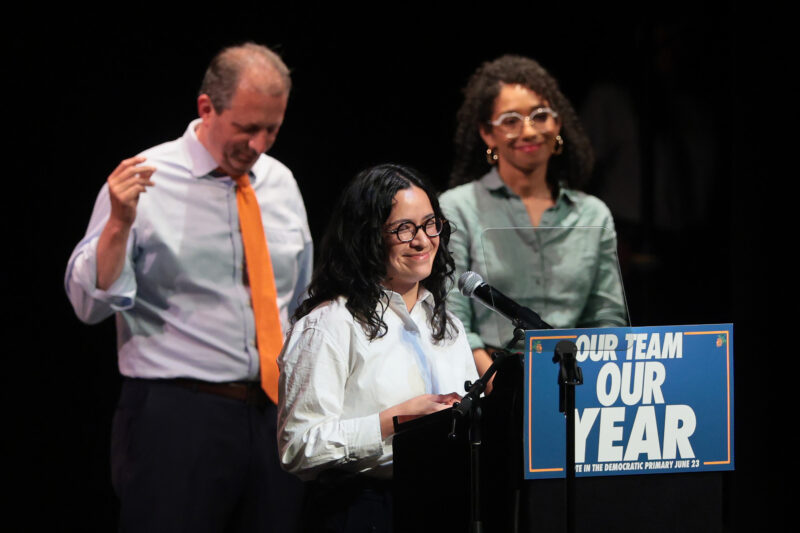
Graham Platner, Democratic Senate candidate for Maine, arrives to speak during a Fighting Oligarchy event in Portland, Maine, on May 25, 2026.


 Add JewishInsider on Google
Top Democrats faced questions over Maine Senate candidate Graham Platner’s scandals on Sunday, days after The New York Times shared details of abusive behavior alleged by past romantic partners.
Rep. Ro Khanna (D-CA), who has endorsed Platner, said he continues to support him even as he criticized Platner’s past behavior and said his campaign should not attack his accusers, while Sen. Mark Warner (D-VA) and House Minority Leader Hakeem Jeffries (D-NY) declined to offer any support for Platner and said that Platner and Maine voters will need to address the scandal.
Khanna, who campaigned with Platner in Maine after last week’s Times scoop, said on CBS’ “Face the Nation” that Platner’s past actions were “misogynistic, they were shameful, they were wrong, but they didn’t come as a surprise to a lot of the folks in Maine,” arguing that the state’s voters knew the presumptive Democratic nominee went through a dark period after his time serving in Iraq and Afghanistan.
“He took accountability, he himself has said that it was shameful,” Khanna said, explaining that he continues to support Platner because of his policy platform. “The Maine voters that I met said they don’t like it. They knew that he had these chapters. They are willing to extend him grace and redemption, and they’re focused now on what he’s running for.”
He said that if there was “evidence of violence” or “evidence of sexual assault” he would not be supporting Platner.
One of Platner’s ex-girlfriends interviewed by theTimes detailed instances when Platner was physically aggressive, including forcing her into a room and preventing her from leaving. She said he had also grabbed her hard enough to leave marks.
“Even according to The New York Times piece, they said there was no harm, no injury. There was toxicity, and there was verbal intimidation, which I condemn,” Khanna told host Margaret Brennan. “But Graham has made it clear that there was no evidence of violence. That to me is a red line.”
He also defended Platner’s ex-partners, and said that Democrats should not be attacking them, praising them for coming forward, even as Platner’s campaign has disparaged one of the accusers as a Republican operative.
“They should not attack her. They should not attack The New York Times reporters who wrote the story,” Khanna said.
In an interview with ABC News’ “This Week,”, Warner declined to offer any support for Platner, and suggested he wants to stay far away from the issue.
“If the allegations are true, they are disturbing. End of the day, though, Maine voters are going to decide this,” Warner continued, adding that he’s focused on his own reelection campaign in Virginia.
Asked about whether Platner has handled the issue properly, Warner said that President Donald Trump’s 2016 campaign appeared to rewrite the rules of what was acceptable in the political realm. He suggested that similar activity would likely have been considered more damaging in decades past.
“At the end of the day, American voters will make those decisions,” Warner said. “I don’t know Mr. Platner, I’ve never met him. I would just say this: the allegations [that] are made, I think you ought to have at least some attempt to prove … or disprove them, if that’s the case.”
He said that he wishes “all candidates in both parties maybe held themselves to a different standard,” before again reiterating that it’s up to Maine voters to judge whether Platner’s past is disqualifying.
Jeffries also declined to offer support for Platner in an interview on Fox News’ “Sunday Briefing” show.
“Violence against women in any way, shape or form is unacceptable. It’s a red line, and nobody should cross that,” Jeffries said. “Any abuser who comes forward has to be treated with dignity and respect.”
He said, however, he isn’t involved in the Maine Senate race and that he hasn’t spoken about the race with Khanna.
Asked whether Platner’s candidacy, and Platner’s attacks on AIPAC and the pro-Israel community, are evidence that the Democratic Party has an antisemitism problem, Jeffries said that Platner is “going to have to speak for himself,” but that antisemitism shouldn’t be a partisan issue.
“We should all be committed to crushing antisemitism and all other forms of hatred into the ground,” Jeffries said.
Pressed subsequently about Adam Hamawy, the Democratic New Jersey Congressional nominee with a history of connections to convicted terrorists and terrorist organizations, Jeffries — who congratulated Hamawy on his victory last week — repeatedly sidestepped the issue.
“I haven’t spoken to him, he’s going to have to speak for himself and address these allegations,” Jeffries responded, when asked about Hamawy’s testimony in defense of Omar Abdel-Rahman, the terrorist mastermind known as the Blind Sheikh, before pivoting to attacking the administration over the war in Iran and high gas prices.
Pressed again, he criticized Republicans for their own hateful comments and the administration for the rising cost of living.
The results remained unchanged from previous iterations of the vote
Graeme Sloan/Bloomberg via Getty Images
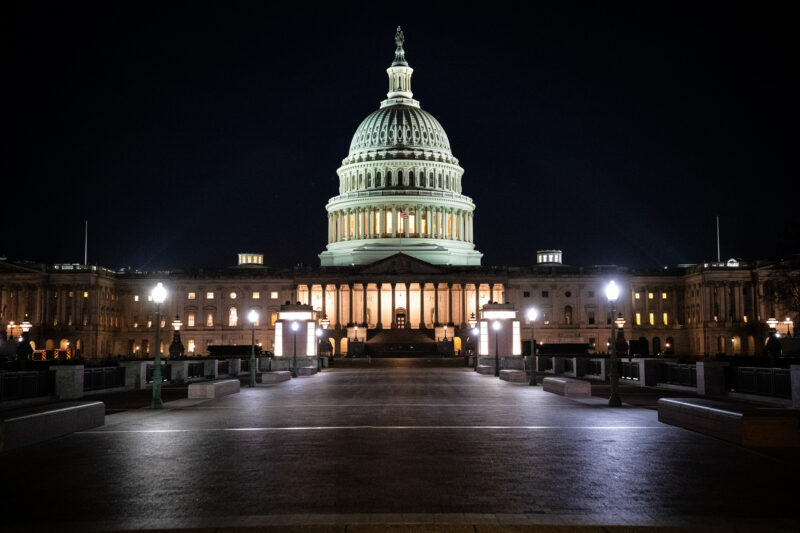
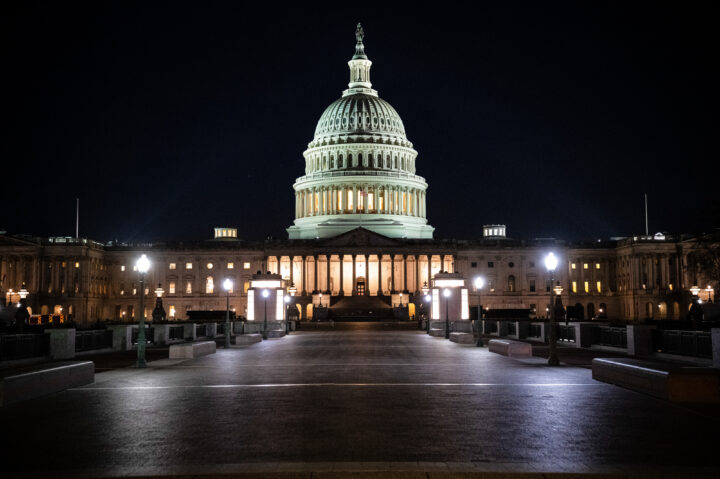
The U.S. Capitol in Washington, DC, US, on Wednesday, April 1, 2026.
For the fifth time, the Senate rejected an effort by Democrats to force the administration to end the war in Iran, with the partisan battle lines on the issue remaining firmly unchanged from previous iterations of the vote.
“Democrats will continue to force votes on war powers resolutions every week until Republicans decide to put the American people over Donald Trump and end this war,” Senate Minority Leader Chuck Schumer (D-NY) said ahead of the vote.
The vote failed 51-46, with Sens. Mark Warner (D-VA), Chuck Grassley (R-IA) and David McCormick (R-PA) not voting, and Sens. John Fetterman (D-PA) and Rand Paul (R-KY) voting with the opposing party.
Democrats have already introduced eight other similar resolutions that will be eligible for votes in the coming days and weeks, giving them plenty of runway to continue such efforts for the foreseeable future.
In the House, Reps. Greg Meeks (D-NY) and Ro Khanna (D-CA) also introduced new war powers resolutions on Iran, after previous efforts narrowly failed. The Congressional Progressive Caucus reportedly plans to force votes on such resolutions frequently next month.
Though they haven’t broken openly with the president, dynamics for at least some Senate Republicans could begin to shift toward the end of the month; under the War Powers Act, the administration can only carry on military operations without congressional approval for 60 days, with an additional 30-day drawdown period.
Though some Republicans have said Congress and the administration should disregard that deadline, others say that some form of action will be necessary at that point, and some hope that the war will be over before then.
Sen. Lisa Murkowski (R-AK) who has been working with other senators on crafting an Authorization for Use of Military Force on the war, told Jewish Insider on Wednesday, “we’ve been having some good conversations, and we’re going to continue them.” She said the goal of the AUMF is to have “greater disclosure, greater transparency” about the war.
Sen. Josh Hawley (R-MO) said earlier this week, ahead of the U.S. extension of the ceasefire, that he believed the president was “trending in a direction of ‘let’s end this without further involvement, including even further strikes’” and said that he hopes the war is over before the 60-day mark.
He told JI that he hasn’t been working with Murkowski on her AUMF, but said that the effort “makes sense since we’re approaching the 60-day deadline.”
Sen. Mike Rounds (R-SD) told JI he would “give the administration the benefit of the doubt that they will respond accordingly, in compliance with that” 60-day deadline “and if not, then we’ll have to have some discussions” around further congressional involvement through an AUMF or other avenue.
Still, other Republicans seem comfortable overlooking the 60-day deadline.
“I think the president has the authority to protect us, so we should let the president protect us,” Sen. Pete Ricketts (R-NE) said.
The minority leader said after receiving the classified briefing that ‘the president has an obligation to make his goals public’
Nathan Posner/Anadolu via Getty Images
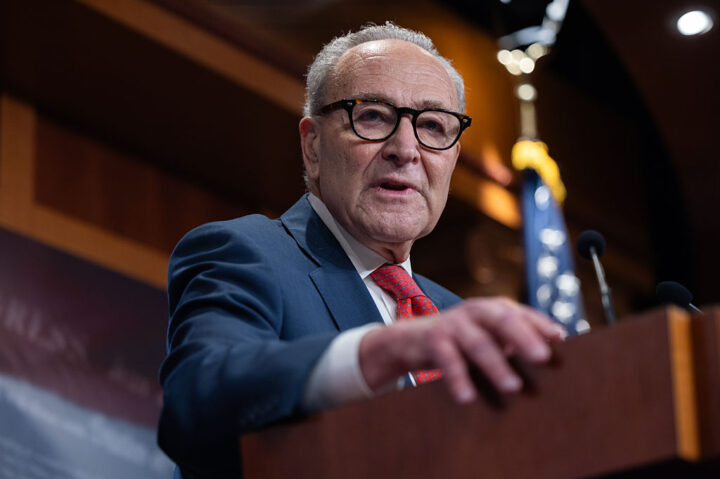
Senate Minority Leader Chuck Schumer (D-NY) speaks at a press conference following recent elections as the government shutdown continues in Washington, DC on November 5, 2025.
Senate Minority Leader Chuck Schumer (D-NY) urged President Donald Trump on Tuesday to explain to the public his goals in the accelerating pressure campaign and military buildup targeting Iran, following a classified briefing earlier in the day for senior congressional leaders by Cabinet officials on the developing situation in Iran.
Several other lawmakers offered similarly sober responses to the briefing.
“It’s very serious and the president has an obligation to make his goals public,” Schumer told Jewish Insider after the briefing.
Sen. Mark Warner (D-VA), the top Democrat on the Senate Intelligence Committee, similarly called on the administration to lay out “what our country’s goals are, what our country’s interests are and how we’re going to protect American interests in the region.”
Rep. Jim Himes (D-CT), the top Democrat on the House Intelligence Committee, said he was “very concerned” and warned that “wars in the Middle East don’t go well for presidents, for the country, and we have not heard articulated a single good reason for why now is the moment to launch yet another war in the Middle East.”
Senate Majority Leader John Thune (R-SD) said the administration is “giving a lot of thought to the situation. And I appreciate where they’re coming from.”
Plus, Huckabee resolves Israeli visa squabble

Rami Alsayed/NurPhoto via Getty Images
The President of the Syrian Arab Republic, Ahmad Al-Sharaa, delivers a speech at the People's Palace during the swearing-in ceremony of the new government, in Damascus, Syria, on March 29, 2025.
Good Monday morning.
In today’s Daily Kickoff, we report on the resolution of tensions between U.S. Ambassador to Israel Mike Huckabee and Israel’s Interior Ministry over visa hurdles faced by Christian Zionists, and talk to Sen. Mark Warner about the American strikes last month targeting Iran’s nuclear program. We preview the House Financial Services Committee‘s upcoming vote on Rep. Mike Lawler‘s legislation conditioning the repeal of Syria sanctions, and cover Columbia University’s announcement that its faculty-run University Senate will no longer have oversight over student disciplinary procedures. Also in today’s Daily Kickoff: Jacob Frey, Adam Katz and Yoav Segev.
What We’re Watching
- The Conference of Presidents of Major American Jewish Organizations kicks off a three-day mission to Israel today.
- Oral arguments in Harvard‘s lawsuit against the Trump administration‘s freezing of approximately $3 billion in federal funds begin today in Boston.
- Lawmakers in Texas return to Austin today for the start of a special legislative session that will take up, among other issues, potential statewide redistricting that could potentially give Republicans an additional five House seats but may make other safe GOP districts more competitive.
- Israel launched fresh drone strikes on Houthi targets in Yemen earlier today, days after a ballistic missile fired by the Iran-backed terror group triggered sirens across central Israel.
- We’re keeping an eye on Iranian nuclear talks, following an announcement this morning from Iran’s Foreign Ministry that Tehran’s deputy foreign minister will meet this Friday in Istanbul with his counterparts from the U.K., France and Germany to continue negotiations. Over the weekend, Russian President Vladimir Putin met with senior Iranian official Ali Larijani.
What You Should Know
A QUICK WORD WITH JI’S JOSH KRAUSHAAR
A newly released CNN poll, conducted this month, illustrates the resilience of a hawkish DNA within the Republican Party and among its voters even amid the rise of an isolationist strain that has sought to gain influence in the GOP during President Donald Trump’s second term.
The poll asked respondents: “Do you think the United States should or should not take the leading role among all other countries in the world in trying to solve international problems?” Overall, 43% took the more active approach, while 56% took a more isolationist view.
Republicans, however, remained the strongest advocates of a muscular American role in world affairs, with 52% supporting America taking a leading role, with 47% opposed. By contrast, just 42% of Democrats and 39% of independents shared the more hawkish worldview.
Notably, the shift in more isolationist sentiment was almost entirely driven by Democrats and independents since the last CNN survey in March, which found majority support for significant American global engagement. In the March survey, a 57% majority of Democrats preferred more American involvement in the world, a number that dropped 15 points in the last four months. The Republican share of those preferring American engagement remained steady at 52%.
The results from the CNN polls suggest there’s a more committed core of Republican-voting hawks that is more resilient than the shifting political winds, whereas the Democratic foreign policy worldview appears more dependent on partisanship and what’s happening in the news at the time.
christian controversy
Netanyahu’s office resolves high-profile visa issue for American Christian groups

Israeli Prime Minister Benjamin Netanyahu’s office resolved a dispute between U.S. Ambassador to Israel Mike Huckabee and Israeli Interior Minister Moshe Arbel over the denial of visas to workers and volunteers for several evangelical Christian organizations, two sources involved in the matter told Jewish Insider’s Lahav Harkov on Sunday. Huckabee sent a letter to Arbel last Wednesday, expressing “great distress” and “profound disappointment” that after the two met to discuss the matter earlier this year, the Interior Ministry’s visa department continued to conduct investigations into American and other evangelical organizations seeking visas for their workers.
Solution found: “A solution has been reached to the satisfaction of all parties. The evangelical Christian organizations active in Israel, which represent the vast majority of Zionists in the world today, will receive all of the visas they need through a streamlined and efficient application process,” Calev Myers, the attorney for the organizations told JI on Monday. Hours before the issue was resolved, a source in the Prime Minister’s Office told JI, “this is something that we consider to be of urgent importance. We have every intention of solving this problem very quickly … It is being handled with the proper sensitivity between the Prime Minister’s Office and the embassy.”
ON THE HILL
House committee to vote on Lawler bill modifying Syria sanctions
The House Financial Services Committee is set to consider legislation by Rep. Mike Lawler (R-NY) this week that aims to create oversight and set conditions for lifting sanctions on Syria, but stops short of full repeal of the 2019 Caesar Syria Civilian Protection Act sanctions bill that other lawmakers are pushing on a bipartisan basis, Jewish Insider’s Marc Rod reports.
Why it matters: That the House is moving forward with Lawler’s legislation, which sets conditions for waiving Caesar Act sanctions, rather than the bipartisan Caesar Act repeal effort may indicate a level of continued skepticism from some House members about the prospect of full sanctions relief for the new Syrian government pushed by the Trump administration.
REVERSING COURSE
National Education Association rejects ADL boycott proposal
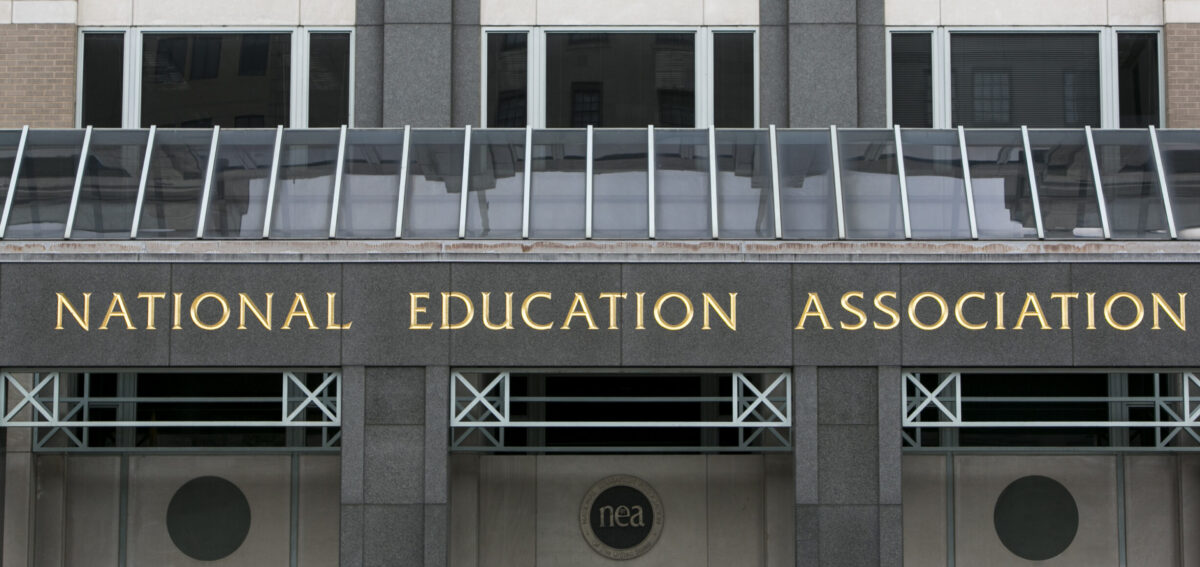
The National Education Association, the largest teachers’ union in the country, announced on Friday that it would not cut ties with the Anti-Defamation League, declining to implement a contentious resolution approved by its governing body earlier this month that sought to target the Jewish civil rights organization, Jewish Insider’s Gabby Deutch reports.
What is said: “After consideration, it was determined that this proposal would not further NEA’s commitment to academic freedom, our membership or our goals,” the union’s board of directors said in a statement. The decision came nearly two weeks after the measure was adopted by the NEA’s representative assembly, its annual leadership gathering that drew more than 6,000 union delegates. “There is no doubt that antisemitism is on the rise. Without equivocation, NEA stands strongly against antisemitism. We always have and we always will,” the NEA’s board wrote. “In this time of division, fighting antisemitism, anti-Arab racism, and other forms of discrimination will take more resources, not fewer. We are ready.”
WORDS WITH WARNER
Sen. Mark Warner: U.S. strikes on Iran were a ‘success,’ but what happens next is critical
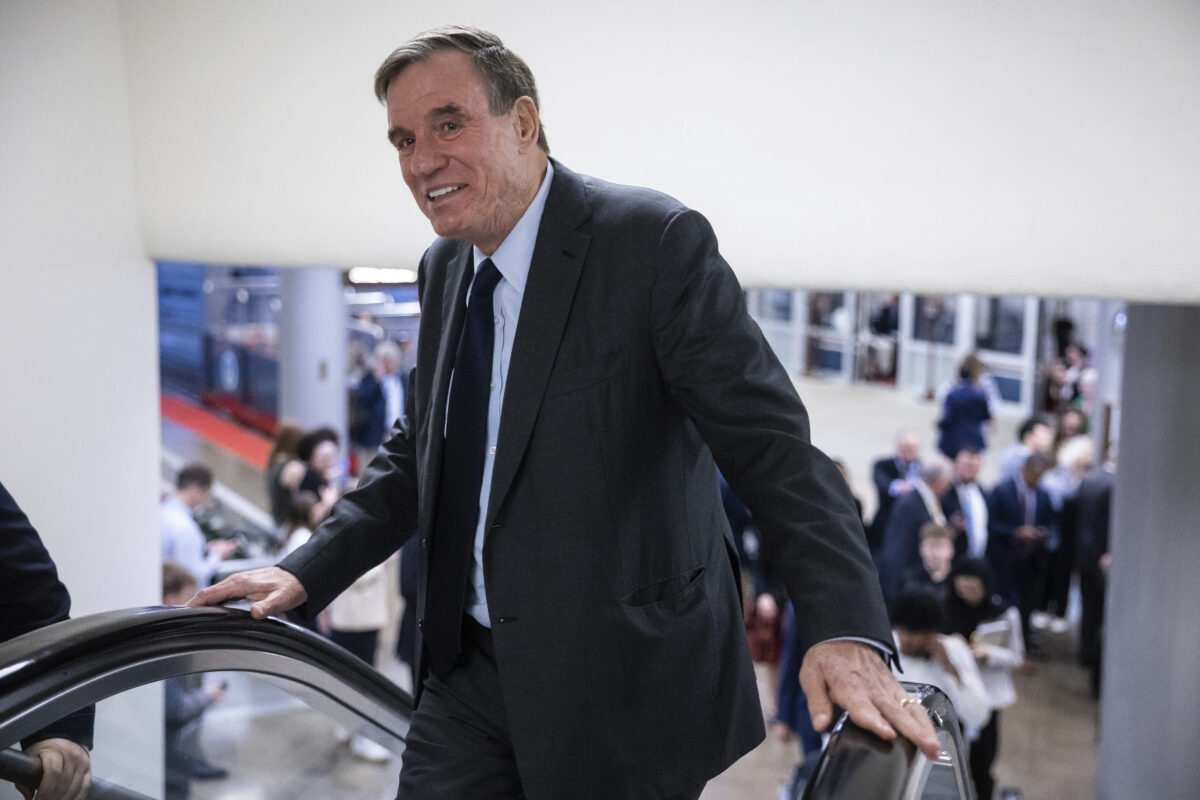
Sen. Mark Warner (D-VA) told Jewish Insider’s Marc Rod on Friday that he’s inclined to view the Trump administration’s strikes on Iran’s nuclear facilities as a “success,” if negotiations with Tehran resume and barring substantial future retaliation from Iran.
What he’s saying: “I will acknowledge the successfulness of the Israeli attacks and how back-foot the regime was. The fact that they didn’t launch the thousands of missiles,” Warner told JI on the sidelines of the Aspen Security Forum. “I was concerned about an attack that didn’t bring Congress along. And I do think there was a huge process foul when the Gang of Eight wasn’t notified and the Republicans [were] — Trump[’s first administration] never did that — but I have never contested the success. … If the current status quo is the same a year from now and it actually leads towards further negotiation — success.”
CREDIT WHERE DUE
Sen. Chris Coons: U.S. strikes on Iran could ultimately be a positive step

Sen. Chris Coons (D-DE) said on Friday that the U.S. strikes on Iran could ultimately produce a positive outcome, a softening of the Delaware senator’s previous skepticism, Jewish Insider’s Marc Rod reports from the Aspen Security Forum.
What he said: “The strike on Iran is one that I disagreed with because of the process, the lack of consultation with Congress, the partisan way that Republicans were notified at the most senior levels [and] Democrats were not,” Coons said at the conference. He said he also had not expected that the administration would be able to avoid significant Iranian retaliation and an escalating conflict. “I frankly, did not believe that we would end up in the period we seem to be in where a counter-strike by Iran against American soldiers and interests has not yet come,” Coons continued.
Also speaking at the forum: Retired Gen. David Petraeus, the former director of the CIA and head of U.S. Central Command, said on Friday that, in the post Oct. 7, 2023, environment, Israel will no longer tolerate threats to its security throughout the region, including a resumption of Iran’s nuclear program.
Differing worldview: Former National Security Advisor Jake Sullivan suggested at the Aspen Security Forum on Friday that the U.S. strikes on Iran had not been necessary and didn’t accomplish the fundamental goal of permanently stopping Iran’s nuclear program.
WINDS OF CHANGE
Columbia moves student disciplinary authority out of University Senate

In a move called for by pro-Israel students at Columbia University, the school announced on Friday that disciplinary action and rules surrounding student protests would be moved out of the purview of the faculty-run University Senate and into the provost’s office, Jewish Insider’s Haley Cohen reports.
Student reaction: “This is the most encouraging and commendable action taken by Columbia’s administration to address the systemic problems within the university since [the Oct. 7, 2023, Hamas terrorist attacks],” Noa Fay, a graduate student entering her last year in Columbia’s School of International and Public Affairs, told JI. “Revoking the University Senate’s power over disciplinary and rule-making procedures has been top of the institutional reform list for many Columbians who wish to see our university restored to order and excellence.”
Worthy Reads
The Trump Whisperer: The New Yorker’s Antonia Hitchens profiles Commerce Secretary Howard Lutnick, looking at the former Cantor Fitzgerald CEO’s yearslong friendship with President Donald Trump. “Lutnick and President Donald Trump speak on the phone most nights, at around one in the morning, just after Lutnick gets in bed. They talk about ‘real stuff,’ like Canadian steel tariffs, Lutnick told me, and also about ‘nothing,’ which he summarized as ‘sporting events, people, who’d you have dinner with, what was this guy like, can you believe what this guy did, what’s the TV like, I saw this on TV, what’d you think of what this guy said on TV, what did you think about my press conference, how about this Truth?’ Of course, Lutnick said, ‘Trump has other people he calls late at night.’ But does he have other people he always calls?” [NewYorker]
Confronting Cambridge: The Atlantic’s Franklin Foer does a deep dive into the tenure of Harvard President Alan Garber, who has handled much of the fallout from the school’s handling of post-Oct. 7 campus antisemitism as well as Harvard’s legal battles with the Trump administration. “Even as Harvard sits on the receiving end of vitriolic attacks from the right, Garber has turned inward — willing to engage with Harvard’s harshest critics and to admit that even bad-faith attacks sometimes land on uncomfortable truths. He’s treated the university’s crisis as an opportunity, leveraging the looming threat of Trump to make changes that would have been politically impossible in less ominous times. The leader of Harvard, bane of MAGA, agrees with much of the underlying substance of the MAGA critique of higher education, at least when stripped of its rhetorical froth and fury. He knows that elite higher education is suffering a crisis of legitimacy, one that is, in no small measure, of its own making, because it gives fodder to those who caricature it as arrogant and privileged.” [TheAtlantic]
The Gaza Debate: In eJewishPhilanthropy, Michael Berenbaum and Menachem Z. Rosensaft respond to genocide scholar Omer Bartov’s recent New York Times op-ed alleging Israel is engaging in genocide. “We are not arguing that this war has always been waged appropriately or that it has been waged proportionally. Nor do we suggest that Israel or any other country involved in warfare cannot be accused of or should not be held accountable for other alleged violations of international law, including crimes against humanity, war crimes and even ethnic cleansing. But those are separate questions from whether a genocide is being committed; and unless such alleged violations of international law satisfy the elements, including specific intent, as defined in Article II of the Convention, they do not constitute genocide.” [eJP]
Cowed on Campus: In Tablet, Eric Kaufmann looks at recent survey data from the Foundation for Individual Rights and Expression that indicates shifts in the behaviors of Jewish college students as campus climates become increasingly politicized in the wake of the Oct. 7, 2023, Hamas attacks and ensuing war in Gaza. “A closer look at the 2024 data shows that the pro-Palestinian tent encampments had a big impact: Before they went up on April 17, 28% of Ivy League Jewish students self-censored. Afterward, 40% did. Across all institutions in the FIRE data, statistical analysis shows that the encampments increased Jewish self-censorship while reducing it for conservatives. Conservative speech has for years been the least free of any major demographic, but Jews have now converged with them. In the Ivy League, Jews now self-censor more than conservatives do.” [Tablet]
Word on the Street
Unnamed Trump administration officials are reportedly angry with Israeli Prime Minister Benjamin Netanyahu‘s recent actions, telling Axios that the prime minister has “acted like a madman” who “bombs everything all the time”; the White House officials expressed concerns that Netanyahu’s actions could “undermine” President Donald Trump’s efforts in the region…
House Minority Leader Hakeem Jeffries (D-NY) met for an hour on Friday with New York City Democratic mayoral nominee Zohran Mamdani but did not issue an endorsement for the candidate; a spokesperson for Jeffries said the two had a “constructive, candid and community-centered” conversation that also included “a variety of other important issues, including public safety, rising antisemitism, gentrification and the importance of taking back the House in 2026”…
Reps. Mark Alford (R-MO), Don Davis (D-NC), Tony Gonzales (R-TX), John Carter (R-TX), Sam Graves (R-MO) and Juan Ciscomani (R-AZ) introduced a resolution congratulating the fighter and bomber wings involved in the U.S. attack on Iran’s nuclear facilities…
Sens. John Curtis (R-UT) and Jacky Rosen (D-NV) introduced a resolution commemorating the anniversaries of the bombings of the Israeli Embassy in Argentina and the Buenos Aires AMIA Jewish community center; in the House, Reps. Debbie Wasserman Schultz (D-FL), Mario Diaz-Balart (R-FL), Adriano Espaillat (D-NY) and Tony Gonzales (R-TX) introduced a resolution condemning the AMIA bombing…
Reps. Jefferson Shreve (R-IN), Josh Gottheimer (D-NJ), Bill Huizenga (R-MI), Maria Elvira Salazar (R-FL) and Mark Messmer (R-IN) introduced a bill requiring the administration to provide a strategy to counter Iran and Hezbollah’s influence in Latin America…
Pennsylvania state Sen. Doug Mastriano, who in 2022 lost to Gov. Josh Shapiro in the commonwealth’s gubernatorial race, teased a potential rematch, posting different logos for a “Doug Mastriano for Governor” campaign…
Minnesota’s statewide Democratic-Farmer-Labor Party endorsed state Sen. Omar Fateh, a democratic socialist, over incumbent Mayor Jacob Frey…
The Wall Street Journal spotlights the efforts of Robert Kraft’s Foundation to Combat Antisemitism, under the leadership of Adam Katz, to use analytics to identify digital trends in antisemitism, craft countermessaging and share data with social media platforms and universities…
Harvard Business School graduate Yoav Segev filed a lawsuit against the university and its police department, alleging that both failed to protect him from being assaulted by anti-Israel campus activists and that school officials obstructed an investigation into the incident…
Israeli Prime Minister Benjamin Netanyahu sought medical attention over the weekend after falling ill from eating spoiled food; the prime minister will work from home until Tuesday while he recovers…
Israel, working with the U.S., reportedly delivered aid to the Syrian Druze city of Sweida as a ceasefire reached late last week appeared to hold; more than 1,100 are believed to be dead in the sectarian violence that drew in Syrian government forces…
Israel will not renew the visa of Jonathan Whittall, the head of the United Nations Office for the Coordination of Humanitarian Affairs in the West Bank and Gaza, citing his “biased and hostile conduct against Israel”…
Hamas officials in Gaza claimed at least 85 people were killed trying to access humanitarian aid near the Zikim border crossing; the IDF, which said it fired “warning shots” to remove an “immediate threat,” disputed the number, saying the “reported number of casualties does not align with the existing information”…
The Wall Street Journal looks at the logistical and operational challenges facing the Gaza Humanitarian Foundation amid increasing concerns over humanitarian aid distribution in the enclave…
Senior Christian leaders from Jerusalem, including Cardinal Pierbattista Pizzaballa, visited the sole Catholic church in Gaza, which was damaged by an Israeli strike last week that also killed three people…
Brig. Gen. (res.) Giora Even Epstein, the most decorated Israeli Air Force fighter pilot in the country’s history, died at 87…
Pic of the Day

Israeli President Isaac Herzog (right) received the credentials of Polish Ambassador to Israel Maciej Hunia. Hunia’s arrival marks the first time in four years that Warsaw has had an ambassador posted to Israel. In addition to Hunia, Herzog also received the credentials of Malta’s new envoy to Israel, Ambassador Claude Bonello.
Birthdays

Actress and producer, Alysia Reiner turns 55…
Laureate of the 1992 Nobel Prize in chemistry, Rudolph A. Marcus turns 102… President at Admar Group, Henry Dean Ostberg turns 97… Retired CEO of Sony/ATV, a large music publishing firm, he is a member of the Songwriters Hall of Fame, Martin Bandier turns 84… Professor emeritus in the Department of Physics at Bar-Ilan University, he won the Israel Prize in 2018, Shlomo Havlin turns 83… Director of the Center for the Political Future at USC, Robert Shrum turns 82… Criminal defense attorney, known for representing many politicians, celebrities and organized crime defendants, Benjamin Brafman turns 77… Former member of the U.K.’s House of Commons, now in the House of Lords, Baroness Susan Veronica Kramer turns 75… U.S. senator (R-WY), John Barrasso turns 73… Chairman and CEO at Quantitative Financial Strategies, Sanford “Sandy” Jay Grossman turns 72… Endocrinologist and professor at Columbia University’s medical school, she is an honorary president of NYC’s Central Synagogue, Shonni Joy Silverberg, MD… Professor at Columbia Law School and daughter of the late Justice Ruth Bader Ginsburg, Jane Carol Ginsburg turns 70… Brooklyn resident, Irene Ostrovsky… Comedian and actor, best known for his five seasons on “Saturday Night Live” ending in 1990, Jon Lovitz turns 68… Former chief rabbi of Moscow, his opposition to the Ukraine war forced him to leave Russia, Rabbi Pinchas Goldschmidt turns 62… Literary agent at the William Morris Endeavor book department, Eric Matthew Simonoff turns 58… Professor of astronomy at MIT and winner of a 2013 MacArthur genius award, Sara Seager turns 54… Brazilian fashion designer best known for avant-garde designs and eclectic prints, Alexandre Herchcovitch turns 54… CEO of Fanatics, licensed sports merchandise and digital sports platform, Michael G. Rubin turns 53… Founder, president and CEO of Securing America’s Future Energy (SAFE) and the Electrification Coalition, Raphael “Robbie” Diamond… Rabbi of Congregation Bais Naftali in Los Angeles, his YouTube channel has over 4.6 million views, Rabbi Yoel Gold… Online media personality and director of product management at Electronic Arts (EA) in Vancouver, British Columbia, Veronica Belmont turns 43… CEO of Women of Reform Judaism since 2023, Rabbi Liz P.G. Hirsch… Clinical social worker, Aniko Gomory-Pink… Entrepreneur and political activist, Chloé Simone Valdary turns 32… Policy advisor at Brownstein Hyatt Farber Schreck, Zachary A. Marshall… Recruiter at Tines, Rachel Elizabeth Nieves… Attorney in Madrid and secretary general of the Federation of Jewish Communities of Spain until 2021, Elias Cohen…
‘If the current status quo is the same a year from now and it actually leads towards further negotiation — success,’ Warner told JI

Francis Chung/POLITICO via AP Images
Sen. Mark Warner (D-VA) ascends on an escalator on his way to a vote at the U.S. Capitol on June 17, 2025.
Sen. Mark Warner (D-VA) told Jewish Insider on Friday that he’s inclined to view the Trump administration’s strikes last month on Iran’s nuclear facilities as a “success,” if negotiations with Tehran resume and barring substantial future retaliation from Iran.
His comments largely echo sentiments shared earlier in the day by Sen. Chris Coons (D-DE) at the Aspen Security Forum, suggesting an increasing willingness by moderate, national security-minded Democrats to publicly acknowledge positive outcomes of the strikes, even if they maintain other concerns about the process that produced them.
“I will acknowledge the successfulness of the Israeli attacks and how back-foot the regime was. The fact that they didn’t launch the thousands of missiles,” Warner told JI on the sidelines of the forum. “I was concerned about an attack that didn’t bring Congress along. And I do think there was a huge process foul when the Gang of Eight wasn’t notified and the Republicans [were]. Trump[’s first administration] never did that — but I have never contested the success.”
Warner, the vice chair of the Senate Intelligence Committee, said he’s been pleased that there has not been ongoing asymmetric retaliation against the U.S. by Iran, such as cyber, sleeper cell or Iraqi militia attacks.
“If the current status quo is the same a year from now and it actually leads towards further negotiation — success.”
Warner, Coons and other top Democrats had cautioned the administration against unilateral action against Iran without congressional approval just days before the attack.
“Let’s make no doubt that the Iranian regime [are] bad guys, and that is why I’ve been such a consistent supporter of Israel,” Warner told JI.
“Iran’s, at least so far, been shown to be more of a paper tiger,” Warner said. “If we could just get to the resolution in Gaza, there really could be a fresh start.”
The senator said that his ongoing concern is how President Donald Trump has responded to the attacks, declaring that Iran’s nuclear program had been completely obliterated.
“The president, within two hours of the strike, set an arbitrary, almost impossible standard to meet, in terms of ‘total obliteration,’” Warner said. “To get the enriched uranium you’re going to need troops on the ground. And there are more than three sites — the vast majority [of the activity] was [at] those three, but there was some bad stuff happening elsewhere.”
He said the intelligence community had also been pressured to “contort itself to meet” the assessment Trump put forward.
In the immediate aftermath of the strikes, Warner and other Democrats expressed frustration that the Trump administration took days to brief Congress about them. Warner said he’s received “some additional clarity” in the weeks since the strikes about their effects. But he said that without physically sending operatives into the facilities, it’s difficult to know for sure the impacts of the strikes.
“Other nations have made assessments that were more in the multiple months” of delay to Iran’s nuclear program, “but I’m not even sure that’s the right metric,” Warner said. “It was a success. So the question is, what’s next? That, I don’t have visibility on.”
Going forward, Warner emphasized the need for negotiations to bring International Atomic Energy Agency inspectors back into Iran, adding that he wants to look further into the source of the delays in resuming talks.
Warner said he’s also seeking information on the timeline on which Iran would be able to build a less sophisticated nuclear device that could be delivered in a truck, rather than via a ballistic missile.
Though he noted that U.S. intelligence had not assessed that Iran was actively constructing a nuclear weapon, he said he had heard reports about an Israeli assessment that offered a different view and that he is looking further into it.
Asked about the fluid situation in Syria, in which Israel went, in the span of just a week, from floating normalization with the new Syrian government to bombing key government facilities in response to attacks on the Druze population, Warner indicated he’s still gathering information.
He said that Israel is “appropriately … very protective of its Druze population,” adding that he does not know at this point whether the Syrian government forces attacking the Druze population are doing so at the orders of that government.
He said he’s hopeful that Israel and other parties involved will not miss an opportunity to find a peaceful resolution that could defuse a major longtime threat to Israel’s north.
Warner said he also wants to see Trump use his “enormous influence in Israel” to “[force] Bibi’s government into a return of the hostages, a ceasefire,” saying that would open up opportunities for transformational change in the region, including Saudi-Israeli normalization.
Warner said that while he’s been critical of Israeli Prime Minister Benjamin Netanyahu, Israel and the IDF deserve credit for their surprise accomplishments in taking down Iran’s proxy network and in their strikes against Iran itself.
“The [Jewish community’s] concern is real and understandable,” Warner said. He said that he has been struck by the “level of anger, animosity, vile things said” in anti-Israel protests that have targeted him — “and I’m not Jewish. And I can only imagine.”
“Iran’s, at least so far, been shown to be more of a paper tiger,” Warner said. “If we could just get to the resolution in Gaza, there really could be a fresh start.”
Asked how concerned he is about the possibility of homeland attacks against the Jewish community carried out by or in the name of Iran, Warner said that U.S. intelligence monitors potential threats fairly comprehensively, but indicated that he’s most worried about radicalized lone-wolf attacks, like those in Washington and Boulder, Colo.
“The [Jewish community’s] concern is real and understandable,” Warner said. He said that he has been struck by the “level of anger, animosity, vile things said” in anti-Israel protests that have targeted him — “and I’m not Jewish. And I can only imagine.”
Warner expressed frustration at the way that the Palestinian cause has crowded out other global issues on college campuses. He said that it “would be healthy” if young people “have the chance to get exposed to other things in the world,” offering as examples the conflict in Sudan — which he said has been more deadly than Gaza and Ukraine combined — and the military junta in Myanmar.
On the subject of the Houthis, who have ramped up attacks against commercial shipping and Israel in recent weeks, Warner called the group a “tough nut to crack,” noting that a protracted Saudi and Emirati campaign against the Iran-backed terrorist group in Yemen had failed to put the issue to bed. But he said that the U.S. can’t rule out further military action against the group.
“I hope that those plans would be kept classified and not shared … on a device that’s not secure,” he quipped, referencing the Signalgate scandal, which he said had prompted concern from the Israeli government.
******
Last week’s Aspen summit, which typically prioritizes bipartisan and nonpartisan discussion and solution-making, became particularly politicized after nearly all Trump administration speakers canceled their participation, followed by a handful of foreign and private sector leaders and former government officials disappearing from the week’s agenda.
The issue was a frequent topic of discussion both on the main stage and across the Aspen Meadows campus last week, seen by many as a sign of the ways that intense partisanship has infiltrated U.S. foreign policy, once seen as a less antagonistic space.
Warner’s own panel featured himself and Coons, but not a Republican senator, as has been tradition.
Nevertheless, Warner said that bipartisanship on foreign policy issues still lives in the Senate, noting that the Intelligence Committee had passed an Intelligence Authorization Act recently in a nearly unanimous vote.
Looking ahead, he said the “easiest place to rebuild that consensus is around China,” which he described as an unprecedented competitor. He said there has been a long and difficult journey across multiple administrations to refocus on China, but he said there has been bipartisan success in pushing back against China.
He also argued that the Trump administration’s transactional and short-sighted approach to foreign policy goes against a longtime bipartisan tradition of viewing U.S. international relationships as an effort in “mutual trust-building.”
He said that his Republican colleagues privately disagree with many of Trump’s more outlandish foreign policy efforts — like annexing Canada. “At some point, there’s got to be a break,” he responded, when pressed on the fact that some Republicans defend Trump’s policies publicly despite those private disagreements.
Warner told JI that the bill the Intelligence Committee recently passed would cut the size of the Office of the Director of National Intelligence. But, despite offering biting criticisms of DNI Tulsi Gabbard, Warner said that the reform efforts are not a reflection of or specifically prompted by concerns about her conduct in the role.
“I’m very comfortable with the idea of bringing the mission closer to what it was originally, but also making sure that people who are at the ODNI get returned to their original home agency and don’t get [fired],” Warner said.
Clarifying comments that he made on the panel about close U.S. intelligence partners in the Five Eyes group curtailing their intelligence sharing with the United States, Warner said he was not aware of specific instances in which that had happened, but said that U.S. partners are concerned about the state of the U.S. intelligence community.
“The challenge about intelligence sharing is [that] this is all based on trust,” Warner said.
28 Democratic senators and 8 Senate candidates in battleground states have publicly expressed opposition to Israeli annexation of parts of the West Bank

U.S. Senate Studio / Gage Skidmore
Minnesota Sens. Amy Klobuchar (D-MN) and Tina Smith (D-MN) have joined more than two dozen Senate Democrats publicly warning Israeli leaders of the implications of efforts to unilaterally annex portions of the West Bank. Israeli Prime Minister Benjamin Netanyahu has said that the government could start annexing territory as early as July 1.
In individual letters sent last month and made public over the weekend, both senators — Klobuchar addressed Secretary of State Mike Pompeo and Smith wrote to Netanyahu and Israeli Defense Minister Benny Gantz — posited that annexation would undermine efforts to attain a two-state solution.
Twenty-eight senators have so far spoken out against the annexation proposal.
Last month, 19 Democratic senators sent a letter to Netanyahu and Gantz urging the Israeli leaders not to move forward with the effort. That letter, which was updated several times before being sent, cautioned the new Israeli government that “unilateral annexation puts both Israel’s security and democracy at risk” and “would have a clear impact on Israel’s future and our vital bilateral and bipartisan relationship.” Sens. Dianne Feinstein (D-CA) and Bob Casey (D-PA) sent individual communiques to Netanyahu and Gantz, similarly opposing the move, and Sens. Michael Bennet (D-CO) and Maggie Hassan (D-NH) addressed the matter in individual letters to Pompeo.
In addition, Sens. Mark Warner (D-VA) and Catherine Cortez Masto (D-NV) issued statements against annexation, and Sen. Chris Coons (D-DE) indicated to Jewish Currents that instead of signing or authoring a letter on annexation, he would “communicate directly with [Israeli] Ambassador [Ron] Dermer and Israeli officials to express his concerns.”
On Monday, eight Senate candidates in battleground states are expected to join the list expressing their strong opposition to such a move. In statements provided to J Street and shared with Jewish Insider, the candidates — Cal Cunningham (North Carolina), Sara Gideon (Maine), Teresa Greenfield (Iowa), Al Gross (Alaska), Jaime Harrison (South Carolina), MJ Hegar (Texas), John Hickenlooper (Colorado), Amy McGrath (Kentucky) and Jon Ossoff (Georgia) — emphasized that annexation would put the future of a two-state solution at risk.
Read their statements in full here.
Earlier this month, House Speaker Nancy Pelosi (D-CA) warned that unilateral annexation “puts the future [of peace] at risk and undermines our national security interest and decades of bipartisan policy.” Presumptive Democratic presidential nominee Joe Biden also came out against annexation, saying it “will choke off any hope for peace.”
“From the presidential nominee to the speaker of the House and from the Senate to the senatorial campaign trail, Democratic leaders have now made absolutely clear that they do not and cannot support unilateral annexation in the West Bank,” J Street President Jeremy Ben-Ami told JI. “For annexation to move forward in the face of this overwhelming opposition would be incredibly harmful to the future of Israelis and Palestinians and to the US-Israel relationship.”
Please log in if you already have a subscription, or subscribe to access the latest updates.
 Continue with Google
 Continue with Apple