

































If Darline Graham falls short on Tuesday, it could be an indication that a Trump endorsement is no longer the automatic ticket to victory
SAUL LOEB / AFP via Getty Images
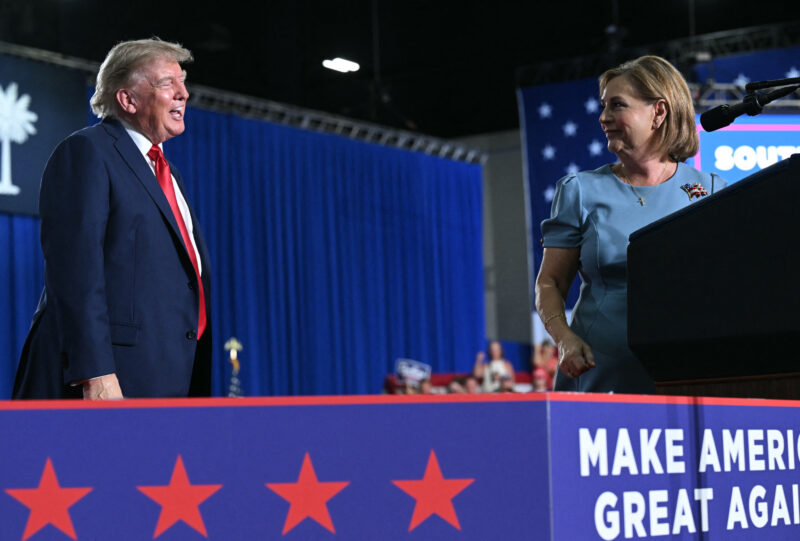
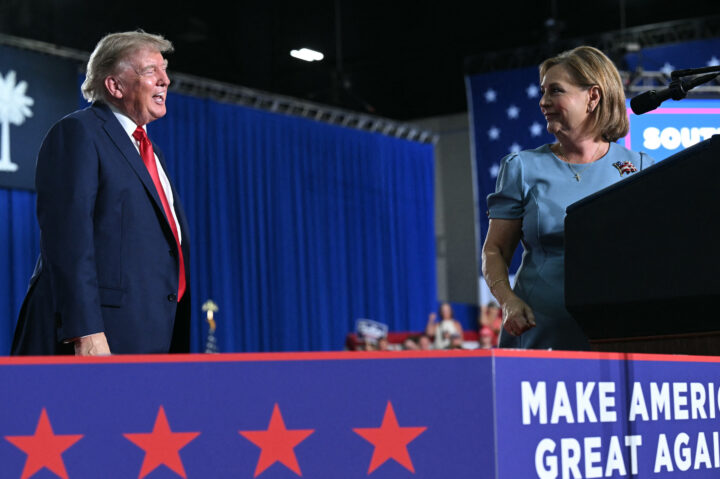
President Donald Trump congratulates Sen. Darline Graham after she spoke during a campaign rally at Myrtle Beach Convention Center in Myrtle Beach, South Carolina on August 21, 2026.


 Add JewishInsider on Google
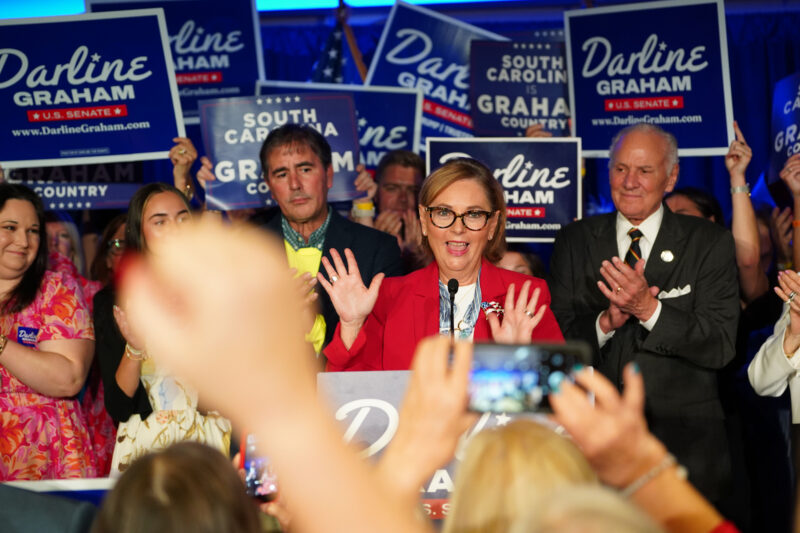
Today’s special election GOP runoff for Senate in South Carolina between appointed Sen. Darline Graham and five-term Rep. Ralph Norman (R-SC) will be a clear test over just how much juice President Donald Trump’s endorsement carries within the Republican Party, at a time when his overall political standing has been on the decline.
Graham has struggled through the shortened campaign to fill the seat of her late brother, dodging the media spotlight (unlike her brother) and sticking to generic talking points in talking about the issues. She faced blowback after admitting she didn’t know enough about foreign policy to answer a debate question about Taiwan — underscoring how much of a novice she is on an issue that defined Lindsey Graham’s legacy.
But Trump has been a loyal backer, holding a rally last Friday for her campaign, which featured appearances from the state’s Republican leadership, including Gov. Henry McMaster and Sen. Tim Scott (R-SC), who is also the chairman of the National Republican Senatorial Committee.
Norman also hardly fits the profile of the up-and-coming challenger. He’s 73 and would be one of the oldest freshman senators in recent memory. And for more-moderate Republicans, his record of antagonism towards House Republican leadership and support for declaring martial law in the days leading up to President Joe Biden’s 2021 inauguration make him a deeply flawed choice.
For national security hawks, Norman’s votes against several Israel aid packages and opposition to Ukraine assistance are also some notable red flags that make Darline Graham the candidate more aligned with her brother’s worldview.
Trump’s endorsement record has been mixed this year, initially backing the losing gubernatorial candidate (Lt. Gov. Pamela Evette) in South Carolina — while endorsing unsuccessful candidates for governor in Georgia, Iowa, Minnesota and Wyoming. All told, he’s backed 10 unsuccessful candidates in primaries this cycle. But the president’s record in Senate races this year is still perfect, having successfully backed insurgent challengers to Sens. Bill Cassidy (R-LA) and John Cornyn (R-TX).
In fact, only three of Trump’s Senate endorsees throughout his political career have lost in primaries (Alabama GOP Sen. Luther Strange in 2017; West Virginia Senate candidate Evan Jenkins in 2018; Utah Senate candidate Trent Staggs in 2024).
Graham is hoping to avoid joining that club, and despite her flubs, she’s still got a strong chance of prevailing. She won the first round of balloting with 33% of the vote — eight points ahead of Norman — and finished a respectable second place in the northeastern corner of the state that makes up Rep. Russell Fry’s (R-SC) home base. (Fry endorsed Graham’s candidacy after finishing in third place in the primary.)
But if Graham falls short, it would not just be a sign that South Carolina voters were wary of her policy inexperience. It would be an indication that the Trump endorsement, while still valuable in Republican primaries, isn’t the automatic ticket to victory that it was for so long.
A number of extremist candidates — on both the left and right — are challenging incumbents across the Sunshine State

Jeff Swensen/Getty Images
Rep. Jared Moskowitz (D-FL), a member of the Task Force on the Attempted Assassination of Donald J. Trump, speaks to the press after touring the shooting site at the Butler Farm Show Grounds on August 26, 2024 in Butler, Pennsylvania.
Tuesday’s Florida primaries are shaping up to be the starkest test yet of how widespread the scourge of antisemitism and extreme anti-Israel views are within both parties.
On the Democratic side, Rep. Jared Moskowitz (D-FL), one of the remaining pro-Israel stalwarts within his party, and Rep. Debbie Wasserman Schultz (D-FL), a pragmatic Jewish lawmaker who is running in a new district after GOP redistricting chopped up her old seat, are both facing serious primary threats from their left flank.
Moskowitz is facing the more direct threat, going up against a Democratic Socialists of America-backed challenger in Oliver Larkin, who is running as a far-left candidate hostile to the U.S.-Israel relationship in a GOP-leaning district with one of the biggest Jewish constituencies in the country.
Larkin’s decision to run on a platform hostile to the district’s Jewish voters would typically be politically problematic. Deciding to campaign with Rep. Rashida Tlaib (D-MI) during the primary’s final stretch is a curious campaign choice, to put it mildly. The blowback was intense enough that several Fort Lauderdale venues declined to host the socialist shindig.
But if there is a surge of left-wing, anti-establishment anger — and latent anti-Israel sentiment from the district’s non-Jewish Democratic voters — it’s worth keeping a close eye on the election results. Even a respectable 40-45% Larkin showing, short of victory, would raise eyebrows about how widespread the far-left ideology has penetrated the party.
After all, Moskowitz’s newly drawn district backed President Donald Trump, and his mainstream record is what’s allowing Democrats to have a good chance at holding the seat. Picking a DSA candidate like Larkin would all but guarantee Republicans pick up a seat that’s not currently at the top of their list.
Republicans will also be nominating their standard-bearer against Moskowitz, with polls suggesting former Boca Raton Mayor Scott Singer holding the edge against business owner Dan Franzese and former state Rep. George Moraitis.
In Florida’s neighboring 20th District, Wasserman Schultz is contending with a changed constituency after she chose to run in a new district with a larger Black population that’s a notch more progressive than her old one. But because multiple Black candidates are splitting the anti-incumbent vote, Wasserman Schultz looks favored to win renomination, though she may do so with a much smaller vote share than usual.
Progressive activist Elijah Manley, who is gay and converted to Judaism, is running in the left-wing lane and attended Tlaib’s socialist rally on Friday. He’s the most credible challenger against Wasserman Schultz, and given that he’s only 27, may end up running again even if comes up short (as analysts expect).
On the Republican side, we’re closely watching how much support two fringe candidates running on openly antisemitic platforms end up receiving in primary races for governor and against Rep. Randy Fine (R-FL), one of only four Jewish Republicans in Congress.
In the governor’s primary, Trump-endorsed Rep. Byron Donalds (R-FL), vying to become the state’s first Black governor, is heavily favored to win the nomination, and likely by a comfortable margin. But the candidacy of openly racist and antisemitic James Fishback has drawn outsized attention on social media. The results will serve as a barometer of whether there’s any real constituency for Fishback’s type of extreme bigotry with the GOP electorate.
The primary polling has been inconclusive in breaking down Fishback’s level of support, with one recent poll showing him only winning 4% of the electorate, with another showing him hitting double-digits. Even as he’s headed towards a decisive defeat, his precise vote total will be watched closely by Republicans eyeing the level of beyond-the-pale racism in their own party.
The other openly racist candidate running is Jew-hating conspiracy theorist and podcaster Dan Bilzerian, who’s challenging Fine. About one-third of Bilzerian’s campaign messages are explicitly antisemitic, according to a study from the Combat Antisemitism Movement, and he’s lent his campaign over $1 million to amplify his message. This year, Israel’s Diaspora Ministry ranked Bilzerian the world’s leading antisemitic influencer for 2025.
Fine is expected to be renominated handily, but as with Fishback, the level of support a neo-Nazi extremist gets in the primary will be an indicator of how widespread this sickness has spread within the Republican Party.
Young activists are divided over Israel and America First, leaving GOP politicians trying to reestablish a common set of facts
Tom Williams/CQ-Roll Call, Inc via Getty Images
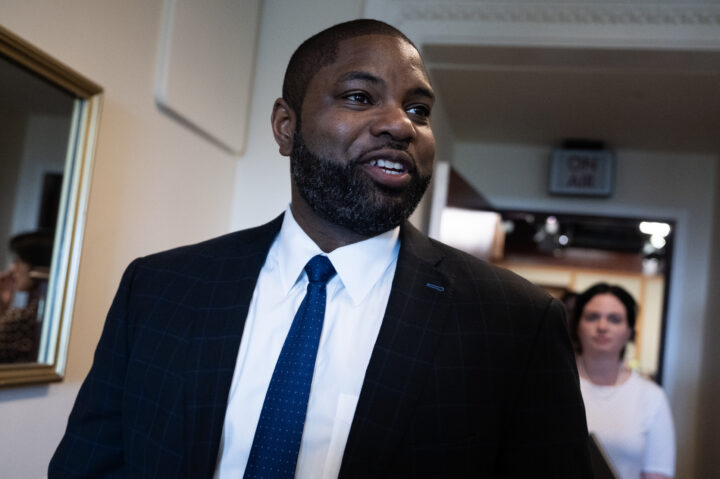
Rep. Byron Donalds (R-FL) arrives for a news conference in the U.S. Capitol on developments regarding Cuba on Wednesday, May 20, 2026.
TAMPA, Fla. – The crosswinds buffeting the Republican Party and conservative media ecosystem over Israel and antisemitism blew through Tampa earlier this month at the National College Republicans convention, and both the politicians who addressed the gathering and the young Republicans themselves had their collars turned up.
Gubernatorial candidate Rep. Byron Donalds (R-FL) warned the crowd: Don’t let social media think for you.
It is too easy, he said, to “go down rabbit trails” and follow personalities instead of facts.
Donalds then turned to why he believes more and more young conservatives have become skeptical of Israel. “Social media, propaganda,” he said.
Foreign governments, Donalds added, “would love nothing more for the United States to be destabilized.”
But he also drew a distinction between criticism of Israeli policy and antisemitism. “If you are having an issue with public policy … have that issue,” Donalds said. But blaming Israel or Jews “with no real facts, no real evidence, just because that’s what you heard” should not be tolerated.
Rep. Kat Cammack (R-FL), who also spoke at the conference, was even more explicit about the problem. For her, the argument over Israel begins before foreign policy: Republicans first have to agree on what constitutes a fact.
“You can’t even begin to have an honest conversation about how we ensure the security of our country, let alone our allies, until people understand what basic facts are,” Cammack said.
The exchanges between lawmakers and student activists captured a broader tension within the Republican Party that was on display throughout the Aug. 8 convention, which focused on recruiting, building chapters, training leaders and working on campaigns. But lawmakers and students kept coming back to a simpler question: where do young Republicans get their news, and whom do they trust?
University of Florida senior Justin Giacomelli said the debate over Israel has become one of the biggest fault lines among younger conservatives raised on social media.
“A lot of younger people, in particular, have grown up on social media where they’ve been bombarded by misinformation and lies about our relationship with Israel,” Giacomelli told Jewish Insider. “They’ve been brainwashed into thinking that Israel is evil, while countries like Iran are not, and they don’t understand the role we have with Israel, our mutual relationship, where we get critical intelligence from them.”
Giacomelli said X is his preferred platform for news because it puts competing arguments in the same feed. He also values the chance to test those arguments in real time by joining the debate himself. He admires Secretary of State Marco Rubio’s approach to Israel, Cuba and Venezuela, and disagrees with far-right, isolationist voices such as Tucker Carlson.
“I have learned that those policies don’t work,” Giacomelli said. “It’s dangerous to turn on your allies and become sympathetic toward your enemies, like Russia, China and Iran. You reach a point where you realize those policies don’t benefit America. They are not America First.”
Ian Lares-Chacin, the incoming chairman of the National Federation of College Republicans, said foreign policy is important to younger Republicans but remains secondary to affordability, particularly homeownership.
“As much as people care about foreign policy and that sort of thing, it’s second. Right now people are just kind of stressed out,” he said.
Still, Lares-Chacin described a “pretty split divide” over Israel among younger conservatives and said the debate had become toxic in some corners. His goal as chairman, he said, is to keep factions cooperating even when they disagree.
“At the end of the day, we’re all conservatives, even if we don’t agree 100% on every issue,” Lares-Chacin said. “I don’t think one or two issues should be the cause of a civil war.”
He said Israel could become a wedge issue, though he did not think it should.
Ephraim Asher, a University of South Florida junior who interned for Rubio when he was a senator, said most of his news comes from YouTube because he prefers extendedlong-form material to clipped excerpts.
“I get most of my information from YouTube, more like long-form content,” Asher said. “One thing I’ve seen is people clipping stuff, and I’m like, just watch the whole thing. So I’d rather watch the whole thing, see what they said, go through the sources and everything else.”
He said he checks Bloomberg, follows hosts with varying viewpoints and uses articles and AI tools to compare arguments. Like Giacomelli, he named Rubio as a model for the party’s future, citing his foreign policy and his ability to disagree without being divisive.
Moses Jinu, an FSU freshman, has a different routine.
“I’m kind of old-fashioned,” Jinu said. “I read the newspaper with my grandpa and then independently research news topics on Google.”
Asked what being a Republican means in 2026, Jinu pointed to “individual freedoms, liberty, and everyone’s right to speech, religion, the First Amendment.” Darren Valens, a Valencia College freshman, emphasized consent of the governed and the idea that rights come from God rather than government.
Scott Johnson, an advisor to the Osceola Young Republicans, said the defining challenge for a generation raised on social media is “figuring out what’s real and what’s not real.”
Cammack, the Florida congresswoman, recalled talking to a young man who believed American politicians were funded by foreign governments, a claim Cammack told him was not true. To her, the exchange showed how much the media landscape has changed. Younger conservatives are less likely to rely on Fox News or the New York Post and more likely to move between podcasts, X accounts and YouTube livestreams.
“There’s no editorial control, no reviews, there’s no accountability,” Cammack said. “There’s no, ‘Oh, I have sources, I have this.’ There’s none of that.”
The COVID-19 pandemic, she said, accelerated a collapse of trust, when many conservatives began questioning institutions and legacy media. That gave an opening for independent journalists and commentators.
She added that “there is a beauty” in the rise of independent media, “but now we’ve seen the abuse of that, and how people can just say whatever the hell they want, and they don’t have to back it up.”
Cammack said she has seen friends share material she believed was created by the Chinese Communist Party while assuming it came from American users. “We are in a full-blown cognitive war with China, with Russia, with Iran,” she said. “People don’t know it.”
Her prescription to the students was not a return to one set of legacy outlets, but more skepticism toward everything they encounter — including content they already agree with.
Cammack encouraged students to check claims before posting them and decide if the sources are credible. Distrust in established institutions makes personal judgment even more important.
“You want to be known as someone who is a beacon of truth, who can be counted on to share the truth,” she told the students, “who has the integrity and the intelligence to go do your own dang research, and you know what is fact and what is fiction.”
Among students, the divide was less abstract.
Conservative influencer Gates Garcia said the right has been too reluctant to confront antisemitism within its own ranks, while also warning against branding every criticism of Israel as antisemitic.
“We have a First Amendment right to criticize anyone,” Garcia said. “But what becomes antisemitic is when we hold Israel to a different set of standards than other people and other countries. And that’s what a lot of people in the conservative movement are falling victim to.”
With Netanyahu and Zelensky in attendance, tributes underscored how difficult it will be to replace Graham's influence on Iran, Ukraine and Israel policy
Daniel Heuer/Bloomberg via Getty Images
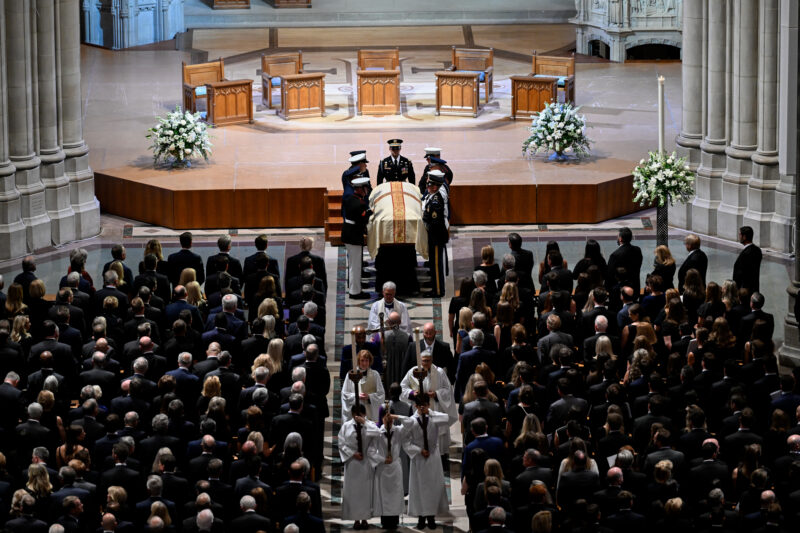
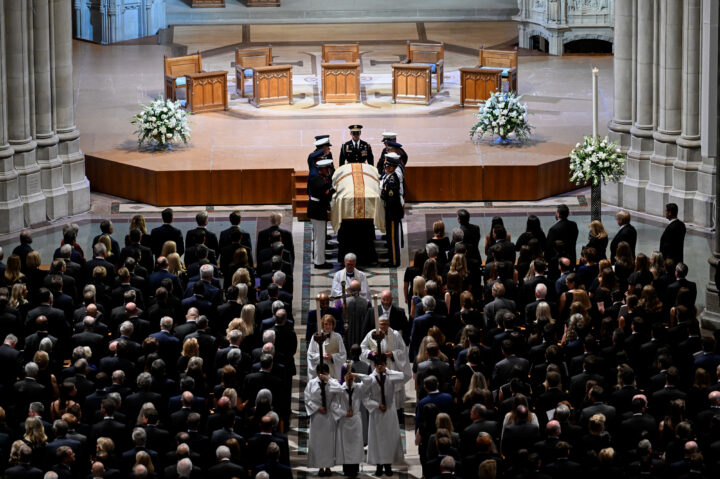
The casket of late Sen. Lindsey Graham is carried out during a funeral service at the Washington National Cathedral in Washington, DC, on July 28, 2026.
A who’s who of international leaders, Cabinet members, senators and ambassadors gathered on Tuesday at the National Cathedral and on Capitol Hill for a somber and emotional tribute to the late Sen. Lindsey Graham (R-SC), a giant both in Washington and on the world stage.
Graham distinguished himself over his career as one of the most important foreign policy voices in the Republican Party and a global statesman, evident in the fact that Israeli Prime Minister Benjamin Netanyahu and Ukrainian President Volodymyr Zelensky sat just seats away from one another at the afternoon memorial service, representing two of the countries that Graham championed during his time in office.
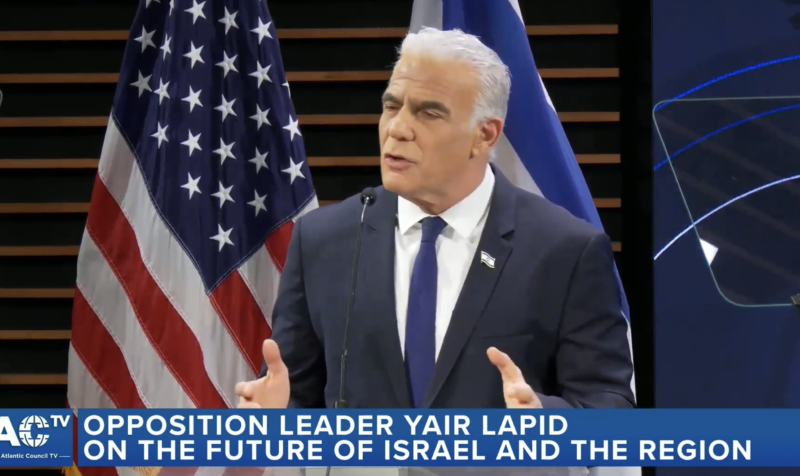
In one sign of how appreciated Graham’s pro-Israel leadership was to so many in the Jewish community, a number of attendees were seen wearing kippot at the National Cathedral service. Among the notable guests at the service were: philanthropist Miriam Adelson; Israel’s former Minister of Strategic Affairs Ron Dermer; Israeli opposition leader and Netanyahu rival Yair Lapid; Axios reporter Barak Ravid; and the parents of slain American Israeli hostage Omer Neutra.
Fox News host Sean Hannity gave special attention to Graham’s dedication to Israel in his eulogy, offering effusive praise to Netanyahu and the importance of the U.S.-Israel relationship.
“Lindsey would have been blown away that you took this long journey with your beautiful bride to be here today. He loved you. He loved the state of Israel, he loved the people of Israel,” Hannity told Netanyahu and his wife, Sara, from the lectern. “Under your leadership, Israel has been one of America’s most consistent and loyal allies. He was never shy to say it, to the day he passed. Just as President Trump has been Israel’s strongest friend in the history of the White House … Lindsey was that friend to Israel in the United States Senate.”
Sean Hannity speaks about Netanyahu and Israel at Sen. Lindsey Graham's funeral.
— Jewish Insider (@jewishinsider) July 28, 2026
"He loved you. He loved the state of Israel. He loved the people of Israel." pic.twitter.com/pOdBZdHRNp
Acknowledging Graham’s role as one of the GOP’s most prominent voices on foreign policy, President Donald Trump said in his own eulogy that Graham “was extremely hawkish” and “never saw a war that he didn’t like” but said Graham pursued those policies “for the good of our country.”
Graham had been one of the most influential voices in Trump’s ear in support of confronting Iran’s malign activity in the Middle East — and urging the president to more actively confront Russian aggression against Ukraine.
This week could mark a major turning point for the senator’s legacy: the Senate voted overwhelmingly yesterday evening to open debate on the Russia (and, at the last minute, Iran) sanctions bill that Graham spent his final months negotiating. And Trump’s meeting Tuesday with Netanyahu, where the two were expected to discuss next steps in Iran, could shape the future of the war.
Graham was one of a rare breed of Republicans who managed to remain a fervent advocate for U.S. involvement abroad while also keeping in Trump’s good graces and maintaining his influence with the president.
But there’s no clear successor to replace Graham’s hawkish voice in Trump’s inner circle, an absence that could tangibly impact the direction of U.S. foreign policy in the coming weeks and months, including the direction of the Iran war.
How largely pro-Israel Democrats in solidly-blue districts balance the pressures from the base against their longstanding principles will speak volumes about whether the U.S.-Israel relationship can maintain support within their party
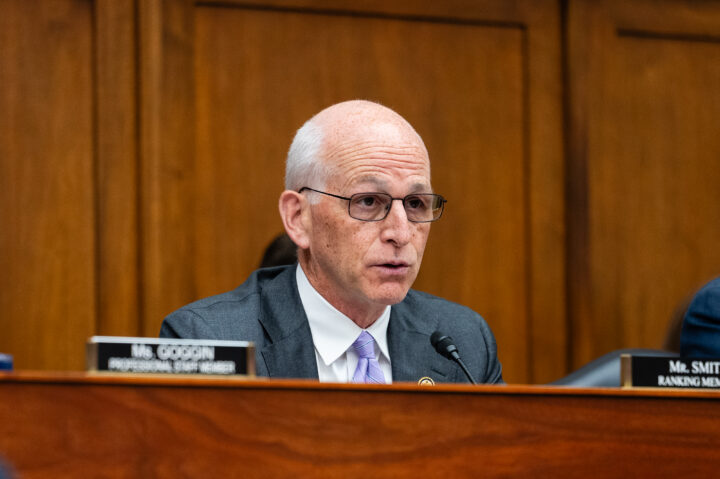
Eric Lee/Bloomberg via Getty Images
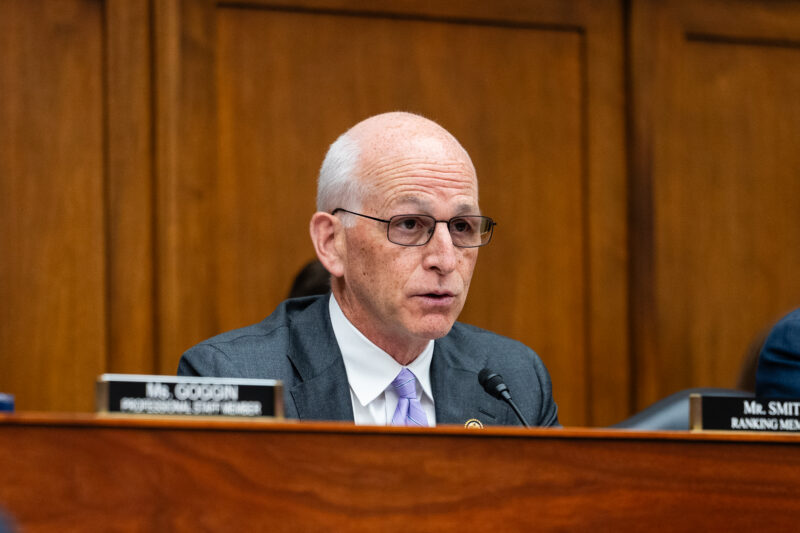
Rep. Adam Smith (D-WA), ranking member of the House Armed Services Committee, during a hearing on May 14, 2026.
President Donald Trump’s capture of the Republican Party did not happen at once, and was memorably met with resistance from some lawmakers who would later become his allies.
Many Republicans, during the rise of Trump, cast mostly party-line votes alongside the president and rarely spoke out publicly when they disagreed. But there were notable times when prominent party leaders used their political capital to stand up for their principles on key issues, such as then-Senate Majority Leader Mitch McConnell’s (R-KY) outspoken advocacy for Ukraine funding or Sen. Susan Collins’ (R-ME) decisive vote against repealing Obamacare.
There may be a similar political calculus at play for some typically pro-Israel Democrats, who are facing immense political pressure from loud activists in their party base to turn against the Jewish state. Nearly half of the House Democratic caucus voted to cut off aid to Israel last week, a record number that included 18 lawmakers who had previously been endorsed by AIPAC and were seen as strong allies of the U.S.-Israel relationship.
AIPAC cut off fundraising to their reelection campaigns after the vote, and how these lawmakers will position themselves on Israel policy going forward is now uncertain.
Not all of the Democrats who supported the amendment have adopted an anti-Israel worldview. Some said that they still support Israel, but wanted to make a statement, via a bill that was certain to fail, that they disagree with many recent actions of the Israeli government.
It’s also possible that some of them — especially those in districts where they face a credible primary threat from the left — took the vote to attempt to placate anti-Israel activists without making any real change in policy, like the Republicans who would offer an olive branch to their right-wing base by voting contrary to their longstanding beliefs.
For instance, in April 2024, then-Sen. Marco Rubio (R-FL) and Sen. Ted Cruz (R-TX) voted against a sweeping foreign aid package for Israel and Ukraine in the face of rising isolationist sentiment in the party, despite their hawkish records. But politically speaking, it helped maintain their credibility with a MAGA base skeptical of any foreign assistance without jeopardizing the funding.
A similar dynamic appears to be taking place among the generally pro-Israel Democrats who are trying to hold onto their place in the party as anti-Israel voices are on the rise.
Rep. Adam Smith (D-WA), for instance, described his “yes” vote as an attempt to “to try to get the attention of the Netanyahu government to force them to change their actions.” He also said he still supports Israel and expressed concern “about the tactics used by those on the far left to advocate for cutting off aid to Israel,” including vandalizing his family’s home. Days later, he spent time on a far-left podcast attacking the host’s anti-Israel views and explaining to her why he’s been such a strong supporter in his career of the Jewish state.
Far from sounding like an anti-Israel convert, Smith sounded like he wanted to throw the left-wing activists a bone by voting for the symbolic anti-Israel resolution without fundamentally shifting his longstanding views on Middle East policy.
In the liberal Boston suburbs, Rep. Jake Auchincloss (D-MA) — a Jewish Democrat and strong supporter of the U.S.-Israel relationship — surprised many by voting for the amendment. But in an interview with Jewish Insider’s Marc Rod this week, he asserted that the vote was in line with his pro-Israel beliefs.
“I represent a pro-Israel, anti-Netanyahu district and this is a pro-Israel, anti-Netanyahu vote,” Auchincloss said, adding that he believes “a majority of my Jewish constituents would agree with me.”
How largely pro-Israel Democrats in solidly blue districts such as those represented by Smith and Auchincloss balance the pressures from the base against their longstanding principles will speak volumes about whether the U.S.-Israel relationship can maintain support within their party.
The president called Fry, who defeated a Republican backing his impeachment in 2021, a ‘very, very talented person’ in an interview this week
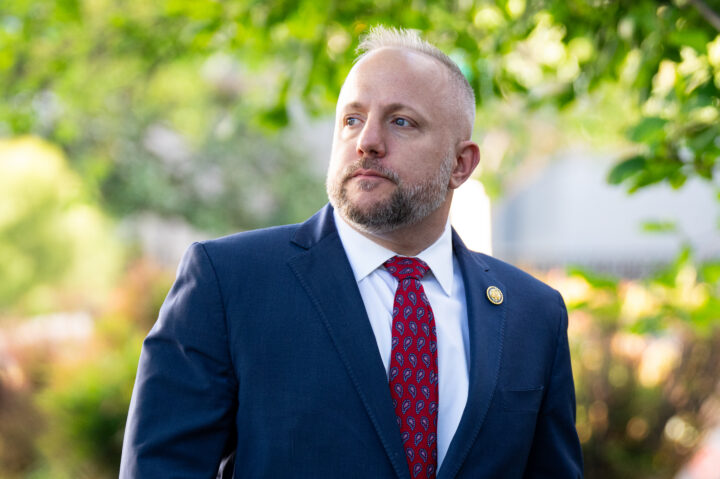
Bill Clark/CQ-Roll Call, Inc via Getty Images
Rep. Russell Fry (R-SC) arrives for the House Republican Conference caucus meeting at the Capitol Hill Club in Washington on Wednesday, May 13, 2026.
The late Sen. Lindsey Graham (R-SC) understood the value of staying in President Donald Trump’s good graces — both to advance his top legislative priorities and to shield himself from challenges on his right flank.
In the wake of Graham’s sudden death, the candidates vying to succeed him have absorbed a central lesson of his career: the most decisive factor in the Republican primary will almost certainly be who wins Trump’s endorsement.
Rep. Russell Fry (R-SC), who ousted a sitting GOP lawmaker with Trump’s endorsement in 2022, is emerging as one of the leading contenders and someone who has an inside track to receive the president’s blessing. Fry’s defeat of former Rep. Tom Rice (R-SC), who was one of the few Republicans to vote for Trump’s impeachment in 2021, allowed him to build early relationships with Trump’s political circle.
Fry has been making calls to White House officials about a possible run this week, a source familiar with the matter told Jewish Insider.
Asked on Monday evening about the possibility of endorsing Fry if he launched a bid for a full term in Graham’s seat, Trump told Newsmax that Fry is “somebody you can watch out for” as a rising Republican star and did not deny he was considering backing the House lawmaker if he enters the race.
Fry, who became an ally of Graham’s while they served in Congress together, was one of the Republicans who had reached out to the White House about a possible interim appointment to the seat. South Carolina Gov. Henry McMaster ultimately announced on Monday that he was appointing Sen. Darline Graham Nordone (R-SC), Graham’s younger sister, to serve out the remainder of her older brother’s Senate term, which expires next January.
“Russell Fry, a young congressman, is outstanding. That could happen. I could see that happening,” Trump said of an endorsement. “I think he’s a very, very talented person. … I mean, he’s doing much better than the person that preceded him. He’s been very popular in the state.”
Reached for comment, a White House official told JI about the president potentially endorsing Fry that, “Until the president makes an announcement, any speculation is just speculation.”
Fry has been a reliably conservative and party-line vote in the House since elected, and also holds a solidly pro-Israel voting record. AIPAC congratulated him on his primary victory in 2024.
Graham’s GOP replacement on the November ballot will be chosen in a special election scheduled for Aug. 11. Candidates can file to run for the seat starting on July 21, in accordance with the timeline required by state law, and several others are also looking to throw their hats in the ring.
Among the other Republicans who have reportedly been lobbying the White House and considering jumping into the race are Rep. Ralph Norman (R-SC); Rep. Nancy Mace (R-SC); former Rep. Trey Gowdy (R-SC), a Fox News host and close ally of National Republican Senatorial Committee chairman Sen. Tim Scott; and Lt. Gov. Pamela Evette, who lost to the state’s Attorney General Alan Wilson in a runoff of South Carolina’s Republican gubernatorial primary in June.
Mark Lynch, who lost to Graham in last month’s primary by 30 points, said on Monday that he would enter the special election and committed $5 million to his campaign. During the campaign, Trump called him a “lunatic” who “would be a DISASTER for the Republican Party,” which came in response to Lynch blaming the U.S. war in Iran on Graham by arguing that the senator had convinced the president to start the conflict. Graham had criticized Lynch, a South Carolina businessman, for employing staffers with records of making antisemitic statements,
Rep. Joe Wilson (R-SC), who was also floated for a possible interim appointment, said on Sunday that he was committed to staying in the House to protect Republicans’ slim majority in the lower chamber. He has not divulged if he is considering entering the special election.
Rep. William Timmons (R-SC) said late Tuesday that he would not enter the race to replace Graham, adding in the announcement that he would not support Noman or Mace’s candidacies.
Regardless of who the nominee is, Republicans are confident that they will hold the Senate seat in November. Trump carried South Carolina in the 2024 presidential election by 18 points, 58-40%.
The Democratic nominee in the race is Dr. Annie Andrews, a pediatrician who handily won her primary. A political outsider who challenged Mace unsuccessfully in 2022, Andrews has drawn attention for her effective fundraising against Graham, outraising the incumbent in the last two quarters. National Democrats, however, have so far declined to prioritize the race, citing the need to use those resources in battleground states.
The Cook Political Report grades the race as solid Republican.
A national Democratic campaign source told JI that this is not expected to change unless Republicans were to nominate a weak candidate with a record of extremism or concerning accusations about their personal background, such as accusations of criminal activity or assault.
“If you remember back to [former Democratic National Committee Chair] Jaime Harrison’s campaign [in 2020], he was the head of the South Carolina Democratic Party and raised over $100 million and still got blown out,” Dr. Gibbs Knotts, a professor of political science at Coastal Carolina University, told JI. “South Carolina has not dipped its toe into that purple state category for two to three decades.”
“Whoever gets this [Republican] nomination, to state the obvious, is very likely to be the next senator.”
Allies of the Texas senator are launching The Front Line, a 501(c)(4) nonprofit aimed at making antisemitism 'disqualifying' for GOP candidates
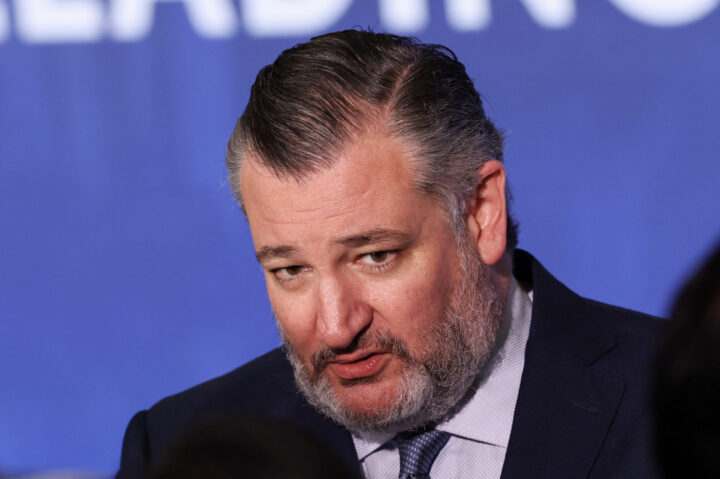
Patrick T. Fallon/AFP via Getty Images
Sen. Ted Cruz (R-TX) speaks during the 29th annual Milken Institute Global Conference at the Beverly Hilton in Beverly Hills, California on May 4, 2026.
Allies of Sen. Ted Cruz (R-TX) are launching a new political organization aimed at countering antisemitism within the Republican Party, Jewish Insider has learned, led by Arielle F. Klepach, a former assistant U.S. attorney and senior counsel for the National Jewish Advocacy Center.
The Front Line (TFL) will operate as a 501(c)(4) nonprofit, meaning the group will not have to disclose its donors and can spend unlimited sums toward political activity, provided campaign finance is not its primary purpose and it does not contribute directly to campaigns.
A source familiar with the matter told JI that those behind the organization, which Cruz is not directly involved with, raised several million dollars to fund the operation. Klepach will run the operation as executive director.
In a statement on her hiring, Klepach said she was enthusiastic to join an effort focused on preventing Republicans from mimicking what she described as Democrats’ embrace of anti-Israel sentiment.
“There has been a surge of antisemitism across America, which first engulfed the left and is now threatening the moral integrity and political unity of the conservative movement and the Republican Party,” Klepach said. “I am excited to lead The Front Line’s efforts to defeat right-wing antisemitism before it takes conservatives down the same path of anti-Americanism, anti-capitalism, and pro-Sharia advocacy that has taken the left.”
TFL’s mission statement describes the group as “an issue advocacy organization aligned with the positions of Ted Cruz dedicated to countering right-wing antisemitism, by making antisemitism disqualifying in the Republican Party and conservative movement, through activities across political, policy, and digital spaces.”
On the political front, the group “seeks to defeat antisemitic candidates at all levels of the Republican Party, first by mapping federal, state, and local primaries, and then by running effective messaging campaigns to ensure that they lose, highlighting and ensuring that antisemitism is an electoral liability for Republican candidates.”
TFL will also “engage in issue advocacy related to a cluster of policies which have emerged in the battle over right-wing antisemitism.”
“Ted Cruz and other lawmakers seek to counter Iran, the Muslim Brotherhood and Islamism, and the global persecution of Christians by Islamist extremists, while boosting the U.S.-Israel relationship and efforts to address antisemitism,” the statement reads. “Right-wing antisemites take and advocate for the opposite position on each of these issues, and related ones.”
Regarding their digital efforts, the group says in its mission statement that it also plans to “create and utilize infrastructure for real-time monitoring and response to right-wing antisemitism, including and especially to the extent that it is being driven by foreign adversaries. It will deploy defensive measures, including the identification and deactivation of inauthentic accounts, as well as measures meant to elevate clarity about antisemitism in the conservative movement and Republican Party.”
The effort has been in the works since late last summer, as Cruz was growing more vocal with his concerns about rising antisemitism within the conservative movement and the need to insulate the GOP from fringe figures who espouse antisemitic views, according to a source familiar with the Texas senator’s concerns.
It’s the latest development in the divide in the GOP over how to approach the outgrowth of antisemitism on the party’s far right, especially if those close to Cruz, who is considering a 2028 presidential bid, use the group to put their thumb on the scale in heated primary contests.
The Texas senator, one of the GOP’s pro-Israel champions, has led the charge in urging the Republican Party to disavow antisemitic figures within the conservative movement as commentators Tucker Carlson, Nick Fuentes, Candace Owens and others grow their influence, particularly with young conservatives.
Cruz has criticized Republicans who refuse to disavow prominent antisemites in the party or avoid weighing in on the issue as “cowards,” and has argued that young Christians were turning away from supporting Israel because leading voices in the America First movement were maligning Jewish conservatives and pro-Israel Christians.
You couldn’t draw up a better test on the degree of Trump’s impact on the Republican Party than examining the results from four states holding highly consequential primaries next month that will be a benchmark of the president’s power
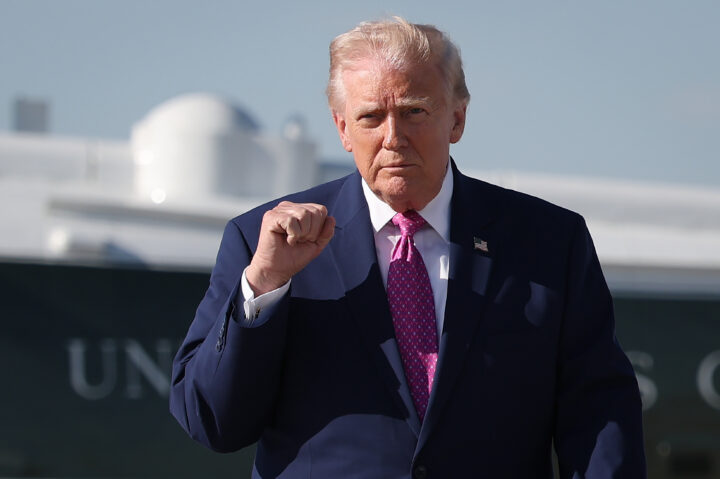
Win McNamee/Getty Images
President Donald Trump walks toward reporters before answering questions prior to boarding Air Force One on April 10, 2026 at Joint Base Andrews, Maryland.
There’s been a lot of debate lately over whether President Donald Trump is losing some of his grip on the Republican Party, amid growing economic concerns and the ongoing military operations in Iran.
While the media coverage has been amplifying any sign of intraparty discontent — to the point that former Rep. Marjorie Taylor Greene (R-GA) is getting strange new respect from some Democrats and mainstream press alike — polls continue to show Trump with widespread backing from within his own party, and especially within the MAGA faction of the GOP.
Ultimately, election results are the best reality check. And you couldn’t draw up a better test on the degree of Trump’s impact on the Republican Party than examining the results from four states holding highly consequential primaries next month that will be a benchmark of the president’s power.
Key races in Indiana, Kentucky, Louisiana and Texas will speak volumes about the president’s ability to shape the GOP agenda for the remainder of his second term — and most consequentially, whether he will be able to maintain a unified front with his party on continuing to pursue military action against Iran.
The biggest intraparty showdown, especially when it comes to foreign policy, is the May 19 primary between Rep. Thomas Massie (R-KY) and military veteran Ed Gallrein. Massie, one of the few anti-Israel Republicans in Congress, is being opposed by Trump but also has a solid base of grassroots support in the northern Kentucky district, which has thus far supported his anti-establishment brand of politics. But Gallrein has proven to be a credible challenger, raising millions and giving Massie the biggest political test of his career.
Trump has spent some valuable political capital to boost Gallrein, including appearing at a recent rally in Massie’s district to promote his challenger. He’s been joined by the Republican Jewish Coalition, which has poured $3.5 million into the race, airing five ads underscoring Massie’s record of breaking with Trump. (Further drawing Trump’s ire: Massie also joined with Democrats in championing the release of the Epstein files.)
It’s never easy to beat a sitting incumbent, but Trump also has an imposing record of winning primaries in which he chooses to engage. If Massie pulls out a victory despite breaking so flagrantly with Trump on a number of key issues, it will be a sign of the president’s diminished political clout.
Another high-profile race where Trump’s engagement in a primary hasn’t yet been definitive: Sen. Bill Cassidy’s (R-LA) uphill fight to win renomination against Trump-endorsed Rep. Julia Letlow (R-LA) and state Treasurer John Fleming. The primary will be held on May 16, with the top two finishers heading to a runoff if no one wins a majority of the vote.
Cassidy, largely because of his vote to impeach Trump in 2021, has long faced challenges with the GOP base. Trump, looking to secure Cassidy’s defeat, backed Letlow earlier this year in hopes she’d consolidate the MAGA vote. But Trump’s endorsement hasn’t translated into a groundswell for Letlow, and the presence of Fleming, a former right-wing congressman, has complicated the political math in the primary.
Cassidy looks like a long shot even if he heads to a runoff, and Letlow holds a narrow lead in the limited public polling of the race. But there’s a chance that Fleming could sneak past Letlow on the primary ballot and face Cassidy in a runoff, blocking Trump’s candidate from the race. If that happened, it would be another sign that Trump’s endorsement doesn’t carry the same weight as it once did.
The first Trump test of the month (May 5) will be in Indiana, where the president is trying to punish certain Republican state legislators for not backing a redistricting plan, championed by the White House, which would have allowed the GOP to gain an additional seat.
Finally, it’s the spring race where Trump has remained on the sidelines that may be a signal of his limited political powers. After Sen. John Cornyn (R-TX) finished ahead of Texas Attorney General Ken Paxton in the state’s primary last month, reports indicated the president was close to endorsing Cornyn for reelection, in an effort to prevent an expensive and competitive general election against Democrat James Talarico.
But amid furious pushback from right-wing activists and polls suggesting that a Trump endorsement wouldn’t have moved the needle that much, the president has not gotten involved in the race. That alone speaks volumes about the limited level of the president’s political capital.
Trump boasts a near-perfect record in GOP primaries throughout his decade-long political career, with the most prominent setbacks being in Georgia (working against Gov. Brian Kemp and Secretary of State Brad Raffensperger in 2022). So if the president’s chosen candidates end up falling short in these key contests, it will be a sign that Republicans may already be preparing for the post-Trump era.
The South Carolina Republican brought Christian and Jewish leaders together to speak out against ‘stopping’ antisemitism in the GOP ‘before it gets stronger’
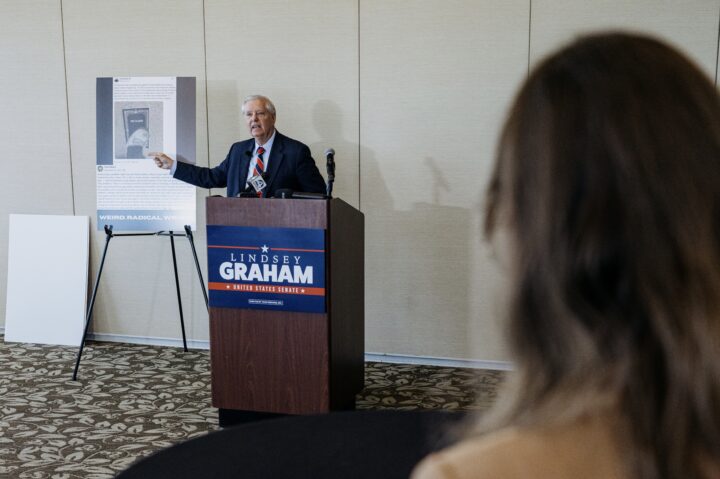
Lindsey Graham for Senate Campaign
Sen. Lindsey Graham (R-SC) at news conference last Thursday during which he criticized the actions of his primary opponents' staffers.
Sen. Lindsey Graham (R-SC) doubled down on his calls for two of his primary challengers in his reelection campaign to fire senior officials over their record of antisemitic statements after both candidates refused to do so — vowing on Tuesday to fight the growing tolerance for Jew-hatred in the GOP and call out aspiring lawmakers in South Carolina who excuse or embrace it.
The South Carolina senator convened Christian and Jewish leaders for a call with reporters to criticize Paul Dans and Mark Lynch, who are challenging Graham in the Republican primary for his Senate seat, over Dans’ refusal to fire Vish Burra as his campaign communications director and Lynch declining to part ways with Evan Mulch as his political director despite their respective records of making antisemitic statements.
Graham told reporters that while he would not typically make an issue of the behavior of staffers from an opposing campaign, he felt compelled to speak out because of the outgrowth of antisemitism in the Republican Party.
“I’m speaking more today as just an American, a senator representing South Carolina, rather than just a candidate. I’ve never had to make a phone call like this, and it, quite frankly, is disturbing,” Graham said. “There are two opponents of mine that have staff members that are very out of touch with where I think South Carolina is, and spewing hate in the form of antisemitism.”
“I’ve never done this before, but this is a problem in America, a small problem in the Republican Party, that I don’t want to grow,” he continued. “I seldom do this, go after other people’s campaigns, because I feel confident that what I’ve got to offer wins the day politically, but this is not about politics. This is not about my primary. This is about stopping something before it gets stronger, calling it out and making it unacceptable.”
Graham highlighted both staffers’ records at a news conference last Thursday and on Tuesday’s call, condemning Burra for depicting Jews as cockroaches in a video he created on the right-wing One America News Network, which ultimately resulted in his firing as a producer.
Mulch, meanwhile, posted a photo on X last June of a boot stepping on the Talmud and calling it a “hate filled book.”
“I call this out because I think it’s a vile antisemitic action. It has no place in politics or, quite frankly, decent society, and he hasn’t been fired,” Graham said on Tuesday. “As a matter of fact, Mr. Dans, in responding to the call to deal with the staffers, said that my campaign was controlled by Israel and that I’m being blackmailed by Israel and other affiliated groups, which I think is one of the oldest stereotypes, that the Jews control politicians.”
“When you step on the Talmud with a boot, I don’t think that’s American,” he added of Mulch. “I don’t think it’s Christian, and I don’t think there’s any place in running for higher office for people who engage in that behavior, and I’ve called for him to be fired with no response.”
While Graham said he does not believe it is inherently antisemitic to voice objections to the policies of the Israeli government, he argued that tolerance of such criticisms did equate to tolerance of blatant antisemitism.
“I’m a strong supporter of Israel, and you can oppose Israeli policies and not be an antisemite,” Graham said. “But when you’re an antisemite, not only do you oppose Israel, I think you oppose human decency and what America stands for.”
Graham told Jewish Insider on the call that he was confident “that when the people of South Carolina — Republicans, Democrats and independents — hear what’s going on, and that’s why I’m doing it today, it will be soundly rejected.”
Matt Brooks, CEO of the Republican Jewish Coalition; Tony Perkins, president of the Family Research Council; Ralph Reed, founder of the Faith & Freedom Coalition; Sandra Hagee Parker, who chairs the board of CUFI Action Fund, the political arm of Christians United for Israel; and Rabbi Yossi Refson of Chabad of Charleston spoke on the call in support of Graham’s efforts.
“We have witnessed, I believe, sadly, the institutionalization of antisemitism in the Democratic Party,” Brooks told attendees. “For us at the Republican Jewish Coalition, let me be very clear and unambiguous that this is a fight that we will take everywhere. We will ensure that antisemitism does not take hold in our party like it has taken hold in the Democratic Party. The fabric of America was woven together based on Judeo-Christian values, the values that we all cherish are built in partnership with our Christian allies and friends. Anybody who traffics in antisemitic rhetoric or antisemitic actions has no place in our party.”
Graham vowed at the end of the call to continue his push to ensure elected Republicans in and out of the state are individuals who repudiate antisemitism.
“The breadth of condemnation here and the quality of the thoughts expressed not only give me hope and prove that I’m doing the right thing. It inspires me. I am not going to let this go after what I heard today. I am never going to let this go until my last breath. I will make sure that any group, but particularly the long suffering Jewish people, have my unequivocal support.”
Dans and Lynch were unapologetic about their campaign staffers, instead releasing statements late last week and Tuesday directing their ire at Graham in deeply personal terms.
“He’s given a member of my campaign staff more attention than he’s given South Carolinians for decades,” Dans said in a statement last Thursday. “The real headline that you should be covering is how many opioid deaths happened in South Carolina last year on Lindsey Graham’s watch. Israel picks Lindsey Graham’s staff, but they do not pick mine. I am not firing Vish Burra and I am calling on the people of South Carolina to fire Lindsey Graham.”
Lynch, meanwhile, told JI in a statement on Tuesday evening that Graham was “an existential threat to both the nation of Israel and the United States.”
“Lindsey Graham is responsible for the deaths of countless Jews in Israel by the fact that he has sent 10s of millions of dollars to Al-Qaeda, Hamas, and Al-Nusra Front — funding the enemies of Israel,” Lynch said.
The Texas senator called Tucker Carlson ‘the single most dangerous demagogue in this country’
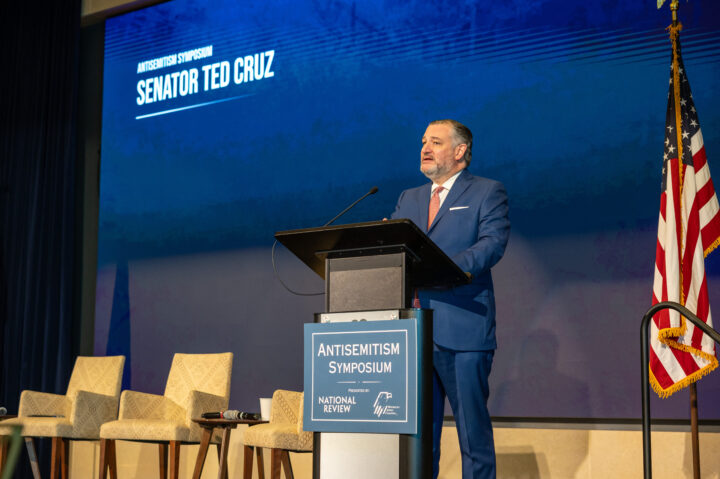
Republican Jewish Coalition
Sen. Ted Cruz (R-TX) speaks at antisemitism symposium in Washington on March 10, 2026.
Antisemitism is rising on the American right, Sen. Ted Cruz (R-TX) warned on Tuesday, expressing concern that efforts to combat it are not doing so quickly or effectively enough.
“I want us to be winning, but I’m not sure it is accurate as a descriptive manner that we are winning right now,” Cruz said at an antisemitism symposium in Washington organized by the Republican Jewish Coalition and the National Review.
Cruz has emerged in recent months as one of the Republican Party’s most vocal critics of right-wing antisemitism. He has targeted influential commentator Tucker Carlson and his strain of isolationist, anti-Israel politics that has in recent months crossed over into overt antisemitism, though Cruz has bemoaned other Republicans’ wariness to criticize Carlson by name.
At the RJC event, Cruz called Carlson “the single most dangerous demagogue in this country.”
But he said that not enough of his colleagues and allies on the right are aware of the extent of the problem.
“I don’t want to wake up in five years and find myself in a country where both major political parties are unambiguously anti-Israel and unapologetically antisemitic, and I think that is a real possibility. If Tucker and his minions prevail, that will happen,” Cruz argued.
Cruz expressed fear that this attitude is not just present but popular among young people on the right, as evidenced by two viral Turning Point USA events last fall where students at Auburn and Ole Miss cheered after deeply anti-Israel questions were asked.
“I worry about the 19-year-olds who say, ‘Oh, that’s what our team believes. That’s who we are.’ Let’s be clear, if you are a young, ambitious Democrat, it is obvious what you should do. You should be viciously anti-Israel,” said Cruz.
He applauded the people who came out to the Museum of the Bible on Tuesday to discuss antisemitism but pointed out that their concern does not reflect how the rest of the country thinks about the issue.
“The fact that this room is persuaded does not mean that the college campus is. It does not mean that the Capitol Hill interns are. It does not mean that the interns at Heritage, at [Conservative Partnership Institute] and every other conservative institution in this country, that they’re persuaded,” said Cruz. “We need to fight and engage it and take on the core premises, because if we lose the next generation, we lose the country.”
Cruz posited that Carlson and other anti-Israel influencers are being paid by foreign nations like Qatar, China and Russia, though he acknowledged that he lacks proof for that theory.
“I don’t believe all of these voices who have suddenly discovered that Israel is the source of all evil, that everything bad in the world was done by the Jews, that America is controlled by the Jews and that radical Islamic terrorists are really nice, wonderful people — I don’t think these people just arrived on this view organically and magically,” said Cruz.
“I think many of these influencers are cashing a check,” he added. “The people in this room could do an enormous service by documenting that. I don’t have the evidence right now to prove it, but Occam’s razor: the simplest explanation is usually the right one.”
The Texas senator, facing a competitive primary, praised Sen. Ted Cruz for taking the lead in speaking out against anti-Jewish hate
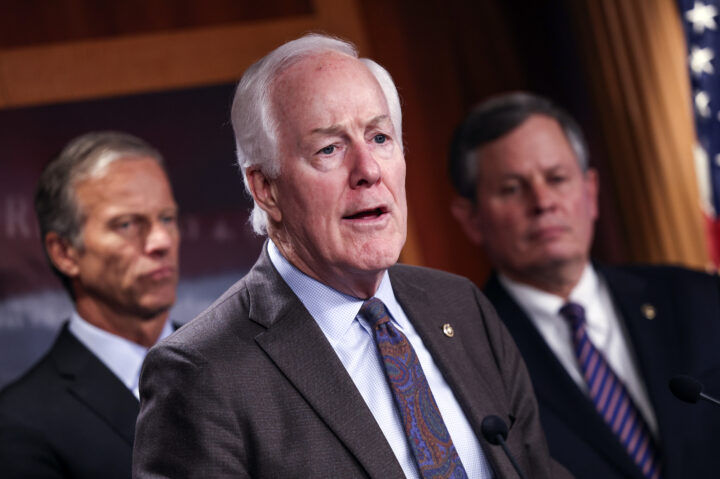
Kevin Dietsch/Getty Images
Sen. John Cornyn (R-TX), joined by Sen. John Thune (R-SD) (L) and Sen. Steve Daines (R-ID) speaks about the Senate Democrats at the U.S. Capitol on September 29, 2021 in Washington, D.C.
Facing a heated primary against Texas Attorney General Ken Paxton, Sen. John Cornyn (R-TX) accused his right-wing challenger on Thursday of associating with antisemitic and anti-Israel voices within the MAGA movement.
Cornyn told Jewish Insider in a wide-ranging interview that Texas Republican voters should view Paxton’s associations with figures such as former Trump advisor Steve Bannon as “alarming” — while urging Republicans to call out antisemitic and anti-Israel voices within the party, along the lines of his outspoken Texas GOP colleague Sen. Ted Cruz (R-TX).
“There’s this interesting, and troubling, tendency of some folks who claim the MAGA mantle to associate with antisemites like Nick Fuentes, Candace Owens and Steve Bannon. I know Ken Paxton regularly goes on Bannon’s ‘War Room’ podcast, and it’s something that should be alarming to Texas voters. People like that I don’t think are what I would call conservatives,” Cornyn said.
“Once they “get their foot in the door, they have a way of corrupting the whole party and the whole movement,” he continued. “I just think allowing somebody like Ken Paxton inside the tent will end up being the destruction of the Republican Party.”
Paxton has been a guest on Bannon’s “War Room” podcast on numerous occasions in recent years, even as Bannon has made a number of controversial comments, most notably labeling popular Jewish conservative podcast host Ben Shapiro as a “cancer” on the party after he spoke out against Tucker Carlson and Owens’ antisemitism at a Turning Point USA conference last year.
Bannon has also ramped up attacks on Israel, calling the Jewish state a “protectorate” of the United States — while speaking out against President Donald Trump’s decision last year to attack Iran’s nuclear facilities.
A spokesperson for Paxton defended the Texas attorney general’s record on Israel and fighting antisemitism in a statement to JI.
“AG Paxton has been a fierce friend of Israel,” the spokesperson said. “After spending $70 million and still being double digits behind in the polls, Sen. Cornyn has nothing else left but to throw random attacks at the wall and see if they stick. AG Paxton has a STRONG and unquestionable record standing against antisemitism.”
Cornyn is facing a tough reelection battle against Paxton and Rep. Wesley Hunt (R-TX), both of whom are running to his right in next month’s Republican primary.
The senator, a fixture in Texas politics for nearly four decades who served at the top levels of Senate leadership, argued that his primary contest would help determine what it means to be an electable Republican at a time when the party’s principles and values are being debated internally.
“A lot of it [the GOP primary election] is going to boil down to a question of character. I think character still matters and the attorney general doesn’t believe it matters at all,” Cornyn said. “I just can’t in good conscience turn over this job representing 32 million people and a state that I love and a party that I helped build over my career, I can’t turn it over to a corrupt and unprincipled individual like the attorney general.”
Cornyn warned that the GOP is at risk of being overrun by extremists if prominent conservatives continue to align themselves with fringe figures who espouse antisemitic views, drawing a comparison to his assessment of the current ideological trajectory of the Democratic Party.
“It starts out with the old saying: the enemy of my enemy is my friend. A lot of these folks were opposed to a lot of the worst excesses of the Democratic Party and the leftists. They began to corrode that movement with things like antisemitism and graft and greed. I think that’s how credibility of the opposition was eroded, by failing to call out people like that,” Cornyn said.
“To maintain the integrity of conservatives, that’s why it’s so important to call out and to cut out some of these cancers that I think ultimately would result in the failure of the conservative movement,” he continued. “Because people could point to the corruption that was allowed to develop and thus undermine the credibility and integrity of the whole movement.”
Cornyn praised Cruz for “being one of the first to stand up and call out some of the fringe characters,” and criticized Republicans who associate themselves with far-right figures.
“I’ve tried to do my part, initially through an editorial in the Dallas Morning News. I know this is a cancer, because antisemitism is just another way of dehumanizing people, and then using that behavior to justify in some people’s minds acts of violence,” the GOP senator said. “Obviously, the history of the Jewish people, dating back to the Holocaust, has been one of opponents trying to dehumanize them and make them seem to be something less than equal in terms of their dignity and their right to exist.”
Asked whether Trump would back him before the March primary, Cornyn told JI that he did not expect an endorsement, adding that he was dealing with “a lot of misinformation and lies.”
“I’ve been supportive of the president and his policies. Unfortunately, you always have to contend with a lot of misinformation and lies in modern elections,” Cornyn explained. “He [Trump] said he considers all three of us [GOP candidates] to be friends. If your base is divided among three people, choosing one out of those three people and disappointing the supporters of the other two, I can understand [that being] not something he would want to necessarily embrace unless he felt like it’s worth the cost.”
Cornyn argued that he would be the strongest general election candidate between himself, Paxton and Hunt, whereas Paxton would “ultimately provide the Democrats the best opportunity they’ve had since 1994 to turn Texas blue.”
“President Trump desperately wants to maintain the majority in the House, and we’ve got five new congressional seats in Texas,” he said. “If I’m the nominee, I will provide some help to those downballot races since I’ll be at the top of the ballot. I won by 10 [points] in 2020. If Paxton is the nominee, he’ll either lose or win by the skin of his teeth.”
Asked about Texas state Rep. James Talarico and Rep. Jasmine Crockett (D-TX), the Democrats in the race, Cornyn suggested he would enjoy running against either in a general election.
“They should be running for Senate in California because they are totally out of step with where I think Texans are,” he said.
Cornyn added that he would not underestimate Crockett.
“I wouldn’t count out Jasmine. Jasmine is smart, but I think she’s not running as good a campaign as Talarico,” Cornyn said. “Talarico is raising a lot of money, and he definitely has a better organization than Jasmine does.”
‘Just because someone is a hateful antisemitic looney-tune doesn’t mean they can’t win office,’ one Jewish community activist said of Shelly Arnoldi

Shaban Athuman/Richmond Times-Dispatch via AP
Shelly Arnoldi looks over her notes during a Joint Commission on Administrative Rules meeting regarding the Youngkin's administration's proposed K-12 transgender policies on Monday, Dec. 19, 2022, at Pocahontas Building in Richmond, Va.
A new candidate for Republican county chair in Virginia’s largest jurisdiction is facing scrutiny over a range of antisemitic social media posts in which she has told Jews to “move to Israel,” spread conspiracy theories about Jewish control of U.S. politics and expressed admiration for prominent neo-Nazis and Holocaust deniers, among other extremist comments.
Shelly Arnoldi, who recently launched her bid to lead the Fairfax County Republican Committee, is stoking concerns among Jewish community leaders now seeking to raise awareness about her extensive public record of promoting antisemitic tropes while demonizing Israel.
While Arnoldi is not seen as a particularly viable candidate in the upcoming Feb. 28 election, local political observers say, her campaign has still given some pause to both Jewish and Republican activists who worry her radical views underscore a creeping embrace of antisemitic sentiment in the GOP fueled by leading far-right commentators including Tucker Carlson, whose interviews she has eagerly endorsed.
“She does not appear to be a serious person,” one Jewish community activist told Jewish Insider on condition of anonymity to address a sensitive topic. “But just because someone is a hateful antisemitic looney-tune doesn’t mean they can’t win office. She strikes me as someone who would continue to run, and in that regard I consider her to be a real threat.”
In recent months, Arnoldi has instructed Jewish social media critics to “move to Israel,” where she has said they “belong,” while promoting antisemitic materials alleging Zionist plots to subvert American governance and to weaken Christian representation. She has also suggested that Jews “appear to control the world,” said that “nobody cares about Jews” and claimed that “Israel owns us,” among multiple other derogatory and conspiratorial remarks posted to X.
Meanwhile, Arnoldi has frequently voiced her enthusiastic support for antisemitic influencers and conspiracy theorists on the far right, such as Nick Fuentes, Candace Owens and Ian Carroll, the latter of whom she has called a “brave man.”
Several posts were flagged by antisemitism watchdogs on social media this week. Arnoldi, who has accused her critics of attempting to smear her, did not return a request for comment from JI.
A new letter circulated on social media by Jewish community activists on Monday called attention to what it described as Arnoldi’s “sustained pattern of antisemitic rhetoric,” saying it is “incompatible with party leadership.”
“If elevated to chair,” the letter warned, “this record will not remain local or contained.”
Arnoldi, who in November ran an unsuccessful campaign for state delegate as an independent, is challenging the incumbent GOP chair, Katie Gorka, who declined to comment on the race when reached by JI on Tuesday.
Even if Republicans face long odds of winning elected office in Fairfax County — increasingly a Democratic stronghold — Arnoldi’s insurgent campaign still carries implications for the future direction of GOP politics in one of the largest jurisdictions in the D.C. area, some party observers cautioned.
Gary Aiken, a former Republican candidate for Fairfax supervisor, expressed alarm at Arnoldi’s campaign on Tuesday. “If these are the kinds of people running for chairman, I may have to get more involved again,” he told JI.
Still, Mike Ginsberg, a member of the Fairfax County Republican Party who also serves as its general counsel, downplayed such concerns — even as he acknowledged that Arnoldi’s messaging would likely resonate with a minority faction of committee members whom he noted are “perpetually disaffected and constantly complaining.”
“People of a certain age would analogize her to Statler and Waldorf in ‘The Muppet Show’ from the 1970s — criticizing from the peanut gallery without making any constructive contributions,” Ginsberg, who is Jewish, told JI. “Statler and Waldorf at least had the benefit of being entertaining — Shelly does not.”
“Put bluntly, Shelly Arnoldi is a crank,” he added. “Every party has them. She is ours.”
Asked about right-wing antisemitism, Blakeman said that Tucker Carlson ‘is a big blowhard who has an issue with Jewish people’
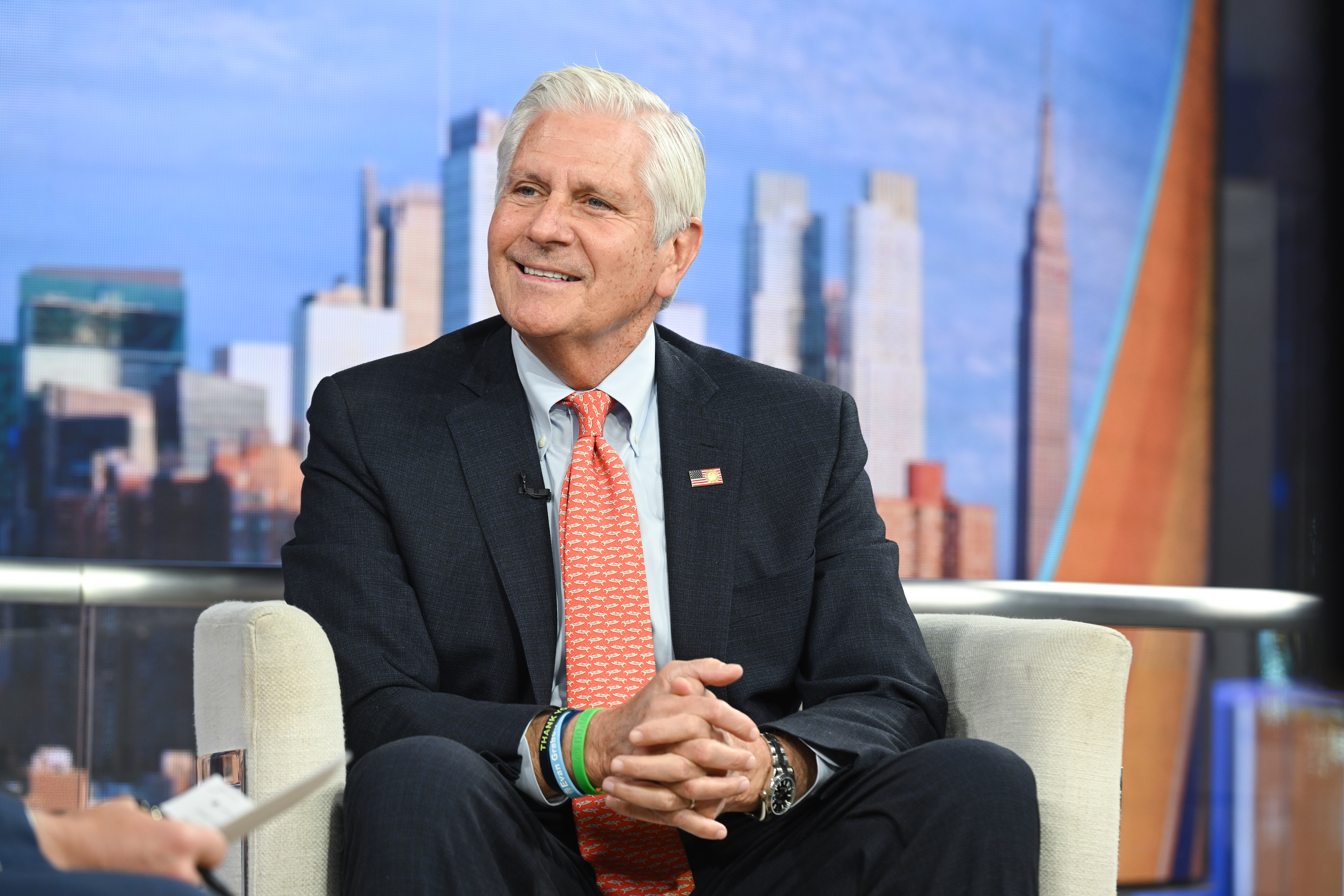
Noam Galai/Getty Images
Bruce Blakeman announces his run for New York governor on "Fox & Friends" at Fox News Channel Studios on December 09, 2025 in New York City. (
Nassau County Executive Bruce Blakeman suddenly emerged as the presumptive Republican nominee for governor of New York in December, with Rep. Elise Stefanik’s (R-NY) unexpected exit from the race against Gov. Kathy Hochul.
Now, with the formal endorsement of President Donald Trump, Blakeman is preparing for an uphill battle in a reliably Democratic state.
Blakeman, 70, is Jewish and said he represents the greatest number of constituents of any Jewish Republican elected official — more than 1.3 million. He vowed to protect the Jewish community statewide against antisemitism, and pledged that under his leadership, the state would step in if New York City Mayor Zohran Mamdani fails to do so.
Blakeman said that he has worked with the Nassau County police to deal with disruptive anti-Israel protests, setting firm rules for demonstrators, with prompt arrests if they stepped outside of those boundaries.
“If they got off the sidewalk, they would be given one chance to get back on it or they’d be arrested,” Blakeman said. “We didn’t take any nonsense. We didn’t allow them to do the things that they got away with in New York City. And that’s the same way I would approach it as governor.”
“Nick Fuentes is, in my opinion, a nut, but a dangerous one, and he has no place in the Republican Party,” Blakeman said. “Tucker Carlson is a big blowhard who has an issue with Jewish people, and it probably emanates from his chameleon-like personality. … He’s very unprincipled and I think he has biases that probably emanated from his youth.”
Blakeman said that if Mamdani fails to enforce the law, he would dispatch state police and national guard to do so. “We will not let any community be lawless, and I will not tolerate any acts of bigotry, antisemitism or racism in a state where I’m the governor.”
Asked about voices like Tucker Carlson and neo-Nazi influencer Nick Fuentes who are working to mainstream antisemitic ideas in the Republican Party, Blakeman did not mince words in his condemnation.
“Nick Fuentes is, in my opinion, a nut, but a dangerous one, and he has no place in the Republican Party,” Blakeman said. “Tucker Carlson is a big blowhard who has an issue with Jewish people, and it probably emanates from his chameleon-like personality. … He’s very unprincipled and I think he has biases that probably emanated from his youth.”
At the same time, Blakeman argued that he sees most antisemitism in the United States coming from the left, pointing to the large-scale turn against Israel in the Democratic Party.
“We have a couple of nuts in our party, but certainly [they are the] vast minority, and in the Democratic Party, it seems to me that they have completely abandoned Israel and that they are a hotbed for antisemitic activities,” Blakeman said.
He predicted those trends will help his campaign capture a significant number of Jewish Democratic voters who “realize that the Democratic Party has become an extreme party that’s hostile to Israel and hostile to Jewish people.”
He said he feels it’s important for the Republican Party to have “a strong Jewish presence” and that he takes his responsibility in that role seriously, saying he wants to be a “role model” for other Jewish people to get involved in GOP politics.
“I am a strong supporter of Israel,” Blakeman said. “I am a Zionist and a proud Zionist.”
“It’s something that I don’t take lightly as being a leader and someone who is a Jew and in the Republican Party,” Blakeman said.
Blakeman said he’s established a strong record as an ally and supporter of Israel in Nassau County, building business ties to Israel, implementing anti-Boycott, Divestment and Sanctions legislation and signing friendship agreements with what he called Judea and Samaria — the biblical term preferred by the Israeli government for the West Bank — and the Shomron Regional Council, a council of Israeli settlements in the West Bank.
“I am a strong supporter of Israel,” Blakeman said. “I am a Zionist and a proud Zionist.”
He said he’s currently under contract to buy an apartment in Beit Shemesh, as an investment.
Asked about the role his Jewish faith has played in his time in office and public life, the Nassau County executive responded, “Everything that I do emanates from the strength that’s given to me by Hashem, by God. So I am very mindful that it’s only with God’s blessings that I have the strength to do what I’m doing.”
“I ask for God’s blessings each and every day, and I pray every day, and I feel that having that spiritual connection with God is a very important part of my life,” he continued.
Blakeman said his campaign will focus on improving public safety, lowering prices for businesses and residents, making the state government more responsive and stopping the population flight from the state, issues he said are being driven by incumbent Gov. Kathy Hochul, a Democrat.
He framed Nassau County, under his leadership, as a counterpoint to those trends, pointing to the county’s low taxes and strong financial position. “If we can do that on the state level, I’m sure people will be happy. They’ll want to do business here. They want to live here, and they will flourish and prosper.”
“I want to make people happy. I want them to be proud of New York. I want them to want to raise their children and their grandchildren,” Blakeman said.
He said that his past victories in a Democratic-leaning county provide a model for winning statewide in deep-blue New York, arguing that he’s been able to reach populations that haven’t traditionally voted Republican, including Hispanic, Latino, Asian American, women and African American voters.
Asked about Mamdani’s victory in New York City, Blakeman said that Mamdani’s focus on affordability “struck a note with a lot of voters,” but New York City Republicans “didn’t have an adequate message with respect to that issue — and I do.”
Blakeman said he wants to create jobs and make the state more prosperous, rather than providing “a free bus ride or a handout,” spurring economic development and job creation in collaboration with the business community and unions.
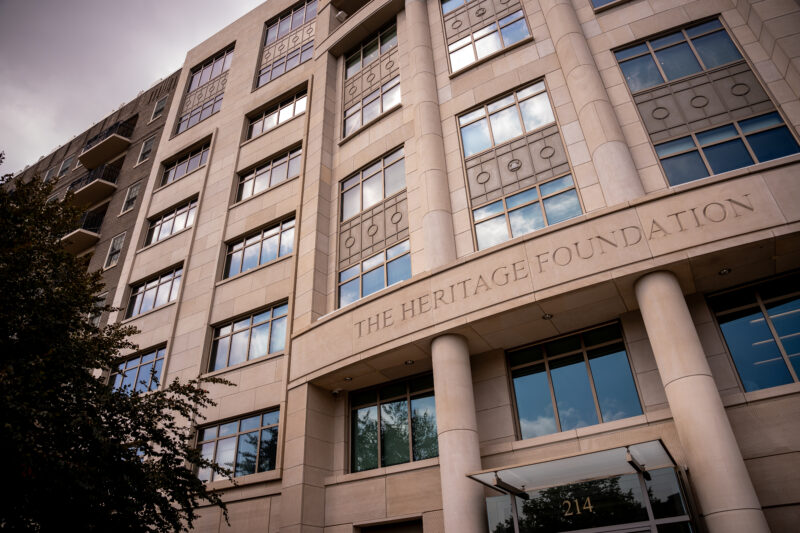
Advancing American Freedom hired 15 staffers from the Heritage Foundation, with its president predicting more defections
Anna Moneymaker/Getty Images
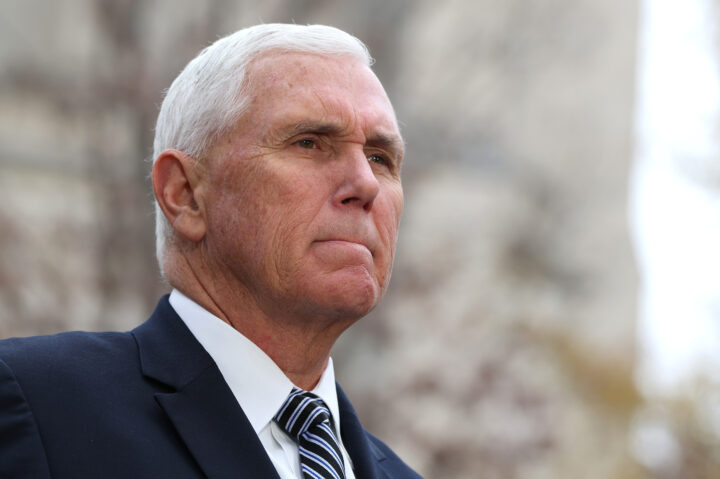
Former U.S. Vice President Mike Pence participates in a television interview outside of the funeral service of former Vice President Dick Cheney at the National Cathedral on November 20, 2025 in Washington, DC.
Tim Chapman, the president of former Vice President Mike Pence’s think tank, said on Monday that he expects his Advancing American Freedom organization to poach more staffers from the Heritage Foundation after announcing the hiring of 15 individuals from the embattled conservative organization.
Advancing American Freedom, founded by Pence in 2021 to advocate for classical conservative principles as President Donald Trump’s MAGA movement cemented its hold on parts of the Republican Party, announced on Monday that 15 Heritage staffers, including three senior officials from the think tank’s legal, economic and data teams, would be moving to AAF at the start of the new year. Chapman, who has been leading the recruitment effort, predicted more Heritage staffers would resign amid continuing frustration over Heritage President Kevin Roberts’ refusal to disavow Tucker Carlson for his platforming of neo-Nazi influencer Nick Fuentes.
“Why I’m so excited about this big move today is because it really supercharges our efforts to be able to be a policy leader on the Capitol Hill and helps us create an institution that will be valuable to policy entrepreneurs,” Chapman told Jewish Insider in an interview on Monday. “These 15 hires that came today will not be the last 15. We expect to see other people leave Heritage and go to AAF and other places as well. We are happy to welcome them.”
Richard Stern, who led Heritage’s economic policy group, and Kevin Dayaratna, who served as Heritage’s chief statistician, were two of the senior officials from the embattled think tank joining AAF along with some members of their team. They are being joined by John Malcolm, Heritage’s vice president of its Institute for Constitutional Government and director of the organization’s Meese Center for Legal and Judicial Studies, who will relocate the center, named for former Attorney General Edwin Meese III, to AAF.
Chapman helped launch and lead Heritage Action, the think tank’s grassroots advocacy arm, and served as chief of staff to the late Heritage cofounder Edwin J. Feulner during part of his 36-year tenure as the organization’s president. He told JI that AAF began a $15 million fundraising campaign last month to cover the expenses of hiring the outgoing Heritage staffers and raised $13 million within two weeks.
“We viewed this as a big opportunity to accelerate our growth plans, to become that institution that we’re building. It all happened very fast,” Chapman said.
Chapman said AAF’s quick success with fundraising suggested to him that “there is a market out there amongst conservative philanthropists for reorganization on the right. There were a lot of new donors who came in because they saw the value in the project and the importance of having an institution like the one I’m describing, and a lot of our current donors who stepped up and gave more.”
“It also says to me that there is a very heightened awareness of the downfall of institutions like Heritage, who have shifted their focus,” he explained.
“I look at it as the conservative movement reorganizing itself. The Heritage team that we are bringing over today, these are principled conservatives more in the traditional conservative camp. They wouldn’t think of themselves as nationalist conservatives, or not even necessarily MAGA conservatives,” Chapman said of the Heritage recruits. “There are a lot of things that MAGA fights for that we might be aligned on, but they would view themselves that way [from a more traditional standpoint], and they very much had been feeling stifled over the last two years at the Heritage Foundation.”
“Heritage had been creating an environment internally where the organization’s role as a traditional think tank that stood outside of the Republican Party was not the business plan for the future of the Heritage Foundation,” he added. “They started to think of themselves more as an outside enforcer for the MAGA nationalist perspective, and really began to orient themselves around personalities, whether it’s President Trump or [Vice President] JD Vance or other personalities that hold significant cachet on the right.”
Pence accused the Heritage Foundation of “abandoning its principles” in an interview with The Wall Street Journal on AAF’s recruitment effort. “Why these people are coming our way is that Heritage and some other voices and commentators have embraced big-government populism and have been willing to tolerate antisemitism,” Pence told the outlet.
A Heritage spokesperson did not respond to JI’s request for comment on Chapman’s comments or on AAF recruiting more than a dozen of their staffers, though Andy Olivastro, Heritage’s chief advancement officer, was critical of the former employees in a statement to the Journal.
“Our mission is unchanged, and our leadership is strong and decisive,” Olivastro said. “Heritage has always welcomed debate, but alignment on mission and loyalty to the institution are non-negotiable. A handful of staff chose a different path — some through disruption, others through disloyalty.”
The Network Contagion Research Institute found that engagement with Nick Fuentes’ posts in the first 30 minutes came largely from anonymous foreign users

Zach D Roberts/NurPhoto via Getty Images
Nick Fuentes, the leader of a Christian based extremist white nationalist group speaks to his followers, 'the Groypers.' in Washington D.C. on November 14, 2020
The neo-Nazi influencer Nick Fuentes has drawn a sizable online following that has fueled debate over his influence in the Republican Party as it grapples with how to address mounting antisemitism within its ranks, particularly among younger conservatives.
But a new report suggests that his rise may in part be artificially driven by a cluster of anonymous social media accounts largely based in foreign countries, and raises questions about the organic popularity of Fuentes’ movement in the United States as he seeks to grow his political reach to shape the coming midterm elections.
The report, published on Monday by the Network Contagion Research Institute, a nonprofit watchdog group affiliated with Rutgers University, analyzed a recent sample of Fuentes’ posts on X and found that engagement within the first 30 minutes not only far exceeded his “legitimate reach” but also “routinely” outperformed accounts commanding significantly larger followings, including Elon Musk, who owns the platform.
For the 20 Fuentes posts examined by NCRI in that opening time window, just over 60% of initial amplification came from the same repeat accounts, pointing to a pattern of “behavior highly suggestive of coordination or automation,” the report states.
Nearly all those users were “fully anonymous,” with no real name, location or other identifying markers, according to NCRI, and a majority were “openly” or “functionally single-purpose” accounts dedicated to promoting Fuentes’ extremist positions, which have included Holocaust denial and admiration for Adolf Hitler.
Meanwhile, the report also found, roughly half of the accounts that promoted three of Fuentes’ most viral posts before the assassination of Charlie Kirk — whose death in September left a major vacuum in the conservative youth movement that Fuentes has been seeking to fill — originated from foreign users that were “heavily concentrated” in India, Pakistan, Nigeria, Malaysia and Indonesia, the sites of known content-engagement farms.
“There is no organic explanation for this pattern,” the report notes, calling such activity “consistent with outsourced engagement infrastructure. These geographies describe the same low-cost amplification clusters and engagement farms that foreign actors often use to manufacture virality, distort platform metrics and manipulate recommendation systems.”
The report argues that such alleged “manufactured engagement” artificially helped elevate Fuentes as a subject of heightened mainstream media interest in the wake of Kirk’s assassination, in addition to a friendly interview with Tucker Carlson weeks later, allowing “him to appear active, relevant and in position when a replacement narrative became available inside the broader MAGA ecosystem.”
Fuentes’ “manipulated reach is not accidental,” the report states, citing hundreds of instances from his show in which he has issued “real-time commands” to share his posts on social media — directives that the NCRI says run afoul of X’s content moderation policies prohibiting “orchestrated amplification.”
“Taken together,” the report concludes, “the evidence points to a deliberate, foreign-influenced campaign — relying on anonymous and possibly automated accounts — to artificially inflate Nick Fuentes’s reach, gaming the platform’s algorithm in a systematic effort to elevate his influence far beyond what genuine grassroots support could achieve.”
The vice president made his remarks at a Breitbart conference on the day of Dick Cheney’s funeral
Tasos Katopodis/Getty Images
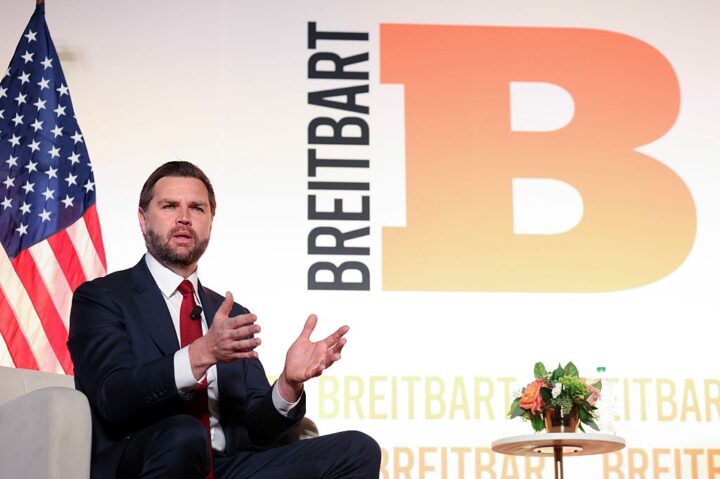
Vice President JD Vance participates in a fireside chat with Breitbart Washington Bureau Chief Matt Boyle at the Andrew W. Mellon Auditorium on November 20, 2025 in Washington, D,C.
Vice President JD Vance dismissed the suggestion that traditional conservative Republicans would “wrest control” of the GOP from supporters of the MAGA movement after President Donald Trump leaves office and “go back to the Republican Party of 20 years ago.”
Vance made the comments during a conversation with Breitbart News’ Washington bureau chief Matt Boyle on Thursday, in which the two broadly discussed the divisions within the MAGA movement on foreign and economic policy. Both argued that the U.S. was experiencing a “political realignment,” with the Republican Party becoming the party of the working class and Democrats now more aligned with wealthier voters.
“Part of what you see as division in the Republican Party is a consequence of this realignment. We have a new governing coalition. We have a new political coalition. We have people who didn’t used to vote Republican,” Vance said. “Frankly, they have different preferences, sometimes on certain issues, than maybe the Ronald Reagan or George W. Bush Republican Party did. I think the Donald Trump party is a fundamentally new phenomenon in American politics.”
“Some of those divisions you talk about are just the natural outgrowth of the fact that we’ve got a lot of working-class voters who, frankly, don’t care what was Republican orthodoxy 25 years ago, and so they’re pushing the party in a different direction,” the vice president continued.
Boyle pointed out Vance’s mention of former President George W. Bush, and noted that the funeral of former Vice President Dick Cheney, who served under Bush, was taking place that morning.
The vice president replied by offering his condolences to the Cheney family and praised his service to the country, but predicted that such an effort to return the Republican Party to the Bush-Cheney era would fail.
“Whether intentional or not, that was the legacy of the Republican Party that came before Donald J. Trump. I’m glad the president got us away from that Republican Party. It lost. It was also a disaster for the United States of America,” Vance said.
Asked for his thoughts on “how to reunify” the conservative movement amid “some divisions” on domestic and foreign policy matters, Vance said he welcomed the ongoing debates while urging Republicans to not lose sight of the fact that their true opponent is the Democratic Party.
“I think these debates should happen. They should happen on podcasts. They should happen in the media. They should happen on the op-ed pages. It’s totally reasonable for the people who make up this coalition to argue about what our foreign policy should be, what our specific tax policy should be, what our housing policy should be,” Vance explained, adding that the “disagreements that animated” the GOP were “important.”
Still, Vance encouraged conservatives “to remember that we have a lot more in common than we do not in common.”
“My attitude is: Let these debates play out, but don’t let the debates that we’re having internally blind us to the fact that we are up against a radical leftist movement that murdered my friend [Charlie Kirk] a couple of months ago, and that would throw many people in the Trump administration in prison, not for doing anything illegal, but for not following the far-left’s agenda,” Vance said.
“That is the real opponent here: a political movement in this country that has no enemy in principle, that has no agenda for the American people. Their sole obsession is to take down Donald Trump and anybody who’d help Donald Trump govern,” he added. “Focus on the enemy. Have our debates, but focus on the enemy so that we can win in victories that matter to the American people.”
The Texas senator recalled a conversation with Israeli PM Benjamin Netanyahu where he dismissed the severity of the issue on the American right
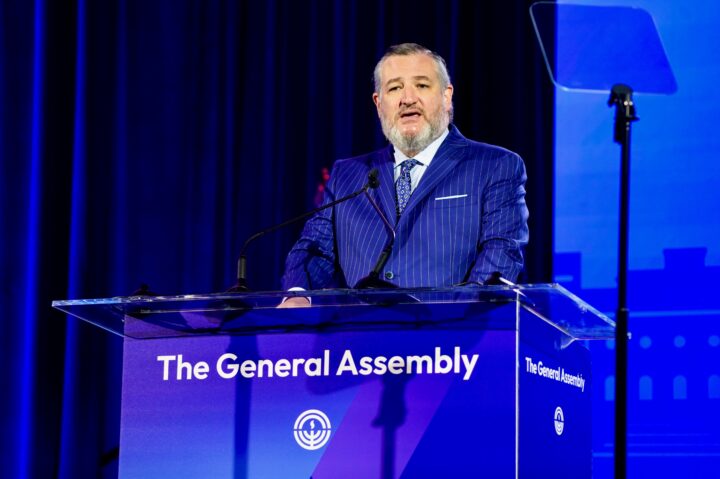
Jewish Federations of North America
Sen. Ted Cruz (R-TX) speaks at the Jewish Federations of North America's General Assembly on Nov. 18, 2025.
Sen. Ted Cruz (R-TX) upped the ante on his recent rhetoric targeting right-wing podcaster Tucker Carlson, telling a gathering of Jewish leaders in Washington that calling out antisemitism from Carlson and his Republican allies is necessary to defend American values. He said America faces an “existential crisis” if the rising antisemitism on the American right is not addressed.
“I do not want to wake up in five years and find that the Republican Party has become like the Democrat Party,” Cruz said on Tuesday at the Jewish Federations of North America’s General Assembly, which brought together 2,000 philanthropists, activists and Jewish communal professionals. “I do not want to wake up in five years and find that both major parties in America have embraced hatred of Israel and have tolerated, if not embraced, antisemitism.”
The conservative movement has faced internal division and tensions since Carlson hosted neo-Nazi Nick Fuentes on his podcast last month.
By digging in on his campaign against Carlson, Cruz further separated himself from President Donald Trump, who on Sunday night offered praise for the former Fox News host when he was asked about Carlson’s decision to do a friendly interview with Fuentes.
“He said good things about me over the years. I think he’s good,” Trump said. “You can’t tell him who to interview.”
Cruz, meanwhile, has gone after Carlson in increasingly sharp messages, after having his own heated interview with the podcaster in June — including at the recent Republican Jewish Coalition conference in Las Vegas, then at a Federalist Society conference in Washington and now at the GA.
In his latest speech, he did more than calling out Carlson and his Republican enablers. He made the case that countering Carlson’s influence is necessary for the future of America.
“That is a poison that not only does damage to Israel. That is a poison that does damage to America,” Cruz said. “And if we’re going to stop it, we’re going to stop it because we stand up and say, ‘No, this is not who we are. This is not what we believe. This is not what the Constitution and the Declaration [of Independence] were all about. This is not what America was all about.’”
At the GA, Cruz was addressing a friendly audience who had spent two days immersed in programming about antisemitism in America. But he warned that many people are not fully grasping the scope of the problem. He described a meeting with Israeli Prime Minister Benjamin Netanyahu this year where, he said, Netanyahu tried to push back on the idea that right-wing antisemitism was a threat.
“I’ll tell you, he actually was a little dismissive of that. He said, ‘No, no, no, that’s Qatar, that’s Iran, that’s bots,’” Cruz said. “My response: ‘Mr. Prime Minister, yes, but no. Yes, that’s happening. Yes, there are millions of dollars being spent to spread this poison. Yes, that’s happening online. But it is real and organic.’”
The misunderstanding, Cruz said, also exists in the Christian world.
“My message to the Christians is, this poison is spreading. There are pastors who love Israel, who think all is fine,” Cruz said. “My message to them is, ‘Go and talk to the teenagers in your congregation. Go and talk to the 20-somethings in your congregation, because they’re picking up their phone and they’re watching Tiktok and they’re watching Instagram, and they’re hearing this message being driven, and it is resonating.’”
The answer, Cruz said, is for other public officials — Republicans in particular — to speak out. But what’s at stake, he argued, is more than just their party or the Jewish community. He made the case that they must do so for the good of America.
“My hope is that we see other Republicans willing to stand up, willing to stand up and to be clear, willing to draw a line,” he said. “This is a fight worth fighting. Saving America is worth fighting. Bringing us back to our founding principles — that is worth fighting.”
Speaking about right-wing antisemitism at a Federalist Society convention, the Texas senator said his colleagues ‘think what is happening is horrifying’ but are scared of Carlson’s sway in the party
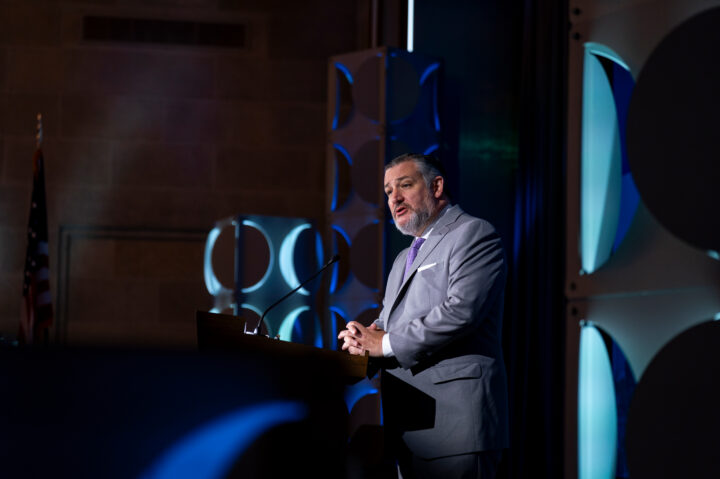
Al Drago/Bloomberg via Getty Images
Sen. Ted Cruz speaks during a U.S. Chamber of Commerce summit in Washington on Sept. 10, 2025.
Sen. Ted Cruz (R-TX) called on his Republican colleagues to speak out against Tucker Carlson, arguing in a fiery Friday morning speech that they need to rise above their fear of alienating the popular conservative podcaster to denounce his platforming of antisemitism.
“It’s easy right now to denounce Nick Fuentes. That’s kind of safe. Are you willing to say Tucker’s name?” Cruz said in a speech at the Washington National Lawyers Convention of the Federalist Society, the conservative legal group.
“Now I can tell you, my colleagues, almost to a person, think what is happening is horrifying. But a great many of them are frightened, because he has one hell of a big megaphone.”
Cruz’s speech escalates a feud within the Republican Party about antisemitism on the party’s rightward fringes, after Carlson, the former Fox News host, held a friendly interview with Fuentes, a neo-Nazi agitator and commentator.
Following Carlson’s interview with Fuentes, Kevin Roberts, the president of the Heritage Foundation, released a video defending Carlson from attacks by the “globalist class” and standing by his right to interview Fuentes. Since then, the influential conservative think tank has been navigating internal dissension and public blowback — with Roberts apologizing for the video but so far refusing to take it down.
Speaking to a room of lawyers, Cruz emphasized his support for the First Amendment and made the case that calling out Carlson is not akin to “canceling” him.
“My complaint about Tucker having Nick Fuentes on was not that he platformed him. That’s a choice you can make or not. But the last I checked, Tucker actually knows how to cross examine someone,” said Cruz, who had his own heated discussion with Carlson on his podcast in June. “If you want to cross examine and challenge him, that’s fine. But he didn’t. He fawningly gazed at him.”
Fuentes and Carlson, Cruz continued, “have a right to say what they are saying. But every one of us has an obligation to stand up and say it is wrong.”
At the start of his speech, Cruz outlined the rise of antisemitism on the American left, arguing that “there is a real and cognizable pro-Hamas wing of the Democrat Party.” But, he added, antisemitism does not end there.
“When that happened on the left, those of us on the right were quite comfortable standing up and denouncing it. In some ways, that’s easy. But now it’s happening on the right,” said Cruz. “In the last six months, I’ve seen more antisemitism on the right than I have at any time in my life. It is growing. It is metastasizing.”
Cruz invoked Ronald Reagan’s famous 1964 speech, “A Time for Choosing,” as he implored conservatives to speak strongly and loudly against antisemitism.
“I believe now, today, is a time for choosing as well. I think it is a time for every elected official, I think it is a time for every editorialist, I think it is a time for every lawyer, for every student, to decide, where do you stand?” said Cruz. “We will stand for liberty. We will stand for the Constitution. We will stand for the Bill of Rights, but we will also stand for truth, and we will call out lies where they occur, and we will call out hatred when they occur. And the best antidote to lies is truth. The best solution to darkness is light.”
He walked off the stage to a standing ovation.
Graham: ‘How many times does he have to play footsie with this antisemitic view of the Jewish people and Israel until you figure out that’s what he believes?’
Amir Levy/Getty Images
Senator Lindsey Graham (R-SC) speaks at a press conference on US-Israel relations on February 17, 2025
LAS VEGAS — Sen. Lindsey Graham (R-SC) spoke out against Tucker Carlson for giving a friendly platform to Nick Fuentes, the neo-Nazi influencer, on his podcast this week, calling it “a wake-up call” for the Republican Party as it grapples with rising antisemitism within its ranks.
“How many times does he have to play footsie with this antisemitic view of the Jewish people and Israel until you figure out that’s what he believes?” Graham said of Carlson in an interview with Jewish Insider on Friday on the sidelines of the Republican Jewish Coalition’s annual leadership summit at the Venetian Resort.
Graham said that “antisemitism has been with us, and it’ll always be with us, and the goal is to limit it, fight back and contain it.”
“I am confident that if anybody in the Republican world ran for office as a member of Congress, for the Senate or any major elected office and spouted this garbage, it would get creamed,” Graham told JI. “This is a niche market. It won’t sell to a wider audience.”
Carlson, a frequent critic of Graham, has faced backlash this week for failing to challenge Fuentes’ antisemitic views, including praising Adolf Hitler and engaging in Holocaust denialism. During the interview, Fuentes railed against “organized Jewry” while Carlson expressed his disdain for Christian Zionists including Mike Huckabee, the U.S. ambassador to Israel, saying he had been seized by a “brain virus.”
“To suggest that evangelical Christians are confused or got it wrong says more about the critic than it does evangelical Christians,” Graham countered. “The guy that’s doing the talking is a raving antisemite white nationalist, and if you want to hook your wagon to that, you’ll have a very short journey in the Republican Party.”
Graham said that Carlson and Fuentes “did us all a favor by being so brazen. It’s kind of a wake-up call.”
Even as Carlson, a close ally of Vice President JD Vance, remains influential in the GOP, Graham argued that “being anti-Israel in the modern Republican Party is a death sentence to political viability.”
“We’re not gonna put up with that crap. We’re not that kind of party,” he said.
The South Carolina senator also joined other senators in raising concerns about the president of the Heritage Foundation, Kevin Roberts, who has faced widespread criticism for defending Carlson’s interview and for soft-pedaling Fuentes views in a video he posted to social media on Thursday. “That’s the decision made, and we’ll see how well it plays in the marketplace,” Graham, who is facing a primary challenge next year from a former Heritage Foundation staffer, reiterated.
Amid the criticism Friday, Roberts posted a follow-up statement on X where he condemned Fuentes’ “vicious antisemitic ideology, his Holocaust denial, and his relentless conspiracy theories that echo the darkest chapters of history” but made no further comment about Carlson.
Sen. Ted Cruz (R-TX), who spoke at the RJC summit on Thursday night, and Mitch McConnell (R-KY) have spoken out against right-wing antisemitism after Carlson’s Fuentes interview.
Vance also drew scrutiny this week from conservative Jewish critics after he spoke at a campus Turning Point USA event and avoided forcefully confronting students who had asked him questions about Israel that used antisemitic tropes, such as suggesting Jewish control of U.S. politics and claiming that Jews oppress Christians.
Graham said he believed that the students were “espousing stereotypes about the Jewish people and the Jewish state,” which he called “pretty unnerving.”
“I think JD handled it well,” he said, but added: “I wish he would have been more direct.”
“I would have been real direct and said, ‘Let me tell you, if you think our relationship with Israel is less than beneficial, you’re ignorant. Israel’s fighting our fight,” he said. “My goal is to keep the threats over there so they don’t come here,” he added. “My goal is not to fight alone, to have other people fighting with us. And you can’t have a better partner in the fight than Israel.”
The Georgia congresswoman has recently boosted claims Israel had a hand in assassinating Charlie Kirk, and has baselessly accused the Jewish state of meddling in American elections
Chip Somodevilla/Getty Images
Rep. Marjorie Taylor Greene (R-GA) leaves the House Chamber following the last vote of the week at the U.S. Capitol on September 12, 2024 in Washington, DC.
Rep. Marjorie Taylor Greene (R-GA) first became a household name for her embrace of a range of wild conspiracy theories — including antisemitic claims about the Rothschild family like the idea that space-based weapons controlled by the Jewish banking family were the cause of California wildfires.
But as the congresswoman has emerged as an unlikely star in liberal circles and mainstream media after breaking with her party on the government shutdown, health care funding and the Jeffrey Epstein files, her erstwhile critics have all but ignored her increasingly frequent use of antisemitic tropes and embrace of conspiracy theories targeting Jews.
Earlier this week, the controversial Georgia congresswoman vowed on X, “No bar codes on me. I’ll never take 30 shekels. I’m America only! And Christ is King!”
Her rejection of “30 shekels” appears to be a reference to the pieces of silver paid to Judas Iscariot to betray Jesus, and the currency of Israel. Greene’s mention of “bar codes” refers to claims by former Rep. Matt Gaetz (R-FL) about AIPAC fundraising events, which AIPAC has denied.
She has also repeatedly boosted claims that Israel and Jewish people were involved in last month’s killing of Turning Point USA founder Charlie Kirk and are seeking to co-opt his organization.
“Do not allow a foreign country, foreign agents, and another religion tell you about Charlie Kirk,” Greene said on X. “And I hope a foreign country and foreign agents and another religion does not take over Christian Patriotic Turning Point USA.”
Last week, Greene reposted an X post by Holocaust denier Evan Kilgore, in which Kilgore shared a video of Candace Owens — a primary propagator of Israel-related conspiracy theories about Kirk’s death — claiming that Kirk had announced prior to his death that he was abandoning his support for Israel.
And she lauded a eulogy delivered by far-right commentator Tucker Carlson at Kirk’s funeral, in which Carlson compared Kirk’s killing to the death of Jesus.
“It’s becoming increasingly clear that no matter which party is in charge, the secular government of Israel always gets its way,” Greene wrote on X.
Greene has been one of the few Republican lawmakers to attack AIPAC and other pro-Israel advocacy groups, accusing them of exercising malign influence over the U.S. government and demanding they register as foreign agents. AIPAC is funded and led by American citizens, not the Israeli government.
She has accused Israel of “meddling in campaigns and elections” and of “meddling in government policy — government of the United States policy — as well as dictating what America does in foreign wars.”
“It’s becoming increasingly clear that no matter which party is in charge, the secular government of Israel always gets its way,” Greene added on X.
Regarding the war in Gaza, Greene has employed language sometimes indistinguishable from that of far-left Israel opponents, accusing Israel of committing genocide and of deliberately killing innocent people and children, particularly Christians. She led an effort in the House to cut off U.S. missile defense aid to Israel, which failed overwhelmingly.
She also shared posts suggesting that Israel had foreknowledge of Hamas’ Oct. 7, 2023, attacks and chose to delay its response, and claimed that “Most of America has Israel fatigue” because politicians ignore domestic problems in order to “talk about Israel all day” and that a GOP colleague is “fighting for his life to maintain his pro Israel money.”
“I am not suicidal and one of the happiest healthiest people you will meet. I have full faith in God and Jesus Christ is my Lord and Savior. As a sinner, I am only saved through His grace and mercy,” Greene said. “With that said, if something happens to me, I ask you all to find out which foreign government or powerful people would take heinous actions to stop the information from coming out.”
Greene described the Anti-Defamation League as a “dangerous hate group that targets Christians,” praising the FBI for recently cutting ties with the group.
Amid her escalating social media campaign against the pro-Israel world and her advocacy for the release of files related to the Epstein investigation, Greene suggested last month on X that a foreign government or other powerful individuals were planning to assassinate her.
“I am not suicidal and one of the happiest healthiest people you will meet. I have full faith in God and Jesus Christ is my Lord and Savior. As a sinner, I am only saved through His grace and mercy,” Greene said. “With that said, if something happens to me, I ask you all to find out which foreign government or powerful people would take heinous actions to stop the information from coming out.”
The post was widely interpreted — including by at least one fellow lawmaker — as a suggestion that Israel or Jewish people were targeting Greene.
“Why do crazy people keep thinking ‘the Jews’ are trying to kill them?” Rep. Ted Cruz (R-TX) replied.
Greene has also claimed Israel is operating a social media campaign targeting her.
Outside of Israel policy and the Jewish community, Greene has also continued to lean into other conspiracy theories, such as posting in August that it is “oddly consistent and strange” that several mass shooters have authored manifestos, asking, “who tells them to do that?” In the past, she has repeatedly spread conspiracy theories about mass shootings, speculating that demonic possession or military mind control may be responsible for school shootings.
Last month, she also shared a Carlson documentary claiming the truth of the 9/11 attacks had been covered up and convened a congressional hearing on weather modification that heavily featured conspiracy theories and false and misleading claims.
“The RJC has endorsed multiple GOP primary challengers to Marjorie Taylor Greene. She is out of step with the Republican Party, and with President Trump. The people of Georgia deserve better — and we are determined to do what we can to retire her,” RJC CEO Matt Brooks said.
“While the president and congressional Republicans back our ally, Rep. Marjorie Taylor Greene is aligned with Reps. Ilhan Omar and Alexandria Ocasio-Cortez to demonize Israel and weaken a partnership that makes America safer, strong and more prosperous,” AIPAC spokesperson Marshall Wittmann told Jewish Insider. “Our 5 million members will not be deterred by her rancid anti-Israel and unhinged raving.”
The Republican Jewish Coalition, which has repeatedly opposed Greene, said it continues to support efforts to defeat her.
“The RJC has endorsed multiple GOP primary challengers to Marjorie Taylor Greene. She is out of step with the Republican Party, and with President Trump. The people of Georgia deserve better — and we are determined to do what we can to retire her,” RJC CEO Matt Brooks said.
Greene did not respond to a request for comment.
Greene has recently been a thorn in the side of GOP leadership for a number of reasons, including criticizing the party’s approach to a health care tax credit central to the current government shutdown, critiquing the Trump administration’s mass deportation strategy and Middle East policy, backing an effort to force a House vote on the release of documents related to the Epstein investigation, accusing the party of blocking women from leadership roles and voting against other elements of the House Republican leadership’s agenda.
Her disputes with the Trump administration could create an opportunity for a Republican primary challenger to make a run against her — though Trump hasn’t personally spoken out against Greene as he has against Rep. Thomas Massie (R-KY), another anti-Israel House GOP colleague, and Greene has continued to profess her loyalty to Trump and his movement.
She does not yet face any serious primary competition.
Greene previously accumulated influence in the House as a close ally of Trump and former House Speaker Kevin McCarthy (R-CA) but has found herself increasingly sidelined. National Republican Party leaders did not back her as she considered a run for Georgia’s Senate seat against Sen. Jon Ossoff (D-GA) or the state’s governorship.
The House speaker cautioned that the party is likely bound for a major debate over foreign policy after President Trump leaves office

Kent Nishimura/Getty Images
House Speaker Mike Johnson (R-LA) does an interview with CNN at the U.S. Capitol on April 17, 2024 in Washington, D.C.
House Speaker Mike Johnson (R-LA) spoke about his efforts to hold the line against the isolationist wing of the Republican Party in a private meeting with pro-Israel leaders on Capitol Hill on Wednesday, several individuals who attended the meeting told Jewish Insider.
Johnson, who described himself to the group as a “Reagan Republican” focused on “peace through strength,” acknowledged that isolationism is rising in the Republican Party, and that the party is likely bound for a major debate on the issue after President Donald Trump leaves office.
And Johnson told the group that, in his candidate recruiting efforts, he’s working to filter out isolationists to prevent that wing of the party from growing larger in the House, four people who attended the meeting said.
“The speaker was very, very direct about the U.S. role with Israel and in the world and understands that there are voices that don’t agree in both parties, on both extremes, and urges us all to be involved in fighting back against those extremes,” Eric Fingerhut, the CEO of the Jewish Federations of North America, told JI.
One attendee said Johnson had also expressed a strong interest in finding new funding methods for humanitarian aid in Gaza, outside of the United Nations.
Johnson also discussed his recent trip to Israel and his and his wife’s lengthy dinner with Israeli Prime Minister Benjamin Netanyahu and his wife, Sara, with whom he said he has become close friends. He said that he and Netanyahu had discussed that there are no good options ahead in Gaza, one attendee told JI.
The speaker also told the group he is eager to return to Israel to address the Knesset, after he was unable to do so as scheduled in June due to the Israel-Iran war.
Johnson emphasized his commitment to working across the aisle to support Israel and the Jewish community, an individual in the room said. With a government shutdown deadline fast-approaching at the end of the month, Johnson said he’s committed to continuing to work through the regular appropriations process and negotiating with the Senate, and noted that various Jewish communal priorities would be part of that process.
One source said Johnson had also highlighted the fact that he was the highest-ranking elected official to visit a settlement in the West Bank, which the source noted puts him at odds with many in the Jewish community.
Rep. Tim Walberg (R-MI), who also addressed the meeting, provided an overview of the investigations that the House Education and Workforce Committee is conducting into antisemitism, as well as noted he’d been texting recently with Anti-Defamation League CEO Jonathan Greenblatt about the proliferation of antisemitic conspiracy theories about the killing of influencer Charlie Kirk.
Rabbi Levi Shemtov of American Friends of Lubavitch (Chabad) delivered a prayer and Reps. David Kustoff (R-TN), Randy Fine (R-FL) and Craig Goldman (R-TX) also spoke to the group.
One attendee described Johnson as clearly knowledgeable about and comfortable with the issues at play and the meeting overall as cordial and non-contentious.
“There’s just a remarkable sense of gratitude from all across the Jewish community for the leadership that Speaker Johnson has brought to the U.S.-Israel relationship,” Fingerhut said. “He was not someone who was that well-known to our community before he became speaker, but he’s comprehensively knowledgeable. It’s clearly something he feels very personally about.”
The organizations in attendance included: The Louis D. Brandeis Center for Human Rights Under Law, the Republican Jewish Coalition, Agudath Israel of America, AIPAC, the Simon Wiesenthal Center, Conference of Presidents of Major American Jewish Organizations, National Council of Jewish Women, Syngeros Holdings, CUFI Action, the Orthodox Union, the U.S.-China Economic and Security Review Commission, Standard Industries, the American Jewish Committee, Zionist Organization of America, National Debt Relief, Jewish Institute for National Security of America, the Deborah Project, Foundation for Defense of Democracies, Coalition for Jewish Values and the Endowment for Middle East Truth.
Trump’s senior director for counterterrorism: ‘I was worried by this neo-Buchanan isolationism, but I look at President Trump's actions, they have no hold on him’
JIM WATSON/AFP via Getty Images
U.S. Senior Director for Counterterrorism Sebastian Gorka walks outside the White House in Washington, DC, on May 7, 2025.
Seb Gorka, the White House senior director for counterterrorism and a deputy assistant to the president, aired his grievances with the anti-Israel faction within the Republican Party on Tuesday, alleging that the wing of the GOP aligned with podcast host Tucker Carlson is “basically Pat Buchanan in a new guise.”
Gorka made the comments in a conversation on counterterrorism and U.S. strategy at the Hudson Institute after being pressed on the foreign policy disputes within the MAGA movement and Carlson’s grievances with President Donald Trump’s decision to strike Iran’s nuclear facilities in June.
Asked by moderator Michael Doran, a Hudson senior fellow and director of the Center for Peace and Security in the Middle East, if he was comfortable addressing the growth of anti-Israel, antisemitic sentiment on right-wing podcasts and social media, Gorka replied, “Yeah, I am, because it bothers me immensely, but I’ve come to a certain realization with regards to that, that this wing of isolationism is nothing new. We had this 100 years ago.”
“This is just a poor, substandard repackaging of neo-Buchananite isolationism,” Gorka said, referencing Buchanan, the former Nixon communications director who became an outspoken critic of Israel. “It’s actually a more shallow version. Pat is far smarter than this version of isolationism.”
Gorka said that he is “actually in a better place with” the onslaught of anti-Israel rhetoric from Carlson’s wing of the party than he was previously, explaining that he realized that most of the rhetoric was coming from “probably half a dozen very loud people on Twitter and Rumble,” the right-wing video platform.
“You get out of the miasma, the cesspit that is social media, and you talk to representative MAGA voters, of the 80 million that put the president back in the White House, they don’t think that we should pull down the shutters on the Pacific and the Atlantic coast,” Gorka explained. “They don’t think that Israel is the reason for Oct. 7. They actually have a very special place in their heart for Israel, and they don’t think that hospitals being bombed in Ukraine is a good thing because somebody offered NATO membership to Ukraine, allegedly, a decade ago.”
“As an immigrant to this country, a legal immigrant to the United States, one of the most trenchant indicative characteristics for me of the American people is common sense. They understand who is responsible for Oct. 7. They understand who [Russian President] Vladimir Putin is. And as such, I was worried by this neo-Buchanan isolationism, but I look at President Trump’s actions, they have no hold on him,” he continued.
Gorka then pointed to the early days of the first Trump administration, alleging that at the time, then-Defense Secretary James Mattis and Secretary of State Rex Tillerson expressed hesitation about moving the U.S. Embassy in Israel to Jerusalem out of fear that doing so would cause a third world war.
Gorka said that Trump told concerned members of his Cabinet at the time that they were going through with the move because, “A) We promised the people of Israel 23 years ago, and we’ve broken that promise every six months of 23 years. B) I promised the American electorate in the campaign. We’re doing it. And C) It’s the right thing to do.” He argued that the “moral clarity” shown by Trump on issues impacting Israel highlighted the contrast between the president and his detractors on foreign policy matters.
Earlier in the program, Gorka told Doran that the president’s approach to the Middle East was heavily focused on combating Iran.
“You need to understand one thing: When the president looks at the region, he doesn’t slice it down into cylinders of excellence. He doesn’t care if you’re the Syrian desk officer or the natural resources expert. He has one overlay for the whole AOR [Area of Responsibility], and that one metric, that one prism, is Iran, and he’s absolutely right,” Gorka said. “Iran is front and center in everything we do in the region, because they remain the greatest state sponsor terrorism, and the world would be a much safer place if that were not the case.”
Gorka noted that when Trump is asked by reporters about anything related to national security, “more than 50% of the time … the president will bring up Iran,” adding that this was “especially” the case “before [Operation] Midnight Hammer, because it really is on his mind that this is the threat. A nuclear Iran, an ideologically Islamo-fascist regime that wishes to acquire the most dangerous weapons in the world, is a threat to all decent peoples.”
Turning his attention to Israel, Gorka argued that the Jewish state’s “post-Oct. 7 operations have rewritten the map of the Middle East for the next 50 to 100 years.” He praised Israel’s military moves in Syria and Lebanon, crediting the IDF with taking down the Assad regime in Damascus and significantly weakening Hezbollah.
As for whether the U.S. will undertake additional operations in the region to target Iranian proxies, Gorka said the “jury is still out on that,” but praised Trump’s strikes against the Houthis.
“We had great success with our operation against the Houthis. Again, it wasn’t well understood by the so-called experts. For the president, the action against the Houthis was about one thing and one thing alone. When we told him there had been 150 attacks against U.S. vessels going through the Straits and that they’d actually fired on naval vessels as well, he said, ‘Well, that will not be allowed to stand.’ It’s not just about U.S. interests [but] about global freedom of maritime transport. So all of these things are connected,” Gorka said of Trump’s motivation to strike the Iran-backed Yemeni terror group.
Gorka also disputed the notion that the president was tied down by ideological labels, but rather that he’s focused on achieving results and fixing problems: “Here’s the trouble for the Beltway with understanding the current commander in chief: there is no ideological taxonomy into which he will fall.”
Even as the president has prioritized tackling antisemitism in his second term, leading conservatives are quietly pushing for more engagement against far-right hate
AP Photo/Alex Brandon
President Donald Trump talks with supporters while standing with pastor Mario Bramnick, second from right, at Versailles restaurant on Tuesday, June 13, 2023, in Miami.
President Donald Trump came into office with a promise to make tackling antisemitism a priority of his second term. So far, the focus of that effort has been almost exclusively on addressing left-wing and Islamist antisemitism, primarily tied to anti-Israel extremism — while leaving out antisemitism emerging from the political right.
Now, a group of staunch Trump allies from within the evangelical Christian community is urging Republicans to also focus on countering what they describe as a growing threat of antisemitism from within their own camp. They see prominent MAGA-aligned figures such as podcast hosts Tucker Carlson and Candace Owens platforming overtly antisemitic views, and worry that those voices — with massive social media followings — could play a role in shaping the direction of the Republican Party.
Last month, an organization called the Conference of Christian Presidents for Israel hosted a meeting to discuss the topic at the Family Research Council, a powerful Christian advocacy group. Billed as a “private roundtable for key Christian leaders,” according to the event invitation, it identified right-wing antisemitism as a high-stakes challenge: “It is vital that Christian leaders counter the forces on the right who are demonizing the state of Israel, its leadership and the Jewish people,” stated the invitation, which was obtained by Jewish Insider.
“We’ve been very concerned about the progressive leftist [antisemitism],” Mario Bramnick, a pastor in South Florida who is the president of the Latino Coalition for Israel, told JI on Tuesday. He is also the founder of the Christian Conference, and he organized last month’s event with Luke Moon, the executive director of the Philos Project. “But some of the statements coming out on the right, to me, are possibly more brazen and more troubling and clearly, clearly, do not represent President Trump or his administration,” added Bramnick.
The meeting was attended by Rabbi Yehuda Kaploun, Trump’s nominee to serve as the special envoy to monitor and combat antisemitism, as well as Mark Walker, a former congressman from North Carolina who is Trump’s pick to serve as ambassador-at-large for international religious freedom. Yair Netanyahu, the eldest son of Israeli Prime Minister Benjamin Netanyahu, addressed the group virtually.
“Antisemitism is a bipartisan issue and needs to be condemned anytime, anyplace,” Kaploun told JI. “It is imperative that all parties educate their members about the dangers of antisemitism.”
The Christian group is concerned about a small but growing anti-Israel faction within the Republican Party. In a press release on Tuesday, Bramnick called out Carlson and Owens, as well as two figures who remain close to Trump: Steve Bannon and Rep. Marjorie Taylor Greene (R-GA). A Trump administration spokesperson did not respond to a request for comment on Tuesday.
“It’s almost like we have more of an onus to handle this, because it’s our own camp, our own family. Imagine something goes wrong with someone in your family, you feel more of an obligation,” Bramnick told JI. “Who better than us to be able to handle it?”
Bramnick met last week with Justice Department senior counsel Leo Terrell, the chair of the federal government’s antisemitism task force, to raise the issue of antisemitism on the right.
“They are clearly on this and following it, from my understanding, and wanting to work with us,” Bramnick said. A spokesperson for Terrell did not respond to a request for comment.
The Conference of Christian Presidents has ties to influential conservative groups in Washington. Hours after the meeting at the Family Research Council, the Conference co-hosted an event on the Trump administration’s policies in the Middle East with the Heritage Foundation. The event featured video remarks from U.S. Ambassador to Israel Mike Huckabee and a keynote speech by evangelical leader Rev. Johnnie Moore, executive chair of the Gaza Humanitarian Foundation.
Last year, the Heritage Foundation released a policy document focused on antisemitism, called Project Esther, which identified left-wing antisemitism as the main form of antisemitism in the U.S., without mentioning any issues on the right. An inquiry to the authors of the Project Esther report did not garner a response.
Christians United for Israel, the largest Christian pro-Israel group with more than 10 million members, is not part of the Conference of Christian Presidents for Israel. But Sandra Hagee Parker, chair of the CUFI Action Fund, told JI that the organization agrees with the need to combat antisemitism on the right.
“One cannot be a Christian and antisemitic. The two are mutually exclusive,” Parker said in a statement. “Just as liberals must condemn those who use human rights as cover for their Jew-hatred, conservatives must call out those who drape themselves in the flag or the banner of the cross while bastardizing the former and defiling the latter.”
Republican Jewish Coalition CEO Matt Brooks said antisemitism is “percolating out there at the extreme ends of the far right, well outside of the mainstream of the Republican Party.”
“I don’t know that it’s growing. It’s gotten a little louder,” he told JI. “Our challenge and our effort going forward is to ensure that it doesn’t take hold in the Republican Party as it did in the Democratic Party.”
Speaking at an Orthodox Union Advocacy Center conference, Sen. Lindsey Graham warned: ‘There is an element of our party that’s saying, We don’t want to get sucked into endless war because of Israel’

Photo by Kevin Dietsch/Getty Images
Sen. Lindsey Graham (R-SC) speaks during a news conference at the U.S. Capitol on July 30, 2021 in Washington, DC.
Sen. Lindsey Graham (R-SC) expressed concern on Monday about the isolationist arm of the Republican Party, making him one of the most high-profile administration allies to publicly criticize a key faction of President Donald Trump’s base.
“On the right, there’s a growing isolationist movement that I fight all the time,” Graham said at an Orthodox Union Advocacy Center attorneys conference in Fort Lauderdale, Fla.
What alarms him, Graham continued, is that Republican isolationists are now beginning to target Israel as they seek to limit America’s activity on the world stage. He noted that many right-wing isolationists view Israel as the driver of Washington’s global interventionist approach.
“It’s beginning to include Israel,” he said. “In the past it really hasn’t, but now it’s more open, and so there is an element of our party that’s saying, We don’t want to get sucked into endless war because of Israel.”
Graham’s comments come just a day after he told Fox News that the U.S. should back Israel if it attacks Iran’s nuclear capability, even as Trump has been floating the idea of negotiations with Iran. Graham said on Monday that he planned to urge Israel to take stronger action against Iran in a meeting with Israeli Prime Minister Benjamin Netanyahu in Washington this week.
Vice President J.D. Vance gave a speech at the isolationist Quincy Institute in May 2024 in which he argued that the America First worldview should differentiate between U.S. support for Israel and U.S. involvement in other foreign conflicts — particularly Ukraine, as many Republicans have grown skeptical of U.S. military assistance to Kyiv.
“It’s sort of weird that this town assumes that Israel and Ukraine are exactly the same. They’re not, of course, and I think it’s important to analyze them in separate buckets,” Vance said last year.
Graham’s remarks underscore concerns from some Republicans that the isolationist wing of the party is now targeting Israel, too, as it seeks to shape Trump’s foreign policy.
Isolationist foreign policy advocates have been elevated to key roles in the Department of Defense, but even hawkish congressional Republicans such as Graham have been reticent to publicly criticize them.
Michael DiMino, Trump’s pick for deputy assistant secretary of defense for the Middle East, and Dan Caldwell, a Pentagon advisor who is playing a behind-the-scenes role guiding personnel decisions, have both made statements indicating that are at odds with the Middle East policy of Trump’s first term.
Elbridge Colby, Trump’s nominee for the Senate-confirmed post of undersecretary of defense for policy, has argued in favor of accommodating Iran’s regional expansionist agenda and opposed military action against Iran’s nuclear program.
The 33-year-old political scion has had to balance his allegiance to Trump with fealty to his family’s more traditional conservatism
On a trip to Israel in October 2012, Pierce Bush visited Masada, the ancient desert fortress where, according to ancient scholars, a band of beseiged Jewish rebel soldiers chose to commit suicide rather than surrender to Roman troops. Though Bush was a long way from his native Houston, the story reminded him of a similar tale back home — that of the Alamo, the famous site of a protracted battle in which a group of Texian revolutionaries died defending the stronghold from Mexican soldiers.
“From a cultural standpoint,” Bush told Jewish Insider, “it spoke to me.”
There may be another reason why the legend of Masada resonates with Bush, the 33-year-old political scion — grandson of the late George H. W. Bush and nephew to George W. Bush, respectively the 41st and 43rd U.S. presidents — who is now running for office in Texas’s 22nd congressional district, a suburban swath of southwest Houston.
Ahead of the primary on March 3, more than a dozen candidates are vying to succeed Republican Rep. Pete Olson, who announced last summer that he would not seek re-election.
In recent years, the Bush name has come under siege in the Republican Party, representative of a kind of genteel conservatism that seems to have been negated in the age of Donald Trump. The Bush family has a strained relationship with the president, who notoriously mocked Jeb Bush as “low-energy” during the 2016 election cycle, in which H.W. — snubbing the GOP — cast his vote for Hillary Clinton instead of Trump.
Any Bush who wants to enter politics now must contend with this history. While Texas Land Commissioner George P. Bush has embraced Trump wholeheartedly, his cousin Pierce seems to have chosen a different and somewhat more cautious route. Rather than surrendering completely to the Trumpian impulses of the modern Republican party, experts say Bush is straddling a delicate line.
Mark P. Jones, a professor in the department of political science at Rice University in Houston, described Bush as a moderate at heart whose core values gravitate to the conservative center.
“But he knows that that doesn’t play in today’s current Texas Republican primary electorate,” Jones told Jewish Insider. So in an effort to survive on the campaign trail, Jones said, Bush has veered further to the right — particularly on issues like immigration — and pledged his allegiance to Trump.
To do otherwise would, perhaps, be a form of political suicide.
***

Pierce Bush, grandson of former President George H.W. Bush, speaks during the unveiling ceremony of the Forever Stamp honoring Bush in June 2019, in College Station, Texas.
Bush’s pedigree is, of course, still an asset in the 22nd district, which was represented by former House Majority Leader Tom DeLay from 1985 to 2006. But he is up against a number of hard-edged candidates who have complicated his prospects.
Republican donor and candidate Kathaleen Wall, who has spent more than $3 million of her own money in the primary, is a frontrunner in the race who has aligned herself with Trump’s policies — vowing, for instance, to stop illegal immigration and build a wall along the border with Mexico. Another serious contender is Troy Nehls, a Fort Bend sheriff who is popular in the district.
Bush has managed to hold his own, raising more money than Wall and Nehls combined — more than $1 million, according to the Federal Election Commission — and notching endorsements from Olson as well as the Houston Chronicle.
In his December announcement video, Bush cast himself as a kindhearted, benevolent leader, touting his role as CEO of Big Brothers Big Sisters Lone Star, a Texas affiliate of the nonprofit youth mentorship organization, while warning of the evils of socialism.
At the same time, he has put forth some views that echo the president’s, vowing in one ad to “stop the cartels” and “deport criminal illegals” — policy points that have created some tension in his messaging.
Moving beyond domestic issues, Bush discusses foreign policy in a manner reminiscent of his uncle’s aggressive, post-9/11 approach.
“We need to be a shining light for the rest of the world in terms of foreign policy and stand for freedom,” Bush told Jewish Insider by phone Friday morning from a polling station in Cinco Ranch, a suburb of Houston, where he was greeting constituents on the last day of early voting. “I think freedom works.”
But he is also quick to praise the man who now occupies the Oval Office. “President Trump is doing a good job on foreign policy — I’d like to be on the record as saying that,” Bush said. “He intervenes when America’s interests are at stake, but he’s also kind of a non-interventionist and he’s shown to be someone willing to go have discussions with people and try to negotiate things in a favorable way for the United States.”
Bush defended Trump’s controversial decision to assassinate Iranian General Qassim Soleimani in early January, a move that critics said could destabilize the Middle East.
“I think it’s his responsibility to make tough calls,” Bush said, speaking more broadly about the president’s prerogatives as commander-in-chief. “I’ve been close to two presidents who had to make those calls. In a strategic way, it makes sense to me, because it’s his decision and it’s on his watch. And it’s a huge responsibility. The world is better without Soleimani, no doubt about it.”
He was equally complimentary of Trump’s Middle East peace plan, released in late January and overseen by Jared Kushner. “I think Jared’s a really smart guy,” Bush told JI. “And I’m sure whatever plan he presents is a good one, because I know he cares deeply about finding a peaceful solution and about our partnership [with Israel].”
Having visited Israel twice in the past decade, Bush told JI he believes the country shares similar values with the U.S., and he regards the Jewish state as a “tremendous partner.” His affinity for Israel — along with his vocal opposition to antisemitism — goes beyond politics. His sister Lauren is married to a Jewish man — David Lauren, son of fashion designer Ralph Lauren.
“My two nephews are being raised in the tradition,” Bush told JI. “And so of course I think we need to stand up to antisemitism. This is a compassionate country and our compassion has to be built around inclusivity and tolerance — and I personally don’t have time for antisemitism at all.”
He added, “I’m blessed to have friends in the Jewish culture, and it’s a rich culture, and it makes our country better. So, believe me — it alarms me, because there are people I love who are Jewish.”
***
In conversation, Bush is warm, engaged and affable, qualities that would seem to be at odds with some of the more hardline beliefs he has adopted. Such views have the potential to alienate voters in a district that is home to a number of immigrants and includes most of Fort Bend, one of the most diverse counties in the country — though they may redound to his benefit in the primary.

Pierce Bush, his wife Sarahbeth and Winston-Moose.
Still, Bush speaks with a sense of awe about his district — where he recently settled with his wife, Sarahbeth, and their golden retriever, Winston-Moose — that suggests a more inclusive brand of conservative politics.
“It’s a pretty amazing place,” he told JI, later adding: “You could say it’s a microcosm of what the country will be like in 20 years.”
Since the primary is so crowded, experts predict the frontrunners will split the vote in Tuesday’s primary, resulting in a runoff election on May 26 between the top two candidates.
“I would be surprised if Pierce Bush would not be in that runoff,” said Cal Jillson, an expert on Texas politics and a professor at the Dedman College of Humanities and Sciences at Southern Methodist University in Dallas.
Should he win the runoff, Bush may still have a fight ahead of him in a district — and a state — that has been shading purple in recent years. Though the 22nd is a historically Republican district, in 2018, Olson beat his Democratic opponent, Sri Kulkarni — who is running again this primary season — by a margin of just five percentage points.
Abhi Rahman, director of strategic communications for the Texas Democratic Party, told JI that he believes Bush will lose if he makes it through to the general election.
“Pierce Bush’s fate,” he said, “proves that the Trump name is stronger than the Bush name among Texas Republicans.”
The more immediate question, as the primary looms, is whether Bush’s name will function more as an asset or as a liability in a political climate that seems to favor brash Republican populism over the traditional conservatism that defines the Bush family.
“The Bush name still has sway with many Republicans,” said Brandon Rottinghaus, a professor of political science at the University of Houston, “but the challenge for Bush is to walk the line between an accessible conservatism associated with the family name and the more strongly conservative leanings of modern Republican primary voters.”
For his part, Bush is optimistic ahead of Tuesday’s vote. “I feel like momentum is on our side,” he told JI. “I think our message is resonating.”
It will be up to voters, then, to decide if Bush’s message is more Trump’s or his own — and, ultimately, if one matters more than the other.
Former Congressman Jason Lewis is challenging Democratic incumbent Sen. Tina Smith

Jim Mone/AP
Republican and former U.S. Congressman Jason Lewis announces his run for a Senate seat in Minnesota Thursday, Aug. 22, 2019 at the State Fair in Falcon Heights, Minn.
A candidate for U.S. Senate is under fire for comments alleging that the “Jewish lobby” controls the Republican Party.
Republican Senate hopeful Jason Lewis, the current frontrunner to challenge incumbent Democratic Sen. Tina Smith in Minnesota next November, made the comments in 2013 on a radio show he hosted at the time. The comments were first reported by CNN.
“I don’t think the Jewish lobby, the Israeli lobby controls America because there are plenty of opponents,” said Lewis. “I do believe, as I said, they are controlling the Republican party.”
A former one-term congressman, Lewis also said Republicans had dual loyalties to Israel and alleged that former U.N. Ambassador John Bolton was a dual citizen of Israel and the United States. Bolton, who left his post as national security advisor to President Donald Trump last week, is not a dual citizen.
Lewis also claimed that “neoconservatives in the Republican Party from John Bolton on down view Israel as a 51st state.” He added, “and if you dare, dare not to support what Israel does, if you dare not support going to war with Iran — so Israel is safe — you are not only not a good Republican, not fit to be Secretary of Defense, you are an antisemite.”
The Minnesota Republican has often criticized Congresswoman Ilhan Omar (D-MN), who has made controversial statements about the U.S.-Israel relationship, including a claim in February that political support for Israel was “all about the Benjamins.” Leading Democrats and Republicans at the time denounced her remarks as antisemitic.
In his campaign announcement in August, Lewis depicted Smith as a stooge of Omar, saying “I refuse to sit back on the sidelines and watch our state, country and way of life continue to come under blistering attack from radical politicians like Ilhan Omar and her footsoldier Tina Smith.”
In a statement to Jewish Insider, Democratic Majority for Israel CEO Mark Mellman condemned the remarks and tied them to the vote taken by Congress in May after Omar claimed that supporters of the U.S. alliance with Israel were “push[ing] for allegiance to a foreign country.”
“Republican Senate candidate Jason Lewis’ vile antisemitic remarks must be condemned by every decent American. The U.S. House of Representatives declared in a 407-to-23 vote that accusations of dual loyalty, like those made by candidate Lewis, are antisemitic. Lewis’ statements take already antisemitic allegations of dual loyalty to new extremes by wrongly claiming that John Bolton and other U.S. officials were actually ‘dual citizens’ of Israel and the United States. Lewis’ claim that the ‘Jewish Lobby’ controls the GOP through ‘money’ is both factually false and morally reprehensible.”
Friday afternoon, Republican Jewish Coalition Executive Director Matt Brooks tweeted, “What [Lewis] said about the Jewish community and their role in US policy as a “shock jock” was indeed shocking. It is unacceptable and indefensible and even if meant to be provocative to his listeners, it has no place in our discourse… In judging [Lewis] one must also look at his time in Cong after his radio career. During his tenure he had an outstanding record of support for Israel and always stood with the Jewish community. He deserves credit for his support and rebuke for his shock jock comments.”
Please log in if you already have a subscription, or subscribe to access the latest updates.
 Continue with Google
 Continue with Apple