


Tom Williams/CQ-Roll Call, Inc via Getty Images
Republicans face the implications of a fractured media world
Young activists are divided over Israel and America First, leaving GOP politicians trying to reestablish a common set of facts


 Add JewishInsider on Google
TAMPA, Fla. – The crosswinds buffeting the Republican Party and conservative media ecosystem over Israel and antisemitism blew through Tampa earlier this month at the National College Republicans convention, and both the politicians who addressed the gathering and the young Republicans themselves had their collars turned up.
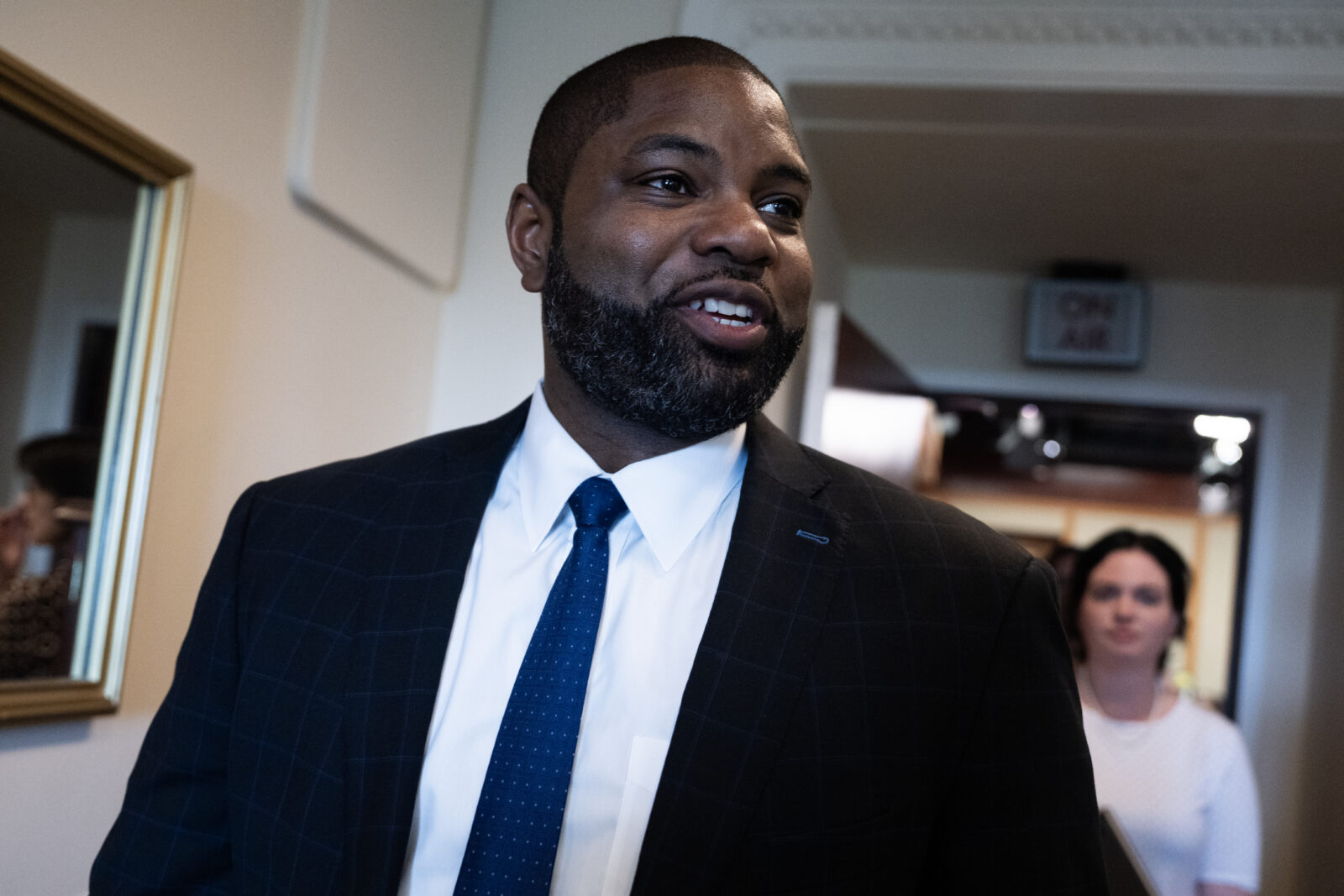
Gubernatorial candidate Rep. Byron Donalds (R-FL) warned the crowd: Don’t let social media think for you.
It is too easy, he said, to “go down rabbit trails” and follow personalities instead of facts.
Donalds then turned to why he believes more and more young conservatives have become skeptical of Israel. “Social media, propaganda,” he said.
Foreign governments, Donalds added, “would love nothing more for the United States to be destabilized.”
But he also drew a distinction between criticism of Israeli policy and antisemitism. “If you are having an issue with public policy … have that issue,” Donalds said. But blaming Israel or Jews “with no real facts, no real evidence, just because that’s what you heard” should not be tolerated.
Rep. Kat Cammack (R-FL), who also spoke at the conference, was even more explicit about the problem. For her, the argument over Israel begins before foreign policy: Republicans first have to agree on what constitutes a fact.
“You can’t even begin to have an honest conversation about how we ensure the security of our country, let alone our allies, until people understand what basic facts are,” Cammack said.
The exchanges between lawmakers and student activists captured a broader tension within the Republican Party that was on display throughout the Aug. 8 convention, which focused on recruiting, building chapters, training leaders and working on campaigns. But lawmakers and students kept coming back to a simpler question: where do young Republicans get their news, and whom do they trust?
University of Florida senior Justin Giacomelli said the debate over Israel has become one of the biggest fault lines among younger conservatives raised on social media.
“A lot of younger people, in particular, have grown up on social media where they’ve been bombarded by misinformation and lies about our relationship with Israel,” Giacomelli told Jewish Insider. “They’ve been brainwashed into thinking that Israel is evil, while countries like Iran are not, and they don’t understand the role we have with Israel, our mutual relationship, where we get critical intelligence from them.”
Giacomelli said X is his preferred platform for news because it puts competing arguments in the same feed. He also values the chance to test those arguments in real time by joining the debate himself. He admires Secretary of State Marco Rubio’s approach to Israel, Cuba and Venezuela, and disagrees with far-right, isolationist voices such as Tucker Carlson.
“I have learned that those policies don’t work,” Giacomelli said. “It’s dangerous to turn on your allies and become sympathetic toward your enemies, like Russia, China and Iran. You reach a point where you realize those policies don’t benefit America. They are not America First.”
Ian Lares-Chacin, the incoming chairman of the National Federation of College Republicans, said foreign policy is important to younger Republicans but remains secondary to affordability, particularly homeownership.
“As much as people care about foreign policy and that sort of thing, it’s second. Right now people are just kind of stressed out,” he said.
Still, Lares-Chacin described a “pretty split divide” over Israel among younger conservatives and said the debate had become toxic in some corners. His goal as chairman, he said, is to keep factions cooperating even when they disagree.
“At the end of the day, we’re all conservatives, even if we don’t agree 100% on every issue,” Lares-Chacin said. “I don’t think one or two issues should be the cause of a civil war.”
He said Israel could become a wedge issue, though he did not think it should.
Ephraim Asher, a University of South Florida junior who interned for Rubio when he was a senator, said most of his news comes from YouTube because he prefers extendedlong-form material to clipped excerpts.
“I get most of my information from YouTube, more like long-form content,” Asher said. “One thing I’ve seen is people clipping stuff, and I’m like, just watch the whole thing. So I’d rather watch the whole thing, see what they said, go through the sources and everything else.”
He said he checks Bloomberg, follows hosts with varying viewpoints and uses articles and AI tools to compare arguments. Like Giacomelli, he named Rubio as a model for the party’s future, citing his foreign policy and his ability to disagree without being divisive.
Moses Jinu, an FSU freshman, has a different routine.
“I’m kind of old-fashioned,” Jinu said. “I read the newspaper with my grandpa and then independently research news topics on Google.”
Asked what being a Republican means in 2026, Jinu pointed to “individual freedoms, liberty, and everyone’s right to speech, religion, the First Amendment.” Darren Valens, a Valencia College freshman, emphasized consent of the governed and the idea that rights come from God rather than government.
Scott Johnson, an advisor to the Osceola Young Republicans, said the defining challenge for a generation raised on social media is “figuring out what’s real and what’s not real.”
Cammack, the Florida congresswoman, recalled talking to a young man who believed American politicians were funded by foreign governments, a claim Cammack told him was not true. To her, the exchange showed how much the media landscape has changed. Younger conservatives are less likely to rely on Fox News or the New York Post and more likely to move between podcasts, X accounts and YouTube livestreams.
“There’s no editorial control, no reviews, there’s no accountability,” Cammack said. “There’s no, ‘Oh, I have sources, I have this.’ There’s none of that.”
The COVID-19 pandemic, she said, accelerated a collapse of trust, when many conservatives began questioning institutions and legacy media. That gave an opening for independent journalists and commentators.
She added that “there is a beauty” in the rise of independent media, “but now we’ve seen the abuse of that, and how people can just say whatever the hell they want, and they don’t have to back it up.”
Cammack said she has seen friends share material she believed was created by the Chinese Communist Party while assuming it came from American users. “We are in a full-blown cognitive war with China, with Russia, with Iran,” she said. “People don’t know it.”
Her prescription to the students was not a return to one set of legacy outlets, but more skepticism toward everything they encounter — including content they already agree with.
Cammack encouraged students to check claims before posting them and decide if the sources are credible. Distrust in established institutions makes personal judgment even more important.
“You want to be known as someone who is a beacon of truth, who can be counted on to share the truth,” she told the students, “who has the integrity and the intelligence to go do your own dang research, and you know what is fact and what is fiction.”
Among students, the divide was less abstract.
Conservative influencer Gates Garcia said the right has been too reluctant to confront antisemitism within its own ranks, while also warning against branding every criticism of Israel as antisemitic.
“We have a First Amendment right to criticize anyone,” Garcia said. “But what becomes antisemitic is when we hold Israel to a different set of standards than other people and other countries. And that’s what a lot of people in the conservative movement are falling victim to.”
Featured Stories
partnership pitch
Somaliland president discusses expanded military cooperation with U.S. officials
ENVOY DEBATE
Congressional Jewish Caucus opposes proposal to combine State Dept. Holocaust, antisemitism offices
FAMILY TRAGEDY
Israeli ambassador’s son seriously wounded in West Bank car-ramming attack
Please log in if you already have a subscription, or subscribe to access the latest updates.
 Continue with Google
 Continue with Apple