


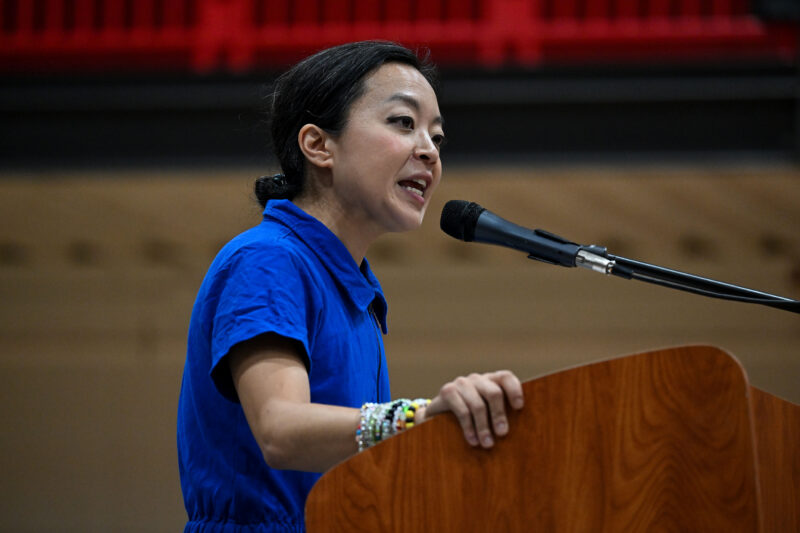





































Chan has been accused of using antisemitic rhetoric in her campaign against state Sen. Scott Wiener
ROBERTO SCHMIDT/AFP via Getty Images
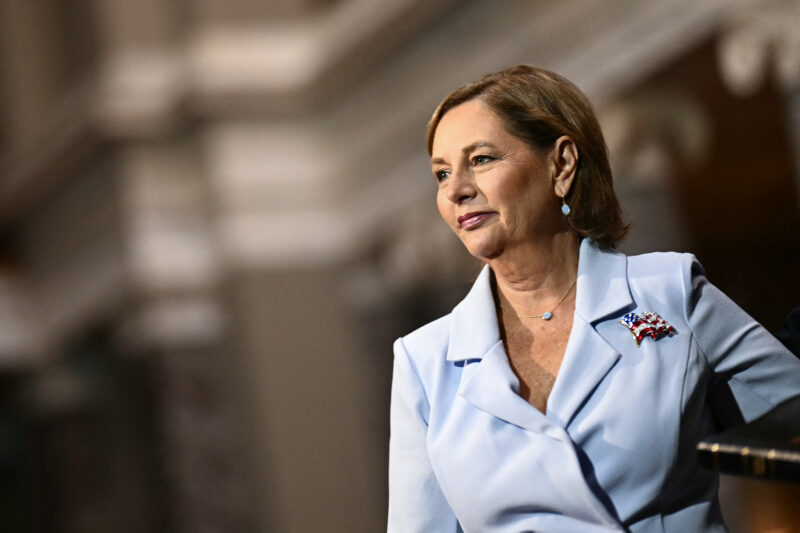
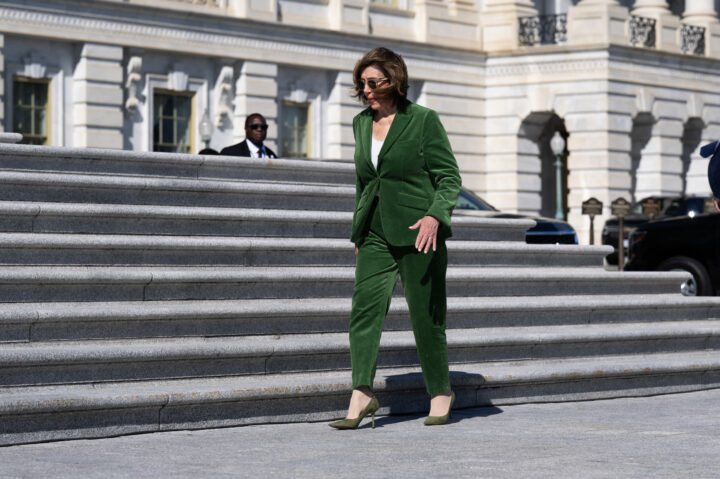
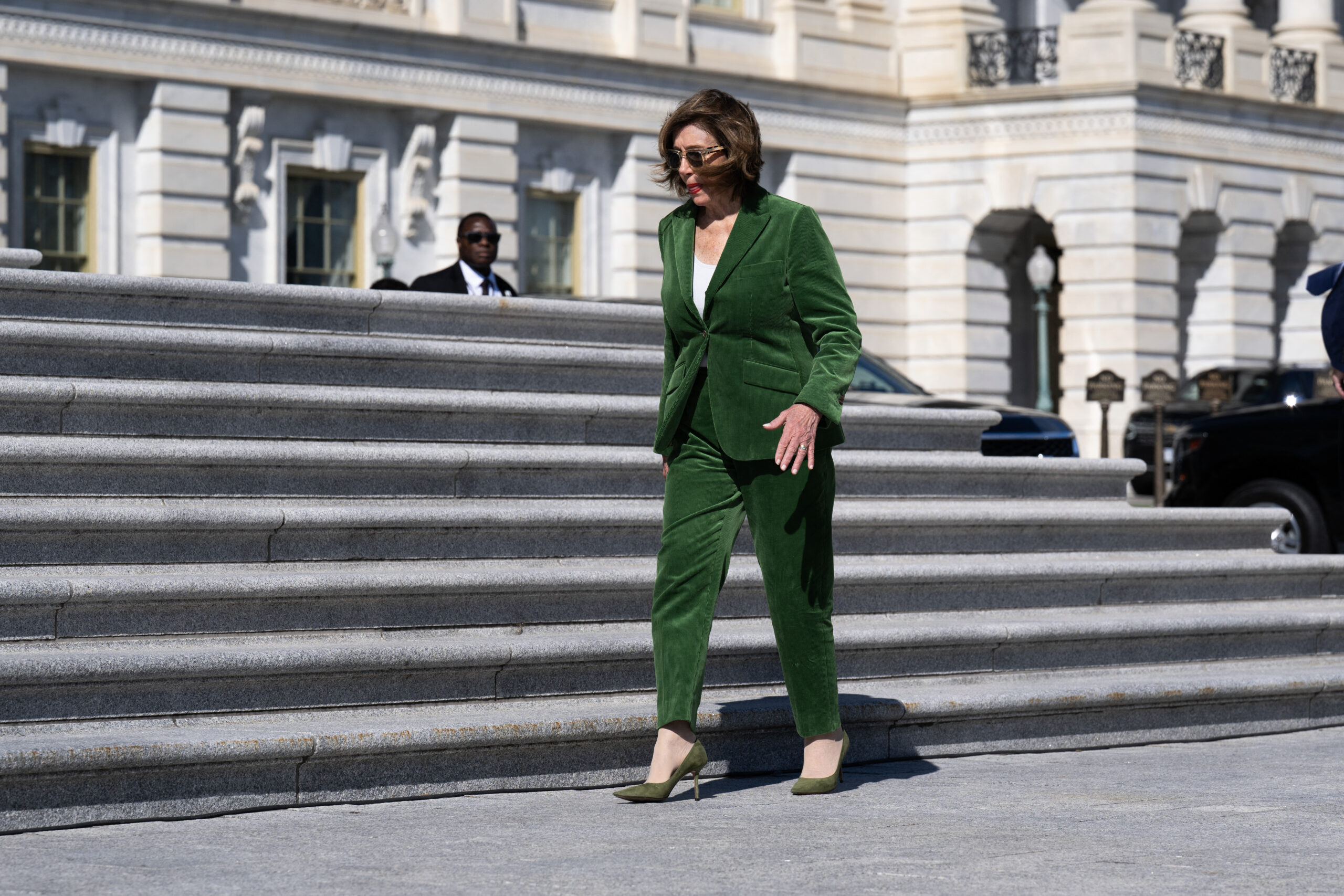
Rep. Nancy Pelosi (D-CA) attends a press conference with House Minority Leader Hakeem Jeffries (D-NY) on the steps of the U.S. Capitol in Washington, D.C., on October 15, 2025.


 Add JewishInsider on Google
Leaders in the Bay Area Jewish community are urging former House Speaker Nancy Pelosi (D-CA) to speak out or otherwise address her endorsed successor Connie Chan’s decision to lean into Israel and AIPAC-related attacks on her Jewish Democratic opponent, state Sen. Scott Wiener, which some in the Jewish community view as antisemitic.
Pelosi has been a longtime ally of the area’s Jewish community and, until her final years in office, a reliable supporter of Israel, though she recently voted for an amendment to cut off U.S. aid to Israel. Pelosi — a top surrogate for Chan, who is a member of the San Francisco Board of Supervisors — has not commented on Chan’s stances or rhetoric on Israel, and did not respond to multiple requests for comment from Jewish Insider on Wednesday and Thursday.
Tyler Gregory, the CEO of the Bay Area Jewish Community Relations Council and executive director of Bay Area Jewish Action, told JI he hopes Pelosi will “educate [Chan] about where the line is between criticizing the Israeli government and amplifying antisemitic tropes.”
“I don’t think Nancy Pelosi’s support for Connie Chan has anything to do with our community’s agenda,” Gregory continued. “We would ask Nancy Pelosi, who I believe has the Jewish community in her heart, to guide Connie Chan on these issues in the same way she is on many other issues.”
He said he plans to raise the issue with Pelosi directly.
Tali Klima, a spokesperson for Bay Area Jewish Coalition-Action, a separate grassroots group, urged Pelosi to speak out publicly.
“We call on Congresswoman Nancy Pelosi, who currently represents this district and has endorsed Chan, to publicly reject Chan’s antisemitic rhetoric,” Klima told JI. “Pelosi has been a longtime friend of the Jewish community. As a respected leader, we urge her to use her platform to make clear that Jew hatred has no place in public discourse and stand up to the growing normalization of antisemitism in our community.”
Ian Krager, a spokesperson for Chan’s campaign, said Chan is “unequivocal that there is no place for antisemitism, anti-Jewish hate, or harassment of Jews in our politics or our society, and our campaign strongly rejects and denounces any efforts to target Jewish people or communities.”
Krager added, “At the same time, criticism of AIPAC, its political spending, or scrutinizing the influence of any political organization or political lobby is well-founded. Connie believes voters deserve to know who is funding political campaigns and what interests candidates are accountable to. That standard applies across the board, regardless of the organization involved.”
Chan’s tactics gained particular attention this week when a fundraising message by Chan’s campaign — first shared by former Democratic Majority for Israel co-chair Todd Richman — circulated on X. The message read, “when children and families are being killed with American dollars, there is no room for careful political hedging.”
“I support a total arms embargo on Israel. I reject all corporate and lobbyist PAC money. And I will never stay silent on human rights. My opponent, Scott Wiener, continues to oppose a full arms embargo and receive donations from the Israeli lobby,” the message continued. “I know this makes me a target and the only way our grassroots campaign beats dark-money Super PACs is when everyday people stand up together.”
The message also touted the endorsement Chan received from TrackAIPAC, the anti-Israel group which has been accused of antisemitism for its pattern of targeting individual American Jewish donors and candidates for their political activity.
TrackAIPAC previously criticized Chan and accused her of receiving support from AIPAC or its affiliates, but she received the group’s endorsement after signing its anti-Israel pledge. Wiener is not endorsed by AIPAC. The only Israel advocacy group that is supporting his campaign is J Street.
Wiener, despite having shifted significantly to the left on Israel policy issues under pressure during the primary campaign, has continued to face antisemitic attacks from the far left, including being harassed into leaving a transgender community event in June.
Gregory, of the JCRC and Bay Area Jewish Action, said that Chan’s use of anti-Israel and anti-AIPAC rhetoric and ties to TrackAIPAC are “disgusting,” saying she’s “politicizing our community and lifting up an antisemitic Twitter account. TrackAIPAC, I think, is antisemitic.”
With the race tightening, Gregory predicted that rhetoric is only going to get uglier over the coming months, and “I think it’s unfortunate that now our community’s issues have become front and center, and in the way that [Chan’s] talking about this.”
Krager, the Chan spokesperson, said that Chan “has also been clear that she will not tolerate harassment or attacks against Jewish candidates, elected officials, donors, or community members” and “condemns conspiracy theories about American Jews and any effort to conflate Jewish identity with the positions of a particular political organization.”
“Connie is running to represent every San Franciscan. She has always been and will continue to be committed to engaging directly and respectfully with San Francisco’s Jewish community,” Krager continued. “She stands firmly against antisemitism while also standing up for the right to debate U.S. foreign policy and the role of money and influence in our politics.”
Gregory attributed Chan’s activity largely to ignorance on her part, explaining that he does not think she knows much about the Middle East and hasn’t engaged much with the Jewish community, something he said the community is trying to change.
“I think she’s amplifying bad advice she’s getting from people aligned with our detractors. She’s taken endorsements from unsavory groups,” Gregory said. “I’m still hopeful that we’ll have the opportunity to sit down with her and educate her about those red lines. So it’s not surprising, without a lot of that education, that she’s just kind of taking this campaign strategy hook, line and sinker.”
Klima, the Bay Area Jewish Coalition-Action spokesperson, said that she’s “shocked by Connie Chan’s messaging promoting the antisemitic organization Track AIPAC.”
“This organization targets Jewish politicians and community members, and spreads conspiracy theories about American Jews. The hypocrisy of vilifying AIPAC is particularly striking given that Chan is endorsed by the radical organization CAIR and received huge donations from several PACs,” Klima said. “We’re equally concerned about the ongoing attempts to push Jewish politicians out of public life here in the Bay Area, including the attacks against Scott Wiener and harassment directed at him on social media by local accounts.”
Chan received support in the form of independent expenditures from some super PACs rather than direct campaign donations.
Chan's opponent, state Sen. Scott Wiener, has been harassed by far-left activists shouting antisemitic slurs at him
Carlos Avila Gonzalez/San Francisco Chronicle via Getty Images
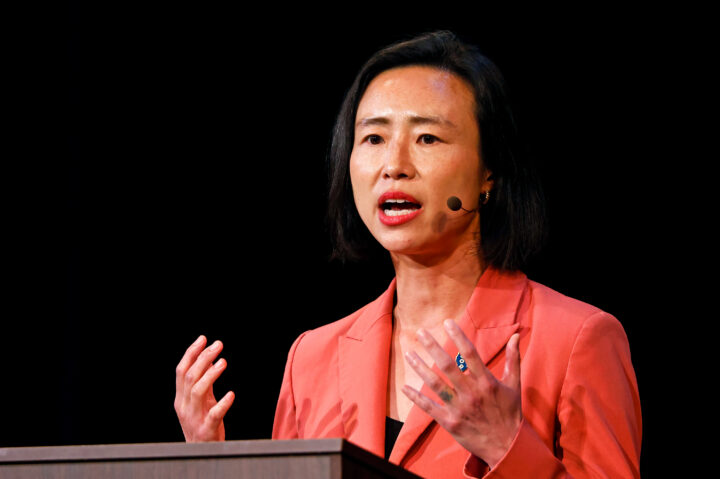
Connie Chan debates Saikat Chakrabarti and Scott Wiener for California's 11th Congressional District at the Sydney Goldstein Theater in San Francisco on March 31, 2026.
Connie Chan, a progressive member of the San Francisco board of supervisors running to succeed retiring Rep. Nancy Pelosi (D-CA), claimed an endorsement on Tuesday from Track AIPAC, a virulently anti-Israel group that has faced accusations of spreading antisemitism.
In a statement posted to social media, Track AIPAC said Chan had completed its candidate questionnaire “affirming that Israel is committing genocide against the Palestinian people and that Congress must end U.S. complicity in it and hold those responsible to account.”
Additionally, the group said, Chan vowed to back “a total arms embargo on Israel,” reject “support from AIPAC and the rest of the Israel lobby” and push for the pro-Israel group to register as a foreign agent — a spurious claim that has drawn scrutiny as a cover for invoking antisemitic tropes concerning dual loyalty.
While Chan had already expressed her alignment with several of the commitments she made in the questionnaire, Track AIPAC had apparently been skeptical of her candidacy until relatively recently.
Chan is also supported by a number of Democrats who have been endorsed by AIPAC, including Pelosi, the former House speaker, and Sen. Adam Schiff (D-CA), among others in California and beyond.
Representatives for Pelosi and Schiff did not return requests for comment about Chan’s friendly rapport with the anti-Israel group, which has drawn criticism for backing extreme candidates, demonizing Zionism and using flawed methodology to distinguish among differing Israel advocacy groups such as J Street and Democratic Majority for Israel.
Both Pelosi and Schiff have been targeted by Track AIPAC for contributions from pro-Israel sources.
The new endorsement, however, comes amid recent tensions between Pelosi and AIPAC, whose political action committee last week chose to remove language from its online endorsement portal that had thanked the veteran congresswoman for her “ongoing support for the U.S.-Israel relationship,” after she voted along with more than 100 House Democrats to end U.S. aid to the Jewish state.
In the top-two primary election last month, Track AIPAC had backed Chan’s far-left opponent, Saikat Chakrabarti, who came in a distant third place. He has since endorsed Chan, who came in second with 30% of the vote — trailing state Sen. Scott Wiener, a Jewish Democrat, by 11 points.
Like Chan, Wiener has said he supports the Block the Bombs Act, which would impose sweeping conditions on weapons sales or transfers to Israel, but carves out an exception for U.S. assistance to help fortify Israel’s defensive systems.
Even as Wiener has also echoed Chan in accusing Israel of genocide in Gaza in an effort to placate the far left in California’s deeply progressive 11th Congressional District, he has continued to face harrassment from anti-Israel activists. Most recently, the veteran lawmaker was chased from a trans rights march in San Francisco by protesters who called him “terrible on Gaza” and said he had “Zionist handlers,” in an incident that drew national media attention.
While Chan broadly condemned the episode, which was captured on video, her statement made no direct mention of Wiener and she did not join local political leaders in signing a community letter denouncing the harassment.
In its statement, Track AIPAC argued that Wiener’s positions on Israel “have been continuously unclear, and where he has taken a stance, he has stopped well short of what accountability requires.” The group also stated that Wiener “has not taken” the opportunity to respond to its candidate questionnaire.
Wiener did not return a request for comment.
Chan’s campaign did not respond to a request for comment about the endorsement from Track AIPAC, which operates a political arm called Citizens Against AIPAC Corruption.
“In Congress, we will oppose any aid to Israel and do everything in our power to stop their government’s genocidal actions against the Palestinian people,” Chan said in a statement to The Intercept. “We are proud to stand with groups like End Citizens United and Citizens Against AIPAC Corruption to fight to fix our democracy.”
The California lawmaker was forced to leave a transgender community march amid harassment from anti-Israel activists shouting antisemitic slurs at him
Gabrielle Lurie/San Francisco Chronicle via Getty Images
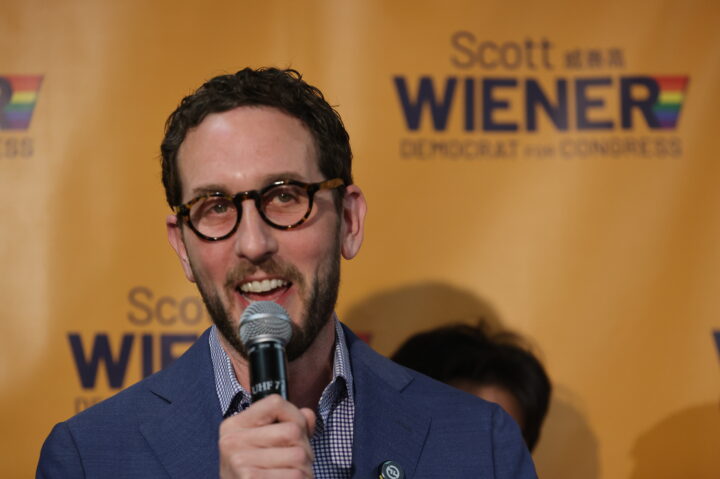
California state Sen. Scott Wiener's election party at his congressional campaign headquarters on election night in San Francisco, Calif. on June 2, 2026.
California state Sen. Scott Wiener, the front-runner to succeed retiring Rep. Nancy Pelosi (D-CA) in Congress, has become the target of antisemitic harassment twice in the last week in his San Francisco district, marking the latest example of a high-profile progressive Jewish politician being singled out and facing threats for his background.
The latest episode occurred Friday when Wiener, who was on his way to participate in a Pride Shabbat service at a transgender community march in San Francisco, was chased out of the event by anti-Israel activists following the state lawmaker and shouting antisemitic slurs at him.
In a video posted by one local anti-Israel activist, the activist follows Wiener around, attacking him for “being terrible on Gaza,” adding, “You do not belong here anymore, Scott. And it breaks my f—ing heart.” Soon after the initial engagement, other even-more hostile activists start cursing at Wiener, with one calling him a “genocidal piece of sh—” and another saying, “F— you and your Zionist handlers.”
Wiener is a longtime supporter of the transgender community, noting in a statement on Saturday about the incidents that he’s attended the march he was harassed out of every year since it began in 2004.
Two days earlier, Wiener, while watching a World Cup game with staffers at a local bar, was berated over his support for Israel by another anti-Israel activist who demanded he say the words “Free Palestine” on camera. The same individual, Wiener said, had stalked him on a plane several years earlier, shouting obscenities about his “tainted bloodline.”
”I have no objection whatsoever to anyone disagreeing with me, opposing me, or protesting me. All of that is core to democracy,” Weiner said, as videos of the confrontations went viral on Saturday.
“But when opposition and disagreement transition to harassment, including cornering me, touching me, or trying to physically bully me out of a public event, that crosses a line. We’re living in a time when violence is all too often threatened or used against people in public life. In San Francisco, we’re better than that.”
Wiener, a progressive stalwart in the California state legislature who has worked closely with the Jewish community the Bay Area, called Israel’s war against Hamas a “genocide” earlier this year after facing intense pressure from left-wing activists to do so. At the time, Wiener was facing primary opposition from a candidate who was attacking him over his support for Israel.
He stepped down as co-chair of the California Legislative Jewish Caucus, after his decision to placate progressives drew opposition from the state’s sizable Jewish community.
Activists have continued to harass the lawmaker even as he finished in first place in the state’s June Democratic primary. (He is facing San Francisco supervisor Connie Chan, who has Pelosi’s endorsement.)
The antisemitic threats against Wiener come after Rep. Dan Goldman (D-NY), who lost a primary last week amid relentless attacks over his support for Israel, faced online harassment from a Brooklyn coffee shop owner after he bought a drink in the store.
“We see that you stopped by our shop today for a coffee. Do you see how it doesn’t taste like genocide juice?” Poetica Coffee wrote in an Instagram post with an image of Goldman standing at the register. “We don’t need your money (it’s probably coming from AIPAC anyways). Don’t ever come to Poetica.”
The Department of Justice’s Civil Rights Division is investigating Poetica Coffee for possible discrimination.
Plus, the race to replace Pelosi

Tasos Katopodis/Getty Images
U.S. President Donald Trump waves to the media after walking off of Air Force One at Miami International Airport on April 11, 2026 in Miami, Florida.
Good Tuesday morning.
In today’s Daily Kickoff, we do a deep dive into the race to succeed Rep. Nancy Pelosi, in what has become something of a proxy battle in the war for the identity of the Democratic Party, and report on an effort by Democratic Majority for Israel to boost a Texas congressional candidate whose far-left opponent has trafficked in antisemitic tropes. We talk to Senate Republicans about the possibility of resuming military operations against Iran, and have the scoop on Gerald Steinberg’s decision to step down from the helm of NGO Monitor early next year, and the first interview with his successor, Olga Deutsch. Also in today’s Daily Kickoff: Daniel Septimus, Rom Braslavski and Ben Shapiro.
Today’s Daily Kickoff was curated by JI Executive Editor Melissa Weiss and Israel Editor Tamara Zieve, with assists from Danielle Cohen-Kanik and Marc Rod. Have a tip? Email us here.
What We’re Watching
- Defense Secretary Pete Hegseth and Chairman of the Joint Chiefs of Staff Gen. Dan Caine are both slated to testify this morning at back-to-back House and Senate Appropriations Committee budget hearings. In the afternoon, FBI Director Kash Patel will testify before Senate Appropriations.
- The Anti-Defamation League is holding a Jewish American Heritage Month reception this evening on Capitol Hill.
- Elsewhere in Washington, the Jewish Democratic Council of America is kicking off its annual summit tonight with a reception at the Watergate Hotel. The group will honor Sen. Elissa Slotkin (D-MI) and Rep. Steny Hoyer (D-MD), and will hear from Sens. Jacky Rosen (D-NV) and Mark Kelly (D-AZ) and Reps. Debbie Wasserman Schultz (D-FL), Jason Crow (D-CO), Chris Deluzio (D-PA), Maggie Goodlander (D-NH) and Chrissy Houlahan (D-PA).
- The funeral for former Anti-Defamation League head Abe Foxman, who died on Sunday, will take place this morning at Park Avenue Synagogue.
- In New York City tonight, three of the top candidates in the open congressional race in NY-12 — George Conway and Assemblymembers Alex Bores and Micah Lasher — will participate in a forum at the West Side Institutional Synagogue moderated by Jewish Insider Editor-in-Chief Josh Kraushaar.
- Elsewhere in New York, the American Jewish Committee will present Cardinal Timothy Dolan with the group’s Nostra Aetate at Sixty Award, honoring Dolan’s interfaith efforts on the 60th anniversary of the groundbreaking Vatican declaration.
- Across the Hudson, the New Jersey Globe is hosting a primary debate for the Democrats running in New Jersey’s 7th Congressional District. ER physician and former government official Tina Shah, former Navy pilot Rebecca Bennett and businessmen Brian Varela and Michael Roth will participate in tonight’s debate, which starts at 7 p.m. ET.
- Israeli Eurovision entrant Noam Battan will perform tonight when the contest’s semifinals kick off in Vienna.
What You Should Know
A QUICK WORD WITH JI’S GABBY DEUTCH
Over the last two years, the second semester of the academic year at American universities coincided with crisis and chaos. In 2024, it was anti-Israel encampments overtaking campus quads across the country; last year, it was threats from the Trump administration to slash hundreds of millions of dollars in funding and ban foreign students.
By comparison, the spring of 2026 has been relatively smooth sailing for research universities, even with a bit of hubbub over graduation speakers scrutinized for their stance on Israel and Gaza at a few schools, including the University of Michigan and Georgetown Law.
But it’s not that things have gone back to the pre-Oct. 7, pre-Donald Trump normal. University administrators have just gotten better at managing an ambient sense of friction: Conflict between university leaders and activist faculty and students is still bubbling under the surface, and the threat of funding cuts at the federal level lingers.
According to several university presidents who gathered last week at the Milken Institute Global Conference in Los Angeles, the task before universities is to win back the trust of skeptical Americans.
“The world of higher education, I think, is still in turmoil,” Vanderbilt University Chancellor Daniel Diermeier told Jewish Insider in an interview at the Milken confab. “I think the time when a university does say that’s all overblown and everything is great, that’s over. At least the vast majority of university presidents know that there are challenges, and they want to take them on.”
democratic fault lines
Race to replace Pelosi offers early test of whether progressive Jews welcomed on the left
The race to fill the seat of Rep. Nancy Pelosi (D-CA) in California’s 11th Congressional District has become somewhat of a proxy battle in the war for the identity of the Democratic Party, where describing Israel’s war in Gaza as a genocide, supporting arms embargoes to Israel and attacking Zionism as a racist ideology have become much more common since the Oct. 7, 2023, Hamas terrorist attacks and the subsequent war in Gaza, Gabe Stutman reports for Jewish Insider. The outcome of the race will help answer an important question: Can a progressive candidate still win in a deep-blue district like San Francisco without fully embracing the politics of the anti-Zionist left?
State of play: The race is by most accounts a three-way contest between state Sen. Scott Wiener, Connie Chan, a progressive member of the San Francisco Board of Supervisors who has the backing of major labor organizations but has struggled to compete in fundraising, and Saikat Chakrabarti, a wealthy tech entrepreneur who entered progressive politics working for Sen. Bernie Sanders (I-VT) during his 2016 presidential bid and later served as Rep. Alexandria Ocasio-Cortez’s (D-NY) chief of staff.
EXCLUSIVE
DMFI works to block antisemitic activist from winning Dem nomination in Texas swing district

Democratic Majority for Israel’s political arm is kicking off an ad campaign on Tuesday to boost Johnny Garcia, a sheriff’s deputy in Bexar County, Texas, in his Democratic runoff election later this month against Maureen Galindo, a San Antonio activist who has faced scrutiny for trafficking in antisemitic tropes, Jewish Insider’s Matthew Kassel reports.
Getting behind Garcia: “Democrats need candidates who can build broad coalitions and win in November,” Brian Romick, the chair of DMFI PAC, told JI. “Johnny Garcia is a coalition builder who supports a strong U.S.-Israel relationship and has been clear in standing against antisemitism. His opponent, on the other hand, proudly embraces vile, antisemitic conspiracies and if she advances could put a Democratic House majority at risk.”
TEHRAN TALKS
Senate Republicans split over the prospect of resuming military operations against Iran

With President Donald Trump publicly mulling the resumption of military action against Iran, fault lines are opening up among Senate Republicans over the prospect of a renewed military effort, Jewish Insider’s Marc Rod reports.
State of play: Some Senate Republicans are publicly calling for the U.S. to resume military operations. Others are leaving the prospect of military action on the table without fully ruling out a diplomatic path, while offering varying degrees of skepticism about how realistic a deal actually would be. Sen. Josh Hawley (R-MO) urged Trump to ignore calls from some of his more hawkish colleagues to restart military operations.
Pakistan problems: Senators on both sides of the aisle, including Sens. Lindsey Graham (R-SC), Mark Kelly (D-AZ) and Ted Budd (R-NC), on Monday expressed concerns about a report by CBS News that Pakistan had sheltered multiple Iranian military aircraft at an air force base in the country since shortly after the U.S.-Iran ceasefire in April, raising questions about the country’s neutrality as a mediator, JI’s Marc Rod reports.
PARTY SWITCH
Israel’s business leaders see opportunity amid war, political shifts

The Israeli financiers, investors and entrepreneurs who attended last week’s Milken Institute Global Conference in Beverly Hills brought an upbeat attitude about Israel’s economy, even two-and-a-half years into near-constant war that began with Hamas’ Oct. 7, 2023, attacks, Jewish Insider’s Gabby Deutch reports.
Exceeded expectations: “When the war began, I think none of us — none of the regulators in Israel, and almost none of the players or the investors in Israel — thought or believed that after two-and-a-half years of war, Israel would show such growth, such resilience,” Seffy Zinger, chair of the Israel Securities Authority, told JI in an interview. “I’m not an investment advisor, but you can see that if you were not in Israel in the past two years, you probably missed out, if Israel was not part of your portfolio.”
SPEAKING OUT
Pennsylvania Supreme Court justice leaves Democratic Party, citing rise in antisemitism
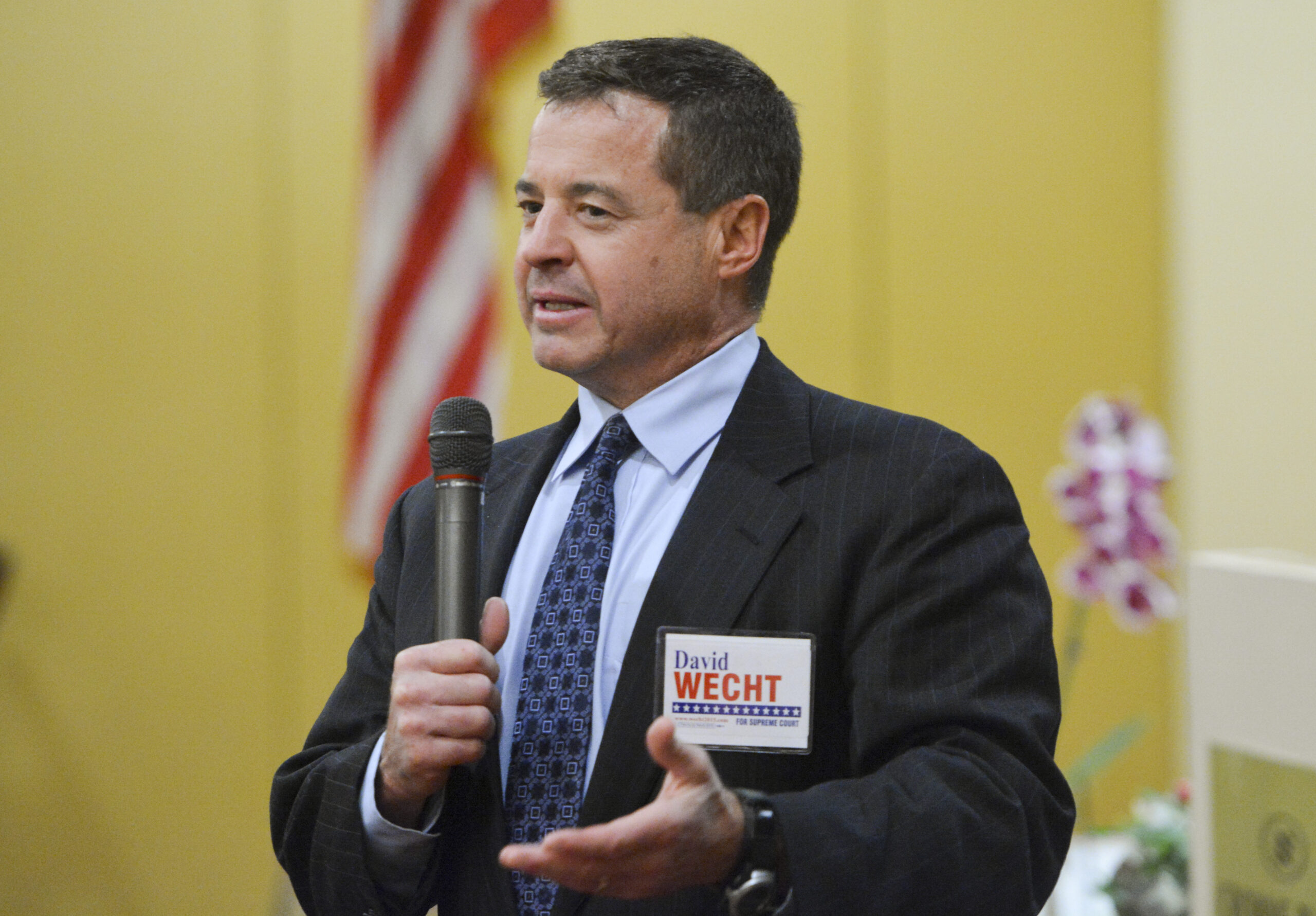
Pennsylvania Supreme Court Justice David Wecht, a former vice-chair of the Pennsylvania Democratic Party, announced Monday he has left the party, citing “anti-Jewish” actions and “acquiescence to Jew-hatred” within the party, including from elected officials, Jewish Insider’s Haley Cohen reports.
What he said: “Acquiescence to Jew-hatred is now disturbingly common among activists, leaders and even many elected officials in the Democratic Party. I can no longer abide this,” wrote Wecht, who was elected as a Democrat in 2015. He added that he is no longer affiliated with any political party. “That terror came from the right,” he wrote. “Jew-hatred has always festered on the fringe of that sector.” But, Wecht continued, “in the quarter century that has passed” since his leadership position, “the Democratic Party has changed.”
scoop
Olga Deutsch to succeed Gerald Steinberg as president of NGO Monitor
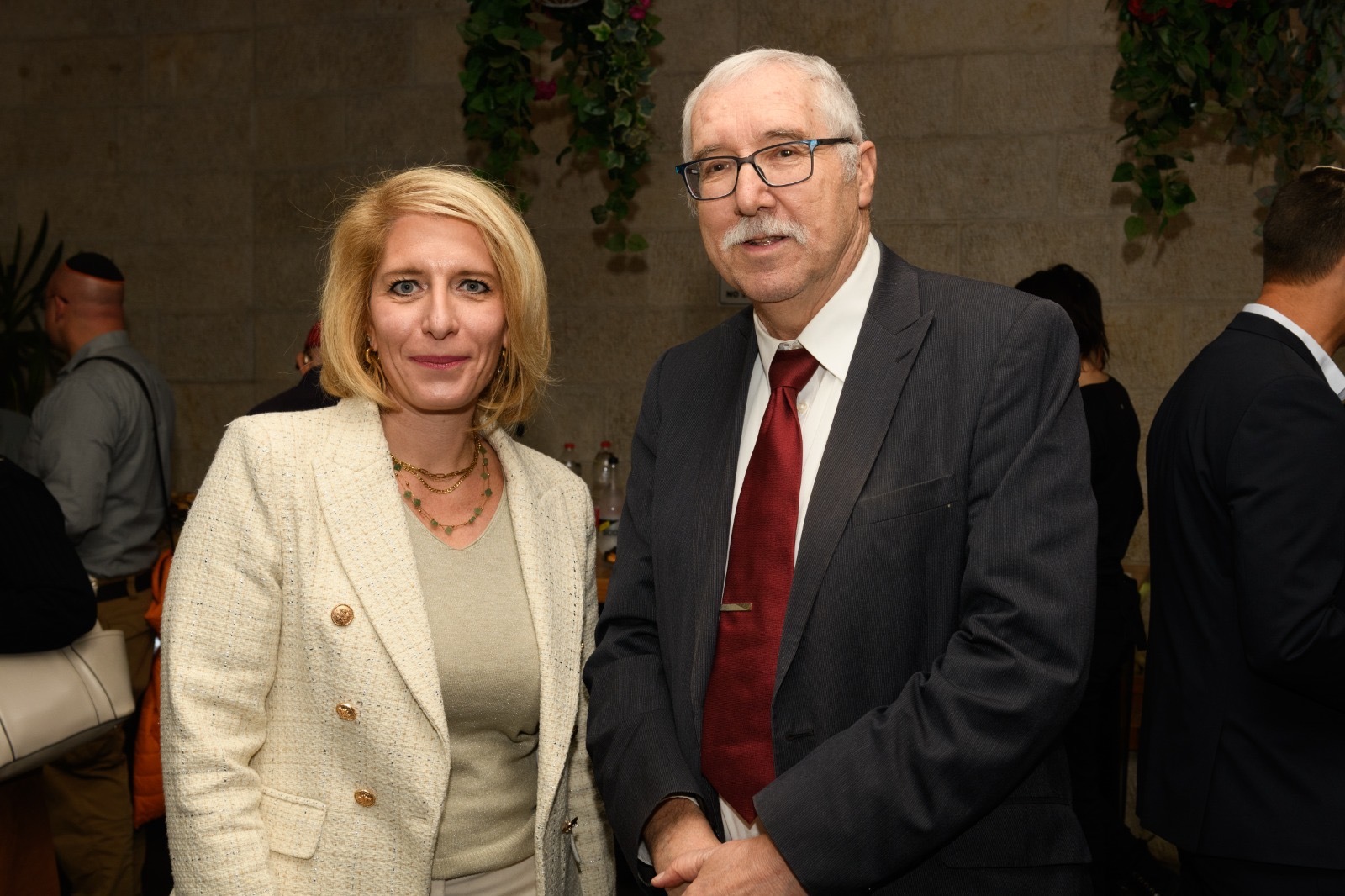
NGO Monitor President Gerald Steinberg is set to step down in January, 25 years after founding the Jerusalem-based watchdog group focused on scrutinizing nonprofit organizations critical of Israel and their funding sources, Jewish Insider’s Tamara Zieve reports. Olga Deutsch, 47, currently NGO Monitor’s vice president, will succeed Steinberg following a months-long transition process at the organization, which since its inception has been closely associated with its founder.
Passing the baton: Steinberg, 74, who resigned from his position as a professor of political science at Bar-Ilan University seven years ago, told JI, “There is a point in one’s life where one has to decide the different priorities. And I’ve done this long enough, and other people can have more energy and can take over.” Deutsch told JI that she hopes to “open the next exciting chapter,” while preserving the “character of the organization that Gerald created, which is serving as pioneers and continuing to flag the new fronts through which the Jewish state and the Jewish people are being attacked or put in danger.”
Worthy Reads
Abe as Mentor: In eJewishPhilanthropy, William Daroff, the CEO of the Conference of Presidents of Major American Jewish Organizations, eulogizes former Anti-Defamation League head Abe Foxman, who died on Sunday. “He combined toughness and warmth in a way few leaders can. He expected seriousness. He spoke with moral clarity. He pushed younger Jewish leaders to think bigger about our responsibility to the Jewish people and the broader democratic society in which we live. He also challenged me, usually in private, though occasionally in the public pages of newspapers. Abe Foxman knew exactly when to make a point, and exactly how to make it land.” [eJP]
Miller Lite: The Atlantic’s Michael Scherer and Nick Miroff spotlight the waning influence of Stephen Miller in the second Trump administration. “White House insiders said that Miller remains a top adviser to the president, that he has a singular relationship to Trump built over the past decade, and that his job is not in jeopardy. Immigration enforcement remains a central theme of the administration and is expected to feature prominently in Trump’s midterm-election messaging. … But Trump, who has previously joked that Miller’s ‘truest feelings’ are so extreme that they should not be aired publicly, has also told others in recent weeks that he understands Miller sometimes goes too far, advisers told us.” [TheAtlantic]
Word on the Street
President Donald Trump said that the ceasefire with Iran was on “life support” following Washington’s rejection of Tehran’s latest response to the U.S. proposal to end the war, Jewish Insider‘s Emily Jacobs reports…
CNN looks at efforts by Iran to recruit operatives in Europe to carry out attacks on Jewish targets…
The United Arab Emirates reportedly carried out strikes on Iran during the active military campaign launched by the U.S. and Israel, targeting among other things an oil refinery on the Lavan Island in the Persian Gulf…
U.S. Ambassador to Israel Mike Huckabee, speaking at the Tel Aviv Conference today,confirmed that Israel sent missile-defense batteries and operating personnel to the UAE during the war with Iran…
The Financial Times spotlights Iran’s “mosquito fleet” of Islamic Revolutionary Guard Corps fast-attack boats that are engaging commercial and military vessels in the Strait of Hormuz…
Rep. Pat Ryan (D-NY) and 17 other Democrats introduced a bill to ban further funding for military operations against Iran…
Trump nominated Cameron Hamilton to head FEMA, a year after Hamilton, who mounted a failed 2024 bid for Congress, was fired as the interim head of the agency…
Kevin Warsh is expected to be confirmed as the next head of the Federal Reserve as early as tomorrow…
Trump invited several business leaders to join him on his trip later this week to China, including Elon Musk, outgoing Apple CEO Tim Cook, BlackRock’s Larry Fink, Meta’s Dina Powell McCormick, Goldman Sachs’ David Solomon, Citi’s Jane Fraser and Blackstone’s Stephen Schwarzman, among others…
Trump announced the nominations of Kari Lake, the former head of the U.S. Agency for Global Media, and Pennsylvania state Sen. Doug Mastriano to be, respectively, the ambassadors to Jamaica and Slovakia…
Former Rep. Billy Long (R-MO), who has been nominated to be U.S. ambassador to Iceland, shared a three-minute clip of a speech by neo-Nazi influencer Nick Fuentes on X on Sunday, Jewish Insider’s Marc Rod reports…
The New York Times spotlights the work of Fuentes’ acolytes to build on the antisemitic conspiracy theorist’s political movement, an effort that coalesced around a conference of influencers and fringe candidates from both parties in a sparsely attended summit; the low turnout was attributed in part to the absence of Fuentes, who distanced himself from the gathering…
Puck News does a deep dive into the recent layoffs at Ben Shapiro’s Daily Wire, finding that the recent decision to cut approximately 20% of the company’s staff was fueled by a combination of internal business disagreements and the “‘vibe shift’ among the MAGA base” that has divided conservatives in recent years…
A judge in Santa Clara County, Calif., ordered a Jewish prosecutor to recuse himself from a case against anti-Israel student protesters at Stanford University after the prosecutor described the incident as antisemitic in campaign literature, Jewish Insider’s Haley Cohen reports…
The Wall Street Journal’s Shira Kaplan reflects on the sanctity of Shabbat following President Donald Trump’s call for the American Jewish community to observe a “national Sabbath” this weekend…
Daniel Septimus is departing Sefaria after 13 years atop the organization, eJewishPhilanthropy’s Jay Deitcher reports…
Australian Jewish musicians testifying on Tuesday before the country’s royal commission into antisemitism in the country detailed the yearslong ostracization they experienced from the arts community for their support for Israel…
Israeli journalist Haviv Rettig Gur breaks down the “obvious propaganda” in a recent New York Times opinion piece by Nicholas Kristof about alleged Israeli abuses of Palestinian prisoners…
Former Israeli hostage Rom Braslavski, who was one of the last hostages to be freed after spending more than 700 days in Hamas captivity, called for the resignation of all members of the current Israeli government, whom he called “miserable cowards”…
Israel’s Civil Commission on October 7 Crimes Against Women and Children released its comprehensive report on sexual violence during the Oct. 7, 2023, Hamas terror attacks and during hostages’ time in captivity…
The Knesset passed, with the support of 93 of the body’s 120 lawmakers, a law establishing a military tribunal to try terrorists who took part in the Oct. 7 attacks…
E.U. member states unanimously voted to sanction Hamas leaders as well as Israeli settlers in a bid to target extremism; the vote came after Hungary, no longer under the leadership of Viktor Orbán, removed its longstanding opposition to the measure…
Israel denied entry to YouTuber Tyler Oliveira, who in recent months has posted videos suggesting that Jews were “invading” communities in New York and New Jersey…
The Israeli soldier photographed desecrating a statue of the Virgin Mary in a southern Lebanese village was sentenced to three weeks in a military prison, while the soldier who took the photo received a sentence of two weeks…
Iran executed a graduate student convicted of spying on behalf of the CIA and Mossad; Erfan Shakourzadeh, who attended the prestigious Iran University of Science and Technology, denied the charges in a letter written before his execution…
Pic of the Day

Ukrainian President Volodymyr Zelensky (left) met in Kyiv earlier today with Palantir CEO Alex Karp.
Birthdays

Acclaimed architect and master planner for the World Trade Center site in Lower Manhattan, he also designed the Jewish Museum in Berlin, Daniel Libeskind turns 80…
Israeli agribusiness entrepreneur and real estate investor, he was chairman and owner of Carmel Agrexco, Gideon Bickel turns 82… Former member of the California state Senate for eight years, following six years as a member of the state Assembly, Lois Wolk turns 80… Chairman of the Israel Paralympic Committee, he served for four years as a member of the Knesset for the Yisrael Beiteinu party, Moshe “Mutz” Matalon turns 73… Former Washington correspondent for McClatchy and then the Miami Herald covering the Pentagon, James Martin Rosen turns 71… SVP and deputy general counsel at Delta Air Lines until 2024, now chief legal officer at private aviation firm Wheels Up, Matthew Knopf turns 70… Professor at Emory University School of Law, he has published over 200 articles on law, religion and Jewish law, Michael Jay Broyde turns 62… Actress known for her role as Lexi Sterling on “Melrose Place,” she also had the lead role in many Lifetime movies, Jamie Michelle Luner turns 55… Founder of strategic communications and consulting firm Hiltzik Strategies, Matthew Hiltzik turns 54… Communications officer in the D.C. office of George Soros’ Open Society Foundations until last year, Jonathan E. Kaplan… First-ever Jewish governor of Colorado, he was a successful serial entrepreneur before entering politics, Jared Polis turns 51… Professor of mathematics at Bar-Ilan University and a scientific advisor at the Y-Data school of data science in Israel, Elena Bunina turns 50… Italian politician, she is the first-ever Jewish mayor of Florence, Sara Funaro turns 50… Israeli pastry chef and parenting counselor, she is married to former Israeli Prime Minister Naftali Bennett, Gilat Ethel Bennett turns 49… Author, blogger and public speaker, Michael Ellsberg turns 49… Senior advisor at Accelerator for America Action, Joshua Cohen… Technology and social media reporter at Bloomberg, Alexandra Sophie Levine… Executive director of government affairs at BridgeBio, Amanda Schechter Malakoff… A government affairs and public policy manager for YouTube, Erica Arbetter… Haifa-born actress and model, she is known for her lead roles in seven films since 2014, Odeya Rush turns 29…
State Sen. Scott Wiener has called Israel’s actions in Gaza a genocide and is open to conditions on offensive aid to the Jewish state, but is still derided as a ‘Zionist’
ROBERTO SCHMIDT/AFP via Getty Images
Rep. Nancy Pelosi (D-CA) attends a press conference with House Minority Leader Hakeem Jeffries (D-NY) on the steps of the U.S. Capitol in Washington, D.C., on October 15, 2025.
A solemn California state Sen. Scott Wiener looked directly into the camera.
He was recording a video to “clarify” whether he believed Israel had committed genocide in Gaza. Four days earlier, he wavered on that question in front of a live audience during a candidate forum for the race to fill the seat of Rep. Nancy Pelosi (D-CA) in California’s 11th Congressional District.
Both of his opponents had quickly answered “yes,” that Israel had committed genocide. Wiener did not answer “yes” or “no,” drawing loud jeers.
“For many Jews, associating the word genocide with the Jewish State of Israel is deeply painful and frankly traumatic,” Wiener said in the follow-up video. Wiener grew up in a Conservative family in New Jersey, supports a two-state solution to the Israeli-Palestinian conflict and has long been a critic of the government of Israeli Prime Minister Benjamin Netanyahu. “We all have eyes,” he continued, “and we see the absolute devastation and catastrophic death toll in Gaza.”
Referring also to what he described as “genocidal statements” from Israeli officials, he said the Israeli government had “tried to destroy Gaza and to push Palestinians out. That qualifies as a genocide.”
The striking about-face, which drew swift rebukes from mainstream Jewish organizations in the Bay Area, was indicative of the immense pressure on Wiener, a gay, progressive Jew who has often been assailed as a “Zionist” by the far left in San Francisco, but who is also harshly critical of the Israeli government’s policies.
One of Wiener’s top challengers for the San Francisco seat, Saikat Chakrabarti, is running a well-funded campaign closely aligned with the anti-Israel left, embracing some of the most extreme voices in that camp.
The race has become somewhat of a proxy battle in the war for the identity of the Democratic Party, where describing Israel’s war in Gaza as a genocide, supporting arms embargoes to Israel and attacking Zionism as a racist ideology have become much more common since the Oct. 7, 2023, Hamas terrorist attacks and the subsequent war in Gaza. The outcome of the race to succeed Pelosi will help answer an important question: Can a progressive candidate still win in a deep-blue district like San Francisco without fully embracing the politics of the anti-Zionist left?
The race is by most accounts a three-way contest between Wiener, Connie Chan, a progressive member of the San Francisco Board of Supervisors who has the backing of major labor organizations but has struggled to compete in fundraising, and Chakrabarti, a wealthy tech entrepreneur who entered progressive politics working for Sen. Bernie Sanders (I-VT) during his 2016 presidential bid and later served as Rep. Alexandria Ocasio-Cortez’s (D-NY) chief of staff.
Chakrabarti has attacked Wiener for being too supportive of Israel, describing him as “horrible on Palestinian rights” in an interview with Zeteo’s Mehdi Hasan.
Wiener had already been sharply critical of Israel’s tactics in Gaza prior to the controversy in January. He had called for a ceasefire early in the conflict, and has described Israel’s actions as a “moral stain” and “indefensible.”

Amid the controversy of his embrace of the term genocide and the ensuing fallout with mainstream Jewish community organizations in the Bay Area, Wiener stepped down as co-chair of the California Legislative Jewish Caucus.
Chakrabarti, for his part, has raced to the left of Wiener and embraced far-left streamer Hasan Piker as a prominent campaign supporter, appearing on Piker’s stream and inviting Piker to campaign with him at a rally in San Francisco last week.
Earlier this spring, in a video the Chakrabarti campaign published on social media, the candidate and Piker sat down for dinner in San Francisco so Chakrabarti could make his pitch to Piker’s audience of millions of mostly young viewers. Behind them sat a poster showing the outline of the map of Israel, the West Bank and Gaza — the entire map filled in with the colors of the Palestinian flag.
“There’s this massive change moment. There’s a bunch of popular outrage,” Chakrabarti said in between bites of food. “We could channel that into an actual political revolution.”
As a wealthy former tech entrepreneur who has poured millions into his own campaign, Chakrabarti might seem like an unusual candidate for that role. But he is banking on enthusiasm from the progressive left in an insurgent campaign for a seat that has not been vacant for a generation.
He is described as a “centimillionaire” in the local press and was an early employee at Stripe, the payment processing company. But his campaign has touted his progressive bona fides as a co-founder of Justice Democrats, the organization built to recruit and elect progressives.
Ocasio-Cortez has repeatedly declined to endorse her former top staffer, dealing a blow to his efforts to consolidate the left behind his campaign.
Jewish community leaders have at times described the race in stark terms, painting Chakrabarti as a threat.
Speaking about what he called the “extreme story” that Chakrabarti is telling voters, Tyler Gregory, CEO of the local Jewish Community Relations Council, said, “this is more than a policy difference [in the] race at this point. There is someone scary, who is actually going to undermine Jewish safety if elected.”
The Chakrabarti campaign did not respond to an emailed list of concerns raised by Jewish groups.
Polling shows Chakrabarti making inroads but lagging behind Wiener. An EMC Research poll conducted in early May and commissioned by a pro-Wiener super PAC showed Wiener at 38%, Chan at 22% and Chakrabarti at 21%. Polls sponsored by Chakrabarti’s campaign, however, show a much slimmer margin; one conducted in early April by Data for Progress had Wiener only leading Chakrabarti by five points, 33-28%.
The top two vote-getters, regardless of party, will move to a runoff in November, meaning the race is unlikely to be decided until the general election.
Close observers of San Francisco politics say the race reflects political divides that have long been salient in the city, but have intensified in recent years amid widespread dissatisfaction on issues such as street crime, public drug use, homelessness and disorder more broadly.
Chakrabarti is “running against the establishment, when people feel like it’s not working for them,” said Gregory. “San Francisco has been tacking to the middle in recent cycles,” Gregory added, pointing to the 2024 election of Daniel Lurie to be the city’s mayor and the 2022 recall of progressive prosecutor Chesa Boudin.
“Are we in an anti-establishment cycle, or are we in a moderate cycle?” Gregory said. “We’ll find out.”
Chakrabarti’s campaign has decisively outspent his opponents, according to the most recently available campaign filings, though Wiener has also raised millions of dollars. As of the most recent filing deadline, the Chakrabarti campaign raised about $5.2 million, of which $4.82 million came via a loan from the candidate himself. Wiener’s campaign had raised about $3.5 million as of the last filing deadline, but had only spent around $900,000 relative to Chakrabarti’s nearly $5 million. Chan’s campaign was lagging with just $459,000 in money raised.
Chakrabarti opposes all U.S. military funding to Israel, including for the Iron Dome missile-defense system, and said during a candidate forum that he supports “breaking the Israel lobby’s hold on our government.” For his part, Wiener said he supports funding for Iron Dome but also would support congressional efforts to block the sale of offensive weapons to Israel.
Chakrabarti also opposes a new California law aimed at combating antisemitism in K-12 schools that critics, including anti-Zionist activists, say infringes on the free speech of teachers. Chakrabarti has attacked Wiener for being an outspoken supporter of the measure, describing it as a Trump-like effort to tamp down on pro-Palestinian speech.
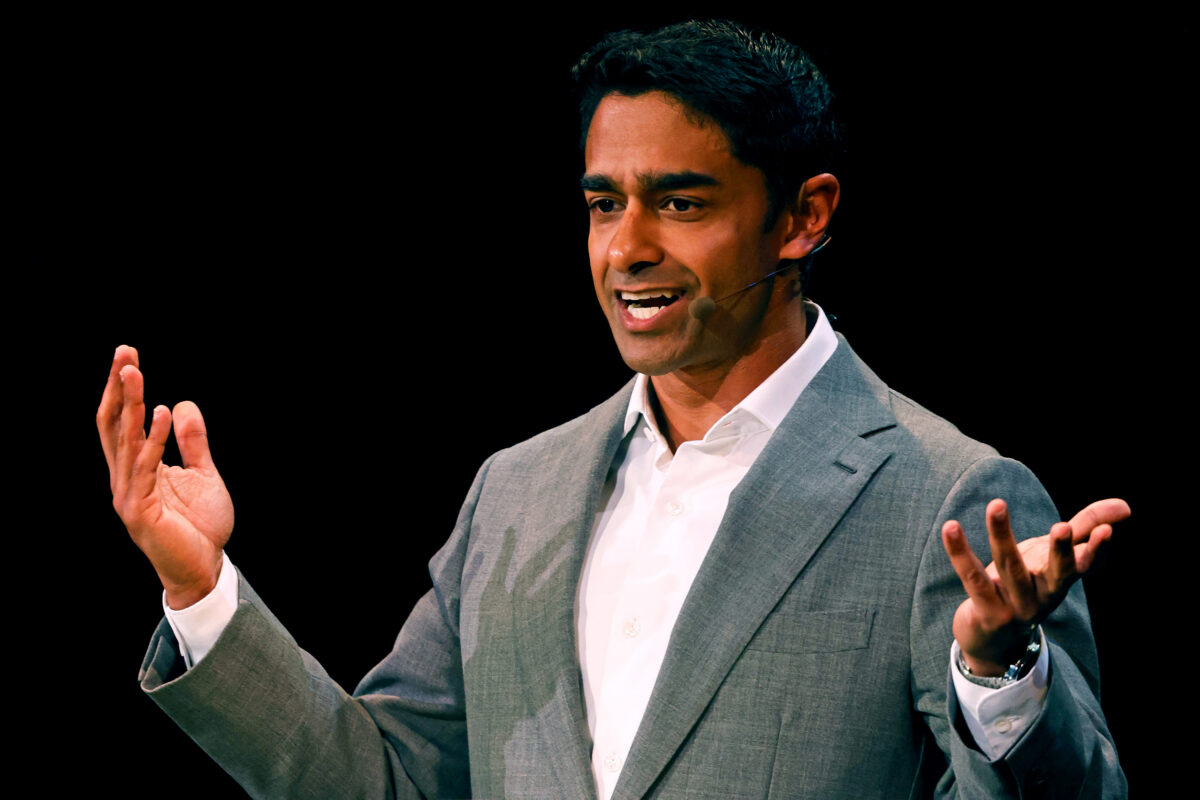
Wiener called AB 715, which establishes a statewide antisemitism prevention coordinator and seeks to curb teacher activism in the classroom after the proliferation of anti-Israel material across California, “a big step for the Jewish community.”
Raising concerns among Jewish community groups, Chakrabarti enthusiastically accepted an endorsement from the Arab Resource and Organizing Center Action, the political arm of the city’s most prominent anti-Zionist activist group, which helps organize rowdy anti-Israel protests in the Bay Area.
“In Congress, I look forward to working with AROC Action as we fight to end our country’s complicity in genocide and apartheid and pursue a just future for all,” Chakrabarti’s campaign wrote on Instagram last month.
Mail-in voting has already begun for the open primary, which takes place on June 2.
Among Wiener’s campaign supporters are wealthy tech and venture capital figures including Garry Tan, CEO of the prestigious VC firm Y Combinator, Yelp co-founder Jeremy Stoppelman and tech investor Chris Larsen.
Political insiders in the city say that Wiener will almost certainly be among the top two vote getters and advance to the general. Chan is popular with a number of established progressive institutions. Chakrabarti’s success will depend in part on whether he is able to get out voters who have not consistently participated in midterm elections.
Wiener “has a very strong base of frequent voters, in the LGBTQ community, in the YIMBY community, and with the majority of moderate — by San Francisco standards — voters in the city,” said Sam Lauter, a political strategist with BMWL public affairs and a Democratic activist who sits on the board of the Democratic Majority for Israel.
“Connie Chan has a passionate base within the politically engaged progressive community,” he added. “The unions, for example.” He added that he expects Chan to have considerable support from the Chinese American community.
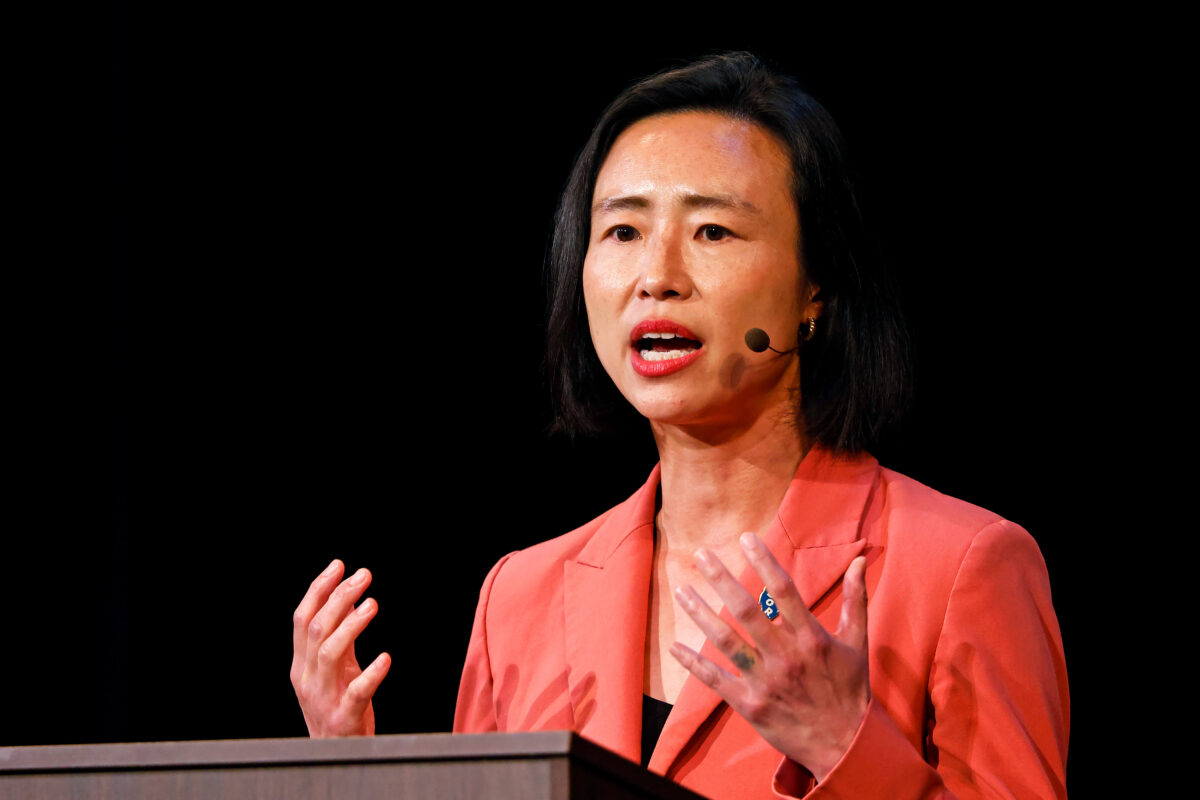
Chakrabarti’s support “seems to be coming from people who haven’t, to date, frequently turned out to vote. Progressives who aren’t in tune with the established progressive community,” he said.
“Having said that, he certainly has increased his name recognition significantly with his personal spending,” Lauter added. “I think he has a very good shot of being in the final two.”
Among Chakrabarti’s top aides is the consultant and activist Nadia Rahman, an outspoken anti-Zionist who serves as the campaign’s political director. Rahman, who publishes a stream of harsh critiques of Israel, Zionism and Zionists on her social media feeds, attributed the Democrats’ loss in the 2024 presidential election to what she described as the party’s refusal to “break from genocide, militarism and imperialism.” She recently reposted an X post stating that “Zionism is racism,” and in another post criticized how “entrenched Zionist ideology is in many California state legislators.”
Wiener is endorsed by the state’s Democratic Party and has been a fixture in San Francisco city politics since his election to the city Board of Supervisors in 2010. Still, he has not won the endorsement of Pelosi, who appeared at a Chan fundraiser but has declined to endorse anyone.
On Jewish support after Wiener’s genocide statement, Gregory said donors fell into three camps. Some continued to back Wiener without hesitation. Others “needed to take a beat and process what happened.” The third group “hasn’t come around,” but Gregory added, “I’m becoming more and more confident they are going to come home” to Wiener.
Gregory added of Chakrabarti, considering the tendency for left-wing candidates to turn out low-propensity voters, “Our community would be foolish to underestimate him.”
Since the Oct. 7 attacks, Rep. Al Green, running against Rep. Christian Menefee, has taken a hostile turn against Israel — and Jewish voters in his district have noticed
Drew Angerer/Getty Images
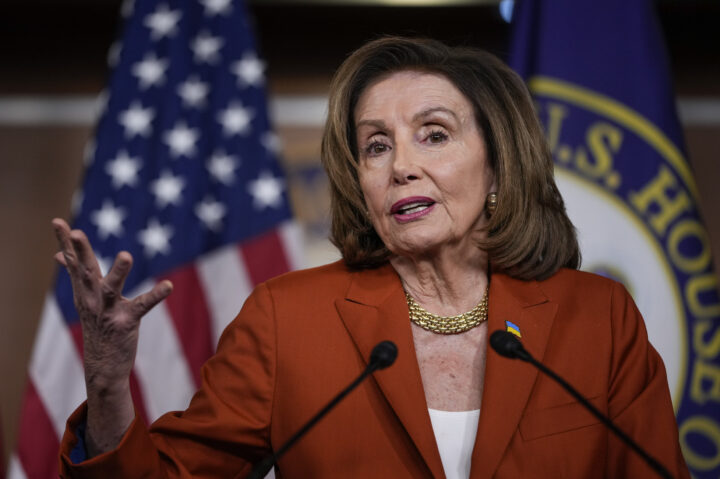
Then-Speaker of the House Nancy Pelosi (D-CA) speaks during her weekly news conference on Capitol Hill March 9, 2022 in Washington, D.C.
Rep. Al Green (D-TX), a vocal critic of Israel competing in a closely contested runoff against a fellow House Democrat later this month, announced in social media posts on Monday that he had received a coveted endorsement from Rep. Nancy Pelosi (D-CA), the powerful former House speaker.
Jewish community leaders in the Houston area were surprised to see Pelosi’s endorsement, especially as it appeared to break with her precedent of declining to engage in member-on-member races.
It also fueled ongoing frustrations with Green’s alleged lack of outreach to Houston’s sizable Jewish community — a potentially critical constituency in what is expected to be a close election.
The endorsement wasn’t straightforward — by Tuesday afternoon, Green’s original post had been removed, raising questions about his claim. Neither Pelosi nor her team had confirmed the purported endorsement before it was suddenly deleted without explanation.
On Wednesday, however, the endorsement had been reposted across Green’s social media accounts, albeit with slightly altered imagery.
“Speaker Pelosi is a leader I have stood beside through the most consequential fights of our time,” Green said on Wednesday. “Her endorsement of our campaign is a profound honor. We carry this moment forward, together, for the people of New CD 18 and the country we love.”
The message was accompanied by a graphic that featured an image of Pelosi differing from the photo used in the initial post. “The honorable Nancy Pelosi endorses,” it said. “Proven fighter. Real results. Vote Al Green in the runoff election.”
Ian Krager, a spokesperson for Pelosi, confirmed to Jewish Insider on Wednesday that Green’s new post was official, saying that her endorsement was “based in loyalty” to a longstanding colleague. Pelosi, who is set to retire at the end of her term, has traditionally avoided taking sides in House races between sitting members of her own party.
Krager declined to comment on why the original posts had been deleted. Green’s campaign also would not comment on the initial posts, only directing JI to his social media platforms “where you can find the endorsement from Speaker Emerita Nancy Pelosi.”
The confusion underscored some of the intraparty sensitivities surrounding the May 26 runoff election between two incumbents — Green, 78, and freshman Rep. Christian Menefee (D-TX), 38 — now vying for a Houston-area House seat in a bitter fight caused by the state’s recent Republican redistricting.
While some House colleagues are supporting Green, according to his campaign site, Pelosi’s backing is a major pickup for the outspoken, 11-term lawmaker seeking reelection in Texas’ newly consolidated 18th Congressional District, redrawn to favor Democrats.
It also marks something of a change in their relationship — Green had publicly clashed with Pelosi during her time as speaker over his efforts in 2019 to impeach President Donald Trump, which she had opposed.
In the March primary election, neither candidate claimed more than 50% of the vote required to win the nomination outright and avoid a runoff. Green secured 44%, two points short of Menefee, a former Harris County attorney who took office in February after winning a special election runoff to fill the seat held by Rep. Sylvester Turner (D-TX) until his death last year.
Art Pronin, a Jewish Democratic leader who lives in the district, echoed others who have said that Green has all but disengaged from the Jewish community in recent years — contributing to a strained relationship with the veteran congressman.
Since the Hamas attacks of Oct. 7, 2023, Green has also taken a noticeably hostile turn against Israel in his votes and public statements, local Jewish leaders say. Weeks after the attacks, for instance, Green was among just 10 House lawmakers who opposed a bill voicing support for Israel while condemning Hamas. He has otherwise supported House legislation calling the war in Gaza a genocide and consistently voted to cut military aid to Israel, among other moves seen as antagonistic.
“Regardless of the rhetoric, showing up” to Jewish community functions “is really important,” especially in a tight race, Pronin told JI on Tuesday. “We don’t see him breaking bread.” Green’s long absence “could cost him the race,” Pronin suggested. “It’s going to be close, and I think that we’re in a situation where a lot of the community is feeling alienated from Green,” he said.
With a few weeks until the runoff, Pronin said he is leaning toward voting for Menefee because the new congressman has been a more active presence in the Jewish community, showing up at several events like a Passover Seder sponsored by the Jewish Federation of Greater Houston last month. Meanwhile, Menefee has expressed a more “balanced view” with regard to Israel and Gaza, Pronin told JI, even as he has made only a limited number of public statements clarifying his own views on Middle East policy while in office.
During a tense debate on Monday, Menefee said he believed that Israel had committed “atrocities” and “war crimes” in Gaza, while acknowledging that Oct. 7 was “absolutely horrific.” He understood, he told the audience, “why a nation would want to wage war against a terrorist organization.”
Green, for his part, reiterated his charge that Israel had committed a genocide and accused Menefee of avoiding the term because, he alleged, his opponent is beholden to the pro-Israel advocacy group AIPAC. “He didn’t say genocide,” Green noted. “AIPAC won’t allow that.”
AIPAC, however, has not issued an endorsement in the race.
One local activist told JI Wiener faced pressure from his own campaign staff to change his position
Russell Yip/San Francisco Chronicle via Getty Images
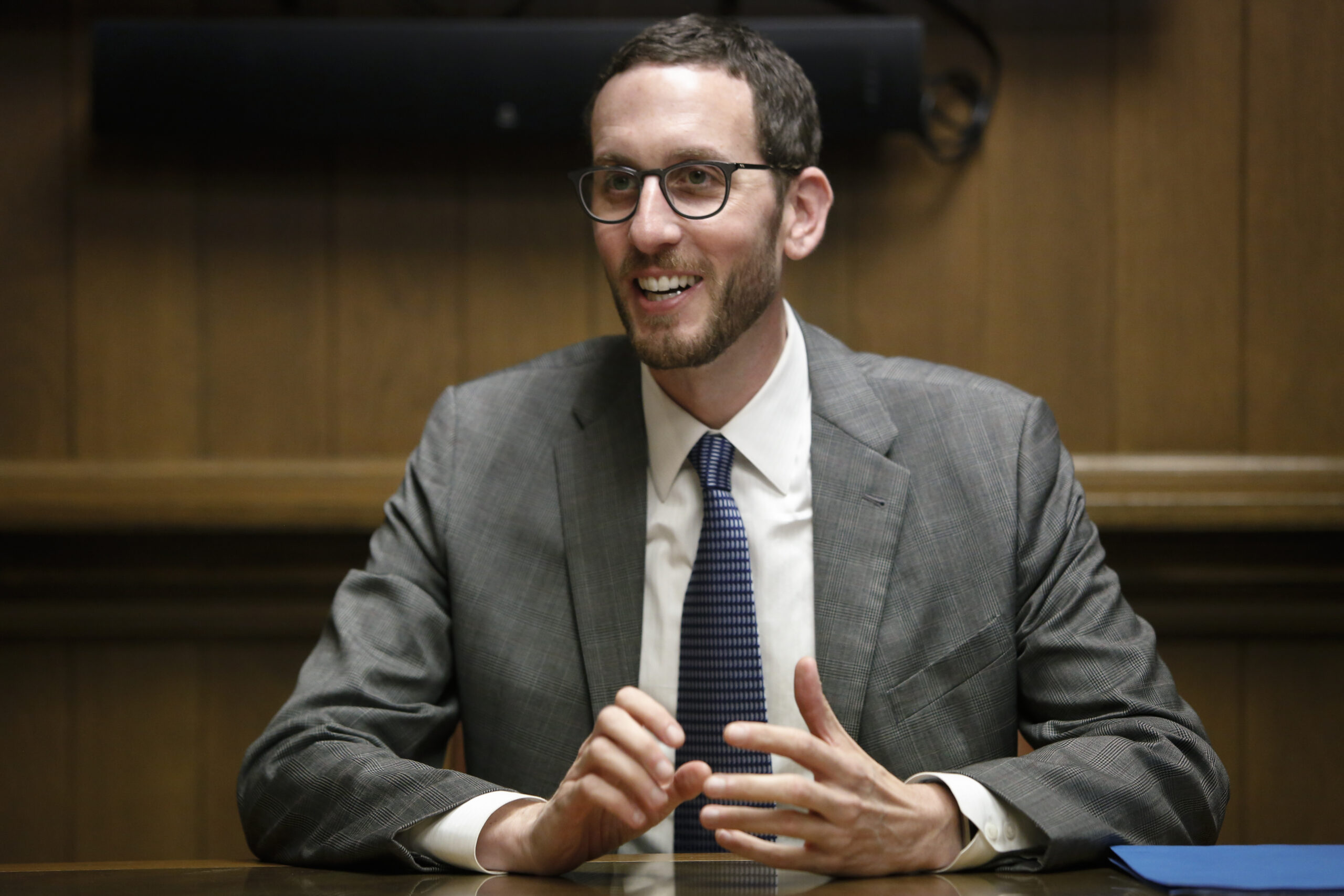
California State Senator Scott Wiener addresses the SF Chronicle Editorial Board on Thursday, Jan. 18, 2018 in San Francisco, Calif.
California state Sen. Scott Wiener, a Democrat running in a crowded primary to replace retiring Rep. Nancy Pelosi (D-CA), has spent the last week navigating the political fallout of a Gaza-related exchange at a candidate forum that lasted no more than 30 seconds but has since gone viral in progressive Bay Area political circles.
All three candidates who appeared at the forum last week — Wiener, San Francisco Board of Supervisors member Connie Chan, and Saikat Chakrabarti, former chief of staff to Rep. Alexandria Ocasio-Cortez (D-NY) — were asked if they believed Israel is committing genocide in Gaza, by lifting a “yes” or “no” placard. The other two said yes; Wiener did not answer at all.
In the days that followed, Wiener was slammed by far-left activists. He posted, then deleted, a message on X saying the Israeli-Palestinian conflict “demands more discussion and certainly more time.” Finally, four days later, he released a video on Sunday where he somberly explained that he has changed his position and now does believe Israel’s actions amount to genocide.
“I’ve stopped short of calling it genocide, but I can’t anymore,” the post said.
“For many Jews, associating the word genocide with the Jewish state of Israel is deeply painful and frankly traumatic,” Wiener said in the video. “But despite that pain and that trauma, we all have eyes and we see the absolute devastation and catastrophic death toll in Gaza inflicted by the Israeli government.”
It was a shocking about-face for one of the most prominent Jewish lawmakers in the state, a progressive who has sharply criticized Israel’s actions in Gaza but who has reiterated his support for the U.S.-Israel relationship as the co-chair of the California Legislative Jewish Caucus. He took a delegation of lawmakers to visit Israel in 2024.
Hours before he posted the video, The Atlantic published a lengthy interview with Wiener where he declined to use the term “genocide” to describe Israel’s actions — and where he said such rhetorical purity tests sort Jews into “good” and “bad.”
“If you’re not willing to use the exact language that we want you to use, then you’re a bad Jew,” Wiener said in the Atlantic interview, describing the tactics of those seeking ideological purity.
The geopolitical reality in Gaza and Israel did not change in the four days between the candidate forum and Wiener’s video. What changed, according to two political activists in the Bay Area, was politics.
Wiener took a great deal of flack from the anti-Zionist left over his refusal to distance himself from the Jewish state, even though he has called Israel’s actions in Gaza “indefensible” and has been a staunch critic of Israeli Prime Minister Benjamin Netanyahu. But as Wiener runs for Congress, the political stakes have only increased.
“Scott was faced with this reality that he was actually, literally losing supporters over this position,” one Jewish Democratic activist in San Francisco told Jewish Insider. The people turning away from his campaign were not the hard-left activists who have been agitating against Wiener since soon after the Oct. 7, 2023, terror attacks that sparked the war in Gaza. Instead, they were progressive activists who supported Wiener for his stances on the LGBTQ community and housing, but who use the word “genocide” as a litmus test, the activist said.
“Folks have been talking to me, saying this was a gut punch, to see Scott do this,” said the activist. “And I said, ‘Well, for me, it’s more of a gut punch that it’s actually politically necessary for him to do this.’”
Wiener was also facing pressure from his own campaign staff, according to the activist.
After Wiener posted the video on Sunday, his communications director, Erik Mebust, re-posted it to his own personal Instagram account.
“Israel has committed genocide in Gaza and must be stopped,” Mebust wrote in a post on his private Instagram story, a screenshot of which was obtained by JI. “[Sen.] Bernie Sanders (I-VT) and [Rep.] Becca Balint (D-VT) are the only two Jewish members of Congress with the courage to say that. Scott Wiener joins them today.” Mebust did not respond to a request for comment.
Several California Jewish organizations, including the Bay Area JCRC and JPAC, a lobbying org that represents Jewish communities across the state, released a joint statement slamming Wiener’s rhetorical shift.
“Senator Wiener’s newly stated position is both incorrect and lacks moral clarity,” the organizations said. “The diminishment and weaponization of the term ‘genocide’ in this context has been deeply painful for our community, given our own historical experiences with the Holocaust.”
JCRC CEO Tyler Gregory told JI that Wiener’s new stance is “deeply disappointing and disheartening.”
“I don’t believe that he believes this. I believe he felt he had to do this,” Gregory said. “I don’t believe in burning bridges. We’re in the community relations business and relationships matter, and he still has a great shot of winning this seat, and we’re going to need to figure out how to work with him and repair [the relationship] if he wins. But this is also deeply damaging to the Jewish community, and words matter, and it’s not a genocide.”
The former House speaker, who announced she is not seeking reelection, received plaudits for her support of the Jewish state, even as her positions changed during the Gaza war
ROBERTO SCHMIDT/AFP via Getty Images
Rep. Nancy Pelosi (D-CA) attends a press conference with House Minority Leader Hakeem Jeffries (D-NY) on the steps of the U.S. Capitol in Washington, D.C., on October 15, 2025.
Rep. Nancy Pelosi (D-CA) announced on Thursday that she would not seek reelection, ending a nearly 40-year career in Congress and earning plaudits across a wide spectrum of Jewish voices, from J Street to AIPAC and many in the San Francisco Jewish community who have worked with her since the 1980s.
Pelosi, who is 85, rose to become the first and only female speaker of the House, a position she held from 2007-2011 and again from 2019-2023, when she presided over a divided caucus and a resurgent far-left flank of the party. Pelosi was known for keeping tight control over congressional Democrats and squashing intra-party squabbles.
“In my view, she was able to keep a pro-Israel consensus in the caucus, but it certainly came at a time when there was more angst around the issue,” said Tyler Gregory, CEO of the Bay Area Jewish Community Relations Council. “While we haven’t always seen eye-to-eye with her on specific policies, she’s always been pro-Israel, and I don’t think anyone can question that.”
Pelosi spoke several times at AIPAC’s annual policy conference. One year, she invoked her father, a former Baltimore mayor and Democratic member of Congress from Maryland, who she said “had a love for the idea of a Jewish state in what was then called ‘Palestine.’”
“Her love and close connection to the Jewish community started in Baltimore, with her father, the mayor,” said Amy Friedkin, a former AIPAC president and a close friend of Pelosi’s. “She used to say that the founding of the State of Israel was the most profound achievement of the 20th century.”
Marshall Wittmann, an AIPAC spokesperson, said that during her tenure as speaker, Pelosi “helped ensure that Israel had the resources to defend itself, which advances American interests and values.”
She sometimes diverged from pro-Israel advocates, particularly in 2015, when she championed the Iran nuclear deal as the leader of the Democratic caucus in the House.
“Nancy Pelosi was an early and steadfast supporter of J Street and a champion of diplomacy,” J Street President Jeremy Ben-Ami said in a statement. “She played a pivotal role in securing congressional support for the Iran nuclear deal and consistently advanced pro-Israel, pro-peace policies aimed at strengthening Israel’s security and promoting safety, dignity and self-determination for the Palestinian people.”
Like many Democrats, Pelosi began to take a more critical stance towards Israel during its two-year war in Gaza following the Oct. 7, 2023, Hamas terror attacks.
In April 2024, she signed onto a congressional letter urging the Biden administration to withhold some weapons transfers to Israel after the killing of World Central Kitchen aid workers in Gaza, a public condemnation of Israel that went further than previous actions by the former speaker.
“There are actions and statements that she made that I would disagree with, but when it came down to what was most important, which is Israel’s ability to be a Jewish, democratic state and live in peace and security — never a moment of wavering. Not even the thought process of wavering,” said Sam Lauter, a former longtime AIPAC activist and co-founder of Democratic Majority for Israel. Growing up in San Francisco, Pelosi’s family lived across the street from Lauter’s childhood home.
“Nancy Pelosi wasn’t just a friend of our community. She was part of our community,” said Lauter. “No one had to teach her about Zionism. She grew up believing in it.”
Rep. Rashida Tlaib’s resolution has been cosponsored by Reps. Alexandria Ocasio-Cortez, Ilhan Omar, Betty McCollum, Marie Newman, Cori Bush and Jamaal Bowman

Chip Somodevilla/Getty Images
Rep. Rashida Tlaib (D-MI) questions Treasury Secretary Janet Yellen as she testifies before the House Financial Services Committee in the Rayburn House Office Building on Capitol Hill on May 12, 2022, in Washington, D.C.
Rep. Rashida Tlaib (D-MI) and a handful of progressive Democrats introduced a resolution on Monday referring to Palestinian Arabs as the “indigenous inhabitants” of Israel and endorsing Palestinian right of return, one of the most sensitive issues in Israeli-Palestinian relations.
The resolution seeks to set as U.S. policy recognition of the “Nakba” — the term, translating to “catastrophe,” that Palestinians use to refer to the mass Palestinian exodus that accompanied the foundation of Israel — and accept as a settled issue Palestinian refugees’ right of return to inside Israel’s borders. It also refers to Palestinians as the “indigenous population” of the region, but does not acknowledge Jewish history in the region.
The legislation accuses Israel of having “depopulated more than 400 Palestinian villages and cities” during its 1948 War of Independence and characterizes ongoing Israeli “expropriation of Palestinian land and… dispossession of the Palestinian people,” including Israeli settlements, as part of an ongoing Nakba. In a statement announcing the legislation, Tlaib accused Israel of “ongoing ethnic cleansing.”
Tlaib’s resolution has been cosponsored by Reps. Alexandria Ocasio-Cortez (D-NY), Ilhan Omar (D-MN), Betty McCollum (D-MN), Marie Newman (D-IL), Cori Bush (D-MO) and Jamaal Bowman (D-NY).
Neither Tlaib nor any of the cosponsors responded to a question from Jewish Insider about whether they viewed Jews as also being “indigenous” to the region.
Newman is currently facing a primary challenger, Rep. Sean Casten (D-IL), who is backed by various pro-Israel groups, including J Street, which had endorsed Newman in 2020. Bowman has faced criticism from the Democratic Socialists of America over his positions on Israel, including voting for supplemental Iron Dome funding and traveling to the Jewish state last year. He has since removed himself as a cosponsor of legislation supporting the Abraham Accords.
Rep. Brad Sherman (D-CA) blasted Tlaib’s resolution as “predicated on a demonstrably false historical narrative… predictably failing to mention the hundreds of attacks on Jewish communities in the British mandate of Palestine by Palestinian militias.”
Sherman noted that the resolution “omits” that Israel was attacked by eight Arab states in 1948, that the 1948 war began with attacks by Arab forces seeking “a war of annihilation” against Jewish militants and civilians, that “not a single Jew was left alive in the portion of the British mandate controlled by Arab armies, that no Jews lived in the Jewish quarter of Jerusalem for two decades and that 800,000 Jews were expelled from neighboring Arab countries.”
“Thankfully, the vast majority of my colleagues in Congress and in the House Foreign Affairs Committee understand that the historical narrative in Congresswoman Tlaib’s resolution is an outrageous falsehood and thus this bill isn’t likely to be passed or even considered,” Sherman added.
Rep. Josh Gottheimer (D-NJ) agreed that the resolution has no “hope of moving forward,” claiming the resolution seeks to “rewrite history and question Israel’s right to exist.”
“It’s unfortunate that this histrionic and invidious resolution was introduced now, particularly, as we see continued progress in efforts to normalize relations between Israel and its neighbors in the region,” Gottheimer added. “Divisive efforts like this only set back our fight against terror and the advancement of democracy in the region.”
Aaron David Miller, a senior fellow at the Carnegie Endowment for International Peace who advised multiple secretaries of state on Arab-Israeli negotiations, said that the legislation asks Congress to “wade into the intricacies and volatility of some of the most combustible issues in the Israeli-Palestinian conflict and essentially recognize a narrative.”
“This legislation is packed with landmines and traps,” Miller continued. “The whole issue of right of return is an issue that for years in negotiations we realized was the most combustible, most complicated, and the one which we had the least chance of resolving…. That’s the third rail of the Israeli-Palestinian negotiations.”
Miller emphasized that the legislation has no prospect of seeing widespread support in “any Congress that I can imagine.”
He described the legislation as “designed basically to support what the framers regard as an unrecognized, underreported and unacknowledged narrative in the American political scene of the Palestinians.” He added that the “Palestinian narrative has never been adequately explored or acknowledged” in U.S. politics and argued that “there was a way perhaps to go about this which would have recognized both Israeli independence and the Nakba being intertwined.”
Some Republicans seized on the legislation.
Rep. Lee Zeldin (R-NY) called it “the latest in a long line of antisemitic, anti-Israel statements, policies and actions by the most radical voiced in the Democratic Party.” Rep. Jim Banks (R-IN) called it “disgusting anti-Semitism.” Sen. Rick Scott (R-FL) said “the continued anti-Semitism from radical socialists in the House is horrific.” The three Republicans also sought to tie House Speaker Nancy Pelosi (D-CA) to the initiative, demanding that she condemn the move.
Sen. Kamala Harris tells Trump that such a move calls into question Israel's 'commitment to shared values of democracy and self-determination'

Perry Bindelglass
A group of Democratic House members are collecting signatures for a letter cautioning Israeli leaders against unilaterally annexing portions of the West Bank. Israeli Prime Minister Benjamin Netanyahu has said that the government could begin annexing territory as early as July 1, though efforts to finalize a plan have stalled in recent days.
The letter, authored by Reps. Jan Schakowsky (D-IL), Brad Schneider (D-IL), Ted Deutch (D-FL) and David Price (D-NC), and shared with Jewish Insider, warns Netanyahu and Defense Minister Benny Gantz that annexation is likely to jeopardize Israel’s warming ties with Gulf states, put Jordan’s security at risk and complicate Israel’s relationships in European countries and around the world. “We do not see how any of these acute risks serve the long-term interest of a strong, secure Israel,” the Democratic lawmakers write.
The letter was distributed to members of the Demcoratic caucus on Monday. JTA first reported the content of the letter.
Earlier this month, House Speaker Nancy Pelosi (D-CA) warned that unilateral Israeli annexation “puts the future [of peace] at risk and undermines our national security interest and decades of bipartisan policy.”
A similar letter from Democratic Senators garnered 19 signatures. The text of the letter, which was updated several times before being sent, cautioned the new Israeli government that “unilateral annexation puts both Israel’s security and democracy at risk” and “would have a clear impact on Israel’s future and our vital bilateral and bipartisan relationship.” Sens. Dianne Feinstein (D-CA), Bob Casey (D-PA) and Tina Smith (D-MN) sent individual communiques to Netanyahu and Gantz, similarly opposing the move. Sens. Michael Bennet (D-CO), Maggie Hassan (D-NH) and Amy Klobuchar (D-MN) addressed the matter in individual letters to Pompeo.
Sen. Kamala Harris (D-CA) sent a letter echoing those sentiments to President Donald Trump on Tuesday. “In recent months, your Administration appears to have given a green light to unilateral annexation, despite the risks to peace and Israel’s security and democracy,” the California senator wrote. Harris suggested that annexation “not only risks Israel’s security, but would also call into question this Israeli Government’s commitment to shared values of democracy and self-determination.”
In the House letter, the lawmakers implore the Israeli government, “as committed partners in supporting and protecting the special U.S.-Israel relationship,” to “reconsider” annexation plans before the target date. “We have consistently endorsed the pursuit of a negotiated peace agreement between Israel and the Palestinians resulting in two states for two peoples and a brighter future for the Israeli people and the Palestinian people. In that vein, we write today to express our deep concern that the push for unilateral annexation of territory in the West Bank after July 1st will make these goals harder to achieve,” the letter reads.
Rep. Yvette Clarke (D-NY) told JI in a recent interview that she would be open to signing such a letter. “While I do not generally believe that strict red lines aid the overriding effort towards a two-state solution, I do believe that there are some issues that have become so politically polarized that they risk politicizing the overall U.S.-Israeli relationship to the detriment of both nations,” Clarke explained.
Below is the full letter:
To:
Prime Minister Netanyahu
Alternate Prime Minister and Defense Minister Gantz
Foreign Minister Ashkenazi
We write as American lawmakers who are long-time supporters, based on our shared democratic values and strategic interests, of Israel and the U.S.-Israel relationship. We firmly believe in, and advocate for, a strong and secure Jewish and democratic State of Israel, a state able to build upon current peace treaties and expand cooperation with regional players and the international community. We have consistently endorsed the pursuit of a negotiated peace agreement between Israel and the Palestinians resulting in two states for two peoples and a brighter future for the Israeli people and the Palestinian people. In that vein, we write today to express our deep concern that the push for unilateral annexation of territory in the West Bank after July 1st will make these goals harder to achieve.
Longstanding, bipartisan U.S. foreign policy supports direct negotiations to achieve a viable two-state solution that addresses the aspirations of both Israelis and Palestinians, and their desire for long-term security and a just, sustainable peace. This position was twice reconfirmed by the U.S. House of Representatives last year. Our fear is that unilateral actions, taken by either side, will push the parties further from negotiations and the possibility of a final, negotiated agreement.
We remain steadfast in our belief that pursuing two states for two peoples is essential to ensuring a secure, Jewish, democratic Israel able to live side-by-side, in peace and mutual recognition, with an independent, viable, de-militarized Palestinian state.
Unilateral annexation would likely jeopardize Israel’s significant progress on normalization with Arab states at a time when closer cooperation can contribute to countering shared threats. Unilateral annexation risks insecurity in Jordan, with serious ancillary risks to Israel. Finally, unilateral annexation could create serious problems for Israel with its European friends and other partners around the world. We do not see how any of these acute risks serve the long-term interest of a strong, secure Israel.
As committed partners in supporting and protecting the special U.S.-Israel relationship, we express our deep concern with the stated intention to move ahead with any unilateral annexation of West Bank territory, and we urge your government to reconsider plans to do so.
28 Democratic senators and 8 Senate candidates in battleground states have publicly expressed opposition to Israeli annexation of parts of the West Bank

U.S. Senate Studio / Gage Skidmore
Minnesota Sens. Amy Klobuchar (D-MN) and Tina Smith (D-MN) have joined more than two dozen Senate Democrats publicly warning Israeli leaders of the implications of efforts to unilaterally annex portions of the West Bank. Israeli Prime Minister Benjamin Netanyahu has said that the government could start annexing territory as early as July 1.
In individual letters sent last month and made public over the weekend, both senators — Klobuchar addressed Secretary of State Mike Pompeo and Smith wrote to Netanyahu and Israeli Defense Minister Benny Gantz — posited that annexation would undermine efforts to attain a two-state solution.
Twenty-eight senators have so far spoken out against the annexation proposal.
Last month, 19 Democratic senators sent a letter to Netanyahu and Gantz urging the Israeli leaders not to move forward with the effort. That letter, which was updated several times before being sent, cautioned the new Israeli government that “unilateral annexation puts both Israel’s security and democracy at risk” and “would have a clear impact on Israel’s future and our vital bilateral and bipartisan relationship.” Sens. Dianne Feinstein (D-CA) and Bob Casey (D-PA) sent individual communiques to Netanyahu and Gantz, similarly opposing the move, and Sens. Michael Bennet (D-CO) and Maggie Hassan (D-NH) addressed the matter in individual letters to Pompeo.
In addition, Sens. Mark Warner (D-VA) and Catherine Cortez Masto (D-NV) issued statements against annexation, and Sen. Chris Coons (D-DE) indicated to Jewish Currents that instead of signing or authoring a letter on annexation, he would “communicate directly with [Israeli] Ambassador [Ron] Dermer and Israeli officials to express his concerns.”
On Monday, eight Senate candidates in battleground states are expected to join the list expressing their strong opposition to such a move. In statements provided to J Street and shared with Jewish Insider, the candidates — Cal Cunningham (North Carolina), Sara Gideon (Maine), Teresa Greenfield (Iowa), Al Gross (Alaska), Jaime Harrison (South Carolina), MJ Hegar (Texas), John Hickenlooper (Colorado), Amy McGrath (Kentucky) and Jon Ossoff (Georgia) — emphasized that annexation would put the future of a two-state solution at risk.
Read their statements in full here.
Earlier this month, House Speaker Nancy Pelosi (D-CA) warned that unilateral annexation “puts the future [of peace] at risk and undermines our national security interest and decades of bipartisan policy.” Presumptive Democratic presidential nominee Joe Biden also came out against annexation, saying it “will choke off any hope for peace.”
“From the presidential nominee to the speaker of the House and from the Senate to the senatorial campaign trail, Democratic leaders have now made absolutely clear that they do not and cannot support unilateral annexation in the West Bank,” J Street President Jeremy Ben-Ami told JI. “For annexation to move forward in the face of this overwhelming opposition would be incredibly harmful to the future of Israelis and Palestinians and to the US-Israel relationship.”
Please log in if you already have a subscription, or subscribe to access the latest updates.
 Continue with Google
 Continue with Apple