















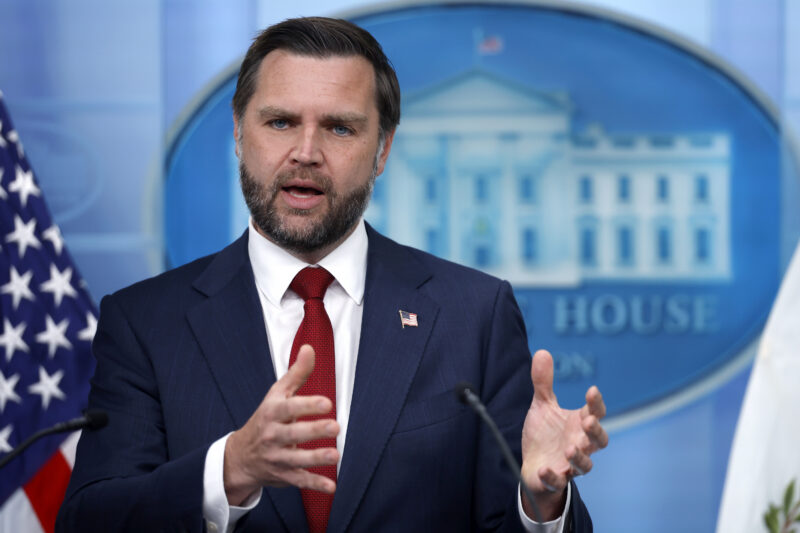

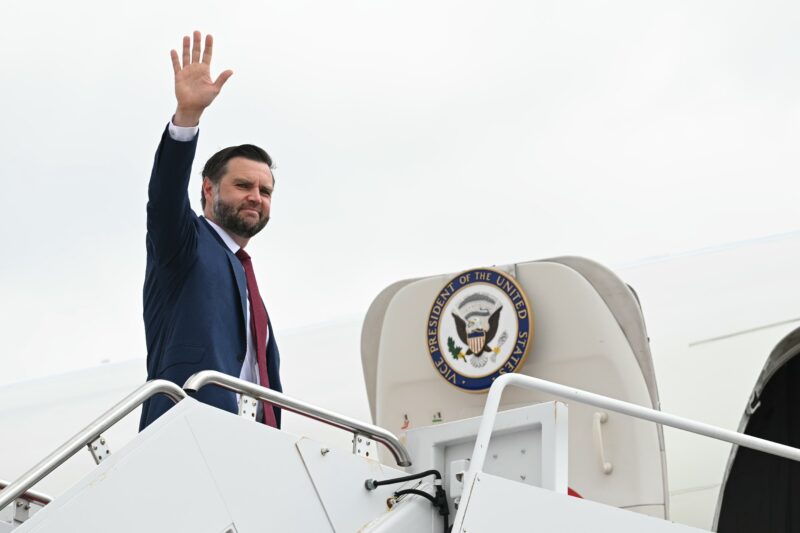
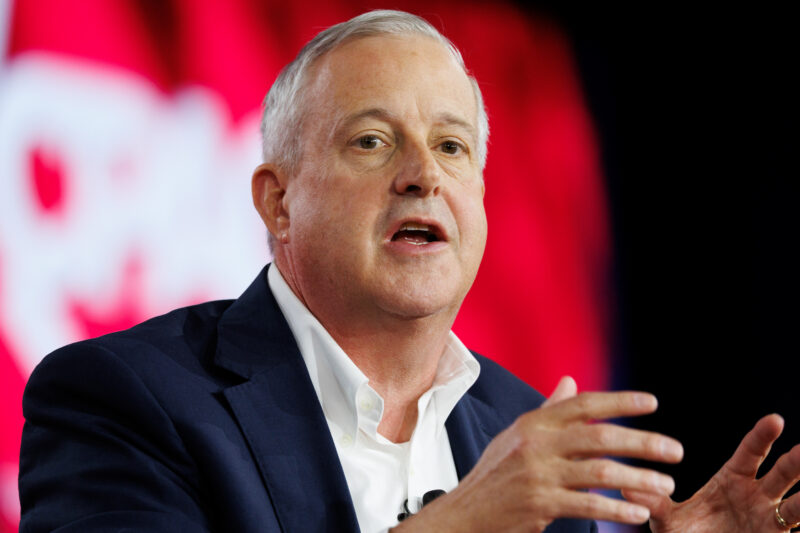
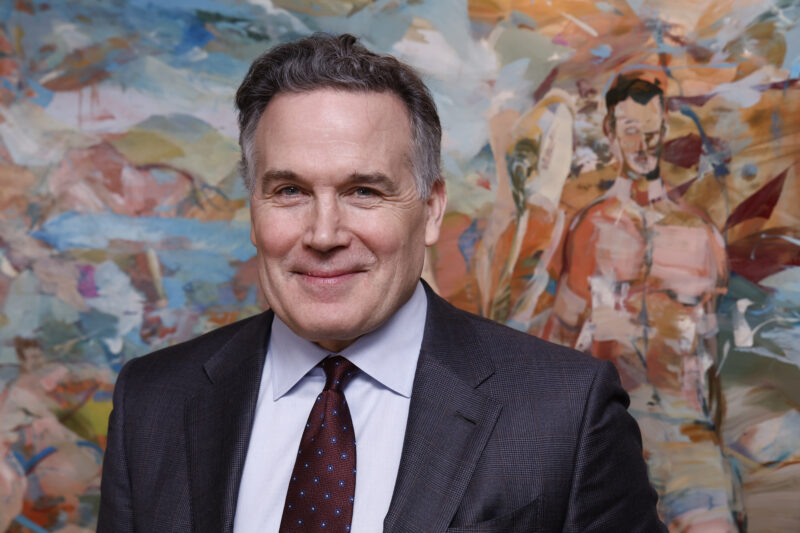
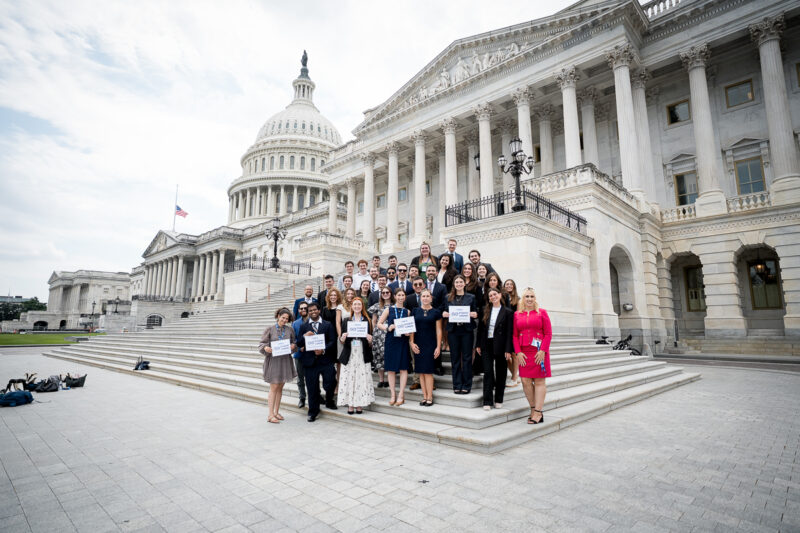

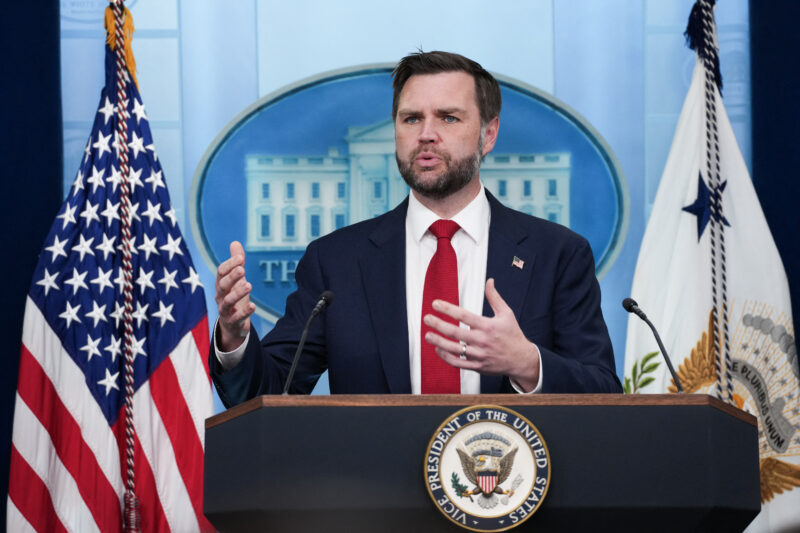


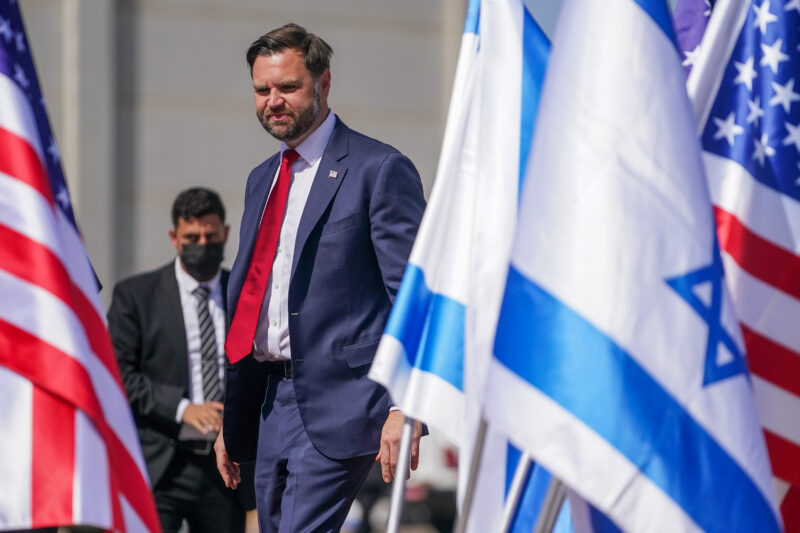











The vice president, answering a question about unease among some on the right over the relationship, argued Trump has been more willing than any president in 40 years to challenge Netanyahu
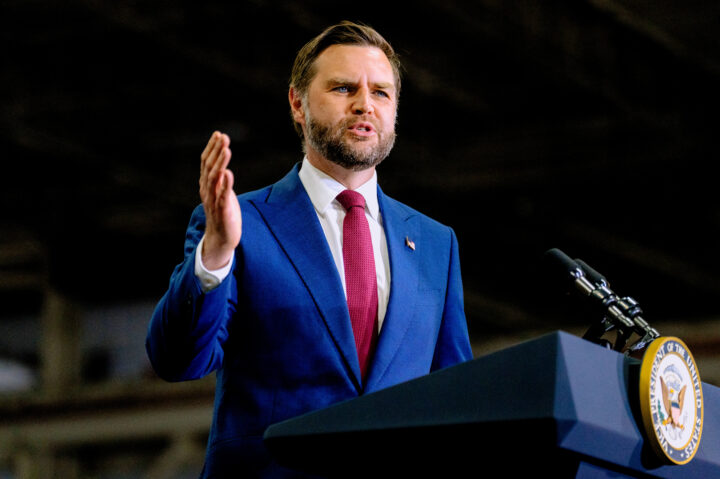
Nic Antaya/Getty Images
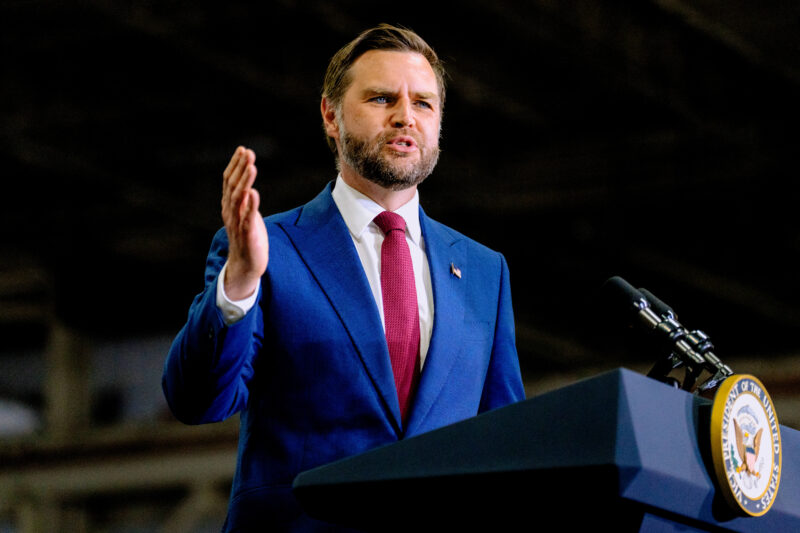
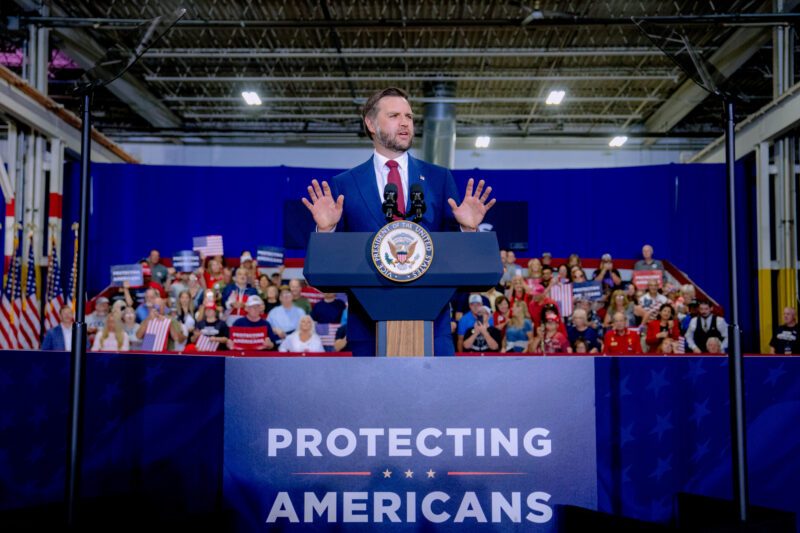
Vice President JD Vance speaks during a rally at Universal Contracting and Urban Tree Trimming on August 31, 2026 in Sterling Heights, Michigan.


 Add JewishInsider on Google
Vice President JD Vance said on Tuesday that the U.S. must prioritize its own needs and “cannot let our Middle Eastern foreign policy be subservient to the State of Israel,” likening the dynamic to that of NATO during a virtual appearance at the All-In Summit.
Vance made the comments in conversation with “All-In Podcast” co-host Jason Calacanis, saying there are “obviously a lot of important relationships, a lot of important partnerships in NATO, but that doesn’t mean that we’re going to completely make our European foreign policy subservient to NATO in the same way that we cannot let our Middle Eastern foreign policy be subservient to the state of Israel.”
“We’re going to work with people when we work with them,” Vance continued. “We’re going to disagree when we disagree, and we’re going to pursue America’s interests. That’s the only way to have a rational foreign policy.”
The vice president also addressed a question about concerns on the right over the closeness of the U.S.-Israel relationship.
“Obviously Israel has been an important partner when it comes to military technology, when it comes to intelligence sharing, but also sometimes the United States doesn’t always agree with Israel,” Vance said to Calacanis. “And I think that, more than frankly any president in the last 40 years, he has shown a willingness to actually part ways with [Israeli Prime Minister Benjamin] Bibi Netanyahu when he feels like the interests of the American people are different from the interests of the government of Israel.”
At the All-In Summit, Vice President JD Vance said that the U.S. must prioritize its own needs and “cannot let our Middle Eastern foreign policy be subservient to the State of Israel.”
— Jewish Insider (@jewishinsider) September 16, 2026
Read more: https://t.co/8PdN50WnI8 pic.twitter.com/uFpPkhTPDg
Vance added, “I find it a little ironic, Jason, that you have Democrats criticizing Donald Trump for his relationship with Bibi when Donald Trump is the one president of the last 40 years who’s been willing to say, ‘You know what? Yeah, Bibi’s a good partner, but also Bibi and I have a different opinion on this, or Bibi’s wrong about this, or maybe Bibi’s right about this from the perspective of Israel, but the American people need us to go in a different direction.’”
The vice president responded to a question about the dynamic between himself and Secretary of State Marco Rubio, saying that the “funniest media narrative is that somehow Marco and I are like, hyper competitive, and we sit around like thinking about, you know, how we’re going to run for president against each other in 2028.”
Vance noted that the two were scheduled to speak immediately after his virtual appearance at the conference. “He’s a great human being. He’s doing a great job too,” Vance said of Rubio.
In an interview with JI, Suozzi recounted the story of a six-day silent retreat in Louisiana after losing the New York gubernatorial primary, which he said hardened his resolve to stick by his values
Heather Diehl/Getty Images
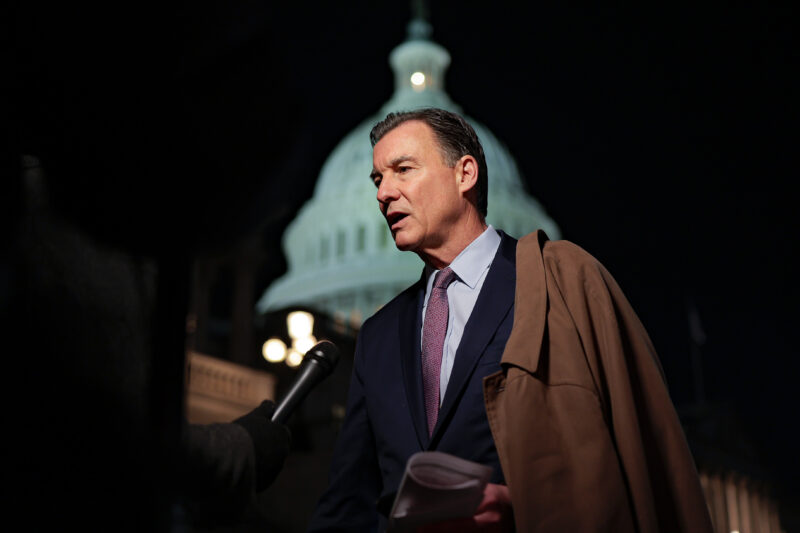
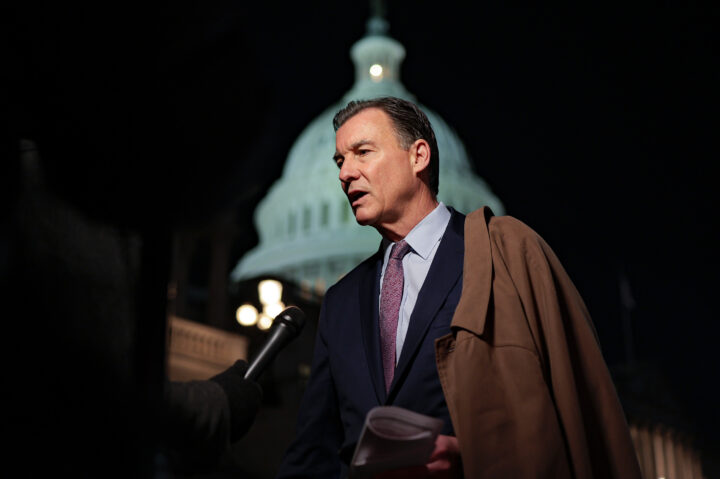
Rep. Tom Suozzi (D-NY) speaks with members of the media outside the U.S. Capitol on December 17, 2025 in Washington, DC.
At a time of rising anti-Israel and, in some cases, antisemitic sentiment in segments of the Democratic Party, Rep. Tom Suozzi (D-NY) said in an interview with Jewish Insider this week that he is not fazed by the pressure, to which some Democratic colleagues have caved.
Suozzi, a moderate pro-Israel Democrat from Long Island, has long been a vocal champion of the U.S.-Israel relationship and the Jewish community in the House, and represents a heavily Jewish district.
The New York congressman is also the lead Democrat in the House on a bill to establish 100-foot buffer zones outside of houses of worship. He had introduced legislation of his own on the subject earlier this year, but subsequently teamed with Rep. Brad Knott (R-NC), Sen. Ted Cruz (R-TX), Sen. Elissa Slotkin (D-MI) and outside advocates on a bipartisan consensus bill, the Right to Worship Act, which Suozzi had a significant role in negotiating.
A slew of outside groups supporting that bill, many of which also backed Suozzi’s original legislation, are set to rally outside the Capitol on Wednesday in support of the legislation.
Suozzi said he “decided years ago that I would be a supporter of Israel through thick and thin, based upon my travel there and different experiences I’ve had in my life.” He said he feels only more emboldened to stick to his guns on the issue in his political second act — Suozzi was a member of Congress from 2017 to 2023, before losing a bid for governor of New York.
In a 2024 special election, he won back his old seat after disgraced former Rep. George Santos (R-NY) was expelled from Congress.
After his gubernatorial loss, Suozzi spent time traveling around the country, culminating in a six-day silent Jesuit retreat in Louisiana, where Suozzi said he “surrendered to the fact that I don’t control things, and things happen the way they’re supposed to happen.”
“You would say things are either beshert or they’re not,” Suozzi said, using the Yiddish word for destined. “So I’ve decided that I’m just going to stick to my values and work as hard as I can, and whatever happens, happens. And so I’ve decided on this issue that I’m going to do the right [thing]. I’m a little bit more fearless than I was last time around. I’m going to do what I think is right and let the chips fall where they may.”
At this point, he said he’s “used to” the pressure and that he takes the “good with the bad.”
“There are some people there are some people that are really happy with my position, and there are others and there are other people that are very unhappy with my position, and that’s that’s the life I live — I guess we all do,” Suozzi said.
A co-chair of the House Problem Solvers Caucus, Suozzi argues that lawmakers need to communicate more and find areas where they can come together and work together.
“Everybody’s going off into their respective camps on a regular basis, and you know there’s not enough conversation taking place,” he said. “We’re facing a lot of very serious issues in our country right now, and it’s not good enough to just do a video onto your phone and say how bad the other side is. We have to do the difficult work of actually trying to find common ground.”
He points to the buffer zone bill as one example of such work.
As Knott told the story in a recent appearance on Fox News, Suozzi called Knott and approached him on the House floor when he heard that Knott was working on his own buffer zone bill. “He put down his bill, he joined this one, he contributed unbelievably productively to this bill’s formation and now he’s gone and helped secure Sen. Slotkin, Sen. Cruz, so it’s a hats off to Rep. Suozzi in this effort,” Knott said during the interview.
Suozzi has said in multiple interviews about the bill that the goal is to ensure that people feel safe going to religious services, and that showing up to practice one’s religion shouldn’t require facing down danger.
“The objective here was to successfully respect the constitutional protections for the right to free speech and the equally important right to worship, which are both in the First Amendment,” Suozzi told JI. “The big thing in my head was that a person shouldn’t have to show particular courage just to attend a religious service.”
He said he hopes that the Senate will take up the bill during the remaining weeks it is in session before the midterm elections, so that the House can take the bill up during the lame duck session.
“The tough lift, the heavy lift here, is to show that we’re trying to responsibly balance First Amendment freedom of speech and right to worship rights,” he said.
Asked about his conversations with colleagues on the bill, Suozzi said that the fact that such a wide range of groups, including ones representing a range of religions and religious communities, “makes people feel more comfortable that we’re taking into account those type of concerns” and that no community has expressed serious concerns.
“It’s just a matter of getting people’s attention in the midst of all the different noise that’s going on here in Washington, D.C. these days,” he said.
The coalition of support for the bill is broad, including a range of Jewish groups including the reform, conservative and Orthodox movements, various Christian and Catholic groups, Hindus, Sikhs, Seventh-Day Adventists, Mormons and Muslims — even including a Muslim group that has faced scrutiny for featuring extremist speakers at a recent conference and which was accused of ties to the Muslim Brotherhood at a hearing Cruz chaired.
Suozzi said he’s found Knott to be “very, very thoughtful, certainly very intelligent” and that he’s brought experience as a prosecutor to the issue. A co-chair of the bipartisan House Problem Solvers Caucus, Suozzi said that he thinks that members of Congress need to cross the aisle to talk to each other more on both this and other issues.
“Tom Suozzi has been an outstanding leader in fighting antisemitism, supporting Israel, and standing with American Jewry,” Nathan Diament, the executive director of the Orthodox Union Advocacy Center said in a statement, of Suozzi’s work. “His work with Congressman Knott to protect our right to worship is exactly the kind of bipartisan leadership we need. There is no greater friend to the Jewish community than Tom Suozzi.”
A clear divide is emerging in the prospective 2028 presidential field over the issues of the U.S.-Israel relationship and dealing with rising antisemitism
Israel Hadari
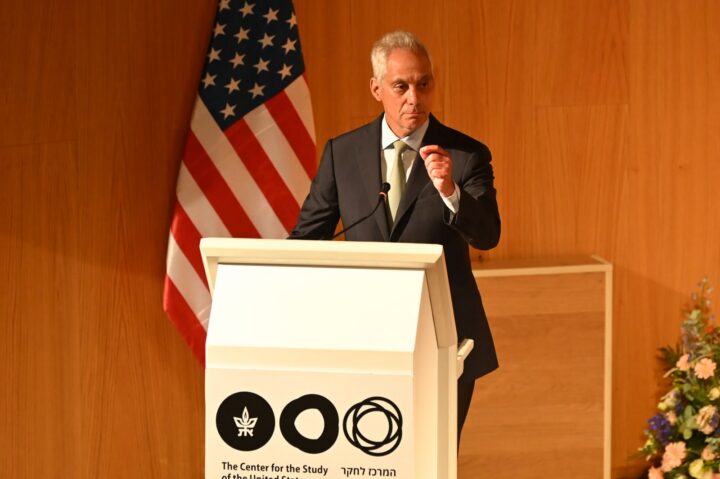
Rahm Emanuel speaks at Tel Aviv University on July 8, 2026.
A quarter century ago, when the late Sen. Joe Lieberman was tapped by Al Gore, the Democratic nominee for president, to be his running mate on the 2000 ticket, the question around many a Shabbat table was, “Is he too Jewish to be in the White House?”
There’s a different question being asked, largely in Democratic circles, of today’s Jewish presidential candidates: “Is he the ‘right’ kind of Jewish candidate to be president?” — a question that is almost entirely centered around a candidate’s position on Israel and how openly he identifies with his religious faith.
A long list of Jewish candidates are considering a presidential campaign or are being touted as credible contenders, ranging from moderates like Pennsylvania Gov. Josh Shapiro, Sen. Elissa Slotkin (D-MI) and former Chicago Mayor Rahm Emanuel to progressives like Illinois Gov. JB Pritzker and those who straddle the ideological divide, like Sen. Jon Ossoff (D-GA).
In both 2026 and 2028, the debate over Israel is on the ballot: Congressional primaries are pitting pro-Israel candidates against those who don’t acknowledge Israel’s right to exist as a
Jewish state, and already a clear divide is emerging in the prospective 2028 presidential field over the issues of the U.S.-Israel relationship and dealing with rising antisemitism.
Even in races where Israel policy is not front-and-center, invoking AIPAC has become something of a catch-all slur for progressives attacking the role of outside money in Democratic primaries. California Gov. Gavin Newsom, a likely 2028 hopeful, proudly proclaimed in February that he’d never taken AIPAC money — which of course he hasn’t, given that AIPAC and its affiliated super PAC historically focus on federal, not state, races.
Since soft-launching his presidential campaign last month (in Tel Aviv, no less), former Chicago Mayor Rahm Emanuel has made the Jewish state — and its relationship with the U.S. — one of his top issues in speeches and interviews. Even when his views are well within the mainstream, his signaling that he’s talking tough against Israel is a sign he recognizes his long-standing pro-Israel record is a vulnerability in a Democratic presidential primary.
A week after his Tel Aviv speech, Emanuel appeared on the Council on Foreign Relations’ “The Spillover” podcast in an episode titled “Rahm Emanuel Talks Israel, Midterm Elections, and the Democratic Party.” Two days later, The New Yorker’s “Radio Hour” podcast aired an interview with Emanuel in conversation with David Remnick titled, “Rahm Emanuel Says Israel’s Path Is ‘Not Sustainable Politically.’” Earlier this week, Emanuel appeared on the podcast of anti-Zionist Peter Beinart for a conversation largely focused on Israel.
The polling reality is that despite his lengthy and impressive resume — a former U.S. ambassador, congressman, Chicago mayor and White House chief of staff — Emanuel’s record is out of step with the ascendant progressivism that’s taken hold within the party. (He is currently polling at 0% in most 2028 Democratic primary polls.)
Emanuel could be using his skill as a straight-talking political operative to push his party to the center on antisemitism and Israel, akin to the way former New Jersey Gov. Chris Christie used his anti-Trump bromides against the MAGA-aligned candidates during the 2024 presidential debates. But Emanuel’s candidacy has thus far been an opportunity to push the party leftward on Israel — in essence, kashering an increasingly unfriendly approach to the U.S.-Israel relationship — and throw jabs at Israeli Prime Minister Benjamin Netanyahu, with whom Emanuel has a long and less-than-amicable history.
Both Emanuel and Newsom’s approaches reflect what they see as a political reality as the 2028 race comes into view: criticizing Israel might garner some support, while backing it is a losing argument.
Other leading Jewish Democrats who are considering 2028 bids are opting not to make Israel — and the future of its relationship with the U.S. — a cornerstone of their campaigns. Some, such as Shapiro, attempt to pivot when pressed on Israel questions, focusing instead on the domestic impact of the war with Iran or on U.S. national security. And when they do talk about Israel, criticism is largely focused on Israel’s government and not the country as a whole.
Shapiro, whose Israel stance was reportedly one reason former Vice President Kamala Harris opted against selecting him as her running mate in 2024, has frequently criticized Netanyahu while also legitimizing Israeli security concerns.
“I don’t think that if you are critical of Benjamin Netanyahu, you’re an antisemite,” Shapiro said on the “Higher Learning” podcast earlier this year. “By the way, I’m critical of Benjamin Netanyahu. And I have been for years and years and years, even predating Oct. 7. I think his approach has made Israel less safe.”
Pritzker has similarly kept the message — largely — focused on Netanyahu. In an in-depth New York Times interview in March, Pritzker said he felt Israelis had erred in selecting Netanyahu, saying that his leadership has led the country into “additional wars” and caused excess death and destruction in Gaza. On AIPAC, the Illinois Democrat, who previously supported the group, explained to The Times that his efforts to distance himself from the group were because it had become increasingly partisan and “pro-Trump,” rather than because of Israeli policy itself.
And then there’s Ossoff , who has always held positions on Israel that fall to the left of the others. We wrote last month that many Peach State Jews find themselves in a political no-win situation as Ossoff, who has voted to block weapons shipments to Israel, defends his seat against Rep. Mike Collins (R-GA), who has a history of inflammatory right-wing rhetoric — and a son-in-law who openly espouses white nationalist, antisemitic propaganda.
While all four have tacked left on Israel, they have done so to varying degrees — for example, Shapiro has expressed support for some aid to Israel to be conditioned, while Ossoff has voted to block weapons sales to Israel and Emanuel has called to immediately end all military aid to Israel.
2028 candidates rightfully sense that the party is shifting, not just on Israel but on a range of policies. When Lieberman was on the ticket a quarter century ago, the question was whether Americans were ready to elect a Jewish president (or vice president). Now, the question facing potential Jewish 2028 contenders is different: What do they have to say about Israel to persuade primary voters they are the “right” kind of Jew to become president?
Plus, NYPD says antisemitism surged under Mamdani
(Robin Buckson/Detroit News via AP, Pool)
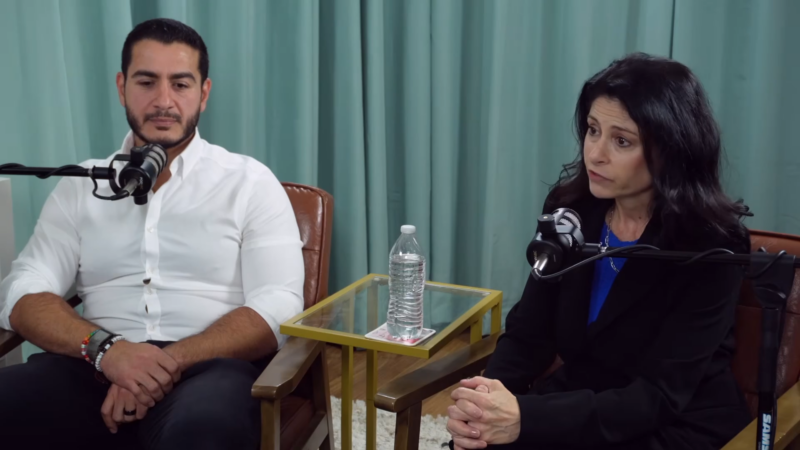
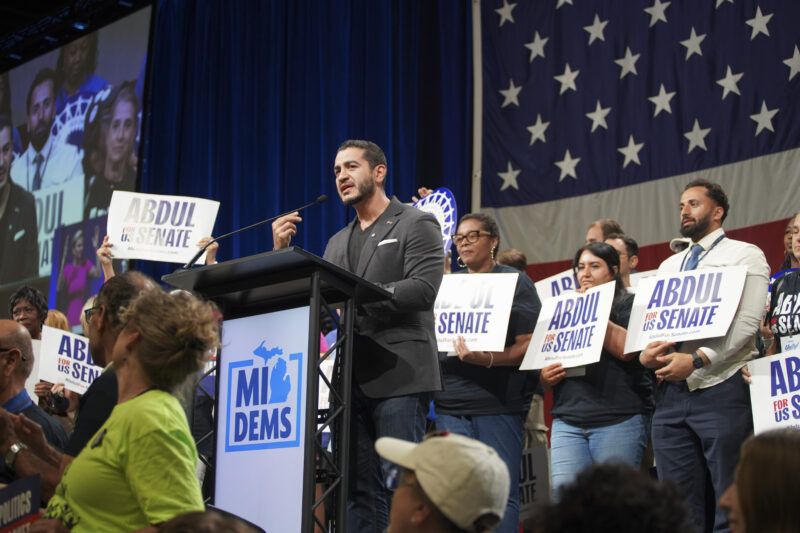
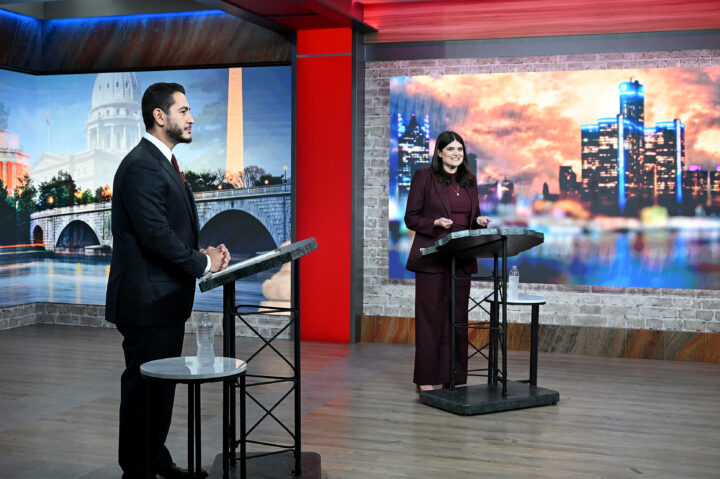
Senate candidates Abdul El-Sayed, left, and Rep. Haley Stevens participate in a televised debate moderated by Roop Raj, Monday, July 27, 2026, in Southfield, Mich.
Good Tuesday morning.
In today’s Daily Kickoff, we cover former Israeli Strategic Affairs Minister Ron Dermer’s observations on the U.S.-Israel relationship, and report on new statistics from the NYPD that indicate a rise in antisemitic hate crimes since New York City Mayor Zohran Mamdani took office at the beginning of the year. We look at the challenges facing Sen. Darline Graham in the GOP primary as she makes a bid for a full Senate term, and cover the more than $1.3 billion in security aid requested by nonprofits in 2026. Also in today’s Daily Kickoff: Zach Dell, Iranian Chief Rabbi Yehuda Gerami and Christina Paxson.
We also have a new on-demand Live Briefing that you can access throughout the day via our new app (on Apple and Android) and on our website.
Today’s Daily Kickoff was curated by JI Executive Editor Melissa Weiss and Israel Editor Tamara Zieve, with assists from Danielle Cohen-Kanik and Marc Rod. Have a tip? Email us here.
What We’re Watching
- It’s primary day in Michigan, Kansas, Missouri, Virginia and Washington state.
- In Michigan, Democrats will head to the polls to cast their ballots in the heated Senate race between Rep. Haley Stevens (D-MI) and Abdul El-Sayed that has become the latest flashpoint in the party’s debate over its ideological future.
- Among the House primaries we’re watching in Michigan: Rep. Shri Thanedar’s (D-MI) effort to hold onto his seat amid a formidable primary challenge from far-left former state Rep. Donavan McKinney; the Democratic primary to take on Rep. Tom Barrett (R-MI) in which a leading candidate said it was a “moral necessity” to end aid to Israel; and the race for Stevens’ House seat that has been marred by allegations of antisemitism.
- In Missouri, Rep. Wesley Bell (D-MO) is facing a rematch against former Rep. Cori Bush (D-MO), whom he unseated two years ago. Read more about the race here.
- Israeli and Lebanese officials are meeting today in Rome for the latest round of U.S.-brokered talks aimed at calming tensions along the Israel-Lebanon border and demilitarizing Hezbollah as the Iran-backed group continues to operate in southern Lebanon.
- Iran and Oman are reportedly nearing an agreement on administering the Strait of Hormuz that would see Iran have control over incoming traffic and be able to charge vessels a “service fee” to be split between Tehran and Muscat.
- The Senate Judiciary Committee is slated to vote this morning on Todd Blanche‘s nomination to be U.S. attorney general after Sens. John Cornyn (R-TX) and Thom Tillis (R-NC) dropped their opposition following an announcement Sunday night from Blanche terminating the administration’s controversial anti-weaponization fund that had raised some GOP concerns.
- The Israel on Campus Coalition’s annual National Leadership Summit concludes this afternoon in Washington. Justice Department Assistant Attorney General for Civil Rights Harmeet Dhillon, Sen. John Fetterman (D-PA) and Rep. Elise Stefanik (R-NY) are slated to speak today. More below.
What You Should Know
A QUICK WORD WITH JI’S JOSH KRAUSHAAR
One of the unsettling realities that American Jews have been learning throughout this election cycle is that antisemitic behavior and virulently anti-Israel rhetoric has become so normalized that it doesn’t register all that much politically anymore.
The early tell was discovering that New York City Mayor Zohran Mamdani’s involvement throughout his life in extreme anti-Israel activism didn’t impact his ability to win an election in the city with the largest Jewish population in the world.
Then we learned that disgraced former Maine Senate candidate Graham Platner’s Nazi tattoo — which he later covered up — made very little difference in his political standing in the battleground Senate race. It wasn’t until he was accused of rape that rank-and-file Democrats began to reconsider their support of him.
And today we’re grappling with the possibility that Michigan Senate candidate Abdul El-Sayed, who won’t acknowledge Israel’s right to exist as a Jewish state (like Mamdani before him), could prevail in a Democratic primary in a swing state.
Jews find themselves in the news often these days, and for that reason it makes sense to want to dwell on the extreme, often-antisemitic positions that these radical candidates have espoused.
But as we head into a general election where several far-left candidates will be testing their political viability in competitive states and districts against strong Republican challengers, it’s important to remember that their biggest vulnerabilities are on issues that don’t directly impact the Jewish community.
The reality is that these candidates are politically problematic to the overall public for reasons that go far beyond their views on Jews or Israel. The same Democratic Socialists of America (DSA) platform that rejects a Jewish state and condones terrorism also is one that envisions abolishing prisons and defunding the police and backs open borders.
CONFERENCE CIRCUIT
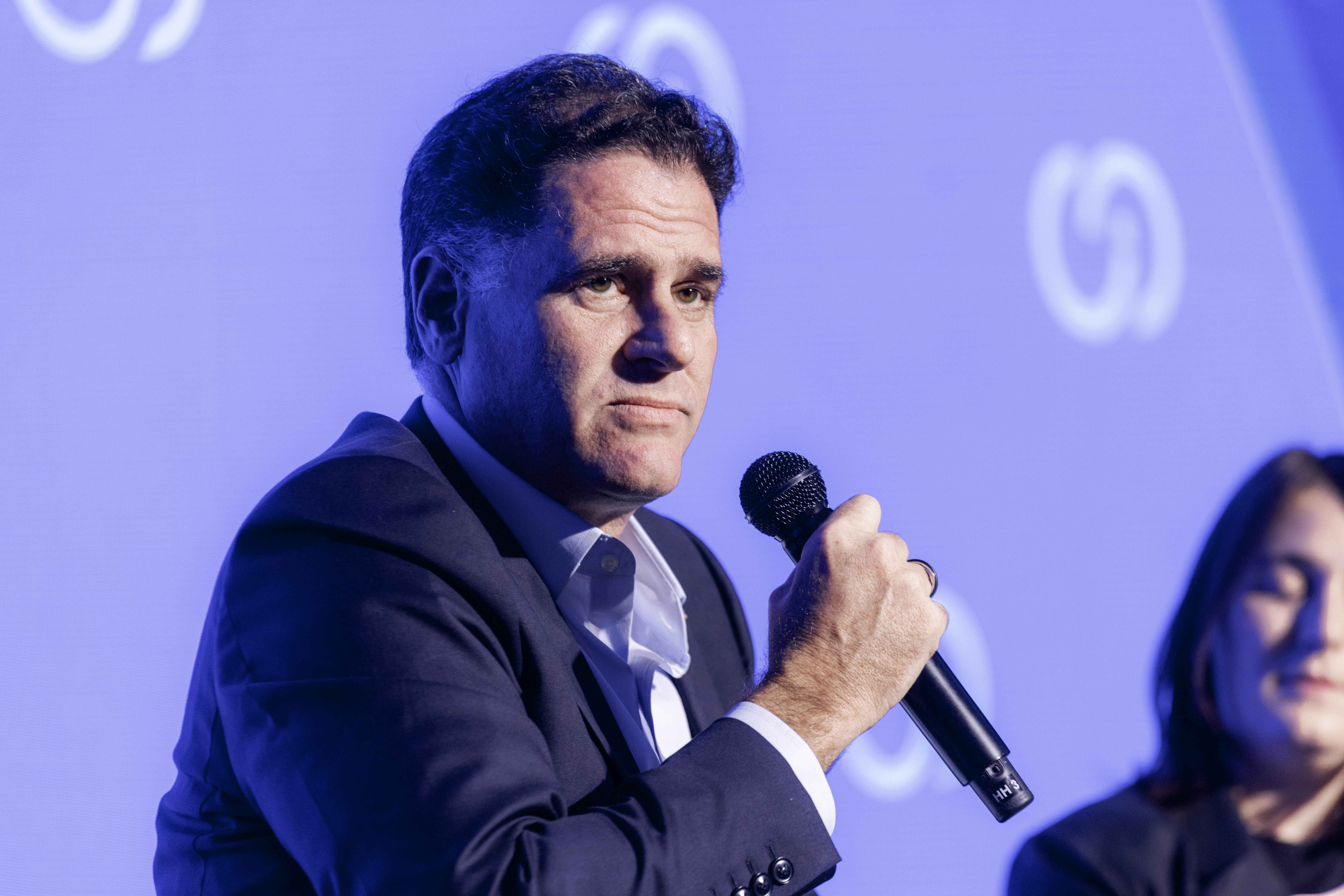
Israel’s relationship with the U.S. depends on mutual interests, not shared values, Ron Dermer, Israel’s former minister of strategic affairs, said on Monday at the Israel on Campus Coalition’s conference in Washington. “The problem people have is they romanticize the U.S.-Israel relationship. People think the U.S. has always been a strategic ally from day one,” Dermer said, Jewish Insider’s Haley Cohen reports.
What he said: “Don’t get me wrong, Israel has shared values with the United States. But that’s not what drives relations between states,” said Dermer. “So you ask me, ‘What’s going to be with the U.S.-Israel alliance long-term?’ Values is not what drives the alliance — It’s actually the interests that make the difference,” Dermer said.
MEETING ADJOURNED
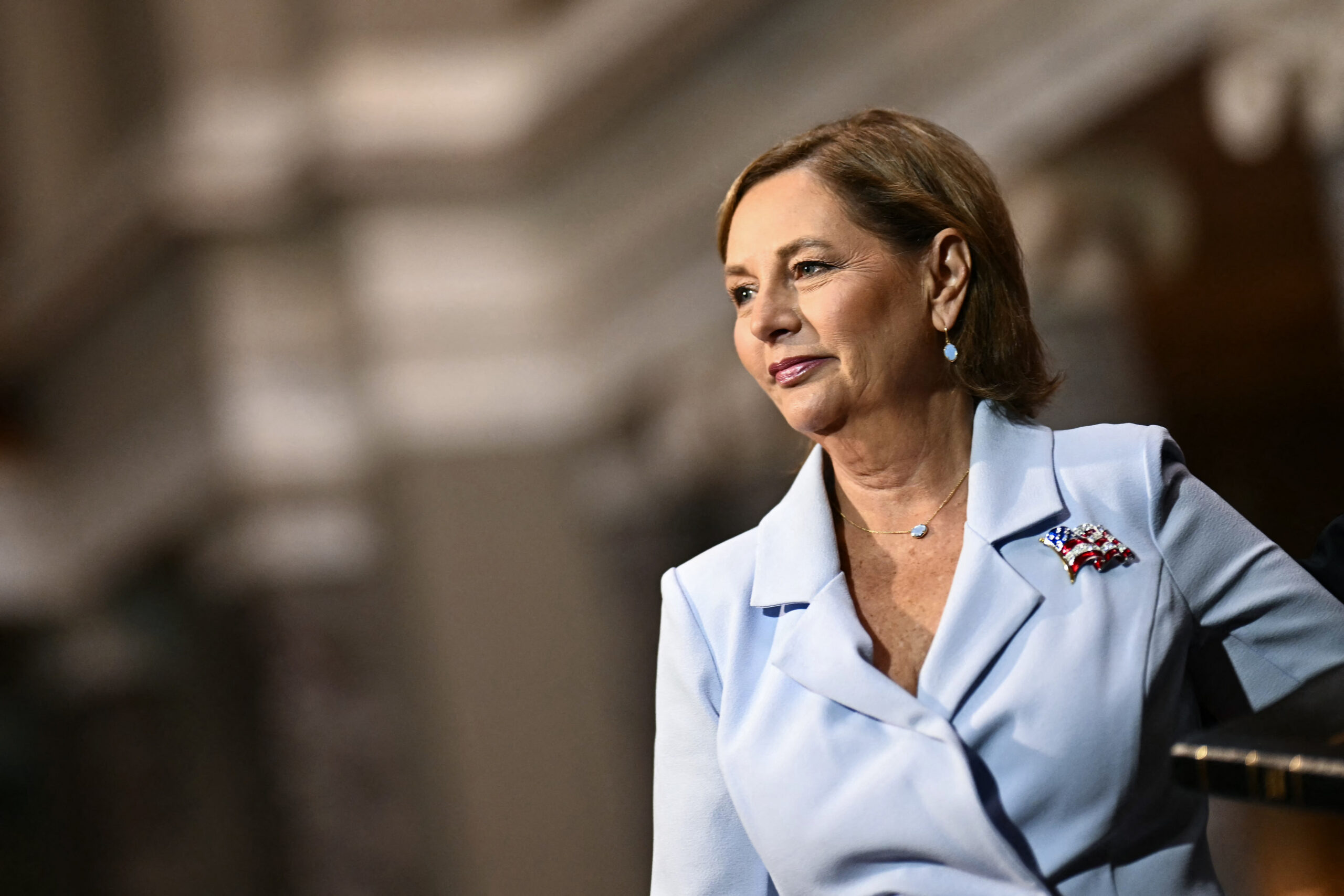
Sen. Darline Graham’s (R-SC) bid to succeed her late brother in the Senate is facing growing skepticism from Republican operatives and lawmakers who say President Donald Trump’s endorsement is unlikely to spare her from a runoff in South Carolina’s special GOP primary next week, Jewish Insider’s Emily Jacobs reports.
Special election forecast: Over the last week, six senior GOP campaign operatives and Republican lawmakers told JI that they believe a runoff is all but certain after the Aug. 11 special election primary, with most predicting Graham will not be able to clinch a majority of the vote to avert one as her brother, the late Sen. Lindsey Graham (R-SC), did with his June primary victory. “The sense that this is going to go to a runoff seems pretty clear,” Doug Heye, a Republican strategist who served as communications director for the Republican National Committee and a deputy communications official for former House Majority Leader Eric Cantor (R-VA), said. “What happens after that is anyone’s guess.”
CENTER STAGE

A senior Trump administration official and a journalist clashed during a Monday debate over whether the White House’s crackdown on campus antisemitism protects or threatens America’s liberal norms. The debate, held at the Israel on Campus Coalition’s National Leadership Summit in Washington, featured Noah Pollak, a senior advisor at the Education Department, who argued that the controversial crackdown is good for the country, and Jonathan Rauch, a senior fellow at the Brookings Institution and contributing writer for The Atlantic, who made the counterargument, Jewish Insider’s Haley Cohen reports.
The arguments: After the Oct. 7, 2023, Hamas terror attacks in Israel, “university leaders chose not to enforce the rules for one group of people,” said Pollak. “As long as it was leftists and pro-Palestine people [leading protests], it was considered fine.” Rauch said, “Noah and I agree on the use of legitimate legal process by this or any administration to ensure that everyone’s civil rights are protected. Where we disagree is that the line has got to be due process. They must not go beyond that. It’s bad for Jews because we of all people know the importance of law.”
GROWING THREAT

Hate crimes — particularly against Jews — have spiked in New York City during the first seven months of Mayor Zohran Mamdani’s administration, new data from the NYPD shows. The police department’s July statistics show general declines thus far in 2026 shootings and murders, and even in hate crimes against certain ethnic groups. But bias offenses were up overall last month, and during the entire period since Mamdani took office on the first of the year, with hate crimes targeting Jewish New Yorkers continuing to make up the majority of such incidents, Jewish Insider’s Will Bredderman reports.
Breaking it down: “More than half of the confirmed hate crimes for the first seven months of the year, or 56.9%, were anti-Jewish hate crimes, despite Jewish New Yorkers making up only 10% of the city’s population,” the NYPD’s report states. There were 23 confirmed hate crimes against Jewish people in July of this year, compared to 15 in July 2025. To date, the Jewish community has suffered 205 confirmed criminal antisemitic incidents during Mamdani’s first seven months at City Hall, compared to 189 such transgressions up to this point in the final year of Mayor Eric Adams’ tenure.
MONEY MATTERS

Nonprofit groups, including religious institutions, requested more than $1.3 billion in funding from the Nonprofit Security Grant Program in 2025, around five times the $266 million that was ultimately available, a Federal Emergency Management Agency spokesperson told Jewish Insider’s Marc Rod.
By the numbers: In total, more than 8,000 institutions applied for funding, of which around 1,600 received funding — an acceptance rate of around 20%. FEMA initially disclosed in a press release last week that state-level administrative agencies had forwarded 6,000 applications to FEMA for federal review, but the spokesperson told JI that the state level agencies had received more than 8,000 total applications.
TEHRAN TALK
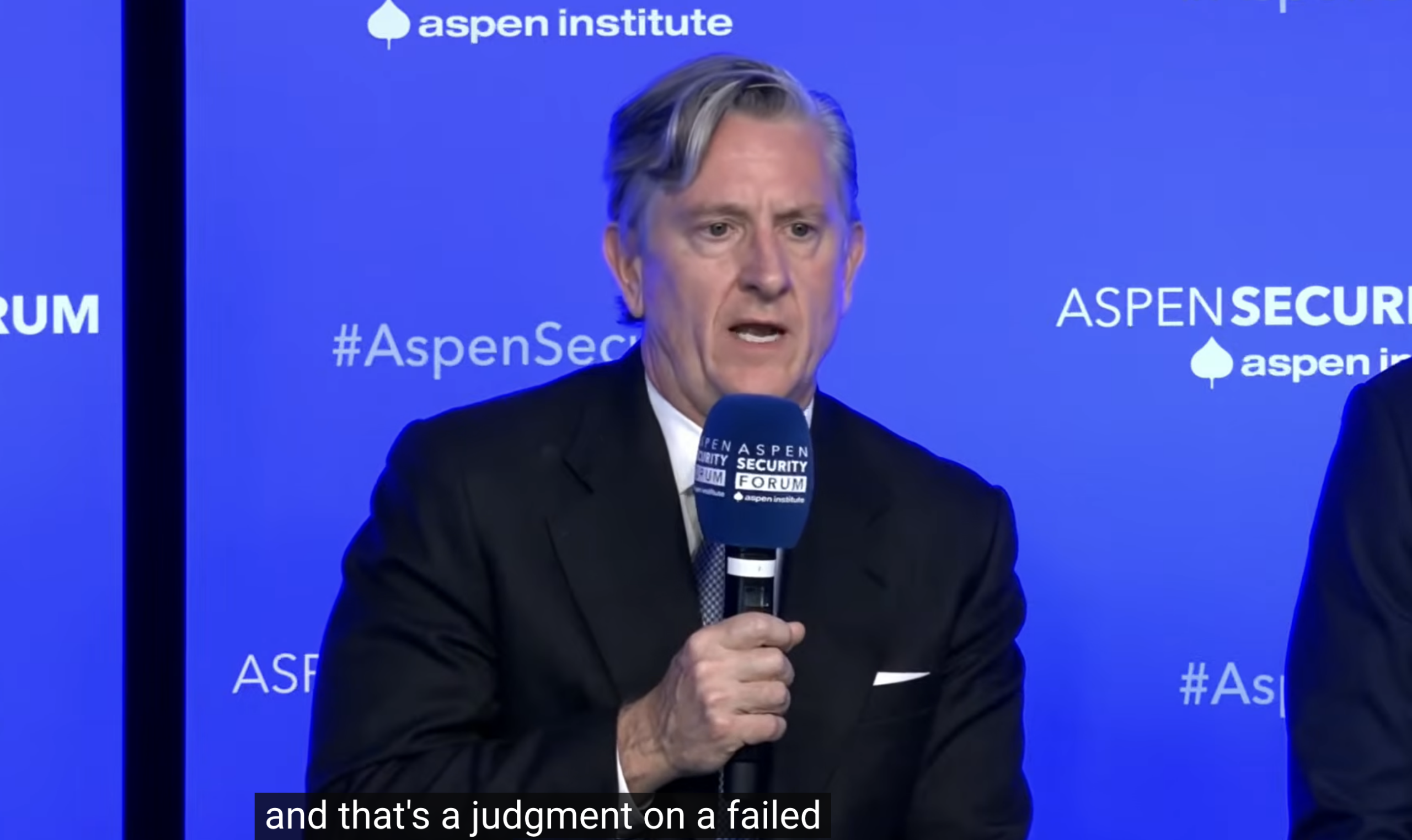
Robert Greenway, who led the Middle East and North Africa portfolio on the National Security Council during President Donald Trump’s first administration, predicted to Jewish Insider’s Marc Rod in an interview last month that the Iranian regime would not “make it” to the end of Trump’s time in office.
Notable quotable: “We’ve really put ourselves in a position where we’ve got massive leverage. Their economy is virtually non-existent. I think it’s dead. We’re just waiting for the funeral, I think their political leadership is in turmoil,” Greenway said in an interview on the sidelines of the Aspen Security Forum. “The military has been decimated, and very little capacity remains to threaten the United States and our interests. That’s the reality of it. Despite claims to the contrary — those are not serious claims. They’re not supported by the facts.”
Worthy Reads
Kicking the Can: The Wall Street Journal’s Gerard Baker posits that the war with Iran will not be resolved until the next presidential administration. “The initial temptation is to say that how it ends is less important than that it ends, that when you’re in the middle of an unfolding calamity, getting out is your only priority. But just as you can blunder into a war, you can blunder out of one. … But we know too that to double down is to fall prey to the timeworn seduction of the sunk-cost fallacy: We’ve invested so much in this effort that to abandon it now would be worse. In war this fallacy is especially, tragically persuasive.” [WSJ]
Toughening Tehran: In The Washington Post, the Foundation for Defense of Democracies’ Behnam Ben Taleblu suggests that years of muted Western responses to Iran have emboldened the regime to carry out increasingly brazen attacks. “For starters, Tehran has come to believe it can prevail in a battle of wills. Despite being militarily outclassed by a nuclear-armed global superpower, Washington’s unwillingness to engage in a protracted war that would further spook oil markets, negatively impact midterms and expend precious munitions like interceptors is by now obvious.” [WashPost]
Find more Worthy Reads in our Live Briefing via our new app (on Apple and Android) and website.
Word on the Street
In a post on his Truth Social platform on Monday, President Donald Trump accused Iran of being “unbelievably duplicitous,” after Tehran denied any negotiations were taking place with the U.S…
Following a meeting on Monday between Board of Peace officials and Israeli Prime Minister Benjamin Netanyahu — and days after its high representative Nickolay Mladenov said Israel’s withdrawal from Gaza would “move in lockstep with decommissioning” — Mladenov said that “the withdrawal of the IDF beyond the Yellow Line will take place only once decommissioning is complete, as Hamas committed to the mediators”…
In a Monday evening phone call with Rep. Max Miller (R-OH), Trump said he doubted that Miller’s reelection effort could survive allegations of domestic abuse by his ex-wife, who is the daughter of Sen. Bernie Moreno (R-OH), and the couple’s young daughter…
The New York Times looks at Ronald Lauder’s political giving, finding that Lauder, a longtime donor to GOP political efforts and candidates who in 2022 spent $13 million to boost GOP House candidates, has halted his giving to the party; one individual who spoke to the Times said the pivot stemmed from a decision made by the 82-year-old Lauder and his adult children to refocus on art and philanthropic projects…
Brown University President Christina Paxson announced on Monday that she will step down from her position at the end of the 2026–27 academic year, concluding a 15-year tenure at the Ivy League, as the school increased Jewish student enrollment even as most peer institutions experienced significant drops, Jewish Insider’s Haley Cohen reports…
The Wall Street Journal spotlights efforts by Base Power, which recently closed a $1 billion funding round, and its cofounder Zach Dell, the son of tech founder and philanthropist Michael Dell, as the company looks to expand its footprint in the battery storage industry…
A New York man facing manslaughter charges in connection with a May hit-and-run in which Jewish journalist Cara Trager was killed was arraigned on hate crimes charges stemming from an incident that occurred weeks prior to the accident in which he vandalized a kosher bagel shop that had Israel flags on display…
The Wall Street Journal profiles Rabbi Yehuda Gerami, the chief rabbi of Iran who leads the roughly 20,000-strong Jewish community in the Islamic Republic…
Major League Soccer is investigating a weekend incident in which supporters of CF Montreal hurled antisemitic insults at an Israeli player on the opposing New England Revolution; in its own statement, New England Revolution condemned the “antisemitic and discriminatory abuse” directed at forward Dor Turgeman…
Former Dallas Mavericks owner Mark Cuban said he’s “open to” buying a minority share of the Dallas Cowboys, whose owner, Jerry Jones, told the Dallas Morning News, is similarly open to selling to him…
Israeli Defense Minister Israel Katz walked back comments made on Israeli television over the weekend in which he indicated that he would fire Maj. Gen. Avi Bluth, the head of Israel’s Central Command, after Katz’s comments on Israel’s Channel 14 reportedly drew the ire of Israeli Prime Minister Benjamin Netanyahu…
A Tel Aviv University analysis of Central Bureau of Statistics data found that 90,922 Israelis left the country for three months or more in 2025, sustaining record emigration levels well above the annual average of about 60,000 in the previous decade…
The New York Times spotlights the thousands of civilian sailors working on ships transiting through the Strait of Hormuz who have been stranded on ships unable to transit through the waterway or, in some cases, held on ships that have been seized by Iran’s Islamic Revolutionary Guard Corps…
Visa said it was acquiring Israeli online fraud detection company BioCatch for $2.4 billion…
Find on-demand Live Briefing updates throughout the day via our new app (on Apple and Android) and website.
Pic of the Day

Israeli President Isaac Herzog received the credentials of Chilean Ambassador to Israel Gabriel Alejandro Zaliasnik, one of six envoys to present their credentials to the president on Monday. Zaliasnik’s appointment comes nearly three years after the South American country — along with Honduras, which also returned its ambassador to Israel this week — recalled its ambassador to Israel following the Oct. 7, 2023, Hamas terror attacks in protest over the ensuing war in Gaza.
Birthdays
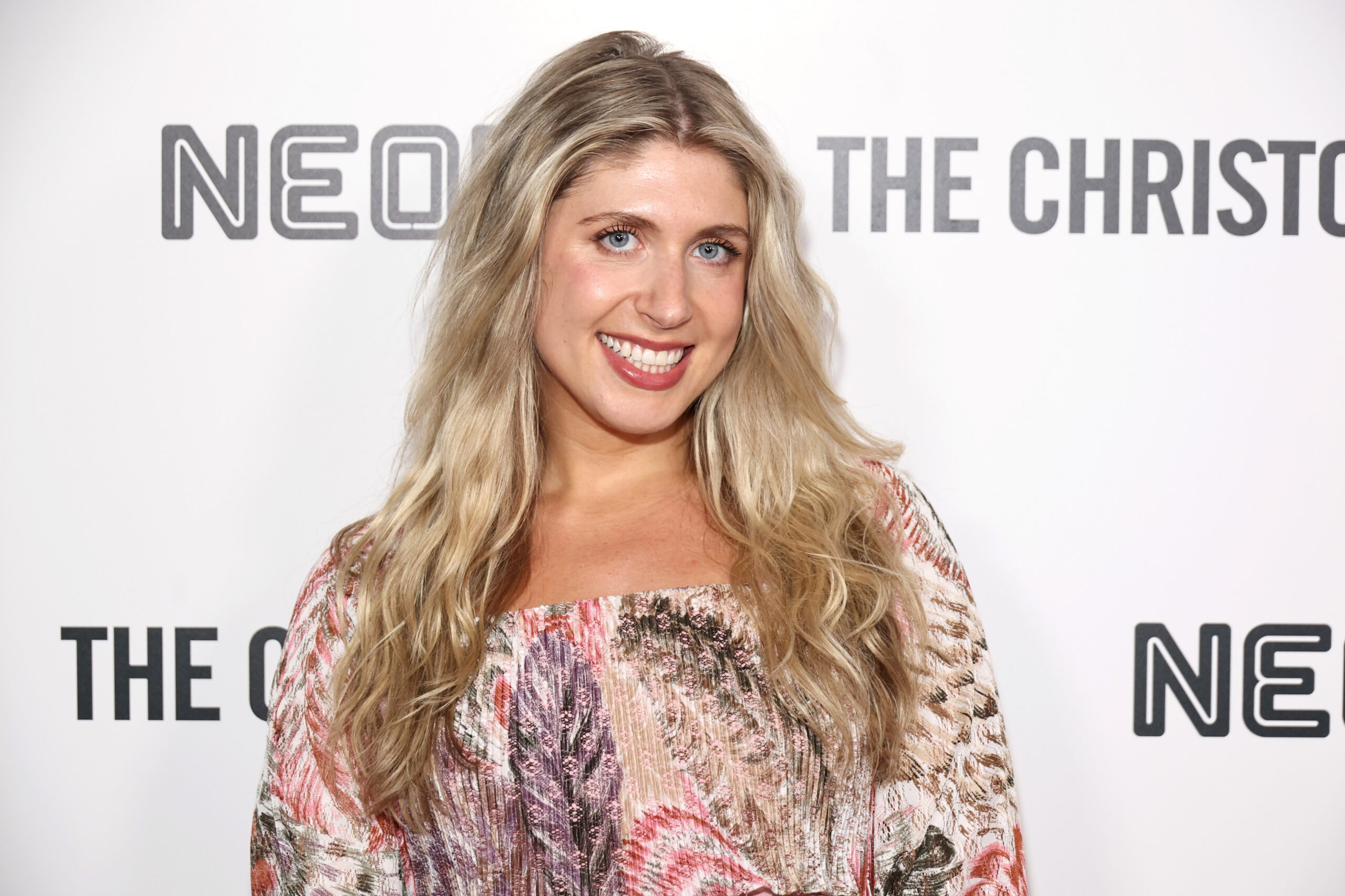
Tiktoker, comedian and influencer, Sabrina Plon Brier turns 32…
Professor emerita of American history at Yeshiva University and Stern College, she is an expert on the history of McCarthyism, Dr. Ellen Wolf Schrecker turns 88… Talmudic scholar and a leader of New York’s Sephardic Jewish community, Rabbi Eliyahu Ben Haim turns 86… President at Salco Mechanical, Michael Salzberg… Rabbi of Centro Israelita de Bogotá and chief rabbi of Colombia, Alfredo Goldschmidt turns 81… Immediate past board chair of the Jewish Funders Network, Marcia Riklis… Former SVP and chief growth officer at the NYC HQ of the ADL, now a board member of the Jewish Democratic Council of America, Frederic Lewis Bloch… Former Ashkenazi chief rabbi of Israel, Rabbi Yona Metzger turns 73… Retired professor in Memphis, Sheldon Dan… Former longtime member of the Knesset for Likud including multiple ministerial positions, Silvan Shalom turns 68… Executive producer of “Live with Kelly and Mark,” Michael Gelman turns 65… 44th president of the United States, Barack Obama turns 65… Mayor of Chicago from 2019 until 2023, Lori Lightfoot turns 64… Attorney general of Minnesota, Keith Ellison turns 63… Administrative manager at Edelman, Helen Lapkovsky… Global editorial director for PwC and editor-in-chief of PwC’s management magazine strategy+business, Daniel Gross turns 59… Editor-in-chief of Cuepoint at Medium, he is known as Shecky Green, Jonathan Miles Shecter turns 58… Congressman (D-NY), he is the minority leader of the House of Representatives, Hakeem Jeffries turns 56… Chief political anchor and host of Fox News’ “Special Report,” Bret Baier turns 56… Emmy Award-winning broadcast meteorologist at WJLA-TV in Washington, D.C., Steven Rudin… Former Washington director of Bend the Arc Jewish Action, Rabbi Jason Kimelman-Block… Former director-general of the U.N. Educational, Scientific and Cultural Organization, Audrey Azoulay turns 54… Executive editor and host at City Cast, Michael Schaffer… Chair of the Arizona Democratic Party from 2011 through 2012, he is a former White House speechwriter, Andrei Cherny turns 51… VP of communications at Arctic Wolf, Caren Beth Auchman… CEO of Something Major, a leadership coaching and advisory firm, she is the author of Something Major: The New Playbook for Women at Work, Randi Braun… Director of corporate growth strategy in the geostrategic business group at EY-Parthenon, Ben-Ari Boukai… CRO and co-founder at Riverside.fm, Jonathan Keyson… Childhood student at the Donna Klein Jewish Academy in Boca Raton, Fla., he is a placekicker in the NFL, Greg Joseph turns 32… Natalie Roberts… Evelyn Murphy…
Dermer: ‘I would love to live in a world where it’s values that drive international relations … That is not the world we live in’
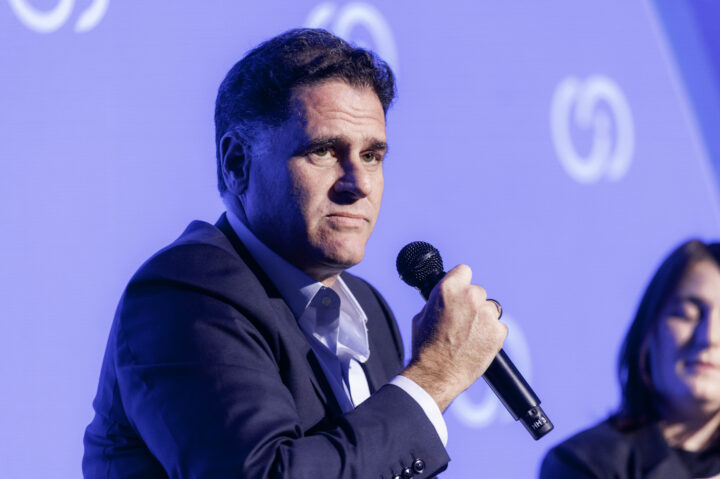
Courtesy ICC
Ron Dermer, Israel’s former minister of strategic affairs, speaks at the Israel on Campus Coalition’s conference in Washington, August 3, 2026
Israel’s relationship with the U.S. depends on mutual interests, not shared values, Ron Dermer, Israel’s former minister of strategic affairs, said on Monday at the Israel on Campus Coalition’s conference in Washington.
“The problem people have is they romanticize the U.S.-Israel relationship. People think the U.S. has always been a strategic ally from day one,” Dermer said. “Israel’s main strategic ally for its first 15 years was France.”
“I would love to live in a world where it’s values that drive international relations. I believe Israel would be the world’s superpower, no doubt,” Dermer told a crowd of some 1,000 pro-Israel college students. “That is not the world we live in and it’s not the world anybody has ever lived in.”
Rather than the shared democratic values and ideological alignment that Israeli leaders have frequently cited to define the U.S.-Israel partnership, Dermer asserted that “it’s actually generated interest” that aligns counties long term, such as security cooperation or economic benefit.
“Interest is what drives stakes over time,” he said.
“It’s always good to have good public opinion, they can be shock absorbers when problems arise, but ultimately being important to that country becomes more critical than whether or not they think they have shared values,” continued Dermer.
“Don’t get me wrong, Israel has shared values with the United States. But that’s not what drives relations between states,” said Dermer.
“So you ask me, ‘What’s going to be with the U.S.-Israel alliance long-term?’ Values is not what drives the alliance — It’s actually the interests that make the difference,” Dermer said.
In his comments, Dermer also urged “every pro-Israel Jewish organization” to “draw a line in the sand that anybody who says that Israel perpetrated a genocide in Gaza has to be completely shunned.”
He argued that those hostile to the Jewish state — including New York City Mayor Zohran Mamdani — are making accusations of Israeli genocide a loyalty test for left-wing politics.
“The enemies of Israel and the enemies of Jews — and right now you’ve got both in Gracie Mansion in New York — they want to turn this into the litmus test of progressive politics,” said Dermer.
“If you don’t say Israel perpetrated genocide, [they] want nothing to do with you. Let them do what they’re gonna do. We have to in the Jewish community, and pro-Israel community, do what we have to do. We have to say, ‘If you say those words, we are done.’ It’s a threat not just to Israel, it’s a threat and a clear and present danger to Jews everywhere.”
The numbers demonstrate the degree to which opinions on Israel and Iran — and the U.S. role in the region — have shifted in the five months since the war began
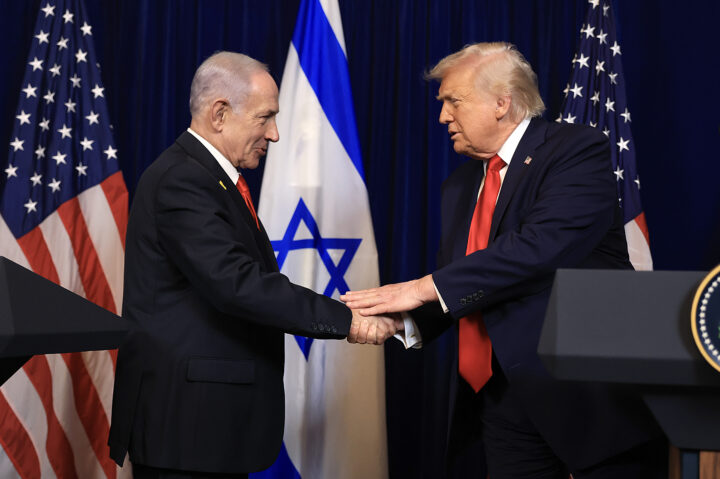
Joe Raedle/Getty Images
President Donald Trump shakes hands with Israeli Prime Minister Benjamin Netanyahu during a press conference at his Mar-a-Lago club on December 29, 2025 in Palm Beach, Florida.
For watchers of the U.S.-Israel relationship, the events of the last few days have had a familiar feel. On Friday, President Donald Trump suggested at the White House Correspondents’ Dinner that Iran would “love to make a deal. I don’t think they’re ready to. I don’t think it’s time yet, but I’m willing to listen.” Today, the president will meet at the White House with Israeli Prime Minister Benjamin Netanyahu as the countries weigh a military escalation with Iran.
The similarities to the dialogue surrounding Iran earlier this year are striking. In early February, Trump told reporters aboard Air Force One, “Iran looks like it wants to make a deal very badly.” Days later, Trump would meet at the White House with Netanyahu for talks focused on Iran. Weeks after that meeting, the U.S. and Israel launched joint military strikes against the Islamic Republic, kicking off a six-week war.
And despite the similarities around today’s meeting — which comes hours before the funeral of Sen. Lindsey Graham (R-SC) — much has changed.
In the U.S., there is growing opposition among Americans to renewed military action against Iran — a sentiment that extends to some top military officials, including, reportedly, CENTCOM head Adm. Brad Cooper.
Public perception of Israel — and Israelis — has hit its most negative point in years, with Gen Z Americans across the political spectrum having significantly more favorable views of Palestinians than Israelis.
The numbers demonstrate the degree to which opinions on Israel and Iran — and the U.S. role in the region — have shifted in the five months since the war began. The domestic politics in the U.S. vis-a-vis Iran look very different than they did during the last Trump-Netanyahu meeting.
Among Israelis, there is little confidence that Trump is acting with Israel’s security needs in mind, with just 28% of those surveyed in an Israel Democracy Institute poll last month saying that they believed the country’s security was a central consideration for Trump.
When Trump and Netanyahu last met, elections in both countries were still a far-off prospect. But with less than four months before both the midterms and Israel’s first election in nearly four years, the calculus has changed.
In Israel, Netanyahu is facing a tough reelection battle as recent polls show former IDF Chief of Staff Gadi Eisenkot and his Yashar party making gains on the prime minister and his Likud party. Netanyahu had reportedly spent weeks seeking a meeting with Trump as the memorandum of understanding between Washington and Tehran fell apart and both sides resumed attacks before confirming he’d attend Graham’s funeral — with a Trump meeting to boot.
The meeting also offers Netanyahu an opportunity to remind Israeli voters of his close relationship with Trump — something no other Israeli candidate can boast. And he’s also seeking a more permanent solution on Iran leading into the election — a tangible win he can tout to Israeli voters, who are overall unhappy with the outcome of the war.
For Trump, the outcome of the midterms is less threatening to his standing, but will likely serve as a referendum on American attitudes toward the war with repercussions extending well into the 2028 presidential race.
And even as Trump has claimed that he doesn’t care about voter opinions about the war with Iran, the rest of his party — and those looking to shape its direction — will be waiting to see the outcome of the Netanyahu meeting.
With the region on edge, today’s meeting is likely to offer one of the clearest indications as to whether Trump and Netanyahu share the same vision for the future of the Middle East — or whether they’re on increasingly divergent paths.
The former ambassador told JI a Netanyahu loss in October’s elections would be a ‘very healthy thing’ for the U.S.-Israel relationship
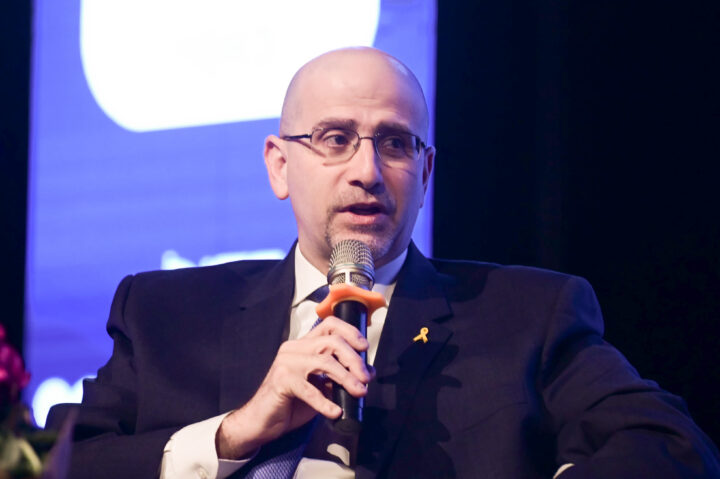
(Tomer Neuberg/Flash90)
Former US ambassador to Israel Dan Shapiro speaks at a Conference of the Institute for National Security Studies (INSS), in Tel Aviv, on February 25, 2025.
ASPEN, Colo. — Former U.S. Ambassador to Israel Dan Shapiro argued on the sidelines of the Aspen Security Forum last week that without new leadership in Israel — meaning a defeat for Prime Minister Benjamin Netanyahu in Israel’s elections — he does not know how Israel can repair its reputation in the United States.
“I don’t see a path to repairing Israel’s deteriorating standing in the United States on both sides of the aisle without a change of leadership in Israel,” Shapiro told Jewish Insider in an interview, a sentiment he repeated during a panel on Israel and the U.S.-Israel relationship at the conference.
Shapiro said that a “wise Israeli government” would pay attention to its “deteriorating standing in the United States” and that the “Israeli public might want to bear that in mind too as they prepare to go to the polls in October.”
Asked whether he thinks some in the U.S. are pinning broader criticisms of Israel on Netanyahu personally, Shapiro emphasized that there’s “a lot of history and a lot of emotion and a lot of associations with the prime minister,” who is “very present in our media, in our politics.”
Netanyahu, he said, is associated with many of the biggest flashpoints in U.S.-Israel relations including opposition to former President Barack Obama and the 2015 Iran nuclear deal, the wars in Gaza and Iran and the rise of his far-right Cabinet ministers.
“Probably a very healthy thing for the U.S.-Israel relationship would be if 95% of Americans do not know the name of the Israeli prime minister, and that’s a possible outcome out of this election,” Shapiro said. “That doesn’t guarantee it fixes everything by any stretch. There’s work to do, but that’s a different starting point.”
Israel, he continued, won’t be able to placate all of the critics of its continued efforts to defend itself, but he said there are other steps it can take to improve attitudes in the U.S., including cracking down on “the Jewish terror wave against Palestinian civilians in the West Bank,” providing withheld funds to the Palestinian Authority, stopping settlement expansion and moving more assertively to implement the U.S.-led 20-point peace plan for Gaza.
Speaking to JI shortly after more than 100 House Democrats voted to cut off U.S. military aid to Israel, Shapiro said that, while there’s “legitimate ground for concern and for criticism” of Israel’s operations in Gaza, cutting off all $3.3 billion wholesale is not “a very thoughtful way” to address concerns about civilian harm. He also emphasized the responsibility Hamas bears for intentionally endangering Palestinian civilians.
“We have an ongoing U.S. interest in ensuring Israel can defend itself from a lot of very dangerous enemies who are also our enemies,” Shapiro said. “There are much more thoughtful and much more careful and nuanced ways of trying to get at the real problem, which is ensuring that U.S. equipment — which Israel may need, and which we’ve made some commitment to, to defend themselves where they legitimately have a need to do so — is not used in a way that produces unacceptable civilian casualties.”
He said the current debate, at its heart, touches on the fundamental question of whether the U.S.-Israel relationship continues to serve American interests, which he strongly believes it does.
“If we were to see a real deterioration and distancing of the U.S. and Israel, for the long term, we’d find that our own interests and our own ability to defend our own influence and our own ability to defend our interests in the Middle East would be significantly compromised,” Shapiro said.
He said that severing the U.S.-Israel relationship would embolden Iran and its proxies — which are also enemies of America — to undermine the regional defense architecture that the U.S. has spent years building, leading U.S. allies to pull away from the Washington and hedge with Iran.
Shapiro said during the panel that those calling for a total dismantling from the U.S.-Israel relationship should be asked to address that policy’s second-order effects on U.S. interests and American influence in the region.
While Shapiro acknowledged that polling has shown that many in the U.S. have a negative impression of Israel’s conduct in the war in Gaza, he does not necessarily believe that means that most Americans want to see the U.S.-Israel relationship severed entirely.
Shapiro argued to JI that there’s a “broad middle” of the Democratic Party, on both sides of the Israel aid vote, that continues to support Israel’s right to exist and has reasonable conversations about the future of the party. On the extremes, however, there are some, including prominent leaders, who do not believe Israel has a right to exist, which Shapiro called strategically wrong, morally wrong and a political mistake.
“I think we’ll end up losing in the swing areas and swing districts and states if we marry ourselves to that most extreme attitude on this issue,” Shapiro, who served under former President Barack Obama, said, emphasizing that extreme anti-Israel candidates have so far only succeeded in deep-blue districts.
Shapiro predicted that the U.S. looks to be on the path toward ending assistance to Israel, whether that be immediately or over time, depending on negotiations between the two sides over the next memorandum of understanding.
“If there’s going to be an MOU, that should [include] some sort of review process or some sort of consultation process to ensure that [U.S.] standards are met, as well as the regular enforcement of U.S. law and U.S. requirements,” Shapiro said.
He predicted that ending U.S. aid to Israel would also lead to an end to the U.S.’ financial support for the Egyptian and Jordanian militaries — other top recipients of U.S. military financing — which could lead those countries to look elsewhere for military weapons, including U.S. adversaries.
Shapiro was critical of the Trump administration’s approach to the war in Iran — in contrast with his support for the strikes in 2025 on Iran’s nuclear program — describing the administration as stuck in a spiral of repeated threats without a focused or sustained strategy.
He said that the U.S. could plausibly have claimed victory in the first few weeks of the war, but missed the opportunity to do so, and “all the leverage swung over” to Iran once it closed the Strait of Hormuz.
“I knew that to end it would require a very weak deal, and I supported a very weak deal to end a very dumb war. I just didn’t expect the MOU to be as weak as it was,” Shapiro said. “It was absurdly so. It gave away massive sanctions relief even before beginning discussions on the nuclear program. It left Iran with the clear impression that they did have permanent authority to control the strait.”
He said there is no clear end strategy for the conflict now, adding that he generally agrees with the basic strategy laid out at the Security Forum by former Secretary of State Condoleezza Rice — to “let the Iranians stew in the juice of the sanctions.”
On the panel, Shapiro also argued that Vice President JD Vance’s comments on Joe Rogan’s podcast blaming an Israeli influence campaign for undermining the MOU with Iran leaned into antisemitic tropes.
“It was frankly an attempt to cast blame on somebody else for the really unsuccessful MOU following an unsuccessful war and trying to blame it on a third party — who was a party to the war, but not really to the negotiation on the MOU,” Shapiro said. “I really think that was uncalled for.”
After 104 members of the House voted last week in favor of an amendment to eliminate military aid to Israel, pro-Israel activists who have spent years building ties with lawmakers are now wondering how to approach those relationships
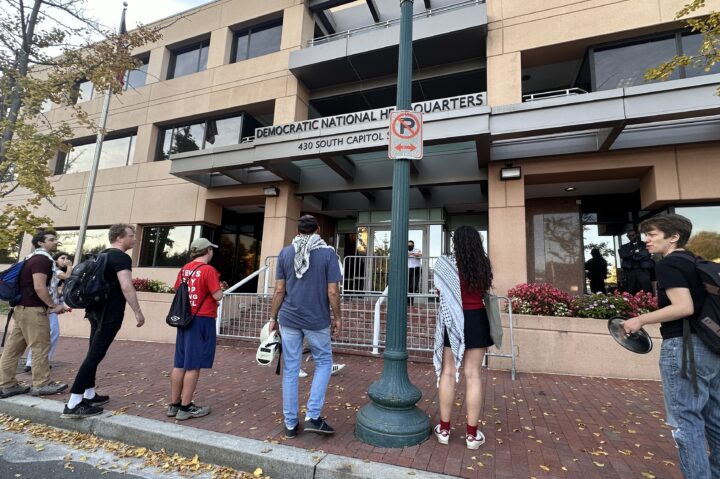
(Yasin Ozturk/Anadolu via Getty Images)
A group of demonstrators hold a noise protest outside the Democratic National Committee Headquarters in Washington D.C., United States on October 31, 2024.
Before AIPAC began spending tens of millions of dollars per election cycle on campaigns, back when it was purely an advocacy organization that touted its relationships with many of the 535 members of Congress, the pro-Israel group used to describe its approach to Capitol Hill with a cheeky, upbeat motto: “You have friends, and you have potential friends.”
But when former Bay Area AIPAC leader Naomi Lauter used to invoke the slogan, she added a third category: “Friends who have a little less potential than others.” Lauter died in 2017, but the saying still resonates with her son, Sam, who is a major Democratic donor and pro-Israel activist in his own right — and who is now wondering whether that third category might be growing even larger.
After 104 members of the House voted last week in favor of an amendment to eliminate all $3.3 billion in annual military aid to Israel, pro-Israel activists across the country who have spent years building ties with lawmakers are now wondering how to approach those relationships following a vote that some see as a betrayal. Even many longtime Israel supporters — including Reps. Jack Auchincloss (D-MA), Glenn Ivey (D-MD), Laura Friedman (D-CA), Nancy Pelosi (D-CA) and Pat Ryan (D-NY) — voted for the amendment, which did not pass. Pro-Israel activists who spent years building trust and gaining access to these lawmakers are now grappling with whether whether those relationships are still worth their continued investment.
To borrow from AIPAC’s old slogan: Are the lawmakers who voted for the amendment still considered friends — or potential friends — of the U.S.-Israel relationship? Or was their vote against the annual aid package to Israel, and against a bill that was opposed by a wide swath of nonpartisan and Democratic Jewish groups, a crossing-the-Rubicon moment that cannot be undone?
Friends and backers of the members of Congress who voted for the amendment are struggling to answer those questions. Several who spoke to Jewish Insider said that a single vote on a measure that was sure to fail should not spell the end of years of friendship. But even as they acknowledged the seismic reverberations of the vote, many also spoke of the need to tread carefully at a politically uncertain moment.
“Our issues are too important to not hold onto the ability to have a conversation with the person, because the votes are not going to end. It’s not going to all of a sudden stop,” Sam Lauter said. He talked to several members of Congress in the days before the vote, including Pelosi, urging them to vote no.
“It’s not a good trend line, but also this idea that we’ve lost the Democrats — let’s not create self-fulfilling prophecies here. There’s an opportunity for us to turn some of this around,” Tyler Gregory, CEO of the Bay Area Jewish Community Relations Council, said. “I am optimistic that several of them could be flipped if the vote had actual consequences, and I think that’s the job ahead of us.”
“Now, if someone said to me, ‘You know what, I voted yes, and my reasoning was because actually I don’t think we should be allies with Israel anymore, and I have no interest in the friendship with the community or the country, I’m done.’ Well, OK, that friendship’s done,” said Lauter.
This vote was destined to fail, but Tyler Gregory, CEO of the Bay Area Jewish Community Relations Council, called it “a dress rehearsal.” It will not be the last time U.S. aid to Israel comes up for a vote, and Gregory said he will need to lean on those lawmaker relationships in the future when the vote is more consequential.
“It’s not a good trend line, but also this idea that we’ve lost the Democrats — let’s not create self-fulfilling prophecies here. There’s an opportunity for us to turn some of this around,” Gregory said. “I am optimistic that several of them could be flipped if the vote had actual consequences, and I think that’s the job ahead of us.”
Halie Soifer, who served as an advisor to then-Sen. Kamala Harris (D-CA), now leads the Jewish Democratic Council of America, which urged members to vote against the amendment — as did Democratic Majority for Israel and the more liberal J Street. She called the vote “an inflection point,” but said the group is not considering removing its endorsements of lawmakers who supported the amendment.
“We’ve maintained a very consistent, principled position with regard to aid for Israel, and it’s not us that shifted,” Soifer said. “There is clearly a fast-moving shift within the Democratic Party itself, and we’re considering what that means.”
When asked whether she had ever seen so many candidates shift their positions on an issue within a single two-year election cycle, Soifer answered directly: “Absolutely not.”
AIPAC responded to the vote by no longer allowing donations, through its political action committee, to the 18 lawmakers it endorsed who voted for the measure.
“AIPAC members across the country watched this vote closely and are making sure their representatives in Congress who stood on principle hear that they’re appreciated,” AIPAC spokesperson Deryn Sousa told JI.
“The reality is these are our representatives. There is a relationship that we have with most of them, and they continue to be our representatives today, tomorrow, next week,” said Jeremy Burton, the CEO of the Greater Boston Jewish Community Relations Council. “The ones who say, ‘No, I’m still committed to Israel’s security and the Jewish community,’ things like that — and I’m not going to quote any one of them — but the ones who are saying that in these private conversations, it’s incumbent upon them now to show what that means.”
Many activists who have relationships with lawmakers are taking the long view, arguing that cutting ties now will not help in future battles. For a lot of them, Israel is not the only issue about which they are concerned.
Jeremy Burton, the CEO of the Greater Boston Jewish Community Relations Council, said he knows that some Jewish Bostonians have told Massachusetts’ congressional representatives, all of whom voted for the amendment, that this moment represents a “break point.” But as the leader of a nonpartisan organization, he cannot end relationships over a disagreement on one vote. He has other issues — such as nonprofit security funding and cooperation on fighting antisemitism — to consider.
“The reality is these are our representatives. There is a relationship that we have with most of them, and they continue to be our representatives today, tomorrow, next week,” said Burton. “The ones who say, ‘No, I’m still committed to Israel’s security and the Jewish community,’ things like that — and I’m not going to quote any one of them — but the ones who are saying that in these private conversations, it’s incumbent upon them now to show what that means.”
For one Jewish former Biden administration staffer, voting to cut off security aid to Israel must be the red line.
“They’re like, ‘Don’t worry about it. It’s just symbolic.’ Well, no, you’re telling us not to care about it, but clearly other people care about it, and that’s why you’re voting in that way,” said the staffer, who requested anonymity to speak about communal organizations they support. “I don’t think the Jewish community should be giving these people a pass right now, and I believe that’s actually creating an incentive for them to actually take these votes against us and against our interests, because there’s no political consequence or repercussions for them.”
House Minority Leader Hakeem Jeffries (D-NY) said on Thursday that Democrats will adopt a new approach to Israel if the party regains control of the House in November. “The current status quo is unsustainable,” said Jeffries, who voted no on the amendment.
“On one hand, I am really disappointed to see some true friends of mine and Israel vote for the [amendment] or vote ‘present,’” said Jennifer Laszlo Mizrahi, a Jewish philanthropist and disability rights advocate in Maryland. “On the other hand, as an American and as a Jew, I am horrified by how Netanyahu and his administration treat Palestinians in the West Bank, give Haredim the ability to be draft-dodgers and don’t show empathy when legitimate security operations accidentally kill an innocent child.”
Many of the 103 Democrats who voted “yes” released statements saying that they still support America’s relationship with Israel, but that they viewed the amendment as a symbolic way to tell Israeli Prime Minister Benjamin Netanyahu that they disagreed with his handling of the wars in Gaza and Iran.
In doing so, they tapped into a difficult reality for many of the Jewish activists who wanted to see the measure defeated. Many of those activists also wish Netanyahu would do more to take the concerns of Democrats and liberal Jews into account, even as they think Washington should continue supporting Jerusalem’s security needs.
“On one hand, I am really disappointed to see some true friends of mine and Israel vote for the [amendment] or vote ‘present,’” said Jennifer Laszlo Mizrahi, a Jewish philanthropist and disability rights advocate in Maryland. “On the other hand, as an American and as a Jew, I am horrified by how Netanyahu and his administration treat Palestinians in the West Bank, give Haredim the ability to be draft-dodgers and don’t show empathy when legitimate security operations accidentally kill an innocent child.”
In Los Angeles, Democratic donor and pro-Israel activist Howard Welinsky said many of the “yes” votes were a result of political “noise” — namely, concerns about current or future primary challengers from the left. “It’s the volume of the noise, and some members of Congress have more intellectual capacity to withstand it, and others have less,” said Welinsky.
So he is holding out hope that a change in Israel’s political leadership might help rectify Israel’s plummeting support among Democrats. “I just pray that Oct. 27” — the day Israel goes to elections — “gives Israel a new prime minister, and we can turn a page,” said Welinsky.
With Graham’s death, one chapter in U.S.-Israel relations has closed. Now, Rahm Emanuel and Ro Khanna are jockeying to write the next

(Amir Levy/Getty Images)
US Senator Lindsey Graham (R-SC) attends a press conference on US-Israel relations on February 17, 2025 at the Kempinski Hotel in Tel Aviv, Israel.
In the span of five days, one of Washington’s most vocal champions of the U.S. relationship with Israel died, while two prospective 2028 Democratic presidential contenders traveled to the Jewish state to define their approaches to the country. Though a coincidence of timing, those events, when taken together, underscored something much more significant: the passing of one generation of American politics vis-a-vis Israel and the opening contest over what will succeed it.
The events of the last week have distilled concerns that have repeatedly emerged at Jewish and Israeli gatherings, over Shabbat meals and in breakfast meetings: As the far left gains traction within the Democratic Party, and as the isolationist right increasingly finds support among Republicans, what does that mean for American Jews and U.S. support for Israel?
Sen. Lindsey Graham (R-SC), who died suddenly on Saturday, represented a generation of politicians — across the political spectrum — for whom support for Israel was tied to deep, long-standing relationships with the Jewish state’s leaders, the belief in the country’s strategic positioning as a key ally and the ability of Israel’s friends in Washington to challenge Jerusalem without imperiling the relationship.
His death sent shockwaves across the Jewish community at a time when U.S. support for Israel — including among Republicans — is on the decline.
Sen. Ted Cruz (R-TX), speaking to JI earlier this week, described Graham as “a passionate and formidable defender of Israel” and noted that Israeli Prime Minister Benjamin Netanyahu “trusted Lindsey and listened to him.”
Cruz pointed out that “Lindsey would sometimes tell his friends messages they didn’t want to hear. Lindsey was not one to just blow smoke. He would tell people exactly what he thought, but that made him an incredibly effective advocate for Israel.”
Days before Graham died, former U.S. Ambassador to Japan Rahm Emanuel was in Israel, where he delivered a speech — his own version of tough talk to Israelis — at Tel Aviv University on the future of the U.S.-Israel relationship. Speaking to reporters ahead of his speech, Emanuel, who served as White House chief of staff from 2009-2010, said that declining U.S. support for Israel “is not a Democratic Party problem. This is an American problem, and a generational problem.”
Emanuel pointed to an Associated Press/NORC Research poll released last week that showed declining support for Israel across both parties in the wake of the war in Gaza — though the erosion was considerably more pronounced among Democrats. The survey, which was conducted last month, also found that 3 in 10 Americans — including 2 in 10 Republicans under the age of 45 — believe Israel committed genocide in Gaza.
Meanwhile, a new survey from the Pew Research Center released on Friday found Israel underwater with young Americans across the political spectrum. Just 12% of Democrats between the ages of 18-29 have a favorable view of Israel, the survey found. Among young Republicans, that number is higher — but not by much. Twenty-eight percent of Republicans ages 18-29 had a favorable view of Israel. Contrast that with the 75% of Republicans (and 47% of Democrats) above the age of 65 who have favorable views of Israel.
Views of Israelis themselves are only somewhat less negative, with 33% of those surveyed between the ages of 18-29 having a favorable view of the people of Israel — not the government. Among young Republicans, that figure is 42% — something that should trigger flashing warning lights among those who have long relied on the support of an aging generation of politicians and voters who share Graham’s pro-Israel disposition.
While the shift among Republicans is happening at a slower rate, movement in the GOP regarding Israel is apparent as the party’s “restrainers,” led by Vice President JD Vance, gain traction among young conservatives. As if to underscore the changing party dynamics, Politico yesterday reported on concerns among Republican Jewish donors over Vance’s approach to the Jewish state, citing his tough rhetoric toward Israeli leaders and support for diplomacy with Iran.
Separate from Emanuel’s trip, Rep. Ro Khanna (D-CA) also traveled to Israel last week, gaining attention for an incident in the West Bank in which local security forces stopped Khanna, who was accompanied by two aides and an activist with Breaking the Silence, after the congressman entered what had been until recently a closed military zone. He has since called for Israel to investigate the incident, even as Israeli officials denied elements of the congressman’s account. Khanna has not provided any evidence to back up his claim of being detained by settlers.
Speaking to The New York Times after he returned to the U.S., Khanna said, “Free advice to the Israelis: It’s not a good idea to detain long-shot presidential candidates. Not how you’re going to build good will with the next American president, whoever that is.”
In his public comments and meetings, Emanuel conveyed a desire to halt the growing daylight between future generations of Israelis and Americans. Khanna, who a decade ago was a staunch supporter of close ties with Jerusalem, has adopted a different political calculation, leaning into the growing anti-Israel sentiment in his party as a launching pad for a national campaign.
It’s no coincidence that two 2028 hopefuls chose to soft-launch their campaigns in Israel, conveying caution rather than camaraderie. It’s a sharp pivot from 18 years ago, when Barack Obama and John McCain — then their parties’ respective presidential nominees — each visited Israel in the run-up to the election, meeting with Israeli leaders and expressing support with the Israeli people.
If candidates used to travel to Israel to reassure both their constituencies and the Israeli populace of the strength of the U.S.-Israel relationship, the candidates traveling to Israel in 2026 are doing so to define themselves, and in the process treating the Jewish state as a test of political identity.
The sort of stalwart support of generations past is rapidly eroding, leaving pro-Israel Americans on both sides of the aisle battling strong headwinds as those who represent the future of their parties shift their approaches to the Jewish state. With Graham’s death, one chapter in U.S.-Israel relations has closed. Now, Emanuel and Khanna are jockeying to write the next.
In an interview with Jewish Insider, Emanuel outlines his views amid changing winds in a Democratic Party increasingly antagonistic to the pro-Israel perspective that had long been central to his identity
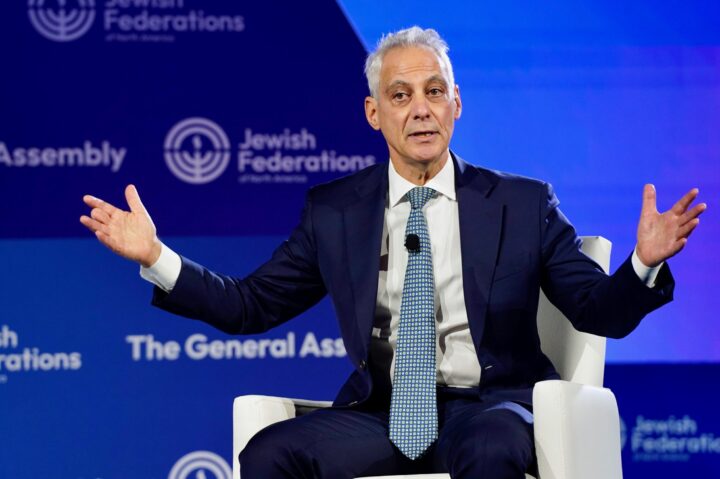
Jewish Federations of North America
Rahm Emanuel speaks at the Jewish Federations of North America's 2025 General Assembly opening plenary on Nov. 16, 2025.
Last November, Rahm Emanuel, the tough-talking Democratic operative and prospective presidential candidate, took the stage of the Jewish Federations of North America’s annual conference in Washington to deliver a blunt word of warning about Israel’s declining reputation in the United States and around the globe.
“I don’t mean to be the party pooper, but look, this is not going to be helpful if we’re not going to be honest with each other,” he said on an opening panel, urging the crowd to reckon with a marked downturn in support for the Jewish state over its war in Gaza, particularly among younger voters. “Israel is extremely unpopular.”
Emanuel, a veteran Jewish politician and party official who had recently concluded a tour as U.S. ambassador to Japan in the Biden administration, acknowledged his message might not ingratiate him to the thousands of Jewish communal leaders in the audience who were no doubt deeply familiar with the issue he was highlighting.
“This may be the last time I’m asked to speak to you. I get it,” he said with a hint of indifference. “But we have to be honest about the task we have” for those “who believe that there is something special” to the U.S.-Israel relationship. “We have our work cut out, and it’s not here to get applause,” he told the crowd.
In hindsight, Emanuel’s frankly worded comments marked something of a turning point in his approach to Israel and the Jewish community, foreshadowing more recent remarks in which he has voiced harsh criticism of the country’s military tactics in the wake of Hamas’ Oct. 7 terror attacks and championed new policy proposals against American military aid to Israel.
Yet even as he builds a profile as a potential candidate willing to tell the Democratic Party hard truths and challenge orthodoxy on a range of issues from trans rights to child social media bans to age limits for politicians, Emanuel, 66, was reticent in exploring his views on Israel in more depth during an interview with Jewish Insider, which he had resisted for nearly a month.
“What I said couldn’t have been clearer,” he told JI last Thursday, referring to his recent comments on “Real Time With Bill Maher” calling for an end to U.S. military aid to Israel that raised eyebrows in the Jewish community. “There will no longer be U.S. taxpayer subsidies for the purchase of U.S. military equipment. Israel will be like every other ally. They can buy what they want, and they have to live within the restrictions.”
“You can decide to slice it, dice it, but that’s what it is,” he said.
While U.S. military funding to Israel has increasingly faced pushback in the Democratic Party, particularly on the far left, Emanuel’s argument that Israel no longer needs the sort of special treatment that he helped promote in the Obama White House has been striking to watch precisely because he has long been a staunch defender of the Jewish state and its founding ideals.
Emanuel, whose middle name is Israel and who speaks fluent Hebrew, holds a uniquely personal connection to the Jewish state. His late father, an Israeli immigrant born in Jerusalem, served in the Irgun, the Zionist paramilitary force that fought for Israeli independence. As a child, he spent summers in Israel and later volunteered as a civilian assistant to the Israel Defense Forces during the Gulf War. His son celebrated his bar mitzvah in Israel.

Emanuel, a moderate former congressman and mayor of Chicago, pointed out in the interview that Israeli Prime Minister Benjamin Netanyahu had himself proposed winding down U.S. military aid over the next 10 years, saying in January that the country had “come of age” and “developed incredible capacity” to continue on its own.
Emanuel, however, said that he would instead suspend the assistance “immediately,” characterizing his position as “part of an overall policy” tied to Israel’s strategically secure position in the region as well as its political isolation on the world stage — both of which he argued have never been greater than now.
“If you or anybody thinks you’re going to continue the American taxpayers paying for this, good luck passing that in the U.S. Congress. You’re asking a president of the United States to spend X amount of political capital to do something that even Israel’s own prime minister acknowledged isn’t going to happen,” he said, referring to continued U.S. military aid.
The Jewish state “has made a decision to only lean on its defense and not lean on its diplomatic front,” he told JI, adding that Netanyahu had chosen to “walk away” from pursuing a two-state solution, support for which has declined in Israel since the Oct. 7 attacks and ensuing war in Gaza.
In his view, the U.S. should continue to stand with Israel only if its efforts in the region help contribute to peace. “Every risk you will take, the State of Israel takes, for peace, then America will stand by you,” he said. “We understand there’s risks. We have stood by Israel through thick and thin.”
“But,” he said, “when one friend in that relationship abandoned something that’s contrary to our interests and contrary, in my view, also to Israel’s interests,” it is reasonable, he suggested, to rethink that alliance.
“There will no longer be U.S. taxpayer subsidies for the purchase of U.S. military equipment. Israel will be like every other ally. They can buy what they want, and they have to live within the restrictions,” Emanuel said of his vision of the future of military aid to Israel.
His comments indicate that he is now embracing a fundamental reassessment of the U.S.-Israel alliance, abandoning even the pretense of tough love that once characterized his approach, among other moderate voices in the Democratic Party.
For example, Pennsylvania Gov. Josh Shapiro, a centrist Jewish Democrat who is also weighing a presidential campaign in 2028, recently reiterated his support for continued U.S. aid to Israel but said that it should be seen as “leverage” to exert pressure over the country’s use of American-made weapons.
“Rahm’s move tells you a lot about the politics of the Democratic Party on Israel now. And that is a sign of how Israel’s image has changed in the country,” said Dennis Ross, a former U.S. diplomat and Middle East negotiator who overlapped with Emanuel in the Obama administration.
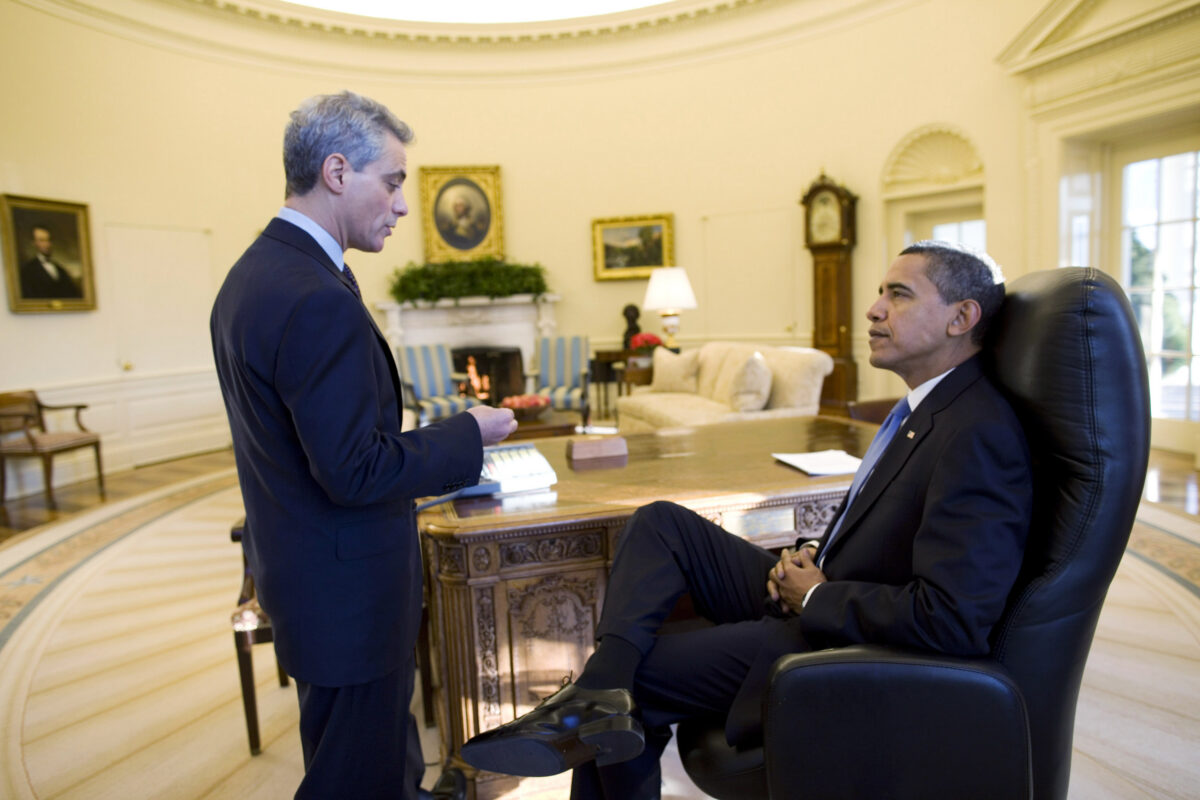
Despite his strong attachment to Israel, Emanuel is reckoning with a changing party no longer broadly sympathetic to the pro-Israel perspective that had long been central to his political identity, even as he has tussled with Israeli leadership during his time as a public figure.
Last Friday, for example, Emanuel signaled he would back Graham Platner, the far-left Senate candidate in Maine now poised to become the Democratic nominee, even as the Marine veteran has called to block U.S. military aid to Israel while facing controversy over a Nazi tattoo he recently covered up.
“Whether it’s people chanting ‘Jews will not replace us’” in Charlottesville, “or somebody bombing Gov. Shapiro’s home, or somebody painting Nazi insignia on my fence, or the candidate saying ‘I did not know that was a Nazi’” insignia on his chest, “we’re going to have to confront this,” Emanuel told JI the day before announcing his support for Platner, while touting his record of fighting antisemitism.
“I’ve dealt with it when I ran for Congress,” he said on the phone from Chicago, noting that he was outside an Anne Frank exhibition opening in his home city. “And I’ve also been upfront when I think a decision is going to lead to the strategic and diplomatic isolation of, not only the State of Israel, but, more importantly, the Jewish people.”
Still, Emanuel seemed reluctant and even somewhat frustrated to answer further questions seeking clarity on the implications of his new approach to Israel and how he arrived at his position. He refused to confirm explicitly, for example, if he would back defensive aid for Israel’s Iron Dome missile defense system, which has recently emerged as a subject of intense debate in some corners of the Democratic Party.
It is a significant contrast with where Emanuel stood during his time as Obama’s chief of staff. In the White House from 2009-2010, Emanuel was one of Obama’s top consiglieres on policies relating to Israel. He was involved in initial funding to boost Israel’s Iron Dome system, an effort that culminated in a 10-year memorandum of understanding between the two countries that provides $3.8 billion in annual aid through 2028, which the White House touted, at the time, as “the largest single pledge of military assistance in U.S. history.”
In 2009, Emanuel shared more reassuring words in his address to the JFNA’s annual gathering, praising Netanyahu while citing his own familial ties to Israel as well as what he had called the “privileged point of view” from understanding the Jewish state’s “value as a homeland.”
“Those who have questioned” whether the Obama administration’s opposition to Israeli settlement building in the West Bank and outreach to the Arab world “implies diminished support for Israel, that is not the intent,” he said, filling in for his boss. “It is not the case and it never will be. The truth is the opposite. Only through dialogue will Israel achieve the peace it seeks.”

Emanuel now takes a more jaundiced view of Israeli diplomacy, fueling his calls for an end to U.S. aid. “Under Prime Minister Netanyahu, in the last three years, you’ve lost Europe, you’ve lost the American public, and you picked up Somaliland,” he scoffed to JI, referring to Israel’s decision to formally recognize the secessionist region in the Horn of Africa last year. “As my grandmother would say, ‘Such a deal.’ That is your only diplomatic achievement.”
Julie Fishman Rayman, senior vice president of policy and political affairs at the American Jewish Committee, called Emanuel’s views “disappointing and worrying,” arguing that U.S. security assistance to Israel “is not just vital to deterring further attacks and ensuring the survival of the state of Israel, but is integrally tied to safeguarding American interests in the region.”
Emanuel argued that his position on U.S. aid is a logical extension of sentiments he had conveyed in 2009 while in the Obama administration, when he repeatedly clashed with Netanyahu over settlement expansion in the West Bank, which the White House cautioned would jeopardize prospects for achieving a two-state solution.
“I went straight to the prime minister to his face and said, ‘What you’re doing is going to lead to the great isolation of Israel,’” Emanuel recalled, noting, as he often does, that Netanyahu called him a “self-hating Jew,” underscoring the highly personal tenor of their long-testy relationship. “Look, I have a longstanding relationship,” he explained. “I’m honest about it.”
But even as he argues that Israel is today “a different country from a sense of wealth and capacity,” he has strained to harmonize the motives now animating his current approach. He has dismissed speculation over the sincerity of his stance and whether it is rooted in a good-faith view of Israel’s economic standing or if it is instead a more cynical political calculation tailored to a rising anti-Israel faction in the Democratic Party.
Though in contrast with high-profile voices on the far left, Emanuel has shied away from charged rhetoric about genocide in Gaza, saying it is a legal question, as well accusations that Israel had tricked President Donald Trump into war with Iran, which he says ignores U.S. agency in the conflict. He has said it is a “mistake” to restrict arms sales to Israel, suggesting that he is not aligned with related resolutions that were introduced by Sen. Bernie Sanders (I-VT) last month and notably drew backing from most Senate Democrats.
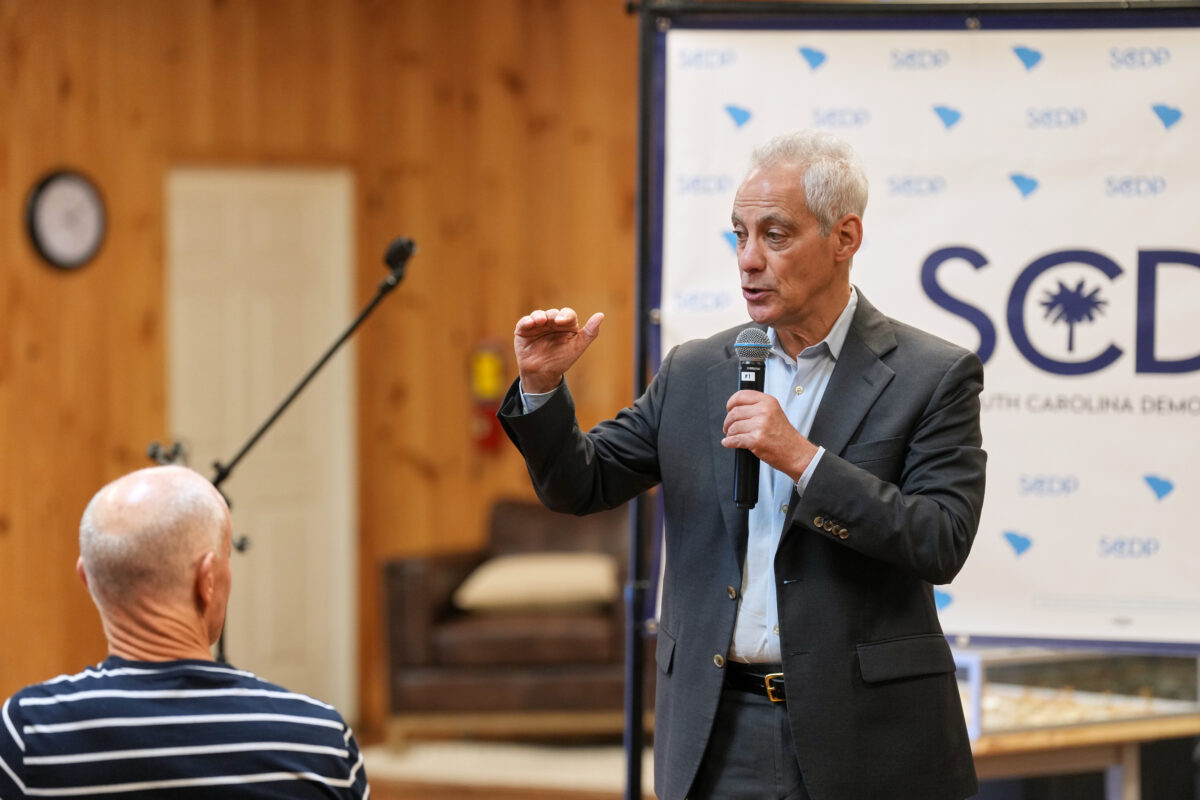
Emanuel’s allies said in recent interviews that they were not surprised with his approach, saying that he has been building to this moment for some time. “Do I agree with him? Not necessarily,” former Rep. Steve Israel (D-NY), who served with Emanuel in Congress, told JI. “But this is not a breakthrough position. He’s expressed those concerns for years.”
David Axelrod, a former chief strategist to Obama, likewise agreed in a text message to JI that “Rahm’s basic concerns about where Bibi is leading are not new,” using Netanyahu’s nickname. “Rahm, like a lot of us, has always believed a two-state solution was the only road to peace and Bibi has been deeply, irretrievably opposed and actively hostile to the notion.”
“You ask these questions like somehow I’ve changed. The prime minister used to articulate a two-state solution. He was for it. He’s the one that’s changed,” Emanuel said of Israeli Prime Minister Benjamin Netanyahu.
One prominent Jewish Democrat, who asked to remain anonymous to discuss a charged issue, called Emanuel’s stance a practical response that “takes the wind out of the sails of the far left and the far right,” which have politicized funding for Israel. “As long as we’re giving aid to Israel, Americans will feel like they have a say in Israeli policy and how that investment is managed.”
But if that is Emanuel’s aim, he has not made it clear. In conversation with JI, he was hesitant to clarify his own positions when pressed. Asked if he would back Iron Dome funding, he said he had been “part of the financing” for a “joint project” that he called “key for Israel’s security” when it was first developed with the United States.
He declined to elaborate further about such aid. “U.S. taxpayers should not be in the position of subsidizing a country,” he reiterated. “You know my history with the Iron Dome,” he said. “I’m done. I’ve answered it.”
Though some allies of Emanuel are willing to indulge his views more favorably than other 2028 prospects with thinner resumes related to Middle East policy, a range of Jewish and pro-Israel organizations are now pushing back on his recent turn against U.S. military aid.
“It’s in America’s interests to keep our word and help a democratic partner shield innocent civilians from missiles,” Deryn Sousa, a spokesperson for AIPAC, told JI, referring to the Iron Dome. “Reneging on the Obama administration’s signed agreement with our closest ally in the Middle East would send a devastating message to our allies, empower our enemies and do nothing to advance peace.”
Brian Romick, president of Democratic Majority for Israel, said that “Israel’s situation is not comparable to our other close allies.”
“Unlike Japan, South Korea and Germany, Israel does not have permanent U.S. troops on the ground,” he told JI recently. “It’s also surrounded by enemies who actively want to wipe it off the face of the earth. U.S. security assistance reflects that reality and the significant strategic benefits the aid provides.”
Michael Makovsky, president and CEO of the Jewish Institute for National Security of America, told JI in a recent interview that he disagreed with Emanuel, even as he acknowledged the sentiment as a “legitimate view.” Still, he added that it is “in the U.S. interest” to continue providing military aid to Israel, “which anyway all goes to buying U.S. weaponry.”
Even some pro-Israel Democrats sympathetic to Emanuel and his perspective said his comments on military aid raise more questions than they answer. One influential Jewish Democrat who has long been acquainted with Emanuel, speaking on the condition of anonymity to address a sensitive topic, expressed concerns that ending aid to Israel could stoke further calls from the far left to condition military funding or block future weapons sales outright.
For his part, Emanuel avoided commenting on the question of Israel’s qualitative military edge, which the U.S. is legally obligated to ensure but allies say could suffer without military aid. “I feel like we’re taking the same question from 50 angles,” Emanuel told JI. “I want Israel to fight for peace the way it’s proven that it’s fought in the last three years. That’s what’s missing,” he said last week.
“You ask these questions like somehow I’ve changed,” Emanuel said earlier in the call. “The prime minister used to articulate a two-state solution. He was for it. He’s the one that’s changed.”
The Iowa congressman championed two amendments to the NDAA that expand and build on collaboration with Israel
Bill Clark/CQ-Roll Call, Inc via Getty Images
Rep. Zach Nunn (R-IA) arrives for the House Republican Conference meeting in the U.S. Capitol on Wednesday, December 10, 2025.
At a time when an increasingly vocal minority on the right is questioning the future and the benefits of the U.S.-Israel relationship, Rep. Zach Nunn (R-IA) led a pair of amendments to the 2026 defense policy bill aiming to expand the relationship, with a particular focus on new technologies.
Asked how he responds to those on the right who question the value of the relationship, Nunn, the chair of the Republican Study Committee’s national security task force, told Jewish Insider, “Israel is the lone bastion of democracy, freedom and Western values in a region where the U.S. has vital national security interests. For decades, Israel has been a strategic partner in kinetic and non-kinetic action against bad actors like Iran.”
He added that programs such as the ones he championed would prepare the U.S. for all manner of challenges.
“As our adversaries embrace low-cost options like drones and cyberwarfare, it’s more important than ever that we not only coordinate closely on joint security, but also on the underlying technologies that will define the next generation of conflict,” Nunn continued. “My amendments are about ensuring that partnership continues to evolve. They are strategic investments that strengthen American security, deter our adversaries and deliver real returns for U.S. taxpayers.”
Versions of the two NDAA amendments that Nunn led related to expanding military technology partnerships with Israel are included in the final version of the bill the House passed on Wednesday and the Senate is expected to pass next week. One encourages the Defense Innovation Unit to consider opening an outreach office in Israel to deepen ties to the Israeli tech industry, while the other expands U.S.-Israel partnerships in counter-drone efforts.
“Israel has been right there on the front line with our American troops every step of the way,” Nunn said, explaining that his amendments aim to examine “what the future of the relationship with Israel is going to be” and leverage Israeli and American innovations to improve U.S. defenses. He said the Pentagon has backed his initiatives and that it will help “bring a lot more of the innovators to the table,” particularly in drone technology, and improve supply chains.
He said the technology also has dual-use capabilities that can contribute to agriculture and manufacturing in his home state.
“This is a really good partnership. I think that’s going to be part of what you’re going to see in this conversation on [the new U.S.-Israel memorandum of understanding] going into 2026 and beyond,” Nunn said, when asked about how such initiatives could play into the future of the U.S.-Israel relationship as the two sides negotiate the next phase of U.S. aid to the Jewish state.
“Some of the solutions coming out of [the U.S.-Israel partnership] — whether it’s counterinsurgency tactics, whether it’s border defense, whether it’s effective ways to find survivors, like what was discovered in the hostage rescue programs — these are things that can be replicated and return huge dividends to the United States,” Nunn said.
Though he said the U.S. had postponed the Iranian nuclear threat through its military action in June and Iran’s proxies have been weakened, he warned that the broader threat from Iran and its proxies remains. And he said that it’s “only a matter of time before they find an ability to bring those [nuclear] components back online.”
“We have an ongoing concern here between Hezbollah, the Houthis, Hamas, certainly, a radicalization which could retake over Syria in the near future,” Nunn said. “There’s a security envelope the United States is very concerned about, and candidly, there’s a threat vector here that’s real that every Iowan I talk to is concerned about. So this hits home on the direct home front of what we can do.”
In order to prevent Iran from rebuilding its nuclear capacity and delay a further conflict, Nunn, a former combat pilot who flew missions off the coast of Iran, said that the U.S. should focus on restricting Iranian financing and particularly target its “ghost fleet” of oil tankers; continue to build a coalition of both Arab and NATO partners to confront Iran and hold it accountable so that the U.S. does not need to shoulder the burden alone; and to empower the Iranian people.
“I think there has to be a conversation, as the president’s highlighted, with the Iranian people themselves,” Nunn said. “I don’t think the overwhelming majority of the Iranians want this regime to stay in power, and they may find that some of their best partners are actually other allies in the region. That means a return of Iran’s ability for self governance, an internal effort to get rid of the [Ayatollah], but one that immediately is welcome to the international community when they do that.”
Watch Netanyahu’s Speech Here
I am pleased to be joining you today, even if I’m doing it by remote
satellite.
I remember the Willard Hotel when I came to Washington the first time in 1982, so this is – 30 years or more have passed and we know how the world has changed, but throughout that I think there’s been this strong U.S.–Israel relationship that taken on these complex issues that we face, and Haim, I want to express to you my personal appreciation for the fact that you are sponsoring the forum to address this complexity.
And it is legion, because the Middle East is undergoing great turmoil, great violence, great instability. But in this turbulence, the special bond between Israel and the United States is the crucial anchor of stability. I didn’t say just a crucial anchor; I think it is the crucial anchor, and I want to thank President Obama for his commitment to our strong alliance. He has repeatedly said that Israel must have the right to defend itself, by itself against all threats. I think that’s a very important statement. It will follow us 360 degrees. And on President Obama’s watch, defense, security and intelligence cooperation between the United States and Israel – this cooperation has reached new heights.
I want you to know that we can have different perspectives. I understand that the United States is a global power with global responsibilities. And President Obama understands that the Jewish state is a beleaguered democracy in a hostile region, threatened like no other country on earth. And though we have the different perspectives of a superpower and a regional power, most of the time and on most things, if not the major things, we see eye-to-eye because we share common values, because we’re anchored in deeply democratic societies, because there is a special bond between the people of Israel and the people of the United States of America. Sometimes we differ because we have these different perspectives. But we always share our views honestly, sincerely and respectfully. That’s what good friends do, and that’s what we’ll continue to do.
Since President Obama’s historic visit to Israel, we have often spoken at length about the pressing issues of our times. I don’t know if there are any other two leaders in the world today who speak more frequently and more openly on such crucial matters. This communication serves both our countries well.
I also want to take this opportunity to praise Secretary John Kerry for his tireless efforts for peace. Tireless. I mean, this man doesn’t sleep. I spend so much time speaking or meeting with John Kerry that some of my cabinet colleagues are starting to get jealous. They complain that I only have time for him. Well John, you have my thanks and the thanks of the people of Israel for your dedication and your commitment to peace.
A moment ago I mentioned that the Middle East is going through unprecedented volatility, violence and instability. Out of all this uncertainty, one thing has become absolutely clear: The Israeli-Palestinian conflict is not the source of the region’s problems. Today, for all but a few diehards, that reality has finally debunked that myth. The tragedy in Syria, the terrorism in Iraq, the nuclear weapons program in Iran, the instability in North Africa, the Shi’ite-Sunni conflict, the scourge of violent Islamic radicalism – none of these is rooted in our dispute with the Palestinians.
This is not to say that peace with the Palestinians is not important. It’s vital – first and foremost for Israel and the Palestinians. Achieving a genuine and enduring peace between us is a strategic goal of the State of Israel and of my government. I’ve made hard decisions to further peace negotiations. I’m willing to make even harder decisions to achieve peace.
I hope President Abbas also is willing to do so because peace can only be and must be a two-way street. I am ready for a historic compromise that ends the conflict between us once and for all. My willingness to make peace flies in the face of a second persistent myth – that peace has eluded us because Israel is not willing to demonstrate the necessary flexibility. That is not true. Under successive governments, Israel has demonstrated the flexibility and the willingness to make painful concessions. These will require discussing the issues of territory and settlements.
But the core of this conflict has never been borders and settlements. It is about one thing: The persistent refusal to accept the Jewish State in any border. The real key to peace is Palestinian recognition of the right of the Jewish people to national self-determination in this part of the world. This conflict didn’t begin because we denied the right of the Palestinian people to a state of their own. We agreed to that in 1937 in the Zionist Movement’s response to the Peel Commission’s partition proposal. The Palestinians refused. We agreed to that again when we accepted the UN partition proposal in 1947 for a Jewish state next to a Palestinian state. The Palestinians again refused.
And in the 20 years since the Oslo accords, every time we’ve offered a historic peace with a Palestinian state next to a Jewish state, the Palestinians still refused. Six successive Israeli Prime Ministers, myself included, have been ready for a historic compromise with the Palestinians. But it was never enough. Because all the Israeli proposals, all the Israeli concessions, were based on one premise: That the conflict would be over, that it would end and that there would be no further Palestinian national claims on the Jewish state. No right of return. No irredentist claims. No residual claims of any kind. And that the Palestinians have so far been unwilling to give.
So the question shouldn’t be, why does Israel make this demand? The question should be: why do the Palestinians consistently refuse to accept it? After all, we recognize that in peace there will be a nation-state for the Palestinian people. And surely we are entitled to expect them to do the same: to recognize the nation-state of the Jewish people.
And my friends, we’ve only been around here for 4,000 years – well, a little less, 3,700 years. We have to have the Palestinians come to grips with the fact that there is going to be a Jewish state, a Jewish nation-state here next to their state. It’s not too much to ask. It’s the minimal requirement for peace.
But it’s not the only requirement, because I don’t delude myself. I think that any kind of peace we’ll have is likely, initially at least, to be a cold peace. And it must withstand the forces of terrorism and the ravaging forces of radicalism and all the forces backed by Iran and others that will try to unravel the peace. And therefore any agreement that we make must enable us to protect the peace or conversely to protect Israel in case the peace unravels. That often happens in our region. So there must be iron-clad security arrangements to protect the peace, arrangements that allow Israel to defend itself by itself against any possible threats. And those security arrangements must be based on Israel’s own forces. There is no substitute for that.
Ladies and gentlemen,
Our best efforts to reach Palestinian-Israeli peace will come to nothing if Iran succeeds in building atomic bombs. A nuclear-armed Iran would give even greater backing to the radical and terrorist elements in the region. It would undermine the chances of arriving at a negotiated peace. I would say it would undermine those peace agreements that we have already reached with two of our neighbors.
Just three days ago Iran’s representative to the U.N. reiterated the regime’s refusal to even recognize Israel. This came a fortnight after the ruler of Iran referred to Israel as a “rabid dog” and to us as not worthy of being called human. He said we were doomed to “failure and annihilation”. And earlier in November, Khamenei called Israel “an illegitimate and bastard regime”. So the Iranian regime’s pursuit of nuclear weapons makes these remarks more than a simple matter of “sticks and stones”. People tend to discount rhetoric from rogue regimes, from radical regimes. They said, well, it’s just talk, but talk has consequences. We’ve learned that in history, especially when the regime that makes these statements is actually building the capability to carry it out.
This same regime supplies its terrorist proxies, Hezbollah, Hamas and Islamic Jihad, with thousands of rockets, rockets that are aimed at Israeli civilians, rockets that are precision-guided munitions that are increasingly lethal and deadly. This is a regime committed to our destruction. And I believe there must be an unequivocal demand alongside the negotiations in Geneva for a change in Iranian policy. This must be part and parcel of the negotiations. In other words, I’m saying that what is required is not merely a shift and a diminution of Iran’s capability and elimination of its capability to produce nuclear weapons, but also a demand to change its genocidal policy. That is the minimal thing that the international community must do when it’s negotiating with Iran.
And as you all know, it’s not just about Israel. Iran continues to trample the rights of its own people, to participate in the mass slaughter in Syria, to engage in terrorism across five continents and to destabilize regimes throughout the Middle East.
I don’t think I can overstate, I don’t think any of us can overstate the Iranian danger. So for the peace and security of the world, Iran must not be allowed to maintain the capability to produce nuclear weapons – not today and not tomorrow. The world must not allow Iran to be a threshold nuclear weapons state with the option to cross that threshold at a time of its choosing. Therefore, unlike the recent interim deal, any final deal must bring about the termination of Iran’s military nuclear capability.
I have expressed my concern since before Geneva that the sanctions would begin to unravel. I heard today that Iran’s president said that in fact the situation in Iran economically is already markedly improved since the accords were announced. They haven’t even been put in place yet. So steps must be taken to prevent further erosion of the sanctions. Because ultimately, the sanctions remain an essential element of the international effort to compel Iran to dismantle its nuclear military infrastructure: to take apart the centrifuges; to tear down the heavy water reactor; to eliminate the current stockpiles of enriched uranium; to cease the development of ballistic missiles and the work on weaponization, which by the way the Geneva agreement does not address. None of these things that Iran insists it must have – none of them is necessary for a peaceful nuclear program.
So while Israel is prepared to do what is necessary to defend itself, we share President Obama’s preference to see Iran’s nuclear weapons program end through diplomacy. But for diplomacy to succeed, it must be coupled with powerful sanctions and a credible military threat. Now let me repeat that: A diplomatic solution is better than a military option. But a military option is necessary for diplomacy to succeed, as are powerful sanctions.
We all agree that after a couple of years of tough sanctions, Iran finally began to negotiate seriously. Because of the pressure, what seemed impossible yesterday became possible today. We should not assume that more and tougher sanctions won’t lead to a better deal. What seems impossible today could become possible tomorrow.
My friends,
Preventing Iran from achieving a nuclear weapons capability is the paramount challenge of our generation because a nuclear-armed Iran would literally change the course of history. It would threaten the peace and security of us all by arming the world’s most dangerous regime with the world’s most dangerous weapons.
I think we’ve learned from history that regimes with unlimited appetites act out their fantasies and their made ideologies when they think they have the weapons of mass death or at least incalculable power. That’s what usually happens. Such power in the hands of such regimes unleashes the worst ambitions. It’s not that they don’t have diplomats – they do. They have diplomats, some of them even wear ties. They might speak English and they might make PowerPoint presentations where in the past they just spoke English and they spoke reasonably well. But when the powers behind the throne, the power on the throne is committed to a radical ideology and pursues it and talks about it again and again and again, then I say: Beware. We’ve learned in our experience, the experience of the Jewish people, to take seriously those who speak about our annihilation, and we will do and I will do what is necessary to protect the Jewish state and the future of the Jewish people.
Our best efforts, mine and those of President Obama, have yet to achieve the desired results. The jury is still out. Iran is perilously close to crossing the nuclear threshold. History will judge all of us on whether we succeed or not in rising to meet this greatest of all challenges.
President Obama and others have called the United States the “indispensable nation”. I agree. I believe though that in meeting this supreme challenge, Israel and the United States form the indispensable alliance. We will continue to work together to strengthen that indispensable alliance for the sake of peace, security and our common future.
Thank you all and good luck.
Please log in if you already have a subscription, or subscribe to access the latest updates.
 Continue with Google
 Continue with Apple