


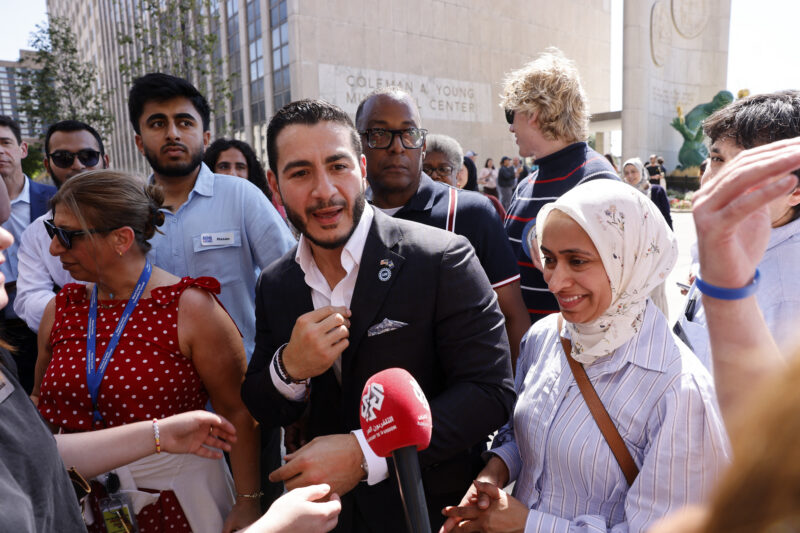

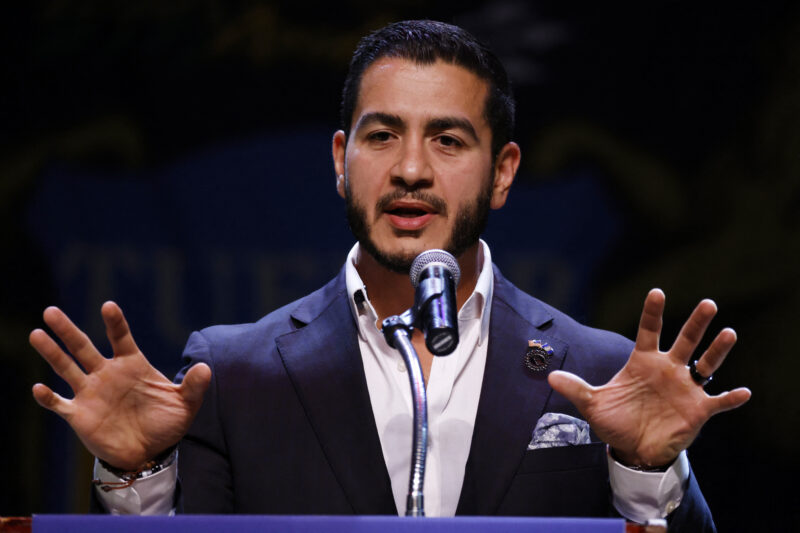
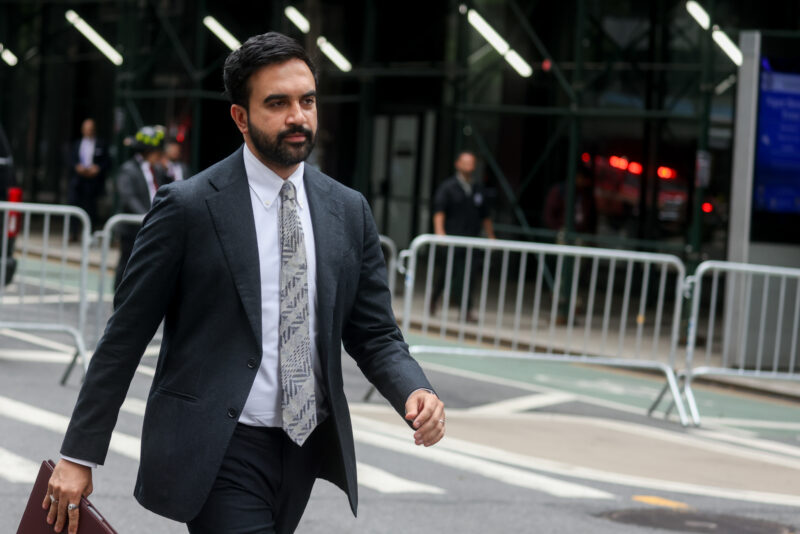
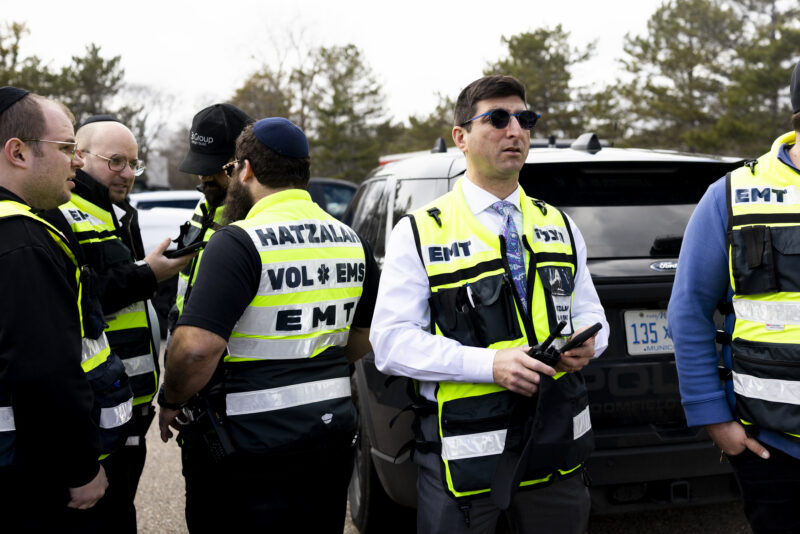
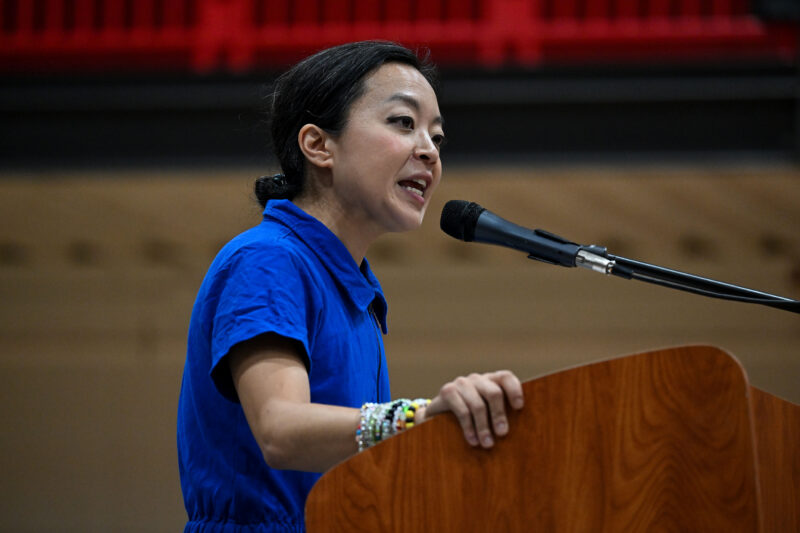



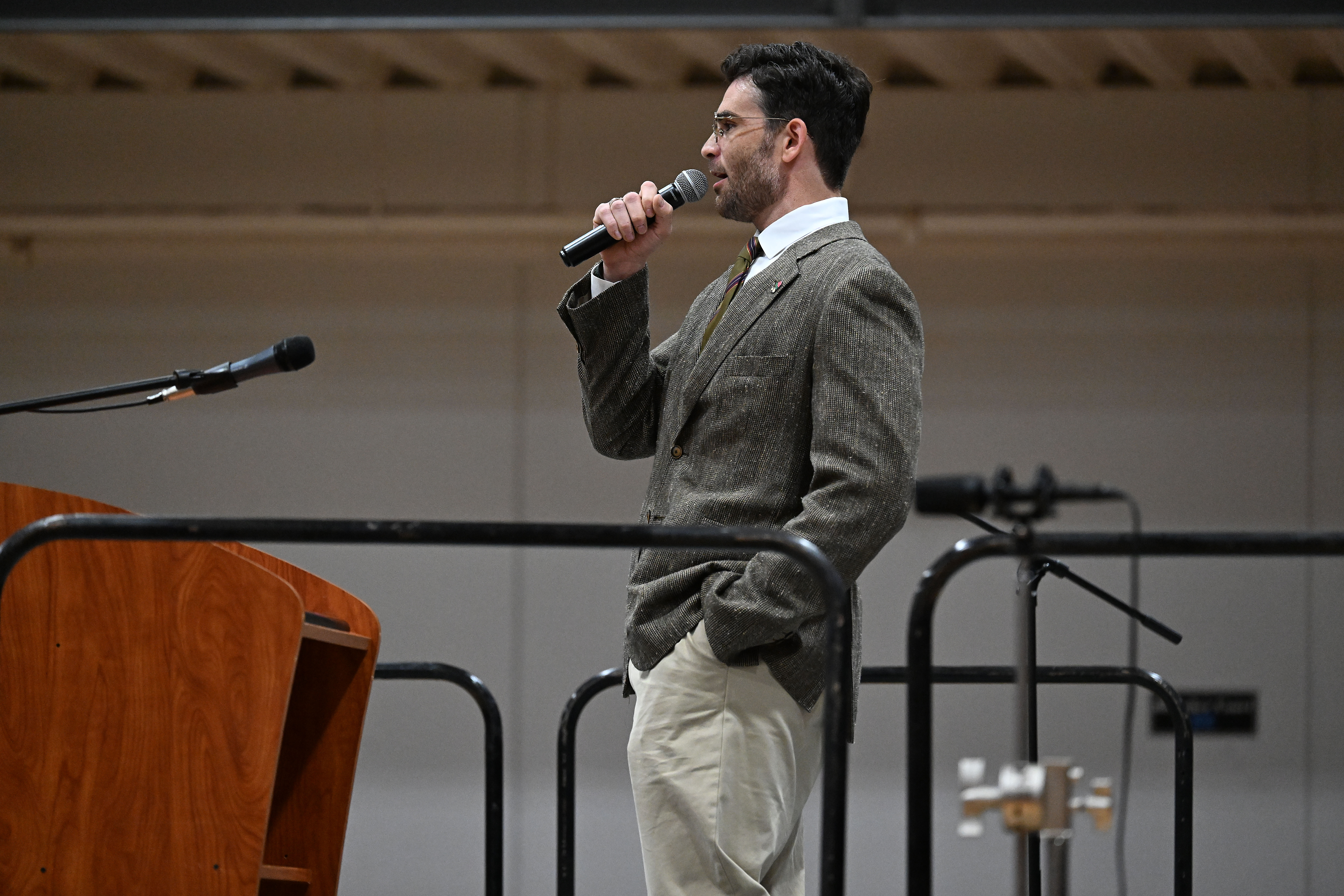




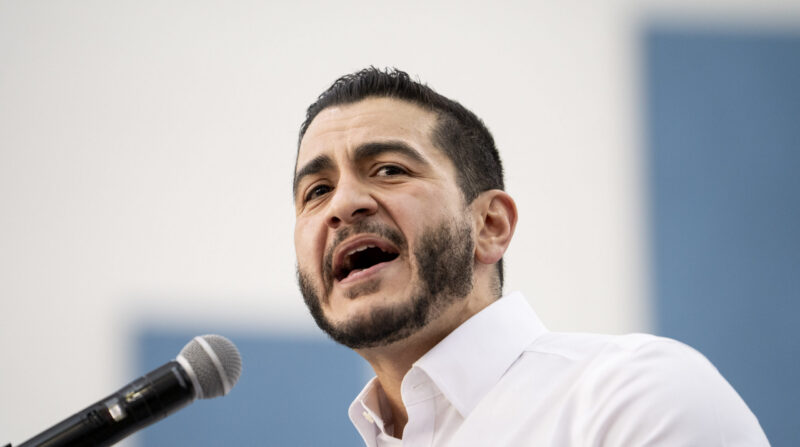
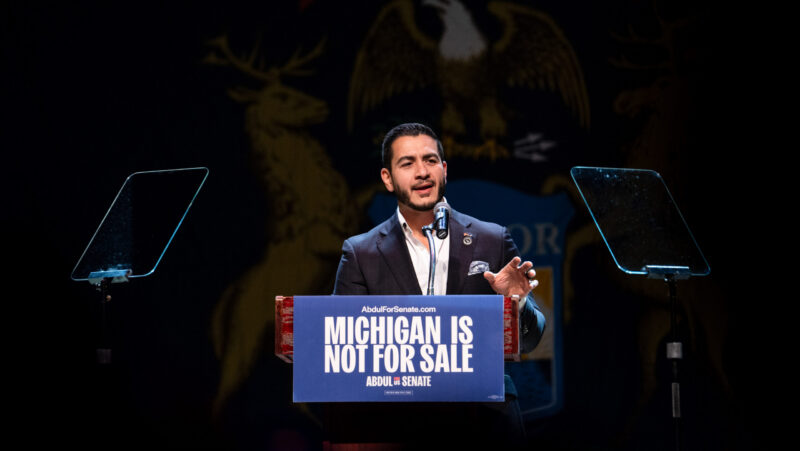



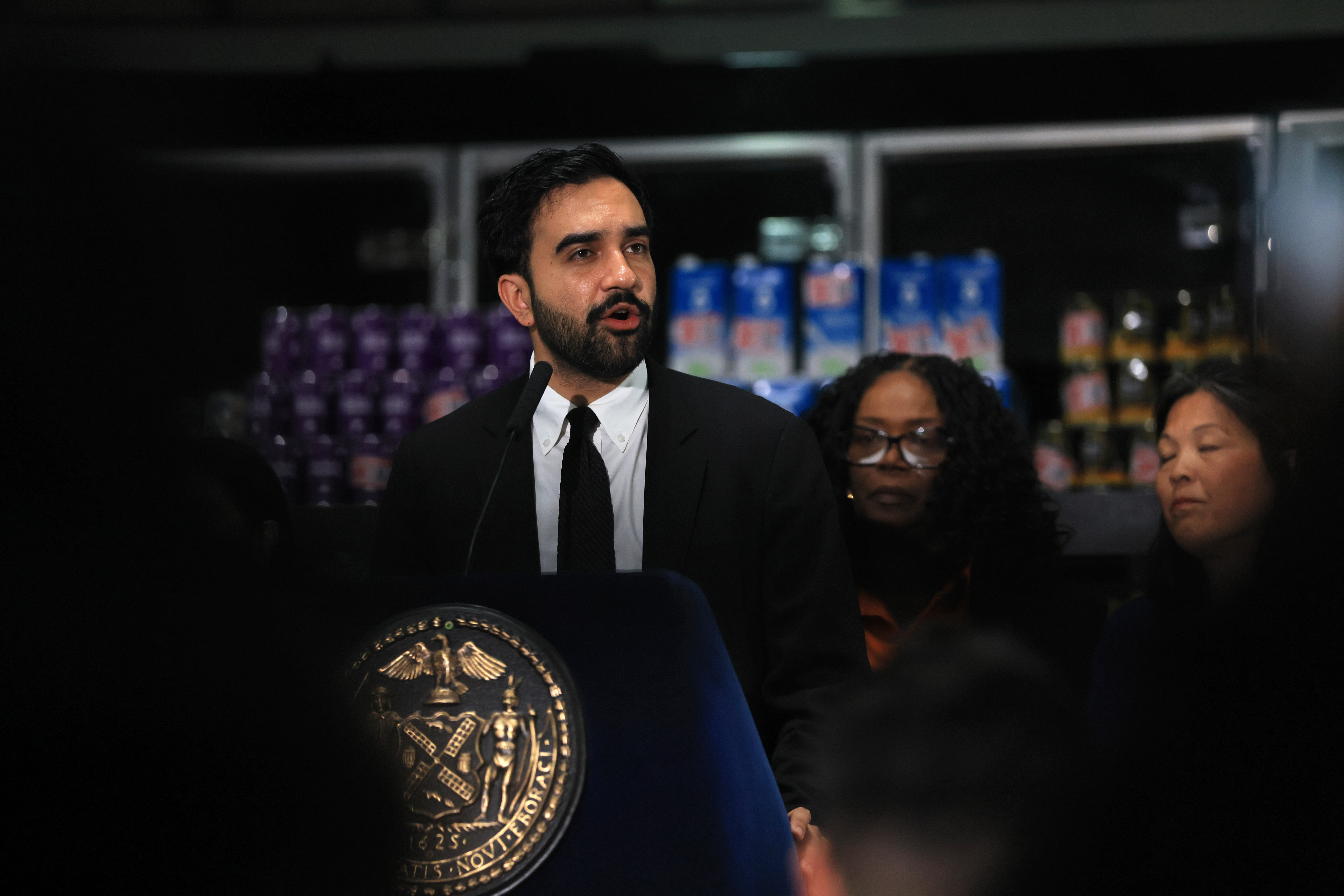



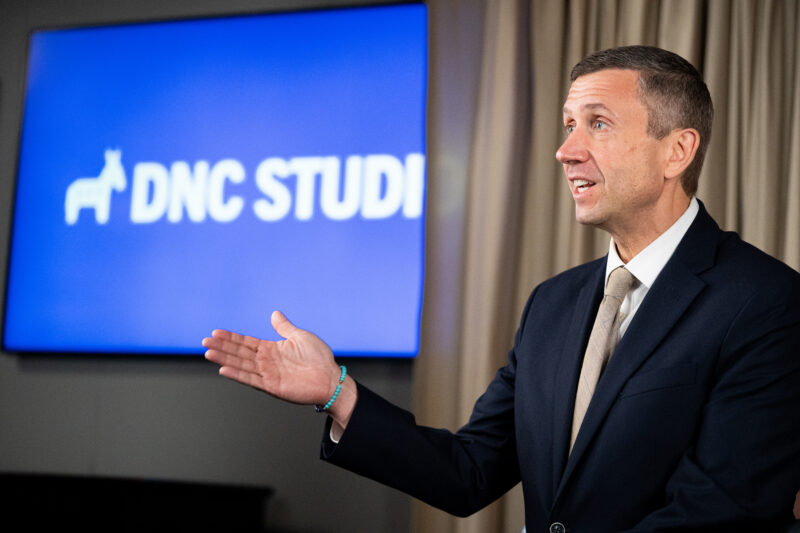
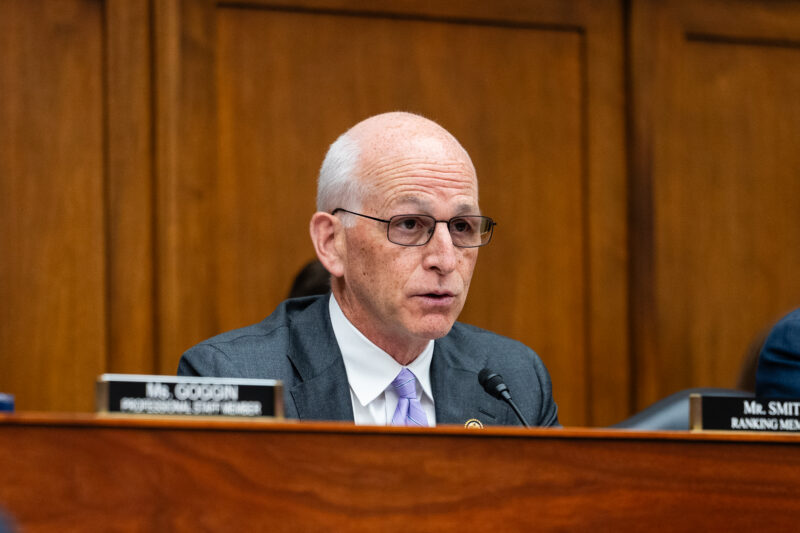


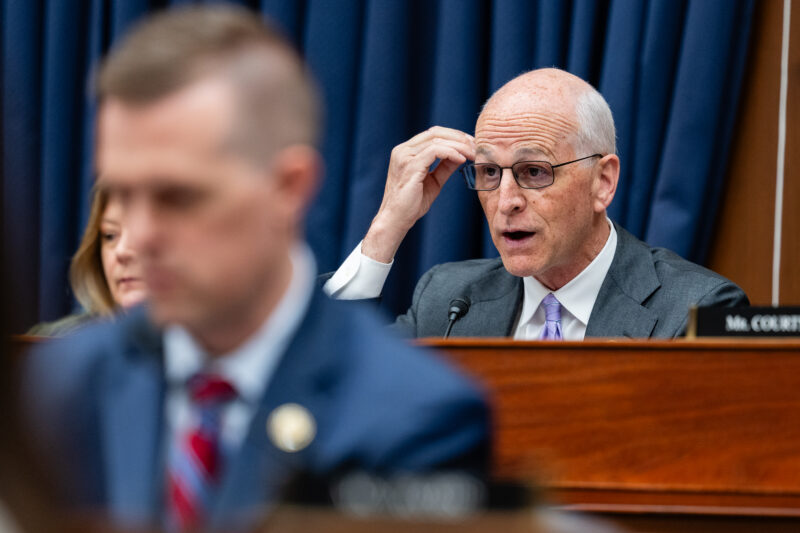










Scholten, a Democrat, also called out Piker for targeting state Sen. Jeremy Moss, a Jewish Democratic congressional nominee in Michigan
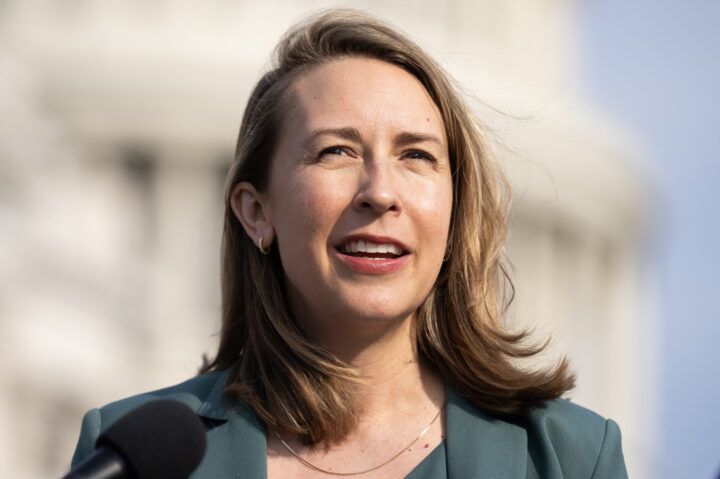
Tom Williams/CQ-Roll Call, Inc via Getty Images
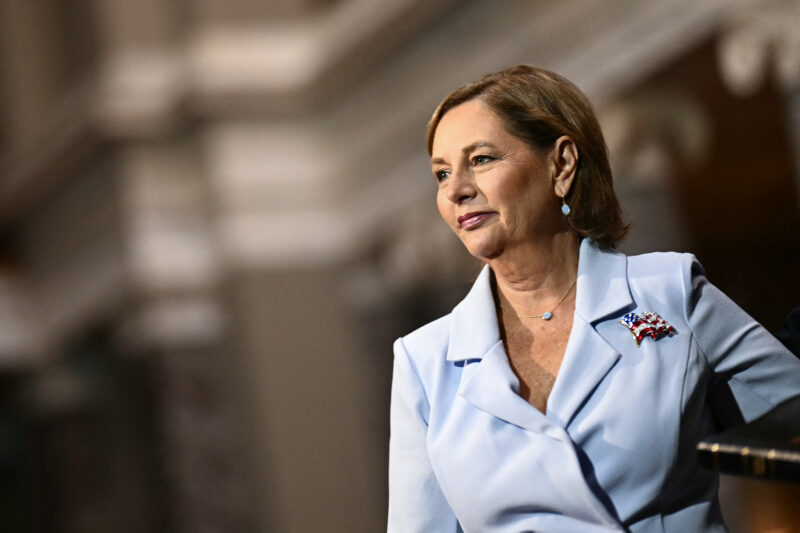
Rep. Hillary Scholten (D-MI) speaks during a news conference outside the U.S. Capitol on March 26, 2026.


 Add JewishInsider on Google
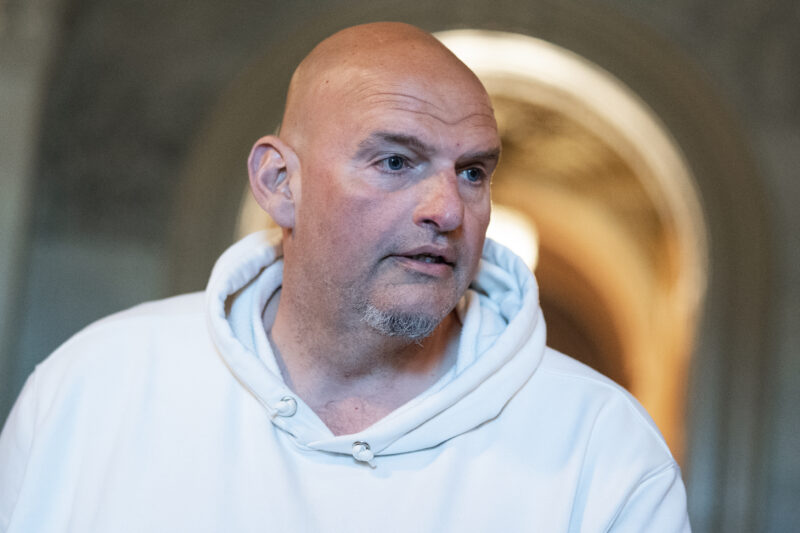
Rep. Hillary Scholten (D-MI) on Monday condemned antisemitic streamer Hasan Piker for comments suggesting that Jews supporting Israel are inviting violence against themselves, and for targeting Democratic Michigan state Sen. Jeremy Moss by name.
Moss last week condemned individuals circulating an unsourced and undated audio clip claiming to depict him expressing his fealty to Israel, which Moss has said is fabricated. During a stream last week, while making those comments about antisemitism, Piker displayed posts about and images of Moss from the antisemitic account TrackAIPAC, including an excerpt from the allegedly fabricated audio clip.
“Hasan Piker’s calls for violence against American Jews, and directly naming a Michigan elected official (and future Congressional colleague) Jeremy Moss are unacceptable. Full stop,” Scholten said on X. “Piker is a hack who thrives on hate, shock and awe because he lacks substance. It’s dangerous for everyone. We should all be calling out this disgusting rhetoric so it loses its grip on our politics once and for all. It has no place in Michigan, and no place in our country.”
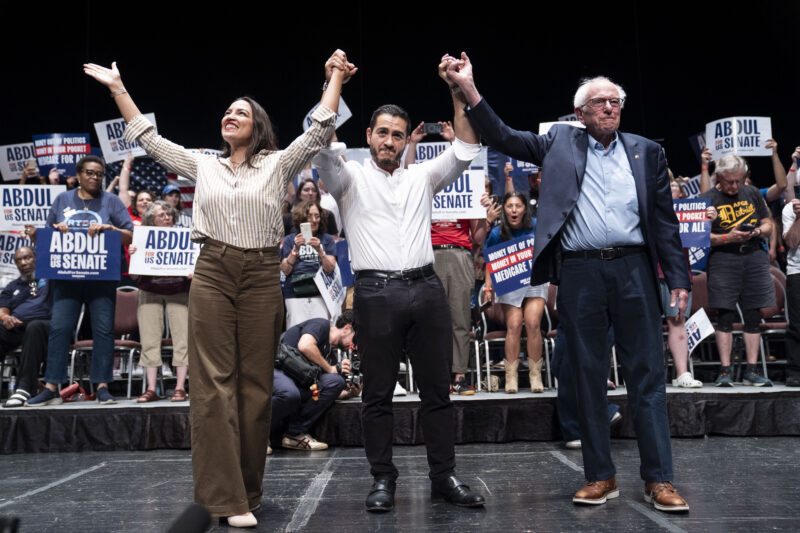
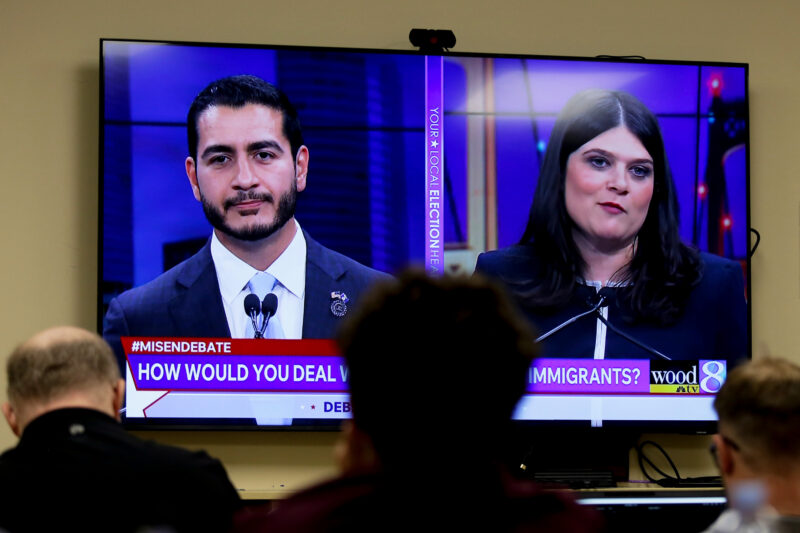
Scholten had previously criticized Democratic Senate candidate Abdul El-Sayed for campaigning with Piker, and said, prior to the primary, that she would not commit to voting for El-Sayed in the general election.
Scholten is one of several elected leaders who has condemned Piker’s comments — though most of the controversial streamer’s allies and supporters have been quiet so far.
Rep. Ro Khanna (D-CA), who has previously appeared on Piker’s show and said he was “proud” to do so, rejected the streamer’s comments about pro-Israel American Jews in a statement to Jewish Insider on Monday.
“Antisemitism is a centuries-old, ugly bigotry. It must be condemned unequivocally. Jews are not the cause of it. Neither are people who support Israel. Antisemites are to blame. That’s it,” Khanna said.
“The only one inciting violence against American Jews is Piker and his rhetoric,” Rep. Josh Gottheimer (D-NJ) said on Sunday. “For the future of our party, Democrats have to call out his hate and condemn these dangerous views. Anyone campaigning with him is part of the problem.”
Rep. Mike Lawler (R-NY) said Piker is a “threat to America.”
“A rich, entitled piece of sh*t who promotes socialism but doesn’t practice it,” Lawler said. “He believes America deserved 9/11, mocks a public assassination [of conservative commentator Charlie Kirk], and believes Jews should be killed. Anyone who supports him is unfit for public office.”
Piker: ‘I don’t know how people don’t recognize how dangerous this predicament is, how dangerous this is for Jews’
Sam Barnes/Web Summit via Sportsfile via Getty Images
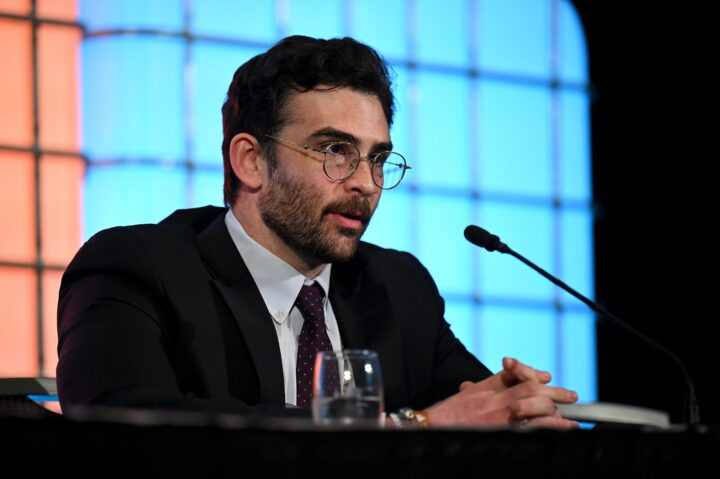
Hasan Piker during day two of Web Summit Vancouver 2026 at Vancouver Convention Centre in Vancouver, Canada.
Antisemitic social media influencer Hasan Piker, who has campaigned with a number of progressive Democratic candidates this year, said on his Twitch stream last week that American Jews who express support for Israel are inviting violence against themselves.
In his commentary, Piker added that Jews who tie their “entire identity” to Israel, which he referred to as “Jewish ISIS,” are “making antisemitism worse.”
“People don’t f*** with Israel any longer,” Piker said two hours into his nearly seven-hour stream on Thursday. “If Jews in America keep putting this idea out there that they are singularly invested in Israel, eventually someone’s going to come around and take action, not against the State of Israel, mind you, but against American Jews.”
“I don’t know how people don’t recognize how dangerous this predicament is, how dangerous this is for Jews,” Piker continued. “You’re running around basically tying your entire identity to a country that inevitably will be seen as Jewish ISIS and you’re saying, as Jews, this is all we care about. You’re making antisemitism worse.”
Piker has a long-standing history of antisemitic rhetoric — including justifying Hamas’ Oct. 7, 2023, terrorist attacks and calling Orthodox Jews “inbred,” a comment he recently defended in an interview with the far-left outlet Zeteo: “I have a policy of using pejoratives when describing any kind of like ethno, racial supremacist groups,” he said. He has also stated that he would “vote for Hamas over Israel every single time,” describing Hamas as “a thousand times better than a fascist settler colonial apartheid state.”
Despite the long record of extremism, the far-left streamer has been invited to speak recently at several high-profile events, including the College Democrats of America’s convention last month.
Piker emerged as one of Democratic Michigan Senate candidate Abdul El-Sayed’s most prominent surrogates in the race, appearing alongside him in the campaign’s closing days as the primary neared. El-Sayed has come under fire for his refusal to acknowledge Israel’s right to exist and comments that appeared to justify an attempted terrorist attack at a Detroit synagogue earlier this year.
There’s widespread interest within the Jewish community to develop efforts to counter the growing populist rage and anti-Jewish hate, city by city

Getty Images
Human crowd forming a big David's star on blue background.
Until recently, the political strategy of the American Jewish establishment could be summed up in two ways: Elect pro-Israel lawmakers to Congress and, at a much smaller scale, educate state and local officials about Jewish values and causes.
But a new model of Jewish political engagement is emerging to counter growing populist angst and surging antisemitism across the political spectrum: local efforts focused on school boards and city councils and statehouses.
These Jewish activists are not shying away from the messy reality of politics: They aren’t here to make friends with everyone, acknowledging that not everyone is an ally. Their goal is to offer support — through door-knocking, organizing and their checkbooks — to candidates who have stood by the Jewish community in the post-Oct. 7 political firestorm, and to try to unseat those who have not.
If you want to make a difference in the actual day-to-day lives of Jewish Americans, these activists argue, the place to do so is not Congress. It’s Sacramento, or Harrisburg, or the local Democratic Party committee meeting up the street.
“All of these groups are starting to pop up because we realize that the infrastructure that the community has had in the past isn’t enough and isn’t working,” said Stefanie Clarke, a political strategist in Colorado who co-founded the Colorado Jewish Action Alliance.
Like nearly all of the groups now operating in local politics, COJAA was born after the Oct. 7, 2023, Hamas terror attacks, when municipal governments in the U.S. became the newest front in Israeli-Palestinian culture wars. Anti-Israel rhetoric that often veered into outright antisemitism could suddenly be heard regularly in city halls and state legislatures. People who were elected to office because of their views on bike lanes or the environment were suddenly being pressured to weigh in on a contentious issue that originated thousands of miles away.
By law, tax-exempt nonprofits cannot engage in the political system. But a growing consensus is emerging that the apolitical approach necessarily adopted by the Jewish philanthropic world is not enough to address the intense partisanship of the moment, where incendiary antisemitic rhetoric has seeped into all levels of the political system.
In places including Atlanta, Denver and Pittsburgh, first-time Jewish activists such as Clarke are responding with grassroots initiatives like COJAA. Elsewhere, existing Jewish communal institutions are incubating new political organizations that they are spinning off as independent entities — for example, in San Francisco, where the local Jewish Community Relations Council created an affiliated advocacy organization called Bay Area Jewish Action (BAJA).
“We are seeing an increasingly unhinged and violent-prone mob challenging elected officials for standing with the Jewish community, and so there is a risk in standing with us, however unacceptable that reality is,” said Tyler Gregory, the CEO of JCRC and executive director of BAJA. “We need to be able to do more than just verbally say thank you in a situation like that.”
What that looks like in practice differs from place to place. BAJA created a political network where members commit to donating a certain amount throughout the election cycle, and have opportunities to meet candidates in BAJA-organized forums.
Other efforts are bipartisan. COJAA endorsed 13 candidates in Colorado’s primaries this year, a mix of Democrats and Republicans. (The primary results were themselves mixed; seven of COJAA’s preferred candidates won.) Georgia Solidarity Network, based in Atlanta, sees its mission as educating lawmakers about the state’s Jewish community.
“Part of our theory of change is that you cannot meet the moment by just showing up in an election cycle and trying to get messaging out there,” Beacon Coalition founder Jeremy Kazzaz explained. “It requires people on the ground, and it requires conversations going all the time.”
“Our legislators are incredible. But our legislators are blueberry farmers and used car sales lot owners and small-time lawyers in tiny towns who have no familiarity at all with the Jewish community,” Georgia Solidarity Network co-founder Alli Medof told Jewish Insider. “We really recognized that there was a need for us as a community to have a strong voice and presence in the legislature and to represent the concerns of Jewish Georgians.”
In Pittsburgh, a group called the Beacon Coalition spent the past year recruiting moderate Democrats to run for local volunteer positions in official Democratic groups throughout Allegheny County. Forty aligned Democrats won their races for small neighborhood seats that play an outsized role in party endorsements.
“Part of our theory of change is that you cannot meet the moment by just showing up in an election cycle and trying to get messaging out there,” Beacon Coalition founder Jeremy Kazzaz explained. “It requires people on the ground, and it requires conversations going all the time.”
Each of these groups is independent, created and operated — and funded (for the most part) — locally. But they see an opportunity to connect with and learn from each other.
Schusterman Family Philanthropies, the philanthropic behemoth that supports liberal causes and pro-Israel groups, convened a gathering earlier this year that brought together dozens of activists in the burgeoning local Jewish political ecosystem.
“I’m deeply concerned about the rise in extremism that’s playing out in local politics,” the foundation’s senior director for U.S. Jewish grantmaking, David Rittberg, told JI. “I do think that Jewish community leaders as well as everyday Americans are waking up to the challenges that these dynamics are creating in a local political context.”
Schusterman’s involvement in this space is an indication that Jewish philanthropists are taking problems at the local level seriously. Rittberg declined to comment on whether Schusterman has given grants to any of the groups, but said the foundation sees its role as being “a connector.”
Many emerging local activists have looked to a group called New York Solidarity Network for advice. NYSN was formed in 2022 after New York City’s Democratic Socialists of America chapter began pressuring local candidates to pledge not to travel to Israel, a request that at the time was seen as radical but has since become the norm in many Democratic primaries in liberal urban areas.
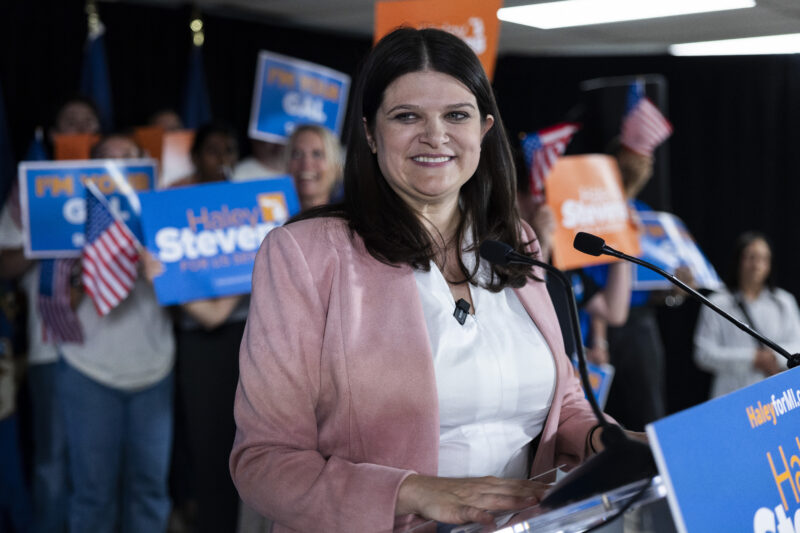
Sara Forman, the group’s founding executive director, advises them that money is not enough — a pointed message at a moment when, at the national level, AIPAC’s super PAC just spent tens of millions of dollars backing Rep. Haley Stevens (D-MI) in a failed Michigan Senate primary bid, and further damaged its image with Democrats in the process.
“DSA has been incredibly successful at organizing community and at making people feel like they are part of something,” said Sara Forman, founding executive director of NYSN. “I think in the Jewish community, having local organizations mimic some of the same practices of DSA is a good thing. Make people feel included. Make people feel like their voice counts.”
“You can’t build something inorganically. There has to be a reason for people to want to come out and attend events, and want to knock on doors and make phone calls and organize their synagogues,” said Forman, who stepped down from NYSN in January. “Check-writing isn’t what’s going to make the difference here.”
The goal, instead, is building up American Jews’ appetite for grassroots political organizing in support of Jewish causes and candidates who support them. That’s a different position than the one taken by AIPAC in recent years, which has invested at the federal level in high-dollar political fundraising. But when groups such as DSA are able to recruit eager volunteers to campaign for far-left officials and show up to public meetings to voice support for anti-Israel measures, Jewish activists increasingly see a need to fight fire with fire.
“DSA has been incredibly successful at organizing community and at making people feel like they are part of something,” said Forman. “I think in the Jewish community, having local organizations mimic some of the same practices of DSA is a good thing. Make people feel included. Make people feel like their voice counts.”
The success of a DSA-aligned faction in several major Democratic primaries this year has led many of these Jewish activists to now see their fight for communal safety as part of a larger battle within the party, about whether it will move left or to the center ahead of the 2028 presidential election.
“I think the overlap between folks who are concerned about fighting illiberalism, extremism, antisemitism and virulent anti-Zionism deeply intersects with those of us who want to strengthen moderate factions on both sides of the aisle, in particular for us on the Democratic side,” Third Way President Jon Cowan told JI. “A lot of folks are coming to realize that those fights deeply overlap.”
“We know that the next phase for us is focusing more on the creeping threat of DSA,” Medof, from Georgia, said. “The way we think about this work is that the sorts of things that we’re fighting for are not just about what’s good for Jewish Georgians. They’re good for Georgia overall.”
Last week, The New York Times outlined a new effort by the centrist Democratic group Third Way to push back against the growing appeal of DSA-aligned groups and policies within the party. Third Way President Jon Cowan told JI that the organization is, for the first time in its history, working with groups at the local level. Third Way gave a grant to the Beacon Coalition this year to support its work and help the organization expand to Cleveland.
“I think the overlap between folks who are concerned about fighting illiberalism, extremism, antisemitism and virulent anti-Zionism deeply intersects with those of us who want to strengthen moderate factions on both sides of the aisle, in particular for us on the Democratic side,” Cowan said. “A lot of folks are coming to realize that those fights deeply overlap.”
Building support for Israel is not what most of these groups see as their focus. They want efforts targeting Israel — like Boycott, Divestment and Sanctions campaigns — to fail, and for local governments to otherwise stay mum on one of the most intractable foreign policy issues in the world.
“We are about Jewish safety, security and engagement in civil life. We really don’t talk about Israel other than how the rhetoric around it endangers our community,” said Mindy Miller, a co-founder of the Colorado group.
Not that that has stopped opponents from trying to tar the groups as, essentially, mini-AIPACs.
“We’ve seen a trend with a very similar pattern of behavior targeting groups like Beacon, where there are Jewish Americans who are showing up in spaces as Jewish Americans and saying our community is important,” said Pittsburgh-based Kazzaz. “It’s a lot of boogeyman-ing, just name calling, ‘You’re a secret Republican.’”
Mostly, though, the new Jewish activists are finding curiosity, not animosity. People who are eyeing local positions are generally not running with Israel or Palestine as their top issue. But that doesn’t mean they don’t understand how thorny the discourse can be.
“One of the things we say is we will never cancel you. There are no stupid questions,” said Miller, from Colorado.
She wants to be a guide to help local politicians learn about the issues. And with financial and manpower resources that can help candidates in their campaigns, Miller hopes the Jewish community will now have a shot of being the first to reach those politicians.
The reality is that these candidates are politically problematic to the overall public for reasons that go far beyond their views on Jews or Israel
Mario Tama/Getty Images
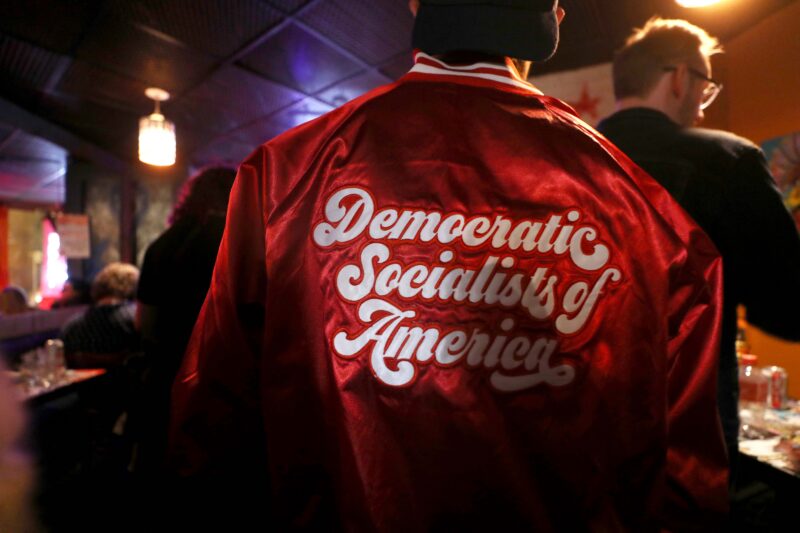
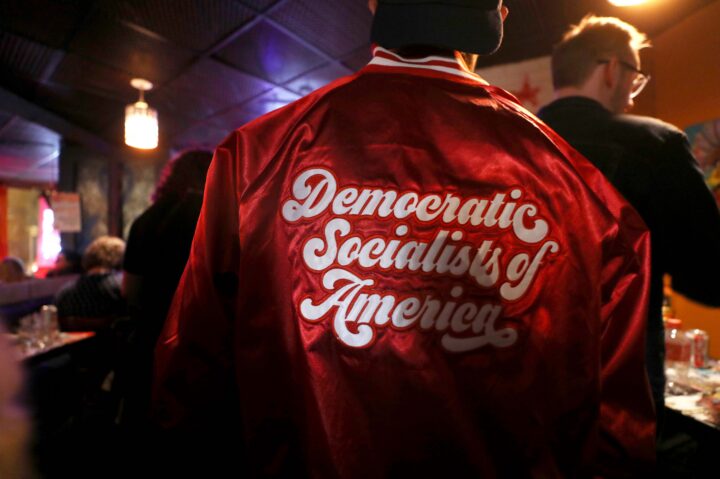
An attendee wears a jacket at an Iowa caucus watch party organized by Metro D.C. Democratic Socialists of America, on February 3, 2020 in Washington, DC.
One of the unsettling realities that American Jews have been learning throughout this election cycle is that antisemitic behavior and virulently anti-Israel rhetoric has become so normalized that it doesn’t register all that much politically anymore.
The early tell was discovering that New York City Mayor Zohran Mamdani’s involvement throughout his life in extreme anti-Israel activism didn’t impact his ability to win an election in the city with the largest Jewish population in the world.
Then we learned that disgraced former Maine Senate candidate Graham Platner’s Nazi tattoo — which he later covered up — made very little difference in his political standing in the battleground Senate race. It wasn’t until he was accused of rape that rank-and-file Democrats began to reconsider their support of him.
And today we’re grappling with the possibility that Michigan Senate candidate Abdul El-Sayed, who won’t acknowledge Israel’s right to exist as a Jewish state (like Mamdani before him), could prevail in a Democratic primary in a swing state.
Jews find themselves in the news often these days, and for that reason it makes sense to want to dwell on the extreme, often-antisemitic positions that these radical candidates have espoused.
But as we head into a general election where several far-left candidates will be testing their political viability in competitive states and districts against strong Republican challengers, it’s important to remember that their biggest vulnerabilities are on issues that don’t directly impact the Jewish community.
The reality is that these candidates are politically problematic to the overall public for reasons that go far beyond their views on Jews or Israel. The same Democratic Socialists of America (DSA) platform that rejects a Jewish state and condones terrorism also is one that envisions abolishing prisons and defunding the police and backs open borders.
DSA co-chair Megan Romer’s interview on “Fox News Sunday” last week where she enthusiastically endorsed all the exotic positions of the group’s national platform went viral — well beyond conservative media — because it was such a direct encapsulation of the ideas that these candidates actually believe.
DSA-aligned Wisconsin gubernatorial front-runner Francesca Hong, whose insurgent primary campaign hasn’t faced much scrutiny until recently, similarly struggled under basic fact-gathering interviews from Fox News and CNN.
In a similar vein, El-Sayed’s recent stumble when asked on CNN about his past support for defunding the police didn’t hurt him much in the Democratic primary. But you can bet his past views will be aggressively litigated in the general election, if he emerges as the nominee.
Unlike the deep-blue districts where DSA-aligned members have won primaries, Michigan and Wisconsin are shaping up to be clear tests of whether normie general election voters have turned so anti-establishment that they’re willing to back socialists and other like-minded allies to send a message against the party in power.
And if Republicans end up prevailing in an otherwise rough environment for their party, it’s going to be because their opponents’ far-left views on crime, taxes and border security matter a whole lot more to the average voter than their views on foreign policy.
With Graham’s death, one chapter in U.S.-Israel relations has closed. Now, Rahm Emanuel and Ro Khanna are jockeying to write the next

(Amir Levy/Getty Images)
US Senator Lindsey Graham (R-SC) attends a press conference on US-Israel relations on February 17, 2025 at the Kempinski Hotel in Tel Aviv, Israel.
In the span of five days, one of Washington’s most vocal champions of the U.S. relationship with Israel died, while two prospective 2028 Democratic presidential contenders traveled to the Jewish state to define their approaches to the country. Though a coincidence of timing, those events, when taken together, underscored something much more significant: the passing of one generation of American politics vis-a-vis Israel and the opening contest over what will succeed it.
The events of the last week have distilled concerns that have repeatedly emerged at Jewish and Israeli gatherings, over Shabbat meals and in breakfast meetings: As the far left gains traction within the Democratic Party, and as the isolationist right increasingly finds support among Republicans, what does that mean for American Jews and U.S. support for Israel?
Sen. Lindsey Graham (R-SC), who died suddenly on Saturday, represented a generation of politicians — across the political spectrum — for whom support for Israel was tied to deep, long-standing relationships with the Jewish state’s leaders, the belief in the country’s strategic positioning as a key ally and the ability of Israel’s friends in Washington to challenge Jerusalem without imperiling the relationship.
His death sent shockwaves across the Jewish community at a time when U.S. support for Israel — including among Republicans — is on the decline.
Sen. Ted Cruz (R-TX), speaking to JI earlier this week, described Graham as “a passionate and formidable defender of Israel” and noted that Israeli Prime Minister Benjamin Netanyahu “trusted Lindsey and listened to him.”
Cruz pointed out that “Lindsey would sometimes tell his friends messages they didn’t want to hear. Lindsey was not one to just blow smoke. He would tell people exactly what he thought, but that made him an incredibly effective advocate for Israel.”
Days before Graham died, former U.S. Ambassador to Japan Rahm Emanuel was in Israel, where he delivered a speech — his own version of tough talk to Israelis — at Tel Aviv University on the future of the U.S.-Israel relationship. Speaking to reporters ahead of his speech, Emanuel, who served as White House chief of staff from 2009-2010, said that declining U.S. support for Israel “is not a Democratic Party problem. This is an American problem, and a generational problem.”
Emanuel pointed to an Associated Press/NORC Research poll released last week that showed declining support for Israel across both parties in the wake of the war in Gaza — though the erosion was considerably more pronounced among Democrats. The survey, which was conducted last month, also found that 3 in 10 Americans — including 2 in 10 Republicans under the age of 45 — believe Israel committed genocide in Gaza.
Meanwhile, a new survey from the Pew Research Center released on Friday found Israel underwater with young Americans across the political spectrum. Just 12% of Democrats between the ages of 18-29 have a favorable view of Israel, the survey found. Among young Republicans, that number is higher — but not by much. Twenty-eight percent of Republicans ages 18-29 had a favorable view of Israel. Contrast that with the 75% of Republicans (and 47% of Democrats) above the age of 65 who have favorable views of Israel.
Views of Israelis themselves are only somewhat less negative, with 33% of those surveyed between the ages of 18-29 having a favorable view of the people of Israel — not the government. Among young Republicans, that figure is 42% — something that should trigger flashing warning lights among those who have long relied on the support of an aging generation of politicians and voters who share Graham’s pro-Israel disposition.
While the shift among Republicans is happening at a slower rate, movement in the GOP regarding Israel is apparent as the party’s “restrainers,” led by Vice President JD Vance, gain traction among young conservatives. As if to underscore the changing party dynamics, Politico yesterday reported on concerns among Republican Jewish donors over Vance’s approach to the Jewish state, citing his tough rhetoric toward Israeli leaders and support for diplomacy with Iran.
Separate from Emanuel’s trip, Rep. Ro Khanna (D-CA) also traveled to Israel last week, gaining attention for an incident in the West Bank in which local security forces stopped Khanna, who was accompanied by two aides and an activist with Breaking the Silence, after the congressman entered what had been until recently a closed military zone. He has since called for Israel to investigate the incident, even as Israeli officials denied elements of the congressman’s account. Khanna has not provided any evidence to back up his claim of being detained by settlers.
Speaking to The New York Times after he returned to the U.S., Khanna said, “Free advice to the Israelis: It’s not a good idea to detain long-shot presidential candidates. Not how you’re going to build good will with the next American president, whoever that is.”
In his public comments and meetings, Emanuel conveyed a desire to halt the growing daylight between future generations of Israelis and Americans. Khanna, who a decade ago was a staunch supporter of close ties with Jerusalem, has adopted a different political calculation, leaning into the growing anti-Israel sentiment in his party as a launching pad for a national campaign.
It’s no coincidence that two 2028 hopefuls chose to soft-launch their campaigns in Israel, conveying caution rather than camaraderie. It’s a sharp pivot from 18 years ago, when Barack Obama and John McCain — then their parties’ respective presidential nominees — each visited Israel in the run-up to the election, meeting with Israeli leaders and expressing support with the Israeli people.
If candidates used to travel to Israel to reassure both their constituencies and the Israeli populace of the strength of the U.S.-Israel relationship, the candidates traveling to Israel in 2026 are doing so to define themselves, and in the process treating the Jewish state as a test of political identity.
The sort of stalwart support of generations past is rapidly eroding, leaving pro-Israel Americans on both sides of the aisle battling strong headwinds as those who represent the future of their parties shift their approaches to the Jewish state. With Graham’s death, one chapter in U.S.-Israel relations has closed. Now, Emanuel and Khanna are jockeying to write the next.
Rabbis, historians and communal leaders told JI that the nation’s semiquincentennial offers an opportunity to celebrate America’s promise even as they confront the antisemitism and political currents challenging Jewish life today
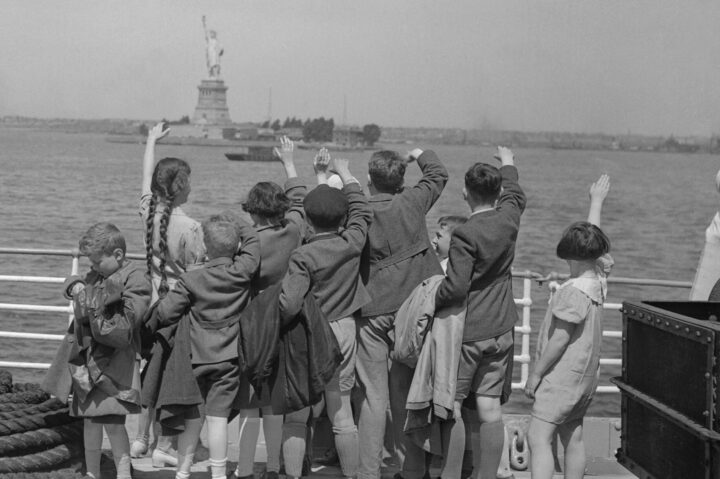
A group of young Austrian immigrants wave to the Statue of Liberty upon their arrival in America aboard the S.S. Harding. The fifty Jewish children, who were greeted by their new adoptive families, were fleeing Nazi persecution in their homeland.
In the run-up to America’s 250th anniversary, the Jewish community finds itself navigating a best-of-times, worst-of-times, head-spinning paradox — standing nervously between the promise of an ideal America and the peril of today’s America.
In conversation after conversation, Jewish thinkers who spoke to Jewish Insider about this unique moment expressed fear and concern about the increasingly precarious situation facing American Jews in one breath. In the next, they spoke glowingly about the unique gifts this country’s democracy has given to the Jews who live here.
In spite of this deep ambivalence, or perhaps because of it, the Jewish community is all-in on the 250th.
As one might expect of the city that arguably jump-started the American Revolution, no expense or antic is being spared to celebrate the country’s birthday in Boston. At the Esplanade, a park along the Charles River, comedian Jane Lynch is emceeing an evening of festivities that will feature musical performances by several Grammy winners. A revolutionary-themed drone show will be followed by a massive fireworks display with an orchestral accompaniment, all live-streamed on CNN. Revolutionary War re-enactors will, naturally, be on hand. (And playing the bugle.)
In the nearby suburb of Newton Center, Rabbi Benjamin Samuels of Congregation Shaarei Tefillah is devising a memorable July Fourth celebration, though without the theatrics that typically accompany the holiday. Independence Day falls on Shabbat this year, so the usual hubbub and pyrotechnics will be inaccessible for Orthodox Jews like Samuels who do not drive, cook or use electronics on the Jewish Sabbath.
Shaarei Tefillah congregants can expect something a little different. They will enjoy a July Fourth barbecue, though without the open flame; all the food will be grilled the day before and kept warm overnight. Brandeis professor Jonathan Sarna, the preeminent historian of American Jewish history and a member of Shaarei Tefillah, will deliver the sermon at Saturday morning services. Any kids who join their parents at synagogue will get a red, white and blue ring pop.
Samuels has lately spent a lot of time considering what it means to be a patriotic American — in particular, a patriotic American Jew — at a moment when large parts of the American Jewish community feel as though they are under attack. He recently edited an entire issue of an Orthodox journal, Tradition, on the topic.
Antisemitism is at levels not seen in generations. The future of the Jewish state has become a political lightning rod that is increasingly a decisive, and divisive, issue in major political campaigns. Eight in 10 American voters believe democracy in America is being threatened, according to a recent Georgetown University poll.
It’s a fraught time for American Jews to be throwing the country a 250th birthday party. Or, at least, it would be easy to think that.
But conversations with nearly two dozen rabbis, writers, historians and Jewish leaders from across the political and religious spectrum reveal a shared sense of hope in the American project — and a belief that this milestone semiquincentennial celebration presents a unique opportunity for American Jews to hold their heads high and reflect on what this democracy, even if flawed, has given to them.
“I think it’s the right thing to be patriotic and participate in a celebration,” Samuels told JI recently. “For all of us who put an Israeli flag, or a ‘We stand with Israel’ poster, or a blue or yellow ribbon around our light post the past few years, put an American flag on your lawn. Every synagogue should have a program on July Fourth, which is on Shabbos this year, dedicated to the American Jewish experience, and celebrate the semiquincentennial.”
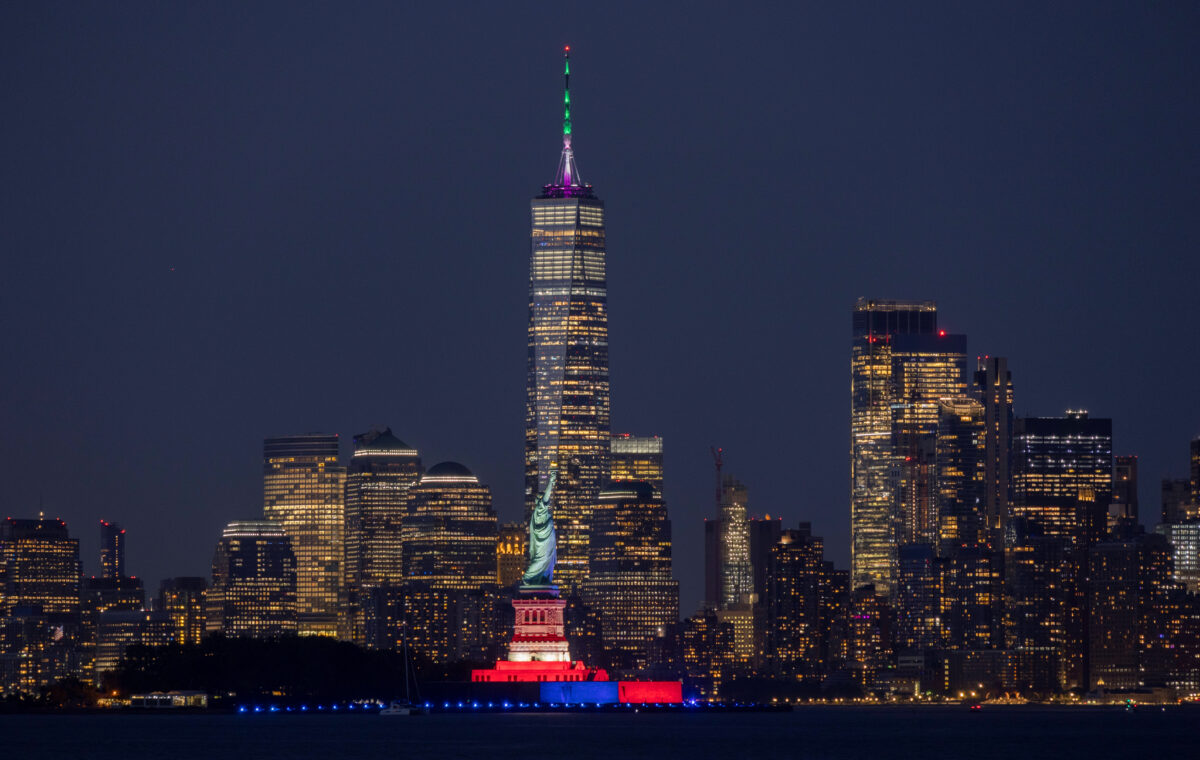
Anyone who steps outside their house on July Fourth is likely to stumble upon one of the hundreds of celebrations of America’s 250th anniversary that will take place in neighborhoods, downtowns, boardwalks, parks and military bases across the country. They’ll be hard to miss; in Washington, the annual fireworks show on the National Mall is expected to use 40 times more fireworks than in typical years.
Some Jewish thinkers believe American Jews have a particular obligation to engage with this anniversary not just as Americans, but as Jews.
“An anniversary is a good occasion to put things in historic perspective. As bad as things may feel in the moment, they’re still pretty great relative to the bulk of not even just Jewish history, but also American Jewish history,” said Franklin Foer, a journalist at The Atlantic who wrote a provocative cover story two years ago arguing that the “golden age” of American Jews is ending. “All the ways in which Jewish values and American values are not just compatible, but overlap and extend one another, is something that I think is really important to cultivate within American Jewry and within American Jewish education.”
Rabbi Rick Jacobs, the president of the Union for Reform Judaism, said he expects many Reform rabbis to address the 250th in their sermons this week.
“I think we’re renegotiating what it means to be a person of deep Jewish faith and a person of deep American patriotism. How am I going to make those not just coexist but really strengthen each other? And I think that’s the big question for this 250th,” said Jacobs. For his part, he drafted a lesson applying a Haftarah reading from the Book of Isaiah to the Fourth of July, and used it to raise questions about the legacy of slavery in this country.
Rabbi Michael Holzman, who leads Northern Virginia Hebrew Congregation, created an interfaith initiative called Faith250 that inspired dozens of synagogues to study America’s foundational texts with the rigor that Jews usually apply to Torah study. At Boca Raton Synagogue, in Florida, Rabbi Efrem Goldberg devoted the congregation’s all-night learning program on Shavuot in May to a series of classes about the past, present and future of Jews in America. (The final class, about spirituality in the U.S., did not begin until 5:00 a.m.)
Every bunk at Camp Ramah in Wisconsin will be spending Shabbat on July Fourth doing age-appropriate learning on the theme of being Jewish in America at the country’s 250th, including exercises in writing their own prayer for the country. (Only English will be used on July Fourth at the camp, which usually sprinkles in Hebrew words for summer-camp words like “cabin” and “lake.”) Members of Kesher Israel, a synagogue in Washington, D.C., will lay a wreath at the Tomb of the Unknown Soldier on July 5th.
The idea behind all of this is to get people to engage deeply with what it means to be American, an exercise they may be more used to doing in a Jewish context.
“When you ask people, ‘Tell me about your American identity,’ they have a hard time answering the question,” said Rabbi Charlie Savenor, executive director of an organization called Civic Spirit, which helps faith communities promote knowledge of civics. He visited Ramah Wisconsin to help organize the Fourth of July programs.
“If I asked you that question about your Jewish identity, would your answer come quicker? 99% of the time people are like, ‘Yes. Passover, Seder, Shabbat. My bar or bat mitzvah.’ You name it, they’ve got something to say,” Savenor continued. “Part of what’s happened is that the American Jewish community — this ranges from unaffiliated all the way to Orthodox — has really invested the energy that we have a stake in this thing that we call Jewish life. And how much you choose to participate, at least you have some sense of where you fit into that picture. But America, which has become so divided and polarized — what it means to be American today has become somewhat confusing.”
Uncertainty about what it means to be an American in 2026 is hardly just a Jewish concern. 77% of Americans say that the signers of the Declaration of Independence would be disappointed in how the country has turned out, according to a Gallup survey. 53% of American adults say they are very or extremely proud to be American — down from 81% a decade ago and 85% in 2006, Gallup found. Educators and politicians often lament the decline or even death of civics education, though Harvard professor Danielle Allen recently argued in The New York Times that, after slumping a decade ago, civics education is on the upswing.
“An anniversary is a good occasion to put things in historic perspective. As bad as things may feel in the moment, they’re still pretty great relative to the bulk of not even just Jewish history, but also American Jewish history,” said Atlantic journalist Franklin Foer.
Rising political polarization complicates Americans’ feelings about how they relate to the country and how, or whether, they feel proud of it. And on top of that, a bipartisan, congressionally funded project to celebrate America’s 250th was sidestepped by President Donald Trump in favor of a more partisan effort called Freedom250.
“I think there has been an increasing linkage between patriotism and partisanship. There’s a sense that if the president I like is in office, then I’m patriotic, and if the president I don’t like is in office, that I’m less patriotic,” said Tevi Troy, a presidential historian and former senior official in the George W. Bush administration.
Chanan Weissman, who leads the institute that publishes the journal Sapir, argued that a crucial project is to figure out how to “recreate the value of nonpartisan patriotism, as challenging as that may be.”
“A flag should not connote a party. It should connote a people. And more than any other group, the Jews should be advancing this,” said Weissman, who served in the Obama and Biden administrations. “We have to make sure that America is not just good for the Jews, as we say, but good for the type of place that a Jewish community can live and thrive and flourish in.”
At 2% of the population, Jews are not going to solve the major education-policy debates in this country, but there is a burgeoning push to help American Jews better understand the ideals and history of this country, and to do so as Jews. Organizations including A More Perfect Union, which promotes democracy as a Jewish value; the Shalom Hartman Institute of North America, a pluralistic Jewish education center; the Tikvah Fund, a right-leaning “ideas institution”; and Pardes, an English-language pluralistic yeshiva in Jerusalem, released source materials about America250, often putting Jewish texts and values in conversation with America’s founding documents.
“Civics education has declined pretty considerably, so it’s not even like this is what you learn in your civics classes,” Hartman President Yehuda Kurtzer told JI. “It has definitely declined as a notion of something I’m supposed to specifically learn as a Jew, that I’m actually responsible as a Jew for this place, for America, and I’m responsible to think about my commitments to America as a Jewish imperative.”
A collective recognition seems to be emerging that this major anniversary, coming as it does at a moment of challenge for American Jews, might actually present an opportunity for renewal, and for reclaiming a common narrative: that this country belongs to the Jews as much as it does to anyone else, but only if they don’t give up on it.
“When Benjamin Franklin was leaving the Constitutional Convention, he was asked by somebody, ‘What kind of government are we forming?’ He says, ‘A republic, if you can keep it,’” said author Dara Horn. “To me, the important word of that sentence is ‘you.’”
A republic is built on the premise that its core rights belong to every citizen equally. Religious freedom, pluralism, full citizenship in a representative democracy — these are values that, while not always fully realized for all Americans, have been the North Star that allowed Jewish life to flourish here.
“Having known the weight of persecution and exclusion, Jews recognized in America’s founding ideals something rare in human history: the possibility of belonging without surrendering our identity,” a group of Jewish leaders, including the heads of several major organizations, former U.S. ambassadors and a number of prominent academics, said in an open letter marking America’s 250th.
“This is not toleration,” said Elliott Abrams, a longtime Republican foreign policy official. “Jews have the same rights as everyone else. This goes back right to the beginning.”
In 1790, President George Washington traveled the country after the Constitution was ratified. Following his visit to Rhode Island, he received a letter from the leader of Touro Synagogue, in Newport, explaining that Jews should have the same rights as other religious groups in America. Washington was so moved that he responded immediately in a now-famous letter espousing his belief in the principle of freedom of religion, including for Jews.
“May the Children of the Stock of Abraham, who dwell in this land, continue to merit and enjoy the good will of the other Inhabitants; while every one shall sit in safety under his own vine and figtree, and there shall be none to make him afraid,” Washington wrote, referencing the Book of Micah. One year later, the Bill of Rights — cementing religious freedom as a core American right — was ratified.
What followed was not a straight line. Slavery undermined the universal values of the Constitution and the Declaration of Independence, and Jim Crow undercut the promise of emancipation. Jewish immigrants escaping pogroms in Europe came to America in massive numbers in the late 19th and early 20th centuries, marveling at the Statue of Liberty as they arrived at Ellis Island, before a jingoistic Congress severely cut back on immigration a century ago. In the 1920s and 1930s, as Nazism progressed in Germany, public figures like Father Charles Coughlin and carmaker Henry Ford spread antisemitic messages to the American masses on the radio and in the newspaper.
“This isn’t the first time that the country has been through an era when it seems not to be living up to its principles,” said Jamie Kirchick, a journalist who has published books about democratic backsliding in Europe and state-sanctioned discrimination against gay people working in the government. “I think that it’s just important to maintain an understanding and a belief in those principles.”
Sarna, the Brandeis historian, put it simply: “In America, we have very short memories.”
“Look at the persecution of German Americans in World War I, or Japanese Americans in World War II. But they recovered. The same was true in the 19th century when Catholics were so mistreated, and now look today at the vice president. So when you look at the long term, there is a lot of reason for hope,” Sarna told JI. “I don’t know that I personally will live to see it, but looking further ahead, I could see things change pretty rapidly, and we will look back and be embarrassed at some of what’s going on.”
Still, just because antisemitism and hatred have existed in America since before its founding does not make this particular revival any more palatable.
“I do think that we have responsibility, while being grateful and feeling responsible, to participate, advocate, vote, do civic duties and so on, but also realize that the lot of the Jew in exile is to constantly sleep with one eye open,” said Rabbi Efrem Goldberg, an Orthodox rabbi in Florida, offering a skeptical rejoinder.
Horn, the author, said she is often cast as the “prophet of doom,” having warned of modern antisemitism even before the Oct. 7, 2023, attacks on Israel and the ensuing war in Gaza touched off the current wave. But she knows that title doesn’t tell the full story.
“Think about the 150th anniversary of the United States, 100 years ago. 1926. Think about the situation of the Jewish community in America then. Pretty crap,” Horn said. Congress had just, essentially, closed the borders. Ford was spreading The Protocols of the Elders of Zion. “It didn’t magically go away. It’s not because people were so good … and they rejected hate. That’s not what happened. This is the height of the [Ku Klux] Klan. What happened was American Jewish activism.”
That’s the message Horn has for the high school and college students she addresses regularly.
Lean in even further to the civic pathways on offer in this country. Run for office. Speak up. Change things. The most important attribute, she tells young people, is courage.
“I think it’s a human instinct to say, ‘Well, we should just hunker down with our people, because that’s who we feel comfortable with.’ My message is no, no, we should not do that,” said Shuly Rubin Schwartz, who retired as chancellor of the Jewish Theological Seminary this week. “Thank God we are citizens. We can use our leverage here. We have the right to protest, we have the right to vote in the people that we want, and we have the opportunity, always, to be building bridges with others.”
Rabbi Goldberg, at Boca Raton Synagogue, offered a skeptical rejoinder, citing a Talmudic teaching about being both respectful and suspicious. “I do think that we have a responsibility, while being grateful and feeling responsible, to participate, advocate, vote, do civic duties and so on, but also realize that the lot of the Jew in exile is to constantly sleep with one eye open,” said Goldberg. American University historian Pamela Nadell called this duality “the paradox of the American Jewish experience.”
In the three years since Oct. 7, the old canard of dual loyalty has come to the fore in American politics with a renewed vigor. An anti-Israel political movement that has been building for years is now making a dent in American politics, pushing the argument that supporters of the Jewish state are driven by the malign influence of a foreign nation and, thus, are insufficiently American. The vast majority of American Jews still maintain a connection to the state of Israel, so one question that Jewish leaders are considering is how to make sure that young Jews are taught to fully inhabit both identities.
Nina Cohen, a history teacher at the Frisch School, a Modern Orthodox day school in New Jersey, developed a course on citizenship and belonging to dig into that tension.
“The ‘dual loyalty’ accusation assumes a zero-sum relationship between Jewish identity and American citizenship,” Cohen wrote in an article last year in Hartman’s Sources journal. “Jewish high schools must teach students to recognize and navigate multiple loyalties — to family, faith, community, nation, and Jewish peoplehood — as a civic strength that enriches democratic participation rather than undermines it.”
The promise of America, according to Jack Lew, a former treasury secretary, U.S. ambassador to Israel and chief of staff to President Barack Obama, requires that Jews not be forced to make that choice, or even to see it as a choice.
“We should be teaching people to be proud of being Americans, and proud of being Jewish, and proud to support Israel as a Jewish democratic state,” Lew told JI. “Those things, if they become choices, undermine the 250 years of progress and success.”
Lew devoted his career to public service, a path that he recognizes was only made possible because his grandparents and his father came to this country from Europe to create a new and better life for their children.
“I think that transition in one generation, from arriving not speaking a word of English to having a son, a child, who can serve at the highest levels of government, is an American story,” said Lew, who is now a professor at Columbia University.
Anne Neuberger, who served as a deputy national security advisor in the Biden administration, argued in a Sapir essay titled “The Jewish Case for Public Service” that raising one’s hand to serve their country is the best antidote to antisemitism.
“Rather than walking away, we should be investing our hearts, our intellects, and our labor into making this nation the sanctuary it was always meant to be,” Neuberger wrote. “Every young person should be encouraged to think seriously about how he might best contribute to that sanctuary.”
For Rabbi Scott Klein, his sanctuary is wherever his soldiers are. As a U.S. Army chaplain at Fort Bragg, in North Carolina, his job is to advise soldiers, most of whom are not Jewish, on ethics and morality; when their unit has to jump out of a plane, for instance, he is right there with them, providing spiritual guidance.
As Klein prepares to celebrate 250 years of America with his soldiers and the local Jewish community in Fayetteville, N.C., he thinks the ethos of the Army offers a useful teaching for all Americans — Jewish and otherwise — at a moment that, for some, feels less celebratory than strained.
“I think that the military remains one of the very few places where Americans from every zip code, background and belief system live, train and bleed together, and it proves that pluralism isn’t a source of weakness,” Klein said. “I hope to remind the Jewish community in the nation that religious freedom is not a passive luxury. It’s actively defended.”
“Rather than walking away, we should be investing our hearts, our intellects, and our labor into making this nation the sanctuary it was always meant to be,” said Anne Neuberger, a deputy national security advisor to former President Joe Biden. “Every young person should be encouraged to think seriously about how he might best contribute to that sanctuary.”

Twelve years after the signing of the Declaration of Independence, when the gunpowder of the Revolutionary War had cleared and the American experiment was still very much an experiment, something momentous happened: the Constitution was ratified. The document that laid out the governing structure of American democracy would, at last, be implemented.
The streets of America filled with parades of citizens cheering on the occasion. The Grand Federal Procession, the country’s official celebration, took place in Philadelphia on July 4, 1788. The spiritual leader of Congregation Mikveh Israel, a Philadelphia synagogue that still operates, marched arm-in-arm at the parade alongside one of the best known ministers in the young country.
A feast was laid out after the parade. One of the tables was filled with kosher food — pickled salmon, bread, almonds, crackers and raisins. The full and enthusiastic inclusion of Jews in the festivities to ring in the ratification of the new Constitution marked a small, if meaningful, inflection point for religious minorities.
“That symbolizes it to me: We always want to be American, fully American, embracing our role as citizens, our privilege and responsibility as citizens,” said Shuly Rubin Schwartz, the former JTS chancellor. “And we want to do so proudly as Jews.”
The study by Combat Antisemitism Movement, conducted in May, found that the more visibly Jewish a person is, the risk of facing antisemitic hate rises significantly

Hannes P Albert/picture alliance via Getty Images
A participant with a kippah stands in front of a menorah.
As the U.S. celebrates its 250th anniversary this weekend, a new study by Combat Antisemitism Movement reveals a stark reality for American Jews: 57% reported experiencing antisemitism — frequently manifesting online — in the past year.
Conducted by Ira Sheskin, director of the Jewish Demography Project at the University of Miami and administered by the National Opinion Research Center at the University of Chicago, the survey — which polled 1,060 Jewish American adults over three weeks in May — found that antisemitism is causing them to actively alter everyday behavior.
A clear majority of respondents (58%) said they felt less safe as Jews in the U.S. than a year ago.
Over one-third (38%) of Jewish American respondents now conceal items that identify them as Jewish, with 32% avoiding posting identifying information online and 23% reporting that they skip Jewish events out of fear.
Even as the number of antisemitic incidents in the U.S. declined by a third last year, according to the Anti-Defamation League’s 2025 audit, the overall global increase in attacks on Jews that came after the Oct. 7, 2023, Hamas terrorist attacks and ensuring war in Gaza continues to have lasting ramifications —- and may even be getting worse for some, according to the CAM survey.
Much of the antisemitism reported was experienced on the Internet, with 59% of respondents saying they had seen antisemitic content directed at someone else online. Only 10% reported being the personal target of online antisemitism.
But the more visibly Jewish a person identifies, the more antisemitism they report facing: 46% of Orthodox Jews and 44% of those active in Jewish communal life reported experiencing antisemitism, compared with 17% of those not involved.
Other forms of antisemitism respondents said they faced over the past year included anti-Jewish vandalism (36%), slurs from colleagues or neighbors (36%) and being socially excluded (14%).
Only 8% of respondents reported being physically threatened or attacked, though 40% also noted that a non-Jewish person had expressed solidarity with them.
“These findings are a stark reminder that antisemitism is a lived daily reality for Jewish Americans,” said Alyza Lewin, CAM’s president of U.S. affairs . “The more openly Jewish you are, the more likely you are to experience antisemitism. Unsurprisingly, as a result, Jews are changing their behavior and thinking twice about how openly Jewish to be.”
“One of the unique aspects of antisemitism is that it manifests as a horseshoe,” said Aaron Keyak, a former U.S. deputy special envoy to monitor and combat antisemitism and CAM’s special representative on international affairs. “As it gets more and more extreme on the left and on the right, the antisemites come to converge on their views of Jews — even though they disagree about every other policy and political issue.”
The survey also revealed strong Jewish communal backing for the International Holocaust Remembrance Alliance’s working definition of antisemitism. Upon reading it, 71% of those polled found it accurate, and over two-thirds supported its adoption by institutions.
The report from the Institute of National Security Studies argues that Israel’s alliance with the American Jewish community is a national security priority

(Noam Galai/Getty Images)
The Maccabeats perform during 'March For Israel' at the National Mall on November 14, 2023 in Washington, DC.
A new study from the Tel Aviv University-affiliated Institute of National Security Studies warns that American Jews’ ties with Israel have weakened in recent years, and Israeli leaders do not seem to care enough about how these shifting attitudes might affect Israel’s national security.
If Israel ignores the growing distance with the American Jewish community, the country could face long-term consequences, authors Ted Sasson and Avishay Ben Sasson-Gordis argue.
“An American Jewish community that is less supportive of Israel would leave Israel more isolated globally, less capable of extending soft power, and less confident in its role as the nation-state of the Jewish people,” Sasson, a Middlebury College professor and INSS scholar, and Ben Sasson-Gordis, director of the Israel-United States Research Field at INSS, write.
The report is one of countless documents and op-eds published by Jewish communal leaders and Israeli officials after the Oct. 7, 2023, attacks that call on Israel’s leaders to improve the country’s public diplomacy efforts.
Yet while many reports authored by pro-Israel analysts argue that Israel merely needs to change its messaging, the authors of the INSS report insist that Israeli leaders need to act differently, too, in order to reckon with the ways that Israel’s actions in Gaza have alienated even some American Jewish allies.
“Israel must undertake a comprehensive effort to rehabilitate its reputation in the United States,” the report states. “This effort should begin by reconsidering some of the more radical policies of the current government that have alienated many U.S. voters and American Jews.”
What the report offers is not a hasbara, or messaging, strategy. The document’s authors assert that it is a “national security strategy,” and that Israel’s leaders ignore their challenges with the American Jewish community at their own peril.
“Israel’s alliance with the American Jewish community is a national security asset and is core to its purpose as a democratic nation-state of the Jewish people,” the report states.
Among the policies Israel should reconsider, according to Sasson and Ben Sasson-Gordis: prioritizing efforts to “expand the Abraham Accords and open a renewed dialogue with the Palestinians,” and avoiding actions “that seriously harm [Israel’s] democratic character.” Both of those goals are tall orders for a government that has pursued controversial judicial reform efforts in the past and insisted a two-state solution with the Palestinians is not feasible. The country should try to “avoid causing unnecessary harm,” the authors add.
The report points out that even many highly engaged American Jews grew frustrated with Israel’s handling of the war.
“Israel’s policies during the October 7 war — as well as how Israel communicated about those policies — alienated large segments of the American public and raised deep concerns among many American Jews,” the report notes. “Israel’s decisions on how to proceed with the war and how to communicate about it were viewed by many of the Jewish leaders with whom we spoke as a driver of mounting anti-Israel sentiment and antisemitism in the United States.”
The report’s authors call on the Israeli government to draft an antisemitism national strategy, which “should focus mostly outward, on ways of holding other nations and non-governmental organizations accountable for combating antisemitism,” but that should also look inward, and “assess the ways Israel’s policies may have contributed to the capacity of antisemitic actors on both the right and the left to win new audiences and expand their influence.”
The report refers to the rise of an anti-Zionist segment of the American Jewish community, though it does not suggest that Israeli leaders should engage with them. Instead, it argues that Israel’s leaders should engage with the full spectrum of Israel advocacy organizations from J Street on the left to the Zionist Organization of America on the right, citing the fact that larger, centrist groups like AIPAC “are losing influence in the corridors of power” in the U.S. (Israeli Ambassador to the U.S. Yechiel Leiter on Monday called J Street a “cancer within the Jewish community” at a conference in Washington.)
Israel’s missteps in dealing with the American Jewish community come at a moment when the standing of the U.S. Jewish community has “diminished,” the report argues. Rising antisemitism and a rapidly growing anti-Israel political constituency should also concern Israeli leaders, the INSS authors state. American Jews should be a bulwark, but instead, their own ties with Israel are fraying, particularly on the left.
“The American Jewish community is deeply challenged not only by its own institutional weakening and division but also by an external environment that has grown exceedingly hostile,” the report states. “Further erosion of U.S. Jewish support for Israel could help pave the way for the Democratic Party to turn fully against the alliance.”
Policy proposals for remedying this growing rift include reinvesting in American travel programs to Israel that have been hampered by the COVID-19 pandemic and the war; making Israel a center of higher education that is more appealing to American Jews; better educating Israeli Jews about the diaspora; seeking the input of American Jews within the Israeli government; and devoting more funding to addressing the problem.
“Israel relies on a strong and flourishing American Jewish community, one that continues to support Israel’s core national interests,” write Sasson and Ben Sasson-Gordis. “It is in Israel’s best interest to take the actions that are within its power to reverse these damaging trends.”
Mohammad Baqer Saad Dawood Al-Saadi, a commander of the Kataib Hezbollah militia, reportedly helped plot at least 18 attacks around the world in revenge for the war against Iran

Haidar Mohammed Ali/Anadolu via Getty Images
Mourners carry the coffin of Kata'ib Hezbollah member on March 2, 2026 amid Kata'ib Hezbollah flags.
Federal authorities have charged an Iran-backed militia commander with plotting to attack Jewish sites in New York City and Los Angeles.
According to a criminal complaint unsealed on Friday in Manhattan, Mohammad Baqer Saad Dawood Al-Saadi helped plot at least 18 attacks, several of which were carried out in Europe and Canada since late February, The New York Times reported.
Al-Saadi, a commander of Kataib Hezbollah, an Iraqi militia that is a proxy for Iran’s Islamic Revolutionary Guard Corps, reportedly said he was seeking revenge for the U.S. and Israel’s attacks on Iran.
Al-Saadi allegedly firebombed a Bank of New York Mellon building in Amsterdam, tried to detonate improvised explosives at the Bank of America building in Paris, stabbed two people in London and carried out two attacks in Canada, the complaint alleges. He also had started planning attacks targeting New York and Los Angeles Jews, including one on a New York City synagogue, according to the complaint.
Al-Saadi had ties to Gen. Qassim Suleimani, a leading commander in the IRGC, according to the complaint. The U.S. military killed Suleimani in a 2020 strike.
The circumstances of Al-Saadi’s arrest and transfer to the U.S. have not been disclosed.
Addressing Temple Emanu-El in Manhattan on Friday evening, NYPD Commissioner Jessica Tisch said that Al-Saadi allegedly stated he selected a New York City synagogue to target because it was “a beacon of solidarity and support to Israel and the Zionist objectives.”
“The attack didn’t occur because the defendant was plotting with an undercover law enforcement officer,” said Tisch.
She stated that Temple Emanu-El was not the target but did not disclose the location. The leadership of the synagogue was notified and the NYPD “continues our work with them to ensure the synagogue’s safety,” she added.
“This is an example of our system working exactly as designed,” continued Tisch. “While the details of this case are truly extraordinary, the broader reality is not.” She said that in her 18 years working in government, including in NYPD’s counterterrorism bureau, she has “not seen a threat environment quite like this one … where developments abroad can have immediate consequences here at home.”
Following the launch of the war against Iran by the U.S. and Israel in late February, there has been a global surge in Iranian-backed retaliatory terrorism. In March, the FBI determined that the attack on Temple Israel in West Bloomfield Township, Mich., was “a Hezbollah-inspired act of terrorism purposely targeting the Jewish community.”
The former House majority leader urged American Jews not to abandon the Democratic Party, despite acknowledging many now feel unwelcome

JDCA
Rep. Steny Hoyer (D-MD) at the Jewish Democratic Council of America’s annual leadership summit, May 12, 2026
Rep. Steny Hoyer (D-MD), a pro-Israel stalwart and a former House majority leader, said on Tuesday that Jewish Democrats “ought to be” concerned about the critical way that some of their Democratic colleagues talk about Israel.
“How many of you here tonight have been trying to convince a family member, a friend, a neighbor not to abandon the party that has long been their political home?” Hoyer said in remarks at the Jewish Democratic Council of America’s annual leadership summit, where he was honored with an award marking his upcoming retirement, after 45 years in Congress.
He was introduced by three of his current and former Jewish senior staffers, including Brian Romick, the CEO of Democratic Majority for Israel.
“How many of you have been anxious yourselves about rhetoric heard from some Democratic officials and candidates? We ought to be,” said Hoyer. “I will stand up and say, ‘I do not agree with that.’”
Hoyer, a longtime champion of pro-Israel legislation, used the speech to reiterate his commitment to the Jewish state and explain why he thinks Democrats should support Israel. But even as he acknowledged issues of antisemitism and anti-Israel sentiment in the party, he also pitched American Jews to maintain their historic support for Democrats and urged those who are unhappy with the party’s leftward shift on Israel to allow room for nuance, and to work to reverse it.
He said he disagreed with the 40 Senate Democrats who voted in April against certain arms sales to Israel, but added that he still believed those lawmakers would support the Jewish community. He encouraged JDCA activists to keep calling those senators to push them to change their minds.
“Those same 40 senators will stand up for you all the time. I disagree with them, but the fact of the matter is, keep in mind, it is not day to day. It is long-term commitment that counts. They need to keep hearing from you,” said Hoyer. “They need to keep seeing us fight to keep our party strong and pro-Israel, and consistent with its values. And they need to see our passion and our resolve.”
Reflecting on his 22 visits to Israel over the last five decades, Hoyer called the trips particularly meaningful due to his Baptist faith. Still, he said he could not distill into words the reason for his deep-rooted affection for Israel.
“I really can’t put my finger on why, but I know that’s what I feel. I know that I feel that the Jewish community … for millennia has been the object of scorn, derision, prejudice, hate and violence,” said Hoyer. “At a very early age, I thought that was wrong, and I am so proud that I had the opportunity to not only say it was wrong, but to try and make it right.”
Hoyer described himself as “a champion for Israel,” a title he said made him proud. He insisted he is not alone in that category among Democrats.
“The majority of Democrats still stand, in my view, and will continue to stand with Israel and with the Jewish people,” said Hoyer. “I’m confident we will be able to overcome this moment and defeat Trumpism at the ballot box, while defeating antisemitism and anti-Zionism in our politics.”
In the speech, Hoyer praised American Jews for the leading role they have played in Democratic politics. He insisted that he will make sure they are still welcome even as he leaves office.
“The Democratic Party has long stood for the same values that Jewish tradition teaches: caring for the sick and hungry, ensuring equal opportunity for all, freedom of conscience, freedom of religion, freedom of choice, freedom for workers to organize and justice for all under the rule of law,” said Hoyer.
“For as long as I am in office, and even in retirement,” he continued, “I will stand with you in strong support, strong foundation for our party as the warm and welcoming home for pro-Israel Jewish voters who care deeply about equal rights, justice and opportunity for all Americans.”
‘We won’t support a Democrat who doesn’t represent the views and values of the vast majority of American Jews,’ Halie Soifer said
MANDEL NGAN/AFP via Getty Images
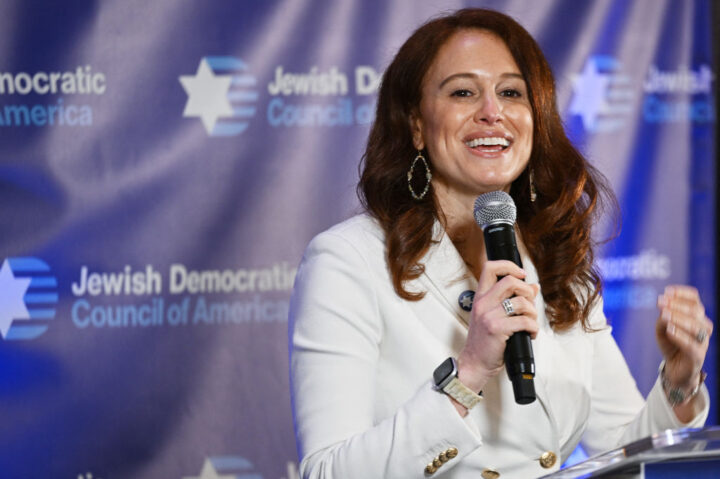
Jewish Democratic Council of America CEO Halie Soifer in Washington on May 24, 2023.
The Jewish Democratic Council of America is not ready to endorse Graham Platner, the controversial presumptive Democratic nominee in Maine’s Senate race, said Halie Soifer, the group’s CEO.
“We won’t support a Democrat who doesn’t represent the views and values of the vast majority of American Jews,” Soifer said in a statement. “JDCA has endorsed more than 120 candidates across the country who are fighting for the issues Jewish Americans care about and standing against antisemitism. It’s those many Democrats who have our backs, and we’ll have theirs as they work to defeat Republicans aligned with this White House whose views are antithetical to our values.”
Soifer additionally told The Forward on Thursday that Platner’s record of incendiary past comments and personal controversies are “reasons for concern” about his candidacy, saying that the far-left insurgent would first need to clarify his views to receive possible consideration from the group.
Reached by Jewish Insider on Thursday, Soifer confirmed JDCA’s position on the race but declined to comment further.
JDCA, a leading Jewish Democratic group, typically endorses most Democrats in major federal races, especially closely contested ones like the Senate seat in Maine.
The group had backed Maine Gov. Janet Mills in the June primary to unseat Sen. Susan Collins (R-ME). But Mills, the establishment favorite, said Thursday that she was suspending her campaign due to a lack of financial resources, clearing the way for Platner to secure the nomination in a race viewed by Democratic leaders as key to regaining control of the upper chamber.
Previously, JDCA had expressed criticism of Platner after it was revealed that he had a Nazi tattoo on his chest for nearly two decades. He has since removed the tattoo and claimed he was unaware of its links to Nazism until recently, even as a former acquaintance told JI that he had long known the icon represented a skull-and-crossbones known as a Totenkopf, adopted by an infamous SS unit.
“Hateful rhetoric and Nazi symbols must have no place in the Democratic Party, the Republican Party, or anywhere in our politics,” JDCA said last year after JI’s report. “Under any and all circumstances, it must be unacceptable to glorify Nazis or Nazism. Period.”
Platner’s hostile approach to Israel and demonization of AIPAC have also faced scrutiny among mainstream Jewish leaders at the state and national levels.
He has repeatedly accused Israel of committing genocide in Gaza and called for blocking U.S. aid to the Jewish state. In a past Reddit post recently uncovered by JI, the Marine veteran voiced admiration for Hamas’ tactics in a violent raid into Israel in 2014.
JDCA’s reservations over Platner’s campaign reflect ongoing discomfort among both Democratic and nonpartisan Jewish organizations that are now reckoning with the implications of his popularity in spite of the tattoo and other issues he has weathered.
The Anti-Defamation League as well as Maine’s Jewish federation have also raised concerns about Platner’s tattoo and past comments.
Platner, for his part, has pledged to engage further with the Jewish community, recently hosting a Seder in Maine that included the state chair of J Street, the progressive Israel advocacy group.
A spokesperson for J Street did not immediately respond to a request for comment on Thursday night about whether it would endorse Platner’s campaign.
In conversation with The Atlantic’s Jeffrey Goldberg, Kurtzer said the Jewish community is caught between the illiberalism of the left and the illiberalism of the right
Shalom Hartman Institute
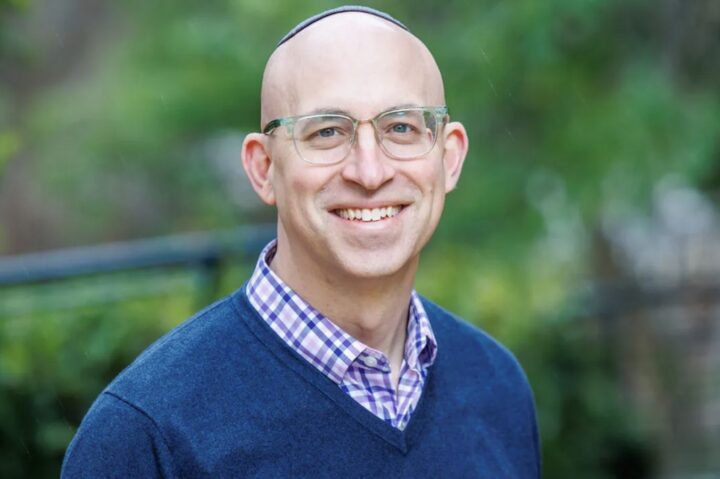
Yehuda Kurtzer
Amid a surge in antisemitism across the political spectrum, many American Jews have described feeling a growing sense of isolation. But for Yehuda Kurtzer, president of the Shalom Hartman Institute, being “politically homeless” is not a crisis to be solved, but rather a position to be embraced.
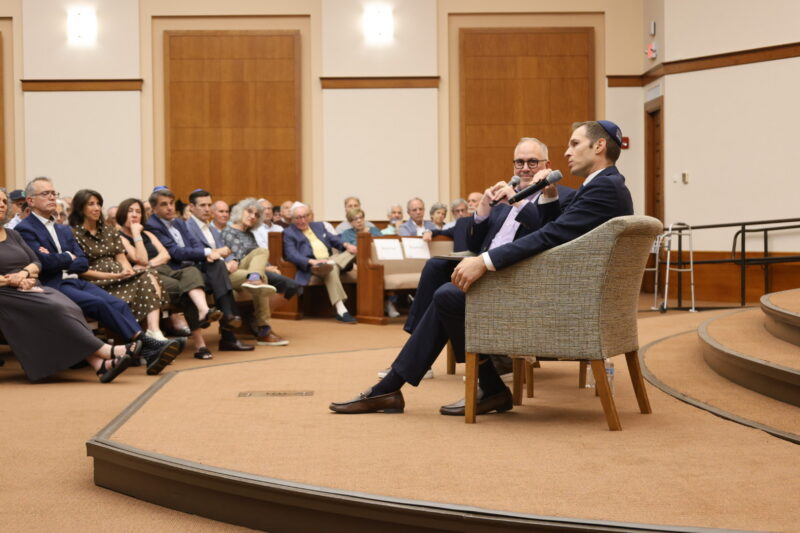
“I don’t think some measure of political homelessness is a fundamentally bad thing,” Kurtzer said on Thursday while speaking alongside Jeffrey Goldberg, editor-in-chief of The Atlantic, at the Capital Jewish Museum in Washington. “I think Americans have become hyper-partisan in ways that reflect that partisan political identity has become part of our identities in ways that are not healthy for Americans.”
Kurtzer and Goldberg sat in conversation at an event focused on American Jewry ahead of the upcoming 250th anniversary of the founding of the United States.
Kurtzer argued that hyper-partisanship is particularly dangerous for the Jewish community, noting that Jews “believe in the notion that we are tethered to other people regardless of what they believe.” He said American Jews “should take that same ethos and apply it to what it means to be an American as well.”
“Choosing a side has never worked for Jews because when you get out of the hall to power, you will be identified as the exemplar of that political attitude that can now be destroyed,” Kurtzer said.
“Now we’re stuck as an American Jewish community between an illiberal argument on the right, which is currently in power, and an illiberalism of the left,” Kurtzer continued. “We don’t have a choice as American Jews but to fight for the very liberal framework that resists the authoritarianism of the right and resists the authoritarianism of the left and insists that this is the only way we can make it work for ourselves.”
This tension is especially acute on university campuses, Kurtzer said, where he believes “progressivism” has played “a major role in shutting down the pluralistic discourse that a university campus is supposed to inhabit.”
“I think there’s an immense amount of shame that travels for American Jews, especially for young people, about association with Israel,” Kurtzer said. “At a moment like this, it’s very hard to get past that shame with even rational arguments.”
However, Kurtzer suggested that young Jews may be uniquely positioned to model a “healthy political alternative” by demonstrating how to navigate complex discourse. He noted that since the Oct. 7, 2023, Hamas attacks, many Jews feel “a greater sense of attachment to the Jewish community and Jewish lives and even the State of Israel.”
He argued that American Jews must “find a way to articulate the thickness of our relationship to Israel and the Jewish people that is not perpetually under the test of what the Israeli government does today and tomorrow.”
Kurtzer also warned that the American Jewish community has grown too “comfortable” being part of the daily fabric of American life.
“Jews wrote the soundtrack to American patriotism. We engaged in that project,” he said. “The thing that I think the American Jewish community has let go of is that we became comfortable saying, ‘We’re now insiders to that project. We no longer need to be active creators of the American story.’ We just get to kind of sit on our laurels.”
While Kurtzer called for further engagement from the Jewish community in American life and political processes, he explained that the strength of the community also lies in its willingness to remain distinct.
“It’s OK and probably important for Judaism to maintain some dimension of counter-culturalism,” Kurtzer said. “Some dimension of insisting that in a radical technological world, anti-technological behaviors like turning off your phone for 25 hours a week are actually good.”
In the wake of Oct. 7, some in the Jewish community turned to faith, philanthropy or federal advocacy. Others set their sights closer to home, organizing to shape school boards and influence city councils
Michael Nigro/Pacific Press/LightRocket via Getty Images
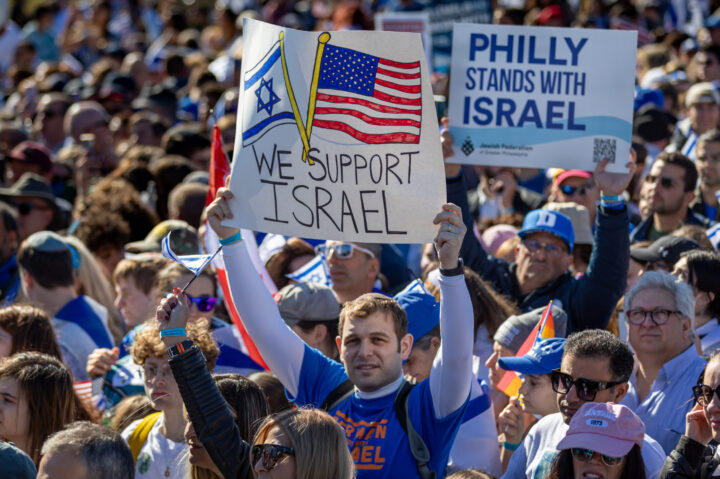
A pro-Israel supporter holds a sign during the "March for Israel" held on the National Mall.
After the Sandy Hook Elementary School shooting in 2012, Norri Leder dedicated herself to fighting gun violence as a founding member of Moms Demand Action, the gun control group created after the shooting.
And last year, there was another single defining moment that pushed her to create something new, just like she did after Sandy Hook: A candidate running in a Houston school board special election in 2025 sent out a mailer showing herself in a photo with a virulently anti-Israel politician. When Leder ran into the candidate at the polls, she told the candidate that she was “unknowingly alienating yourself, potentially, from members of the Jewish community.” The candidate had no idea.
“She asked me if there was a Jewish group that meets with candidates as they’re running,” Leder recalled. “I said, there are Jewish groups, but it occurred to me that many of them don’t have the bandwidth to meet on these races that are at much more of a local, state and county level as [candidates are] running for office.”
So Leder created one. Where she was once a single-issue activist fighting for gun control measures, now she is putting everything else aside to focus on Jewish communal concerns with her new organization, Houston Jewish Women Vote. Less than four months into its existence, the group has met with candidates running in local attorney, city council and judicial races in 2026.
“We are narrowly focusing on physical security for the Jewish community, antisemitism, targeting of Jews in academic and professional settings, prayer in school and staying in your lane for state, local and county offices — just please don’t engage in foreign policy issues that undermine bridge building in the community and accomplish nothing in the world of foreign policy,” said Leder. “There’s a feeling of, we’re Jewish women, and a lot of us feel politically homeless right now. People feel good knowing that they’re participants and that they can exercise their voice.”
Houston Jewish Women Vote joins dozens of other Jewish advocacy efforts that grew out of the desperation people felt in the days after the Oct. 7, 2023, attacks to fill a void in local politics.
In Pittsburgh, the Beacon Coalition was created when community activist Jeremy Kazzaz saw that local politicians were too afraid to criticize a colleague who posted pro-Hamas messages. The group is now urging Jewish Democrats in the Pittsburgh area to run for seats on the Allegheny County Democratic Committee to be able to help shape the party’s endorsements.
In California, Israeli immigrants helped launch the Bay Area Jewish Coalition (BAJC), in part to help locals make sense of the many local races for positions most people have never heard of.
“Even when we have special elections for things that seem totally unrelated, like the county assessor, which is in charge of property taxes and things like that, at this point, people are reaching out to us and saying, ‘Who do we vote for?’” said BAJC co-founder Keren-Or Reiss, who was born in Israel and now lives in San Mateo, Calif., where she works as a product manager at a tech company. “Is there someone here who’s going to somehow use this platform to spread hate or to normalize antisemitism against us?”
Some in the Jewish community turned to religious practice after Oct. 7, or to supporting charities helping victims of the attacks in Israel, or to pro-Israel political advocacy through establishment groups like AIPAC, or some combination. Leder, Kazzaz and Reiss represent a new class of Jewish American activists: people who were disappointed by the apathy or even outright hostility that some co-workers, teachers, neighbors and local elected officials demonstrated towards Jews and Israelis suffering in the aftermath of Oct. 7, and who felt no one was doing what needed to be done to reach those leaders.
“Local community members can’t just wait for institutions to have enough bandwidth to do everything. People can take responsibility to step up and engage. And that’s what people were doing,” said Jeremy Burton, CEO of the Boston Jewish Community Relations Council. “Part of this revitalization of American Jewish life that we’ve seen has been this emergence of these activists.”
They saw a new kind of opportunity in an American political landscape reshaped by Oct. 7 and the ensuing war in Gaza. Advocating for Congress to vote a certain way on weapons sales to Israel would not do much to affect the swell of antisemitism growing in their communities. Although the war was happening thousands of miles away, they understood that its impact would be local.
“Almost every other community and interest group is doing this on the local level, and not the Jewish community. So we’re really trying to close that gap,” said Tyler Gregory, CEO of the Bay Area Jewish Community Relations Council, which in 2024 became the first JCRC in the country to launch an affiliated advocacy arm to fundraise for candidates and engage in elections. “I think it’s a combination of Congress being sexier and there being fewer issues at the local level.”
After Oct. 7, it became clear that there were not, in fact, fewer issues locally. City council members who were elected to work on municipal governance were now tasked with voting on contentious ceasefire resolutions and calls to divest from Israel. School superintendents and principals had to decide how to respond to teachers who were bringing biased, anti-Israel instruction into the classroom. These were battlefields where existing Jewish communal infrastructure did not have the capacity to fight — either because their nonprofit status kept them from engaging in political races, or because they simply did not have the manpower to reach the hyper-local spaces where debates about Israel, Zionism and antisemitism were now front and center.
“Local community members can’t just wait for institutions to have enough bandwidth to do everything. People can take responsibility to step up and engage. And that’s what people were doing,” said Jeremy Burton, CEO of the Boston Jewish Community Relations Council. “Part of this revitalization of American Jewish life that we’ve seen has been this emergence of these activists.”
The new Jewish activism did not begin in Jewish federation board rooms or congressional office buildings in Washington. It was grassroots campaigns that started in WhatsApp groups and recruited dozens of volunteers through word-of-mouth conversations. These were people who showed up to city hall hearings or met with candidates running for local offices that prior to Oct. 7 may have seemed irrelevant to Jewish concerns.
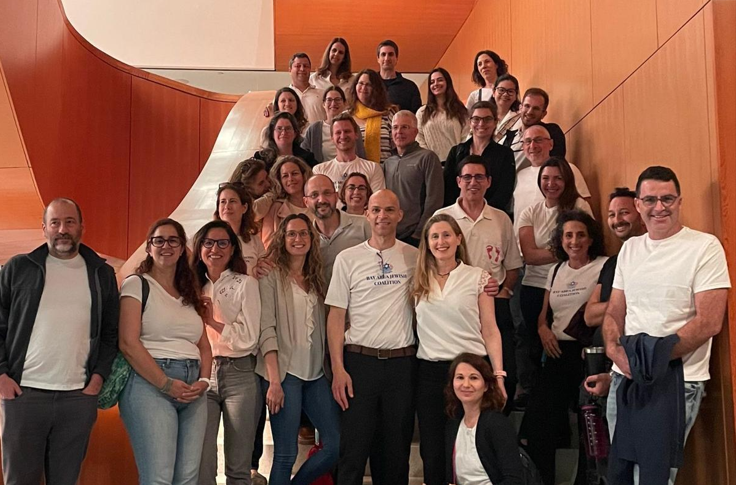
For Sam Gechter, who works in tech in Boston, a call from a friend in early 2024 alerted him that the city council of Somerville, Mass., where he lives, was trying to pass a resolution calling for a ceasefire in Gaza. The language, Gechter recalled, was “atrocious,” pinning the blame for the war on Israel and hardly mentioning Hamas.
“I got off the phone. I turned to my wife, who was standing next to me, and said, ‘We gotta start a WhatsApp right now of everybody we know in Somerville and get people to come and speak against this,’” Gechter told JI. “That was my moment of being politically activated.”
Soon, that WhatsApp group became Shalom Somerville, a group of Jewish people in the small Boston suburb — an uber-progressive city that neighbors the better-known Cambridge — committed to advancing “a Somerville that is safe for Jews and Israelis.” Despite nominally being an advocacy organization, Shalom Somerville has also become a lifeline for people who otherwise weren’t connected to Jewish institutions.
“For a number of people who haven’t found their place Jewishly in the community, this has become their main Jewish community,” said Gechter. “We had, like, 150 people at our Hanukkah party. It’s gotten to be a pretty big group.”
New organizations that formed to focus on important but unglamorous posts like the county commission and municipal human relations councils are heading into a major election year with ambitious plans to activate Jewish community members to flex their political muscle. They want to show local officials that they ignore Jewish voters at their own peril — and that, conversely, Jewish voters will miss a chance to improve their community if they sit out these races that have a real impact on their day-to-day lives.
“Around the country, there was this awakening, and an understanding that the cavalry wasn’t coming for anybody,” Chicago Jewish Alliance founder Daniel Schwartz told JI.
Each local outfit has a different strategy. Mindy Miller, a former top aide to the Colorado Senate president, co-founded the Colorado Jewish Action Alliance to educate her former colleagues about topics that they never expected to address but that are now everywhere, even in state politics.
“We ask them what they think Zionism means because it’s been so weaponized, and I would say virtually all of them have been appreciative of being able to have those conversations without being fear of being canceled or called out or vilified, because they have to walk a tight rope,” Miller told Jewish Insider.
Chicago Jewish Alliance founder Daniel Schwartz has taken a more confrontational approach. During the city council’s vote on a contentious ceasefire resolution in January 2024, he showed up at City Hall draped in an Israeli flag. He created a WhatsApp group — called the “Zionist Information Group” — to get Chicagoans out to protest.
“Around the country, there was this awakening, and an understanding that the cavalry wasn’t coming for anybody,” Schwartz told JI.
In Lexington, Mass., a suburb of Boston, a group called Lexington United Against Antisemitism, is focused on interfaith work, and connecting members of the town’s Jewish community with Christians.
“Quickly we understood that people, actually, even in Lexington, know very little about Jews altogether. Jews — what do they think? What do they believe?” said Francine Jacobs, a retired Tufts professor who created LUAA.
The group was founded several months before Oct. 7, but its founders have doubled down on their mission, particularly as some liberal Christians who are critical of Israel have taken stances that crossed into antisemitism.
“It took some of the steam out of our effort. There were some folks who just said, ‘Oh, Israel, I’m so angry about it, I just can’t hear the word Jew,’” said Stephen Van Evera, a retired MIT international relations professor, who is Christian and leading LUAA with Jacobs. “I mean, why are you connecting these dots that way? Do you really think that the Jewish community in Lexington is deciding how to fight the Gaza war?”
What drove many people to get involved was their kids. Viviane Safrin became an education activist in San Francisco after the pandemic, when she felt frustrated that public schools were not doing more to reopen. After Oct. 7, parents started calling her to report that their children had experienced antisemitism. So she created SF Jews in School, with the tagline “advancing Jewish inclusion in San Francisco schools.”
“We respond to incidents. We guide families through working with their school. We also engage directly with principals and administrators to support them in ensuring that our schools are welcoming spaces, but we also celebrate our heritage. We build Jewish pride and belonging across the city,” Safrin told JI. “We bring apples and honey for Rosh Hashanah and sufganiyot for Hanukkah.”
Two thousand five hundred miles away, in the Philadelphia suburb of Lower Merion, Dani Shaw created a WhatsApp group for 75 moms soon after Oct. 7. They wrote to the diversity, equity and inclusion director in their school district to ask to talk about ensuring Jewish perspectives were included in the office’s programming. They wound up meeting with the superintendent instead and having a productive conversation. But, shortly after, an op-ed in a high school newspaper that Shaw said spread “blood libels” against Israel caused the moms to step up their activism.
“We created an organization called the Jewish Families Association with a board that consisted at the time of about 15 parents who were all representing different schools in the district,” Shaw told JI. There are now several other Jewish Families Associations in small school districts across Pennsylvania. “It’s really representation — a bridge between the parents and the administration, the school district, to make sure that these incidents, whether they be bullying or problematic curriculum, are dealt with appropriately.”
The group in Lower Merion, a heavily Jewish suburb, supported three Republican candidates for school board last year. They all lost in the liberal town. Keeping activists engaged in the work is hard — “they have to get on with their lives and their livelihoods,” Shaw acknowledged — particularly because the group plans to remain volunteer-led and grassroots, with no fundraising arm.
Fatigue is real. The work of building ties with dozens or even hundreds of local elected officials requires dedicated volunteers and resources. BAJC, the Bay Area group, created a voter guide in 2024 tracking dozens of races — work they want to replicate in 2026, even as they see some people in the community losing interest.
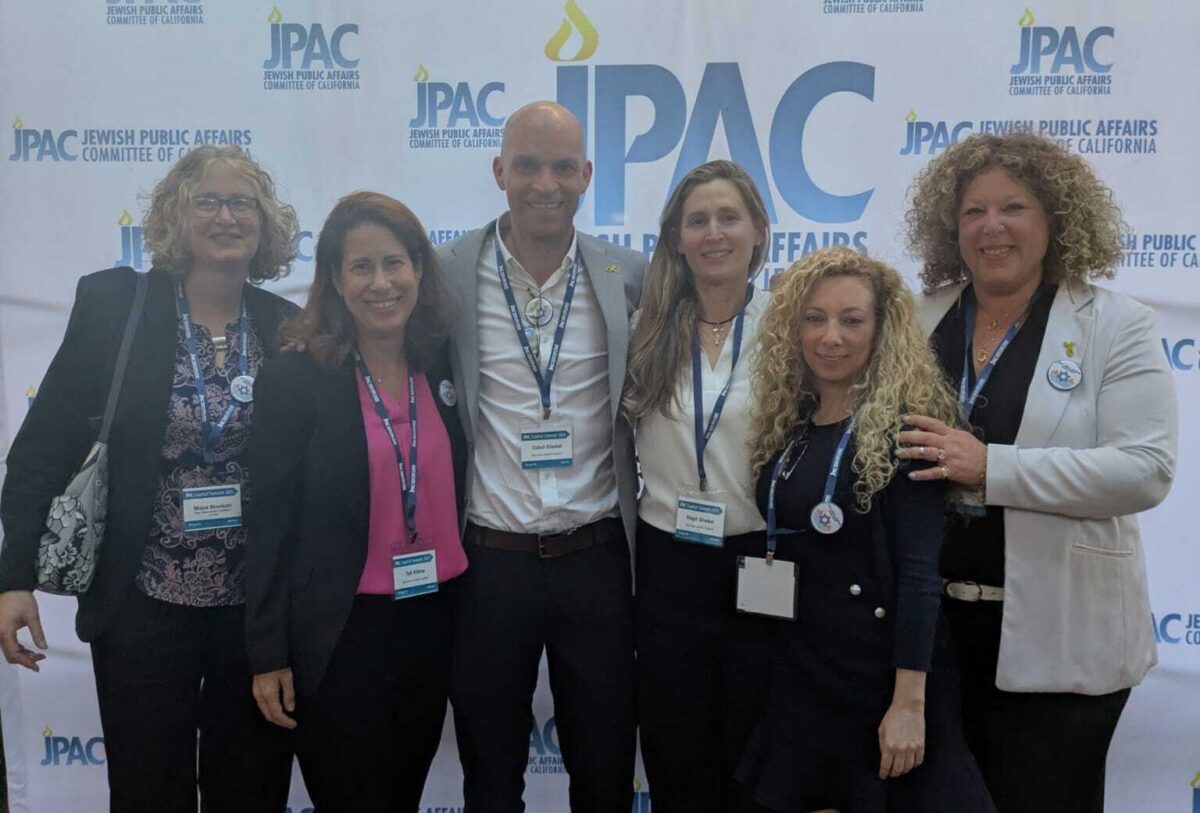
“It’s a constant fight to activate the community. I wouldn’t take that for granted. People prefer to go and watch a football game than to go to a demonstration,” said Oded Shekel, a BAJC leader and an Israeli immigrant who is the CEO of a financial technology startup. “You need to find ways to keep people motivated, activated, connected. I think local fights are easier to connect to than, ‘Would you like to come and support, like, a D.C. bill that we are going to promote?’ Yeah, whatever, I don’t care. ‘Would you like to meet the school boards who actually create policies for the teachers or the kids in your class?’ That’s more likely.”
Not everyone who got involved in this work after Oct. 7 remains involved. But many still are. There is now an entire class of American Jews, many of whom were not engaged politically at all before, who now wholeheartedly believe that the way to make their communities safer and more welcoming is to get involved in local politics. And as both the Democratic and Republican parties face internal fissures over Israel at the national level, an awareness is starting to solidify that reaching politicians at the beginning of their careers, when they are unpolished and open-minded, is a winning strategy.
“We’re not seeking to educate candidates about our issues once they announce for Congress. We want to have multi-year relationships and be able to explain the many nuances of Judaism and Zionism long before they’d like to run for higher office,” said Sam Jefferies, co-chair of The Kids Table, a political action committee in Washington state that is supporting “pro-Jewish” candidates. “You can’t solve antisemitism, but you can prevent antisemites from being in positions of power.”
Murphy: ‘Not a single one of us is safe from a future that mirrors the thousands of years of persecution that the Jewish people, with no self-determination, suffered under’

Jemal Countess/Getty Images for Fair Share America
Sen. Chris Murphy (D-CT) speaks at the U.S. Capitol on April 10, 2025 in Washington, DC.
Since the beginning of President Donald Trump’s second term, Sen. Chris Murphy (D-CT) has routinely adopted the argument that Trump poses a unique threat to American democracy. In an address on Monday at the J Street conference in Washington, Murphy leaned on Jewish history to tailor his case to fight Trump specifically to American Jews.
Murphy, who is considered a possible 2028 presidential candidate, invoked three pivotal moments in Jewish history that he said should inspire American Jews to speak out against what he described as Trump’s efforts to undercut democratic norms and procedures: the Bar Kokhba revolt against the Roman empire that led to the displacement of the Jewish diaspora; the Spanish Inquisition in 1492 that saw Jews flee Spain rather than face conversion or death; and pogroms under imperial Russia in which Jews had no recourse against state-sanctioned violence.
If American Jewry doesn’t stand up to Trump, Murphy said, they risk facing a similar fate in the United States.
“We are here today because we believe that this tragic history requires our world to make a home for the Jewish people in the Holy Land. That place is Israel. That place will always be Israel,” said Murphy, who has taken a harsher stance toward Israel in recent years. “When we criticize the government of Israel, when we speak up against its policies in places like Gaza or the West Bank, it is because we love Israel. It is out of our love for Israel and our belief that its current leaders are jeopardizing the future survival of that state.”
Yet he argued that the existence of a Jewish state should not preclude American Jews from fighting for the future of their own country.
“The answer to thousands of years of the Jewish people’s faith being decided by emperors and queens and czars is not and cannot simply be the State of Israel. No, the rest of the answer is simple. It’s democracy,” said Murphy. “In a working democracy, Jewish citizens are not subjects. They are not petitioners. They’re not guests to be expelled at the whim of a monarch. They are, you are, we are citizens.”
In the speech, Murphy criticized the U.S. attacks on Iran, saying Trump “launched an illegal war that the American people do not want” and that it amounts to “his most grievous assault on democracy.” But Murphy mostly used the stage to raise the alarm about democracy generally, saying America is “in the middle” of “a totalitarian takeover” and rallying J Street’s attendees to work to save it.
“You are here at maybe the most pivotal moment of all of our lifetimes when it comes to the preservation of self-determination, essential to the American project, essential to the future of the Jewish people all over the country,” said Murphy.
He closed by using a story about former Israeli Prime Minister Golda Meir as a call to action. Murphy described her attendance at the 1938 Evian Conference on the shores of Lake Geneva, where 32 nations — led by President Franklin Delano Roosevelt — discussed the plight of Jews in Europe. Meir attended as a Zionist representative of British Mandatory Palestine.
“She was assigned the status of observer, forced to watch in silence as one by one the representatives of 32 nations rose to express their deepest sympathy for the Jewish people in Europe, and then one by one explained why their countries could not take them in,” said Murphy. “Years later, reflecting on what her experience at that pivotal conference had taught her, she put it simply. The Jews should not be dependent on anyone giving them permission to stay alive.”
But where Meir used that sentiment to justify her support for Zionism, Murphy argued that it should also apply to American Jews living in the diaspora.
“Today, Jews in America and a multitude of other groups that are still facing discrimination and bias are not observers like Golda Meir was in the late 1930s. In our democracy, however imperfect, we have self-determination,” said Murphy.
“What a gift to be alive,” Murphy offered in closing, “when our mission is to save a country and to remember that without self-governance and self-determination, not a single one of us is safe from a future that mirrors the thousands of years of persecution that the Jewish people, with no self-determination, suffered under.”
A new survey from the Jewish Federations of North America illustrates the complexities of supporting Israel and the word ‘Zionism’ in a post-Oct. 7 landscape
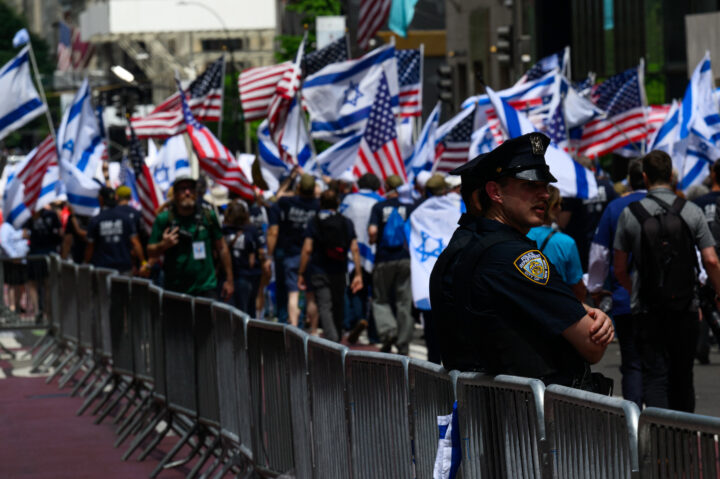
Alexi Rosenfeld/Getty Images
NYPD officers stand on the side during the Celebrate Israel Parade up Fifth Avenue on May 18, 2025 in New York City.
Young American Jews have less of an emotional attachment to Israel than older Jews, but the overwhelming majority of all American Jews, across age groups, believes in Israel’s right to exist as a Jewish and democratic state, new survey data from Jewish Federations of North America reveals.
The results from the survey, which was conducted in March 2025 and released this week, makes clear that a baseline belief in Israel’s existence is still a consistent feature of American Jewish life among at least three-quarters of all Jews in the United States. At the same time, illustrating the complexities of the post-Oct. 7 landscape, one-third of young Jews describe themselves as anti-Zionist or non-Zionist.
Overall, nearly 9 in 10 American Jews believe in Israel’s right to exist, though there is a disparity among age groups. Ninety-eight percent of Jews between the ages of 55 and 74 believe in Israel’s right to exist as a Jewish, democratic state, compared to 76% of American Jews between 18 and 34.
Among younger Jews, a majority still describe feeling emotionally attached to Israel, although there is a larger discrepancy from their parents’ generation. Fifty-seven percent of American Jews between 18 and 34 said they feel emotionally attached to Israel, compared to roughly three-quarters of Jewish Americans between 55 and 74. Among American Jews who are older than 75, 88% described feeling emotionally attached to Israel.
According to the survey, fewer than half of American Jews — across nearly all age categories — identify as Zionists. Among those between the ages of 18 and 34, 35% identify as Zionist. Among Jews over 75, just 33% identify as a Zionist.
JFNA’s chief impact officer, Mimi Kravetz, argued in a Jewish Telegraphic Agency op-ed explaining the survey results that Jews’ reluctance to describe themselves as Zionists, while agreeing with the fundamental tenets of Zionism, is a result of misperceptions about the word, which Kravetz said had experienced “definition creep,” shaped by “political agendas, public discourse, and broader social forces.”
She urged Jewish advocates to respond with unity and a recommitment to the term’s earliest definition.
“For us, Zionism means supporting the State of Israel and the Israeli people and uniting the Jewish people behind this shared commitment,” Kravetz wrote.
But while relatively few American Jews describe themselves as Zionists across age groups, the data shows that far more young Jews identify as anti-Zionists or non-Zionists than older Jews. About one-third (32%) of Jews between 18 and 34 describe themselves as anti-Zionists or non-Zionists. That’s a much larger number than any other demographic: 13% of Jews between 35 and 44 say the same, compared to 15% of Jews between 45 and 54, 1% of Jews between 55 and 64, 4% of Jews between 65 and 74 and 9% of Jews older than 75.
The coming months could offer the mainstream Jewish community something of a breather to assess the changed political landscape
(Noam Galai/Getty Images)
The Maccabeats perform during 'March For Israel' at the National Mall on November 14, 2023 in Washington, DC.
With all of the living hostages released from Gaza and an end (at least for the time being) of Israel’s war in the Palestinian territory, the coming months could offer the mainstream Jewish community something of a breather to assess the changed political landscape.
In the war’s final months, the anti-Israel far left gained a foothold in Democratic Party politics, most prominently in the New York City mayoral race with Zohran Mamdani, but also in urban contests ranging from Seattle to Somerville, Mass. The antisemitic forces on the far right have been less of a political force, but have gained strength on podcasts and among younger right-wingers, and have been embraced to a greater extent by a few populist lawmakers like Rep. Marjorie Taylor Greene (R-GA).
With the return of the living hostages, Israel’s success in degrading Hamas and additional enemies, and the apparent end of the Gaza war, Jewish optimists can plausibly argue that some degree of normalcy could creep back in the political sphere. Israel should become a less salient issue for low-information scrollers, with the war’s end reducing the constant anti-Israel and antisemitic propaganda being fed on so many screens.
With a ceasefire finally achieved, the anti-Israel forces have been remarkably silent, and have been exposed for the Hamas-sympathizing extremists that they always have been. That faction of the anti-Israel Democratic left is as politically exposed as it’s been since the immediate aftermath of Oct. 7, 2023.
There’s also the possibility that, with Israeli elections being held next year, a new Israeli prime minister would get elected, bringing with him or her a new Israeli government that may not be as polarizing to liberal critics of Israel back in the U.S.
Jewish pessimists also have a plausible case to make. Support for Israel has declined in the past year, with the most significant slippage coming from Democratic Party voters and some independents. It’s hard to imagine it will rebound anytime soon. The youngest Gen Z voters are the most hostile towards Israel and have been even before Oct. 7. It’s reasonable to expect their future growth in the electorate will only grow the pool of anti-Israel voters.
Furthermore, the rise of anti-Israel and antisemitic sentiment isn’t happening in isolation; it’s a symptom of the rise of larger illiberal and extreme forces within both parties. The fact that polls show an upward tick in the toleration of political violence, growing antipathy to capitalism on the left, and growing sympathy for authoritarianism on the right is the broader context of the growing hostility Jews are facing, and it’s not showing any signs of abatement.
In the coming year, it will be important to track whether the political outlook for Jews is getting better or whether the trends we’ve seen worsen in the last couple years are accelerating.
We’ll be debuting an election scorecard next week, examining the most meaningful elections in the coming year that will test the influence of the political mainstream against the extremes. Stay tuned: it will be worth bookmarking and tracking as we approach Election Day this November, and in the runup to next year’s congressional primaries.
American University Professor Pamela Nadell: ‘The closing off of spaces to Jews today is happening once again’
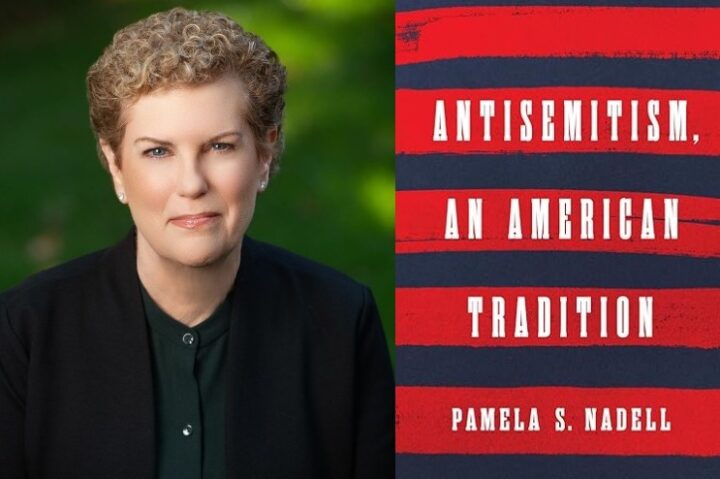
Pamela Nadell
Historian Pamela Nadell is very familiar with the rituals of publishing a book, as she has written nine of them: Secure a release date, present at academic conferences, maybe headline a handful of general-public events. Although she is at the forefront of her field at American University — chair in Women’s and Gender History, director of the Jewish studies program and past president of the Association of Jewish Studies — Nadell knows that success in academia does not often translate to strong book sales.
Things appear to be different for her latest book, Antisemitism: An American Tradition.
Nadell began to understand how much interest a book on antisemitism would generate when her publisher assigned a full-time publicist to promote the book, which will be published on Oct. 14. Nadell is booked at speaking engagements across the country into 2027, starting with an event at the Washington bookstore Politics and Prose this week.
The book that she began researching six years ago will now appear on bookshelves at a time when antisemitism has reached record levels since the Anti-Defamation League began tracking data in 1979.
“I had hoped, frankly, that the subject would be seen as a historic subject by the time [the book] came out into the world,” Nadell told Jewish Insider in a recent interview. “And that’s absolutely not the case.”
Nadell argues in her book that antisemitism is not an aberration in the United States. Instead, she writes, it is intricately woven into the American experience — as American as, say, apple pie.
Jews came from Europe seeking freedom from religious persecution, and while they escaped the pogroms that had haunted them overseas, they did not arrive in a world magically free from antisemitism. She traced the history of anti-Jewish sentiment in America from colonial days to the present, identifying the aftermath of the Civil War as the moment it really gained a foothold in American society.
“America is different [from Europe] in that we never had state sponsored violence against American Jews,” Nadell said. “But the roots of anti-Judaism in America start immediately … the roots of anti-Judaism in America rest on traditional Christian ideas about who the Jews are and what they did to Jesus.”
While antisemitism has always been present in America, the tenor and intensity of it has ebbed and flowed. “We’re in a moment,” she said, “where it’s really bad.”
The reason she is most concerned about the state of antisemitism in America is not just the frequency of antisemitic incidents or the toll of violent attacks on Jews. According to a study published this week by the Anti-Defamation League and Jewish Federations of North America, more than half of American Jews now say antisemitism is a normal part of the Jewish experience.
It’s that doors are once again closing to Jews in a way that reminds her of the quotas, housing covenants and employment restrictions that were baked into American life until the 1950s and 1960s.
“The perception that [antisemitism] was over was because of how much American Jews ascended into American life as those structural barriers fell,” Nadell said. “The doors to corporations opened up, the doors to the colleges opened up. But antisemitism — it’s like it was a nagging factor.”
America is now experiencing another period “where Jewish life once again seems to be constricting,” Nadell argued. “Not in exactly the same ways that it did in those years between World War I and World War II, when there were so many structural limitations. But the closing off of spaces to Jews today is happening once again.”
She pointed to boycotts of Jewish and Zionist writers in the publishing industry, and antisemitic litmus tests appearing in unexpected places like the mental health profession.
“Being told that you have to denounce Israel in order to join a student club? Those students are going to carry those memories forward into their future,” said Nadell.
In recent years, and particularly following the wave of antisemitism that was unleashed after the Oct. 7 attacks two years ago, several Jewish thinkers have posited that the American Jewish community’s best days are behind it. Franklin Foer wrote an Atlantic cover story under the alarming headline, “The Golden Age of American Jews is ending.”
Nadell argues that the notion that there ever was a “golden age” is a myth. “The idea that there was a golden age of Jews in Spain actually emerges during the Dreyfus Affair [in 1894], when things are so terrible in Europe,” she noted. Similarly, Nadell argues that the supposedly now-over golden age for American Jews after the end of quotas and de jure discrimination is not really so straightforward.
“By the time we get to the late ‘60s and on in the 20th century, American Jews feel really secure. The places that used to be closed to us have now opened, and that’s what leads to the perception of the golden age,” said Nadell. “The problem … is the assumption that antisemitism disappeared, but it didn’t.”
Still, Nadell considers herself an optimist. Antisemitism is part of the American fabric. And while that might be a demoralizing conclusion, she views it the other way: Jews have thrived in this country despite antisemitism, and they will continue to do so.
“The reality is that it is part of the normative Jewish experience to experience antisemitism,” said Nadell. “But I think ultimately, American Jews will be okay in the United States.”
A new survey by JFNA found that communal engagement by LGBTQ Jews, Jews of color, Jews with disabilities and financially vulnerable Jews is still higher than pre-Oct. 7 but down year over year
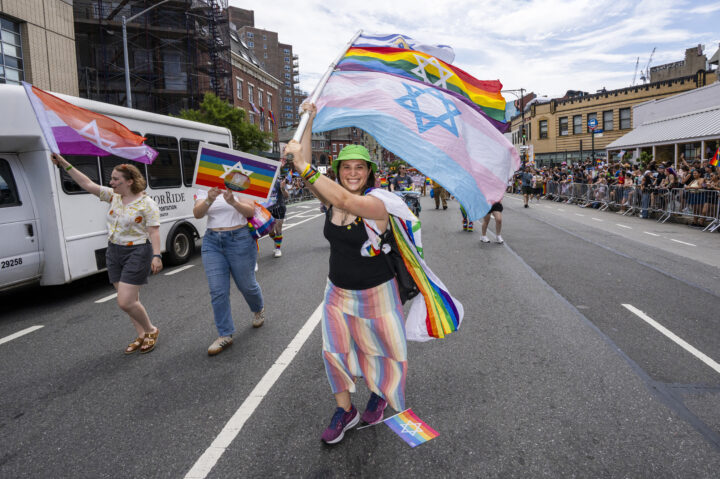
Craig T Fruchtman/Getty Images
People take part in the 2025 NYC Pride March on June 29, 2025 in New York City.
In the aftermath of the deadly Oct. 7 attacks two years ago, American Jews were pulled off the sidelines and got much more involved in Jewish life — a trend, dubbed “the surge,” that has continued into a second year, according to a survey released this spring.
But a further breakdown of that survey data, shared this week by the Jewish Federations of North America (JFNA), shows that the impact of “the surge” is waning more quickly among Jews from minority populations, including LGBTQ Jews, Jews of color, Jews with disabilities and financially vulnerable Jews, than it is among the broader Jewish community.
The survey found that 31% of Jewish respondents said this year that they are engaging more with the Jewish community now than before Oct. 7, down from 43% last year — still significant post-Oct. 7 growth, but slightly down from the immediate aftermath. But among historically marginalized populations, that decrease was even more pronounced.
“We’re sad and disheartened to see that these marginalized groups are engaging so much less than they were at this time last year,” JFNA’s chief impact and growth officer, Mimi Kravetz, told Jewish Insider on Wednesday. “It’s still higher than baseline. There’s still people showing up more. But there has been a more significant drop among these most marginalized groups.”
Roughly one-fifth of people with an LGBTQ+ member of their household say they are now engaging more with the Jewish community in 2025, down from 49% from the year before. Among Jews who are not white and Ashkenazi, 30% of people are “surging” this year, a decrease from 57% the year before. Thirty-two percent of financially vulnerable Jews are “surging” now, compared to 49% a year earlier.
Across these different populations, there is no single answer as to why there was a sharper decline in engagement than among the broader Jewish community. The Jewish leaders analyzing this data have not yet identified what they think accounts for the disparity, but they have some ideas — and suspect that some of the differential can be explained by simmering tensions over Israel.
Overall, the JFNA survey found that roughly one-third of American Jews believe conversations about the war in Gaza are “negatively impacting community engagement and belonging,” according to a presentation for Jewish community stakeholders hosted by JFNA on Tuesday. Thirty-five percent feel that if they shared their views on Israel, they wouldn’t be welcome in the Jewish community.
But just because people are sometimes afraid to voice their opinion, that doesn’t mean they are all in alignment. Similar percentages of American Jews feel the community is too hard-line in its support for Israel (39%) and feel that it is not outspoken enough in its support for Israel (34%).
Among LGBTQ Jews, or those who live with someone LGBTQ, “we do see a slightly lower sense of pride and emotional attachment to Israel, and we do see that they are more likely to believe that the community is too hard-line in its support of Israel,” Kravetz offered as one possible explanation for why the community is now “surging” less.
That’s different from financially vulnerable Jews, who are “more likely to feel pride in an emotional attachment to Israel than the general Jewish public,” Kravetz said on the webinar. One challenge for them may be a sense of feeling uninformed compared to others in the community.
“They’re actually far less likely to say that this issue of the community and Israel is affecting their sense of engagement and belonging,” she added. “They are much more likely, though, to say that they don’t know enough to participate in the conversation.”
But the Israel hypothesis falls short when looking at why Jews of color are “surging” less than a year ago. “Their views actually mirror the general population,” said Kravetz. But part of that may account for diversity within the broad “Jews of color” umbrella — which encompasses Mizrahi Jews, Black Jews, Latinos and more.
The data is particularly concerning for Jewish leaders who had invested in understanding diverse segments of the community and helping them feel more included. But the same barriers that existed before Oct. 7 are still present.
“What’s really affecting their sense of surge and engagement and belonging are the same things that affected them prior to Oct. 7, and those are that they need to see a reflection of themselves in leaders and other participants,” said Kravetz. “They need space to show up as their whole self, whatever that looks like for them. They need to see visible evidence of diversity and inclusion policies and practice, and that those policies will be followed, and they need to know before they enter.”
It’s the highest number of anti-Jewish hate crimes ever recorded by the bureau since it began collecting data in 1991

Tom Brenner For The Washington Post via Getty Images
Metropolitan Police Department and Federal Bureau of Investigation officers stand guard at a perimeter near the Capital Jewish Museum on May 22, 2025 in Washington.
The FBI reported on Tuesday that the American Jewish community remains the most targeted religious group, accounting for nearly 70% of all religiously motivated hate crimes in 2024, even as overall hate crimes in the country have decreased.
Hate crimes targeting Jews had plateaued following a sharp increase immediately after the Oct. 7 Hamas terror attack.
In 2024, 1,938 anti-Jewish hate crimes were reported to the FBI’s data collection program out of 3,096 reported religiously motivated hate crimes. The year 2024 saw the highest number of anti-Jewish hate crimes ever recorded by the bureau since it began collecting data in 1991 — and an increase compared to 1,832 incidents the year prior, which accounted for 67% of all religiously motivated hate crimes that year.
Some of that increase could be attributed to improvement in data collection, according to the FBI. That increase comes as hate crime incidents across the country slightly decreased from 11,862 in 2023 to 11,679 in 2024.
Fifty percent of hate crime incidents across the country in 2024 were motivated by bias based on race, ethnicity or national origin, with reported anti-Black hate crimes comprising the single largest portion of those incidents (51% of 7,043 reported offenses).
The FBI also reported that the number of anti-Muslim hate crimes (228) and anti-LGBTQ+ hate crimes (2,390) were slightly down compared to 2023.
Jewish organizations responsible for tracking threats to the Jewish community expressed concern over the findings, which come months after two deadly antisemitic attacks in Washington and Boulder, Colo.
Michael Masters, national director and CEO of the Secure Community Network, said that the current threat environment for American Jews is “unlike anything in modern memory.”
“We have documented individuals echoing the rhetoric of designated foreign terrorist organizations and plotting heinous attacks on our houses of worship, schools, and centers of Jewish life,” Masters said in a statement. “This reality demands accurate, timely reporting so law enforcement and Jewish security partners can respond swiftly.”
Jonathan Greenblatt, CEO of the Anti-Defamation League, said in a statement, “Since the Hamas-led Oct. 7 massacre in Israel, Jewish Americans have not had a moment of respite and have experienced antisemitism at K-12 school, on college campuses, in the public square, at work and Jewish institutions. Our government and leaders must take these numbers seriously and enact adequate measures to protect all Americans from the scourge of hate crimes.”
Ted Deutch, CEO of the American Jewish Committee, called for “leaders of every kind — teachers, law enforcement officers, government officials, business owners [and] university presidents [to] confront antisemitism head-on” in response to the FBI data.
“Jews are being targeted not just out of hate, but because some wrongly believe that violence or intimidation is justified by global events,” Deutch said. “With the added climate of rising polarization and fading trust in democracy, American Jews are facing a perfect storm of hate. Whether walking to synagogue, dropping their kids off at school, sitting in restaurants, or on college campuses, Jews are facing a climate where fear of antisemitism is part of daily life.”
“This is unacceptable — the targeting of Jews is not a Jewish problem, it is a society-wide issue that demands a society-wide response.”
An April 2025 Pew Research Center survey found 72% of Jewish Americans held a favorable view towards Israel
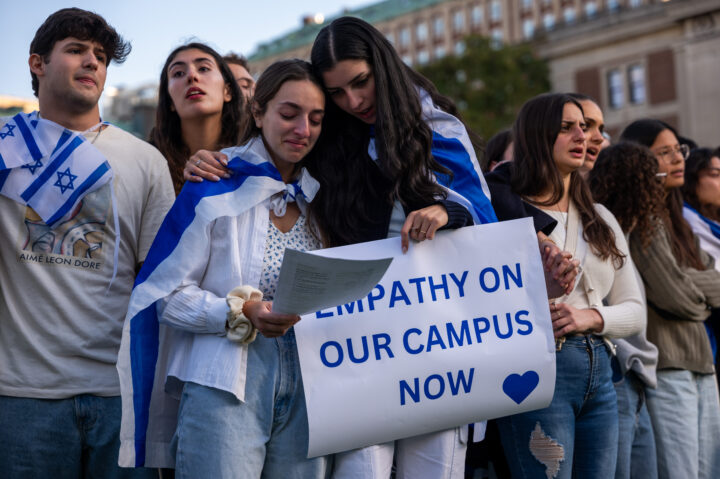
Spencer Platt/Getty Images
Columbia students participate in a rally and vigil in support of Israel in response to a neighboring student rally in support of the Palestinians at the university on October 12, 2023 in New York City.
One of the biggest challenges in our modern media ecosystem is breaking out of the echo chambers that so many are locked into.
Ezra Klein’s New York Times column this week, headlined “Why American Jews No Longer Understand Each Other,” is a worthwhile example of how even the best-intentioned columnists can struggle to understand the world outside their own social and informational bubble.
The column portrays a vocal minority of anti-Zionist sentiment within the Jewish community as much larger than it actually is. The characterization of a roughly even divide within the Jewish community between Zionists and anti-Israel Jews is at odds with numerous reputable polls tracking Jewish public opinion.
Public polling serves as a useful reality check to much of the framing in the column, and underscores the breadth of Jewish support towards Israel. An April 2025 Pew Research Center survey found 72% of Jewish Americans held a favorable view towards Israel. A fall 2024 poll of Jewish voters commissioned by the conservative Manhattan Institute found 86% of Jews considering themselves “a supporter of Israel.” A spring 2024 survey of Jewish voters commissioned by the Democrat-affiliated Jewish Electoral Institute (JEI) found 81% of Jewish respondents were emotionally attached to Israel.
This doesn’t paint the portrait of a community that is meaningfully divided over Israel — even amid the wave of negative, if not hostile, coverage towards the Jewish state in recent months.
Klein’s column interviews four Jewish voices — from anti-Israel polemicist Peter Beinart to the publisher of the anti-Zionist Jewish Currents publication to the rabbi of a deeply progressive Park Slope synagogue to self-proclaimed “progressive Zionist” Brad Lander — while just one (former Biden antisemitism envoy Deborah Lipstadt) reflects the mainstream Jewish majority.
The other canard advanced in the column is that younger Jews, in particular, have become hostile towards Israel. And while Gen Z Jews’ level of support for the Jewish state is not as high as their older counterparts, the degree of support towards Israel among the younger Jewish generation is still significant — especially when compared to their non-Jewish counterparts on campuses.
A November 2023 poll commissioned by the American Jewish Committee asked: “Thinking about what being Jewish means to you, how important is caring about Israel?” Two-thirds of Jewish respondents between the ages of 18-29 said it was important — with 40% saying it was “very important.” (Over four-fifths of Jews older than 30 responded in the affirmative.)
A February 2024 Pew Research Center study found a 52% majority of Jews ages 18-34 considered Israel’s conduct in its war against Hamas to be acceptable, while 42% disagreed. By a 61-26% margin in the same poll, Gen Z Jews also favored the U.S. continuing to provide military aid to Israel to help it defeat Hamas.
In a thorough study and survey of Jewish student public opinion in the summer of 2024, Tufts University political scientist Eitan Hersh flagged that the source of anti-Israel Jewish student opinion is almost entirely concentrated among the “very liberal” faction of Jewish students on campus, which make up 18% of the Jewish population. That closely matches the 22% of Jewish students who said they feel no connection to Israel at all.
By comparison, an outright 54% majority of Jewish college students said they “feel their own well-being is connected to what happens to Jews in Israel.”
“We see that the gaps between liberals and very liberals (the former more moderate, the latter further left) are enormous. In fact, they vastly exceed the gaps between conservatives and liberals,” Hersh concluded.
Indeed, the biggest disconnect on college campuses these days is between Jewish students, who still largely support Israel, and their non-Jewish counterparts, who have become downright hostile towards the Jewish state — or, among elements of the right, have become more apathetic towards Israel.
For example, Hersh’s survey found that 51% of Jewish college students blamed Hamas for the conflict in Gaza, while 18% blamed Israel. But among non-Jewish college students, more blamed Israel (35%) than Hamas (18%) for the current war. Nearly one-third (30%) said both, in a sign of apathy and exhaustion towards the conflict.
Those findings are consistent with a new analysis from political science professor Eric Kaufmann in Tablet, which found that far from becoming more critical of Israel, liberal Jews on campus have instead become more isolated from their non-Jewish peers while moving more towards the political center.
“Ivy League Jews went from being well to the left of the median Ivy League student to leaning right of the average,” Kaufmann concluded. “In the Ivy League, Jews now self-censor more than conservatives do.”
Democratic pollster Mark Mellman found Trump’s overall approval rating with Jewish voters stands at 24%, while 31% approve his record on antisemitism

Ethan Miller/Getty Images
President Donald Trump is introduced at the Republican Jewish Coalition's Annual Leadership Summit at The Venetian Resort Las Vegas on October 28, 2023 in Las Vegas, Nevada.
More than 7 in 10 American Jews disapprove of President Donald Trump’s job performance, a new poll found, but he is making some inroads with Jewish voters on his handling of antisemitism, compared to his first-term standing.
The poll, administered by Democratic pollster Mark Mellman for the Jewish Electoral Institute (JEI) between April 15-18 and released on Wednesday, found that Trump’s overall approval rating among Jewish voters is at 24%, with 72% disapproving. The results suggest there hasn’t been much of a shift since the election: Trump won 26% of the Jewish vote, according to Mellman’s post-election survey conducted last December.
The poll also found large majorities of the 800 registered American Jewish voters who were surveyed opposing his policies on tariffs, cuts to the federal government, and threats to law firms.
“American Jewish voters are deeply distressed about the direction in which Donald Trump is taking the country and oppose many of his key policies. Indeed, a majority of Jewish voters disapprove of his job performance overall and disapprove of the way Trump is handling antisemitism,” Mellman said.
But on the issue of handling antisemitism in America, Trump receives higher marks from Jewish voters. The poll found 31% of Jewish voters approve of the way he’s dealing with antisemitism, while 56% disapprove. His current rating on antisemitism is markedly better than it was in his first term: When Mellman asked a similar question in JEI’s 2018 poll of Jewish voters, Trump’s disapproval rating on handling antisemitism was much higher (71%).
Among Jews under 30, many of whom have attended college recently or are currently university students, Trump’s numbers are also in better shape. One-third of younger Jewish voters said they approve of Trump’s handling of antisemitism, while just a narrow majority (52%) disapprove.
When asked about one of Trump’s specific policies designed to combat antisemitism, Trump faces broader disapproval. More than 7 in 10 American Jews disapprove of the executive order “allowing the federal government to deport individuals without a court hearing.”
Please log in if you already have a subscription, or subscribe to access the latest updates.
 Continue with Google
 Continue with Apple