





































The letter warns that New Jersey ‘cannot lag behind in equipping our state to confront rising antisemitism’
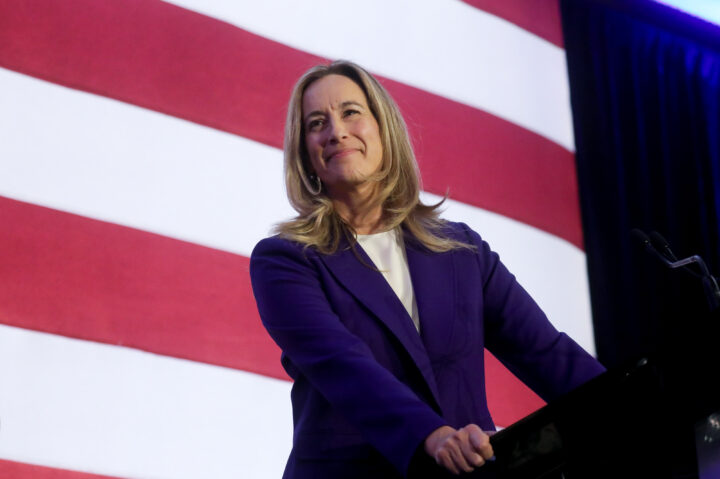
Michael Nagle/Bloomberg via Getty Images
New Jersey Gov. Mikie Sherrill during an election night event in East Brunswick, New Jersey, on Nov. 4, 2025.


 Add JewishInsider on Google
More than 2,000 New Jersey rabbis and lay leaders signed a petition to New Jersey Gov. Mikie Sherrill and state lawmakers urging them to take prompt action to implement the International Holocaust Remembrance Alliance’s working definition of antisemitism in the state.
Legislation on the issue picked up broad support in the New Jersey Statehouse last year, but was ultimately halted by then-Gov. Phil Murphy and other state Democratic leaders over concerns that the bill — while enjoying support from a majority of assemblymembers — would require some Republican support to pass, and that voting for the measure could fuel progressive primary challenges to some Democratic members.
“We were deeply dismayed that legislation to adopt the IHRA definition was recently shelved for political reasons, despite broad support in the legislature and clear evidence of rising antisemitism,” the letter, which was organized by the Jewish Majority, reads. “At a moment when Jewish communities seek protection and clarity, this delay sends a troubling message about whether Jewish safety is prioritized.”
The letter argues that the IHRA definition is a “practical necessity” and that, given its substantial Jewish population, the state “cannot lag behind in equipping our state to confront rising antisemitism.”
The bill has been reintroduced in the current legislative session, but one Jewish leader said it does not appear that it has much momentum or institutional backing at the moment, or that the state of play has substantially changed since Murphy’s term ended and the new governor came into office.
Sherrill, a Democrat, had previously expressed support for the IHRA legislation.
Rabbi David-Seth Kirshner of Temple Emanu-El in Closter, N.J., who was one of the driving forces behind the petition, said he was “really furious” when Murphy “played a game with this legislation,” calling it “strange and uncharacteristic” from a leader who was once a “fierce advocate of the Jewish community.”
Kirshner said that, given New Jersey’s large Jewish population, it should have been among the first states to adopt IHRA, rather than lagging behind more than 35 other states. He said that he and other leaders in the state want to support the effort to pass and implement IHRA in any way they can.
He said he would also like to see Sherrill act on the issue through an executive order — even one that is time-limited to allow the Legislature to pass the IHRA bill. He said he would have liked her to implement such an order on her first day in office.
“This is not complicated, and the idea that the governor’s office or that any of our legislators want to complicate this process is a passive-aggressive form of continued antisemitism,” he said.
Rabbi Matthew Gerwitz of Temple B’nai Jeshrun in Short Hills, N.J., another organizer of the petition, said that New Jersey Jews need to “find all ways and operate at all levels” to address rising antisemitism in the state, and not let it become normalized, lest they “end up contributing to our own downfall and demise.”
“[The governor has] expressed her support of us. And this is part and parcel of supporting Jews right now, is making sure that every legal, ethical, communal device is put into place, so that we can feel protected during a time where [antisemitism] has become … normalized,” Gerwitz said.
He said that the Jewish community felt like it had the “rug pulled out from under our feet during a perilous time for Jews” by Murphy.
Gerwitz said that he has no issue with an executive order, as long as it has teeth, but said that he wants to ultimately see legislation passed, so that the state government speaks in one voice on the issue.
“I would like to see the stamp of approval from the Assembly, from the state Senate and from the governor to say every single branch of this government is going to be behind you … the way they should be behind any group that is feeling persecuted,” he said.
Rabbi Samuel Klibanoff of Etz Chaim in Livingston, N.J., inside Sherrill’s former House district, who also helped lead the petition, said it was a “great show of unity amongst the rabbis, because [it’s] not that often that you see a Conservative, Reform and Orthodox rabbi do something together.”
“I hope that [Sherrill] will [act on] her conviction and not party lines or party pressure or whatever it might be,” Klibanoff said. “I just hope she’ll do the right thing, and not play politics with this.”
He said it’s important to bring renewed attention to the issue, and that the longer the bill takes, the longer the Jewish community is left in peril.
Jonathan Schulman, the executive director of Jewish Majority, described the petition as a follow-on and expansion to a previous letter from around 100 rabbis in the state urging passage of the IHRA legislation, explaining that rabbis had heard interest from their congregants about joining the effort as well.
He said he’s hearing widespread support among local leaders for a stopgap executive order, which he said would also create political cover for Democratic lawmakers to “finally be able to vote their conscience and support legislation like this.”
Karim Khan has been accused of sexual misconduct; Jerusalem alleges the ICC’s head prosecutor pursued a case against senior Israeli officials as a distraction

Michael M. Santiago/Getty Images
Prosecutor of the International Criminal Court Karim Khan speaks during a UN Security Council meeting at the United Nations headquarters.
Israel petitioned the International Criminal Court on Monday to remove chief prosecutor Karim Khan from its case, saying he pursued charges against Israeli leaders to distract from sexual harassment accusations lodged against him.
Israel also asked the court to cancel its arrest warrants against Israeli Prime Minister Benjamin Netanyahu and former Defense Minister Yoav Gallant over Khan’s allegations that they perpetrated war crimes and crimes against humanity in Gaza, including “starvation of civilians as a method of warfare” and “intentionally directing attacks against a civilian population.”
The petition came after two women submitted complaints against Khan for workplace sexual misconduct. One is an ICC employee, who alleged the misconduct occurred as recently as 2024 and that Khan attempted to dissuade her from making claims against him.
In a leaked recording of a phone call between Khan and the ICC employee, she lamented that she had been accused of being a “Mossad plant” over the complaint. Khan was recorded telling the woman that someone had leaked the complaint to the media to “get rid of the warrants for Palestine,” among other open cases.
According to The Guardian, private investigators hired by Qatar had attempted and failed to find a link between the accuser and Israel.
Khan went on leave in May, while the ICC conducted an internal investigation into the allegations against him.
The Israeli Foreign Ministry said that the reports “raise serious concerns that the prosecutor acted with inappropriate personal motivations to advance false and baseless allegations against Israel to distract public attention from the serious accusations against him.”
The Foreign Ministry also clarified that it continues to maintain that the warrants against Netanyahu and Gallant are void and that the court did not have the authority to issue them.
Elliot Malin, an international lawyer who has filed petitions to the ICC, including against Iran for abetting Hamas in the Oct. 7, 2023, attacks on Israel, evaluated Israel’s chance of success in its petition to be “50-50.”
Sources in the ICC “thought the request for warrants [against Netanyahu and Galant] were premature,” Malin told Jewish Insider. “When Khan requested a warrant for the crime of extermination, it was rejected. … Extermination is a lower-threshold crime than genocide, and the threshold to grant warrants is extremely low. You only have to present that you might have a case, so the fact that judges reject it is noteworthy.”
At the same time, Malin said that the warrant for intentional starvation was “based on hearsay,” so it seems the decision may have been “political, because they rejected a lot [of other charges], saying that Khan didn’t show evidence that demonstrates those crimes.”
“If the court wants to do its best to appear objective, it’s in its interest” to remove Khan, Malin added.
Jason Miyares says AMP refuses to comply with demand for financial documents to scrutinize possible ties to terror

Julia Rendleman for The Washington Post via Getty Images
Virginia Attorney General Jason Miyares.
Jason Miyares, the attorney general of Virginia, announced this week that his office had filed a petition to enforce a judge’s order from last July that a pro-Palestinian advocacy group with alleged ties to Hamas turn over closely guarded financial records that could shed light on its donor network — which has faced growing scrutiny in the wake of the Oct. 7 Hamas terror attacks.
Miyares’ office said in a statement on Tuesday that American Muslims for Palestine (AMP), a nonprofit group headquartered in Virginia that he has been investigating in a probe of its fundraising operations, “has refused to comply” with a civil investigative demand for documents the group has long shielded from public view.
The petition “seeks AMP’s immediate compliance” with the demand, the statement said, reiterating that Miyares’ team has been requesting records as part of an ongoing investigation into allegations that the group “may have used” funds “for impermissible purposes, such as benefiting or providing support to terrorist organizations.”
In a major court ruling last summer, a Richmond judge rejected AMP’s effort to challenge the demand, ordering the group to “produce records” and denying its petition to narrow the focus of the probe, according to a statement from the attorney general’s office after the decision had been made.
But Miyares, a Republican who first launched his investigation shortly after Hamas’ attacks on Israel in October 2023, said that AMP has continued to drag its heels several months later.
“Despite the court denying AMP’s previous efforts to halt my investigation, they continue refusing to comply,” he said in a separate statement posted to social media on Tuesday, while calling the petition “necessary to ensure accountability and uphold the law.”
A spokesperson for his office did not respond to a request for comment on the investigation.
Christina Jump, an attorney for AMP, said that she was unable to comment on the petition because she had “yet to see the referenced enforcement action,” claiming the attorney general’s office had “issued a press release prior to making any effort to contact AMP — or its counsel — about this new step.”
Jump added that AMP had filed a “timely” appeal of the judge’s decision and made “requests for a stay of the enforcement,” accusing the attorney general’s office of attempting to “thwart” the group’s “right to utilize the full legal process,” which she called “both disappointing and premature.”
“We will continue to pursue all legal actions which AMP may rightfully pursue — and its appeal of the underlying decision remains actively pending,” she wrote in an email to Jewish Insider on Wednesday.
Founded in 2006, AMP describes itself as “a grassroots organization dedicated to advancing the movement for justice in Palestine by educating the American public about Palestine and its rich cultural, historical and religious heritage and through grassroots mobilization and advocacy.”
But in the wake of Oct. 7, the group has faced growing scrutiny over its involvement in anti-Israel protests on college campuses around the country and its financial backing of National Students for Justice in Palestine, members and chapters of which have voiced outspoken support for Hamas.
Top officials at AMP, meanwhile, were also once affiliated with a now-defunct group, the Islamic Association for Palestine, found liable for aiding Hamas.
The attorney general’s investigation is one of several legal challenges now targeting AMP’s records, which critics have long suspected of hiding illicit financial activity.
The group has insisted it has never supported or funded terrorism and that it does not send money overseas. Jump, in her email to JI, said “no court, in any jurisdiction, has ever found that AMP has done anything inappropriate regarding its fundraising. It has not.”
AMP’s fiscal sponsor, AJP Educational Foundation, took in more than $2.2 million in revenue in 2023, according to its most recent tax filings, which do not disclose the group’s donors.
In an interview with JI last September, Miyares — who has largely avoided commenting publicly on the active investigation — said that his office has been “aggressively in the process of using the legal system” to obtain additional records that AMP has fought to withhold.
“We have been relentless in that pursuit, and we will continue to be relentless,” he said. “Our job is to get to the truth.”
Please log in if you already have a subscription, or subscribe to access the latest updates.
 Continue with Google
 Continue with Apple