



























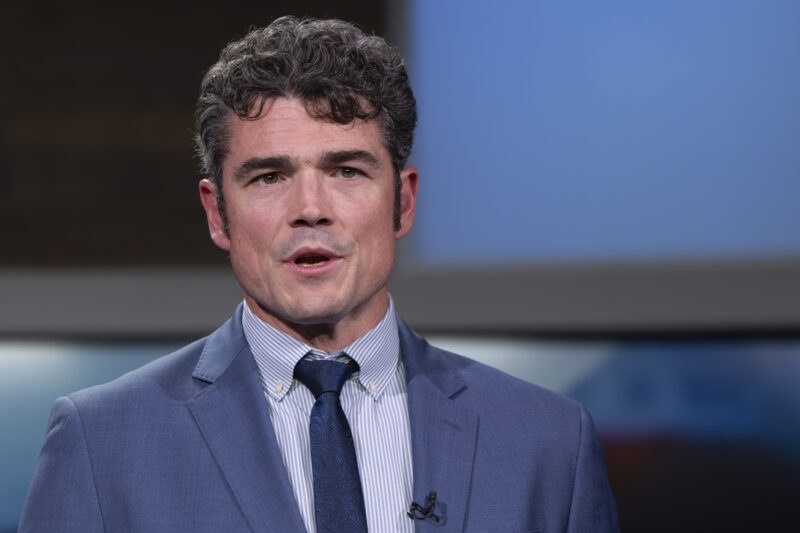









Janeese Lewis George said she regrets committing not to attend events focused on ‘promoting Zionism,’ but hasn’t said so publicly

Craig Hudson for The Washington Post via Getty Images
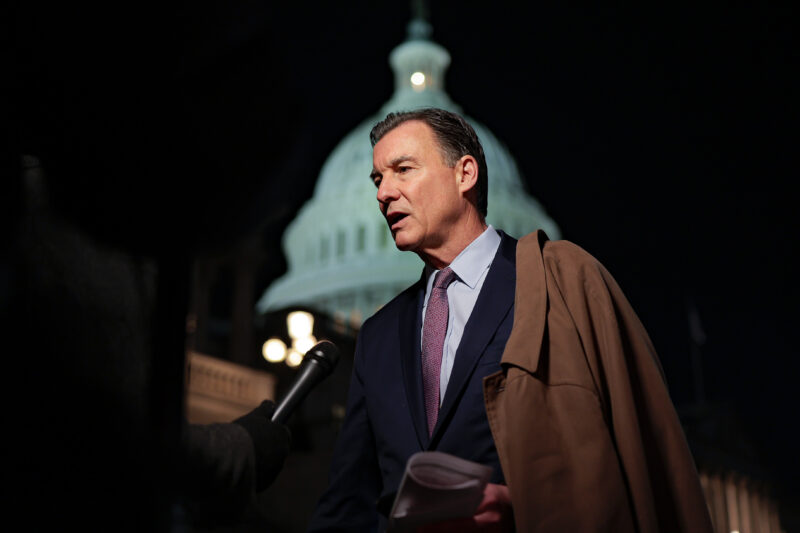
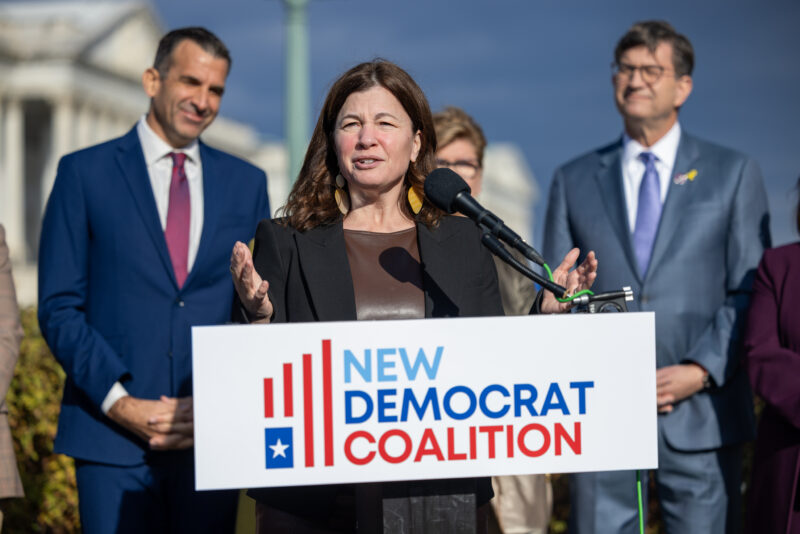
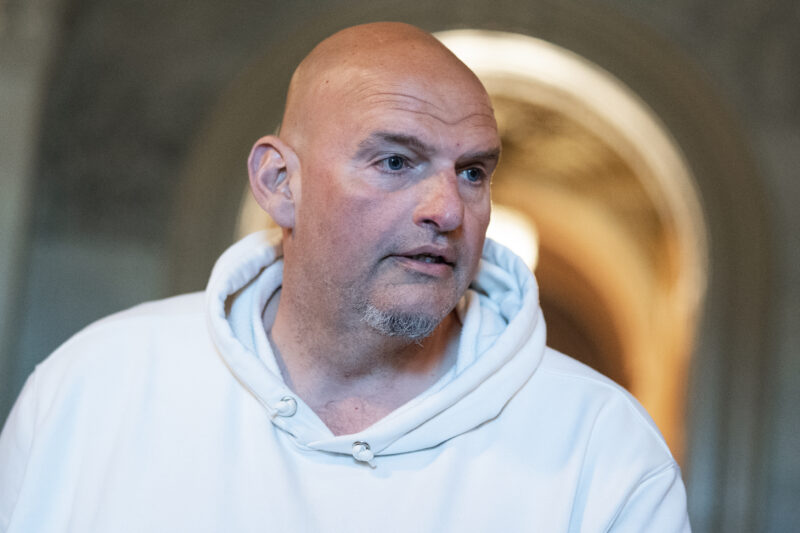
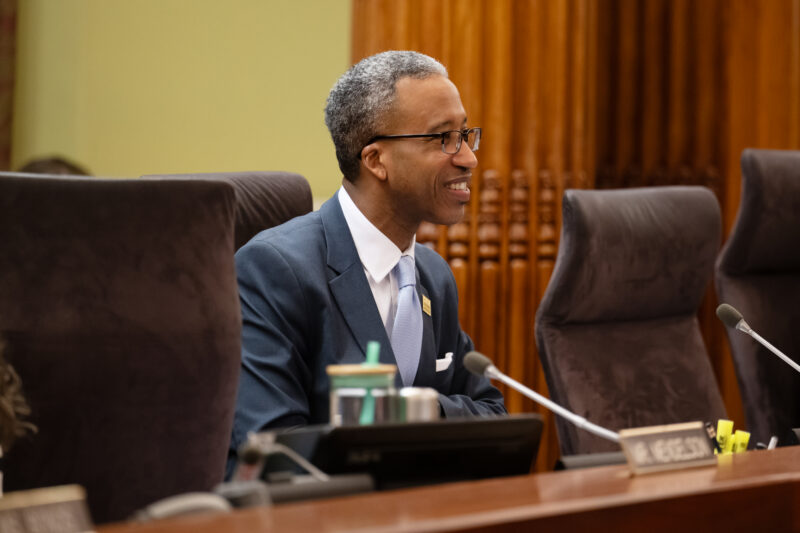
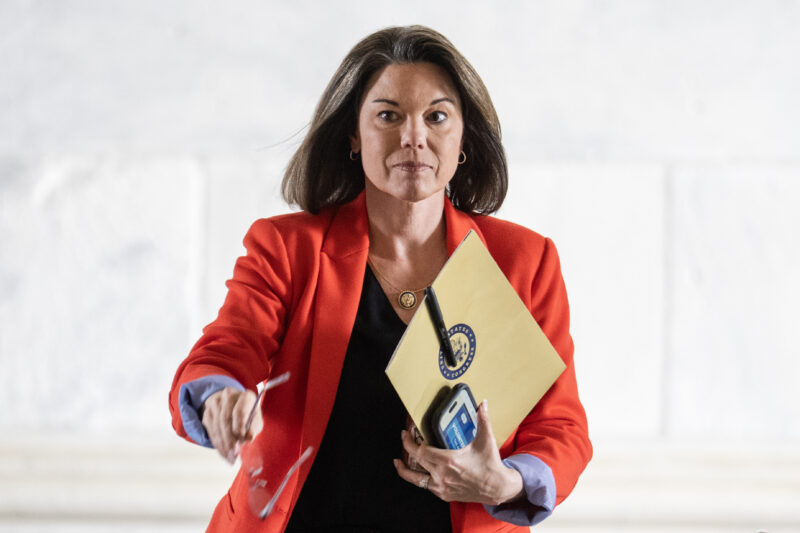
D.C. councilmember and mayoral candidate Janeese Lewis George is seen on Capitol Hill for a press conference in Washington, DC on March 10, 2025.


 Add JewishInsider on Google
Janeese Lewis George, a Democratic Socialists of America-endorsed candidate for mayor of Washington, D.C., met with prominent local rabbis and Jewish community leaders last week amid fallout over a DSA questionnaire she filled out outlining her views on Israel and antisemitism.
The March 19 meeting, at the Orthodox Ohev Sholom Congregation in Shepherd Park, was arranged after her responses to a DSA endorsement questionnaire were made public last month, according to two sources familiar with the meeting.
In the questionnaire, Lewis George pledged not to attend events focused on “promoting Zionism and apartheid.” She also said that she had attended a D.C. Jewish Community Relations Council event in December only to talk about opposing Immigration and Customs Enforcement’s deportation measures in the region, and that she did not agree with JCRC’s stances on Israel, Zionism and antisemitism.
At the meeting at Ohev Sholom, Lewis George apologized for her statements in the questionnaire, one of the event’s attendees told Jewish Insider, and cried when someone in the meeting described feeling hurt by her answers in the questionnaire.
She blamed the anti-Israel responses on one of her staff members, and said she would have submitted a different response if she had seen it before it was submitted.
However, she has not expressed that same sentiment publicly. A spokesperson for Lewis George did not respond to multiple requests for comment on Monday.
Lewis George did not make any promises to apologize publicly or to further address her comments in the DSA questionnaire, according to the meeting attendee.
The meeting included rabbis and senior leaders from Milton Gottesman Jewish Day School, the Edlavitch D.C. JCC, Temple Sinai, Ohev Sholom, Adas Israel Congregation, Tifereth Israel Congregation, the JCRC and Tzedek DC, a legal services organization.
Lewis George will appear at a rally hosted by the Metro DC DSA chapter on Wednesday alongside Rep. Rashida Tlaib (D-MI), one of the most vocal detractors of Israel in Congress.
Ron Halber, the CEO of the Jewish Community Relations Council of Greater Washington, wrote in an op-ed published Monday that Metro DC DSA threatens “the sense of attachment and belonging that we [Jews] have long enjoyed in D.C.”
“Their questionnaire for political candidates encourages the systematic erasure of Jewish and pro-Israel Americans from public life. It is an outrageous and revolting display of religious discrimination,” Halber wrote in Washington Jewish Week. He did not specifically mention Lewis George.
Correction: A previous version of this article identified Temple Micah as one of the participants in the meeting. They did not have a representative in the room.
The mayor’s comments responding to pro-Hamas protesters in Queens and an arson attack on a synagogue in Jackson, Miss., illustrate what Mamdani’s critics interpret as a core tension animating his assessment of antisemitism
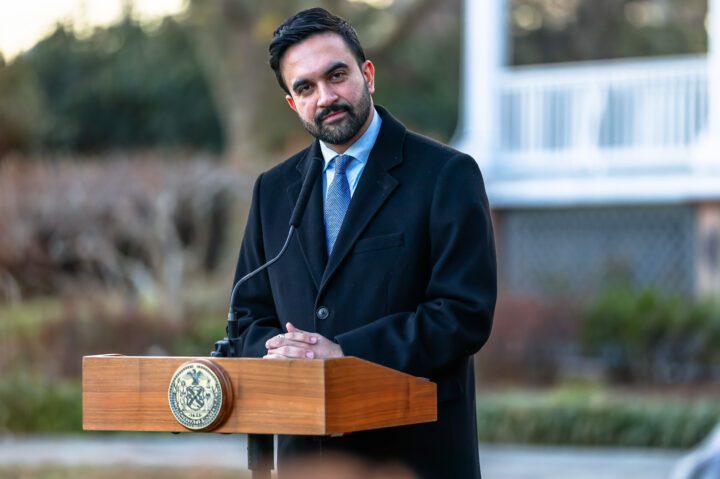
Michael M. Santiago/Getty Images
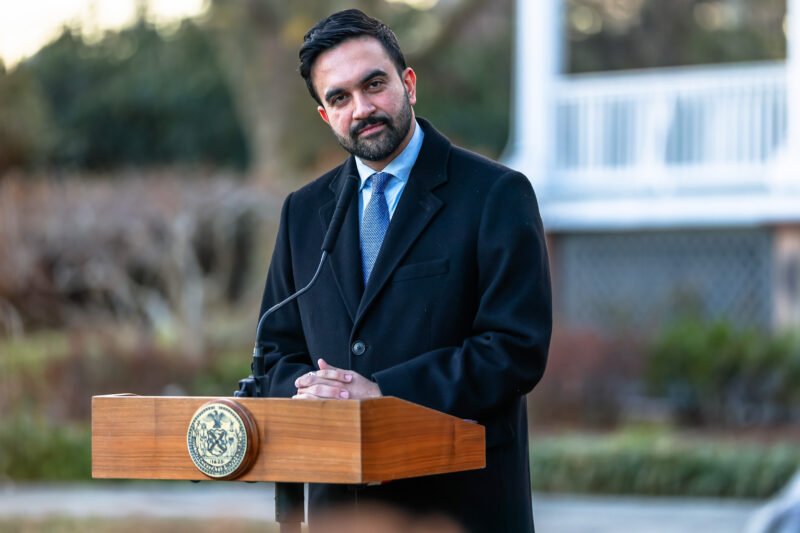
Mayor Zohran Mamdani speaks at a press conference during moving day at Gracie Mansion on January 12, 2026 in New York City.
New York City Mayor Zohran Mamdani sparked an uproar among Jewish community leaders when, on his first day in office, he revoked an executive order that adopted a definition of antisemitism equating some criticism of Israel with anti-Jewish prejudice.
But the mayor has yet to articulate which, if any, definition of antisemitism he will abide by, raising questions about his views toward escalating anti-Jewish hate in the city as he continues to weigh in on high-profile issues affecting the Jewish community.
His recent comments responding to pro-Hamas protesters in Queens last week and an arson attack on a synagogue in Jackson, Miss., over the weekend illustrate what Mamdani’s critics interpret as a core tension animating his assessment of antisemitism.
While Mamdani released a statement on Sunday calling the arson a “violent act of antisemitism,” his comment on the demonstration outside a synagogue in Kew Gardens Hills where protesters openly voiced support for Hamas was delayed and came only after he faced growing pressure from media outlets and Jewish community leaders to denounce the demonstration.
In contrast with several of his top allies on the left, Mamdani, who has long been an outspoken critic of Israel, ultimately chose not to the call the protesters antisemitic, even as he otherwise denounced Hamas as a “terrorist organization” and said that the chants heard at the demonstration “are wrong and have no place in our city.”
The statements on two separate issues in different states helped distill how Mamdani has traditionally reacted to individual instances of antisemitism. He has unequivocally condemned as antisemitic recent incidents where Jews have faced violent attacks and have been targeted by vandalism, among other acts. But the mayor has been slower to react decisively on protests near Jewish institutions involving anti-Israel activism.
Mamdani, who has long identified as anti-Zionist and refuses to recognize Israel’s right to exist as a Jewish state, drew backlash last November after he admonished a Manhattan synagogue that was also targeted by anti-Israel demonstrators who chanted slogans including “death to the IDF” and “globalize the intifada,” a phrase he has declined to renounce.
Even as he distanced himself from the language used by protesters in objecting to an event about immigration to Israel, Mamdani said that “sacred spaces should not be used to promote activities in violation of international law,” a statement he later revised. He did not label the protest antisemitic, as other elected officials had done. On the recent Queens protest outside an Israeli real estate event, Mamdani used similar language when asked why he hadn’t condemned “both sides.” He answered, “I absolutely have an opposition to the sale of land in the West Bank. It’s a violation of international law and that comes from my belief in the importance of following international law.”
His ongoing reluctance to explicitly identify such protests as antisemitic underscores how his record of pro-Palestinian activism has long been central to his self-conception. While he moderated on several key issues in the election, Mamdani notably resisted softening even some of his most controversial views relating to Israel — such as a pledge to arrest Israeli Prime Minister Benjamin Netanyahu on charges of war crimes.
“On an ideological level, it’s a very problematic issue to be a proud anti-Zionist — especially if you are the mayor of New York City,” Rabbi Ammiel Hirsch, who leads Stephen Wise Free Synagogue on Manhattan’s Upper West Side, said. “On a practical level, wherever anti-Zionism has been normalized,” he said, “as night follows day, it leads to antisemitism, in every single case, and it is the case today. There won’t be an exception simply because the mayor, at this time, insists on being an anti-Zionist and is proud of it.”
Rabbi Ammiel Hirsch, who leads Stephen Wise Free Synagogue on Manhattan’s Upper West Side, said in an interview with Jewish Insider on Monday that he has spoken with Mamdani repeatedly about what he called a clear connection between anti-Zionism and antisemitism — which, he noted, the mayor has not acknowledged.
Even as Hirsch conceded “it’s not necessarily the case in every circumstance” that “anti-Zionism is, ipso facto, antisemitism,” he said such discussions are “completely divorced from reality,” disagreeing with Mamdani’s assessment of the Queens protest last week. “What Jews mean by anti-Zionism is not what Hamas means by anti-Zionism,” he explained. “If you are pro-Hamas, then you are, by definition, an antisemite.”
“On an ideological level, it’s a very problematic issue to be a proud anti-Zionist — especially if you are the mayor of New York City,” Hirsch argued to JI. “On a practical level, wherever anti-Zionism has been normalized,” he said, “as night follows day, it leads to antisemitism, in every single case, and it is the case today. There won’t be an exception simply because the mayor, at this time, insists on being an anti-Zionist and is proud of it.”
The working definition of antisemitism Mamdani rescinded, which is promoted by the International Holocaust Remembrance Alliance, has long been a target of anti-Israel activists and some progressives who believe it stifles legitimate criticism of Israel — even as it is widely accepted as useful guidance by mainstream Jewish groups.
A spokesperson for Mamdani did not respond to a request for comment from JI asking how he would define what he has frequently called “the scourge of antisemitism” while pledging to ensure the safety of Jewish New Yorkers.
Mamdani has yet to announce key administration hires for areas related to antisemitism, such as the office to combat antisemitism, which he has vowed to retain, and he has sent mixed messages regarding his efforts to fight antisemitism — voicing interest, for example, in a city curriculum embraced by leading Jewish groups that promotes a definition of Zionism seemingly at odds with his own views on Israel.
Shortly before his inauguration, Mamdani argued that a report issued by the Anti-Defamation League, which highlighted several members of his transition team who had used antisemitic tropes and justified Hamas’ Oct. 7, 2023, attacks, ignored what he called “the distinction between antisemitism and criticism of the Israeli government.” He did not address some of the most extreme comments made by appointees, but said the ADL report “draws attention away from the very real crisis of antisemitism we see.”
Mark Goldfeder, the director of the National Jewish Advocacy Center, said he suspects that Mamdani is now “gearing up to adopt” what he characterized as “one of the ‘IHRA-lite’ definitions” of antisemitism, citing those embraced by the Jerusalem Declaration on Antisemitism and the Nexus Project — which he called “a little better than JDA,” though neither are widely accepted by mainstream Jewish organizations. Both definitions, he argued to JI, “provide more cover to those who wish to hide their antisemitism behind the curtain of anti-Zionism.”
Jonathan Jacoby, the president and national director of the Nexus Project, said in a statement to JI on Monday that Mamdani “and all public officials should be judged by the actions they take to protect Jewish communities — not by their adherence to any one controversial definition of antisemitism.”
According to Goldfeder, applying the Nexus definition to the recent incidents addressed by Mamdani “would mean that attacking Jews at a synagogue,” as in Jackson, “would be antisemitic — but harassing them, as long as no physical attack” took place, as in Queens, “would be fine.”
“I, for one, am not OK with either,” Goldfeder said. “Neither are the federal government, the majority of U.S. states and the vast majority of Americans both Jewish and non-Jewish.”
Jonathan Jacoby, the president and national director of the Nexus Project, said in a statement to JI on Monday that Mamdani “and all public officials should be judged by the actions they take to protect Jewish communities — not by their adherence to any one controversial definition of antisemitism.”
“Mamdani has expressed a clear commitment to engaging a wide range of Jewish voices in the fight against antisemitism and hate, and affirmed that the city will continue to operate an office to combat antisemitism,” Jacoby added. “Instead of getting hung up on fights over definitions like IHRA that were never intended to be enshrined into law, we need to see more security funding for vulnerable institutions, more support for more education about antisemitism and bias, and the enforcement of civil rights laws to prevent actual discrimination and harassment.”
Amy Spitalnick, the CEO of the Jewish Council for Public Affairs, said that the “biggest question” for her “is not whether the mayor personally adopts a specific definition but, rather, how he will respond to acts of antisemitism and invest in a comprehensive strategy to counter it.”
Rabbi Marc Schneier, who has spoken privately with Mamdani about issues concerning the Jewish community, said he was “pleasantly surprised” that Mamdani spoke out against the Queens protest and called Hamas a terror group, noting that the mayor had faced scrutiny for not even mentioning Hamas in his initial statement regarding the Oct. 7 attacks.
“We may be witnessing some evolution in terms of his understanding of Israel,” Schneier told JI, while adding that the Jewish community has “a long way to go.”
Amy Spitalnick, the CEO of the Jewish Council for Public Affairs, said that the “biggest question” for her “is not whether the mayor personally adopts a specific definition but, rather, how he will respond to acts of antisemitism and invest in a comprehensive strategy to counter it.”
“I’ve appreciated his willingness to engage with our community and evolve his position and I hope that he will continue to do so,” she told JI on Monday. “The pro-Hamas protests in Kew Gardens and the arson attack in Jackson are different examples of the many ways antisemitism is manifesting right now. All of it threatens Jews and our broader society and democracy.”
Plus, AIPAC travels to APEC

Anna Moneymaker/Getty Images
Sen. James Lankford (R-OK) speaks at a press conference on taxes at the U.S. Capitol Building on August 03, 2022 in Washington, DC.
Good Thursday morning!
In today’s Daily Kickoff, we talk to New York Democratic officials and Jewish community leaders about the main threats that a Mamdani administration could pose to Jewish life in the city, and report on Heritage Foundation President Kevin Roberts’ apology for his controversial video defending Tucker Carlson after Carlson hosted a friendly interview with neo-Nazi leader Nick Fuentes. We also talk to key players in the two-year-long advocacy campaign for the release of the hostages about the days leading up to the return of all the living hostages from Gaza, and interview Sen. James Lankford about key policy issues, including next steps in Gaza. Also in today’s Daily Kickoff: Elliot Brandt, Yair Lapid and Ambassador Amy Gutmann.
Today’s Daily Kickoff was curated by Jewish Insider Israel Editor Tamara Zieve and U.S. Editor Danielle Cohen-Kanik, with an assist from Marc Rod. Have a tip? Email us here.
What We’re Watching
- The Blue Square Alliance Against Hate (formerly the Foundation to Combat Antisemitism) is hosting its second Sports Leaders Convening at Gillette Stadium in Massachusetts today. The full-day event will feature Robert Kraft, the organization’s CEO and owner of the New England Patriots; Ted Deutch, CEO of the American Jewish Committee; Jonathan Greenblatt, CEO of the Anti-Defamation League; Adam Lehman, CEO of Hillel International; Michael Masters, CEO of the Secure Community Network; and leaders from major sports leagues.
- The 2025 Somos Conference, drawing New York Democrats to gather in Puerto Rico, continues today. New York City Mayor-elect Zohran Mamdani is expected to attend, beginning his visit tonight with a cocktail reception hosted by New York Attorney General Letita James. JI correspondent Matthew Kassel is at the conference — send any New York political tips his way.
- This morning, the Senate Armed Services Committee is holding a nomination hearing for Alex Velez-Green to be deputy under secretary of defense for policy, coming days after committee lawmakers blasted the Pentagon office and its head, Elbridge Colby, during a contentious hearing for failing to communicate with them.
- The Senate Judiciary Committee is holding a hearing on the Holocaust Expropriated Art Recovery (HEAR) Act, a bill aimed at eliminating loopholes used by museums to possess Nazi-looted artwork that Jewish families have been trying to recover.
- The Edlavitch Jewish Community Center in Washington is beginning a run today screening the movie “The Floaters.” Read JI’s coverage of how the movie came together here.
What You Should Know
A QUICK WORD WITH JI’S Josh Kraushaar and matthew shea
In addition to New York City Mayor-elect Zohran Mamdani’s race, we’ve been spotlighting two other mayoral contests where socialist, anti-Israel candidates were running competitively against more traditionally liberal standard-bearers: in Minneapolis and Seattle.
If Mamdani’s bare 50% majority in the three-way race signaled that a far-left candidate could prevail in a deep-blue city — even while dividing the Democratic Party — the underperformance of the two other far-left challengers on big-city ballots underscores the limited appetite even deep-blue constituencies have for radical politics.
In Minneapolis, Mayor Jacob Frey won reelection to a third term over Democratic Socialists of America-affiliated state Sen. Omar Fateh. The race was close: While Frey held a substantial 10-point lead in the first round of balloting, he narrowly secured a victory by six points (50-44%) in the second round of the city’s ranked-choice election system.
Fateh formed an alliance with two other left-wing candidates in the race, but ultimately enough people who didn’t back Frey in the first round chose him as a second or third preference.
Fateh, a progressive affiliated with the DSA, has accused Israel of committing genocide, among other anti-Israel views, and campaigned with Rep. Ilhan Omar (D-MN), who remains one of Israel’s harshest critics in Congress.
Members of Fateh’s staff had also expressed hostile views towards Israel; his communications manager, Ayana Smith-Kooiman, said in a series of now-deleted social media posts that Israel “does not have a ‘right’ to exist” and “must be dismantled,” and said she did not care about Hamas a month after the Oct. 7, 2023, terror attacks — statements that drew rebuke from Sen. Amy Klobuchar (D-MN).
The outcome is also looking favorable for the more-moderate incumbent in Seattle — though far from certain. Mayor Bruce Harrell, who trailed his socialist challenger Katie Wilson during the summer primary, is now leading her in the general election by eight points, 54-46%, with more than three-quarters of votes tallied.
COMMUNITY CONCERNS
What New York City Jewish leaders are most worried about in a Mamdani mayoralty
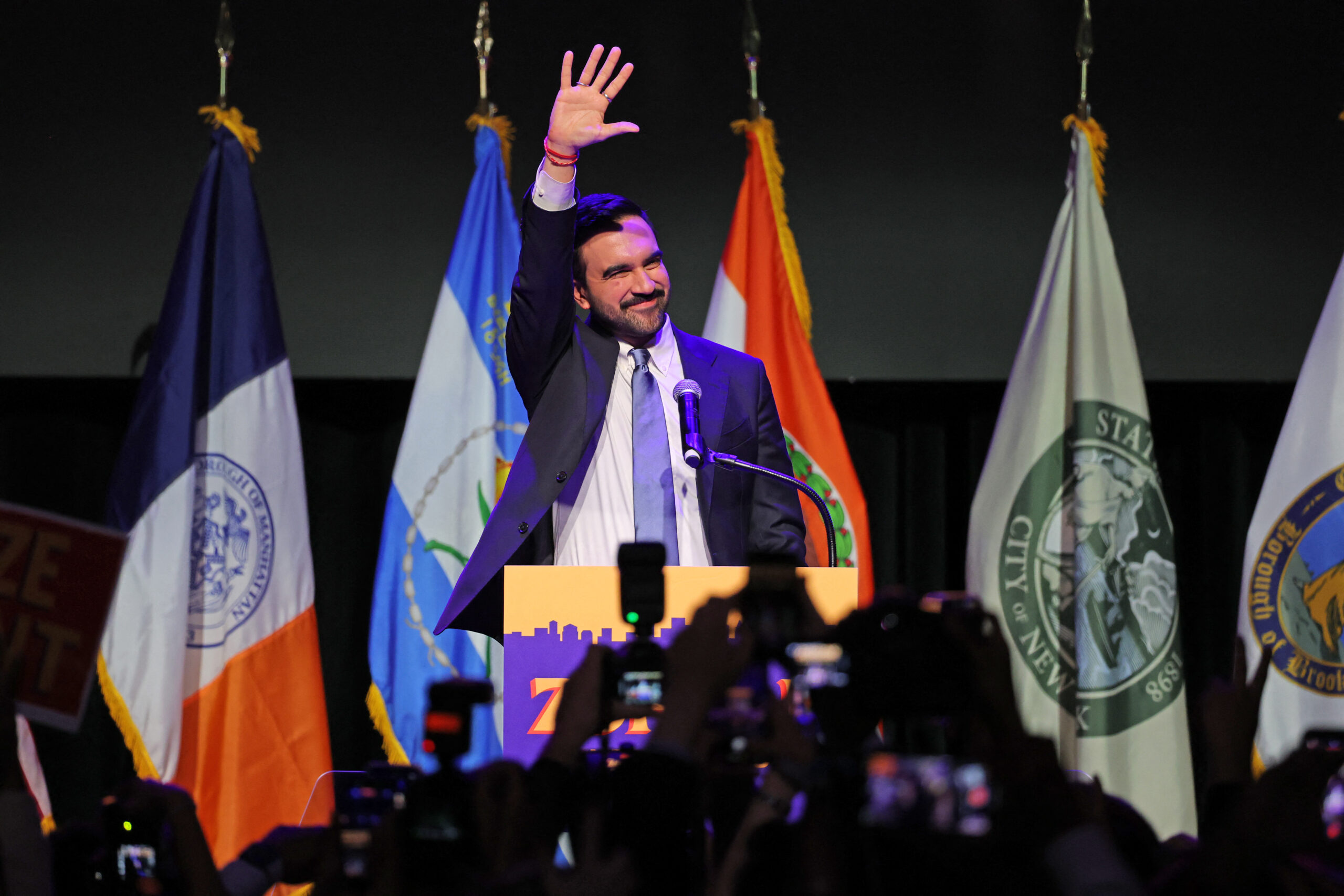
New Yorkers elected democratic socialist Zohran Mamdani on Tuesday as the next New York City mayor, ensuring the city will be headed in a leftward ideological direction for the next four years. Mamdani’s election has also sparked widespread concerns in the city’s Jewish community about how the incoming mayor, who refused to condemn “globalize the intifada” rhetoric or acknowledge the State of Israel as a Jewish homeland, would impact the day-to-day life of Jewish New Yorkers. Jewish Insider’s Haley Cohen asked senior New York Democratic officials and Jewish community leaders — granted anonymity to offer their candid thoughts — to discuss the top threats that a Mamdani administration could pose to Jewish life in the city.
Chief concerns: Respondents expressed worry that Mamdani’s anti-Israel worldview could lead to heightened antisemitism, bring a vanguard of leftist operatives hostile to Jewish concerns into City Hall, impact the effectiveness of the New York Police Department and fray ties between the city and Israeli institutions or businesses. He has even vowed to arrest Israeli Prime Minister Benjamin Netanyahu if he visits the city, though experts have voiced doubt on the legality of the move.
FACING THE MUSIC
Heritage’s Roberts apologizes for Carlson video, but leaves plans going forward vague
Heritage Foundation President Kevin Roberts apologized in a staff meeting on Wednesday for his video last week defending Tucker Carlson and refusing to “cancel” neo-Nazi leader Nick Fuentes, saying that the video was the result of internal failures of communication and consultation that left too few people involved in its production, Jewish Insider’s Marc Rod reports. Roberts and other Heritage leaders also repeatedly made reference to a plan under development for how Heritage will approach its relationship with Carlson going forward, amid strong pressure from numerous staff members to forcefully disavow the right-wing podcast host and his activities, but provided little clarity about what that approach will entail and sidestepped the full-throated denunciation of Carlson that several Heritage staffers sought.
Notable quotable: “About ‘no cancelation,’ is there a limiting principle to that? I should have said that there was, especially in light of Tucker hosting not just Fuentes, but a handful of other people,” Roberts said. “You can say you’re not going to participate in canceling someone — a personal friend, an institutional friend — while also being clear you’re not endorsing everything they’ve said. You’re not endorsing softball interviews. You’re not endorsing putting people on shows. And I should have made that clear.”
Update: In a new public video posted following the staff meeting, Roberts delivered a similar message, saying, “everyone has the responsibility to speak up against the scourge of antisemitism, no matter the messenger. Heritage and I will do so, even when my friend Tucker Carlson needs challenging.”
THE INSIDE STORY
The 36 hours in Washington that took hostage families from grief to gratitude
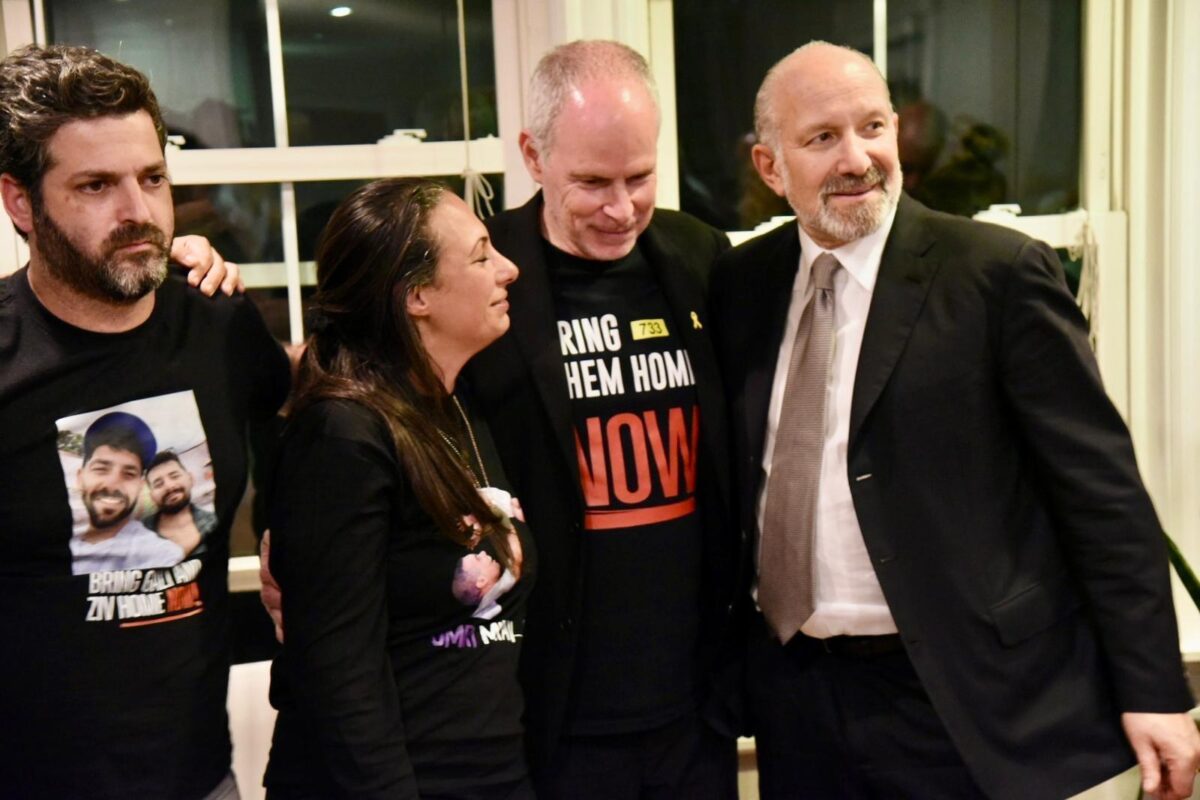
When several dozen people gathered at the Kennedy Center for a yoga class overlooking the Potomac River on Oct. 8, the class began with a practice familiar to anyone who regularly does yoga: intention setting. Among those taking part in the class were former hostages and the family members of those still held in Gaza, all of whom had gathered at the same spot a day earlier for a somber event marking two years since the attacks that reshaped their lives. “What do you do in yoga? You set your intention. You think about the release of the hostages,” recalled Matan Sivek, who until last month was the director of the Hostage Families Forum’s U.S. operation. As soon as the class ended, a cacophony of cellphones began ringing as news broke about a possible deal. Sivek, and other key players in the campaign for the hostages, spoke with Jewish Insider’s Gabby Deutch last week to reflect on the two-year-long advocacy campaign — spearheaded by Sivek, his wife Bar Ben-Yaakov and leading Jewish organizations.
Behind the scenes: Within the Trump administration, Commerce Secretary Howard Lutnick was working behind the scenes on behalf of the hostages. His wife, Allison, was the driving force behind his advocacy. Allison Lutnick had gotten to know many of the families after a trip to Israel early last year, when she met the mother of Omer Shem Tov, a hostage who was freed in February. Allison then connected with Sivek when she moved to Washington this year, and soon after he facilitated a meeting between the Lutnicks and several freed hostages at the Lutnicks’ apartment in Miami. “We spent three three hours together in our apartment talking and sharing. They spoke of the horrors of what they’d been through and we spoke of the horrors of what we had been through 24 years earlier on 9/11,” Allison told JI on Wednesday.
postwar policy
Sen. Lankford: Turkey, Qatar should be limited in Gaza reconstruction roles

As the global community looks to advance the ceasefire plan in Gaza, Sen. James Lankford (R-OK) emphasized the need for continued pressure from countries like Turkey and Qatar on Hamas to comply with the terms of the ceasefire requiring it to disarm, Jewish Insider’s Marc Rod reports. But he also warned that there should be limits on the ways in which Turkey and Qatar are involved in the future of Gaza, arguing that they should have no role in certain sensitive areas, even as they remain involved in reconstruction work.
Looking ahead: Lankford said that ensuring that Hamas disarms, something it has thus far refused to do, will require military, diplomatic and financial pressure, particularly from countries like Turkey and Qatar that have been Hamas patrons. “If the Turks want contracts to be able to rebuild in Gaza, which they do, then that’s not going to happen until Hamas is actually disarmed, so Turkey’s got to decide, ‘Do you want those contracts to be able to rebuild or not?’ If they do, then here’s what that requirement is going to be,” Lankford said. Turkey and Qatar’s roles in the future of Gaza should be limited to certain sectors, Lankford added, given the countries’ hostility to Israel and support for Hamas. He said he’s comfortable seeing Ankara assist with reconstruction, but it should not be involved in running hospitals, schools or mosques or in rebuilding the economy.
TRIP TALK
AIPAC brings delegation of major donors to Taiwan, Japan, South Korea

A delegation organized by AIPAC recently completed a nine-day visit to Taiwan, Japan and South Korea, Jewish Insider’s Danielle Cohen-Kanik has learned, as the pro-Israel lobbying group seeks to promote ties with Israel among key U.S. allies. Over 200 of AIPAC’s largest donors as well as its CEO, Elliot Brandt; board chair, Michael Tuchin; board president, Bernie Kaminetsky; and top professional staff traveled to the region from Oct. 22-30, according to a participant with knowledge of the trip’s background.
Boosting ties: Though Israel already has warm relations with all three countries, as both Israel and the U.S. look to increase ties in the Indo-Pacific region, the trip was meant to highlight the Jewish state’s relevance in its defense prowess, relationship to the U.S., shared democratic values, growing relations to the Gulf states — which have historically provided the Asian nations with much of their oil and gas — and acumen in the technology and business sectors, the participant said. The large group met with high-level leadership in each country, including the Taiwanese president, vice president and secretary-general of its National Security Council, Korean ministers and a Japanese senior diplomat.
New in town: Israeli chef Eyal Shani teased the imminent opening of a new branch of his Miznon restaurant in Taipei, Taiwan, in an Instagram post yesterday.
BOMBSHELL ANNOUNCEMENT
Israel’s Yesh Atid party drops out of World Zionist Organization, calling it ‘corrupt’
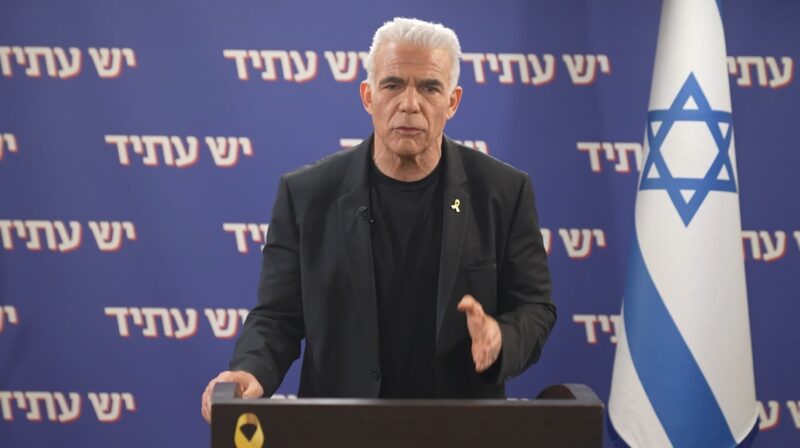
Yair Lapid, Israel’s opposition leader, said on Wednesday that he was pulling his centrist Yesh Atid party out of the World Zionist Organization and called for the “immediate nationalization” of the Keren Kayemeth Le’Israel-Jewish National Fund, which controls more than 10% of the land of Israel, describing the so-called “National Institutions” as hopelessly corrupt, eJewishPhilanthropy’s Judah Ari Gross reports.
Background: The announcement comes as the World Zionist Congress was nearing a power-sharing agreement that would have seen Yesh Atid split control of the WZO and KKL-JNF over the next five-year term. An initial arrangement was tentatively approved last week, but it fell apart after Culture Minister Miki Zohar of the Likud party, who negotiated on behalf of the center-right bloc, announced that he planned to name Israeli Prime Minister Benjamin Netanyahu’s divisive son, Yair, to a senior position within the WZO. A new deal was approaching completion, but Lapid’s decision to abandon the organization throws the negotiation process back into turmoil, with no clear path forward.
Read the full story here and sign up for eJewishPhilanthropy’s Your Daily Phil newsletter here.
Worthy Reads
Steer Clear of Mamdani: The center-left Democratic Party think tank Third Way urged national Democrats “to resist the pressure to align” with the politics and agenda of New York City Mayor-elect Zohran Mamdani, offering 10 reasons why doing so “will fail in tough races.” “The DSA platform is extreme and is a Republican ad maker’s dream: Just a glance at the DSA platform makes clear how politically toxic it would be to any voter not deeply in the sway of socialist ideology. … Indeed, the Mayor-elect’s affiliation with the DSA is already being weaponized against his fellow Democrats, as Republicans have declared him to be their ‘single most effective foil’ as they seek to paint Democrats across the country as radicals. … Mainstream Democrats ran authentic campaigns and won big without being socialists: Two moderate Democrats, Abigail Spanberger (VA) and Mikie Sherrill (NJ) delivered historic victories in key gubernatorial races, with Spanberger flipping Virginia from red to blue. … While they shared Mamdani’s focus on addressing affordability, both Spanberger and Sherrill did so with ideas and narratives drawn from the center left, not the far left.” [ThirdWay]
The Fuentes Feud: The New York Times’ Ross Douthat argues that the older generation of conservatives have a role to play in constraining the younger, “groyper” antisemitic strain on the right. “Whatever share of Capitol Hill interns or think tank employees are actually Fuentes sympathizers, this is the scenario the institutional right needs to avoid right now: preventing radicalized junior staffers from steamrolling or puppeteering nominal superiors. But this isn’t just a matter of imposing discipline; the older generation also has to understand where the radical ideas are coming from, the true shape of the debate. You aren’t going to out-debate Fuentes himself — that’s not the business he’s in — but you still want to understand the chain of ideas that draws younger right-wingers toward antisemitism, and offer adult wisdom that’s responsive to its pull.” [NYTimes]
Kippah Quandary: Tevi Troy, a senior fellow at the Ronald Reagan Institute, writes in The Wall Street Journal about his decision to hide his kippah under a hat in anticipation of Zohran Mamdani’s victory in the New York mayoral race. “The reason openly identifiable Jews can walk around safely wearing religious garb is the social compact. There is an understanding that people will behave appropriately and that there are consequences for misbehavior. One reason for the spate of attacks on religious Jews in New York in recent years has been the belief that antisemitic assaults won’t be punished. … My fear is that Mayor Mamdani will encourage even more impunity. His antipathy to Israel, and his tacit support for ‘globalizing the intifada,’ may send a signal to the New York City Police Department that protecting Jews won’t be a priority for the city. That in turn could send another signal to people on the streets of New York — that it is open season on Jews.” [WSJ]
Word on the Street
New York City Mayor-elect Zohran Mamdani named his transition team on Wednesday, an all-female group of advisors with experience in city government but lacking backgrounds in education and public safety, as has historically been included in mayors’ transition teams…
Robert Tucker, the Jewish commissioner of the New York City Fire Department, resigned, The New York Post reports, hours before he was set to fly to Israel to meet his counterpart there…
The Wall Street Journal considers the economics behind Mamdani’s largest campaign promises, including a state corporate tax hike, a “millionaires tax,” universal child care and rent stabilization…
The Times of Israel’s Editor-in-Chief David Horovitz rejects the argument that Mamdani’s victory is based on local issues and unconnected to his anti-Israel positions, describing it as “delusional”…
Rep. Jared Golden (D-ME) announced on Wednesday that he will not seek reelection in Maine’s 2nd Congressional District, citing the “increasing incivility and plain nastiness” in politics and rise of political violence. Golden is one of the few House Democrats to represent a district that President Donald Trump carried in the 2024 presidential election, and his district is now a prime GOP pickup opportunity…
Former Democratic National Committee Vice Chair Michael Blake announced a primary campaign against Rep. Ritchie Torres (D-NY), and plans to run as an anti-Israel Democrat…
U.S. Ambassador to the U.N. Mike Waltz met Tuesday with Palestinian diplomats in New York to discuss a U.S.-sponsored U.N. Security Council resolution laying out an international security force to be deployed to Gaza, Axios reports. The U.S. is reportedly looking to bring it to a vote at the UNSC within two weeks…
The U.S. is seeking to strike a deal over dozens of Hamas terrorists “stuck” in tunnels on the Israeli side of the “yellow line” dividing Gaza, providing them safe passage to the Hamas-controlled side and amnesty in exchange for their disarmament, Axios reports…
The U.S. is preparing to establish a military presence at an airbase in Damascus in order to advance a security agreement between Syria and Israel, sources told Reuters…
An event with IDF veterans hosted by Students Supporting Israel at Toronto Metropolitan University yesterday was stormed by anti-Israel protesters, causing one person to be injured. The university’s chapter of Students for Justice in Palestine (SJP) had publicized the event on social media, calling on its followers to demonstrate against it…
The body of Joshua Loitu Mollel, a Tanzanian citizen and agronomy student who was killed and kidnapped in the Oct. 7, 2023, attacks, was returned to Israel by Hamas last night…
Recently released hostage Rom Braslavski said he was sexually assaulted by his captors in Gaza, in an interview with Israel’s Channel 13 “Hazinor” program…
An Afghan national was arrested in Denmark on Wednesday on suspicion of promising to acquire weapons for an Iranian-backed attack on Jewish targets in Germany…
Saudi Arabia’s sovereign wealth fund was named on Monday as the presenting partner for the inaugural America Business Forum, taking place now in Miami. President Donald Trump spoke at the event, which took place across the street from the future site of his presidential library, on Wednesday…
Saudi Arabia is in talks with Syria to build data cables to connect the Gulf state to Europe, according to Semafor…
Singapore’s Minister for Foreign Affairs Dr. Vivian Balakrishnan met with Israeli President Isaac Herzog in Israel this week and discussed prospects for peace in the region. Balakrishnan also met with several Israeli lawmakers during his visit…
Kim Kardashian’s SKIMS fashion brand announced on Tuesday that it is entering the Israeli market through a partnership with the Ironi group, which owns Factory 54, and is set to open stores in Ramat Aviv Mall and Big Fashion Glilot, Israel Hayom reports…
Warner Bros. Discovery, under CEO David Zaslav, aims to decide by Christmas whether to sell the entire company or pursue a split. Paramount Skydance, according to NBC, has sent the WBD board multiple letters pressing for its $23.50 per share acquisition offer…
A Reddit rumor, flagged by Puck, claims that Saudi Arabia’s Public Investment Fund has been planning to make a buyout offer for Warner Bros. to the tune of more than $70 billion…
Joel Pollak, formerly Breitbart’s senior editor-at-large, has been appointed as opinion editor of The New York Post’s new newspaper, The California Post…
Israel’s Hapoel Tel Aviv basketball team is facing off against the Dubai team today in Sarajevo, Bosnia and Herzegovina, in Round 9 of the EuroCup…
Pic of the Day

The Weitzman National Museum of American Jewish History in Philadelphia last night honored Ambassador Amy Gutmann with the Only in America Award, lauding her “indelible contributions to our society.”
“She has been an outspoken advocate for Israel, and steadfast in her forceful opposition to antisemitism, hate, and discrimination in all its forms,” the museum said of the former ambassador to Germany and president emerita of the University of Pennsylvania.
Pictured from left: Weitzman Chair Emeritus Phil Darivoff, Weitzman Co-chairs Sharon Tobin Kestenbaum and Mark Oster, former Ambassador David L. Cohen, University of Pennsylvania President Dr. Larry Jameson, Gutmann, Weitzman Museum President and CEO Dan Tadmor, museum namesake Stuart Weitzman, NBC News Chief Washington Correspondent and Chief Foreign Affairs Correspondent Andrea Mitchell, Chair of the Penn Board of Trustees Ramanan Raghavendran.
Birthdays
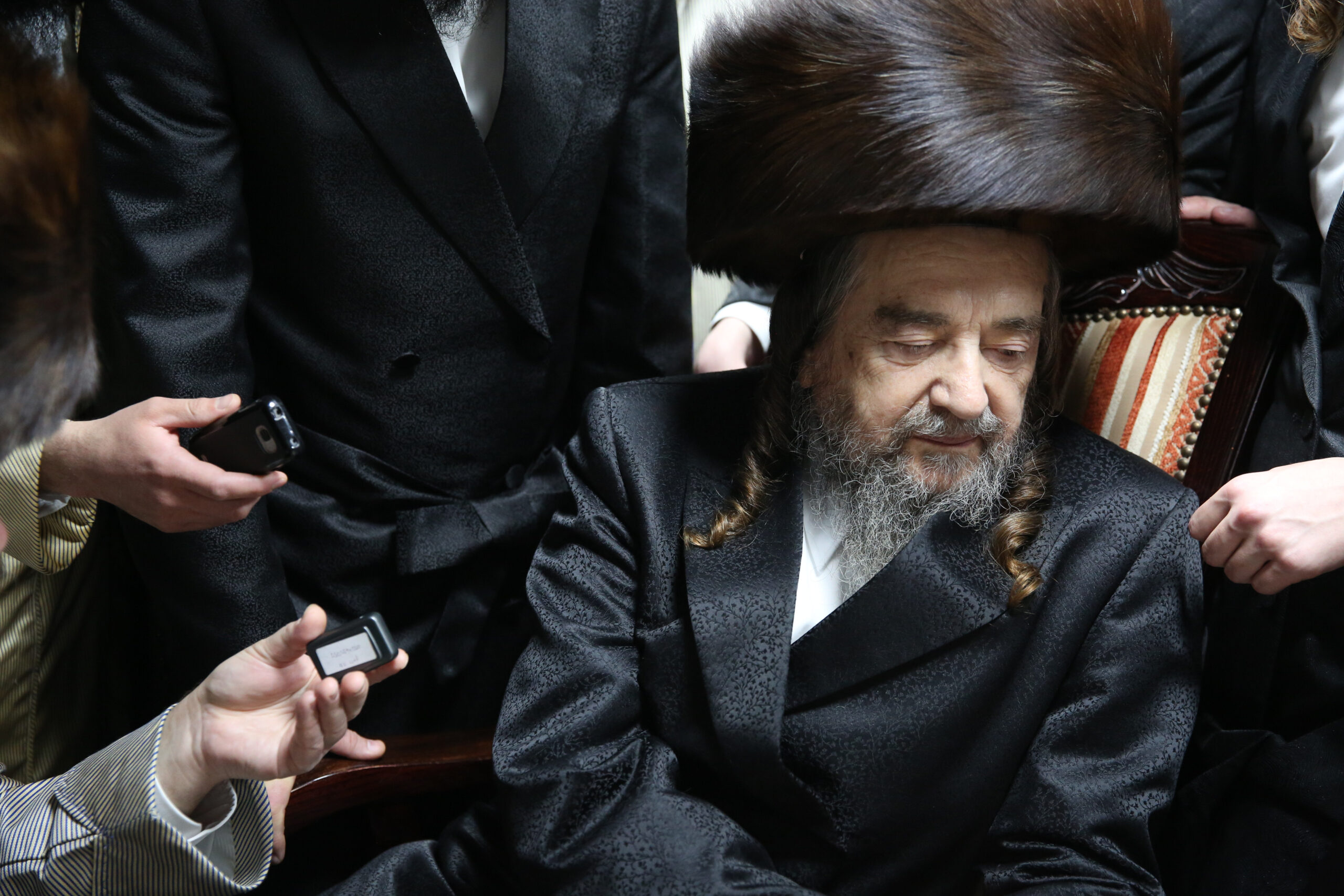
Leading teacher in the Breslov Hasidic movement in Israel, Rabbi Yaakov Meir Shechter turns 95…
Belgian theoretical physicist, a Holocaust survivor and 2013 Nobel Prize laureate, François Englert turns 93… Former president and CEO of American Jewish World Service until 2016, prior to that she served as the Manhattan borough president, Ruth Wyler Messinger turns 85… Former commissioner of the Social Security Administration until 2021, Andrew Saul turns 79… Former aide to President Bill Clinton and a longtime advisor to Hillary Clinton, Sidney Blumenthal turns 77… Research scientist at NYU’s Langone Medical Center, Barbara Volsky turns 75… Senior chair of Sullivan & Cromwell, Joseph C. Shenker turns 69… Actress and cellist best known for her lead role in the 1984 film “Footloose” and the television series “Fame,” Lori Singer… and her twin brother, violinist, composer and conductor, he is the founder and music director of the Manhattan Symphonie, Gregory Singer both turn 68… Managing director of the NFL Players Association for 15 years until he retired five months ago, Ira Fishman turns 68… Editorial page editor and Op-Ed columnist for the Los Angeles Times until 2023, Nicholas Goldberg turns 67… Professional poker player from Las Vegas, he has won 10 World Series of Poker bracelets and his total tournament winnings exceed $45.5 million, Erik Seidel turns 66… Founder of Nourish Snacks, she is the host of NBC’s “Health & Happiness” and author of 15 New York Times best-sellers, Joy Bauer turns 62… Philanthropist, she is the founder and chair of Emerson Collective and XQ Institute, Laurene Powell Jobs turns 62… Principal and COO at Douglass Winthrop Advisors, Andrew S. Weinberg… SVP of investments in the Beverly Hills office of Raymond James, Seth A. Radow… Chairman at IDTFS Bank in Gibraltar, he is a partner in Covenant Winery, Geoffrey Rochwarger turns 55… Executive at Elliott Management, podcast host and author of Start-up Nation and The Genius of Israel, Dan Senor turns 54… Director of external affairs at the William Davidson Foundation, Kari Alterman… Film producer, together with her husband Robert Downey Jr., Susan Nicole Levin Downey turns 52… South Florida entrepreneur, Earl J. Campos-Devine… Head cantor of Lincoln Square Synagogue in New York City, Yaakov (“Yanky”) Lemmer turns 42… and his younger brother, the first Hasidic Jew to sign a contract with a leading record label, Shulem Lemmer turns 36… Producer on the Ben Shapiro Show, Jake Pollack turns 30… Former baseball outfielder in the Orioles and Angels systems, he played for Team Israel in 2012 and is now a manager of business development at Robson Forensic, Robert Eric Widlansky turns 41…
Commerce Secretary Howard Lutnick and his wife, Allison, supported the creation of the sukkah through their family foundation
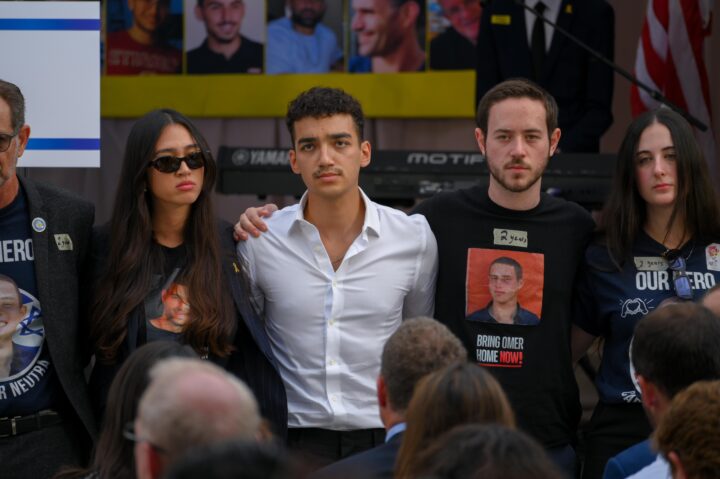
Liri Agami
Former hostages Noa Argamani (left) and Edan Alexander (center) stand with Daniel Neutra, brother of hostage Omer Neutra, and other hostage family members at a memorial event at the Kennedy Center in Washington, D.C., on Oct. 7, 2025.
Oct. 7 bloomed warm and sunny in Washington this year as dozens of Jewish community leaders and bipartisan political officials gathered somberly at a pavilion at the Kennedy Center to mark two years since the Hamas terror attacks in Israel.
A large sukkah, deemed the “Sukkah of Hope,” had a simple message displayed: “Two years in captivity. We can bring them home,” with photos of the 48 people, living and dead, still held captive by Hamas in Gaza. Several former hostages and the family members of those still in Gaza walked up to the stage inside the sukkah, one after the other, all with variations on the same message: Thank you, President Trump, they said. Bring our loved ones home.
“President Trump, we are thankful for what you’ve done, for your determination, for the time and energy you’ve given to this cause,” said Liran Berman, whose twin brothers, Gali and Ziv, remain in Gaza.
“We are really grateful and hopeful. I’m glad that this man, Donald Trump, is behind us,” said Iair Horn, who in February returned to Israel after 498 days in Hamas captivity. His younger brother, Eitan, is still being held in Gaza.
Their appeal to the president’s dealmaking prowess came after the Hostages and Missing Families Forum nominated Trump for a Nobel Peace Prize, an honor he has long coveted. The president sent a letter to the former hostages and the hostage families early Tuesday thanking them for the nomination and expressing his commitment “to returning all the hostages home, and ensuring the total destruction of Hamas so these horrific acts may never be repeated.”
The Sukkah of Hope was supposed to be constructed on the Ellipse, outside the White House. But the government shutdown meant that could not happen. Still, its move to the Kennedy Center did not keep high-level government officials from visiting.
Before the memorial service, several Cabinet secretaries had breakfast with the former hostages and hostage family members. In attendance were Secretary of State Marco Rubio, Commerce Secretary Howard Lutnick, Interior Secretary Doug Burgum, Director of National Intelligence Tulsi Gabbard, Environmental Protection Agency Administrator Lee Zeldin and Treasury Secretary Scott Bessent.
Ronen Neutra, whose son Omer was killed on Oct. 7 and whose body is being held hostage by Hamas, said the Cabinet members sounded optimistic about the possibility of a deal.
“We are hearing from the Cabinet members their optimism that we might be getting closer to a deal,” Neutra said. “But I think what is more important for us, or as important, is to hear the commitment that [we] have been hearing from President Trump, that this has to happen, and this is on his top priority list, and I think it trickles down.”
Lutnick and his wife, Allison, supported the creation of the sukkah through their family foundation.
“Donald Trump is the driving force of peace in this world,” Lutnick said at the memorial event. “The United States of America is together with the hostages and the hostage families. We are part of you, we are with you and we will help get them home.”
In the crowd at the event were Noa Argamani, Edan Alexander, Keith Siegel, Arbel Yehoud, Doron Steinbrecher and Ilana Gritzewsky, all of whom survived Hamas captivity. Alexander, a dual U.S.-Israeli citizen, and the Neutra family met with Trump at the White House on Tuesday afternoon.
At the memorial, several outlined the torture they face and they fears they harbor for loved ones who remain in Gaza.
“There are no words in any language to describe what I went through,” said Yehoud, whose partner, Ariel Cunio, 28, remains in Gaza. “Even as I stand here before you, I’m not really there. A massive part of me is still there, trapped in that darkness, and I will remain there until my Ariel and everyone comes home.”
The Florida Democrat has shifted away from commitments he made to Jewish leaders during his first run for Congress, fueling frustration among former supporters

Courtesy
Maxwell Frost
When Rep. Maxwell Frost (D-FL) won his first election to the House in 2022, Jewish leaders in his Orlando, Fla., district who had been encouraged by his personal outreach were optimistic he would follow through on a range of commitments he had made vowing to uphold support for Israel.
Despite some initial concerns about his history of involvement in pro-Palestinian demonstrations as well as relationships with anti-Israel activists, Frost had circulated a lengthy Middle East position paper in consultation, in part, with a top pro-Israel group that largely assuaged lingering reservations among Jewish community leaders over the sincerity of his views.
In the paper as well as a candidate questionnaire solicited by Jewish Insider during his first primary, the young progressive organizer, describing himself as both “pro-Israel” and “pro-Palestinian,” voiced opposition to conditioning aid to Israel — arguing that the security threats facing the Jewish state are “far too grave” to enact such measures. In backing a two-state solution, he clarified that any agreement should require “the basic recognition that Israel has a right to exist” as well as “an end to the antisemitic rhetoric and positions of Hamas.” And if elected, he pledged to visit Israel — which he called “one of the United States’ most important allies and strategic partners.”
Now, almost midway into his second term, Jewish and pro-Israel leaders are expressing some buyer’s remorse as Frost, 28, has embraced positions that put him at odds with his past commitments, fueling frustration among those who had believed he would be a more dependable ally on key issues concerning Israel.
Frost, for his part, insists that the humanitarian conditions in Israel’s war with Hamas in Gaza have deteriorated so drastically during his tenure that he had no choice but to change his views, though that has not quelled discontent among his former allies.
“He has broken a lot of promises,” said one Jewish leader, echoing others who expressed dismay with Frost’s turn in Congress.
The most recent move to draw scrutiny from Jewish and pro-Israel leaders is a letter Frost signed urging the Trump administration to recognize a Palestinian state over growing concerns with the humanitarian crisis in Gaza.
The letter, signed by several prominent House progressives and led by Rep. Ro Khanna (D-CA) — who plans to introduce a similar resolution — said such a state “will need to fully recognize Israel” and guarantee “the disarmament of and relinquishing of power by Hamas.” But pro-Israel activists broadly see the renewed effort as a misguided concession to Hamas amid the ongoing war — as the terror group seeks to leverage international outrage over Israel’s military conduct.
Democratic Majority for Israel, whose political arm had provided input on Frost’s position paper during his primary, took issue with his decision to join the letter. While the group felt sufficiently comfortable with Frost’s Middle East policy views when he first ran for Congress, opting not to intervene on behalf of a top primary rival who had won an endorsement from its super PAC, it has become dissatisfied with his approach as he has continued to stake out more adversarial stances toward Israel during his time in the House.
“We strongly support a two-state solution that ensures Israel’s future as a Jewish and democratic state with recognized borders and upholds the right of Palestinians to live in freedom and security in a viable state of their own,” Brian Romick, DMFI’s president, said in a statement to JI on Tuesday. “But unilateral recognition of a Palestinian state at this time — as the terrorist group Hamas still governs parts of Gaza and continues to hold Israeli hostages — would not advance peace. It will instead prolong the war by incentivizing Hamas to reject any ceasefire deal, and reward the terrorism we saw on Oct. 7 while making future acts of terror more likely.”
In addition to the letter — which followed a similar resolution he co-sponsored in 2023 during his first term — Frost in May joined legislation to place unprecedented new conditions on aid to Israel by withholding offensive weapons over its alleged violations of international law.
Last year, he also voted against a widely approved bill to provide supplemental aid to Israel six months after Hamas’ attacks. In a statement explaining his thinking at the time, Frost wrote that he was “only able to justify aid for defense, not offense, and this legislation did not allow me to separate the two,” as the war “has claimed the lives of countless innocent Palestinian civilians and brought us no closer to the return of innocent Israeli hostages held by Hamas.”
“For me, the North Star here is having a two-state solution, and everything, all the decisions we make, have to point to that,” Frost said, arguing that he has remained consistent in upholding his core beliefs on the conflict even as his positions on specific policies have changed since he launched his initial campaign for Congress. “The thing I have in mind is the safety and security of everybody, of Israel, of Palestinians — of everybody.”
Meanwhile, Frost has yet to fulfill his campaign vow to travel to Israel, and has declined invitations to do so while in Congress, according to a person familiar with the matter.
In an interview on Wednesday, Frost acknowledged that his approach has changed since he entered the House, attributing his new positions to his revulsion at Israel’s behavior in Gaza — which he described as “completely unacceptable” and “abhorrent” in light of the civilian death toll. “In terms of specific policy points, things have changed,” Frost told JI. “Things have changed a lot — and unfortunately, not for the better.”
“For me, the North Star here is having a two-state solution, and everything, all the decisions we make, have to point to that,” he added, arguing that he has remained consistent in upholding his core beliefs on the conflict even as his positions on specific policies have changed since he launched his initial campaign for Congress. “The thing I have in mind is the safety and security of everybody, of Israel, of Palestinians — of everybody.”
Even as he condemned Hamas and said the terror group should have no role in rebuilding postwar Gaza, Frost said the conflict has evolved into what he regards as a “war on innocent people,” resulting in “massive loss of innocent life” that has fueled his decision to speak up against the Israeli government and its ongoing military campaign.
In the Middle East position paper he wrote in his first primary, Frost had rejected placing additional conditions on aid to Israel because, he wrote at the time, it would “undermine Israel’s ability to defend itself against the very serious threats it faces.” But he explained on Wednesday he had also felt such measures were “already written into the law” and “we didn’t really need to go further” in enforcing it at the time.
Now, however, “I do believe that the law is being violated,” he told JI, clarifying his recent support for legislation that seeks to withhold transfers of offensive weapons to Israel. “Because of that, we have to look at the way that we are both complicit but also encouraging the current behavior of the Netanyahu government,” he said.
Unlike a handful of his far-left House colleagues who have accused Israel of carrying out a genocide in Gaza, Frost hesitated to use the term himself, calling it a “difficult” word because of its historical connection to the Holocaust. Still, he said he would not seek to discourage others from such charges. “I’m not going to sit here and defend what is going on right now in any way, shape or form,” he said. “I understand why people use that word. But when we see what’s going on, it’s hard to find the words for it.”
“There’s a lot of things to hold, but the main thing is, yes, there are many things that have changed,” he reiterated. “But for me, what has not changed is the main goal, which is making sure that everyone’s safe and everyone’s secure.”
Frost is hardly alone among Democratic lawmakers who in recent months have become more critical of Israel’s behavior, with even some of the staunchest supporters of the Jewish state struggling to defend the Israeli government as the humanitarian situation in Gaza has continued to worsen nearly two years into the war.
“It’s a radical shift,” one community activist told JI, voicing frustration with Frost’s positions, even as he described their ongoing conversations as “very open and honest.”
His vacillating stances also illustrate some of the cross-pressures facing progressive Democrats who are not completely aligned with the party’s far left on its hostility toward Israel. Pro-Israel Democrats have recently voiced their concerns that anti-Israel policies could become a litmus test for the left in the midterms, particularly amid Israeli Prime Minister Benjamin Netanyahu‘s moves to occupy the enclave.
But Jewish community leaders in Frost’s district, who spoke on condition of anonymity to address what they characterize as an increasingly delicate relationship with the congressman, explained they are particularly disappointed with his evolution on Middle East policy, given their initial hopes that he would be among a dwindling number of progressive allies committed to defending Israel in the House.
“It’s a radical shift,” one community activist told JI, voicing frustration with Frost’s positions, even as he described their ongoing conversations as “very open and honest.”
The activist noted that Frost, who had been a prominent gun control advocate before he was elected to Congress, has “a good heart and doesn’t want to see people dying.” But “as a result,” he said, Frost has “a lot of blind spots” in his assessment of the conflict. The activist argued that Frost’s critique of Israel’s conduct in Gaza has ignored Hamas’ role in perpetuating the crisis as it refuses to surrender.
“At the end of the day, he very much comes from the ‘oppressor-oppressed’ worldview and sees Israel as the oppressor,” the activist said.
Frost, for his part, said his statements have been misconstrued by a wide range of critics across the spectrum, including pro-Palestinian activists who allege that he made separate commitments during his first primary bid that he has failed to uphold in Congress.
He stressed that he does not “do tit-for-tat stuff” while addressing the war. “Whenever I post about the hostages, I’ll have people sending me messages. ‘What about this?’ No,” he said. “Whenever I post about Palestinians, I’ll have people saying, ‘What about this?’ No, I will post about it all. I will talk about it all. I will say how I feel about everything.”
“I’m very firm in that, just coming from a place of, since I was 15 years old, being involved in the fight to end gun violence, and have grown up through a movement of death,” he told JI. “I just don’t think that’s the way to live as a human, quite frankly.”
“We’ve been disappointed that he has not met the commitments he gave to us,” one DMFI source told JI. “At the same time, we’re grateful that he has come to realize he made a mistake in at least one case, but members of Congress should think through their votes fully and discuss them with knowledgeable people before casting them.”
Even as Jewish and pro-Israel leaders say their relationships with Frost have worsened in recent months, frustration over his approach to Israel has been mounting since his first term, when he called for an “immediate ceasefire” in Gaza just days after Hamas’ terror attacks. As a freshman, he also voted against a resolution condemning rising antisemitic activity on college campuses, but he later said that vote had been a mistake after meeting with Jewish students in his district.
While Frost had shown contrition for his vote on the resolution in November 2023, DMFI still expressed dissatisfaction with his initial decision at the time — alleging he had not performed proper due diligence beforehand. “We’ve been disappointed that he has not met the commitments he gave to us,” one DMFI source told JI not long after the vote.
“At the same time, we’re grateful that he has come to realize he made a mistake in at least one case, but members of Congress should think through their votes fully and discuss them with knowledgeable people before casting them,” the source stated.
A spokesperson for Frost told JI at the time that the congressman “is trying to hold multiple truths all at once” as he receives input from constituents pushing opposing interests.
“I’m very comfortable with the decisions I’ve made,” Frost said of his approach to Israel. “As I walk the streets of my district, as I speak with the people in my district, this is where I find most people are at. They’re not really at the extremes that I’ve heard from.”
Speaking with JI on Wednesday, Frost said he has appreciated his ongoing discussions with pro-Israel leaders in his district — even if they have not been aligned on major policy questions in recent months. “Hearing their perspective is really important,” he confirmed. “What I always tell people is I might not always come to the conclusion that you agree with,” he said, “but I hope you’ll always feel I’ve engaged in good faith.”
He suggested that Jewish community activists who have been irked by his approach to the Middle East have not fully reckoned with his belief that Israel’s military actions have damaged its reputation in the United States. “It’s palpable across the country, and I think a lot of this has to do with the decisions that are being made by Netanyahu,” he argued.
“I’m very comfortable with the decisions I’ve made,” Frost said of his approach to Israel. “As I walk the streets of my district, as I speak with the people in my district, this is where I find most people are at. They’re not really at the extremes that I’ve heard from.”
When he assumed office in 2023, Frost had sought guidance from pro-Israel Democrats including Rep. Ritchie Torres (D-NY), who enthusiastically backed his campaign, and House Minority Leader Hakeem Jeffries (D-NY), one person familiar with the matter told JI. But the congressman has since drifted away from the two lawmakers on Israel while staking out positions that have put him more in line with the far left.
More recently, Frost has built closer relationships with such leading Israel critics as Rep. Alexandria Ocasio-Cortez (D-NY), the source told JI, even if he has resisted identifying as an official member of the so-called Squad of progressive House Democrats.
Owing in part to his network in Congress, Jewish community leaders are doubtful Frost will change his views on Israel. “It may be the best that we can hope is that he doesn’t become an actual member of the Squad,” said one activist, while noting that Frost is “totally safe” in his deeply blue district as he seeks a third term next year.
Still, the activist said, “his refusal to actually go and see” Israel “first-hand is a problem,” particularly in light of his primary vow to visit the Jewish state as a congressman.
Frost, who acknowledged the commitment that he had made, said he hopes to see the region “at some point,” but added that it has “been difficult to figure out the timing.”
After the interview, Frost asked his spokesperson to clarify that he would “like to travel to the region at a point where he’d be able to visit both Israel and the Gaza Strip,” indicating a potential visit is unlikely to occur in the foreseeable future.
The senator asked several pro-Israel organizations to refrain from involvement in races where he endorsed candidates without Jewish communal support

Kevin Dietsch/Getty Images
Sen. Mark Kelly (D-AZ) talks to campaign volunteers on Election Day on November 08, 2022 in Tucson, Arizona.
Sen. Mark Kelly (D-AZ) is facing new scrutiny from some Jewish community leaders in Arizona who are frustrated by his endorsements boosting the activist left in a series of recent House primaries in which he has withheld support for pro-Israel candidates and has even worked to actively oppose their campaigns behind the scenes, according to people familiar with the matter.
Kelly’s engagement has strained what had been seen as a positive relationship with the pro-Israel community in Arizona, according to multiple local Jewish leaders who have voiced disappointment with his approach. Meanwhile, his recent interventions have raised questions about the political motivations of the Democratic senator in a key battleground state who has long been associated with his party’s moderate, centrist wing.
The most recent source of tension with Jewish and pro-Israel leaders stems from Kelly’s endorsement of Adelita Grijalva in a Tucson House primary this month to succeed her late father, former Rep. Raul Grijalva (D-AZ), a longtime critic of Israel who died in March.
While the younger Grijalva, a former Pima County supervisor, has a limited record of commentary on Israel and Middle East policy, her affiliation with a range of far-left leaders, including Rep. Ilhan Omar (D-MN) and Alexandria Ocasio-Cortez (D-NY), has raised concerns among mainstream Jewish activists who favored one of her primary opponents, Daniel Hernandez, a former state lawmaker and pro-Israel progressive.
Grijalva, who struggled to articulate her positions on key issues such as conditioning aid to Israel — suggesting during the race, for instance, that U.S. involvement in the ongoing conflict “has not been helpful at all” — handily won the primary and is all but assured a seat in the deeply Democratic district.
“Senator Kelly supports Adelita because she’s ready to fight for his home district in Congress, and clearly the district agrees,” a spokesperson for Kelly said in a statement to Jewish Insider on Thursday. “He respects that some folks may have a difference of opinion, and values the strong relationships he has in the Arizona Jewish community.”
Still, the pro-Israel community in Arizona was troubled that Kelly had bolstered her campaign, owing in part to their differences in tone on Middle East policy. Among other issues, Grijalva called for a ceasefire just 10 days after Hamas’ Oct. 7, 2023, terror attacks, whereas Kelly expressed continued support for Israel in the aftermath of the incursion and faced protesters outside his Phoenix office who demanded he back an end to the war. While serving as a county supervisor, Grijalva had also reluctantly voted for a resolution condemning Hamas, voicing frustration that she “couldn’t talk about peace and humanitarian aid” for Gaza.
One Jewish activist in Tucson, who like others spoke on condition of anonymity to avoid reprisals, called Kelly’s endorsement “a slap in the face” to the pro-Israel community in Arizona. “He tries to make himself seem like a very moderate, pro-Israel guy — especially when he’s fundraising,” the local activist claimed. “There’s a lot of mistrust in the community right now.”
From an even more personal standpoint, the senator and his wife, former Rep. Gabby Giffords (D-AZ) — who also endorsed Grijalva — have long been close with Hernandez and his family. In 2011, Hernandez, who was then a 20-year-old intern for Giffords, had been credited with helping to save her life immediately after she was shot in the head by a gunman during a political event in the Tucson area.
Despite such history, Kelly privately urged a leading pro-Israel group, Democratic Majority for Israel, to stay out of the primary, according to people familiar with the matter who spoke with JI this week. The organization’s political arm, DMFI PAC, ultimately endorsed Hernandez a month before the election, but it did not invest financial resources in the race, where polling indicated he was unlikely to prevail. He came in third place with just 14% of the vote.
“If you know the story, your mouth was wide open,” one Jewish community leader in Arizona remarked on Kelly’s decision to oppose Hernandez. “It could easily have been ‘I can’t help you but I’m not going to hurt you.’ But it wasn’t — it was like a stab in the heart.”
In a statement to JI on Wednesday, a spokesperson for DMFI PAC — which has backed Kelly in both of his previous Senate races — said the group “makes its own decisions on endorsements and spending,” adding, “No one else does.”
Hernandez did not respond to a message seeking comment.
Thomas J. Volgy, a former mayor of Tucson and a professor of political science at the University of Arizona, pushed back against accusations that Kelly is now emboldening the party’s far left. He said that Kelly is “not a single-issue politician” and had likely endorsed Grijalva based on “his understanding that she was the most qualified candidate in the field” — and “because she is consistent with his position on a range of issues, including on Israel but also across the spectrum.”
In a more closely contested Phoenix House race last cycle, Kelly had also engaged in private outreach to AIPAC, asking the pro-Israel lobbying group to keep away from the open-seat race in which he endorsed Raquel Terán, a left-leaning former state lawmaker and party chair, according to people with knowledge of the situation.
Like Grijalva, Terán, a prominent progressive activist who drew support from Squad-aligned House members, refused to publicly clarify her views on key Middle East policy questions during the race, fueling concerns among Jewish leaders who had backed Yassamin Ansari, a former vice mayor of Phoenix endorsed by DMFI’s political arm. Terán had also drawn criticism from Jewish community members over her decision to oppose an antisemitism reporting bill that had been widely approved by the Arizona state Legislature while she was in office.
In his outreach to AIPAC, whose super PAC has engaged in several recent primaries, Kelly sought to allay reservations with Terán’s continued lack of clarity on Middle East policy issues, offering assurances that if she were elected, he would help to personally oversee her House votes related to Israel, according to people familiar with the situation.
A spokesperson for AIPAC, which chose not to get involved in the race last year, declined to comment.
Ansari, the first Iranian-American to hold public office in Arizona who had explicitly opposed placing conditions on aid to Israel, won the primary by just 39 votes after a closely watched recount, buoyed in part by nearly $300,000 in outside spending from DMFI PAC.
Jason Morris, a pro-Israel activist and attorney in suburban Phoenix who supported Ansari and was informed of Kelly’s conversation with AIPAC during the race, said he found the senator’s endorsement of Terán “baffling,” and he voiced skepticism about the senator’s apparent proposal to serve as a counsel on Middle East issues in Congress.
Morris acknowledged that he assesses candidates “from a much more narrow perspective than the senator,” a former NASA astronaut and Navy pilot who is perhaps best known for his advocacy on gun control. But he said that Kelly’s efforts have left an impression that the senator is largely unconcerned about rising hostility toward Israel within the party, arguing that his endorsements are, inadvertently or not, “fueling the left and the most progressive Israel haters in the Capitol.”
Jewish and pro-Israel activists in Arizona have been puzzled over Kelly’s moves, with some speculating that he is seeking to appease the left even as he continues to be identified as a moderate Democrat. “He’s watched the party shift to the left in Arizona,” one pro-Israel leader told JI, arguing that Kelly has helped “create a permission structure” in the state for establishment Democrats to support candidates who are not seen as dependable allies on Israel. “I think he thinks he can have his cake and eat it too.”
“He wants to make sure that he’s got cred with the lefties,” another Jewish community leader said of Kelly, who saw his national profile rise last year as he was cited among a handful of candidates under consideration to be former Vice President Kamala Harris’ running mate. “In the Jewish community in Arizona, there’s a growing anxiety of, is this what’s to come?”
Kelly, who has visited Israel at least twice since the Oct. 7 Hamas attacks, has maintained his support for Israel in the Senate, even as he has been a critic of Israel’s military actions in Gaza and its handling of the unfolding humanitarian crisis in the enclave.
Last year, he raised the prospect of conditioning aid to Israel if the country did not “do better” to prevent civilian deaths in Gaza, though he later clarified that he was not yet ready to support such measures.
More recently, he has registered concerns with President Donald Trump’s decision to strike Iran’s nuclear facilities without congressional approval. In April, Kelly, who serves on the Senate Armed Services Committee, was among just three Democrats who broke with his party to confirm Elbridge Colby as under secretary of defense for policy — despite the nominee’s public skepticism of support for Ukraine and comments on containing a nuclear Iran that had provoked anxiety in the pro-Israel community.
But while some pro-Israel leaders in Arizona have interpreted such activity as a sign that Kelly is now beginning to gradually move away from reflexively backing Israel, Morris, the Phoenix-based attorney, said he is more concerned about what he called the senator’s “indifference” to the pro-Israel community as it raises objections to his recent endorsements in key House races.
“Ultimately,” Morris told JI in a recent interview, “you have to conclude that this is about what’s best for the senator — and not necessarily what’s best for the pro-Israel community.”
Adams, in launching his campaign Thursday, said the race is between ‘a candidate with a blue collar’ and one with a ‘silver spoon’
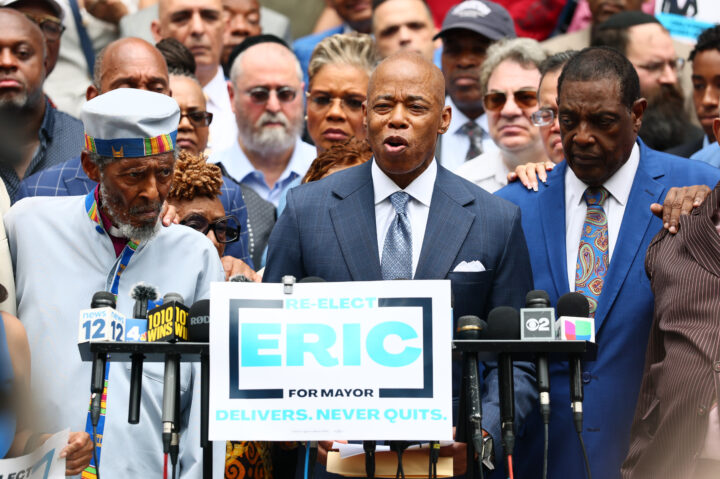
Michael M. Santiago/Getty Images
New York City Mayor Eric Adams speaks during a press conference at City Hall on June 26, 2025 in New York City.
Days after New York state Assemblyman Zohran Mamdani’s stunning upset in the Democratic primary for mayor of New York City, an emerging effort to block his path to Gracie Mansion is now beginning to materialize among a coalition of Jewish community leaders, business executives and Republican donors who have expressed alarm about his far-left policies and strident opposition to Israel.
While still in its nascent stage, the anti-Mamdani coalition is coalescing behind Eric Adams, the embattled mayor who skipped the primary to run as an independent and launched his reelection bid on Thursday. The mayor, who a day before in an appearance on “Fox & Friends” had called Mamdani a “snake-oil salesman,” is gearing up for a public brawl with the 33-year-old assemblyman and democratic socialist aiming to unseat him.
“This election is a choice between a candidate with a blue collar and one with a silver spoon,” Adams said in his campaign announcement on the steps of City Hall, depicting Mamdani, the son of a Columbia University professor and a filmmaker, as privileged.
Political strategists say Mamdani, who upset former New York Gov. Andrew Cuomo in the Democratic primary and would enter the general election as the presumptive front-runner, is a formidable nominee, particularly as the scandal-tarred mayor confronts dismal favorability numbers owing largely to the federal corruption charges he avoided while forging an unpopular alliance with the Trump administration.
But some opponents of Mamdani view Adams as the most effective vehicle to stop the presumptive Democratic nominee from winning in November, and are readying for a fight. Among other possible efforts now in the works is a “big push” to create an independent expenditure committee backed by real estate executives and other donors to boost Adams’ campaign, according to one consultant familiar with the matter.
“That’s definitely going to happen,” the consultant told Jewish Insider on Thursday, speaking on the condition of anonymity to discuss ongoing private deliberations. “People aren’t going to be taking this easy and just dealing with Mamdani,” he explained, noting the pro-Israel donor community could join the outside spending effort. “I’m sure some people are, but the people who have a lot to lose aren’t.”
Eric Levine, a top Republican fundraiser in New York City, endorsed Adams on Wednesday and said in an interview that he believes it is a “feasible” goal to reelect the mayor, provided that Cuomo stays out of the race and Curtis Sliwa, the GOP nominee, ends his campaign in order to avoid splintering the vote.
While Cuomo has yet to confirm if he will run on an independent ballot line, Sliwa has rejected growing calls for him to step aside. Jim Walden, a lawyer, is also running as an independent in what has become an unusually crowded race.
Levine, a board member of the Republican Jewish Coalition, said that he had received overwhelmingly positive responses since announcing his support for Adams in an email sent to 2,000 people — including from Democrats who backed Cuomo in the primary. “I’ve gotten feedback from a lot of people that this is a five-alarm fire and they’re going to line up behind Adams,” Levine told JI on Thursday, adding that he was “seriously considering” organizing a fundraiser for Adams and is hopeful Republican leaders would attend.
One strategist suggested that Adams could face backlash for campaigning with Republicans in the heavily Democratic city, especially as he has drawn scrutiny over his ties to the Trump administration. But the mayor will likely need to win support from a significant portion of GOP voters if he has any hope of building a viable coalition that has included Black and Orthodox Jewish residents whom Mamdani, with a long record of anti-Israel activism, has struggled to win over.
“Eric Adams has been a friend since his first days in office,” Leon Goldenberg, an executive board member of the Flatbush Jewish Community Coalition, said in a social media post. “Fighting antisemitism and standing with the Jewish community is in his DNA. The stakes are very high.”
The Jewish community, which overwhelmingly backed Cuomo in the primary, is expected to throw its support behind Adams, promising to deliver key voting blocs in November. Adams, who announced his reelection campaign alongside Orthodox leaders on Thursday, has long-standing ties to the community and during the primary engaged in a covert pressure campaign to try to influence the endorsement deliberations as Cuomo won backing from major Hasidic sects.
Leon Goldenberg, an executive board member of the Flatbush Jewish Community Coalition, said on Thursday he was supporting Adams’ campaign, the first endorsement from an Orthodox leader in what is anticipated to be many more heading into the fall.
“Eric Adams has been a friend since his first days in office,” Goldenberg, who has expressed concerns about Mamdani’s rise, said in a social media post. “Fighting antisemitism and standing with the Jewish community is in his DNA. The stakes are very high.”
Shabbos Kestenbaum, an Orthodox activist close to the Trump administration, has backed Adams and is also now seeking to rally support for his bid while urging Sliwa to drop out of the race. He said he was not yet at liberty to divulge specific names, but told JI he had been in communication with “Wall Street executives” as well as “young student activists” and a range of religious leaders about working to reelect Adams.
“There has really been a profound resurgence of a diverse coalition who truly, truly are terrified of Mamdani’s socialist dystopian future for New York City,” Kestenbaum said.
Still, no major financial commitments appear to have been made yet, even as Adams reportedly met with business leaders this week to discuss the race. “People haven’t made decisions,” said a person who has met with donors about the election. “Those types of decisions can’t be made in two or three hours.”
“A lot of people are talking about Eric. I just don’t see it in terms of being a contender,” George Arzt, a veteran political consultant, told JI. “Mamdani is very articulate. He is very likable. He’s got to prove himself to the real estate community and to the Jewish community.”
Jay Martin, executive vice president of the New York Apartment Association, said his organization “isn’t making any decisions for a little while,” but he added that his peers in the industry would likely be rallying behind the mayor. “I think they are going to see what they can do with Adams at the moment,” he told JI.
Mamdani, who has won some support from Democratic leaders since Tuesday’s primary, has dismissed the gestating efforts to corral support for Adams, saying that they will prove ineffective as his movement continues to gain traction. “What we have shown in this primary is our ability to overcome the same billionaires who may fund Eric Adams’s re-election campaign,” he told The New York Times, “and ultimately we’re able to do so because of the power of New Yorkers across the five boroughs.”
George Arzt, a veteran political consultant, said he was doubtful Adams would be able to win re-election as mayor, even as he acknowledged that there are “a lot of people” in the real estate industry and the Jewish community who are “very worried” about Mamdani, who has proposed rent freezes while defending calls to “globalize the intifada,” among other things.
“A lot of people are talking about Eric. I just don’t see it in terms of being a contender,” Arzt told JI. “Mamdani is very articulate. He is very likable. He’s got to prove himself to the real estate community and to the Jewish community.”
Jerry Skurnik, a senior consultant for Engage Voters U.S., a political consulting firm, said that “it will be very hard to defeat Mamdani in November,” noting that after the ranked-choice voting count is finalized, “he’ll have received over 500,000 votes.”
“That’s a pretty good start to a majority as he’ll have opportunity to then add votes from Democrats who didn’t vote in the primary and Democratic-leaning independents,” Skurnik added, before including a caveat. “On the other hand, I didn’t think Mamdani had a chance to win the primary until recently, so I don’t rule out anything.”

Mayoral Photography Office
Amid a dramatic wave of antisemitic violence, Jewish community leaders excoriated NYC Mayor Bill de Blasio during a roundtable — which was closed to the media — in Borough Park on Thursday, Jewish Insider has learned.
According to several attendees who spoke on condition of anonymity, community leaders challenged the mayor over his response to the situation and expressed their disaffection about a lack of coordination with local NYPD precincts.
Speaking to reporters after the meeting, de Blasio said, “It’s going to take a lot of work at the grassroots to change hearts and minds. We have got to get to the day, and we’ve got to get there soon, where Jewish people in the city never have to worry about walking down the street, never have to worry about their safety.”
During the meeting, one of the leaders criticized the Democratic mayor for “politicizing” the issue of antisemitism by “pointing fingers” at President Trump, according to audio obtained by Jewish Insider. De Blasio pushed back, insisting that “the reality is” that the president “unleashed the forces of hatred” and it would be “dishonest” to claim that the threat doesn’t come from white supremacists and the alt-right.
De Blasio also defended critics of Israel in the Democratic Party, emphasizing that it is generally directed at the Netanyahu government. He added, “I am a Democrat, I am progressive, but I also went to the AIPAC [conference] purposely to make a message that all of us should be able to very clearly call out antisemitism, and we should be ready to oppose BDS and we should be ready to support Israel. But if see something that needs to be called out, I want to hear about it. I think we will probably agree 99 percent of the time. What I am not hearing so much is local leaders in New York City being antisemitic.”
De Blasio also defended the new state bail reform law which eliminates cash bail for those accused of committing misdemeanors and felonies, including non-violent hate crimes, though he pledged to work to change parts of the legislation.
Please log in if you already have a subscription, or subscribe to access the latest updates.
 Continue with Google
 Continue with Apple