







































Georgia passes landmark transparency law for foreign funding in universities, K-12 schools
The Georgia Solidarity Network and Reps. Esther Panitch and Houston Gaines spearheaded the effort after a report was released documenting Qatari funding of Georgia’s public schools

Julia Beverly/Getty Images
The Georgia State Capitol building is seen on July 08, 2025 in Atlanta, Georgia.


 Add JewishInsider on Google
Following a report spotlighting Qatari funding in Georgia public schools, the state’s General Assembly became the first in the country to pass legislation requiring the disclosure of foreign government funding in statewide K-12 schools.
The Foreign Funding Transparency and Accountability Act, HB 1379, requires public school districts, public universities and technical colleges to report funding of $10,000 or more from foreign countries or entities, naming specifically Qatar and Saudi Arabia — the two largest foreign funders of American universities.
The bill — which passed both chambers of the Assembly earlier this month and now awaits Republican Gov. Brian Kemp’s signature — was spearheaded by Democratic state Rep. Esther Panitch, the only Jewish member of the Georgia Statehouse, as well as Rep. Houston Gaines and the pro-Israel Georgia Solidarity Network.
In January, the Foundation for Defense of Democracies published a report showing that the Qatari royal family’s U.S. philanthropy arm, Qatar Foundation International, had spent at least $281,000 on education in Georgia — including K-12 teacher trainings, Arabic textbooks for young students and student trips to Qatar.
Panitch told Jewish Insider she tweeted the findings, only to be surprised by a direct and hostile response from the Qatari ambassador to the U.S. and his deputy chief of mission on X, who allegedly told her she was spreading misinformation “like you people always do.”
“Why did they care what a legislator from Georgia thinks? It was weird. I started engaging back and this went on for days,” said Panitch. The back and forth eventually resulted in her involving the FBI. “The moment he responded to me was the moment I knew FDD was on to something right,” she said.
“We were all caught off guard after [the Oct. 7, 2023, terrorist attacks]. I think Qatar had a lot to do with the responses on college campuses. Parents had no idea that some of their kids were being radicalized. I hope we get more answers, but this will definitely help,” continued Panitch.
The Georgia Solidarity Network, a two-year-old bipartisan political action committee supporting pro-Jewish and pro-Israel causes, proposed legislation crafted by co-founder Alli Medof, which Panitch filed a couple weeks after the report’s release.
“We didn’t want to make it loud and attract the attention of people who might object,” Panitch told JI. “I didn’t want Qatar to come in and hire a lobbyist. We went to committees and didn’t get much pushback.”
There was, however, some pushback from colleges and schools “in an operational sense, asking how they are supposed to carry this out,” said Panitch.
The bill also faced scrutiny in the state Senate, according to Panitch, who said some lawmakers “didn’t seem to care that Qatari money had seemingly resulted in teachers saying that [late Hamas leader] Yayha Sinwar was to be commended or that suicide bombing is okay.”
Ultimately, the bill passed the Senate 31-20 and the House 139-16. Kemp has 40 days to sign the bill into state law. If he doesn’t veto it, it goes into law automatically.
“I wouldn’t presume anything” in terms of whether the governor will sign the bill, said Panitch, adding she has not heard anything that implies he would veto it.
A second bill establishing a K-12 statewide Title VI coordinator, also crafted by the Georgia Solidarity Network, simultaneously passed. The bill authorizes the withholding of state funding from institutions that fail to correct violations within 30 days — an enforcement mechanism absent from comparable laws in Tennessee, Oklahoma and California.
The legislative session also secured $3 million in state security funding for the rest of 2026 for nonprofit organizations at elevated risk of attack, with an additional $5 million budgeted for Fiscal Year 2027.
“The Title VI bill was kind of similar because we were also dealing with schools and universities,” Panitch told JI. “There was a part that mentioned antisemitism that we ended up taking out. The preamble still mentions antisemitism but we didn’t want anyone to think this was only for the Jews. It was the Jewish community that brought it forward because we’ve been dealing with this, but essentially it’s a civil rights bill for kids and everyone wants to protect their kids, so it passed, not difficultly.”
Six months ago, foreign funding transparency was “not on the roadmap or priority list” of many Georgia legislators, GSN co-founder David Zalik said. There was already evidence of foreign funding in university systems, he said, but “when we went back to the legislators and showed them documentation [regarding the same for K-12], they were stunned and surprised.”
Following the legislative session, Zalik sees the bill as “a model” for adoption beyond the Peach State.
“Other leaders in other communities reached out,” he told JI. “We crafted new language that other states want to emulate. Georgia is a state that clearly takes this very seriously.”
Medof added, “We’re incredibly proud of the impact this is going to make, and not just on the Jewish community. I think every one of these measures are going to improve the quality of life of students and Georgians. Foreign funding impacts curriculum, ideology, faculty and research [for all students]. It’s not just anti-Jewish or anti-Israel, it’s anti-American ideology that’s coming in. The more we can do to shine a line on that, the better it is for all Georgia students.”
More Stories

WAKE-UP CALL
Cruz warns Christian leaders are ‘asleep’ on antisemitism among youth
VEEP APPEAL
Michigan Jewish leaders urge Kamala Harris to appeal to El-Sayed on antisemitism, Israel
RIPPING ON RIYADH
Trump’s pick for Saudi ambassador once suggested kingdom is not a ‘true ally’
partnership pitch
Somaliland president discusses expanded military cooperation with U.S. officials
DAMASCUS DIARIES
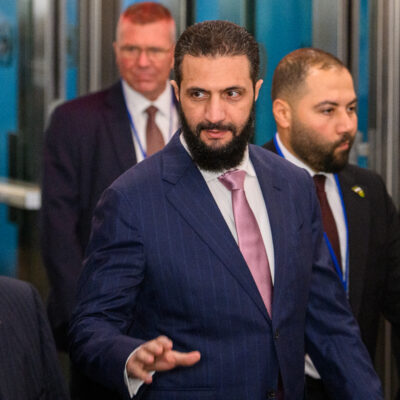
Syrian president blames Israel for diplomatic difficulties, rejects Trump push to send forces into Lebanon
MONEY MATTERS
Treasury moves to terminate tax-exempt status for some universities, private schools
Please log in if you already have a subscription, or subscribe to access the latest updates.
 Continue with Google
 Continue with Apple