































































The World Food Program executive director posted a video from Gaza where she said the enclave is ‘at a breaking point’

Hani Alshaer/Anadolu via Getty Images
Palestinians receive aid from the World Food Programme (WFP) in Khan Yunis, Gaza on July 23, 2025.


 Add JewishInsider on Google
Humanitarian aid to Gaza must only go to civilians, Israeli Prime Minister Benjamin Netanyahu and World Food Program Executive Director Cindy McCain said in a joint statement following their meeting on Thursday.
“It was agreed that every effort must be made to ensure that humanitarian aid reaches the most vulnerable people where they are, and that humanitarian aid is provided exclusively to civilians,” they stated.
The statement comes as Israel and U.N. agencies have been at odds over humanitarian aid distribution in Gaza, where there have been widespread reports of food shortages. Israel has pointed to looting and hoarding of food by Hamas as a major source of the problem, and has supported the efforts of the Gaza Humanitarian Foundation since May to distribute food without the terrorist group interdicting it.
U.N. aid agencies, like the WFP, have refused to accept Israeli security for their food deliveries or to work with the GHF or any other alternatives to UNRWA, the U.N. refugee agency for Palestinians, which Israel has outlawed. Some UNRWA employees took part in the Oct. 7, 2023 attacks on Israel and were Hamas fighters, and Hamas has used UNRWA facilities and resources in the war.
The joint statement from Netanyahu and McCain said that they “discussed the importance of protecting civilians from hunger and malnutrition and ensuring that their basic essential needs are met.”
“They noted the increase in humanitarian aid into Gaza over the last month and agreed to redouble efforts to expedite and sustain the entry of humanitarian goods into Gaza given the dire needs on the ground,” the statement reads.
McCain warned in an earlier post on X that “Gaza is at a breaking point.”
She recorded a video from the city of Deir el Balah in central Gaza, where she said that “famine is expected in the coming weeks if food doesn’t reach the thousands of starving families here fast enough.”
“The desperation here is overwhelming. We can reach them. We need safe routes and sustained access. We must deliver at the scale this crisis demands,” McCain stated.
McCain met with IDF Chief of Staff (Lt.-Gen.) Eyal Zamir and Maj.-Gen. Ghassan Alian, the head of COGAT, the IDF unit responsible for overseeing humanitarian aid, on Wednesday, who “emphasized the IDF’s commitment to preventing famine and doing everything in its power to continue enabling humanitarian aid to reach the civilian population directly, rather than Hamas,” the IDF stated.
She also met with Palestinian Authority Prime Minister Mohammad Mustafa in Ramallah.
Plus, Qatari editor calls for more hostage-taking
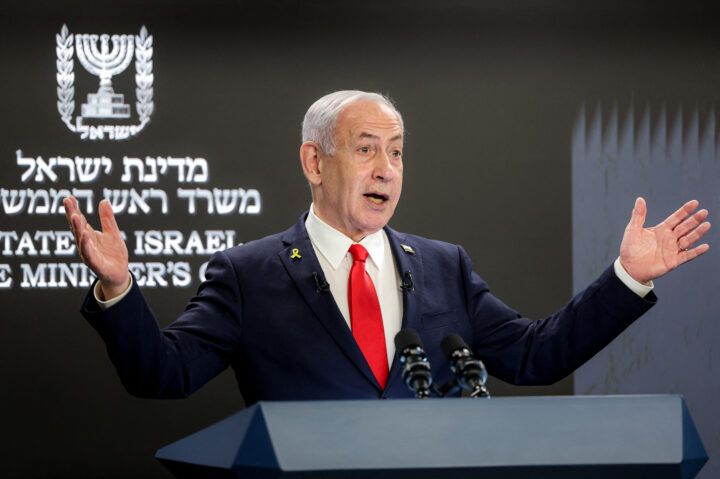
ABIR SULTAN/POOL/AFP via Getty Images
Israel's Prime Minister Benjamin Netanyahu gives a press conference at the Prime minister's office in Jerusalem on August 10, 2025.
Good Wednesday morning.
In today’s Daily Kickoff, we report on yesterday’s votes on Israel-related resolutions at the Democratic National Committee’s summer meeting and subsequent decision to create a task force on the issue, and cover Rep. Adam Smith’s support for leveraging arms sales to Israel. We report on a call from a prominent Qatari journalist tied to the country’s royal family to kidnap IDF soldiers, and report on a push from Jewish groups, led by the Jewish Federations of North America, for the Trump administration to move forward with its nominations for antisemitism envoy and religious freedom ambassador. Also in today’s Daily Kickoff: Avraham Tahari, Jonathan Karp and Shmuel and Anat Harlap.
What We’re Watching
- President Donald Trump will lead a meeting at the White House today focused on winding down the war in Gaza and increasing humanitarian aid to the country. Steve Witkoff, the Trump administration’s Middle East envoy, told Fox News that the administration believes “that we’re going to settle this one way or another, certainly before the end of this year.”
- Israeli Foreign Minister Gideon Sa’ar, who is in the U.S. this week, will meet with Secretary of State Marco Rubio this afternoon in Washington.
- This evening, the Florida Democratic Party Jewish Caucus is hosting a briefing with Rep. Debbie Wasserman Schultz (D-FL).
What You Should Know
A QUICK WORD WITH JI’S JOSH KRAUSHAAR
In the run-up to the U.S. presidential election last year, one common refrain heard in Israeli leadership was to wait out the election in the hope of a friendlier Trump administration taking over.
Increasingly, many pro-Israel voices in the United States are quietly saying the same thing about upcoming Israeli elections, which polls suggest could usher in a more moderate coalition, and diminish the influence of far-right leaders in the current Israeli government.
The possibility of new elections taking place soon, more than any particular shift in military strategy or policy decisions, is looking like the most likely factor that could advance progress in the region.
While Israeli elections are not guaranteed to take place until October 2026, the legislative crisis over Haredi conscription in the IDF is looking like it could collapse Israeli Prime Minister Benjamin Netanyahu’s coalition, and move up the election timetable to as early as next January.
What has prevented elections until now is the fact that all members of the governing coalition are projected to lose seats if elections are held. That most Israelis want new elections is the very reason why they haven’t happened – yet.
Indeed, if elections were held today, Netanyahu would be in serious trouble. A recent poll commissioned by Israel’s Channel 12 found the anti-Netanyahu bloc making up a narrow majority of 61 of the Knesset’s 120 seats, with the current Likud-led coalition sitting at 49 seats, and Arab parties making up the remaining 10 seats.
minneapolis moment
Under pressure from left-wing activists, DNC Chair Ken Martin withdraws Israel resolution

Shortly after members of the Democratic National Committee passed a resolution on Tuesday voicing support for humanitarian aid to Gaza and calling for the release of hostages held by Hamas, Ken Martin, the party chair, announced that he would withdraw the measure, which he had introduced, and instead form a task force to continue discussing the matter, Jewish Insider’s Matthew Kassel reports.
Dem divide: The surprise reversal came even as the DNC, now holding its annual summer meeting in Minneapolis, had voted to reject a dueling and more controversial resolution that had backed an arms embargo as well as a suspension of U.S. military aid to Israel, raising alarms among Jewish and pro-Israel Democrats who rallied behind Martin’s effort, co-sponsored by DNC leadership. “There is a divide in our party on this issue. This is a moment that calls for shared dialogue and calls for shared advocacy,” Martin said after the competing measure had been voted down. He said that he would “appoint a committee or a task force comprised of stakeholders on all sides of this to continue to have the conversation, to work through this, and bring solutions back to our party.”
‘Inside baseball’: Pro-Israel Democrats expressed cautious optimism about the unexpected decision. Despite Martin’s 11th-hour reversal, Halie Soifer, the CEO of the Jewish Democratic Council of America, told JI’s Matthew Kassel she was satisfied with the outcome, noting the DNC also passed a resolution condemning antisemitism that, coupled with its rejection of the arms embargo proposal, “reflects where the party stands” on major issues concerning Israel and the Jewish community. Brian Romick, Democratic Majority For Israel’s president and CEO, said that he viewed the outcome as “a win” for the pro-Israel community, in light of the potential for a more hostile debate. “The bad resolution was rejected and Ken’s compromise resolution also passed the committee,” Romick said. “That all happened publicly” and “reaffirmed where the party stands on Israel,” he said. “Anything else beyond that is just inside baseball.”
the center shifts
Leading moderate House Democrat calls for ‘leveraging’ arms sales to Israel
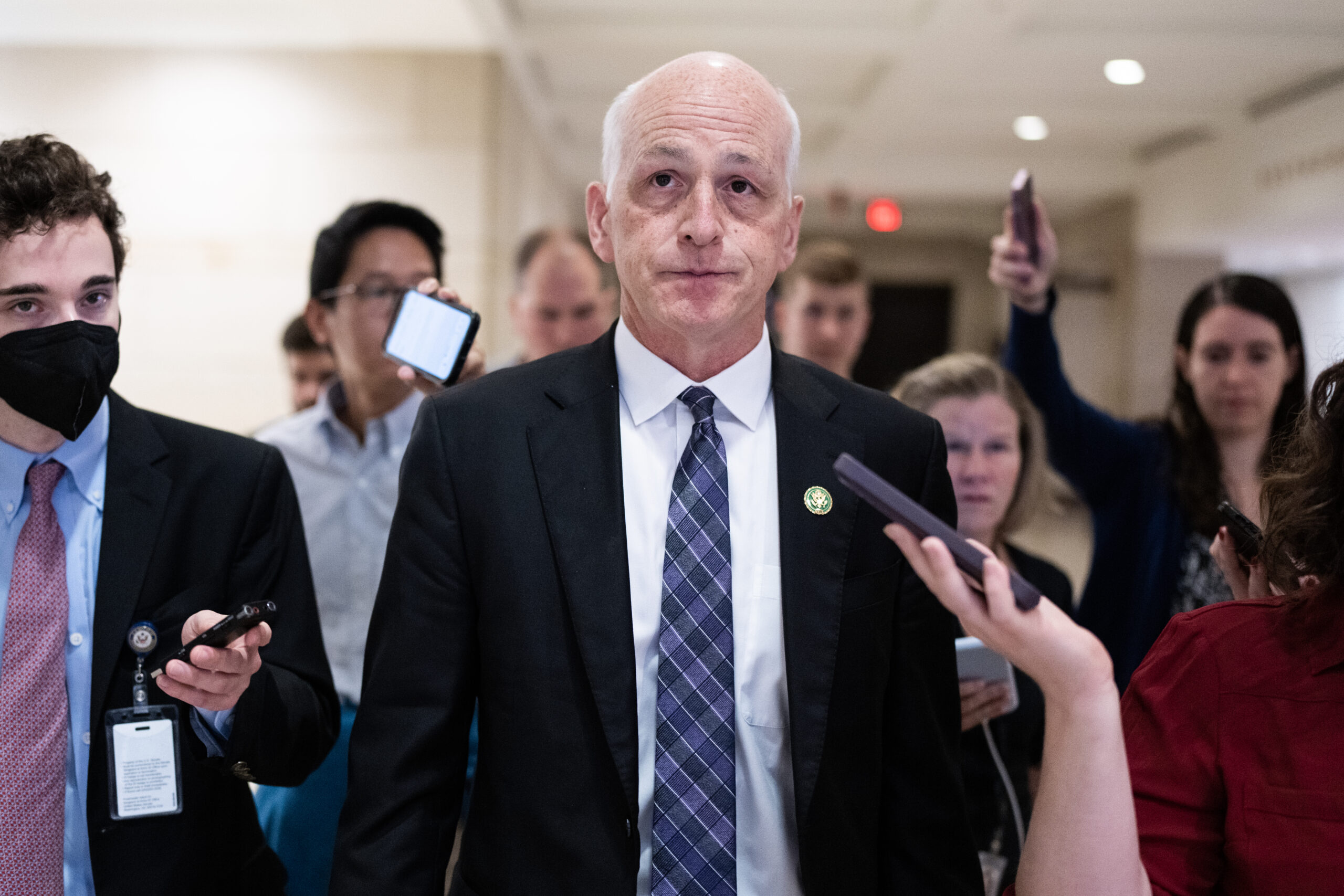
Rep. Adam Smith (D-WA), ranking member of the House Armed Services Committee, said in a statement on Tuesday that he “believe[s] it is time for the United States government to stop the sale of some offensive weapons systems to Israel as leverage to pressure Israel” into implementing a ceasefire, increasing humanitarian aid in Gaza and stopping the expansion of West Bank settlements, Jewish Insider’s Danielle Cohen-Kanik reports. The Washington state Democrat, who has served his Seattle-area district since 1997, said he changed his position on blocking weapons sales to Israel because the “situation in the Middle East has changed dramatically in recent months.”
Nuanced stance: Smith, a member of the moderate New Democrat Coalition who has played a leading role in Democratic foreign policy, was careful to emphasize that he supports Israel and “recognize[s] both the threats they face and the reality that the actions of Hamas and their supporters have driven this conflict.” He also affirmed that “Yes, the hostages must be returned. It is outrageous that Hamas took the hostages and has continued to hold them.” However, Smith said, “six months of war since the end of the last ceasefire has done nothing to bring the hostages home” and it is “impossible to see how further military action in Gaza could degrade Hamas … further than what has already occurred.”
media mania
Qatari government-aligned newspaper editor called on Hamas to kidnap IDF soldiers

The editor-in-chief of Qatar’s pro-government newspaper Al Sharq called on Hamas “heroes” to kidnap more IDF soldiers in a since-deleted tweet, Jewish Insider’s Haley Cohen reports. “If success is not achieved this time in capturing Zionist soldiers at the hands of the heroes of #AlQassamBrigades, then the second, third, and fourth attempts will succeed, God willing, by adding new rats to the tally held by the heroes of the Brigades,” Qatari journalist Jabar Al-Harmi wrote in Arabic last week.
Propaganda push: Al Sharq, which is published in Doha by a privately held media company founded and owned by Sheikh Khalid bin Thani Al Thani, a member of the Qatari ruling family, is one of the four leading private daily Arabic newspapers in Qatar, all of which have a pro-government bent. Ghaith Al-Omari, a senior fellow in The Washington Institute for Near East Policy’s Irwin Levy Family Program in the U.S.-Israel Strategic Relationship, told JI that the tweet is “not surprising” and comes amid widespread praise for Hamas in Qatari media. “The Qatari media landscape is rife with statements, selective reporting and editorials that support Hamas,” said Al-Omari, former executive director of the American Task Force on Palestine. “Under the guise of supporting the Palestinian people, many Qatari media outlets have been a key vehicle for amplifying Hamas propaganda.”
beirut or bust
Graham advocates for mutual defense agreement with Lebanon during bipartisan visit

Sen. Lindsey Graham (R-SC) championed a U.S. defense agreement with Lebanon during a bipartisan congressional delegation to Beirut on Tuesday, saying it would be the “biggest change in the history of Lebanon,” Jewish Insider’s Danielle Cohen-Kanik reports. Speaking at a press conference alongside Sen. Jeanne Shaheen (D-NH) and Rep. Joe Wilson (R-SC), Graham asked, “How many nations have a defense agreement with the United States? Very few. … The number of nations that America is willing to go to war for is very few. Why do I mention Lebanon being in that group? You have one thing going for you that is very valuable to me: religious diversity.”
Making the case: “Christianity is under siege in the Mideast. Christians are being slaughtered and run out of all over, all over the region, except here. And so what I am going to tell my colleagues is, ‘Why don’t we invest in defending religious diversity in the Mideast? Why don’t we have a relationship with Lebanon where we would actually defend what you’re doing?’” Graham continued. “I think it’s in America’s interest to defend religious diversity, whether you’re Druze or Alawite or a Christian or whatever. The idea that America may one day have a defense agreement with Lebanon changes Lebanon unlike any single thing I could think of,” Graham said.
granite state race
Top N.H. congressional candidate balances support of U.S.-Israel relationship with criticism of Gaza aid strategy

Maura Sullivan, a Marine veteran who served in Iraq and later worked as a senior Defense Department official, is aiming to leverage that experience to win the New Hampshire congressional seat currently held by Rep. Chris Pappas (D-NH), who is running for the Senate. She’s also leaning on “that firsthand perspective, experience and knowledge” as she stakes out her positions on the conflict in the Middle East, she told Jewish Insider’s Marc Rod in a recent interview.
Military mindset: As a Pentagon official, Sullivan, who noted that she’d be seeking a spot on the House Armed Services Committee if elected, said she spent time in the Middle East on “allied reassurance tours,” visiting allies and meeting with top officials to learn about Israel’s challenges and capabilities and “talking about the incredibly important relationship between the United States and Israel and strongly reaffirming the United States commitment” to Israel. “I’ve been very clear since the devastating, absolutely deplorable Oct. 7 attacks that Hamas perpetrated that Israel has the right to defend itself,” Sullivan continued. “I also want to be clear that the conditions in Gaza are inhumane, they’re deplorable and they must be improved immediately. … Hamas can be destroyed and significant aid can be let in at the same time. It’s a false choice to think that those two objectives cannot occur simultaneously.”
scoop
Jewish groups to urge Senate to confirm antisemitism envoy, religious freedom ambassador

Several major Jewish organizations are calling on the Senate to “swiftly” confirm President Donald Trump’s nominees for special envoy to monitor and combat antisemitism and international religious freedom ambassador, Jewish Insider’s Gabby Deutch reports. In April, Trump tapped Rabbi Yehuda Kaploun, an Orthodox businessman and Chabad rabbi who served as a campaign surrogate, to serve as the next U.S. special envoy to monitor and combat antisemitism, and has named former Rep. Mark Walker (R-NC) as the U.S. ambassador-at-large for international religious freedom. Both positions require Senate confirmation, and neither has had a confirmation hearing yet.
‘Utmost importance’: The groups, led by the Jewish Federations of North America, wrote in a letter to Senate Majority Leader John Thune (R-SD) and Senate Minority Leader Chuck Schumer (D-NY) that filling the roles is “of utmost importance in fighting growing antisemitism and ensuring freedom of religion or belief worldwide,” according to a draft obtained by JI. “We dare not delay in filling these critical positions that protect human rights around the world,” the letter states. “To that end we strongly urge you to prioritize filling these positions, sending a powerful signal to governments around the world that the United States upholds our constitutionally guaranteed rights to life and liberty, to freedom of religion and belief, and calls on them to do the same.”
Worthy Reads
The Heck With Hasbara: The Wall Street Journal’s Elliot Kaufman interviews Israeli Foreign Minister Gideon Sa’ar about the diplomatic and public relations hits the country has taken as it nears two full years of war against Hamas in Gaza. “Hamas took over and Israel is still paying the price, in diplomacy and in lives. The logic leads me to the conclusion that whether the Gaza war ends now or in some months seems less important for Israel — and even for its foreign relations — than whether Hamas is left with the ability to draw it into another war a few years on. In general, Mr. Sa’ar says, ‘We need to survive first. After that, there comes popularity and how much we are able to convince others around the world.’ Later, he catches himself, and adds, ‘I’m not saying diplomacy shouldn’t be taken into consideration. I’m the last to say that — I’m foreign minister.’” [WSJ]
Southern Comfort: The Atlantic’s Rose Horowitch spotlights the growing popularity of southern universities among prospective Jewish students, as many of the Ivies and small liberal arts colleges in the Northeast face widespread anti-Israel and at times antisemitic activism. “The line between criticism of Israel and anti-Semitism is nearly always contested; the anti-Israel protest movement on some campuses counts many Jewish students among its ranks. Meanwhile, southern colleges are becoming more popular with northeastern students of all backgrounds. No doubt some Jewish students have opted out of the Ivy League simply because they think the South is the place to be. Even so, an atmosphere of fear has clearly taken hold among many Jewish families. Jewish leaders at Columbia, Harvard, and Yale told me that just about every parent of a prospective student asks if their child will be safe on campus. (Here I will resist the temptation to make any quips about Jewish moms.)” [TheAtlantic]
Crimson Coexistence: In The New York Times, Jacob Miller and Tommy Barone, who served as chairs of the Harvard Crimson’s editorial board during the last academic year, reflect on how they worked to maintain civil discourse in the publication’s pages. “The two of us faced a measure of internal criticism, but we consistently underscored the importance of principled, rational disagreement. Meeting by meeting, the board rallied behind this approach. Disagreeing civilly about big stories — the Israeli-Palestinian conflict, but also D.E.I., free speech and admissions policies — became routine, and we published thoughtful editorials that helped earn back disillusioned readers’ respect. Refined by dissent, our editorials, regardless of their ideological tilt, offered stronger reasoning and more engagement with counterarguments. They passed the test our previous editorials on controversial issues had too often failed.” [NYTimes]
Split With Hamas: In Haaretz, Haisam Hassanein considers the outcomes of the Arab League’s call for Hamas to be disarmed and removed from Gaza. “On paper, this new declaration is historic. But it seems most Israelis don’t even know it exists. If Arab leaders are serious, they can’t stop at communiqués read in Cairo or Riyadh. They have to step into Israel’s conversation. That means Hebrew language interviews, Israeli TV, op-eds in this paper and others. Spell it out directly: Arab states are ready to put money into rebuilding Gaza. They are ready to back one Palestinian leadership. They themselves are also ready to move toward normalization. But all of it hinges on Israel doing its part – stopping the drift into endless conflict and opening a real path toward a two-state solution. That’s the message. And Israelis deserve to hear it unfiltered. Right now, they don’t.” [Haaretz]
Word on the Street
Dan Scavino, the longest-serving aide to President Donald Trump, was tapped to head the White House Presidential Personnel Office, replacing Sergio Gor, who was nominated to be U.S. ambassador to India…
U.S. Ambassador to Turkey Tom Barrack received pushback from Lebanese journalists and commentators after warning journalists at a press conference in Beirut to “act civilized” and not be “animalistic”…
Microsoft is weighing disciplinary measures against employees who, protesting the company’s tech sales to Israel, participated in a sit-in in the office of President Brad Smith at the company’s Washington state headquarters that temporarily locked down the building…
Business executives and Jewish leaders in Chicago are preparing to open a college preparatory Jewish high school in the city’s Lakeshore East neighborhood after purchasing the unfinished building, where construction on another school stalled six years ago…
Police in St. Louis County, Mo., charged an area man with defacing a sign outside the city’s Jewish Student Union, which provides programming and community events to Jewish high schoolers in the city…
The Wall Street Journal spotlights the high-profile, high-stakes divorce proceedings of David Geffen, who did not sign a prenuptial agreement with his now-estranged husband, amid allegations of drug use and unequal power dynamics…
Elie Tahari co-founder Avraham Tahari listed his Alpine, N.J., home for $24.75 million, 15 years after buying the property for $4.25 million…
The Woodstock, N.Y., property that was featured on the cover of Bob Dylan’s “Bringing It All Back Home” sold for $4.6 million…
Simon & Schuster CEO Jonathan Karp is stepping down after five years in the role; Karp will remain at the publisher, overseeing its newly created Simon Six imprint…
In The Wall Street Journal, Tevi Troy reflects on the slow pace encouraged by vacation life…
Norges Bank Investment Management, Norway’s sovereign wealth fund, is ending its investments in Caterpillar as well as five Israeli banks, after its ethics council reviewed the companies’ ties to Israeli construction and Palestinian home demolitions in the West Bank…
Israel said that a strike on the Nasser Hospital in Khan Younis earlier this week that killed 20 people had targeted a camera the army alleged had been positioned by Hamas to observe IDF troop movements…
Israeli Prime Minister Benjamin Netanyahu praised the decision by Australia to expel Iran’s ambassador in Canberra, calling it a positive “first step,” days after he had criticized Australian Prime Minister Anthony Albanese for being “weak” and failing to adequately address antisemitism in the country…
French President Emmanuel Macron doubled down in his support for Palestinian statehood, writing in a letter to Netanyahu, which was published in several European newspapers, that a lasting Israeli-Palestinian peace “is essential to the State of Israel’s security”…
German Chancellor Friedrich Merz said Berlin would not join other foreign powers in recognizing a Palestinian state at the United Nations General Assembly next month; Merz, speaking at a press conference with Canadian Prime Minister Mark Carney, said that Germany doesn’t “see the requirements met” for statehood…
The Financial Times looks at how the 12-day war between Israel and Iran has sparked calls inside Iran for political change…
Philanthropists Shmuel and Anat Harlap made a $180 million donation to the Rabin Medical Center in central Israel, the largest-ever single gift to an Israeli hospital, eJewishPhilanthropy’s Judah Ari Gross reports…
Commentator Batya Ungar-Sargon is joining NewsNation, where she will host an eponymous weekend program…
Jewish communal activist and fundraiser Jacqueline Levine, who was active in the Civil Rights Movement as well as the movement to free Soviet Jewry, died at 99…Physicist Rainer Weiss, who won the Nobel Prize in 2017 for his role in developing a mechanism to predict intergalactic events, died at 92…
Pic of the Day
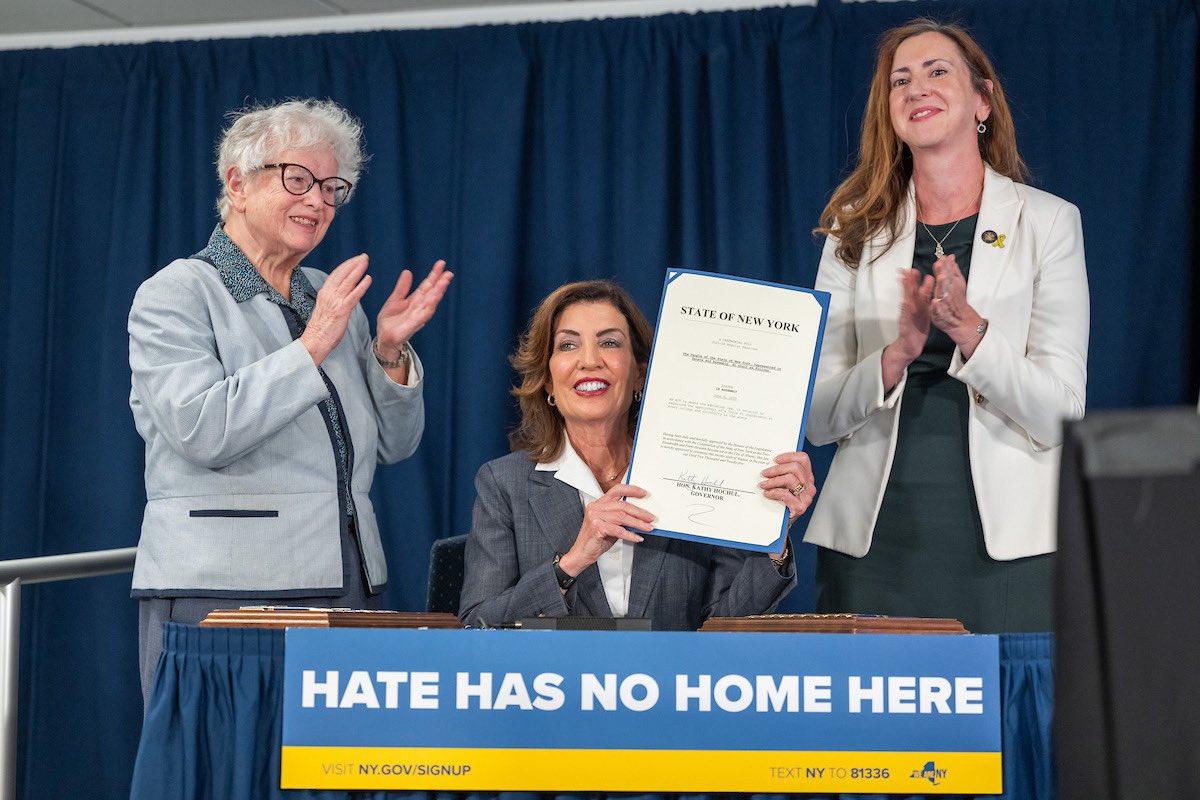
New York Gov. Kathy Hochul (center) signed into law legislation that requires all colleges in the state to designate anti-discrimination coordinators to enforce Title VI of the Civil Rights. Hochul was joined by state Sen. Toby Ann Stavisky (left) and Assemblywoman Nily Rozic (right), who sponsored the legislation in their respective chambers.More on the new law here.
Birthdays

Member of AJR, an indie pop multi-instrumentalist trio, together with his two brothers, Adam Metzger turns 35…
Chatsworth, Calif., resident, Ruth Ann Kerker Hapner… Board chair for North America at the Pardes Institute of Jewish Studies, Mark S. Freedman turns 74… Author, essayist and journalist, Michael Wolff turns 72… President of the Israeli Jewish Congress focused on battling antisemitism, he is a former senator in the Russian Federation, Moshe Shlomo (Vladimir) Sloutsker turns 69… President of Cornell University until June 2024, Martha Elizabeth Pollack turns 67… Governor of New York State since 2021, Kathy Hochul turns 67… Israel’s ambassador to the Czech Republic, Anna Azari turns 66… Vice chairman at IBM and lead independent director on the board of Apollo Global Management, Gary Cohn turns 65… Executive director of J Street Israel, he served as Israel’s consul general to New England from 2006 until 2010, Nadav Tamir… Contributing editor at the National Interest, he is also chairman and CEO of Widehall, Steve Clemons turns 63… Private equity investor and a trustee of the Jewish Federations of North America’s Board, Neil A. Wallack… Israeli-born CEO of Insitro, she was a professor at Stanford for 18 years and a 2004 winner of a MacArthur genius fellowship, Daphne Koller turns 57… Director of National Intelligence throughout the four years of the Biden administration, Avril Haines turns 56… Co-founder of the 2017 Women’s March which she departed citing concerns over antisemitism, Vanessa Wruble turns 51… Managing partner and founder of G2 Investment Partners, Joshua Goldberg… Former director general of the Israeli Ministry of Finance, now CEO of the Strauss Group, Shai Babad turns 49… Mayor of Evanston, Ill., Daniel Kalman Biss turns 48… Senior advisor at the Foundation for Defense of Democracies, Richard Goldberg turns 42… Director of the JCRC at the Jewish Federation & Foundation of Northeast Florida in Jacksonville, Nelson France… Co-founder of theSkimm, Danielle Merriah Weisberg turns 39… Michael Weiss… Director of the Botanical Garden and senior lecturer, both positions at Tel Aviv University, Yuval Sapir… Talia Rubin…
Democratic insiders told JI that DNC chair Ken Martin withdrew his Israel resolution largely to avoid a disruptive floor debate over Israel on Wednesday

Audrey Richardson/Bloomberg via Getty Images
Ken Martin, chairman of the Democratic National Committee , speaks during a news conference in Aurora, Ill., on Tuesday, Aug. 5, 2025.
Pro-Israel Democrats expressed cautious optimism about the unexpected decision by Democratic National Committee Chairman Ken Martin to withdraw his resolution pressing for humanitarian aid to Gaza and for the release of hostages held by Hamas, which was unanimously approved by party members on Tuesday at the DNC’s annual summer meeting held in Minneapolis.
Martin, in a sudden reversal, announced he would pull the resolution after DNC members rejected a dueling measure, opposed by pro-Israel groups, that had endorsed an arms embargo and a suspension of U.S. military aid to Israel. Instead, he said he would create a task force “comprised of stakeholders on all sides” of the Israel debate to pursue what he called a “shared dialogue” on an increasingly divisive issue.
“This was a surprise ending to this meeting,” Halie Soifer, the CEO of the Jewish Democratic Council of America, which helped draft the pro-Israel measure and privately advocated for its passage, told Jewish Insider on Tuesday.
Despite Martin’s 11th-hour reversal, Soifer said she was satisfied with the outcome, noting the DNC also passed a resolution condemning antisemitism that, coupled with its rejection of the arms embargo proposal, “reflects where the party stands” on major issues concerning Israel and the Jewish community.
“It’s my sense,” she added of Martin, “that he introduced and ensured passage of this resolution to defeat the other resolution,” which she said “was completely out of step with the views of the party.”
Soifer said she hopes to join the proposed task force “to discuss the path forward” on approaching Israel, acknowledging internal tensions that have roiled the party in recent years. Martin “clearly recognized that there are a range of strongly held views on this matter, and he wants to make sure that those voices are heard,” she told JI.
Martin has not yet shared additional details on the task force, and the DNC did not return a request for comment from JI. Latonya Reeves, a DNC member in Minneapolis, told JI on Tuesday that she had not been further informed of the task force — which she called “the best way to move forward” on the issue.
Sara Forman, who leads the New York Solidarity Network, a local pro-Israel group that aligns with Democrats, said she was broadly “encouraged” that the DNC had chosen “not to recommend” what she dismissed as a “one-sided resolution against Israel,” arguing that the party “represents far more than its progressive base.”
“I’m always one for conversation, and think that talking about things is an important step, so I’m going to offer grace to Martin in this regard,” she said of his announcement. Still, she added of the failed resolution, “I think it’s a bigger concern overall that the Democratic Party seems to be uniquely singling out Israel for rebuke or scrutiny in a way that no other U.S. ally is rebuked or scrutinized.”
A spokesperson for Democratic Majority for Israel, which released a statement praising the DNC’s votes before Martin revealed he would pull the resolution, said it was “pleased that the anti-Israel measure was decisively defeated by the committee,” but declined to comment more broadly on what transpired at the end of the meeting.
Brian Romick, DMFI’s president and CEO, said in an interview with JI that he viewed the outcome on Tuesday as “a win” for the pro-Israel community, in light of the potential for a more hostile debate. “The bad resolution was rejected and Ken’s compromise resolution also passed the committee,” Romick said. “That all happened publicly” and “reaffirmed where the party stands on Israel,” he said. “Anything else beyond that is just inside baseball.”
Some Democratic insiders familiar with internal party dynamics indicated that Martin had chosen to change course because he anticipated a disruptive floor debate over his resolution, which was poised to face broader scrutiny during the DNC’s general session on Wednesday.
“He’s worried about what would happen at the meeting,” one party source informed of the matter said on Tuesday. “On one hand, viewed from there, it makes sense and seems like a rational move,” the source reasoned, while also noting that it has “some real downsides.”
On the other hand, “when you punt something to a task force you actually continue the debate, because now it’s going to be a big fight” over who is included in the committee, the source said. “Then it becomes hard to move past.”
Manny Houle, a Democratic pro-Israel strategist in Minneapolis, said Martin’s maneuver was tactically smart — as DNC leadership seeks to avoid “internal proxy fights and focus messaging on pushing back against” the Trump administration in advance of the upcoming elections. “It is often a tactic to give your most ardent detractors busy work so you can focus on the work that matters,” he explained.
The party’s pro-Israel wing knows it has “the power to push back,” Houle told JI. “It’s not worth giving more air to the extremist factions.” The debate over Israel “is not going away anytime soon,” he added. “But we’ve shown where we stand and hopefully there are more pressing things that we need to give oxygen to.”
Whatever Martin’s intentions, Susan Turnbull, a former DNC vice chair, said she was excited by the prospect of a task force, suggesting that it would be well-timed to take place between the conventions.
“What I think is the case is that this, of all issues, needs to have consensus and that what he wanted in his first meeting is not to have winners and losers,” she told JI. “He wanted to come to a good result for collaboration.”
“I’m giving him a lot of credit because we have a hard enough time within the Jewish community dealing with this issue,” she said, adding that it will be “important that every perspective be considered” as the DNC hones its approach to the Middle East.
It remains to be seen if Martin, who on Tuesday acknowledged a “divide” in the party over Israel, will find partnership on the opposing end of the issue. Allison Minnerly, the 26-year-old DNC member who had introduced the failed measure on Gaza, which faced criticism for not mentioning Hamas, voiced disappointment with his decision and said he was “prolonging” the conversation rather than taking a position to align the party with a base she views as amenable to her views on Israel.
Still, as the DNC moves to reach a tenuous detente on Israel, some pro-Israel Democrats said that any future resolution on the issue should reflect values that have long been espoused by the party, even as they have faced ongoing pushback from the activist left.
“The vast majority of American Jews, and Americans more broadly, understand the complexity of the conflict — wanting to see Israel’s security protected and the remaining hostages released, the humanitarian crisis in Gaza truly addressed, and all parties work toward a future in which both Israelis and Palestinians are safe and free,” Amy Spitalnick, CEO of the nonpartisan Jewish Council for Public Affairs, told JI. “Any resolution on Gaza should reflect those widely-held values.”
Amanda Berman, CEO of the Zioness Action Fund, a progressive pro-Israel advocacy group, said on Tuesday that “there is legitimate critique and concern about this devastating war dragging on — and Democrats should stand staunchly with the Israeli public as it models dissent, protest and a pro-democracy movement the American left should emulate.”
“To the extent that any fringe element of the Democratic Party is willing to abandon Israel and the American Jewish community,” Berman said, “they will be abandoning true progressive values, liberation for persecuted minority communities, our historic alliances and America’s national security.”
Rep. Adam Smith, ranking member of the House Armed Services Committee, said he recognizes restricting offensive weapons to Israel could ‘embolden Hamas’ but it is ‘time to try something else’
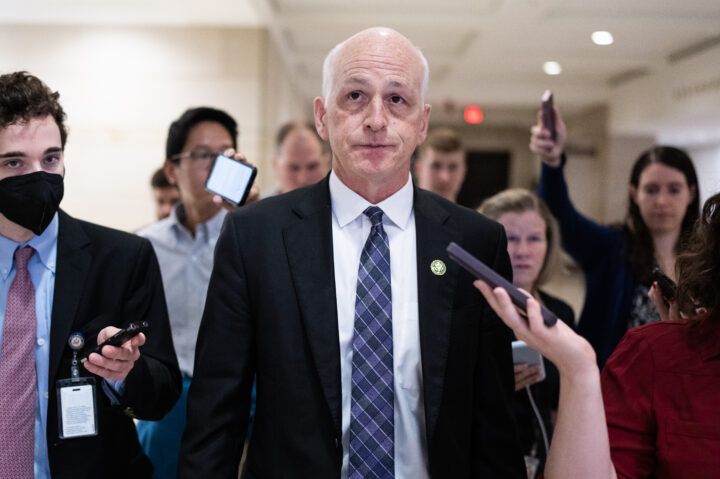
Tom Williams/CQ-Roll Call, Inc via Getty Images
Rep. Adam Smith, (D-WA), is seen in the Capitol Visitor Center after an all members briefing on the attack on Israel on Wednesday, October 11, 2023.
Rep. Adam Smith (D-WA), ranking member of the House Armed Services Committee, said in a statement on Tuesday that he “believe[s] it is time for the United States government to stop the sale of some offensive weapons systems to Israel as leverage to pressure Israel” into implementing a ceasefire, increasing humanitarian aid in Gaza and stopping the expansion of West Bank settlements.
Smith, a member of the moderate New Democrat Coalition who has played a leading role in Democratic foreign policy, was careful to emphasize that he supports Israel and “recognize[s] both the threats they face and the reality that the actions of Hamas and their supporters have driven this conflict.”
He also affirmed that, “Yes, the hostages must be returned. It is outrageous that Hamas took the hostages and has continued to hold them.”
“But,” Smith said, “six months of war since the end of the last ceasefire has done nothing to bring the hostages home” and it is “impossible to see how further military action in Gaza could degrade Hamas … further than what has already occurred.”
The Washington state Democrat, who has served his Seattle-area district since 1997, said he changed his position on blocking weapons sales to Israel because the “situation in the Middle East has changed dramatically in recent months.” He acknowledged that the weakening of Hezbollah, Hamas and Iran and the fall of the Assad regime in Syria “might not have happened if the U.S. had reduced its support to Israel prior.”
“But these developments also mean that Israel faces little if any risk to its security if the U.S. blocks the sale of some weapons now,” Smith continued.
He recognized that attempts to pressure Israel into ending the war could “simply embolden Hamas to keep fighting. I believe this has happened throughout the war as various international groups have consistently failed to hold Hamas accountable.”
“I am not naive that this approach is somehow guaranteed to work, but simply continuing the war has clearly failed to completely eliminate Hamas or gain the return of the hostages. It is time to try something else,” Smith said.
He said the world should not “blindly trust” how Hamas conveys the humanitarian situation in Gaza, but the “scale” of the crisis “cannot be denied.
“I also believe that if Israel does not end the war in Gaza, they run the risk of being ostracized globally in a way that is a far greater threat to the long-term security of Israel than anything their adversaries are now capable of doing,” Smith said.
Smith also spoke out against the far-left elements of his party, saying he “remain[s] concerned that so many people advocating for the U.S. to stop supporting Israel believe that Israel does not have the right to exist as a country.
“Opposing the actions of the Israeli government in Gaza to stop the war and end the suffering of the Palestinian people is very different from opposing the Israeli government out of a desire to wipe it off the map,” Smith said.
Martin will be creating a party task force comprised of ‘stakeholders on all sides’ of the Israel debate

Democratic National Committee Chair Ken Martin (Photo by Sarah Reingewirtz/MediaNews Group/Los Angeles Daily News via Getty Images)
Shortly after members of the Democratic National Committee passed a resolution on Tuesday voicing support for humanitarian aid to Gaza and calling for the release of hostages held by Hamas, Ken Martin, the party chair, announced that he would withdraw the measure, which he had introduced, and instead form a task force to continue discussing the matter.
The surprise reversal came even as the DNC, now holding its annual summer meeting in Minneapolis, had voted to reject a dueling and more controversial resolution that had backed an arms embargo as well as a suspension of U.S. military aid to Israel, raising alarms among Jewish and pro-Israel Democrats who rallied behind Martin’s effort, co-sponsored by DNC leadership.
“There is a divide in our party on this issue. This is a moment that calls for shared dialogue and calls for shared advocacy,” Martin said after the competing measure had been voted down. “And that’s why I’ve decided today, at this moment, listening to the testimony and listening to people in our party, to withdraw my amendment resolution to allow us to move forward in a conversation on this as a party.”
He said that he would “appoint a committee or a task force comprised of stakeholders on all sides of this to continue to have the conversation, to work through this, and bring solutions back to our party.”
Martin announced his decision after huddling with co-sponsors of the failed resolution, which also called for recognition of a Palestinian state and was expected to be voted down. The measure additionally drew criticism for not mentioning Hamas — in contrast with Martin’s proposal, which also supported a two-state solution. The measures, each backing an immediate ceasefire in Gaza, were nonbinding and meant to telegraph the party’s stances on an issue that has increasingly fueled internal tensions.
His about-face underscores the pressures that Martin, who became DNC chair in February, is facing from an outspoken contingent of anti-Israel activists who are now aggressively seeking to push the party away from its traditional commitment to defending the U.S.-Israel relationship — which has come under growing strain amid party backlash to the ongoing war in Gaza.
Martin has offered no additional details on what motivated his abrupt decision or his new plan to create a task force. The DNC did not respond to a request for comment on Tuesday.
His sentiments echoed the “big-tent” rhetoric that he had endorsed when he ran for DNC chair — with some pro-Israel party members voicing reservations that his approach could be overly accommodating to extreme views and fail to enforce red lines on Middle East policy.
Martin’s Gaza resolution was unanimously approved by the DNC’s Resolutions Committee, while the dueling measure, introduced by a 26-year-old member from Florida, was rejected in a voice vote.
The committee did not take a recorded vote and no members asked for a breakdown, a person familiar with the process said. An attempt to add language into the alternate resolution calling for the release of all hostages and to oppose offensive weapons to Israel also fell flat, reflecting a failed effort to unify the resolutions that preceded the votes this week.
The meeting on Tuesday was expected to be heated but largely avoided the sort of drama that animated its convention last year, drawing more attention for Martin’s decision to yank his own proposal near the end of the proceedings.
Even as Martin called for a continued dialogue on the matter, Allison Minnerly, the DNC member who had introduced the failed resolution, expressed disappointment with his choice and said she believed he was “prolonging” the conversation rather than taking a position to align the party with a base that she views as amenable to her views on Israel.
A new report from NGO Monitor describes the ‘workaround’ used by international aid groups to continue flow of aid to Gaza despite Hamas involvement

Ali Jadallah/Anadolu via Getty Images
Members of the Al-Qassam Brigades, the military wing of Hamas as the bodies of hostages' are handed over to the Red Cross teams as part of the Hamas-Israel prisoner-hostage swap agreement in Khan Yunis, Gaza on February 20, 2025.
Amid an international outcry over the humanitarian conditions in Gaza, Israel and the Gaza Humanitarian Foundation have repeatedly pointed to Hamas’ practice of diverting and disrupting the distribution of aid that officials say has entered Gaza unimpeded as one of the culprits behind the crisis.
NGO Monitor, which tracks the funding of anti-Israel organizations, wrote a new report given exclusively to Jewish Insider, which claims to show evidence of Hamas controlling the destination of humanitarian aid given in cash for years before and during the Gaza war, including money coming from U.N. agencies and NGOs funded by European governments.
The report alleges that the groups distributed cash and vouchers to beneficiaries selected by the Hamas-run Gaza Ministry of Social Development (MoSD), which since 2019 has been led by Ghazi Hamad, a member of the Hamas politburo who was designated a terrorist by the U.S. last year and who, weeks after Hamas’ Oct. 7, 2023 attacks, vowed that “there will be a second, a third, a fourth … one-millionth” Oct.7-style attack on Israel.
Hamad made headlines in Israel earlier this week with his assertion that the commitments of 11 countries to recognize a Palestinian state is an “achievement” stemming from Hamas’ attacks on Israel.
In 2023, the EU provided $19.6 million, France donated $9.34 million and Spain $1.75 million “for the payment of social allowances to poor Palestinian families.” The EU stated that since 2008, it “has been a steadfast supporter of the Palestinian Authority’s Ministry of Social Development, collaborating to ensure that basic social allowances are extended to the most vulnerable families residing in the West Bank and Gaza.”
In August 2024, according to the report, the EU and Spain provided 15.5 million Euros of aid for Gaza, saying they were partnering with the PA MoSD to deliver it. The EU also gave UNICEF over 4 million Euros in 2023 for a project in which the MoSD was the “main partner.”
Among the governments funding programs involving the MoSD is the U.K., even though its Foreign Office had been made aware of the matter and expressed concern over possible “severe” reputational damage that could come from its involvement.
Other countries funding programs working with the MoSD, according to the NGO Monitor report, include Germany, Switzerland and Norway.
The EU and others say that they are working with the MoSD in Ramallah, controlled by the Palestinian Authority, as opposed to the Gaza MoSD, controlled by Hamas.
However, the NGO Monitor report argues that the Ramallah MoSD was used to circumvent Western countries’ rules against contact with Hamas, a proscribed terrorist organization, while the beneficiaries were still chosen by the Hamas-controlled MoSD in Gaza.
A 2022 Oxfam International analysis of its cash-assistance programs in Gaza described “workarounds needed for the no-contact policy” with Hamas, by way of “the interface between humanitarian agencies and the MoSD in Ramallah, and the local authorities in Gaza,” otherwise known as Hamas.
The Oxfam analysis notes that there is “collaboration between the de-facto government in Gaza and the official Ramallah government,” and that “in the MoSD in Gaza, most of the staff are from the de-facto government,” meaning Hamas.
The organization called for more work with Arab humanitarian aid groups, “capitalizing on the fact that the latter are not restricted by no-contact policies,” meaning that they work directly with Hamas.
Hamas also takes a cut of the cash that aid organizations transfer into Gaza.
The minutes from a Oct. 8, 2024, meeting of the Gaza Cash Working Group, a U.N.-led coordination mechanism for U.N. agencies and international NGOs, state that the Hamas-controlled government in Gaza charged “withdrawal fees up to 20% … these fees are not limited to multipurpose cash assistance, but apply across the entire market.”
NGO Monitor also highlighted a 2022 Mercy Corps Gaza project as an example of Hamas control of humanitarian funding. A description of the project from the U.N. repeatedly referred to the MoSD’s central role.
“Through unconditional cash assistance, this project will identify and select the most vulnerable HHs [households] … from the Ministry of Social Development (MoSD) unserved waiting lists of Social Safety Net (SSN),” the U.N. description states. At another point, it says that the project will be undertaken with “full coordination and engagement with the MoSD.”
Oxfam responded to inquiries from JI that the organization “operates under a strict and clear no-contact policy with de facto authorities in Gaza. We do not work or communicate with the Ministry of Social Development (MoSD) in Gaza. In line with this, our work in Gaza is coordinated through the MoSD’s PA focal point based in Ramallah.”
“The reference in the 2022 study is not an admission of direct engagement,” the organization continued. “It describes sector-wide challenges … We have robust safeguards in place to prevent any misuse or manipulation of our aid programs and adhere to the highest standards of humanitarian principles and accountability.”
Mercy Corps also told JI it has a strict no-contact policy against engaging with sanctioned entities and that allegations that it worked with the MoSD in Gaza is “false and inaccurate.” Their aid recipient lists came from the MoSD in Ramallah, managed by the PA, the organization stated.
“We do not and have not coordinated with Hamas in Gaza to implement our aid programs, and allegations that we work with Hamas are false,” the group stated. “We are confident in our processes and policies, including a rigorous verification process for program participants, which ensures we help the most vulnerable families, while avoiding those with affiliation or contact with sanctioned groups. We have decades of experience delivering humanitarian assistance in high-risk environments like Gaza.”
The BBC reported on Wednesday that Hamas has continued to pay 30,000 salaries throughout the war in Gaza using “a secret cash-based payment system” even as Israel attempts to block the terrorist group from making payments.
Hamas employees receive encrypted messages inviting them to “meet a friend for tea” at a specific time and place. When they arrive, someone hands them an envelope of cash and then walks away.
Hamas has stockpiled about $700m in cash, according to the BBC, but has only paid $7m in salaries since the war began in Oct. 2023. Employees reportedly only receive about 20% of their wages, and the BBC quoted employees claiming to have non-combat roles who were frustrated with the insufficient payments and the dangers in having to travel to collect the cash amid Israeli airstrikes.
In addition, Hamas has reportedly distributed food packages to its members, angering Gazans who accuse the terrorists of not aiding others, according to the BBC.
The senators said that aid should be surged to NGOs and multilateral organizations

Kevin Carter/Getty Images
U.S. Capitol Building on January 18, 2025 in Washington, DC.
A group of 40 Senate Democrats, nearly all of the caucus, wrote to administration officials on Tuesday raising concerns about the humanitarian situation in Gaza and calling for a significant expansion of aid, describing the Gaza Humanitarian Foundation as a failure.
The letter to Secretary of State Marco Rubio and Middle East envoy Steve Witkoff, led by Sens. Adam Schiff (D-CA), Brian Schatz (D-HI), Chuck Schumer (D-NY) and Jacky Rosen (D-NV), highlights the extent of the concern even among Democratic leaders and pro-Israel stalwarts.
“The acute humanitarian crisis in Gaza is … unsustainable and worsens by the day,” the lawmakers said. “Hunger and malnutrition are widespread, and, alarmingly, deaths due to starvation, especially among children, are increasing.”
The senators said that the Israeli- and American-backed GHF aid distribution system had “failed to address the deepening humanitarian crisis and contributed to an unacceptable and mounting civilian death toll around the organization’s sites.”
They argued that aid must be significantly expanded, including through “experienced multilateral bodies and NGOs that can get life-saving aid directly to those in need and prevent diversion.” Israel has argued that other aid distribution mechanisms, particularly those affiliated with the United Nations, have failed to effectively distribute aid and prevent Hamas diversion.
The letter further states that efforts to finalize a ceasefire in Gaza “are as critical and urgent as ever and we urge the resumption of good-faith talks as quickly as possible.” The administration walked away from talks with Hamas last week, saying that Hamas was not negotiating in good faith.
“There still remains a viable pathway to end this war, bring home Israeli hostages, and achieve a diplomatic resolution of the Israeli-Palestinian conflict,” the senators asserted.
They emphasized that the living hostages in Gaza “have suffered too long, as have their families” and that “it is imperative that those still living be brought home as soon as possible, before more perish as the war drags on.” They also noted the need to return the bodies of deceased hostages.
The Democrats also voiced “our strong opposition to the permanent forced displacement of the Palestinian people” from Gaza, as has been floated by some Israeli and American leaders, calling such an outcome “antithetical to international humanitarian law,” to the security of Israelis and Palestinians, to lasting peace and to the expansion of the Abraham Accords.
They urged the administration to clearly reject such a plan.
“Beyond a negotiated ceasefire, a permanent end to this war will also require an end to Hamas rule in Gaza and ensuring that Hamas can no longer pose a serious military threat to Israel,” the letter continues. “We reaffirm our strong support for continued U.S.-led diplomacy with Israel, Palestinian leaders, and other partners in the Middle East in pursuit of the long-term goal of a negotiated two-state solution with Israelis and Palestinians living side by side in lasting peace, security, dignity, and mutual recognition.”
The only Senate Democrats who did not sign the letter were Sen. John Fetterman (D-PA) — who has generally abstained from letters by other Democrats critical of Israel — as well as Sens. Andy Kim (D-NJ), Ed Markey (D-MA), Jeff Merkley (D-OR), Tina Smith (D-MN) and Elizabeth Warren (D-MA). Sen. Bernie Sanders (I-VT) also did not sign.
It follows a letter earlier this week from 21 progressive Senate Democrats that more strongly condemned the GHF, describing it as a “private group supported by U.S. security contractors and connected to deadly violence against starving people seeking food in Gaza” that “blur[s] the lines between delivery of aid and security operations.”
That letter called on the administration to “immediately cease all U.S. funding for GHF and resume support for the existing UN-led aid coordination mechanisms with enhanced oversight to ensure that humanitarian aid reaches civilians in need.”
The progressive lawmakers said that the GHF system is insufficient to replace the United Nations aid network and that it is facilitating efforts to displace Palestinians and depopulate Gaza, as well as highlighted incidents in which aid recipients were allegedly attacked at distribution sites.
The lawmakers said the administration had dodged legal and vetting requirements in its provision of aid to the GHF. They also argued that the American military contractors employed to guard the GHF sites are at risk from both Hamas and anti-Hamas militia forces in Gaza.
Israel’s former ambassador to France said the airdrops of aid are a result of condemnation from European capitals

Antoine Gyori - Corbis/Corbis via Getty Images
British Prime Minister Keir Starmer is greeted by French President Emmanuel Macron ahead of the 'Coalition Of The Willing' summit in support of Ukraine at Elysee Palace on March 27, 2025 in Paris, France.
For European leaders who are ratcheting up pressure on Israel to end the humanitarian crisis in Gaza, the Jewish state’s moves to pause military activity to allow a freer flow of humanitarian aid and begin airdrops of aid are “steps in the right direction,” the German foreign minister said on Sunday.
But the aid crisis is inextricably linked, observers say, to a much larger and even thornier issue — a deal to end the grinding 21-month war with Hamas and a release of the hostages. Until such a deal is struck, the pressure from Europe, and from some inside Israel, likely won’t ease. And it could worsen, with some experts warning that European sanctions on Israel aren’t out of the question.
Daniel Shek, a former Israeli ambassador to France and a member of the Hostage Families Forum’s diplomatic team, said that the aid airdrops are “a result of international pressure and not sudden altruism.”
However, Shek said, they are “like Tylenol for a cancer patient. Surgery is needed, meaning the end of the war.”
A spokesperson for German Chancellor Friedrich Merz said that he is “prepared to increase the pressure if progress [on a ceasefire and humanitarian aid] is not made.”
French President Emmanuel Macron announced last week that his country would recognize a Palestinian state. French Foreign Minister Jean-Noël Barrot argued that the move “proves [Hamas] wrong. It supports the side of peace against that of war,” because “Hamas has always rejected the two-state solution.”
The terrorist group praised France’s “positive step in the right direction.”
England and Germany declined to join France in recognizing a Palestinian state, but their leaders released a statement with Macron focusing on the “humanitarian catastrophe” in Gaza and calling for “the most basic needs of the civilian population, including access to water and food [to be] met without further delay” and for Israel “to immediately lift restrictions on the flow of aid.”
Israel has argued that it is not restricting the flow of aid into Gaza, but that the U.N. refuses to cooperate with the U.S. and Israel supported Gaza Humanitarian Foundation to distribute it.
U.K. Prime Minister Keir Starmer said that he is “unequivocal” in his support for a Palestinian state, but that recognition must come as “part of a wider plan which ultimately results in a two-state solution and lasting security for Palestinians and Israelis. This is the way to ensure it is a tool of maximum utility.”
The IDF noted that “responsibility for food distribution to the population lies with the U.N. and international aid organizations. Therefore, the U.N. and international organizations are expected to improve the effectiveness of aid distribution and to ensure that the aid does not reach Hamas.”
Israel initiated on Sunday 10-hour “pauses” in the coming days in areas of Gaza in which there are no IDF ground troops, daily until further notice, “aimed at improving the humanitarian response in the Gaza Strip and to refute the false claim of deliberate starvation.”
In addition to 28 airdrops on the first day, the IDF established corridors to allow the safe movement of U.N. convoys of food and medicine. The military also noted that “responsibility for food distribution to the population lies with the U.N. and international aid organizations. Therefore, the U.N. and international organizations are expected to improve the effectiveness of aid distribution and to ensure that the aid does not reach Hamas.”
Starmer, however, said after the airdrops were announced on Saturday that “Israel must allow aid in over land…The situation is desperate.”
German Foreign Minister Johann Wadephul said that “humanitarian pauses and aid deliveries into Gaza are steps in the right direction, results of many direct conversations in the last few days. Yet the situation remains unbearable: Hamas must release all hostages, a comprehensive ceasefire is badly needed.”
Starmer reportedly plans to ask President Donald Trump to return to ceasefire talks with Hamas, during the president’s visit to Scotland on Monday. A source in his office told The Guardian over the weekend that Starmer will “discuss further with [Trump] what more can be done to secure the ceasefire urgently, bring an end to the unspeakable suffering and starvation in Gaza and free the hostages who have been held so cruelly for so long.”
The U.S. and Israel withdrew their teams from the negotiations in Doha, Qatar, last week, after Hamas rejected a ceasefire and hostage deal by making new demands in areas that had previously been resolved. U.S. envoy Steve Witkoff said that Washington was looking for “alternative options,” which Israeli Prime Minister Benjamin Netanyahu later echoed.
Germany similarly remained concerned about the humanitarian situation in Gaza, with Foreign Minister Johann Wadephul saying that “humanitarian pauses and aid deliveries into Gaza are steps in the right direction, results of many direct conversations in the last few days. Yet the situation remains unbearable: Hamas must release all hostages, a comprehensive ceasefire is badly needed.”
Merz and Netanyahu spoke on the phone on Sunday. Following the call, Merz said he asked Netanyahu “to do everything in his power to bring about an immediate ceasefire and called on him to allow urgently needed humanitarian aid to reach the starving civilian population in Gaza without delay.”
Israel is taking a different approach to each major European capital and its statements and actions on Israel, a Foreign Ministry source told Jewish Insider.
The Israeli Foreign Ministry summoned the French charge d’affaires for a demarche by Director-General Eden Bar-Tal on Sunday. A statement from the ministry said that France “chose to harm Israel in its most difficult hour…France directly harmed the negotiations to return the hostages and for a ceasefire and all future diplomatic negotiations.”
Soon after Macron’s announcement on Thursday, Netanyahu said that it “rewards terror and risks creating another Iranian proxy, just as Gaza became. A Palestinian state in these conditions would be a launch pad to annihilate Israel — not to live in peace beside it. Let’s be clear: the Palestinians do not seek a state alongside Israel; they seek a state instead of Israel.”
If the war continues, Daniel Shek, a former Israeli ambassador to France and a member of the Hostage Families Forum’s diplomatic team, warned, “we could find ourselves under real pressure, such as sanctions, even from friendly countries that blocked [such steps] until now. Israel is isolating itself.”
Though Berlin has continued to make critical statements, the Foreign Ministry source indicated that Jerusalem still views Germany as a largely supportive country.
The source noted that while there was significant domestic pressure over Germany’s Israel policy, it has not backed down, such as last week when Berlin declined to join a letter of 28 countries calling to end the war immediately.
In addition, Germany did not support moves to reexamine Israel’s “association agreement” with the EU, which could result in a chill in relations between Israel and its largest trade partner. Changes in the association agreement would require consensus from all 28 EU member states, several of whom would be unlikely to support downgrading ties with Israel.
Wadephul and Israeli Foreign Minister Gideon Sa’ar have met three times since the former entered office three months ago. In one of the meetings he said that Germany would not cut off arms sales to Israel.
Emmanuel Navon, an international relations lecturer at Tel Aviv University and fellow at the Jerusalem Institute for Security Studies, said that the aid drops would likely be enough to stop Germany from taking action against Israel.
“I find it hard to believe that Germany, who we have very close ties with, would do something like [downgrade the association agreement] unless Israel has totally cut off humanitarian aid … For German public agreement, you need aid flowing into Gaza,” he added.
Shek was skeptical that Germany would follow Macron in recognizing a Palestinian state, but said “even Germany is showing signs of impatience and urgency,” and that there are other steps that Berlin could take.
The former ambassador also said he thought that canceling the EU-Israel Association Agreement was unlikely, because Hungary and Eastern European states would not support it. However, he said that the Brussels bureaucracy could slow-walk agreements and cooperation with Jerusalem in areas that often depend on EU grants such as scientific research and culture.
If the war continues, Shek warned, “we could find ourselves under real pressure, such as sanctions, even from friendly countries that blocked [such steps] until now. Israel is isolating itself.”
That being said, Shek and Navon doubted that the latest moves from Europe actually constituted pressure on Jerusalem.
Shek dismissed angry Israeli reactions to Macron’s “recognition of a virtual Palestinian state state that doesn’t exist … Those reactions are only aimed at the Israeli voter and have no value in international relations.”
“We need to say Hamas is looting and the U.N. won’t distribute the aid — we don’t need to wait to be accused of starving [Gazans] to say it,” said Emmanuel Navon, an international relations lecturer at Tel Aviv University and fellow at the Jerusalem Institute for Security Studies. “The problem is that we wait to be attacked and then we react. Once the accusation is out, it’s hard to correct.”
Navon noted that other G7 countries were not on board with Macron’s initiatives, even those with left-wing governments like the U.K. and Canada.
“Macron has brought relations with Israel to the low of the early to mid 1970s … when France was graded as hostile in Israel’s foreign policy,” Navon said. “It will take years to repair after [Macron].”
Navon said that Israel needs to be more proactive in communicating what is happening in Gaza: “We need to say Hamas is looting and the U.N. won’t distribute the aid — we don’t need to wait to be accused of starving [Gazans] to say it. The problem is that we wait to be attacked and then we react. Once the accusation is out, it’s hard to correct.”
In addition, Navon said, “Netanyahu needs to get his act together and tell his ministers to shut up or take away their phones.”
He referred to remarks by Heritage Minister Amichai Eliyahu in a radio interview last week that “the government is racing ahead to wipe out Gaza … All of Gaza will be Jewish.”
“The prime minister has to have better control of rogue members of his government and party who are causing us terrible damage,” Navon added.
Shek, however, said the way to improve Israel’s relations with Europe and the rest of the world is to end the war in Gaza.
The former ambassador argued that the issue is not one of Israel doing a poor job at explaining the situation to the world: “If all of these countries have reached the conclusion that the war needs to end, then Israel needs to have a discussion with them to find out how they can contribute to a better reality after the war … We need to just get into a conversation about an exit strategy … which is something that the Israeli government has refused to do from Oct. 8, 2023, to this day.”
Rep. Brad Schneider (D-IL): ‘The world must not turn a blind eye to the fact that children are starving because of this war’

Bill Clark/CQ Roll Call
Rep. Brad Schneider (D-IL)
Amid reports of a mounting hunger crisis in Gaza, some of Israel’s staunchest defenders in the Democratic Party are now calling for Israel to do more to get humanitarian aid to Gazans — a signal that deteriorating conditions in the enclave are shifting public opinion even among those firmly in the pro-Israel camp.
In a series of Friday statements, two major pro-Israel Democratic groups and a top Jewish Democrat in Congress raised concerns about what Rep. Brad Schneider (D-IL) described as “undeniably dire” circumstances in Gaza.
“Israel must take immediate action to ensure sufficient food gets into the territory and to the people in desperate need. The world must not turn a blind eye to the fact that children are starving because of this war,” Schneider said in a statement. “It is Israel’s responsibility, and within its capacity, to address and resolve the situation.”
Israel has said the United Nations is to blame for conditions in the Gaza Strip, alleging that the agency is responsible for failing to distribute much of the assistance. The U.N. has blamed Israel for not giving agency officials the necessary approvals to reach the aid piled up on the Gaza side of Israel’s border crossings.
Israel’s backers in Washington have generally agreed with Israeli leaders that the U.N. and Hamas, which Israel has accused of stealing aid, share the blame for the humanitarian situation in Gaza. U.S. Ambassador to Israel Mike Huckabee told Jewish Insider on Thursday that Hamas is the “biggest reason that people are not getting the food and medicine they need.”
But that patience appears to be growing thin among some Democratic allies.
Democratic Majority for Israel CEO Brian Romick said Friday that even though Hamas has no interest in mitigating human suffering in Gaza, Israel still has a responsibility to help starving children.
“Even as Hamas works to prolong this war and prevent food from getting to people in need, Israel — along with the United States, Egypt, Qatar, and the rest of the international community — must continue to work to get food to innocent children in Gaza,” Romick said in a statement.
Rep. Ritchie Torres (D-NY) called out Rep. Randy Fine (R-FL) for a post in which Fine called for the release of the hostages, writing “until then, starve away.”
“Telling Palestinians in Gaza to ‘starve away’ is an evil thing to say,” Torres wrote on X on Thursday.
Halie Soifer, the CEO of the Jewish Democratic Council of America, expressed “deep concern for Israel’s security, international standing and future as a Jewish and democratic state” while calling “for immediate steps to alleviate the dire and growing humanitarian crisis in Gaza.”
“The situation in Gaza is unacceptable and antithetical to our Jewish values, and it’s incumbent on the Israeli government, the United States and all parties to ensure that Gazans have access to food,” Soifer said in a statement.
The rhetorical shift comes as Israeli reporters acknowledge that the humanitarian situation in Gaza has grown worse in recent weeks.
“Gaza may well be approaching a real hunger crisis,” Israeli journalist Amit Segal wrote in The Free Press on Thursday. “There have been tremendous lies told about Israel’s war. That doesn’t mean the threat of starvation isn’t real. It is.”
Times of Israel editor David Horovitz wrote this week that Israel shoulders some blame for the suffering in Gaza, having refused to distribute the aid itself while at the same time putting untrained Israeli soldiers in charge of controlling access to humanitarian aid sites run by the Gaza Humanitarian Foundation — which has led to the deaths of Palestinians converging on the crowded aid sites.
In an interview with JI, Huckabee pinned the humanitarian issues in Gaza on Hamas and the U.N.

Maya Alleruzzo/AP Photo
U.S. Ambassador to Israel Mike Huckabee speaks to journalists with Director General of Soroka Medical Center Dr. Shlomi Codish, left, outside a hospital building that was struck by an Iranian missile, Thursday, June 26, 2025 in Beersheba, Israel.
Since his arrival in Israel in April, former Arkansas Gov. Mike Huckabee has made his mark as the first evangelical U.S. ambassador to Israel — and possibly the most effusive in his remarks about the Jewish state.
That may be why a leaked letter he wrote to Israeli Interior Minister Moshe Arbel last week, expressing “profound disappointment” that an issue delaying work visas for Christian organizations had gone unresolved and suggesting that Israelis may be treated in kind by the U.S., drew so much attention.
A day after the letter leaked, the ambassador visited Taybeh, a Palestinian village in the West Bank where there had been a fire in a field near a church, writing on X that “desecrating a church, mosque or synagogue is a crime against humanity and God,” and “I will demand those responsible be held accountable.” With Taybeh church leaders blaming settlers, Huckabee’s comments were interpreted in many media accounts as doing the same, though he later clarified that he was not attributing the fire to anyone.
But with the visa issue resolved and the world’s attention on the humanitarian situation in Gaza and the latest round of collapsed negotiations for a ceasefire and hostage-release deal, Huckabee was back to standing firmly behind Israel in an interview with Jewish Insider in his office at the U.S. Embassy in Jerusalem on Thursday. With an a guitar hanging on the wall behind him emblazoned with an American flag and President Donald Trump’s slogan “make America great again,” Huckabee pinned the humanitarian issues in Gaza on Hamas and the U.N and the failure of negotiations on Hamas, and was critical of other Western countries that have come out against Israel, accusing them of emboldening the Gazan terrorist group.
The interview has been condensed and edited for clarity.
Jewish Insider: There’s a lot of pressure on Israel over humanitarian aid in Gaza and claims that residents of Gaza are starving. Israel says that they are letting more food in but no one is distributing it, while much of the world doesn’t believe that. I want to ask you: Do you think there is really starvation in Gaza? What is really happening?
Ambassador Mike Huckabee: This very morning, I had a visit from someone who returned yesterday from three days in Gaza. He firsthand went and saw the [Gaza Humanitarian Foundation] feeding sites, talked to people, not only from the staffing and the distribution, but he talked to people in Gaza … He came to the conclusion, first of all, that absolute lies that are being told, not only about GHF and what they’re doing, but are also being told about the deprivation.
There are clearly people who need food and medicine. That’s not a doubt. But the biggest reason that people are not getting the food and medicine they need is that Hamas is doing its best to cause the people to suffer. They want to get the photos of the most disastrous consequences possible.
The photos that I also saw, which were very disturbing but also revealing, [were of] hundreds and hundreds of pallets of food that are sitting out in the sun ready to be distributed, but the U.N. won’t move them. Hundreds of trucks filled with food and medicine, and the U.N. claims that they’re trying to help. No, they’re not. They are as much a part of the problem, if not the biggest part of the problem there is. And this food could be distributed right now, but the U.N. isn’t doing it. The NGOs aren’t doing it, and the World Food Program isn’t doing it, because they just drop it off. Then, basically, they’re waiting on Hamas to come and steal it so [the group] can turn around and sell it to the people that ought to be getting it for free. It is a scam.
It is a disgrace and an outrage that the story that is being told is that GHF is killing people, and they’re not. They haven’t fired one round at anybody … It’s simply not true. It is sadly being reported sometimes because Hamas will release a news story and the Associated Press, CNN, The Washington Post, will gobble it up. They’ll print it without any verification … That’s what Israel is up against. It’s what the U.S. is up against every single day, with really, really horrible misinformation about what’s happening.
JI: Why do you think countries that purport to be friends of Israel and the U.S. — 26 countries signed a letter to Israel about the aid including the U.K., Canada, France — are believing Hamas?
MH: It’s hard for me to understand why they would do that without doing a little better job of verifying the information. If they would, they would have a totally different picture…
The other day there was the story of the 26 countries that came out and did this condemnation of Israel. If you read the news release, it’s all about Israel, all about what they haven’t done right, and a lot of the things in the story are just untrue. The biggest just shocker of it all, was that there was one brief mention of the fact that the war was started by Hamas on Oct. 7, as a passing reference, without really giving the qualifier that this war should have ended on Oct. the 8th, but Hamas doesn’t want it to, and they’re doing everything they can to make sure it doesn’t…
I’ve been shocked that very few other nations and even nonprofit organizations have been willing to stand up and help in the distribution of the food through the GHF, because the whole model was based on … No. 1, get food to people who are hungry, and No. 2, do it in a way that it doesn’t get stolen by Hamas. That’s been accomplished; over 85 million meals now have been served and continues to operate at almost 2 million meals a day.
It hasn’t been perfect. There have been hiccups, but [that happens] when you have that many people coming to a site and trying to get that much food out to people. Heck, you can go to Walmart on Christmas Eve … and it’s bedlam. Sometimes you stand in the long line and sometimes they ran out of what you wanted, but that’s true in the most efficient retailer on the planet. This is being done out in the middle of a desert for heaven’s sakes, and has really worked pretty doggone good.
Well, we just want people to get the truth and to get the food, but we don’t want Hamas to steal it, which is what they have done through the U.N. model, which has been an absolute disaster.
Maybe the U.N. is more interested in preserving the machinery of the U.N. than they are in feeding people. And I know that sounds harsh, but I absolutely am on the record for that, because when I see just thousands of pallets, thousands of tons of food sitting that could be consumed by people, it’s sitting there because the U.N. doesn’t really have any incentive to go out and actually get it to the people. They can just present that ‘We carried X number of trucks in.’ How many people got fed from that? Bigger question is, how many of those trucks or pallets are going to be looted by Hamas, who will then sell it to the people that are hungry?
JI: Do you think that there’s something that Israel needs to be doing differently at this point with regards to humanitarian aid?
MH: Get their message out more strongly. You know, they have a good message about what they’re trying to do. They’re trying to protect the people who are delivering the food. Food isn’t being delivered by the IDF. That was one of the key points; they didn’t want the military giving the food, because there’s a distrust, and we understand that, so we brought our own contractors in. But you can’t give food away in a war zone without having the military who’s prosecuting the war involved, at least on the perimeter, so that they can make sure that there’s a secure route in and a secure route out … Israel has a much better story to tell than the world is hearing, and it’s very frustrating, especially when so-called allies are attacking Israel and not even really mentioning Hamas.
JI: Hamas is degraded, but it’s still a force in Gaza and it’s still holding hostages. We’re talking a day after Hamas essentially rejected the temporary ceasefire and hostage deal being offered. But there was talk before that of turning the proposed 60-day ceasefire into a permanent one, even though Hamas has not been eliminated. How does the Trump administration see things going forward?
MH: The president has said repeatedly, without any equivocation, that Hamas can’t stay, and they can’t govern. … And frankly, it’s the right message. They can’t stay, they can’t govern. It would be like saying the Nazis can stay in Germany after World War II and have a hand in governing the future; nobody would have thought that was a good idea … Hamas built tunnels bigger than the London Underground so they could kill Jews. It’s a horrible, horrible story, and people need to put the blame where it falls, and that’s on Hamas and not on Israel.
JI: The negotiations seem to have reached a dead end. What more do you think that could be done to get the hostages home?
MH: If everyone in the world puts enough pressure on Hamas and says it won’t be just Israel and the U.S. coming to get you, it’ll be the whole world coming to get you. It’s like in the movie “Tombstone” and Wyatt Earp says, “I’m coming for you, and hell is coming with me.” That’s the kind of message that we need to say. The problem is Israel has made concession after concession. They have made offer after offer. The U.S. has intervened time and time and time again and gone to, I don’t know how many different talks, meetings and negotiations, but every time you will hear “we’re close,” we think we’re about there, and then Hamas changes all the conditions at the last minute, or just outright rejects them…
[On Wednesday, Hamas] went back to a position that [it] had abandoned in the past. So when there’s not a good faith negotiation going on, and then you have to ask: Whoever thought there was going to be? These are the people that murdered pregnant women in front of their families, and that raped women in front of their children. When people do things like that, these aren’t people you sit down and work out a negotiation to buy a home from or sell a car to. So, while everybody has hopes that this is going to end and soon, all the hostages returned and Hamas is gone, it’s up to Hamas whether or not that’s going to happen.
JI: Do you think the letter from the 26 countries emboldened Hamas to harden its position?
MH: That’s the real tragedy. It’s not just that they’re condemning Israel, but by condemning Israel and barely mentioning Hamas, they’re empowering Hamas to just keep hanging on.
There needs to be a collective across-the-whole-globe condemnation of Hamas with this clarity of message that what they’ve done is evil and holding hostages for nearly 700 days can’t be justified under any conditions … The families who have been put through a living hell over this deserve to be relieved.
JI: What about the Qataris? Do you think that the U.S. is doing enough to put pressure on them? It seems that they are doing everything they can to try to stay on President Trump’s good side.
MH: One thing they could do — if that’s their goal, to be in the president’s good graces — would be to be key in bringing this to a resolve. And I hope they do. I hope they use every influence they have, and they truly have some. I mean, they’ve been housing some of the Hamas leaders since all of this started. And Al Jazeera, which is one of the most despicable propaganda machines in the world, is financed by them…
I’ll leave [the details] to the headquarters in Washington, but nobody would be disappointed if [Qatar] did more.
JI: There’s also President Trump’s plan to to turn Gaza into a ‘riviera.’ There has not been a lot of progress. Where do things stand? Is the U.S. asking any countries to accept Gazan refugees?
MH: I think it’s more of an Israeli mission to make that decision. What the president has said is U.S. policy is that people who are there who want to leave should be free to leave. They shouldn’t be forced to leave and face expulsion, but neither should people be forced to stay. It ought to be an individual, personal decision on the part of the people who are right now living in what is anything less than an ideal circumstance.
JI: So you’re saying the U.S. is not involved in trying to find countries that will accept them?
MH: It’s not something that has been shared with me as to being an immediate issue. I know that there is definitely talk that this would be a great opportunity for people to have a fresh start that has been discussed at both the U.S. and Israeli levels. And I think everybody thinks that would be a wonderful thing if people had that option, and if countries were willing to say, “Hey, we’d love to have people come and be part of our labor force and immigrate to our country.” But I don’t know that there’s any specific plans that the U.S. has made on that…
The U.S. took a position several months ago when the president said … ’We’ll just take [Gaza] over. Immediately, within 24 hours, you had four or five Gulf countries saying, “Oh no, no, we want a piece of it. We’ll help govern.” People who don’t understand the president and how he works probably didn’t get it that the whole point was to force people to pony up and get in the game, and that’s exactly what happened…
What he does want to do is to see that these people have a chance for a better life, economically, and just from a security standpoint, they’re never going to have it under Hamas … Who runs [Gaza in the future]? Good question. Maybe it comes to the place where there’s a number of Middle Eastern countries that come and really make a partnership and a coalition and invest the money to rebuild it and give people an opportunity to have a decent and deserved life.
JI: There have been terrible clashes and massacres of the Druze minority in Syria in recent weeks. It seems from U.S. Ambassador to Turkey Tom Barrack, who’s also envoy to Syria, that the Trump administration still wants to give new Syrian President Ahmed al-Sharaa a chance. Is that causing friction with Israel, which tried to stop the violence against the Druze with airstrikes?
MH: Right now, the ceasefire has held for two days, which doesn’t seem like a lot of time, but in Syrian time, that’s a lot of time. There were some horrific things that have happened, especially to the Druze. The Israelis were very bold in standing up for the Druze and showing their support … literally going in and trying to help them with supplies and standing up assistance in every way they could. I thought it was an admirable thing, because the Druze have stood with Israel.
The head sheikh of the Druze community [Muwaffaq Tarif] was sitting right where you are on Tuesday afternoon. We had a very candid meeting about the situation they faced. They’re deeply grateful for Israel’s support. It did mean a lot to them that they weren’t just left hanging…
I’ve had several conversations with Ambassador Barrack over the course of the last week and before. It’s a fragile situation. Nobody’s going to deny that al-Sharaa is not exactly the person the U.S. would have picked … but he’s who we got.
What the president [Trump] did was, I think, bold, but also brilliant, at a time when al-Sharaa realized he doesn’t have the military or economic capacity to make Syria viable. He’s got to find a partner. He’s like the kid that goes to the prom and doesn’t have a date. Somebody’s going to go over there and say, “Would you dance with me?” Do we want it to be Iran, Russia, China? Absolutely not. President Trump comes in and says, “You can dance with me, but if you do, terrorism has to go away.” We can’t have these relationships with bad guys and remilitarize Syria and turn it into another nightmare like Assad. [Al-Sharaa] wisely decided that that was a better partnership than any offer he had. That’s where we are now.
Everybody has anxieties about where this could go, but we also are in a place where it could turn the corner, go very well, and we could see normalization between Syria and Israel, and that would have looked really unthinkable two years ago.
JI: You don’t think that the last couple weeks have taken a Syria-Israel agreement off the table?
MH: No, I don’t at all. I think it showed some of the challenges that we face. A lot of things happened because of misunderstanding and lack of communication. When [the Syrian military] went south of Damascus with artillery and tanks, it looked like they were getting ready for a military operation. They should have better communicated to the Israelis [and said,] “This is not a threat to you. We’re not moving this equipment in there because we’re going to come across the border.” You know, everybody should have talked to each other better.
JI: But Israel wants that part of Syria, the south, entirely demilitarized. Do you think that’s something that Syria would agree to?
MH: Yes, I do. You want Syria to have some security forces, you’ve got to have that, but they don’t need a full-scale military with an air force and all the others. I think there are regional interests that would help provide a level of security for them that does not require the standing up of a navy and army … The ideal is to help them to become stable economically.
JI: There was reporting after the Israeli strikes in Syria that some people in the Trump administration called Netanyahu a madman and asked, “What country are they going to bomb next?” Does that ring true to you?
MH: I think that people who know don’t talk, and people who talk don’t know … I hate this kind of stuff where a person pretends that he knows something and blabs it out. The president has been very clear, again, without equivocation, that he and [Netanyahu] are very close friends. I saw with my own eyes and was in the room when there was an extraordinary level of camaraderie and cooperation … For all this talk about how there’s this terrible clash and all I would say, look at what is on the record, what is sourced with firsthand source, and dismiss the nonsense that people say … I discount it as somebody who’s trying to be important when they’re not that important.
JI: Still, it seems like there’s a kernel of truth to there being some sort of push and pull within the Trump administration, and even more so within the broader Republican Party, about foreign policy and how to relate to Israel. Do you think this is going to be a problem for Israel?
MH: I really don’t see that. I mean, are there moments where Israel and the U.S. will disagree? Of course, [it] happens in partnerships, whether you’re in business or in marriage. I’ve been married 51 years. I guarantee you, my wife and I have had disagreements, sometimes, some pretty strong ones. She would tell you that she’s right and I’m always wrong. That’s part of the way we’ve stayed together 51 years. But it doesn’t mean that you don’t love each other and that you don’t stay together.
It’s part of the process of being adults that you hash out your differences. So I don’t have any doubts that there are times they may have a conversation that they’re not on the same page … I haven’t been privy to those, but that would be normal.
JI: We’re coming out of a complicated week for Israel and Christians. There was an issue with work visas for people working in Christian organizations. How is that going to work going forward?
MH: It really wasn’t a big issue, except within that one area. And fortunately, we have it all resolved, and everybody’s happy … Really the new arrangement is the old arrangement, and that was that the process through which people would be granted visas coming to teach or to be a part of a Christian organization. It’s been handled the same exact way for decades, and we were very clear. We didn’t want anything new … Just do what you’ve been doing. It’s been working very well. There have been no problems with it. And then all of a sudden, in January, before I came, apparently there was a change in the way it was processed, and it was creating an enormous level of bureaucratic problems for the organizations, and they were frustrated, and it involved deep investigations and a lot of paperwork and cost…
So we had a meeting with a minister. Thought it went well and thought everything was resolved. The problem continued to happen. So if we would call with one specific case, it would get resolved, but then another one would come up, and then another … So I sent a letter. It was terse, but I felt it was an honest assessment of, look, we thought this was fixed. It isn’t. Here’s the problems it’s causing. We did not leak the letter, but it got leaked. I don’t know who sent it out, but that’s beyond the point. It resulted in immediate attention…
The point that I was making was that at a time when Israel needs all the friends it can get, and some of the best friends you have, the evangelical Christians in America, you really don’t want to tell them they’re not welcome, and that’s the message that’s being sent … We have to get it fixed. So we did, so everybody’s happy.
JI: By unfortunate coincidence, this was the same week where an IDF shell hit the church in Gaza, and then there was a fire near a church in Taybeh that Palestinians blamed on Israel.
MH: I think that it was unfortunate they were all happening at the same time, but they’re totally separate and not tied together in any way. The State of Israel didn’t do anything in Taybeh. And you know, [the shelling of] the Church of the Holy Family was a horrible thing, but to their credit, [the IDF] admitted that it was a terrible mistake and they apologized for it. It’s not something you would ever want to see happen. But Israel doesn’t get enough credit for owning up to a mistake when they make one and trying to make it right, and I appreciate that about them.
JI: You hear these voices of people saying Israel is going to lose Christian support. And there are polls that show young evangelical support for Israel in decline. Do you think that Israel needs to be doing something differently or reaching out more?
MH: I think there is some lessening of the support … There are several things at play. One is the advent of a lot of Middle Eastern studies on college and university campuses, highly funded by Gulf states that are pouring billions of dollars into these programs, and they’re somewhat indoctrinating influences … That’s part of it, and a lot of it is that maybe there’s just not a good historical context for some of the younger people that they don’t know.
I’m convinced that one of the most important things people can do is to come to Israel and see for themselves. Don’t even take my word for it. You just come. That’s what I’ve been doing for 52 years. When I tell people my views of Israel, I tell them, look, it’s not something I read in a book or watched on a documentary or listened to some people give lectures. I’ve been coming here for 52 consecutive years. I’ve watched this country develop and grow and change … which I think had more credibility than just “I was at a march somewhere in Palo Alto [Calif.] and carried a sign for a few blocks. That’s something I hope happens more and more. The Jewish community has Birthright that brings a lot of young Jewish people here. There’s now an organization called Passages, and it’s bringing a lot of Christian kids here. I think that’s the most wonderful thing that can happen.
JI: Is the Trump administration still trying to negotiate with Iran? The Europeans said they will snap back sanctions if there isn’t an agreement by the end of August, and an Israeli official recently said the U.S. was hoping they would do it sooner. Is that true?
MH: I don’t know whether there’s any U.S. policy on hoping it would come sooner. Frankly, I’m just glad to hear the Europeans stand up for something that is right for a change. You know, they’ve been beating up Israel instead of Hamas for a while, and it’s kind of refreshing for them to realize that Iran’s playing games, and they’re still beating their chest and making threats that make no sense in light of what they’ve just been through.
In “Monty Python and the Holy Grail,” King Arthur cuts off [the Black Knight’s] arm, then his other arm, and then his legs. And the guy says, “‘tis but a scratch.” I mean, that’s Iran. They got their arms and legs cut off, and they’re hollering, “Just a scratch, you didn’t get me’” … And you just want to say to them, “Did you not get the message? You just got your brains kicked out, and this would be a good time for you to experience a little humility and recognize you’re never going to have a nuclear weapon. Everybody’s telling you this, even Europe is telling you this. They’re about to put sanctions on you because of it, and this might be a good time to reassess your aspirations to be a nuclear-weapon country.” So I’m grateful that Europe is talking this way, and if they do it in August, wonderful. That’s better than not doing it at all. And maybe — probably not, but maybe — Iran comes to [its] senses.
JI: You recently made an appearance in the courtroom for [Israeli Prime Minister Benjamin] Netanyahu’s trial with a Bugs Bunny doll. Was that something that the president wanted you to do, or was that your idea? Some Israelis are concerned that the country or the judiciary could be penalized over Netanyahu’s trial the way President Trump threatened to raise tariffs on Brazil over the corruption trials against former President Jair Bolsonaro. Is that a possibility?
MH: I have not heard anything like that … [Trump] had two very significant, substantial statements about the trials here because he himself has been put through an extraordinary level of lawfare. It’s just been shocking as an American citizen, to watch this, where they try to file charges, both civil and criminal, anywhere they can find a court that’ll take him, New York, the District of Columbia, Georgia, Florida…
I think what he’s trying to say is that if you’re going to want to change the government, do it at the ballot box. You don’t do it in the courtroom. What he saw happening to the prime minister here, he saw as a mirror reflection of what was going on there [in the U.S.]. And it’s not so much that it’s an accusation about the courts or their integrity here, but the act of prosecuting and the tenacity of prosecution while a prime minister is going through the middle of two wars and trying to get hostages released.
As far as my being there, I hadn’t seen a circus in a long time, so I decided to go.
Druze Israeli women attempted to smuggle emergency contraception to women who were allegedly sexually assaulted in the clashes

Stringer/Getty Images
Forces with the Syrian interior ministry ride in trucks on July 15, 2025 near Sweida, Syria.
Amid clashes between Druze residents of Syria, Bedouins, militias supporting Syrian President Ahmad al-Sharaa and Syrian government forces in recent weeks, videos and eyewitness testimony has emerged of brutal executions, torture and rape in Sweida, a Druze town in southern Syria.
A group of Israelis has been working together to provide medical aid to Syrian Druze women who were allegedly sexually assaulted, an Israeli Druze source who is part of the initiative told Jewish Insider on Wednesday. There have been reports of rape of Druze girls and women, including the rape and murder of a five-year-old girl, though the number of victims is still unknown.
Israel began transferring NIS 2 million (over $600,000) in humanitarian aid to the Sweida area in recent days, including food, first aid kits and other medical equipment. Hundreds of Israelis donated blood to be sent to Syria. On Sunday, four Israeli Air Force helicopters reportedly reached the hospital in Sweida, which was attacked in last week’s clashes.
In addition to the official aid packages, Druze Israeli women attempted to smuggle emergency contraception delaying or preventing ovulation, to minimize the likelihood of pregnancy among women reportedly raped in the clashes. However, those packages were intercepted.
The Druze Israeli women are continuing their effort to send other kinds of medical aid to victims of rape in the attacks, the source said.
Laila Khalife, an Israeli Druze activist, said that pro-government militias and Bedouin in the area have “targeted aid for the Druze community, whether it’s food or medicine, it’s been stolen. Even medical crews were killed so they can’t help.”
The IDF declined to comment on the matter.
One widely circulated video showed a reporter from the Qatar-backed Al-Araby channel interviewing a Bedouin man who claimed to have kidnapped the Druze women and children in his car. A woman in the car confirmed that she was Druze and that she and her family had hid in their home for a week before being taken captive. Reports indicated that 97 Druze women were missing on Tuesday, though Druze sources in Israel put the number as high as 1,000.
Khalife, a resident of Maghar in northern Israel, is part of a small group of Israelis — Druze and Jewish — who have been in constant contact with the Druze community in Syria and are working to provide them with aid.
She said that “almost 1,000 women were abducted and many more were murdered, some were raped before they were murdered and many were brutally violated. Their husbands and sons were murdered in front of them … There is no one left to fight for [the abducted women].”
Khalife expressed concern that the missing women would be “forced to convert to Islam, violated and used for sex trafficking.”
The women who remain in Sweida are “struggling with emotional and physical scars,” Khalife said.
Attacking Druze women is particularly painful for the community, Khalife added, because “in the Druze religion, [women] are sacred and protected. They are symbols of honor, of dignity.”
Khalife said that a fatwa, the Islamic religious ruling, calling to attack Sweida permitted the sexual violence: “It’s a vile war tactic that existed hundreds and thousands of years ago. It has no place in today’s world … The human conscience cannot comprehend it.”
Khalife called on women worldwide “to raise protests in every street, every city and every country. Women should not remain silent.”
“It’s like Oct. 7,” she added, referring to the 2023 Hamas attacks on southern Israel. “The world still doesn’t believe and doesn’t condemn all of the war crimes. The women’s organizations did not condemn the rape and violation of women on Oct. 7. And that was only one day — this has been more than a week [in Sweida].”
The Syrian Observatory for Human Rights reported earlier this week that 634 Druze were killed in the clashes in Sweida, about half of whom were combatants, and 194 of whom were executed, including a U.S. citizen, 35-year-old Hosam Saraya. In addition, 342 members of government-affiliated militias were killed, as well as 21 members of Bedouin tribes in the region.
Though U.S. Ambassador to Turkey Tom Barrack, who is also serving as the Trump administration’s Syria envoy, claimed that “these atrocities that are happening … are not by Syrian regime troops,” the Syrian Observatory said it documented the massacre of 12 members of one family by Syrian Defense Ministry forces.
Over 150,000 Israelis are members of the Druze religious and ethnic minority. The population is deeply integrated in Israel — most of the men serve in the IDF, including at very high ranks. Israel has committed to protecting the Druze in Syria, and the IDF launched airstrikes in Syria last week, aiming to stop the attacks in Sweida, some 25 miles from the border. As many as 1,000 Israeli Druze illegally crossed into Syria to try to defend their brethren.
Khalife said that the attacks are “a horrifying act of ethnic cleansing, not just fighting in a war zone. We are witnessing hell on earth in real time, entire villages being invaded and crushed.”
She said that the names and photos of some Druze university students in Damascus have been published on social media with calls to rape, abduct and kill them.
Druze in Israel continue to be in contact with their Syrian counterparts to try to help.
“For the Druze community, it doesn’t matter where you are in the world, we are very connected,” Khalife said. “People don’t understand the bond we share. It’s like having a twin, and you can feel their pain.”
Facing antisemitism in the workplace, these staffers have turned to each other in group chats and at the Shabbat dinner table for comfort

Kevin Carter/Getty Images
The U.S. Capitol Building is seen at sunset on May 31, 2025 in Washington, DC.
On the night of May 21, several dozen young diplomats and political aides gathered at the Capital Jewish Museum in Washington for a reception focused on humanitarian aid efforts in Gaza.
The event was one of dozens of similar programs that happen around Washington, offering networking opportunities and social connection (alongside tasty hors d’oeuvres) to the overworked, largely underpaid employees that power Congress and the federal bureaucracy. But this event imprinted on the minds of young Jewish politicos because of what happened as it was ending, when Sarah Lynn Milgrim and Yaron Lischinsky, two Israeli Embassy staffers, were shot and killed just after leaving the American Jewish Committee event by an assailant who said that he carried out the attack “for Gaza.”
“I saw the news and I said, ‘Could’ve been any of us,’” a legislative aide for a Democratic member of Congress, who had a ticket to that night’s event, told Jewish Insider last week.
For that staffer, the event brought back to the fore the kind of visceral pain and discomfort that Jewish congressional aides — especially those in Democratic offices and social circles — have gotten used to dealing with since the Oct. 7, 2023, Hamas terror attacks in Israel.
Confronting the aftermath of that day and the ongoing war in Gaza has been a challenge for American Jews in all fields, many of whom have had to face growing antisemitism and antipathy to Israel in their professional lives. But in the Democratic spaces of Capitol Hill — one of the most consequential and most scrutinized workplaces in the country, which is in large part managed by young staffers in their 20s and 30s — the issue is inescapable.
Many of the liberal-minded Jewish staffers on the Hill came to Washington to work on issues such as reproductive rights, access to health care and environmental policy. Now, for nearly two years, they have had to navigate a professional environment that demands an air of detached professionalism while their fellow staffers and Democrats writ large adopt a more critical approach to Israel and antisemitism.
A June poll showed Democratic sympathy toward Israel at an all-time low, with 12% saying they sympathize more with Israelis, and 60% saying they sympathize more with Palestinians. That was a major drop from November 2023, when 34% of Democrats said they were more sympathetic to Israelis and 41% said they were more sympathetic to Palestinians.
Several Democratic Jewish staffers, ranging from junior aides to chiefs of staff — most of whom requested anonymity, wary of being made a target of antisemitism and concerned about putting themselves at risk professionally at a time when Democratic jobs are hard to come by — told JI that, in the face of growing antipathy to Israel and continued antisemitic terror and threats, they have turned to each other to build a tight-knit community among Jews working on Capitol Hill.
“It has led to increased camaraderie and dialogue and kind of just a common understanding and bond … We work for a lot of different members: members who are Jewish, members who are not Jewish, members who one of their main issues is the U.S.-Israel relationship, members who are not mainly concerned with it,” said the legislative staffer. “But nonetheless, I think a lot of us are united and brought together by the aftermath of Oct. 7.”
“If you’re just going to pick up lunch, and you just hear something about ‘apartheid Israel’ in the cafeteria, that hurts. You feel something on that,” said one former senior Jewish staffer who no longer works on Capitol Hill.
Laurie Saroff spent more than 20 years on Capitol Hill, most recently as chief of staff to Rep. Lou Correa (D-CA). When she left Congress in 2022, she started a bipartisan networking organization called the Capitol Jewish Women’s Network.
“So many of us, which is something people don’t understand, are grieving. We’ve been grieving for 650-plus days. Everyone is touched at a different level, but it’s very personal, and sometimes I’m with people who are not Jewish and don’t understand how this impacts us so much,” Saroff told JI. “I think there’s a need for people to come together that I hadn’t seen in the past.”
Part of that desire to connect came from a feeling of alienation from other colleagues on Capitol Hill. Encountering charged anti-Israel rhetoric in the hallways of the Capitol and its fortress of office buildings has become commonplace.
“If you’re just going to pick up lunch, and you just hear something about ‘apartheid Israel’ in the cafeteria, that hurts. You feel something on that,” said one former senior Jewish staffer who no longer works on Capitol Hill. Whenever the war in Gaza intensifies, congressional offices face a barrage of angry, often confrontational phone calls seeking to pressure the members not to support Israel, which the Jewish staffer called “absolutely brutal” for the interns tasked with picking up the phone.
“The things that we hear in our day-to-day about the way that people talk about Jewish communities or Israel groups is so outside the boundaries of what could be considered polite or not antisemitic statements – ‘AIPAC controlling the government,’ AIPAC’s money in races where they don’t even spend it, and yet it’s blamed on AIPAC,” a Jewish foreign policy staffer told JI. “We hear from callers all day long about AIPAC money. Clearly at this point, it’s just a stand-in for saying Jewish money. That’s how I hear it.”
Soon after the Oct. 7 attacks, some Democratic congressional staffers began to pressure their bosses to call for a ceasefire between Israel and Hamas. “Dear White Staffers,” an Instagram account that first went viral several years ago for revealing allegations of lawmaker misconduct, has taken a sharply anti-Israel turn, frustrating many Jewish aides who see their colleagues continuing to follow and engage with the account.
In 2024, some staffers who wanted the U.S. to take a tougher line against Israel created a website that they dubbed the Congressional Dissent Channel. “We are congressional aides dedicated to changing the paradigm of U.S. support for the genocide against Palestinians in Gaza being carried out by the state of Israel,” the organizers wrote on the website, which has since been taken offline.
“I also have had a lot of Dem staff who are not Jewish — who kind of privately don’t agree with this sort of orthodoxy on the topic that is emerging — reach out to me and be like, ‘This is kind of crazy,’” a Jewish Democratic staffer said. “And it’s really nice to hear that. And I’ve definitely gotten closer to some people for that reason,” she told JI, though she added that the anti-Israel contingent in the Democratic Party and on the Hill “feel like there’s a lot of permissiveness for them to say things that are really not acceptable.”
“It’s the small things, like Dear White Staffers. You can’t even explain to your colleagues how repugnant some of these posts are. For any other group, it feels like they would be disciplined. The post would be removed. There would have to be apologies,” the foreign policy staffer told JI. “It’s no secret that — how do I say this? — that diversity is something that seems to be really valued, except for when it comes to Jewish voices.”
Another Jewish Democratic staffer wanted to make clear that many of her non-Jewish colleagues were similarly alarmed by the language that other Hill staffers had adopted after Oct. 7.
“I also have had a lot of Dem staff who are not Jewish — who kind of privately don’t agree with this sort of orthodoxy on the topic that is emerging — reach out to me and be like, ‘This is kind of crazy.’ And it’s really nice to hear that. And I’ve definitely gotten closer to some people for that reason,” she told JI, though she added that the anti-Israel contingent in the Democratic Party and on the Hill “feel like there’s a lot of permissiveness for them to say things that are really not acceptable.”
A senior staffer for a pro-Israel member of Congress said that when their office interviewed potential new hires after Oct. 7, the interviewers began asking job candidates — mostly younger people seeking early career roles — if they were comfortable with the member’s views on Israel and other topics, and what they would do if they disagreed.
“You had to walk on eggshells with your staff, because staff are way more progressive than the offices we were representing. It was a very, very challenging thing, while you’re also dealing with the personal ramifications and trauma of the actual events that happened,” said the former senior staffer who no longer works on the Hill. “I remember there was this one junior staff walkout, and it was the craziest thing to me, because if you’re not from the community, if you’re not a constituent, what are you trying to do? Members are trying to represent the interests of their district, not what their staff or interns want them to do.”
With these experiences casting a shadow over Jewish staffers’ time on the Hill and their understanding of politics and identity, they’ve found comfort in each other and in Jewish tradition.
“There’s a deep desire amongst people to lean on the most beautiful parts of the [Jewish] identity,” a Jewish policy staffer told JI. “I think that gives people a lot of strength because it’s really hard to hear all these things about your community all the time, and then you go to something like a Shabbat dinner … and you’re really reminded that this negative barrage is something that you have to endure for the sake of something that is really meaningful and powerful.”
The legislative aide who had purchased a ticket to the Capital Jewish Museum event said that the aftermath of Oct. 7 and rising antisemitism are “not theoretical and are extraordinarily personal,” which “is a theme that I have found has united and brought together a lot of Jewish staffers on the Hill.” The past two years have also led to “increased camaraderie and dialogue and a common understanding and bond,” bringing these staffers together both inside and outside the workplace.
The staffer who found solidarity with some non-Jewish colleagues said Jewish staff “have formed group chats to support each other and check in and … vent about frustrating experiences that they’re having, stuff like that. So I definitely think professionally and personally the community has deepened a lot and people are really leaning on each other.”
“Shabbat has really been an anchor, I think,” the aide told JI. Congressional staffers endure “lots of busy weeks, lots of long weeknights.” Joining together for a Shabbat meal, as groups of staffers do frequently, becomes “an intentional place to kind of withdraw from that and exist in our Jewish selves.”
The staffer said that, in attending Shabbat dinners, “there’s a deep desire amongst people to lean on the most beautiful parts of the [Jewish] identity. I think that gives people a lot of strength because it’s really hard to hear all these things about your community all the time, and then you go to something like a Shabbat dinner … and you’re really reminded that this negative barrage is something that you have to endure for the sake of something that is really meaningful and powerful.”
Shabbat, she added, is “a good antidote for the constant gaslighting.”
GHF head Johnnie Moore said the world is turning a blind eye to Hamas violence against aid workers
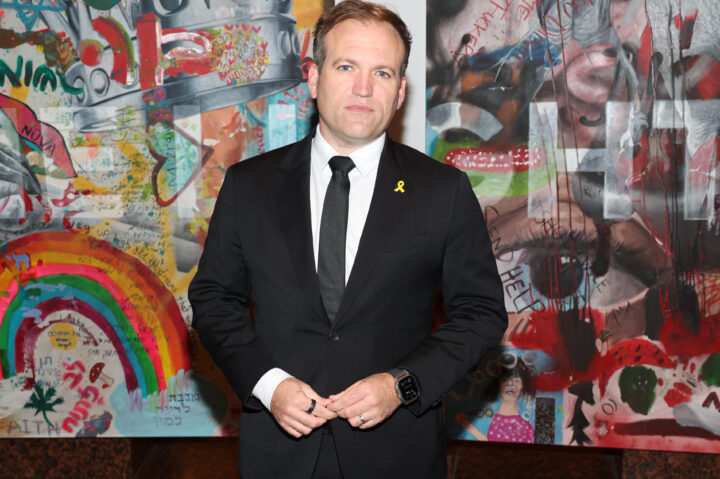
Jerritt Clark/Getty Images for Museum of Tolerance
Reverend Dr. Johnnie Moore, President of the Congress of Christian Leaders attends the Museum Of Tolerance Commemoration of the one-year anniversary of the October 7 attacks at Museum Of Tolerance on October 06, 2024 in Los Angeles, California.
Rev. Johnnie Moore, a member of President Donald Trump’s evangelical advisory committee, has years of experience with complex situations in the Middle East. He helped evacuate Christian refugees under threat from ISIS and has advocated for religious freedom and tolerance for minorities in the region.
But the challenges Moore faces as executive chairman of the Gaza Humanitarian Foundation, the U.S. group, supported by Israel, that began distributing food and humanitarian aid in Gaza in May, have been unique.
Since its inception, GHF has faced a pervasive negative narrative in the international media and among aid organizations. More recent statements from U.N. and other aid groups in effect accuse the GHF of being an IDF front luring Gaza residents to one place so they can be attacked, while largely ignoring Hamas violence against Palestinians working with the GHF.
In a wide-ranging interview this week with the Misgav Institute for National Security’s “Mideast Horizons” podcast, co-hosted by Jewish Insider’s Lahav Harkov, Moore pushed back against what he says are false narratives about the group’s work and accused aid organizations of “sabotage” and spreading disinformation, while acknowledging the challenges of aid distribution in an active war zone.
*****
GHF is addressing “a problem that everyone knew and admitted existed … and now everyone has amnesia,” Moore said. “The vast majority of humanitarian assistance that has gone into the Gaza Strip over many, many, many years, was almost immediately diverted into the hands of Hamas, and then used for various nefarious purposes. And I’m not talking about some of the aid — I’m talking about almost all of the aid.”
As such, the mission of GHF is to equally and directly distribute aid to Gazans without having it be “used to prolong a conflict or hoarded,” he said.
Since the beginning of GHF’s operations on May 26, the organization has opened four distribution sites in southern Gaza, from which it said it has provided Gazans with over 958,000 boxes of food. Moore said the GHF calculates meals with a greater caloric value than what the U.N. aid organizations distribute, and by the GHF’s count, it has distributed over 54.8 million meals.
“In an objective world, this would be viewed as an incredible success,” Moore said. “To my great surprise, we poked a number of bears that I wasn’t anticipating, and not all of them are Hamas threatening our local aid workers and the Americans helping these people. A lot of [the antagonists] wear suits and are in places like Geneva and New York City.”
Moore quipped that he has faced “lots of trouble” in his career advocating for religious freedom for Christian minorities around the world, including death threats and sanctions from the Chinese Communist Party, but that the negative response to GHF is unique.
“Respectable — I don’t even call them respectable anymore — elite organizations that we would assume [have] good intent have just attacked us again and again. The whole time, we’re like ‘cooperate with us … teach us, let’s find ways of solving problems together,’” to no avail, he said.
Moore said he would have liked to collaborate with major humanitarian organizations, such as the World Food Program, but that the U.N. has “been trying to sabotage us from the very beginning.”
“We’d really like the people whose job it has been to do this for many years to decide to help us,” he added. “Instead, they spread lies that originate in Hamas and try to shut us down, and I can’t think of anything more immoral than trying to shut down an operation that’s … feeding millions and millions of meals every day.”
Moore said details his staff on the ground in Gaza have heard from residents have been “a shock to us,” and revealing about other humanitarian aid groups’ conduct.
“Early on, we had a number of people who wanted to confirm that the aid was free, because in every other circumstance, their experience was that the aid that was coming in from the United Nations and other organizations was being taken and sold to them. It was unbelievable to them that we were giving this stuff away for free,” Moore said.
Moore pushed back against news stories associating death and killing in Gaza with the GHF and its distribution sites, slamming them as “lies.”
“We didn’t wait for a ceasefire to start our aid distribution. We’re distributing aid in the middle of a hot war,” he said. “There have been incidents in the Gaza Strip of civilians being killed. But what’s clear is that there is this very intentional disinformation campaign that is trying to say that … the GHF is a death trap, that we exist not to feed people 50 million meals, but to lure people. This is the lie that they keep telling.”
Hamas has dedicated extensive efforts to delegitimizing GHF in the eyes of the world and trying to threaten and scare Gaza residents seeking food from GHF, Moore said.
“They release these statistics every single day and they say that all these people are being killed at our aid sites or in close proximity to our aid sites,” Moore said. “This is their primary way of both trying to scare Gazans [from] getting our aid, trying to force us to shut down, trying to force European governments not to fund us, for the United Nations to continue opposing us.”
Moore has been actively pushing back on social media against false claims about GHF, and called on the media and international organizations to scrutinize claims from the terrorist organization in Gaza, “but no one is asking hard questions,” he lamented.
“What about the prolific evidence that we do have of Hamas intentionally killing people and then attributing their murder to the GHF or others?” he added.
Moore said that “sometimes you read all these crazy headlines and you’re like, ‘Am I deceiving myself here?’ but we’re actually talking to the people [of Gaza] every day, and it seems [reality] really is in many cases the exact opposite.”
On the ground in Gaza, Moore says people are adapting to GHF’s mode of distribution, with families often getting together to trade if one needs more of one product than another. GHF also tries to be flexible under the circumstances, having morning and evening distribution times when needed to keep the process more orderly.
Some Israeli politicians have maintained that providing aid for Gaza hinders the achievement of Israel’s war aims. Some on the right, who oppose letting any aid into Gaza, argue that if Hamas can pocket humanitarian aid and make money selling it, they will continue to control the enclave. And Hamas does still retain a significant measure of control over the area, despite more than 20 months of IDF operations.
Moore agreed with the argument that Hamas’ ability to take control of aid was “prolonging the conflict,” but said that GHF’s “mission is not related to the war.”
Still, he said that he thinks Hamas feels very threatened by GHF: “The fact is that Hamas continues to threaten Gazans and killed 12 of our local workers two weeks ago and nearly killed others and tortured others … Hamas took them to the Al Nasr Hospital and piled the dead and the injured outside … and wouldn’t let them get medical treatment, in order to send a message.”
“So I think it’s a hard argument to make that Hamas doesn’t oppose what we’re doing or isn’t somehow feeling threatened by what we’re doing,” Moore added. “Think of the fact that they issued bounties on the heads of Americans … They’re doing everything they can to shut [the GHF] down, which means that every time our aid workers, local or American, step into [Gaza], they are risking their lives in order to feed people.”
Moore noted that GHF does not operate in northern Gaza, where U.N. trucks continue to enter and are often taken by Hamas: “There was one day where 55 U.N. trucks went in and literally 52 were hijacked at gunpoint by Hamas or Hamas-linked militants,” he said. Another example he recalled was a time when “there was a [U.N.] truck that went in … Hamas wasn’t able to hijack the truck. So what does Hamas do? Hamas kills civilians around the truck to try to keep the civilians from getting what they can.”
“Amidst all of this, the U.N. literally told the BBC that none of their aid had been diverted. Zero. That was the official statement,” Moore said. “The U.N. is just lying through their teeth.”
Moore declined to share who funds GHF, but said that “the seed funding … principally came from a couple of countries, not Israel, that wanted to remain totally secret for political reasons.” Moore said he supports the decision of those countries not to reveal themselves, because of the negative narrative about the GHF, and expressed appreciation for the Trump administration for contributing to the foundation and encouraging others to do the same.
*****
Last month, Moore visited Syria with Rabbi Abraham Cooper of the Simon Wiesenthal Foundation and a Syrian Muslim refugee who had fled the country. In Damascus, Moore met with al-Sharaa for nearly three hours.
Moore’s approach to al-Sharaa’s new government in Syria, he said, “comes down to two things. Number one … You’re saying nice things, but can we trust you? And number two, if we can trust you, are you actually capable of doing these things?”
Following the meeting, Moore said, “I absolutely believe there will be peace between Syria and Israel.”
“I think the first priority in Syria has to be the stabilization of Syria. But I definitely left that conversation with a very clear idea of what needed to be done, of how it could be done, and of the probability in the right time of it being done in order to see peace all across the region.”
There have been contradictory reports in recent days as to whether al-Sharaa is willing to acknowledge Israeli sovereignty in the Golan Heights. Moore suggested that peace between the countries may involve things that make both sides “uncomfortable.”
“I do think many of us, including many people in Israel, misread certain aspects of this new government, all for good reasons,” Moore added, referring to those who highlight al-Sharaa’s history as a leader of an Al Qaeda affiliate in Syria. “Those of us who focus on the Middle East … have a tendency to be, we can be cynical, we can be conspiratorial, we can be a bit paranoid sometimes … But I always say the most valuable commodity in the Middle East is not oil or gas, it’s trust. If there’s no trust, nothing exists. And our visit was a trust-building exercise, and it was far more beneficial than I expected.”
Moore called al-Sharaa “a type of unicorn.”
“He comes from an Islamist orientation, no question whatsoever. But I’m not sure you can take this person and easily profile him,” Moore said. “This is the last gasp of a lot of extremists and when I met with Shahra, I viewed him as being more like [Saudi Crown Prince Mohammed bin Salman] as almost any other of the leaders that I’ve that I’ve met with, in terms of his generation, and the way he talks about solving problems and all of these things. This is a younger generation of leaders in a region with a lot of older leaders who think only about the past. I think al-Sharaa, like MBS, and a few other leaders, are future-oriented.”
Moore called for the U.S. to help Syria rebuild, because the country’s economy and infrastructure are in shambles.
*****
Moore has also been a longstanding advocate for a strong U.S.-Israel relationship and evangelical support for Israel.
Asked about polls showing decreasing support for Israel among young evangelicals, and the rise of figures such as Candace Owens and Tucker Carlson who have used Christianity as an argument against such support, Moore said he thinks the decline is exaggerated as is the influence of the podcasters.
“For a long time, there was exaggerated concern about a rise of antisemitism on the right while we were watching this incredible surging of antisemitism on the left. Well, now, I’m sorry to say, but we’re seeing it on both sides,” Moore said. “Yet, it actually isn’t the right. OK, it’s a type of pseudo-libertarianism. You know that isn’t a part of the institutional right, but because of the internet, it’s much more influential.”
Still, he added, “I’m not seeing some of these actors becoming more influential among evangelicals. I’m seeing evangelicals reject these influencers as they start talking about things that evangelicals actually know quite well … like skepticism about, you know, the evangelical relationship with Israel.”
Moore said he summarizes the relationship between evangelicals worldwide with the Jewish community, and Israel in one sentence: “Your book is our book; your heroes are our heroes; and your values, while we interpret them differently, are our values.”
“You have this massively dispersed religious movement around the world, 700 million people, and they all generally feel the same, 80-90% of them, about the Jewish community and Israel, because they get it from the Bible,” he said. “I’m not focused very much on politics these days, as we try to feed Gaza, but I think the evangelical community all around the world is a positive force and I don’t think the macro trends are changing at all.”
Plus, Torres urges APA to address 'persistent and pernicious’ antisemitism

SAEED JARAS/Middle East Images/AFP via Getty Images
Dislocated Palestinians carry the humanitarian aid they have received from a United Nations distribution point in Rafah, southern Gaza Strip on May 27, 2025.
Good Thursday morning.
In today’s Daily Kickoff, we consider the efficacy of the first days of the Gaza Humanitarian Foundation’s operations to distribute aid in the enclave, and report on a call by Rep. Ritchie Torres on the American Psychological Association to address antisemitism in its ranks. We have scoops on a call by 33 senators for $500 million in nonprofit security funding on the heels of the Capital Jewish Museum shooting; a bipartisan House letter urging President Donald Trump to reach a deal to release the hostages in Gaza; and a statement by 41 pro-Israel House Democrats praising the resumption of humanitarian aid to Gaza. Also in today’s Daily Kickoff: Marc Steinberg, Sam Feist and Gal Gadot.
What We’re Watching
- The Capital Jewish Museum will reopen today, a week after a deadly attack in which two Israeli Embassy staffers were killed after attending an American Jewish Committee event held at the museum. The museum will hold a program this morning that includes addresses from museum officials, local clergy and Washington, D.C., Mayor Muriel Bowser.
- In Massachusetts, the Holocaust Museum Boston is holding its official groundbreaking ceremony today.
What You Should Know
A QUICK WORD WITH MELISSA WEISS
In October 2023, then-Deputy National Security Advisor Jon Finer said that “getting assistance into Gaza is a complicated undertaking.” In a constantly evolving war in which much has changed over the last 19 months, Finer’s comments remain as relevant and prescient as they did when he first made them to CNN. Aid distribution has long plagued Israeli, American, Palestinian and Arab agencies and officials, who have since the start of the war struggled to unite on a comprehensive aid plan.
There are a variety of challenges, among them the resistance of many aid organizations in Gaza to work with Israel, Israeli bureaucracy and logistical hurdles, and the sheer challenge of delivering aid to two million people in an enclave in which terrorists embed themselves with civilians and in aid groups.
After the failed attempt to create a humanitarian pier to deliver aid by sea, skepticism ran high that outside actors could facilitate the mass transfer of aid across Gaza. And in the first 48 hours of its operations, the Gaza Humanitarian Foundation faced a slew of online criticism — largely from activists and other aid groups.
But a closer look at the GHF’s operations shows a newly formed organization that is serving as an efficient, if imperfect, mechanism to distribute aid in Gaza after an 11-week-long block.
Despite some isolated incidents, including brief chaos ensuing from a rush on supplies that was quickly calmed, and the looting of some facilities, the transmission of aid has largely proceeded smoothly. There are expected hurdles, including the long distances some have to travel to access the aid being provided by GHF. On the first day of operations, GHF said it distributed 8,000 packages, increasing the next day to 14,000. That number is expected to steadily increase as operations are refined and adjusted as needed.
The aid mechanism’s successes to date are underscored by Hamas’ efforts to thwart its work. The terror group used Facebook to spread rumors that GHF had closed some of its facilities. The rumors were quickly picked up by news outlets, such as Reuters, despite a lack of verification. GHF released a statement saying it “urge[s] journalists and the public to verify sources carefully. In several instances, we are seeing news reports echo Hamas statements or online disinformation campaigns without verification for accuracy.” Such narratives, the group added, “endanger humanitarian efforts and mislead the public.”
Outside aid efforts have for months faced resistance from established groups on the ground, including U.N. organizations. UNRWA in particular, which has been largely sidelined from operations since the implementation of an Israeli law banning the group from operating in the Palestinian territories over its staffers’ ties to Hamas, has been among the most critical of the new effort.
Critics were quick to write the GHF’s obituary earlier this week, following the resignation of its CEO and COO. But the first days of operations show what a coordinated, multi-party effort could look like, and provide an alternative for those looking for a new way to address an issue that has long plagued decision-makers. The greatest threat to GHF’s existence may not be the logistical problems or online backlash, but the deeply entrenched institutions that have repeatedly failed to deliver for the people of Gaza.
exclusive
Torres warns American Psychological Association to address ‘persistent and pernicious’ antisemitism in its ranks

Concerned with a “persistent and pernicious pattern of antisemitism” at the American Psychological Association, the preeminent professional organization for American psychologists, Rep. Ritchie Torres (D-NY) is urging the body’s leadership to investigate antisemitism within its ranks and better respond to the concerns of Jewish members, Jewish Insider’s Gabby Deutch reports. His letter comes as the mental health field grapples with an antisemitism problem that has only grown more acute after the Oct. 7, 2023, Hamas attacks on Israel.
Blowing the whistle: “I have spoken directly with whistleblowers — many of them longtime APA members — who accuse the organization of enabling a hostile environment,” Torres wrote in a letter, obtained by JI, that he sent to the APA’s president and president-elect on Wednesday. “These incidents collectively suggest that the APA has not only been dismissive of the legitimate grievances of Jewish psychologists but also permissive of content that traffics in malicious falsehoods against Zionism, Israel, and the Jewish community.”
SCOOP
After Capital Jewish Museum killings, 33 senators call for $500 million in nonprofit security funding

A bipartisan group of 33 senators — mostly Democrats — sent a letter last week urging Senate Appropriations Committee leaders to provide $500 million for the Nonprofit Security Grant Program in 2026, matching the record-high request from a group of House members earlier this month, Jewish Insider’s Marc Rod reports.
About the request: The letter was sent the day following the murder of two Israeli Embassy employees outside the Capital Jewish Museum in Washington, an attack that led a coalition of Jewish groups to call for increasing funding for the program, which provides synagogues and nonprofits with grants to improve their security, to $1 billion. Though only two Republicans signed the letter, the bipartisan request marks a change in Senate advocacy on this issue — in the past, bipartisan Senate groups have not specified amounts in their lobbying for the program. Senate Democrats last year called for $400 million for the program.
rumor realized
Trump confirms he told Netanyahu not to strike Iran last week
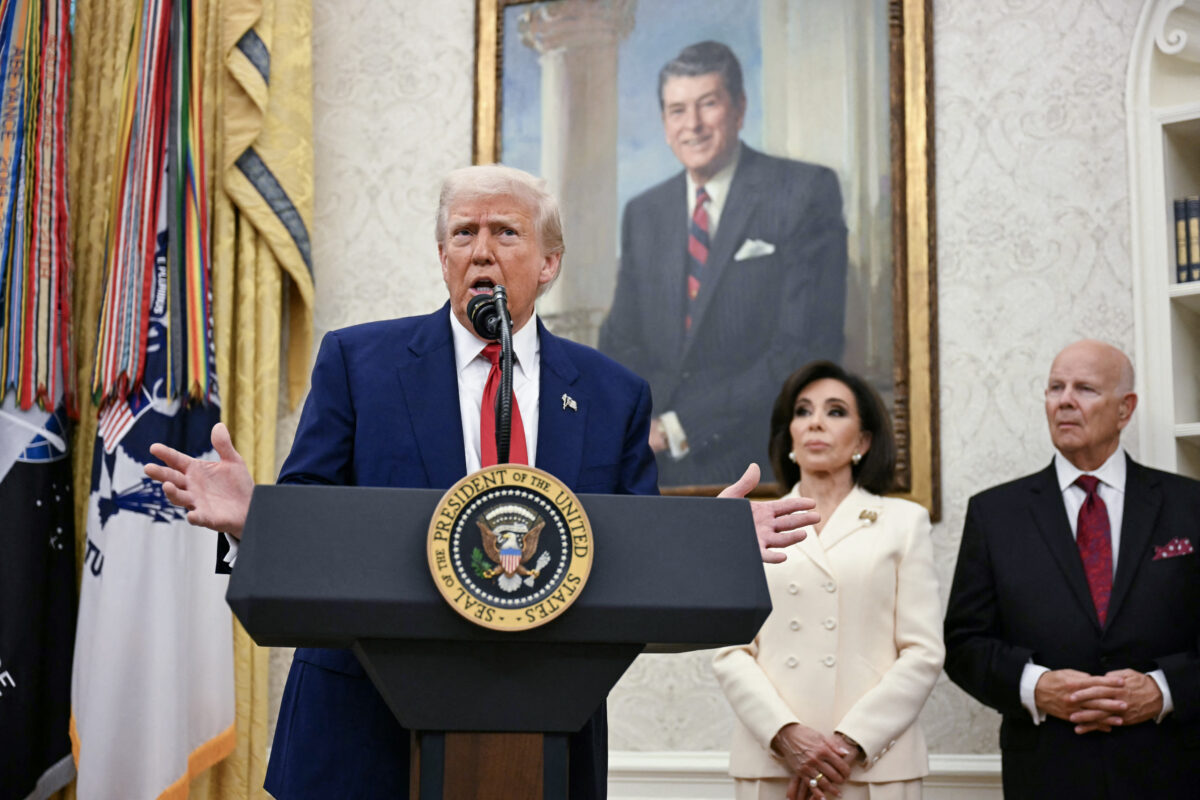
President Donald Trump confirmed reports that he warned Israeli Prime Minister Benjamin Netanyahu in a phone call last week not to proceed with plans to attack Iran’s nuclear facilities while the U.S. and Iran continue negotiations, saying that he told the Israeli leader a strike “is not appropriate right now,” Jewish Insider’s Danielle Cohen reports.
What he said: Speaking to reporters in the Oval Office on Wednesday, the president responded to a question about the validity of the report by saying, “I’d like to be honest. Yes, I did.” Pressed about the nature of the conversation, the president clarified, “It’s not a warning, I said I don’t think it’s appropriate. We’re having very good discussions with them [Iran] and I don’t think it’s appropriate right now.”
EXCLUSIVE
Pro-Israel Dems say resumption of Gaza aid will refocus attention on hostages

A group of 41 pro-Israel House Democrats released a statement on Wednesday praising the resumption of humanitarian aid to Gaza as helping to refocus international attention on releasing the hostages and calling for a comprehensive plan for postwar Gaza, Jewish Insider’s Marc Rod reports.
What they said: The statement, first shared with JI, argues that the renewed delivery of aid, which began on Monday, was “essential to alleviate the humanitarian crisis in Gaza, so that the primary focus of the international community can return to releasing the hostages that remain in captivity.” They added, “the United States, Israel, and key Arab partners must agree upon a serious and credible political and security plan to govern Gaza after the war.” The statement was organized by Rep. Dan Goldman (D-NY), in cooperation with Democratic Majority for Israel.
after captivity
Hostages’ long-lasting mental and physical scars of Gaza captivity are treated at ‘Returnees Ward’

When Israelis held hostage by terrorists in Gaza are released, there is a flurry of attention. Members of the media descend on the hospitals to which the newly freed hostages are sent. Soon after, however, the public no longer hears much from most of them. Beilinson Hospital in Petah Tikva, in central Israel, has treated and continues to treat hostages released in the ceasefire that took place earlier this year. Dr. Michael Bahar, director of the Rehabilitation Unit at Beilinson, who has been overseeing their recovery, told Jewish Insider’s Lahav Harkov in the hospital this week that his department “built rehabilitation programs based on each patient’s specific needs. It’s a multidisciplinary process, working with physical therapists, occupational therapists, dieticians, nurses and psychologists. For the rehabilitation of the female soldiers, “we work with the IDF,” he added.
Meaningful connection: The Rehabilitation Unit at Beilinson also treats many wounded soldiers, and Bahar said they and the former hostages have found it meaningful to undergo joint treatment and exercises together, including in the department’s pool. “The soldiers felt that they were fighting to free the hostages, so we connected between them,” Bahar said. “One evening the [female soldier hostages] went to visit the wounded soldiers in the department. It was an indescribable moment. They couldn’t speak, they were so excited … It was very significant, very powerful for the soldiers and the returnees.”
exclusive
Bipartisan House letter urges use of ‘all available diplomatic efforts’ to free hostages

In a letter to President Donald Trump, a bipartisan group of House members renewed a call for a deal to release all of the remaining hostages held in Gaza, including the bodies of four Americans believed to be deceased, urging him to capitalize on potential momentum from the release of Israeli American Edan Alexander earlier this month, Jewish Insider’s Marc Rod reports.
Letter writing: “Building on the momentum of Edan’s release, we strongly urge your Administration to press forward with all available diplomatic efforts to secure the return of all hostages — including the four remaining Americans: Omer Neutra, Itay Chen, Gadi Haggai, and Judi Weinstein Haggai,” the House letter reads. “While Edan’s return marks a critical breakthrough, the suffering he endured underscores the urgency of this mission … This moment — coming in the wake of Edan’s homecoming—offers a window of opportunity.”
Worthy Reads
Ditch Gaz-a-Lago: In Foreign Policy, former U.S. Ambassador to Israel Dan Shapiro suggests that President Donald Trump should abandon his proposed “Gaza Riviera” plan in the interest of ending the war and freeing the remaining hostages. “The plan was utterly unrealistic from the start. The White House quickly clarified that Trump envisioned no U.S. troops taking part and no U.S. funds being used to implement it. No other countries stepped forward either to host the displaced Palestinians or with money to pay for the grand reconstruction. Having never asked Gaza’s residents if they wanted to leave — surely some do, and should be permitted to, but others would choose to stay — Trump’s plan, if it forced the latter category out, would amount to ethnic cleansing. But even a mirage can cause damage. What the Gaza Riviera plan did accomplish was to empower the far-right Israeli leaders, Finance Minister Bezalel Smotrich and National Security Minister Itamar Ben-Gvir, to pursue their extremist agenda of ridding Gaza of Palestinians, followed by Israeli reoccupation and resettlement. … But Netanyahu’s embrace of this plan has become a major obstacle to the release of hostages and a better path for Gaza. It is fueling the worst instincts of Israeli politicians whose agenda would upset Trump’s own regional goals.” [ForeignPolicy]
The NSC Purge: In The Atlantic, Thomas Wright, who served in the Biden administration’s National Security Council, considers the role that a fully staffed NSC plays in presidential decision-making, following the White House’s purge last week of dozens of appointed officials. “Those who oppose Trump may welcome these cuts, precisely because they reduce the ability of this president to destroy and remake U.S. foreign policy. Decimating the NSC removes a layer of White House oversight from the departments engaged in foreign affairs, which could mean strengthening them relative to Trump: If Rubio is truly a temporary national security adviser, there for just six months, the gutting of the NSC will weaken his successor and strengthen his influence as secretary of state. The Pentagon, Treasury Department, Department of Homeland Security, Central Intelligence Agency, and other agencies could likewise set up their own mini–foreign policies, each based on the Cabinet secretary’s interpretation of what they heard from the president, whether in a meeting, a side conversation, or a Truth Social post.” [TheAtlantic]
Word on the Street
The transfer of a Qatari plane to the Trump administration has not been finalized amid delays regarding a memorandum of understanding that lays out the terms of the agreement; President Donald Trump has said that the plane is a “free” gift from Doha, while Qatari officials have stated that the Trump administration initiated the transaction…
A federal court blocked the imposition of the Trump administration‘s tariffs, saying the administration overstepped its authority in imposing the tariffs…
The New York Times’ Edward Wong posits that Trump may be envisioning a world order in which China, Russia and the United States operate in separate spheres of influence…
CNN interviews released hostages Omer Shem Tov and Keith Siegel about their time in Gaza and efforts to raise awareness about the plight of those who remain in captivity, including Omri Miran and Matan Angrest, with whom Siegel was kept for long periods of time…
A federal judge in New Jersey issued an order on Wednesday ruling that the Trump administration’s justification for its monthslong effort to deport Columbia University protest leader Mahmoud Khalil was likely unconstitutional — but that his failure to disclose his affiliations with anti-Israel groups raises concerns, Jewish Insider’s Haley Cohen reports…
Elon Musk reportedly threatened to withhold the Trump administration’s support for the creation of an artificial intelligence campus in the United Arab Emirates that is being built in partnership with Sam Altman’s OpenAI and Nvidia if Musk’s xAI was not included in the project…
Elliott Investment Management partner Marc Steinberg was appointed to the board of Honeywell International; Elliott, which has a more than $5 billion stake in the company — one of its largest investments — last year called on Honeywell to break itself apart…
C-SPAN CEO Sam Feist said the network is facing a “crisis of funding” amid a broader shift away from cable news and the decision by distributors, including YouTube and Hulu, not to include the channel in its offerings…
The Wall Street Journal looks at the origins of the Trump administration’s targeting of elite universities, positing that the president’s focus on the issue began following the 2019 assault of a conservative student at the University of California, Berkeley…
Five anti-Israel activists were arrested for protesting at the London set where Israeli actress Gal Gadot is filming “The Runner”…
The U.K. is mulling sanctions on Israeli Finance Minister Bezalel Smotrich and National Security Minister Itamar Ben-Gvir…
Israeli Prime Minister Benjamin Netanyahu confirmed that Israel killed Hamas leader Mohammed Sinwar in an airstrike earlier this month…
Israeli Defense Minister Israel Katz said that Israel planned to establish 22 settlements in the West Bank, a move he said “strengthens our hold” on the territory…
The Israeli Defense Ministry said it has shot down more than 40 drones using its new laser air-defense system since October 2023; most of the drones shot down by the new system were fired from Lebanon…
Ravid Haim, the baby born following a West Bank terror attack that killed his mother two weeks ago, died on Thursday morning; the baby had been in serious condition since he was delivered by emergency c-section immediately after the shooting…
The Financial Times looks at the domestic and international challenges facing South African President Cyril Ramaphosa as he confronts “a hostile U.S., a stagnant economy and radical populist parties hovering in the wings”…
International Atomic Energy Agency head Rafael Grossi said that “the jury is still out” on whether the U.S. and Iran will reach a new nuclear agreement, as the parties prepare for a fifth round of talks to start on Friday…
Boston-based philanthropist and business leader Richard Barry Slifka died at 85…
Chicago real estate lawyer Morrie Much, a longtime donor to the Simon Wiesenthal Center and the Jewish United Fund of Chicago who also supported the construction of the Holocaust Museum in Skokie, Ill., died at 88…
Educator and fundraising professional Henry Saltzman died on May 11 at 95…
Pic of the Day

Israelis gathered yesterday in front of the U.S. Embassy branch office in Tel Aviv to mark the 600th day of the war, calling on President Donald Trump to put pressure on Israeli Prime Minister Benjamin Netanyahu to end the war and secure the release of the remaining 58 Israeli hostages from Gaza.
Birthdays

Founder and creative director of the fashion label Shoshanna, style director for Elizabeth Arden, Shoshanna Lonstein Gruss turns 50…
Montreal-based businessman and philanthropist, Marvin Birnbom turns 95… Professor emerita of marine biology at Rutgers University, Judith Shulman Weis turns 84… Former member of the Knesset for the Likud party and then Israel’s ambassador to Japan, Eli Cohen turns 76… Winner of three Emmy Awards and a Grammy, actor, composer, singer, songwriter and record producer, Danny Elfman turns 72… U.S. Sen. Jerry Moran (R-KS) turns 71… Retired senior diplomat in the Israeli Ministry of Foreign Affairs, she was previously a brigadier general in the IDF, Ruth Yaron turns 68… Television writer, producer and actor, best known as the creator of the sitcom “Arrested Development” as well as the co-creator of “The Ellen Show,” Mitchell Hurwitz turns 62… Immediate past president of Ahavath Achim Congregation in Wichita, Kan., she is a trustee-at-large on the board of JFNA, Ellen Ginsburg Beren… Professor at the University of Chicago, co-author of the best-selling books in the Freakonomics series, Steven Levitt turns 58… CEO and executive editor of 70 Faces Media, Amiram (Ami) Eden… Policy analyst at Centers for Medicare and Medicaid Services, Yaakov Feinstein… Founding partner of Blandford Capital, Nathaniel Jerome Meyohas turns 51… Chief communications officer and global spokesperson at Aish, she is also a cookbook author with over 100,000 cookbooks sold, Jamie Geller turns 47… Film producer and former corporate lawyer at Skadden Arps, Edward Frank “Teddy” Schwarzman turns 46… Senior political reporter at The Forward, Jacob Kornbluh… Swedish-born pro-Israel activist, commentator and reporter, Annika Hernroth-Rothstein turns 44… Managing director at Hudson Bay Capital Management, Alexander Berger… Assistant secretary for constituency affairs for New York Gov. Kathy Hochul, Jacob “Jake” Adler… Israeli-born assistant pitching coach for the Miami Marlins, he pitched for Team Israel at the 2020 Summer Olympics, Alon Leichman turns 36… English actor, his bar mitzvah was at the Western Wall in Jerusalem, Gregg Sulkin turns 33…
The statement also calls for a ‘serious and credible political and security plan’ for Gaza

Anna Moneymaker/Getty Images
Rep. Dan Goldman (D-NY) returns to a hearing with the House Committee on Homeland Security on Capitol Hill on January 30, 2024 in Washington, DC.
A group of 41 pro-Israel House Democrats released a statement on Wednesday praising the resumption of humanitarian aid to Gaza as helping to refocus international attention on releasing the hostages and calling for a comprehensive plan for postwar Gaza.
The statement, first shared with Jewish Insider, argues that the renewed delivery of aid, which began on Monday, was “essential to alleviate the humanitarian crisis in Gaza, so that the primary focus of the international community can return to releasing the hostages that remain in captivity.”
“We strongly believe that there can be no lasting peace while Hamas remains in power. Its tyrannical rule over Gaza must end. To achieve that objective, the United States, Israel, and key Arab partners must agree upon a serious and credible political and security plan to govern Gaza after the war,” the lawmakers added. “Then, with the hostages returned and Hamas removed from power, the rebuilding process can begin to ensure lasting peace and security for Israelis and Palestinians alike.”
The statement highlights that Israel has facilitated the entry of 1.78 million tons of aid into Gaza since Oct. 7, 2023, and states that aid “must be disbursed swiftly and safely to Palestinian civilians and not Hamas, which has been stealing aid since the start of the war.”
It notes that Hamas continues to hold 58 hostages, saying, “Every day that goes by without the hostages’ release is a dagger in the hearts of their families.”
“We call on President Trump and his administration to do everything within their power to secure the release of the hostages, facilitate the disbursement of aid, and bring a swift end to the war,” the statement concludes.
The statement was organized by Rep. Dan Goldman (D-NY), in cooperation with Democratic Majority for Israel.
The statement was co-signed by Reps. Haley Stevens (D-MI), Greg Landsman (D-OH), Jimmy Panetta (D-CA), Debbie Wasserman Schultz (D-FL), Jake Auchincloss (D-MA), Vicente Gonzalez (D-TX), Dina Titus (D-NV), Jared Moskowitz (D-FL) Don Davis (D-NC), Sheila Cherfilus-McCormick (D-FL), Ritchie Torres (D-NY), Lois Frankel (D-FL), Tom Suozzi (D-NY), Wesley Bell (D-MO), Brad Sherman (D-CA), Angie Craig (D-MN), Hillary Scholten (D-MI), Grace Meng (D-NY), Frank Pallone (D-NJ), Josh Gottheimer (D-NJ), Greg Stanton (D-AZ), George Latimer (D-NY), Emilia Sykes (D-OH), Sarah Elfreth (D-MD), Mike Levin (D-CA), Brad Schneider (D-IL), Steve Cohen (D-TN), Frederica Wilson (D-FL), Jim Costa (D-CA), Laura Friedman (D-CA), Laura Gillen (D-NY), Sarah McBride (D-DE), Marilyn Strickland (D-WA), Josh Riley (D-NY) and Janelle Bynum (D-OR), Adriano Espaillat (D-NY), Juan Vargas (D-CA), Marc Veasey (D-TX), Jimmy Gomez (D-CA) and Ted Lieu (D-CA).
“This statement from 41 congressional Democrats, spearheaded by DMFI, reflects a clear-eyed understanding of the moral and strategic imperatives at stake in the continuing Israel–Hamas war,” DMFI President Brian Romick said in a statement. “Hamas’s continued captivity of 58 hostages after some 600 days, including the remains of American citizens, is a humanitarian outrage that demands the world’s attention. At the same time, aid intended for Palestinian civilians must not be diverted by Hamas to fuel terror and prolong this devastating war.”
“Their voices send a powerful message: the United States must remain steadfast in its commitment to our ally Israel, to the return of the hostages — both living and dead — and to a post-conflict vision that rejects terror and embraces peace,” Romick continued.
Please log in if you already have a subscription, or subscribe to access the latest updates.
 Continue with Google
 Continue with Apple