






















































Top IDF and government officials have clashed on a series of issues, including the appointments of more than two dozen military officials and Zamir’s opposition to the plan to take over Gaza City and expand IDF operations in the Gaza Strip

IDF
The Chief of the General Staff, LTG Eyal Zamir, the Director of the ISA, Ronen Bar, and the Commanding Officer of the IAF, Maj. Gen. Tomer Bar, in the IAF’s Underground Operations Center, commanding the strikes in Gaza overnight between March 17th and March 18, 2025


 Add JewishInsider on Google
Tensions between Israeli Prime Minister Benjamin Netanyahu and Eyal Zamir, the chief of staff of the IDF, are as high as the record-setting temperatures that have swept the region.
The IDF’s top officials and the Israeli government have clashed on a series of issues in recent days, including the appointments of more than two dozen military officials and Zamir’s opposition to Netanyahu’s plan to take over Gaza City and expand IDF operations in the Gaza Strip, which was approved by Israel’s Security Cabinet last week.
The IDF chief of staff has warned that the new approach to Gaza risks the lives of the 20 remaining living hostages in the enclave, and would further deplete the military’s resources in Gaza. The army, under strain after nearly two years of war, has — even prior to Zamir’s appointment in March — been at odds with the government over the continued exemption of the majority of the country’s Haredi population from the mandatory conscription required of most Israelis.
Israel Democracy Institute President Yohanan Plesner told Jewish Insider this morning that “historically, the relationship between the political level — prime minister, defense minister — and the top brass of the defense establishment, and mainly the IDF chief of staff, has been based on the premise that when Israel engages or embarks on significant security endeavors, operations and so on, it’s based on mutual consent,” with both parties having “de facto … veto power.”
But now, Plesner said, Netanyahu “is violating this decision-making norm that characterized the way decisions on core security [and] national security issues were made in the past.”
Plesner pointed to IDI polling conducted earlier this summer that showed Zamir being the senior official in whom Israelis had the most trust, at 68.5%. The same poll found Netanyahu with a trust rating of 40%.
The potential removal of a senior official months into his tenure “was not in the cards in the past. A chief of staff would voice their professional opinion and they wouldn’t risk being fired.”
The clash between Netanyahu and Zamir has also drawn in former Israeli Prime Minister Naftali Bennett, who is widely seen as one of the only people who could topple Netanyahu in the next election. Bennett attributed the infighting to Zamir’s opposition to the continuation of Haredi draft exemptions — an issue that has sowed division even within Netanyahu’s coalition and still threatens to topple the government.
“Instead of standing behind the army,” Bennett said, “the government has launched an attack *on* the army.”
Netanyahu has previously clashed with — and dismissed — senior military officials, most notably former Israeli Defense Minister Yoav Gallant, whom Netanyahu first tried to fire in early 2024 but was met with mass protests, before ousting him in November 2024. Last summer, Israeli media reported tensions between the prime minister and Zamir’s predecessor, Lt. Gen. Herzi Halevi, over Netanyahu’s suggestion that hostage talks had not moved forward because Hamas did not feel enough pressure from the country’s military. Netanyahu also pursued the dismissal of former Shin Bet chief Ronen Bar whom he clashed with on a number of issues — including the hostage negotiations and war strategy — citing “continuing lack of trust.”
Plesner pointed out that relations between Netanyahu and both Gallant and Halevi “very much soured around the fact that they were committed to implementing the Supreme Court ruling” that removed the Haredi draft exemption, and that Zamir, as chief of staff, similarly backs the conscription of the Haredi community as war fatigue plagues the reservists who have served hundreds of days in uniform since the start of the war.
Nearly all of the IDF’s top leaders from Oct. 7, 2023, have departed their roles, whether by choice or force, in the almost two years since the attacks. Netanyahu — who has long tried to absolve himself of responsibility for the attacks, instead blaming the military and the Shin Bet — remains the only senior government official from that time still in power. Analyst Nadav Pollak suggested that the prime minister has, since Oct. 7, been “trying to divert the blame from him to the military leadership (he didn’t know Hamas plans etc.) and as long as the focus is on the IDF leadership it’s not on Bibi.”
Now, with the Knesset out for the rest of the summer, ceasefire talks stalled and an immediate collapse of his government off the table, Netanyahu is able to buy some time — perhaps up to several weeks — as Israel’s top political and military brass game out and implement the government’s Gaza strategy. Meanwhile, observers will watch to see how Zamir will carry out Netanyahu’s orders.
United Torah Judaism left the coalition and Shas quit the government, but did not pull its 11 lawmakers out of the parliamentary coalition
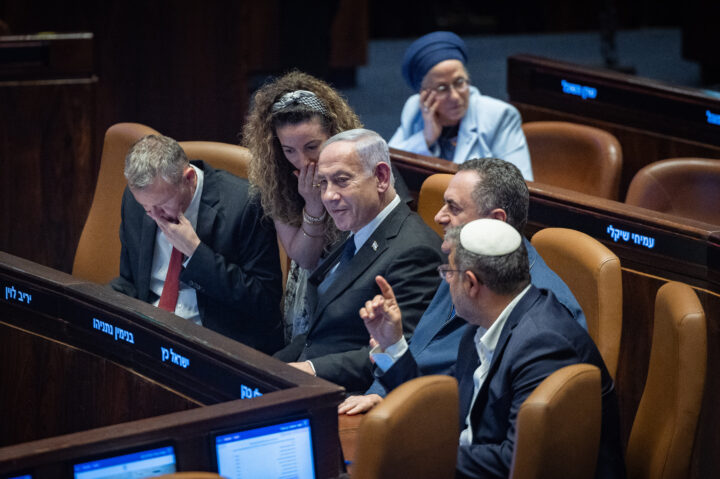
Yonatan Sindel/Flash90
A discussion and a vote on the expulsion of MK Ayman Odeh at the assembly hall of the Knesset, the Israeli parliament in Jerusalem, July 14, 2025.
New Israeli elections are unlikely to happen this year, despite the departure on Wednesday of two parties from Israeli Prime Minister Benjamin Netanyahu’s government over disagreements over Haredi military exemption legislation.
After months of disagreements, Ashkenazi Haredi faction United Torah Judaism left Netanyahu’s coalition in protest, leaving it with 61 out of the Knesset’s 120 seats. On Wednesday, Sephardic Haredi party Shas’ five Cabinet ministers quit the government, though party leader Aryeh Deri will remain an observer in the Security Cabinet.
Shas only quit the government — meaning their Cabinet posts — and did not pull its 11 lawmakers out of the parliamentary coalition. Shas, whose voter base is right-wing and even more supportive of Netanyahu than the prime minister’s own Likud party, said it will not vote with the opposition. This means that Netanyahu retains a majority in the Knesset, albeit a razor-thin one.
Opposition leader Yair Lapid still argued soon after Shas’ announcement that “starting today, Israel has a minority government. A minority government cannot send soldiers into battle … It has no authority, no right. It is an illegitimate government.”
“Israel does not have full-time welfare, health, interior, housing or labor ministers,” Lapid added. “The Netanyahu government is a minority government that endangers the care of Israel’s citizens.”
Both Haredi parties have been boycotting Knesset votes since April in protest over the Haredi conscription debate, in effect leaving the coalition with a minority and obstructing its ability to pass laws.
Israeli law only allows an early election to be called proactively, meaning that a Knesset member would have to propose a bill to disperse the legislature, followed by three separate votes on the issue. Opposition leaders held a vote last month on dispersing the Knesset, and under Israeli law are prevented from calling another such vote for six months unless 61 lawmakers sign a petition to the Knesset speaker.
Netanyahu’s government has time on its side, with the Knesset’s summer recess beginning on July 27 and the legislature’s voting schedule recommencing on October 19.
By law, the next election is set for Oct. 27, 2026, but the last time a Knesset election was held on its originally scheduled date was in 1988.
Shas and UTJ left the government over the ongoing political debate over legislation that would impose penalties on Haredi yeshiva students who do not enlist in the IDF. The parties’ Councils of Torah Sages have argued that religious study must be prioritized over serving in the military.
Israel has a mandatory military draft, but has historically exempted Arab citizens and Haredi yeshiva students from conscription. Governments on the left and right maintained the exemption for Haredim over decades, but Israel’s High Court of Justice struck it down in a series of rulings over more than 10 years, with no minor adjustments made by consecutive governments satisfying the justices’ standard of equality under the law. Last summer, the court ordered the Defense Ministry to send draft notices to young Haredi men.
Meanwhile, the 21 months of war in Gaza — with hundreds of thousands of Israelis serving in reserves, many of whom have served hundreds of days in active duty, leaving behind families and businesses — have increased the IDF’s manpower needs and the urgency to resolve the issue of Haredi conscription. Shas and UTJ’s allies on the Israeli right have moved away, in varying degrees, from tolerating the exemption for political expedience even as their own constituents serve in the IDF.
Knesset Foreign Affairs and Defense Committee chairman Yuli Edelstein, a Likud lawmaker, has been at the forefront of the dispute with the Haredi parties, refusing to advance legislation that does not satisfy the military’s needs, while Shas and UTJ demand that the bill institute little to no consequences for yeshiva students who do not serve in the IDF.
When announcing his resignation from the cabinet on Wednesday, Religious Services Minister Michael Malkieli said that penalizing yeshiva students for not serving is “no less than cruel and criminal persecution.”
Among the proposed sanctions are cutting daycare and housing subsidies afforded to the Haredi sector, prohibiting those who ignore conscription notices from receiving driver’s licenses or leaving the country, and, in some cases, arrest.
Edelstein reached a compromise over the sanctions with the Haredi parties in June, less than a day before the 12-day war with Iran began. However, the Haredim continued to boycott coalition votes in recent weeks, leading Edelstein to withdraw some of his concessions.
Speaking at a conference on Wednesday, Edelstein said that “this is not the time to bring down a right-wing government.”
He called on the Haredim to “bring a concrete proposal. For once, the Haredim should say what they agree to. My door is open; I promise to examine it quickly and hold negotiations.”
“For an entire year, they did not bring any concrete proposal for a conscription law,” Edelstein added. “In the moment of truth, they … made all kinds of excuses every time … It’s apparently not a question of the extent of the sanctions or the target [enlistment] numbers, but a total refusal to take part in the holy privilege … that is called the Israeli Defense Forces.”
Edelstein agreed to postpone some penalties on yeshiva students who avoid the IDF draft

MENAHEM KAHANA/AFP via Getty Images
Israel's Prime Minister Benjamin Netanyahu addresses the assembly during a session of the Israeli parliament (Knesset) at its headquarters in Jerusalem on June 11, 2025.
The Knesset on Thursday struck down a bill that would have called an election later this year, with Haredi parties agreeing to another week of negotiations on penalties for yeshiva students who avoid the IDF draft.
The bill to disperse the Knesset was voted down 53-61 at about 3 a.m., and as a consequence, opposition parties will not be able to propose similar legislation for six months. The Haredi parties, however, could still submit a bill to call an early election should negotiations not go their way.
Knesset Foreign Affairs and Defense Committee Chairman Yuli Edelstein was optimistic that the sides would come to an agreement, announcing shortly before the vote that “agreements about the principles on which the conscription bill will be based,” had been reached.
“Only a real, effective bill that will expand the IDF’s basis of enlistment will come out of a committee that I lead,” Edelstein added. “We are on the way to a real repair of Israeli society and the security of the State of Israel.”
Haredi parties Shas and United Torah Judaism had threatened to bring down the government over legislation regarding the draft of yeshiva students into the IDF.
The High Court of Justice ordered the government last year to actively conscript Haredi yeshiva students after they were exempted for decades. Leading Haredi rabbis have said they oppose any young men from their communities enlisting in the IDF, even if they are not learning Torah full time.
The bill in question sets rising target numbers for Haredi conscription, reaching 50% in five years. The dispute between Edelstein and Haredi parties centered around the penalties for Haredi men aged 18-26 who do not report to the IDF after receiving draft notices.
Edelstein reportedly agreed to delay some of the sanctions on yeshiva students who do not enlist. The new version of the bill will include immediate bans on receiving drivers licenses and leaving the country and canceling affirmative action for government jobs and subsidies for college degrees for those who do not report for IDF service. However, the discount on daycare tuition will remain in place for six months after a missed draft date, and welfare payments will continue for a year. Housing subsidies would not be canceled for two years after avoiding the draft.
Yeshivas with students that avoid conscription will lose government subsidies; if 75% of the annual draft target is not met, the government will stop subsidizing all Haredi yeshivas.
Israeli Opposition Leader Yair Lapid accused Israeli Prime Minister Benjamin Netanyahu of “spitting in the faces of IDF fighters. Once again you sold out our combat soldiers — for what? For two more weeks? Three more? … The government allowed [the Haredim] to ignore the reservists and help them [ensure] draft avoidance for tens of thousands of healthy young people.”
Please log in if you already have a subscription, or subscribe to access the latest updates.
 Continue with Google
 Continue with Apple