























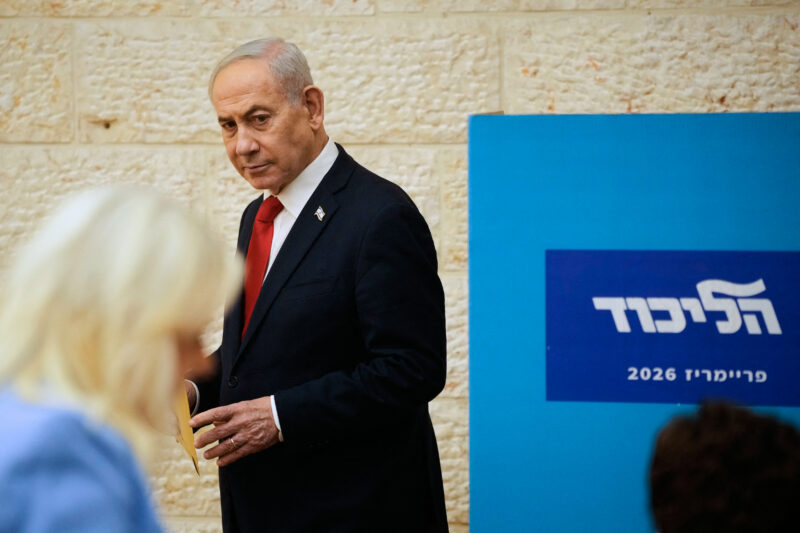













The announcement came following a meeting between Netanyahu, Jared Kushner and BOP head Nickolay Mladenov; the parties agreed that no reconstruction will begin in Gaza before demilitarization is complete
Shalev Shalom
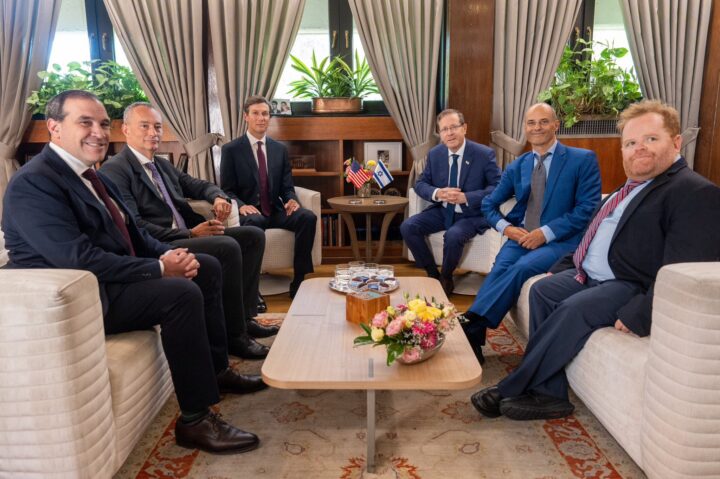
Israeli President Isaac Herzog meets with Jared Kushner and Board of Peace representatives in Jerusalem on Aug. 17, 2026.


 Add JewishInsider on Google
Israeli Prime Minister Benjamin Netanyahu’s office announced on Monday that Israel and the U.S.-led Board of Peace will launch two working groups to address key issues in the board’s plan for disarming Hamas and reconstructing the enclave.
The PMO announced the developments in a readout following Netanyahu’s “deep and constructive discussions” with Jared Kushner and Board of Peace High Representative Nickolay Mladenov, as well as their respective teams, in Jerusalem. Mladenov and Kushner had met a day earlier in Cairo with Hamas leaders and Turkish, Egyptian and Qatari mediators.
Also participating in the Jerusalem meeting were former British Prime Minister Tony Blair and Board of Peace senior advisors Aryeh Lightstone and Liran Tancman.
One working group will focus on disarmament and demilitarization in Gaza, the PMO said, “which both Israel and the Board of Peace are determined should be prompt and completed before any reconstruction happens in Gaza.”
The second working group will focus on “sanitation, clean water and other public health issues for the people of Gaza and which also impact the people of Israel,” the statement continued.
Kushner, Mladenov, Blair, Lightstone and Tancman also met on Monday with Israeli President Isaac Herzog at his official residence in Jerusalem. Herzog expressed gratitude for Kushner and Mladenov in a statement following the meeting “for their ongoing efforts to advance to the next stages in Gaza,” and said he “was impressed that Israel’s security interests are an important and central element of their plan.”
Hamas leaders have agreed to a phased disarmament that would only take place after Israel’s complete withdrawal from Gaza, contrary to the roadmap’s timeline that calls for Hamas’ complete disarmament before any IDF withdrawal begins. Due to these and other concerns, Netanyahu announced last month that Israel would not agree to the deal.
During the summit in Cairo, Hamas officials detailed what they described as Israeli violations of the ceasefire in Gaza, while Kushner asked Hamas representatives to move ahead with disarmament, according to The New York Times.
'At the end of the day, the Board of Peace is a game for Washington, and life or death to Israel,' Danielle Pletka, a senior fellow at the American Enterprise Institute, told JI
Prime Minister's Office
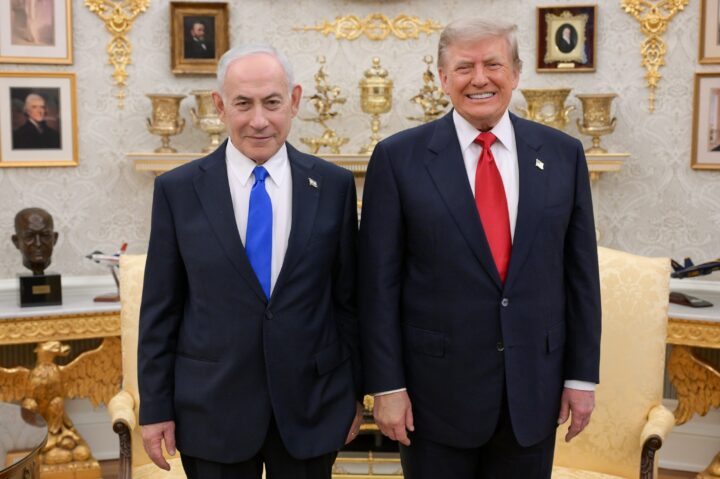
Israeli Prime Minister Benjamin Netanyahu meets with President Donald Trump in the Oval Office on July 28, 2026.
Israeli Prime Minister Benjamin Netanyahu on Sunday said Jerusalem “does not accept the 15-point document” agreed to last month by the U.S.-led Board of Peace and Hamas that would see the eventual disarmament of the terror group and withdrawal of the IDF from the Gaza Strip — a rare public break with the White House, which has touted the plan since it was announced.
In comments to his Cabinet on Sunday, Netanyahu said Israel “would not carry out any withdrawal until Hamas is disarmed.”
The White House and Jerusalem have largely been in lockstep on issues related to Gaza. The rupture over Hamas’ disarmament is one of the more significant policy breaks between President Donald Trump and Netanyahu.
Trump announced in late July what he described on his Truth Social site as a “HISTORIC” agreement, saying that the parties, through mediation by Qatar, Turkey and Egypt, had achieved a “critical step towards Gaza finally being governed by a new Palestinian government that will work closely with the Board of Peace to help the Palestinian people.”
Jonathan Conricus, a former IDF spokesperson who is now a senior fellow at the Foundation for Defense of Democracies, told JI that the mediating countries benefit from Hamas’ continued rule in the Gaza Strip and have no urgency to press for the terror group’s disarmament.
That lack of seriousness, he added, makes it unlikely that Hamas will take the necessary steps to disarm. “It’s all a show, it’s a charade, a spectacle,” Conricus said. “The only way that Hamas really ceases to control the Gaza Strip is if all of their weapons are handed in — not stored, not temporarily safeguarded somewhere else, but actually handed in, and if that is verified. As long as we won’t see that happening, I don’t think that Israel is going to agree with any charade.”
The agreement released by the Board of Peace states that none of Hamas’ weapons “shall be transferred or handed to Israel or non-Palestinian parties” and they will instead “be decommissioned and stored” by the Palestinian technocratic government in Gaza.
Conricus described the dynamic as “a very unfortunate diplomatic situation” in which Israel is being “presented as the side that is turning down the 15-point deal, [at the same time as] Hamas appears to be getting away with not implementing the deal.”
But Netanyahu’s response, Conricus said, “reeks of petty Israeli politics” and was “much more political posturing for local politics than anything else.”
Danielle Pletka, a senior fellow at the American Enterprise Institute, told JI that the break between Trump and Netanyahu was “inevitable” — and that Jerusalem and Washington have differing approaches to the future of the Gaza Strip.
“U.S. policy in the region is a circus, with grifters, diplomats, terrorists and a few well-intentioned bit players all making occasional appearances,” she said. “At the end of the day, the Board of Peace is a game for Washington, and life or death to Israel.”
Similarly to Iran, Pletka continued, “Israel is in it to win it. The Trump administration’s intentions are less clear. As a result, there are going to be public breaks, reconciliations and more breaks. Each country will pursue its interests as it sees them. That’s the way it has always been, and it isn’t going to change.”
Netanyahu is also running up against the deadline of the Oct. 27 election in Israel, walking a political tightrope as he aims to preserve his close public ties with the White House while running a reelection campaign.
The Israeli leader, Israel Policy Forum senior analyst Dan Rothem told JI, “is carefully maneuvering between Trump and the constraints of Israeli politics.
“The sequencing in the 15-point roadmap on withdrawal and disarmament does not directly contradict the 20-point plan [Netanyahu] endorsed in October 2025, and Israel was briefed throughout the negotiations,” Rothem said. “Yet three years of a ‘total victory’ narrative, combined with the political pride taken in the IDF’s control of roughly 60% of Gaza, has sharply narrowed his room to maneuver. Publicly rejecting the document lets him signal toughness to his base ahead of elections while still keeping channels open with Washington.”
Rothem added that the on-the-ground reality will matter more than election-season rhetoric. “The public rejection [by Netanyahu] serves clear electoral needs,” he said, noting that Israel had scaled back its attacks in Gaza in recent days following a meeting between Netanyahu and Board of Peace head Nickolay Mladenov, and that the Israeli Cabinet signed off on the framework for the Board of Peace’s International Stabilization Force.
GOP Sen. Mike Rounds: ‘I’ll believe it when I actually see it happening’
Tom Williams/CQ-Roll Call, Inc via Getty Images
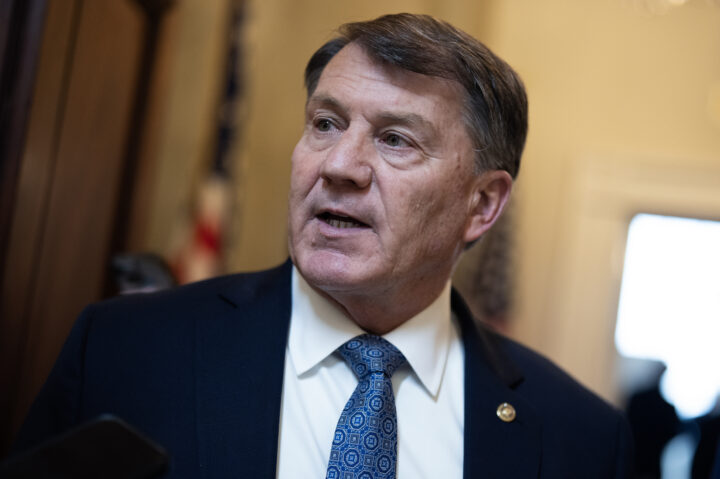
Sen. Mike Rounds (R-SD) talks with reporters in the U.S. Capitol on Tuesday, March 3, 2026.
U.S. lawmakers expressed deep skepticism on Tuesday over the international Board of Peace’s newly announced Hamas disarmament framework, pointing to violations already taking place in Gaza and a lack of indications that Hamas is serious about honoring a deal as evidence that the ambitious peace proposal faces near-insurmountable hurdles.
The pushback comes less than a week after President Donald Trump announced that the Board of Peace had brokered an agreement calling for the “complete disarmament of Hamas and all other armed groups” in the enclave, at which point the IDF is expected to completely withdraw.
However, the agreement hit immediate turbulence over the weekend. Despite the plan calling for an immediate cessation of hostilities, the Israel Defense Forces carried out multiple strikes across Gaza. On Monday, Board of Peace High Representative Nickolay Mladenov held a “constructive and detailed” meeting in Jerusalem with Israeli Prime Minister Benjamin Netanyahu, requesting a full pause in military operations to allow disarmament efforts to begin.
Netanyahu said in a video statement on Tuesday that the U.S. “sent us a draft” of the agreement, but “we didn’t agree. It wasn’t our draft. We sent our responses.” He vowed that Israeli troops would not pull back from their current lines in Gaza until disarmament was complete.
Against the backdrop of hostilities and diplomatic friction, members of Congress across the aisle voiced serious doubts on Tuesday about the viability of the deal.
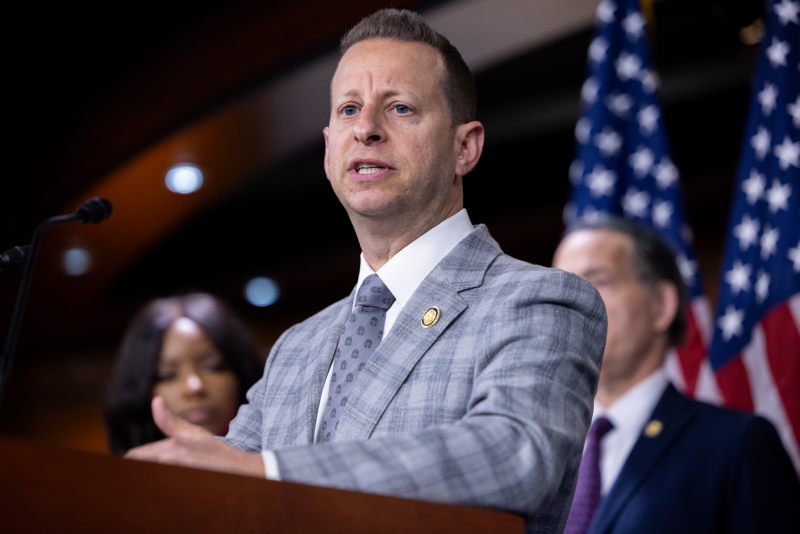
“There will be no real peace for Gaza or Israel as long as Hamas has weapons and is allowed to ruthlessly rule over innocent Palestinians,” Rep. Josh Gottheimer (D-NJ) told Jewish Insider. “I’m cautiously encouraged by this plan, but let’s not kid ourselves — Hamas has a long record of lying, and they’ve broken their word before, over and over. I’ll be watching every step of this until Hamas is fully disarmed.”
Sen. Richard Blumenthal (D-CT) was succinct in his assessment, noting that “it’s not really yet what I would call a deal,” given the resistance it has already faced.
Republicans also expressed skepticism that Hamas would live up to its end of the agreement.
“I suspect that while this may have good intentions to it, I’ll believe it when I actually see it happening,” Sen. Mike Rounds (R-SD) told JI.
Sen. John Kennedy (R-LA), meanwhile, pointed the finger at international bodies and critics of Israel, arguing that enforcing Hamas’ disarmament will require real forces on the ground rather than unhelpful rhetoric from foreign observers.
“This plan will work, but first you’ve got to take their weapons, and they’re not going to just give up their weapons,” Kennedy said. “They’re going to say ‘Israel has to withdraw first, and then we’ll give up our weapons,’ and they won’t give up their weapons … My question is, where are all these other backseat drivers that have been criticizing Israel? Where are they? This is their chance for peace.”
“Other people in the world, including but not limited to the United Nations, who are preaching in Israel and in America about how we screwed up Gaza, they need to get off their ice-cold lazy butts and send some of their troops, along with Israeli troops, to disarm Hamas,” Kennedy added. “And they won’t do it. They just want to sit there and criticize us and the president.”
The president thanked Turkey, Qatar and Egypt for mediating the deal that will see the IDF withdraw from Gaza and the International Stabilization Force take over
Omar AL-QATTAA / AFP via Getty Images
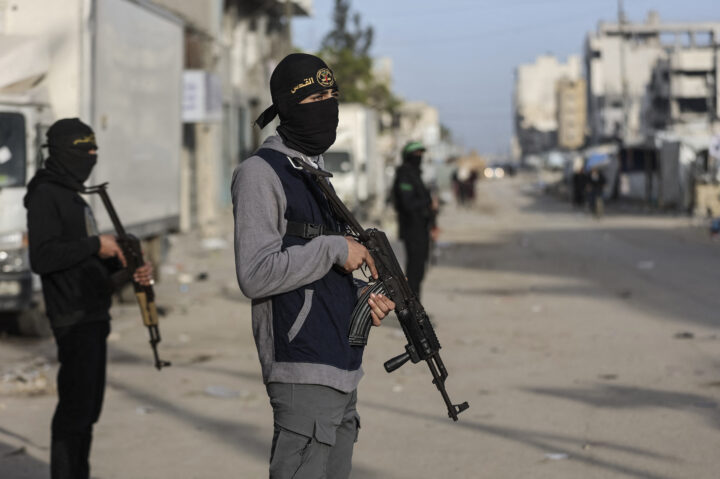
Members of Palestinian Hamas' Ezzedine Al-Qassam Brigades and Islamic Jihad's Quds Brigades are deployed at intersections in Gaza City on March 20, 2026.
President Donald Trump announced on Thursday that the Board of Peace had reached a “historic” agreement for the “complete disarmament” of Hamas and all other armed groups in Gaza, calling it a “monumental step toward lasting PEACE and SECURITY.”
Trump said in a post on Truth Social that the agreement would be “carried out carefully in structured phases,” and that the IDF would withdraw when Hamas’ disarmament is “completed.”
The president said that moving forward, “the International Stabilization Force will work with a new Palestinian police force to take responsibility for Gaza being safe for its residents and neighbors.” He emphasized that the transition represents a critical step toward establishing a government that works for Palestinians while not posing a threat to Israeli security.
“The threat that emerged from Gaza on October 7 will NOT be allowed to rebuild!” Trump wrote. “Under this agreement, Gaza will finally be in the hands of a new Palestinian government that serves its PEOPLE.”
Trump said the ultimate goal is for the Palestinian government, ostensibly a reference to the technocratic government established under the Board of Peace, to “work closely” with the board and oversee a Gaza “no longer used as a base for terror attacks.”
He also thanked Turkey, Qatar and Egypt for their role as mediators whose “important efforts” made “this historic breakthrough possible.”
Following the announcement, a senior U.S. official said in a call with reporters on Thursday evening that the document is “an agreement by Hamas to follow through on the decommissioning” of its weapons as well as its terror tunnels. The official noted that Iran tried to “convince [Hamas] not to do this deal,” but in the end, “the final communication came through the mediators that Hamas has agreed.”
“There were a lot of concerns that [Hamas] had about what would happen to them — would Israel honor its commitments if they did that? — it’s been a very delicate negotiation and discussion with them over the past months that have led us to this breakthrough where we have an understanding of what needs to be done,” the U.S. official said. “We’ll hopefully work over the next weeks to start putting it in motion.”
Text of the deal released on Friday by the Board of Peace indicates the process will be carried out over three years, and requires that Israel immediately end all military operations in the Gaza Strip, to eventually withdraw completely from the enclave.
Hamas must relinquish its heavy weapons, military production sites, depots of weapons and terror tunnels in a process linked to the IDF’s phased withdrawal, and personal weapons will be “subject to the regulations of relevant Palestinian laws.” At the end of the process, “only [the new technocratic government] shall hold, store or control weapons in Gaza,” the agreement reads.
Ghazi Hamad, a senior Hamas figure, told Al Jazeera, “We will not take any action regarding disarmament prior to Israel’s withdrawal from the Strip.”
Meanwhile, Reuters cited an Israeli official as having said, prior to Trump’s announcement, “Israel demands the complete disarmament of Hamas, including the removal of weapons from Gaza and the complete demilitarization of the Strip as a precondition for any process.”
A Board of Peace official told reporters that the plan includes U.N. Security Council Resolution 2803, in which the U.N. endorsed Trump’s Gaza peace plan, stating that “for the first time, effectively, Hamas and the Palestinian factions have agreed to accept this entire framework and have agreed on a way to implement it.”
They noted that the framework includes “everything from demilitarization and de-radicalization to the transfer of civilian authority in Gaza to the transfer of security authority in Gaza as well to the national committees,” along with “a full monopoly on weapons.”
The Board of Peace official said that the board will implement a “verification committee” in order to ensure the plan’s objectives are being met. They noted that weapons will be transferred to the technocratic government.
Officials added that the ISF has secured commitments for over 5,000 troops from various nations. The force will help train Palestinian police, oversee the decommissioning of weapons and act as a buffer between Israeli and Palestinian forces during the IDF withdrawal. Meanwhile, a newly trained Palestinian police force will handle internal security, taking over from Hamas.
Asked whether the board would seek the involvement of the Palestinian Authority, the official said that “for the time being, we’re trying to just do something new.”
“They [the PA] have to show that they can run the West Bank and do reforms,” the official said. “If the PA shows that they do a good job … then obviously the discussion could be open.”
The official said that despite “a lot of criticism, particularly in Israel,” about the involvement of Turkey and Qatar in the Board of Peace, they noted that the two Arab nations, along with Egypt, have been “essential partners … in getting to this stage.”
The Board of Peace official said that the negotiations were “very complicated,” given that the two sides “do not trust each other.”
“From Day One, we heard the same thing both from Hamas and Israel, that they absolutely do not trust each other,” the official said. “So we built this entire proposal that we took to them on the basis of zero trust … everything that is in it is conditional, and it needs to be verified. No side is being asked to do something without that being confirmed and by reciprocity from the other side.”
“The first step is getting a framework, getting the de-escalation, getting the humanitarian issues resolved, having a plan forward … and so we’re going to do it as quickly as we can,” the official added. “But it can get slower, and hopefully both sides will cooperate in an appropriate way. And if they don’t, we’ll deal with it accordingly, like we have the last months.”
A senior U.S. official told reporters, “We’re not asking Israel to do anything that isn’t in the 20-point plan that they agreed to initially, and so we’re very confident they will adhere to it. If they don’t, President Trump would be very, very disappointed.”
Baerbock claimed at the Aspen Security Forum that the U.N. is better equipped to handle post-war Gaza than the U.S.-led board
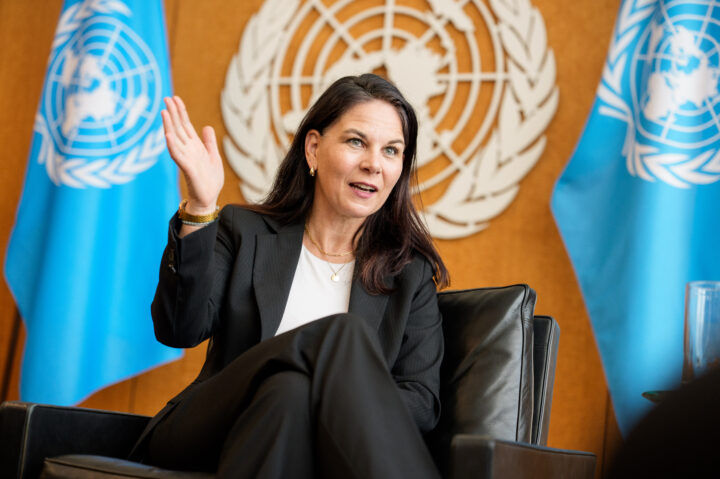
Michael Kappeler/picture alliance via Getty Images
Annalena Baerbock, president of the United Nations General Assembly and former German foreign minister, photographed in her office at the UN during an interview.
ASPEN, Colo. — Annalena Baerbock, the president of the United Nations General Assembly and former foreign minister of Germany, on Friday criticized the Board of Peace, the U.S.-led body responsible for managing the ceasefire in Gaza.
The Board of Peace has “proved what I just said — that obviously it’s not so easy to build another institution, and for sure it can never ever replace the United Nations,” Baerbock said at the Aspen Security Forum, referring to claims by some in the Trump administration that the board could act as an alternative to the U.N. for a range of global conflicts.
“There’s a reason why we do have a body for peace and security, where every country, no matter how big or small, how powerful or rich, has a seat at the table and an equal voice and vote at the table.”
She argued, during a live taping of the podcast Pod Save the World, hosted by former Obama administration officials, that existing U.N. institutions are better equipped to deal with the situation in Gaza. The U.N. Relief and Works Agency and other U.N. bodies have come under significant criticism over ties to terrorism and entrenched anti-Israel bias.
“We have specialized agencies who can go into Gaza, we have specialized agencies for health, for education,” Baerbock continued. “Obviously a new setup where you just say, ‘We just collect money and somehow we throw it into an area,’ does not work at all because you need the structures on the ground, and you don’t even have the money. We need billions, and I think we have, what, $23 million so far collected.”
She also said that the Board of Peace was an example of why calls to build an alternative to the U.N. are misguided.
Baerbock claimed that the U.N. conference held last July on a two-state solution organized by France and Saudi Arabia, during which numerous countries announced their support for Palestinian statehood, had been a driving factor behind the peace deal and the formation of the Board of Peace, though it’s not clear that was actually the case.
But she framed the conference as an example of the ability of individual member states, acting outside of the Security Council, to push for change and progress within the U.N. system. She also dismissed as impractical calls for removing the U.N. Security Council’s veto, while calling for other reforms.
Baerbock also argued that the U.S. cannot reopen the Strait of Hormuz through military power alone, but said that the U.N. had also failed to deal with the situation in Iran, though she seemed to point blame toward the U.S. for failing to bring the issue to the Security Council before launching its operation.
Three senior officials with the board are requesting $200 million from Congress to support the International Stabilization Force in Gaza
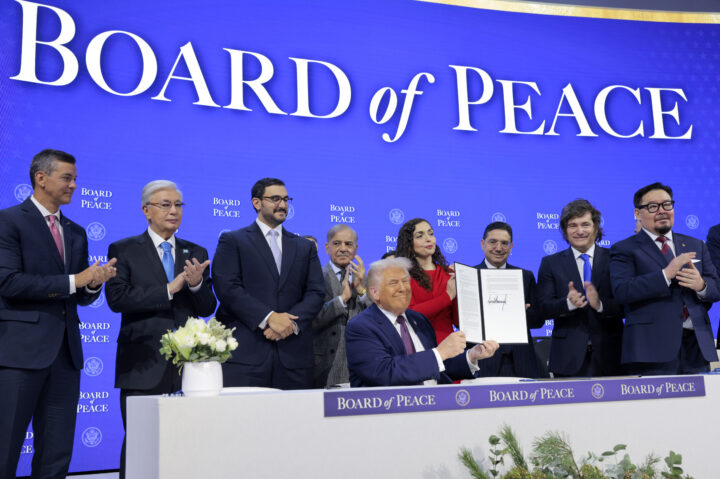
Chip Somodevilla/Getty Images
President Donald Trump holds up his signature on the founding charter during a signing ceremony for the “Board of Peace” at the World Economic Forum (WEF) on January 22, 2026 in Davos, Switzerland.
Three senior U.S. officials connected to the Board of Peace, the Trump-led body created to resolve the conflict in Gaza, have been meeting with congressional offices this week to request $200 million for a peacekeeping force, according to two people with knowledge of the meetings. The meetings mark the first time that Board of Peace representatives have approached Congress with a funding request.
Jasper Jeffers, an American military officer serving as commander of the International Stabilization Force, the United Nations-mandated peacekeeping force created in last year’s ceasefire deal between Israel and Hamas; Board of Peace senior advisor Josh Gruenbaum; and retired Gen. Mark Schwartz, a former U.S. security coordinator for Israel and the Palestinian Authority who is now the Board of Peace’s security lead, spoke at the Capitol Hill meetings.
The ISF, which was part of President Donald Trump’s 20-point peace plan announced last September, has struggled to find backers. Indonesia, Morocco, Kazakhstan, Kosovo and Albania pledged troops to the effort, but most have not yet done so. Indonesia paused its plans in March during the Iran war. What was billed as a 20,000-troop force has fewer than 20 initial members, according to a Wall Street Journal report this week. The ISF’s goal is to demilitarize Gaza and keep Hamas out of power, and countries have voiced concerns over whether their troops would be required to militarily confront Hamas.
Gruenbaum, Jeffers and Schwartz have met or plan to meet with staff from the Senate Foreign Relations Committee, the House Foreign Affairs Committee and the national security-focused subcommittees on the House and Senate Appropriations committees. A Board of Peace official called the meetings “extensive and highly constructive.”
“The delegation shared the progress that the Board has made in recent weeks, including movement toward the establishment of a humanitarian pilot [program] in Gaza, ongoing efforts in negotiations to disarm Hamas, preparations for the Palestinian technocratic government to assume authority, the huge improvement in the humanitarian situation, the pending start of training for a civilian police and the recent and ongoing scale-up in manpower and logistics for the International Stabilization Force,” the official told Jewish Insider.
The requested $200 million for peacekeeping operations, or PKO — a specific category in the Foreign Assistance Act — is primarily intended to fund the International Stabilization Force, according to a source with knowledge of the Board of Peace’s activities.
The request is for discretionary funding, rather than a direct congressional appropriation for the Board of Peace. The Board of Peace source said conversations about congressional appropriations for the body may come later.
The Board of Peace official said the congressional meetings marked “the start of an extensive effort to work with Congress” in order to “transform Gaza into a place of peace, prosperity, economic development and reconstruction.”
Earlier in the week, Board of Peace officials met in Brussels with senior Palestinian Authority leaders, and the European Union committed to providing $1 billion toward Gaza recovery efforts.
The Board of Peace’s high representative and senior advisor were in Belgium for a meeting of the Palestine Donor Group
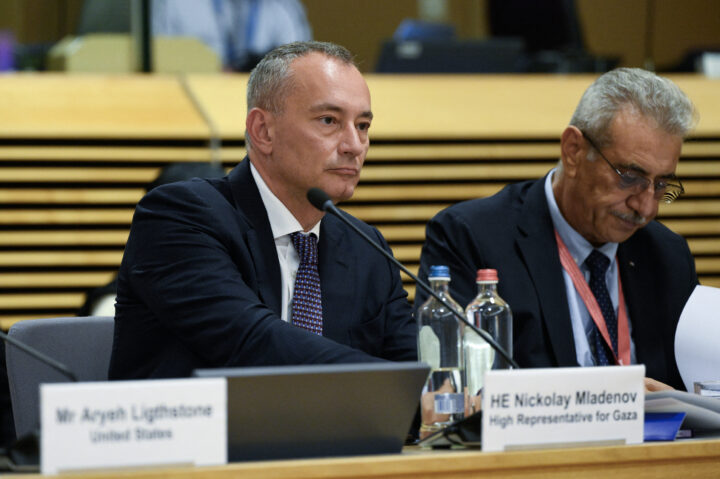
(JOHN THYS / POOL / AFP via Getty Images)
UN Special Coordinator for the Middle East Peace Process Nickolay Mladenov attends the second meeting of the Palestine Donor Group (PDG) to discuss support for Palestinian government at the EU headquarters in Brussels on July 13, 2026.
Nickolay Mladenov and Aryeh Lightstone, respectively the high representative for the Board of Peace and the body’s senior advisor, met in Brussels earlier this week with rabbis representing Jewish communities across the Islamic world, Jewish Insider has learned.
Mladenov and Lightstone met with the executive board of the Alliance of Rabbis in Islamic States at the group’s annual two-day board meeting. On Monday, the two also attended the second convening of the EU-backed Palestine Donor Group, as the collective of some 65 delegations launched a billion-dollar initiative to begin the economic recovery of the Gaza Strip. Jared Kushner joined the donor conference by video.
Among those in attendance at the board meeting were rabbis from Morocco and Turkey.
Officials and analysts warned that Hamas is seeking to cede administrative control of Gaza while retaining its weapons and remaining the dominant force in the enclave

Photo by Moiz Salhi/Anadolu via Getty Images
Hamas spokesperson Hazem Qassem and Director of the Government Media Office in Gaza Ismail Al-Thawabta deliver a press statement following the announcement that the head of the Government Emergency Committee had resigned and the committee had been dissolved as part of the transfer of governance in the Gaza Strip to the National Gaza Administration Committee, on July 6, 2026.
American and Israeli officials expressed skepticism on Monday that Hamas would follow through with its pledge to dissolve its governing body that has ruled Gaza for over two decades.
Hamas announced the dissolution of the “Emergency Committee,” the terrorist organization’s governing body, and the resignation of Mohammed al-Farra as the committee’s chief on Monday. The terrorist group said that it was prepared to transfer authority to the National Committee for the Administration of Gaza (NCAG), the technocratic committee established under President Donald Trump’s Gaza peace plan and overseen by the Trump administration’s Board of Peace.
The announcement did not address whether the terrorist group would disarm, a key facet of the Gaza peace plan. Hamas’ announcement came after the Board of Peace convened a series of meetings last week to advance plans for the NCAG to take over the governance of Gaza.
The Board of Peace said that it was withholding judgment on the announcement, instead vowing to assess Hamas’ “actions, not promises, to meet the critical needs of the people of Gaza.”
“Decisions must be comprehensive with respect to the requirements as set out in the Roadmap for advancing governance, security, and transition in Gaza,” the board said in a statement. “We look forward to the successful conclusion of discussions on this Roadmap, including on the implementation mechanisms necessary to enable the National Committee for the Administration of Gaza to assume full governing authority.”
The board’s statement also noted that the “core principle” of the ongoing peace efforts in Gaza “remains one authority, one law and one weapon,” and reiterated its position that Hamas must disarm. “A genuine transfer of authority must enable the NCAG to exercise its mandate independently, including taking the administrative and governance decisions entrusted to it.”
Israeli Foreign Minister Gideon Sa’ar dismissed the move outright, saying that Hamas had agreed to give up governing control of the Gaza Strip in a largely symbolic overture while sidestepping disarmament calls.
“Hamas’s trick is simple. Hamas’s apparent willingness to ‘make room’ for a technocratic government is designed to prevent its own disarmament,” Sa’ar wrote on X. “Hamas seeks to replicate the ‘Hezbollah model’ in Gaza: a technocratic administration would be responsible for garbage collection and other municipal services, while Hamas would remain the dominant military force.”
“As long as Hamas retains its weapons, any civilian government will of course operate as Hamas dictates,” he continued. “This would allow Hamas to continue oppressing the Palestinian people in Gaza, while pursuing its jihadist war against Israel.”
Sa’ar went on to note that Israel “insists on the full implementation of the Trump plan, with its core principles being the disarmament of Hamas and all other terrorist organizations, and the complete demilitarization of the Gaza Strip.”
Elliott Abrams, who served as Iran envoy under the first Trump administration, similarly expressed doubt about the prospect of Hamas giving up its weapons and influence in Gaza.
“In my view, this is Hamas trying to become Hezbollah,” Abrams told Jewish Insider. “Hamas used to run everything, up to and including garbage collection. They were the government of Gaza. Hezbollah uses a different mode: there is a Lebanese government providing public services, so Hezbollah can just concentrate on being an army and a terrorist group.”
“This offer by Hamas does not suggest that they will disarm, and as Board of Peace chairman [Nickolay] Mladenov has said, without Hamas disarmament there will be zero progress,” he continued.
Steven Cook, a senior fellow at the Council on Foreign Relations, said that he believes Hamas is seeking to retain power and authority in Gaza without having to govern or be held accountable for the new government’s potential shortcomings.
“[Hamas] will cede governing to technocrats who represent no one but will retain its arms to ensure that Hamas remains the center of power and authority in Gaza,” Cook said.
Analysts argued that unless Hamas disarms, the group will remain in power and progress on the president’s Gaza plan will remain stalled. Jonathan Ruhe, a fellow at the Jewish Institute for National Security of America, called the announcement from Hamas “fairly meaningless” without disarmament.
“Hamas can proclaim it’s ceding administrative authority to technocrats, but it will retain de facto power in its slice of Gaza as long as it still has a monopoly on violence there,” Ruhe said. “Until and unless Hamas actually disarms, voluntarily or otherwise, anything else the group says or does is fairly meaningless in terms of the peace plan’s vision for stabilization, reconstruction, and new governance in Gaza.”
Ruhe also suggested that Hamas made the announcement in an effort to shift the pressure toward Israel without fulfilling its own commitments.
“The group’s official line is telling. Hamas cynically frames this step as removing the pretext for Israel’s ‘occupation’ of Gaza, even though it knows full well that demilitarization is a two-sided commitment, not a unilateral obligation on Israel,” Ruhe said. “This shows how Hamas wants to cherry pick parts of the Gaza peace plan, in order to put pressure on Israel, but without fulfilling its own commitments to disarm under that same plan.”
Neomi Neumann, an adjunct fellow at The Washington Institute for Near East Policy, similarly argued that Hamas is seeking to put the “blame game into an Israel area.”
“I think their [Hamas] message is: ‘We have given up the government in Gaza, and now Israel is on the side of preventing the progress,’” Neumann said. “For Hamas, they understand that if they will stay with the same position. [At] the end of the day, Mladenov will declare [Hamas] as a rejectionist organization, so as a result I think that Hamas is trying to frame the move … in order to survive.”
Neumann expressed skepticism that Hamas would give up its weapons in addition to governance in Gaza, adding that there is a “very low” chance that Hamas changes its mind. However, she said, “you can never say never.”
“We also thought that [Hamas] will never bring back the hostages,” Neumann said. “I think that if the United States and Turkey and Qatar will push Hamas very hard and put pressure on Hamas, they will say they are willing to give up the heavy weapons, but they won’t find it easy to say they are willing to give up their guns because everybody can kill them and in the end of the day they know they need to continue to control the Gaza Strip with weapons.”
Still, she noted that the situation remains a “disaster” from the Israeli perspective.
“From Israel’s point of view, I think it will be a disaster, because they [Hamas] just will get stronger.” Neumann said. “Iran will continue now to give much more money to Hamas. They [Hamas] won’t let any other power to emerge and to get strong, and it will be very complicated.”
Gruenbaum will continue serving as a senior advisor to the Board of Peace
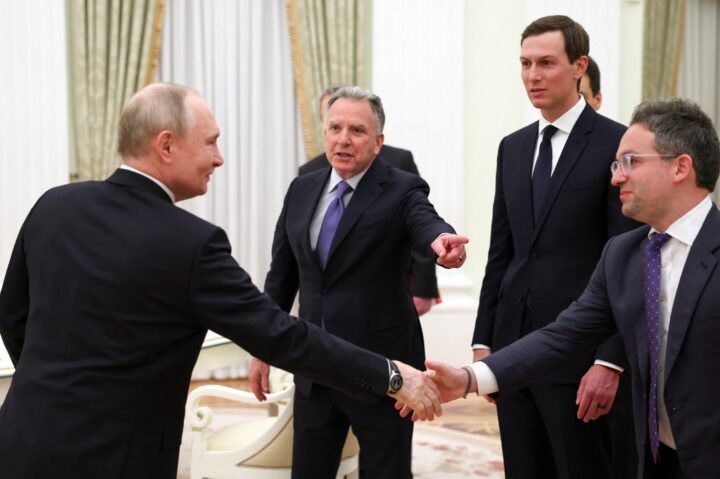
Alexander KAZAKOV / POOL / AFP via Getty Images
Russian President Vladimir Putin welcomes White House Special Envoy Steve Witkoff, Jared Kushner and Commissioner of the Federal Acquisition Service Josh Gruenbaum during a meeting at the Kremlin in Moscow on January 22, 2026.
Josh Gruenbaum, a former private equity investor who joined the Trump administration last year to lead the Federal Acquisition Service and has recently been detailed to the White House, has departed the federal government, a source with knowledge of the move told Jewish Insider.
Gruenbaum will continue serving as a senior advisor to the Board of Peace — a role he has held since earlier this year, with a focus on Gaza — in an unpaid capacity. He is set to join an investment firm. Gruenbaum declined to comment.
“The Board of Peace is thankful for Josh’s contributions in advancing the president’s vision of peace and prosperity in the Middle East,” a Board of Peace spokesperson told JI on Thursday. “We appreciate his continued engagement as a senior advisor for the Board as we pursue the next steps in implementing a sustainable reconstruction for the people of Gaza and peace for all peoples in the region.”
Gruenbaum quickly rose through the ranks of the administration after taking a DOGE-style approach to the FAS, the agency that oversees federal contracts. In that role, he served on the Trump administration’s interagency antisemitism task force.
He joined Steve Witkoff and Jared Kushner’s negotiating team earlier this year, appearing with them at a meeting in Russia with Russian President Vladimir Putin, and moved over to the White House in April.
The terror group has reportedly rejected a Board of Peace proposal to disarm
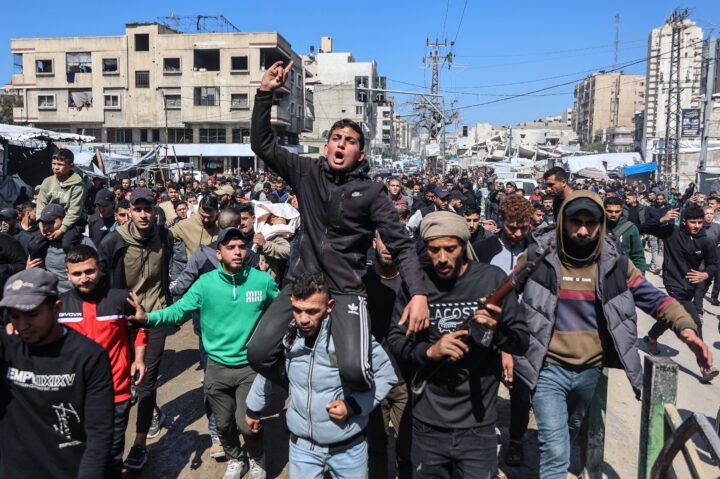
Omar AL-QATTAA / AFP via Getty Images
Mourners react at a funeral in Gaza City's Shujaiya neighbourhood on March 28, 2026.
As Hamas reportedly continues to reject the U.S.-led Board of Peace’s disarmament framework and fails to comply with key demilitarization deadlines, the future of the fragile Gaza peace process remains uncertain.
Disarming Hamas is a central pillar of President Donald Trump’s 20-point peace initiative, which secured the release of the remaining Israeli hostages and included a partial Israeli military withdrawal from eastern Gaza. Its second phase has hinged on Hamas laying down its arms — a step that is expected to pave the way for further IDF withdrawal from the enclave and a transition to governance by the 15-member National Committee for the Administration of Gaza, led by Ali Shaath and operating under the Board of Peace.
Last month, Nickolay Mladenov, the Board of Peace’s high representative for Gaza, presented a framework for demilitarization and set a deadline for the end of last week for Hamas to disarm. Reports indicate the group rejected the proposal, accusing Mladenov of bias toward Israel and blaming Jerusalem for not completely fulfilling its obligations under the first phase of the plan.
U.S. and Hamas negotiators held the first direct talks between the parties since the announcement of the Gaza ceasefire in October 2025 on Tuesday night, CNN reported. Senior U.S. advisor Aryeh Lightstone and Mladenov met with Khalil al-Hayaa, a chief Hamas negotiator, in Cairo, where Mladenov communicated that Hamas must accept the terms of the demilitarization agreement “or face a return to war.”
Former White House officials are split over the path forward and whether the Trump administration should escalate pressure on Hamas or stay the course.
Dan Shapiro, who served as U.S. ambassador to Israel under President Barack Obama and was appointed by then-President Joe Biden in 2021 to serve as special liaison to Israel on Iran, said Hamas is unlikely to disarm voluntarily, arguing the group would only do so “under duress.” One potential avenue, he said, would be renewed Israeli military action, though he emphasized that such a move would be both costly and unlikely.
“[Israeli military action] would come at an enormous price in civilian casualties, given Hamas’ embedded position within Gaza’s population,” Shapiro said, adding that it is “highly unlikely the Trump administration would lend its support to such an operation” and that it would deal “further blows to Israel’s international support.”
Instead, Shapiro pointed to regional pressure as a more viable path, particularly from Qatar and Turkey, which he said have previously used their leverage to influence Hamas.
“The other source of pressure on Hamas would be the threat of Qatar and Turkey to withdraw their political, financial and hosting support of the organization,” Shapiro said. “They were the parties who used their unique leverage with Hamas after the Israeli strike in Doha to convince Hamas to release all hostages. Trump should engage their leaders, as he did in that period, to convince them to use their leverage again, this time to pressure Hamas to disarm.”
However, Shapiro cautioned that the war in Iran has diverted U.S. attention and “may have reduced Trump’s ability to influence key regional leaders, like [Turkish President Recep Tayyip] Erdogan and the emir of Qatar, to take this necessary action on Hamas disarmament.”
Elliott Abrams, a former Iran envoy under the first Trump administration, similarly noted that Hamas “hasn’t changed its spots.” He said that Hamas leaders “obviously think a disarmed Hamas is a dying Hamas; without ‘armed struggle’ they believe they will disappear and become just another political party.”
“What Mladenov and the U.S. government need to figure out is what happens to the Board of Peace and to U.S. policy if Hamas won’t disarm,” Abrams said. “I think the answer is to prevent any arms and money from being smuggled into the half of Gaza that Hamas still controls, and to develop the half of Gaza under Israeli control.”
“No one seems to want to invade and conquer western Gaza, including the IDF,” Abrams added. “Perhaps over time, Gazans will begin migrating to the parts of Gaza where life can be lived without Hamas.”
Meanwhile, Alexander Gray, former chief of staff to the National Security Council during Trump’s first term, offered a more supportive view of the administration’s current strategy, calling it “realistic.”
“While we must continue to work with Israel to ensure Hamas is unable to wage war against our partners and allies and terrorize the region, we must also be realistic about the nature of the organization and its leadership,” Gray said. “The administration’s vision for a prosperous Gaza and secure Israel must continue apace, while appropriate and realistic steps are taken to prevent Hamas from acting true to its charter and perpetrating further death and destruction.”
At the inaugural meeting of the Board of Peace, the president also announced monetary and troop commitments from several foreign nations
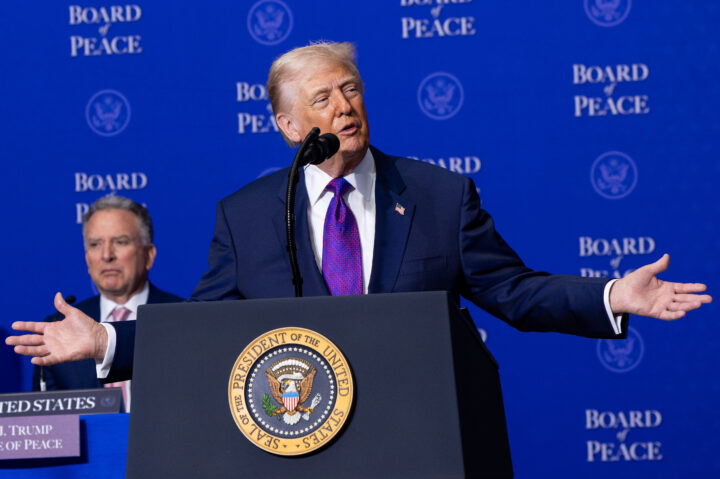
Murat Gok/Anadolu via Getty Images
President Donald Trump makes a speech during the inaugural meeting of the 'Board of Peace' at the US Institute of Peace in Washington, DC, United States on February 19, 2026.
President Donald Trump used the occasion of the first meeting of the Board of Peace in Washington on Thursday to announce significant monetary and troop commitments from the U.S. and other countries to stabilize Gaza, as well as lay out a timeline for military action against Iran.
“I want to let you know that the United States is going to make a contribution of $10 billion to the Board of Peace,” Trump said at the United States Institute of Peace, where several foreign leaders gathered for the meeting.
The president also named, for the first time, which countries have agreed to make additional financial contributions to the reconstruction of Gaza: Kazakhstan, Azerbaijan, the United Arab Emirates, Morocco, Bahrain, Qatar, Saudi Arabia, Uzbekistan and Kuwait “have all contributed more than $7 billion toward the relief package,” Trump said.
The meeting comes as the administration works to address several issues in the Middle East, including rising tensions with Iran. The U.S. has amassed a large collection of military assets in the region in preparation for a potential strike, as the two sides attempt to negotiate a nuclear deal.
Trump said in his remarks, “Now we may have to take it a step further or we may not. Maybe we are going to make a deal [with Iran]. You are going to be finding out over the next probably 10 days.”
Speaking to reporters on Air Force One later in the day, Trump said, “I would think that would be enough time — 10, 15 days, pretty much maximum.” Last June, Trump said he would decide whether to take action against Iran within two weeks, and carried out strikes on Iranian nuclear facilities two days later.
During the meeting, Trump also called on Iran to “join” the board “on a path that will complete what we’re doing.”
“If they [Iran] join us, that will be great. If they don’t join us, that will be great too, but it will be a very different path,” the president said. “They cannot continue to threaten the stability of the entire region, and they must make a deal. Or if that doesn’t happen, I maybe can understand if it doesn’t happen, but bad things will happen.”
Trump also announced that several countries would contribute personnel to an International Stabilization Force tasked broadly with securing Gaza and upholding the ceasefire between Hamas and Israel. Morocco, Albania, Kosovo and Kazakhstan “have all committed troops and police to stabilize Gaza,” he said. Indonesia vowed prior to the meeting to also contribute personnel to the body’s mission.
The president added that “Egypt and Jordan are likewise providing very, very substantial help, troops, training and support for a very trustworthy Palestinian police force. We think we’re getting some very good people on that police force.”
However, despite the announcements, questions remain over how effective the pledges will be. Hamas continues to maintain a presence in Gaza and has thus far refused to disarm or relinquish governing authority — a dynamic that could complicate reconstruction and stability efforts. Trump has not clearly defined the operational scope of the International Stabilization Force, including whether its members would be expected to confront Hamas directly or focus on traditional peacekeeping functions.
Despite those uncertainties, Trump still expressed confidence that Hamas would comply with disarmament commitments.
“[Hamas] made a promise, and they promised me they would get rid of their weapons. Looks like they’re going to be doing that,” Trump said, adding that if they do not, “they’ll be very harshly met.” Since announcing the Board of Peace, Trump has made similar threats to Hamas numerous times.
He also said there are “two countries that want to go in and do a number on Hamas,” without specifying which countries, but added, “I really don’t think that’s going to be necessary, because [Hamas] they made a promise.” The ISF is not expected to play a role in countering Hamas.
During his address, the president also took a moment to acknowledge the foreign leaders of member countries that had shown up to back the announcement, including offering praise for Sheikh Mohammed bin Abdulrahman Al Thani, Qatar’s prime minister. Despite widespread criticism of Doha’s ties to Hamas officials and support for the terrorist organization, Trump strongly defended the leader against accusations that he and his country are “evil.”
“His excellency, Prime Minister Al Thani of Qatar, just a great and highly respected man,” said Trump. “I always say he needs a public relations agency because you do so much good, and they have you down as evil, and you’re not evil. You help us so much and you’re such a good ally.”
Meanwhile, Trump signaled that he hopes to broaden the Board of Peace’s membership, though several leaders of major U.S. allies — including the United Kingdom, Germany and France — have indicated they do not plan to take part.
Trump also withdrew an invitation previously extended to Canadian Prime Minister Mark Carney after the leader delivered remarks critical of the initiative at last month’s World Economic Forum in Davos.
“So many of our friends in Europe are attending today, and we’re eager to have them become full members,” said Trump. “And we’ve had a great response from Europe. I’m excited to announce that Norway has agreed to host an event bringing together the board of peace.”
Trump also addressed the board’s relationship with the United Nations, amid questions about whether the new body is intended to complement or rival existing international institutions. He positioned the board as senior to the U.N., and that the two bodies would work “very closely.”
“We’re going to bring them back. I think the United Nations has great potential, really great potential. It has not lived up to potential,” said Trump. “The United Nations will be much stronger, and the Board of Peace is going to almost be looking over the United Nations and making sure it runs properly. But we’re going to strengthen the United Nations. We’re going to make sure its facilities are good. They need help, and they need help money wise. We’re going to help them money wise, and we’re going to make sure the United Nations is viable.”
The gathering, ostensibly focused on the disarmament of Hamas and the establishment of a peace-aligned administration in the Gaza Strip, comes as the U.S. moves dozens of fighter jets and support aircraft to the region
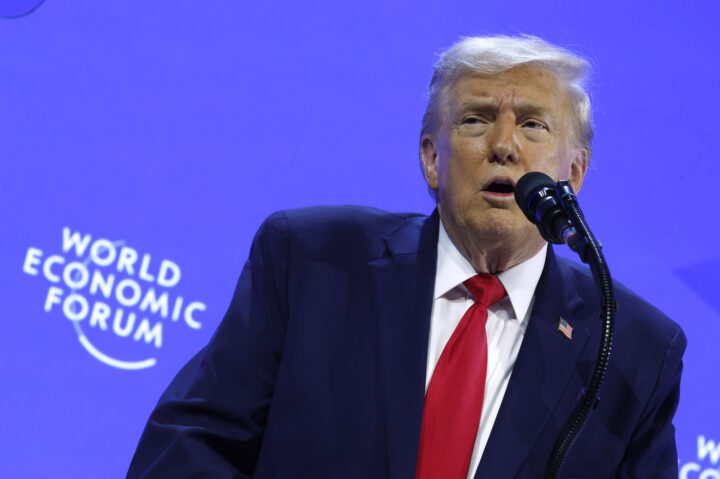
Chip Somodevilla/Getty Images
U.S. President Donald Trump gives a speech at the World Economic Forum (WEF) on January 21, 2026 in Davos, Switzerland.
High-level foreign officials, top diplomats and heads of state will gather in Washington today for the first in-person convening of the Trump administration’s Board of Peace — as U.S. military assets flow into the Middle East and President Donald Trump mulls a potentially weekslong sustained military campaign in Iran.
The gathering, ostensibly focused on the disarmament of Hamas and the establishment of a peace-aligned administration in the Gaza Strip, comes as the U.S. moves dozens of fighter jets and support aircraft to the region — reportedly the largest buildup in military air power since the 2003 invasion of Iraq.
It’s a split screen befitting the president — who said at his inauguration last year that his “proudest legacy will be that of a peacemaker,” and who has claimed success in negotiating an end to numerous conflicts, as well as the release of the remaining Israeli hostages from Gaza last year — even as the U.S. has used force to enact political change, such as in Venezuela.
But a U.S. operation in Iran would differ significantly from what took place in Venezuela last month. In the place of ousted President Nicolás Maduro is Delcy Rodríguez, the former vice president who is now working with the Trump administration. No such natural successor to Iranian Supreme Leader Ayatollah Ali Khamenei exists. Behind the supreme leader is a laundry list of equally — if not more — radical hard-liners eager to take the ailing Khamenei’s place. Reza Pahlavi, the son of the deposed shah of Iran, who has spent most of his life living in exile, has sought to return to Iran to usher the Islamic Republic into a new democratic era — but does not appear to have the on-the-ground support as well as enough legitimacy among Iran’s vast diaspora community.
The Trump administration continues to signal publicly that it wants to find a diplomatic resolution to the situation in Iran, with White House Press Secretary Karoline Leavitt saying as much at yesterday’s press briefing.
But the White House is continuing to move forward with preparations for a military confrontation, which could include anything from targeted strikes on Iran’s nuclear facilities to a move toward regime change. Trump met on Wednesday with Secretary of State Marco Rubio, White House Special Envoy Steve Witkoff and Jared Kushner to discuss options for Iran.
Rubio is set to travel to Israel on Feb. 28, an announcement that could signal that strikes are not imminent — or that could be a ruse by the administration.
Recall that in June, Trump gave Iran a two-week deadline to resume talks, choosing to strike the country’s nuclear facilities just three days later.
Meanwhile, Russian Foreign Minister Sergey Lavrov — whose country is participating in military exercises with Iran’s Islamic Revolutionary Guard Corps today in the Strait of Hormuz — warned against renewed strikes targeting Iran.
Iran is also preparing for a potential military conflict, fortifying its nuclear sites and reviving a chain of command that empowers lower-level military officials.
A month ago, as the world teetered on the edge of another U.S.-Iran military confrontation, diplomacy won out, and the parties agreed to talks. Now, Washington and Tehran — as well as Jerusalem — find themselves again on the brink. The next big decision belongs to Trump.
A source told JI they expect discussion on humanitarian aid and the Palestinian technocratic government in Gaza; it remains to be seen how Israel and Hamas will respond to the board's directives
Chip Somodevilla/Getty Images
President Donald Trump holds up his signature on the founding charter during a signing ceremony for the “Board of Peace” at the World Economic Forum (WEF) on January 22, 2026 in Davos, Switzerland.
After a splashy debut at the World Economic Forum in Davos last month, President Donald Trump’s Board of Peace will convene for its first meeting on Thursday in Washington.
The new international body now faces a test of its ability to operationalize its goals: Observers will be watching whether the board makes any significant announcements toward its goal of implementing Phase 2 of Trump’s peace plan, which is focused on rebuilding Gaza and securing the enclave.
A source familiar with Thursday’s meeting told Jewish Insider that it is “not just pomp and circumstance,” and that they expect discussion about topics including humanitarian aid and the Palestinian technocratic government in Gaza. “It’s not window dressing at all,” the source said of the board’s work.
Trump has assembled a roster of regional heavy hitters on the Board of Peace, including Saudi Arabia, the United Arab Emirates, Qatar, Turkey, Jordan and Israel. Many European nations, including France, have so far declined the invitation, wary that it intrudes on the United Nations’ authority and that its mandate is not clearly confined to Gaza.
According to a senior Trump administration official, speakers at the event will include Trump, Secretary of State Marco Rubio, Jared Kushner, former U.K. Prime Minister Tony Blair, U.S. Ambassador to the U.N. Mike Waltz, White House Special Envoy Steve Witkoff and Nickolay Mladenov, the former U.N. Middle East envoy now serving as the high representative for Gaza on the Board of Peace. Little has been shared publicly about what the format will be.
Hungarian Prime Minister Viktor Orban, a close ally of Trump, said he plans to attend, as will the leaders of Armenia, Azerbaijan, Indonesia, Vietnam, Cambodia, Pakistan, Kazakhstan and Uzbekistan. Several countries, including Israel, Egypt and Turkey, are sending senior ministers in place of their heads of state. A European Union commissioner is expected to attend Thursday’s meeting as an observer, alongside observers from some other nations who have not joined the board, including South Korea.
“President Trump is proud to welcome representatives from over 40 nations to the Donald J. Trump Institute of Peace on Thursday for a big announcement on Board of Peace actions to establish an enduring peace in the Middle East,” White House principal deputy press secretary Anna Kelly told Jewish Insider, arguing that the board will be “the most consequential international body in history.”
The gathering of Middle East and global leaders will also come against the backdrop of U.S.-Iran nuclear negotiations and speculation that Trump is seriously considering military action against Iran, with the U.S. building up military assets in the region this week.
Trump announced on Sunday that member countries have pledged $5 billion toward rebuilding the war-torn enclave and will commit thousands of personnel to the International Stabilization Force, which has not yet been launched. He did not detail which member nations were making the pledges for funds or troops, though Indonesia said it was readying up to 8,000 personnel to deploy to Gaza by this summer. The estimated cost to rebuild Gaza is $70 billion.
The White House said the media had been too skeptical of Trump’s plans but declined to offer specifics about the source of the $5 billion or how the money would be deployed.
“We’re talking about reconstructing Gaza. I remember when those words came from the president’s lips in the East Room many months ago and all of you in the press were bewildered at how the president could have such an ambitious goal of rebuilding Gaza, which is obviously a place that has been just turmoiled by violence and chaos for many many years,” White House Press Secretary Karoline Leavitt said at a Wednesday press briefing. “But we’re well underway in doing that.”
The key question facing the body is whether it can actually make progress toward addressing the most intractable issue in Gaza: Hamas’ continued control over large parts of the Strip and the terror group’s refusal to disarm.
“What will come out of it besides rhetoric is some financial commitments and troop commitments. But the troop commitments are limited. No one will agree to disarm Hamas,” Elliott Abrams, who served as an Iran envoy in Trump’s first term, told JI. “Reconstruction won’t really begin until Hamas is disarmed and fighting has ended.”
While Trump has repeatedly indicated that disarming Hamas is a top priority, the International Stabilization Force tasked with keeping the peace in Gaza is not expected to take on Hamas militarily. The White House has not laid out a plan for how the ISF will take over control from Hamas, which is thus far unwilling to relinquish governance. It is also not clear how Israel and Hamas will respond to the board’s directives.
“The three core questions that the board is examining are, who’s going to govern Gaza, who is going to provide security for Gaza and then number three, how is Gaza going to be reconstructed?” said Aaron David Miller, a former State Department negotiator. “The board can’t answer those questions. It can provide the resources that could supplement good answers, but those decisions lie in Jerusalem and in Gaza and on the part of Hamas’ external leadership.”
Gruenbaum started working with Steve Witkoff and Jared Kushner on Middle East diplomacy after the ceasefire between Israel and Hamas took effect in October
Alexander KAZAKOV / POOL / AFP via Getty Images
Russian President Vladimir Putin welcomes White House Special Envoy Steve Witkoff, Jared Kushner and Commissioner of the Federal Acquisition Service Josh Gruenbaum during a meeting at the Kremlin in Moscow on January 22, 2026.
Josh Gruenbaum’s Thursday started in Davos, Switzerland, at the signing ceremony to inaugurate President Donald Trump’s Board of Peace. Gruenbaum walked onto the World Economic Forum stage where Trump sat, surrounded by world leaders, to hand the president the board’s first resolution — focused on the demilitarization and reconstruction of Gaza — for him to sign.
Hours later, Gruenbaum’s day ended at the Kremlin in Moscow, alongside the two men most closely associated with Trump’s unorthodox brand of foreign policy dealmaking: White House Special Envoy Steve Witkoff and advisor Jared Kushner.
“This is Josh,” Witkoff told Russian President Vladimir Putin as he shook Gruenbaum’s hand at the start of their meeting, a video feed from the Kremlin showed. The men sat down just before midnight. The overnight meeting lasted four hours, ahead of planned security talks between Russia, the U.S. and Ukraine in Abu Dhabi today.
Gruenbaum is a relatively new figure on the diplomatic scene. He started working with Witkoff and Kushner soon after the ceasefire between Israel and Hamas took effect in October. Since then, he’s been spotted in meetings with Israeli Prime Minister Benjamin Netanyahu and Ukrainian President Volodymyr Zelensky. Earlier this month, Gruenbaum was named a diplomatic advisor to the new Board of Peace, which the Trump administration is reportedly envisioning as a replacement to the United Nations.
It’s a somewhat surprising turn for Gruenbaum, whose expertise is not diplomacy or foreign policy but investment banking. But with his business background, Gruenbaum fits in with Witkoff and Kushner, both of whom come from the real estate world. His rise underscores how the Trump administration is reshaping the machinery of government by elevating loyalists with private-sector backgrounds and expanding their portfolios far beyond traditional lanes.
Gruenbaum first joined the Trump administration last year as commissioner of the Federal Acquisition Service, a little-known agency within the General Services Administration that oversees federal contracting. He told Jewish Insider last March that the role allowed him to take a DOGE-like approach to cost-cutting. It was also a perch that allowed him to be involved with federal antisemitism policy, and he quickly joined the federal antisemitism task force.
Gruenbaum’s hypothesis was that government contracts are an effective venue for the Trump administration to exert its influence. So if the government has contracts with, say, a university, then the government can apply pressure to ensure that university complies with federal civil rights laws — a strategy that was used frequently last year to target billions of dollars in federal research funding going to universities that the White House alleged were not appropriately committed to fighting antisemitism.
“I come from a community where Jewish values and the Jewish religion were very important. That is part and parcel to how I was raised and how I think about the world and where I get my moral compass from,” Gruenbaum told JI last year.
He grew up in an Orthodox Jewish community and studied at a yeshiva, before working in his father’s food importing business and then earning a law degree and MBA from New York University. He most recently worked at the private equity firm KKR before moving to Washington last year.
In his role at FAS — a position he still holds, while also flitting between world capitals — Gruenbaum practiced the Washington maxim of making yourself useful, and making your presence known. He undertook a multibillion dollar review of federal contracts. Last fall, he worked on the Trump administration’s higher education compact, an attempt to get universities to sign onto a White House pact in order to get preferential access to federal funds. (No universities have yet agreed to it.)
Now he is also a senior advisor to the president.
Rep. Joe Wilson: ‘My personal point of view is that both of these [countries] are actually part of the axis of evil’

Bonnie Cash/Getty Images
Rep. Joe Wilson (R-SC) looks on during a hearing to examine war crimes from Syria to Ukraine at the U.S. Capitol on July 10, 2024 in Washington, DC.
Some Republican lawmakers said on Thursday that they’re hesitant about President Donald Trump’s decision to invite Russia and China to be part of the Board of Peace that is set to oversee the reconstruction of Gaza.
The administration formally announced the board’s membership on Thursday, consisting largely of countries from the Middle East, North Africa, Eastern Europe and Asia, with several major European allies declining to participate. China and Russia have also not, to this point, accepted their invitations.
Rep. Joe Wilson (R-SC) told Jewish Insider of Russia and China,“I would not have included either of those countries. I wouldn’t have included Belarus either. Belarus is an illegitimate government. It was installed illegitimately by war criminal [Vladimir] Putin.”
Wilson said he views Russia and China as “part of the axis of evil.” He continued, “The axis of evil is easy: it’s Iran, which finances Hamas, and war criminal Putin and the Chinese Communist Party. I do not see them [Russia and China] as [capable of serving as] independent law enforcement, and so it needs to be looked at, in my view.”
Wilson went on to say that, “We are in a conflict we didn’t choose, and that is of dictatorships with rule of gun invading democracies with rule of law. It began on Feb. 24, 2022, with the invasion of Ukraine, and then Oct. 7, the invasion by — I won’t use the word proxies — Iranian puppets, to invade Israel. It’s very important that we show peace through strength to defend the people of Taiwan.”
Rep. Chris Smith (R-NJ) said of inviting China and Russia to join the board, “I don’t know what that brings.”
“I am concerned that they’re a malign influence no matter what they do. And the Middle East, Russia has always been trying to do more. I think their credibility is largely squandered with their invasion of Ukraine,” he continued.
He said the leaders of both China and Russia should face trial for crimes against humanity.
Rep. Darrell Issa (R-CA) said that it made sense to invite the two U.S. adversaries but that they should not have much of a substantive role.
“To exclude them from participation would be inappropriate; to include them in any real positive influence — neither one of them contributes money, neither one of them contributes an expertise in democracy,” Issa said. “I don’t mind them being included, but I think we have to be realistic. They both lack either the generosity or the expertise necessary to create a different world for the Palestinians in their future government.”
He said that other non-democracies, such as Saudi Arabia, the United Arab Emirates and Qatar, are more valuable partners given their potential willingness to contribute financially to the reconstruction of Gaza.
“And if I want others, I want them because they’re willing to demand that there be real representation and real recognition of the international rules that most of our nations live under, Russia and China not being among them,” Issa continued.
Though originally conceived to address the situation in Gaza, Trump has floated the idea that the Board of Peace will pursue a broader agenda, as a potential alternative or replacement for the United Nations, to address other global conflicts, an issue that has prevented some European allies from joining.
Republicans indicated that they’re open to that idea, citing the U.N.’s long-standing anti-Israel bias.
“I think the people of Israel would welcome an alternative to the United Nations that represented free people and democracy in a way that the United Nation skirts,” Issa said. “Israel has been the whipping boy and the piñata of the U.N. for a very long time. And so, you know, finding a group of [countries] willing and more independent and more willing to work for the greater good” could have value.
But, he added, countries like Russia and China do not need to be involved “unless they’re going to have an active and positive role,” of which he has seen no indication.
Smith, a longtime critic of anti-Israel bias at the U.N., said the body “has no credibility. The U.N. Human Rights Council doesn’t, the U.N. itself. Just like UNRWA has no credibility, ever, I feel the same way about this.”
“I think our leadership, as a country, hopefully, can make the difference,” he continued.
Wilson said he believes the board’s mission will remain focused on Gaza.
The lunch, where both praised the Abraham Accords, was hosted by Meta President Dina Powell McCormick and philanthropist David Rubenstein
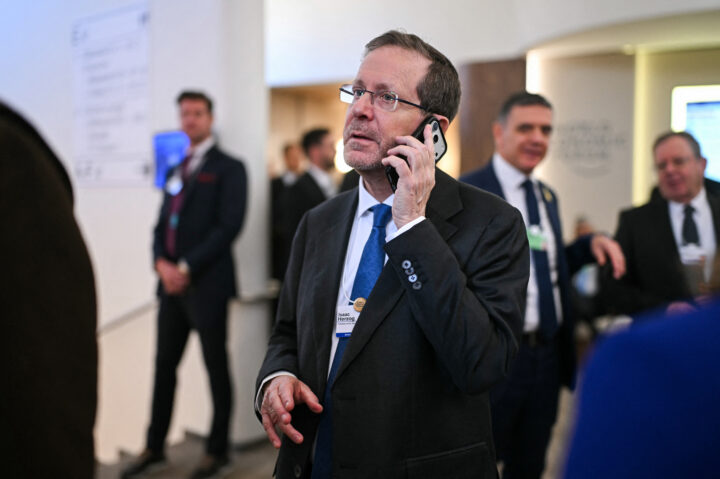
Fabrice COFFRINI / AFP via Getty Images
Israeli President Isaac Herzog at the World Economic Forum (WEF) annual meeting in Davos on January 21, 2026.
After President Donald Trump wrapped up a signing ceremony inaugurating his new Board of Peace in Davos, Switzerland, on Thursday, several of the highest-profile attendees of the event hustled to a private lunch where they spoke hopefully about the future of the Abraham Accords.
Saudi Ambassador to the U.S. Princess Reema Bandar Al Saud and Israeli President Isaac Herzog both shared optimistic remarks about the region’s future, according to one guest. Also in the room were Bahraini Crown Prince Salman bin Hamad Al Khalifa and Khaldoon Al Mubarak, the CEO and managing director of the Mubadala Investment Company, an Emirati sovereign wealth fund.
Hosted and moderated by new Meta President Dina Powell McCormick and philanthropist David Rubenstein, the event honored Lally Weymouth, a former longtime Washington Post journalist who died in 2025. Her daughter, Katherine Weymouth, and brother, Don Graham, both former publishers of the Post, invited a long list of World Economic Forum dignitaries who had known Weymouth. She was described at the lunch as a “force of nature,” the attendee told Jewish Insider.
Participants also toasted Lutnick’s wife, Allison Lutnick, who was a leading advocate within the Trump administration for the release of the Israeli hostages held in Gaza.
Other guests included Commerce Secretary Howard Lutnick, Treasury Secretary Scott Bessent, CNN host Fareed Zakaria, Post columnist David Ignatius, Bank of America CEO Brian Moynihan, JPMorgan Chase CEO Jamie Dimon, Dell Technologies CEO Michael Dell, Bridgewater CEO Nir Bar Dea, International Monetary Fund Managing Director Kristalina Georgieva and Israeli entrepreneur Yossi Vardi.
Kushner: ‘I see people criticizing Israel, or Israel criticizing Turkey and Qatar. Just calm down and work together for 30 days’
Mandel NGAN / AFP via Getty Images
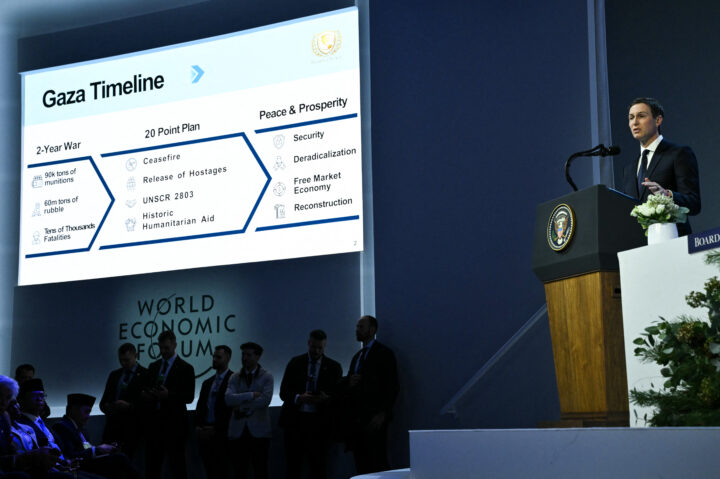
Jared Kushner speaks at the "Board of Peace" meeting during the World Economic Forum (WEF) annual meeting in Davos on January 22, 2026.
Hamas must demilitarize before Gaza can undergo redevelopment, President Donald Trump’s informal advisor Jared Kushner said on Thursday on the sidelines of the World Economic Forum in Davos, Switzerland, as he presented the administration’s plan to disarm the terrorist group and rebuild Gaza.
Kushner was building off of earlier remarks by President Donald Trump at the founding ceremony for his Board of Peace. “We are committed to Gaza being fully demilitarized, properly governed and properly rebuilt. … We’re going to be very successful in Gaza; it’s going to be a great thing to watch,” Trump said at the ceremony.
Hamas, Trump said, “has to give up their weapons, and if they don’t do that, it’s gonna be the end of them.”
Kushner said that the disarmament of Hamas would be a prerequisite to the reconstruction of the enclave. “Without that we cannot rebuild,” he said. “If Hamas does not demilitarize that will be what holds back Gaza and the people of Gaza from achieving their aspirations.”
Kushner presented the administration’s “demilitarization principles” meant to be implemented in the next 100 days. These include the destruction of “heavy weapons, tunnels, military infrastructure, weapons production facilities and munitions.”
According to the plan, Gaza will be governed by a single civilian authority, which will first be the National Committee for the Administration of Gaza (NCAG), the committee of Palestinian technocrats announced last week, followed by the Palestinian Authority, if it undergoes reforms. Any personal weapons in Gaza must be authorized by the NCAG, which will have a monopoly on the use of force, integrating and vetting any internal security and police.
“The end state: only NCAG-sanctioned personnel may carry weapons,” the presentation states.
Reconstruction, according to the plan, will only take place in sectors that are fully disarmed, and those who agree to disarm will be given amnesty and reintegration into or safe passage out of Gaza.
The IDF will gradually withdraw from Gaza based on the successful implementation of the plan, until it fully withdraws to the IDF-controlled security perimeter separating Gaza from Israeli civilians.
The other Board of Peace priorities in Gaza over the next 100 days will be delivering humanitarian aid and rehabilitating essential infrastructure, including water, electricity, sewage, hospitals and bakeries, as well as clearing rubble and building improved temporary housing.
Kushner presented the Trump administration’s vision for a redeveloped Gaza with a map that included a port and a tourism zone along the Mediterranean coast, as well as large residential areas and industrial complexes, while retaining the security perimeter.
Trump spoke in his concluding remarks about the potential of seaside property in Gaza: “This is a great location. See, I’m a real estate person at heart … I said ‘look at this location on the sea, look at this piece of property what it can be … People that are living so poorly can be living so well.’”
The plan includes the construction of a “New Rafah” in the next two to three years, including over 100,000 housing units, and subsequently, a “New Gaza.” Kushner envisioned 100% employment, with 500,000 jobs created and a $10 billion GDP by 2035.
In addition, Kushner projected over $25 billion in investments into the enclave, and said that donor countries will be announced at a separate ceremony in Washington in the coming weeks.
“We’re studying the best practices in the world,” Kushner said. “We want to encourage all the countries to be able to follow these best practices. … If we find what’s working in other countries, we should be copying them.”
Kushner encouraged all countries to put aside their differences to help the plan succeed.
“This deal only happened because … we all worked together to make this happen,” he said. “I see people criticizing Israel, or Israel criticizing Turkey and Qatar. Just calm down and work together for 30 days. … The goal here is peace between Israel and the Palestinian people. Everyone wants to live peacefully, everyone wants to live with dignity. … Let’s focus on the positive story, let’s calm down, turn a new chapter. If we believe peace can be possible, then peace is possible.”
Israeli National Security Minister Itamar Ben-Gvir voiced objections to Qatar and Turkey’s continued involvement on the Gaza Executive Board overseeing the NCAG.
“Turkey and Qatar remain pro-Hamas states that bolstered the Nazi terrorist organization leading up to October 7 and supported it throughout the war; this will not change in 30 days. Hamas must be utterly destroyed — countries that support it will not do so,” he said in a statement following Kushner’s remarks.
Ali Sha’ath, the head of the NCAG, said in a video address shown at the Davos ceremony that the Rafah border crossing would be opened next week. The Board of Peace’s high representative for Gaza, Nickolay Mladenov, also said in a post on X that “an agreement has been reached regarding the preparation for re-opening of the Rafah crossing. Concurrently, we are working with Israel and the National Committee for the Administration of Gaza to expedite the search for the remaining Israeli hostage.”
An Israeli official told Jewish Insider that the matter of the Rafah crossing would be discussed at an Israeli Security Cabinet meeting in the coming days, along with the return of the remains of Ran Gvili, the final Israeli hostage in Gaza.
Former Defense Minister Avigdor Liberman, a member of the opposition, posted on X that “the Rafah crossing is opening, the government of terrorists in suits” — referring to the NCAG — “is already acting in Gaza, and Israel is acting surprised. There are no surprises here, the Oct. 7 government continues to surrender to the Palestinians.”
The president hinted at diplomacy with Iran in his remarks at the ceremony, saying ‘Iran does want to talk, and we'll talk’
Chip Somodevilla/Getty Images
U.S. President Donald Trump gives a speech at the World Economic Forum (WEF) on January 21, 2026 in Davos, Switzerland.
President Donald Trump hosted a signing ceremony on the sidelines of the World Economic Forum in Davos, Switzerland, on Thursday for the founding members of the Board of Peace, his newly formed organization dedicated to world peace and security.
“We’re going to have peace in the world, and boy, wouldn’t that be a great legacy for all of us,” Trump said in his speech launching the board.
The Board of Peace’s “inaugural resolution,” which Trump signed at the ceremony, is to oversee the demilitarization and reconstruction of Gaza.
On Iran, Trump said that the U.S. bombing in June was because “they were two months from having a nuclear weapon, and we can’t let them have that. Iran does want to talk, and we’ll talk.”
In addition to the U.S., 19 countries attended the “massive event,” as a Trump administration source characterized it to Jewish Insider: Bahrain, Morocco, Argentina, Armenia, Azerbaijan, Bulgaria, Hungary, Indonesia, Jordan, Kazakhstan, Kosovo, Pakistan, Paraguay, Qatar, Saudi Arabia, Turkey, United Arab Emirates, Uzbekistan and Mongolia.
Members of Trump’s team in Davos — Chief of Staff Susie Wiles, Secretary of State Marco Rubio, Special Envoy Steve Witkoff, informal advisor Jared Kushner and Josh Gruenbaum, a diplomatic advisor to the board — spent the hours preceding the event working to bring more countries on board.
Some 35 of the 50 invited countries agreed to join the Board of Peace, Reuters reported. Those who did not attend the signing ceremony include Egypt, Vietnam and Belarus and Israel. Israeli President Isaac Herzog was in Davos on Thursday but did not attend because the Board of Peace is under Israeli Prime Minister Benjamin Netanyahu’s remit.
Most Western European countries declined to join the Board of Peace because of its apparent aim to replace the United Nations, as well as Trump’s pressure to turn Greenland over to the U.S. and Russia’s invitation to join.
“Just about every country wants to be a part of” the Board of Peace, Trump said. “We’ll work with many others, including the U.N. … This board has a chance to be one of the most consequential bodies ever created, and it’s my honor to serve as its chairman. … I take it very seriously.”
Though Trump first raised the idea of a Board of Peace as a supervisory body for the Gaza ceasefire reached last year, its charter describes a body concerned with peace worldwide and does not mention Gaza or Israel.
The charter says that the Board of Peace aims to “promote stability, restore dependable and lawful governance, and secure enduring peace in areas affected or threatened by conflict.”
It also makes clear that the board’s expansive mission was borne of disappointment with past efforts by the U.N., with its preamble “declaring that durable peace requires pragmatic judgment, common-sense solutions, and the courage to depart from approaches and institutions that have too often failed … Emphasizing the need for a more nimble and effective international peace-building body.”
Trump said in his remarks on Thursday that “the U.N. has got tremendous potential, and it has not used it,” following a comment earlier this week that the Board of Peace “might” replace the U.N. U.S. diplomats were instructed to say that the Board of Peace is meant to complement the U.N., not replace it, Bloomberg reported.
Trump will be the board’s inaugural chairman, a position that does not have an end date and carries executive power, including to invite and remove members, veto decisions, set the agenda and choose a successor. Membership is free for a three-year term, while permanent membership costs $1 billion.
Italy has yet to join the Board of Peace specifically because it may violate its constitution to join a body led by a single foreign leader, in which it does not have equal standing with other countries.
Rubio, Witkoff, Kushner and former U.K. Prime Minister Tony Blair sit on the Board of Peace’s founding Executive Board, and Gruenbaum and Aryeh Lightstone are its diplomatic advisors.
Trump also said in his remarks that Hamas “has to give up their weapons and if they don’t do that, it’s gonna be the end of them. Many countries say we really want to do it.”
The U.S. is “committed to Gaza being fully demilitarized, properly governed and properly rebuilt,” he added. “We’re going to be very successful in Gaza; it’s going to be a great thing to watch.”
The board's charter describes a body concerned with peace worldwide, not with removing Hamas’ terror threat in Gaza
Kevin Dietsch/Getty Images
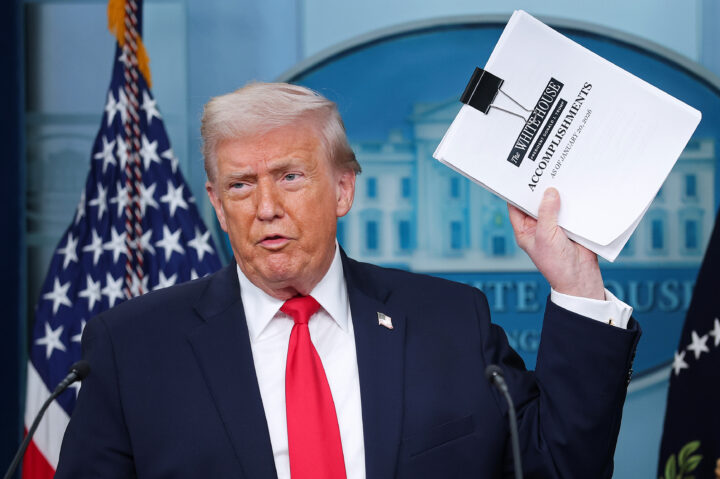
President Donald Trump gives a press briefing at the White House on January 20, 2026 in Washington, DC.
When President Donald Trump first raised the idea of establishing a Board of Peace in October, it was as part of his 20-step ceasefire plan for Gaza. The board was meant to oversee a committee of Palestinian technocrats — whose composition was announced last week — and “set the framework and handle the funding for the redevelopment of Gaza … [and] call on best international standards to create modern and efficient governance that serves the people of Gaza and is conducive to attracting investment.”
The following month, the U.N. Security Council passed a resolution supporting the ceasefire plan and “welcom[ing] the establishment of the Board of Peace,” authorizing it to operate in Gaza until the end of 2027.
But the board’s charter describes a body concerned with peace worldwide, not with removing Hamas’ terror threat in Gaza, and in fact, it does not mention Hamas, Gaza or Israel at all. Its expansive, stated role is to “promote stability, restore dependable and lawful governance, and secure enduring peace in areas affected or threatened by conflict.”
Indeed, it appears to be an attempt to compete with the United Nations. Its preamble says: “Declaring that durable peace requires pragmatic judgment, common-sense solutions, and the courage to depart from approaches and institutions that have too often failed … Emphasizing the need for a more nimble and effective international peace-building body.” Asked at a press conference on Wednesday if he intends for the body to replace the U.N., Trump said it “might.” “I wish the United Nations could do more. I wish we didn’t need a Board of Peace,” he said.
Israeli Prime Minister Benjamin Netanyahu also acknowledged, in a speech to the Knesset on Monday, that the Board of Peace is meant to serve as a kind of alternative U.N. — something that Israel is unlikely to have a problem with, considering the deep anti-Israel bias in Turtle Bay, Geneva and beyond — and he announced on Wednesday that Israel would be joining.
The problem for Israel is that the Board of Peace’s mission creep could distract from what is, for Israel, the most important part of the ceasefire plan, which is to dismantle Hamas as a governing and fighting force.
As Netanyahu put it in the Knesset this week: “In Gaza, we are before Stage 2 of the Trump plan. Stage 2 says one simple thing: Hamas will disarm and Gaza will be demilitarized. We are sticking to these goals and they will be achieved, either the easy way or the hard way.”
In the lengthy announcement about the various committees and boards involved in Gaza reconstruction and its oversight, the White House did not even mention Hamas, let alone demilitarization.
Asked at a press conference on Wednesday if he intends for the body to replace the U.N., Trump said it ‘might’
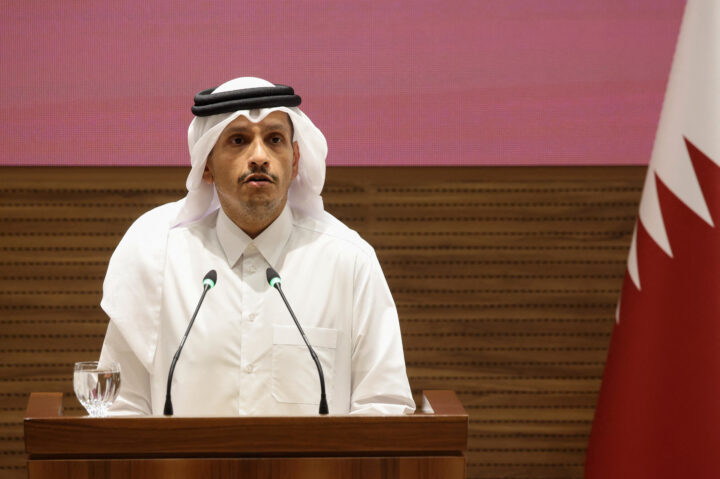
KARIM JAAFAR/AFP via Getty Images
Qatar's Prime Minister and Minister of Foreign Affairs Sheikh Mohammed bin Abdulrahman Al-Thani speaks during a press conference in Doha on April 27, 2025.
Sheikh Mohammed bin Abdulrahman Al Thani, Qatar’s prime minister and foreign affairs minister, said on Tuesday that President Donald Trump’s proposed Board of Peace represents the only viable path forward for Gaza, confirming that Doha has been invited to join the initiative.
“Yes, we were invited to the board,” Al Thani said at the World Economic Forum in Davos, Switzerland. “We are happy to be a contributor to peace and stability in our region. There are a lot of challenges in the implementation, but we have no alternative paths to seek right now.”
Al Thani emphasized that any participating countries would need to “work hard” to ensure the board functions effectively and serves as a stabilizing force.
“President Trump has proposed this path to move forward. We have a lot of work to be done,” said Al Thani. “I think that the most important thing right now is to ensure that Gaza is stabilized and we ensure that the withdrawal of the Israeli forces happens as soon as possible, and ensure that the people can get their life back as soon as possible. That should be the key focus for the Board of Peace.”
Trump has invited a range of countries to join the board, including the U.K., Canada, France and Jordan, as well as China and Russia. As of Wednesday, confirmed participants included Israel, Kosovo, Azerbaijan, Argentina, Hungary, Kazakhstan, Morocco, Belarus, Bahrain and the United Arab Emirates.
Under Trump’s 20-point Gaza peace plan, the board was initially created to oversee post-Hamas governance in Gaza and supervise a committee of Palestinian technocrats. However, the group’s new charter does not mention Gaza or the United Nations. Critics have argued that the board’s expanded mandate, along with Trump’s ramped up criticism of the U.N., are signs the group could evolve into a larger international authority intended to rival or sideline existing institutions.
Asked at a press conference on Wednesday if he intends for the body to replace the U.N., Trump said it “might.” “Wish the United Nations could do more, wish we didn’t need a Board of Peace,” he said.
Al Thani also addressed rising tensions with Iran, urging regional leaders to remain “cool-headed” and “resort to wisdom” amid the unrest inside the country in recent weeks. Earlier this month, Israel and regional partners watched closely as the Trump administration weighed — and ultimately held off on — military strikes in response to Tehran’s crackdown on protesters, which Trump had described as a red line.
While the president has not specified what steps the U.S. may take next, reports have indicated that Israel and Arab states, including Qatar, conveyed concerns about military action. Asked whether Doha had clashed with Washington over the issue, Al Thani suggested otherwise.
“We didn’t argue with the Americans,” he said. “What we offer, as a partner and as an ally of the United States, is honest advice that the best way forward is to find a diplomatic solution.”
Al Thani said Qatar and the U.S. remain in “continuous dialogue,” but reiterated Doha’s opposition to military escalation, even as a means of addressing Iran’s nuclear ambitions.
“We don’t want to see military escalation in our region,” said Al Thani. “We always believe that there is a room for diplomacy, and that’s been our approach in the State of Qatar, and we will always keep advocating for peaceful resolution. We need to understand that any escalation will have consequences.”
A Trump administration source characterized Netanyahu's statement to JI as a minor issue that would likely be smoothed out within days
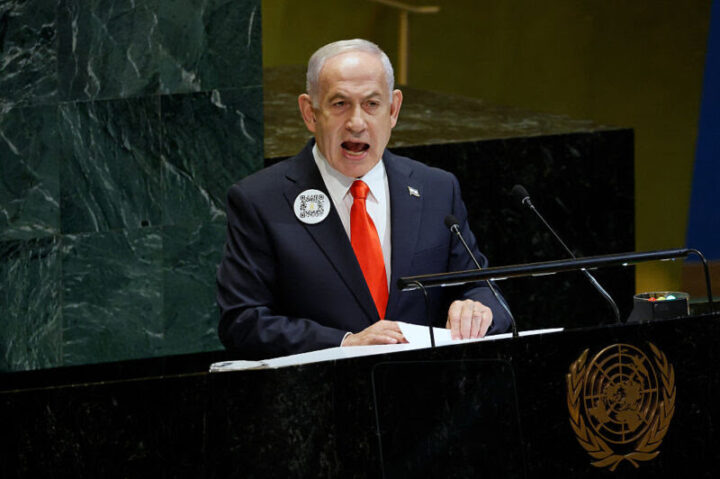
Taylor Hill/Getty Images
Prime Minister of Israel Benjamin Netanyahu speaks during the 80th session of the UN’s General Assembly (UNGA) at the United Nations headquarters on September 26, 2025 in New York City.
Israeli Prime Minister Benjamin Netanyahu opposes the composition of the executive board meant to oversee the rebuilding of Gaza, his office said on Saturday.
“The announcement regarding the composition of the Gaza Executive Board, which is subordinate to the Board of Peace, was not coordinated with Israel and runs contrary to its policy,” the Prime Minister’s Office stated. “The Prime Minister has instructed the Foreign Affairs Minister to contact the U.S. Secretary of State on this matter.”
Netanyahu emphasized his objection in a speech to the Knesset on Monday, saying that “there will be no Turkish or Qatari soldiers in Gaza. We are currently in a dispute with the U.S. over the makeup of the advisory council for Gaza.”
Though Netanyahu said the board was not coordinated with Israel, he spoke with President Donald Trump twice in recent days, and Mossad Chief David Barnea met with White House Special Envoy Steve Witkoff on Friday. The calls and meetings were reportedly about Iran.
The White House announced on Friday that several committees to govern Gaza and oversee its reconstruction and administration had been formed, including the Gaza Executive Board.
The Gaza Executive Board is meant to support the office of the high representative for Gaza and the National Committee for the Administration of Gaza, which is made up of Palestinian technocrats. It includes Witkoff, Jared Kushner, former U.K. Prime Minister U.K. Tony Blair, Apollo Global Management CEO Marc Rowan, Israeli-Cypriot businessman Yakir Gabay, head of Egyptian intelligence General Hassan Rashad, UAE Minister for International Cooperation Reem Al-Hashimy, U.N. Special Coordinator for the Middle East Peace Process Sigrid Kaag, and the previous holder of that position, Nickolay Mladenov, who will serve as the high representative for Gaza.
The board also includes Turkish Foreign Minister Hakan Fidan and Qatari diplomat Ali Al-Thawadi. Israeli officials have previously spoken out against Turkish involvement in Gaza’s reconstruction. Qatar has funded Gaza reconstruction in the past, with significant funding and dual-use materials reaching Hamas; the terrorist group’s leaders have also resided in Doha.
A Trump administration source characterized Netanyahu’s statement to Jewish Insider as a minor issue that would likely be smoothed out within days.
The source noted that Turkish and Qatari representatives were key to negotiating the ceasefire in Gaza, which took effect in October, and that they call Witkoff and Kushner daily, and therefore have an influence on the process regardless of the titles they are given. He also added that Netanyahu has a direct line to Trump.
“It’s all based on whether Hamas demilitarizes or not,” he added. “If Hamas demilitarizes, that is what’s most important [above the composition of the board]. If Hamas doesn’t demilitarize, none of this matters. … The prime minister has a commitment from the president that Hamas will demilitarize.”
Israeli Opposition Leader Yair Lapid said that “Netanyahu is allowing Turkey and Qatar into Gaza. That endangers Israel’s security. That is not what our brave soldiers fought for for two years.
“Instead of releasing panicky statements of protest, Israel should offer a clear alternative, for Egypt to administer Gaza for the next 15 years, for Hamas to be disarmed, and work with American partners to strengthen Israel’s border,” Lapid added.
Israeli National Security Minister Itamar Ben-Gvir said that he supports Netanyahu’s “important message.”
“Gaza does not need an ‘executive board’ that will supervise its ‘rehabilitation,’ it needs to be cleaned of Hamas terrorists who should be destroyed, along with encouraging massive voluntary emigration, in accordance with President Trump’s original plan,” Ben-Gvir said. “I call on the prime minister to instruct the IDF to prepare to go back to war in Gaza using great force in order to achieve the central goal of the war, the destruction of Hamas.”
The White House also announced the members of the founding executive board of the Trump-chaired Board of Peace, whose purview is not limited to Gaza. Netanyahu told the Knesset on Monday that the board is meant to serve as an alternative to the United Nations, 66 of whose organizations the U.S. left earlier this month. The board is composed of Secretary of State Marc Rubio, Witkoff, Kushner, Blair, Rowan, World Bank President Ajay Banga and Deputy National Security Advisor Robert Gabriel.
Canadian Prime Minister Mark Carney and Argentinian President Javier Milei also accepted invitations from Trump to join the board, while Egyptian President Abdel Fattah al-Sissi and Turkish President Recep Tayyip Erdogan had yet to respond. French President Emmanuel Macron declined to join. Netanyahu was invited to join or send an Israeli representative, according to Ynet. Russian President Vladimir Putin was invited, as was President Alyaksandr Lukashenka of Belarus; Ukrainian President Volodymyr Zelensky received an invitation on Tuesday, Ukrainian Ambassador to Israel Yevgen Kornichuk told JI. China, Germany, Australia, Albania, Jordan, Egypt and Bahrain reportedly received invitations, as well.
Membership on the Board of Peace is for three years; Trump asked countries to pay $1 billion for a permanent seat, Bloomberg reported.
Trump appointed Aryeh Lightstone and Josh Gruenbaum, members of Witkoff’s team, to be special advisors to the Board of Peace, “leading day-to-day strategy and operations, and translating the Board’s mandate and diplomatic priorities into disciplined execution,” the White House stated.
Experts said the White House needs to clarify how governance and security structures will operate in Gaza moving forward
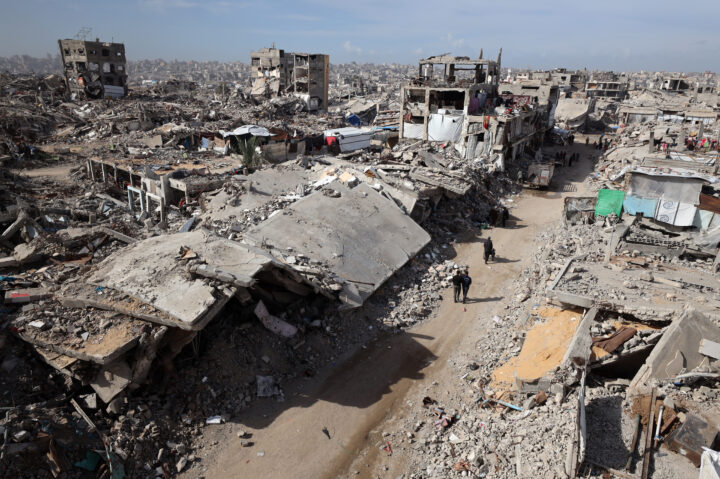
Majdi Fathi/NurPhoto via Getty Images
A photograph shows destroyed buildings in Jabalia, in the northern Gaza Strip, on December 9, 2025.
It has been nearly three months since President Donald Trump unveiled his 20-point peace proposal for Gaza, but officials have yet to explain how key aspects would function in practice or how Hamas’ entrenched presence in the enclave will be addressed.
Under the plan, Gaza’s governance would be overseen by a Trump-led “Board of Peace,” followed by an international executive board expected to include Jared Kushner and White House Special Envoy Steve Witkoff. Beneath the board would sit a technocratic Palestinian government of approximately a dozen Palestinians who are not affiliated with Hamas.
Trump initially planned to announce board members by Christmas, but that timeline has slipped to early next year. On Thursday, the White House proposed that Nickolay Mladenov, a Bulgarian diplomat and former UN Middle East envoy, join the Trump-led board as an on-the-ground representative in Gaza. In such a role, Mladenov would be expected to work with a future Palestinian technocratic government.
But as Trump focuses on hand-picking members for his ideal Palestinian governing body, experts told Jewish Insider that the administration has offered little clarity on how this layered structure would actually govern Gaza — or, more consequentially, how it can operate while armed Hamas terrorists remain in control of much of the enclave.
“It just hasn’t been made clear on the issue of governance or security how this stuff is actually going to work, or how Hamas is going to be persuaded to step aside,” said Aaron David Miller, a senior fellow at the Carnegie Endowment for International Peace. “Is [the Board of Peace] the overriding executive authority that has the final say in Palestinian governance and security? If that’s the case, it’s going to fail because none of these members of the Board of Peace have the time or inclination to make those decisions.”
Israel currently controls 53% of Gaza, as demarcated by the “Yellow Line,” while Hamas maintains control in the remaining western part of the enclave. Despite heavy losses, Hamas fighters continue to operate and have given no indication of relinquishing power. Miller called the task of ensuring Hamas is “stripped of its weapons” an “extremely difficult” objective.
“There is no indication that Hamas is ready to meet its commitments to disarm,” said Dana Stroul, research director at The Washington Institute for Near East Policy. “If anything, [Hamas’] surviving leaders are deliberately muddying the messaging to make their terrorist organization appear reasonable and a legitimate representative of the Palestinian people.”
To prevent a Hamas resurgence, Trump has made the deployment of an International Stabilization Force (ISF) a central pillar of the plan. But the administration has yet to define the composition of the force. Israel has objected to Turkish participation, and while countries such as Azerbaijan and Indonesia have been floated as part of the force, it lacks definitive commitments.
Elliott Abrams, who served as Iran envoy during Trump’s first term, told JI that the White House has yet to “seriously address the question of who would maintain security in Gaza and prevent a Hamas recovery.”
“To answer that question you have to answer, ‘Who is willing to shoot at Hamas terrorists?’” said Abrams. “The ISF proposal was unrealistic in that it never even asked this, much less answered it. The idea that Muslim or European or U.N. forces would shoot [at Hamas] was never realistic.”
Miller echoed that concern and questioned how an international force would respond in the event Hamas fighters “emerge from tunnels crossing the line of control.”
“Would forces from Arab and Muslim countries fire on Palestinians? Will they be able to maintain their legitimacy if the Israelis are unhappy or dissatisfied with the response of this force and choose to undertake a response of their own?” said Miller. “That’s an extraordinarily challenging set of problems that need to be unpacked.”
The Trump administration indicated on Thursday that it is planning to appoint a two-star American general to command the stabilization force. But experts said the administration should first lay out a concrete plan of what it expects from ISF participants.
“Who heads [the stabilization force] is much less important, frankly, then what it’s going to do,” said Miller. “It doesn’t matter who sits on top of the organization or the construct if it’s feckless, weak and riddled with contradictions and dysfunction.”
Stroul agreed, adding that without “clarity on the missions and activities” of the ISF, the force will “encounter challenges.”
“Without a clear plan of responsibility for security on the ground, it is difficult to imagine international organizations and funding coming into Gaza to start the work of rubble clearing and reconstruction,” said Stroul.
Please log in if you already have a subscription, or subscribe to access the latest updates.
 Continue with Google
 Continue with Apple