






































U.N. General Assembly president criticizes Board of Peace
Baerbock claimed at the Aspen Security Forum that the U.N. is better equipped to handle post-war Gaza than the U.S.-led board
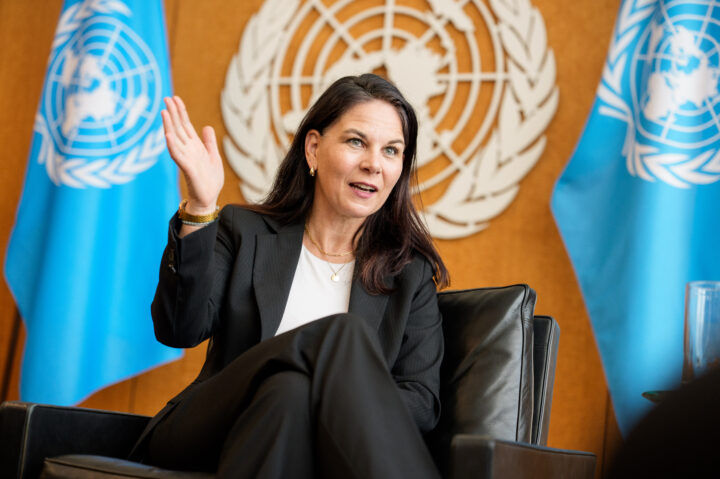
Michael Kappeler/picture alliance via Getty Images
Annalena Baerbock, president of the United Nations General Assembly and former German foreign minister, photographed in her office at the UN during an interview.


 Add JewishInsider on Google
ASPEN, Colo. — Annalena Baerbock, the president of the United Nations General Assembly and former foreign minister of Germany, on Friday criticized the Board of Peace, the U.S.-led body responsible for managing the ceasefire in Gaza.
The Board of Peace has “proved what I just said — that obviously it’s not so easy to build another institution, and for sure it can never ever replace the United Nations,” Baerbock said at the Aspen Security Forum, referring to claims by some in the Trump administration that the board could act as an alternative to the U.N. for a range of global conflicts.
“There’s a reason why we do have a body for peace and security, where every country, no matter how big or small, how powerful or rich, has a seat at the table and an equal voice and vote at the table.”
She argued, during a live taping of the podcast Pod Save the World, hosted by former Obama administration officials, that existing U.N. institutions are better equipped to deal with the situation in Gaza. The U.N. Relief and Works Agency and other U.N. bodies have come under significant criticism over ties to terrorism and entrenched anti-Israel bias.
“We have specialized agencies who can go into Gaza, we have specialized agencies for health, for education,” Baerbock continued. “Obviously a new setup where you just say, ‘We just collect money and somehow we throw it into an area,’ does not work at all because you need the structures on the ground, and you don’t even have the money. We need billions, and I think we have, what, $23 million so far collected.”
She also said that the Board of Peace was an example of why calls to build an alternative to the U.N. are misguided.
Baerbock claimed that the U.N. conference held last July on a two-state solution organized by France and Saudi Arabia, during which numerous countries announced their support for Palestinian statehood, had been a driving factor behind the peace deal and the formation of the Board of Peace, though it’s not clear that was actually the case.
But she framed the conference as an example of the ability of individual member states, acting outside of the Security Council, to push for change and progress within the U.N. system. She also dismissed as impractical calls for removing the U.N. Security Council’s veto, while calling for other reforms.
Baerbock also argued that the U.S. cannot reopen the Strait of Hormuz through military power alone, but said that the U.N. had also failed to deal with the situation in Iran, though she seemed to point blame toward the U.S. for failing to bring the issue to the Security Council before launching its operation.
More Stories
POLL POSITION
U.S. experts split on Netanyahu’s prospects ahead of Israel’s election
CAMPUS CLASH
Georgetown Law student association brands Cruz aide Islamophobic after lecture on Muslim Brotherhood
ROGUE ALLIES
El-Sayed campaign distances himself from antisemitic ad promoting his campaign
WAR WORRIES
Could another war with Iran be the October surprise of the Israeli election?
CANCEL CALLS
Democratic push grows for Ilhan Omar, Fateh to cancel Hasan Piker event

HAWKEYE HANGUP
Top Democratic recruit in Iowa balances support of Israel with criticism of war in Gaza
Please log in if you already have a subscription, or subscribe to access the latest updates.
 Continue with Google
 Continue with Apple