
















































Future of Gaza peace plan uncertain amid Hamas intransigence
The terror group has reportedly rejected a Board of Peace proposal to disarm
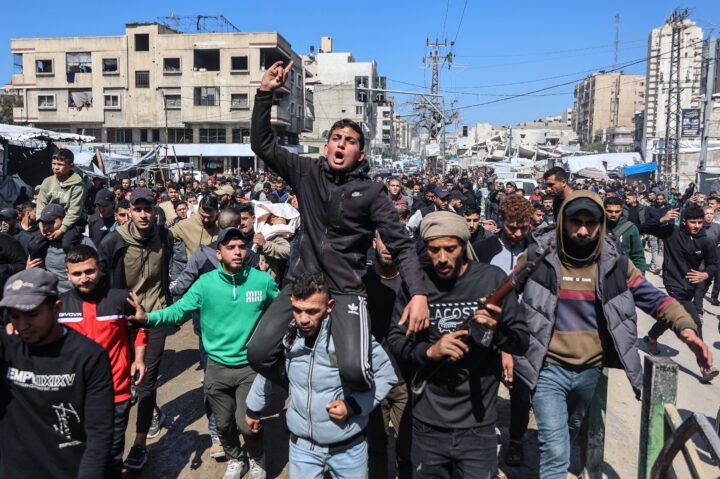
Omar AL-QATTAA / AFP via Getty Images
Mourners react at a funeral in Gaza City's Shujaiya neighbourhood on March 28, 2026.


 Add JewishInsider on Google
As Hamas reportedly continues to reject the U.S.-led Board of Peace’s disarmament framework and fails to comply with key demilitarization deadlines, the future of the fragile Gaza peace process remains uncertain.
Disarming Hamas is a central pillar of President Donald Trump’s 20-point peace initiative, which secured the release of the remaining Israeli hostages and included a partial Israeli military withdrawal from eastern Gaza. Its second phase has hinged on Hamas laying down its arms — a step that is expected to pave the way for further IDF withdrawal from the enclave and a transition to governance by the 15-member National Committee for the Administration of Gaza, led by Ali Shaath and operating under the Board of Peace.
Last month, Nickolay Mladenov, the Board of Peace’s high representative for Gaza, presented a framework for demilitarization and set a deadline for the end of last week for Hamas to disarm. Reports indicate the group rejected the proposal, accusing Mladenov of bias toward Israel and blaming Jerusalem for not completely fulfilling its obligations under the first phase of the plan.
U.S. and Hamas negotiators held the first direct talks between the parties since the announcement of the Gaza ceasefire in October 2025 on Tuesday night, CNN reported. Senior U.S. advisor Aryeh Lightstone and Mladenov met with Khalil al-Hayaa, a chief Hamas negotiator, in Cairo, where Mladenov communicated that Hamas must accept the terms of the demilitarization agreement “or face a return to war.”
Former White House officials are split over the path forward and whether the Trump administration should escalate pressure on Hamas or stay the course.
Dan Shapiro, who served as U.S. ambassador to Israel under President Barack Obama and was appointed by then-President Joe Biden in 2021 to serve as special liaison to Israel on Iran, said Hamas is unlikely to disarm voluntarily, arguing the group would only do so “under duress.” One potential avenue, he said, would be renewed Israeli military action, though he emphasized that such a move would be both costly and unlikely.
“[Israeli military action] would come at an enormous price in civilian casualties, given Hamas’ embedded position within Gaza’s population,” Shapiro said, adding that it is “highly unlikely the Trump administration would lend its support to such an operation” and that it would deal “further blows to Israel’s international support.”
Instead, Shapiro pointed to regional pressure as a more viable path, particularly from Qatar and Turkey, which he said have previously used their leverage to influence Hamas.
“The other source of pressure on Hamas would be the threat of Qatar and Turkey to withdraw their political, financial and hosting support of the organization,” Shapiro said. “They were the parties who used their unique leverage with Hamas after the Israeli strike in Doha to convince Hamas to release all hostages. Trump should engage their leaders, as he did in that period, to convince them to use their leverage again, this time to pressure Hamas to disarm.”
However, Shapiro cautioned that the war in Iran has diverted U.S. attention and “may have reduced Trump’s ability to influence key regional leaders, like [Turkish President Recep Tayyip] Erdogan and the emir of Qatar, to take this necessary action on Hamas disarmament.”
Elliott Abrams, a former Iran envoy under the first Trump administration, similarly noted that Hamas “hasn’t changed its spots.” He said that Hamas leaders “obviously think a disarmed Hamas is a dying Hamas; without ‘armed struggle’ they believe they will disappear and become just another political party.”
“What Mladenov and the U.S. government need to figure out is what happens to the Board of Peace and to U.S. policy if Hamas won’t disarm,” Abrams said. “I think the answer is to prevent any arms and money from being smuggled into the half of Gaza that Hamas still controls, and to develop the half of Gaza under Israeli control.”
“No one seems to want to invade and conquer western Gaza, including the IDF,” Abrams added. “Perhaps over time, Gazans will begin migrating to the parts of Gaza where life can be lived without Hamas.”
Meanwhile, Alexander Gray, former chief of staff to the National Security Council during Trump’s first term, offered a more supportive view of the administration’s current strategy, calling it “realistic.”
“While we must continue to work with Israel to ensure Hamas is unable to wage war against our partners and allies and terrorize the region, we must also be realistic about the nature of the organization and its leadership,” Gray said. “The administration’s vision for a prosperous Gaza and secure Israel must continue apace, while appropriate and realistic steps are taken to prevent Hamas from acting true to its charter and perpetrating further death and destruction.”
More Stories

AID ARGUMENTS
Michael Oren, Jonathan Schanzer split over when Israel should move past U.S. aid

STUDENT SAFETY
Federal civil rights complaint accuses Montgomery County, Md., schools of ignoring antisemitic harassment

CALLING IT OUT
Rep. Don Bacon blasts Dan Osborn over ‘anti-Jewish’ ad
SCOOP
AIPAC to end candidate endorsements, PAC contributions to allies
POLL POSITION
U.S. experts split on Netanyahu’s prospects ahead of Israel’s election

EXCLUSIVE
JDCA launches streaming and digital ads supporting Cait Conley, attacking Lawler
Please log in if you already have a subscription, or subscribe to access the latest updates.
 Continue with Google
 Continue with Apple