













The current geopolitical conditions laid the groundwork for yesterday’s State Department summit
Andrew Harnik/Getty Images
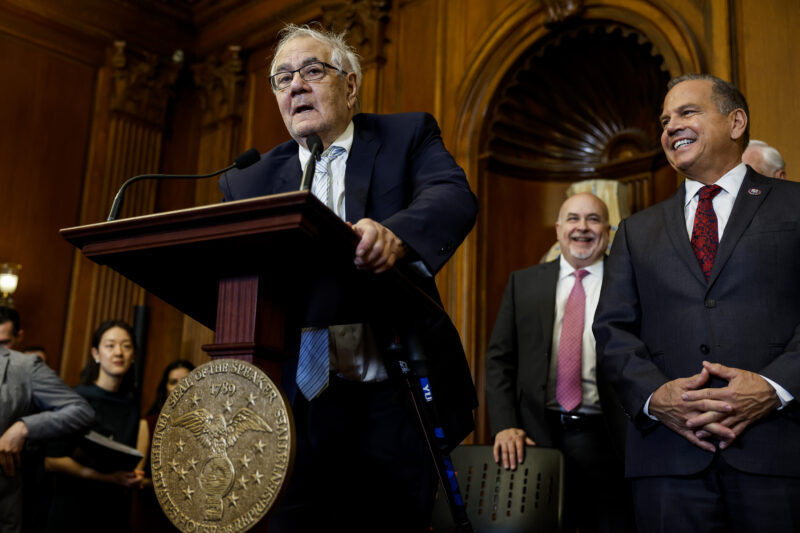
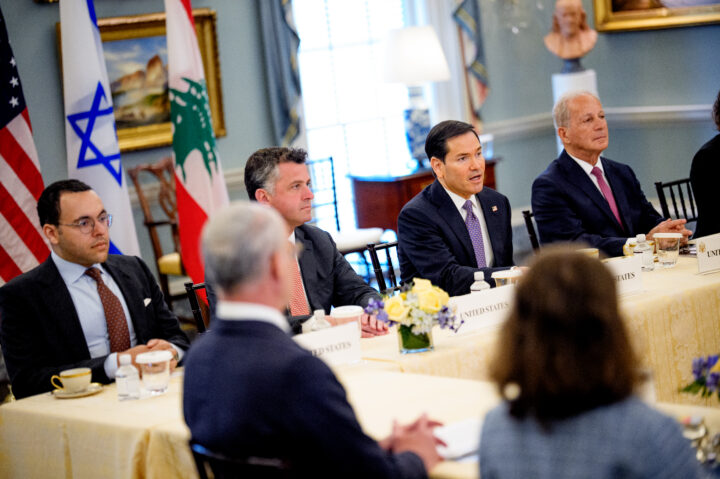
U.S. Secretary of State Marco Rubio (2nd-R), accompanied by U.S. State Department Counselor Michael Needham (C), and U.S. Ambassador to Lebanon Michel Issa (R), speaks as they begin working-level peace talks with Lebanese Ambassador to the U.S. Nada Hamadeh Moawad and Israeli Ambassador to the U.S. Yechiel Leiter at the U.S. State Department on April 14, 2026 in Washington, DC.


 Add JewishInsider on Google
A popular “domino effect” meme circulates online every few months, linking slain Hamas leader Yahya Sinwar’s decision to launch the Oct. 7, 2023, attacks — the smallest domino — to a series of major geopolitical shifts across the Middle East. While both simplified and exaggerated, the meme underscores the dramatic reshaping of Middle Eastern power dynamics.
The next domino may be the decades-long fraught relationship between Israel and Lebanon, as Iran’s ironclad grip over the region loosens and its most powerful proxy, Hezbollah, finds itself increasingly weakened and marginalized in Lebanon, where it has for decades played a key role in the country’s politics and military.
Those current geopolitical conditions — Iran at its weakest point in decades, successive levels of Hezbollah leadership removed from power through Israeli military actions, the degradation of Hamas and a new government in Syria that has separated itself from Tehran — laid the groundwork for yesterday’s State Department summit, convened by Secretary of State Marco Rubio, between Israel and Lebanon.
The State Department meeting between the ambassadors from Lebanon and Israel took place as the U.S. navigates stalled talks and a tenuous ceasefire with Iran — which was initially on unstable ground as Iran demanded that Israel cease its targeting of Hezbollah as part of the ceasefire.
A senior Israeli official told Jewish Insider on Wednesday that Iran’s effort to link the two conflicts was “a strategic trap with long-term ramifications.”
“There was real pressure to link the Lebanon front to the Iran ceasefire,” the official said. If President Donald Trump had acquiesced to the Iranian demand to link the two conflicts, the official continued, “We would not be on the path to peace that we’re on now. Keeping the arenas separate ultimately means that the fate of Lebanon is no longer dictated by Iran.”
Former Israeli Prime Minister Naftali Bennett — now mounting a comeback bid ahead of elections later this year — has often used the “Octopus Doctrine” to describe a security approach to tackling Iran’s decades-long control over the region. Cut off the head of the octopus — Tehran — and the tentacles will be easier to tackle, the logic goes.
Israel, having severed the metaphorical octopus’ head on the opening day of the recent war with Iran, is now continuing its work to degrade and dismantle Iranian proxies — a process that began two and a half years ago, triggered by the Oct. 7 attacks.
“One of the most significant developments in the Middle East since Oct. 7 has been the steady dismantling of that axis — separating arenas that sought to bind their fates together,” the senior Israeli official said.
The talks are not without risk. Lebanese Prime Minister Nawaf Salam called off a planned trip to the U.S. over the weekend out of concerns of potential domestic unrest — amid the still very real risk that Hezbollah, albeit weakened, could attempt a power grab in his absence. Recall that in 2005, former Lebanese Prime Minister Rafic Hariri was killed in a car bombing, with a Hezbollah operative convicted by a U.N. tribunal in absentia for the assassination.
The talks were hailed by Israeli Ambassador to the U.S. Yechiel Leiter, who said that the parties “discovered today that we’re on the same side of the equation” and “are both united in liberating Lebanon from an occupation power dominated by Iran called Hezbollah.”
Rubio delivered a measured assessment of the goals of yesterday’s talks: “This is about bringing a permanent end to 20 or 30 years of Hezbollah’s influence in this part of the world,” he said at a roundtable ahead of the meeting. “This will take time, but we believe it is worth this endeavor.”
Beirut has in recent years — and with varying degrees of seriousness and success — worked to disentangle itself from Iran and Hezbollah. Now, the U.S.-Israeli military pressure on Iran, combined with the Trump administration’s zest for dealmaking and the degradation of Hezbollah, could create the right environment to bring peace to the Mediterranean Riviera.
Michael Schill said no Northwestern students have been disciplined for anti-Israel behavior

Valerie Plesch for The Washington Post via Getty Images
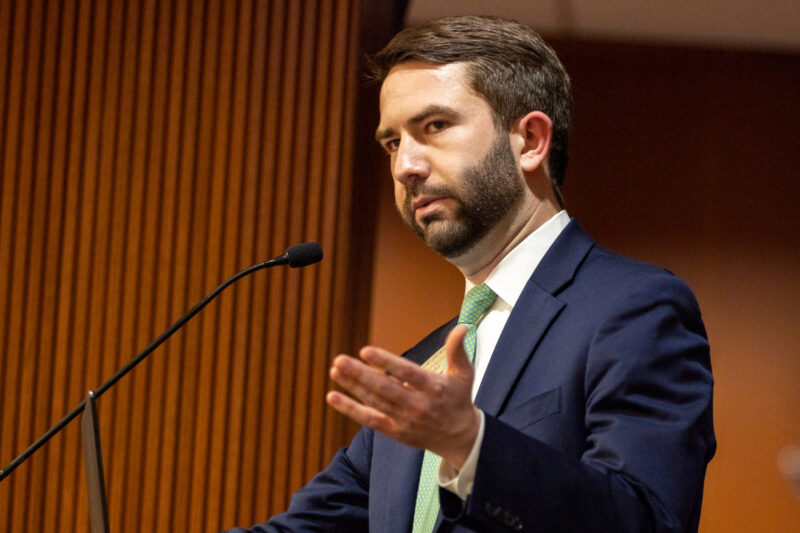
Michael Schill, president of Northwestern University, before a House Committee on Education and the Workforce hearing, "Calling for Accountability: Stopping Antisemitic College Chaos" on Capitol Hill on May 23, 2024.
Michael Schill, the Northwestern University president who announced his resignation last week amid widespread controversy over his tenure, appeared unfazed to hear that a Palestinian professor he hired as part of a deal with encampment protestors had once met with the late Hamas leader Yahya Sinwar, an interview with the House Committee on Education and Workforce, released on Thursday, reveals.
In the Aug. 5 interview, which was released as a response to Schill’s resignation announcement on Thursday, House investigators pressed Schill on the hiring of Mkhaimar Abusada as a visiting associate professor of political science.
Abusada, who Schill described as “someone who is regularly quoted as an authority on Palestine governance and politics,” published a piece in Haaretz last year about his 2018 meeting with Sinwar.
“Hypothetically, if somebody, you know, 4 years, 5 years before Oct. 7 has met with someone who — and, I mean, I’m not sure — my guess is — I’ve never been to Gaza, but it’s a pretty small place, and that you are going to meet people and talk to people,” said Schill, who claimed to not be aware of that meeting when he hired Abusada but noted in the interview that the professor’s position had been extended to August 2026. “I don’t know whether a seasoned professor who is doing the politics of Gaza could avoid getting to know some of these people, or whether that would be not doing his job right.”
Schill, who will remain as president in an interim role until his successor is chosen, oversaw a period of antisemitic turmoil on the Chicago-area campus after the Oct. 7, 2023, terrorist attacks and was accused of failing to respond in an adequate manner, leading some lawmakers to call for his resignation.
The 135-page interview transcript provides new, detailed information on Schill’s response to years of campus turbulence, including his controversial handling of a violent anti-Israel encampment in spring 2024 and the university’s close ties to Hamas-allied Qatar.
The interview comes as Northwestern is in talks with the Trump administration to restore $790 million in funding for the university that was pulled by the federal government over an alleged failure to protect Jewish students.
Jewish alumni expressed optimism that Schill’s resignation, and the interview being made public, would lead to Northwestern leaders making necessary reforms.
“Northwestern’s board needs to take control of the situation in a way they have declined to until now [and] clear out all other administrators who have been part of this culture of enabling antisemitism on campus,” Rich Goldberg, a senior advisor at Foundation for Defense of Democracies who holds bachelor’s and master’s degrees from Northwestern, told Jewish Insider.
“Those who are negotiating on behalf of the Trump administration, now seeing this transcript, will need to review any additional information that’s come to light, additional questions that they might have for the university, see if this changes anything that’s been under negotiation to date, and with Schill stepping down, hopefully signaling the board of the university wanting to see real changes made,” Goldberg continued.
Michael Teplitsky, president of the Coalition Against Antisemitism At Northwestern, said that Abusada “should never have been at Northwestern.”
“There must be a massive turnaround and restructuring at the university and they have to make meaningful changes,” said Teplitsky.
When anti-Israel encampments emerged on college campuses across the country in spring 2024, Schill, who is Jewish, became the first university president to strike a deal with demonstrators. The deal included no disciplinary action taken against students and acceded to several demands of the protesters, which drew strong condemnation from many Jewish leaders. Among other concessions, Schill committed to hire two Palestinian professors, which would include Abusada, and offer full scholarships to five students from Gaza.
Schill acknowledged in the interview that — despite telling Congress that “discipline has been meted out to many of those students” who participated in the encampment and other antisemitic incidents on campus — no students had actually faced disciplinary action for anti-Israel activity on campus. Schill said that the university had reason to believe some demonstrators could be armed and claimed that university leadership had no option but to negotiate with the encampment organizers because they were dangerous. The university was afraid to send in the police to remove them, he said.
“We didn’t think our students were armed, but we didn’t know,” Schill told the House committee. “There was a suspicious tent off to the side, and we knew that our students were trying to avoid the people in that tent, and we didn’t know what was inside the tent. And so we were concerned about that.”
The released testimony also puts a spotlight on Northwestern Provost Kathleen Hagerty’s support for the encampment and BDS activism on campus, which Schill argued she may have viewed as a “teachable moment.”
In a series of exposed text messages, Hagerty wrote that “if the students really cared about actual divestment, then they need the patience to do the work to actually make it happen.”
In an April 27 text exchange with a professor, Hagerty wrote that for Northwestern to boycott Sabra, an Israeli hummus company that is sold at the university, it would “probably be pretty easy,” adding that she is “all for making a deal.”
Schill responded to the text messages by highlighting his support for the Jewish state. “I view Israel as our number one strategic partner in the world,” he said.
“I don’t think [Schill] is the only administrator that needs to go,” said Goldberg. “Clearly the provost needs to follow him out the door as someone who is also chiefly responsible for the culture of enabling antisemitism at the university and implementing the encampment appeasement.”
The interview also raised new questions around Northwestern’s relationship with Qatar. Schill said that students on Northwestern’s Qatar campus are exempted from completing the university’s mandatory antisemitism training and acknowledged several examples of professors on the Qatar campus engaging in extreme pro-terrorism and antisemitic activism and speech on social media.
He said that Northwestern’s contract with Qatar prevents it or its affiliates from criticizing the country. “NU, NU-Q, and their respective employees, students, faculty, families, contractors and agents, shall be subject to the applicable laws and regulations of the State of Qatar, and shall respect the cultural, religious and social customs of the State of Qatar,” said Schill. He said that Qatar has given Northwestern $737 million since 2008.
“The initial deal to put a campus out in Qatar was put together, it was in the era after 9/11,” Teplitsky told JI. “I think people had hopes and ambitions to build bridges in the Middle East, in Qatar. It had wonderful intentions. I think now looking back and looking at it specifically through the lens of Northwestern University… looking at it from a perspective of … values that Northwestern lists on its website, that relationship has not been a good one. It’s been one of failure.
Teplitsky continued, “Should Northwestern be registered, as long as they continue to have this campus, with the Department of Justice as a foreign agent? I believe that they should have to register as a foreign agent if they choose to continue to have this campus.”
Jewish Insider Senior Congressional Correspondent Marc Rod contributed reporting.
Please log in if you already have a subscription, or subscribe to access the latest updates.
 Continue with Google
 Continue with Apple