

















































Netanyahu’s coalition promised Haredi parties to effectively bring back the draft exemption as IDF warns of dangerously low manpower
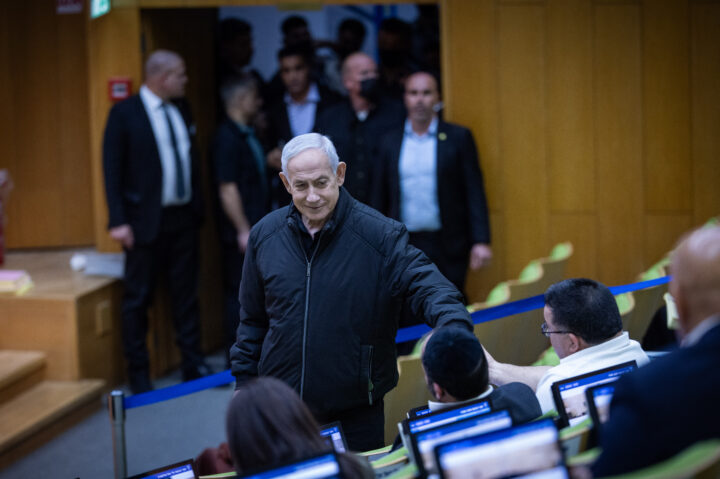
Yonatan Sindel/Flash90
A vote on the state budget at the auditorium in the Knesset, the Israeli parliament in Jerusalem, during the war with Iran and Hezbollah, March 29, 2026.


 Add JewishInsider on Google
Israeli Prime Minister Benjamin Netanyahu’s governing coalition narrowly beat a deadline that would have led to an early election, passing the 2026 state budget early Monday morning, a day before the March 31 deadline.
The budget passed after the coalition granted NIS 800 million ($255 million) in benefits to Haredi institutions, and promised Shas and United Torah Judaism that the government would pass a law that, in effect, would continue yeshiva students’ exemption from military service, even as Lt. Gen. Eyal Zamir, the IDF chief of staff, raised “10 red flags” about insufficient military manpower.
According to Israeli law, state budgets are meant to be passed by the end of the previous fiscal year, on December 31, but an extension is permitted to the end of March. If no budget is passed by the final deadline, the Knesset is automatically dissolved and an election is called for three months later.
This government had used that extension amid disputes over legislation reducing the penalties on Haredi yeshivas and young men who do not enlist in the IDF such that it would effectively continue their blanket exemption from military service. The matter remained unresolved, with Haredi parties threatening to vote against the budget, as the war with Iran began at the end of February.
Two weeks into the war, Netanyahu and Israeli Finance Minister Bezalel Smotrich announced that the coalition would set aside legislation under dispute, including Haredi conscription, in order to pass the budget.
As part of the conditions for Haredi parties Shas and United Torah Judaism to drop their demand to pass the conscription exemption bill, the budget included an increase of over NIS 1 billion (approximately $319 million) for Haredi yeshivas and other institutions. The funding would offset much of the sanctions on Haredi individuals and institutions in recent years, after the High Court of Justice struck down their exemption from IDF service.
Israeli Attorney-General Gali Baharav-Miara had blocked most of the funds from being included in the draft of the budget that went to a vote, because it was meant to circumvent the law, but the coalition voted it in soon after midnight Sunday as an amendment to the budget bill.
In addition, Knesset Foreign Affairs and Defense Committee chairman Boaz Bismuth, of Netanyahu’s Likud Party, said last week that the Haredi IDF exemption bill would be back on the Knesset agenda in two weeks, after Passover — meeting another demand by the Haredi parties that the exemption from the IDF be legislated as soon as possible after the budget.
Bismuth’s remarks about the return of the Haredi exemption bill came on the same day as a report on Israel’s Channel 13 that Zamir warned in a Security Cabinet meeting that the “IDF is going to collapse in on itself” if it does not increase its ranks.
In addition to the likelihood of Haredim no longer facing penalties for failing to serve, a law reducing mandatory IDF service from 36 months to 30 months is set to go into effect in January 2027. Zamir asked the government earlier this year to revert to the previous length of mandatory service.
”I am raising 10 red flags,” Zamir reportedly said. “The IDF needs a [Haredi] conscription law, a reserve duty [extension] law and a law to extend mandatory service. Before long, the IDF will not be ready for its routine missions and the reserve system will not last.”
The 2026 budget is the largest in Israel’s history, reaching NIS 850.6 billion ($271 billion), with an unprecedented NIS 143 billion ($45.8 billion) for the defense budget alone, amid the war with Iran and Hezbollah and continued operations in Gaza.
All other ministries were cut by 3% to fund the extra wartime spending.
The budget was passed in a final vote after over 13 hours of opposition filibustering, as well as repeated missile sirens stopping the proceedings, during which lawmakers voted from a fortified room, as opposed to the regular Knesset plenum.
United Torah Judaism left the coalition and Shas quit the government, but did not pull its 11 lawmakers out of the parliamentary coalition
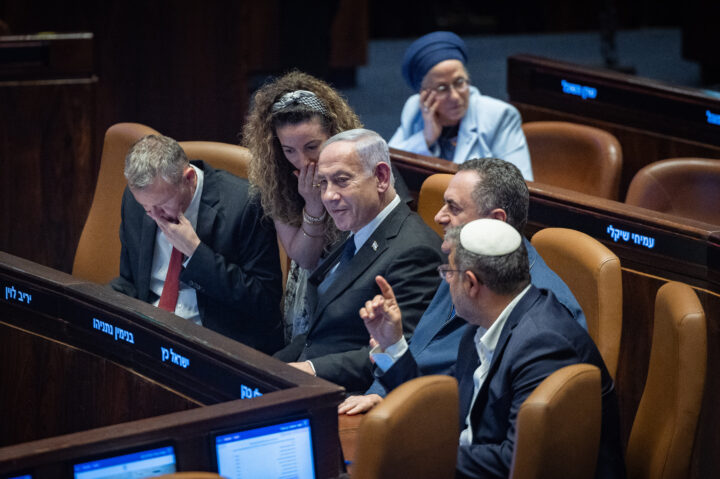
Yonatan Sindel/Flash90
A discussion and a vote on the expulsion of MK Ayman Odeh at the assembly hall of the Knesset, the Israeli parliament in Jerusalem, July 14, 2025.
New Israeli elections are unlikely to happen this year, despite the departure on Wednesday of two parties from Israeli Prime Minister Benjamin Netanyahu’s government over disagreements over Haredi military exemption legislation.
After months of disagreements, Ashkenazi Haredi faction United Torah Judaism left Netanyahu’s coalition in protest, leaving it with 61 out of the Knesset’s 120 seats. On Wednesday, Sephardic Haredi party Shas’ five Cabinet ministers quit the government, though party leader Aryeh Deri will remain an observer in the Security Cabinet.
Shas only quit the government — meaning their Cabinet posts — and did not pull its 11 lawmakers out of the parliamentary coalition. Shas, whose voter base is right-wing and even more supportive of Netanyahu than the prime minister’s own Likud party, said it will not vote with the opposition. This means that Netanyahu retains a majority in the Knesset, albeit a razor-thin one.
Opposition leader Yair Lapid still argued soon after Shas’ announcement that “starting today, Israel has a minority government. A minority government cannot send soldiers into battle … It has no authority, no right. It is an illegitimate government.”
“Israel does not have full-time welfare, health, interior, housing or labor ministers,” Lapid added. “The Netanyahu government is a minority government that endangers the care of Israel’s citizens.”
Both Haredi parties have been boycotting Knesset votes since April in protest over the Haredi conscription debate, in effect leaving the coalition with a minority and obstructing its ability to pass laws.
Israeli law only allows an early election to be called proactively, meaning that a Knesset member would have to propose a bill to disperse the legislature, followed by three separate votes on the issue. Opposition leaders held a vote last month on dispersing the Knesset, and under Israeli law are prevented from calling another such vote for six months unless 61 lawmakers sign a petition to the Knesset speaker.
Netanyahu’s government has time on its side, with the Knesset’s summer recess beginning on July 27 and the legislature’s voting schedule recommencing on October 19.
By law, the next election is set for Oct. 27, 2026, but the last time a Knesset election was held on its originally scheduled date was in 1988.
Shas and UTJ left the government over the ongoing political debate over legislation that would impose penalties on Haredi yeshiva students who do not enlist in the IDF. The parties’ Councils of Torah Sages have argued that religious study must be prioritized over serving in the military.
Israel has a mandatory military draft, but has historically exempted Arab citizens and Haredi yeshiva students from conscription. Governments on the left and right maintained the exemption for Haredim over decades, but Israel’s High Court of Justice struck it down in a series of rulings over more than 10 years, with no minor adjustments made by consecutive governments satisfying the justices’ standard of equality under the law. Last summer, the court ordered the Defense Ministry to send draft notices to young Haredi men.
Meanwhile, the 21 months of war in Gaza — with hundreds of thousands of Israelis serving in reserves, many of whom have served hundreds of days in active duty, leaving behind families and businesses — have increased the IDF’s manpower needs and the urgency to resolve the issue of Haredi conscription. Shas and UTJ’s allies on the Israeli right have moved away, in varying degrees, from tolerating the exemption for political expedience even as their own constituents serve in the IDF.
Knesset Foreign Affairs and Defense Committee chairman Yuli Edelstein, a Likud lawmaker, has been at the forefront of the dispute with the Haredi parties, refusing to advance legislation that does not satisfy the military’s needs, while Shas and UTJ demand that the bill institute little to no consequences for yeshiva students who do not serve in the IDF.
When announcing his resignation from the cabinet on Wednesday, Religious Services Minister Michael Malkieli said that penalizing yeshiva students for not serving is “no less than cruel and criminal persecution.”
Among the proposed sanctions are cutting daycare and housing subsidies afforded to the Haredi sector, prohibiting those who ignore conscription notices from receiving driver’s licenses or leaving the country, and, in some cases, arrest.
Edelstein reached a compromise over the sanctions with the Haredi parties in June, less than a day before the 12-day war with Iran began. However, the Haredim continued to boycott coalition votes in recent weeks, leading Edelstein to withdraw some of his concessions.
Speaking at a conference on Wednesday, Edelstein said that “this is not the time to bring down a right-wing government.”
He called on the Haredim to “bring a concrete proposal. For once, the Haredim should say what they agree to. My door is open; I promise to examine it quickly and hold negotiations.”
“For an entire year, they did not bring any concrete proposal for a conscription law,” Edelstein added. “In the moment of truth, they … made all kinds of excuses every time … It’s apparently not a question of the extent of the sanctions or the target [enlistment] numbers, but a total refusal to take part in the holy privilege … that is called the Israeli Defense Forces.”
Please log in if you already have a subscription, or subscribe to access the latest updates.
 Continue with Google
 Continue with Apple