

























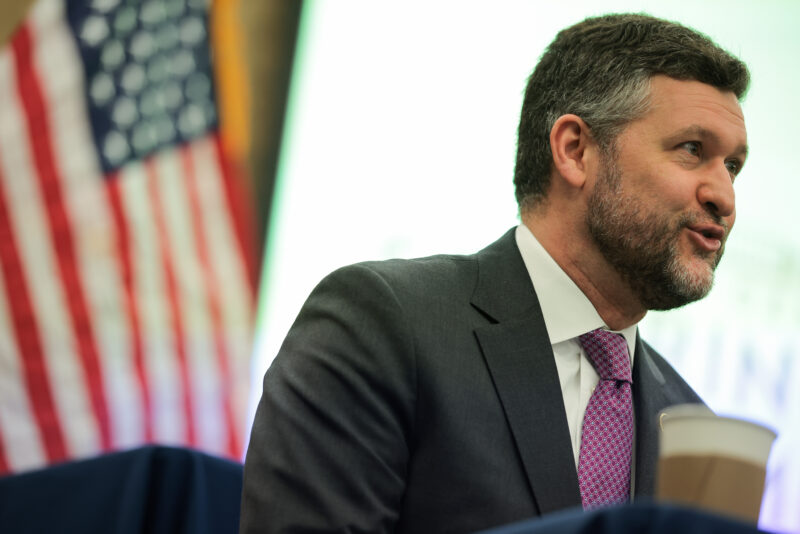

















The New York Republican praised the Pennsylvania Democrats’ responses to post-Oct. 7 campus antisemitism, arguing that most of their party failed to show similar leadership.

Kent Nishimura/Getty Images
Rep. Elise Stefanik (R-NY) testifies before the Senate Foreign Relations Committee on her nomination to be Ambassador to the United Nations on Capitol Hill on January 21, 2025 in Washington, D.C.


 Add JewishInsider on Google
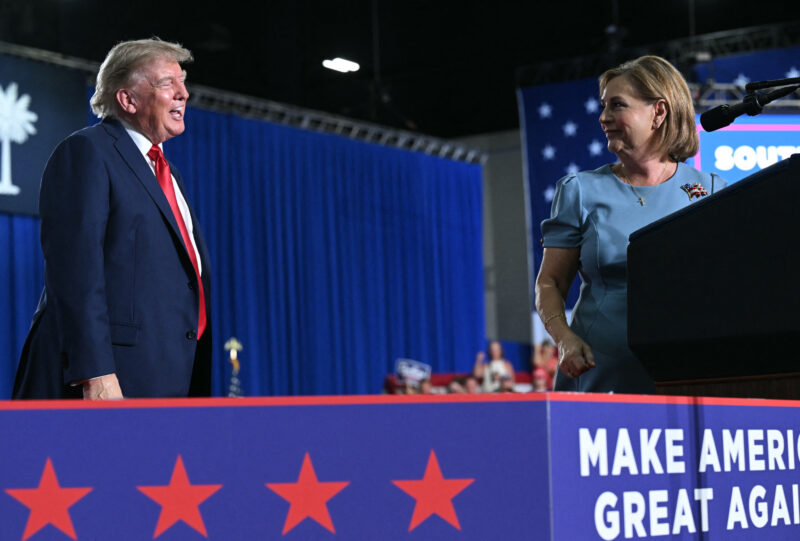
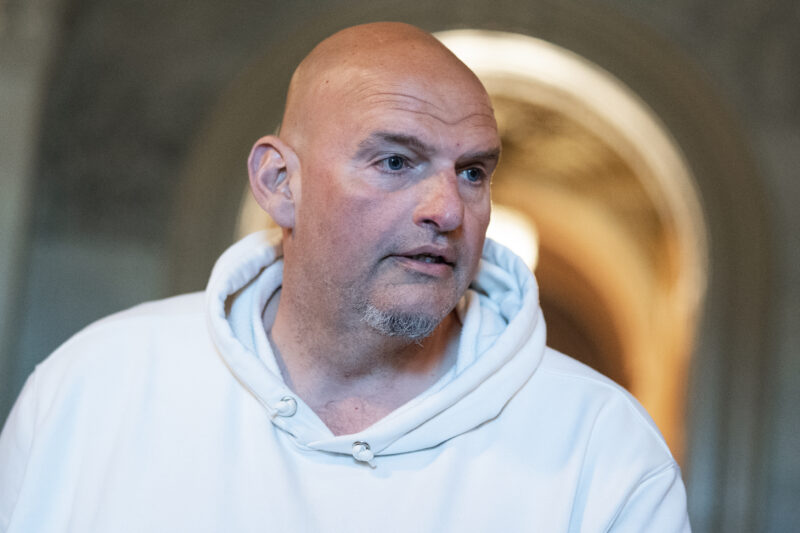
Rep. Elise Stefanik (R-NY) praised Pennsylvania Gov. Josh Shapiro and Sen. John Fetterman (D-PA) on Wednesday, arguing that both Democrats’ forceful condemnations of campus antisemitism after Hamas’ Oct. 7, 2023, attacks made them outliers in their party on the issue.
Speaking on a webinar with the Jewish Institute for National Security of America to discuss her book on campus antisemitism, Poisoned Ivies: The Inside Account of the Academic and Moral Rot at America’s Elite Universities, Stefanik noted Shapiro was a rare Democrat to call for the resignation of Liz Magill, the former University of Pennsylvania president, after she struggled to answer Stefanik’s questions during a December 2023 committee hearing on whether calling for the genocide of Jews constituted bullying or harassment. (Magill resigned days after the hearing amid mounting criticism of her testimony.)
“There’s a huge challenge within the Democrat Party right now with this rise of antisemitism. I do highlight in the book that Fetterman was a really important voice that condemned without hesitation,” Stefanik said. “Josh Shapiro, he was governor of Pennsylvania when this happened. Penn was among the worst, and you had very weak leadership from Liz Magill. He called for her resignation immediately as well.”
“There are a few examples, but that’s outside of the norm of the Democratic Party and what we’re seeing play out both in the public polling, but also in some of these primary elections,” she continued, referencing the increase in anti-Israel candidates who have won recent Democratic primary contests.
Stefanik suggested that a number of Democratic candidates had won recent primaries despite leading campus encampments themselves, though she did not specify anyone by name and it was not clear who she was referring to.
“It was only the House Republicans who conducted these hearings. The Senate at the time was controlled by Democrats. They didn’t have a single hearing on the crisis in higher education and the skyrocketing antisemitism. That, in and of itself, I think shows the lack of prioritization,” Stefanik said. “Politically, look at what’s happening in these Democrat primaries. You now have the leaders of the pro-Hamas encampments running for Congress and getting elected in these Democrat primaries. So, I make the case in the book that what happens on these campuses has a direct line into what’s happening politically.”
Schools that fail to institute required policies for two years would lose their federal funding
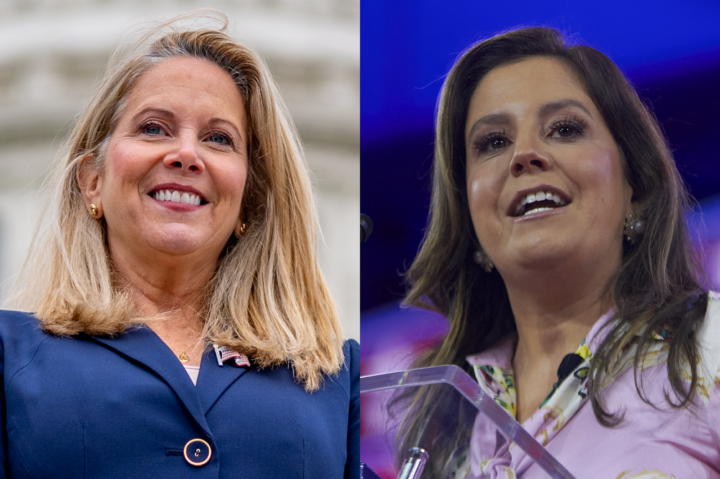
Andrew Harnik/Getty Images & DOMINIC GWINN via Getty Images
Laura Gillen (D-NY) and Reps. Elise Stefanik (R-NY)
Reps. Elise Stefanik (R-NY) and Laura Gillen (D-NY) this week introduced the Student Protection and University Accountability Act, which aims to compel schools to institute clear policies for addressing antisemitism and other forms of discrimination under Title VI of the Civil Rights Act, or face losing their federal funding if they fail to do so.
The bill requires schools to designate a specified Title VI coordinator and to develop clear procedures for investigating student complaints and publicize those procedures, as well as to publicly display guidance from the Department of Education on Title VI complaints.
The bill also requires schools to provide timely notifications to complainants if an investigation is opened or declined, and on the outcome of such an investigation, as well as create a system for maintaining records of complaints and how they were addressed.
Schools would be required to certify annually to the Department of Education that they are complying with these provisions, and would be ineligible for federal funding if they fail to comply for two years in a row.
The legislation also limits the circumstances under which the Department of Education’s Office for Civil Rights can dismiss Title VI complaints before they are fully investigated, and requires the department to brief Congress monthly on investigations and how it plans to address them.
Some of the bill’s provisions have been included in other antisemitism legislation, including the Jewish American Security Act, a bipartisan and bicameral package of measures to combat antisemitism. Some provisions also mirror regulations around Title IX, which addresses sex-based discrimination on campuses.
“The surge of antisemitism on college campuses since October 7th is shocking and unacceptable,” Gillen said in a statement. “Colleges and universities must be held accountable for enforcing civil rights and protecting all students from harassment and discrimination. I’m proud to co-lead this bipartisan bill to stop antisemitism and all forms of hate on campus.”
Stefanik did not respond to a request for comment.
Nathan Diament, the executive director of the Orthodox Union Advocacy Center, said the bill aims to ensure that antisemitism complaints are taken seriously and addressed.
“We appreciate Reps. Stefanik and Gillen’s leadership and effort to create actionable and enforceable policy surrounding Jewish students’ legally protected rights on campus,” Diament said. “Many university administrations give second-class status to complaints about antisemitism on campus and have ignored, dismissed, or dragged out those complaints with no resolution or accountability.”
“Passing the Student Protection and University Accountability Act will be a critical victory for Jewish students who have faced attacks and for any student experiencing discrimination under Title VI because it will compel university administrators to put proper procedures in place or automatically lose their eligibility for federal funds,” he continued.
Plus, Elise Stefanik on her new book and next moves
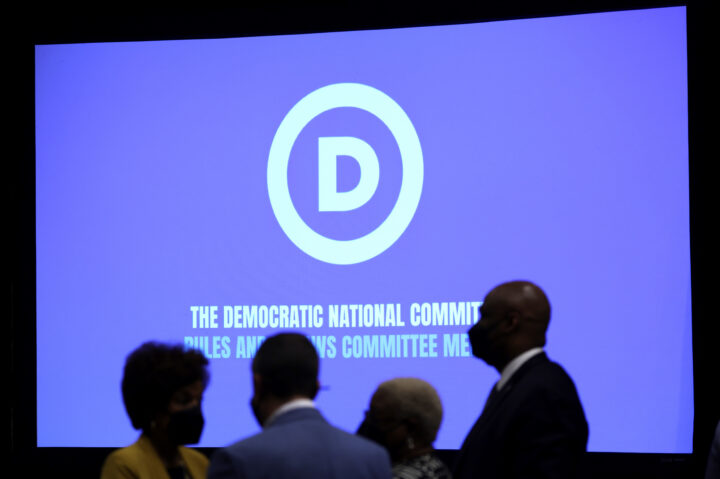
Alex Wong/Getty Images
Committee members wait for the beginning of a meeting of the Democratic National Committee’s Rules and Bylaw Committee in Washington, DC
Good Friday morning.
In today’s Daily Kickoff, we report on the social media activity of the incoming head of progressive campus advocacy group More Perfect University, who liked and shared content justifying Hamas’ Oct. 7, 2023, attacks, and talk to Rep. Elise Stefanik about her new book on higher education and post-Congress plans. We cover yesterday’s inaugural Brandeis Center conference on antisemitism at Harvard University, and have the scoop on a push by Senate lawmakersfor $750 million in security grant funding for next fiscal year. Also in today’s Daily Kickoff: Stephen Feinberg, Rom Braslavski and Matan Grinberg.
Today’s Daily Kickoff was curated by JI Executive Editor Melissa Weiss, with assists from Danielle Cohen-Kanik and Marc Rod. Have a tip? Email us here.
For less-distracted reading over the weekend, browse this week’s edition of The Weekly Print, a curated print-friendly PDF featuring a selection of recent Jewish Insider and eJewishPhilanthropy stories, including: ‘I dig it’: Graham Platner praised Hamas tactics in 2014 graphic video of killings of Israeli soldiers; From trauma to table: An Israeli duo uses food therapy and song to foster connection; and Former Rep. Eliot Engel, Foreign Affairs Committee chair and stalwart supporter of Israel, dies at 79. Print the latest edition here.
What We’re Watching
- The next round of U.S.-Iran talks could take place as soon as this weekend, President Donald Trump told reporters on Thursday, adding that “Iran wants to make a deal, and we’re dealing very nicely with them.” The president suggested earlier in the day that he could travel to Islamabad, Pakistan, for a signing ceremony if an agreement with Tehran is reached.
- We’re keeping an eye on the ceasefire between Israel and Lebanon that went into effect last evening. More below on the ceasefire and the Trump administration’s efforts to convene a summit with Israeli Prime Minister Benjamin Netanyahu and Lebanese President Joseph Aoun.
- U.K. Prime Minister Keir Starmer and French President Emmanuel Macron are co-chairing a virtual meeting today aimed at developing a postwar plan to deploy a multinational force to ensure secure transit through the Strait of Hormuz once the U.S. blockade of the waterway lifts.
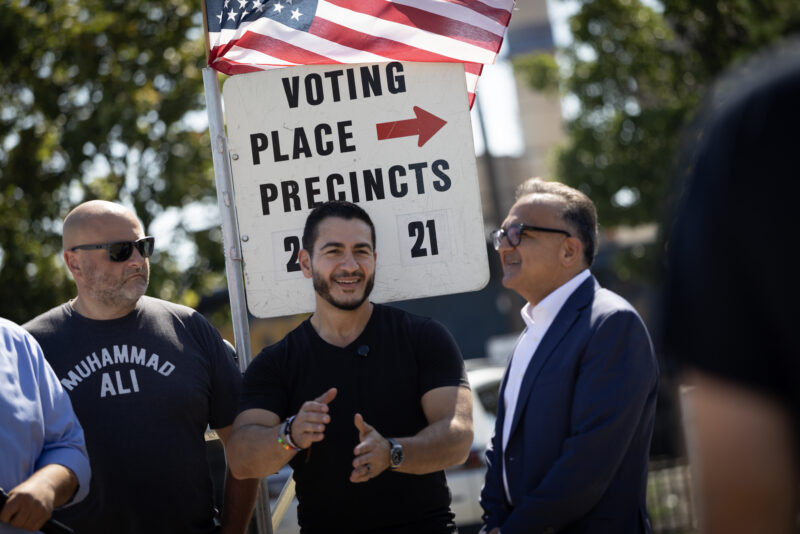
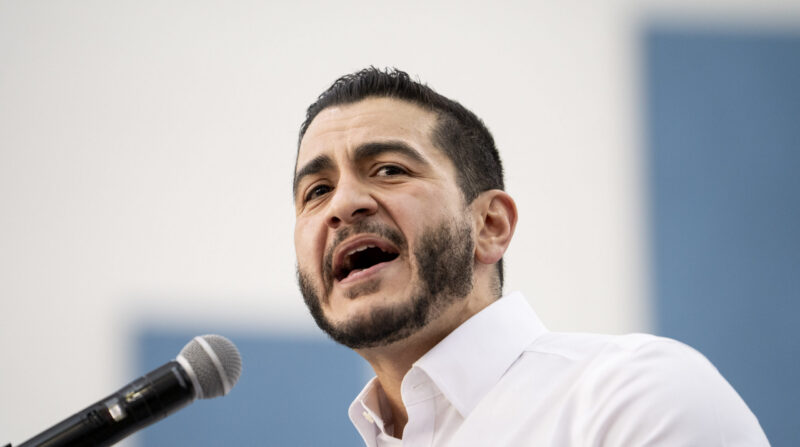
- The Michigan Democratic Party is holding its endorsement convention on Sunday, where the party will nominate a number of candidates, including its choices for the University of Michigan’s Board of Regents. Read our recent reporting on the regent race, in which Dearborn lawyer Amir Makled is seeking to unseat Jordan Acker, who is Jewish, over his support for Israel.
- On Sunday night, Rachel Goldberg-Polin will be interviewed by Anderson Cooper on CBS’s “60 Minutes” ahead of the release on Tuesday of her new book, When We See You Again, about grieving the death of her son, Hersh Goldberg-Polin, in Hamas captivity.
- Elsewhere on Sunday, Sen. Elizabeth Warren (D-MA) is slated to campaign with Maine Senate candidate Graham Platner, who earlier this week was revealed to have praised a deadly 2014 Hamas attack on an Israeli military base.
What You Should Know
A QUICK WORD WITH JI’S MARC ROD
The Democratic shift on Israel policy was on full, dramatic display on the Senate floor on Wednesday night as 40 of 47 Senate Democrats voted for at least one of two resolutions to block U.S. shipments of bulldozers and bombs to Israel.
The votes left many pro-Israel Democrats shocked and disillusioned — exemplified in the muted statements, if any, on the vote from key pro-Israel groups — and is being seen by some as the marker of a new era of Democratic policy on Israel, in which critics of Israel are firmly in the party mainstream.
“It’s yet another data point that the bipartisan consensus [in support of Israel] is, at least at the moment, no longer,” a former Biden administration official told Jewish Insider on Thursday. “Democrats think it’s politically advantageous to take these votes that would have been completely out-of-bounds just two-and-a-half years ago. … It’s deeply concerning if you care about the relationship, if you care about the security of [Israel]. But that’s the state of play at the moment, I think until or unless there’s an event that changes the trajectory.”
Abe Foxman, the former head of the Anti-Defamation League, said the vote highlights the “progressive socialist wing” of the Democratic Party’s increasing takeover. “This is a calamity for the Democratic Party, if it will not be contained and stopped,” Foxman told JI. “What’s also disturbing to me is that this litmus test is being first administered to every Jewish candidate.”
He added that the votes send a terrible message to U.S. allies beyond Israel that the U.S. can’t be relied upon.
SCOOP
Leader of More Perfect University liked posts justifying Oct. 7 terror attacks

Elise Joshi, a Gen Z activist and influencer who is taking the helm of a newly launched progressive campus advocacy group affiliated with the prominent left-wing media organization More Perfect Union, liked social media posts justifying the Hamas attacks of Oct. 7, 2023, and expressed similar sentiments in at least one now-deleted X comment, Jewish Insider’s Matthew Kassel reports.
Social media history: In one since-removed X comment from Oct. 7, 2023, for instance, Joshi suggested the Hamas attacks that killed 1,200 people and took more than 250 hostages were an act of justified resistance linked to a broader movement including violent efforts to oppose slavery, apartheid and colonialism. Joshi, who at the time was a recent graduate of the University of California, Berkeley, where she emerged as an outspoken youth activist with a sizable following on TikTok, also liked some comments posted on the day of the attack that expressed similar views, other screenshots show — including by one user who had asked, “What did y’all think decolonization meant? Vibes? Papers? Essays? Losers.”
partner posts
Mamdani dodges continued questions about wife’s extreme social media history

New York City Mayor Zohran Mamdani refused to speak directly to his wife’s inflammatory social media history, a day after First Lady Rama Duwaji indicated in an interview she regrets posting a racial slur online while in high school, but stopped short of apologizing for much more recent activity signaling support for Hamas’ Oct. 7, 2023, terror attacks, Jewish Insider’s Will Bredderman reports.
Playing defense: Mamdani refused to directly answer the question when pressed in person on Thursday, preferring instead to praise Duwaji personally. “You know, she shared some of her reflections in this interview. I won’t add much to them,” the mayor said following an unrelated City Hall press conference. “What I will say, however, is that she is someone of incredible integrity, she is someone I am lucky to be able to call my wife and that I am proud of her each and every day.”
CAMPUS SCRUTINY
Trump official defends controversial antisemitism probe of University of Pennsylvania
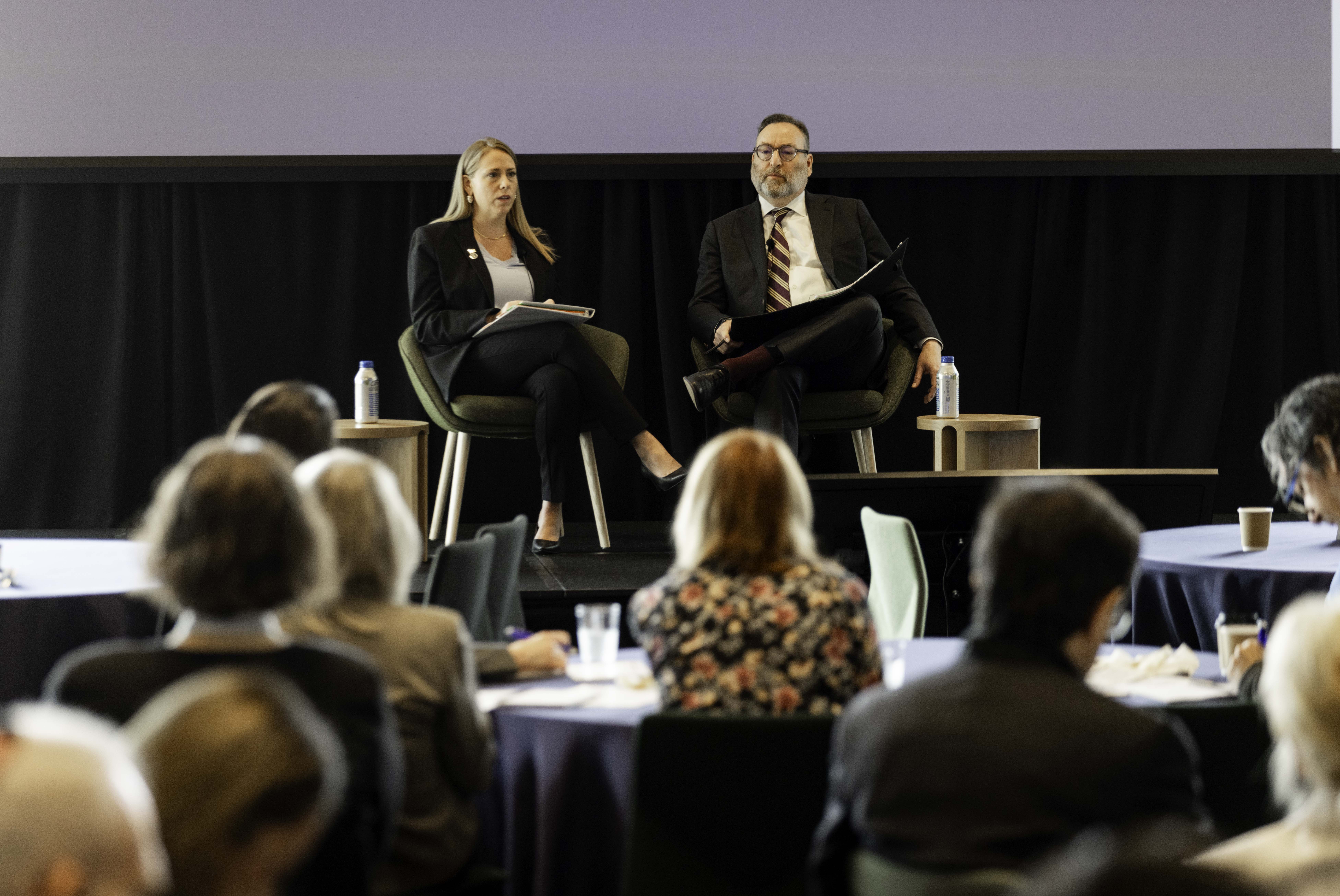
The Trump administration official leading a controversial probe into antisemitism at the University of Pennsylvania told Jewish leaders and legal experts on Thursday that compiling a list of Jewish faculty with their detailed personal information was necessary to identify and protect victims, Jewish Insider’s Haley Cohen reports from the Louis D. Brandeis Center for Human Rights Under Law’s inaugural conference on antisemitism and civil rights law, held at Harvard University. Last month, a federal judge ordered Penn to comply with a subpoena from the Trump administration requesting detailed information about Jewish university affiliates as part of the EEOC’s ongoing investigation into Penn’s handling of antisemitism.
Collecting names: “There is no other way to protect victims of harassment or discrimination unless you collect information about them,” Andrea Lucas, chair of the United States Equal Employment Opportunity Commission, said. “The EEOC’s long-standing practice is to collect personal information because we want to make sure that there is not any clear monitoring of your email systems … that when you speak to a government agency you feel completely not pressured.”
BOOKSHELF
Elise Stefanik showcases her fight against campus antisemitism in new book ‘Poisoned Ivies’

As she prepares to leave Congress next year, Rep. Elise Stefanik (R-NY) is out with a new book on campus antisemitism, Poisoned Ivies: The Inside Account of the Academic and Moral Rot at America’s Elite Universities, recounting her work in the fight that made her a household name in the American Jewish community and beyond, Jewish Insider’s Marc Rod reports. “We’re putting this [book] out in the world and helping set the tone for the type of leadership we need in New York and, frankly, across the country,” Stefanik told JI.
What she said: More than two years after the first House hearing with college presidents on campus antisemitism, Stefanik offered a mixed readout on how she sees the state of American higher education in an interview with JI this week, while praising the ongoing work of the Trump administration on the issue. She also largely dismissed the idea that antisemitism on the right is, or could become, a significant problem within the GOP, arguing that GOP voters reject it in a way that Democrats haven’t. And though she passed on a 2026 gubernatorial run, Stefanik seems to have longer-term plans in New York politics.
WAR UPDATE
Trump announces 10-day Israel-Lebanon ceasefire

President Donald Trump announced a 10-day ceasefire between Israel and Lebanon on Thursday, after holding separate calls with Lebanese President Joseph Aoun and Israeli Prime Minister Benjamin Netanyahu earlier in the day, Jewish Insider’s Danielle Cohen-Kanik reports.
Peace push: “These two Leaders have agreed that in order to achieve PEACE between their Countries, they will formally begin a 10 Day CEASEFIRE,” the president wrote on Truth Social. Trump added in a second post that he will be inviting Aoun and Netanyahu to the White House for “meaningful talks.” Netanyahu said in a statement that he had agreed to the ceasefire “to try and advance the agreement we began discussing during the meeting of ambassadors in Washington” on Tuesday, which were the highest-level discussions between Jerusalem and Beirut in over 30 years.
Bonus: Jewish Insider’s Matthew Shea talks to former U.S. officials, including former U.S. Ambassador to Israel Dan Shapiro and former Iran envoy Elliott Abrams, about Hamas’ rejection of the U.S.-led Board of Peace’s disarmament framework and failure to comply with key demilitarization deadlines.
SCOOP
Senate lawmakers push for $750 million in security grant funding for 2027

Saying that funding to protect synagogues and other religious-based nonprofits “has not kept pace to meet the moment,” 41 senators — almost exclusively Democrats — wrote to leaders of the Senate Appropriations Committee urging members to provide $750 million in funding for the Nonprofit Security Grant Program in 2027, Jewish Insider’s Marc Rod reports.
Increasing need: Last year, 33 senators requested $500 million for the program, a record-high request at the time. This year’s request represents a new high-water mark, both in terms of the funding requested and the number of lawmakers who signed the bipartisan letter in support. “The threat of violence is unfortunately increasing at places of worship across our country at alarming rates,” the lawmakers wrote, citing “an increase in hoax bomb threats and attacks against houses of worship that are intended to interrupt services and intimidate worshippers” in recent years, as well as “an increase in antisemitic incidents across the country following the October 7th attack on Israel.”
Worthy Reads
Let’s Do the Time Warp Again: The Atlantic’s David Brooks opines that modernism has unintentionally caused a “reversion to authoritarian strongmen,” rather than a move toward liberal democracy and expanded personal choice. “Maybe you’ve seen photos of Tehran in the 1970s, just before the Islamic Revolution: images of young women going to work in miniskirts, of couples making out in parks while wearing bell-bottoms, of people at pools in bikinis. It looks like Paris or Milan or Los Angeles. But in 1979 the revolution happened, and now Tehran looks like something from an earlier century. Sometimes I think that our whole world has become kind of like that — going backwards in time. The religious movements thriving in today’s secularized age are the traditionalist ones that dissent from large parts of contemporary culture — not only the Shiite Islam of post-revolution Iran, but Orthodox Judaism and conservative Catholicism.” [TheAtlantic]
Raw Deal: In The Washington Post, RedBird Capital partner Hamid Biglari, who left Iran in 1976, suggests that the Trump administration is making three rectifiable errors in its approach to talks with Iran: negotiating with the wrong representative, ignoring the Iranian public and misgauging Iran’s strategy of slow-walking conflict resolution. “Require a single reconciled text — English and Persian — before any point is treated as agreed upon. Embed automatic escalation triggers in the ceasefire agreement itself, removing the deliberation window that managed irresolution depends on. And make the Iranian population a formal variable: Tie sanctions relief to measurable civilian benchmarks, including restored internet access and a moratorium on political executions. And have reconstruction funds monitored by international bodies rather than IRGC-controlled banks.” [WashPost]
Kennedy Center Calamity: In The Atlantic, Josef Palermo, who until last month served as the Kennedy Center’s first curator of visual arts, reflects on the decisions made by the Trump administration and Ric Grenell, the center’s former acting director, to reform and restructure the institution, including doing away with its Israel Lounge. “Speaking at the opening reception [of an Oct. 7 commemoration event last fall], Grenell warned the mostly Jewish audience that unless donors came forward to sponsor the space and pay for renovation costs, the lounge would be given away to a new donor. ‘It certainly would be a shame if we lost this room to a corporation or an individual and it was no longer the [Israeli] lounge,’ he said. Such a strong-armed fundraising pitch, at an event commemorating a pogrom, struck many of us in the room as inappropriate. I was mortified.”[TheAtlantic]
Not Doing Israel’s Bidding: The Jerusalem Journal’s Avi Mayer posits that claims that Israel pulled the U.S. into war with Iran are factually inaccurate and play into antisemitic tropes. “The reality is that President Trump’s decision to launch the military campaign in Iran was driven by far more than any single ally’s wishes, and claiming otherwise betrays, at best, a lack of familiarity with either the facts or how consequential decisions are made by American presidents. … To focus on Israel’s role while ignoring all other factors and considerations is to ascribe to the Jewish state outsized, almost mystical influence over American policy — a modern echo of dark tropes from bygone eras.” [JerusalemJournal]
Word on the Street
Progressive organizer Analilia Mejia, an outspoken critic of Israel, easily defeated Republican Joe Hathaway in the special election in New Jersey’s 11th Congressional District on Thursday. With most of the vote counted, Mejia is leading Hathaway by 20 points (60-40%), a sizable margin that’s larger than Kamala Harris’ eight-point win in 2024 and Joe Biden’s 17-point win in 2020. But heavily Jewish precincts in Livingston and Millburn swung dramatically to Hathaway, an indication Mejia’s anti-Israel politics led to a Jewish voter backlash…
President Donald Trump said in a Truth Social post that he had initially tapped Joe Kent, the former head of the National Counterterrorism Center who resigned last month over the Iran war, to the position because he was “feeling sorry” for Kent, a failed two-time congressional candidate whose first wife had died in a 2019 Islamic State attack in Syria…
Trump is set to renominate Cameron Hamilton to serve as head of FEMA, a year after Hamilton was ousted from the role amid clashes with then-Homeland Security Secretary Kristi Noem and Corey Lewandowski, who served as a top advisor to Noem…
Trump announced the nomination of Dr. Erica Schwartz to be the next head of the Centers for Disease Control…
Defense Secretary Pete Hegseth warned on Thursday that U.S. forces are “maximally postured” to resume military operations in Iran, and specifically target energy infrastructure, should the country’s current leaders not agree to a negotiated settlement to end the war, Jewish Insider’s Emily Jacobs reports…
The New York Times looks at Vice President JD Vance’s efforts to build up donor support — including from Paul Singer and Dr. Miriam Adelson — ahead of a likely 2028 presidential run, as he serves as finance chair of the Republican National Committee — the first sitting vice president in the role…
The Wall Street Journal profiles Deputy Defense Secretary Stephen Feinberg, the former head of private-equity firm Cerberus Capital Management, as he works to shore up congressional support for the Trump administration’s proposed $1.5 trillion military budget…
The House narrowly voted to block a Democratic resolution to force an end to the war in Iran by a vote of 214-213-1, with all but one of the four Democrats who opposed a similar effort in March changing their votes to support it on Thursday, Jewish Insider’s Marc Rod reports…
The Atlantic’s Jonathan Chait argues that the only way the Democratic establishment can defend itself against the extremist Hasan Piker wing of the partyis to end American financial support for Israel; “If a Democratic president is going to succeed Donald Trump, not only must he or she emerge from a primary electorate that is likely to be highly skeptical of Israel, but the candidate must also win over a November electorate that is highly skeptical of foreign aid of any kind,” Chait writes…
The Wall Street Journal spotlights Factory co-founder and CEO Matan Grinberg, whose AI coding startup is in talks to raise $150 million in a funding round led by Khosla Ventures with backing from Sequoia Capital, Insight Partners and Blackstone…
Empire State Realty Trust Chairman and CEO Anthony Malkin met on Thursday in Doha with Sheikh Bandar bin Mohammed bin Saoud Al-Thani, the governor of Qatar Central Bank…
Patrick Drahi’s Sotheby’s made $53 million in pretax profits in 2025, after two years of losses, amid growth in the art market…
The Wall Street Journal looks at the new private schools being established in South Florida by business, tech and real estate titans, including Jeff Greene, Stephen Ross and Adam Neumann, as the area’s existing private schools struggle to meet growing demand…
Playbill announced the 2027 premiere of “Unorthodox,” a musical co-written by Benj Pasek, Shaina Taub and Joshua Harmon, which will debut in Boston next spring; the show follows the trajectories of a 17-year-old Haredi girl in Brooklyn and her grandmother 60 years earlier at approximately the same age…
A senior official in the U.K.’s Foreign Office resigned amid an investigation that found that the government allowed Peter Mandelson to serve as U.K. ambassador to the U.S. despite having failed the vetting process; a government spokesperson said this week that Prime Minister Keir Starmer was unaware recommendations against Mandelson by the U.K.’s security vetting team had been overruled…
Israel’s “Uvda” news program shared never-released footage of residents of Kibbutz Kfar Aza reuniting in the immediate aftermath of the Oct. 7, 2023, Hamas terror attacks…
The Palestinian Authority extradited to France a man accused of coordinating a deadly 1982 terror attack on a Jewish restaurant in Paris’ Le Marais district; Hicham Harb was one of four individuals sought in the aftermath of the attack, in which six people were killed…
Israeli Ambassador to France Joshua Zarka reportedly met this week with Marine Le Pen, the leader of the far-right National Rally party…
CNN spotlights Iranian cyberattacks on the United Arab Emirates and Bahrain, which skyrocketed following the onset of the war in February…
Former longtime New York City Councilmember Carol Greitzer, who spent her years in office working to protect Greenwich Village from gentrification and development, died at 101…
Wine of the Week

JI wine columnist Yitz Applbaum reviews the La Citadelle de Diamant Marius:
“To experience this mind-boggling Israeli wine, one whose roots run deep in French winemaking tradition, I traveled to Heckfield Place in Hook, England: a 5-star hotel, owned by my dear friend Dr. Gerold. The hotel is a world leader in farm-to-table dining, and its freshness and vitality mirrored the wine perfectly.
“La Citadelle de Diamant Marius is a blend of cabernet, merlot and shiraz, with grapes sourced from Moshav Nov, an angelic moshav in the Golan Heights. The opening bruises the palate with powerful tannins, a sign this wine has a long road ahead. The mid-palate reveals the deep earthiness of a true Bordeaux blend, and the finish is as elegant as the packaging is beautiful. It pairs brilliantly with grilled ChalkStream trout and has at least another seven years of life ahead of it.”
Pic of the Day

Former Israeli hostage Rom Braslavski (right), with Jerusalem Mayor Moshe Lion, took part in the annual International Jerusalem Winner Marathon in the Israeli capital this morning. Braslavski, who was freed from Hamas captivity in October, kicked off the marathon’s 10K race.
Birthdays
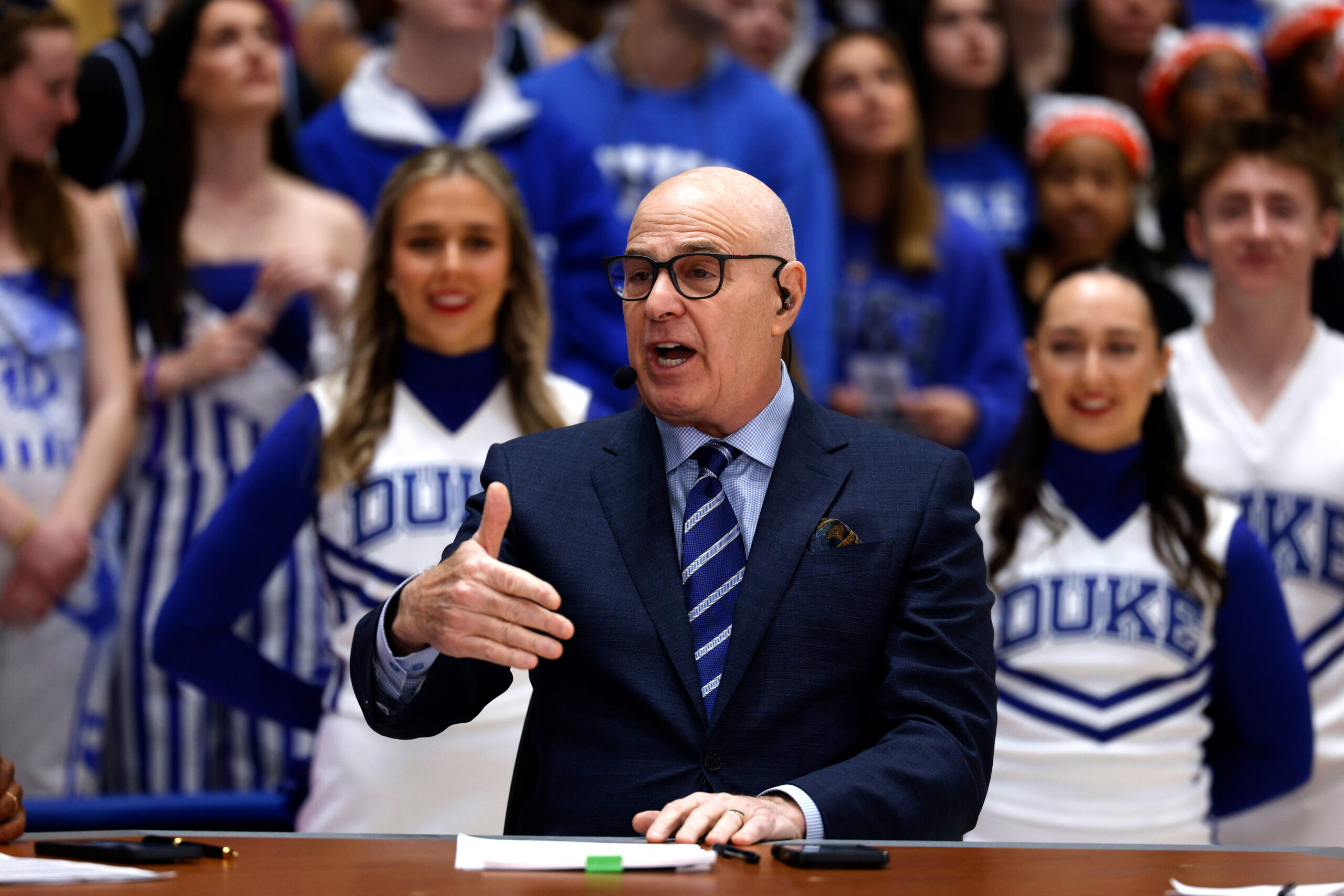
Former college basketball coach for 34 years, he is now an ESPN analyst, Seth Greenberg turns 70 on Saturday…
FRIDAY: Short story writer, novelist and essayist, Cynthia Ozick turns 98… Retired Los Angeles cardiologist and active Yiddish enthusiast, Dr. Martin Bobrowsky turns 86… NYU professor and noted legal scholar, he spent 38 years on the faculty of University of Chicago Law School, Richard Allen Epstein turns 83… Affiliate of Tel Aviv law firm Guy, Bachar & Co., Barry Schreiber… Official historian for Major League Baseball since 2011, he was born in a DP camp in Germany following WWII, John Abraham Thorn turns 79… Talk radio host best known for his work on NYC’s sports radio station WFAN, his nickname is “The Schmoozer,” Steve Somers turns 79… Rebbe and leader of the Pupa Hasidic group, Rabbi Yaakov Yechezkiya Greenwald turns 78… CEO of B’nai B’rith International, retiring at the end of June, Daniel S. Mariaschin turns 77… Dean of Beth Medrash Govoha in Lakewood, N.J., one of the largest yeshivas in the world with more than 9,000 students, Rabbi Aryeh Malkiel Kotler turns 75… French businessman, based in Geneva, he and his brother own the House of Chanel perfume company as well as holdings in vineyards and a thoroughbred horse racing stable, Gérard Wertheimer turns 75… Former member of the Rhode Island Senate, Joshua Miller turns 72… Elizabeth H. Scheuer… Israeli journalist for the daily Yedioth Ahronoth, Ben-Dror Yemini turns 72… Rabbi emerita, after 39 years, of Beth Hillel Temple in Kenosha, Wis., her brother is the former U.S. senator from Wisconsin, Russ Feingold, Dena Feingold… Co-founder and former CEO, now board member, of United Talent Agency (UTA), Jeremy Zimmer turns 68… Actress, screenwriter and film director, Daphna Kastner turns 65… Winner of two Super Bowl rings during his career with the San Francisco 49ers, he is now a physician and an inductee in the National Jewish Sports Hall of Fame, Dr. John E. Frank turns 64… Director of Rutgers University Press since 2016, following 15 years at Temple University Press, Micah Kleit turns 56… Professor of politics at NYU and longtime co-author of “The Monkey Cage,” a politics and policy blog at The Washington Post, Joshua A. Tucker turns 55… Congressional editor for The New York Times, she is also a political analyst for CNN, Julie Hirschfeld Davis turns 51… Member of the Alaska Legislature, first in the Assembly and then in the state Senate, Jesse Kiehl turns 50… Israeli actor, musician, director and television presenter, Ido Mosseri turns 48… Executive director at Morgan Stanley, Nadya Belenkiy… Deputy editor-in-chief at Semafor, Shelly Banjo… Southern California-based regional director at The Washington Institute for Near East Policy, Ora Miriam “Miri” Katz Belsky… Press secretary for Senate Minority Leader Chuck Schumer (D-NY), Angelo Roefaro… Wikipedia editor since 2004, having made at least one edit to one-third of all English Wikipedia articles, Steven Pruitt turns 42… Senior communications manager at the Center for Responsible Lending, Matt Kravitz… Partner at Bully Pulpit Interactive, Alex Kellner… Grammy Award-winning singer-songwriter, Avriel “Avi” Benjamin Kaplan turns 37… Former deputy national security advisor for strategic communications and speechwriting for then-VPOTUS Kamala Harris, Dean Lieberman… Member of the Baltimore City Council, Isaac “Yitzy” Schleifer turns 37… Deputy general counsel at the Missouri State Highway Patrol, Brian T. Earll turns 34… Offensive lineman for the NFL’s Tampa Bay Buccaneers for seven seasons, he retired in 2022 and is now pursuing a doctorate in psychology, Alexander “Ali” Marpet turns 33… Associate at Covington & Burling, Ahuva Neuberger…
SATURDAY: Chief rabbi of the Old City of Jerusalem until 2008, Rabbi Avigdor Nebenzahl turns 91… Senior counsel in the intellectual property law firm of Adwar Ivko, Philip Furgang turns 89… Former executive director of the American Civil Liberties Union for 23 years until 2001, Ira Saul Glasser turns 88… Biochemist, geneticist and winner of the Nobel Prize in Medicine in 1985, Joseph Leonard Goldstein turns 86… Partner and managing director of fundraising consulting firm Mirsky, Jaffe & Associates, Michael Jaffe turns 86… English barrister and arbitrator, his clients have included the British chief rabbi in a case which held that the rulings of the beit nin were not subject to judicial review, Michael Jacob Beloff turns 84… Corporate turnaround expert and mergers & acquisitions specialist, Jerry W. Levin turns 82… Los Angeles resident, Saul Bernstein… Former member of the Vermont state Senate and co-founder of Jogbra, the original sports bra, Hinda Miller turns 76… Former mayor of Phoenix for eight years after two terms on the Phoenix City Council, Phil Gordon turns 75… Composer, pianist and musicologist, Robert M. Greenberg turns 72… Pulitzer Prize-winning reporter and director of the Northeastern University School of Journalism, Jonathan Kaufman turns 70… Pulitzer Prize-winning journalist and author of four acclaimed books, Susan Faludi turns 67… Community leader in Detroit and former president of AIPAC, David Victor… Editor of Commentary magazine, John Mordecai Podhoretz turns 65… President and dean of Ohr Torah Stone institutions in Israel since 2018, prior to making aliyah he was a VP at Yeshiva University and rabbi of the Boca Raton (Fla.) Synagogue, Rabbi Dr. Kenneth R. Brander turns 64… VP and deputy general counsel at Scholastic Inc, he is a past president of Beth El Synagogue Center in New Rochelle, N.Y., Mark Seidenfeld… Executive director of the American Zionist Movement, Herbert Block… Emmy Award-winning actress known for her work on daytime television, Tamara Braun turns 55… Film director and producer associated with the horror genre, Eli Roth turns 54… Chabad rabbi, founder and executive director of the Aspen Chabad Jewish Community Center, Mendel Mintz turns 51… Poet, critic, translator and professor, Ilya Kaminsky turns 49… Under secretary of homeland security for strategy, policy and plans during most of the Biden administration, now partner at Ropes & Gray, Robert P. Silvers turns 46… VP for political campaigns and strategy for AIPAC’s Florida region, Evan Philipson… Dov Maimon…SUNDAY: A co-founder of Judea Reform Congregation, in Durham, N.C., Nancy Jean Warner Laszlo turns 90… Jocelyn’s father, Robert Brotman turns 89… Legal scholar and public intellectual, now a visiting professor at Cardozo School of Law, Stanley Fish turns 88… Prominent Israeli criminal defense attorney who also served as the attorney general of Israel, Yehuda Weinstein turns 82… Rebbi of the Vizhnitz Hasidic dynasty based in Bnei Brak, Israel, Rabbi Yisroel Hager turns 81… Head of strategic human resources at Elliott Investment Management, prominent philanthropist on the board of The Paul E. Singer Foundation, Tikvah Fund, Jewish Food Society and Startup Nation Central, Terry Kassel… Comedian, actress and mental health campaigner in the U.K., Ruby Wax turns 73… Investor and hedge fund manager, Jacob Ezra Merkin turns 73… VP of GEM Commercial Flooring Company in Kansas, Gloria Elyachar… Angel investment fund manager, he won three Super Bowls during his 12-year NFL career, Harris Barton turns 62… Law professor at Arizona State University and senior fellow at the Foundation for Defense of Democracies, Orde Félix Kittrie turns 62… Historian, author, screenwriter, political commentator and senior lecturer at the Hebrew University, Gadi Taub turns 61… Board chair of Prizmah: Center for Jewish Day Schools, Laurie Hasten… Israeli entrepreneur best known as the founder and former CEO of Better Place, an electric car company that raised $850 million yet was liquidated in a 2013 bankruptcy, Shai Agassi turns 58… Attorney general of Michigan, Dana Nessel turns 57… French stand-up comedian and actor, during 2019 he starred in “Huge in France,” an American comedy series on Netflix, Gad Elmaleh turns 55… Author of five books and a frequent columnist in The New Yorker, Rivka Galchen turns 50… Veteran journalist, Gil Hoffman turns 49… Award-winning film, television and theater actor, his official bar mitzvah was in 2015 at age 37, James Franco turns 48… Toronto-based entrepreneur, philanthropist, CEO and co-founder of Klick Health (a digital marketing firm in the medical field), Leerom Segal turns 47… Actress, author and fashion entrepreneur, she co-founded Fabletics (a fitness brand and membership program), Kate Hudson turns 47… Chief development officer at NYC’s Metropolitan Council on Jewish Poverty, Brian Tregerman… Rabbi, philosopher, poet, coach and entrepreneur, he writes a weekly Torah commentary on Substack, Zohar Atkins turns 38… Senior program officer at Schusterman Family Philanthropies, Seffi Kogen… Jake Gerber…
The New York Republican talked to JI about her leading role holding university presidents accountable
Kent Nishimura/Getty Images
Rep. Elise Stefanik (R-NY) testifies before the Senate Foreign Relations Committee on her nomination to be Ambassador to the United Nations on Capitol Hill on January 21, 2025 in Washington, D.C.
On Capitol Hill, Rep. Elise Stefanik (R-NY) has long been a vocal advocate for combating antisemitism and active on Middle East security issues. But it was her questioning at a December 2023 hearing that made her a household name in the American Jewish community and beyond, and drew her into the center of the unfolding fight on campus antisemitism.
“Does calling for the genocide of Jews violate [your school’s] code of conduct or rules regarding bullying and harassment?” Stefanik asked the presidents of Harvard, the University of Pennsylvania and the Massachusetts Institute of Technology.
Their equivocal responses, as disruptive and at times threatening anti-Israel protests were sweeping universities across the country, were a major factor in the resignations of two of those presidents and a slew of further hearings that put college presidents in the hot seat.
Now, as she prepares to leave Congress next year, Stefanik is out with a new book on campus antisemitism, Poisoned Ivies: The Inside Account of the Academic and Moral Rot at America’s Elite Universities.
More than two years after that first hearing — and after a tumultuous political period in which she saw her nomination as ambassador to the United Nations withdrawn before launching a short-lived New York gubernatorial campaign — Stefanik offered a mixed readout on how she sees the state of American higher education in an interview with Jewish Insider this week.
“In the year after the hearing, we saw that the universities failed to fix themselves and continued to dig deeper and deeper, and it was going to take significant administrative and legislative and frankly, appropriations action of withholding of funds, to force them to really reckon with what the American people saw loudly and clearly in that hearing, [which] is that there are deep-seated issues in higher education,” Stefanik said.
She said that there have also, however, been leadership changes at many of the universities that were probed by the House Committee on Education & the Workforce, in part because of those hearings, as well as overhauls such as the elimination of diversity, equity and inclusion programs at some schools.
“The other piece, I would say, is you’re seeing parents and students vote with their wallets and their feet,” such as the rising application and matriculation rates to schools like Vanderbilt University, which Stefanik has highlighted as having handled the post-Oct. 7, 2023, environment effectively.
The New York congresswoman argued that the hearings played a major factor in the reform efforts that followed. She also said that the Trump administration, even before it took office, has been sharply focused on the issue of campus antisemitism, coordinating closely with her office to help shape the administration’s lawsuits and executive orders on the issue.
Asked about anti-Israel and antisemitic voices in the Republican Party such as commentators Tucker Carlson and Candace Owens, Stefanik largely dismissed the idea that antisemitism was, or could become, a significant problem within the GOP.
“The difference between [New York City Mayor Zohran] Mamdani and those podcasters is Mamdani is elected to the most important city in the world as mayor, and those other names are not elected, and I think are often overstated [in] their influence,” Stefanik said. “They would not be elected to local office, to state office, to congressional office. That’s why I think it’s very important for actual elected officials, actual leaders, to speak out on issues of importance.”
She praised Trump for calling out Carlson and Owens and making clear that they don’t represent him or his voters, and argued that similar voices represent just a small fringe of Republican members in Congress.
Pressed on the fact that such voices represented a similarly small fringe of the Democratic Party in Congress a decade ago, Stefanik insisted that Republican voters would not embrace such voices.
“The Democrat[ic] Party — it’s a full blown takeover of Hasan Piker, of these voices that The New York Times is now embracing, and ‘Pod Save America’ is now embracing,” Stefanik said. “That is not the case on the Republican side. And as a candidate who actually has stood in front of the voters for the past decade-plus — yes, those voices can say what they want, you actually represent the people that elect you, and that’s not what voters in my district [want].”
Despite the relatively small share of Jewish voters in her district, Stefanik said that her work on campus antisemitism still receives some of the strongest praise from constituents.
Though the administration’s initial blitz of action on campus antisemitism has faded from the headlines, Stefanik said its efforts to address issues in higher education are ongoing, and that the issue also remains top-of-mind for the country at large.
“It’s not just about antisemitism,” she added. “This is broader higher education reform. … That was the canary in the coal mine issue that brought up so many broader issues that were wrong with higher education.”
In Congress, she said that more legislation should be brought to the floor on campus antisemitism, adding that she’s also hoping to work on reining in funding to colleges, cracking down on tax advantages and loopholes that benefit colleges and further limiting foreign funding and foreign student populations at U.S. institutions in her remaining months on the Hill.
She pointed to Qatar as one driver of antisemitism on campuses, and said that the U.S. should make clear to Doha that, if it wants to remain a military partner with the U.S., it “can’t foment and fund this anti-Americanism on college campuses, full stop.”
Stefanik isn’t yet sharing her next steps, but said she wrote her new book in part to serve as a historical record of antisemitism on college campuses, so that “mainstream media” can’t “brush this chapter under the rug.” She said she intends to continue shining a light on the issue.
Though she ultimately passed on a gubernatorial run, Stefanik seems to have longer-term plans in New York politics, and said that Republicans will be in a stronger position to win in the state in the coming years.
Regarding her decision to drop out of the governor’s race, Stefanik argued that the political environment is not currently ripe for a GOP victory, that Republicans need more time to build their statewide infrastructure and that Mamdani’s policies will grow more unpopular in the next few years.
“I think the Democrat Party is going to be increasingly taken over [by Mamdani-aligned socialists],” Stefanik said. “That, long-term, is where Republicans can win back those independents and traditional Democrats.”
Stefanik drew a direct line between the anti-Israel encampment at Columbia University and Mamdani’s election — both because Mamdani’s father is “very much part of this antisemitic petri dish” at Columbia and because “the same people that were organizing the pro-Hamas encampment at Columbia directly were boots on the ground for [his] campaign.”
She called herself “the leader” among state Republicans in pushing back against “socialist and Democrat single-party rule of New York State,” and highlighted that she has her own statewide political apparatus — separate from the statewide GOP, which she said lacks infrastructure.
“There is going to be a long road in rebuilding that infrastructure to save the state,” she said.
She also said she wanted to spend more time with her four-year-old son at this stage of his life.
“My voice is not going anywhere. If anything, it’s more. I mean, we’re putting this [book] out in the world and helping set the tone for the type of leadership we need in New York and, frankly, across the country,” Stefanik said.
The upstate Republican urged the Trump administration to look into possible use of federal funds for the 'Global Oppression and Public Health' working group

Kent Nishimura/Getty Images
Rep. Elise Stefanik (R-NY) testifies before the Senate Foreign Relations Committee on her nomination to be Ambassador to the United Nations on Capitol Hill on January 21, 2025, in Washington, D.C.
Rep. Elise Stefanik (R-NY) urged the Trump administration Thursday to investigate reports that a clique of ideologically driven staffers at the New York City Department of Health and Mental Hygiene had launched an anti-Israel “working group” inside the agency.
In a letter addressed to Health and Human Services Secretary Robert F. Kennedy Jr., the upstate lawmaker decried reports that employees had met during work hours at the city bureaucracy’s Queens headquarters.
Stefanik raised the possibility the department’s federal funding might have gone toward a prohibited political purpose — or that the gathering may have violated civil rights protections by creating a discriminatory environment for Jewish New Yorkers.
“The use of federal funds to support or tolerate government-sponsored activities that veer into ideological advocacy or that risk emboldening hate is a grave matter with civil rights and public safety implications,” Stefanik wrote.
The letter requested Kennedy’s agency probe four questions: whether any federal resources went toward enabling the working group, whether it created a hostile context for Jewish employees and service recipients, whether higher-ups in the agency were aware or approved of its establishment and activities and whether HHS action against the agency is appropriate. Stefanik further asked for a briefing within 30 days on the federal department’s findings.
Neither HHS nor the Mamdani administration immediately replied to requests for comment.
Asked about right-wing antisemitism, Blakeman said that Tucker Carlson ‘is a big blowhard who has an issue with Jewish people’
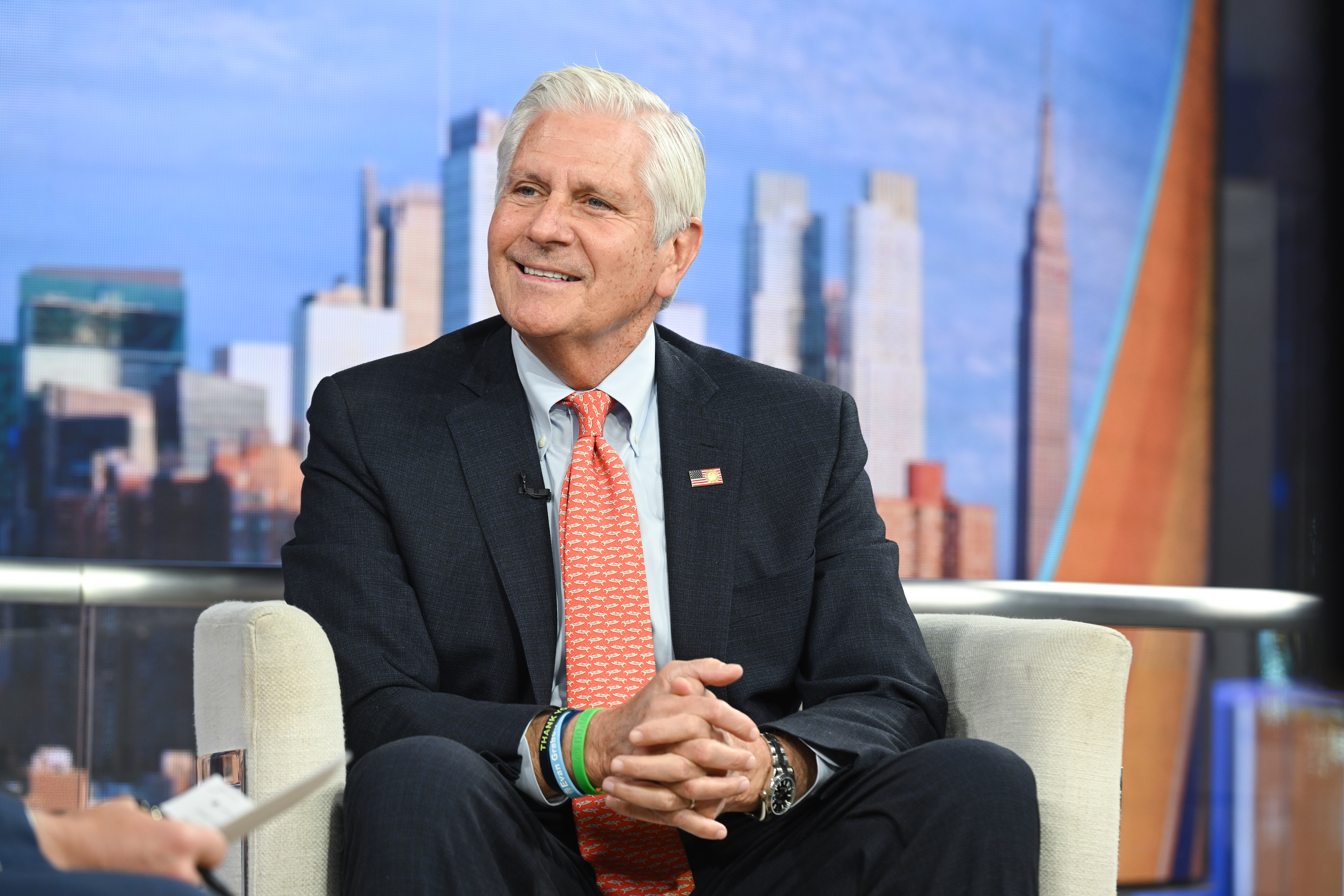
Noam Galai/Getty Images
Bruce Blakeman announces his run for New York governor on "Fox & Friends" at Fox News Channel Studios on December 09, 2025 in New York City. (
Nassau County Executive Bruce Blakeman suddenly emerged as the presumptive Republican nominee for governor of New York in December, with Rep. Elise Stefanik’s (R-NY) unexpected exit from the race against Gov. Kathy Hochul.
Now, with the formal endorsement of President Donald Trump, Blakeman is preparing for an uphill battle in a reliably Democratic state.
Blakeman, 70, is Jewish and said he represents the greatest number of constituents of any Jewish Republican elected official — more than 1.3 million. He vowed to protect the Jewish community statewide against antisemitism, and pledged that under his leadership, the state would step in if New York City Mayor Zohran Mamdani fails to do so.
Blakeman said that he has worked with the Nassau County police to deal with disruptive anti-Israel protests, setting firm rules for demonstrators, with prompt arrests if they stepped outside of those boundaries.
“If they got off the sidewalk, they would be given one chance to get back on it or they’d be arrested,” Blakeman said. “We didn’t take any nonsense. We didn’t allow them to do the things that they got away with in New York City. And that’s the same way I would approach it as governor.”
“Nick Fuentes is, in my opinion, a nut, but a dangerous one, and he has no place in the Republican Party,” Blakeman said. “Tucker Carlson is a big blowhard who has an issue with Jewish people, and it probably emanates from his chameleon-like personality. … He’s very unprincipled and I think he has biases that probably emanated from his youth.”
Blakeman said that if Mamdani fails to enforce the law, he would dispatch state police and national guard to do so. “We will not let any community be lawless, and I will not tolerate any acts of bigotry, antisemitism or racism in a state where I’m the governor.”
Asked about voices like Tucker Carlson and neo-Nazi influencer Nick Fuentes who are working to mainstream antisemitic ideas in the Republican Party, Blakeman did not mince words in his condemnation.
“Nick Fuentes is, in my opinion, a nut, but a dangerous one, and he has no place in the Republican Party,” Blakeman said. “Tucker Carlson is a big blowhard who has an issue with Jewish people, and it probably emanates from his chameleon-like personality. … He’s very unprincipled and I think he has biases that probably emanated from his youth.”
At the same time, Blakeman argued that he sees most antisemitism in the United States coming from the left, pointing to the large-scale turn against Israel in the Democratic Party.
“We have a couple of nuts in our party, but certainly [they are the] vast minority, and in the Democratic Party, it seems to me that they have completely abandoned Israel and that they are a hotbed for antisemitic activities,” Blakeman said.
He predicted those trends will help his campaign capture a significant number of Jewish Democratic voters who “realize that the Democratic Party has become an extreme party that’s hostile to Israel and hostile to Jewish people.”
He said he feels it’s important for the Republican Party to have “a strong Jewish presence” and that he takes his responsibility in that role seriously, saying he wants to be a “role model” for other Jewish people to get involved in GOP politics.
“I am a strong supporter of Israel,” Blakeman said. “I am a Zionist and a proud Zionist.”
“It’s something that I don’t take lightly as being a leader and someone who is a Jew and in the Republican Party,” Blakeman said.
Blakeman said he’s established a strong record as an ally and supporter of Israel in Nassau County, building business ties to Israel, implementing anti-Boycott, Divestment and Sanctions legislation and signing friendship agreements with what he called Judea and Samaria — the biblical term preferred by the Israeli government for the West Bank — and the Shomron Regional Council, a council of Israeli settlements in the West Bank.
“I am a strong supporter of Israel,” Blakeman said. “I am a Zionist and a proud Zionist.”
He said he’s currently under contract to buy an apartment in Beit Shemesh, as an investment.
Asked about the role his Jewish faith has played in his time in office and public life, the Nassau County executive responded, “Everything that I do emanates from the strength that’s given to me by Hashem, by God. So I am very mindful that it’s only with God’s blessings that I have the strength to do what I’m doing.”
“I ask for God’s blessings each and every day, and I pray every day, and I feel that having that spiritual connection with God is a very important part of my life,” he continued.
Blakeman said his campaign will focus on improving public safety, lowering prices for businesses and residents, making the state government more responsive and stopping the population flight from the state, issues he said are being driven by incumbent Gov. Kathy Hochul, a Democrat.
He framed Nassau County, under his leadership, as a counterpoint to those trends, pointing to the county’s low taxes and strong financial position. “If we can do that on the state level, I’m sure people will be happy. They’ll want to do business here. They want to live here, and they will flourish and prosper.”
“I want to make people happy. I want them to be proud of New York. I want them to want to raise their children and their grandchildren,” Blakeman said.
He said that his past victories in a Democratic-leaning county provide a model for winning statewide in deep-blue New York, arguing that he’s been able to reach populations that haven’t traditionally voted Republican, including Hispanic, Latino, Asian American, women and African American voters.
Asked about Mamdani’s victory in New York City, Blakeman said that Mamdani’s focus on affordability “struck a note with a lot of voters,” but New York City Republicans “didn’t have an adequate message with respect to that issue — and I do.”
Blakeman said he wants to create jobs and make the state more prosperous, rather than providing “a free bus ride or a handout,” spurring economic development and job creation in collaboration with the business community and unions.
The move by the prominent Republican, who gained attention for her grilling of university presidents amid federal inquiries into campus antisemitism, comes a month after she entered the race
Kent Nishimura/Getty Images
Rep. Elise Stefanik (R-NY) testifies before the Senate Foreign Relations Committee on her nomination to be Ambassador to the United Nations on Capitol Hill on January 21, 2025 in Washington, D.C.
Rep. Elise Stefanik (R-NY) announced on Friday that she was ending her campaign for governor of New York, an abrupt and unexpected move that comes just over a month after the Republican congresswoman launched her bid to unseat Gov. Kathy Hochul.
In addition to not running for governor, Stefanik said in a statement posted to social media that she also would not seek reelection to her House seat, making her future plans unclear. Stefanik said the decision to end her short-lived gubernatorial bid was based on her desire to spend more time with family and the uphill battle she would face in the general election after what would likely be a bruising Republican primary battle.
“While spending precious time with my family this Christmas season, I have made the decision to suspend my campaign for Governor and will not seek re-election to Congress. I did not come to this decision lightly for our family,” Stefanik wrote on social media.
Stefanik added, “As we have seen in past elections, while we would have overwhelmingly won this primary, it is not an effective use of our time or your generous resources to spend the first half of next year in an unnecessary and protracted Republican primary, especially in a challenging state like New York.”
“And while many know me as Congresswoman, my most important title is Mom. I believe that being a parent is life’s greatest gift and greatest responsibility,” she continued. “I have thought deeply about this and I know that as a mother, I will feel profound regret if I don’t further focus on my young son’s safety, growth, and happiness — particularly at his tender age.”
Stefanik’s withdrawal from the race came weeks after Nassau County Executive Bruce Blakeman, another close ally of President Donald Trump, jumped into the GOP primary, setting up a competitive fight ahead of what would be a difficult general election contest for Republicans in the blue state.
Stefanik was briefly Trump’s nominee to be U.S. ambassador to the United Nations, though she withdrew her nomination as it became clear that House Speaker Mike Johnson (R-LA) could not afford another vacancy in the House without risking Republicans’ already slim majority.
Trump said in a statement on his Truth Social platform after Stefanik announced her decision, “Elise is a tremendous talent, regardless of what she does. … She will have GREAT success, and I am with her all the way!”
Johnson, meanwhile, wrote on X, “I know this was a tough decision for my friend and colleague @EliseStefanik, but her resolve to put family first is one that everyone will respect. Elise is an exceptional talent who has served the people of New York valiantly in Congress.”
“She will continue to be [a] leading force for our party and its principles no matter what the next chapter brings,” he added. “We are grateful for her service and wish her well in her next endeavors.”
The upstate New York lawmaker, a pro-Israel stalwart in Congress, had said during her confirmation process earlier this year that anti-Israel and antisemitic bias at the U.N. was a major factor that drove her interest in the Turtle Bay role. As she began considering entering the governor’s race this fall, Stefanik became a vocal critic of Hochul, frequently tying her to New York City Mayor-elect Zohran Mamdani and his policies.
Stefanik has gained attention in the Jewish community in the two years since Hamas’ Oct. 7, 2023 attack on Israel, most notably due to her aggressive questioning of university presidents about campus antisemitism.
To mark the second anniversary of the Oct. 7 attacks in Israel, the Jewish Insider team asked leading thinkers and practitioners to reflect on how that day has changed the world. Here, we look at how Oct. 7 changed higher education

JOSEPH PREZIOSO/AFP via Getty Images
Tents and signs fill Harvard Yard in the anti-Israel encampment at Harvard University in Cambridge, Massachusetts, on May 5, 2024.
The texts from Claire Shipman, published in a letter by the House Education Committee, call a Jewish board member a ‘mole’ and ‘extremely unhelpful’

Alex Wong/Getty Images
Acting Columbia University President Claire Shipman testifies before the House Committee on Education & the Workforce at Rayburn House Office Building on April 17, 2024 in Washington, DC.
Text messages obtained by the House Committee on Education and Workforce published in a letter on Tuesday revealed that Claire Shipman, acting president of Columbia University, suggested that a Jewish trustee should be removed over her pro-Israel advocacy and called for an “Arab on our board,” amid antisemitic unrest that roiled the university’s campus last year.
“We need to get somebody from the middle east [sic] or who is Arab on our board,” Shipman, then the co-chair of Columbia’s Board of Trustees, wrote in a message to the board’s vice chair on Jan. 17, 2024. “Quickly I think. Somehow.”
Shipman said in a follow-up message days later that Shoshana Shendelman, a Jewish board member who frequently condemned campus antisemitism, had been “extraordinarily unhelpful” and said, “I just don’t think she should be on the board.”
In another communication on April 22, 2024, according to the texts obtained by the committee, Wanda Greene, vice chair of the board of trustees, asked Shipman — referring to Shendelman — “do you believe that she is a mole? A fox in the henhouse?” Shipman agreed, stating, “I do.” Greene added, “I am tired of her.” Shipman agreed, “so, so tired.”
The messages were referenced in the letter, first obtained by Free Beacon, sent to Columbia on Tuesday by the committee’s chairman, Tim Walberg (R-MI), and Rep. Elise Stefanik (R-NY) as part of the committee’s ongoing investigation into whether the school is violating Title VI of the Civil Rights Act of 1964 by allowing harassment of Jewish students.
The lawmakers wrote in the letter, which was addressed to Shipman, “These exchanges raise the question of why you appeared to be in favor of removing one of the board’s most outspoken Jewish advocates at a time when Columbia students were facing a shocking level of fear and hostility.”
Columbia responded to the letter, in a statement to Free Beacon, claiming that the text messages were taken out of context.
“These communications were provided to the Committee in the fall of 2024 and reflect communications from more than a year ago,” the university said. “They are now being published out of context and reflect a particularly difficult moment in time for the University when leaders across Columbia were intensely focused on addressing significant challenges.”
Shipman, a former ABC News reporter, stepped into the role in March after interim President Katrina Armstrong’s abrupt resignation. At the time, Stefanik called the choice of Shipman “untenable.” On campus, the news of Shipman’s hiring was met with cautious optimism from pro-Israel student leaders.
Last April, Shipman testified at a congressional hearing regarding antisemitism at Columbia alongside then-Columbia President Minouche Shafik, who resigned from her post in August, and board co-chair David Greenwald. Shipman told members of the House Committee at the time that she knew Columbia had “significant and important work to do to address antisemitism and to ensure that our Jewish community is safe and welcome.”
The lawmakers accuse Harvard researchers of working with Chinese academics on research funded by an entity chartered by Iran

Andrew Lichtenstein/Corbis via Getty Images
Harvard Yard during finals week, December 13, 2023 in Cambridge, Mass.
A group of top House Republicans wrote to Harvard University on Monday, questioning the school about alleged work on research funded by the Iranian government, as well as members of the Chinese government.
The letter accuses Harvard researchers of working with Chinese academics on research funded by the Iranian National Science Foundation, an entity chartered by the Iranian government and ultimately controlled by the Iranian supreme leader.
It states that such work occurred at least four times since 2020, as recently as last year.
The letter was signed by Reps. John Moolenaar (R-MI), Tim Walberg (R-MI) and Elise Stefanik (R-NY). Moolenaar is the chair of the Select Committee on the Chinese Communist Party, Walberg chairs the Education and Workforce Committee and Stefanik is the chair of House Republican Leadership.
“As you may know, under the Iranian Transactions and Sanctions Regulations, the Office of Foreign Assets Control has specifically disallowed transactions incident to publication when they involve the Iranian government and its instrumentalities,” the letter reads. “This funding from an Iranian government agent raises serious concerns and may violate U.S. law.”
The lawmakers emphasized that the 2024 research took place following the imposition of wide-ranging U.S. sanctions on Iran, after Iranian proxies killed U.S. servicemembers and in the midst of intense U.S. government attention on Iran’s malign activities.
They requested a list of all collaborations between Harvard affiliates and anyone receiving funding from the Iranian government or Iranian government entities.
The letter as a whole focuses primarily on alleged connections between Harvard and Chinese researchers and programs, characterizing such work as a national security threat.
Harvard did not immediately respond to a request for comment.
Rep. Elise Stefanik is floating a run for governor, joining Rep. Mike Lawler, who has also been seen as planning to run for the state’s top job

DOMINIC GWINN via Getty Images
New York Republican Rep. Elise Stefanik during the 2024 Conservative Political Action Conference the Gaylord National Convention Center in Fort Washington, Maryland, Friday, Feb. 23, 2024.
The New York Republican gubernatorial primary could pit two lawmakers popular in the Jewish community — Reps. Elise Stefanik (R-NY) and Mike Lawler (R-NY) — against each other.
Lawler has long been seen as a likely GOP candidate, but Stefanik’s potential entry comes as more of a surprise, weeks after President Donald Trump asked her to withdraw her nomination to be U.S. ambassador to the United Nations.
Both lawmakers have been stalwart advocates on issues of concern within the Jewish community. Stefanik has been an outspoken supporter of Israel and aggressively questioned college presidents about antisemitism during House Education and Workforce Committee hearings in 2023.
Lawler leads the House Foreign Affairs Committee’s Middle East subcommittee and has also been among the House’s most vocal supporters of Israel and opponents of antisemitism, passing multiple bipartisan bills on the issues. He represents one of the nation’s most Jewish districts in the New York City suburbs, which is also a swing seat.
Stefanik appeared to lean into the speculation — first raised in an NBC News article on Wednesday and confirmed by other outlets — with a campaign press release attacking New York Gov. Kathy Hochul and highlighting a poll showing a majority of New Yorkers do not want Hochul to seek reelection.
“This latest bombshell polling proves what every New Yorker already knows: that we must FIRE Kathy Hochul in 2026 to SAVE NEW YORK. Hochul is the Worst Governor in America and it’s not even close,” Stefanik said in the release. “This polling shows that we can WIN & SAVE NEW YORK.”
A campaign spokesperson did not respond to a request for comment about the possibility of a primary against Lawler. Lawler did not rule out the possibility of a primary against Stefanik, but also praised her.
“Elise Stefanik has been a powerful leader in the House, where she maintains a strong and important role in leading our conference. We both agree that Kathy Hochul is the worst Governor in America, bar none,” Lawler said in a statement to Jewish Insider. “In 2026, New Yorkers have a chance to elect a strong, competent leader to move the state in a better direction. In the coming months the process will play out to ensure that Republicans have the strongest candidate possible.”
Given her long record in Congress, fundraising prowess and close ties to President Donald Trump as a former cabinet nominee and vocal defender of him in GOP leadership, Stefanik would likely have the edge in the GOP primary.
Amid the speculation, Trump posted on Truth Social, “Congresswoman Elise Stefanik is GREAT!!!” suggesting she’d be well-positioned to receive his endorsement.
But Lawler’s more moderate profile and willingness to reach across the aisle and distance himself from Trump at times could prove an asset in the general election, with swing voters and persuadable Democrats wary of voting for an ardent Trump supporter.
He has twice proven his electoral mettle by winning a district that both former President Joe Biden and former Vice President Kamala Harris carried in their presidential campaigns.
Congressional Republicans would be happy to see Lawler remain in Congress; his departure would make winning his seat more difficult, while Stefanik’s upstate district is more favorable to Republicans. But Stefanik is also a member of House Republican leadership.
On the other side of the aisle, Rep. Ritchie Torres (D-NY), another favorite of the Jewish community, has openly mused about a gubernatorial run against Hochul in the Democratic primary.
Claire Shipman, a former ABC News correspondent, was elevated to the school’s top job at a time of historic turmoil
Alex Wong/Getty Images
Acting Columbia University President Claire Shipman testifies before the House Committee on Education & the Workforce at Rayburn House Office Building on April 17, 2024 in Washington, DC.
After Columbia interim President Katrina Armstrong’s abrupt resignation on Friday, several of the university’s congressional antagonists quickly jumped in to criticize Armstrong’s successor, former ABC News journalist Claire Shipman, the co-chair of Columbia’s board.
Rep. Virginia Foxx (R-NC), the former chair of the House Education Committee, said that Shipman’s tenure as interim president would be “short-lived.” Rep. Elise Stefanik (R-NY), freshly returned to Capitol Hill after President Donald Trump withdrew her nomination to be U.N. ambassador, called the choice of Shipman “untenable.”
But a different reaction came from the White House: subtle praise. The Trump administration’s antisemitism task force called Columbia’s Friday night actions an “important step,” which an administration official confirmed to Jewish Insider was in reaction to Shipman’s appointment. News reports last week indicated that days before her resignation, Armstrong had promised the Trump administration she would enforce a mask ban on campus while telling faculty privately that she would not.
On Columbia’s campus, the news of Shipman’s hiring was met with cautious optimism from pro-Israel student leaders.
“We’re in desperate need of strong leadership willing to make the deep-seated reforms necessary to save the university at this pivotal moment,” said Eden Yadegar, a senior studying Middle East studies and modern Jewish studies who last year testified before Congress about the antisemitism she has faced on Columbia’s campus. Yadegar declined to elaborate on whether she believes Shipman will bring about those reforms.
Lishi Baker, a junior studying Middle East history and co-chair of the campus Israel advocacy group Aryeh, also said he would take a wait-and-see approach to Shipman. Baker expects university leadership to bring “deep structural and cultural changes at Columbia [that] are necessary to restore our campus to its primary mission of teaching, learning, and research,” he said.
“Some of these changes can happen immediately and some will take longer,” Baker told JI.
The university’s Hillel director, Brian Cohen, praised Shipman in a statement to JI, saying that she “is deeply committed to Columbia University and has consistently demonstrated concern for the well-being and needs of its Jewish community.”
“I look forward to working with her in this new role,” Cohen said.
Major Jewish organizations have largely avoided weighing in on Shipman’s appointment. The Anti-Defamation League told JI that it was “too early.”
Shipman, a veteran reporter and author with no academic leadership experience, has publicly stood by the university’s leadership as co-chair of Columbia’s board of trustees in response to the antisemitism that exploded on campus after the Oct. 7, 2023, Hamas attacks and ensuing war in Gaza.
From the beginning of her tenure, Shipman will be contending with a complex campus landscape: Many liberal faculty and students are angry about the university’s decision to acquiesce to Trump’s demands as a way to regain access to $400 million in federal funding that his administration pulled in March, citing Columbia’s failure to properly address antisemitism.
She will also face a tough negotiating partner in Washington, and pressure from Jewish students and alumni to take a stronger stance against a campus culture in which anti-Israel protests have thrived, with little consequences for rule-breaking activists until recently.
“In an existential crisis, they need to collaborate and to be candid in the exchanges with the Trump administration and what they’ll do, and they need to stick with that,” Mark Yudof, former president of the University of California, offered as advice for Shipman. “You need good faith implementation of what you agree with with the administration, that you’re not looking for loopholes.”
In a message sent to the Columbia community on Monday, Shipman expressed a desire to meet with people across Columbia’s campus as she navigates this “precarious moment” for the university. She did not reference the circumstances of her appointment, nor did she discuss antisemitism on campus, although she hinted at the seriousness of the task before her.
“My request, right now, is that we all — students, faculty, staff and everyone in this remarkable place — come together and work to protect and support this invaluable repository of knowledge, this home to the next generation of intellectual explorers, and this place of great and continuing promise,” Shipman wrote.
Last April, Shipman testified at a congressional hearing about antisemitism at Columbia alongside then-Columbia President Minouche Shafik, who resigned from her role in August, and board Co-Chair David Greenwald. Shipman told members of the House Committee on Education and Workforce that she knows Columbia has “significant and important work to do to address antisemitism and to ensure that our Jewish community is safe and welcome.”
The hearing generally avoided the splashy headlines that followed testimony from the presidents of Harvard and the University of Pennsylvania in December 2023. (Shipman reportedly described that hearing as “capital [sic] hill nonsense,” according to a congressional report published in October.)
But her Capitol Hill appearance with Shafik and Greenwald was followed by the erecting of Columbia’s anti-Israel encampment — the first such protest in the country, which touched off dozens of others. Columbia’s response to the encampment earned criticism from bipartisan lawmakers, even as Shipman and her fellow board members stood by Shafik’s handling of the protests, which turned violent when students occupied a campus building.
Choosing a university president from outside of academia is an unusual choice, even for an interim position. Shipman, who grew up in Columbus, Ohio, graduated from Columbia College in 1986 and returned to earn a master’s degree from Columbia’s School of International and Public Affairs in 1994. She reported from Moscow for CNN, covered the Clinton administration at NBC News and spent 15 years covering politics and international affairs at ABC News.
Shipman, notably, also spent time earlier in her career covering the Israeli-Palestinian conflict on assignment in the Middle East.
Shafik is the fourth Ivy League president to step down in the last year amid growing antisemitism and anti-Israel activism at elite universities

Indy Scholtens/Getty Images
Columbia University President Minouche Shafik visits Hamilton Hall on the campus of Columbia University on May 1, 2024 in New York City.
Columbia University President Minouche Shafik announced her resignation on Wednesday, days before the start of the school year — and months after the end of a chaotic school year that saw her testify before Congress about antisemitism and navigate the unruly fallout of the first anti-Israel encampment in the nation.
Dr. Katrina Armstrong, CEO of Columbia’s Irving Medical Center, will serve as interim president, a university spokesperson confirmed to Jewish Insider. A source familiar said Armstrong has already been in touch with Hillel leadership at Columbia.
News of Shafik’s resignation was first reported by the Washington Free Beacon’s Eliana Johnson. Shafik is the fourth Ivy League president to step down in the last year amid rising anti-Israel activism on campuses, following the University of Pennsylvania’s Elizabeth Magill, Harvard’s Claudine Gay and Cornell University’s Martha Pollack.
“I have had the honor and privilege to lead this incredible institution, and I believe that — working together — we have made progress in a number of important areas,” Shafik, who only started in the role in July 2023, wrote in an email to the Columbia community.
“However, it has also been a period of turmoil where it has been difficult to overcome divergent views across our community. This period has taken a considerable toll on my family, as it has for others in our community. Over the summer, I have been able to reflect and have decided that my moving on at this point would best enable Columbia to traverse the challenges ahead,” she wrote.
Following the Oct. 7 Hamas attacks, Columbia, like other American universities, saw an uptick in antisemitism and targeting of Zionist students. But in an April hearing before the House Education and the Workforce Committee, Shafik avoided the kind of viral moment that dogged her colleagues at the University of Pennsylvania, Harvard and the Massachusetts Institute of Technology.
But when she went back to Manhattan, she faced the first anti-Israel encampment at an American university. Her decision to call in the police to break up the demonstration set off a wave of anger among many students and faculty members on campus and sparked dozens of other solidarity encampments at other universities.
From there, her leadership was under a microscope. Following a number of antisemitic incidents related to the encampment, several members of Congress from both parties went to Columbia to speak to Jewish students and show solidarity.
In a statement, the Anti-Defamation League said it is “saddened that the leadership of another flagship university has crumbled under the weight of antisemitism on its campus,” calling on the school to move quickly to fill the leadership vacancy before the fall semester.
House Speaker Mike Johnson (R-LA), in a statement first shared with JI, cheered Shafik’s decision to step aside: “As a result of President Shafik’s refusal to protect Jewish students and maintain order on campus, Columbia University became the epicenter for virulent antisemitism that has plagued many American university campuses since Hamas’ barbaric attack on Israel last fall.”
“I stood in President Shafik’s office in April and told her to resign, and while it is long overdue, we welcome today’s news. Jewish students at Columbia beginning this school year should breathe a sigh of relief…We hope that President Shafik’s resignation serves as an example to university administrators across the country that tolerating or protecting antisemites is unacceptable and will have consequences,” Johnson added.
Rep. Virginia Foxx (R-NC), the chair of the House Committee on Education and the Workforce, said that, under Shafik’s leadership “a disturbing wave of antisemitic harassment, discrimination, and disorder engulfed Columbia university’s campus” and students were allowed to break the law with impunity.
“Columbia’s next leader must take bold action to address the pervasive antisemitism, support for terrorism, and contempt for the university’s rules that have been allowed to flourish on its campus,” Foxx continued,
Rep. Elise Stefanik (R-NY), a prominent member of the House Committee on Education and the Workforce, crowed, “THREE DOWN, so many to go,” adding that her “failed presidency was untenable and that it was only a matter of time before her forced resignation.”
She added, “We will continue to demand moral clarity, condemnation of antisemitism, protection of Jewish students and faculty, and stronger leadership from American higher education institutions.”
Rep. Mike Lawler (R-NY) told JI that the resignation was “long overdue.”
“I have been calling for President Shafik to be ousted or resign ever since her abysmal failure to condemn Columbia’s antisemitic outbursts or ensure the safety of Jewish students on her campus,” Lawler said. “Let this be a lesson to all who waver in the face of evil.”
Rep. Jared Moskowitz (D-FL) said that “when President Shafik failed to enforce the code of conduct and protect Jewish students just trying to walk to class safely, she failed at her job and allowed a hostile, antisemitic environment to escalate.”
He asserted that similar treatment of any other minority group would have been quickly stopped by school administrators and that signs reading “go back to Poland” displayed just outside Columbia’s gates when he visited the campus have stuck with him.
Rep. Ritchie Torres (D-NY) called Columbia “ground zero for campus antisemitism in NYC,” urging the new leadership to “summon the moral clarity and the moral courage to confront the deep rot of antisemitism at Columbia’s core.”
But Columbia’s problems didn’t stop with the encampment. In late April, student protesters occupied a campus administrative building, leading to hundreds of arrests by police. (The charges have since been dropped against most student protesters.)
Two days later, President Joe Biden condemned unlawful protests at U.S. universities. “Destroying property is not a peaceful protest. It’s against the law. Vandalism, trespassing, breaking windows, shutting down campuses, forcing the cancellation of classes and graduation — none of this is a peaceful protest,” he said in a White House address in May. “It’s against the law.”
In May, the faculty of arts and sciences — which was mostly supportive of the anti-Israel encampment — approved a vote of no confidence in Shafik.
Columbia made news earlier this month when three deans who had been placed on leave over exchanging antisemitic text messages resigned.
And as recently as this week, lawmakers demanded that the school reimburse the New York Police Department for costs incurred in clearing the encampment on the Columbia campus.
Brian Cohen, executive director of Columbia/Barnard Hillel, declined to comment on Shafik’s departure but praised Armstrong’s appointment as interim president.
“I think very highly of Dr. Armstrong and I know many colleagues feel the same way,” Cohen told JI. “She is a strong leader — when there were issues that needed to be addressed at the Medical Center, Dr. Armstrong was quick to respond and to address the issues.”
Jewish Insider Congressional correspondent Emily Jacobs contributed to this report.
Led by Reps. Tim Walberg and Elise Stefanik, House members said they have ‘serious concerns regarding the inadequacy’ of the task force’s recommendations

JOSEPH PREZIOSO/AFP via Getty Images
People walk through Harvard Yard at Harvard University in Cambridge, Massachusetts on December 12, 2023.
In a new letter to interim Harvard President Alan Garber sent on Monday, 28 Republican House members, led by Reps. Tim Walberg (R-MI) and Elise Stefanik (R-NY), said that the Harvard antisemitism task force’s recent preliminary recommendations on responding to campus antisemitism don’t go nearly far enough to address the situation on the campus.
The lawmakers said they have “serious concerns regarding the inadequacy” of the recommendations, which are “weaker, less detailed, and less comprehensive” than those presented by a previous task force in December 2023. Harvard Jewish leaders and alumni have said they’re disappointed by the recommendations, released in late June.
“Instead of offering a tangible plan to address antisemitism at Harvard, the task force’s most specific and actionable recommendations are to organize public talks on respectful dialogue and religious relations, increase the availability of hot kosher meals, and to circulate guidance about accommodating Jewish religious observance and a calendar of Jewish holidays,” the letter reads.
It calls the recommendations “particularly alarming given that Harvard’s leaders had already received a strong, detailed, and comprehensive set of recommendations” from the previous task force, arguing that the current group should have built on that framework.
The lawmakers said that Garber needs to “publicly address” criticisms of the task force from Jewish community members, adopt and begin to implement the recommendations from both task forces before the next semester and sever Harvard’s relationship with Birzeit University in the West Bank, whose student government and administration have expressed support for Hamas.
The letter states that the task force was correct to support disciplinary action and condemnation in response to the “serious problem with antisemitism” on Harvard’s campus but did not “offer real solutions for doing so.” It also accuses the task force of giving “insufficient attention” to Harvard’s “failures in imposing discipline for antisemitic misconduct.”
The lawmakers said that the task force “left numerous other significant issues wholly unaddressed,” such as academic programs that have seen significant issues with anti-Israel and antisemitic sentiment, student groups’ violations of Harvard rules, failures by Harvard’s Equity, Diversity, Inclusion, and Belonging office to address antisemitism, falling Jewish enrollment, a lack of viewpoint diversity among faculty on the Middle East, masked protests and possible foreign influence.
They further said that the university “has a consistent practice of balancing statements and efforts regarding antisemitism with similar ones regarding Islamophobia and anti-Arab bias.”
“While hatred and discrimination against Muslims and Arabs is deplorable and must be addressed, there is simply no comparison between the explosion of pervasive antisemitism on Harvard’s campus and instances of Islamophobia or anti-Arab bias,” the Republicans continued. “These constant attempts at balancing serve to trivialize antisemitism and distract from the urgency and severity of the problem.”
Other signatories to the letter include Reps. Kelly Armstrong (R-ND), Jim Banks (R-IN), Aaron Bean (R-FL), Gus Bilirakis (R-FL), Lori Chavez-DeRemer (R-OR), Anthony D’Esposito (D-NY), Randy Feenstra (R-IA), Russell Fry (R-SC), Lance Gooden (R-TX), Michael Guest (R-MS), Erin Houchin (R-IN), Ronny Jackson (R-TX), Nick LaLota (R-NY), Nick Langworthy (R-NY), Mike Lawler (R-NY), Mariannete Miller-Meeks (R-IA), Burgess Owens (R-UT), Keith Self (R-TX), Pete Sessions (R-TX), Jason Smith (R-MO), Lloyd Smucker (R-PA), Michelle Steel (R-CA), Claudia Tenney (R-NY), Jeff Van Drew (R-NJ), Randy Weber (R-TX) and Rudy Yakym (R-IN).
But unlike in Pennsylvania, leading Massachusetts Democrats aren’t giving Harvard’s Claudine Gay and MIT’s Sally Kornbluth votes of no confidence

Kevin Dietsch/Getty Images
Claudine Gay, president of Harvard University and Liz Magill, president of University of Pennsylvania, testify before the House Education and Workforce Committee at the Rayburn House Office Building on December 05, 2023, in Washington, D.C.
Following Elizabeth Magill’s resignation as the president of the University of Pennsylvania, public attention is now focusing on Harvard and the Massachusetts Institute of Technology, which are facing calls to unseat their own presidents. But Harvard’s Claudine Gay and MIT’s Sally Kornbluth are thus far facing less in-state political pressure for their resignations.
Pressure from Pennsylvania Gov. Josh Shapiro played a role in Magill’s ouster; other Pennsylvania political figures, such as Senate candidate David McCormick and Sens. Bob Casey (D-PA) and John Fetterman (D-PA) were also critical of the former Penn president. But such calls have been less prevalent so far from within Massachusetts.
“Strong, moral leadership should be qualification number one for the president of the world’s leading university, but as a tireless advocate for ending the ‘cancel culture’ so pervasive at Harvard over the past decade, I’m not going to rush to cancel the president,” Rep. Seth Moulton (D-MA), a Harvard alum, said in a statement to Jewish Insider on Monday. “That’s a decision the university’s governing boards should consider carefully.”
Rep. Jake Auchincloss (D-MA) said Friday, “I would say that in the last two months, Dr. Gay has been making a lot of second and third statements when she should have gotten it right the first time. Genocide is unacceptable, period,” but said he’d leave the decision of her resignation to the school’s board.
Sen. Elizabeth Warren (D-MA) said last week, “If you can’t lead, if you can’t stand up and say what’s right and wrong — very much in the extreme cases, and these are the extreme cases — then you’ve got a problem,” but didn’t respond to a question from JI on Monday about whether the schools’ boards should ask their presidents to resign.
Neither did Sen. Ed Markey (D-MA) or Massachusetts Gov. Maura Healey, a Democrat.
Gay came under increased scrutiny over the weekend over accusations she plagiarized portions of her doctoral thesis, which she has denied.
Several prominent Harvard alums in Congress, including Senate Majority Leader Chuck Schumer (D-NY), also did not respond to requests for comment.
Rep. Elise Stefanik (R-NY), who led the questioning at a House hearing last week that fueled outrage toward the three college leaders, renewed her calls on Monday for Gay and Kornbluth to be fired.
“As clear evidence of the vastness of the moral rot at every level of these schools, this earthquake has revealed that Harvard and MIT are totally unable to grasp this grave question of moral clarity at this historic moment as the world is watching in horror and disgust. It is pathetic and abhorrent,” Stefanik said in a statement. “The leadership at these universities is totally unfit and untenable.”
Sen. Ted Cruz (R-TX), who led a letter with Stefanik and other Republican Harvard alums in October raising concerns about the treatment of Jewish students on campus, said on his podcast on Monday, “I think we could easily see all three of these college presidents lose their jobs because of this testimony.”
“Both those institutions are hoping this just blows over,” Cruz continued. “They’re defending them in essence by not firing them right away after they witnessed this testimony.”
Bipartisan letter argued that not removing the presidents from their positions would constitute an ‘endorsement’ and ‘act of complicity’ in the presidents’ ‘antisemitic posture’
Kevin Dietsch/Getty Images
Claudine Gay, president of Harvard University and Liz Magill, president of University of Pennsylvania, testify before the House Education and Workforce Committee at the Rayburn House Office Building on December 05, 2023, in Washington, D.C.
Seventy-four House lawmakers wrote to the boards of Harvard, the Massachusetts Institute of Technology and the University of Pennsylvania on Friday demanding that they immediately fire their presidents in response to widely criticized congressional testimony they delivered on antisemitism on their campuses earlier this week.
The presidents of the three schools have come under increasing scrutiny this week amid growing speculation that their jobs could be on the line following their refusal to say earlier this week that calls for Jewish genocide would violate their schools’ codes of conduct.
“Testimony provided by presidents of your institutions showed a complete absence of moral clarity and illuminated the problematic double standards and dehumanization of the Jewish communities that your university presidents enabled,” the letter reads. “Given this moment of crisis, we demand that your boards immediately remove each of these presidents from their positions and that you provide an actionable plan” to ensure the safety of the Jewish community on campus.
“Anything less,” than the steps they requested, the lawmakers continued, “will be seen as your endorsement… and an act of complicity in their antisemitic posture.”
The letter was led by Rep. Elise Stefanik (R-NY), who questioned the presidents on the genocide issue, and Rep. Jared Moskowitz (D-FL). Rep. Josh Gottheimer (D-NJ) is the only other Democrat who signed the letter; the rest are Republicans.
The lawmakers said that the testimony makes it “hard to imagine” any Jewish or Israeli person feeling safe on their campuses when the presidents “could not say that calls for the genocide of Jews would have clear consequences on your campus.”
It adds that subsequent social media statements seeking to clarify or walk back those comments “offered little clarification on your campus’ true commitment to protecting vulnerable students in this moment of crisis,” describing them instead as “desperate attempts to try and save their jobs” and “too little too late.”
Shortly before the Stefanik-Moskowitz letter was released, a group of thirteen House Democrats wrote to the boards of the three schools urging them to re-examine their codes of conduct to make clear that calls for the genocide of Jews are not acceptable.
This second letter, led by Reps. Kathy Manning (D-NC), Jake Auchincloss (D-MA) and Susan Wild (D-PA), includes similar language to the bipartisan letter regarding the presidents’ testimony and how it would make Jewish campus members feel unsafe, but stops short of directly calling for the presidents to be fired.
The lawmakers wrote that they felt “compelled to ask” if the presidents’ responses “align with the values and policies of your respective institutions.”
“The presidents’ unwillingness to answer questions clearly or fully acknowledge appalling and unacceptable behavior — behavior that would not have been tolerated against other groups — illuminated the problematic double standards and dehumanization of the Jewish communities at your universities,” the letter continues. “The lack of moral clarity these presidents displayed is simply unacceptable.”
The lawmakers requested that the schools update their policies to “ensure that they protect students from hate” and describe their plans for protecting Jewish and Israeli community members.
“There is no context in which calls for the genocide of Jews is acceptable rhetoric,” the letter reads. “While Harvard and Penn subsequently issued clarifying statements which were appreciated, their failure to unequivocally condemn calls for the systematic murder of Jews during the public hearing is deeply alarming and stands in stark contrast to the principles we expect leaders of top academic institutions to uphold.”
The letter notes that federal civil rights law prohibits discrimination against Jews on campus, and that criminal law bans hate crimes, violence and incitement to violence.
“Students and faculty who threaten, harass, or incite violence towards Jews must be held accountable for their actions,” the lawmakers wrote. “If calls for genocide of the Jewish people are not in violation of your universities’ policies, then it is time for you to reexamine your policies and codes of conduct.”
Signatories to the Democratic letter include Manning, Wild, Auchincloss, Debbie Wasserman Schultz (D-FL), Lois Frankel (D-FL), Haley Stevens (D-MI), Greg Landsman (D-OH), Grace Meng (D-NY), Brad Schneider (D-IL), Dan Goldman (D-NY), Donald Norcross (D-NJ), Jerry Nadler (D-NY) and Elissa Slotkin (D-MI).
All of the signatories to the Democratic letter are either Jewish or deeply involved with Jewish community issues on the Hill.
Earlier this week, a third letter by six House Republicans from Pennsylvania — Reps. Guy Reschenthaler (R-PA), alongside Congressmen John Joyce, M.D. (R-PA), Mike Kelly (R-PA), Lloyd Smucker (R-PA), Brian Fitzpatrick (R-PA), and Dan Meuser (R-PA) — called for University of Pennsylvania President Liz Magill specifically to be fired.
Rep. Seth Moulton, a Harvard graduate: ‘I cannot recall a moment when I’ve been more embarrassed by my alma mater’

Scott Eisen/Getty Images
An entrance gate on Harvard Yard at the Harvard University campus on June 29, 2023 in Cambridge, Massachusetts.
One day after 31 student organizations at Harvard University published a letter on social media claiming Israel is “entirely responsible” for Hamas terrorists’ murder of 900 Israelis, Jewish student leaders and alumni condemned the university’s handling of the incident and called for a stronger response from Harvard’s administration.
Harvard President Claudine Gay and other university leaders said in a Monday night statement that the school is “heartbroken by the death and destruction unleashed by the attack by Hamas.” But Jacob Miller, the president of the student board at Harvard Hillel and a former editorial fellow at Jewish Insider, called Harvard’s response a “weak statement [that] fails to capture the gravity of the moment.” He called for the university to “unequivocally condemn these terror attacks, a step they have been unwilling to take thus far.”
“It’s completely wrong to blame Israel for these types of attacks,” Miller told JI on Monday afternoon. “Clearly Israel is not responsible for attacks against its own civilians and it’s also deeply offensive to the Jewish community. I would say it’s antisemitic to blame Israel.”
Two letters from Harvard students and alumni directly call on the university’s leadership to condemn the anti-Israel statement released by the student organizations, who called themselves the Harvard Palestine Solidarity Groups (PSG).
One, organized by Harvard Hillel and Harvard Chabad, was signed by more than 2,000 people as of Monday night. “The statement signed by the Palestine Solidarity Committee and dozens of other student groups blaming Israel for the aforementioned attacks is completely wrong and deeply offensive,” the letter states. “There are no justifications for acts of terror as we have seen in the past days. We call on all the student groups who co-signed the statement to retract their signatures from the offensive letter.”
Signatories include former NBC Universal President Noah Oppenheim, businessman and philanthropist George Rohr, former Harvard Law professor Alan Dershowitz, former U.S. solicitor general Seth Waxman, Rep. Ritchie Torres (D-NY), Hadar President Ethan Tucker and novelists Dara Horn and Allegra Goodman.
The Harvard chapter of alumni group Alums for Campus Fairness (ACF), is demanding in a letter set to be released today that the school’s leadership directly condemn the anti-Israel statement released by the student organizations.
“It’s time for the administration to step up and make a statement,” Naomi Steinberg, a 1988 Harvard graduate who spearheaded the counter letter through ACF, told JI. “Our strategy is completely alum-based to put pressure on the administration.”
Steinberg’s daughter, Alana, who graduated from Harvard in 2018, added, “The silence is deafening. In not saying anything they are making a statement.”
The alumni letter, which is addressed to President Gay, states that “ACF-Harvard holds Hamas and Iran fully responsible for this premeditated day of savagery, which will live in infamy. More Jews were murdered on October 7, 2023, than on any single day since the Holocaust. Hamas has killed and kidnapped babies, raped women, and paraded mutilated bodies of Israelis through the streets of Gaza, often accompanied by celebrations.”
The letter, a copy of which was obtained by JI, goes on to call the joint statement from Harvard student groups “shameful and replete with lies and should be rejected by fair-minded and informed people.” A Harvard spokesperson did not respond to a request for comment on Monday.
“As pro-Israel alumni, ACF stands with Jewish students and faculty on Harvard’s campus during this difficult time. We call on President Gay, the Board of Overseers, and all Harvard administration and faculty to unequivocally support the Jewish and Israeli members of the Harvard community during the difficult days ahead.”
“We believe that now is the time for the university to adopt the International Holocaust Remembrance Alliance (IHRA) definition of antisemitism, which would place the Harvard Palestine Solidarity Groups’ statement well within the definition of antisemitism, and would give the university even more grounds for condemnation,” the statement concludes.
The statement from Harvard’s administration, which came after pressure from several prominent alumni, including members of the U.S. House and Senate, did not condemn or mention the letter from the student groups.
The student letter, titled “Joint Statement by Harvard Palestine Solidarity Groups on the Situation in Palestine,” was signed by 31 student organizations, including the Ivy League’s affiliate of Amnesty International. It condemned Israel, claiming Hamas’ attack “did not happen in a vacuum,” and that the Israeli government has forced Palestinians to live in an “open-air prison for over two decades.”
“We, the undersigned student organizations, hold the Israeli regime entirely responsible for all unfolding violence,” the letter reads. “The apartheid regime is the only one to blame.”
The letter continued, “Today, the Palestinian ordeal enters into uncharted territory. The coming days will require a firm stand against retaliation. We call on the Harvard community to take action to stop the ongoing annihilation of Palestinians.”
Signatories to the letter include the African American Resistance Organization, the Harvard Islamic Society and Harvard Jews for Liberation.
The statement from Harvard’s administration, which came more than 24 hours after the student letter, said the university has “heard an interest from many in understanding more clearly what has been happening in Israel and Gaza.”
It also said the school has “no illusion that Harvard alone can readily bridge the widely different views of the Israeli-Palestinian conflict, but we are hopeful that, as a community devoted to learning, we can take steps that will draw on our common humanity and shared values in order to modulate rather than amplify the deep-seated divisions and animosities so distressingly evident in the wider world.”
Naomi Steinberg told JI that “ACF-Harvard rejects the equivocating statement made by the Harvard administration, which attempts to draw a moral equivalency between Hamas terrorism and Israel’s defensive operations. The statement blatantly ignores and fails to condemn simple facts, among which are: that Hamas has slaughtered, raped, and taken innocent civilians hostage and is using them as pawns on the international stage.”
“The administration must clearly and unequivocally condemn Hamas as an antisemitic terrorist organization in order to protect Harvard’s Jewish and pro-Israel students, as well as denounce the statement made by PSG,” Steinberg said.
On Sunday night, more than 100 students gathered at Harvard Hillel to mourn Israeli victims.
A vigil for “all civilian lives lost and in solidarity with Palestine” is planned for Tuesday night at the university.
The letter from the student groups sparked almost immediate scrutiny, including from Lawrence Summers, who served as Harvard president from 2001-2006. “In nearly 50 years of @Harvard affiliation, I have never been as disillusioned and alienated as I am today,” Summers wrote on X on Monday.
Summers, who was the Treasury secretary under President Bill Clinton and advised former President Barack Obama, wrote, “The silence from Harvard’s leadership, so far, coupled with a vocal and widely reported student groups’ statement blaming Israel solely, has allowed Harvard to appear at best neutral towards acts of terror against the Jewish state of Israel.”
“Instead, Harvard is being defined by the morally unconscionable statement apparently coming from two dozen student groups blaming all the violence on Israel,” he wrote, adding, “I am sickened.”
Lawmakers who attended Harvard also expressed disappointment in the school’s lack of response.
Immediately after the Harvard administration released its statement, Rep. Jake Auchincloss (D-MA) tweeted, “Harvard’s leadership has failed. The president and deans refuse to denounce the antisemitism of Harvard student groups. Instead of moral clarity and courage, they offer word salad approved by committee. I am ashamed of my alma mater.”
Rep. Seth Moulton (D-MA) wrote on X, “Terrorism is never justified nor someone else’s fault. As hundreds of Israelis and others, including several Americans, remain kidnapped, injured, or dead, the 31 Harvard organizations that signed a letter holding Israel ‘entirely responsible’ for Hamas’ barbarous terrorism should be condemned, as should Harvard leadership for whom silence is complicity.” He added, “I cannot recall a moment when I’ve been more embarrassed by my alma mater.”
Republican Conference Chair Rep. Elise Stefanik (R-NY), who graduated from Harvard in 2006, also condemned the letter and called on Harvard to respond.
“It is abhorrent and heinous that Harvard student groups are blaming Israel for Hamas’ barbaric terrorist attacks that have killed over 700 Israelis,” Stefanik tweeted. “Any voice that excuses the slaughter of innocent women and children has chosen the side of evil and terrorism.
“I am calling on the leadership of Harvard to immediately publicly condemn these vile anti-Semitic statements.”
Jason Furman, head of the U.S. National Economic Council under the Obama administration, wrote on X that the letter is “getting global attention and the sentiments it expresses are egregious.”
“Blaming the victims for the slaughter of hundreds of civilians,” Furman continued. “Absolving the perpetrators of any agency. This is morally ignorant and painful for other members of the community.”
Political scientist Ian Bremmer posted on X that he “can’t imagine who would want to identify with such a group.” “Harvard parents — talk to your educated kids about this.”
Sen. Ted Cruz (R-TX), who attended Harvard Law School, wrote, “What the hell is wrong with Harvard?”
At a Monday pro-Israel rally on the Boston Common, former Harvard Hillel director Rabbi Jonah Steinberg called out his former workplace. “We do not want to see crimson in this city become blood on the hands of those student groups who have signed on to such a despicable letter,” said Steinebrg, who is now the regional director of the Anti-Defamation League in New England.
At universities around the U.S., Students for Justice in Palestine (SJP) chapters released statements similar to the Harvard student group letter, but with far fewer student groups signing on. National SJP called for a Day of Resistance on Thursday at colleges including Penn State, New York University and University of Virginia The group also praised Hamas’ “surprise operation against the Zionist enemy which disrupted the very foundation of Zionist settler society.”
Jewish Insider’s Capitol Hill reporter Marc Rod contributed reporting.
Please log in if you already have a subscription, or subscribe to access the latest updates.
 Continue with Google
 Continue with Apple