

























































Google’s AI partnership with Al Jazeera raises concerns among national security experts
While the agreement’s details are vague, experts said Google’s backing brings a perception of legitimacy to the Qatar-backed media network
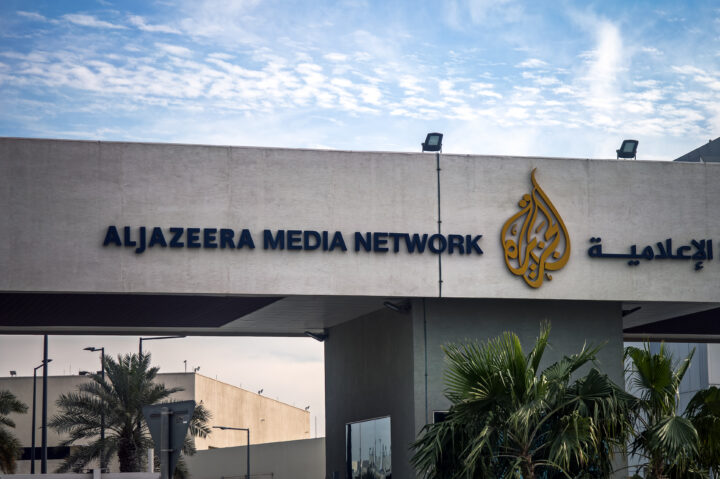
Getty Images
The headquarters of the Al Jazeera TV channel in Doha, Qatar. February 1, 2025


 Add JewishInsider on Google
A recently announced AI partnership between Google and Al Jazeera, the Qatar-backed media network, is raising concerns among some national security experts who say the arrangement helps to legitimize a state-controlled news organization long criticized for its sympathetic coverage of Hamas and hostility to Israel.
The agreement, announced in December, allows Al Jazeera to use Google Cloud as its main technology provider powering the network’s newly launched AI initiative, known internally as “The Core,” according to a press release.
Though vaguely characterized, the collaboration will help Al Jazeera produce editorial content that draws on Google’s AI platforms including Gemini, a major component driving a key program called “AJ-LLM,” which the network describes as its “editorial brain.” The effort, which uses a large language model built on Al Jazeera’s archives, is among several so-called “pillars” of the media company’s AI project seeking to embed the technology in its workflow and output.
The deal represents a “major expansion” of Google’s deepening partnership with Al Jazeera that extends back to 2017, the press release says, as other leading U.S. tech companies — such as Microsoft and Cisco — have also forged closer ties to the media network.
But some experts are warning that Google’s new partnership in particular will help lend a sheen of institutional credibility to a channel that has faced accusations of spreading misinformation in service of promoting Qatar’s preferred narrative on a range of sensitive topics including the Israeli-Palestinian conflict.
Toby Dershowitz, a senior advisor at the Foundation for Defense of Democracies, an organization highly critical of Qatar, said that Al Jazeera “positions itself as an independent media outlet” even as it is “actually funded by and editorially governed by an authoritarian country,” noting the Department of Justice has required AJ+, its social media offshoot, to register as a foreign agent. “So far,” she said, “it has not obeyed the law.”
“Well-regarded Western big tech companies have a responsibility to ensure they are not colluding in Al Jazeera’s information capture, whether through the use of algorithms, AI or other methods,” she added in an interview with Jewish Insider on Wednesday. “Google’s expanding partnership with Al Jazeera is therefore deeply concerning.”
Dershowitz, who recently published an analysis investigating the Google partnership, suggested that “big tech companies like Google are being used to help amplify often compromised information and transform it into legitimate sources, allowing it to flow throughout the news ecosystem,” all “without proper labels.”
“Because it’s a black box, consumers don’t fully understand what is happening,” she explained.
Other critics have aired similar reservations about the agreement with Google, especially as Al Jazeera has emerged as a top source on such widely used AI assistants as Gemini for news summaries regarding Israel and Gaza, according to a recent analysis.
While it is unclear if the partnership will end up influencing Gemini’s broader public output, some observers say that Al Jazeera’s plan to train the AI tool with its own archives is a red flag.
“Those archives are not neutral,” Simone Rodan-Benzaquen, a Middle East analyst and former managing director of the American Jewish Committee’s European division, wrote of Al Jazeera in a recent Substack newsletter entry. “They encode years of narrative framing: legitimization of Islamist actors, systematic delegitimization of Israel, conflict framed as oppression versus resistance.”
Google’s role in the agreement, Rodan-Benzaquen argued, “adds a crucial layer of legitimacy.” Even as it “does not endorse Al Jazeera’s editorial line,” the tech company’s “infrastructure confers neutrality.”
“A tool hosted on Google Cloud is perceived as technical, professional, objective,” she concluded.
The Doha-based network, which broadcasts in Arabic, English and other languages, has drawn criticism from U.S. lawmakers in both parties who have called it a “state-controlled propaganda arm” used “to incite violence, glorify terrorist killers as ‘martyrs’ and broadcast hateful, extremist content.”
Al Jazeera has also faced bans from several Middle Eastern countries including Egypt, the United Arab Emirates and Israel, the latter of which has accused the network of acting as a “mouthpiece of Hamas,” whose leaders have been hosted in Qatar. Last year, the Palestinian Authority temporarily suspended Al Jazeera from the West Bank over accusations it was “inciting sedition” as well as “interfering in internal Palestinian affairs.”
A spokesperson for Google referred JI to its recent press release announcing the partnership but did not respond to additional questions about the new arrangement. Al Jazeera did not return a request for comment.
Michael O’Hanlon, the director of research at the Brookings Institution’s foreign policy program, told JI on Wednesday that he had reservations about the agreement, even as he suggested he was receptive to engaging with Al Jazeera. (Brookings has previously received funding from Qatar but says it chose to end the financial arrangement in 2017.)
“I have generally felt that in most cases it’s best to work with Al Jazeera,” he said. “That said, a formal partnership is a different matter. I’m not quite sure I’d do that.”
More Stories

speaking out
In open letter, dozens of retired U.S. military leaders reject genocide allegations against Israel

Arrivederci, Reggio
Jewish preschool educators forced to condemn Israel to attend Reggio Emilia conference

LESSONS LEARNED?
Three years after Oct. 7, Israel’s security is ‘much better,’ but risks loom

DEBATE DEBACLE
El-Sayed dodges Rogers’ attacks on terrorism ties during heated Senate debate

IN THE CROSSHAIRS
Posters target University of Oregon Hillel executive director as ‘enemy of the people’

NOT ON BOARD
Lansing Mayor Andy Schor, a Jewish Democrat, says he’s not supporting El-Sayed
Please log in if you already have a subscription, or subscribe to access the latest updates.
 Continue with Google
 Continue with Apple