





























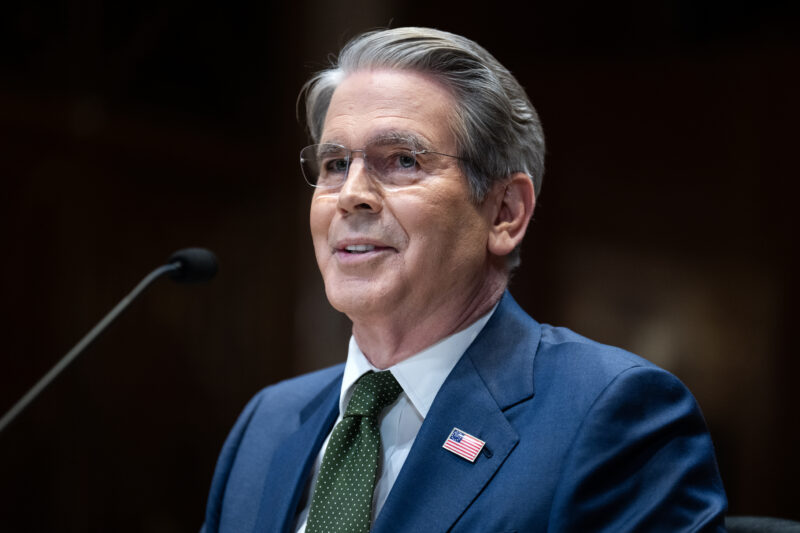










The U.S. ambassador to the U.N. met with Emirati FM Sheikh Abdullah bin Zayed Al Nahyan during his time in Abu Dhabi
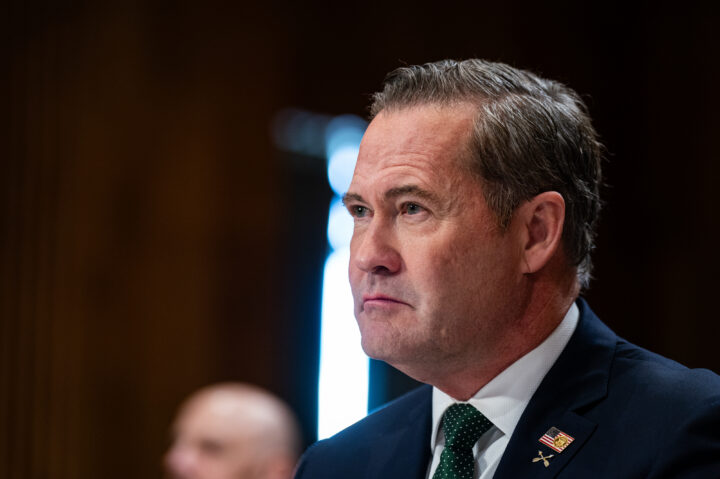
Al Drago/Bloomberg via Getty Images
Mike Waltz, U.S. ambassador to the United Nations, during a Senate Foreign Relations Committee hearing in Washington, DC, US, on Wednesday, April 15, 2026.


 Add JewishInsider on Google
U.S. Ambassador to the U.N. Mike Waltz traveled to the United Arab Emirates and Bahrain this week, marking the highest-level public visit by a U.S. official to the Middle East since the war with Iran began on February 28.
In the UAE, Waltz held separate meetings with Emirate President Sheikh Mohamed bin Zayed Al Nahyan. Emirates News Agency reported that Waltz and the president “discussed UAE-U.S. strategic ties and ways to further strengthen cooperation across various fields in support of both countries’ mutual interests.”
On Wednesday, Waltz met with Foreign Minister Sheikh Abdullah bin Zayed Al Nahyan in Abu Dhabi. A readout from the UAE Foreign Ministry said that Waltz and the foreign minister “discussed cooperation between the UAE and the United States, particularly within the framework of multilateral action and international organisations” and “reviewed regional developments and the repercussions of the unprovoked Iranian attacks that targeted the UAE and a number of sisterly countries.”
Waltz shared the UAE Foreign Ministry’s X post about the visit, adding that the two officials had a “Great meeting.” Emirati Ambassador to the U.S. Yousef Al Otaiba also attended the meeting.
The UAE has been targeted by Iran more than any other country in the region — including Israel — since the start of hostilities in February.
Waltz traveled on to Bahrain from the UAE, where on Wednesday he visited the country’s main oil refinery. Twice this week, Iran has fired ballistic missiles at a U.S. military base in Bahrain, in addition to bases in Jordan and Kuwait. Shrapnel from the interceptions of the missiles fired toward Bahrain caused property damage in parts of the small Gulf state.
Defense Secretary Pete Hegseth said in late March that he had quietly traveled to the region days prior to meet with troops amid the Trump administration’s Operation Epic Fury, but did not provide details on where he traveled.
U.N. Ambassador Mike Waltz told JI, ‘once we've cut off any other path’ for the terror group, ‘I think they have no other choice’
Al Drago/Bloomberg via Getty Images
Mike Waltz, U.S. ambassador to the United Nations, during a Senate Foreign Relations Committee hearing in Washington, DC, US, on Wednesday, April 15, 2026.
LOS ANGELES — While the world’s attention has been fixed on Iran, U.S. Ambassador to the U.N. Mike Waltz and a team of American bureaucrats have spent the last few months quietly working to turn President Donald Trump’s Board of Peace into a fully functioning entity.
The fledgling international organization — billed by some as an alternative to the U.N., although Waltz insists there is room for both — has the astronomically large task of governing and rebuilding Gaza. Waltz is bullish on the possibility that the morass of Gaza can be worked out peacefully, with enough buy-in from countries who are willing to finance the creation of a new governing and police structure in Gaza.
“The contributions keep coming in for both the international stabilization force and the new police force. That training is standing up in both Egypt and Jordan. It’s going to take time, but all of those pieces are moving forward,” Waltz told Jewish Insider during an interview on Monday at the Milken Institute Global Conference in Los Angeles.
One lingering challenge to Waltz’s premise of a peaceful Gaza is Hamas’ grip on power, which remains a huge variable in a plan that is largely contingent upon the U.S. and Israel’s defeat of Hamas. The terror group still controls large swathes of Gaza, even if not all of it. It will be loath to hand over that power willingly. Waltz swore that Hamas “will never again rule Gaza,” whether as a result of “diplomatic action or military action.”
“I wouldn’t expect a terrorist organization like them to just roll over and hand over everybody, but once we’ve cut off any other path for them, then I think they have no other choice,” said Waltz.
Hamas, he argued, will not put down its arms unless compelled to do so. If Hamas feels squeezed enough — if the U.S. has enough leverage — then the group will have no choice but to give in, according to Waltz.
“At the end of the day, Hamas has a choice to make. Those negotiations are going on as we speak. [Nickolay] Mladenov laid out a demilitarization plan, a plan to decommission their weapons,” Waltz said, referring to the Bulgarian diplomat who heads the Board of Peace. “I’m going to remain optimistic, as horrific an organization that Hamas is.”
The deck is now stacked against Hamas, Waltz argued. He pointed to the Gulf states and Arab nations that are members of the Board of Peace — places like Turkey, Egypt, Jordan, Saudi Arabia and the United Arab Emirates — to signal that Hamas is deeply isolated.
“They really have no option,” said Waltz. “They’re either going to do this the easy way or the hard way. And let’s all pray they do it the easy way.”
Still, he acknowledged that the group’s hold on power remains strong.
“I think they’re [Hamas] unfortunately still exerting control over portions, but we’ve also seen pushback from local tribes, local families,” Waltz said of Hamas. He noted that the Board of Peace-affiliated National Committee for the Administration of Gaza has plans to take over government services. But that will be only in the parts of Gaza not controlled by Hamas.
The bill withholds 10% of the U.S. contribution for the U.N. or any U.N. agency until the State Department confirms to Congress that the agency is ‘taking credible steps to combat anti-Israel bias’
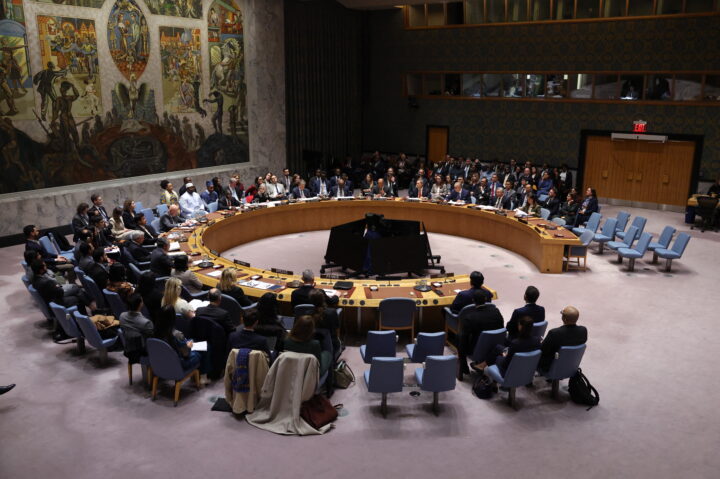
ANGELA WEISS/AFP via Getty Images
Ambassadors and representatives to the United Nations meet at the U.N. Security Council to vote on a U.S. resolution on the Gaza peace plan at the U.N. Headquarters in New York City, Nov. 17, 2025.
The finalized 2026 funding package for the State Department, released Sunday, leverages a portion of the U.S.’ contributions to the United Nations and its agencies to push for changes in what the U.S. has said is the institution’s anti-Israel bias and antisemitism.
The bill withholds 10% of the U.S. contribution for the U.N. or any U.N. agency until the State Department confirms to Congress that the agency is “taking credible steps to combat anti-Israel bias,” putting measures in place to inform donors of when funds have been diverted or destroyed, “effectively vet[ting]” staff for ties to terrorism and taking steps to address antisemitism, among a variety of other anticorruption and accountability measures.
The moves put new financial teeth behind longstanding U.S. efforts to combat antisemitism at the U.N., as well as to ensure stronger oversight following revelations that members of the United Nations Relief and Works Agency participated in the Oct. 7, 2023, Hamas attacks on Israel.
However, the provisions relating to the U.N. in the final bill are significantly scaled back from the House’s draft of the legislation — which would have cut all U.S. funding for the U.N. regular budget and withheld funding for the U.N. secretariat pending a series of specific accountability steps relating to UNRWA personnel.
The explanatory report accompanying the bill includes a new requirement for relevant investigators general to provide a plan to Congress to conduct “risk-based investigations and related oversight of United States-funded implementing partners” of any aid provided in Gaza and the West Bank. It directs the administration to focus on reports of staff or contractors for such aid providers who have ties to or involvement in terrorism, and provide recommendations for addressing and preventing these issues.
The legislation maintains longstanding mechanisms governing U.S. aid to Gaza and the West Bank and the Palestinian Authority and new accountability measures implemented following the Oct. 7 attacks, as well as a ban on U.S. funding for UNRWA and a ban on funding for the U.N. Human Rights Council and its Commission of Inquiry investigating Israel.
It provisions limiting U.S. assistance to U.N. bodies if the Palestinians receive status equivalent to that of a state in any U.N. body.
The legislation provides the expected $3.3 billion in funding for military aid to Israel, as per the terms of the U.S.-Israel memorandum of understanding. It includes a new $5 million allocation for historical, archeological and cultural initiatives to strengthen the U.S.-Israel relationship. It also bans relocating the U.S. Embassy in Israel from Jerusalem.
The bill includes cuts to a number of U.S. assistance programs in the Middle East, including cutting funding for the Middle East Partnership for Peace Act program from $50 million to $37.5 million, for Israeli-Arab scientific partnerships from $8.5 million to $7 million and the Middle East Partnership Initiative from $27.2 million to $20 million.
It holds funding for joint U.S.-Israeli development projects in third countries at $3 million.
The legislation provides a significant boost in funding for the office of the State Department’s special envoy to monitor and combat antisemitism — $2.6 million, up from $1.75 million.
It also instructs the antisemitism envoy and the special envoy for Holocaust issues to work with the U.S. Holocaust Memorial Museum to prioritize efforts with U.S. partners to address Holocaust denial and distortion and antisemitism on social media and in artificial intelligence, and to brief Congress on a plan to tackle these issues. It directs the antisemitism envoy to consult with Congress on programs to combat antisemitism more broadly as well.
“At a moment when antisemitism is surging worldwide, the $2.6 million included in this minibus for the State Department’s special envoy to monitor and combat antisemitism is both necessary and timely,” Lauren Wolman, the Anti-Defamation League’s senior director of government relations and strategy, told Jewish Insider. “Antisemitic hatred is spreading across borders and being supercharged online, with real-world consequences for Jewish communities everywhere. This bill will strengthen U.S. leadership in confronting global antisemitism and sends a clear signal that combating antisemitism and Holocaust distortion is an urgent national priority.”
The legislation requires the administration to report to Congress on the impact of U.S. sanctions on Iran, as well as on U.S. efforts to eliminate Iranian oil exports to China — including the specific dates of communications between U.S. and Chinese officials about those imports.
The bill continues to bar the administration from revoking the Islamic Revolutionary Guard Corps’ terrorism designation, or entering into a nuclear deal with Iran in contravention of the Iran Nuclear Agreement Review Act. And it permits the use of funding to prevent Iran from obtaining a nuclear weapon, support democracy in Iran and otherwise combat Iranian malign activities.
It mandates that the State Department lay out a strategy, within 90 days, to expand the Abraham Accords, specifically including the possibility of providing arms transfers and other defense materiel to signatories.
The legislation includes $1.65 billion in funding for Jordan — $845 million in budget support funding for the government and $425 million in military aid.
The bill provides $1.425 billion in funding for Egypt, $1.3 billion of that in military aid, with $320 million conditioned on various human rights benchmarks, though those conditions can — and traditionally have been — waived.
For Lebanon, the bill provides $112.5 million, maintaining existing provisions and accountability measures emphasizing reforming the Lebanese Armed Forces and combatting Hezbollah.
The bill permits the provision of funding for nonlethal assistance in Syria, but bars the use of any funding to support Iranian, terrorist or Russian objectives and requires the administration to consult with Congress prior to providing any such funding.
It also requires the administration to report to Congress on the treatment of minorities in Syria and on whether the new Syrian government is taking “all sufficient actions” to protect them.
The bill allocates $20 million for the office of the special envoy for the Middle East, $2 million of that dedicated to activities in Lebanon, and $7 million for the office of the special envoy for Syria.
Several other provisions related to the Middle East that were included in the original House draft of the bill, including restrictions related to the International Court of Justice and International Criminal Court, preventing the establishment of additional diplomatic facilities in Jerusalem other than the U.S. Embassy and a directive to treat the West Bank and Gaza as separate entities for budgeting purposes have not been included in the final version of the bill.
From the House’s explanatory report, the negotiated version of the bill adopts anti-Boycott, Divestment and Sanctions provisions, as well as expanded vetting procedures to ensure political neutrality by aid recipients; new oversight requirements for U.S. aid to Syria; a report on antisemitism by foreign governments; a requirement for the State Department to report to Congress on efforts to end the PA’s terror payments program; and a report to the Congress on the possibility of a memorandum of understanding with Egypt on Security Assistance.
The legislation removes provisions included in 2024 appropriations legislation that prohibited military education and training funding for Saudi Arabia and that barred funding to support a Saudi nuclear program unless Saudi Arabia agreed to strict controls including renouncing uranium enrichment and reprocessing.
The U.N. ambassador pointed to the recent unanimous U.N. Security Council vote supporting Trump’s Gaza peace plan

Haley Cohen
U.S. Ambassador to the U.N. Mike Waltz at Mission of Israel to the U.N. Hanukkah reception, The Jewish Museum, Dec. 17, 2025
As Jews worldwide face a scourge of antisemitism — including the mass shooting at a Hanukkah celebration at Australia’s Bondi Beach over the weekend — U.S. Ambassador to the U.N. Mike Waltz said on Tuesday night that the U.S. “can and will confront antisemitism without apology, without hesitation and will do so everywhere around the world, including right here in the halls of the U.N.”
“We are taking real action on those who perpetuate their antisemitic actions,” Waltz said at a Hanukkah reception hosted by Israel’s U.N. mission, held at The Jewish Museum in Manhattan. He pointed to recent U.S. sanctions on Francesca Albanese, the U.N. special rapporteur for the Palestinian Territories who has frequently bashed Israel.
At the event, which was co-hosted by UJA-Federation of New York to mark the third night of Hanukkah, Waltz also lauded President Donald Trump’s 20-point plan to end the war in Gaza, calling it “not perfect,” but offering “a far better chance [at peace] than where we were just a few months ago.”
“The goal is to break that cycle of insanity where Hamas is allowed to survive, attack Israel once again, Israel responds and here we are all over again,” continued Waltz. “President Trump’s plan will break that cycle. We are going to see it through, and ultimately, he is determined — and put his name on it in a huge way, to the point that we have hundreds of soldiers on the ground in Israel — in moving all of that forward so that we never experience another Oct. 7.”
Last month, the U.N. Security Council voted 13-0 in favor of Trump’s peace plan, which Waltz called “the most positive council, probably ever.”
“We will work in partnership with Israel, not only to fight antisemitism, but to bring peace and stability to that region so the next generation isn’t experiencing what the previous generation did. We can expand the Abraham Accords,” continued Waltz. “Let’s bring light to the darkness we’ve seen these last two years.”
“We are determined to make the U.N. great again. We have a new term called ‘MUNGA’ — Make the U.N. Great Again,” Waltz said as the crowd erupted in laughter.
As guests noshed on festive hors d’oeuvres — bite-sized latkes and sufganiyot — remarks were also delivered by Israeli Ambassador to the U.N. Danny Danon and Eric Goldstein, the outgoing CEO of UJA-Federation.
“What happened in Australia on the first night of Hanukkah was an act of terror targeting Jews,” said Danon. Among the 15 killed in the attack were 10-year-old Matilda Britvan, Chabad Rabbi Eli Schlanger and Holocaust survivor Alex Kleytman.
“Three generations targeted simply for being Jewish. Tonight we honor their memories,” continued Danon before — together with Goldstein and Chabad’s Rabbi Mendy Kotlarsky — lighting a menorah made from shrapnel of Iranian ballistic missiles intercepted by Israeli and U.S. interceptors.
The move, which experts told JI is unlikely to be implemented, would enable the body to further target Israel by preventing the U.S. from vetoing anti-Israel resolutions
ANGELA WEISS/AFP via Getty Images
Ambassadors and representatives to the United Nations meet at the U.N. Security Council to vote on a U.S. resolution on the Gaza peace plan at the U.N. Headquarters in New York City, Nov. 17, 2025.
Members of the United Nations General Assembly are renewing their push to curb or eliminate the Security Council veto, intensifying concern over whether such a reform would make it easier for the international body to target Israel.
The “veto initiative,” adopted in 2022, requires the General Assembly to convene a debate any time a permanent member of the Security Council — the United States, United Kingdom, France, China or Russia — blocks a resolution. Since then, 17 vetoes have triggered General Assembly meetings.
During the war between Israel and Hamas, the Security Council attempted multiple times to pass resolutions calling for an “immediate” and “unconditional” ceasefire in Gaza. The United States often cast the lone veto, arguing the measures were one-sided and would ultimately benefit Hamas.
Delegates from several countries have argued that U.S. vetoes have prevented the 15-member body from taking meaningful action and that the debates prompted by the initiative have produced “little tangible impact.”
“The veto, once envisioned as a safeguard for peace, has too often become a barrier to collective action,” said Latvia’s representative during a Nov. 20 General Assembly meeting, speaking on behalf of the Baltic and Nordic states. “Time and again, we have seen the veto used or threatened to block [Security] Council action to protect civilians in Sudan and Gaza.”
This has led member states to call for abolishing the veto entirely, arguing that a single vote enables permanent members to endorse “the worst levels of cruelty and barbarity,” according to Colombia’s representative.
But many in the pro-Israel community warn that eliminating the veto would dramatically accelerate what they see as entrenched anti-Israel bias at the U.N. The General Assembly has adopted 173 resolutions against Israel and 80 against all other countries combined between 2015 and 2024. In 2025 alone, the GA is projected to pass 16 resolutions on Israel and 10 on the entire rest of the world, according to the pro-Israel watchdog group UN Watch.
If the veto were removed, the United States would no longer be able to block resolutions viewed as hostile or disproportionately focused on Israel, a shift experts said would allow such measures to advance far more easily.
“Anti-Israel bias at the United Nations is pervasive, and the U.S. veto is the only thing standing in the way of the body passing binding resolutions that would pose a danger to the Jewish state,” said David May, a senior research analyst at the Foundation for Defense of Democracies. “A U.N. Security Council without a U.S. veto would be indistinguishable from Students for Justice in Palestine or a pro-Hamas rally.”
Elliott Abrams, who served as Iran envoy in the first Trump administration, told Jewish Insider that efforts to restrict or eliminate the veto are not new and that doing so would pose serious risks for Israel.
“Any restriction accepted by the United States would endanger Israel, because the U.S. has so often been Israel’s only defender in the Security Council,” said Abrams. “With an automatic anti-Israel majority in the General Assembly, the U.S. veto is critical.”
“President Trump should adopt a very simple policy,” said Abrams. “Just say no.”
Both the U.S. and Russia defended the use of the veto and rejected any effort to alter it. Julie Rayman, the American Jewish Committee’s senior vice president for policy and political affairs, told JI that this opposition and structural realities make changes to the veto unlikely to occur.
“The veto power can only be changed through an amendment to the U.N. Charter, which requires unanimous agreement of all five permanent members,” said Rayman. “There’s no realistic chance this will happen, so the system isn’t currently at risk of being changed to allow even greater disproportionate targeting of Israel at the U.N.”
May echoed those sentiments, calling efforts to eliminate the veto “aspirational,” and adding that “the five permanent Security Council members who hold a veto are not inclined to relinquish their power.”
However, May said there are mechanisms countries could employ to “circumvent” the veto.
“For example, the Palestinian Authority’s effort to expel Israel from the United Nations came up against the U.S. veto at the Security Council,” said May. “Instead, there was talk of having the credentials of the Israeli delegation revoked, something within the remit of the General Assembly, effectively achieving an expulsion without Security Council support.”
As the UNGA begins, several countries are recognizing a Palestinian state and the EU is considering suspending free trade with Israel
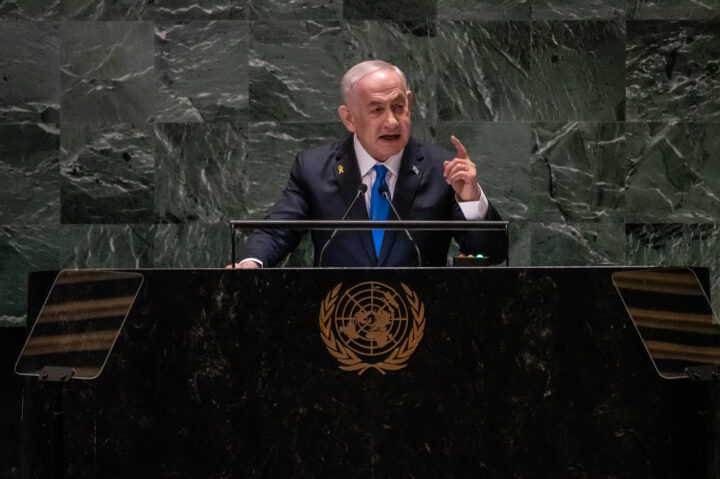
Stephanie Keith/Getty Images
Israeli Prime Minister Benjamin Netanyahu speaks during the United Nations General Assembly (UNGA) at the United Nations headquarters on September 27, 2024 in New York City.
Israeli Prime Minister Benjamin Netanyahu’s planned speech to the United Nations General Assembly on Friday is being overshadowed by European moves to isolate Israel, with the U.K., as well as Canada and Australia recognizing a Palestinian state on Sunday and more to come, as well as an upcoming EU vote on sanctions against Israel.
Netanyahu released a statement, in which he said he has “a clear message to the leaders who recognize a Palestinian state after the terrible massacre of Oct. 7: You are giving a massive prize to terror. … It will not happen. There will not be a Palestinian state west of the Jordan River.”
The prime minister hinted that Israel will increase settlement activity in response: “For years I prevented the establishment of this terror state facing great pressures, domestic and foreign … Not only that, we doubled the Jewish settlement in Judea and Samaria. The response to the latest attempt to force a terror state on us in the heart of our land will be given after my return from the U.S. Wait.”
U.K. Prime Minister Keir Starmer said on Sunday that his country is “acting to keep alive the possibility of peace and a two-state solution. That means a safe and secure Israel alongside a viable Palestinian state. At the moment, we have neither.”
He pushed back against the Israeli argument that recognition of a Palestinian state at this time acts as a reward for Hamas, arguing that “our call for a genuine two-state solution is the exact opposite of [Hamas’] hateful vision. … This solution is not a reward for Hamas, because it means Hamas can have no future.”
Hamas, however, praised the recognition as an “important move” and called for it to be accompanied by ending the “Judaization of the West Bank and Jerusalem, Israel’s isolation and Israel’s leaders brought before international court,” as well as the recognition of the Palestinians’ “natural right to resistance.”
The High-Level Conference on Palestine Statehood, led by France and Saudi Arabia, is set to take place Monday, on the eve of Rosh Hashanah. Nearly a dozen countries have said they would recognize a Palestinian state as part of that effort, following the announcements of the U.K., Canada and Australia on Sunday.
French President Emmanuel Macron argued in an interview with Israel’s Channel 12 News that “recognition of a Palestinian state is the best way to isolate Hamas … What they want is to destroy [Israel], but if we consider that the Palestinian state will always have the objective to destroy Israel, how [do] they want to build a sustainable future? There is no way.”
A recent poll commissioned by the French-Jewish umbrella organization CRIF found that 71% of French people reject the recognition of a Palestinian state before the hostages are freed and Hamas gives up power. In the U.K., a survey in The Telegraph showed 87% of Britons disagree with recognition of a Palestinian state without preconditions, including 89% of Labour voters. A YouGov poll, however, found that 44% of Britons supported the move, while 18% were opposed and 37% unsure.
U.S. Ambassador to France Charles Kushner noted that in conjunction with his announcement of Palestinian state recognition, Macron called for Palestinian recognition of Israel as a Jewish state, the demilitarization of Hamas and the establishment of strong governance for the Palestinians as preconditions for any recognition of Palestinian statehood. “These were France’s own conditions for recognition of a Palestinian state. How can France move forward with next week’s vote when none of these have been met?” Kushner said.
Netanyahu, who was Israel’s ambassador to the U.N. from 1984-1988, is known to relish his addresses to the U.N. General Assembly, embracing theatrical props, puns and long pauses on a platform where he hopes to capture the world’s attention for Israel’s benefit.
After his UNGA speeches, Netanyahu holds court, with other leaders visiting him in a conference room in Turtle Bay. This year, he is expected to meet with Argentinian President Javier Milei, the leaders of Paraguay and Serbia and New York Mayor Eric Adams, and there are reports that he will meet with Syrian President Ahmad al-Sharaa ahead of a possible security agreement between Damascus and Jerusalem. Then, Netanyahu is expected to fly to Washington to meet with President Donald Trump.
Meanwhile, Israel’s Foreign Ministry and Economy Ministry, which oversees foreign trade, have been pushing back against proposed European Union sanctions. The European Commission proposed the roll-back of relations between the bloc and Israel after it “found that actions taken by the Israeli government represent a breach of essential elements relating to respect for human rights” given “the rapidly deteriorating humanitarian situation in Gaza following the military intervention of Israel, the blockade of humanitarian aid, the intensifying of military operations and the decision of the Israeli authorities to advance the settlement plan in the so-called E1 area of the West Bank, which further undermines the two-state solution.”
The proposal, if accepted, would suspend free trade between Israel and the European Union, its largest trade partner.
A source in Brussels estimated that the move would cost Israel 227 million Euros ($266 million) in customs duties per year.
A date has not yet been set for voting on the suspension of free trade, which requires a qualified majority, also known as a “double majority,” meaning 55% of member states, and states representing 65% of the EU population, with at least four states opposed.
Hungary and the Czech Republic said they would oppose the proposal, following calls between their foreign ministers and Israeli Foreign Minister Gideon Sa’ar.
Sa’ar called the proposal “morally and politically distorted.”
“Moves against Israel will harm Europe’s own interests,” Sa’ar warned. “Israel will continue to struggle, with the help of its friends in Europe, against attempts to harm it while it is in the midst of an existential war. Steps against Israel will be answered accordingly, and we hope we will not be required to take them.”
Economy Minister Nir Barkat sent letters to Germany, Hungary, Czechia, Italy, Bulgaria, Greece, Lithuania, Cyprus, Croatia and Latvia asking them to oppose the measure to suspend free trade.
The European Commission also suspended 20 million Euros ($23.5 million) in projects with Israel, dealing with civil service training and regional-EU cooperation related to the Abraham Accords, through 2027. The commission was able to end the cooperation without a vote and noted in repeated statements that it was exempting “civil society and Yad Vashem.”
In addition, the European Commission proposed sanctions against Israeli Finance Minister Bezalel Smotrich and National Security Minister Itamar Ben-Gvir, as well as “violent settlers” and 10 members of the Hamas politburo, which would require a unanimous vote by EU member states. The ban on Israelis is unlikely to be approved, especially not the cabinet ministers.
In another sign of Israel’s increased isolation in Europe, several countries’ public broadcasters said they would boycott the 2026 Eurovision Song Contest if Israel were to take part, as it usually does.
Spain, the Netherlands, Slovenia, Iceland and Ireland have said they will not participate in the contest along with Israel, and Belgium threatened to follow suit.
Israeli public broadcaster Kan said that it will continue to be “a significant part in this cultural event, which cannot become political.”
“Israel is one of the most successful participants in the Eurovision contest — in the past seven years its songs and representatives have finished in 5th, 3rd, 2nd and 1st place,” Kan CEO Golan Yochpaz said.
Austrian Foreign Minister Beate Meinl-Reisinger, whose country is due to host the Eurovision next year, posted on X that the contest “is a symbol of peace, unity, and cultural exchange — not an instrument for sanctions.”
The complaint also alleges ‘gross misconduct and misuse of humanitarian funds’ by the agencies, the whistleblower confirmed to Fox News

STR/AFP via Getty Images
A convoy of aid trucks on the Egyptian side of the Rafah crossing with the Gaza Strip on July 27, 2025.
An aid worker in Gaza filed a whistleblower complaint with the inspector general of the U.S. Agency for International Development alleging that the World Food Program and U.N. refused security cooperation with the IDF, the whistleblower confirmed to Fox News.
The complaint alleges “gross misconduct and misuse of humanitarian funds” by the WFP and U.N. Office for the Coordination of Humanitarian Affairs (OCHA) and that the agencies had turned down support “including security protection and coordination” to distribute humanitarian aid from senior IDF officials, saying “they were not prepared to discuss such coordination.”
The whistleblower told Fox News that the IDF has cleared thousands of tons of U.N. aid for distribution that are waiting inside of Gaza, and the “U.N. must be held accountable to pick up and distribute such aid.”
They said that it must be determined “the extent to which U.N. agencies, by refusing to coordinate with the IDF on essential issues, including security, are abusing U.S. taxpayer funds rather than using them to deliver the aid the American people are donating — and whether such actions are being taken independently by U.N. officials in Gaza or at the direction of the U.N. Secretary General or other senior U.N. officials in New York.”
A senior State Department official told Fox News in response to the report that “aid diversion to terrorists frequently occurs in conflict zones under Foreign Terrorist Organization (FTO) control. It is a moral and legal obligation, and our duty to the American taxpayer, to work with our partners to ensure this ends immediately.”
USAID’s Office of Inspector General has “published concerns related to the vetting of NGO personnel in Gaza” and “identified serious shortcomings and vulnerabilities in oversight mechanisms to prevent diversion of aid to Hamas terrorists,” the official continued.
The agency “has received and is actively investigating credible allegations of systematic interference by Hamas in Gaza. These allegations can come from aid workers, whistleblowers, and other parties, rather than sanitized disclosures sent by U.N. agencies which refuse to name Hamas as the party responsible for the interference,” they said.
An Israeli security official confirmed the IDF’s difficulties in collaborating with the U.N. to the outlet, saying, “In recent months, Israeli security officials have several times proposed to U.N. representatives that they hire the services of a security company. However, the U.N. has categorically refused and opposed the Israeli proposal.”
The Israeli official continued, “It should be emphasized that despite this opposition by the U.N. to armed security for the organizations’ convoys in the Gaza Strip, the U.N. does agree to receive security and escort for its convoys in other countries around the world where it provides humanitarian services to civilians, such as South Sudan or Congo.”
One senior Republican congressional staffer told Fox News that several congressional offices have seen the report and that it has been discussed between members of Congress and USAID and State Department officials.
A new report from NGO Monitor describes the ‘workaround’ used by international aid groups to continue flow of aid to Gaza despite Hamas involvement

Ali Jadallah/Anadolu via Getty Images
Members of the Al-Qassam Brigades, the military wing of Hamas as the bodies of hostages' are handed over to the Red Cross teams as part of the Hamas-Israel prisoner-hostage swap agreement in Khan Yunis, Gaza on February 20, 2025.
Amid an international outcry over the humanitarian conditions in Gaza, Israel and the Gaza Humanitarian Foundation have repeatedly pointed to Hamas’ practice of diverting and disrupting the distribution of aid that officials say has entered Gaza unimpeded as one of the culprits behind the crisis.
NGO Monitor, which tracks the funding of anti-Israel organizations, wrote a new report given exclusively to Jewish Insider, which claims to show evidence of Hamas controlling the destination of humanitarian aid given in cash for years before and during the Gaza war, including money coming from U.N. agencies and NGOs funded by European governments.
The report alleges that the groups distributed cash and vouchers to beneficiaries selected by the Hamas-run Gaza Ministry of Social Development (MoSD), which since 2019 has been led by Ghazi Hamad, a member of the Hamas politburo who was designated a terrorist by the U.S. last year and who, weeks after Hamas’ Oct. 7, 2023 attacks, vowed that “there will be a second, a third, a fourth … one-millionth” Oct.7-style attack on Israel.
Hamad made headlines in Israel earlier this week with his assertion that the commitments of 11 countries to recognize a Palestinian state is an “achievement” stemming from Hamas’ attacks on Israel.
In 2023, the EU provided $19.6 million, France donated $9.34 million and Spain $1.75 million “for the payment of social allowances to poor Palestinian families.” The EU stated that since 2008, it “has been a steadfast supporter of the Palestinian Authority’s Ministry of Social Development, collaborating to ensure that basic social allowances are extended to the most vulnerable families residing in the West Bank and Gaza.”
In August 2024, according to the report, the EU and Spain provided 15.5 million Euros of aid for Gaza, saying they were partnering with the PA MoSD to deliver it. The EU also gave UNICEF over 4 million Euros in 2023 for a project in which the MoSD was the “main partner.”
Among the governments funding programs involving the MoSD is the U.K., even though its Foreign Office had been made aware of the matter and expressed concern over possible “severe” reputational damage that could come from its involvement.
Other countries funding programs working with the MoSD, according to the NGO Monitor report, include Germany, Switzerland and Norway.
The EU and others say that they are working with the MoSD in Ramallah, controlled by the Palestinian Authority, as opposed to the Gaza MoSD, controlled by Hamas.
However, the NGO Monitor report argues that the Ramallah MoSD was used to circumvent Western countries’ rules against contact with Hamas, a proscribed terrorist organization, while the beneficiaries were still chosen by the Hamas-controlled MoSD in Gaza.
A 2022 Oxfam International analysis of its cash-assistance programs in Gaza described “workarounds needed for the no-contact policy” with Hamas, by way of “the interface between humanitarian agencies and the MoSD in Ramallah, and the local authorities in Gaza,” otherwise known as Hamas.
The Oxfam analysis notes that there is “collaboration between the de-facto government in Gaza and the official Ramallah government,” and that “in the MoSD in Gaza, most of the staff are from the de-facto government,” meaning Hamas.
The organization called for more work with Arab humanitarian aid groups, “capitalizing on the fact that the latter are not restricted by no-contact policies,” meaning that they work directly with Hamas.
Hamas also takes a cut of the cash that aid organizations transfer into Gaza.
The minutes from a Oct. 8, 2024, meeting of the Gaza Cash Working Group, a U.N.-led coordination mechanism for U.N. agencies and international NGOs, state that the Hamas-controlled government in Gaza charged “withdrawal fees up to 20% … these fees are not limited to multipurpose cash assistance, but apply across the entire market.”
NGO Monitor also highlighted a 2022 Mercy Corps Gaza project as an example of Hamas control of humanitarian funding. A description of the project from the U.N. repeatedly referred to the MoSD’s central role.
“Through unconditional cash assistance, this project will identify and select the most vulnerable HHs [households] … from the Ministry of Social Development (MoSD) unserved waiting lists of Social Safety Net (SSN),” the U.N. description states. At another point, it says that the project will be undertaken with “full coordination and engagement with the MoSD.”
Oxfam responded to inquiries from JI that the organization “operates under a strict and clear no-contact policy with de facto authorities in Gaza. We do not work or communicate with the Ministry of Social Development (MoSD) in Gaza. In line with this, our work in Gaza is coordinated through the MoSD’s PA focal point based in Ramallah.”
“The reference in the 2022 study is not an admission of direct engagement,” the organization continued. “It describes sector-wide challenges … We have robust safeguards in place to prevent any misuse or manipulation of our aid programs and adhere to the highest standards of humanitarian principles and accountability.”
Mercy Corps also told JI it has a strict no-contact policy against engaging with sanctioned entities and that allegations that it worked with the MoSD in Gaza is “false and inaccurate.” Their aid recipient lists came from the MoSD in Ramallah, managed by the PA, the organization stated.
“We do not and have not coordinated with Hamas in Gaza to implement our aid programs, and allegations that we work with Hamas are false,” the group stated. “We are confident in our processes and policies, including a rigorous verification process for program participants, which ensures we help the most vulnerable families, while avoiding those with affiliation or contact with sanctioned groups. We have decades of experience delivering humanitarian assistance in high-risk environments like Gaza.”
The BBC reported on Wednesday that Hamas has continued to pay 30,000 salaries throughout the war in Gaza using “a secret cash-based payment system” even as Israel attempts to block the terrorist group from making payments.
Hamas employees receive encrypted messages inviting them to “meet a friend for tea” at a specific time and place. When they arrive, someone hands them an envelope of cash and then walks away.
Hamas has stockpiled about $700m in cash, according to the BBC, but has only paid $7m in salaries since the war began in Oct. 2023. Employees reportedly only receive about 20% of their wages, and the BBC quoted employees claiming to have non-combat roles who were frustrated with the insufficient payments and the dangers in having to travel to collect the cash amid Israeli airstrikes.
In addition, Hamas has reportedly distributed food packages to its members, angering Gazans who accuse the terrorists of not aiding others, according to the BBC.
In an interview with JI, Huckabee pinned the humanitarian issues in Gaza on Hamas and the U.N.
Maya Alleruzzo/AP Photo
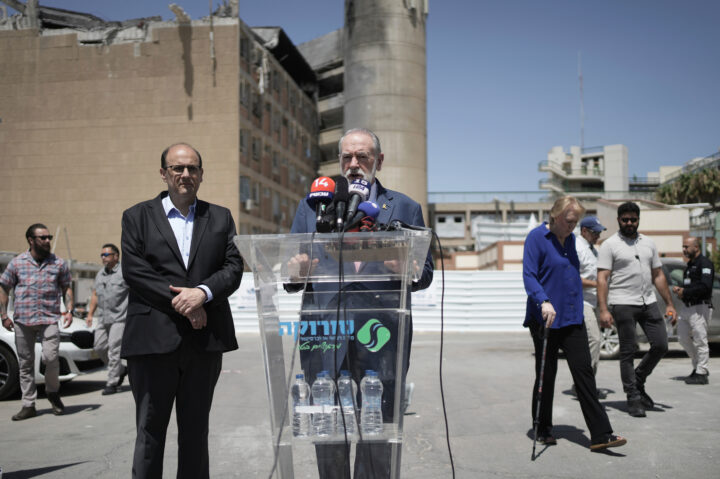
U.S. Ambassador to Israel Mike Huckabee speaks to journalists with Director General of Soroka Medical Center Dr. Shlomi Codish, left, outside a hospital building that was struck by an Iranian missile, Thursday, June 26, 2025 in Beersheba, Israel.
Since his arrival in Israel in April, former Arkansas Gov. Mike Huckabee has made his mark as the first evangelical U.S. ambassador to Israel — and possibly the most effusive in his remarks about the Jewish state.
That may be why a leaked letter he wrote to Israeli Interior Minister Moshe Arbel last week, expressing “profound disappointment” that an issue delaying work visas for Christian organizations had gone unresolved and suggesting that Israelis may be treated in kind by the U.S., drew so much attention.
A day after the letter leaked, the ambassador visited Taybeh, a Palestinian village in the West Bank where there had been a fire in a field near a church, writing on X that “desecrating a church, mosque or synagogue is a crime against humanity and God,” and “I will demand those responsible be held accountable.” With Taybeh church leaders blaming settlers, Huckabee’s comments were interpreted in many media accounts as doing the same, though he later clarified that he was not attributing the fire to anyone.
But with the visa issue resolved and the world’s attention on the humanitarian situation in Gaza and the latest round of collapsed negotiations for a ceasefire and hostage-release deal, Huckabee was back to standing firmly behind Israel in an interview with Jewish Insider in his office at the U.S. Embassy in Jerusalem on Thursday. With an a guitar hanging on the wall behind him emblazoned with an American flag and President Donald Trump’s slogan “make America great again,” Huckabee pinned the humanitarian issues in Gaza on Hamas and the U.N and the failure of negotiations on Hamas, and was critical of other Western countries that have come out against Israel, accusing them of emboldening the Gazan terrorist group.
The interview has been condensed and edited for clarity.
Jewish Insider: There’s a lot of pressure on Israel over humanitarian aid in Gaza and claims that residents of Gaza are starving. Israel says that they are letting more food in but no one is distributing it, while much of the world doesn’t believe that. I want to ask you: Do you think there is really starvation in Gaza? What is really happening?
Ambassador Mike Huckabee: This very morning, I had a visit from someone who returned yesterday from three days in Gaza. He firsthand went and saw the [Gaza Humanitarian Foundation] feeding sites, talked to people, not only from the staffing and the distribution, but he talked to people in Gaza … He came to the conclusion, first of all, that absolute lies that are being told, not only about GHF and what they’re doing, but are also being told about the deprivation.
There are clearly people who need food and medicine. That’s not a doubt. But the biggest reason that people are not getting the food and medicine they need is that Hamas is doing its best to cause the people to suffer. They want to get the photos of the most disastrous consequences possible.
The photos that I also saw, which were very disturbing but also revealing, [were of] hundreds and hundreds of pallets of food that are sitting out in the sun ready to be distributed, but the U.N. won’t move them. Hundreds of trucks filled with food and medicine, and the U.N. claims that they’re trying to help. No, they’re not. They are as much a part of the problem, if not the biggest part of the problem there is. And this food could be distributed right now, but the U.N. isn’t doing it. The NGOs aren’t doing it, and the World Food Program isn’t doing it, because they just drop it off. Then, basically, they’re waiting on Hamas to come and steal it so [the group] can turn around and sell it to the people that ought to be getting it for free. It is a scam.
It is a disgrace and an outrage that the story that is being told is that GHF is killing people, and they’re not. They haven’t fired one round at anybody … It’s simply not true. It is sadly being reported sometimes because Hamas will release a news story and the Associated Press, CNN, The Washington Post, will gobble it up. They’ll print it without any verification … That’s what Israel is up against. It’s what the U.S. is up against every single day, with really, really horrible misinformation about what’s happening.
JI: Why do you think countries that purport to be friends of Israel and the U.S. — 26 countries signed a letter to Israel about the aid including the U.K., Canada, France — are believing Hamas?
MH: It’s hard for me to understand why they would do that without doing a little better job of verifying the information. If they would, they would have a totally different picture…
The other day there was the story of the 26 countries that came out and did this condemnation of Israel. If you read the news release, it’s all about Israel, all about what they haven’t done right, and a lot of the things in the story are just untrue. The biggest just shocker of it all, was that there was one brief mention of the fact that the war was started by Hamas on Oct. 7, as a passing reference, without really giving the qualifier that this war should have ended on Oct. the 8th, but Hamas doesn’t want it to, and they’re doing everything they can to make sure it doesn’t…
I’ve been shocked that very few other nations and even nonprofit organizations have been willing to stand up and help in the distribution of the food through the GHF, because the whole model was based on … No. 1, get food to people who are hungry, and No. 2, do it in a way that it doesn’t get stolen by Hamas. That’s been accomplished; over 85 million meals now have been served and continues to operate at almost 2 million meals a day.
It hasn’t been perfect. There have been hiccups, but [that happens] when you have that many people coming to a site and trying to get that much food out to people. Heck, you can go to Walmart on Christmas Eve … and it’s bedlam. Sometimes you stand in the long line and sometimes they ran out of what you wanted, but that’s true in the most efficient retailer on the planet. This is being done out in the middle of a desert for heaven’s sakes, and has really worked pretty doggone good.
Well, we just want people to get the truth and to get the food, but we don’t want Hamas to steal it, which is what they have done through the U.N. model, which has been an absolute disaster.
Maybe the U.N. is more interested in preserving the machinery of the U.N. than they are in feeding people. And I know that sounds harsh, but I absolutely am on the record for that, because when I see just thousands of pallets, thousands of tons of food sitting that could be consumed by people, it’s sitting there because the U.N. doesn’t really have any incentive to go out and actually get it to the people. They can just present that ‘We carried X number of trucks in.’ How many people got fed from that? Bigger question is, how many of those trucks or pallets are going to be looted by Hamas, who will then sell it to the people that are hungry?
JI: Do you think that there’s something that Israel needs to be doing differently at this point with regards to humanitarian aid?
MH: Get their message out more strongly. You know, they have a good message about what they’re trying to do. They’re trying to protect the people who are delivering the food. Food isn’t being delivered by the IDF. That was one of the key points; they didn’t want the military giving the food, because there’s a distrust, and we understand that, so we brought our own contractors in. But you can’t give food away in a war zone without having the military who’s prosecuting the war involved, at least on the perimeter, so that they can make sure that there’s a secure route in and a secure route out … Israel has a much better story to tell than the world is hearing, and it’s very frustrating, especially when so-called allies are attacking Israel and not even really mentioning Hamas.
JI: Hamas is degraded, but it’s still a force in Gaza and it’s still holding hostages. We’re talking a day after Hamas essentially rejected the temporary ceasefire and hostage deal being offered. But there was talk before that of turning the proposed 60-day ceasefire into a permanent one, even though Hamas has not been eliminated. How does the Trump administration see things going forward?
MH: The president has said repeatedly, without any equivocation, that Hamas can’t stay, and they can’t govern. … And frankly, it’s the right message. They can’t stay, they can’t govern. It would be like saying the Nazis can stay in Germany after World War II and have a hand in governing the future; nobody would have thought that was a good idea … Hamas built tunnels bigger than the London Underground so they could kill Jews. It’s a horrible, horrible story, and people need to put the blame where it falls, and that’s on Hamas and not on Israel.
JI: The negotiations seem to have reached a dead end. What more do you think that could be done to get the hostages home?
MH: If everyone in the world puts enough pressure on Hamas and says it won’t be just Israel and the U.S. coming to get you, it’ll be the whole world coming to get you. It’s like in the movie “Tombstone” and Wyatt Earp says, “I’m coming for you, and hell is coming with me.” That’s the kind of message that we need to say. The problem is Israel has made concession after concession. They have made offer after offer. The U.S. has intervened time and time and time again and gone to, I don’t know how many different talks, meetings and negotiations, but every time you will hear “we’re close,” we think we’re about there, and then Hamas changes all the conditions at the last minute, or just outright rejects them…
[On Wednesday, Hamas] went back to a position that [it] had abandoned in the past. So when there’s not a good faith negotiation going on, and then you have to ask: Whoever thought there was going to be? These are the people that murdered pregnant women in front of their families, and that raped women in front of their children. When people do things like that, these aren’t people you sit down and work out a negotiation to buy a home from or sell a car to. So, while everybody has hopes that this is going to end and soon, all the hostages returned and Hamas is gone, it’s up to Hamas whether or not that’s going to happen.
JI: Do you think the letter from the 26 countries emboldened Hamas to harden its position?
MH: That’s the real tragedy. It’s not just that they’re condemning Israel, but by condemning Israel and barely mentioning Hamas, they’re empowering Hamas to just keep hanging on.
There needs to be a collective across-the-whole-globe condemnation of Hamas with this clarity of message that what they’ve done is evil and holding hostages for nearly 700 days can’t be justified under any conditions … The families who have been put through a living hell over this deserve to be relieved.
JI: What about the Qataris? Do you think that the U.S. is doing enough to put pressure on them? It seems that they are doing everything they can to try to stay on President Trump’s good side.
MH: One thing they could do — if that’s their goal, to be in the president’s good graces — would be to be key in bringing this to a resolve. And I hope they do. I hope they use every influence they have, and they truly have some. I mean, they’ve been housing some of the Hamas leaders since all of this started. And Al Jazeera, which is one of the most despicable propaganda machines in the world, is financed by them…
I’ll leave [the details] to the headquarters in Washington, but nobody would be disappointed if [Qatar] did more.
JI: There’s also President Trump’s plan to to turn Gaza into a ‘riviera.’ There has not been a lot of progress. Where do things stand? Is the U.S. asking any countries to accept Gazan refugees?
MH: I think it’s more of an Israeli mission to make that decision. What the president has said is U.S. policy is that people who are there who want to leave should be free to leave. They shouldn’t be forced to leave and face expulsion, but neither should people be forced to stay. It ought to be an individual, personal decision on the part of the people who are right now living in what is anything less than an ideal circumstance.
JI: So you’re saying the U.S. is not involved in trying to find countries that will accept them?
MH: It’s not something that has been shared with me as to being an immediate issue. I know that there is definitely talk that this would be a great opportunity for people to have a fresh start that has been discussed at both the U.S. and Israeli levels. And I think everybody thinks that would be a wonderful thing if people had that option, and if countries were willing to say, “Hey, we’d love to have people come and be part of our labor force and immigrate to our country.” But I don’t know that there’s any specific plans that the U.S. has made on that…
The U.S. took a position several months ago when the president said … ’We’ll just take [Gaza] over. Immediately, within 24 hours, you had four or five Gulf countries saying, “Oh no, no, we want a piece of it. We’ll help govern.” People who don’t understand the president and how he works probably didn’t get it that the whole point was to force people to pony up and get in the game, and that’s exactly what happened…
What he does want to do is to see that these people have a chance for a better life, economically, and just from a security standpoint, they’re never going to have it under Hamas … Who runs [Gaza in the future]? Good question. Maybe it comes to the place where there’s a number of Middle Eastern countries that come and really make a partnership and a coalition and invest the money to rebuild it and give people an opportunity to have a decent and deserved life.
JI: There have been terrible clashes and massacres of the Druze minority in Syria in recent weeks. It seems from U.S. Ambassador to Turkey Tom Barrack, who’s also envoy to Syria, that the Trump administration still wants to give new Syrian President Ahmed al-Sharaa a chance. Is that causing friction with Israel, which tried to stop the violence against the Druze with airstrikes?
MH: Right now, the ceasefire has held for two days, which doesn’t seem like a lot of time, but in Syrian time, that’s a lot of time. There were some horrific things that have happened, especially to the Druze. The Israelis were very bold in standing up for the Druze and showing their support … literally going in and trying to help them with supplies and standing up assistance in every way they could. I thought it was an admirable thing, because the Druze have stood with Israel.
The head sheikh of the Druze community [Muwaffaq Tarif] was sitting right where you are on Tuesday afternoon. We had a very candid meeting about the situation they faced. They’re deeply grateful for Israel’s support. It did mean a lot to them that they weren’t just left hanging…
I’ve had several conversations with Ambassador Barrack over the course of the last week and before. It’s a fragile situation. Nobody’s going to deny that al-Sharaa is not exactly the person the U.S. would have picked … but he’s who we got.
What the president [Trump] did was, I think, bold, but also brilliant, at a time when al-Sharaa realized he doesn’t have the military or economic capacity to make Syria viable. He’s got to find a partner. He’s like the kid that goes to the prom and doesn’t have a date. Somebody’s going to go over there and say, “Would you dance with me?” Do we want it to be Iran, Russia, China? Absolutely not. President Trump comes in and says, “You can dance with me, but if you do, terrorism has to go away.” We can’t have these relationships with bad guys and remilitarize Syria and turn it into another nightmare like Assad. [Al-Sharaa] wisely decided that that was a better partnership than any offer he had. That’s where we are now.
Everybody has anxieties about where this could go, but we also are in a place where it could turn the corner, go very well, and we could see normalization between Syria and Israel, and that would have looked really unthinkable two years ago.
JI: You don’t think that the last couple weeks have taken a Syria-Israel agreement off the table?
MH: No, I don’t at all. I think it showed some of the challenges that we face. A lot of things happened because of misunderstanding and lack of communication. When [the Syrian military] went south of Damascus with artillery and tanks, it looked like they were getting ready for a military operation. They should have better communicated to the Israelis [and said,] “This is not a threat to you. We’re not moving this equipment in there because we’re going to come across the border.” You know, everybody should have talked to each other better.
JI: But Israel wants that part of Syria, the south, entirely demilitarized. Do you think that’s something that Syria would agree to?
MH: Yes, I do. You want Syria to have some security forces, you’ve got to have that, but they don’t need a full-scale military with an air force and all the others. I think there are regional interests that would help provide a level of security for them that does not require the standing up of a navy and army … The ideal is to help them to become stable economically.
JI: There was reporting after the Israeli strikes in Syria that some people in the Trump administration called Netanyahu a madman and asked, “What country are they going to bomb next?” Does that ring true to you?
MH: I think that people who know don’t talk, and people who talk don’t know … I hate this kind of stuff where a person pretends that he knows something and blabs it out. The president has been very clear, again, without equivocation, that he and [Netanyahu] are very close friends. I saw with my own eyes and was in the room when there was an extraordinary level of camaraderie and cooperation … For all this talk about how there’s this terrible clash and all I would say, look at what is on the record, what is sourced with firsthand source, and dismiss the nonsense that people say … I discount it as somebody who’s trying to be important when they’re not that important.
JI: Still, it seems like there’s a kernel of truth to there being some sort of push and pull within the Trump administration, and even more so within the broader Republican Party, about foreign policy and how to relate to Israel. Do you think this is going to be a problem for Israel?
MH: I really don’t see that. I mean, are there moments where Israel and the U.S. will disagree? Of course, [it] happens in partnerships, whether you’re in business or in marriage. I’ve been married 51 years. I guarantee you, my wife and I have had disagreements, sometimes, some pretty strong ones. She would tell you that she’s right and I’m always wrong. That’s part of the way we’ve stayed together 51 years. But it doesn’t mean that you don’t love each other and that you don’t stay together.
It’s part of the process of being adults that you hash out your differences. So I don’t have any doubts that there are times they may have a conversation that they’re not on the same page … I haven’t been privy to those, but that would be normal.
JI: We’re coming out of a complicated week for Israel and Christians. There was an issue with work visas for people working in Christian organizations. How is that going to work going forward?
MH: It really wasn’t a big issue, except within that one area. And fortunately, we have it all resolved, and everybody’s happy … Really the new arrangement is the old arrangement, and that was that the process through which people would be granted visas coming to teach or to be a part of a Christian organization. It’s been handled the same exact way for decades, and we were very clear. We didn’t want anything new … Just do what you’ve been doing. It’s been working very well. There have been no problems with it. And then all of a sudden, in January, before I came, apparently there was a change in the way it was processed, and it was creating an enormous level of bureaucratic problems for the organizations, and they were frustrated, and it involved deep investigations and a lot of paperwork and cost…
So we had a meeting with a minister. Thought it went well and thought everything was resolved. The problem continued to happen. So if we would call with one specific case, it would get resolved, but then another one would come up, and then another … So I sent a letter. It was terse, but I felt it was an honest assessment of, look, we thought this was fixed. It isn’t. Here’s the problems it’s causing. We did not leak the letter, but it got leaked. I don’t know who sent it out, but that’s beyond the point. It resulted in immediate attention…
The point that I was making was that at a time when Israel needs all the friends it can get, and some of the best friends you have, the evangelical Christians in America, you really don’t want to tell them they’re not welcome, and that’s the message that’s being sent … We have to get it fixed. So we did, so everybody’s happy.
JI: By unfortunate coincidence, this was the same week where an IDF shell hit the church in Gaza, and then there was a fire near a church in Taybeh that Palestinians blamed on Israel.
MH: I think that it was unfortunate they were all happening at the same time, but they’re totally separate and not tied together in any way. The State of Israel didn’t do anything in Taybeh. And you know, [the shelling of] the Church of the Holy Family was a horrible thing, but to their credit, [the IDF] admitted that it was a terrible mistake and they apologized for it. It’s not something you would ever want to see happen. But Israel doesn’t get enough credit for owning up to a mistake when they make one and trying to make it right, and I appreciate that about them.
JI: You hear these voices of people saying Israel is going to lose Christian support. And there are polls that show young evangelical support for Israel in decline. Do you think that Israel needs to be doing something differently or reaching out more?
MH: I think there is some lessening of the support … There are several things at play. One is the advent of a lot of Middle Eastern studies on college and university campuses, highly funded by Gulf states that are pouring billions of dollars into these programs, and they’re somewhat indoctrinating influences … That’s part of it, and a lot of it is that maybe there’s just not a good historical context for some of the younger people that they don’t know.
I’m convinced that one of the most important things people can do is to come to Israel and see for themselves. Don’t even take my word for it. You just come. That’s what I’ve been doing for 52 years. When I tell people my views of Israel, I tell them, look, it’s not something I read in a book or watched on a documentary or listened to some people give lectures. I’ve been coming here for 52 consecutive years. I’ve watched this country develop and grow and change … which I think had more credibility than just “I was at a march somewhere in Palo Alto [Calif.] and carried a sign for a few blocks. That’s something I hope happens more and more. The Jewish community has Birthright that brings a lot of young Jewish people here. There’s now an organization called Passages, and it’s bringing a lot of Christian kids here. I think that’s the most wonderful thing that can happen.
JI: Is the Trump administration still trying to negotiate with Iran? The Europeans said they will snap back sanctions if there isn’t an agreement by the end of August, and an Israeli official recently said the U.S. was hoping they would do it sooner. Is that true?
MH: I don’t know whether there’s any U.S. policy on hoping it would come sooner. Frankly, I’m just glad to hear the Europeans stand up for something that is right for a change. You know, they’ve been beating up Israel instead of Hamas for a while, and it’s kind of refreshing for them to realize that Iran’s playing games, and they’re still beating their chest and making threats that make no sense in light of what they’ve just been through.
In “Monty Python and the Holy Grail,” King Arthur cuts off [the Black Knight’s] arm, then his other arm, and then his legs. And the guy says, “‘tis but a scratch.” I mean, that’s Iran. They got their arms and legs cut off, and they’re hollering, “Just a scratch, you didn’t get me’” … And you just want to say to them, “Did you not get the message? You just got your brains kicked out, and this would be a good time for you to experience a little humility and recognize you’re never going to have a nuclear weapon. Everybody’s telling you this, even Europe is telling you this. They’re about to put sanctions on you because of it, and this might be a good time to reassess your aspirations to be a nuclear-weapon country.” So I’m grateful that Europe is talking this way, and if they do it in August, wonderful. That’s better than not doing it at all. And maybe — probably not, but maybe — Iran comes to [its] senses.
JI: You recently made an appearance in the courtroom for [Israeli Prime Minister Benjamin] Netanyahu’s trial with a Bugs Bunny doll. Was that something that the president wanted you to do, or was that your idea? Some Israelis are concerned that the country or the judiciary could be penalized over Netanyahu’s trial the way President Trump threatened to raise tariffs on Brazil over the corruption trials against former President Jair Bolsonaro. Is that a possibility?
MH: I have not heard anything like that … [Trump] had two very significant, substantial statements about the trials here because he himself has been put through an extraordinary level of lawfare. It’s just been shocking as an American citizen, to watch this, where they try to file charges, both civil and criminal, anywhere they can find a court that’ll take him, New York, the District of Columbia, Georgia, Florida…
I think what he’s trying to say is that if you’re going to want to change the government, do it at the ballot box. You don’t do it in the courtroom. What he saw happening to the prime minister here, he saw as a mirror reflection of what was going on there [in the U.S.]. And it’s not so much that it’s an accusation about the courts or their integrity here, but the act of prosecuting and the tenacity of prosecution while a prime minister is going through the middle of two wars and trying to get hostages released.
As far as my being there, I hadn’t seen a circus in a long time, so I decided to go.
Sherman’s statement comes in response to a letter from Albanese to Israel Bonds, accusing the group of involvement in genocide and war crimes

Brian Lawless/PA Images via Getty Images
Francesca Albanese, United Nations special rapporteur on the Occupied Palestinian Territories, during a press conference at Buswells Hotel in Dublin on March 20, 2025.
Rep. Brad Sherman (D-CA), in a blistering statement, accused the U.N.’s special rapporteur for the Palestinian territories, Francesca Albanese, of antisemitism and said that her activity has undermined the United Nations and eroded U.S. support for the U.N. and foreign aid in general and will contribute to deaths around the world.
The statement comes in response to a letter from Albanese, who has faced ongoing accusations of antisemitism from U.S. officials and lawmakers who have described her as unfit for her role, to Israel Bonds, accusing the group of involvement in crimes against humanity, war crimes and genocide.
“Only for a demonstrated antisemite like Ms. Albanese could stabilizing Israel’s economy after the worst massacre of the Jewish people since the Holocaust be something negative,” Sherman said. “This is just the latest instance in Ms. Albanese’s long history of antisemitism – she has regularly used antisemitic terms like the ‘Jewish lobby’ and claims that Israel doesn’t have the right to defend itself or even to exist.”
He said that, “Albanese and her ilk have turned once-legitimate entities like the United Nations into kangaroo courts and clown shows, significantly undermining U.S. support for the funding of international institutions and foreign aid.”
Sherman argued that actions by officials like Albanese make it harder for U.S. supporters of foreign aid to fight the Trump administration’s cuts to U.S. foreign development assistance and to support funding to international organizations. He drew a connection between Albanese and the antisemitism at the U.N. and what he said were 3.3 million anticipated deaths as a result of cuts to U.S. foreign aid.
“There’s a substantial amount of blood on her hands – but her victims live in countries that she doesn’t care about,” Sherman continued. “In fact, it seems the only thing she cares about is justifying attacks on Israel and Jews worldwide.”
Sherman also argued that the goal of Albanese and others in the anti-Israel movement is to weaken Israel economically and militarily so that future terrorist attacks can successfully eliminate the Jewish state.
“Believe that the anti-Israel movement means it when they say they want to eradicate Israel and will use any means to do it,” Sherman said. “Ms. Albanese condemns, and seeks to prevent, every effort of the Israeli government to feed and house its poorest citizens and care for the disabled. Due to her blinding rage of antisemitism, she seeks to hurt the most vulnerable.”
Albanese, in her letter to Israel Bonds, formally known as the Development Corporation for Israel, alleged that the group is responsible for a host of crimes against humanity and human rights violations, and suggested it faces international criminal liability.
“The applicable legal framework and the gravity of the situation on the ground in the occupied Palestinian territory, particularly in Gaza, indicate that there are reasonable grounds to believe that DCI is contributing to gross human rights violations that require the immediate cessation of the concerned business activity, and the remedy of the harm done to Palestinians,” Albanese wrote in the letter, which was obtained by JI.
“The continued failure to act responsibly in line with international law risks implicating DCI in an economy of much more serious violations, and increasing the associated liability. Indeed, given the international crimes being considered by the [International Court of Justice] and the [International Criminal Court], DCI is now on notice of a serious risk of being implicated in international crimes, the disregard of which may give rise to criminal liability, both for DCI and its executives,” she continued.
Dani Naveh, the CEO of Israel Bonds, said in a statement, “We will not be deterred by our enemies driven by antisemitism. Hamas, which carried out the atrocities of October 7, and its supporters, will not prevail. Their efforts have failed time and time again, as evidenced by the billions of dollars Israel Bonds has raised globally since the horrific attacks of October 7, 2023,” and called on supporters of Israel to respond by buying more bonds.
The U.S. special envoy to monitor and combat antisemitism also spoke about her hopes for the Trump administration’s efforts to fight antisemitism during a roundtable with reporters

Noam Galai/Getty Images
Ambassador Deborah Lipstadt, U.S. special envoy to monitor and combat antisemitism, speaks during 'March For Israel' at the National Mall on November 14, 2023 in Washington, D.C.
The U.S. special envoy to monitor and combat antisemitism, Ambassador Deborah Lipstadt, told reporters at a roundtable on Tuesday — her last before departing her role — that U.N. Secretary-General António Guterres had condemned Francesca Albanese, the special rapporteur on the situation on human rights in the Palestinian territories, who the U.S. has repeatedly criticized for antisemitic comments, in a one-on-one conversation with her.
Lipstadt also spoke about her hopes for the Trump administration’s efforts to fight antisemitism, internal issues among some State Department staff relating to her office’s mission, China’s role as a driver of global antisemitism and her most important accomplishments in office.
The outgoing envoy said that, during an event at a synagogue during the Munich Security Conference, she had spoken to Guterres about the U.S. government’s concerns with Albanese. In Lipstadt’s retelling, Guterres responded, twice, “She’s a horrible person.”
U.S. lawmakers have repeatedly pressed Guterres and the U.N. to dismiss Albanese, whose position is unpaid, but those calls have gone unanswered.
Lipstadt declined to comment on some of the controversial names, such as Shmuley Boteach, Alan Dershowitz and Dov Hikind, who’ve been floated to replace her, but said that she hopes President-elect Donald Trump will nominate “someone who will be a barn-builder, not a barn-burner,” and can build on the progress she has made.
“I would hope it would be someone who would command the respect and the attention of the foreign governments with which they’ll be dealing,” she continued. Lipstadt said she “certainly hope[s]” that the incoming administration is up to the task of combating the global surge in antisemitism.
She said that, based on conversations with Secretary of State-designate Marco Rubio during her confirmation process, she is confident that the Florida senator “takes this issue very seriously” and “gets it 100%, just as Secretary [Tony] Blinken got it, so that gives me direct hope on this issue.”
Lipstadt said she’d be willing to offer advice to the Trump team or her eventual replacement if they ask, explaining that refusing to do so “would be a dereliction of duty and everything I’ve said.”
Since the Oct. 7 attacks, several mid-level State Department staffers have publicly resigned in protest of the U.S.’ support for Israel. While Lipstadt said that the issue had not impacted the senior policy-making levels of the State Department, some individual mid-level staff had expressed issues with her office’s work because they did not understand that combating antisemitism and support for Israel are separate issues.
“For some of them, I think it spilled over into thinking, ‘Well, if they fight antisemitism, they must support Israel 120%,’ or something like that,” she said. “It wasn’t resistance to the work that we’re doing but I think there were some people, misinformed people, who thought [they knew] what our particular views were without ever asking us.”
Lipstadt said that State Department officials also still had yet to identify who scrawled a swastika inside an elevator in the State Department headquarters several years ago.
She also noted that China has been a significant driver of global antisemitism in recent years, which she described as a form of “utilitarian” antisemitism, employed for political gain, rather than ideological reasons.
“It seems to have been … a way of signaling that ‘We are with the global south. We’re with you and not with them,’” Lipstadt said.
She said that such discussions have made a particularly strong impression on foreign officials with whom she has met, and helped some better understand the nature and importance of combating antisemitism.
U.S. intelligence and security agencies are “very aware” of the Chinese government’s amplification of antisemitism and the “global implications” of that, she added.
Reflecting on the rise of antisemitism since Oct. 7, Lipstadt said she believes that the organized Jewish community overlooked and underestimated the extent to which anti-Israel and pro-Hamas groups had built up support on college campuses. She said she’s “glad the organizations are re-assessing” and are adapting to the new landscape.
She also emphasized that antisemitism is now impacting individual Jews’ “personal lives in a way that we haven’t seen since the ‘50s and early ‘60s.”
The spike, she said, has brought antisemitism issues “into sharper focus than I ever imagined,” and the global landscape has “changed tremendously,” with antisemites becoming more emboldened and brazen.
She noted that it’s been “frustrating at times” to be restricted, because of her international remit, in her ability to address domestic antisemitism on college campuses, where she spent most of her career before the State Department.
Lipstadt did say she was struck by how “heated and extreme” rhetoric on college campuses became, including overt support for terrorism and denial of Hamas’s atrocities, “in a way that I had never seen before in relation to other kinds of tragedies.” She said that “struck me as something really significant.”
Lipstadt said that one of her early goals in office was making progress on fighting antisemitism in Gulf states, and convincing them to separate the issue from geopolitical issues with Israel. Her first foreign trip in her role was to Saudi Arabia to pursue this goal.
She said those efforts were stalled as a result of the Oct. 7 attack, but said she hopes that the next administration is able to advance them.
“I think that could have a very big impact in terms of the power of those countries, the importance of those countries, but also in terms of antisemitism within the Muslim world, the Arab world,” Lipstadt said.
Lipstadt said she believes she has helped raise the prominence of antisemitism as a foreign policy concern issue both within the State Department and with partner governments abroad, even in countries without substantial Jewish populations.
One key signal of this, she said, is that the State Department distributed the global guidelines for combating antisemitism, which the U.S. and other partners developed, as a démarche to a range of U.S. partners, formally asking other nations to sign express their support for the guidelines and making them a formal part of the State Department’s global human rights agenda.
Lipstadt said another major success was overhauling the structure of the office, which had just two full time and one part-time permanent staff members when the Trump administration left office and effectively shut down in the transition period between presidential administrations.
Now, the office will have approximately 20 full-time non-political staff who will continue on into the Trump administration and will be able to keep the office’s work moving ahead even before a new special envoy is nominated or a deputy special envoy is appointed.
Those staff, she said, will continue to work on recruiting additional countries to sign the global guidelines, participate in international conferences and continue to advise other State Department personnel and policymakers on antisemitism.
Lipstadt, who was a frequent social media user in her pre-government life — a fact that caused issues with some Republicans during her confirmation process — said she’s still deciding how best to speak out in her post-government life.
She said that she’s also found, in government life, that not speaking out, or acting quietly, can be more effective in the long-run than public condemnations.
“I’ll have to decide,” she said. “Also, if you speak too much on everything, at some point you’ll just be dismissed as a partisan hack.”
Please log in if you already have a subscription, or subscribe to access the latest updates.
 Continue with Google
 Continue with Apple