























Starmer on Friday morning called the results 'really tough,' adding that the outcome 'hurts, and it should hurt, and I take responsibility'
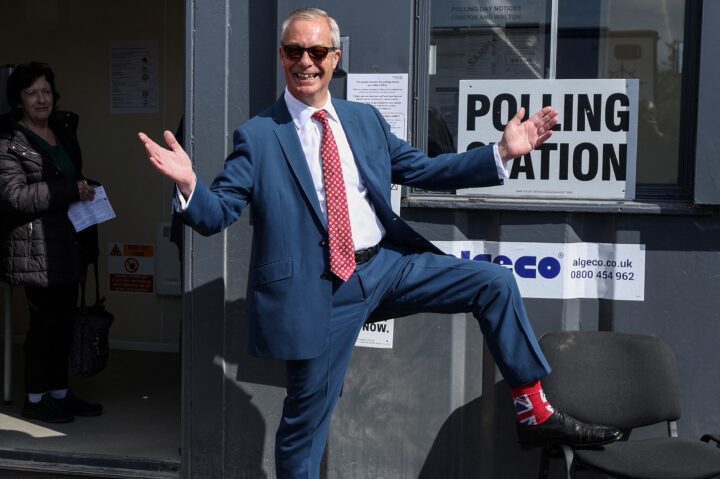
Chris Radburn / AFP via Getty Images
Reform UK leader Nigel Farage poses to show off his socks as he visits a polling station in Walton-on-the-Naze, eastern England on May 7, 2026, to cast his vote in the local elections.


 Add JewishInsider on Google
All politics is local, as the saying goes. And if true, that could be very bad news for U.K. Prime Minister Keir Starmer following yesterday’s local elections across the country that saw significant losses for his Labour Party — a showing that could prompt party officials to reassess the party’s direction.
With partial results in shortly after polls closed, Nigel Farage’s hard-right Reform U.K. party appeared to have made significant gains in working-class areas of the country, while Labour lost hundreds of local seats. Farage, who has faced multiple allegations of antisemitism — including bullying Jewish classmates as a teenager and promoting antisemitic conspiracy theories, as well as his multiple appearances on conspiracy theorist Alex Jones’ show — was the night’s clear victor.
All told, Labour did not lose as badly as some polls had predicted, but the significant losses it did suffer, compared to Reform’s gains, portend future challenges for Starmer as he works to hold onto the premiership, less than two years into his term.
Starmer on Friday morning called the results “really tough,” adding that the outcome “hurts, and it should hurt, and I take responsibility.” He insisted he had no intention of leaving 10 Downing St., telling BBC News repeatedly, “I’m not going to walk away.”
The other big loser in the day’s elections was Kemi Badenoch’s Conservative Party, which, aside from reclaiming London’s Wandsworth and Westminster districts (both of which it lost to Labour in the 2022 elections), made few significant gains, while the Green Party fared better than Labour and the Tories,pulling out modest wins and gaining at least a dozen seats.
The Greens’ rise comes as the party investigates more than two dozen members for antisemitism, and as its leader, Zack Polanski, draws heavy criticism for making inaccurate claims about police actions during last week’s terror attack targeting two Jewish men in the London suburb of Golders Green, for which he ultimately apologized.
That the two parties claiming the best outcomes fall on opposite — and extreme — ends of the political spectrum is deepening concerns among British Jews, who are already on edge amid spiking antisemitism and a wave of violent attacks targeting Jewish communities around the country. The country’s Jewish leaders have not come out in force against Farage, who is broadly supportive of Israel, and his Reform Party in the same way they’ve raised concerns about antisemitism in Labour and the Greens.
“Many British Jews have looked on with horror as the traditional domination of two political parties has been disrupted by the rise in support for populist parties on the extremes — both right with Nigel Farage’s Reform UK and left with Zack Polanski’s Greens,” Justin Cohen, the editor-in-chief of the U.K.’s Jewish News, told JI. “Both parties have had to remove candidates during this election campaign over antisemitic rhetoric, although the issue does appear more pronounced within the latter.”
“That’s not to dismiss the meteoric rise of Reform,” he added, “which was formed just four years ago and has now for the first time won considerable support at the ballot box. And it would be wrong to claim that the party’s positions on Israel — and claims of easy solutions to the extremism that threatens our community — haven’t attracted support in large sections of the community at a time of unprecedented attacks and fears for the future.”
Ultimately, Cohen said, “Just as there other Jews consider the party’s rhetoric to be utterly abhorrent. Where’s some of the community are happy to dismiss claims of Farage’s own antisemitic comments as a teen, others refuse to do so. Many of them will be hoping that the extra scrutiny that comes with this week’s electoral success, combined with the pressures of power they now hold at local level, will be their undoing before the next general election scheduled for three years time.”
The British PM called for protesters who use the phrase ‘globalize the intifada’ to be prosecuted and for increased security presence in Jewish communities
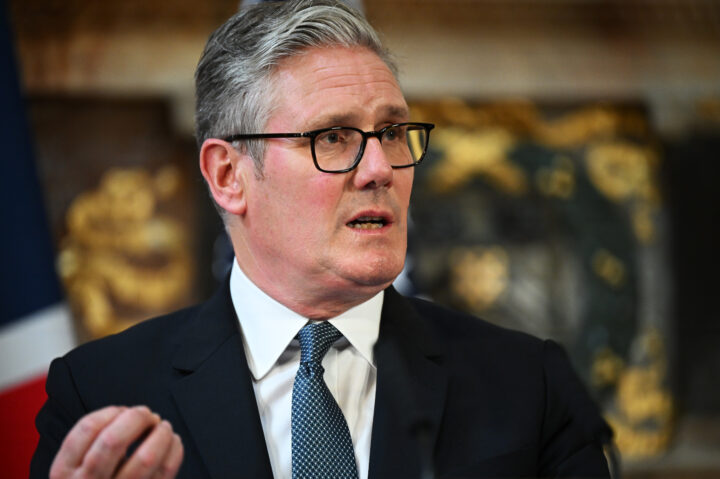
Leon Neal/Getty Images
UK Prime Minister Keir Starmer talks at a press conference at Chequers at the conclusion of a state visit by U.S. President Donald Trump, on September 18, 2025 in Aylesbury, England.
U.K. Prime Minister Keir Starmer announced several new policies aimed at protecting British Jews, including a ramped up security presence, a tightening of immigration laws and a crackdown on extremist charities, in a speech on Thursday following the stabbing of two Jewish men in a suburb of London.
Starmer denounced the rise in antisemitic attacks, naming several that have occurred in recent months, and fear that British Jews experience while conducting everyday life. He listed new government priorities including increasing visible police presence in Jewish communities; increasing investments in Jewish security services; introducing new legislation to prevent “hate preachers” from entering the country and speaking on college campuses; and working to speed up sentencing for perpetrators of antisemitic attacks.
Starmer further condemned those who participate in protests with antisemitic themes. “Of course we protect freedom of speech and peaceful protest in this country, but if you are marching with people wearing pictures of paragliders without calling it out, you are venerating the murder of Jews,” he said.
He added that demonstrators who use the phrase “globalize the intifada” are “calling for terrorism against Jews” and should be prosecuted.
As British authorities are investigating whether a recent surge of attacks targeting Jewish institutions in the country is linked to Iran, Starmer added, “We need stronger powers to tackle the malign threat posed by states like Iran because we know for a fact that they want to harm British Jews, which is why we will fast-track the necessary legislation.”
British Jews have been raising the alarm on rising antisemitism in the country and government inaction to combat it. On Wednesday, two Jewish men, one in his 70s and one in his 30s, were stabbed in the heavily Jewish London suburb of Golders Green. Both were hospitalized in stable condition, according to the Metropolitan Police, which declared the attack a terrorist incident.
The stabbing is the latest in a string of violent attacks against Jewish individuals and sites around London in recent months, which U.K. Chief Rabbi Ephraim Mirvis has called a “sustained campaign of violence and intimidation.” He said following Wednesday’s attack that “words of condemnation are no longer sufficient.”
Last week, an arsonist who pleaded guilty to attacking a London synagogue was released on bail. Also this month, two suspects in an arson attack on another London synagogue were similarly released on bail, and a building that used to house the Jewish Futures charity and still bears its name on the side was targeted in a separate arson attack the same week.
Antisemitic attacks in the country have extended beyond London. Last year, during Yom Kippur, two men were killed at the Heaton Park Hebrew Congregation synagogue in Manchester in a car-ramming and stabbing attack. At the time, Starmer promised to do “everything” in his power to protect the Jewish community, including allocating $13 million in emergency funds to provide greater security.
After meeting with U.K. Prime Minister Starmer, the president said the U.S. will be getting more involved in providing aid

Tasos Katopodis/Getty Images
President Donald Trump
President Donald Trump decried the humanitarian situation in Gaza on Monday, telling reporters that he does “not particularly” agree with Israeli Prime Minister Benjamin Netanyahu’s assessment that there is no starvation taking place in the enclave.
“That’s real starvation stuff,” Trump said, following a meeting in Scotland with U.K. Prime Minister Keir Starmer. “I see it, and you can’t fake that.”
Trump said the U.S. will be getting “even more involved” in taking steps toward addressing hunger in Gaza, including by setting up “food centers.” A White House spokesperson declined to comment when asked for specifics about what this plan might entail. Trump said “all of the European nations” would be part of the project.
“We’re going to do it in conjunction with some very good people, and we’re going to supply funds,” said Trump.
Food distribution in Gaza is currently being operated by the Gaza Humanitarian Foundation, which is backed by both the U.S. and Israel. The organization has faced criticism for failing to meet the needs of Gazans, and scenes of chaos at the gates of its distribution centers have spread online.
Without mentioning GHF by name, Trump appeared to take aim at the existing aid mechanisms, saying that the new “food centers” will not have fences to keep people out.
“We’re also going to make sure that they don’t have barriers stopping people here. You’ve seen the areas where they actually have food, and the people are screaming for the food in there, they’re 35-40 yards away, and they won’t let them because they have lines that are set up,” said Trump. “And whether they’re set up by Hamas or whoever, but they’re very strict lines. We have to get rid of those lines.”
Trump blamed Hamas for the failure of recent ceasefire talks and for prolonging the war, including the humanitarian crisis. The president’s comments come after European leaders have pressed Israel to allow a freer flow of humanitarian aid into Gaza.
“We have a good group of countries who can help with the humanitarian needs, which is food, sanitation, some other things. It’s very difficult to deal with Hamas,” said Trump. “Hamas has become very difficult to deal with in the last couple of days, because they don’t want to give up these last 20 [hostages], because they think as long as they have them, they have protection. But I don’t think it can work that way.”
Fifty hostages remain in Gaza, and Israel believes at least 27 of them are dead. The most recent ceasefire proposal would only have seen the release of about half of the living hostages.
Trump also said Iran played a role in the failure of ceasefire talks, saying Iran “interjected themselves in this last negotiation.”
“I think they got involved in this negotiation, telling Hamas and giving Hamas signals and orders. And that’s not good,” Trump said. “For a country that just got wiped out, they’ve been sending very bad signals, very nasty signals. And they shouldn’t be doing that.”
Please log in if you already have a subscription, or subscribe to access the latest updates.
 Continue with Google
 Continue with Apple