


























The document repeatedly invoked antisemitic themes and conspiracy theories in the attack that left a Jewish community member and a police officer dead
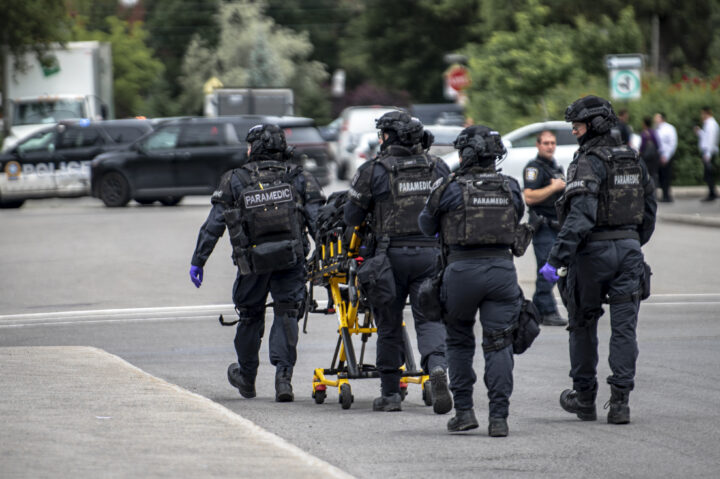
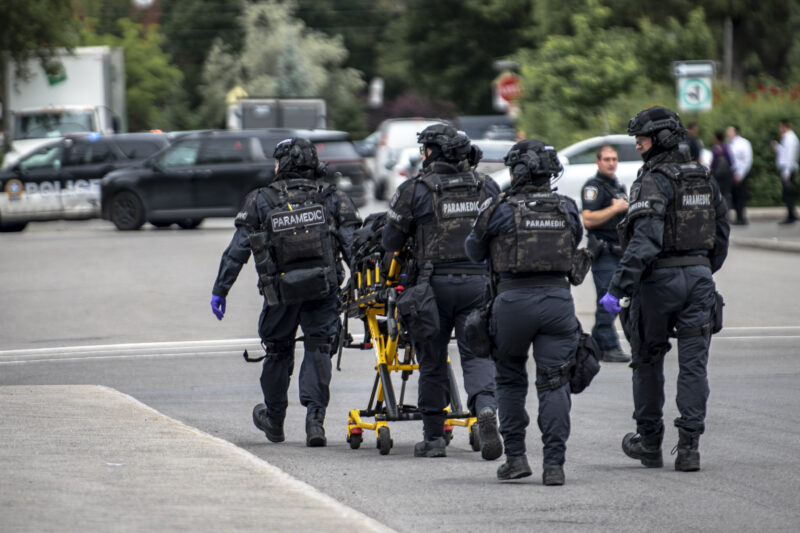
Photo by Andrej Ivanov/Getty Images
Paramedics near the scene of an active shooter situation on June 22, 2026 in Montreal, Canada.


 Add JewishInsider on Google
A manifesto allegedly left by the gunman behind Monday’s rampage in Côte-des-Neiges, a heavily Jewish neighborhood in Montreal, repeatedly targeted Jews and Zionists, specifically identifying “influential Zionists” among his intended victims, according to a copy of the document published by Rebel News.
A Jewish civilian, a police officer and the suspect were killed in the attack, while one other police officer was seriously injured but is in stable condition. On Tuesday, Quebec authorities identified the alleged suspect as Seth Hatfield, a 25-year-old man from Alberta. Police have not yet released a motive for the attack.
The 104-page document, published in full by Rebel News, lists “valid potential class A targets,” including large investment banks, powerful politicians and “influential Zionists.”
The manifesto included antisemitic conspiracy theories, stating, “The influence of Zionist Jews upon the western bourgeoisie is in fact so strong that in my other works I sometimes refer to the western ruling class itself as the Judaeo-bourgeois class.” It also repeatedly laments male loneliness and capitalist ideology.
The Quebec coroner’s office confirmed that the civilian killed was Michael Mizrachi, 64. He has been described as an active member of the Jewish community and father of three who sold suits for a living. His local rabbi, Mendel Raskin, told Canadian media that Mizrachi was originally from Lebanon and had moved to Israel before settling in Montreal.
Montreal police declined to comment to Jewish Insider Tuesday on the ongoing investigation.
The shooting comes as Jewish leaders across Canada have warned that law enforcement and the government have failed to properly address a historic rise in “systemic” antisemitism.
Montreal police said the suspect's motive is still under investigation
Daphné LEMELIN / AFP via Getty Images
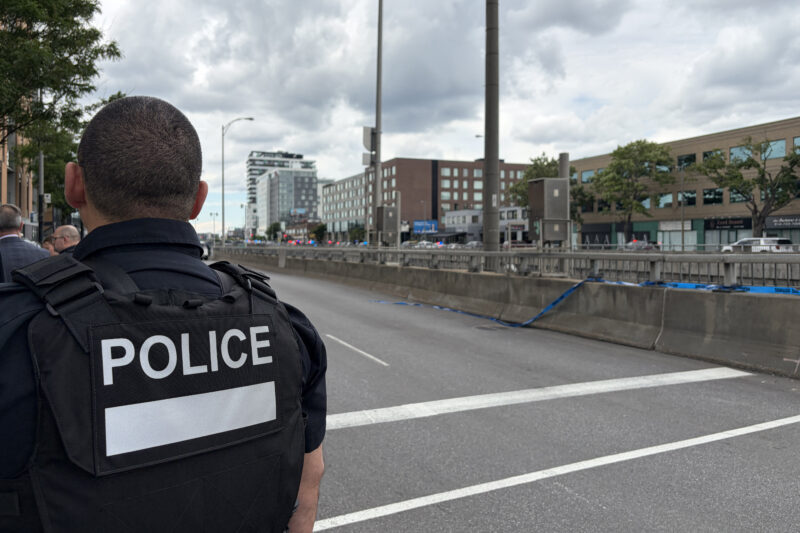
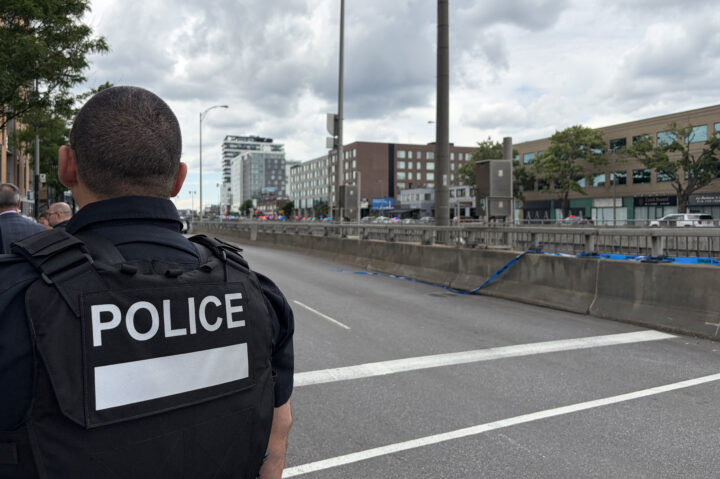
A police officer looks toward the scene of a shooting (near the tall building at L) in Montreal on June 22, 2026, which left three people dead.
Three people were killed in a shooting attack in Côte-des-Neiges, a heavily Jewish neighborhood in Montreal, Canada. A civilian, a police officer and the suspect were confirmed dead by Montreal police, while one other police officer was seriously injured but in stable condition.
Police urged residents to shelter in place, lock their doors and avoid the area as they responded to the incident and searched the area for additional suspects. In a press conference, Fady Dagher, Montreal’s police chief, said that the motive was still under investigation. He said they had determined there had only been one suspect who shot at them and he had been neutralized.
Tzipi Zeigerman, an Israeli who moved to the neighborhood two years ago, told Jewish Insider she was home when the attack began around noon, and from her window “noticed people running and screaming ‘active shooting.’”
“I heard tons of police cars and helicopters,” said Zeigerman, adding that as of Monday afternoon the streets were still closed and all businesses and schools in the area, including several Jewish institutions, remained on lockdown.
“It’s a tragic moment, it’s a real nightmare, knowing that you get engaged … to protect and serve, and get killed — it’s a dramatic moment for me as a chief, for my troops,” Dagher said, noting that he had visited the troops in hospital. “When we become a police officer, we become a police officer knowing the risk — we never expect this to happen.”
Côte-des-Neiges is home to several historically significant synagogues, including the The Spanish & Portuguese Synagogue, the oldest Jewish congregation in Canada, dating back to 1760.
The shooting comes amid a wave of targeted antisemitic attacks in Canada, which have led local Jewish leaders to raise the alarm on the country’s failure to properly protect the community. The Canadian government eliminated the standalone role of national antisemitism envoy in February.
Three synagogues in the Toronto area were shot at in early March in a span of five days, amid an escalated threat environment as Canada has experienced some of the most severe manifestations of the global surge in antisemitism since the Oct. 7, 2023 terrorist attacks — with higher rates of antisemitic incidents than other countries but lower conviction rates. In another recent incident, Canadian law enforcement arrested three Toronto-area men accused of planning violent kidnappings targeting women and members of the Jewish community. Irwin Cotler, Canada’s former justice minister, told JI in April that if the issue is not addressed quickly, there’s “a ticking bomb here in Canada for what will be the Bondi massacre occurring in Canada,” a reference to the December 2025 mass shooting at a Hanukkah gathering at Bondi Beach in Sydney, Australia, that killed 15 people.
Still, Zeigerman, who said she moved to Canada from Israel to seek a safer life, “felt very safe here — until now.”
The foiled attack at the Michigan synagogue is being called a miracle — but those who were inside now face the lasting impact of trauma and a search for safety
JEFF KOWALSKY / AFP via Getty Images
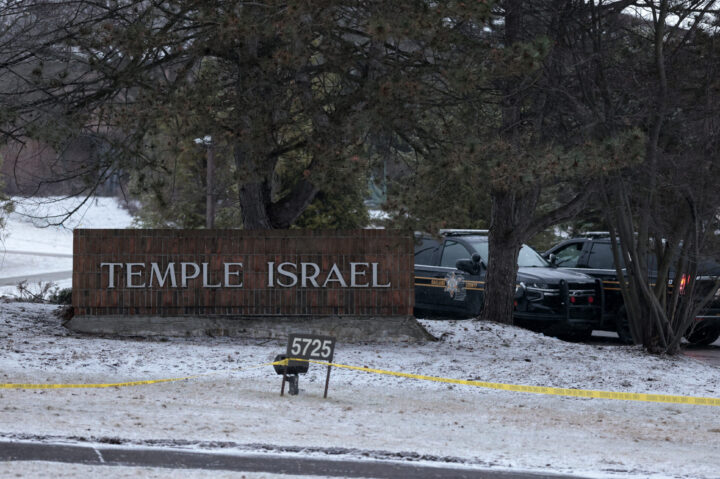
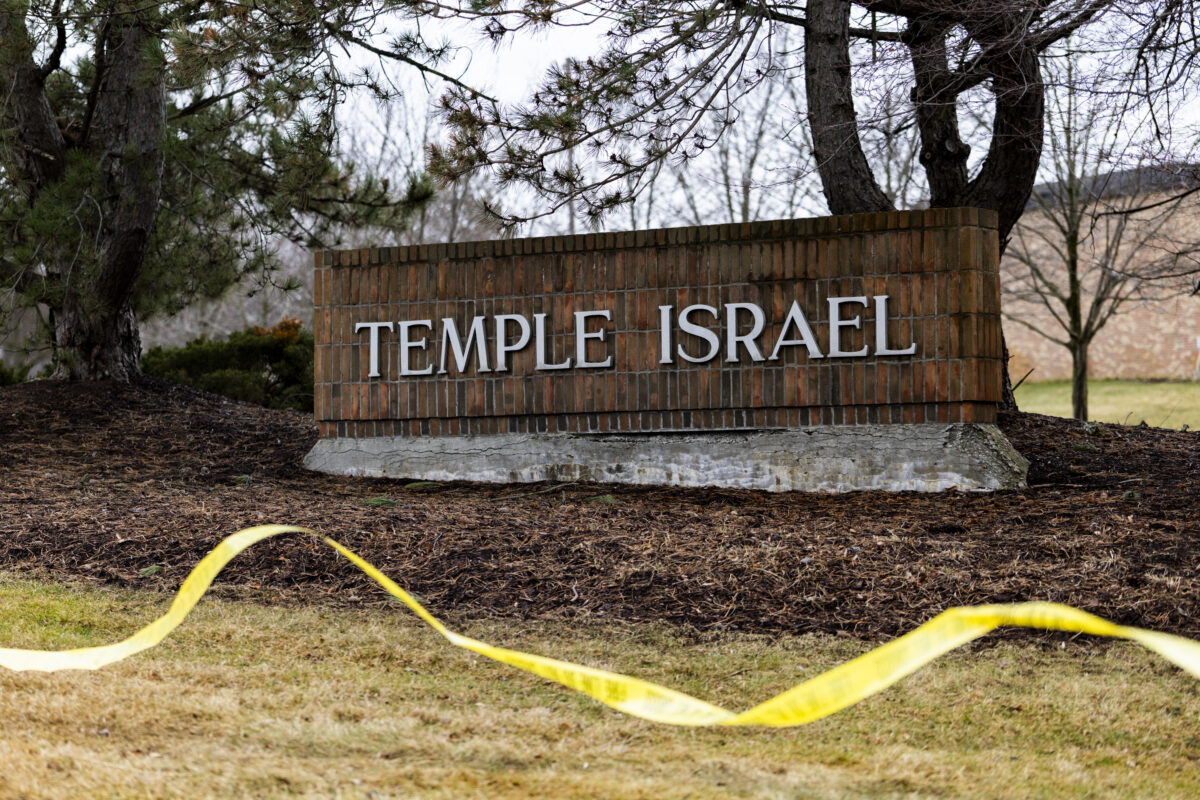
Law enforcement vehicles are seen parked outside Temple Israel guarding the scene in West Bloomfield, Michigan, on March 13, 2026.
WEST BLOOMFIELD, Mich. — Pop. Pop. Pop. Liz Rosenbaum heard the unmistakable sounds of a gun being fired and took a deep breath as the 4-year-old boy next to her looked her way, wide-eyed. Even in the best of times, he was an anxious kid. This was not one of those times. “Was that a gun?” he asked.
Without missing a beat, Rosenbaum reminded the boy that the classroom across the hall in the Temple Israel Early Childhood Center had a bunch of balloons set up earlier for someone’s birthday. They must’ve popped, she suggested. “Remember? You saw the balloons in their class,” she told the child.
Rosenbaum, a retired Detroit public school teacher, locked eyes with the much younger teacher across the room and whisper-yelled to her: Don’t show any emotion. Just take care of the kids. So they held the babies — to a preschool teacher, any child is a baby — and waited, not knowing anything beyond the fact that someone was shooting a gun and the smell of smoke was getting worse. Rosenbaum’s 5-year-old grandson, Theo, was in a nearby classroom, but she had already gotten word from her daughter, via Theo’s teacher, that he was OK.
Seconds or minutes or hours later — it was hard to know — police officers came to the door. Rosenbaum’s co-teacher was perched at the door’s little window, peeking through a one-way blackout shade that allowed teachers to look out but kept outsiders from seeing in.
The officers said the code word that the teachers had been trained to know would reveal the person on the other side of the door was, in fact, one of the good guys. The teachers opened the door and grabbed the kids, carrying or pulling or holding or dragging, whatever it took to obey the officers’ command to “get out of here, fast.”
“[The kids] knew something was going on. I said, ‘Remember these officers you studied? You read about them. We talked about them. Those are our helpers,’” Rosenbaum recalled telling the kids. Two days earlier, police and firefighters had visited the preschool, located in the largest Reform congregation in Michigan, as part of a lesson.
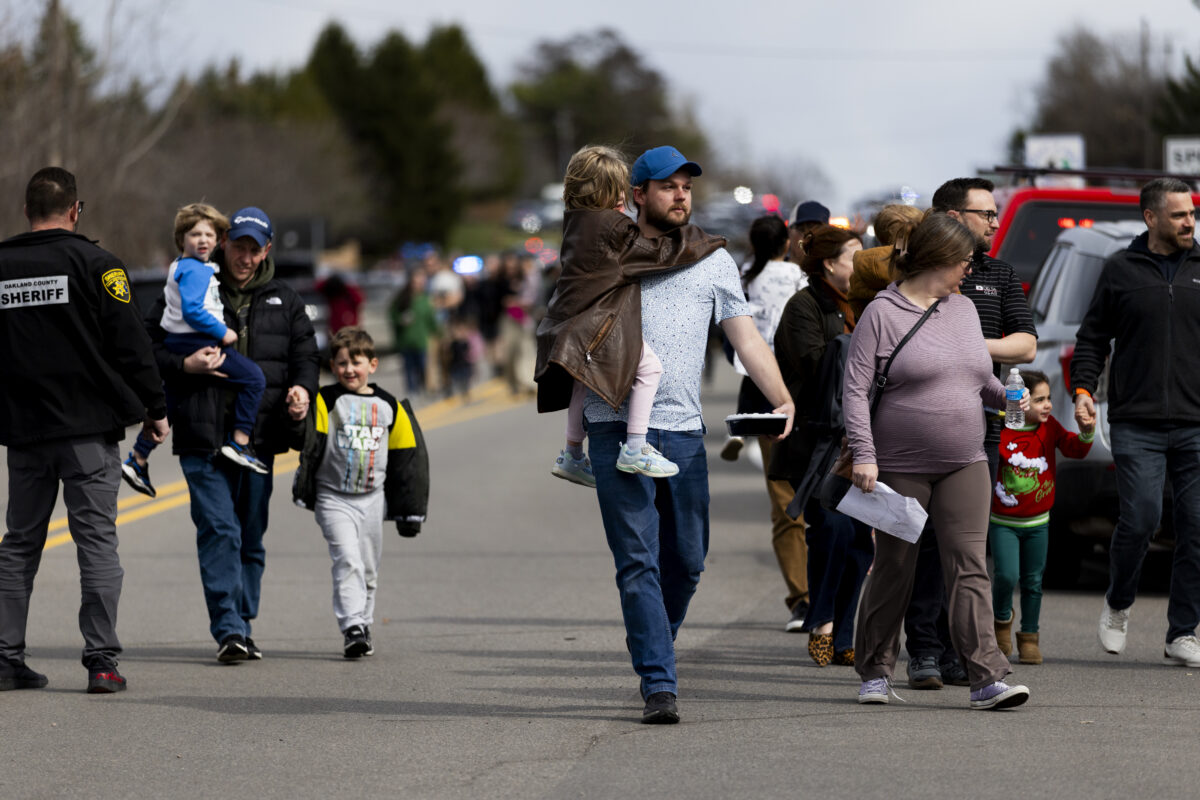
A cadre of preschool teachers carried babies and led toddlers out the back door of the synagogue, first to an ambulance that was too crowded, and ultimately onto a West Bloomfield School District bus that took them across the street to a country club for the Chaldeans, an Iraqi Christian community. Some teachers had to run with their kids to get there. You’re a dinosaur — run as fast as you can! they said, hoping to hurry the kids along without scaring them.
Rosenbaum and the entire world would soon learn that a Lebanese immigrant — later revealed to have ties to the terror group Hezbollah — had driven a truck packed with explosives into Temple Israel around noon that day. Cable news networks showed aerial shots of smoke billowing from the roof of the synagogue and reported in alarming chyrons that an active shooter was inside. The attacker got out of his car and started shooting before he died of a self-inflicted gunshot wound.
Every child in Rosenbaum’s classroom walked out of Temple Israel alive. In fact, every person who was already in the building survived; the only person who was injured was a security guard, hailed as a hero and already on the mend. (He was apparently quite pleased that, in his moment of need, he convinced a Temple Israel rabbi to buy him a sandwich with bacon to bring to his hospital room.)
The story of Temple Israel is one of miracles. The building’s sprinkler system turned on, soaking everything in the building except for the Torah scrolls. Miracle. The hallway where the attacker rammed his car was set aflame, burning most of the photos that lined the wall showing the synagogue’s annual confirmation classes but sparing the oldest photos, from decades ago, which were not digitized and otherwise would’ve been lost forever. Miracle. Teachers trained in active-shooter protocols acted quickly and meticulously to secure their classrooms, and security guards performed their jobs perfectly. Miracle. No children were in the hallway in the path of the truck. Miracle upon miracle upon miracle.
“Nes gadol hayah poh,” Noah Arbit, a lifelong member of Temple Israel and a Michigan state representative whose district includes the synagogue, said last week in an interview with Jewish Insider at a bakery a couple of towns over. A great miracle happened here. It was a riff on a Hebrew phrase used on Hanukkah, the holiday that celebrates the Jews’ miraculous victory over the ancient Greeks during the time of the Second Temple in Jerusalem. Usually, Jews living in the diaspora say a different version of the phrase that translates to “a great miracle happened there.” This time, the miracle was here in Michigan.
”I think if it happened anywhere else but Temple Israel, we probably could have had a massacre. Temple Israel benefits from scale and resources in a way that other synagogues around here don’t,” said Arbit, a Democrat.
But it is not accurate to say that this is only a story of miracles. For people who don’t live in West Bloomfield, once the headlines shifted from “active shooter at a synagogue” to “antisemitic attack thwarted,” many moved on. Jews in Metro Detroit did not. For them, this story of miracles was first a story of terror, of fear, of never being able to un-learn the feeling of dread that comes from not knowing whether your child is alive or dead.
“People are traumatized, and there’s no way around it,” Rabbi Josh Bennett, who has been on the pulpit at Temple Israel for 33 years, told JI last week. “And yet there’s an entirely different world out there, which is the world talking about miracles, and thank God nobody was injured. And that’s actually very dissonant, because the rest of the world has kind of moved on, and they’re just waiting for us to reopen the building.”
The path toward healing is not as straightforward as just reopening the building, and even that will be complicated and time-intensive.
“The building will be rebuilt. If you drive by there now, you’ll see there’s construction workers working on it right now, and they’re drying it out, and they’re redoing the drywall and fixing it. It will come back bigger and better,” said Steve Ingber, a Temple Israel member and CEO of the Jewish Federation of Metropolitan Detroit.
There’s also the question of where to have Temple Israel’s preschool meet for the rest of the school year. The ECC students have been holding playdates together as the school remains closed and Temple Israel looks to find an alternate place for the school to meet.
But first and foremost is the lingering emotional trauma that is only beginning to be unpacked.
“We don’t want to leave anyone behind. We don’t want anyone to feel like they are isolated and living in a black hole, and after this traumatic moment and after a mass violence experience, that is often the case, is what I’m learning from these professionals,” said Rabbi Arianna Gordon, Temple Israel’s director of education and lifelong learning. “It’s really easy to fall into that black hole and really feel like you’re invisible, feel like you’re isolated. And we are really, really trying to make sure that everyone feels seen and feels helped and feels heard.”
On March 12, the day of the attack, Gordon heard a loud boom that she later learned came from the truck driving into the building. She opened her office door and saw a stroller overturned in a pile of broken glass. A security guard shouted to get back in the room, and she took her staff to shelter in place in a far corner of a new office they had moved into only two days earlier. She sent a message to all the teachers, telling them to implement lockdown procedures.
Her 2-year-old son was in the building. When Gordon and her colleagues were evacuated, she waited outside the building until her son came out.
“Rachel, our ECC director who ran out with me, will say that my voice screaming for my child, when we were running out, will forever haunt her,” said Gordon. She doesn’t remember making a sound.
Most of all, as social workers and rabbis work to meet community members’ emotional needs, the biggest unanswered question has to do with security: Is there enough? Even if so — and by all accounts, Temple Israel’s large security operation saved lives — how do community members make sense of the fact that their sense of safety has now been shattered? That a man from a nearby community pledged his allegiance to a foreign terrorist group and sought to bring tremendous harm to Jewish children?
“It hurts more than I ever thought that it would. I think there’s a lot of people who feel that way. It’s a beautiful building and a sacred space,” said Arbit, the state representative. He blinked back tears. “Sorry. It’s been really hard.”
The day of the attack, Ingber was getting ready to leave the federation office in nearby Bloomfield Hills for lunch when he heard the security radio crackle to life. The Jewish Federation of Detroit employs 23 security officers throughout the community’s schools and synagogues, and each of them carries a radio. The one in Ingber’s office goes off each morning around 8 a.m., a tech check to make sure it works. It sits quiet the rest of the time. Except on March 12. “SHOTS FIRED,” a voice announced over the radio.
“First, it took me a second, like, Wait, did I just hear that?” Ingber recalled during an interview in his office last week. “From there, we heard that this was real, and then we immediately started working on it, and that entailed sending every other Jewish building in town into lockdown, because we don’t know: Is this a one-off, or is this a coordinated attack?”
Security is the biggest annual line item expense for the Jewish federation, as it is for many Jewish institutions. The federation has made more than $1 million in security funds available to local organizations since the attack. Jewish activists from Detroit and around the country went to Capitol Hill the week after the attack to lobby Congress to increase the amount of money in the federal Nonprofit Security Grant Program.
But for the 75,000 or so Jews in the Detroit metropolitan area, the need still feels almost impossible to meet.
“I still feel, despite everything, that Temple Israel is incredibly safe, because what happened was our team protected us. They protected the staff and the children,” said Elyssa Schmier, the regional director of the Anti-Defamation League’s Michigan office and a Temple Israel member. Her 5-year-old son goes to another Jewish preschool in the area that is smaller, with less of a security presence.
”My son’s preschool was — the security was fine. I wouldn’t say it was great, and we’ve kind of known all along it wasn’t super great. So now they’ve had to put in full-day armed security and go with a new company. People weren’t sending their kids to school until that went into place. We’ve had a couple families pull out altogether,” Schmier said in a conversation last week in a coffee shop near West Bloomfield. “The additional cost is astronomical now of what the school’s going to have to take on.”
All of the added security means even more closed doors at a time when the Jewish community longs more than ever for allies.
“Things that are part of the strength of the Michigan Jewish community are now being looked at with an eye of concern, and the irony of that, for a community that so values community building and institutions is, I think, not lost on anybody,” Sen. Elissa Slotkin (D-MI) told JI last week.
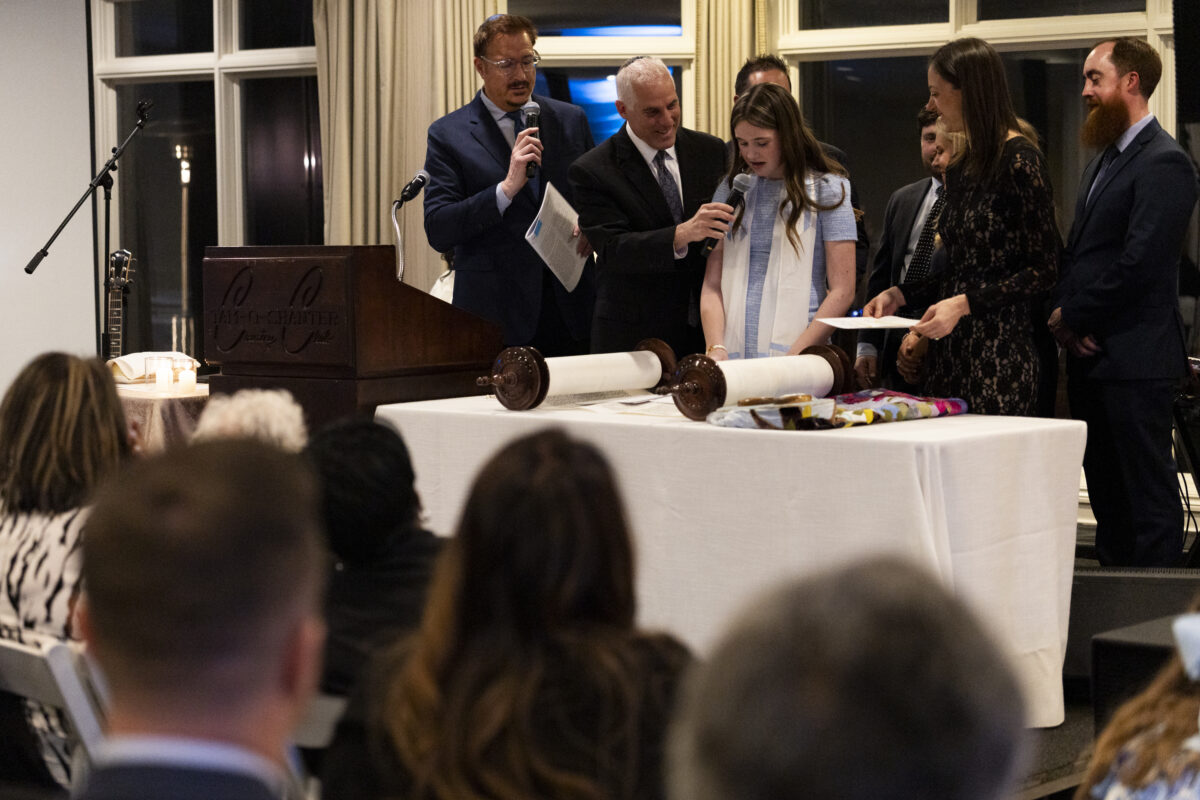
Jeremy Moss, a Democratic state senator who attends a Conservative synagogue in the area, said over a meal of rye bread, pickles and chicken soup at a West Bloomfield deli last week that the Temple Israel attack warrants a much larger outcry from outside the Jewish community than it is getting. Moss, who is running for Congress this year, is the only Jewish member of the Michigan state Senate. He is also the only LGBTQ member of the Senate. He knows that those two parts of his identity are often treated differently.
“When I talk about LGBTQ rights, I have my Democratic colleagues rushing to be behind me, to stand in solidarity, to allow me to lead on the discussion, to allow me talk about what is homophobic and transphobic, to back me up,” he said.
“In the past several years, when I talk about antisemitism, it feels like I’m talking alone, or that I’m challenged, or that I’m lectured, not necessarily by my colleagues, but lectured about what is antisemitism from others, rather than allowing my own experience to be accredited, to be valid,” he added. “It’s a very isolating, lonely feeling, and it really makes you realize how small the Jewish community is and how difficult it is to get our lived experience heard and supported.”
The attack on Temple Israel, and the fact that no one died, offers a “second chance,” Moss said. Not just for the parents and children, he said, but “for all of us.”
“Whether you’re on the left, this is a second chance to speak out if you haven’t spoken out before. Whether you’re on the right, this was a second chance for them,” Moss said, taking aim at his Republican colleagues who did not support a major hate crimes package passed last year. “I think there’s a lot of second chances going on as a result of this incident, where every child went home healthy to their parents that day. The question is, what are we going to do with that?”
For a lot of people at Temple Israel, it’s too early to think about what all of this means. The pain is too raw. Because here’s what they know: A man was able to park in the Temple Israel parking lot, sit there for two hours listening to Arabic battle anthems while texting his sister and other family members about his plans and drive his truck head-on into the building, while teachers shushed children and sang them songs just feet away.
What could be normal after that?
“It needs to be driven home over and over again: A person who drives their vehicle with fireworks and gasoline into an early childhood center with the intent of killing children and Jews — that is antisemitism,” said Bennett, the senior rabbi. “It is impossible to be in an event like this without being forever changed. It is an indelible mark on the soul of our congregation.”
In a strange irony, many of the kids who were at Temple Israel during the attack are unfazed. Some were too young to notice anything out of the ordinary. The slightly older kids experienced the chaos, but they mostly felt lucky to get an unexpected field trip that came with chicken tenders, pizza and games. Parents whose younger children were at the ECC are struggling to describe what happened to their older kids.
“When they ask, like, why do people hate Jews, it is really hard to be a parent and to be an educator in this moment and figure out the right things to say to our children,” said Gordon, the education director. Her 2-year-old is, of course, not asking those questions; he was mostly asleep throughout the attack, which occurred during nap time. But her 7- and 9-year-old kids are.
“I say that I don’t have a good explanation. I can’t tell you why people hate Jews. But what I can tell you is that there also are people who are really incredibly helpful and wonderful and supportive of our Jewish community, and we want to focus on that,” said Gordon.

The day after the attack, Shabbat services were held at Shenandoah County Club, the Chaldean club that had opened its doors a day earlier as a reunification center during the attack. Last Friday, Temple Israel’s members met inside another West Bloomfield synagogue. At least 200 people joined the service, eager to hug each other and sing together and live out the beautiful parts of being Jewish. But they were reminded at every moment that they were living in a world transformed by ugliness.
Police cars parked out front directed traffic, and anyone coming in had to pass seven or eight security guards as they walked through a metal detector. During the service, security guards slowly walked around the room, monitoring the crowd. One guard stood like a sentry at the sanctuary’s big window, eyes fixed on whatever unknown threats might be lurking outside on the frigid early spring evening.
Indoors, Temple Israel’s rabbis and cantor joyfully ushered in Shabbat with a musical service. They told congregants about webinars being offered by mental health professionals. They shared that the synagogue’s staff were being given the entire week of Passover off so they could relax with their families.
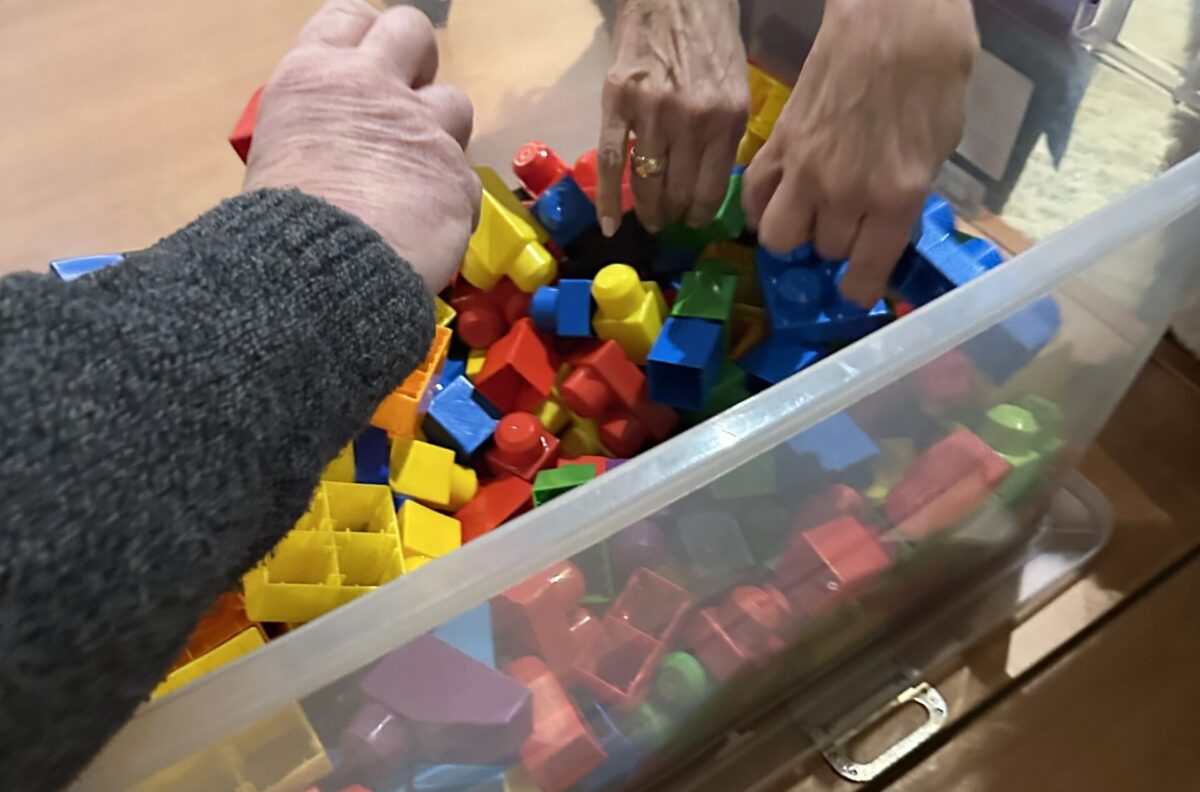
The rabbis and ECC staff had been allowed back into the synagogue briefly to be able to take items from their offices before cleanup crews disposed of the rest, most of which was waterlogged or burned. One of them grabbed a box of large, colorful plastic bricks.
As people left the service, they were invited to take one of those bricks home with them to place on their Seder plates. It would be a bitter reminder of what Temple Israel had endured. But more importantly, it would remind people that with the help of its dedicated and loving community, Temple Israel will rebuild.
For Rosenbaum, the Temple Israel preschool teacher, it’s been a challenging few weeks. She woke a few days after the attack from a nightmare. She stepped outside, breathing in the fresh air. She is in therapy. Babysitting the Temple Israel toddlers who are now out of school helps, too. She will be back teaching at Temple Israel as soon as she is allowed.
“My mother taught me, when you fall off a bicycle, you get back on and you learn to ride it. When you get in an auto accident, you get back in the car and you learn to drive it. I taught my kids that. And Temple Israel is very strong. We are going to go back. We’re going to go back as being strong and supporting and loving one another, like we do,” said Rosenbaum.
“In the grand scheme of things, Hashem was with us.”
Armed security stationed at Temple Israel in West Bloomfield, Mich., engaged with the attempted shooter, who was identified by DHS as Ayman Mohamad Ghazali
Emily Elconin/Getty Images
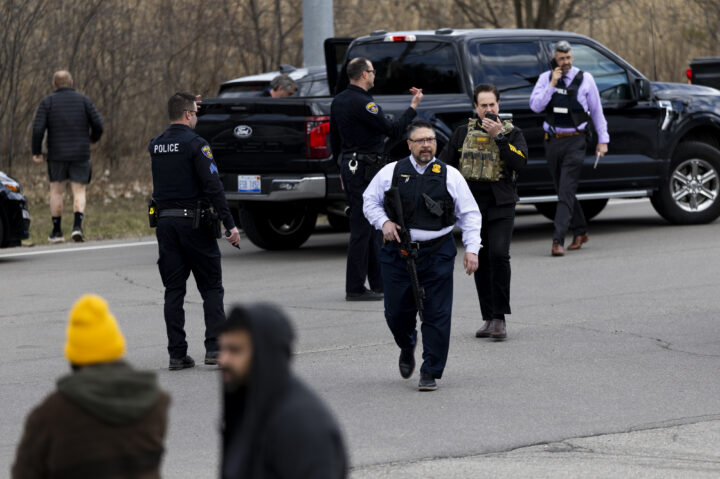
Law enforcement respond near Temple Israel following reports of an active shooter on March 12, 2026 in West Bloomfield, Mich.
An assailant was killed during an active shooter situation at Temple Israel in West Bloomfield Township, Mich., law enforcement officials confirmed on Thursday afternoon. One other person, a security guard, was injured.
The attack is being investigated as a “targeted act of violence against the Jewish community,” Jennifer Runyan, the special agent in charge of the FBI’s Detroit field office, confirmed in a Thursday evening press conference.
A Department of Homeland Security spokesperson confirmed to Jewish Insider that the attack was carried out by Ayman Mohamad Ghazali.
Ghazali, 41, was born in Lebanon and entered the U.S. in 2011 on an IR1 immigrant visa as the spouse of a U.S. citizen. He was granted U.S. citizenship in 2016, according to DHS.
Armed security stationed at the synagogue engaged with Ghazali inside a vehicle that “breached the facility by driving into it,” Oakland County Sheriff Michael Bouchard said. Shots were fired and Ghazali was killed inside the vehicle, according to Bouchard, who added that “we can’t say what killed him at this point, but security did engage him with gunfire.”
Bouchard said that a security guard who was knocked unconscious during the incident and hospitalized “should be OK.”
The Oakland County Sheriff’s Office said the vehicle likely intentionally crashed into the synagogue, causing the building to catch fire. Smoke could be seen billowing from the roof in early live news footage.
Temple Israel, one of the largest Reform congregations in the U.S., runs a preschool, which was in session at the time of the incident. In a message to members, the synagogue said that “all students and staff are safe” and had been evacuated to a nearby location.
Bouchard added that he and other law enforcement leaders had been preparing for a scenario such as this for the last two weeks, around the start of the U.S. and Israeli war in Iran.
Michigan Gov. Gretchen Whitmer, as well as the three main Democratic candidates vying for the U.S. Senate seat to represent the state, swiftly issued statements on X addressing the incident.
“Michigan’s Jewish community should be able to live and practice their faith in peace,” said Whitmer. “Antisemitism and violence have no place in Michigan.”
“Before our very eyes, a Temple in West Bloomfield is under attack,” said Rep. Haley Stevens (D-MI), who represents the district where Temple Israel is located. “Like many of you, I am getting reports in real time. To everyone in Michigan’s 11th district, continue to follow the guidance of local law enforcement. To the Jewish American community in Michigan and beyond, we stand with you.”
“I’m hearing the first reports of an incident at Temple Israel in West Bloomfield,” said state Sen. Mallory McMorrow “Please stay away from the area and listen to direction from first responders as we wait to learn more.”
“The rise in antisemitism is not abstract. It’s not left or right. It is here. It is in our state, our community, just miles from my own house. It is in our neighborhoods, our schools, our houses of worship. Enough,” she said in a follow-up statement later on Thursday afternoon.
Far-left Senate candidate Abdul El-Sayed said that he was “horrified to hear the reports of an active shooter at Temple Israel in West Bloomfield. Please stay safe if you’re in the area. This kind of violence has no place in our communities.”
State Sen. Jeremy Moss, the front-runner to succeed Stevens in Congress, said in a statement that he has “been in contact with local officials to monitor the active shooting at Temple Israel in West Bloomfield and am praying for everyone inside … We’re living through an incredibly agonizing time in our Jewish community. We deserve safety in our synagogues, schools, and everywhere else. This rise in targeted hate and violence is untenable.”
Speaking to reporters on Capitol Hill Thursday afternoon, Sen. Elissa Slotkin (D-MI) said she “grew up not far from” Temple Israel.
Slotkin declined to “get ahead of the police” as “law enforcement are still securing the scene.” She urged the public to “listen to the warnings that they’re putting out.”
Amid rising antisemitism in Michigan, Steven Ingber, CEO of the Jewish Federation of Detroit, said during a Thursday evening press conference that he was not “shocked or surprised” by the attack.
A Baltimore Police officer and a suspect were shot during an active shooter incident
Peter Byrne/PA Images via Getty Images
A generic stock photo of police tape at a crime scene.
A leading Jewish security organization said that there is no known threat to the Jewish community following an active shooter incident Tuesday afternoon near the Agudath Israel of Baltimore synagogue in which a Baltimore Police officer and a suspect were shot.
The Secure Community Network said in a statement, citing a law enforcement source, that the shooting was most likely “domestic in nature.”
“There are no indications that the Jewish community was the target, and there is no known active threat to the community,” SCN said.
According to WBAL-TV in Baltimore, the suspect fired shots from a window toward an undisclosed location. Authorities were called around 12:30 pm to the 6200 block of Park Heights Avenue, near the Orthodox Agudath Israel of Baltimore synagogue.
Officers asked the public to avoid the area on Tuesday afternoon as they investigated a motive.
One officer was taken to University of Maryland Shock Trauma. Another officer suffered a non-life threatening injury. The suspect’s condition has not been disclosed and it was not immediately made clear if they are in custody.
“We are aware of the police involved shooting,” the Baltimore Police union said in a statement. “All involved members are in good spirits.”
Neither Baltimore police nor Agudath Israel of Baltimore immediately responded to requests for comment from Jewish Insider.
Officials are investigating a possible connection between the attacks
Sammy Kogan/The Canadian Press via AP
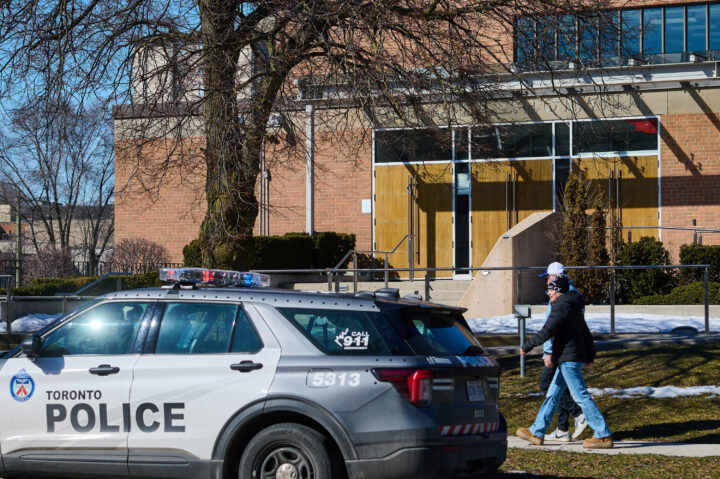
Pedestrians pass by a police car parked outside Shaarei Shomayim synagogue in Toronto, Sunday, March 8, 2026.
Two Toronto-area synagogues were damaged by gunfire late Friday and early Saturday following an earlier shooting at another area synagogue last week.
Officials are investigating a possible connection between the shootings, the latest of which occurred outside of Shaarei Shomayim Synagogue and The Beth Avraham Yoseph of Toronto (BAYT) synagogue over the weekend. No one was injured in either incident.
In a message to congregants, Rabbi Daniel Korobkin, senior rabbi of BAYT, called the shooting “an appalling and cowardly act of evil,” adding that it left damage to the building’s front doors. BAYT — one of the largest Orthodox synagogues in North America — is located in the city of Vaughan’s Thornhill neighborhood, a heavily Jewish Toronto suburb.
Korobkin praised several Canadian politicians, including MPP Laura Smith, Vaughan Mayor Steven Del Duca, MP Melissa Lantsman and Vaughan City Councillor Gila Martow, for “working tirelessly with all levels of government, the intelligence community, and York Regional Police, who are in the midst of conducting a thorough investigation.”
He told members that they should continue to “attend minyanim, shiurim and other communal activities with renewed vigor and resolve.”
According to Toronto police, multiple shots were fired at the front doors of Shaarei Shomayim at 12:03 a.m. on Saturday — less than an hour after the BAYT shooting. Shaarei Shomayim is located in North York, about three miles from Thornhill.
Prime Minister Mark Carney called the attacks “an assault on the rights of Jewish Canadians to live and pray in safety.”
The attacks come after another Toronto synagogue was shot at last Monday night, causing damage to the building’s exterior. Toronto Police Service said that there were several bullet holes in the front windows of Temple Emanu-El in North York. No injuries were reported, but some people were inside the building at the time of the attack, following a Purim celebration.
At a press conference on Sunday, Noah Shack, the CEO of the Centre for Israel and Jewish Affairs, the advocacy arm of Jewish Federations of Canada-UIA, said that the country is “at a crossroads” following the three shootings.
“This gunfire didn’t come from nowhere,” said Shack. “Over the last two years, our Jewish community has been subject to increasing incidents of hate, intimidation, harassment and violence.”
Israel’s Ministry for Diaspora Affairs and Combating Antisemitism found a 670% increase in antisemitic incidents in Canada in 2024.
Toronto Police Chief Myron Demkiw said at the press conference that there are ongoing investigations. He promised a “relentless” pursuit to hold suspects accountable.
Mayor Olivia Chow called the shooting ‘an unacceptable act of antisemitism and intimidation’ amid heightened concerns to Jewish communal safety
Creative Touch Imaging Ltd./NurPhoto via Getty Images
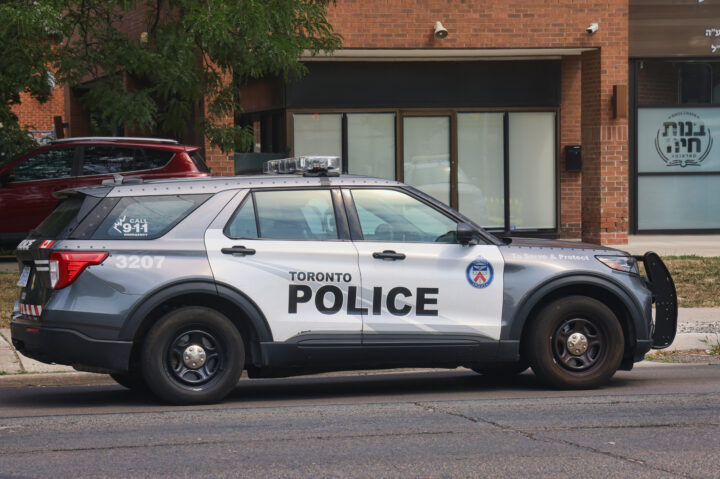
A Toronto police vehicle parks outside a Jewish school in Toronto, Ontario, Canada, on August 16, 2025.
A Toronto synagogue was shot at Monday night, causing damage to the building’s exterior, according to police.
Toronto Police Service said that there were several bullet holes in the front windows of Temple Emanu-El in North York. No injuries were reported.
The shooting occurred shortly before 11pm, as some people remained inside the building following a Purim celebration, a source with knowledge of the incident told Jewish Insider. Officers found “multiple shell casings at the front entrance of the synagogue, evidence of gunfire and damage to the building,” Toronto Police Deputy Chief Robert Johnson said during a Tuesday afternoon press conference. No information about the suspect or the type of firearm used has been confirmed, Johnson said.
“This is being investigated as a targeted incident” by the Integrated Gun & Gang Task Force and Hate Crime Unit, a police spokesperson told JI.
Toronto Mayor Olivia Chow called the shooting “an unacceptable act of antisemitism and intimidation.”
“We will not tolerate antisemitic hate in our city. Toronto Police are investigating and will increase their presence in the area to keep the community and congregants safe,” Chow said. “Toronto’s Jewish community has the right to practice their faith without fear, intimidation or violence.”
“The synagogue I attended as a boy and youth, where I was bar mitzvah’d and received my primary Jewish education, now under gunfire in once-peaceable North York, Ontario,” David Frum, senior editor at The Atlantic, wrote on X.
In response to the shooting, the Jewish Security Network of Greater Toronto, which is part of Toronto’s Jewish federation, said in a statement that it advises “the community to exercise heightened vigilance and awareness at this time.”
The shooting came as Jewish communities worldwide are on increased alert amid U.S.-Israeli operations against Iran. Earlier this week, security groups warned of potential risk to Jewish institutions globally by attackers motivated by the events.
Canada has seen a particularly egregious rise in antisemitism since the Oct. 7, 2023 Hamas terrorist attacks in Israel. So far in 2026, 22 antisemitic occurrences have been reported in Toronto, representing approximately 62% of all reported hate crimes, according to police.
Israel’s Ministry for Diaspora Affairs and Combating Antisemitism found a 670 percent increase in antisemitic incidents in the country in 2024.
Australian Prime Minister Anthony Albanese called the attack, among whose victims was a Chabad emissary, an ‘act of terror’
George Chan/Getty Images
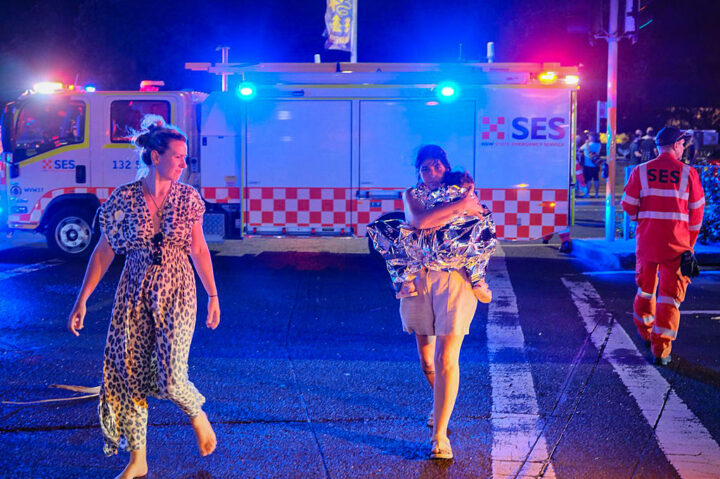
A member of the public leaves the scene with her child, who is covered in an emergency blanket, after a shooting at Bondi Beach on December 14, 2025 in Sydney, Australia.
At least 15 people were killed on Sunday in an attack at a Hanukkah event in Sydney, Australia, in what authorities described as a targeted terror attack on the Jewish community.
The event was hosted by Chabad of Bondi, a neighborhood with a major Jewish community in Sydney.
Two gunmen opened fire with long rifles from outside the gated-off event, killing at least 15, and injuring 40. Among the victims were Rabbi Eli Schlanger, the Chabad emissary to Bondi, Holocaust survivor and immigrant from the Former Soviet Union Alex Kleytman, 87, and a 10-year-old girl identified by the Australian press only as Matilda.
The terrorists were Naveed Akram, an unemployed bricklayer and his father, Sajid, a grocer, who was killed at the scene. Naveed was shot, as well, and was in critical condition in the hospital on Monday. They were known to Australian Federal Police, which were investigating their possible ties to the ISIS offshoot the Islamic State of East Asia.
Police also found unexploded bombs in the area, near Sydney’s most popular beach, as well as additional weapons in the Akrams’ car.
Chris Minns, the premier of New South Wales, the province in which Sydney is located, said that the shooting was a “targeted attack on the Sydney Jewish community.” NSW Police declared the attack a terrorist incident. One of the two assailants was identified by authorities as Naveed Akram, and was killed at the scene.
Australian Prime Minister Anthony Albanese said following the attack that his government would implement parts of its special envoy on antisemitism’s recommendations, including additional funding for security.
“This senseless attack is one which is an act of terror. It is aimed at creating fear. But we will stand with the Jewish community and Jewish Australians at this time,” Albanese said in a statement to the press.
Kobi Farkash, an Israeli tourist in Sydney and an eyewitness to the attack, told Jewish Insider that he went to the beach and happened upon the Chabad event.
“It was surrounded by a simple fence. There were four or five Jewish security guards without weapons, and maybe two police officers there before the attack,” he recalled. “Someone from Chabad, a man with a kippah and tzitzit, invited me in … he told the security guard to let me in because I’m Israeli. I put on tefillin, ate a sufganiya [jelly doughnut]. There were activities for kids, like at any community event.”
After spending some time at the event, Farkash said, “I heard gunshots … I saw people running and someone on the floor, bleeding. I started running away with everyone else.”
“People were running in all directions, like the Nova,” Farkash said, referring to the Hamas massacre of revelers at a rave in southern Israel on Oct. 7, 2023. “It’s an event where people are celebrating and happy, and you can’t believe this happened a moment later. It felt like the Nova.”
When things seemed quieter, Farkash returned to the scene and found that first responders “were working very slowly. In Israel, we’re used to this and things work much faster. The ambulances, police, news reports, come sooner. My sense was that [Australian authorities] don’t know how to deal with mass casualty events. … I didn’t see anything on the news for almost an hour, and when I asked locals why they weren’t calling news hotlines or reporting on news apps, they said Australia doesn’t have that. In Israel, it would be in the news three minutes later.”
“I have never been in a terrorist attack in Israel,” Farkash, who grew up in Bnei Brak, near Tel Aviv, said. “It’s crazy that I went to the end of the world and experienced a terror attack here.”
Lissy Abrahams was walking with her adult daughter to a Bar Mitzvah party being held nearby and parked by where the Chabad party was being held. As they were walking, she and her daughter heard gunshots.
“We looked at each other and said ‘run,’” Abrahams recounted to JI. “I was wearing high heels that were strapped on and couldn’t just flick them off. My daughter was wearing flat shoes, and she kept coming back for me, but I told her to go. … She looked at me and made a decision that she couldn’t.”
Abrahams and her daughter saw a storage area, where lifeguards keep their equipment, and ran down to the beach to take shelter with beachgoers, including parents holding babies.
“People were standing in the doorway and didn’t know what to do, but as Jews, we understood what was going on,” she said. “I said ‘this is a terrorist attack. We need to be very careful and we need to pull this [garage] door down.’ … We needed a barrier. I had to be very firm with them, because they didn’t understand, but I had Oct. 7 footage in my mind.”
“Time was distorted, it was moving fast and slow, so I have no idea how long it took, but someone from the [local] council came and said we can go. We decided to trust that advice and go out … My daughter and I just ran. … We hitchhiked; we jumped into a stranger’s van. … We were so lucky,” she said.
Abrahams said she kept thinking about the Oct. 7, 2023, Hamas attacks on Israel: “It really struck me how many decisions I had to make and I had no idea where they would lead me. I didn’t know how many terrorists there were. I was making decisions that could have ended my life. … Jews on Oct. 7, they just had to make decisions, too.”
Abrahams was part of a group of Sydney residents who would meet weekly to read the names of the hostages taken in the Oct. 7 attacks, and she said she was very moved to see the letter written by the Hostage Families Forum to the community.
“On Saturday [the group] met for lunch. We were happy; we could breathe; we were proud of our commitment. And there we were the next day, with our community suffering,” she said. “We are feeling the love from Israel and around the world. We are one big Jewish family.”
Abrahams spoke to JI on Monday, after returning to Bondi Beach to retrieve her car, and said she saw Chabad rabbis had set up a booth at the site to help people put on Tefilin: “These are the cousins, the brothers-in-law and the best friends of people killed.”
Prominent pro-Israel activist Arsen Ostrovsky, who recently moved back to Australia after living in Israel for 13 years to head the advocacy group Australia Israel & Jewish Affairs Council, was injured by a bullet that grazed his head during the attack. His wife and two daughters also attended the event, but were not injured.
“I was here with my family, it was a Hanukkah event, there were hundreds of people, there were children, families, elderly, enjoying themselves,” Ostrovsky told Australia’s News 9. “All of a sudden, there’s absolute chaos, there’s gunfire, people ducking. … I saw blood gush in front of me, I saw people hit. … My only concern was where are my kids? Where is my wife? … I survived Oct. 7, I lived in Israel 13 years. We came here only two weeks ago to work with the Jewish community, to fight antisemitism, to fight this bloodthirsty ravaging hatred. … We’ve lived through worse. We’re going to get through this and we’re going to get the bastards that did this.”
“It was an absolute bloodbath, blood gushing everywhere. Oct. 7, that’s the last time I saw this. I never thought I’d see this in Australia, not in my lifetime,” Ostrovsky added.
Ostrovsky’s brother-in-law, Rabbi Menachem Creditor, founder of Rabbis Against Gun Violence, posted a photo of Ostrovsky being evacuated, writing, “Antisemitism is blasphemy against life, and I know this will not slow my brave brother Arsen down. It will fuel his work with AIJAC … on behalf of the Jewish community in Sydney … All Jews are family and are responsible for one another. In this case, that hit even closer to home. We will not be quiet. We will not hide. We are Jews. We are proud. We are strong. And we have work to do in the world, and this will not slow us down. Am Yisrael Chai!”
There has been a sharp increase in antisemitic attacks in Australia since the Oct. 7, 2023, Hamas attacks on Israel and the subsequent war. In the decade before October 2023, there was an average of 342 anti-Jewish incidents a year in Australia; since then, the average has risen to 1,858. Two days after the Oct. 7 attacks, thousands gathered outside the Sydney Opera House to protest Israel and chanted “f*ck the Jews.” Incidents since October 2024, the period that the latest antisemitism report from the Executive Council of Australian Jewry measures, included an arson attack on a kosher caterer, burning of cars and vandalizing buildings in a Sydney suburb, and the firebombing of a synagogue in Melbourne.
Australia expelled the Iranian ambassador earlier this year and designated the Islamic Revolutionary Guard Corps a terrorist organization, after intelligence services found that Iran was linked to the arson attacks.
Israeli President Isaac Herzog said, “The heart of the entire nation of Israel skips a beat at this very moment, as we pray for the recovery of the wounded … and we pray for those who lost their lives.”
Herzog and Israeli Foreign Minister Gideon Sa’ar noted that Israel had warned Australia that it needs to do more against antisemitism.
“We repeat our alerts time and again to the Australian government to seek action and fight against the enormous wave of antisemitism which is plaguing Australian society,” Herzog stated.
Sa’ar posted that the attack is “the results of the antisemitic rampage in the streets of Australia over the past two years, with the antisemitic and inciting calls of ‘globalize the Intifada’ … The Australian government, which received countless warning signs, must come to its senses!”
Lischinsky and his girlfriend, Sarah Milgrim, who were Israeli Embassy employees, were killed in the Capital Jewish Museum shooting earlier this year
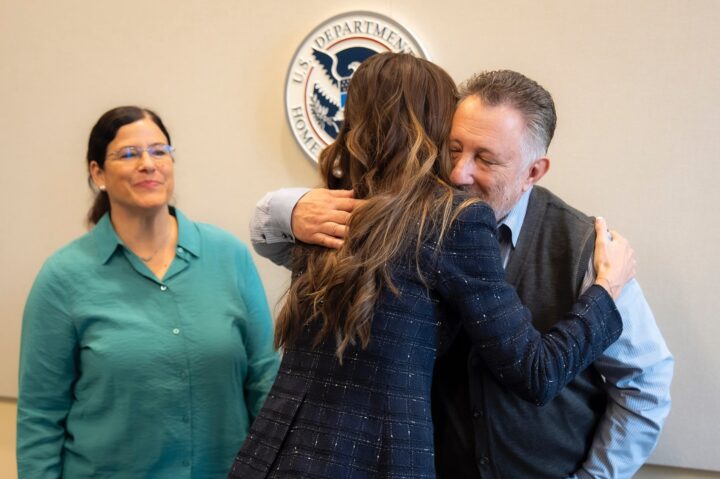
Secretary of Homeland Security Kristi Noem/Facebook
Secretary of Homeland Security Kristi Noem meets with Daniel and Ruth Lischinsky, November 21, 2025
Six months after the death of their son, Yaron Lischinsky, and his girlfriend, Sarah Milgrim, in a shooting outside the Capital Jewish Museum, Daniel and Ruth Lischinsky visited Washington last week to meet with senior administration officials and visit the sites where their son — who, with Milgrim, worked at the Israeli Embassy — lived, worked and, ultimately, died.
Speaking to Jewish Insider during their time in the U.S. capital, the pair reflected on their son’s life and legacy.
“In the beginning it was a big shock for all of us because it was so unexpected — [it was] like an earthquake,” Ruth Lischinsky said of his killing. “Now, we are feeling much more — we are missing him much more. He’s not coming back home. He’s not calling, no message[s], no nothing. So it’s really hard.”
At first, Daniel Lischinsky said, they equated the experience to being on drugs. “We didn’t know where we are and somebody removed the floor beneath us.” But he said they were grateful for the support of their friends, family and community as they grappled with their loss.
He said that his son was a “very sweet boy” and “very gentle, very artistic, very sensible all the time”; he was passionate about soccer as a child and had visions of being a professional player.
“All the time [he was] looking [out] for other people. What are their needs, how are they feeling, approaching the people that are lonely or on the side when you are in big groups,” Daniel Lischinsky continued. “He was a peacemaker. He tried [to make] people understand one [another], talking with the other and not fighting. He was a big fan of the Abraham Accords and he was a peacemaker. He knew that through diplomacy he can reach and he can make achievements.”
It was that passion, his mother said, that led him to pursue diplomatic service and ultimately land in the Israeli Embassy in Washington. She said she’s been struck by the number of people that knew her son in the nation’s capital.
“I have so many opportunities reaching out to different communities,” she said. “He was in contact with so many people. We were really blown away when we realized it now, that so many people knew him and he had contact with them.”
Lischinsky “loved” his time in Washington and ended up “in the right place,” Daniel Lischinsky said.
During their time in Washington, the Lischinskys visited the site where their son and Milgrim were killed, outside the Capital Jewish Museum.
“Seeing the place where they [were] killed was the hardest part, of course,” Ruth Lischinsky said. “But we wanted to go there to somehow connect.”
They said they regretted that they did not have the opportunity to meet Milgrim in person before her death. The young couple had arranged to visit Lischinsky’s parents in Israel days after they were killed, and Lischinsky was planning to propose.
The Lischinskys traveled to Washington both to meet with administration officials involved in fighting antisemitism as well as to meet with Lischinsky and Milgrim’s colleagues at the embassy, and see where the couple had worked together.
Ruth Lischinsky said she’d been impressed by the dedication to fighting antisemitism expressed by the officials they met with — “they are really serious about it.”
Daniel Lischinsky said that they came to offer any help they can, but also told the officials that “they need to be stronger, much more strong against antisemitism, and against every crazy one that can be suspicious, like this murderer that took the life of our children. We told them that we don’t want to hear anymore about something like this, not here in Washington, D.C., and not in the States.”
Ruth Lischinsky added that the U.S. media needs to do a better job of accurately reporting what is happening in Israel. Daniel Lischinsky said that inaccurate reporting encourages violent attacks such as the one that killed Lischinsky and Milgrim.
The couple also called for better education, starting early in schools, and for stronger law enforcement response to suspicious individuals like Elias Rodriguez, who has been indicted on murder charges for the shooting.
The Lischinskys, referencing an issue that Milgrim’s parents have also spoken about publicly, expressed shock that protesters were allowed to gather for months directly outside the Israeli Embassy in Washington, making so much noise that they were disrupting work inside the building.
The pair have also been traveling to Jewish communities around the world, recently visiting the site of a bombing that targeted the AMIA Jewish community center in Argentina and the Jewish community in Los Angeles.
“We, all the Jewish people, the people in Israel, are praying for you, and you are helping us and praying for us, the Israelis and the people in Israel,” Daniel Lischinsky said. “We are very much encouraged by the support and the love of the Jewish community here in the U.S. It’s really a balsam for our hearts.”
The state’s attorney general said the suspect ‘was making a lot of different statements, and it appears to us that it’s more likely that those statements were intended to create chaos’
Brandon Bell/Getty Images
A police vehicle and crime scene tape.
Authorities said on Sunday that they believe the suspected gunman in the fatal shooting at a country club in New Hampshire on Saturday night shouted “Free Palestine” in order to “create chaos” at the scene, suggesting they do not view the case as motivated by antisemitism.
Hunter Nadeau, a 23-year-old Nashua, N.H., resident, was apprehended and taken into custody near the Sky Meadow Country Club on Saturday. Shortly before, Robert Steven DeCesare, 59, was killed in the shooting while attending dinner at the club, located about 40 miles north of Boston, and two other adults, another restaurant patron and an employee were injured. The employee was in stable but critical condition as of Sunday, Nashua Police Chief Kevin Rourke said.
Four other restaurant patrons were wounded as a result of the chaos as people tried to escape the shooting.
According to local reports, as a wedding was taking place at the club, gunfire rang out as guests were gathering around the dance floor for the bride and groom’s first dance, which was set to include some individuals breaking dishes, a traditional custom in Greek weddings. Attendees quickly scattered amid the realization of gunfire, with some hiding inside the event room and others running into the kitchen and the club’s restaurant, located directly next door.
Several witnesses reported hearing the suspect shout “Free Palestine,” including Tom Bartelson, the groom’s uncle, who told WCVB that the shooter also shouted: “The children are safe.”
“It looked like a target, that he was going right for this person. I feel terrible for him,” Bartleson later told WMUR.
Speaking to reporters on Sunday, New Hampshire Attorney General John Formella said that the suspect made a series of statements during the shooting, and that authorities did not currently have evidence of the attack being motivated by antisemitism or other hate-based reasons.
“He was making a lot of different statements, and it appears to us that it’s more likely that those statements were intended to create chaos during the event and that they don’t really give us much of a sense of his motive,” Formella said at a news conference.
Formella said Nadeau had been charged with one count of second-degree murder for knowingly shooting DeCesare, whose mother told CNN her son lunged at the gunman in an attempt to stop the shooting when he was killed. While police originally believed there to be two suspects, prompting a local shelter in place order to be issued temporarily, they reversed course later Saturday after apprehending Nadeau, who is expected to face additional charges relating to the victims with non-gunshot wounds.
The state attorney general revealed that Nadeau was a former employee of the club, but had not been employed there in about a year.
The suspected shooter, like several other recent attackers, was active in violent online forums and showed a fascination with previous mass killers
CHET STRANGE/AFP via Getty Images
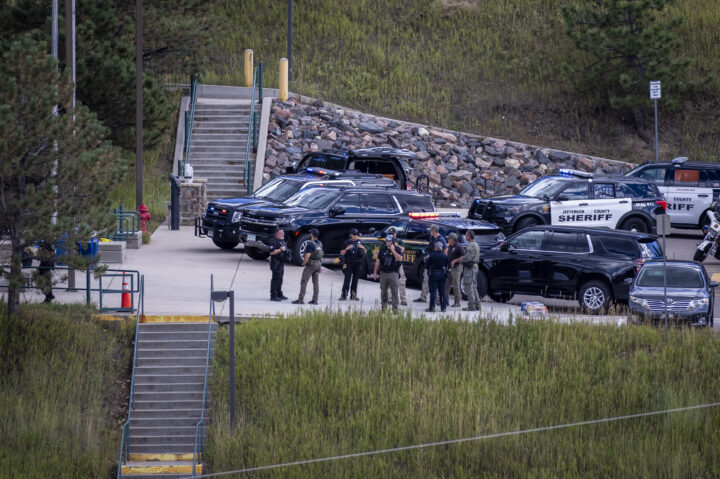
Police officers on the scene at Evergreen High School where a shooting occurred earlier in the day, in Evergreen, Colorado on September 10, 2025.
Desmond Holly, the suspected shooter who critically injured two students at Evergreen High School in Colorado on Wednesday, shared antisemitic and white nationalist views online, according to the Denver Post and the Anti-Defamation League.
Local authorities said Thursday that Holly had been “radicalized by some extremist network,” without specifying further.
According to the Denver Post, one of Holly’s online accounts used a coded slogan for Holocaust denial and reposted antisemitic videos and other videos showing individuals in Nazi uniforms.
The ADL’s Center on Extremism said Friday that Holly’s TikTok accounts were “filled with white supremacist symbolism,” including a reference to the white nationalist “14 words” slogan, and utilized a neo-Nazi symbol in his profile photo.
The ADL reported that Holly, in online interactions, shared photos of patches he had created featuring neo-Nazi symbols, similar to those used by prior mass shooters. He also shared a photo of himself in a mask that featured multiple white nationalist symbols and slogans, including “TJD” — standing for “Total Jew Death.”
According to the ADL, Holly collected tactical gear — inspired in some cases by past mass shooters — which he decorated with extremist symbols, posted internet content mimicking prior shooters and suggested in online comments that he was preparing to carry out an attack.
His accounts included numerous references to Brenton Tarrant, the far-right killer who murdered 51 at two mosques in New Zealand, among other mass killers.
Holly also maintained an account on an internet forum where users share images and footage of various deaths and murders, and commented on posts about past mass shootings, according to the ADL research. The platform has been used by multiple prior mass shooters.
Similar fascinations with extremist and antisemitic views and prior school shooters, as well as apparent interactions with online extremist networks, have been a feature of several recent mass attacks.
“The deeply disturbing specifics of this case follow a pattern recently discovered by ADL Center on Extremism, which its analysts have found in at least three school shootings committed by young people over the past year,” the ADL report stated, including engagement with some of the same online forums.
The Colorado shooting took place shortly after the killing of right-wing influencer Charlie Kirk in Utah.
Federal prosecutors filed an indictment against Elias Rodriguez, who is accused of murdering two Israeli Embassy staffers at the Capital Jewish Museum
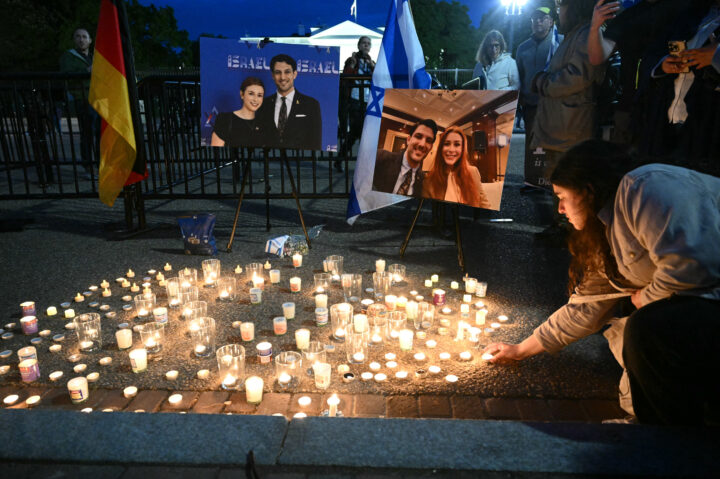
People attend a candlelight vigil at Lafayette Square across from the White House in Washington, DC on May 22, 2025, following a shooting that left two people dead (Photo by Mandel NGAN / AFP)
Authorities in the District of Columbia announced on Thursday that they filed federal hate crime charges against Elias Rodriguez, the suspect in the fatal shooting in May of two Israeli Embassy staffers outside the Capital Jewish Museum in Washington.
The indictment on nine counts, filed on Wednesday, includes a charge relating to a hate crime resulting in death and comes more than two months after Rodriguez was charged with two counts of first-degree murder, the murder of foreign officials, causing death with a firearm and discharging a firearm in a violent crime for the May 21 attack.
Speaking at a press conference on Thursday morning about the new charges, U.S. Attorney for the District of Columbia Jeanine Pirro said that the indictment was a continuation of “our journey to seek justice for not only two, but four victims of this horrific crime, which has had enormous consequences and repercussions, not just in the District, but nationwide and worldwide, not only affecting these victims and their families, but opening old wounds and revictimizing victims of past antisemitism.”
“A D.C. grand jury has charged in this indictment two hate crimes, alleging that he murdered Yaron Lischinsky and Sarah Milgrim because of his bias against the people of Israel. He demonstrated this hatred through his words, ‘Death to Israel,’ and his violent actions against Yaron and Sarah and their co-workers from the Israeli Embassy,” Pirro said.
Pirro, who said in May that Rodriguez was eligible for the death penalty while vowing to prosecute the case to the fullest extent of the law, said on Thursday that the indictment “begins the statutory process on whether to seek the death penalty.”
“This is a weighty decision. It takes time. There will be a rigorous process, after which the capital case section in the attorney general’s office will advise the attorney general and the attorney general herself will make a decision regarding whether or not this office will seek death against Elias Rodriguez,” Pirro said.
“We are starting the process. We’ve made no decision yet,” she added of seeking the death penalty, again noting that Attorney General Pam Bondi “will determine whether or not to authorize my office to seek death.”
Pirro added that Lischinsky and Milgrim’s parents, with whom she’s been in contact, had been made aware that “they will have an opportunity and a right to put their input into what decision is ultimately made” on if the Justice Department will seek capital punishment.
Rodriguez will appear in federal court in D.C. on Friday for a hearing on the broader indictment against him, where more details about the new charges are expected to be discussed.
The new filing alleges that Rodriguez flew from Chicago, Ill., to Washington the day before the attack with “a Heckler and Koch VP9 SK 9mm semi-automatic handgun packed in his luggage,” and wrote in a document dated that same day that, “Those of us against the genocide take satisfaction in arguing that the perpetrators and abettors have forfeited their humanity.”
He purchased a ticket the next day to the reception taking place later that evening for young diplomats and Jewish professionals hosted by the American Jewish Committee in the nation’s capital.
Lischinsky and Milgrim, a couple who worked at the Israeli Embassy, were shot at point-blank range while leaving the museum event. Rodriguez, a 31-year-old Chicago native, was seen on video shouting “free Palestine” after the attack. A witness to the attack told Jewish Insider that Rodriguez also shouted, “I did it for Gaza.”
In addition to Lischinsky and Milgrim, Rodriguez also assaulted two individuals, referred to in the indictment as C.S. and A.T., “with the intent to kill a person,” Pirro said on Thursday.
Reid Davis, the special agent in charge for the FBI Washington field office’s criminal division, said investigators believe Rodriguez acted alone and was “motivated by anti-Zionist and pro-Palestinian ideology.”
Davis said that the “FBI investigation to date indicates that the subject acted alone with the intent to commit a violent act in the District of Columbia. Based on his writings and communications, we believe he was a lone-wolf actor motivated by anti-Zionist and pro-Palestinian ideology, with the goal of conducting a mass shooting to call attention to his political agenda.”
The indictment also claims that Rodriguez expressed support for violence against Israelis in correspondence on social media prior to the attack. It states that he sent a direct message through a social media platform in May of 2024 that stated: “please please please god please vaporize every Israeli 18 and above so these kids have some chance at becoming human,” according to the indictment.
Harmeet Dhillon, the assistant attorney general for civil rights, said at Thursday’s presser that her office, which oversees the certification of any federal hate crime charges, moved to do so “in this case with alacrity.”
“The Civil Rights Division is committed to ensuring that every community in these United States is safe from violence, intimidation and discrimination, as in this case,” Dhillon said. “This indictment reflects our ongoing commitment to hold these criminals accountable, and we will continue to relentlessly pursue justice for Yaron and Sarah, their families and their communities.”
“I hope this beginning of this process brings some comfort to the many people in this community who have approached the Department of Justice and expressed their deep concern for their safety. I think no one can claim that this is not a serious problem here in our district right now, and it is embarrassing as an American to see that,” she continued.
Pirro, who was confirmed by the Senate to her role last week after being appointed by President Donald Trump in early May, vowed in closing remarks that “violence against anyone in this District will not be tolerated, especially violence which has hate at its core and is the genesis of violence.”
“The president put me here to do a job, to clean up the district, to make sure that crime doesn’t overshadow this phenomenal city, our nation’s capital. I have, throughout my career, fought antisemitism for 32 years as a prosecutor and a judge. I fight hate crimes with a vengeance,” Pirro said, referencing her tenure as Westchester County, N.Y., district attorney.
D.C. Metropolitan Police Assistant Chief Ramey J. Kyle, who leads the Investigative Services Bureau, said that the new charges emphasized their “collective commitment” to ensuring Rodriguez faces the maximum penalty for these murders.
“The charges unveiled here this morning underscore our collective commitment to ensuring Rodriguez faces the maximum punishment possible,” Kyle said.
News of the indictment was well received by leading Jewish organizations.
The American Jewish Committee said in a statement that Milgrim and Lischinsky’s “young lives and full potential were horrifically stolen,” calling their murders a “deliberate and heinous act” that was “a deeply personal tragedy for their families and for the entire AJC community.”
“It was an assault on the values we hold as Americans, as Jews, and as members of a shared society. Their families deserve justice and healing. We are grateful for the vigor with which the Department of Justice has proceeded thus far, and are confident that it will diligently continue its pursuit of justice for this murderous hate crime,” the statement read.
“The May 21 shooting outside the Museum was motivated by hatred but we will not allow acts of terrorism to silence or isolate us. We honor the memories of Sarah and Yaron by remembering their values, their work, and the life they should have lived together and by redoubling our efforts to ensure that the Jewish people and the State of Israel are safe and thriving and to build a world grounded in respect, safety, and justice,” it continued.
The Anti-Defamation League wrote in a social media post that they “welcome these charges as an important step toward justice for the families of Yaron Lischinsky and Sarah Lynn Milgrim and the greater Jewish community. May their memories always be for a blessing.”
ADL CEO Jonathan Greenblatt: ‘I'd like to see the extremes marginalized so the vast majority of members of Congress on both sides can get the stuff done that needs to happen’

Marc Rod
Lawmakers gather on the Capitol steps on June 10, 2025 for a vigil for Yaron Lischinsky and Sarah Milgrim, Israeli Embassy staffers who were killed in an anti-Israel attack.
It’s been two months since the Capital Jewish Museum shooting in Washington and the Boulder, Colo. firebombing attack.
The two attacks prompted unified condemnation from lawmakers and calls from the Jewish community for Capitol Hill to take aggressive action against the escalating antisemitism crisis in the United States. But as Congress heads into its August break, that initial momentum has produced little concrete action.
The House and Senate have passed resolutions condemning the attacks, but key legislation related to antisemitism remains stalled, even as lawmakers individually and in groups continue to press for action.
There are still no clear prospects for passage of the Antisemitism Awareness Act, a key element of congressional efforts to address antisemitism, after a contentious Senate committee meeting in April in which Democrats, joined by Republicans including Sen. Rand Paul (R-KY), voted to add amendments that most Republicans supporting the bill view as nonstarters. House leaders have made no public moves to advance the legislation.
And despite calls from Jewish groups for significant increases in nonprofit security funding to as much as $1 billion next year and a push from a bipartisan coalition of lawmakers for $500 million, the funding levels under consideration in the House are so far little different from those discussed in prior years.
One Republican senator working on the Antisemitism Awareness Act told Jewish Insider they have not seen much movement among colleagues who have continued concerns about the legislation, in conversations with those colleagues and the White House.
The senator said they are frustrated by unresolved disputes about the International Holocaust Remembrance Alliance’s working definition of antisemitism on the Republican side of the aisle, noting as well that there are steps the administration can take independently.
Jonathan Greenblatt, the CEO of the Anti-Defamation League, said at a press conference last week that “there needs to be, for sure” more focus from Congress on tackling antisemitism. A key part of that, he said, will be sidelining extreme voices.
“I think too often extremes on both ends kind of warp the conversation and insist that the definition of antisemitism somehow needs to include things like the false charge of ‘the Jews murdered Jesus,’ or the claim that anti-Zionism is never antisemitism,” Greenblatt said, alluding to the objections from both sides of the aisle to the Antisemitism Awareness Act.
“All the Jews didn’t murder Jesus, and anti-Zionism is antisemitism. I think I’d like to see the extremes marginalized so the vast majority of members of Congress on both sides can get the stuff done that needs to happen once and for all,” he continued.
Several sources familiar with the situation said that the bill is “stuck,” for the moment. Senate Republicans could attempt to bring the bill to the floor and utilize procedural means to eliminate the poison-pill amendments added to the bill in the Senate Health, Education Labor and Pensions Committee, but that would require Democratic support and could rehash the same ugly debates seen in the HELP committee.
It could also be added to a must-pass legislative package — but that same plan failed last year.
A source who has advocated for the legislation said that the recently passed budget reconciliation package sapped attention for antisemitism legislation in recent months, but argued that passing the Antisemitism Awareness Act is critical because there are no realistic alternative proposals for tackling antisemitism on Congress’s agenda at this point.
The Senate has also been focused on confirming presidential appointees.
The source said that advocates for the bill need to find strategies to work around the obstacles to the legislation, “and that has not been easy,” but insisted that they and others are not giving up on the bill.
“There just hasn’t been a lot of legislation [moving] in general,” Nathan Diament, the executive director of public policy for the Orthodox Union, said — arguing that the slow progress is not unique to the Antisemitism Awareness Act or antisemitism generally.
Sen. Jacky Rosen’s (D-NV) office told JI that she is continuing to advocate for the Antisemitism Awareness Act, and is also looking at potential other legislation that could move forward on antisemitism. Rosen, the co-chair of the Senate antisemitism task force, is the lead Democratic sponsor of the Antisemitism Awareness Act.
Senate Republicans had vowed, coming into the majority, to pass the bill.
“Republican control of the Senate means that this institution will no longer turn a blind eye to the growing threat of antisemitism in our country or the numerous threats that our ally Israel faces on all sides,” Senate Majority Leader John Thune (R-SD) told JI after Republicans won the Senate majority. “We will empower committees to advance legislation addressing antisemitism and protecting students on campuses, and we will increase oversight into Iran’s malign actions.”
On the House side, Rep. Mike Lawler (R-NY) told JI last week that “we’re working on” the Antisemitism Awareness Act. Pressed on whether Congress is moving strongly enough to respond to antisemitic violence, Lawler said, “It continues to be a strong focus of mine and many of my colleagues, and we’re working through the legislation.”
House Speaker Mike Johnson (R-LA) did not respond to a request for comment.
Observers believe the House, which passed the bill last year only for it to fail to move forward in the Senate, is waiting on the Senate to move first this year and prove that it can pass the bill.
Another source argued that, given the action the administration has taken to address antisemitism on college campuses, the Antisemitism Awareness Act is “less necessary” in the near term.
On NSGP funding, the House Appropriations Committee approved a bill that would allocate $335 million for the program in 2026 — the same funding level that the House backed for the program in 2025, though final funding levels ultimately fell short of that mark.
The Senate Appropriations Committee, meanwhile, has yet to finalize its homeland security funding bill. Sen. Chris Murphy (D-CT), the ranking member of the subcommittee responsible for such funding, told JI last week that lawmakers are “still negotiating” it.
Congress will have just a month to finalize government funding or pass a stopgap bill when it returns from August recess.
A Republican senator working on the issue said they’ve been focusing on ensuring that outstanding NSGP funding for this year is disbursed from the administration before turning to the appropriations process for next year.
“First things first on it, let’s get the grant money out so people can actually create a more secure environment where they’re physically located,” the senator said. The administration opened applications for the 2025 grant program on Monday, but some supplemental funding remains to be allocated.
Diament said that Congress is in the “fourth or fifth inning out of nine” on government funding, and that the process will likely play out mostly in September or October. He also argued that, given the “tight fiscal environment,” particularly for homeland security funding, the fact that advocates were able to secure a $30 million increase in NSGP funding from the initial proposed level of $305 million, on a bipartisan basis in the House Appropriations Committee is very “valuable in the process going forward.”
In “the later innings of the process, it laid very good groundwork” for further bipartisan movement to increase funding as the process proceeds, Diament continued. “We made sure to work it on a bipartisan basis and we’re moving in the right direction.”
“Given everything else on the legislative calendar and where we are on the legislative calendar, I don’t feel like we’re behind,” he continued.
Rep. Don Bacon (R-NE), a co-chair of the House antisemitism task force, asked about congressional action on antisemitism last week, said that “there’s a place for legislation” but argued that other steps are also needed to make antisemitism unacceptable in public discourse.
“In the end, Americans have to speak out on this,” Bacon said at a press conference on legislation aiming to tackle support for terrorism on social media. “We have to make it like it’s embarrassing to be standing on that side saying those things. So we got to speak up. And you can’t legislate that.”
Several Democrats said last week that more needs to be done legislatively to tackle antisemitism.
“We’ve had an unlimited amount of hearings, and the speaker has now come out with a security plan [for members] for the summer, and a lot of that, obviously, is tied to the amount of hate and threats that we are getting, but we still haven’t passed the Antisemitism Awareness Act,” Rep. Jared Moskowitz (D-FL) said. “No, we’re not doing enough to combat antisemitism and other forms right now of hate and demagoguery that’s going on.”
“The language and the culture, it’s just completely toxic,” Moskowitz continued, adding that Congress is “also not doing enough on the security grants. … They gave ICE $140 billion. We’re trying to get more money for security when the community is in grave danger, and these threats are out of control, at all-time levels.”
Sen. Richard Blumenthal (D-CT) said that “there can never be too much focus on antisemitism, and I see, frankly, too little right now, in light of events that are unfolding around the country.”
“I wish there were more focus on bias and bigotry of all forms, because it is growing, and so is violent extremism and the confluence of the two make for a very dangerous recipe for potential disaster,” Blumenthal continued.
Rep. Brad Schneider (D-IL), a co-chair of the House Jewish Caucus, said that “it’s not business as usual” on antisemitism, and that lawmakers are “working on it and we’re trying to take constructive steps.”
But he added that “we have to do more. We’re seeing antisemitism rising all across the country, being normalized in ways that should never be normalized” on both sides of the political spectrum.
Schneider said that “it is critical that everybody, Democrats, Republicans, House, Senate, stand together, stand united against anti semitism and not what about ism in here, we need to stand against hate. But antisemitism is rising at a rate that should give everyone concern.”
He primarily blamed Republicans for the lack of progress on legislation like the Antisemitism Awareness Act.
Jewish Insider’s congressional correspondent Emily Jacobs contributed reporting.
Good Tuesday afternoon,
This P.M. briefing is reserved for our premium subscribers like you — offering a forward-focused read on what we’re tracking now and what’s coming next.
I’m Danielle Cohen-Kanik, U.S. editor at Jewish Insider. I’ll be curating the Daily Overtime for you, along with assists from my colleagues. We hope you enjoy the inaugural edition and would love to hear your thoughts and feedback. Please don’t hesitate to drop us a line by replying to this email.
📡On Our Radar
Notable developments and interesting tidbits we’re tracking
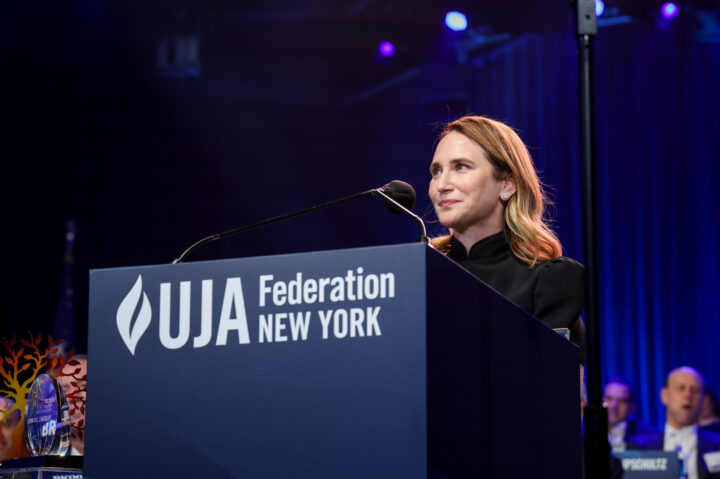
Today, we remember Wesley LePatner, a Jewish philanthropist and Blackstone executive killed in Monday’s shooting at the firm’s Manhattan headquarters. LePatner, 43, served on the boards of the pluralistic Abraham Joshua Heschel School and the UJA-Federation of New York. The federation called LePatner “extraordinary in every way” in a statement, saying she “lived with courage and conviction, instilling in her two children a deep love for Judaism and the Jewish people.” Hindy Poupko, deputy chief planning officer at UJA, said in remarks at the Israel on Campus Coalition’s National Leadership Summit in Washington today that there was a second Jewish victim of the shooting, Julia Hyman. Hyman, a Cornell graduate, worked for Rudin Management in the Midtown skyscraper…
Concerns among Democrats about the humanitarian situation in Gaza and Israel’s role in it are intensifying. On Capitol Hill, the majority of Senate Democrats, led by a group including Senate Minority Leader Chuck Schumer (D-NY) and Sen. Jacky Rosen (D-NV), sent a letter to Secretary of State Marco Rubio and Middle East envoy Steve Witkoff calling the humanitarian crisis in Gaza “unsustainable” and saying that the Israeli- and American-backed Gaza Humanitarian Foundation has “failed” to properly deliver aid…
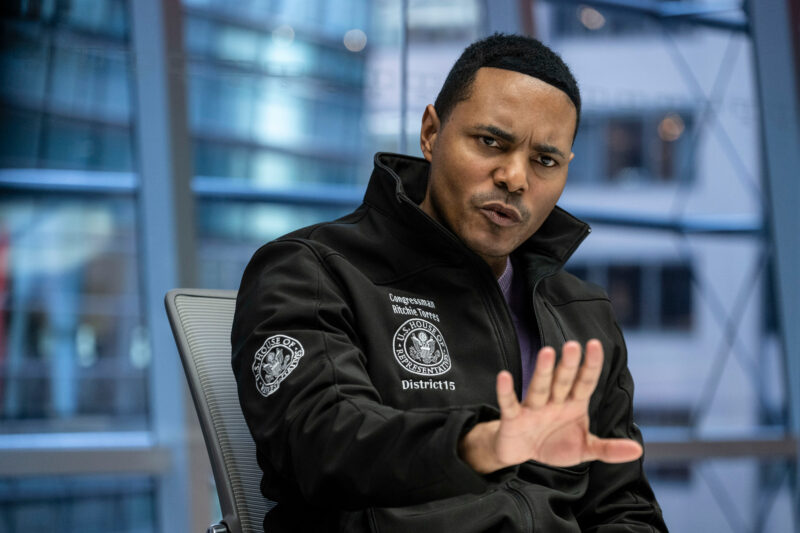
One Democrat standing up for Israel is Rep. Ritchie Torres (D-NY), who said at the ICC summit today, “We have to remind the world that, despite the amnesia, Hamas was the central cause of the war in Gaza. … Hamas is morally responsible, principally responsible for the war in Gaza.” Read more on Torres’ speech in JI’s Daily Kickoff tomorrow…
Sen. Bernie Sanders (I-VT), who did not sign the Senate Democrats’ letter, jumped into the fray by introducing another resolution to block an arms transfer to Israel — his third since November 2024. In a novel twist, this resolution would block the sale of $1 million worth of assault rifles to Israel’s police force overseen by far-right Minister of National Security Itamar Ben-Gvir, potentially opening the door for more Democrats to vote in favor, given Ben-Gvir’s less-than-favorable reputation within the party…
British Prime Minister Keir Starmer, applying pressure of his own, announced today that the U.K. will recognize a Palestinian state at the U.N. General Assembly in September — matching France’s timeline, announced last week — unless Israel takes “substantive steps to end the appalling situation” in Gaza, reaches a ceasefire with Hamas and commits to reviving the possibility of a two-state solution and not annexing the West Bank. President Donald Trump, who met with Starmer in Scotland yesterday, told reporters that the British PM didn’t discuss the move with him and that he has no view on it, but that the U.S. is “not in that camp”…
On the home front, UCLA settled a lawsuit with Jewish students who alleged that the university permitted antisemitic conduct during the campus’ anti-Israel encampments in spring 2024. According to the agreement announced today, the university cannot allow or facilitate the exclusion of Jewish students, faculty or staff from UCLA programs or campus areas. Notably, the agreement specifies that Jews cannot be excluded “based on religious beliefs concerning the Jewish state of Israel.” Also getting a windfall in the settlement: UCLA agreed to pay over $2.3 million combined to UCLA Hillel and Chabad, the Anti-Defamation League, the Academic Engagement Network and other Jewish organizations combating antisemitism on campus…
⏩ Tomorrow’s Agenda, Today
An early look at tomorrow’s storylines and schedule to keep you a step ahead
Keep an eye on Jewish Insider later this week where we’ll feature an interview with Jeanine Pirro, interim U.S. attorney for D.C., who spoke with JI about the ongoing prosecution of the assailant responsible for the deadly May shooting at the Capital Jewish Museum. We’ll also cover Rep. Mike Collins’ (R-GA) record on antisemitism as he jumps in the race to challenge Sen. Jon Ossoff (D-GA), and report on Harvard’s overtures to the Jewish community while it gears up for a settlement with the federal government.
We’re staying tuned for how President Donald Trump may react as some of the U.S.’ closest allies gear up to recognize a Palestinian state, a policy the U.S. has rejected as unhelpful to peace efforts for decades. Though he said today he has “no view” on the matter, as the U.N. General Assembly nears, will Trump take a tougher line on his European partners?
Stories You May Have Missed
WAIT-AND-SEE APPROACH
New York Jewish leaders reluctant to fight against Mamdani
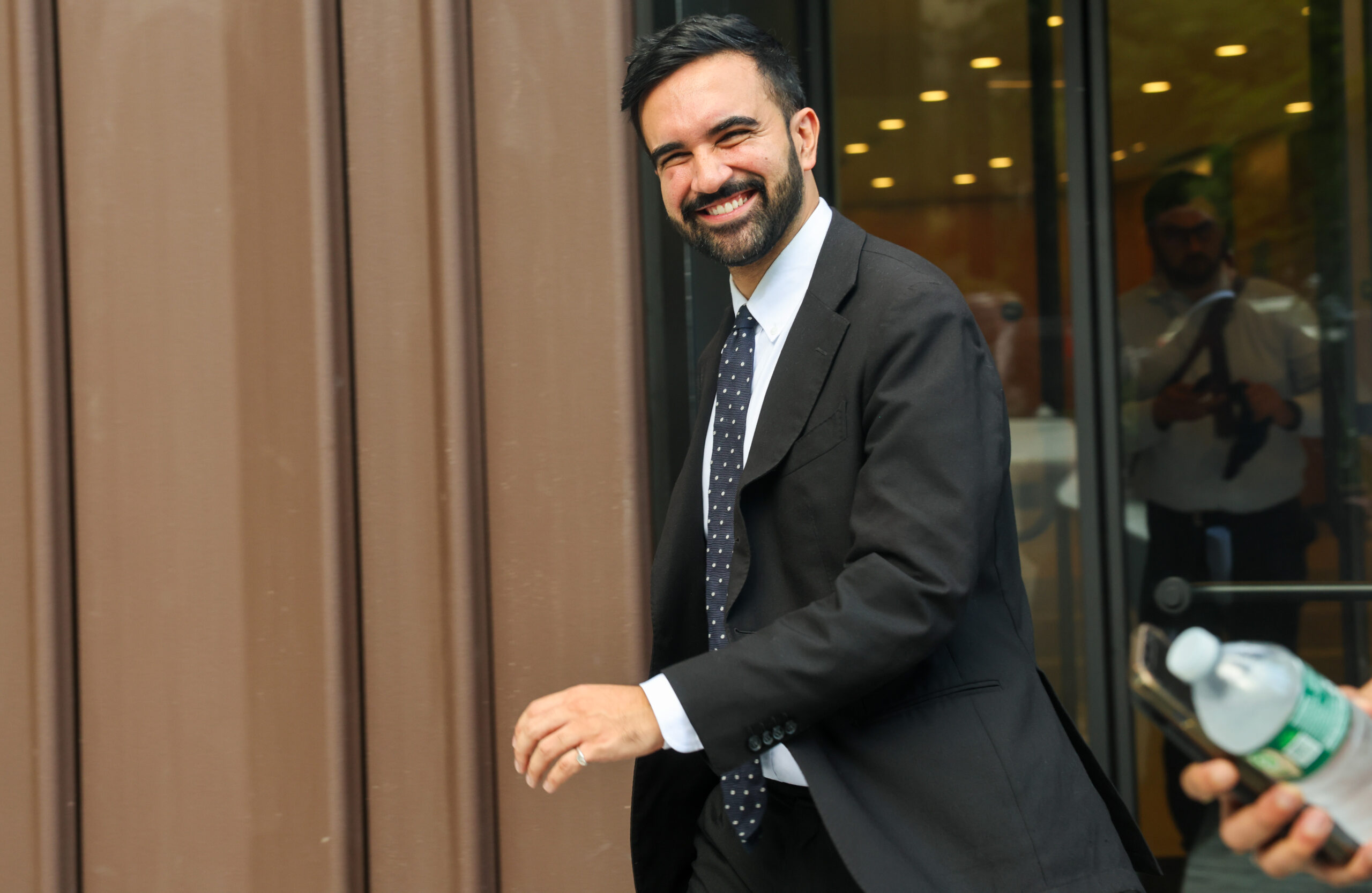
One Jewish political leader: ‘No one thinks it’s going to be good for the Jewish community to be hostile and to be in constant war with the next mayor’
PODCAST POLITICS
Former Obama staffers turned podcasters reemerge to lead anti-Israel chorus

Ben Rhodes and Tommy Vietor shaped the story of the Iran nuclear deal. Now they’re trying to turn Democrats away from Israel
LePatner, a Blackstone executive, served on the boards of the Abraham Joshua Heschel School and UJA-Federation of New York
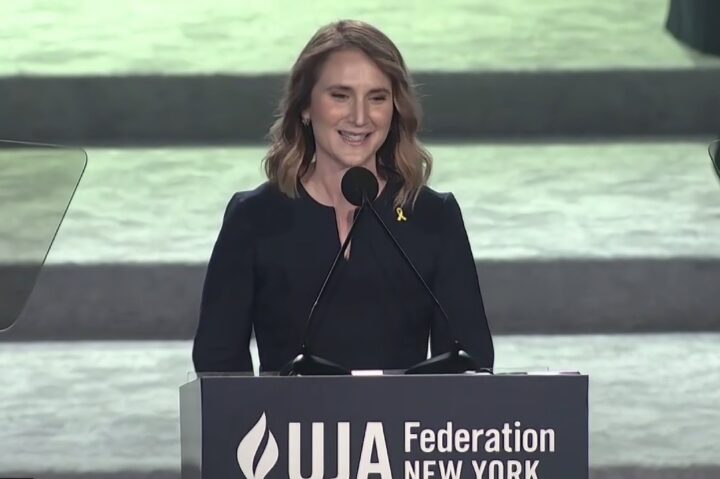
courtesy/UJA-Federation of NY
Wesley LePatner speaks at the UJA-Federation of New York's annual Wall Street Dinner in December 2023.
Wesley LePatner, a Blackstone executive who was involved with Jewish communal organizations in New York City, was killed in the Monday shooting at the firm’s Midtown headquarters, the company confirmed on Tuesday.
LePatner was the global head of Core+ Real Estate at Blackstone and CEO of Blackstone Real Estate Income Trust, according to Blackstone’s website. A Yale graduate, she joined the company in 2014 after more than a decade at Goldman Sachs.
She served on the board of trustees at the Abraham Joshua Heschel School, a pluralistic Jewish day school in New York, and she joined the board of directors at UJA-Federation of New York earlier this month.
“We are devastated by the tragic loss of Wesley LePatner, a beloved member of UJA’s community and a member of our board of directors, who was killed in yesterday’s mass shooting in Midtown,” the federation said in a statement.
“Wesley was extraordinary in every way — personally, professionally, and philanthropically,” the organization said. “In the wake of Oct. 7, Wesley led a solidarity mission with UJA to Israel, demonstrating her enduring commitment in Israel’s moment of heartache. She lived with courage and conviction, instilling in her two children a deep love for Judaism and the Jewish people.”
In 2023, LePatner was awarded the Alan C. Greenberg Young Leadership Award at UJA’s 2023 annual Wall Street dinner. In a speech, she outlined her involvement with the organization, dating back nearly two decades.
“I first attended the UJA Wall Street dinner as a young analyst in 2004, where I am pretty certain I sat in one of the last tables at the back of the room,” LePatner said at the event, which took place two months after the Oct. 7 attacks. “Never in my wildest imagination could I have believed that I would be up on this stage two decades later. UJA has many super-powers, but its most important in my view is its power to create a sense of community and belonging, and that ability to create a sense of community and belonging matters now more than ever.”
LePatner also sat on the board of the Metropolitan Museum of Art, the Yale University Library Council and Nareit, a real estate organization.
The shooting also claimed a second Jewish victim, Julia Hyman. A Cornell graduate, Hyman worked for Rudin Management in the Midtown skyscraper.
Ofir Akunis, consul general of Israel in New York, called the murder of LePatner and Hyman — as well as NYPD Officer Didarul Islam — “horrific and senseless” at the Israel on Campus Coalition’s National Leadership Summit in Washington on Tuesday. “In this difficult moment, Israel stands in solidarity with New Yorkers and all Americans,” Akunis said.
The requests, in some cases, constitute calls for Trump to walk back funding cuts he proposed earlier this month

Getty Images
U.S. Capitol Building
In response to the shooting that killed two Israeli Embassy staffers outside the Capital Jewish Museum last week, a bipartisan group of 46 House members wrote to President Donald Trump on Friday urging him to support expanded funding for key security programs in his full budget request to Congress, expected as soon as Friday afternoon.
While presidential budget requests are non-binding and are frequently modified by Congress, Trump’s requests are likely to be influential in the GOP-controlled Congress. And the appeals made by the lawmakers, in some cases, constitute calls for Trump to walk back funding cuts he proposed in the high-level budget toplines — known as a “skinny budget” — he submitted to Congress earlier this month.
Highlighting the “sharp rise in threats to the Jewish community,” the lawmakers — most of them Democrats — said that it is “imperative that the federal government take the necessary steps to increase funding for enhanced security measures” and “ensure that the Jewish community is equipped with the necessary tools to prevent loss of life in the case of an attack.”
The legislation calls on Trump to support $500 million in funding for the Nonprofit Security Grant Program, the same funding level that bipartisan groups of House and Senate members have urged Appropriations Committee leaders to support, calling the program “one of the most effective and critical programs for protecting the Jewish community and all faith-based communities from attack.” Jewish groups have called for funding to be increased to $1 billion.
Trump, in his “skinny budget,” had called for a reduction in funding for non-emergency grants at the Federal Emergency Management Agency, a category that includes NSGP, but did not put forward a specific request for the program itself. In the past, presidents have not always made any specific funding requests for the NSGP, even in their more detailed budget outlines.
The letter outlines a series of examples that “demonstrate the direct return on investment for communities under threat” from the NSGP, highlighting incidents in which security upgrades paid for by the program likely saved lives by stopping shooting attacks.
The lawmakers also called for Trump to “explore opportunities,” in collaboration with lawmakers, to provide an additional dedicated fund to allow faith-based organizations to hire security officers.
“Although Jewish institutions can use the NSGP to hire additional security personnel, the majority of Jewish institutions have either not been recipients of these grants or cannot afford the additional costs incurred,” the letter reads. “In light of recent events, it is more clear than ever that Jewish institutions are in desperate need of additional personnel support.”
The letter calls on Trump to support increased funding for the Federal Bureau of Investigation. Trump called for a $545 million cut to the FBI’s budget in his “skinny budget”, pledging that the FBI would focus on counterintelligence and counterterrorism and that it would eliminate “duplicative intelligence activities.”
The letter emphasizes the FBI’s role in domestic terrorism investigations, which have been on the rise, and intelligence gathering and the FBI’s responsibility to report to Congress on domestic terrorism threats.
It calls for increased Department of Justice grants for local law enforcement to ensure that hate crimes are properly reported to local and federal law enforcement agencies, and specifically for grant programs to counter hate crimes “to ensure that antisemitic hate crimes are addressed and prosecuted in a timely manner” and their extent is fully understood.
The “skinny budget” called for cutting $1 billion in DOJ grant programs, including “programs that focus on so-called hate crimes in clear violation of the First Amendment.”
The letter was led by Reps. Josh Gottheimer (D-NJ) and Jared Moskowitz (D-FL) and co-signed by Reps. Max Miller (R-OH), Haley Stevens (D-MI), Brittany Pettersen (D-CO), Laura Gillen (D-NY), John Larson (D-CT), Dan Goldman (D-NY), Jamie Raskin (D-MD), Nikema Williams (D-GA), David Scott (D-GA), Wesley Bell (D-MO), Shri Thanedar (D-MI), Dina Titus (D-NV), Donald Norcross (D-NJ), Susie Lee (D-NV), Andre Carson (D-IN), Shontel Brown (D-OH), Sheila Cherfilus-McCormick (D-FL), Lloyd Doggett (D-TX), Lizzie Fletcher (D-TX), Greg Landsman (D-OH), Frederica Wilson (D-FL), Debbie Wasserman Schultz (D-FL), Janelle Bynum (D-OR), Madeleine Dean (D-PA), Frank Pallone (D-NJ), Jerry Nadler (D-NY), LaMonica McIver (D-NJ), Ted Lieu (D-CA), George Latimer (D-NY), Juan Vargas (D-CA), Julie Johnson (D-TX), Julia Brownley (D-CA), Marilyn Strickland (D-WA), Darren Soto (D-FL), Chris Pappas (D-NH), Brendan Boyle (D-PA), Bill Keating (D-MA), Tom Suozzi (D-NY), Steve Cohen (D-TN), Benny Thompson (D-MI), Jan Schakowsky (D-IL), Brad Sherman (D-CA), David Kustoff (R-TN) and Del. Eleanor Holmes Norton (D-DC).
Miller and Kustoff, who are both Jewish, are the only Republican signatories.
Please log in if you already have a subscription, or subscribe to access the latest updates.
 Continue with Google
 Continue with Apple