

































‘If the current status quo is the same a year from now and it actually leads towards further negotiation — success,’ Warner told JI
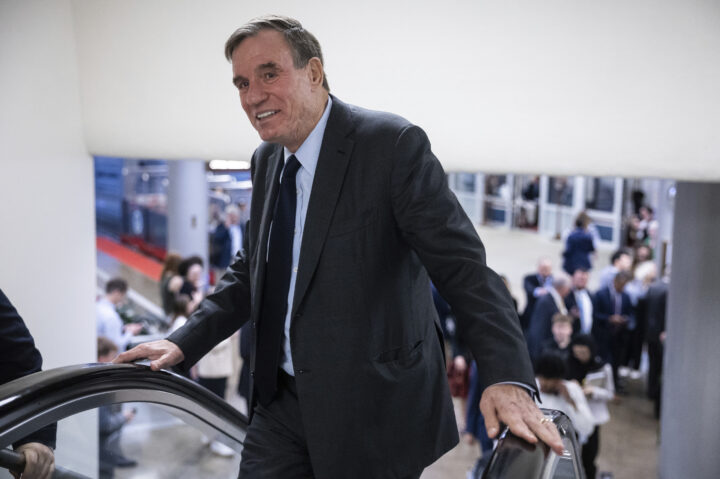
Francis Chung/POLITICO via AP Images
Sen. Mark Warner (D-VA) ascends on an escalator on his way to a vote at the U.S. Capitol on June 17, 2025.


 Add JewishInsider on Google
Sen. Mark Warner (D-VA) told Jewish Insider on Friday that he’s inclined to view the Trump administration’s strikes last month on Iran’s nuclear facilities as a “success,” if negotiations with Tehran resume and barring substantial future retaliation from Iran.
His comments largely echo sentiments shared earlier in the day by Sen. Chris Coons (D-DE) at the Aspen Security Forum, suggesting an increasing willingness by moderate, national security-minded Democrats to publicly acknowledge positive outcomes of the strikes, even if they maintain other concerns about the process that produced them.
“I will acknowledge the successfulness of the Israeli attacks and how back-foot the regime was. The fact that they didn’t launch the thousands of missiles,” Warner told JI on the sidelines of the forum. “I was concerned about an attack that didn’t bring Congress along. And I do think there was a huge process foul when the Gang of Eight wasn’t notified and the Republicans [were]. Trump[’s first administration] never did that — but I have never contested the success.”
Warner, the vice chair of the Senate Intelligence Committee, said he’s been pleased that there has not been ongoing asymmetric retaliation against the U.S. by Iran, such as cyber, sleeper cell or Iraqi militia attacks.
“If the current status quo is the same a year from now and it actually leads towards further negotiation — success.”
Warner, Coons and other top Democrats had cautioned the administration against unilateral action against Iran without congressional approval just days before the attack.
“Let’s make no doubt that the Iranian regime [are] bad guys, and that is why I’ve been such a consistent supporter of Israel,” Warner told JI.
“Iran’s, at least so far, been shown to be more of a paper tiger,” Warner said. “If we could just get to the resolution in Gaza, there really could be a fresh start.”
The senator said that his ongoing concern is how President Donald Trump has responded to the attacks, declaring that Iran’s nuclear program had been completely obliterated.
“The president, within two hours of the strike, set an arbitrary, almost impossible standard to meet, in terms of ‘total obliteration,’” Warner said. “To get the enriched uranium you’re going to need troops on the ground. And there are more than three sites — the vast majority [of the activity] was [at] those three, but there was some bad stuff happening elsewhere.”
He said the intelligence community had also been pressured to “contort itself to meet” the assessment Trump put forward.
In the immediate aftermath of the strikes, Warner and other Democrats expressed frustration that the Trump administration took days to brief Congress about them. Warner said he’s received “some additional clarity” in the weeks since the strikes about their effects. But he said that without physically sending operatives into the facilities, it’s difficult to know for sure the impacts of the strikes.
“Other nations have made assessments that were more in the multiple months” of delay to Iran’s nuclear program, “but I’m not even sure that’s the right metric,” Warner said. “It was a success. So the question is, what’s next? That, I don’t have visibility on.”
Going forward, Warner emphasized the need for negotiations to bring International Atomic Energy Agency inspectors back into Iran, adding that he wants to look further into the source of the delays in resuming talks.
Warner said he’s also seeking information on the timeline on which Iran would be able to build a less sophisticated nuclear device that could be delivered in a truck, rather than via a ballistic missile.
Though he noted that U.S. intelligence had not assessed that Iran was actively constructing a nuclear weapon, he said he had heard reports about an Israeli assessment that offered a different view and that he is looking further into it.
Asked about the fluid situation in Syria, in which Israel went, in the span of just a week, from floating normalization with the new Syrian government to bombing key government facilities in response to attacks on the Druze population, Warner indicated he’s still gathering information.
He said that Israel is “appropriately … very protective of its Druze population,” adding that he does not know at this point whether the Syrian government forces attacking the Druze population are doing so at the orders of that government.
He said he’s hopeful that Israel and other parties involved will not miss an opportunity to find a peaceful resolution that could defuse a major longtime threat to Israel’s north.
Warner said he also wants to see Trump use his “enormous influence in Israel” to “[force] Bibi’s government into a return of the hostages, a ceasefire,” saying that would open up opportunities for transformational change in the region, including Saudi-Israeli normalization.
Warner said that while he’s been critical of Israeli Prime Minister Benjamin Netanyahu, Israel and the IDF deserve credit for their surprise accomplishments in taking down Iran’s proxy network and in their strikes against Iran itself.
“The [Jewish community’s] concern is real and understandable,” Warner said. He said that he has been struck by the “level of anger, animosity, vile things said” in anti-Israel protests that have targeted him — “and I’m not Jewish. And I can only imagine.”
“Iran’s, at least so far, been shown to be more of a paper tiger,” Warner said. “If we could just get to the resolution in Gaza, there really could be a fresh start.”
Asked how concerned he is about the possibility of homeland attacks against the Jewish community carried out by or in the name of Iran, Warner said that U.S. intelligence monitors potential threats fairly comprehensively, but indicated that he’s most worried about radicalized lone-wolf attacks, like those in Washington and Boulder, Colo.
“The [Jewish community’s] concern is real and understandable,” Warner said. He said that he has been struck by the “level of anger, animosity, vile things said” in anti-Israel protests that have targeted him — “and I’m not Jewish. And I can only imagine.”
Warner expressed frustration at the way that the Palestinian cause has crowded out other global issues on college campuses. He said that it “would be healthy” if young people “have the chance to get exposed to other things in the world,” offering as examples the conflict in Sudan — which he said has been more deadly than Gaza and Ukraine combined — and the military junta in Myanmar.
On the subject of the Houthis, who have ramped up attacks against commercial shipping and Israel in recent weeks, Warner called the group a “tough nut to crack,” noting that a protracted Saudi and Emirati campaign against the Iran-backed terrorist group in Yemen had failed to put the issue to bed. But he said that the U.S. can’t rule out further military action against the group.
“I hope that those plans would be kept classified and not shared … on a device that’s not secure,” he quipped, referencing the Signalgate scandal, which he said had prompted concern from the Israeli government.
******
Last week’s Aspen summit, which typically prioritizes bipartisan and nonpartisan discussion and solution-making, became particularly politicized after nearly all Trump administration speakers canceled their participation, followed by a handful of foreign and private sector leaders and former government officials disappearing from the week’s agenda.
The issue was a frequent topic of discussion both on the main stage and across the Aspen Meadows campus last week, seen by many as a sign of the ways that intense partisanship has infiltrated U.S. foreign policy, once seen as a less antagonistic space.
Warner’s own panel featured himself and Coons, but not a Republican senator, as has been tradition.
Nevertheless, Warner said that bipartisanship on foreign policy issues still lives in the Senate, noting that the Intelligence Committee had passed an Intelligence Authorization Act recently in a nearly unanimous vote.
Looking ahead, he said the “easiest place to rebuild that consensus is around China,” which he described as an unprecedented competitor. He said there has been a long and difficult journey across multiple administrations to refocus on China, but he said there has been bipartisan success in pushing back against China.
He also argued that the Trump administration’s transactional and short-sighted approach to foreign policy goes against a longtime bipartisan tradition of viewing U.S. international relationships as an effort in “mutual trust-building.”
He said that his Republican colleagues privately disagree with many of Trump’s more outlandish foreign policy efforts — like annexing Canada. “At some point, there’s got to be a break,” he responded, when pressed on the fact that some Republicans defend Trump’s policies publicly despite those private disagreements.
Warner told JI that the bill the Intelligence Committee recently passed would cut the size of the Office of the Director of National Intelligence. But, despite offering biting criticisms of DNI Tulsi Gabbard, Warner said that the reform efforts are not a reflection of or specifically prompted by concerns about her conduct in the role.
“I’m very comfortable with the idea of bringing the mission closer to what it was originally, but also making sure that people who are at the ODNI get returned to their original home agency and don’t get [fired],” Warner said.
Clarifying comments that he made on the panel about close U.S. intelligence partners in the Five Eyes group curtailing their intelligence sharing with the United States, Warner said he was not aware of specific instances in which that had happened, but said that U.S. partners are concerned about the state of the U.S. intelligence community.
“The challenge about intelligence sharing is [that] this is all based on trust,” Warner said.
Speaking at the Aspen Security Forum, the analysts also discussed the possibility of Iran attempting to reconstitute its nuclear weapons program covertly and the prospect of regime change in Iran
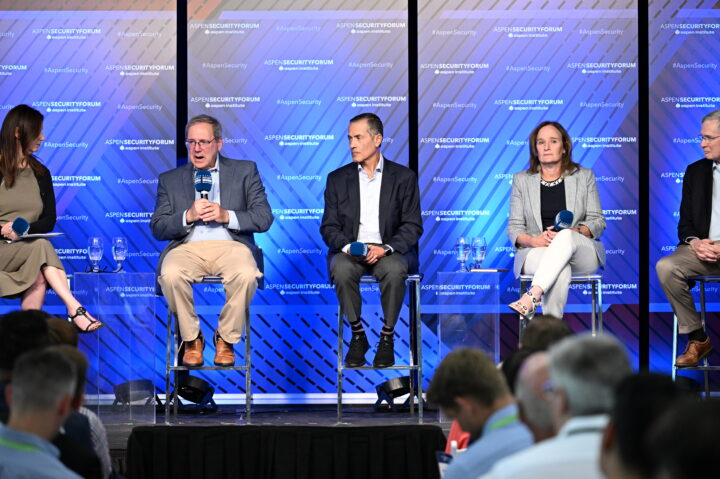
Aspen Security Forum
Former National Security Advisor Stephen Hadley, Rachel Bronson, David Sanger and Vali Nasr speak on a panel about Iran at the Aspen Security Forum on July 17, 2025.
ASPEN, Colo. — Speaking on a panel at the Aspen Security Forum, a group of Iran analysts discussed the potential paths forward in nuclear talks with Iran after the American and Israeli strikes on Iran’s nuclear facilities, the possibility that Iran will attempt to reconstitute its nuclear program covertly and the prospect of regime change in Iran.
Former National Security Advisor Stephen Hadley laid out three paths forward after the strikes: a continued campaign of Israeli air strikes to “mow the lawn,” while Iran works to try to re-establish its own deterrence; a negotiated agreement with Iran including intrusive inspections that would make it difficult for Iran to construct a covert nuclear program, with provisions addressing Iran’s ballistic missiles and proxies; and the possibility, with an agreement, that Iran decides to give up its pursuit of nuclear weapons, having spent billions of dollars on the program, alienated the region and still failed to deter a U.S. or Israeli attack.
“There is a question whether the Iranians will decide that the cost of pursuing a nuclear program was just too high,” Hadley said. “It was supposed to safeguard them from getting attacked by the Israelis in the United States, and it resulted in them getting attacked. … That’s a long way down the road. It’s probably a low-likelihood probability, but it would certainly remake the Middle East.”
He presented a potential pathway for Iran, working with Gulf states, to pursue the model that they have laid out, focusing on economic development.
Rachel Bronson, a senior advisor at the Bulletin of the Atomic Scientists, said that it’s widely believed Iran has seen a nuclear weapon as a guarantor of regime survival, in the model of North Korea. But she said there’s a chance that Iran wants to go down a different path.
“That begs the question whether the Iranians want to live like North Koreans and want to live in a sanctioned regime and in such isolation, which the Iranians demonstrated that they don’t want to live that way,” Bronson said.
David Sanger, the chief Washington correspondent for The New York Times, argued that, while the Fordow nuclear facility has likely been rendered inoperable due to U.S. strikes, other sites, such as Natanz and Isfahan, can likely be repaired or rebuilt.
“I don’t think anybody can say whether or not this is really gone for good. My guess is you’re going to need a political agreement with getting inspectors back in to make sure that it stays out of circulation,” he said.
Sanger added that it would be a “long time” before Iran is in a position where it will be willing to negotiate. He said he’s concerned about the lack of inspections in the interim, “because I think if we get into another confrontation with them, they will leave the [Nuclear Non-Proliferation Treaty]. And if that happens, I think we could see a second cycle of [military action].”
From the U.S. side, Sanger said that Washington publicly presenting a proposal could build pressure on Iran to strike a deal. Without diplomacy, Sanger continued, future military confrontation is likely. He said there are also major questions around enrichment that Israel and Iran will have to answer.
“The question for the Israelis is, would they give an assurance that says, ‘We won’t strike you if you don’t try to reconstitute your program and don’t have a covert nuclear weapons program?’” Sanger said. ”For the Iranians on the enrichment point, there’s a question of whether, diplomatically, you could finesse it by saying, ‘You of course have the sovereign right to enrich, but you also, in the exercise of that sovereignty, can elect to give it up for other purposes.’”
And he said that Israel should also consider whether it’s willing to allow limited enrichment under comprehensive and intrusive IAEA inspections, arguing that Iran’s pathway to a potential covert weapons program would come via other avenues.
Bronson highlighted that the U.S.’ European partners, and even Russian President Vladimir Putin, are now in lockstep with the Trump administration in insisting that Iran must give up its enrichment capacity.
She also said it’s likely unrealistic that Iran would be able to restart a covert nuclear program without the world’s knowledge, particularly if it attempts to retrieve its stockpiles of highly enriched uranium, activity that would be noticed by various intelligence services.
“The covert is always out there, but it’s a long way to go for them to get back in that game,” she said.
Johns Hopkins University professor Vali Nasr predicted that the Iranian government’s priority would be finding a way to prevent future strikes by the United States and Israel, rebuilding its deterrence and defense.
He also argued that the public, aggressive diplomacy from the Trump administration, including demands on Truth Social for full dismantlement of Iran’s nuclear program, make such a deal politically unpalatable for the Iranian regime. He accused the Trump administration of failing to seriously negotiate before its strikes.
“You’re basically asking for surrender. It’s not a compromise anymore,” Nasr said. “So then the question becomes, what is the acceptable cost for surrender? Would the supreme leader think that Iran is back to the wall sufficiently for him to … go and sign a surrender treaty?”
Nasr suggested that the U.S. would have to offer Iran incentives to bring in to the table and that Tehran would make significant demands for such a deal, including a guaranteed end to Israeli strikes on Iran and safeguards against the U.S. pulling out of the deal in the future.
The panel members downplayed the notion that regime change is an imminent prospect in Iran.
Hadley said the most likely source of such a change would be from a faction inside the regime, like the Islamic Revolutionary Guard Corps, that decides it wants to reduce the role of the mullahs and their revolutionary ideology.
“If folks come out in the streets it may be because one of those factions has called them to the streets to give them an excuse for making some kind of change with the regime,” Hadley said. “But that’s going to take a long, I think, considerable time, to play out.”
Sanger said that “betting on regime change is a risky business.” He said that the Obama administration had been gambling on the idea that Supreme Leader Ayatollah Ali Khamenei would be dead before the JCPOA sunset.
“It’s pretty clear from talking to the Israelis who were in Washington last week, that is their bet now: They are just pushing for time, and they think a regime change will happen,” Sanger continued. “But I’m not sure where they get that confidence.”
Nasr predicted that there will be no major changes inside Iran as long as Khamenei is still alive. And he argued that the U.S. would need to lay out an attractive alternative and future for Iran in order to motivate a faction like the IRGC to take action.
“How do you force this shift in Iran? How do you cause the debate at the top that people seriously consider that this is a dead end and there’s some other path on the table?” Nasr said. “Iranian leaders, hardline moderates cannot react to what is theoretically possible but is not actually solidly in front of them as an option.”
At the same time, Nasr said that the failure of Iran’s proxy network had been a significant blow to segments of Iran’s government, leaving them in a weakened position in the regime.
Please log in if you already have a subscription, or subscribe to access the latest updates.
 Continue with Google
 Continue with Apple