
















































Qatar’s be-everywhere, invest-in-everything strategy has allowed Doha to gain footholds across the global economy and in diplomatic circles

Jacquelyn Martin/AP
Qatari Prime Minister and Minister of Foreign Affairs Sheikh Mohammed bin Abdulrahman bin Jassim Al-Thani, attends a news conference about the Israel-Hamas war, and pressure to reduce civilian casualties, Friday, Dec. 8, 2023, in Washington.


 Add JewishInsider on Google
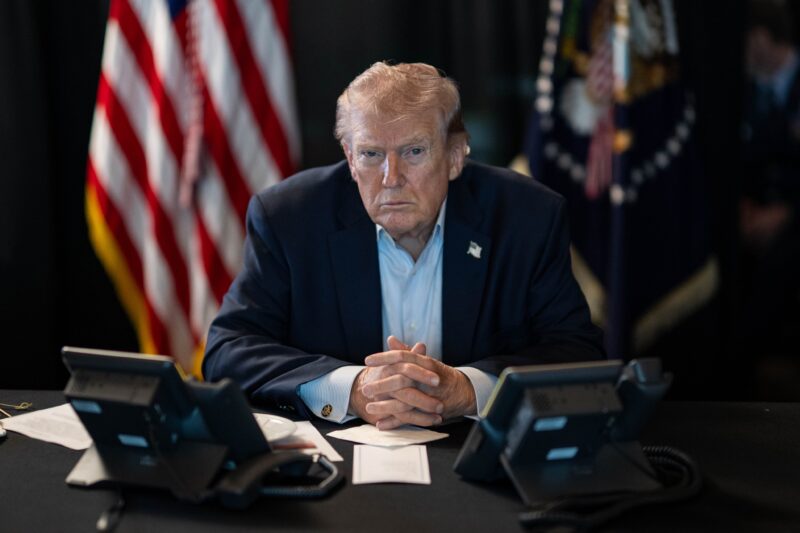
Ceasefire and hostage-release talks have been ongoing in Doha, Qatar, for the last week. But one of the most consequential meetings in the negotiations could be happening tonight in Washington, when President Donald Trump hosts Qatari Prime Minister Mohammed bin Abdulrahman Al Thani for dinner at the White House.
This continues a new tradition for Trump of hosting prominent Gulf royals who aren’t the heads of state of their respective countries for dinner at the White House. In March, Trump hosted a dinner in the White House’s State Dining Room for Sheikh Tahnoon bin Zayed Al Nahyan, the United Arab Emirates’ national security advisor and chairman of several sovereign wealth funds.
Qatari officials have been in the U.S. all week. Qatari Emir Sheikh Tamim bin Hamad Al Thani was rumored to have met with Trump on the sidelines of the FIFA finals in New Jersey on Sunday, after being spotted in New York over the weekend.
White House Middle East envoy Steve Witkoff, whose trip to Doha last week was postponed over stalled talks, told reporters over the weekend that he planned to meet with Qatari negotiators on the sidelines of the match. And Trump shared a suite with senior Qatari sports officials at the match, including Nasser bin Ghanim Al-Khelaifi, the president of the Paris Saint-Germain team who played in New Jersey on Sunday and chairman of beIN Sports, previously known as Al Jazeera Sport. (In a weekend interview at the FIFA match, Trump even noted Qatar’s “big presence.”)
Qatar also loomed large in Washington this week, where legislators on the House Education and the Workforce Committee pressed university leaders from Georgetown, CUNY and the University of California, Berkeley about their foreign funding sources during a hearing about antisemitism in higher education. Former Rep. Jim Moran (D-VA), one of Qatar’s top lobbyists in Washington, was seen sitting right behind Georgetown University interim President Robert Groves as Groves testified on Tuesday. The school has received over $1 billion from Qatar, and has a campus in Doha.
Qatar’s be-everywhere, invest-in-everything strategy has allowed Doha to gain footholds across the global economy and in diplomatic circles. And since the start of the war, it has sought to highlight its role as a facilitator of ceasefire talks between Israel and Hamas, the latter of which Doha supports financially and diplomatically.
With Iran weakened following last month’s war, Qatar remains the Hamas sponsor with the most leverage on the terror group. Despite pledges last year to expel senior Hamas officials to Turkey, many of those officials remain in Qatar.
Earlier this week, Trump threatened steep tariffs on Russia if Moscow doesn’t reach a peace agreement with Ukraine before the end of August. But the Qatari royal family, with endless wealth and more favored global standing, does not face the same fiscal and geopolitical challenges and limitations as Russian President Vladimir Putin. It’s unclear what leverage Trump could use to push Qatar to exert pressure on Hamas as he seeks a resolution to the war.
Doha has the power to push Hamas to accept a ceasefire. Whether tonight’s dinner will exact a change in Qatar’s approach to Hamas remains to be seen. The sit-down between Trump and the Qatari prime minister could change the tide in the 21-month war, or it could serve as yet another missed opportunity in a war full of stalemates and diplomatic posturing — with fresh casualties mounting on both sides and 50 hostages still languishing in captivity.
Rabbi Doron Perez said waiting for his son Daniel’s body to be returned ‘is looking forward to something painful, which is an unusual thing, but it’s the end to an ongoing saga’

Alexi J. Rosenfeld/Getty Images
Sisters Shira Perez and Adina Perez, mother Shelly Perez, father Doron Perez and brother Yonatan Perez salute and cover their ears during the gun salute to IDF Capt. Daniel Perez at the end of the funeral at Mount Herzl National Cemetery on March 18, 2024 in Jerusalem.
As negotiations continue for a temporary ceasefire in Gaza, in which half of the remaining 50 hostages are expected to return to Israel over 60 days, families of those still being held are waiting to learn if their loved ones will be among those coming home soon. About 20 of the hostages are thought to be alive, but the families of the 30 others are also hoping to have a measure of closure, with their loved ones’ remains returned to be buried in Israel.
Rabbi Doron Perez told Jewish Insider that this period, in which there is constant discussion of a possible deal with hostages’ bodies returned to Israel, “is very nerve-wracking. … It aggravates the wound.”
His son Daniel was a 22-year-old officer in the IDF armored corps on Oct. 7, 2023, when Hamas attacked Israel. For five months, the family thought Daniel had been kidnapped, before learning that he had been killed on the day of the terrorist attacks and his body taken to Gaza.
When there is no talk of negotiations, Perez said, “You start thinking again, ‘Where is Daniel? Where is his body? Where is he being held?’ Some were found in cemeteries, some in tunnels, some in cupboards. You try to put it out of your mind, the vivid thoughts of where he may be, but [news about negotiations] brings it up again.”
Yafa Rudaeff is the wife of Lior Rudaeff, who was 61 years old and a member of the emergency squad in Kibbutz Nir Yitzhak, where they lived. He was killed by terrorists on Oct. 7 while defending the kibbutz; his body was taken to Gaza. He is survived by his wife, their four children and three grandchildren.
Rudaeff described the constant news about hostage talks to JI as emotionally wrenching. “It’s a roller coaster; sometimes yes, sometimes no,” she said. “It’s crazy.”
She was skeptical even as she called for a deal that would bring home all of the hostages.
“I live near the Gaza border, I hear what happens every evening [in Gaza] and wake up every morning to hear of another soldier killed,” she said. “I think that the best thing would be to get them all out in a deal so no more soldiers are killed.”
Rudaeff called for all of the living hostages to be released as soon as possible: “You cannot divide them. There is no one hostage whose situation is better or worse after so much time. They must all come home now.”
Perez said that the families of living hostages are going through “unimaginable suffering” and that he is praying for them, but he emphasized that it is important that the bodies not be left for the end, “because then you’ll never know if you’ll get them back.”
He noted that negotiations take a different view of living and deceased hostages.
“For a body, [Israel] gives something appropriate for a body, not a live, murderous terrorist,” he said, referring to some of the Palestinian prisoners released in exchange for living hostages. “It’s not bodies [of hostages] returning in place of those alive.”
In the past Israel has exchanged live terrorists for soldiers, such as in 2008, when it gave up five Hezbollah terrorists, including the infamous Samir Kuntar, who murdered Israeli children, in exchange for the bodies of Ehud Goldwasser and Eldad Regev.
Even if a temporary deal is reached, only half of the remaining hostages would be freed. Perez said that “in an ideal world, I would hope and pray that they can all come out, but I don’t think that is going to happen … because I don’t think Israel and Hamas can see eye-to-eye over what is considered the end of the conflict.”
But he is hoping for some degree of closure if Daniel’s body is returned.
“As a parent of someone deceased, you know the best you can hope for is to get a body back in a coffin,” he said. “There is no joy. … It is looking forward to something painful, which is an unusual thing, but it’s the end to an ongoing saga.”
Perez said his family is relatively lucky because they have a gravesite to visit, which they find to be “very meaningful.” Daniel’s bloodied uniform was found and buried, because under Jewish law all parts of the body, including any blood found, must be interred.
“There is a measure of comfort in that,” he said. “We don’t have a body, but we have a place. For people who don’t have a grave, it’s even worse. They have nowhere to go to pay respects.”
Rudaeff, however, has no gravesite for her husband. “We had a parting ceremony, but we haven’t really parted from him. We don’t have anything tangible.” she said. “I’m not delusional; I don’t think he’ll return, but we need the closure to successfully move forward.”
“This situation is not natural in any way,” she added.
Rudaeff expressed concern that her husband’s body will not be found “after all of the destruction in Gaza.”
She said the families of the deceased hostages “want to be able to end this chapter and start building something else without our loved ones. Now, we can’t do anything; we don’t know how to behave. To successfully rise up from this situation, we have to end it.”
Shlomi Nahumson, CEO of the IDF Widows and Orphans Organization, has been advocating for Rudaeff, whose husband is considered an IDF fallen because he was in the emergency squad, and five others widowed on Oct. 7 whose husbands remain in Gaza. There have been 317 new IDF widows and 735 new orphans since Oct. 7.
“These men put everything on the line to protect our future,” Nahumson said. “But until they can lay their loved ones to rest, they remain trapped in a tormenting state of uncertainty. It is imperative that we bring all their loved ones home — so that these families can find closure and begin to heal.”
Perez, who serves as the executive director of the World Mizrachi movement, said that in the nearly two years of advocating for his son’s return, he has seen that some cultures do not value the sanctity of a body after death, and he has had to explain this Jewish value to ambassadors and heads of state.
“I often quote Deuteronomy 21:24, which says you are not allowed to leave a body hanging, because it has the curse of God on it,” he said. “Our sages say the body has the image of God, a soul. A human body is not just a physical entity; it was infused during its life with something godly, soulful, beyond the physical world.”
“By not respecting the body, you are not respecting life, because a body is a receptacle of life, a fusion between heaven and earth. If you leave a body hanging, it is sacrilege … The desecration of the human body is a desecration of God’s name and the spirit and value of life,” he added.
A senator in attendance told JI that Netanyahu took a different tone discussing negotiations with Hamas: ‘It sure felt like he'd been told by Trump to get to a ceasefire’
Tom Williams/CQ Roll Call via AP Images
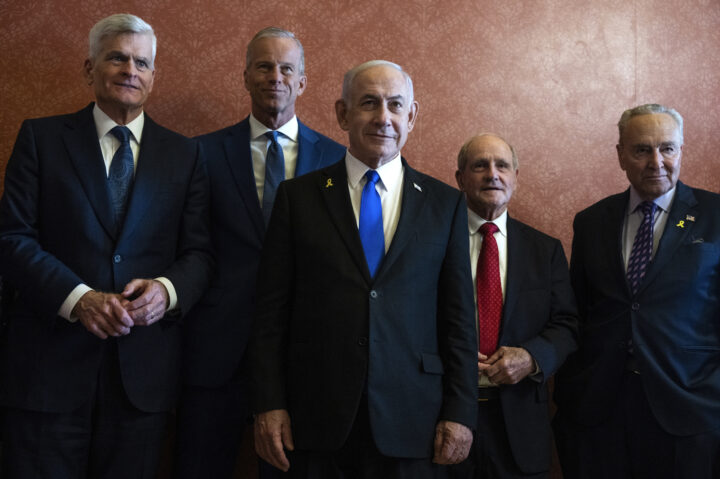
Israeli Prime Minister Benjamin Netanyahu, center, is seen during photo op before a bipartisan meeting with senators in the U.S. Capitol on Wednesday, July 9, 2025. Also appearing are, from left, Sen. Bill Cassidy, R-La., Senate Majority Leader John Thune, R-S.D., Sen. Jim Risch, R-Idaho, and Senate Minority Leader Charles Schumer, D-N.Y.
Israeli Prime Minister Benjamin Netanyahu gathered with Senate leaders on Capitol Hill on Wednesday to discuss the ongoing efforts to reach a ceasefire in Gaza and expand the Abraham Accords.
Among those in attendance at the meeting, which was rescheduled from Tuesday, were Senate Majority Leader John Thune (R-SD), Senate Minority Leader Chuck Schumer (D-NY), Sens. Jim Risch (R-ID), Ted Cruz (R-TX), Steve Daines (R-MT), Bill Cassidy (R-LA), Chris Coons (D-DE), Jacky Rosen (D-NV), Maria Cantwell (D-WA), Amy Klobuchar (D-MN), Cory Booker (D-NJ) and Adam Schiff (D-CA).
The prime minister was joined by Israeli Ambassador to the U.S. Yechiel Leiter, Israeli Strategic Affairs Minister Ron Dermer and advisor Caroline Glick.
Netanyahu projected unity with President Donald Trump in comments to reporters just before the meeting, dismissing media reports “about the great tension between us, about the great disagreements between us” in the lead-up to Israel launching its attack on Iran’s nuclear facilities and on the ongoing ceasefire and hostage-release talks with Hamas, which Trump has been eager to finalize.
“President Trump and I have a common goal. We want to achieve the release of our hostages. We want to end Hamas rule in Gaza. We want to make sure that Gaza does not pose a threat to Israel anymore. In pursuing this common goal, we have a common strategy. Not only do we have a common strategy, we have common tactics. This doesn’t involve pressure, doesn’t involve coercion, it involves full coordination,” Netanyahu said.
“President Trump wants a deal, but not at any price. I want a deal, but not at any price. Israel has security requirements and other requirements, and we’re working together to try to achieve them. Everything else that you hear and are being briefed on is folly,” Netanyahu continued.
Behind closed doors, Netanyahu spoke for around 30 to 40 minutes about the rationale for Israel’s actions in Iran and Gaza and his vision for the Middle East, including the normalization of ties with Saudi Arabia and Syria through an expanded Abraham Accords, before taking questions from the group, two senators in attendance told Jewish Insider on condition of anonymity.
On Gaza, Netanyahu said that he and the U.S. were trying to reach a ceasefire deal with Hamas and did not suggest he had any opposition to the push, something one of the senators described as a shift in tone for the Israeli prime minister.
The senator noted that Netanyahu was “very clear [that] we are actively negotiating towards a ceasefire without the usual, predictable litany of reasons why we can’t [agree to a deal]. It sure felt like he’d been told by Trump to get to a ceasefire. It felt that way.”
Netanyahu also addressed criticisms of how Israel has handled the distribution of humanitarian aid in Gaza by pointing to Hamas’ seizure of relief packages and criticizing what he called the “humanitarian aid industrial complex,” according to the senators.
“Netanyahu said that one of the sticking points with Hamas is that they want to control the distribution of food. That’s how they make their money and get their recruits, and so they don’t want them to have control of the distribution of food,” one senator said.
“He told us, ‘We don’t want anyone to starve. We’re going to be delivering more humanitarian aid. We recognize people here are critical of how we’ve delivered humanitarian aid.’ But it was all wrapped in Hamas stealing everything we send in,” the other senator quoted Netanyahu as saying, adding that Dermer also answered several questions on the subject.
On the issue of Saudi normalization, Netanyahu outlined a plan for new energy cooperation through the region.
“He said if there was not the destabilization of Iran, without their proxies in Gaza, Syria and Lebanon, then the Saudis could run a pipeline through the desert, through Israel, to the Mediterranean,” one senator told JI. “So instead of having to go through the Suez Canal, you could just take it straight to the Mediterranean. Think about what that would do to international energy security and even to energy prices.”
Other topics touched upon were ways to address the threats from the Houthis and Hezbollah, as well as the best approach to Iraq.
Publicly, lawmakers said little about the sit-down. Thune called it “good,” while Schumer said that “there were a lot of comments back and forth,” declining to comment further.
Schiff said the meeting was “fine” and “informative.” He said he hadn’t had a chance to ask questions because the meeting was cut short by a Senate vote. “We covered the waterfront of issues.”
Sen. John Fetterman (D-PA) met privately with the Israeli leader on Tuesday.
“My meeting with Netanyahu was a great opportunity to discuss and congratulate Israel’s total domination over Iran and its proxies,” Fetterman told JI. “I expressed my admiration for the sacrifices of the IDF, my support for bringing the hostages home and my hope for the possibility of true peace in the region.”
Earlier Wednesday, Netanyahu met off Capitol Hill with Sens. Lindsey Graham (R-SC), Tom Cotton (R-AR) and Richard Blumenthal (D-CT).
“We discussed the importance of keeping the Iranian regime in a weakened state until they change their behavior toward Israel and the region, and toward the United States,” Graham said on X. ”We also talked about the mutual desire to continue to integrate the region politically and economically, moving toward the light away from the darkness. I completely support Israel’s position that Hamas must be removed from Gaza as part of any peace agreement and that Iran should recognize Israel’s right to exist as a prerequisite to any peace negotiations.”
Graham said that Netanyahu had also celebrated Graham’s birthday — his 70th — with cake and a rendition of “Happy Birthday.”
Israel getting ‘80-90%’ of what it wants from a temporary ceasefire, but Hamas not willing to take steps towards ending the war, official says
Saeed M. M. T. Jaras/Anadolu via Getty Images
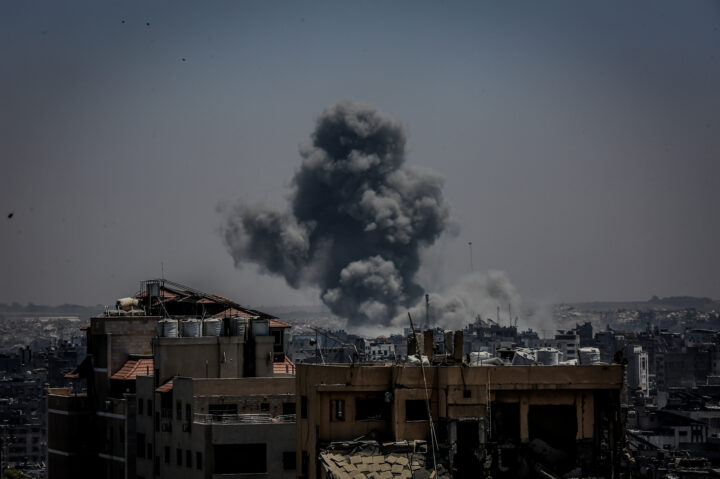
Smoke rises after an Israeli strike in the eastern part of Gaza Strip on July 3, 2025.
A breakthrough in negotiations between Israel and Hamas for a temporary ceasefire and hostage-release deal is likely to take longer than expected, a senior Israeli official in Prime Minister Benjamin Netanyahu’s delegation to Washington told reporters on Monday, after Netanyahu’s dinner with President Donald Trump.
“We hoped that [a deal] would take a few days, but it may take more time,” the official said.
The negotiations in Doha, Qatar, are “fully coordinated” with the Trump administration, and Netanyahu and Trump may meet again “if necessary” while the prime minister is in Washington this week, the official said. Netanyahu is expected to return to Israel on Thursday afternoon, but in the past, he has extended his visits.
Israel and Hamas have been in negotiations mediated by the U.S. and Qatar for a 60-day ceasefire, in which Hamas would gradually free half of the 50 remaining hostages, approximately 20 of whom are thought to be alive, in exchange for the release of hundreds of Palestinian prisoners. In addition, Israel would withdraw from parts of the Gaza Strip, while keeping troops in the area’s perimeter and along key corridors.
Hamas responded to the temporary ceasefire proposal over the weekend, asking for many changes, the senior Israeli official said, to the extent that “Hamas’ answer was essentially no.”
Hamas previously rejected a similar proposal when Middle East envoy Steve Witkoff presented it earlier this year, but now, the official said, “the gaps are small enough for there to be talks.”
A second official on the delegation said the current proposal presents Israel with “80-90% of what it wanted to get.”
In addition to a continued presence on the Philadelphi Corridor, along the Gaza-Egypt border, where Israel has insisted on maintaining control since it reached the area in May 2024, the senior official said that Israel is demanding to keep troops along the Morag Corridor, slightly north of Philadelphi, which separates the southern Gazan cities of Rafah and Khan Younis.
A deal to end the Gaza war is not on the table because “Hamas is not responsive to the conditions that would allow a comprehensive agreement,” such as demilitarization for Gaza and exile for remaining Hamas leaders, the senior official explained. Without those conditions, “Hamas could do [the Oct. 7, 2023 attacks] again.”
“The conversation in the [news] studios that we can finish the war now is delusional. [Hamas] would see that as a major victory that could allow Iran to recover and Hezbollah to recover. I believe that with military and diplomatic pressure, we can bring back all of the hostages. Our pressure is neutralizing Hamas’ ability to control [Gaza],” the official said.
Israel’s vision for Gaza after the war is that “there is no more Hamas; Hamas is dismantled. Another force takes over the territory, the leaders are exiled and Hamas lays down its weapons … I need Gaza demilitarized, and I mean it.”
The senior official did not rule out the possibility that forces affiliated with the Palestinian Authority could be part of the other force, noting that there may be Fatah members in the existing militias that are pushing back against Hamas in Gaza.
“There needs to be another system that administers life [in Gaza]. I’m not certain that it won’t be [Israel], maybe it will be for some time and then we’ll pass it to someone else,” the senior Israeli official said.
The senior Israeli official addressed a plan, previously proposed by Trump, in which the population of Gaza is relocated outside of the Strip, saying that after the meeting between the president and Netanyahu, the official is convinced that the president was serious.
“The plan is alive,” he said. “What is needed is operational coordination, not just in the goal but how to achieve it, and that is what we discussed. The will is there.”
When it comes to Iran, the senior Israeli official said that Jerusalem and Washington are now working “to preserve our achievements against Iran, to prevent uranium enrichment and ballistic missile [production].”
According to the official, there has never been a time in which the governments of Israel and the U.S. have been more coordinated, and that the sides trust each other.
Israel “didn’t ask for and didn’t receive a green light from Trump to attack Iran. There is a different relationship now,” the official said. “We agree on things … You also don’t need to get approval. He understands that we have existential needs.”
A second Israeli official said Netanyahu and Trump’s administrations “had diplomatic coordination before the attack, military coordination during the attack, and now diplomatic coordination again.”
Azerbaijan's national energy company, SOCAR, finalized its purchase of a 10% stake in Israel's Tamar gas field

Leon Neal/Getty Images
President of Azerbaijan Ilham Aliyev arrives at the 6th European Political Community summit on May 16, 2025 at Skanderbeg Square in Tirana, Albania.
Following the Israel-Iran ceasefire and amid questions about the extent of the damage Israel and the U.S. inflicted on the Islamic Republic’s nuclear program, an important piece of news flew under the radar: Azerbaijan’s national energy company, SOCAR, finalized its purchase of a 10% stake in Israel’s Tamar gas field.
The deal and its timing amid hesitation from other countries that have considered investing in Israel, reflect a growing strategic partnership between Jerusalem and Baku — one that has garnered increasing pressure from Iran toward Azerbaijan.
The day after the ceasefire between Israel and Iran was announced toward the end of last month, Union Energy, owned by Israeli businessman Aharon Frenkel, received the final approval from Israel’s Petroleum Council and Competition Authority to sell half its shares of the gas field in the Mediterranean, which provides 60-70% of Israel’s electricity each year, to Azerbaijan’s SOCAR. Chevron owns 25% of the Tamar field and the UAE’s Mudabala owns an 11% stake.
Jerusalem and Baku have had relations since 1992, soon after the latter’s independence from the Soviet Union, and in 2023, Azerbaijan became the first Shi’ite Muslim-majority country to open an embassy in Israel.
Azerbaijan supplies as much as two-thirds of Israel’s oil, and Israel was the largest supplier of arms to Azerbaijan from 2016-2020. Israel continued to sell drones and missiles to Baku during its war with Armenia over the disputed Nagorno-Karbach region in 2020, as well as satellites and a missile-interception system in 2023, during another war between Azerbaijan and Armenia.
A 2009 U.S. diplomatic cable posted on Wikileaks described cooperation between Israel and Azerbaijan in terms that are still apt today: The relationship between Jerusalem and Baku is “an iceberg; nine-tenths of it is below the surface,” the cable stated.
Azerbaijan also shares a 475-mile border with Iran. The cable noted that “much like Israel, Azerbaijan perceives Iran as a major, even existential security threat, and [for] the two countries, cooperation flows from this shared recognition … Even open sources have identified an extensive relationship between the countries’ intelligence services … and it only stands to reason that this remains a major area of cooperation, which both sides naturally seek to downplay.”
Some parts of that relationship have surfaced: for example, that Israel smuggled Iran’s archive out via Azerbaijan in 2018.
Three years ago, Azerbaijan’s president, Ilham Aliyev, during a time of tensions with Iran, staged a photo-op of himself stroking an Israeli attack drone, after Tehran accused Baku of allowing Israel to “establish its presence in several regions of Azerbaijan.”
There had been persistent reports, going back over a decade, that Israel plans to use Azerbaijan’s airbases for a strike on Iran, which Baku and Jerusalem have consistently denied.
Tehran latched onto that theory at the onset of Israel’s 12-day operation targeting Iran’s nuclear and ballistic-missile programs.
The day the Israeli strikes began, Azerbaijan’s Foreign Ministry condemned “the escalation,” urging diplomacy, and a day after that, Azerbaijani Foreign Minister Ceyhun Bayramov told his Iranian counterpart, Abbas Araghchi, that Azerbaijan would not be used to attack Iran.
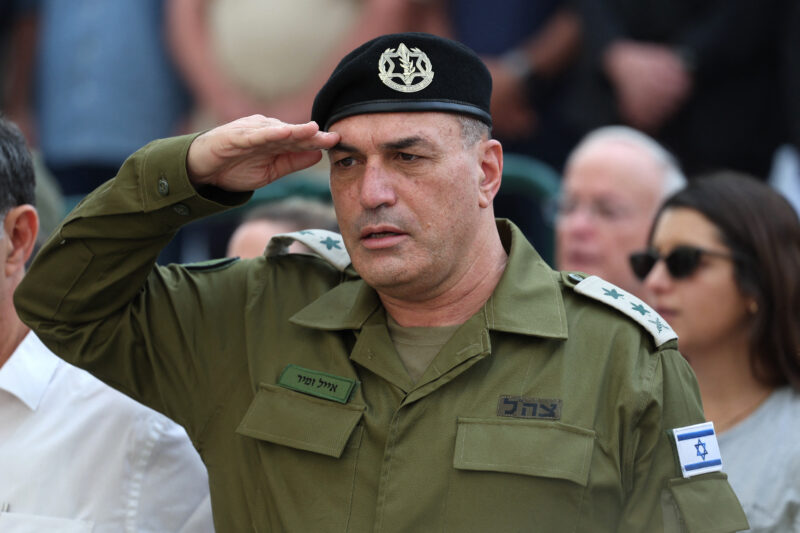
When the operation ended, IDF Chief of Staff Eyal Zamir said that commandos operated “on the ground,” but the military later clarified he meant in a nearby unspecified country.
On June 26, Iranian President Masoud Pezeshkian said in a call with Aliyev that Baku must “investigate and verify” reports that Israeli drones entered Iran via Azerbaijan. Aliyev denied that his country’s territory was used.
While the IDF has not publicized the details of every IAF flight to Iran, it has mentioned in its statements the long distances of flights, making it clear that Israel has the capability to fly directly to the Islamic Republic.
Farid Shafiyev, the chairman of the Baku-sponsored think tank Center for Analysis of International Relations, dismissed the pressure from Iran.
“The latest round of accusations is probably because Iran’s air defense was decimated and not capable of defense. The people in charge, especially the military establishment, are trying to find scapegoats,” Shafiyev told Jewish Insider. “My understanding is that different factions in the Iranian establishment are trying to blame someone outside of Iran for the failures of their military system.”
Shafiyev argued that “if Azerbaijan was somehow a part of [Israel’s operation in iran] it would be known by major intelligence agencies or by the media. It’s fake news.”
Relations between Iran and Azerbaijan have had ups and downs, such as the attack on Azerbaijan’s embassy in Tehran in 2023, he said, “but lately we have managed to maintain our relationship.” Pezeshkian even visited Baku last week for a regional economic conference, suggesting that the latest round of tensions between the countries may have subsided.
“If Iran were to try to exert pressure on someone, Azerbaijan would be a likely target because of that open relationship with Israel and Azerbaijan’s assets connected to the much larger global [energy] grid, supplying oil and gas to Turkey and Europe, in addition to Israel,” Gabriel Mitchell, the director of undergraduate studies at Notre Dame’s Jerusalem campus and an expert on the intersection between energy and security policy, said.
Gabriel Mitchell, the director of undergraduate studies at Notre Dame’s Jerusalem campus and an expert on the intersection between energy and security policy, told JI that “the dynamic with Iran is very serious.”
“If you consider all of the things that have happened over the 20 months of war [in Gaza],” Mitchell said, “such as [Iranian President Ebrahim] Raisi dying in a helicopter crash [that originated in] Azerbaijan, the escalation between Israel and Iran, and it is no secret the degree to which Israel and Azerbaijan have collaborated on security issues in the last decade and a half, it’s natural for Iran to start pointing fingers.”
“If Iran were to try to exert pressure on someone, Azerbaijan would be a likely target because of that open relationship with Israel and Azerbaijan’s assets connected to the much larger global [energy] grid, supplying oil and gas to Turkey and Europe, in addition to Israel,” he said.
Mitchell noted that there is a large ethnic Azeri minority in Iran, and Iran’s pressure on Azerbaijan also sends a message to that minority to curb any rebellious aspirations.
“Iranian pressure may have nothing to do with Israel and more to do with internal politics,” he added. “It’s impossible for them to flex against Israel right now and they’re not going to act against the Gulf states, so Azerbaijan is a soft middle ground that has a complicated relationship with Iran.”
Despite the ongoing backlash from Iran over ties with Israel, Azerbaijan’s state energy company SOCAR buying a stake in Israel’s Tamar gas field indicates that Baku is not hiding or backing down from a close relationship with Jerusalem.
“SOCAR is not an independent company,” Mitchell said, “so [the deal] is signalling not only to Israel but to the region and the U.S. that Azerbaijan is interested in cooperating with Israel … and wants to be part of broader regional arrangements in a more constructive way.”
The sale of a significant stake in a gas field in the eastern Mediterranean “stands in contrast with anything else going on in the region,” Mitchell said. “Very few companies are interested in making investments in the EastMed natural gas scene right now for understandable reasons, not only because of the war, but … Egypt has economic issues with being able to fulfill payments, which has dampened interest from oil and gas companies in investing in the region.”
“That SOCAR decided to take this leap is rare, and for that reason it should be applauded. It’s only a good thing for Israel,” he added. “I wouldn’t be surprised if other companies saw it as a green light for them to invest.”
The investment is also likely to benefit Azerbaijan as Tamar is a very reliable gas field, Mitchell said: “Azerbaijan can always say, ‘Set aside geopolitics, we’re just here for the money.’”
“When it comes to Turkey,” said Farid Shafiyev, the chairman of the Baku-sponsored think tank Center for Analysis of International Relations, “Israelis should understand that we are very close, we are military allies … Overall, I think there is room for diplomacy and Azerbaijan can play a role.”
Azerbaijan had the confidence to invest in the Tamar field, Shafiyev said, “because we believe the conflicts in the Middle East will not cause a major crisis that will make the fields inaccessible.”
The bilateral ties have withstood the souring relationship between Azerbaijan’s strongest ally, Turkey, and Israel, and Baku has at times served as a mediator between them.
“When it comes to Turkey,” Shafiyev said, “Israelis should understand that we are very close, we are military allies … Overall, I think there is room for diplomacy and Azerbaijan can play a role.”
The Azerbaijan-Israel relationship also remains stable despite the war in Gaza and beyond, Shafiyev said, because it rests on a decades-long foundation. He also cited the longstanding community in Azerbaijan of Mountain Jews, a population that has inhabited the eastern and northern Caucasus since the fifth century.
Roman Gurevich, the Jewish Agency’s honorary ambassador in Azerbaijan, who is well-connected in the government in Baku, said that “the deep-rooted friendship between the Jewish and Azerbaijani peoples has naturally evolved into the warm relationship Azerbaijan now shares with the State of Israel. When the brutal Hamas attack occurred on Oct. 7, [2023], ordinary citizens in Baku brought memorial candles and flowers to the Israeli Embassy in a spontaneous outpouring of solidarity.”
“Regardless of outside pressure or hostility, Azerbaijan remains committed to its friendship and strategic alliance with Israel and the Jewish world,” Gurevich added. “A strong, independent Azerbaijan that honors its friends and knows how to defend its interests is an invaluable ally for Israel.”
A security cabinet meeting on Gaza over the weekend ended inconclusively; experts say contrary to Trump claims, Netanyahu’s trial is not delaying a ceasefire

Avi Ohayon (GPO) / Handout/Anadolu via Getty Images
Israeli Prime Minister Benjamin Netanyahu convenes a meeting with members of his security cabinet following Iran's launch of a ballistic missile attack against Israel, in Tel Aviv, Israel on June 14, 2025.
Two roads diverged for Israel’s security cabinet in a Sunday night meeting about Gaza, and since they could not travel both routes, the cabinet decided not to make a decision.
The Security Cabinet met to discuss Israel’s next steps in Gaza after 633 days of war: ceasefire or escalation.
Some in the IDF high brass argued that the Gaza war’s objectives have been met — noting that the army had destroyed Hamas’ military infrastructure, killed nearly all of the senior Hamas commanders on its target list, dismantled tunnels, seized 60% of Gaza, blocked key smuggling routes — leaving Hamas weaker than it has been since its 2007 takeover of Gaza. They argued that now is the time to pursue an exit strategy, according to military analyst Amir Bohbot.
If there is no ceasefire, the IDF plans to continue its current operation in Gaza, calling up tens of thousands of IDF reservists and moving to conquer 80% of the territory. Officers in the cabinet meeting reportedly warned that doing so could bring about a large number of casualties, including some of the hostages. In the past week, the army has suffered near-daily losses of soldiers in Gaza.
On Monday, the IDF called on the residents of several neighborhoods in northern Gaza to evacuate, warning that military operations in their areas would escalate and intensify.
President Donald Trump’s choice is clear: “MAKE THE DEAL IN GAZA. GET THE HOSTAGES BACK!!!” he wrote on Truth Social on Sunday. Two days earlier, he said there could be a ceasefire within a week.
What a ceasefire would mean is unclear. The parties could agree to a temporary ceasefire, which Israelis have called the “Witkoff outline,” after Middle East envoy Steve Witkoff. Such a ceasefire would last 60 days, with the release of half of the remaining 50 hostages, 21 of whom are thought to be alive, in exchange for hundreds of Palestinian prisoners, including terrorists, and increased humanitarian aid flow into Gaza.
Israeli Prime Minister Benjamin Netanyahu denied a report last week that he and Trump discussed a sweeping plan to end the Gaza war and expand the Abraham Accords, but a source with knowledge of the matter told Jewish Insider on Monday that much of the details are, in fact, currently in talks, even if they may still be far from fruition.
Among the elements under discussion are the exile of remaining Hamas leaders from Gaza, and for Israeli troops to remain along Gaza’s perimeter — the Philadelphi Corridor along the Gaza-Egypt border is still under debate — and for the United Arab Emirates, Egypt and Saudi Arabia to take a central role in Gaza’s administration. In addition, there have been talks about normalization between Israel and Syria.
Netanyahu’s rush to deny the original report — which included Israeli acknowledgment of a future Palestinian state — underscores the degree to which he believes such a move would be politically toxic and could threaten to break up his governing coalition.
Of course, the U.S. and Israel can make plans, but Hamas has ideas of its own. Negotiators have on multiple occasions leaked the details of past ceasefire proposals, only for Hamas to reject the deals on the table. As Michael Milshtein, an expert on Palestinian affairs at Tel Aviv University, told Israel’s Kan Radio on Monday morning, “even after Iran blew up, Hamas is sticking to the same stance … [that] the IDF must fully withdraw” from Gaza.
More recently, Trump has found a different culprit for the lack of a ceasefire: the Israeli judiciary. For the second time in recent days, the president took to his social media network to lament that “it is terrible what they are doing in Israel to Bibi Netanyahu … How is it possible that the Prime Minister of Israel can be forced to sit in a Courtroom all day long, over NOTHING (Cigars, Bugs Bunny Doll, etc.). It is a POLITICAL WITCH HUNT, very similar to the Witch Hunt that I was forced to endure. This travesty of ‘Justice’ will interfere with both Iran and Hamas negotiations.”
One part of Trump’s Truth Social post raised alarm bells in the Israeli commentariat, with some interpreting the president’s words as a threat: “The United States of America spends Billions of Dollar a year, far more than on any other Nation, protecting and supporting Israel. We are not going to stand for this,” he wrote. “This greatly tarnishes our Victory [in Iran].”
The judge in Netanyahu’s trial was not convinced by Trump’s first post on social media, nor by a confidential letter from Netanyahu saying that there are urgent security matters requiring the postponement of the prime minister’s planned cross-examination this week. However, when the head of the Mossad and the head of IDF intelligence showed up at the courthouse hours after Trump’s second post on Sunday, Netanyahu received the deferral that both he and Trump wanted.
Asked whether Netanyahu’s trial is holding up a possible ceasefire in Gaza, Amichai Cohen, head of the Israel Democracy Institute’s Program on National Security and the Law, told JI that “it’s common sense that if critical things are happening in the war in Gaza, there won’t be proceedings. You don’t need the [resident of the United States for that to happen; the Israeli system knows how to handle it.”
Marc Zell, an international lawyer who is the chairman of Republicans Overseas Israel and a frequent defender of Trump in Israeli media, took issue with the interpretation that Trump is tying the issue of the hostages and the war in Gaza with to the trial, beyond the fact that “President Trump is quite understandably concerned that the prime minister is being distracted by what he considers silly political proceedings, which he understands because Trump himself was the object of a similar campaign … Trump is highly motivated to get this thing done and take advantage of what could be a sea change in the politics of the Middle East.”
Cohen and Zell were both skeptical that Trump’s entreaties would have much of an impact on Netanyahu’s case.
Cohen said that Trump may be trying to get a plea deal for Netanyahu. However, Attorney General Gali Baharav-Miara, whom Netanyahu’s cabinet ministers are currently trying to fire, would have to sign off on it. “I don’t think Trump would influence her,” Cohen said.
However, Trump could pressure Israeli President Isaac Herzog to pardon Netanyahu, which Cohen said was “the only place where politics could play a role. However, he added, “according to past rulings by the High Court, a pardon can only apply to someone who admitted wrong doing” — which Netanyahu has not done.
Zell called the proceedings against Netanyahu “specious,” but defended the independence of Israel’s judiciary. He told JI that Trump’s attempted intervention is “a direct affront to [Israel’s] sovereignty” and that “this is not the business of the U.S.; it’s the business of the State of Israel.”
Of Netanyahu supporters who cheered Trump’s posts, he said: “If we’re inviting a foreign state to interfere in our own proceedings, however misguided they may be … it opens the door to subsequent administrations. This is what the Biden administration did; it tried to interfere in our political processes and stop judicial reform.”
Customs and Border Protection Commissioner Rodney Scott: ‘The threat of sleeper cells or sympathizers acting on their own, or at the behest of Iran, has never been higher’

JIM WATSON/AFP via Getty Images
A sign for the US Department of Homeland Security in Washington, DC, March 24, 2025.
In the aftermath of the U.S. strikes on Iran, officials and lawmakers are warning of potential threats from Iranian or Iran-affiliated “sleeper cells” embedded in the United States, a threat that could persist in spite of the ceasefire reached last week.
Experts say that there is a real threat that Iran could seek to target the U.S. government, Jewish communities or other targets within the United States, either through networks of operatives in the country or individuals radicalized online against Israel and Jews.
“Though we have not received any specific credible threats to share with you all currently, the threat of sleeper cells or sympathizers acting on their own, or at the behest of Iran, has never been higher,” Customs and Border Protection Commissioner Rodney Scott said in a memo to CBP personnel earlier this month, asserting that thousands of known and unknown Iranian nationals are believed to have entered the United States.
Iran also reportedly sent a message to President Donald Trump days before the U.S. strikes on Iranian nuclear facilities, threatening to activate a terrorist network inside the United States if the U.S. struck Iran, NBC News reported.
A Department of Homeland Security public bulletin warned that the conflict in Iran could prompt attacks in the United States, and that a specific direction from Iran’s religious leadership could increase the likelihood of homegrown violent extremist mobilization. It also warned of potential cyberattacks.
Both before and after the U.S. strikes, lawmakers on both sides of the aisle had delivered similar warnings. Jewish community security groups came together to caution institutions to take heightened precautions in response to the strikes to protect their physical safety and cybersecurity.
Matthew Levitt, the director of the counterterrorism and intelligence program at The Washington Institute for Near East Policy and a former counterterrorism official, told Jewish Insider that homeland threats are very real, though he argued that the term “sleeper cells,” which he said invokes spy thriller TV shows, can trivialize the threat.
Levitt said there are past cases of Islamic Revolutionary Guard Corps-linked operatives being smuggled into the U.S. and surveying sensitive government and Jewish community locations. One such individual, after his arrest, told authorities he might have been instructed to attack those sites following a development like a direct American attack on Iran.
Levitt said that there have also been documented cases of groups such as Hezbollah setting up networks abroad to raise funds or spread propaganda, among other operations — but these individuals are generally not, as seen in popular culture, “a trigger puller who’s been sent here to wait until he’s ultimately told to pull the trigger.”
“There is real concern that if there was ever a time when Iran or Hezbollah was going to use these types of operatives, now would be it,” Levitt said, “especially since their other toolkits have generally been denied to them.”
Embedded foreign operatives operatives are likely few in number, Levitt added. A larger threat is from individuals in the United States who have been radicalized by anti-Israel and antisemitic propaganda or could be prompted to violence by a potential future Shia religious edict.
The degradation of Iran’s proxies and limited effectiveness of its missile attacks leaves “the potential for international terrorist attacks” that are less easy to definitively trace to the Iranian government, but send a message that “they haven’t been beaten” and can still retaliate, Levitt said.
Oren Segal, the vice president of the Anti-Defamation League’s Center on Extremism, told JI that “this specific conflict speaks to concerns that intelligence agencies have talked about for years, about the idea that Iran or its proxies have people around the world.”
“It’s understandable for not only the Jewish community, but frankly, the broader community, to be feeling anxiety over whether these people are in place and what they might do,” Segal continued.
He said it’s difficult to know how many direct Iranian assets might be in the United States, but regardless of that, there’s an ongoing threat of individuals being radicalized online.
“You don’t have to look too far to see attacks that have happened, or plots in this country that were motivated or animated by ideology, as opposed to somebody coming in from abroad,” Segal said. “To me, that is always going to be the most omnipresent threat.”
He emphasized that violent language targeting the Jewish community has skyrocketed since recent antisemitic terrorist attacks in Washington and Boulder, Colo., and “we just don’t have the luxury to ignore any of these threats.”
Secure Community Network CEO Michael Masters, speaking on a recent webinar with FBI and DHS officials, warned of heightened risks to Jewish community groups that could emanate from a range of different sources, according to prepared remarks reviewed by JI.
Masters emphasized that Iran has a record of attempting operations inside the United States in recent years, and noted that U.S. military engagement against Iran has long been seen as a likely trigger for Iranian retaliatory attacks in the United States.
He said SCN believes that Jewish institutions and leaders would be top targets of Iranian proxies and criminals working with them. And he noted that within hours of the U.S. attacks on Iran, SCN had identified nearly 1,700 violent social media posts targeting the American Jewish community.
Levitt said that the “good news is” that IRGC and Hezbollah operatives in the country are likely under tight surveillance, noting that recent reporting indicates that the FBI has increased its focus on such groups in recent days.
“On the one hand, I’m sure that there are adversaries that would like to do something against America in America,” Levitt said. “It’s also a case that — there’s no such thing as 100% successful — we’re pretty good at law enforcement, intelligence and border security and all that here.”
Many Republicans have linked the “sleeper cell” threat to increased levels of undocumented immigration during the Biden administration, a connection that Levitt largely dismissed.
“I don’t subscribe to the opinion that border security was so lax in previous administrations that all kinds of bad guys got in,” Levitt said. “More people were allowed in the country. It doesn’t mean that law enforcement wasn’t doing its job, and the actual [number of] cases we know about where bad guys were able to come into the country is very, very small.”
A new report by Israel Hayom says the two leaders also agreed that the U.S. would recognize Israeli sovereignty in parts of the West Bank and Israel would voice support for a two-state solution

SAUL LOEB/AFP via Getty Images
President Donald Trump with Israeli Prime Minister Benjamin Netanyahu during the signing of the Abraham Accords.
President Donald Trump and Israeli Prime Minister Benjamin Netanyahu agreed to terms to end the war in Gaza and advance other shared interests in a telephone call held shortly after the U.S. struck nuclear sites in Iran earlier this week, according to a new report by Israel Hayom.
A source familiar with the conversation told the right-leaning Israeli daily that Trump and Netanyahu were joined on the call by Secretary of State Marco Rubio and Israeli Minister of Strategic Affairs Ron Dermer, where the four determined that Israel would end the war in Gaza within two weeks.
This process would include the exiling of what remains of Hamas’ leadership from Gaza, voluntary emigration for Gazans who elect to leave the territory — though which countries would host them was not specified in the report — and the release of the 50 hostages remaining in Gaza, less than half of whom are thought to be alive.
Under the terms of the agreement, the UAE and Egypt, along with two other Arab countries, would jointly govern the Gaza Strip after Hamas’ removal.
In addition, the Abraham Accords would be expanded to include Syria and Saudi Arabia, as well as additional Arab and Muslim states.
The plan would also see U.S. recognition of “limited” Israeli sovereignty in the West Bank, while Israel would express support for a future two-state solution premised on reforms within the Palestinian Authority.
Shortly after the publication of the Israel Hayom report, Netanyahu released a statement saying, “We fought valiantly against Iran — and achieved a great victory. This victory opens up an opportunity for a dramatic expansion of the peace agreements. We are working hard on this.”
“Along with the release of our hostages and the defeat of Hamas, there is a window of opportunity here that must not be missed,” Netanyahu added. “Not even a single day must be wasted.”
The following morning, however, Netanyahu’s office released a new statement saying, “The conversation described in the ‘Israel Today’ report did not happen. The diplomatic proposal described in the article was not presented to Israel and Israel obviously did not agree to it.”
The feasibility of this plan remains in question. The Israeli government has been firm in its opposition to a two-state solution and public opposition to a Palestinian state grew after the Oct. 7, 2023, Hamas terror attacks. In April, as French President Emmanuel Macron moved to recognize a Palestinian state, Netanyahu “expressed fierce opposition” to the move in a phone call with Macron and conveyed to him that “a Palestinian state established a few minutes away from Israeli cities would become an Iranian stronghold of terrorism; that the vast majority of the Israeli public opposes that categorically — and that this has been the PM’s consistent and longstanding policy,” according to a readout from the Prime Minister’s Office.
Even the potential acceptance of a future Palestinian state could put Netanyahu’s governing coalition at risk, with not only the parties led by Finance Minister Bezalel Smotrich, National Security Minister Itamar Ben-Gvir and Foreign Minister Gideon Sa’ar adamantly opposing one, but most Likud lawmakers, as well.
U.S. lawmakers told Jewish Insider last week after a trip to the region that the normalization process between Saudi Arabia and Israel had been dealt setbacks by and since Oct. 7 and that the Saudis were demanding concrete progress toward a two-state solution before moving forward with normalization.
Egypt and Saudi Arabia in March condemned moves by the Israeli government to encourage migration from Gaza. The Arab League, meeting earlier that month, also adopted a plan for Gaza’s reconstruction put forward by Egypt where a committee of Gazan professionals would manage the Strip for a period of time until the Palestinian Authority would take over its governance.
JI’s Tamara Zieve contributed to this report.
In an interview with independent Iranian media outlet Iran International, Leiter said Israel is ‘not in the position to make a long-term strategy for another country. Our long-term strategy is to stay alive’

Mo Broushaky
Israeli Ambassador to the U.S. Yechiel Leiter speaks at an event with Iran International on June 24, 2025.
When Israeli Ambassador to the U.S. Yechiel Leiter agreed last week to a major interview with Iran International, the biggest independent Iranian news outlet in the world, the geopolitical status of the region looked very different than it did when Leiter sat down with anchor Fardad Farahzad on Tuesday morning at the National Press Club in Washington.
What was billed as a candid conversation with Leiter, where he would answer questions directly from Iranians curious about Israel’s approach to military strikes in Iran, turned into a newsy postmortem on the 12-day war between Israel and Iran, which had shakily come to a close just hours earlier with a ceasefire brokered by President Donald Trump and the Qataris.
Leiter touted Israel’s military victories but did not offer a full endorsement of the ceasefire — and asked whether he was surprised by Trump’s announcement on Tuesday night, he demurred: “I came to Washington on Jan. 27, and there hasn’t been one day where I haven’t been surprised,” Leiter quipped.
“I think we saw it coming, because we accomplished the vast majority of our goals, our military goals, and that’s diminishing to the point of elimination the path to a nuclear bomb and proliferation of ballistic missiles,” said Leiter.
In 12 days, Israel had “decimated [Iran’s] capacity to inflict tremendous damage on Israel,” Leiter continued. When pressed by Farahzad whether that meant Israel had eliminated Iran’s nuclear program, Leiter’s message was less straightforward.
“Eliminated is a big word. Obliterated is a big word. We can’t get into … what, exactly, ‘obliterated’ means,” said Leiter. (Trump said in a Truth Social post on Sunday that “obliteration is an accurate word.”)
While the details of how thoroughly Israel had damaged Iran’s nuclear and ballistic missile programs are still somewhat uncertain, the fact that Israel had achieved great military success in Iran in less than two weeks was not disputed.
Instead, much of the conversation featured Leiter grappling with the limits of Israel’s capabilities in Iran. As barbaric and evil as Israel finds Iran’s regime, Leiter reiterated that regime change is not on the table for Israel.
“There are few things that unite Israelis, but change in Iran is one of them,” said Leiter. “We want regime change. We’re certainly going to support it in every way we can. But militarily? No. War cannot bring regime change. It doesn’t work.”
Farahzad read questions that had been sent in by Iranian viewers and called on several Iranians in the audience. Almost every one of them asked some version of the same question: Now that there is a ceasefire, Iranians are afraid of what will come next for them. The mullahs remain in power, weakened and wounded. What will they do to the people of Iran? How can the U.S. and Israel leave the Iranian people on their own and walk away?
“Please help assuage the people of Iran’s mindset that the world leaders are saying stuff from both sides of their mouths, but they’re not taking into consideration that if the mullahs are left in power, it will do much more damage to the people of Iran,” one audience member pleaded with Leiter.
He acknowledged the precarity of this moment for the Iranian people, and their frustration at Israel’s inability to help them reach the outcome that many of them want. Instead, Leiter said he hoped Israel’s brief incursion into Iran, helped by the U.S., could spur Iranians who want a change in their country’s leadership to overcome their fears and bring about that change.
“I don’t think I have an answer that’s fully going to satisfy you,” said Leiter. “The bandwidth in the United States right now for anything that even smacks of regime change — very small bandwidth. The ability for Israel to act [by] itself for regime change is extremely limited. What we are doing is, I think, advancing the cause of liberty to a great degree. In our efforts to secure ourselves, we are moving the region into a greater effort of liberty. It takes time.”
Leiter presented a vision of a forward-looking Middle East, where the arc of history bends toward justice for the Iranian people, even if that arc is not a straight line.
“Based on history, I think we are moving towards an era of greater freedom, of greater people sovereignty. I think that that’s been helped, facilitated, by what we’ve done,” said Leiter. “We’re not in the position to make a long-term strategy for another country. Our long-term strategy is to stay alive.”
Iranians now worry that they may be left paying a price for Israel’s victory, as the country’s hard-line rulers lash out. Leiter acknowledged that, but countered that it is not only Israel who can help the Iranian people. He called for Europe to step up.
“We’re not the only democracy in the world. Why is it that the chancellor of Germany says Israel is doing the dirty work for all of us? We’re a tiny, little country. Where’s Germany? Where’s England? England has a huge stake,” said Leiter. “Are we the world’s policeman? Please. I would say to the chancellor of Germany, ‘You’re absolutely right. We’re doing the dirty work for the world, but it’s about time that you helped us.’ And if they did, it would be a lot easier for the people of Iran.”
The interview will air several times this week on primetime in Iran, and to Iranian diasporas around the world.
Trump: ‘I'm not happy with Iran, but I'm really not happy with Israel … [Israel and Iran] don’t know what the f*** they’re doing’

Tasos Katopodis/Getty Images
President Donald Trump
President Donald Trump blasted Israel on Tuesday morning after it said it would respond to Iranian violations of the ceasefire, telling reporters, “I’m not happy with Iran, but I’m really not happy with Israel.”
“We have two countries that have been fighting for so long and so hard that they don’t know what the f*** they’re doing,” he continued, speaking to reporters at Joint Base Andrews before taking off to attend the NATO summit at The Hague, Netherlands.
The IDF intercepted two missiles from Iran at about 10:30 a.m. Israel time, just hours after the ceasefire announced by Trump on Monday night came into effect. Israeli Defense Minister Israel Katz said he “instructed the IDF to respond forcefully to the violation of the ceasefire by Iran with powerful strikes against regime targets in the heart of Tehran.”
Asked about Iran’s violation of the ceasefire, Trump said, “They violated it but Israel violated it, too. Israel, as soon as we made the deal, came out and they dropped a load of bombs the likes of which I’ve never seen before. … I’m not happy with Iran, either, but I’m really not happy if Israel is going out this morning because of one rocket that didn’t land, that was shot perhaps by mistake, that didn’t land. I’m not happy about that.”
“These guys gotta calm down, it’s ridiculous,” he added later.
The Prime Minister’s Office said in a statement on Tuesday, “The ceasefire was set for 7 a.m. At 3 a.m., Israel forcefully struck at the heart of Tehran, damaging regime targets and eliminating hundreds of Basij militants and Iranian security forces. Shortly before the ceasefire went into effect, Iran sent a barrage of missiles, one of which took the lives of four of our civilians in Beersheba. At 7:00 the ceasefire went into effect. At 7:06 Iran sent one missile to Israeli territory and at 10:25, two additional missiles. The missiles were intercepted or fell in open areas with none injured and no damage.”
Shortly after he made his comments, Trump posted to Truth Social, “ISRAEL. DO NOT DROP THOSE BOMBS. IF YOU DO IT IS A MAJOR VIOLATION. BRING YOUR PILOTS HOME, NOW!”
Jerusalem sought clarifications from the Trump administration after his Truth Social post, an Israeli official told Jewish Insider, as the president had previously reassured Israel it could respond to Iranian violations of the ceasefire.
A senior Israeli official told Axios’ Barak Ravid that Trump called Israeli Prime Minister Benjamin Netanyahu on Tuesday and told him not to respond to Iran. Netanyahu reportedly told the president he could not cancel the strike and needed to give some kind of response to Iran’s violation of the ceasefire, and it was ultimately decided Israel would significantly scale back its attack and strike only one target.
The PMO confirmed the Israeli Air Force destroyed a radar system near Tehran as its response.
“Following a conversation between President Trump and Prime Minister Netanyahu,” the PMO continued, “Israel avoided conducting further strikes. In their conversation, President Trump expressed his great appreciation for Israel, which reached all of its goals in the war. The president also expressed his confidence in the stability of the ceasefire.”
After the conversation, Trump wrote on Truth Social, “ISRAEL is not going to attack Iran. All planes will turn around and head home, while doing a friendly ‘Plane Wave’ to Iran. Nobody will be hurt, the Ceasefire is in effect!” and then wrote, “IRAN WILL NEVER REBUILD THEIR NUCLEAR FACILITIES!”
Jewish Insider’s senior political correspondent Lahav Harkov contributed to this report.
Israel vows to ‘respond with force’; four people killed in wave of Iranian missile launches
IDF
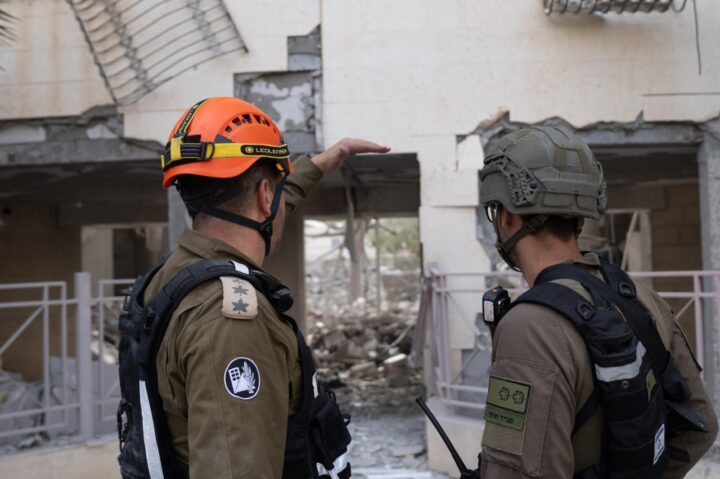
IDF Home Front Command forces operate at the impact site in Beersheva, June 24th, 2025
Iran violated a ceasefire with Israel hours after it began on Tuesday, with Israel vowing “powerful strikes” in response.
The IDF intercepted two missiles from Iran at about 10:30 a.m. No injuries were reported. Despite residents of northern Israel reporting interceptions, Iran denied firing the missiles.
Israeli Defense Minister Israel Katz said he “instructed the IDF to respond forcefully to the violation of the ceasefire by Iran with powerful strikes against regime targets in the heart of Tehran.” IDF Chief of Staff Lt.-Gen. Eyal Zamir said that “in light of the severe violation of the ceasefire carried out by the Iranian regime, we will respond with force.” A senior Israeli diplomatic source said that “Iran violated the ceasefire — and it will pay.”
In the hours before the ceasefire was meant to go into effect at 7 a.m., Iran launched 20 missiles in a series of barrages at Israel, killing four in a direct hit on a building in Beersheba.
Ahead of the deadly strike, Iranian Foreign Minister Abbas Araghchi sent mixed messages, first posting on X that “there is NO ‘agreement’ on any ceasefire … However, provided that the Israeli regime stops its illegal aggression against the Iranian people no later than 4 am Tehran time, we have no intention to continue our response afterwards.” Less than 20 minutes later, Araghchi implied on X that a ceasefire had gone into effect: “The military operations of our powerful Armed Forces to punish Israel for its aggression continued until the very last minute, at 4am.”
The Islamic Republic has repeatedly struck Beersheba since the war began 12 days ago, damaging buildings in the Soroka Medical Center, Microsoft offices and residences in the southern Israel city. The regime said it was aiming at an IDF research center in the city’s HiTech Park.
President Donald Trump announced a “Complete and Total CEASEFIRE” on Truth Social on Monday evening, saying that each “side will remain PEACEFUL and RESPECTFUL … This is a War that could have gone on for years, and destroyed the entire Middle East, but it didn’t, and never will!”
According to the president, Iran was supposed to have stopped firing at Israel at 7 a.m. local time, and Israel would stop 12 hours later.
At about 8 a.m. Israel time, Trump added: “THE CEASEFIRE IS NOW IN EFFECT. PLEASE DO NOT VIOLATE IT!”
Netanyahu and Trump spoke about the ceasefire overnight, while an American team that included Vice President JD Vance talked to Tehran, Reuters reported. Israel’s condition for the ceasefire was that Iran stop launching attacks, which they reportedly agreed to at the time. Qatar also took part in the negotiations.
The Israeli government released a statement on Tuesday morning that Prime Minister Benjamin Netanyahu reported to the Security Cabinet that “Israel has achieved all of the objectives of Operation Rising Lion, and much more. Israel has removed a double existential threat — on both the nuclear issue and regarding ballistic missiles. The IDF also achieved complete air superiority in the skies over Tehran, struck a severe blow to the military leadership and destroyed dozens of Iran’s main regime targets.”
“In Operation Rising Lion, the State of Israel made great historic achievements and placed itself in the first rank of the world’s major powers,” the government stated. “This is a great success for the people of Israel and its fighters, who removed two existential threats to our country, and ensured the eternity of Israel.”
Israel also “thank[ed] President Trump and the U.S. for their defensive support and for their participation in removing the Iranian nuclear threat.”
The ceasefire was reached “in full coordination with President Trump,” the statement reads, but “Israel will respond forcefully to any violation of the ceasefire.”
IDF Spokesperson Brig.-Gen. Effie Defrin also said in a briefing on Tuesday morning that “the IDF has fully met all the objectives defined in Operation Rising Lion.”
“The Chief of the General Staff instructed the IDF to maintain a high level of alert and readiness to deliver a powerful response to any violation of the ceasefire,” he added.
In addition, Israel’s Home Front Command maintained its restrictions on Israelis, including the continued closure of schools and non-essential businesses.
The Israeli government statement also said that the IDF killed hundreds of militants from the Basij, “the terrorist regime’s instrument of repression,” and killed a senior nuclear scientist, named Mohammad Reza Sadighi, according to Iranian reports.
Defrin said that on Monday night and early Tuesday, the Israeli Air Force “struck dozens of military targets in Tehran … deploying more than one hundred munitions.” The targets included the headquarters of SPND, where weapons systems and nuclear technology were developed, as well as military manufacturing infrastructure. The IAF also eliminated eight missile launchers that were ready to fire at Israel.
Reps. Massie and Khanna are standing down on their war powers resolution, but Democrats in the House and Senate will continue to push ahead with other legislation

Aaron Schwartz/Sipa USA via AP Images
Rep, Jim Himes (D-CT) gives remarks on camera outside the House Chamber of the Capitol Building on Thursday April 10, 2025.
House and Senate Democrats are pushing ahead with efforts to bring forward votes this week in both chambers on resolutions that aim to constrain the administration from taking any further military action against Iran in spite of President Donald Trump’s surprise announcement of a ceasefire between Israel and Iran.
Trump’s diplomatic breakthrough is creating some political awkwardness for Democrats who had insisted the president would escalate the war, but many are still likely to support the resolutions, which reflect their dissatisfaction with the president’s decision to strike Iran’s nuclear facilities without congressional authorization.
Rep. Thomas Massie (R-KY), the lead sponsor of one war powers resolution in the House, said he no longer plans to force a vote on it, explaining, “if we’re not engaged in hostilities, I think it’s a moot point.” He said he had told House Speaker Mike Johnson (R-LA) that he would not attempt to bring the resolution to the floor.
Rep. Ro Khanna (D-CA), Massie’s lead co-sponsor, said, “The anti-war advocacy of the left and right broke through. I am glad cooler heads prevailed and Trump seems committed to stopping this war. I spoke with Rep. Massie this evening and we are taking a wait and see approach about whether a vote will be needed now on our War Powers Resolution.”
But a group of senior House Democrats introduced a separate resolution on Monday evening, which they are expected to continue to advance.
The U.S. strike, Massie’s resolution and broader questions about the situation in Iran have been causing heartburn for many House Democrats, particularly supporters of Israel, Democratic staff sources told Jewish Insider earlier Tuesday.
Democratic staffers not authorized to speak publicly explained that, behind the scenes, the largely unified public Democratic opposition to the strikes has been driven by several factors, including the perceived lack of political support for the strikes, concerns about an escalating war and frustration with the Trump administration.
“I think a lot of members support the strike privately but see this as a politically vulnerable issue for [Trump],” one Democratic staffer said.
Another staffer said that Democrats are afraid of echoes of the Iraq war: If the U.S. ends up in a full-scale, protracted, politically unpopular war with Iran, they don’t want to be on record as having supported it.
And, the staffer said, there’s a deep level of distrust for the Trump administration, which acted largely unilaterally in the strikes, did not make efforts to keep congressional leaders informed about the strikes and hasn’t yet presented any evidence to Congress of the need for the strikes or their success.
Rep. Jim Himes (D-CT), the ranking member of the House Intelligence Committee, who worked with other top Democrats on an alternative war powers resolution, said the resolution effort should continue “if United States forces remain engaged.”
Himes, along with Reps. Greg Meeks (D-NY) and Adam Smith (D-WA), the top Democrats on the Foreign Affairs and Armed Services committees, introduced their own war powers resolution Monday evening, after the ceasefire was announced.
Whether that resolution will come to the floor remains an open question. The House speaker was reportedly working on a procedural plan that would strip the Massie resolution of its privileged status, sidestepping a vote on the House floor, and could potentially use the same tactic to defuse the new Democratic resolution.
On the Senate side, Sen. Tim Kaine (D-VA) said he also plans to push forward with his efforts, and said that Senate Majority Leader John Thune (R-SD) is working with Minority Leader Chuck Schumer (D-NY) to facilitate a vote.
“Whether or not a ceasefire between Israel and Iran comes to fruition — and I hope it does — I will move forward to force a vote on my resolution to require Congress to debate and vote on whether or not the United States should engage in a war with Iran,” Kaine said in a statement to JI. “Americans don’t want matters of war and peace, bombing and ceasefire, to rest upon the daily whims of any one person.”
“That’s why the Framers of our Constitution decided that war should only be declared following a public debate and congressional vote,” Kaine continued. “Congress must affirm its commitment to that principle and send a clear message: no more endless wars.”
Other Democrats agreed that a war powers resolution should still receive a vote in spite of the ceasefire.
Rep. Greg Casar (D-TX), the chairman of the Congressional Progressive Caucus, told JI, “At the end of the day, I think that a war powers resolution makes good sense to vote on and for Congress to finally reassert what is in black-and-white letters in the Constitution, which is that only Congress and the consent of the American people can start a war.”
Rep. Pat Ryan (D-NY), a former Army intelligence officer, argued that the uncertainty of the situation necessitated that Congress step in.
“It’s a very volatile situation, which, to me, makes it even more urgent that we make clear and reassert what the Constitution of the United States says, which is that it is the Congress that has the authority to declare war or authorize the use of [force],” Ryan told JI.
He added that it “should be concerning to every American that multiple days after doing — not even a preemptive strike — a preventive strike, there’s still no legal justification, there’s still no clarity about the effectiveness.”
A memo sent by Trump to the Senate cited presidential foreign relations authorities enshrined in the U.S. constitution as the legal backing for the strike.
Rep. Jared Moskowitz (D-FL), among the few House Democrats who supported the strikes, told JI that he wants to see Congress reclaim its power but that the administration also has the ability to take defensive action without consulting Congress. He said that the war powers resolution push is likely no longer relevant if the ceasefire continues.
“Based on the ceasefire that was announced, it if holds, it appears that the issue in this current climate is moot, but overall, still important,” Moskowitz said. “[The war powers resolution] is no longer relevant to this particular purpose. It would be more of a general ‘us reasserting our authority as Congress.’”
Kaine told reporters earlier in the day that his resolution in the Senate would come up for a vote on Thursday or Friday.
Kaine said that the vote was “fluid” but he expected to see Republican support, and that he expected nearly all Democrats, with the exception of Sen. John Fetterman (D-PA), to support it.
“I think the fluidity and change is something that I think warrants — this is why you get a congressional discussion, because these things can escalate,” Kaine said. “They can move in ways that are hard to predict, and that’s why a discussion and a vote is a good idea.”
He said that, “my colleagues on the Democratic side, regardless of whatever they feel about Iran, [believe] wars without Congress, wars that bypass us, are a bad idea.”
Sen. Rand Paul (R-KY) confirmed he planned to support the resolution as well, arguing that the Constitution is clear that war powers are vested in Congress and that his position on the issue has been consistent across administrations.
“There have always been people who argue the president can do whatever he wants,” Paul said. “The problem is, that’s a recipe for chronic intervention. It’s a recipe for endless war.”
Sen. Adam Schiff (D-CA), a pro-Israel Democrat, also said he supported the resolution.
Ahead of the ceasefire, some specific concerns with the wording of the Massie resolution had split Democrats, one Democratic staffer said. That prompted the separate resolution from Meeks, Himes and Smith. House Minority Leader Hakeem Jeffries (D-NY) claimed at a press conference on Monday that he hadn’t reviewed the Massie resolution yet, indicating that he would not be supporting it.
A Democratic staffer explained that there were fairly widespread concerns that Massie’s resolution could block the U.S. from continuing to support Israel’s defense.
The Democrat-led resolution includes a specific exception allowing the U.S. to defend itself or any ally or partner from “imminent attack,” whereas Massie’s resolution only allowed for continued defense of the United States and intelligence sharing with allies. The Democrats leading the resolution emphasized in a statement that it would allow U.S. forces defending Israel to continue their activities.
“What we’re trying to get clarity on is to ensure that there’s no ambiguity or doubt about our ability to fully support the defense of Israel and the Israeli people, that we can continue … intelligence sharing and information sharing, cyber,” Ryan said earlier, of the Massie resolution. “There are key dimensions where we have to continue to be very closely aligned.”
“My concern is less about the language of the resolution and more about who introduced it, frankly,” Ryan continued. Massie has a history of comments that colleagues on both sides of the aisle have condemned as antisemitic.
Jeffries, at his press conference, largely focused on the fact that the Trump administration had failed to inform Congress about the strikes in the normal manner and had still not provided a proper justification for the strikes or accounted for Iran’s nuclear material.
He also argued that the administration’s claims to have destroyed Iran’s nuclear program completely couldn’t be trusted.
Rep. Steny Hoyer (D-MD), a former House majority leader and perhaps the most prominent Democratic supporter of the strikes, told JI that his support for the strikes was consistent with unilateral action taken by administrations dating back to President Bill Clinton.
He added that it would be “hypocritical” not to support the strikes now, when administrations have said for decades that they will not permit a nuclear Iran, and said that the recent International Atomic Energy Agency report showed that Iran was “too close” to a nuclear weapon and “stopping them was the right thing to do.”
Hoyer also noted that Congress moves more slowly than the executive branch and that a slow public debate over a potential strike in Congress over strikes would have “incentivized [Iran] to move ahead as quickly as possible.”
He said that as a general matter, however, he believes that it is important for Congress to be able to put a check on the administration’s ability to go to war, though he said that the decision to strike Iran was a long time coming.
Fetterman, the only Senate Democrat who has announced he plans to oppose the war powers resolution, blasted some colleagues who have called the strikes unconstitutional. He said he would have opposed the Kaine resolution before the strikes.
He noted that previous Democratic administrations had conducted similar “one-off” strikes and argued that congressional approval would only be needed if the U.S. was going to start a broader, protracted war.
Fetterman also blasted Democrats for joining Massie’s effort calling him, “that weirdo from Kentucky.”
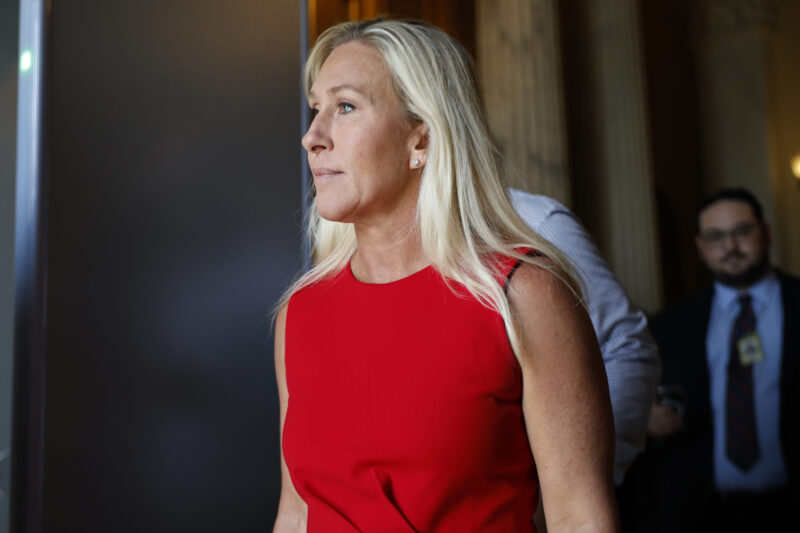
Among Republicans, Massie’s resolution may have seen some additional support from a handful of isolationist Republicans, but likely not many. Rep. Marjorie Taylor Greene (R-GA), the Republican who, alongside Massie, has been most outspoken against the U.S. strike, told Punchbowl News she would not support the effort.
But she also said she wanted to push to cut off U.S. aid to Israel, and has previously condemned Israel’s military action against Iran.
News of the ceasefire united all factions in the Republican party behind Trump; even some Democrats welcomed the diplomatic development

Tom Williams/CQ-Roll Call, Inc via Getty Images
Speaker of the House Mike Johnson (R-LA)
Republicans are publicly lauding President Donald Trump’s ceasefire between Israel and Iran as an example of his “peace through strength” approach to foreign policy.
Trump announced that Israel and Iran had agreed to a “complete and total ceasefire” that will bring an end to the war. “This is a war that could have gone on for years, and destroyed the entire Middle East, but it didn’t, and never will,” the president wrote on his Truth Social platform, alluding to criticism that he was dragging the U.S. into another prolonged Middle East conflict.
House Speaker Mike Johnson (R-LA) told reporters on Monday evening that the news of a ceasefire was “incredible,” saying, “This is what peace through strength looks like.”
“This is what real leadership yields, and we’re certainly grateful for the decisive leadership of President Trump,” Johnson said, adding that he would expect “that Iran will bring an end to their nuclear enrichment program and that there will be a lasting peace in the Middle East.”
Sen. John Kennedy (R-LA) told Jewish Insider that he’s “very much pleased” by the news.
Pressed on whether he’s concerned that the deal could give Iran breathing room to rebuild its nuclear program, Kennedy said, “There’s this rule when you practice law, when you’ve won for the judge, you shut up. OK? You don’t keep talking. It’s a ceasefire. We won. We ought to take our victory.”
Sen. Josh Hawley (R-MO) said he viewed the ceasefire as a “very good development.”
“I think the question now is how do we get to a place where we can get to a deterrence posture, a containment posture for Iran for the long haul, that will keep them in their box, keep Iran in their box, but will also allow us, the United States, to draw down our troop and military presence in the region,” Hawley told reporters.
Asked about his initial concerns about the potential consequences of an offensive strike on Iran’s nuclear program, Hawley replied, “If he can get a ceasefire out of it, listen, I support the president and want him to succeed, so this is good progress.”
Sen. Eric Schmitt (R-MO) praised the president for having the discipline to execute the mission of degrading Iran’s nuclear program without pulling the U.S. into a broader war.
“There are a lot of voices out there, here in permanent Washington, that wanted more engagement [in the conflict]. And President Trump, I think he had that restraint and that instinct to do what needed to be done to bring about peace,” Schmitt said during a Fox News appearance.
Sen. Mike Rounds (R-SD) wrote on X that the president “accomplished peace through strength” with the announcement of a deal. “If this ceasefire is upheld by both Iran and Israel, it will bring a successful conclusion to this 12 Day War and a major victory for President Trump. This demonstrates how critical it is to have a state of the art and well-funded military, as well as a President who recognizes the art of the deal,” Rounds wrote.
Sen. Jim Banks (R-IN) wrote in a lengthy thread on X that, “President Trump has long understood that the American people never supported ‘forever wars’ with unclear goals and no clear metrics for success. But at the same time, President Trump understands that when it comes to setting a red line, he will actually follow through and enforce it, sending a clear message that our enemies in Beijing and elsewhere should heed.”
Sen. Bernie Moreno (R-OH) praised Trump for carrying out this weekend’s operation without embroiling the U.S. in a deeper conflict.
“President Trump has always been clear: the era of Forever Wars abroad is over. He was able to DECIMATE the Iranian nuclear program without boots on the ground, any dead Americans or a new regime change war. He’s 100% right that it’s time to push for peace,” Moreno posted on X.
Sen. Katie Britt (R-AL) described the deal as “historic” and hailed Trump as “The President of Peace!”
“President Trump’s restoring peace through strength. It’s good for America and for the world. Let’s continue to pray for the president, our service members and for a lasting peace,” Sen. James Lankford (R-OK) wrote on X.
“Our great nation and the world is a better and safer place because of President Trump’s bold leadership. … He took decisive action to eliminate Iran’s nuclear program to bring peace,” Rep. Elise Stefanik (R-NY), a member of House leadership, said in a statement. “President Trump told our allies and adversaries we would always put America First and achieve peace through strength.”
Rep. Steny Hoyer (D-MD), one of the few congressional Democrats who supported the strikes, suggested that the ceasefire puts to rest fears that many had expressed about a protracted war in the Middle East.
“Now there’s a ceasefire … so the fear of an un-ending war apparently is not there, in part I think because Iran thinks we’re serious,” Hoyer continued. “I’ve always hoped that we were prepared to follow up on our rhetoric that [a nuclear Iran] was an unacceptable alternative, which I think Trump has done.”
Rep. Brad Schneider (D-IL), a co-chair of the House Jewish Caucus, said on X that he hoped “this announced ceasefire truly brings an end to the war. A diplomatic path to reversing Iran’s nuclear ambitions, and permanently dismantling Iran’s nuclear development programs is preferable to war.”
Rep. Jerry Nadler (D-NY), the other Jewish Caucus co-chair, said he welcomed “the news of a ceasefire between Israel and Iran. The violence has cost too many innocent lives and inflicted too much destruction on innocent civilians” and that he hoped the deal would put the region on a path to a durable peace.
Other national security-focused House Democrats highlighted the risks of Trump’s actions if they did not successfully eliminate Iran’s nuclear program.
“If you take this shot, you have to land it, and it’s a very hard shot to land,” Rep. Pat Ryan (D-NY) told JI when news of the ceasefire emerged, arguing that the situation highlighted the need for Congress to assert a role in war-making authorities.
“Taking the shot and not landing it is incredibly dangerous and risky because now the risk to break out — there’s no reason for them to hold back, whereas before we at least had some sense that there was an effective deterrent,” Ryan continued. “They have every reason to race to break out now.”
Rep. Jim Himes (D-CT), the ranking member of the House Intelligence Committee, emphasized that the success of the strikes is very uncertain at this point, and that he would be “most worried about an Iran that goes silent right now.”
“If Iran goes silent right now, what are they doing? Are they actually developing something?
Dana Stroul, the research director for the Washington Institute for Near East Policy and a former deputy assistant secretary of defense for the Middle East, told JI that declaring a ceasefire before the full impact of U.S. strikes over the weekend had been determined could be risky.
“The major risk of declaring the ceasefire now without verifying the damage to Iranian capabilities is that it leaves intact enough of the program or the stockpile of enriched uranium — secure within Iran — providing the regime a path to rebuild at some point in the future,” Stroul said.
“After staking U.S. credibility on eliminating Iran’s nuclear program, hopefully President Trump can explain to the international community and Israel that a ceasefire at this time opens the door to urgent diplomacy that ends Iran’s threats and sets the region on a more stable trajectory,” Stroul continued. “What we don’t know right now is what kind of regime we face on the other side of Israeli and American military strikes. Is the regime ready to make the necessary concessions?”
Trump’s announcement of a deal came hours after Iran’s missile attack on U.S. bases in Qatar and Iraq. Despite their later praise for the ceasefire, the Iranian attack initially prompted some Republicans to call for an aggressive American response, while others in the party argued that they should be viewed as a sign of Tehran’s willingness to avoid escalating the conflict.
Sen. Roger Wicker (R-MS), the chairman of the Senate Armed Services Committee, said he was of the view that the attack was a sign of the regime’s understanding of its weaknesses.
“My view, based on totally open source news, is that this was a face-saving move on the part of the Iranian regime. They felt they had to retaliate as a matter of honor, but they wanted to make sure the response was not escalatory,” Wicker told JI.
Sen. John Fetterman (D-PA) said he saw Iran’s response as an admission from the regime that it lacks the military capacity to be able to escalate the conflict. The Pennsylvania senator noted that he has been saying since last year that “Iran can’t fight for s***” while dismissing claims that the regime had the capacity to create broader, long-term conflict against the West.
“If you can’t defend your own airspace, you don’t have anything left. … Israeli air supremacy is everything, but they [Iran] can’t defend their own airspace. They can’t defend anything, and so they definitely can’t project s***,” Fetterman told JI in an interview on Monday.
“Right now, it’s not an escalation. … I don’t see it like that. I think it was a different shade of a white flag. I’m not surprised by this. In fact, I honestly expected they would do something. You know, they have to do some things for their domestic audience,” he continued.
Sen. Ted Cruz (R-TX) argued that the attack served as evidence of the regime’s weakened state following the U.S. and Israel’s military operations.
“This weekend, President Trump took decisive action to fully disable the regime’s main nuclear facilities. The regime is weak, flailing, and lashing out dangerously. If harm comes to an American as a result of their continued violence, I have full confidence that President Trump will again respond decisively,” Cruz said in a statement.
Jennings, stuck indefinitely in Israel until airspace reopens, said Americans ‘need to understand what’s going on here is nothing short of the fight for Western civilization’

Courtesy
Scott Jennings visits the Nova Music Festival site during an AIEF trip to Israel in June 2025.
CNN contributor Scott Jennings traveled to Israel last week to bear witness to the atrocities Hamas committed during the Oct. 7, 2023, terrorist attacks. But in the wake of Israel launching its military operation to take out Iran’s nuclear facilities and prevent the regime from acquiring a nuclear weapon, Jennings is witnessing more than he expected to on his first trip to the Jewish state.
“Not only did I get to fulfill my mission of understanding deeply the horrors of Oct. 7, but being here watching the war unfold against Iran, I feel like I am here at the beginning of the war to defend Western civilization,” Jennings, who is traveling with the AIPAC-affiliated American Israel Education Foundation, told Jewish Insider from his hotel in Tiberias on Friday. “I think this has to end with a complete annihilation of Iran’s ability to make a nuclear weapon,” he said, calling on the U.S. to do “whatever we have to do to achieve that in concert with our special partner, Israel.”
“I had gotten up at about 3 a.m. [Friday morning] to do a CNN appearance on the politics of the day. That’s when our phones went off with the emergency alert,” Jennings recalled. “I went out on the hotel balcony and for the next couple of hours watched the sky and saw lots of jets flying over. It was really the front end of the war watching the Israeli Air Force heading off towards bombing Iran.”
Slated to head back to the U.S. on Saturday but now stuck in Israel while the country’s airspace remains closed, Jennings is making the most of his extended trip. On Sunday, he met with U.S. Ambassador to Israel Mike Huckabee.
Earlier in the week, the group visited Tel Aviv, Jerusalem and Kibbutz Nir Oz, a community where approximately one-quarter of the 400 residents were killed or taken hostage by Hamas on Oct. 7, as well as the site of the Nova Music Festival massacre, where 378 people were killed. They also met with the mother of Alon Ohel, who was kidnapped from the festival and remains held captive in Gaza.
Jennings, who served as special assistant to the president and deputy director of political affairs in the George W. Bush administration, said that his message to Americans amid Israel’s war with Iran is the “need to understand what’s going on here is nothing short of the fight for Western civilization.”
“Israel is the one fighting it and they’re fighting it in their own backyard,” he told JI. “But these people who hate Israel also chant ‘death to America.’ To allow Iran to continue to develop terror proxies and nuclear weapons, it’s just not a possibility for the West. Israel’s taking care of that and we should be fully supportive of that.”
Jennings expressed “continuing rolling disappointment” with Senate Democrats, who have voiced divided responses on Israel’s strikes on Iran.
“This idea that everything must be turned into some sort of anti-[President Donald] Trump narrative is ridiculous,” the conservative commentator said. “I’ve been thoroughly unimpressed. There are a few Democrats who stepped forward and said the right thing,” he continued, mentioning Sen. John Fetterman (D-PA), who on Friday criticized his Democratic colleagues in Congress who have spoken out against Israel’s attack on Iran, calling it “astonishing” to see members of his party treat Israel’s actions as escalatory.
“Looking at this situation — literally looking at it, watching missiles fly over my head,” Jennings continued, “we should be thankful that Israel is willing to take bold, decisive steps to defeat the enemy of the West. We should also be thankful that President Trump participated in this.”
“President Trump has clearly said his policy is that Iran cannot get a nuclear weapon,” Jennings said. “I think President Trump has played this smart so far and if it all ends with a neutered Iran thanks to Israel and the U.S. working together, that’s a great outcome,” he said.
Trump has continued to reject assertions that the U.S. is involved in Israel’s strikes on Iran. “We’re not involved in it. It’s possible we could get involved. But we are not at this moment involved,” the president said on Sunday.
By Monday afternoon, Iran had fired around 350 missiles and several drones at Israel, killing 24 Israelis and injuring almost 600 others.
But amid the chaos and fear, Jennings said he’s observed that Israelis are overwhelmingly united — even across the political spectrum.
“Talking to people, you get a sense of resolve,” he told JI. “They have differences of opinion on certain things but everybody seems to agree — you can’t live with Hamas next door. Everybody seems to agree that Iran is the head of the octopus here. From north to south, what you get a feeling for is this incredible resolve and clarity of purpose when it comes to defeating the enemies of Israel. This is not happening in a faraway land. What happened to them happened in their homes, in their [kibbutzim], at a music festival. It’s up close and personal. You get a feeling that they’re still living with that trauma.”
“You get a real feeling for the camaraderie and sense of purpose,” Jennings said, calling the trip “a real eye-opening experience.”
“I wasn’t sure what to expect,” he continued. “I get the feeling everyone is resolved to endure whatever sacrifices they have to in order to put an end to this existential threat once and for all.”
Speaking to the media in Israel for the first time in five months, the Israeli prime minister denied reports of friction with the U.S.

MAYA ALLERUZZO/POOL/AFP via Getty Images
Israeli Prime Minister Benjamin Netanyahu speaks during a press conference in Jerusalem on December 9, 2024.
Striking a defiant tone on Wednesday amid intensifying international pressure to end the war in Gaza, Israeli Prime Minister Benjamin Netanyahu laid down his conditions for the end of hostilities.
“The world is telling us to end the war,” Netanyahu said, in the first press conference he has held in Israel since December. “I am prepared to end the war according to clear conditions: Hamas lays down its weapons, steps down from power, returns all the hostages, Gaza is demilitarized and we implement the Trump plan” to relocate residents of Gaza.
“Whoever is calling for us to end the war is calling for Hamas to stay in power,” Netanyahu said, a day after Britain suspended free trade talks with Israel and the EU said it will review whether Israel is violating the human rights clause of the EU-Israel Association Agreement and two days after France, the U.K. and Canada threatened sanctions against Israel.
Netanyahu stressed that if there was an option for a temporary ceasefire in exchange for the release of hostages, Israel would accept that. He said there are 20 hostages confirmed to be alive in Gaza and the remains of up to 38 deceased individuals.
The prime minister reiterated previous comments he has made that friends of Israel, including U.S. senators, have said they support Israel in its war against Hamas, but they cannot accept a humanitarian crisis in Gaza, which many have said worsened after Israel instituted an 11-week blockade of aid.
Addressing reports of strained ties between the U.S. and Israel, Netanyahu said that he spoke to President Donald Trump about 10 days ago and Trump told him, “Bibi, I want you to know I have a total commitment to you and to the State of Israel.”
Netanyahu said that both countries seek “together to ensure Iran doesn’t get nuclear weapons, that Hamas will be thrown out of Gaza, that Trump’s plan — which I think is a genius plan — will happen,” and “change the face of the Middle East.” He stressed that the relocation plan would only be for those who wish to leave Gaza.
Referring to Trump’s recent Middle East tour, which excluded Israel, Netanyahu said, “I have no opposition to the U.S. deepening its ties to the Arab world … I think this can help broaden the Abraham Accords that I’m very interested in.”
Turning to Iran, Netanyahu said, “Iran remains a serious threat to Israel. We are in full coordination with the U.S. — we talk to them all the time. We hope that it’s possible to reach an agreement that will prevent a nuclear weapon from Iran and will prevent Iran from having the ability to enrich uranium. If it is reached, of course, we will welcome it,” he said, before adding, “In any case, Israel reserves the right to defend itself against a regime that threatens to destroy us.”
Netanyahu previously called for total dismantlement of Iran’s nuclear infrastructure, which would go farther than stopping Iran from enriching uranium. However, an official in Netanyahu’s office denied that his remark reflects a change in policy.
Speaking on the IDF’s expanded engagement in Gaza, Netanyahu laid out three phases of “Operation Gideon’s Chariots,” as the latest stage in the war is called: the immediate entry of aid into Gaza; opening aid distribution points that will be managed by American companies and secured by the IDF; and the creation of a “sterile” humanitarian zone for civilians.’
Netanyahu said that at the end of the operation, “all of Gaza’s territories will be under Israeli security control, and Hamas will be totally defeated.”
Netanyahu slammed Britain’s decision to sanction veteran settler leader Daniella Weiss, calling it “shameful” that “instead of sanctioning Hamas, they sanction a woman who is threatened every day … they are under pressure from the Islamist minority, from a population that is repeating the Hamas propaganda, the false propaganda and they give in to it. We don’t. We responded aggressively to them calling to give the ultimate reward for Oct. 7 — to give a Palestinian state. There is no greater prize for terror.”
‘There is no chance we will agree to a ceasefire with Hamas that will only allow it to rearm, recover and continue its war against Israel,’ a senior Israeli official said

Mahmoud Issa/Anadolu via Getty Images
Smoke rises after Israeli army's attack on the Tuffah neighbourhood in the east of the Gaza City, Gaza on April 25, 2025.
Israel will not accept a Hamas-proposed five-year ceasefire and hostage-release deal, because it does not require the terrorist organization to disarm, a senior Israeli official said in a briefing to journalists on Monday.
A Hamas official said on Saturday the group would release at one time all of the remaining hostages in Gaza — 59 total, including at least 21 living — in exchange for a five-year ceasefire.
Hamas would not, however, agree to disarming and would only enter an agreement to end the current war in Gaza, rejecting a 45-day ceasefire and hostage deal proposal proffered by Israel earlier this month.
The Israeli official said that the five-year proposal has been “going around some Arab states.”
“There is no chance we will agree to a ceasefire with Hamas that will only allow it to rearm, recover and continue its war against Israel,” he said.
Regarding a recent report that Qatar encouraged Hamas to harden its stance in the negotiations, the official said that “the Qataris had a negative influence in the current negotiations.”
The official said that the reason Israel has been fighting at a lower intensity in Gaza since the last ceasefire ended on March 18 was to give hostage negotiations a chance.
”We want to exhaust the effort to return the hostages and that influences our patterns of action,” he said.
However, the official added, “our patience is not endless,” indicating that the war could increase in its intensity in the coming weeks.
With regard to President Donald Trump’s proposal for Gazans to emigrate, the official said that there are Western countries, including Canada, that told Israel they want to help their citizens or relatives of citizens get out of Gaza.
“People who want to leave should be able to, freely, and there are countries that want to absorb them,” the official stated.
Israel is still not allowing humanitarian aid into Gaza. The official said that the Coordinator of Government Activities in the Territories, a combined IDF-civilian unit that deals with aid, among other matters in the West Bank and Gaza, “is constantly monitoring, and if there is not enough food, the information will be given to decision-makers.”
“We have no obligation to feed the war machines of the enemy’s economy,” the official added. “The trucks strengthened Hamas’ economy … It was their main source of income. It led us to think about how to prevent this phenomenon.”
The outgoing president laid out the terms of the agreement in a White House address

ROBERTO SCHMIDT/AFP
President Joe Biden, flanked by Vice President Kamala Harris and Secretary of State Antony Blinken, speaks about the Israel-Hamas ceasefire and hostage release deal in the Cross Hall of the White House on January 15, 2025.
Nearly eight months after President Joe Biden gave a White House address laying out the terms of a proposed cease-fire and hostage-release deal between Israel and Hamas, he again spoke at the White House lectern on Wednesday, this time to announce that the two warring sides had “finally” agreed to the deal.
“At long last, I can announce a cease-fire and a hostage deal has been reached between Israel and Hamas,” Biden said. “This is the cease-fire agreement I introduced last spring. Today, Hamas and Israel have agreed to that cease-fire agreement and the whole of ending the war.”
He offered a veiled rebuttal to conservative critics who opposed the deal when he outlined it last year but are now more supportive of it following the backing of President-elect Donald Trump, whose aides were central to bringing the deal about.
“This is the exact framework of the deal I proposed back in May. Exactly,” said Biden. But, he added, his administration and the incoming one have “been speaking as one team” while negotiating in the region in recent days.
Trump announced the deal earlier in a post on his social network Truth Social, where he called it an “epic” agreement.
The deal has three phases, the first of which will include a “full and complete cease-fire, withdrawal of Israeli forces from all the populated areas of Gaza and and the release of a number of hostages held by Hamas, including women and elderly and the wounded,” said Biden. “I’m proud to say that Americans will be part of that hostage release in phase one as well, and the vice president and I cannot wait to welcome them home.”
In the first phase of the deal, 33 hostages are set to be gradually released — including some who are not alive.
Phase one will also include the release of hundreds of Palestinian prisoners from Israel, Biden said, as well as a surge of humanitarian assistance into Gaza. Many of those prisoners are believed to be Palestinians serving life sentences, some for murder of Israelis. During this period, Israel “will negotiate the necessary arrangements to get phase two, which is a permanent end of the war,” said Biden.
At the start of phase two, there will be an exchange of all the remaining living hostages, including male soldiers, and “all remaining Israeli forces will be withdrawn from Gaza,” according to Biden. “A temporary ceasefire will become permanent.”
Phase three will include the release of the remains of any additional hostages who were killed, and a “major reconstruction plan for Gaza will begin,” said Biden.
“This is one of the toughest negotiations I’ve ever experienced, and we reached this point because of the pressure that Israel built on Hamas backed by the United States,” said Biden, who touted Hamas’ military losses, the weakening of Hezbollah in Lebanon and the U.S.-led coalition to combat the Houthis as significant achievements.
“I’m deeply satisfied that this day has come — finally come — for the sake of the people of Israel and the families waiting in agony, and for the sake of the innocent people in Gaza who suffered unimaginable devastation because of the war,” said Biden. “In this deal, the people of Gaza can finally recover and rebuild. They can look to a future without Hamas in power.”
The Haaretz journalist digs into the experiences and histories of more than 100 civilians and interweaves Jewish and Israeli history as well as political analysis through the chapters

courtesy/URI BAREKET
10/7: 100 Human Stories/Lee Yaron
Just a few weeks after the Oct. 7 Hamas terror attacks in Israel, Haaretz journalist Lee Yaron began gathering testimonies from the massacres and learning the personal stories of their victims. Having been thousands of miles away on the day of the attacks, at Columbia University where the Israeli reporter was on a fellowship, Yaron seized the only tool she felt she had to help the victims — to tell their stories thoroughly and faithfully and ensure they are remembered. In her book, 10/7: 100 Human Stories, which was released in September, Yaron digs deep into the experiences and histories of more than 100 civilians — spanning the gamut of Israeli society as well as foreign victims — through interviews with survivors, the bereaved and first responders.
Interwoven through the personal stories Yaron, 30, provides Jewish and Israeli historical background as well as political analysis. “I wanted the book to be a way to understand — not just to get to know the victims — but understand Israel and the history of the conflict better,” Yaron said in an interview with Jewish Insider during which she also discussed the impact Oct.7 had on Israel’s peace camp, the reaction of the global left to the Hamas attacks and the gender aspect of Israel’s intelligence failure leading up to Oct. 7.
The following interview is lightly edited for clarity.
Jewish Insider: What made you decide to write this book?
Lee Yaron: I started very early, in the end of October, and I just felt I needed to do something. There’s not much you can do for the dead. So the thing I felt like I could do is to write, and I really wanted to tell the story of Oct. 7 from the bottom-up. I couldn’t hear the politicians anymore. You know, all of these people taking this innocent civilian’s life and just revealing and mistelling their stories. And I wanted to hear it, to learn about them first, to learn about their lives and their beliefs and their communities, and as you saw, I went really deep on the research of their families’ histories two and three generations back, because I tried to understand Israel again and the Israeli-Palestinian conflict through these victims to use their stories as a mirror for a bigger story. But it started just from, you know, we’re after Yom Kippur now, and I really felt like I wanted to ask them, “slicha” [sorry], and I wanted to do something for them, at least to make them remembered.
JI: Was there anything that shocked you that you hadn’t already known, that you hadn’t heard already in the stories already out there?
LY: There were a lot of, for example, in the Moshe Ridler story, the story of the Holocaust survivor, I knew a little bit about his story from what was published in Israeli media, but when I was doing the research, I learned about just how crazy is the story of how he survived the Holocaust and was saved by this Ukrainian family. And then afterward, it was amazing the discovery that he was deported from his home in Hertza on the very same day of Simchat Torah, when he was murdered 82 years later. When we began the interviews, the family didn’t know it. And then after two or three interviews, we stayed in touch, and they told me, ‘You wouldn’t believe it, we got a letter from another survivor that is now living in Israel, and she said she knew Moshe from this town, and she wanted us to know that the Nazis deported them on Simchat Torah.’ And they were like, ‘We don’t know if it’s true, you know, it’s like a very old lady, but check it.’ And then I went to the community’s yizkor [remembrance] books, and there are documentations from them, and I discovered it was true.
So a lot of the things were about how this day is not just part of Israeli history, but it’s part of Jewish history, and putting this day in the wider context of you know, understanding the Shahar Zemach story [the peace activist killed defending Kibbutz Beeri], and then understanding his grandmother’s story fleeing the Farhud pogrom in Iraq in Baghdad in ‘41 and this family of generations of fleeing persecution, trying to find a safe place. And how, in that matter, Oct. 7 is not just about our immediate pain and grief. It’s about the shattering of a dream of generations of Israel as a place of safety. And I think that was something that I discovered in so many stories, and a question that is still open now, when we see so many young people now leaving Israel, using the passports of their grandparents to go back to other countries, this feeling of if this place can fulfill its mission, its dream, what we were promised Zionism will be.
JI: I know you split your time between Israel and the U.S. Were you in Israel on Oct. 7?
LY: The day it happened I was doing a fellowship in Columbia University. So it started far from me. But my family lives in Ofakim. It’s one of these border towns. So from the first moments, we understood that there were 20 terrorists near their home shooting and 49 of their friends and neighbors were murdered in Ofakim. My family was luckily saved because they stayed home. It’s so important for me to share the story of Ofakim, because I feel like people outside of Israel do not always understand who were the communities that were harmed by [Oct. 7], and it’s many times very poor communities. In Ofakim, they’ve been suffering from rockets from Gaza for more than 20 years now, since 2001, and people just don’t have shelters in their homes because they can’t afford it. We in Tel Aviv, most of us have [bomb shelters] in our building, at least, but they’re so close, and so many people don’t have it. So when the sirens start [in Ofakim], people are usually running to the street and go to the public shelter for safety. And that morning, of course, they didn’t know terrorists were there, but it just made them easy targets.
JI: You mentioned you were at Columbia University. A lot has been said about the rise in antisemitism since Oct. 7 and the war in Gaza. Has that impacted you as an Israeli reporter and in your capacity there as a fellow?
LY: I think, like a lot of people on the Israeli left, I was feeling betrayed by the global left movement. … [I was] the first climate correspondent for Haaretz. I was fighting for climate justice for years, for LGBTQ rights, Black Lives Matter. I was revealing so much policies of discrimination against asylum seekers. Everything I believed was aligned with the goals of the global left. … On Oct. 7, I discovered that our lives as Jews and as Israelis are not as worthy to this movement as I thought, and as a woman as well. I understand these people wish for justice for Palestinians, and I share this will that we’ll find a way to live here altogether. But I feel like so many people are looking now for this perfect justice and wishing to change the past. And as a person who lived all my life and grew up in Israel, for me, intifada is [one of] my first memories, it’s not a chant for me, and I know that justice will always be a compromise. No one is going anywhere. Palestinians are not going anywhere. The Jews are not going anywhere. There are 2 million Palestinian Israelis that show us that we can do it and can live together. And I really, I wish this energy that we see in the campuses would go to fight together, people with people against these governments that are, I think we’re all victims, you know, of these governments that don’t care about any of us, Israelis and Palestinians, and to really seek together for a two-state solution, to demand our leaders to work for it. And, you know, so many of the victims of Oct. 7 were part of this peace community, or the people that did more than anyone for a two-state solution, donating money to families in Gaza, driving sick Palestinian kids to hospitals.
JI: What do you think Oct. 7 has done to the peace community? How do you think it looks today?
LY: I’m speaking with so many families from this community and so many of them say they feel like not only they lost their loved ones, but everything they believed in was destroyed because they chose to live near the Gaza border, because they believed in peace, and they feel foolish, many of them. We see it in the numbers. I mean, a decade ago, 60% of Israelis believed in a two-state solution. A month before the attack, it was about 50% and when you see the numbers a few weeks ago, it’s about 25 to 35% of Israelis. So we look at it now when we’re still in the midst of war, when we’re still all waiting for the hostages and in grief, people lost their faith in peace, and we need to remember that for you know, [Israeli Prime Minister Benjamin] Netanyahu’s 17 years in power, he is trying to weaken the peace community, saying we can’t solve this conflict, we can only manage it.
I come from the younger generation of Israelis that is 50% of the Israeli society, that we are 30 years old or younger, and that means that we were born with the murder of Yitzhak Rabin and the murder of the Oslo Accords. So we’ve never lived in a time of real hope for peace. It’s so important for people to understand that Israel is so young in that way, and of Palestine as well, more than half of the people are 18 years old in Gaza or younger. So we’re all people who were born to this violence. I hope that my generation will be the generation to end what the shot of [Rabin assassin] Yigal Amir finished when we were born. Rabin has his famous words in Oslo when he says, ‘I come to you as a soldier today, I came from war. I know the price of war. I come from the country where parents buried their children. And as a soldier, I say to you, enough. Enough with the tears, enough with the blood.’ Now it feels like the peace community in Israel is destroyed. It feels like Hamas helped to destroy what remained of the peace community. But as a young woman, as a person whose grandparents came to Israel after the Holocaust, after they were deported from so many places, and that’s my only home, I have to be optimistic, and I do believe that hope is action, and that my generation has the responsibility to act, especially after going through this.
JI: You picked 100 stories for your book. How did you choose them?
I had these three principles that I followed. One was to represent the diversity in Israeli society. The book is following 12 chapters of very different communities. There’s a chapter about the refugees from Ukraine, an overlooked community of people who fled the rockets of Putin on Feb. 22 only to flee, again, Hamas rockets and stories in this community; stories of the Bedouin community, part of the Arab Israeli community that’s 22% of the Israeli society. A Holocaust survivor, the kibbutzim, the poor cities on the border — very diverse because the victims were as diverse as Israeli society.
The second principle was to represent the underprivileged, or people that we didn’t hear their stories a lot, like the story of Sujud, this young woman whose baby was the youngest victim of the attack — a 10-hour-old baby girl, a Bedouin Muslim baby girl that was shot in her mother’s womb [and died 10 hours after she was born]. It’s like this unbelievable, painful story that wasn’t really told. Or the story of the bus of the elderly immigrants from the former Soviet Union, people that we don’t see every day in the news. They come from very mostly from very weak or families that are struggling to make a living. Same thing about the Ukrainians. So I tried to go deep and give respect to people we didn’t hear about.
And the third and maybe most important one was that I understood that I don’t want to tell individual stories, but to tell stories that are connected to one another. So I chose in the beginning, when I started a few stories in each community that seemed interesting to me, and I started reaching out to the families. I had very little time to write the book. … So I had a few amazing research assistants that helped me to reach the families and ask them if they want to be interviewed, to take the basic information from them for the first interviews. And then we started to, you know, some families didn’t want to speak. It was too painful for them. And the families I could go deep into interviews with were the ones that felt like that was what they could do for their children or for their family members, to at least remember them and to be the ones telling their stories. So after I had a few families in each community, I always asked them about the relationships their loved ones had with other victims or survivors. And then this way one story led me to another. And this web of connections is really the backbone of the book. I built a book around these relationships, and I think it’s important, because I feel like it represents Israel better, because we’re such a small country, these communities were very close-knit communities. And it’s not the tragedy of individuals, of a family mourning one person, it’s communities that are mourning their family, their friends, their neighbors, losing their homes. Kibbutz Beeri lost 10% of the population that was murdered or taken hostage.
JI: Your book is in some way an answer to the denialism and fake news out there surrounding Oct. 7. How did you go about verifying accounts?
LY: I spoke on every story with multiple people that were connected to one another, with governmental and the IDF and the police and getting the information they had, speaking with families and friends and going to archives, pictures, messages, so I always made sure I had enough sources to verify every piece of information.
And I think a lot of the beauty… I tried to write a book that is not only about death, but it’s about life, and it’s about really seeing these people not merely as victims but also as the people they were. So some chapters started in the ‘50s, in the ‘40s, and just you know this, getting to know their families and what they’ve been through from these family archives with, I always try to go deep on the personal story and then also research the bigger political and historical picture. And these two lines are woven together because I wanted the book to be a way to understand, not just to get to know the victims, but understand Israel and the history of the conflict better.
So, for example, there’s this story of Chaim Ben Ariyeh and a chapter about victims of grief. It’s a story that is also mostly overlooked in the international media, of people who just couldn’t bear the grief and ended their lives. There are so many cases like this in Israel today that is hard to speak about because the authorities don’t want to encourage more people to do so, and they feel like when you publish this data, it’s encouraging more people, but it’s true that so many people chose to end their lives, and one of the stories is the story of Chaim Ben Ariyeh, a man who was a settler in the Gaza Jewish settlements and was evacuated with the rest of these 21 settlements and the thousands of people who live there in 2005 in the engagement plan. And it’s a good example … the way that we get to know Chaim and the way he met his wife. You read that they are from the right wing so they’re meeting in a protest against the Oslo peace process with a bus that is taking them to their home in Gush Katif. And then we see their struggle to fight this decision in a year that looks a lot like 2023 what happened in Israel before the war, we had 39 weeks of Israelis protesting against Netanyahu, against the judicial overhaul, was very, very similar from the other side of the map, and then understanding that Chaim was post-traumatic from recognizing the bodies of his neighbors in one of the most horrible terror attacks that happened, and the Kissufim road in Gush Katif. And then we follow one of his last rides, when on Oct. 7, he is sent to save the kids of Beeri, the ones who survived and taken to the hotels in Yam Hamelach (the Dead Sea). And he is just so traumatized by the fact of what he saw and the fact that he couldn’t help them, that after two weeks, he committed suicide. So this is a story, for example, that is a lot about speaking with with his family, but also just going to the archives and finding the articles from 2004, 2005, where he’s giving interviews about how he felt after he found the Hatuel family, or going deep into the these years of the disengagement. And I’m writing in the book about people from the left wing, from the right wing, settlers, people who didn’t care about politics at all, all the Israeli spectrum. It was important for me to represent also these people and to show what the disengagement was for them, as such a critical moment to understand the present.
JI: Was your perspective at all impacted through the conversations you’ve had with the wide range of people that you interviewed?
LY: I tried to leave my perspective, out of the book as much as possible, and to. I felt like my mission was to tell the stories of the victims of this war from their perspectives … in the introductions that are a bit more political and historical where I give a bit more of how I see things.
For me personally this war and writing this book made my commitment to peace and to a two-state solution stronger. I lost a very dear friend of mine, Gal Eisenkot, who was the son of Gadi Eisenkot, who was the chief of the IDF and a minister. And the book is dedicated to Gal. His death was extremely painful, still is. We were good friends since childhood, he was a good friend of mine and my whole family. And he died on Dec. 7, two months after, exactly two months after it started. And I got the call in the middle of an interview with a mother who lost her son and daughter-in-law, and just this feeling of anger, of losing him and feeling that, you know, he died in a mission to save hostages. He was a student. He was a reserve soldier. He didn’t choose a military way like his father. He wanted to be a doctor. He treated Syrian refugees. He wanted to save people and he had so many dreams and hopes, and he was so talented and so kind. And I feel like, when you experience it personally, I feel like, you know, every family in Israel has their own Gal. We’re all and this endless shiva, one-year shiva, still mourning. And just losing him, I feel like you know nothing, nothing is worth it. I mean, of course, Israel needed to respond, of course, what happened to us was horrible, but I would do anything to bring Gal back. We lost so many young lives, and I believe that, we always say in Israel that we need to be worthy. I think being worthy is really working for the next generations not needing to experience what we’ve experienced.
JI: Is there anything else you want to mention that we haven’t discussed?
LY: I am really upset about the fact that people are ignoring the gender aspect of this war, the fact that women were the first and almost only ones to warn us that that was coming. The tatzpitaniyot [observers] sitting there on the border, reporting to their commanders that they’re seeing a suspected activity and being ignored and dismissed. And then thinking about the peace community that was led by Vivian Silver that just won, that her movement, Women Wage Peace just won this award this week. They led a huge peace march on Oct. 4, with their sister Palestinian movement, Women of the Sun, 2000 women, Israel and Palestinian marching together, speaking about their Mother’s Call. It’s a file they signed together about having more that unites us as mothers than separates us, and their call for their leadership of both sides to go back to the negotiation table. Then three days later, Vivian was murdered with three other members of Women Wage Peace and just thinking that it’s so crucial that we’ll speak about the gender aspect of this war, and that whatever leadership comes next in Israel and in Gaza, we have to have women’s voices in the decision-making process. We need to speak about it — that it’s only men making the decisions of the war and the hostages.
The accounts were only reinstated after Jewish Federations of North America intervened and contacted Meta directly

Justin Sullivan/Getty Images
A pedestrian walks in front of a new logo and the name 'Meta' on the sign in front of Facebook headquarters on October 28, 2021 in Menlo Park, California.
With the first anniversary of the Oct. 7 terror attacks approaching, JEWISHcolorado — a Denver-based nonprofit affiliated with the Jewish Federations of North America — posted on Instagram on Oct. 1 about the organization’s Oct. 7 commemoration event. Concerns about antisemitism meant attendees would need to register in advance, and JEWISHcolorado needed to give them time to do so before the start of Rosh Hashanah.
The post, though, did not successfully reach community members. That’s because soon after sharing it, JEWISHcolorado’s Instagram account was disabled. When the account manager tried to appeal the suspension, an automated email informed the JEWISHcolorado staff that their account, with 895 posts and nearly 2,500 followers, was “permanently disabled,” with all of its content set to be “permanently deleted,” according to messages shared with Jewish Insider.
JEWISHcolorado was one of at least four local Jewish federations in the United States to have accounts on Meta-run platforms disabled after posting in the lead-up to the anniversary of the Oct. 7 attacks. They did not receive any answers from Meta regarding why they had been suspended, leading some to question whether they were being targeted for the content of their posts — sharing information about Oct. 7.
“We suspect maybe it had something to do with our posting, but it’s an automated message that says you violated community guidelines. We don’t consider that to be so,” said Renee Rockford, president and CEO of JEWISHcolorado. The reasoning, according to a message from Meta, was that Meta does not “allow people on Instagram to pretend to be a business or speak for them with our permission.”
The Facebook account of the Jewish Federation of San Antonio was disabled in mid-September. Similar to JEWISHcolorado, they were removed for alleged “impersonation,” according to Kayde Jones, director of marketing and communications at the San Antonio federation.
Jones and her colleagues had no way of explaining themselves, or finding out who Meta believed them to be impersonating.
“It was as if we were completely wiped off the Facebook Earth,” said Jones. “It’s very hard to get in touch with anybody at Meta. There’s no phone calls. There’s no customer service that’s readily available.” Attempts to appeal the decision through Meta’s platforms were unsuccessful.
All of the disabled accounts have since been restored — JEWISHcolorado’s after four days, and the San Antonio federation’s after nearly two weeks. But it took the involvement of a staff member at JFNA, the national advocacy arm representing Jewish Federations, who reached out to a contact at Meta directly.
It’s not clear if someone had reported the Jewish federation accounts, or if Meta’s automated systems erroneously detected these accounts. None of them had ever previously had their accounts disabled.
“We are very grateful these issues were resolved, which seems to indicate that Meta is not intentionally targeting Jewish pages,” Niv Elis, a JFNA spokesperson, told JI. “That said, the fact that pages were taken down over Oct. 7 commemoration posts was very disappointing and indicates that there is clearly a problem that still needs to be fixed.”
A spokesperson for Meta did not respond to a request for comment on Monday.
Please log in if you already have a subscription, or subscribe to access the latest updates.
 Continue with Google
 Continue with Apple