


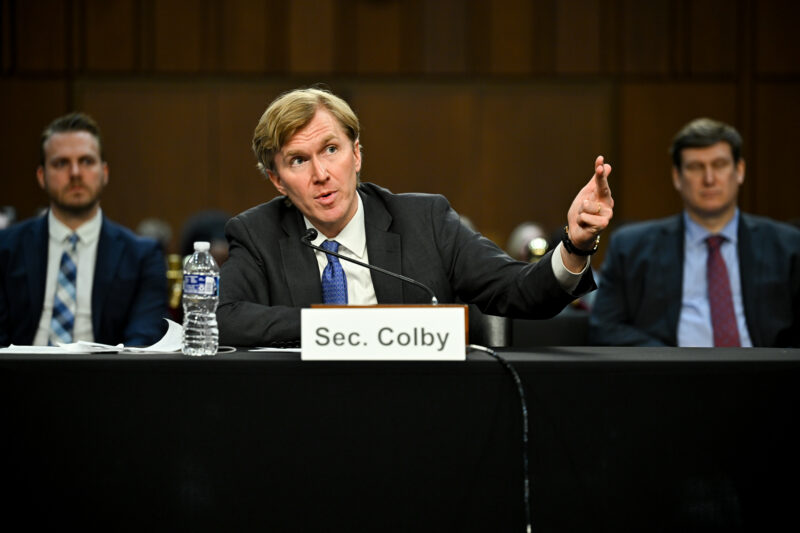
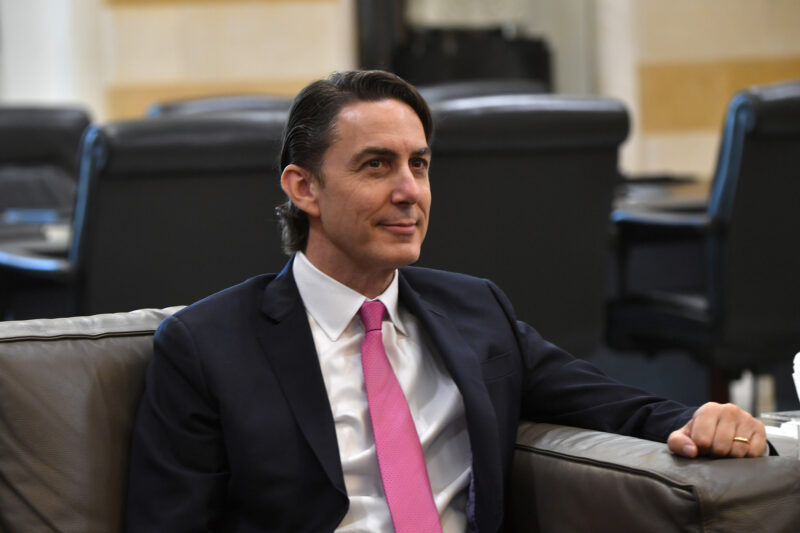




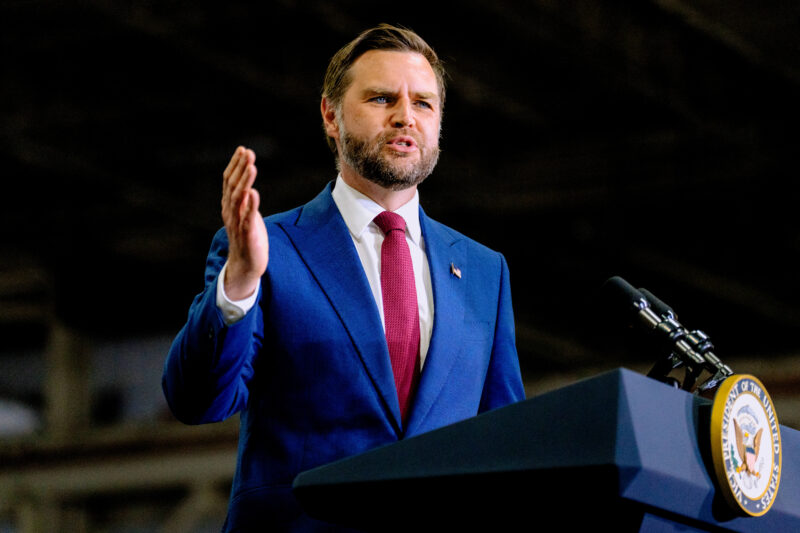







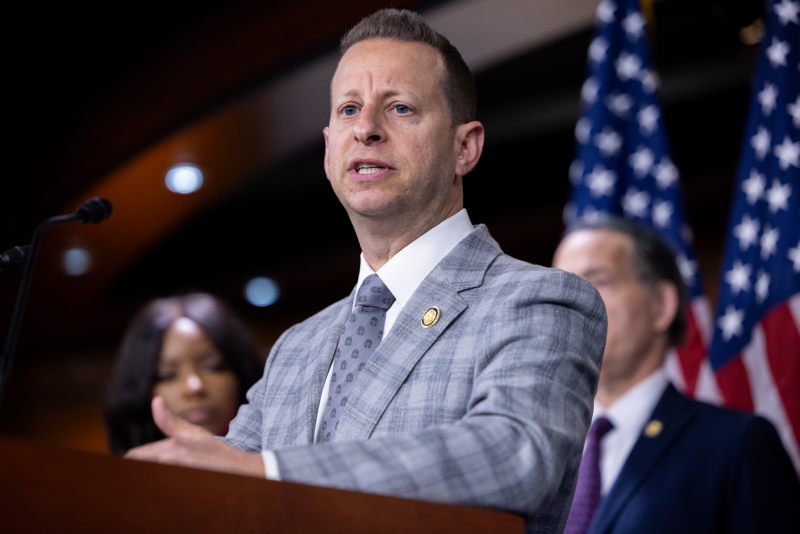

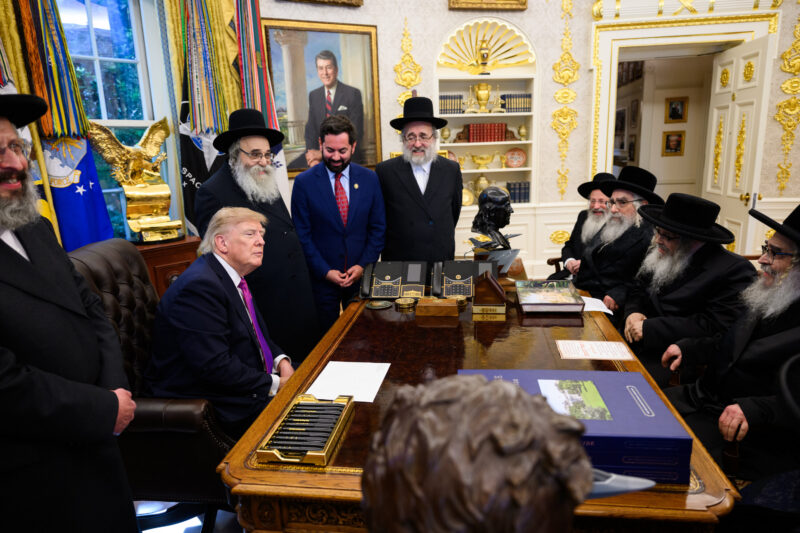

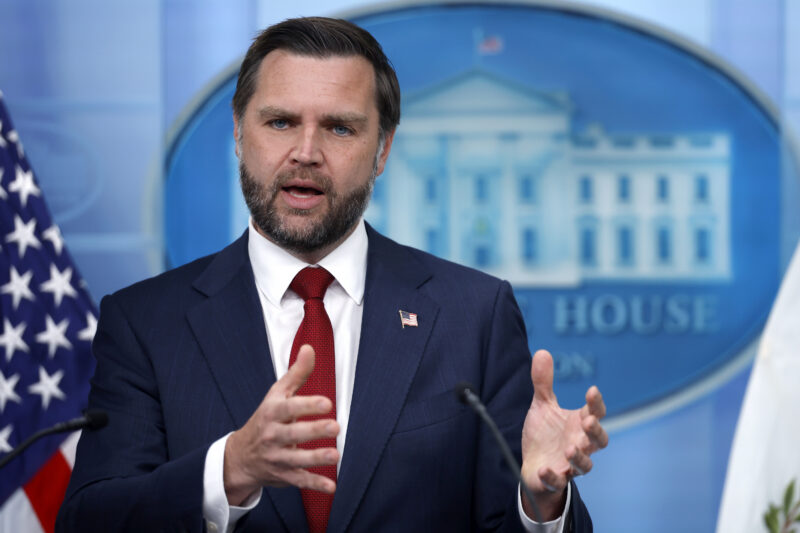
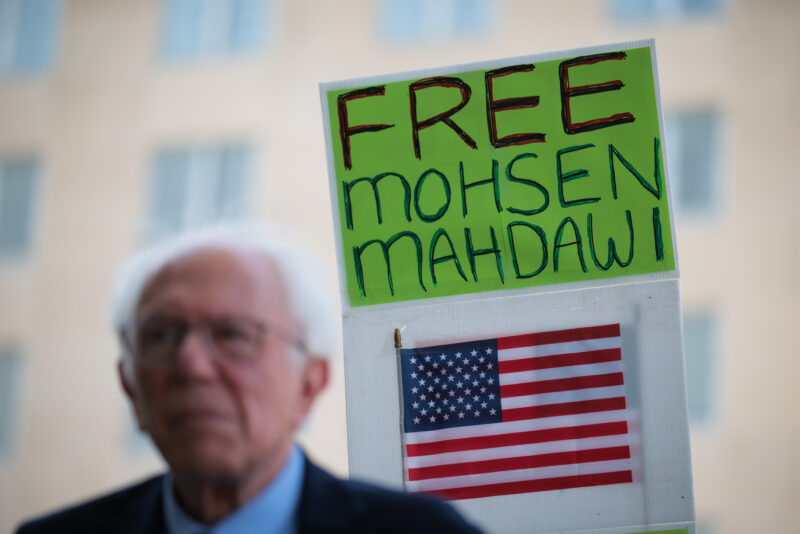

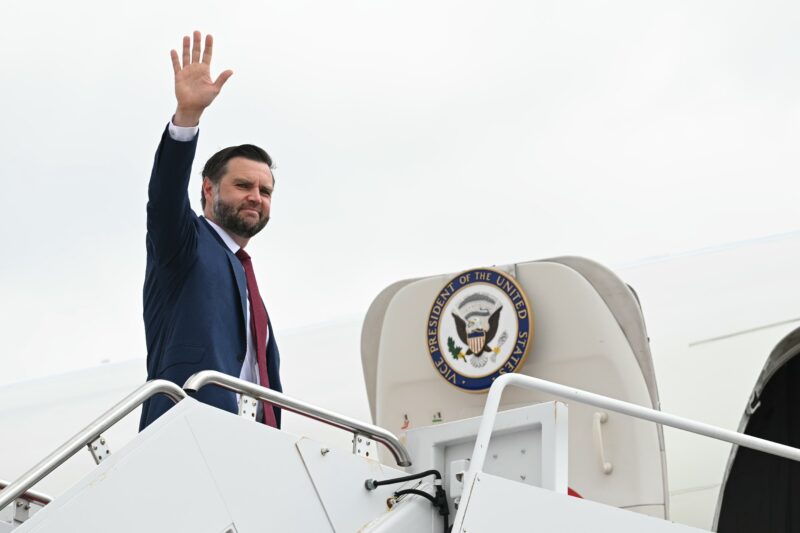
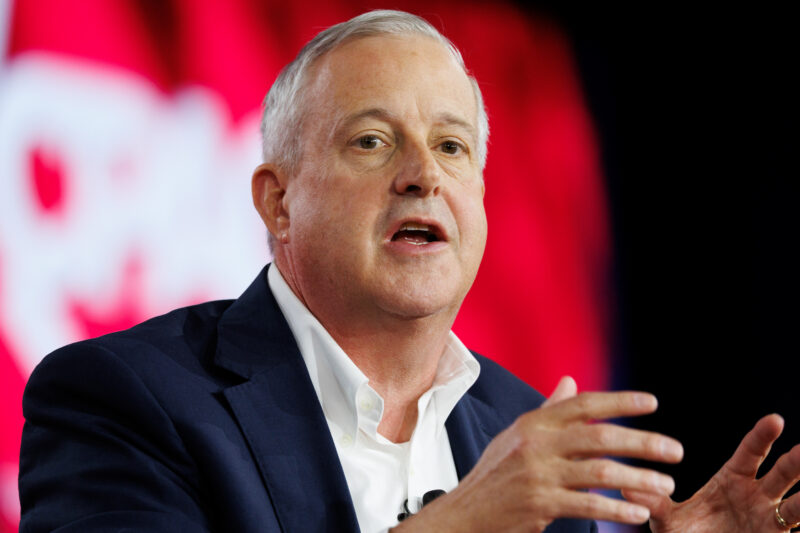



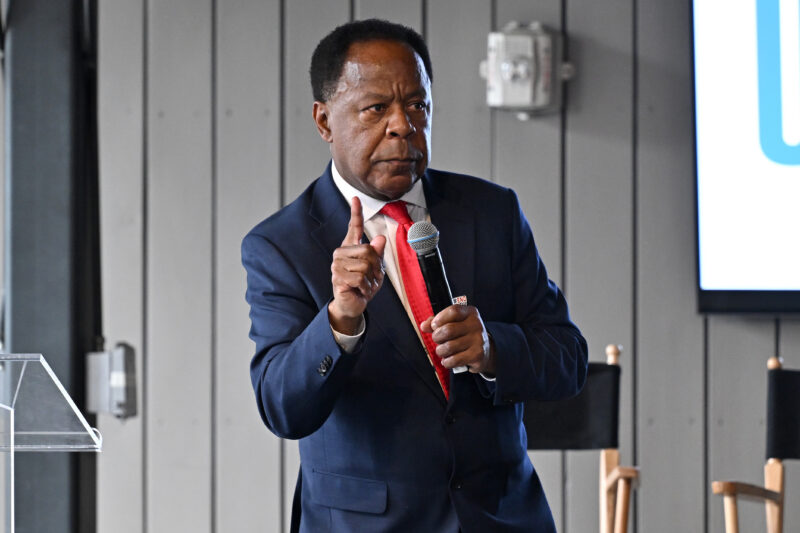
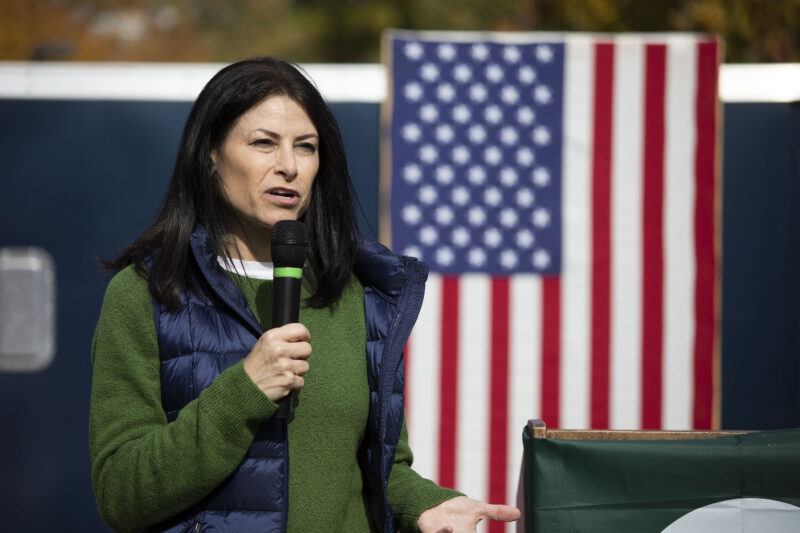




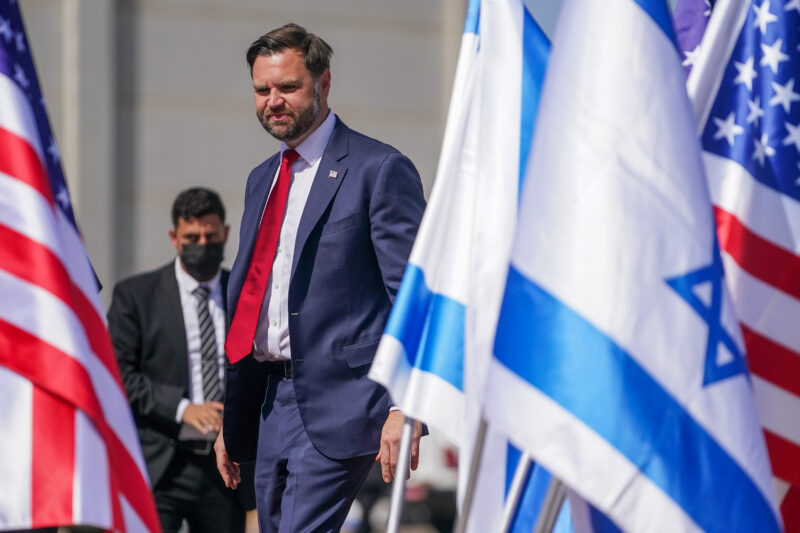
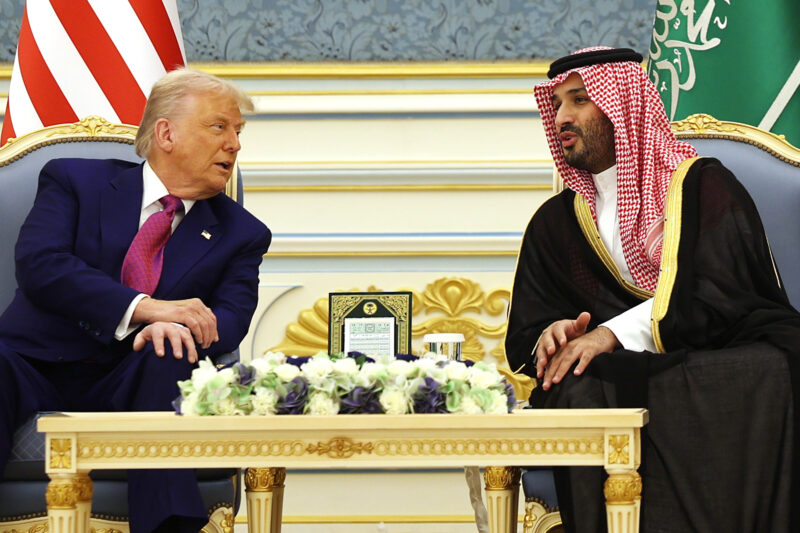









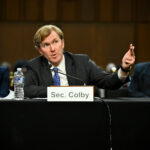




The Blackstone CEO was seen applauding, while the JPMorgan Chase CEO filmed the moment
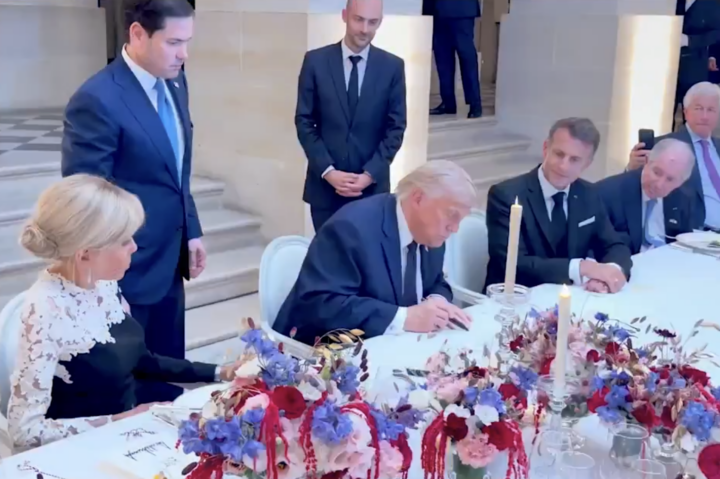
Screenshot/The White House
President Donald Trump signed the memorandum of understanding between the U.S. and Iran, at the Palace of Versailles, France, Jun 17th, 2026


 Add JewishInsider on Google
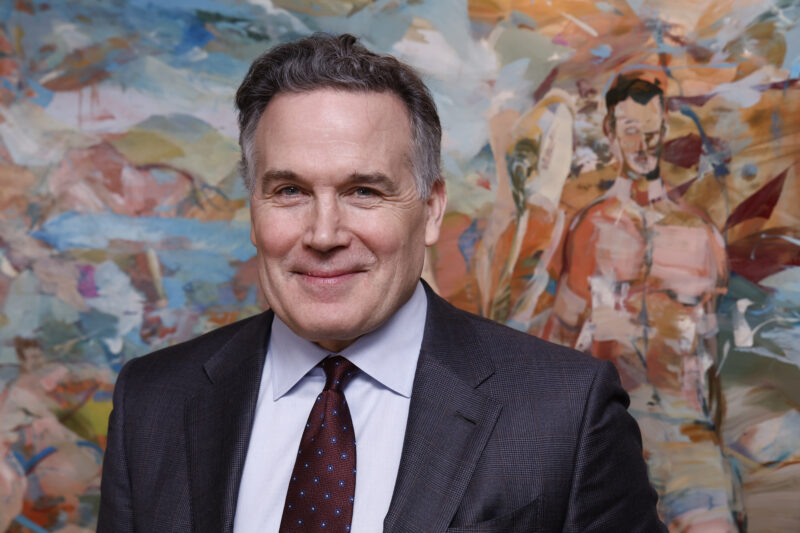
Blackstone CEO Stephen Schwarzman and JPMorgan Chase CEO Jamie Dimon were among the high-profile invitees at a dinner in France on Wednesday during which President Donald Trump signed the memorandum of understanding between the U.S. and Iran.
After Trump signed the agreement at the dinner, hosted by French President Emmanuel Macron at the Palace of Versailles, Schwarzman was seen applauding in video footage of the event. Dimon, who was sitting two seats down from Macron — who was beside Trump — appeared to film the moment on his phone. Afterward, Macron shook hands with Secretary of State Marco Rubio and Trump, saying, “Great job, bravo!”
French businessman Bernard Arnault, CEO OF LVMH, was also at the event, seated next to French First Lady Brigitte Macron.
Hours earlier, the Trump administration shared with journalists the official text of the memorandum of understanding between the U.S. and Iran to establish a ceasefire with Iran, permanently end Israel’s war against Hezbollah in Lebanon, reopen the Strait of Hormuz while ending the U.S. naval blockade and kickstart a 60-day negotiation period on the future of Iran’s nuclear program and the possibility of lifting U.S. sanctions on Tehran.
The move marks the latest deterioration in the relationship between Jerusalem and Paris
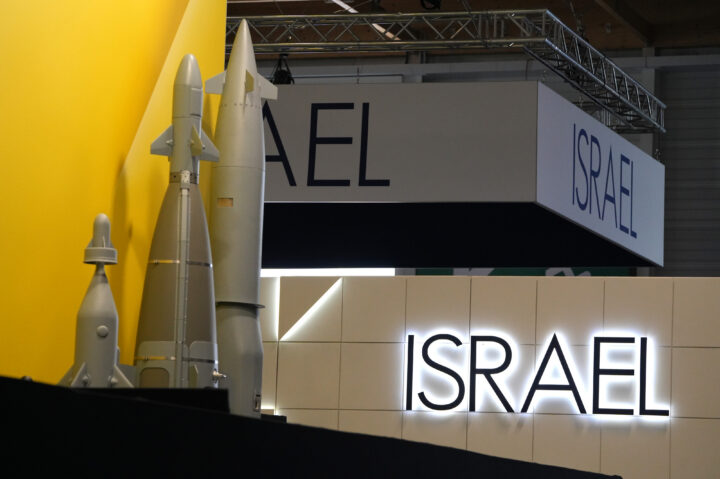
Nathan Laine/Bloomberg via Getty Images
A display of air-to-surface munitions at the Elbit Systems Ltd. zone inside the Israel aerospace pavilion at the Paris Air Show in Paris, France, on Monday, June 16, 2025.
Israel is ending all defense procurement from France, the Israeli Defense Ministry said, citing Paris’ hostile posture toward Jerusalem and a desire to increase domestic production and purchases from allies.
“Israel will reduce all defense procurement from France to zero, replacing it with domestic Israeli procurement or purchases from allied countries,” Israel’s Ministry of Defense told Politico on Tuesday.
Maj. Gen. Air Baram, the director general of the ministry, said on Israel’s Channel 12 that the move is part of a larger effort to decrease military dependence on and partnerships with nations that have strained diplomatic relations with Israel.
The ministry also canceled meetings with France’s minister of the armed forces, instead insisting that “there will be no new professional engagement with the French military.”
The move is the latest rift in the bilateral relationship that has sharply deteriorated following the Oct. 7, 2023, terrorist attacks. During the Israel-Hamas war, France took a critical stance toward Jerusalem’s military conduct in the Gaza Strip and worked to pressure Israel to halt operations.
In September of last year, French President Emmanuel Macron became one of the first major U.S. allies to recognize Palestinian statehood. In that same month, Macron had said that Israel’s operations in Gaza were “making so many civilian casualties and victims that [Jerusalem is] completely destroying the credibility and image of Israel not only in the region but in public opinion everywhere.”
President Donald Trump has also expressed frustration with France for its actions amid the war in Iran, including prohibiting planes with military supplies destined for Israel from flying over its territory. He wrote on Truth Social that Paris has been “VERY UNHELPFUL” and that “The U.S.A. will REMEMBER!!!” — a post that surprised French officials.
Paris has also moved to limit Israeli participation in defense forums, barring dozens of Israeli companies from the Eurosatory 2024 exhibition, restricting their presence at the 2025 Paris Air Show and suspending export licenses.
Experts told Jewish Insider that the latest announcement is likely political posturing and will not have any practical impact on Israel given that defense ties between the two countries have already been on the decline.
“Israeli procurement from France was apparently quite limited and since the Israeli Ministry of Defense initiated the cut-off, they made the calculation that they could replace the items they obtain from France,” said Michael Eisenstadt, a fellow at The Washington Institute for Near East Policy. “I suspect there will be no practical consequence for Israeli manufacturers.”
A parliamentary report published in late 2025 found that France approved more than 200 dual-use export licenses to Israel in 2024 totaling €76.5 million — a roughly 60% drop from the previous year.
Eisenstadt noted that the latest action from Israel will not impact “collaboration between private companies or entities.” Existing agreements are expected to be upheld, and private firms can continue pursuing deals.
“Israel has lost patience with French criticism and unreliability,” Edmund Fitton-Brown, a former British diplomat and senior fellow at the Foundation for Defense of Democracies, told JI. “The fact is that Israel has historic reasons not to trust France, and now no longer needs France.”
Fitton-Brown said that moving forward Israel may increasingly “rely on the U.S. to represent its
interests in international affairs.” He similarly said that it will likely not have much impact on Israel.
“Israel is increasingly all-in with the U.S. as a defense partner, which makes diversifying defense supply an irrelevance,” Fitton-Brown said. “France has been the most disappointing of Israel’s European friends, adopting neutral or even hostile positions on a range of issues: recognition of a Palestinian state, a failure to back Israel fully against Hezbollah in Lebanon, ambivalence and obstruction regarding the U.S.-Israeli campaign against Iran.”
The embassy told JI that the constitution’s ‘first draft was not written in coordination with France, and we were exposed to it with the broader public.’

Photo by CHRISTOPHE ENA/POOL/AFP via Getty Images
French President Emmanuel Macron (L) meets with Palestinian President Mahmoud Abbas on October 24, 2023 in the West Bank city of Ramallah. Macron's visit comes more than two weeks after Hamas militants stormed into Israel from the Gaza Strip and killed at least 1,400 people and amid Israel's retaliatory strikes.
France did not take part in drafting the Palestinian Authority’s proposed constitution released earlier this month, which enshrines payments to terrorists in Israeli prisons, the French Embassy in Israel told Jewish Insider, despite PA President Mahmoud Abbas and French President Emmanuel Macron’s announcement of a joint committee on the matter last year.
The embassy told JI that the constitution’s “first draft was not written in coordination with France, and we were exposed to it with the broader public.”
“As part of the joint committee to strengthen the building of a Palestinian state … a delegation of French constitutional law experts is expected to examine the draft that was published and present recommendations,” the embassy spokeswoman stated.
Ofer Bronchtein, Macron’s advisor on Israeli-Palestinian affairs, told JI that the committee had met “here and there,” but like the embassy spokeswoman, did not know when they would meet next.
France recognized a Palestinian state last September and after Abbas wrote a letter to Macron saying he was committed to a two-state solution while calling for “an end of the Israeli occupation.” French Foreign Minister Jean-Noël Barrot interpreted the letter as promising “the end of allowances for the families of prisoners convicted on terrorism offences.”
Macron and Abbas met in Paris in November to announce a committee to establish the framework for a Palestinian state, including drafting a constitution. France reportedly raised concerns to the Palestinians about its practice of paying terrorists and their families, and Macron said after the meeting that Abbas agreed to an audit by an American company to ensure that the payments had ended.
Abbas had previously promised to stop the payments to terrorists last February, yet i24News reported on Wednesday that the PA had paid NIS 500 million ($161 million) to terrorists and their families in the past year. The PA has granted monthly payments, higher than the average Palestinian salary, to those imprisoned for committing or attempting acts of terror, or to their families. The amount paid increases with a longer prison sentence, thus incentivizing killing more Israelis.
The day before the presidents’ meeting, Abbas fired his finance minister, Omar Bitar, for continuing the payments, but Israel has accused Abbas of not intending to end the program, called “pay for slay” by its critics.
The PA draft constitution, published this month, includes two articles guaranteeing “protection and care for the families of martyrs, and the wounded, and prisoners, and those released from the occupation prisons, and the victims of genocide,” as well as “comprehensive care for the families of martyrs, the wounded, and prisoners, and those released.” One of the articles is part of the “public rights and freedoms” chapter, of which the draft states: “it is not permissible to conduct any constitutional amendment.”
The French Embassy said that when it comes to “the matter of ‘pay for slay,’ our stance is known and clear: This phenomenon must stop. The PA made a commitment to France on this matter, and it will be examined through an independent audit. We will act with determination and without compromising on this matter.”
Bronchtein argued that Abbas has stopped paying “those regarded in Israel as terrorists,” and that there should be universal social security for Palestinians.
“All families would have rights, without being linked to the criminal acts of certain family members. In Israel, for example, the families of [Prime Minister Yitzhak Rabin’s murderer] Yigal Amir or [Hebron massacre terrorist] Baruch Goldstein have rights like any other family — no more and no less,” he suggested.
Bronchtein is not a member of the joint committee, but took part in the meeting between Macron and Abbas in November. He said that “a group of jurists — French, and above all Palestinian — will finalize [the PA constitution]. The French constitutional model has inspired many countries, including the United States.”
“Palestinians and Israelis ultimately need to decide both their constitutional framework and their borders; that would resolve a large part of what opposes them [to each other],” he said. Israel does not have a constitution.
According to Bronchtein, Abbas promised France that parties or individuals advocating violence would not be able to run in elections. However, that rule is not part of the constitution.
The draft also refers to Jerusalem as “the capital of the State of Palestine,” and states that the PA is “committed to preserving [Jerusalem’s] religious character and protecting its Islamic and Christian sanctities.” It does not mention Jews or Judaism.
Bronchtein said that Jerusalem “is, and will remain, the eternal capital of the Jewish people. President Macron has acknowledged this. Al-Quds” — the Arabic name for Jerusalem — “would be the capital of Palestine; they are two different cities, but I believe they should remain united.”
“The Old City of Jerusalem — less than 1% of the city — should be open to everyone, as it was for a long time,” he added.
Emmanuel Navon, a longtime international relations lecturer at Israeli universities and CEO of the new Euro-Med Middle East Council, said that he “didn’t expect a Zionist manifesto” from the constitution, but that the French advisors should take note of “how this constitution relates to the Jewish people and their relation to the land. … Describing Jerusalem as only for Muslims and Christians says it all.”
Navon called the draft constitution a “joke.”
“Abbas did it because Macron said that, before he recognizes a Palestinian state, they needed to promise to be a democracy based on liberal values,” Navon said. “Abbas was elected in 2005 for a four-year term, and now he has a constitution? The whole thing is BS.”
“When they put pay for slay in the constitution, it shows that they don’t take Macron seriously,” Navon added.
Navon also took issue with France presenting itself as an expert on writing constitutions.
“One of the amazing achievements of the Fifth Republic [established in 1958] is that it managed to finally grant France a stable, functioning regime after almost 200 years since the revolution in which it went back and forth between republic, empire and constitutional monarchy. The regimes in the Third and Fourth Republics were completely unstable because of an extreme system of parliamentary politics where governments lasted an average of eight months. … Macron took France back to the Fourth Republic — he’s had five prime ministers in two years,” Navon explained.
“That adds to the irony of [Macron] going around advising people on constitutional law,” he added.
The partnership comes as antisemitism is surging in France, leading many French Jews to emigrate to Israel

Courtesy
American Jewish Committee William Petschek Global Jewish Communities Department Director Alexandra Herzog, AJC CEO Ted Deutch, Conseil Représentatif des Institutions Juives de France ( CRIF) President Yonathan Arfi and AJC Europe Vice President Anne-Sophia Sebban-Bécache, after AJC and CRIF signed a partnership agreement in Paris to deepen transatlantic cooperation in fighting antisemitism.
The American Jewish Committee and Conseil Représentatif des Institutions Juives de France (CRIF), the umbrella organization representing French Jewry, announced a new partnership on Friday aimed at combating an increase of antisemitism that has caused many French Jews to consider leaving the country.
The agreement was formalized at the CRIF’s 40th annual dinner in Paris on Thursday. According to the groups, the partnership will bring together Jewish leaders and antisemitism experts from the U.S. and France to strengthen ties between the communities in their respective countries. It builds on existing collaborations between AJC and CRIF, including a conference last year titled “On the Frontlines: French-American Forum on Antisemitism,” which focused on youth engagement, education and transatlantic cooperation.
France, which is home to Europe’s largest Jewish community, has seen a “dramatic rise of antisemitism,” as the country’s U.S. Ambassador to France Charles Kushner described it in an open-letter to French President Emmanuel Macron in August.
In the letter, which was published in The Wall Street Journal, Kushner wrote that since Oct. 7, 2023, “pro-Hamas extremists and radical activists have waged a campaign of intimidation and violence across Europe.” He also raised concerns that in France, “not a day passes without Jews assaulted in the street, synagogues or schools defaced, or Jewish-owned businesses vandalized,” citing statistics shared by the country’s Interior Ministry regarding the rise in antisemitic incidents.
Robert Ejnes, executive director of CRIF, wrote in August, “I don’t know a family that is not speaking about” emigrating to Israel.
“AJC and CRIF are focused on shaping a future in which Jews are safe and thriving,” said Ted Deutch, CEO of AJC. “By formalizing our collaboration, we are strengthening our ability to act together to confront antisemitism and defend democratic values at a moment when Jewish communities are under threat.” AJC’s Europe headquarters has been located in Paris since 2015.
“AJC and CRIF have built a strong foundation of trust, shared leadership and concrete achievements,” said Yonathan Arfi, president of CRIF. “This agreement reflects the reality of a relationship that has existed and thrived for many years.”
A group of lawmakers threatened potential ‘punitive measures’ in response to the European allies’ move

Kevin Carter/Getty Images
U.S. Capitol Building on January 18, 2025 in Washington, DC.
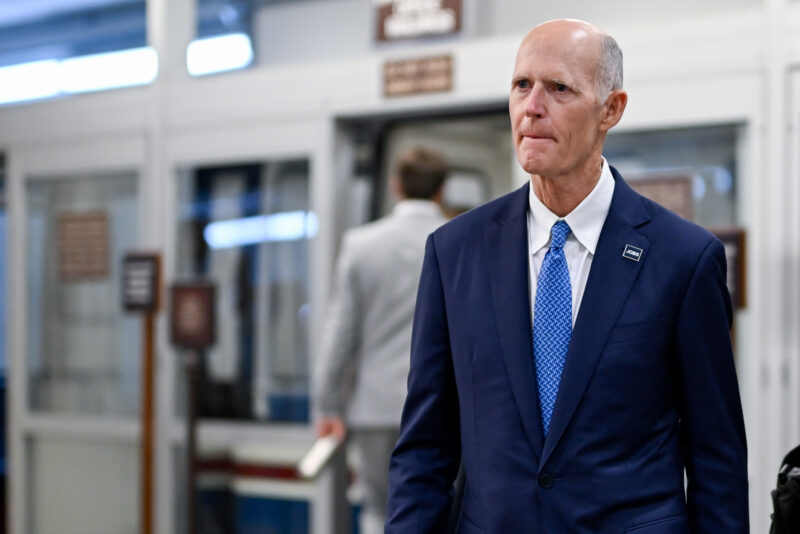
A group of 28 Republican lawmakers in the Senate and House wrote to the leaders of Australia, Canada, France and the U.K. urging them to walk back their plans to recognize a Palestinian state this month and threatening potential retaliation if they proceed.
“This is a reckless policy that undermines prospects for peace. It sets the dangerous precedent that violence, not diplomacy, is the most expedient means for terrorist groups like Hamas to achieve their political aims,” the Republicans, led by Sen. Rick Scott (R-FL) and Rep. Elise Stefanik (R-NY), wrote. “Accordingly, we respectfully request that you reconsider your decision, especially as Hamas continues to hold Israeli citizens hostage while still refusing to agree to a ceasefire.”
The Republicans suggested that the move could prompt “punitive measures” by the United States, without offering further details.
They said that unilateral recognition “undermines the principles of direct negotiations and imperils Israel’s security by removing incentives for Palestinian groups to repudiate terrorism, recognize Israel’s right to exist, and address final-status issues” and is “especially troubling” in the context of the Oct. 7, 2023, Hamas attacks on Israel.
They said that granting statehood now would only serve as a validation of Hamas’ activities and fuel more violence in the future, and that statehood should not be granted “until the Palestinians are willing to take responsibility for their people, renounce terrorism, and come to the negotiating table in good faith.”
They emphasized that France, the U.K., Canada and other countries lost citizens as well in the Oct. 7 attacks and that Hamas continues to hold hostages in “deplorable conditions.”
“Hamas’ war crimes are clear, and its rejection of diplomacy should lead your countries to impose more pressure. Instead, you offer greater rewards,” the lawmakers continued.
They said that the “misguided effort to reward terrorism” will also endanger the Jewish populations in the U.S. ally nations, where they already face rising antisemitism, harassment and attacks.
“You have the responsibility to stand against this scourge, denounce violence, and protect Jewish communities,” the lawmakers argued. “Sadly, your actions to legitimize a Palestinian terror state will only provide greater motivation to the violent antisemitic mobs.”
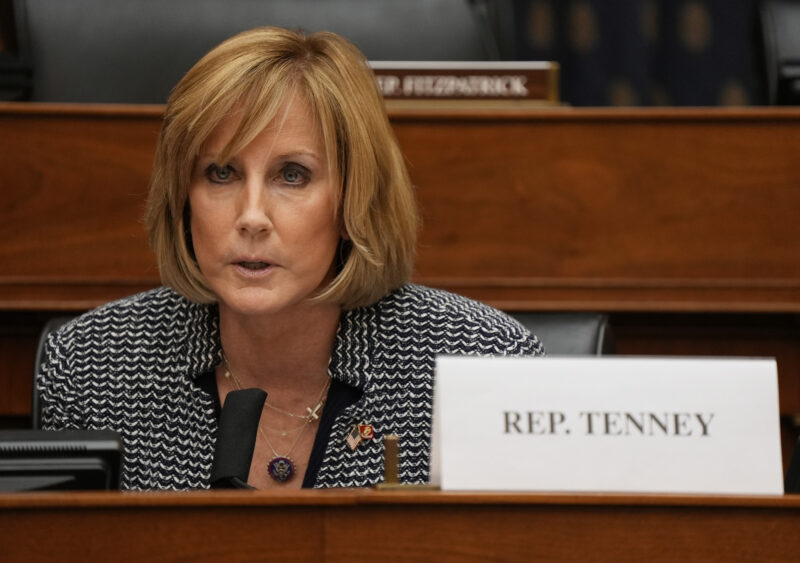
The letters were co-signed by Sens. Tom Cotton (R-AR), John Cornyn (R-TX), Ted Cruz (R-TX), Mike Lee (R-UT), Bill Cassidy (R-LA), Bill Hagerty (R-TN), Cynthia Lummis (R-WY), Pete Ricketts (R-NE), Steve Daines (R-MT), Dan Sullivan (R-AL), Joni Ernst (R-IA) and Dave McCormick (R-PA) and Reps. Rudy Yakym (R-IN), Greg Steube (R-FL), Barry Moore (R-AL), Jefferson Shreve (R-IN), Josh Brecheen (R-OK), Chris Smith (R-NJ), Craig Goldman (R-TX), Mike Flood (R-NE), Marlin Stutzman (R-IN), John McGuire (R-GA), Scott Franklin (R-FL), Claudia Tenney (R-NY), Doug LaMalfa (R-CA) and August Pfluger (R-TX)
Stefanik said in a statement to Jewish Insider, “Unilateral recognition of a Palestinian state undermines the principles of direct negotiation and imperils Israel’s security. This absurd action would reward the behavior of Hamas terrorists and does nothing to secure the release of the 48 hostages still held by Hamas.”
If sanctions return, the Iran nuclear deal ‘is dead, we’re sitting shiva, it is over. That is an unpredictable reality for the regime, for its economy and its financial stability,’ Rich Goldberg said
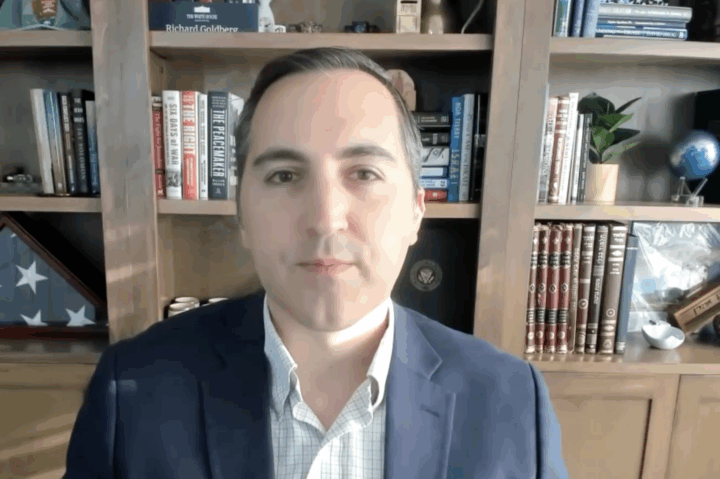
Screenshot
Foundation for Defense of Democracies senior advisor Richard Goldberg on the Misgav Institute for National Security and Zionist Strategy’s Mideast Horizons podcast, Sept. 2025
The Sept. 27 deadline to snap back United Nations sanctions on Iran’s nuclear and other weapons programs is rapidly approaching.
The E3 — as France, Germany and the U.K. are known — announced last month that they planned to trigger the snapback sanctions mechanism, meaning the likely return of all U.N. sanctions that had been “sunsetted” per the 2015 Iran nuclear deal.
In an interview with Jewish Insider’s Lahav Harkov on an episode of the Misgav Institute for National Security and Zionist Strategy’s Mideast Horizons podcast, Foundation for Defense of Democracies senior advisor Richard Goldberg explained the snapback procedure and how the sanctions are expected to damage Iran’s economy.
Goldberg recently finished a stint as the Trump administration’s National Energy Dominance Council’s senior counselor and was the director for countering Iranian weapons of mass destruction in the first Trump administration.
“The Iran nuclear deal, in 2015, set out all kinds of parameters for the years to come,” Goldberg said. “In 2020, the conventional arms embargo on Iran went away. That was scheduled to happen as one of these sunsets under the deal. That was a [U.N.] Security Council restriction previously on Iran. … The missile embargo goes away.”
Another part of the Iran deal set to sunset was the snapback mechanism itself, which expires at the end of this month.
Snapback “was part of the marketing sell to Congress and the American people by [former Secretary of State] John Kerry and [former President] Barack Obama at the time, saying that if Iran violates the deal at any time, we can just bring back all the sanctions from the U.N.,” Goldberg recounted.
The snapback procedure outlined in the Joint Comprehensive Plan of Action, the formal name for the Iran deal, states that after snapback is invoked, other U.N. Security Council members have 10 days to propose a resolution opposing the return of the sanctions. The council would then have to affirmatively vote not to enact snapback, with the permanent members retaining veto power, Goldberg explained.
Ten days after the E3 triggered the snapback sanctions process, no country had submitted such a resolution, requiring the current president of the UNSC, South Korea, to do so instead, and hold a vote within the 30-day period from the snapback announcement. The vote has not been scheduled yet, and in all likelihood, the U.S., France or the U.K. will veto the resolution, such that snapback will take effect.
“The process does appear to be unfolding by the book,” Goldberg said.
“The onus is on the Iranians or the Russians or the Chinese to try to overcome a U.S. or European veto,” Goldberg said. “We have all the cards.”
If the resolution to cancel snapback does not pass, then the JCPOA “sort of self-destructs,” he said. That means the return of the U.N. missile embargo and conventional arms embargo on Tehran, and Iran will no longer be permitted to enrich any uranium.
“Then, it’s on the secretariat, the U.N. staff, the secretary-general … to actually do the things that need to happen to roll back to the previous sanctions regime,” Goldberg said. “And that will be the next test to see if the Russians or Chinese exert some kind of pressure. … I expect it will occur at this point.”
Goldberg said it is important not to stop the snapback process, even if Iran suddenly agrees to cooperate.
“You don’t stop the snapback, which goes away in just a few weeks,” he said. “You cannot trigger this again after October; it’s done. Iran just wins all these strategic gains forever. … You have to complete the snapback because you don’t get another chance at it.”
The impact of snapback would be significant on several fronts.
“On a strategic level, they will no longer have any claim of legitimacy to transfer weapons to Russia,” Goldberg said. “Technically, the Russians today will tell you that it is fully legal under the Security Council, which is true. … That will be done after the snapback is completed.”
It also sends a message to any other countries who may want to help Iran rebuild its nuclear program or its missile activities that “you are in violation of a Security Council resolution and [the U.S. and Europe] are going to hold you accountable.”
In addition, Goldberg said the sanctions will hurt the regime economically.
“I think that’s one of the reasons why they fought this so hard,” he said.
Throughout the years, as the E3 spoke out against Iran’s violations of the JCPOA, the deal was still in place, Goldberg said, and even as the Iranian economy tanked, the sunsetting of sanctions gave the markets hope that they had not yet reached bottom.
“You have seen the Rial go back into freefall since snapback was triggered. That means there’s instability again. There’s uncertainty again. Once snapback happens and all the international resolutions come back, there is no hope of the JCPOA coming back. …The patient is dead, we’re sitting shiva, it is over. I think that is an unpredictable reality for the regime, for its economy and its financial stability,” he said.
At the same time, the U.N. sanctions are not financial; they are on weapons programs and trade in components, but not on individuals or banks.
Goldberg argued that Iran “value[s] the veneer of legitimacy” from being part of the Nuclear Non-Proliferation Treaty and what the sunsetting of U.N. sanctions permitted — such as selling drones that Russia used in its war against Ukraine.
“It’s a bizarre thing in regimes like Iran, even Russia, China, though they flout international law, conduct illicit activity, make a mockery of the international institutions which we founded and still care about,” he said, “they actually try to use them to create their own sense and source of legitimacy, so a Security Council resolution that has their back … is really valuable to them because it forces the Europeans to contort themselves.”
“They yearn for that legitimacy to insulate themselves from further pressure from good actors,” he added.
Last week, Iran was elected vice-chair of the International Atomic Energy Agency’s annual conference, while refusing to allow the agency to inspect its nuclear sites.
“Only in the United Nations can such a thing occur,” Goldberg said, calling it “a wild, wild thing.”
Iran is supposed to allow basic inspections of its nuclear facilities as a member of the Non-Proliferation Treaty. Under the framework of the JCPOA, they agreed to adopt “additional protocols,” including snap inspections and videotaping of their nuclear facilities. Iran stopped respecting those commitments years ago.
Still, the IAEA was able to release quarterly reports on Iran’s enriched uranium stockpiles, something that Goldberg said is “not going to happen for the foreseeable future, because all those stockpiles and the materials and the facilities are either heavily degraded or destroyed” by the June strikes by Israel and the U.S.
The world, however, “should be worried long-term about reconstitution efforts,” he said.
The question remains how the world will know if Iran tries to reconstitute its nuclear program, given the lack of oversight.
“We will have to rely on Western intelligence between Israel, the U.S., partners and allies, and whatever else the IAEA can glean on its own from visits and tours that the Iranians allow … We should obviously be pushing them to accept inspections, robust verification and dismantlement of anything that is left over. … The nuclear-capable missile program still has infrastructure and could be threatening … and maybe foreign actors come in to help them as well,” Goldberg said.
Plus, Patel probes far-left protest funding

Good Wednesday morning.
In today’s Daily Kickoff, we interview Sen. Steve Daines about his weekend visit to Israel and have the scoop on a letter signed by 50 Senate Republicans urging the foreign ministers of the U.K., France and Germany to hold firm in triggering snapback sanctions on Iran. We report on FBI Director Kash Patel’s comments that federal investigators are probing the funding sources of left-wing protest movements and highlight a call by House Republicans on the White House to probe far-left billionaire Neville Roy Singham’s ties to China. We also cover a press conference held yesterday by Israeli Prime Minister Benjamin Netanyahu to clarify his previous comments that the Jewish state will need to be like “super-Sparta” and adapt to “autarkic characteristics.” Also in today’s Daily Kickoff: Gov. Josh Shapiro, Rep. Josh Gottheimer and Alex Karp.
Today’s Daily Kickoff was curated by Jewish Insider Israel Editor Tamara Zieve and U.S. Editor Danielle Cohen-Kanik, with an assist from Marc Rod. Have a tip? Email us here.
What We’re Watching
- President Donald Trump and First Lady Melania Trump are spending the day in England for a royal visit, where they will be welcomed by King Charles III and Queen Camilla at Windsor Castle.
- This morning, the House Foreign Affairs Committee will hold a markup of bills aimed at reorganizing and reforming the State Department. Read JI’s breakdown of the legislation here.
- The Senate Foreign Relations Committee will vote to advance a series of nominees out of committee, including Michel Issa to be ambassador to Lebanon; Richard Buchan to be ambassador to Morocco; Ben Black to lead the U.S. International Development Finance Corporation; and a second vote on the nomination of Mike Waltz, the former national security advisor, to be U.S. ambassador to the U.N., in order to prevent a procedural challenge from Democrats.
- Also on the Hill, the U.S. Helsinki Commission will hold a briefing on “conspiracy theories, antisemitism and democratic decline.”
- The annual Defense of Freedom-Federalist Society Education, Law & Policy Conference examining the most pressing legal and policy issues in education kicks off today in Washington. Featured speakers include Secretary of Education Linda McMahon and Brandeis Center Chairman Kenneth Marcus. One of the panels will focus on discussing the federal government’s efforts to combat antisemitism.
What You Should Know
A QUICK WORD WITH JI’S JOSH KRAUSHAAR
A new poll of young conservatives between the ages of 18-34 commissioned by the Washington Free Beacon shows that Gen Z Republicans are decidedly more supportive of Israel than their liberal counterparts, but that there is a notable faction of those who take a more critical view towards the Jewish state.
The Echelon Insights poll also found that anti-Israel and antisemitic podcasters like Nick Fuentes, Tucker Carlson and Candace Owens are viewed favorably by this right-wing cohort — even among many of the respondents who say they support Israel and recognize antisemitism is a problem.
Carlson’s favorability rating among these Gen Z conservatives, for instance, is 50%, with only 11% viewing him unfavorably. Owens has a similarly strong 49/14% favorability rating. The Holocaust-denying podcaster Darryl Cooper isn’t nearly as well-known, but is viewed positively by those who listen to him, holding a 26/8% favorability rating.
At the same time, pro-Israel podcasters like Ben Shapiro are also viewed very favorably; Shapiro’s favorability rating with this cohort is 50/16%. Fox News host Mark Levin isn’t quite as well-known, but holds a stellar 29/7% favorability rating. Asked about “Jews” generally, half of respondents hold a favorable view with only 12% holding an unfavorable opinion.
The encouraging news? A number of these podcast listeners are tuning in to these transgressive shows featuring conspiracy theories, anti-Israel views and some antisemitism, but many are not being persuaded by them. For all their vitriolic attacks against the Jewish state, 54% of Carlson’s viewers and 58% of Owens’ audience have a favorable view towards Israel.
But the gloomier finding is that a notable minority on the right holds bigoted views towards Jews and is critical of Israel. Between 20-25% of these Gen Z conservatives consistently express anti-Israel or antisemitic views — while support for Israel is not nearly as widespread as it is among older conservatives. While 40% of respondents said they side with Israel in its current conflict, about one-fifth (22%) said they side with the Palestinians. About the same percentage of Gen Z conservatives said they agree that “Israel is a colonizer built on the suffering of others.”
KARP’S CALL

Palantir CEO Alex Karp called for the Jewish community to step outside its “comfort zone” and look for new strategies to defend itself amid rising antisemitism, during a speech on Tuesday at the American Friends of Lubavitch (Chabad) annual Lamplighter Awards in Washington. Karp, who was honored at the Chabad gala, also framed the battle against antisemitism as part of a broader fight for Western civilization and societies, Jewish Insider’s Marc Rod reports.
What he said: “Lessons that we’ve learned at Palantir … might be valuable for defending the West, in this particular case a particular tribe of people that are equally associated with the West, the Jewish people,” Karp said. “Palantir is a metaphor for working when there’s no playbook, and currently there is no playbook because institutions that have historically effectively defended people who’ve been discriminated against, especially Jewish people, are kind of not working.” Karp continued, “If we’re going to have a meaningful chance of fighting, everybody’s going to have to leave their comfort zone a couple times a year. It’s our job and my job to remind people [of] that, especially younger people here.”
trip talk
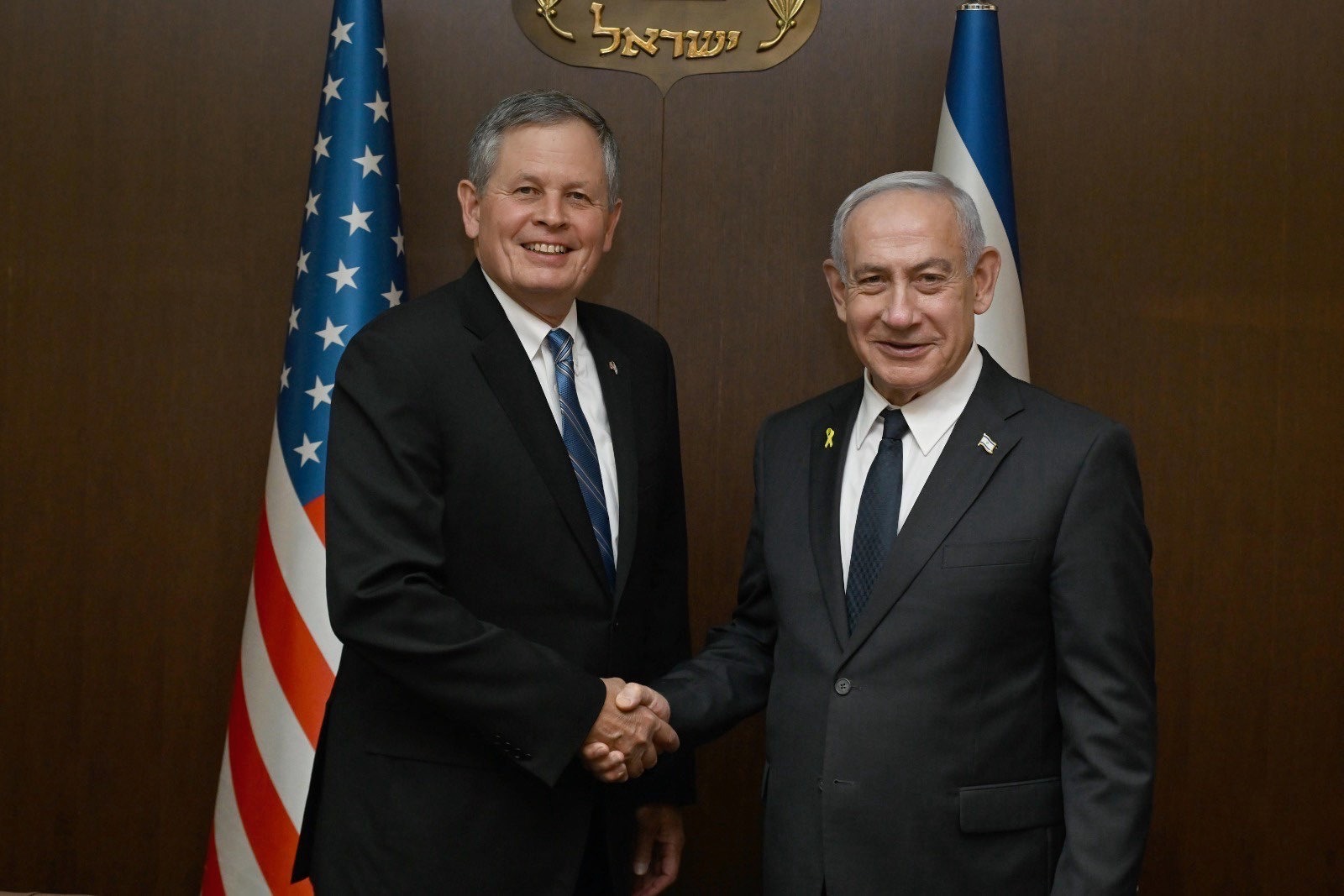
Sen. Steve Daines (R-MT) said he left Israel from a weekend visit with a renewed belief in the U.S.-Israel relationship and the necessity of fully eradicating Hamas, as the IDF begins expanded operations in Gaza City, Jewish Insider’s Marc Rod reports.
Doubling down: “It just reinforced my position of the importance that the United States stands with Israel, and in supporting Israel in their mission to eradicate Hamas in Gaza,” Daines said in an interview with JI this week, reflecting on a meeting with Israeli Prime Minister Benjamin Netanyahu. “There will never be true peace in Gaza and peace with Israel until Hamas is eradicated.” He said that it’s also crucial for innocent Palestinians that Israel be successful in its mission to defeat Hamas. Daines said that he didn’t discuss the postwar vision for Gaza with Netanyahu, “but clearly the important first step will be eradicating Hamas.”
SCOOP

Fifty Senate Republicans wrote to the foreign ministers of the U.K., France and Germany on Tuesday urging them to hold firm in triggering snapback sanctions on Iran and requesting their cooperation in sanctions enforcement, Jewish Insider’s Marc Rod reports.
Notable quotable: “While we back diplomatic efforts to restore Iran’s compliance with its International Atomic Energy Agency (IAEA) commitments, the international community should not allow hollow gestures and cynical threats from Tehran to stop the snapback process,” the lawmakers wrote. “The regime has abused diplomatic processes for years to avoid penalties. Sanctions relief should only be negotiated after snapback is fully implemented.”
COMMENT CLEAN-UP
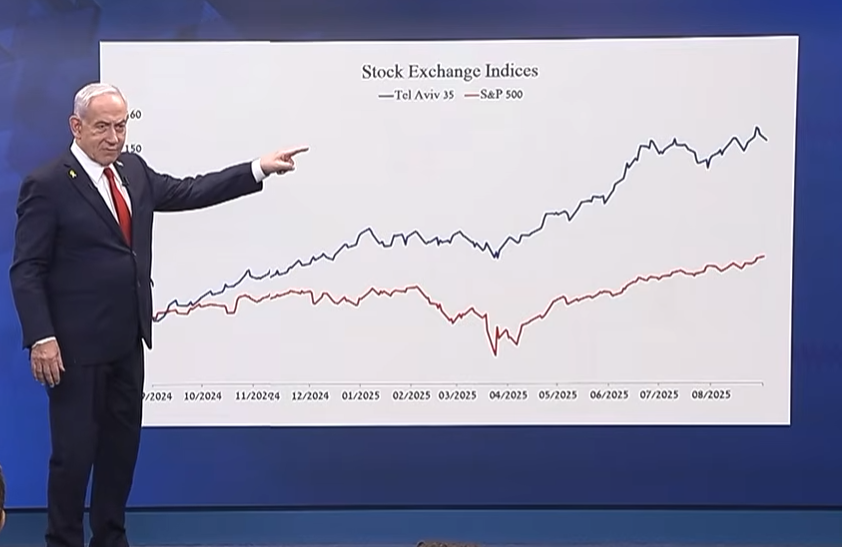
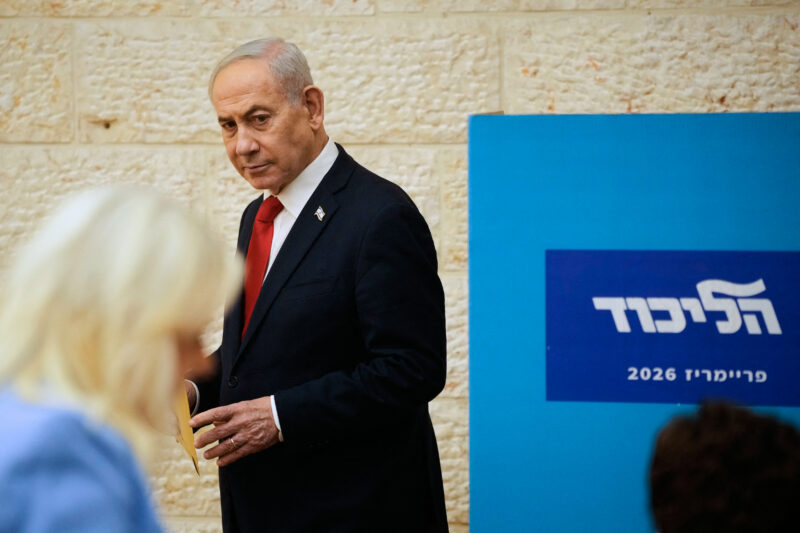
Israeli Prime Minister Benjamin Netanyahu clarified his remarks that Israel’s economy may “need to adapt to … autarkic characteristics” on Tuesday, after a dip in the Tel Aviv Stock Exchange and after business and industry leaders came out against Netanyahu’s remarks, saying that “an autarkic economy will be a disaster for Israel,” and “this vision … will make it hard for us to survive in a developing globalized world,” Jewish Insider’s Lahav Harkov reports.
Damage control: A day later, Netanyahu called a press conference amid widespread concern in Israel, clarifying that his comments were specific to the Israeli defense industry. In the defense industry, he said “there are limitations that are not economic, but political.” He stated, “If there’s one lesson from this war, it is that we want to be in a situation where we are not limited. We want to defend ourselves by ourselves and with our own weapons. We are going to produce an independent arms industry that is very strong that can withstand any political constraints.”
WH invite: In the press conference, Netanyahu also said he had spoken on the phone with President Donald Trump several times since Israel’s strike aimed at Hamas leaders in Qatar last week, including one in which the president invited him to the White House. Netanyahu said he will be meeting with Trump in Washington on Sept. 29.
PROTEST PROBE
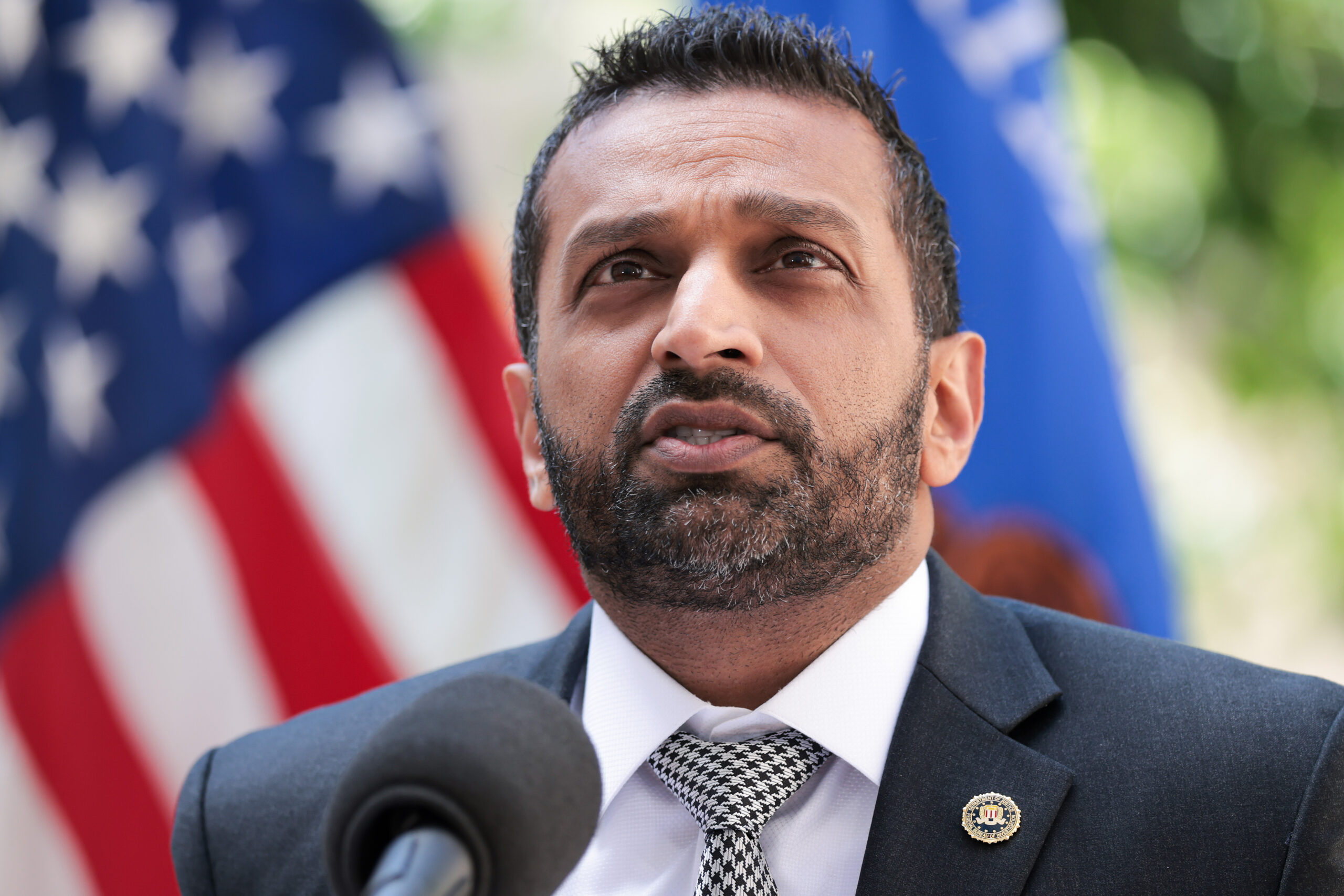
FBI Director Kash Patel said on Tuesday that federal investigators were looking into the funding sources for left-wing groups behind organized protest movements that have resulted in rioting on city streets and civil rights violations on college campuses. Patel made the comments while appearing before the Senate Judiciary Committee for a marathon oversight hearing, where he faced dozens of questions from Democrats and Republicans about the assassination of conservative influencer Charlie Kirk last week, Jewish Insider’s Emily Jacobs reports.
Follow the money: Sen. Ted Cruz (R-TX) urged Patel to investigate the financing of far-left groups that the Texas senator said may have influenced the suspected shooter and supported protests in recent years that saw instances of rioting or other illegal activity. “As I’ve always said, Senator, money doesn’t lie. We’ve been following the money, and that’s what we’re doing, issuing a lawful process to organizations involved with criminal activity because the money has got to come from somewhere,” Patel told Cruz.
Money matters: The House Oversight Committee asked the Trump administration on Monday to investigate if far-left billionaire Neville Roy Singham’s bankrolling of “extremist organizations fueling division and civil unrest across the United States” would qualify him for federal sanctions or make him eligible for criminal or legal penalties.
SHAPIRO’S SERMON

Amid an alarming rise in political violence, Pennsylvania Gov. Josh Shapiro said Tuesday that the way to combat extremism and division is by bringing people together and restoring their faith in the government — a civic-minded strategy that included some thinly veiled swipes at President Donald Trump and the hard-line rhetoric he has adopted since conservative activist Charlie Kirk was killed in Utah last week, Jewish Insider’s Gabby Deutch reports.
What he said: “I believe we have a responsibility to be clear and unequivocal in calling out all forms of political violence, making clear it is all wrong,” Shapiro, a Democrat, said in a keynote address at the Eradicate Hate Global Summit, a Pittsburgh conference created in the aftermath of the 2018 mass shooting at the Tree of Life synagogue. “Unfortunately some, from the dark corners of the internet all the way to the Oval Office, want to cherry pick which instances of political violence they want to condemn.” Shapiro leaned on Jewish teachings in his speech, referring as he often does to how his faith underpins his public service.
Worthy Reads
Out in Left Field: Former Obama administration official Ken Baer writes in the Washington Post about how DSA-affiliated New York City mayoral nominee Zohran Mamdani is an affront to Democratic Party principles. “It is “spineless politics” to do precisely what [Sen. Chris] Van Hollen, [Gov. Kathy] Hochul and other Democrats have done — and that more Democrats presumably will do in coming days — by casting aside the party’s time-honored liberal principles to back Mamdani. Addressing the affordability crisis is noble. But who’s against affordability? What matters is not just a party’s policy ends, but also its means and its rationale for pursuing them. In the months since President Donald Trump’s victory, Democrats have made no progress in articulating what they are for — and why … At best, this failure presents Democrats as inauthentic as they explain and backpedal when confronted with extreme beliefs from the party’s left but offer nothing in replacement. At worst, it allows the left — within and outside the party — to define the party” [WashPost]
Good Cop, Bad Cop: In The Free Press, Michael Doran, senior fellow and director of the Center for Peace and Security in the Middle East at the Hudson Institute, weighs in on what he describes as President Donald Trump and Israeli Prime Minister Benjamin Netanyahu’s “good cop-bad cop” routine. “Israel’s ability to go on offense places it in a rare category among U.S. allies. Most lack the will or capacity to wage war independently. Critics like Tucker Carlson depict Israel’s independence as a liability, dragging America into fights that don’t serve its interests. Trump sees the reverse: Unilateral Israeli military operations spare American forces and serve U.S. strategic goals. In just two years, Israel has blunted Iran’s nuclear ambitions, hammered Hezbollah, neutered Hamas, and weakened the Houthis—achievements many Americans view as enhancing their own security.” [FreePress]
History Lesson: In The Atlantic, Arash Azizi revisits the history of Zionism amid growing use of the term as a slur. “One summer in Brooklyn, a controversy broke out in my dog-park group chat. Dedicated to the upkeep of the park and welfare of our canines, our chat had never indulged in politics before. But someone was now complaining that a dog-insurance company was ‘Zionist,’ and a passionate debate ensued … To criticize someone for supporting, say, the Israeli government or its war in Gaza is one thing. But this charge is broader and vaguer, uttered sometimes in circumstances with no reference to Israel, and in many cases as little more than an anti-Semitic dog whistle. I’m probably the only Middle Eastern member of that park group chat. I’m also a historian by training. I jumped in to say that I didn’t think Zionist should be used as a term of derision. Zionism is a nationalist movement, I insisted, and like other nationalist movements, it has a story rooted in the 19th century—one that is neither all good nor all bad. To call someone a Zionist as an insult is as strange as attacking someone for being a Ghanaian or Chinese nationalist. I’m not sure how many people I convinced. But to me the history of Zionism bears revisiting as a reminder of its impetus and early diversity.” [Atlantic]
Word on the Street
Israeli and U.S. officials continue to lament the failure of the Israeli strike in Doha, Qatar, both substantively and diplomatically, with one Israeli official telling Axiosthat “none of the top Hamas leaders were killed” and an American official saying they’d advised Israel to take steps to rectify its relationship with the Trump administration…
Rep. Josh Gottheimer (D-NJ) wrote to Kathy Goldenberg, the president of the New Jersey State Board of Education, on Monday urging the state to reject calls from the New Jersey chapter of the Council on American-Islamic Relations for the state’s education boards to cut ties with the Anti-Defamation League, Jewish Insider’s Marc Rod reports…
Advocates with the Anti-Defamation League are set to lobby lawmakers this week on a series of actions related to antisemitism, including a push to jump-start the stalled Antisemitism Awareness Act, Jewish Insider’s Marc Rod reports…
A new plaintiff was added to a lawsuit brought by the Louis D. Brandeis Center for Human Rights under Law against the Massachusetts Institute of Technology. The complaint alleges that a Jewish graduate student was cornered in a campus parking lot by masked individuals calling for death to Israel and Zionists and faced a “campaign of hostility” inside his lab, and the university took no action when it was reported. The original complaint focused on a tenured linguistics professor who publicly harassed an Israeli postdoctoral researcher at the school…
Jerry Greenfield, co-founder of Ben & Jerry’s, has quit the ice cream company, saying that the business has been “silenced” by parent company Unilever on social issues; Unilever and Ben & Jerry’s have clashed in recent years over issues related to the Israeli-Palestinian conflict…
Israel presented Syria with a new security agreement several weeks ago, Axios reports, and Syria is now preparing a counterproposal. Israeli Strategic Affairs Minister Ron Dermer, Syrian Foreign Minister Asaad al-Shaibani and U.S. envoy Tom Barrack are set to meet in London on Wednesday to discuss the proposal…
Israeli strikes in Gaza City have reportedly cut off internet and telephone services in the city…
Iran executed Babal Shahbazi, whom it accused of spying for Israel, Iranian state media reported today…
The U.S. and China are finalizing a deal to transfer 80% of ownership of TikTok’s U.S. business to an investor consortium including Oracle, Silver Lake and Andreessen Horowitz. The new U.S. app will still utilize ByteDance’s algorithm, and Oracle will handle its user data in Texas…
Carl Heastie, the Democratic speaker of the New York State Assembly, is expected to endorse New York City Democratic mayoral nominee Zohran Mamdani this week, The New York Times reports, one of several state leaders in the party who have thus far resisted doing so, while Jay Jacobs, chair of the New York Democratic Party, told several people he does not plan to endorse Mamdani. Rep. Yvette Clarke (D-NY), chair of the Congressional Black Caucus, is reportedly set to endorse him on Monday…
Rep. Elise Stefanik (R-NY) introduced a bill that would “prohibit state and local law enforcement from arresting foreign nationals within the United States” solely based on warrants from the International Criminal Court, as Mamdani has threatened to do to Israeli Prime Minister Benjamin Netanyahu…
Sens. John Fetterman (D-PA) and Dave McCormick (R-PA) appeared on Fox News’ “Special Report” with Bret Baier on Tuesday evening for a discussion on improving political civility, where the duo condemned the use of political rhetoric equating one’s political opponents to Nazis or Adolf Hitler. “When you see dangerous rhetoric like fascist and Nazism and authoritarianism, and the end of democracy, that’s a permission, that takes us down a path where the inevitable next step is violence, and that’s what we see,” McCormick said…
The Democratic PR firm SKDK terminated its contract with the Israeli government, which was meant to run until March 2026. Originally contracted to raise the profile of the Bibas family tragedy, a spokesperson for the firm declined to tell Politico why the deal was cut short…
Gordon Gee, who served as president of five universities, is joining Brownstein as a strategic consulting adviser for the firm’s higher education task force…
Israeli Transportation Minister Miri Regev cleared Uber for entry into Israel’s taxi market, a significant move for the country, which has a strong taxi drivers union…
Ecuadorian President Daniel Noboa signed an executive order on Tuesday designating the Islamic Revolutionary Guard Corps, Hamas and Hezbollah as terrorist organizations…
The Wall Street Journal reviews Yaakov Katz and Amir Bohbot’s new book, While Israel Slept: How Hamas Surprised the Most Powerful Military in the Middle East, calling it “an agonizing litany of might-have-beens” and saying “Katz and Bohbot could have titled their book ‘While Israel Was Busy Doing Other Things.’” Read JI’s Lahav Harkov’s interview with Katz here…
Speaking at The Jerusalem Post Diplomatic Conference yesterday, U.S. Ambassador to Israel Mike Huckabee called out European countries for pushing for a unilateral recognition of a Palestinian state, charging that “it destroyed the negotiations for the hostages.” …
Political commentator, author and former host of “The View,” Meghan McCain accepted the Champion of Israel Award yesterday at the American Friends of Magen David Adom Gala at Cipriani Wall Street in New York City…
The Air Force said it has started upgrading the luxury jet donated by Qatar for use as Air Force One…
The New York Times reports on growing turmoil at Manhattan’s iconic Pierre Hotel, where Commerce Secretary Howard Lutnick, the building’s largest shareholder, now faces backlash from residents over a proposed $2 billion sale involving foreign investors that could force them out…
The Wall Street Journal spotlights the transformation of Manhattan’s 666 Fifth Avenue, once a high-profile real estate debacle under Jared Kushner’s ownership, now rebounding under Brookfield’s leadership with major renovations and new tenants…
TikTok recently removed at least two antisemitic items from TikTok Shop, a spokesperson told Axios, in a sign of the platform’s recent attempts to address antisemitism…
A new Broadway play, “Giant,” will explore the life of children’s author Roald Dahl and his controversial moments around antisemitism and Israel, in particular, including incendiary comments about the First Lebanon War and the Holocaust…
Pic of the Day
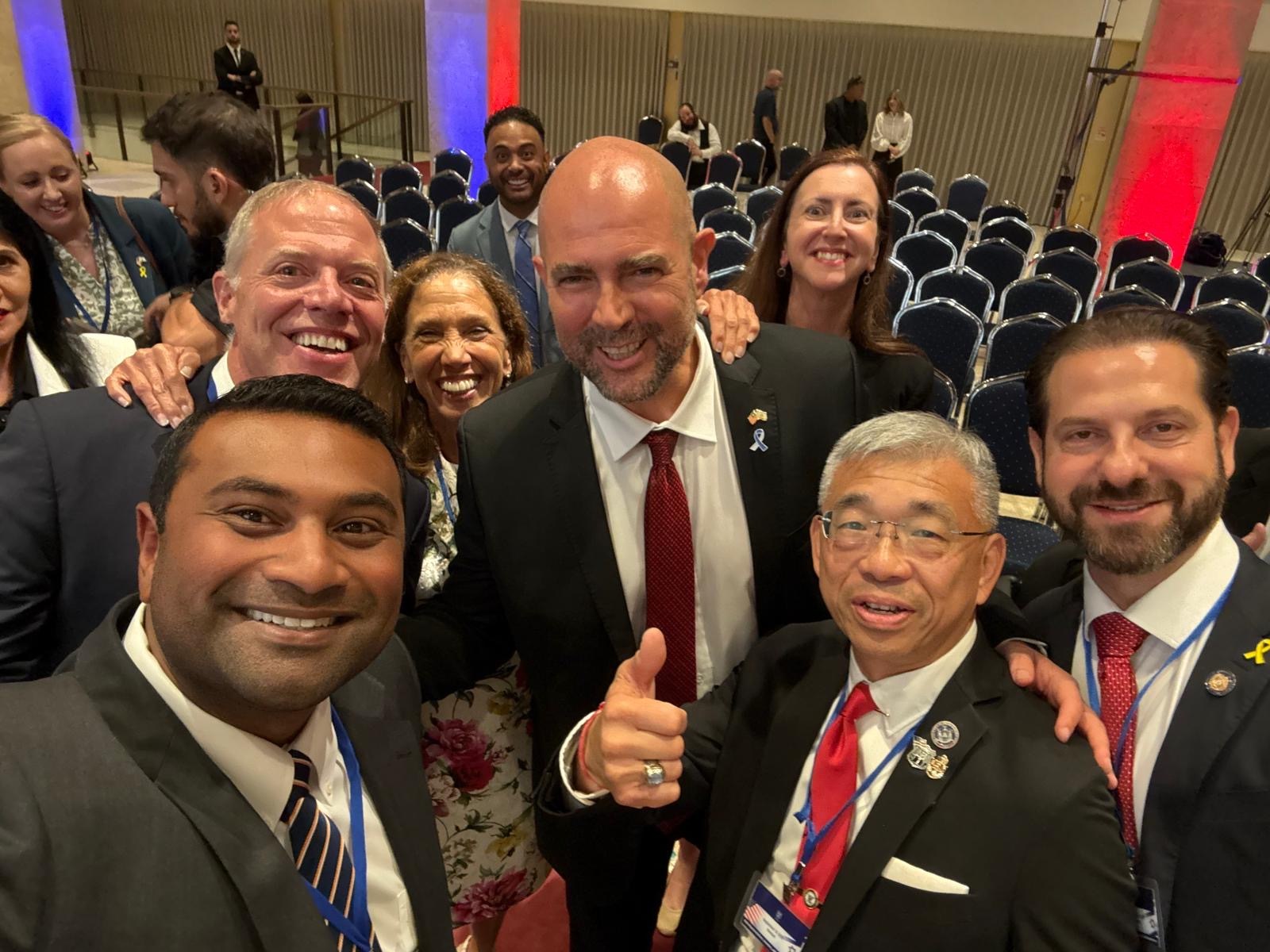
A delegation of New York State legislators met with Knesset Speaker Amir Ohana (center) in Jerusalem on Monday. From left: Assemblyman AJ Beephan, Minority Leader Will Barclay, Assemblywoman Amy Paulin, Assemblywoman Nily Rozic, Assemblyman Lester Chang and Assemblyman Daniel Norber.
Birthdays

Comedian, writer and actress, she was a frequent guest of Johnny Carson on the “Tonight Show,” Rita Rudner turns 72…
Fashion designer, known worldwide for his leading-edge corporate uniforms, Stan M. Herman turns 97… U.S. senator (R-IA) since 1981, Chuck Grassley turns 92… Investment banker who once served as a NYC deputy mayor, Peter J. Solomon turns 87… Newbery Honor-winning author of many young adult books, Gail Carson Levine turns 78… Author of 11 books, Joshua Muravchik turns 78… Former president of the National Technical Institute for the Deaf and then president of Gallaudet University, T. Alan Hurwitz turns 78… Rochester attorney, he has held positions at the UJA-Federation of New York and the Rochester Jewish Federation, Frank Hagelberg… Retired judge on the U.S. District Court for the Northern District of California, Jeremy Don Fogel turns 76… Professional tennis player who achieved a world ranking of No. 5 in 1980, Harold Solomon turns 73… Author, comic book writer and editor, best known as group editor of the Spider-Man books at Marvel Comics, Daniel Fingeroth turns 72… Israeli businessman with real estate holdings in Israel and NYC, Mody Kidon turns 71… Author and graphic designer, Ellen Kahan Zager… Former member of the Knesset for the Yesh Atid party, Rina Frenkel turns 69… Rabbi of the New North London Synagogue with over 3,700 members, Jonathan Wittenberg turns 68… Former consultant at Quick Hits News, Elliott S. Feigenbaum… Journalist, best-selling author including two books on the Obama presidency and Emmy Award-winning executive producer, Richard Wolffe turns 57… Director of the Centers for Disease Control and Prevention (CDC) for the last 18 months of the Biden administration, Mandy Krauthamer Cohen turns 47… Former regional communications director and spokesperson for President Obama, now a partner at Seven Letter, Adam Abrams… Member of the Los Angeles Unified School District’s Board of Education, Nick Melvoin turns 40… Former Obama White House speechwriter who has since written a best-selling comedic memoir, David Litt turns 39… Principal product manager for CathWorks, Adina Shatz… National health-care reporter The Washington Post covering the FDA, Rachel Roubein… Associate at Strand Partners in London, Natalie Edelstein Jarvis… Founder of the Israel Summit at Harvard and board member of the IDF Widows and Orphans Organization, Max August…
The sanctions will be reinstated in 30 days; Iran could come to an agreement with the West before then
Selcuk Acar/Anadolu via Getty Images
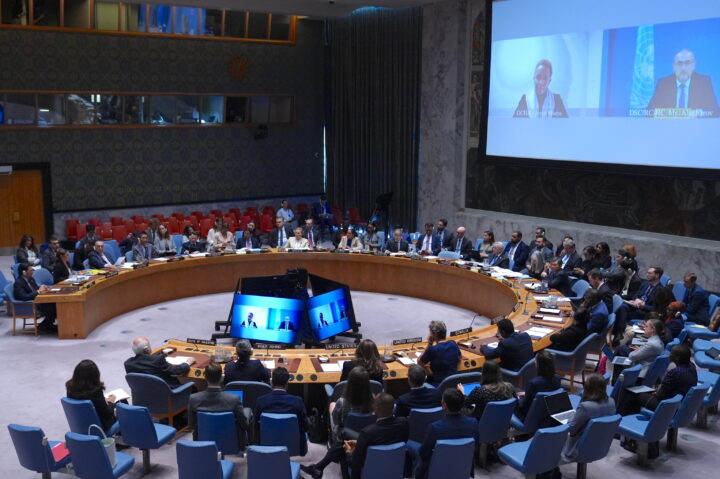
U.N. Security Council meeting New York City on August 27, 2025.
France, Germany and the United Kingdom triggered the snapback sanctions mechanism on Thursday, to reinstate all United Nations Security Council sanctions on Iran that had been lifted since the implementation of the 2015 nuclear deal.
The European parties to the Iran deal, known as the E3, notified the UNSC that they were triggering snapback sanctions due to Iran’s continued noncompliance with its commitments under the Joint Comprehensive Plan of Action, to which they are still parties despite the U.S. withdrawal in 2018.
If the UNSC does not adopt a resolution stopping the process — which is unlikely unless Iran reaches an agreement with the West, because it would be subject to vetoes from the states triggering the sanctions and the U.S. — all of the sanctions sunsetted in the framework of the 2015 deal will be restored in 30 days.
However, the E3 said it is open to continuing negotiations with Iran during those 30 days.
The E3’s move came after its foreign ministers met with their Iranian counterpart Abbas Araghchi in Geneva earlier this week in a last-ditch effort to reach an agreement with the Islamic Republic to scale back its nuclear program. It also comes less than three months after Israel and the U.S. bombed Iranian nuclear facilities, after which U.S.-Iranian negotiations broke down.
“Since 2019,” the E3 foreign ministers’ statement reads, “Iran has exceeded JCPoA limits on enriched uranium, heavy water, and centrifuges, restricted the IAEA’s ability to conduct JCPoA verification and monitoring activities, and has abandoned the implementation and the ratification process of the Additional Protocol to its Comprehensive Safeguards Agreement. These actions contravene Iran’s commitments set out in the JCPoA and have serious implications on the capacity of Iran to progress toward developing a nuclear weapon.”
The E3 noted that it repeatedly negotiated with Iran to return to its 2015 commitments, to no avail.
“Today, Iran’s non-compliance with the JCPoA is clear and deliberate, and sites of major proliferation concern in Iran are outside of IAEA monitoring,” the foreign ministers stated. “Iran has no civilian justification for its high enriched uranium stockpile … Its nuclear program therefore remains a clear threat to international peace and security.”
Among the sanctions that would be restored are an arms embargo, a ban on Iranian uranium enrichment and reprocessing, a ban on transferring ballistic missile technology and technical assistance, a global asset freeze on targeted Iranian individuals and entities and foreign inspections of Iranian cargo planes.
The snapback mechanism was set to expire at the end of October, in accordance with the terms of the JCPOA, but Russia will assume the presidency of the UNSC in October, raising concerns in the West that it would try to delay the 30-day snapback process. As such, the E3 set a deadline for the end of August for Iran to make progress in rolling back its nuclear program.
In 2020, two years after the U.S. left the JCPOA, the first Trump administration attempted to trigger snapback sanctions, but the other parties argued that it was no longer entitled to do so.
Iran’s Foreign Ministry said that it “categorically reject[s] and condemn[s] in strongest terms the unlawful notification by the E3 to the UNSC … This escalation will severely undermine the ongoing process of engagement between Iran and the International Atomic Energy Agency. It will be met with appropriate responses.”
Secretary of State Marco Rubio said the U.S. supports the E3’s move and called it “a direct response to Iran’s continuing defiance of its nuclear commitments.”
“At the same time,” Rubio said in a statement, “the United States remains available for direct engagement with Iran … Snapback does not contradict our earnest readiness for diplomacy, it only enhances it.”
Israeli Foreign Minister Gideon Sa’ar posted on X that “even after Israel and the U.S. operation against Iran’s nuclear program, Iran hasn’t abandoned its desire to acquire a nuclear weapon. This is why the E3’s move to initiate the return of UN sanctions on Iran is inevitable. It is an important step in the diplomatic campaign to counter the Iranian regime’s nuclear ambitions.”
Macron advisor to JI: ‘We are not planning to force the return of Palestinian refugees’
MOHAMMED BADRA/POOL/AFP via Getty Images
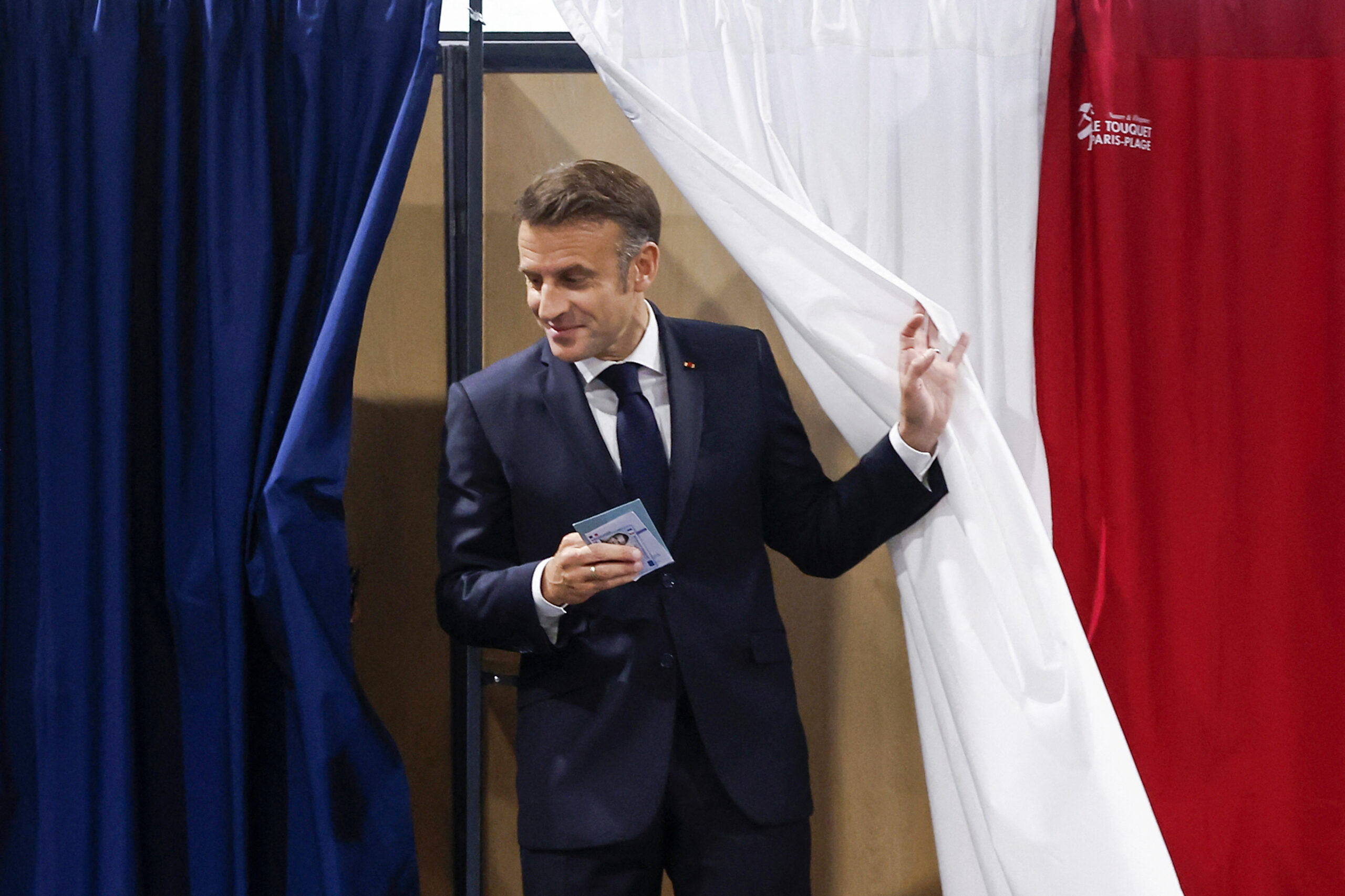
France's President Emmanuel Macron exits a polling booth, adorned with curtains displaying the colors of the flag of France, to vote in the second round of France's legislative election at a polling station in Le Touquet, northern France on July 7, 2024.
France plans to remove a call for the “right of return” for millions of Palestinian refugees to Israel from its declaration, made alongside 60 other countries, for a Palestinian state, Ofer Bronchtein, an advisor to French President Emmanuel Macron, told Jewish Insider on Wednesday.
France and Saudi Arabia spearheaded a conference at the U.N. last month to call for a two-state solution, resulting in a declaration calling for Palestinian statehood that was signed by the entire European Union, Arab League and other countries, which is expected to be the text of a U.N. General Assembly resolution next month.
Article 39 of the declaration calls for “a regional and international framework offering appropriate support to resolving the refugee question, while reiterating the right of return.”
In the context of the Israel-Palestinian conflict, the right of return refers to Arab refugees from the 1948 Israeli War of Independence, as well as all of their descendants, amounting to millions of people around the world, who could seek to migrate to sovereign Israel.
Israel has argued that such a move would shift the demographic balance such that Israel would no longer be a Jewish and democratic state.
Yigal Carmon, president of the Middle East Media Research Institute (MEMRI), wrote this week in an X post that the call for a right of return “cancels recognition of Israel” by the U.N., which came in the context of partition between Jews and Arabs on the land.
“Thus, France and the countries that will support the resolution are adopting the joint Palestinian demand of Hamas and the PLO for a right of return to the State of Israel and cancel the recognition of the State of Israel from May 15, 1948. Such a decision, when it is accepted, will return Israelis and Palestinians to the year 1948 and reopen the violent struggle between the two nations over the territory between the Mediterranean Sea and the Jordan River,” Carmon wrote.
Bronchtein responded to Carmon on X, writing that “this is a mistake that we are correcting. The correct text will be that ‘the sides will negotiate about a solution to the refugee problem.’ Thank you for your understanding and justified concerns.”
Bronchtein, a French-Israeli dual citizen who also holds a Palestinian Authority passport promised to him by PLO leader Yasser Arafat in recognition of his peace activism, was an advisor to Israeli Prime Minister Yitzhak Rabin during the negotiation of the Oslo Accords. He currently serves as the French president’s special envoy to the Middle East.
Bronchtein told JI that opponents of the declaration are nitpicking to undermine it, and said that the declaration “is almost 20 pages long, and those are two words.”
Still, he acknowledged that the wording of Article 39 “could be problematic.”
“We are working with the Saudis to find a way to make it clear that was not our intention at all. Macron will say this is our stance. We are not planning to force the return of Palestinian refugees anywhere,” he said.
Bronchtein said the intention was to resolve the refugee issue through negotiations between Israel and the Palestinians.
“It is clear to all that there are certain topics that we do not want to dictate a resolution to the Israelis and the Palestinians, which are refugees, Jerusalem and borders,” he said.
In addition, Bronchtein said the mention of a “regional and international framework” was intended to refer to the roughly 750,000 Jews from Arab and Muslim lands who became refugees following Israel’s independence.
Carmon told JI that Bronchtein’s response was insufficient, and that “only changing Article 39 would be a fraud because [the right of return] is in two other places.”
The declaration indirectly recognizes a right of return by supporting the Arab Peace Initiative and U.N. General Assembly Resolution 194, which states that Palestinian “refugees wishing to return to their homes and live at peace with their neighbours should be permitted to do so…and that compensation should be paid for the property of those choosing not to return.”
“They’re saying everyone can return,” Carmon argued. “The difference between this and recognition of a Palestinian state is that they are making a decision about Israel. They are pulling the rug out from under the recognition of the State of Israel.”
“They are opening the gates of hell,” he added.
Carmon criticized the Israeli Foreign Ministry for not addressing this matter. The office of Israeli Ambassador to the U.N. Danny Danon was not available for comment.
Carmon also emphasized that, in February, the emir of Qatar met with Macron and committed to investing 10 billion Euros in France.
Emmanuel Navon, an international relations lecturer at Tel Aviv University, similarly told JI that “Macron is reading the Qatari script, which consists of preserving the right of return while pretending you don’t.”
Navon also expressed skepticism that Bronchtein’s post means the text will, in fact, be amended.
Bronchtein defended France’s move to recognize a Palestinian state, amid vocal opposition from Israel and the U.S. France is also considering opening an embassy in the West Bank city of Ramallah later this year, Israel’s Channel 12 reported on Thursday.
“By recognizing a Palestinian state, we are encouraging those who support two states,” he said, while acknowledging that recognition alone does not create a state: “We will help, certainly, but the sides need to work things out.”
Bronchtein also referred to a letter that Palestinian Authority President Mahmoud Abbas wrote to Macron, who asked for assurances before the U.N. conference.
“It says important things in Arabic and in English,” he noted. “First, it condemns what Hamas did on Oct. 7. Second, it calls for the immediate and unconditional release for the hostages. Third, it calls on Hamas to disarm and surrender. Fourth, it says a Palestinian state will be demilitarized. Fifth, it says there will be a reform in the PA and elections within a year. He agrees to a lot of things the current Israeli government wants.”
Israeli Prime Minister Benjamin Netanyahu “said two weeks ago that, in the end, the ones who will run Gaza are Palestinians,” Bronchtein said. “That’s what we think too. He said it can’t be Hamas, and everyone agrees, including the Arab League. But then he says it can’t be run by the PA. Then which Palestinians is he talking about? … Abbas is the best Palestinian partner today. He will not be an enthusiastic Zionist. He is an enemy, but a pragmatic one…There is no alternative.”
Netanyahu and U.S. Ambassador to France Charles Kushner have in recent weeks accused Paris of emboldening antisemites by recognizing a Palestinian state and not doing enough to fight antisemitism. Bronchtein argued that France is working hard in that regard, providing security to institutions and enforcing hate crime laws.
“To turn France into an enemy and call the president of France antisemitic crosses every line…It’s a lie to say we encourage antisemitism,” Bronchtein said. “Whoever says recognizing a Palestinian state is a prize for Hamas is lying. Hamas doesn’t want a Palestinian state. They entered Israel on Oct. 7 with green [Islamist] flags, not the Palestinian flag.”
Reports indicate the move could come as soon as Thursday, after talks in Geneva ended with little progress on rolling back the Iranian nuclear program
Kay Nietfeld/picture alliance via Getty Images
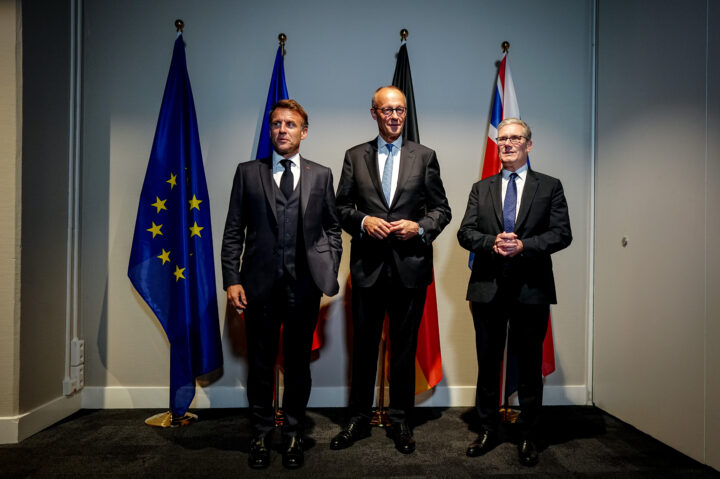
French President Emmanuel Macron (l-r), German Chancellor Friedrich Merz (CDU) and Keir Starmer, Prime Minister of Great Britain, meet in The Hague at the delegation hotel on the sidelines of the NATO summit for trilateral talks in the E3 format.
France, Germany and the U.K. are poised to reinstate snapback sanctions on Iran in the next several days, after talks held in Geneva this week aimed at scaling back Iran’s nuclear program reportedly concluded with little progress.
The three countries — known as the E3 — sent a letter to the U.N. Security Council earlier this month outlining “ongoing concerns regarding the lack of assurances as to the exclusively peaceful nature of Iran’s nuclear program” and Tehran’s ongoing violations of the 2015 Joint Comprehensive Plan of Action, to which the E3 countries are still parties despite the U.S. withdrawal in 2018.
The countries threatened to reinstate snapback sanctions by the end of August 2025 if “no satisfactory resolution” to the issue was reached before then.
The mechanism to trigger snapback sanctions at the UNSC expires in October, at which point any attempt to adopt new UNSC sanctions could face vetoes from Russia and China. However, the E3 and U.S. are looking to start the process before Russia assumes the UNSC presidency in October, giving it the power to delay the imposition of snapback sanctions — a process that takes 30 days to complete — until its expiration date.
The foreign ministers of the E3 and Iran met in Geneva earlier this week to discuss a diplomatic solution that would see Iran roll back its nuclear program without additional sanctions, which reportedly ended with little progress made.
A senior European diplomat told Axios on Wednesday that it would take a “diplomatic miracle” to prevent the reinstatement of snapback sanctions, with the European nations poised to trigger the mechanism as soon as Thursday.
Secretary of State Marco Rubio held a call with the E3 foreign ministers on Wednesday, during which all of the officials “reiterated their commitment to ensuring that Iran never develops or obtains a nuclear weapon,” State Department Principal Deputy Spokesperson Tommy Pigott said.
U.S. lawmakers have repeatedly pressed for the E3 to trigger the snapback mechanism.
The French Foreign Ministry summoned the U.S. ambassador in response to his missive, published on Sunday in ‘The Wall Street Journal’
X/Charles Kushner
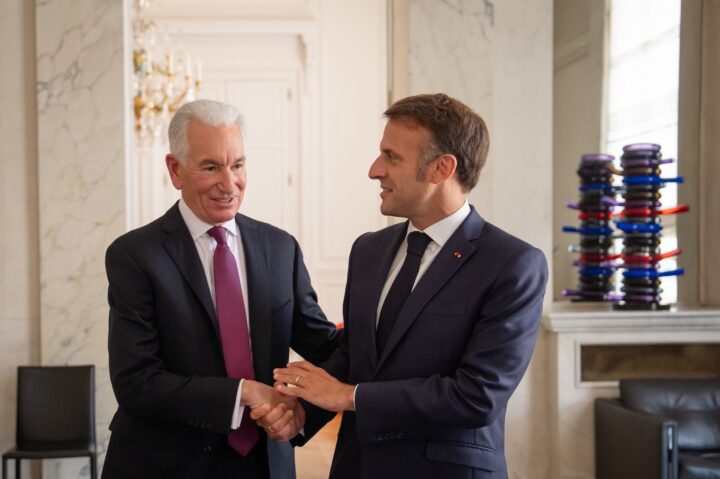
U.S. Ambassador to France Charles Kushner and French President Emmanuel Macron
U.S. Ambassador to France Charles Kushner on Sunday penned an open letter to French President Emmanuel Macron, published in The Wall Street Journal, criticizing the “dramatic rise of antisemitism in France” and Paris’ failure to address the threat.
In the op-ed, Kushner, who arrived at his posting last month, raised concerns that in France, “not a day passes without Jews assaulted in the street, synagogues or schools defaced, or Jewish-owned businesses vandalized,” citing statistics shared by the country’s Interior Ministry regarding the rise in antisemitism incidents.
Kushner called on Macron to “enforce hate-crime laws without exception; ensure the safety of Jewish schools, synagogues and businesses, prosecute offenders to the fullest extent; and abandon steps that give legitimacy to Hamas and its allies.”
In response, France’s Foreign Ministry summoned Kushner, issuing a statement calling his comments “unacceptable.” The letter comes weeks after Macron’s announcement that Paris intends to unilaterally recognize a Palestinian state at next month’s United Nations General Assembly.
An Anti-Defamation League report from 2023, released months before Hamas’ Oct. 7 attacks, found that the “penetration” of antisemitism in France, the U.K., Germany and Spain “into the political mainstream is cause for concern and has in some cases alienated Jews and other supporters of Israel.”
Kushner wrote in the WSJ that since Oct. 7, 2023, “pro-Hamas extremists and radical activists have waged a campaign of intimidation and violence across Europe.”
Antisemitism in France has been on the rise for years. In 2022, Ambassador Deborah Lipstadt, at the time the Biden administration’s special envoy to monitor and combat antisemitism, warned that antisemitism in France was no longer “unique” and had spread across the European continent.
Earlier this month, the head of CRIF, the French Jewish umbrella group that represents the community, noted a “very strong rise” in antisemitism in the country, adding, “I don’t know a family that is not speaking about” emigration to Israel.
The Arab League, in signing the declaration, condemned the Oct. 7 attack and called on Hamas to release the hostages to end the war for the first time
Selcuk Acar/Anadolu via Getty Images
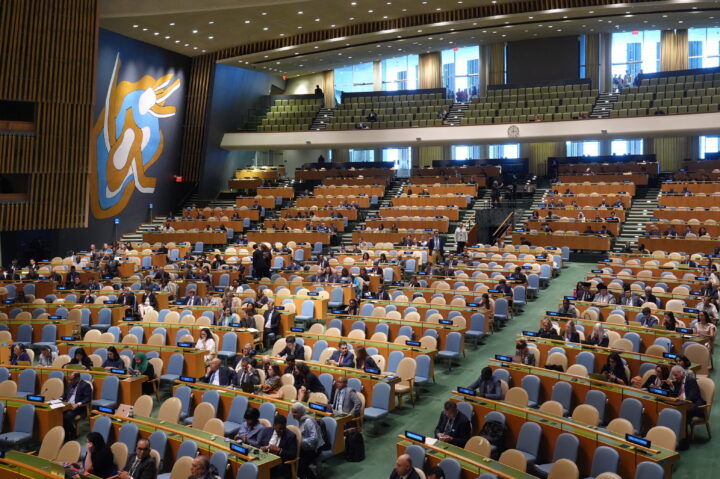
A general view of hall at the High-Level International Conference on achieving a peaceful resolution to the Palestinian question and implementing a long-term sustainable peace, reviving the prospect of a two-state solution at the United Nations headquarters in New York, United States on July 29, 2025.
Eleven countries declared their intention to recognize a Palestinian state in conjunction with Tuesday’s France and Saudi Arabia-sponsored conference at the United Nations on a two-state solution.
The Arab League, along with the entire European Union and seventeen additional countries, signed the “New York Declaration,” which details a plan starting with the immediate end of the war and concludes with an independent, demilitarized Palestinian state living peacefully next to Israel. The declaration calls for UNRWA — the U.N. agency for Palestinian refugees, some of whose employees participated in the Oct. 7 attacks — to take part in the transition, and for the Palestinian Authority to implement reforms and hold democratic elections within a year.
Notably, by signing the declaration, for the first time, the entire Arab League — including Hamas benefactor Qatar — condemned Hamas’ Oct. 7 attacks on Israel and called for the terrorist group to disarm, give up its rule over Gaza and release the hostages in order to end the war.
A separate statement, the “New York Call,” was signed by 15 Western countries, six of whom already recognized a Palestinian state, and another nine who “expressed or express willingness … to recognize the state of Palestine as an essential step towards the two-state solution, and invite all countries that have not done so to join this call.”
Most U.N. member states — 145 out of 193 of them — recognize a Palestinian state, the vast majority of them having followed the Soviet Union in doing so in 1988. Nine of them took the step after the Oct. 7 attacks and the start of the war in Gaza. Eleven more announced the intention to do so this week.
The countries that joined the “New York Call” were Andorra, Australia, Canada, Finland, Luxembourg, Malta, New Zealand, Portugal and San Marino.
The declaration came hours after British Prime Minister Keir Starmer said that his country will recognize a Palestinian state by September if Israel does not reach a ceasefire with Hamas — though Hamas is the one who rejected such a deal last week — and commit to not annexing the West Bank and agree to reviving the idea of a two-state solution.
Last week, ahead of the conference, French President Emmanuel Macron announced that Paris would also recognize a Palestinian state in September at the U.N. General Assembly.
The response from Jerusalem was overwhelmingly negative, with Israeli Prime Minister Benjamin Netanyahu warning that recognizing a Palestinian state “rewards Hamas’s monstrous terrorism and punishes its victims … Appeasement towards jihadist terrorists always fails.” Foreign Minister Gideon Sa’ar called the statements “a reward for Hamas … at a time when Israel is still fighting in Gaza and there are still Israeli hostages there,” and “a rash and ill-considered decision, primarily driven by internal political considerations and pressures.”
Israeli opposition leader Yair Lapid wrote that “if Europe genuinely wants a Palestinian state to come into being one day, it needs to … demand that the Palestinians change … Declaring support for those who handed out candy in the streets of [the West Bank cities of] Nablus and Hebron on the morning of Oct. 7 does not advance a two-state solution. If anything, it pushes it further away.”
The State Department also called the conference an “unproductive and ill-timed publicity stunt” that will “embolden Hamas and … undermine real-world efforts to achieve peace … It keeps hostages trapped in tunnels.”
Former hostage of Hamas Emily Damari, a British citizen, posted on X that Starmer’s recognition of Palestinian statehood “risks rewarding terror [and] sends a dangerous message: that violence earns legitimacy … Recognition under these conditions emboldens extremists and undermines any hope for genuine peace. Shame on you.”
The Hostages Families Forum said that “recognizing a Palestinian state while 50 hostages remain trapped in Hamas tunnels amounts to rewarding terrorism … The abduction of men, women, and children, who are being held against their will in tunnels while subjected to starvation and physical and psychological abuse, cannot and should not serve as the foundation for establishing a state … The essential first step toward ensuring a better future for all peoples must be the release of all hostages through a single, comprehensive deal.”
Dan Diker, president of the Jerusalem Center for Security and Foreign Affairs, said in an interview with Jewish Insider that the move to recognize a Palestinian state emboldens Hamas, in that it convinces them that “they’re winning the long game. Hamas now says ‘The West is with us.’ This is exactly what they want, to pressure and corner Israel to succeed, and Hamas will say, ‘We’re not going to release the hostages.’ They’re just biding their time.”
Emmanuel Nahshon, the Israeli Foreign Ministry’s former deputy director for public diplomacy and a former ambassador to Brussels who resigned in protest against the government last year, told JI that 11 countries saying they’ll recognize a Palestinian state in one week creates “a slippery slope” towards diplomatic isolation for Israel.
“This enables countries that were friendly with Israel to criticize us publicly, and strengthens extremely radical elements in those countries,” Nahshon said. “It’s a kind of perfect storm with the purpose of delegitimizing Israel.”
Among those countries, he said, are Canada, the Netherlands and France.
“These are countries that we always considered to be like-minded, in terms of a point of reference for the State of Israel. We don’t want to compare ourselves to African dictatorships; rather, we see ourselves like Western European democracies. Now, Western European democracies are growing more and more distant from Israel,” Nahshon said.
Diker said that 11 countries recognizing a Palestinian state is “very dangerous in the perception war.”
“This is the greatest success for what was originally a Soviet plan, that the Palestinians under [PLO leader Yasser] Arafat and [Palestinian Authority President] Mahmoud Abbas and then Hamas inherited. The strategy is to divide … Western states from Israel, isolate Israel, and cause it to bleed to death,” he said.
Diker noted that France and the U.K.’s position is especially consequential because they are permanent members of the U.N. Security Council aligned with the U.S. If London and Paris follow through and recognize a Palestinian state, the U.S. will be the only permanent member of the UNSC not to do so.
Diker said that “what Starmer and Macron … [did] is an ill-advised move … The PA have not satisfied any of the requirements for statehood. They don’t have a functioning government; they don’t have control over the population or the ability to engage in international relations — they have 100 political warriors they call diplomats and all they do is subvert Israel.”
Nahshon added that the countries “are not stupid; they know that even if they recognize a Palestinian state it doesn’t mean there is a Palestinian state. You can trust the international community that they understand fully well that it won’t have practical, immediate implications, certainly not when Palestinians are unable to run their own state and possibly unwilling to have their own state, because if you ask most Palestinians, they would rather destroy Israel.”
Rather, he said the move to recognize a Palestinian state “sends a message to Israel of criticism and disapproval,” Nahshon said. “It’s addressed first and foremost at Israel … It’s a vote of no confidence addressed at the Israeli government saying, ‘We are very unhappy with the way you run the war in Gaza and with the free hand given to extreme settlers.’ The message is addressed to Netanyahu and his government.”
Diker pointed out that Starmer is “a well-heeled international lawyer, a human rights lawyer,” and that he and Macron “see themselves as being the human rights conscience of the Europeans” but put pressure mainly on Israel, “ironically, while Hamas kills and tortures its own people while they’re seeking humanitarian aid.”
“Israel has had a very serious problem in leading the narrative,” Diker said. “This is narrative warfare … [that] brought us to where we are … Israel has got to pull itself together and prosecute a soft power war.”
Diker called for there to be widely-released images of “Israeli soldiers handing food and aid to the Gazans. That is political, cognitive warfare. We should be seen doing that.”
Asked if that might be a domestic political risk to the current Israeli government, Diker said: “If we’re totally isolated internationally, it’s a fundamental threat to our existence. We can’t operate in a vacuum.”
Plus, a sit-down with Mike Huckabee ☕
MOHAMMED BADRA/POOL/AFP via Getty Images
France's President Emmanuel Macron exits a polling booth, adorned with curtains displaying the colors of the flag of France, to vote in the second round of France's legislative election at a polling station in Le Touquet, northern France on July 7, 2024.
Good Friday morning.
In today’s Daily Kickoff, we talk to Republicans on Capitol Hill about France’s plans to recognize a Palestinian state later this year and report on the daylight between Sen. Mark Kelly (D-AZ) and Arizona’s pro-Israel community as he throws his support behind candidates with histories of being critical of Israel. We interview U.S. Ambassador to Israel Mike Huckabee as he navigates his first months on the job, and report on Sen. Jeanne Shaheen’s (D-NH) support for Mike Waltz to be U.S. ambassador to the U.N., bypassing a delay imposed by Sen. Rand Paul. Also in today’s Daily Kickoff: Mandela Barnes, Tanya Simon and Elad Gil.
What We’re Watching
- We’re keeping an eye on the unfolding dispute regarding humanitarian aid in Gaza, as Israel and the U.N. accuse each other of holding up distribution efforts in the enclave amid broader concerns of worsening malnutrition among the Strip’s most vulnerable.
- In Istanbul, Turkey, today, France, Germany and the U.K. are holding nuclear talks.
- And in Washington, the Israel on Campus Coalition’s National Leadership Summit kicks off on Sunday afternoon in Washington.
What You Should Know
A QUICK WORD WITH JI’S GABBY DEUTCH
With a unanimous vote last week rejecting a measure that would’ve cut ties with the Anti-Defamation League, the board of directors of the National Education Association extended an olive branch to frustrated Jewish educators and parents who are concerned about creeping antisemitism within the union’s ranks.
ADL CEO Jonathan Greenblatt told Jewish Insider earlier this week that he was “pleased” to see the NEA reject the anti-ADL measure. But, he added, the union still has a “long way to go” toward making clear that it respects the Jewish community.
Greenblatt’s lingering concern is a sign that the NEA — the largest teachers’ union in the country, with more than 3 million members — has not entirely placated Jewish communal stakeholders. In fact, additional questions have continued to emerge in light of an NEA document that encourages teaching the “Nakba” and that erases antisemitism from the history of the Holocaust.
The Washington Free Beacon reported this week on the NEA’s 2025 handbook, a 434-page report outlining the organization’s “visionary goals” and “strategic objectives.” Among the items included in the dense document are dozens of measures that passed at last year’s “representative assembly,” a convening of the organization’s top leaders from around the country — the same group that, this year, voted to censure the ADL. Several of them have raised eyebrows in the Jewish community.
Q&A
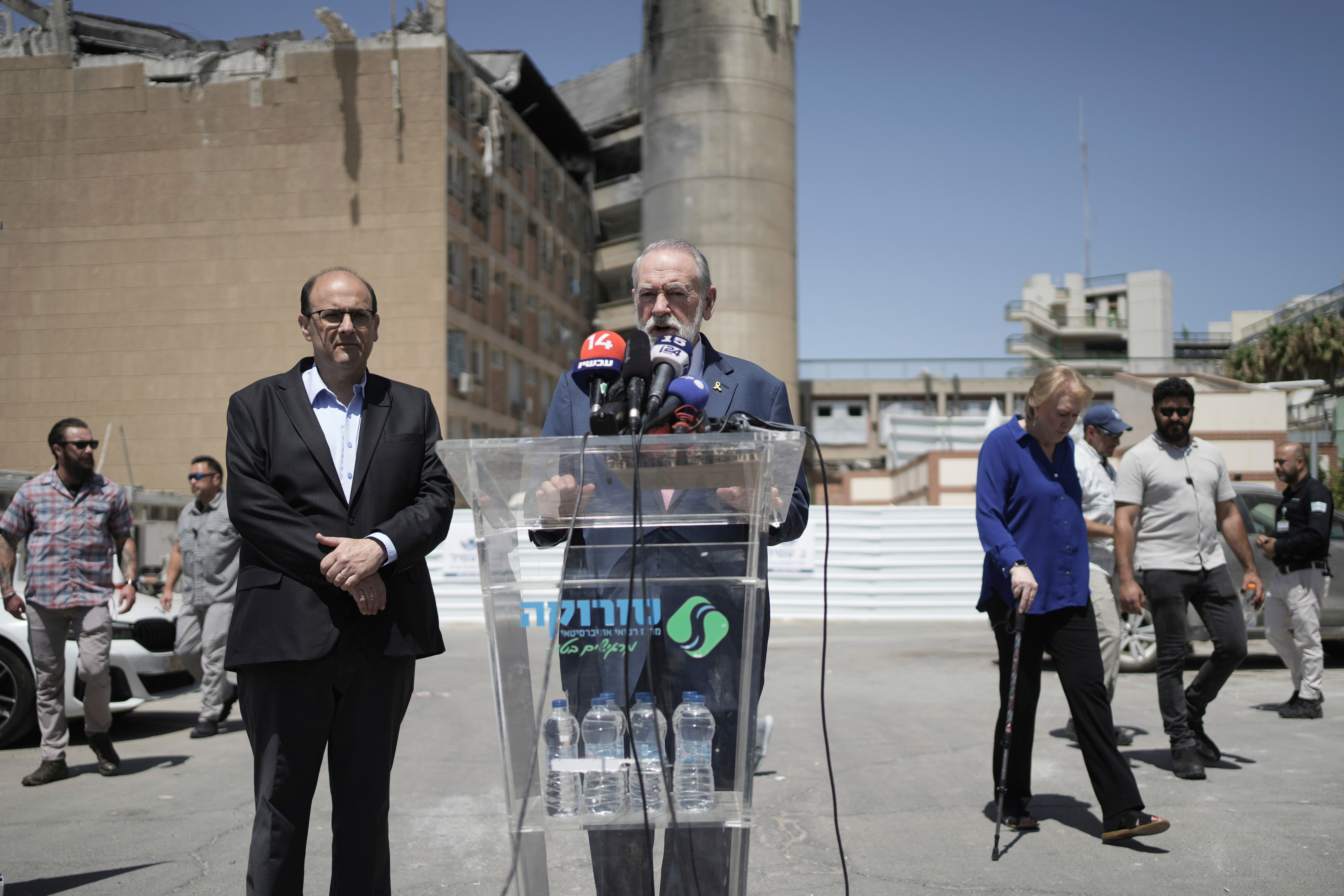
Since his arrival in Israel in April, former Arkansas Gov. Mike Huckabee has made his mark as the first evangelical U.S. ambassador to Israel — and possibly the most effusive in his remarks about the Jewish state. Following issues with work visas for Christian organizations and several incidents involving Palestinian Christians, Huckabee issued some strongly worded statements directed toward Israeli officials. But with the visa issue resolved and the world’s attention on the humanitarian situation in Gaza and the latest round of collapsed negotiations for a ceasefire and hostage-release deal, Huckabee was back to standing firmly behind Israel in an interview with Jewish Insider’s Lahav Harkov in his office at the U.S. Embassy in Jerusalem on Thursday.
On the issues surrounding aid distribution: “Well, we just want people to get the truth and to get the food, but we don’t want Hamas to steal it, which is what they have done through the U.N. model, which has been an absolute disaster. Maybe the U.N. is more interested in preserving the machinery of the U.N. than they are in feeding people,” Huckabee said. “And I know that sounds harsh, but I absolutely am on the record for that, because when I see just thousands of pallets, thousands of tons of food sitting that could be consumed by people, it’s sitting there because the U.N. doesn’t really have any incentive to go out and actually get it to the people.”
SUPPORTER SCRUTINY

Sen. Mark Kelly (D-AZ) is facing new scrutiny from some Jewish community leaders in Arizona who are frustrated by his endorsements boosting the activist left in a series of recent House primaries in which he has withheld support for pro-Israel candidates and has even worked to actively oppose their campaigns behind the scenes, according to people familiar with the matter, Jewish Insider’s Matthew Kassel reports.
Tensed-up ties: Kelly’s engagement has strained what had been seen as a positive relationship with the pro-Israel community in Arizona, according to multiple local Jewish leaders who have voiced disappointment with his approach. Meanwhile, his recent interventions have raised questions about the political motivations of the Democratic senator in a key battleground state who has long been associated with his party’s moderate, centrist wing. The most recent source of tension with Jewish and pro-Israel leaders stems from Kelly’s endorsement of Adelita Grijalva in a Tucson House primary this month to succeed her late father, former Rep. Raul Grijalva (D-AZ), a longtime critic of Israel who died in March.
PARIS POSITION

Republicans and senior Trump administration officials are blasting French President Emmanuel Macron for announcing on Thursday that France will recognize a Palestinian state at the United Nations General Assembly later this year, Jewish Insider’s Marc Rod reports.
Pushback: “The United States strongly rejects [Macron’s] plan to recognize a Palestinian state at the [UN] general assembly,” Secretary of State Marco Rubio said. “This reckless decision only serves Hamas propaganda and sets back peace. It is a slap in the face to the victims of October 7th.” Top Republican lawmakers largely argued that the decision constituted a reward for Hamas for its Oct. 7, 2023, attacks on Israel and its intransigence in recent hostage talks, the most recent round of which collapsed just hours before Macron’s announcement.
Read the full story here with additional comments from Sens. Tom Cotton (R-AR) and Lindsey Graham (R-SC) and Reps. Brian Mast (R-FL), Randy Fine (R-FL) Carlos Gimenez (R-FL) and former U.S. Ambassador to the United Nations Nikki Haley.
Bonus: In a tongue-in-cheek X post, U.S. Ambassador to Israel Mike Huckabee said, “Macron’s unilateral ‘declaration’ of a ‘Palestinian’ state didn’t say WHERE it would be. I can now exclusively disclose that France will offer the French Riviera & the new nation will be called ‘Franc-en-Stine.’”
LENT A LIFELINE

Sen. Jeanne Shaheen (D-NH), the top Democrat on the Senate Foreign Relations Committee, voted with nearly all committee Republicans to advance former National Security Advisor Mike Waltz’s nomination to be U.S. ambassador to the United Nations to move to the consideration of the full Senate, Jewish Insider’s Marc Rod reports.
Notable quotable: “I recognize that Mr. Waltz represents a moderating force with a distinguished record of military service and an extensive background in national security policymaking,” Shaheen said in a statement. “Further, Mike Waltz did not represent himself to me as someone who wants to retreat from the world—and this is a quality I value in nominees. Simply put, in a Situation Room filled with people like Vice President [J.D.] Vance and Under Secretary [of Defense Elbridge] Colby, who want to retreat from the world, and like Secretary [of Defense Pete] Hegseth, I think we’re better off having someone like Mike Waltz present.”
PUT ON PAUSE

The Senate Homeland Security and Government Affairs Committee on Thursday delayed a confirmation hearing for Paul Ingrassia, the Trump administration’s nominee for a government ethics oversight role, amid questions about his record from some Senate Republicans, Jewish Insider’s Marc Rod reports. Ingrassia has a record of conspiratorial comments, including describing the Oct. 7, 2023, Hamas attacks on Israel and the ensuing war as a “psyop” and defending prominent antisemites, among other issues.
What they’re saying: Sen. James Lankford (R-OK) told JI he had more questions he wanted to ask Ingrassia and that the hearing had been delayed because “he had not met with a lot of members” and the lawmakers wanted the chance to do so. He said that the hearing will now likely happen in “September or later,” after the Senate’s August recess, to provide more time for these meetings.
Garden State race
In a Democratic Party that has lost its grip on the working class — long its base of support and wellspring of its values — Brian Varela is offering a way back home. Varela, a small business owner and New Jersey political activist vying for the Democratic nomination for New Jersey’s 7th Congressional District, is leaning in to his working-class Colombian roots, suggesting that the Democrats need candidates, like him, who are better connected to the middle-class voters in his district. Varela, 36, has firmly established himself as a serious contender for the Democratic nomination for New Jersey’s 7th Congressional District with his recent announcement of a $700,000 fundraising haul in his first three months in the race, Jewish Insider’s Marc Rod reports.
Positioning: “I consider myself more of a moderate,” Varela told JI in an interview. “I do believe that we do need to be tight around budgets, and we can’t just go and haphazardly be cutting programs, but we do need to understand that we cannot allow the deficit to continue increasing.” He said that he thinks his perspective coming from a working-class background can help Democrats appeal to working-class voters they struggled to attract in 2024. And he said that Israel has been a “strong ally for us, and I think it’s important to make sure that we are there for Israel, that we help Israel with their ability to defend themselves.”
Worthy Reads
Where’s the Outrage?: In The Washington Post, Stephen Rapp, who served as U.S. ambassador-at-large for war crimes issues from 2009-2015, raises concerns about global silence around Iran’s human rights violations. “The regime’s response to its perceived vulnerability in the wake of that conflict has become increasingly aggressive. While its failures may be attributed to incompetence and the foreign penetration of its security services, its fury is being directed at domestic political opponents. Thousands of Iranians are in danger as parliament now seeks to expedite death sentences in cases involving imagined collaboration with foreign entities.” [WashPost]
A New Gaza: In The Wall Street Journal, Yasser Abu Shabab, the commander of the Popular Forces in Gaza, makes the claim that he has developed a model for post-Hamas governance in the Gaza Strip. “Through our efforts, we have shown a glimpse of what a new Gaza could look like. … Within months, more than 600,000 people — nearly a third of Gaza’s population — could be living outside the cycle of war. We need only three things to make this vision a reality: financial support to prevent Hamas’s return, humanitarian aid to meet the population’s immediate needs for food and shelter, and safe corridors so people can move around. In a short time, we could transform most of Gaza from a war zone into functioning communities. When the rebuilding has begun, Hamas can negotiate with Israel for the release of hostages in exchange for safe passage out of Gaza. Let them go to Qatar, Turkey or wherever their enablers will have them. We don’t want them among us.” [WSJ]
‘Needling the Jews’: In National Review, Jamie Kirchick breaks down far-right commentator Tucker Carlson’s evolution from Fox News host to conspiracy theorist trafficking in antisemitic tropes. “After years of ‘just asking questions,’ he has reached the nadir to which such questions inevitably lead. Carlson has chosen to exploit the world’s oldest prejudice while pretending that it’s somehow edgy. Ultimately, the reasons why Carlson decided to become America’s leading purveyor of antisemitic ideas matter less than what this development says about our society. Why has ‘needling the Jews,’ the very thing Carlson condemned Pat Buchanan for a quarter century ago, been a safe career move? For the persistent acting out of his anti-Jewish obsession in the national discourse hasn’t put a dent in his popularity; on the contrary, it may have even boosted it.” [NationalReview]
Word on the Street
U.S. Ambassador to Turkey Tom Barrack, the Trump administration’s Syria envoy, convened a four-hour meeting in Paris on Thursday for senior Israeli and Syrian officials, including Israeli Minister of Strategic Affairs Ron Dermer and Syrian Foreign Minister Assad al-Sheibani, to discuss security issues; the meeting was the first high-level sit-down between Israeli and Syrian officials in 25 years…
U.S. and Israeli negotiators departed Doha, Qatar, following Hamas’ most recent response to a ceasefire proposal, with White House Middle East envoy Steve Witkoff saying that the terror group’s response “shows a lack of desire to reach a ceasefire”…
The Pentagon informed staff on Thursday that it had indefinitely suspended the Department of Defense’s participation in think tank and research conferences and events; the announcement comes a week after the Pentagon pulled its affiliated speakers from the lineup at the Aspen Security Forum…
A new report from the Jewish Institute for National Security of America found that the U.S. launched nearly 14% of its THAAD interceptor stockpile during last month’s war between Israel and Iran; the report’s authors suggested it could take between three and eight years to replenish the stockpile…
Russia successfully launched an Iranian Soyuz communications satellite into orbit, months after signing a “strategic partnership” agreement with Tehran…
The Wall Street Journal reports on a 2003 birthday book given to Jeffrey Epstein that included messages from President Donald Trump and former President Bill Clinton…
Wisconsin Gov. Tony Evers, a Democrat, announced he does not plan to seek a third term; former Lt. Gov. Mandela Barnes, who came within a percentage point of unseating Sen. Ron Johnson (R-WI) in 2022, said he is considering entering the race to succeed Evers, while Sara Rodriguez, the state’s current lieutenant governor, hinted she was interested in the seat…
Members of a New Jersey state Assembly panel advanced a bill that would adopt the International Holocaust Remembrance Alliance’s working definition of antisemitism…
The FCC signed off on the $8 billion merger between Skydance Media and Paramount; The New York Times said that the merger “effectively ushers in the beginning of a new family dynasty for Paramount, which has been controlled by the Redstone family for decades. David Ellison, son of the tech billionaire Larry Ellison, plans to take control of the company when the deal closes”…
CBS News tapped network veteran Tanya Simon, who had overseen “60 Minutes” since the resignation last year of Bill Owens, as the weekly news program’s executive producer…
Israeli-American venture capitalist Elad Gil is raising a $1.5 billion fund for young startups; if closed, it would be one of the largest funds raised by a solo VC…
Two Jewish comics slated to perform at the upcoming Edinburgh Fringe next month had their shows canceled due to what organizers said were safety concerns…
Hungary issued a three-year ban on members of the Irish hip-hop group Kneecap from entering the country, citing the group’s “antisemitic hate speech and open praise for Hamas and Hezbollah as justification”; the ban comes ahead of the upcoming Sziget festival in Budapest, at which Kneecap was slated to perform…
Archeologists working at the Tinshemet Cave site in central Israel discovered what they believe to be, at 100,000 years old, one of the oldest burial sites in the world…
Eight Israeli soldiers were injured in a car-ramming attack on Thursday near the central Israeli city of Netanya; the assailant drove off and is believed to have abandoned his car near the West Bank town of Beit Lid…
Israeli Ambassador to the U.S. Yechiel Leiter distanced the Israeli government from recent comments by Israeli Heritage Minister Amichay Eliyahu, a far-right lawmaker who said that Jews would settle in the Gaza Strip and the government “is racing ahead for Gaza to be wiped out”…
Pic of the Day
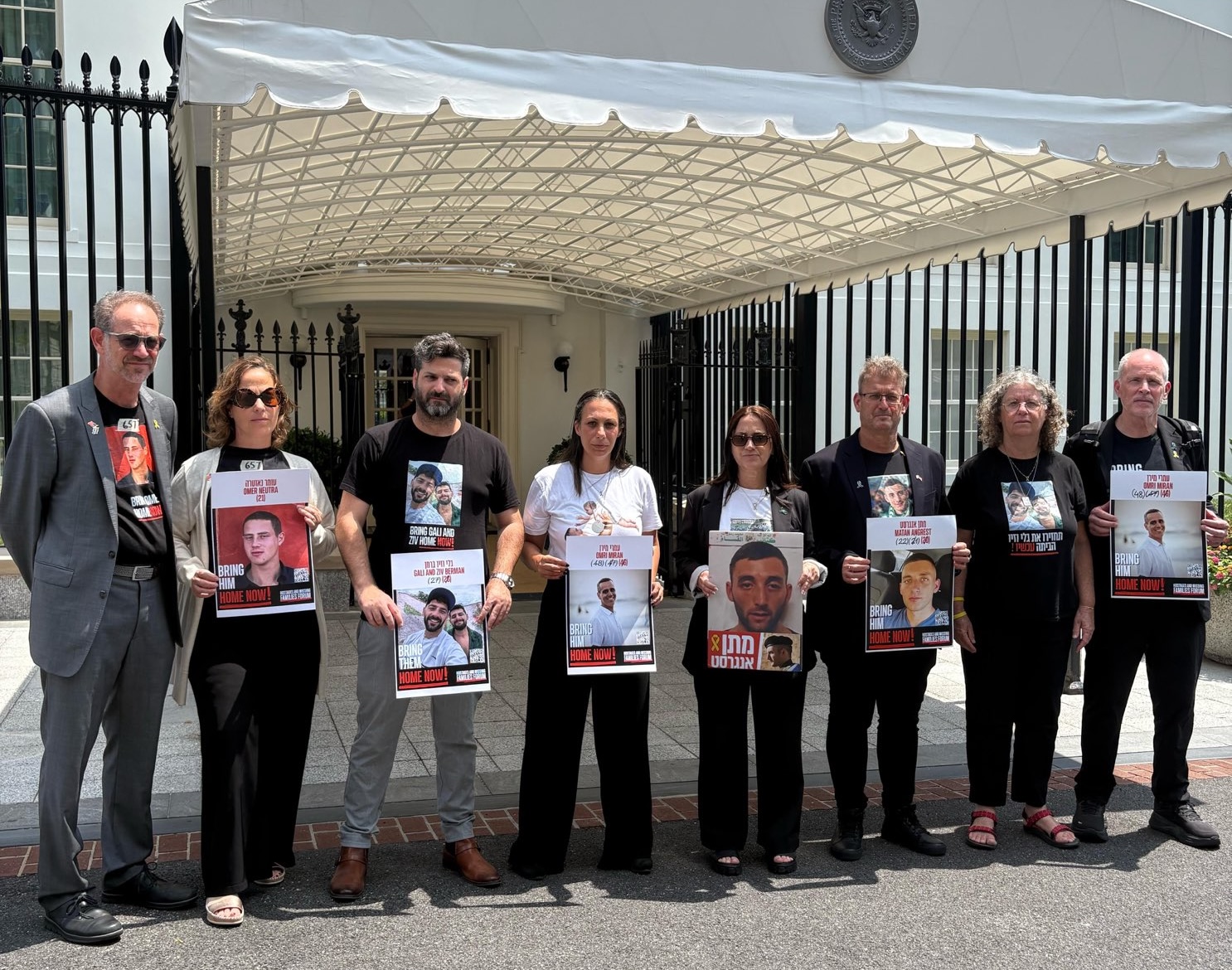
Former hostages and family members of some of the remaining 50 hostages still in captivity were in Washington this week for meetings with Trump administration officials, including Justice Department senior counsel Leo Terrell, the chair of the department’s antisemitism task force. At far right are Keith Siegel and his wife, Aviva, who were both taken hostage by Hamas on Oct. 7, 2023.
Birthdays
Actor, comedian and producer, Jeremy Samuel Piven turns 60 on Saturday…
FRIDAY: Warsaw Ghetto Uprising participant and Holocaust survivor, she is the subject of the 2021 documentary “I am Here,” Ella Blumenthal turns 104… Former publisher and editor-in-chief of Jewish Lights Publishing, he is an economist and religious scholar best known for his interfaith work, Stuart M. Matlins turns 85… Cinematographer, whose work includes “The Rocky Horror Picture Show” and “The Empire Strikes Back,” Peter Suschitzky turns 84… Member of the New York City Council from 2014 to 2021, Alan N. Maisel turns 79… Born in Casablanca, Morocco, nightclub owner, entrepreneur and film producer, he produced “The Woman in Red” and “Weekend at Bernie’s,” Victor Drai turns 78… Former IDF brigadier general (he was part of Operation Entebbe in 1976), then a member of Knesset, Efraim “Effi” Eitam turns 73… Voiceover artist, he is also the writer, producer, director and narrator of a documentary about the restoration of a NYC synagogue, Peter Grossman… Chairman of Vibrant Capital Partners and chair emeritus of the Weitzman National Museum of American Jewish History in Philadelphia, Philip Darivoff… Screenwriter, director and producer, best known for creating “Beverly Hills, 90210” and “Sex and the City,” Darren Star turns 64… Pulitzer Prize-winning author and journalist, she is a staff writer at The Atlantic, Anne Applebaum turns 61… Retired MLB pitcher from a small Jewish community in the Dominican Republic, he maintains a kosher home, José Bautista turns 61… Israeli journalist, television news anchor and author of a nonfiction book and a novel, Oshrat Kotler turns 60… CEO of Friends of the Israel Defense Forces until earlier this week, Rabbi Steven Weil… NYC-based criminal defense attorney, Arkady L. Bukh turns 53… Head coach of the men’s basketball team at Kent State University since 2011, Rob Senderoff turns 52… Radio personality on Baltimore’s WBAL and 98 Rock, Josh Spiegel turns 50… VP of communications and PR for the National Association of Healthcare Quality, Erin Seidler… Experimental electronic music producer, composer and singer, known professionally as Oneohtrix Point Never, Daniel Lopatin turns 43… Film and television actor, Michael Welch turns 38… Senior policy advisor at Nelson Mullins, Jake Kohn turns 36… Pitcher for Team Israel at the 2020 Olympics and at the 2023 World Baseball Classic, he is also a real estate broker at CBRE, Joseph “Joey” Samuel Wagman turns 34…
SATURDAY: Former mayor of Las Vegas for 12 years, where he was succeeded by his wife who served for 12 more years as mayor, Oscar Goodman turns 86… Former administrator at the University of Illinois and the University of Houston, chancellor of the California State University system and CEO of the J. Paul Getty Trust, Barry Munitz turns 84… Journalist and author or co-author of nearly two dozen books, both of her parents were killed in Auschwitz, Paulette Cooper turns 83… Author, podcaster, columnist and rabbi, Shammai Engelmayer turns 80… Member of the Florida House of Representatives from 2012 to 2020, Richard Stark turns 73… Chief medical officer at F|42, Alan H. Spiro, MD, MBA… Film and television director, she is best known for her work on the Showtime drama series “Homeland,” Lesli Linka Glatter turns 72… Sports columnist, author, television and radio personality, he works for ESPN’s Charlotte, N.C.-based SEC Network since 2014, Paul Finebaum turns 69… Venture capitalist, James W. Breyer turns 64… Former correspondent at ABC News for 23 years, now a founder at Ten Percent Media, Daniel B. “Dan” Harris turns 54… Physician and attorney, he is the founder and chairman of the DC-based consulting firm Stonington Global, Nicholas Muzin turns 50… U.S. senator (R-OK), Markwayne Mullin turns 48… Actress best known for her role in the “Spider-Man” trilogy, Mageina Tovah Begtrup turns 46… Managing partner of the D.C. office of ColdSpark, Nachama Soloveichik… Political correspondent at Israel’s Walla News, Tal Shalev… Israeli-born classical music composer, Gilad Hochman turns 43… Israeli born R&B singer and songwriter, Hila Bronstein turns 42… Manager of advisor communications at Cetera Financial Group, Lauren Garfield-Herrin… Actress and filmmaker, Hallie Meyers-Shyer turns 38… Member of the comedy group “The Try Guys,” with almost 2.9 billion YouTube views, Zachary Andrew “Zach” Kornfeld turns 35… Associate policy director for complex care at United Healthcare, Drew Gerber… NFL running back who retired in 2024, Tarik Cohen turns 30… Pitcher on the Israeli Women’s National Softball Team, now a curriculum designer at Great Hearts Academies, Tamara “T” Statman Schoen turns 28… President at B&B Digital Media, Tomer Barazani…
SUNDAY: Real estate developer who founded Aspen Square Management, he heads an eponymous foundation known for its flagship program PJ Library, Harold Grinspoon turns 96… Forensic pathologist known for his HBO show and his work investigating high-profile deaths, Michael M. Baden turns 91… Managing partner of Access Fund Management Company, he is a past president of the Jewish Community Federation of San Francisco, Harold Zlot… Former deputy secretary of defense and then CIA director in the Clinton administration, now a professor emeritus at MIT, John Mark Deutch turns 87… Steven M. Mizel turns 86… Former chairman of the Conference of Presidents of Major American Jewish Organizations, Stephen M. Greenberg turns 81… Artist and museum founder focused on Fusionism, Shalom Tomáš Neuman turns 78… Israeli author and television producer, he is best known for his documentaries of Israel’s intelligence agencies, Yarin Kimor turns 73… Israeli-born fitness personality, Gilad Janklowicz turns 71… Comedian, writer, producer and actress, Carol Leifer turns 69… Washington bureau chief and White House correspondent for the Christian Science Monitor, Linda Feldmann… Former VP of global communications, marketing and public policy at Facebook, he previously held a similar position at Google, Elliot Schrage turns 65… U.S. Army colonel (retired), Jeffrey Brian Carra… Israeli television and radio personality, Erez Moshe Tal turns 64… Heir to the Hyatt Hotels fortune, now a film producer, Jean “Gigi” Pritzker turns 63… Former CEO of the Rabbinical Assembly, she is now the founder of Insight Eldercare, Rabbi Julie Schonfeld… Member of the Hungarian Parliament for 20 years, then a member of the European Parliament since 2009, Tamás Deutsch turns 59… Rabbi at Kesher Israel: The Georgetown Synagogue, Rabbi Hyim Shafner… Former national platform director for the Democratic National Committee, now a political consultant and recruiter, Andrew Grossman… Former chief of staff of the House Republican Conference, he is now the managing partner at Capitol Venture, LLC, Jeremy Deutsch… Head of marketing at Jumplight and winner on “Jeopardy!” in 2019, Aaron Lichtig… D.C.-area political activist, Benjamin Rothenberg… SVP at Upland Workshop, Jeremy Adler…
Sen. Ricketts’ resolution intended to urge the U.K., France and Germany to impose snapback ‘as soon as possible’
Al Drago/Getty Images
Sen. Rand Paul (R-KY) walks to the Senate floor during overnight votes at the U.S. Capitol on July 1, 2025 in Washington, DC.
Sen. Pete Ricketts (R-NE) attempted to call up and pass by unanimous consent a resolution urging the United Kingdom, France and Germany to trigger the snapback of United Nations sanctions on Iran under the Joint Comprehensive Plan of Action “as soon as possible,” but was blocked by Sen. Rand Paul (R-KY).
“In order to seize this moment,” and capitalize on Iranian weakness, “the U.S. and our allies must impose maximum pressure to the highest extent possible to force Iran to agree to permanently and verifiably end its nuclear program, including its capacity to enrich,” Ricketts said on the Senate floor on Wednesday.
The option to invoke snapback is set to expire in mid-October, but Ricketts emphasized that the process will take at least 30 days to complete, and that Russia is set to assume the presidency of the U.N. Security Council in October, in which role it could delay the proceedings. European allies have reportedly set an August deadline to initiate snapback, but Ricketts argued that “timeline … leaves little room for error.”
“I stand to urge our European friends to hold the line” in upcoming talks with Iran, Ricketts said, warning that Iran is trying to buy time and delay snapback.
Paul warned that the U.S. attack on Iran might make Iran more resistant to U.S. demands and “may turn out to be a disaster” that prompts Iran to sprint to a nuclear weapon.
He argued that sanctions have never changed Iran’s behavior — a notion disputed by leaders on both sides of the aisle — and “are often counterproductive” in general. Paul also suggested that the U.S. is in no position to make any requests related to snapback since President Donald Trump removed the U.S. from the Iran nuclear deal in 2018.
“It is a bit inconsistent for us to be arguing that Europe should apply and adhere to the JCPOA, which we no longer participate in,” Paul said. “If the United States is no longer a member of the JCPOA, what gives Washington the right to advise those who remain in it to invoke certain mechanisms within the agreement?”
He requested the Ricketts resolution be modified to instead call for deescalation and diplomacy.
Ricketts responded that diplomacy without pressure is a failed concept.
Sen. Jim Risch (R-ID), the chairman of the Senate Foreign Relations Committee, also spoke on the Senate floor in support of Ricketts’ resolution.
“Over the last 10 years, Iran has enjoyed unwarranted sanctions relief and time is short before the opportunity expires to snap back sanctions,” Risch said. “We cannot afford to wait until the end of August. Initiating the snapback process would be the right and long overdue move.”
Mechanism to bring back U.N. sanctions expires in October
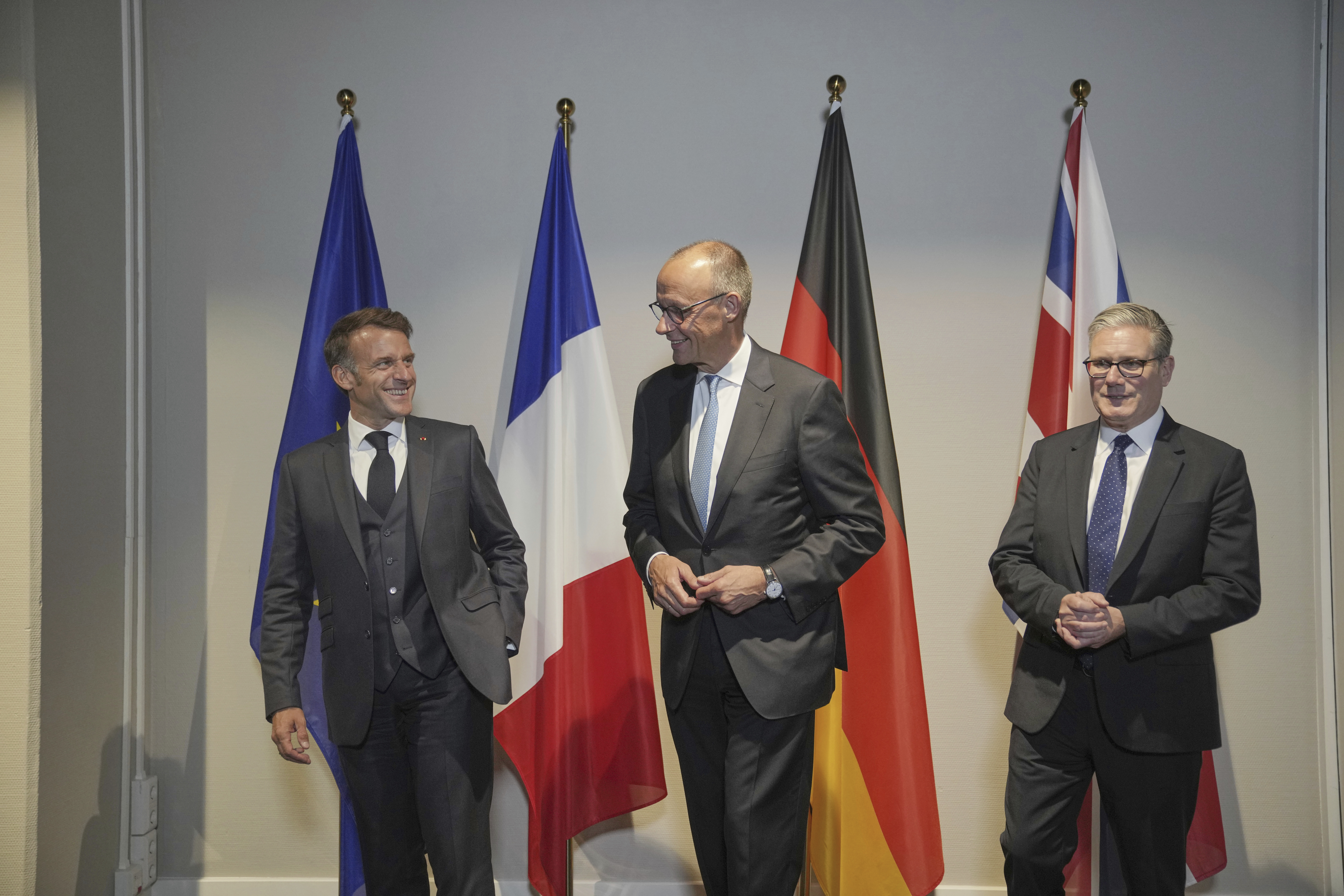
Press Association via AP Images
French President Emmanuel Macron, Germany's Chancellor Friedrich Merz and Prime Minister Sir Keir Starmer at a hotel prior to an E3 meeting on the sidelines of the NATO summit in The Hague, Netherlands, Tuesday June 24, 2025.
France, Germany and the U.K. will bring back sanctions on Iran via the U.N. Security Council if a nuclear deal is not reached by the end of August, French Foreign Minister Jean-Noel Barrot warned on Tuesday.
Barrot said that the E3, the European countries party to the 2015 Iran nuclear deal known as the Joint Comprehensive Plan of Action, will trigger the snapback mechanism, reimposing all U.N. sanctions, if a new agreement is not reached.
The Trump administration hopes to reach an agreement with the Islamic Republic to stop any uranium enrichment in Iran after Israeli and American strikes on Iran’s nuclear sites last month, aiming to prevent Tehran from rebuilding its severely damaged nuclear program.
“France and its partners are … justified in reapplying global embargoes on arms, banks and nuclear equipment that were lifted 10 years ago,” Barrot said on the way to a meeting with EU foreign ministers in Brussels. “Without a firm, tangible and verifiable commitment from Iran, we will do so by the end of August at the latest.”
The snapback mechanism expires in October and takes 30 days to activate, such that the end of August is the last chance to impose U.N. sanctions that cannot be vetoed by Russia and China, Iran’s allies on the Security Council. Moscow is slated to assume the presidency of the U.N. Security Council in October and could try to obstruct the move if it is not completed before then.
The E3 reached the shared policy in a phone call with Secretary of State Marco Rubio on Monday, according to Axios.
Barrot’s statement also came after reports in Arabic and Iranian media that Germany planned to activate snapback sanctions this week, which the German Foreign Ministry denied to Jewish Insider. A German official confirmed that his country shares France’s position.
Earlier this week, Tehran threatened a “proportionate and appropriate response” if the E3 snaps back sanctions, a move Iranian Foreign Ministry Spokesman Esmaeil Baqaei claimed “lacks any legal, political or moral justification.”
“European parties are constantly trying to use it as a tool in violation of their fundamental obligations,” he added.
In Kushner’s confirmation testimony, he spoke about his parents having lost most of their family in the Holocaust

Ivanka Trump/Instagram
Charles Kushner is sworn in as U.S. ambassador to France on June 18, 2025.
President Donald Trump and Secretary of State Marco Rubio on Wednesday swore in Charles Kushner as the U.S. ambassador to France.
Kushner, a real estate executive, longtime Jewish philanthropist and father of Trump’s son-in-law Jared, was confirmed in May on a mostly party-line vote, with Sen. Cory Booker (D-NJ) the only Democrat to support the confirmation.
In Kushner’s testimony to the Senate Foreign Relations Committee, he told senators about his parents having immigrated to the U.S. from Belarus, where most of their family died in the Holocaust.
“My parents loved and appreciated our great country, the land of opportunity, just as I do,” Kushner said.
In 2020, Trump pardoned Kushner, after the latter served two years in a federal prison for tax evasion and for retaliating against a federal witness. In November, Trump described Kushner as “a tremendous business leader, philanthropist and dealmaker.”
During Kushner’s Oval Office swearing-in, he was joined by his children and grandchildren, including Jared Kushner and Ivanka Trump — a rare White House appearance for the couple, who opted not to take on any official roles in Trump’s second term. Jared Kushner was a top Middle East advisor to Trump in his first term, and his swearing-in came as Trump is considering whether the U.S. should attack Iran’s nuclear program.
Sen. Josh Hawley: ‘It certainly sounds like they take us for granted and think that they can act without consequence’

LUDOVIC MARIN/AFP via Getty Images
French President Emmanuel Macron (R) shakes hands with Palestinian President Mahmud Abbas during a meeting on the sidelines of the 79th Session of the United Nations General Assembly in New York on September 25, 2024.
French President Emmanuel Macron’s campaign for international recognition of a Palestinian state and championing of an upcoming United Nations conference on the subject despite U.S. opposition has received a frosty reception from Senate Republicans.
France is set to co-chair “The High Level International Conference for the Peaceful Settlement of the Question of Palestine and the Implementation of the Two-State Solution” with Saudi Arabia at the U.N. headquarters in New York next week. Several described it as a distraction from U.S. efforts to secure peace in the region while praising the Trump administration’s decision to urge U.N. member states against participating.
The U.S. sent a diplomatic demarche on Tuesday discouraging countries from attending the summit, “which we view as counterproductive to ongoing, life-saving efforts to end the war in Gaza and free hostages,” according to the cable. The demarche, first reported by Reuters, stated that any government that took “anti-Israel actions” after the conference would be viewed as acting in opposition to U.S. foreign policy priorities and warned of potential diplomatic consequences.
“It certainly sounds like they take us for granted and think that they can act without consequence. France has a long history of doing this in foreign policy. They’re consistently a problem and have been forever, but I’d say it’s very unhelpful of them at this present moment,” Sen. Josh Hawley (R-MO) told Jewish Insider.
“Well, it’s Macron. The Bob Dylan song ‘Blowing in the Wind’ was named after him,” Sen. John Kennedy (R-LA) said. “He’s powerless right now, and he’s got too much time on his hands.”
Asked what the response should be from the U.S. if Macron continues with this approach, Kennedy replied, “Unless it gets out of hand, I would just ignore them. Nobody’s scared of France. Germany runs Europe, not France. Right now, I know the Brits have left the EU but they’re still part of NATO, and the two countries that matter right now are Germany and the U.K. I love France … but I meant what I said, Macron, he’s lost all of his power. He’s erratic.”
Sen. Lindsey Graham (R-SC) said he spoke to French officials to try to dissuade them from continuing their Palestinian statehood push, but did not divulge how they responded. “Now is not the time. That’s what I told the French,” Graham told JI.
“They’ve generally had a cozy relationship with Iran that is purely driven by economic ties, maybe some historic ties. It makes no sense to me. I don’t think it’s well received by our administration,” Sen. Thom Tillis (R-NC) said.
Pressed on if France’s efforts would have an impact on U.S. foreign policy, Tillis replied: “I don’t know. I think it all depends on how far it goes. I think they’re still in the thought phase. It will be interesting to see if anything meaningful comes out of it, then I think the administration will probably take a more definitive position against it.”
Sen. Markwayne Mullin (R-OK) offered a similar take, telling JI, “France will be France. When they need our help, they always come ask us. Right now they’re trying to be tough, so let them stand there on their own ground, by all means. What they do doesn’t change what we decide to do.”
France is sponsoring a U.N. conference towards recognizing a Palestinian state, as experts warn harsh rhetoric from Macron encourages homegrown antisemitism
LUDOVIC MARIN/AFP via Getty Images
French President Emmanuel Macron (R) shakes hands with Palestinian President Mahmud Abbas during a meeting on the sidelines of the 79th Session of the United Nations General Assembly in New York on September 25, 2024.
Israel and France have been on a diplomatic collision course in recent weeks, with French President Emmanuel Macron set to lay out steps toward the recognition of a Palestinian state at a French- and Saudi- sponsored conference promoting a two-state solution being held at the United Nations headquarters in New York next week.
The move comes as the French government released a report calling on Paris to recognize a Palestinian state and recalibrate its policies towards Israel to “appease” France’s growing Muslim population.
Last month, Macron called Israeli policies on Gaza “shameful” and raised the possibility of downgrading European Union cooperation with Israel; in response, Israeli Prime Minister Benjamin Netanyahu accused Macron of spreading blood libels and standing with Hamas. Days later, France threatened sanctions on Israel if it does not allow unrestricted humanitarian aid to be distributed by U.N. agencies in Gaza. After Macron once again threatened to “toughen” his stance against Israel last week, the Israeli Foreign Ministry accused him of being on a “crusade against the Jewish state” — referring to a period in which French knights massacred European Jews.
France has been preparing to co-chair “The High Level International Conference for the Peaceful Settlement of the Question of Palestine and the Implementation of the Two-State Solution” with Saudi Arabia at the U.N. on June 17-20. Macron said last week that the conference, which was first announced in December, is meant “to give fresh impetus to the recognition of a Palestinian state.” The French Foreign Ministry told The Guardian that Paris is trying to convince other countries to join it. The gathering’s other agenda items include reforming the Palestinian Authority and disarming Hamas.
French diplomats met with officials in Jerusalem to discuss the matter, and briefed reporters that the main goals of the conference are disarming Hamas, freeing the hostages, reforming the Palestinian Authority and planning for the “day after” the war in Gaza, including a two-state solution.
A French diplomatic source said on Sunday that France is “determined to recognize the state of Palestine to create the conditions for the existence of this state … Our goal for this conference indeed goes beyond the question of recognition. It is indeed about recreating an international consensus around the two-state solution, which allows for a lasting resolution to the conflict.”
Amid the sparring between Israel and France and the preparation to recognize a Palestinian state, the French Interior Ministry released a report titled “Muslim Brothers and Political Islam in France,” calling the Muslim Brotherhood an “imminent threat” to French national security. The Islamist group is funded by foreign powers, has over 100,000 members in France and runs or influences countless mosques, schools and other organizations. The report also describes the Muslim Brotherhood’s dissemination of antisemitic texts and propaganda.
Among the report’s recommendations is “the recognition by France of a Palestinian State alongside Israel” to “appease the frustrations” of French Muslims who perceive Paris as “supporting Jewish Israelis against Muslim Palestinians.”
Experts drew a connection between Macron’s pressure on Israel, Muslim Brotherhood influence and antisemitism in France.
French conservative intellectual Michel Gurfinkiel told Jewish Insider that “the main point of the report is not what it says about the Muslim Brotherhood. The real point is the conclusion that the French government should make efforts to bring French Muslims into the French fold, and that means … to recognize a state of Palestine.”
“There is a kind of interplay here,” he added. “The interior minister wanted to publish the report in order to give legitimacy to his own policy against Islamism in France. But it was published with the approval of President Macron … and obviously, the real goal of the president was to tell everybody, ‘I must recognize a State of Palestine because it is the only way for us to fight the Muslim Brotherhood.'”
Gurfinkiel noted that while Macron has to vacate the presidency in two years, he can run for a third nonconsecutive term in 2032, when he will be 55. “To return, his calculation is that he needs to secure the Muslim vote in France, which is going to grow in the coming years. He wants French Muslims to see him as the champion of their cause, and to be a champion of the Muslim cause means you support Palestine. Palestine is a code word for Muslim power in France, just like the right is extremely pro-Israel as a metaphor” against growing Islamism.
Emmanuel Navon, a professor of international relations at Tel Aviv University, also pointed out that the report about the Muslim Brotherhood says “clearly the Muslims are out of control and maybe one way of calming them down is to recognize a Palestinian state.”
“The report says there is a plan to conquer and Islamicize France. That’s not a conspiracy theory, it’s in the report,” Navon added.
Israel’s former ambassador to France, Daniel Shek, told JI, “I can’t rule out that there are domestic political motivations, but I can say that as someone who knows [Macron] and spoke with him about the topic [of a two-state solution] years ago, it’s not his central motivation. He wants to end the war out of a concern for Israel.”
“You see what happened on the Champs-Élysées on Saturday night,” Navon added, referring to soccer riots last month, during which there were several incidents of antisemitic vandalism. “Macron used an Arabic expression for ‘my brothers’ on Twitter, it is very telling. It’s clear he wants to appease the Muslims. Spoiler: It’s not going to work.”
The report’s repeated references to the Israeli-Palestinian conflict show that it is an important part of the French public debate because it is a synecdoche for political positions on immigration and Islam in France, Navon and Gurfinkiel said.
Israel’s former ambassador to France, Daniel Shek, however, told JI, “I can’t rule out that there are domestic political motivations, but I can say that as someone who knows [Macron] and spoke with him about the topic [of a two-state solution] years ago, it’s not his central motivation. He wants to end the war out of a concern for Israel.”
Boaz Bismuth, a Knesset member from Netanyahu’s Likud Party and a former diplomat and foreign correspondent based in France, told JI that French Foreign Ministry representatives discussed Macron’s plan to sponsor a conference supporting Palestinian statehood months ago, long before the French Interior Ministry’s report came out.
“I would even say this is the usual position of the French,” he said.
Over a week ago, vandals targeted Paris’ Shoah Memorial, two synagogues and a Jewish restaurant in the Marais, the historic Jewish neighborhood, and a third synagogue in another part of the city. A French rabbi reported that he was assaulted twice in the past week.
Gurfinkiel said that Macron’s remarks “obviously” encourage antisemitism.
“What people don’t understand,” he said, “is once you start saying that the Jews in Israel are bad, the consequence is that Jews everywhere are [perceived as] bad. It reactivates countless negative views and images of the Jews that are embedded in Western culture. You can’t escape it.”
Navon cited a recent French decision to posthumously give Alfred Dreyfus a promotion and said: “Remember that book People Love Dead Jews? It’s exactly that. They love dead Jews. They’re trying to fight antisemitism 100 years ago … but when it comes to the true antisemitism, which is the obsession with Israel and attacking Jews under the name ‘Zionist,’ they basically are taking part in demonizing Israel which encourages it.”
“He says [Israel is] committing war crimes and killing women and babies,” Navon added. “That feeds the antisemitism of the far-left and the Muslims. This hypocrisy is unacceptable.”
Bismuth also said that he “wouldn’t say [Macron] is an enemy of Israel or hates the Jews. I think he doesn’t understand the significance of what he’s doing.”
“I give him the benefit of the doubt that it’s not intentional … I call on him to show responsibility and understand the consequences and the meaning of the things he said,” the Likud lawmaker stated.
Shek took issue with what he said was “the Israeli government’s position that any initiative to end the war is an existential threat and anyone doing it is an antisemite.”
Bismuth voiced disappointment in Macron, who expressed support for Israel after Oct. 7. “I was in a meeting between him and Netanyahu [in October 2023]. I heard him call to establish an international coalition with Israel against Hamas. And he went from there to calling for an arms embargo on Israel [in 2024] … He did a 180-degree flip-flop.”
“What France, the U.K. and the U.S. need to remember is that we don’t only share the same values, but also the same enemies,” he added.
Shek also noted that “Macron was a real friend of Israel and defended Israel’s right to defend itself for months.”
“Then we turned him into an antisemitic enemy and a supporter of Hamas,” he added, referring to the way Israelis spoke about the French president. “And then, we’re surprised that Israel is isolated.”
According to Shek, Macron’s critical turn happened because “time has gone by and nothing positive is happening. He, like many other leaders in the world, think this war has been continuing for too long and the time has come to stop it. He’s not alone; he’s just more vocal. At least he’s trying to do something.”
Ilan Berman, senior vice president of the American Foreign Policy Council, said that France leading the U.N. two-state solution conference “speaks to [its] eroding global position currently,” Berman said. “For France, the Middle East in general and Israel-Palestine in particular is a very attractive portfolio to play in and take an outsize role.”
Navon cited two advisors to Macron as major engines behind the U.N. conference. Ofer Bronchtein, a French-Israeli who was involved in the Oslo Accords, is Macron’s advisor on the Middle East and is expected to represent him at the U.N. next week. The other is Jacques Attali, an Algiers-born Jewish social theorist who advised former French presidents Francois Mitterand, Nicolas Sarkozy and Francois Hollande before Macron. Attali began criticizing the war in Gaza as early as November 2023 and recently equated Hamas with Israel’s leadership in a post calling for Europe to “exert pressure” so that both are removed.
Navon also blamed Qatar’s influence on France, noting that Doha has made major investments in France at a time when the country has a large budget deficit.
Ilan Berman, senior vice president of the American Foreign Policy Council, said that France leading the U.N. two-state solution conference “speaks to [its] eroding global position currently,” Berman said. “For France, the Middle East in general and Israel-Palestine in particular is a very attractive portfolio to play in and take an outsize role.”
Berman expressed concern about the practical impact of France’s moves, saying that “as more and more countries, including upper-tier countries like France, begin to preemptively recognize Palestine as a state, it becomes harder and harder to assume that there isn’t a state, even though the fundamental conditions [for statehood] don’t apply.”
“It’s one thing for Sweden to say it; it’s another when France does,” he added. “There is a question in my mind: At what point does this boulder rolling downhill begin to pick up steam, and what does that mean?”
Shek said that not much will change if France recognizes a Palestinian state, noting that 147 countries, over three-quarters of U.N. member states, have already done so.
“It only pressures Israel, and as far as I’m concerned, that’s OK. If pressure ends the war, brings back the hostages and integrates Israel into the region, then it’s a very pro-Israel act,” he said.
The former ambassador argued that the establishment of a Palestinian state is in Israel’s interest, in that it would “turn the Palestinian Authority into a responsible party.”
Navon agreed that recognition of a Palestinian state will not change much on the ground, but he still called on Israel to scale back relations with France should they take such a step.
“We have to try to circle the wagons against countries trying to appease our common enemy. They are making a moral and practical mistake. The U.S. should make that point very clear,” said Emmanuel Navon, a professor of international relations at Tel Aviv University.
“Make sure they don’t participate in any future diplomatic initiatives in the Middle East. Downgrade security and defense relations, on which they depend. There should be consequences,” he said. “Let’s be obnoxious too. France has problems with former colonies … New Caledonia is supposed to have a referendum [about independence from France] and [the French] keep pushing it off,” Navon said, referring to the Pacific island nation. “Why don’t we bring up a resolution at the U.N.?”
As to what the American response should be to France’s latest moves against Israel, Navon said that the U.S. should not participate in the conference at the U.N. next week and “should be very clear in their statements that this is a global war against terror and that we don’t break ranks.”
“We have to try to circle the wagons against countries trying to appease our common enemy. They are making a moral and practical mistake. The U.S. should make that point very clear,” he stated.
Berman said that “for the Trump administration, this is a really good opportunity to say ‘put your money where your mouth is’ and help reconstruct Gaza. There is a really good play to be made here. The French, Spanish, Dutch and others are very eager to moralize and grandstand, but very reticent to put their money where their mouth is and contribute.”
Berman suggested that the Trump administration can say “we disagree with their decision, but in light of it, we hope Paris will agree to [help with] reconstruction and expect greater contributions to the Gaza Humanitarian Foundation,” the U.S. and Israel-backed group distributing food in Gaza.
“It’s the worst of all possible worlds if Macron gets an easy win and doesn’t have to actually do anything,” he added.
Countries call on Israel to cancel Gaza escalation and let in more humanitarian aid or face 'concrete actions'

Antoine Gyori - Corbis/Corbis via Getty Images
British Prime Minister Keir Starmer is greeted by French President Emmanuel Macron ahead of the 'Coalition Of The Willing' summit in support of Ukraine at Elysee Palace on March 27, 2025 in Paris, France.
The United Kingdom, France and Canada threatened on Monday to take “concrete actions” and impose sanctions against Israel if it does not change its policies on humanitarian aid and the war in Gaza, as well as settlements in the West Bank.
The statement from the three countries came in response to Israel’s announcement that it had begun an escalation in the fighting in Gaza, while allowing in a limited amount of food, 11 weeks after blocking all aid in an attempt to pressure Hamas to free more hostages.
The countries said they “strongly oppose the expansion of Israel’s military operations in Gaza. The level of human suffering is intolerable. Israel’s denial of essential humanitarian assistance to the civilian population is unacceptable and risks breaching International Humanitarian Law.”
In addition, they said that the “basic quantity of food” to be allowed into Gaza “is wholly inadequate,” and that Israel must work with United Nations agencies. Israel and the U.S. have been working on an alternative mechanism to distribute aid rather than rely on U.N. agencies, which have not prevented Hamas from pocketing large quantities of aid and in some cases employed Hamas terrorists.
“If Israel does not cease the renewed military offensive and lift its restrictions on humanitarian aid, we will take further concrete actions in response,” the statement reads.
French Foreign Minister Jean-Noël Barrot said in an interview with French radio station France Inter on Tuesday that “further concrete actions” could include supporting a push led by the Netherlands to cancel the EU-Israel Association Agreement, which would in effect downgrade relations between Jerusalem and Brussels. Canada and the U.K. would not be involved, as they are not EU member states.
France, the U.K. and Canada also spoke out against Israeli settlements in the West Bank, calling them illegal and saying they “will not hesitate to take further action, including sanctions.”
In addition, they called to work towards a two-state solution, arguing that it is “the only way to bring long-lasting peace and security that both Israelis and Palestinians deserve.”
The three countries said they “have always supported Israel’s right to defend Israelis against terrorism” and called on Hamas to release the 58 hostages held since Oct. 7, 2023, at least 20 of whom are thought to be alive.
A second statement from 23 countries, including most of the EU, plus Australia, Canada, the U.K., New Zealand, Norway and Japan, also called on Israel to “allow a full resumption of aid into Gaza immediately” and enable U.N. agencies to distribute it, and called for a two-state solution. The EU countries that did not sign the letter were Austria, Czech Republic, Hungary, Poland, Belgium, Bulgaria, Croatia, Cyprus, Greece, Malta, Romania and Slovakia.
Israeli Prime Minister Benjamin Netanyahu responded that “the leaders in London, Ottawa and Paris are offering a huge prize for the genocidal attack on Israel on October 7 while inviting more such atrocities.”
“Israel accepts President [Donald] Trump’s vision and urges all European leaders to do the same,” he added. ”The war can end tomorrow if the remaining hostages are released, Hamas lays down its arms, its murderous leaders are exiled and Gaza is demilitarized. No nation can be expected to accept anything less and Israel certainly won’t. This is a war of civilization over barbarism. Israel will continue to defend itself by just means until total victory is achieved.”
Israeli Foreign Minister Gideon Saar shared on X a screenshot of a press release in which Hamas welcomed the countries’ threat, and added: “What a disgrace.”
French President Emmanuel Macron has been increasingly critical of Israel in recent weeks, calling Israel’s Gaza policies “shameful” and saying the EU should consider revoking its free trade agreement with Israel, to which Israeli Prime Minister Benjamin Netanyahu responded that Macron is standing with Hamas. France is also spearheading, together with Saudi Arabia, a high-level meeting at the U.N. next month calling for a two-state solution.
Marine Le Pen, president of the far-fight French party National Rally, told i24 News on Monday that she is “very concerned about the distance that Emmanuel Macron is creating with Israel, if I may put it this way, precisely at the worst possible time. At a time when Israel is fighting a war against terrorism, when it needs the support of its friends, and France has traditionally been a friendly country toward Israel.”
Please log in if you already have a subscription, or subscribe to access the latest updates.
 Continue with Google
 Continue with Apple