














































































Oren urged Israel to quickly pivot towards a strategic military partnership, while Schanzer warned a hasty move could leave Israel vulnerable
92NY
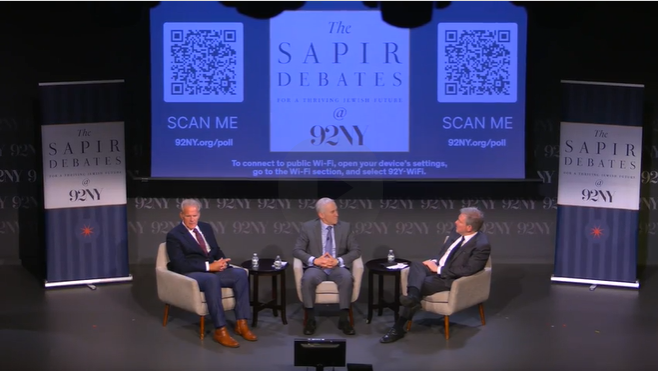
Michael Oren and Jonathan Schanzer debate over U.S. aid to Israel, moderated by Bret Stephens.


 Add JewishInsider on Google
Former Israeli Ambassador to the U.S. Michael Oren and Foundation for Defense of Democracies executive director Jonathan Schanzer squared off Monday evening in New York over whether Israel would be better off weaning itself from U.S. military aid.
Oren argued that Jerusalem should shift toward a strategic partnership before political winds in Washington dictate more unfavorable terms, while Schanzer warned that abandoning the arrangement mid-war could leave Israel exposed.
Audience members were unswayed by either argument: Polled before and after the debate, 39% still agreed that Israel would be better off without American aid, while 61% disagreed. The discussion, part of the 92nd Street Y’s SAPIR Debates series, was moderated by Bret Stephens, editor-in-chief of SAPIR and a New York Times columnist.
Despite taking opposing sides, Oren and Schanzer largely agreed that the U.S.-Israel relationship should eventually move from a traditional military aid arrangement toward a strategic partnership centered on shared defense technology and cooperation. Their disagreement focused on how quickly to make that transition and whether Israel could afford to do so amid continuing regional threats.
“I’m not sure we have more than a couple of months, and so we have to move very, very quickly,” Oren said, warning that a potentially less supportive Congress after the midterm elections could leave Israel with little control over the timing of a transition away from American assistance. He also noted that “there’s already a dialogue going on with the Trump administration about how we can move [the U.S.-Israel relationship] to a partnership.”
Oren argued that Israel’s reliance on U.S. assistance gives American administrations leverage over Israeli military decisions, particularly during wartime, while projecting an image of dependence that he said undermines Israel’s standing as a sovereign nation, pointing to the Obama administration’s withholding of certain munitions shipments during the 2014 Gaza conflict and the Biden administration’s decision to hold shipments of 2,000-pound bombs during the more recent Gaza war.
“Being dependent or being perceived as being dependent on America, it was unbecoming to our status,” Oren said. “It was sending the wrong message to our neighbors in the region — a message of weakness, a dependency — and it was exposing us to blackmail.”
Oren also argued that the existing aid arrangement restricts Israel’s ability to independently develop, purchase and sell military technology, potentially limiting the growth of its defense industry.
As an example, Oren criticized the phaseout of offshore procurement – the portion of U.S. aid Israel could spend on its own defense industry. He said the previous MOU allowed Israel to spend 26.3% of the funds in Israel, supporting local jobs and the development of capabilities tailored to Israel’s needs. However, he claimed that under the Obama-era MOU, offshore procurement was gradually eliminated.
“We cannot sell to whom we want to sell. We have to buy what we’re told to buy,” Oren said, arguing that such restrictions impact Israel’s economy and its ability to develop “capabilities that we need that the United States doesn’t necessarily need.”
Schanzer acknowledged that American assistance can come with political constraints but argued that the immediate military risks of relinquishing it outweigh the potential benefits of greater independence.
“I don’t believe that Israel would be winning the war that it’s winning right now were it not for this aid, and not just the money, but the weapons, the training, everything,” Schanzer said. “The United States has helped to create the army that Israel has, and I don’t like the idea of Israel without this moving forward.”
Furthermore, Schanzer argued that the loss of U.S. assistance would also carry diplomatic weight that extends beyond the battlefield.
“If the United States cuts off Israel or if Israel decides that it no longer wants to take aid from the United States, there is literally no other country out there that will be willing to defend Israel at the U.N.,” Schanzer said.
Schanzer argued Israel should try to maintain the assistance for now, while warning that building a defense industrial base and replacing U.S. systems could take years.
“To develop a fifth-generation fighter [jet] takes 23 years, with multiple countries,” Schanzer said. “Is Israel going to try to do that in the middle of this war? That feels like an enormous undertaking.”
He also emphasized the financial importance of American assistance during wartime, arguing that its contribution to Israel’s defense budget increases significantly when the country is engaged in prolonged military operations.
“It’s only 15% except when war breaks out. Then it’s 35%,” Schanzer said, referring to what he described as the share of Israel’s defense budget covered by American assistance in 2024.
Schanzer further warned that ending U.S. military financing could have consequences beyond the loss of direct assistance, potentially jeopardizing Israel’s ability to purchase American weapons in the future.
“You start with the financing, and then it goes to sales, and then who knows where it goes? Goes to punitive measures. Goes to sanctions,” Schanzer said.
Oren agreed that “the greatest significance of the aid was strategic and psychological. It sent a message, an unequivocal message to everybody in the region: the United States stands behind this country, the State of Israel.” However, he rejected Schanzer’s concerns, arguing that American defense manufacturers have strong economic incentives to continue selling weapons to Israel, while the Israeli military’s use of American equipment serves as a valuable demonstration of its effectiveness.
The former ambassador also suggested that Washington and Jerusalem could restructure their defense relationship by placing certain forms of military support under Pentagon programs rather than traditional foreign assistance, similar to arrangements with other major U.S. allies.
Schanzer, meanwhile, reiterated his support for eventually pursuing such a partnership but maintained that Israel should preserve American military assistance for as long as possible while its current conflicts continue.
“I think Michael and I, we’re probably 100% in agreement that that’s where it needs to go,” Schanzer said. “The question is, in my mind, can Israel get rid of the aid quickly?”
“I think doing it in the middle of a war is, well, scary at best, reckless at worst,” he added.
Hamas member Majed al-Zeer said ‘the resistance’ is key to changing how the Western world views Israel
Paul Sancya/AP
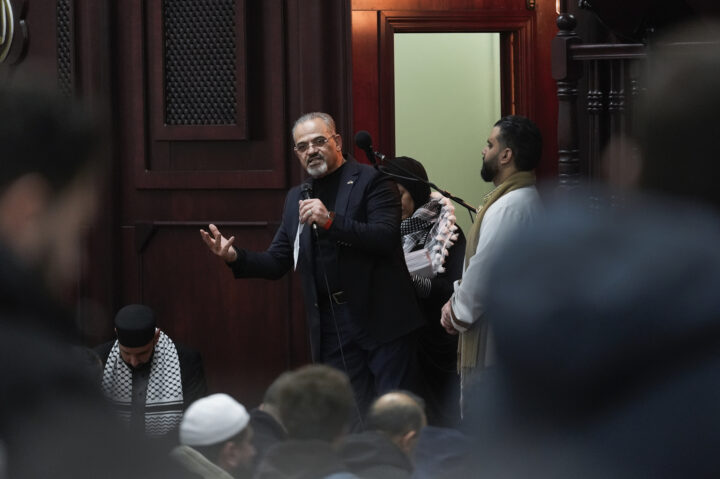
Khalid Turaani, co-chair of the Abandon Biden campaign in Michigan, speaks at the Islamic Center of Detroit in Detroit, Friday, Jan. 26, 2024.
The executive director of the Council on American-Islamic Relations’ Ohio branch moderated an online event last week featuring a Hamas official designated as a terrorist by the Treasury Department, as well as other Hamas and Palestinian Islamic Jihad members.
The Beirut-based think tank Al-Zaytouna Centre for Studies and Consultations hosted an event in Arabic last week titled “Palestinians Abroad and Regional International Strategic Transformations in Light of Operation Al-Aksa Flood,” using Hamas’ name for its Oct. 7, 2023, attacks on southern Israel.
Among the speakers at the web conference was Majed al-Zeer, who was designated by the Treasury Department in October 2024 as “the senior Hamas representative in Germany, who is also one of the senior Hamas members in Europe and has played a central role in the terrorist group’s European fundraising.”
Al-Zeer said that “the resistance” is key to maintaining the momentum of a “strategic shift” in how Europe and the world views the Palestinian issue.
Palestinian Islamic Jihad financier Sami al-Arian, a former University of South Florida computer science professor who was deported from the U.S. in 2015 due to his ties to the terrorist group, said on the same panel as Al-Zeer that “the overall Palestinian situation is much better strategically than it was before the flood [Oct. 7].”
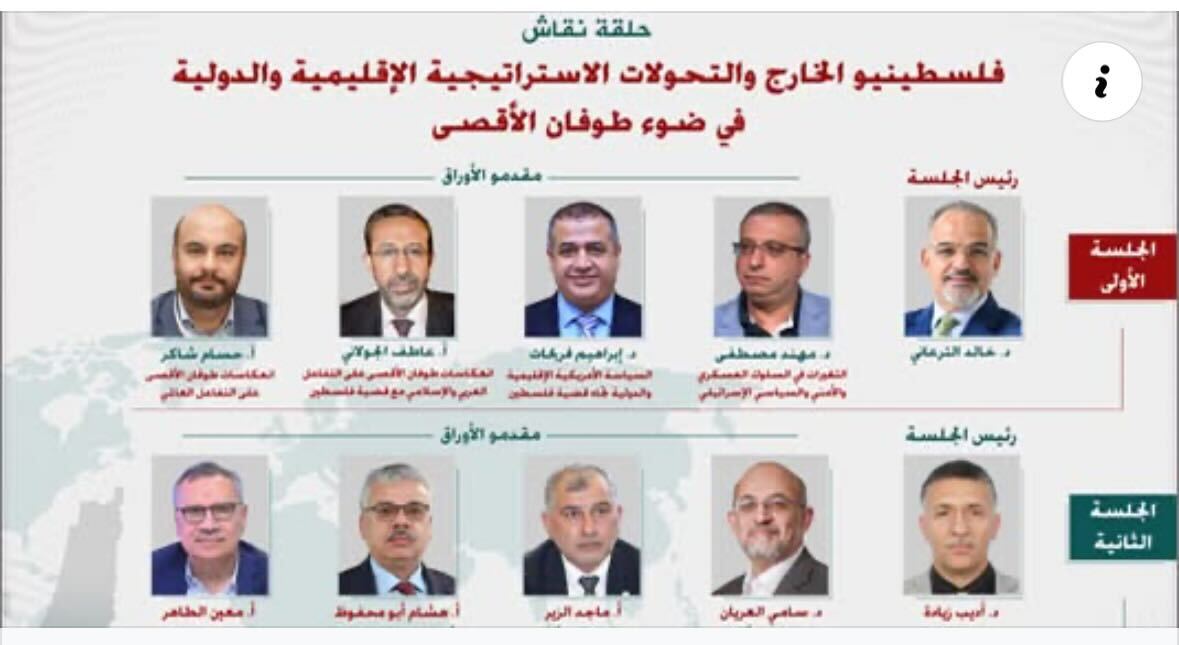
CAIR-Ohio Director Khalid Turaani moderated one panel with commentary provided by Ziad el-Aloul, who is active in several Hamas-affiliated organizations in Europe, including the Popular Conference for Palestinians Abroad, which was designated a terrorist group by Israel in 2021 for its work on behalf of Hamas. More recently, PCPA was found to be involved in facilitating the Global Sumud Flotilla that attempted to sail to Gaza with climate activist Greta Thunberg on board.
Another speaker in the Turaani-led panel expressed hope that the Turkish army would deploy in Gaza and fight the IDF.
The CAIR-Ohio director’s participation in a conference with senior Hamas and Palestinian Islamic Jihad figures came two months after Sen. Tom Cotton (R-AR) called for an IRS investigation into the organization and the revocation of its 501(c)(3) nonprofit status, citing alleged “ties to terrorist organizations like Hamas and the Muslim Brotherhood.”
CAIR did not respond to a request for comment.
The World Food Program executive director posted a video from Gaza where she said the enclave is ‘at a breaking point’
Hani Alshaer/Anadolu via Getty Images
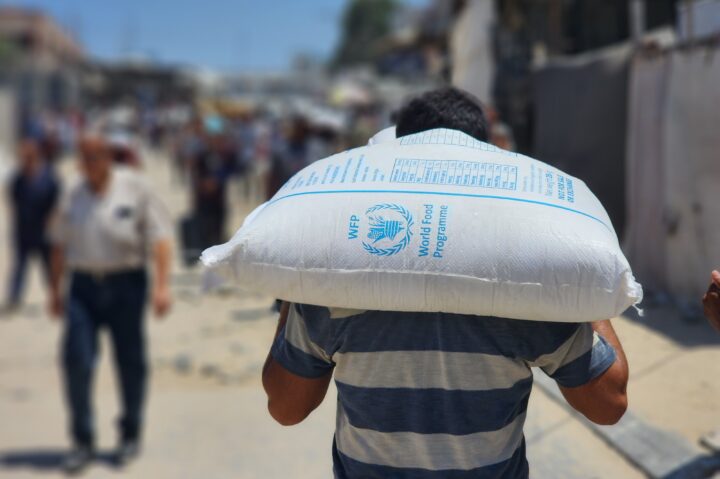
Palestinians receive aid from the World Food Programme (WFP) in Khan Yunis, Gaza on July 23, 2025.
Humanitarian aid to Gaza must only go to civilians, Israeli Prime Minister Benjamin Netanyahu and World Food Program Executive Director Cindy McCain said in a joint statement following their meeting on Thursday.
“It was agreed that every effort must be made to ensure that humanitarian aid reaches the most vulnerable people where they are, and that humanitarian aid is provided exclusively to civilians,” they stated.
The statement comes as Israel and U.N. agencies have been at odds over humanitarian aid distribution in Gaza, where there have been widespread reports of food shortages. Israel has pointed to looting and hoarding of food by Hamas as a major source of the problem, and has supported the efforts of the Gaza Humanitarian Foundation since May to distribute food without the terrorist group interdicting it.
U.N. aid agencies, like the WFP, have refused to accept Israeli security for their food deliveries or to work with the GHF or any other alternatives to UNRWA, the U.N. refugee agency for Palestinians, which Israel has outlawed. Some UNRWA employees took part in the Oct. 7, 2023 attacks on Israel and were Hamas fighters, and Hamas has used UNRWA facilities and resources in the war.
The joint statement from Netanyahu and McCain said that they “discussed the importance of protecting civilians from hunger and malnutrition and ensuring that their basic essential needs are met.”
“They noted the increase in humanitarian aid into Gaza over the last month and agreed to redouble efforts to expedite and sustain the entry of humanitarian goods into Gaza given the dire needs on the ground,” the statement reads.
McCain warned in an earlier post on X that “Gaza is at a breaking point.”
She recorded a video from the city of Deir el Balah in central Gaza, where she said that “famine is expected in the coming weeks if food doesn’t reach the thousands of starving families here fast enough.”
“The desperation here is overwhelming. We can reach them. We need safe routes and sustained access. We must deliver at the scale this crisis demands,” McCain stated.
McCain met with IDF Chief of Staff (Lt.-Gen.) Eyal Zamir and Maj.-Gen. Ghassan Alian, the head of COGAT, the IDF unit responsible for overseeing humanitarian aid, on Wednesday, who “emphasized the IDF’s commitment to preventing famine and doing everything in its power to continue enabling humanitarian aid to reach the civilian population directly, rather than Hamas,” the IDF stated.
She also met with Palestinian Authority Prime Minister Mohammad Mustafa in Ramallah.
Please log in if you already have a subscription, or subscribe to access the latest updates.
 Continue with Google

 Continue with Apple