

















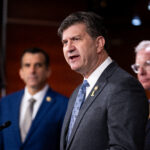

Moss said that audio allegedly depicting him expressing loyalty to Israel over the U.S. is ‘manipulated’ and includes ‘things I never did and never would say’
Courtesy Jeremy moss
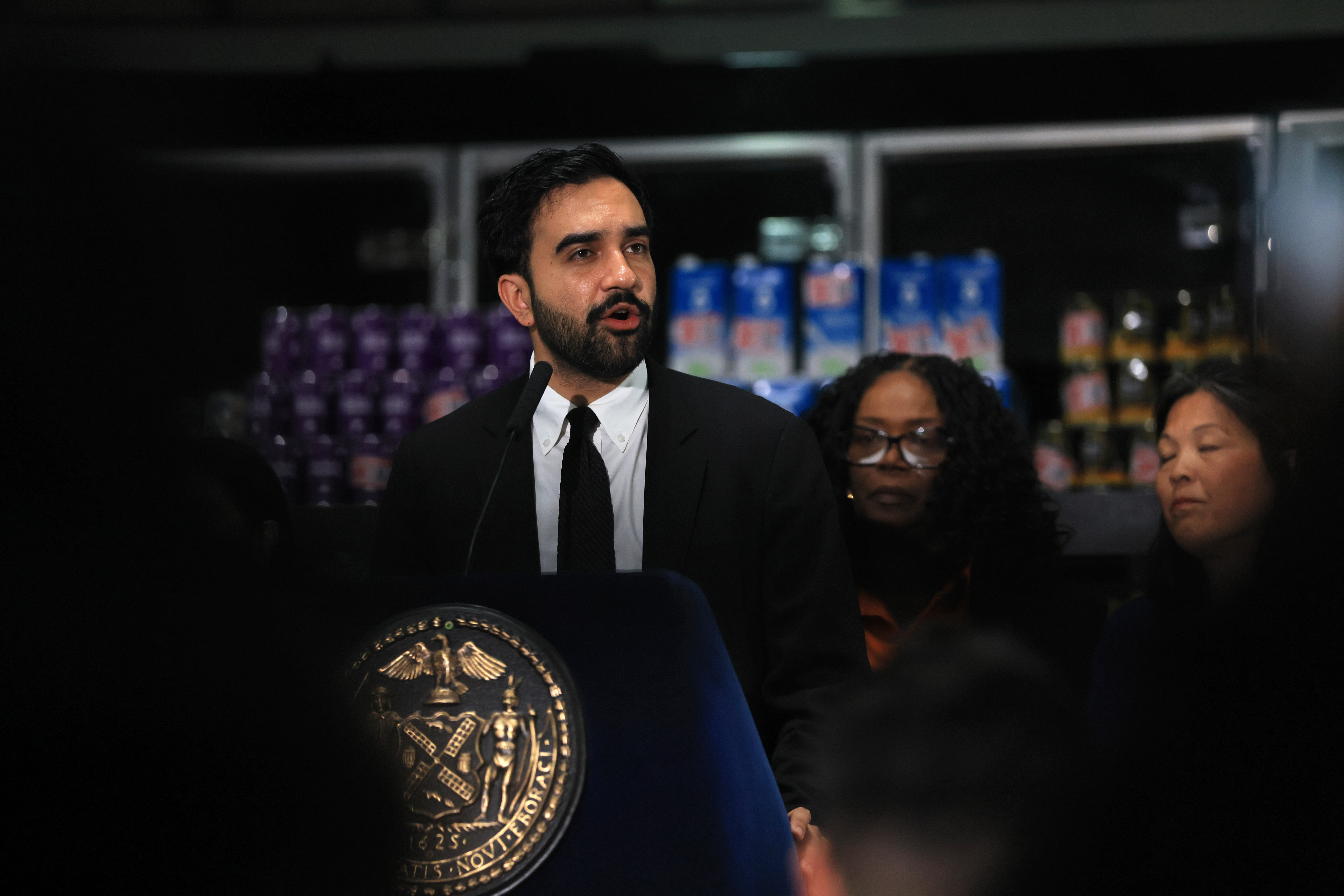
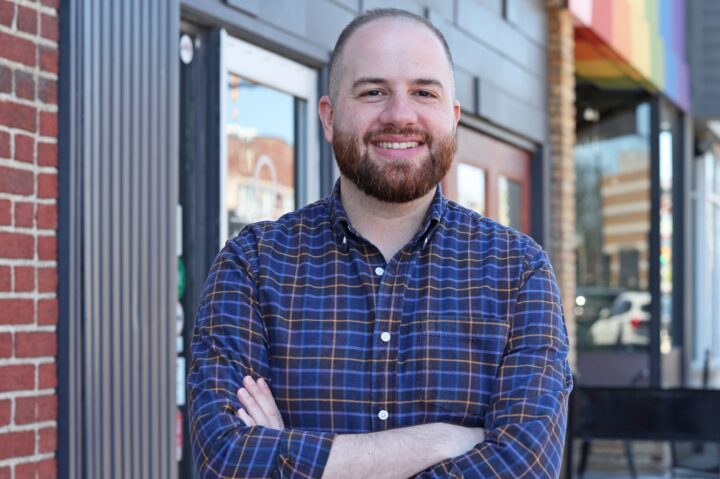
Democratic Michigan state Sen. Jeremy Moss


 Add JewishInsider on Google
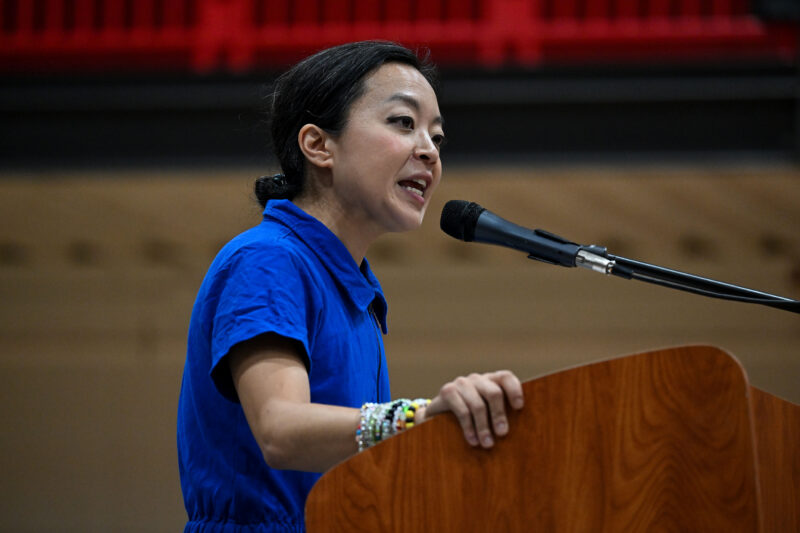
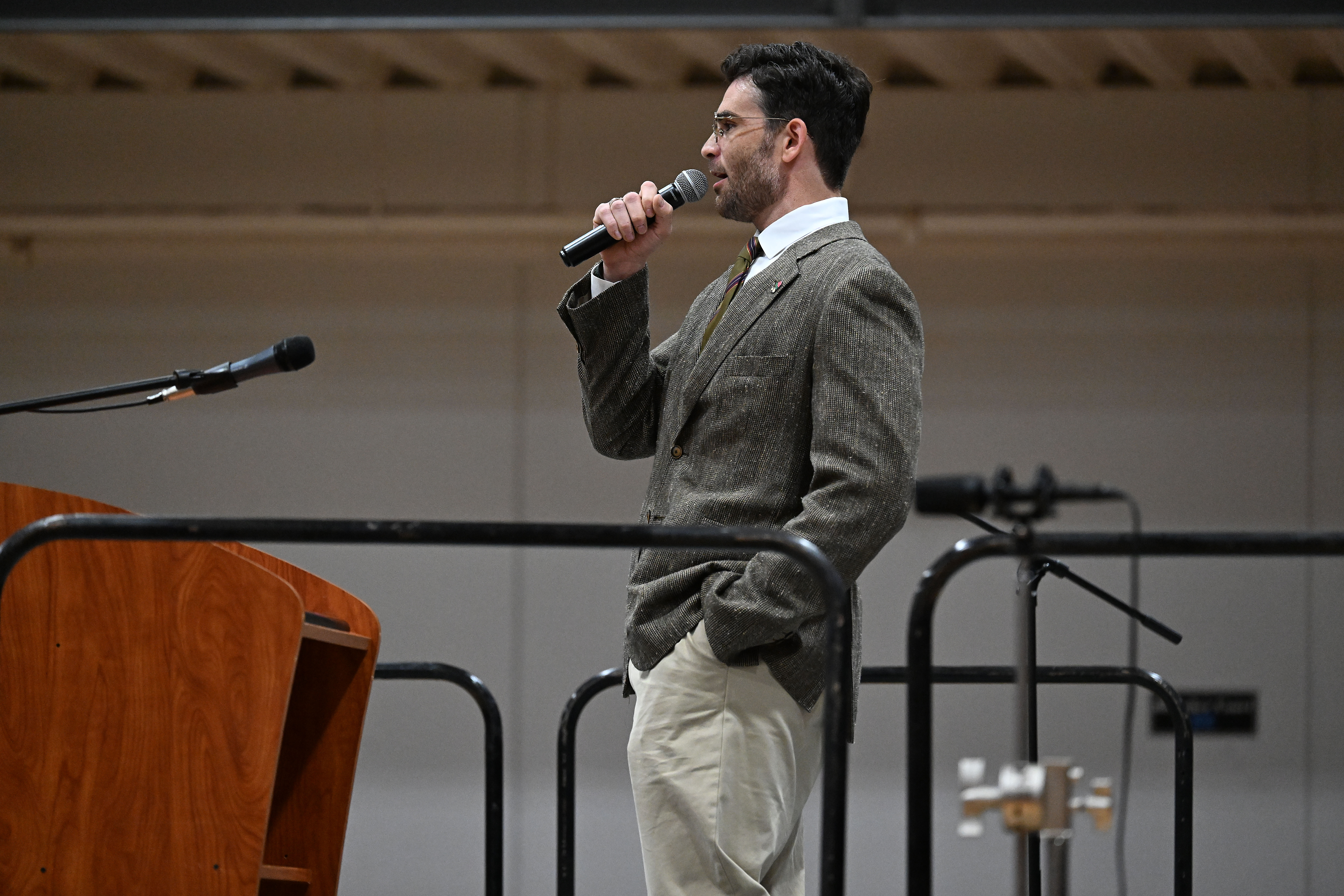
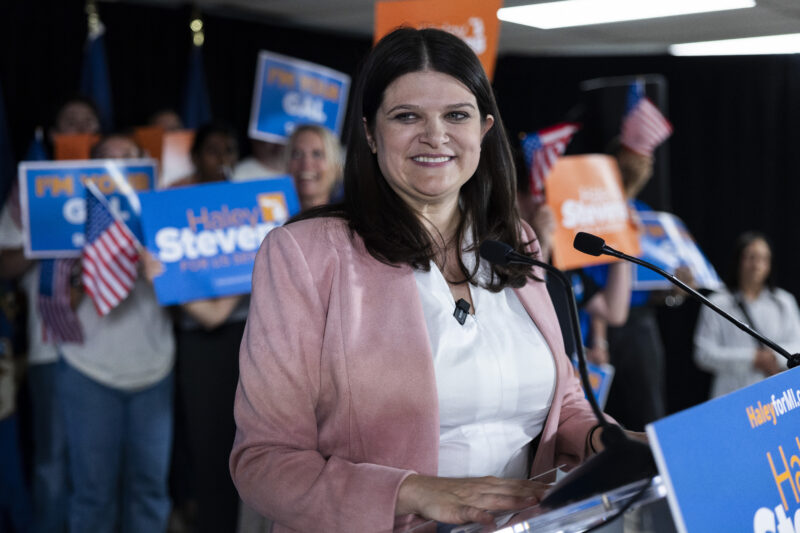
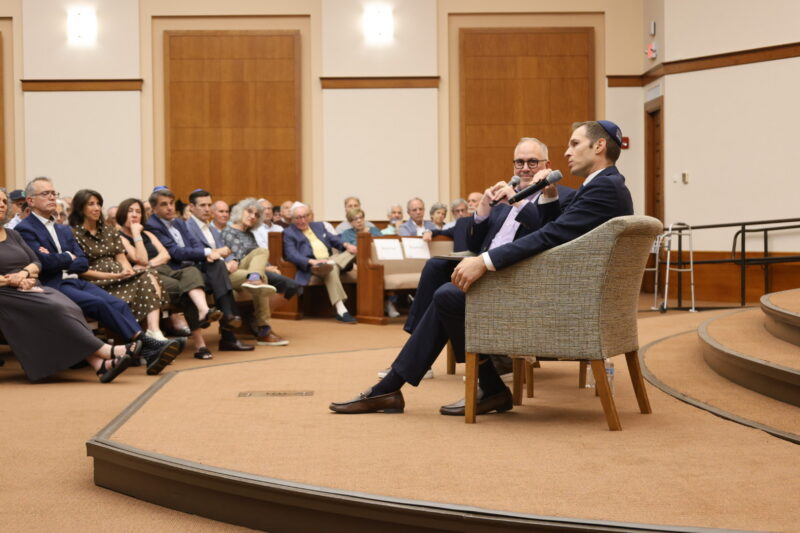
Michigan state Sen. Jeremy Moss, the Democratic nominee in Michigan’s 11th Congressional District, pushed back on Tuesday against what Moss alleged was a doctored audio clip circulating online designed to portray him as more loyal to Israel than the United States.
“There is a manipulated and unsourced audio, with things I never did and never would say, that is nothing more than political disinformation intended to portray me as anti-American,” Moss, who is Jewish, said on X. “It peddles in offensive tropes and lies — especially the lie of dual loyalty suggesting that Jews are never fully citizens of or loyal to their home countries.”
The unsourced and undated audio depicts Moss saying that the entire purpose of his campaign is to support Israel and that Jews should support Israel over the United States.
The original source of the audio is unclear, but it has been shared over the past few weeks on X by former Moss opponent Aisha Farooqi and by multiple antisemitic X accounts.
Ryan Grim, co-founder of the Hamas-sympathetic outlet Drop Site News, posted an alleged quote from the clip this week, but subsequently removed the post after acknowledging he had not verified the recording.
“We are in a dangerous era of disinformation. Circulating a lie because it affirms your bias or belief is equally bad whether it comes from the left or the right,” Moss said. “We all have a choice not to spread fabricated images, videos, and audio about candidates and campaigns. We all have a role in stopping the erosion of our democracy.”
“I’m a proud Michigander. I was born in Detroit. I grew up in Oakland County. I won’t stand for people using lies to diminish my American story and my career delivering for Michigan families,” Moss continued.
Moss has repeatedly faced attacks over his support for Israel, including from the Oakland University College Democrats, which refused to endorse him over his support for Israel. In an article about the decision, the news outlet The Midwesterner also shared the audio.
The swing-district nominee told JI she wouldn’t be campaigning with her fellow nominee Adam Hamawy, who has been dogged by past ties to Islamist extremists
Adam Gray/Bloomberg via Getty Images
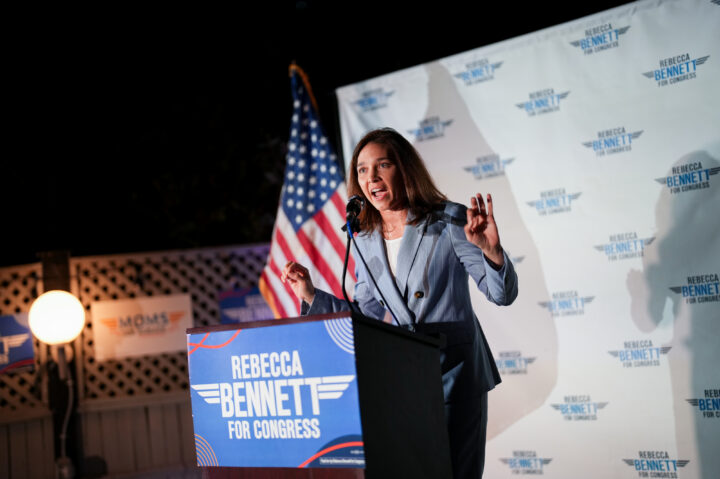
Rebecca Bennett, Democratic congressional candidate in New Jersey, during a primary election night event in Bridgewater, New Jersey, on June 2, 2026.
Rebecca Bennett, the Democratic nominee in New Jersey’s swing 7th Congressional District, distanced herself from a fellow Democratic nominee, Adam Hamawy, who is running in a neighboring district.
Hamawy has attracted national scrutiny over his past association with Omar Abdel-Rahman, the terrorist known as the Blind Sheikh, and his work for a charity in Bosnia that was subsequently shuttered as al-Qaida front group. Republicans have sought to tie Bennett, a military veteran running on a more moderate platform, to Hamawy, who is also a veteran.
“Rebecca Bennett is not going to campaign with or endorse Adam Hamawy this fall, as she is laser focused on flipping New Jersey’s seventh district, lowering costs, and getting corruption out of Washington,” a Bennett campaign spokesperson told Jewish Insider.
Bennett has carved out a relatively moderate and pro-Israel platform. She’s set to face Rep. Tom Kean Jr. (R-NJ) in the November midterm election, after a commanding win in the Democratic primary earlier this summer.
Hamawy’s campaign has said in statements that his “entire career and life have been defined by his patriotism and deep love of this country,” and described his testimony in defense of the Blind Sheikh as his “civic and legal duty,” carried out while Hamawy was a member of the Army. It also has brushed off criticisms of his involvement with the al-Qaida-tied charity as “desperate,” “absurd” and “gross and bigoted.”
Potential replacements for Platner are lining up to be considered as his successor
Laura Brett/Getty Images
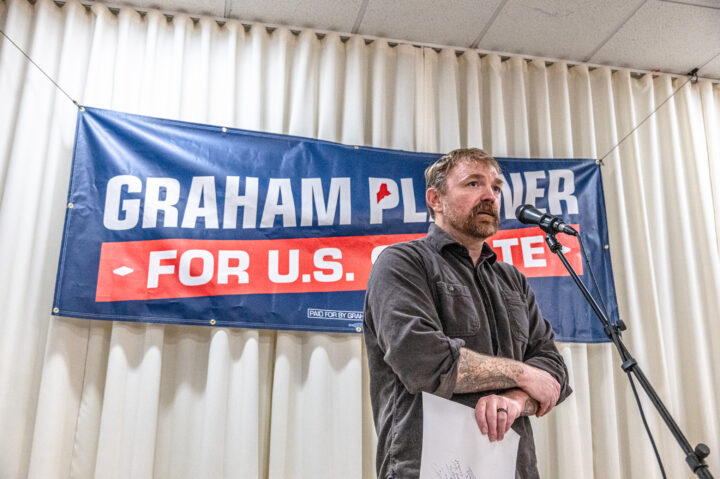
Democratic U.S. Senate candidate Graham Platner speaks to voters at a town hall at the Elks Lodge 188 on June 7, 2026 in Portland, Maine.
The Maine Democratic Party accused Senate candidate Graham Platner on Tuesday of attempting to “put his thumb on the scale” to influence whom the party chooses to replace him on the ticket, as a growing wave of Democrats in the state position themselves to run for the seat.
The charge by party officials comes a day after a former romantic partner accused Platner of sexual assault and as many of his key supporters urge him to suspend his campaign.
Additional allegations of nonconsensual sexual conduct emerged on Tuesday, in a new Washington Post interview with another former romantic partner of Platner who had previously accused him of domestic abuse. Platner’s campaign has denied all of the allegations.
In a striking video statement released on Tuesday evening, the Maine Democratic Party’s executive director, Devon Murphy-Anderson, said that Platner’s team had “repeatedly reached out to us in an attempt to put their thumb on the scale of what this process looks like.”
“We have repeatedly reiterated to Graham Platner’s team that they have no role in determining our next Democratic nominee for the U.S. Senate, nor in determining what this process looks like,” Murphy-Anderson continued. “We have also reiterated that Graham Platner must drop out of this race, so that Democrats in Maine can focus on defeating Susan Collins this November.”
Murphy-Anderson said the party is developing a new nomination process “that is open, inclusive, transparent and fair,” and that it will lay out that process once Platner drops out.
Multiple outlets have reported that Platner and his advisors are slow-walking an exit from the race, either attempting to ride out the latest scandal or force the party to nominate an approved ally in his place.
The New York Post reported that Morris Katz, a top advisor to Platner, urged him to remain in the race, but Katz said that the Post was not in a position to know about his or the campaign’s deliberations, without directly denying the report.
A Platner campaign spokesperson denied any efforts to influence the replacement process and said Platner wouldn’t want to be part of it but also said “he would want to make sure the voters and volunteers make this decision — not the political establishment.”
Several Democrats who previously ran in the U.S. Senate or gubernatorial primaries have publicly positioned themselves to run for the seat upon Platner’s withdrawal, including former Maine Centers for Disease Control director Nirav Shah, former state Senate President Troy Jackson, former House candidate Jordan Wood, former Senate candidate David Costello, Secretary of State Shenna Bellows and former House candidate Paige Loud.
State Rep. Valli Geiger, a close Platner ally, has also expressed interest and said she would bring on Platner’s staff to her campaign. She said that Planter was “trying to leverage things” to make sure “there is an economic populist who takes his place.”
Retiring Rep. Jared Golden (D-ME) is reportedly fielding calls about the race, but his spokesperson again ruled out a run.
Gov. Janet Mills, who finished in a distant second to Platner in the Senate primary after suspending her campaign, hasn’t addressed the latest allegations or publicly expressed any interest in rejoining the race.
Some erstwhile Platner allies argue that the nomination should pass to an ideologically aligned candidate, with many pointing to Jackson, who was endorsed by the Democratic Socialists of America in his gubernatorial bid, as their preferred successor.
Others, such as Shah, argue that the party should undergo a new nominating process. Shah called for at least one televised debate and multiple town halls across the state for the new candidate.
On Monday, amid speculation that he could be a potential replacement for Platner, Shah said on X that he would not support U.S. aid to Israel and that he believes the country is committing genocide.
Bellows ran against Collins in 2014 and lost by more than 35 percentage points.
The New York Times reported that the Maine Democratic Party plans to hold a “pop-up convention” or statewide caucus on July 25 to select the new nominee, rather than leaving the choice to party leadership alone.
Also on Tuesday, Platner’s campaign lost the remaining major supporters he had maintained.
Sen. Bernie Sanders (I-VT), perhaps Platner’s most crucial Senate endorser, was the last of his prominent supporters to call on him to withdraw from the race, a day after the Maine Democratic Party and Senate Democratic leadership pulled their support, alongside many other Platner supporters.
“I have spoken with Graham Platner about the best path forward for Maine,” Sanders said in a statement. “In light of these very serious allegations, I have recommended that he step aside.”
Sen. Chris Van Hollen (D-MD), another holdout, also called for Platner to exit the race. “These allegations are serious and cannot be ignored. Graham Platner should step aside,” Van Hollen said.
New York City Mayor Zohran Mamdani, whose political rise was shaped by many of the same consultants as Platner’s campaign, likewise urged Platner to leave the race.
Despite not having made any public announcement, Platner’s campaign reportedly canceled all of its upcoming fundraisers and pulled its ads on Facebook and Instagram, signs that the campaign is preparing to wind down.
Attorney General Phil Weiser, the Democratic nominee for governor, made the comments after she declined to call the Boulder firebombing antisemitic
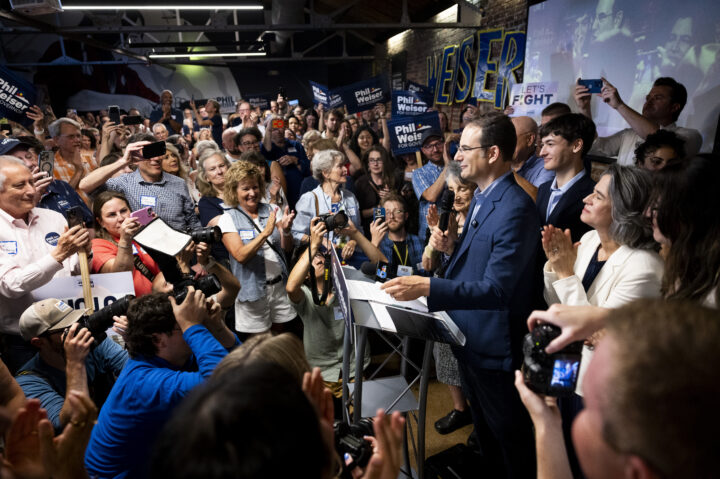
Photo by Michael Ciaglo/Getty Images
Colorado gubernatorial candidate, state Attorney General Phil Weiser speaks at an election-night watch party after winning the Democratic primary, at Ace Eat Serve on June 30, 2026 in Denver, Colorado.
Colorado Attorney General Phil Weiser, the Democratic nominee for governor, criticized his party’s socialist congressional nominee Melat Kiros for her refusal to describe the deadly firebombing of a Boulder, Colo., hostage awareness march last year as an act of antisemitism.
Kiros, speaking last week to 9News, a local channel, declined to call the attack antisemitic, because “I don’t know what was in the heart of the perpetrator. … I don’t know what his intentions were.”
Melat Kiros, a DSA-backed congressional candidate in Colorado, declined to call the Boulder firebombing attack antisemitic in an interview with the local channel 9News.
— Jewish Insider (@jewishinsider) June 26, 2026
"I don't know what was in the heart of the perpetrator," Kiros said.
Read more: https://t.co/rtQDjet1sl pic.twitter.com/jcK9qsMhH5
Weiser, who is Jewish, said in an interview with the same channel that he was concerned by Kiros’ comments, noting that he was personally friendly with Karen Diamond, the Holocaust survivor killed in the attack, and her husband.
“What happened on June 1 in Boulder was an antisemitic attack,” Weiser said. “We cannot look at that murder and say anything else happened than a hate crime, and so if someone isn’t going to acknowledge that I’m concerned about that, because this was tried, this was how we have a conviction” for a hate crime.
He said that he hasn’t spoken to Kiros yet, but when he does, he would raise his concerns about her comments.
“You hear it a lot in the context of Black Lives Matter — now we’re talking Jewish lives matter,” Weiser said. “Black Lives Matter, period. Black Lives Matter — Elijah McClain’s life mattered. Period. You don’t put a comma. Jewish lives matter. Karen Diamond’s life mattered. You don’t put a comma, an ‘and’ or a ‘but.’ Period.”
In a CNN interview on Wednesday, Kiros described the attack as “a horrific attack on a group of Jewish people that were engaging in peaceful protest” which “made many Jewish people … feel incredibly unsafe” but she again declined to directly call the attack antisemitic.
“The fact of the matter is, is that this conflation between the actions of the state of Israel and Judaism and the Jewish people is making Jewish people less safe. It is leading to a rise in antisemitism that’s taking place all across our country,” Kiros said. “My commitment is to protecting the sanctity and dignity of life for everyone. That means standing strong, side-by-side to our Jewish brothers and sisters and neighbors, to make sure that they are protected against this rising hate and this rising antisemitism.”
Pressed again on why she didn’t call the attack antisemitic, Kiros insinuated that Israel’s military actions in Gaza were to blame for the attack.
“What we’re talking about here is attacks that are taking place on the Jewish community as a result of the actions that are taking place in Palestine, the genocide that is taking place in Palestine, actively making Jewish people less safe in our city and across our country,” she said.
She repeated that “our commitment has to be to combating that hate, combating the conflation between the actions of the state and the Jewish people and standing against this antisemitism.”
Kiros’ campaign did not immediately respond to requests for comment.
The candidates’ views on Israel did not define the mayoral race, but they were a throughline in the background
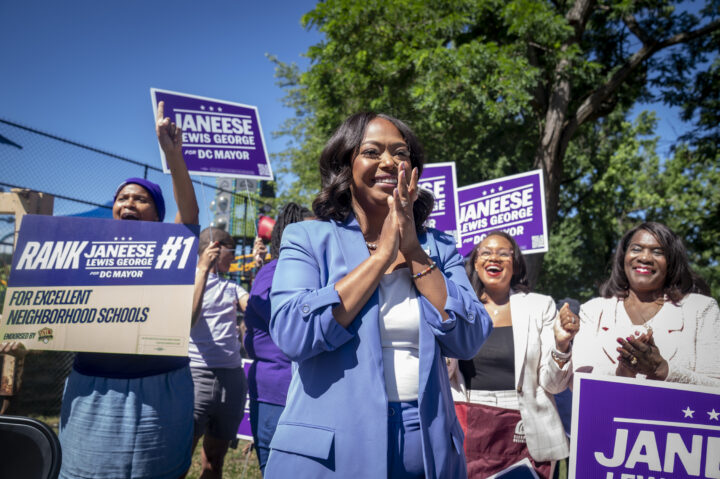
Maxine Wallace/The Washington Post via Getty Images
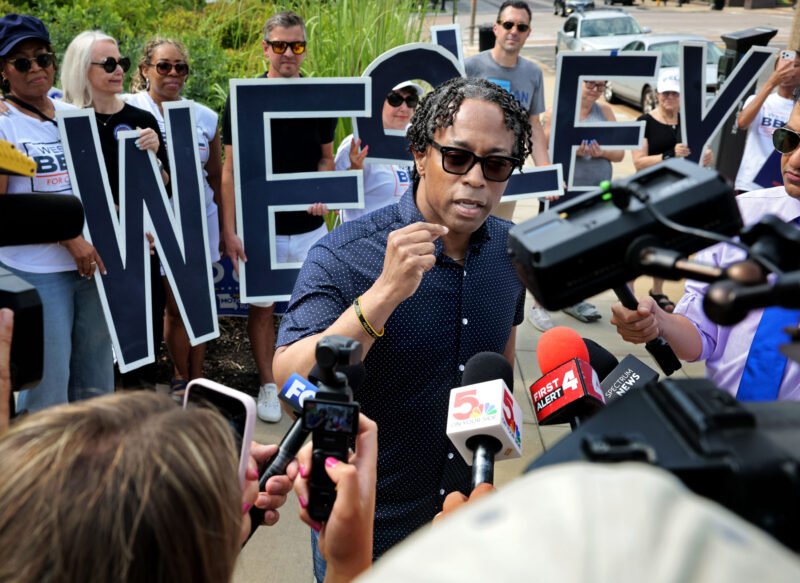
Janeese Lewis George volunteers continue to campaign for her at the Benning Stoddert Recreation Center on June 16,2026 in Washington, DC.
Voters in Washington, D.C., appeared poised to select Councilmember Janeese Lewis George to be their Democratic nominee for mayor, all but guaranteeing that she will be elected in November to replace Mayor Muriel Bowser, who is not seeking another term after 12 years in office. The race has not been called, but Lewis George leads by more than 15,000 votes with 64% of the votes counted.
Lewis George, a 38-year-old member of the Democratic Socialists of America, ran a campaign powered by local labor unions that was focused on cost-of-living issues and countering President Donald Trump. She is on track to defeat Kenyan McDuffie, a former councilmember who ran on a more pragmatic platform that eschewed DSA’s brand of radical politics.
The candidates’ views on Israel did not define the race, but they were a throughline in the background. Lewis George filled out a DSA endorsement questionnaire early in the campaign in which she pledged to avoid engaging with “the Israeli government or Zionist lobby groups.” Later, she promised to stand firm in fighting antisemitism while also supporting Palestinian human rights. McDuffie tried to use the comments to appeal to anti-DSA voters and Jewish Washingtonians.
Lewis George will represent a shift from Bowser, a moderate Democrat who in 2019 led a trade mission to Israel and who regularly addressed the annual AIPAC policy conference in Washington before AIPAC canceled the event after 2020.
Elsewhere in Washington, Councilmember Robert White was elected in the Democratic primary to serve as Washington’s delegate to Congress, a nonvoting role. He’ll succeed Rep. Eleanor Holmes Norton, who is retiring after 35 years.
Aparna Raj, a DSA-backed candidate for D.C. Council, appeared likely to win the Democratic primary for Ward 1, a district that includes the neighborhoods of Adams Morgan and Columbia Heights. She told the D.C. Jewish Community Relations Council in a voter guide released last month that she “will not work with AIPAC or organizations whose mission is to lobby for pro-Israel policies.”
Meanwhile, it was a short night in Georgia, where Rep. Mike Collins (R-GA) quickly claimed victory over former college football coach Derek Dooley in a Senate primary runoff. Collins picked up a last-minute endorsement from President Donald Trump, while Dooley’s backing by Gov. Brian Kemp wasn’t enough to push him to victory.
Collins ultimately finished the race around 10 points ahead of Dooley, a similar margin as in the primary election earlier this year. Dooley dominated in Atlanta and Athens, Ga., home of the University of Georgia, while Collins led around the rest of the state.
Dooley was widely seen as the more moderate and more electable of the two Republicans, as compared to Collins, who has been trailed by a series of scandals. Republicans may struggle to reclaim the seat from Sen. Jon Ossoff (D-GA) with Collins as their standard-bearer in the race.
The race may also present a difficult choice for Jewish voters in the state, many of whom have been frustrated by Ossoff’s leftward turn on Israel issues and repeated votes to block arms sales. Some Jewish Ossoff donors sought, earlier in the cycle, to recruit Kemp to run for the seat.
But Collins might not be a palatable alternative for some Jewish voters, having endorsed a post by an antisemitic X account attacking a reporter for being Jewish. His current chief of staff was also recently revealed to be part of a group chat with several white nationalists, where he discussed his efforts to use his congressional influence to free a Holocaust denying far-right activist from prison. He also opposed the Antisemitism Awareness Act.
Many prominent Jewish conservatives supported Dooley in the primary, but could line up behind Collins for the general, given his consistently pro-Israel voting record in the House.
Already, some commentators are discussing the possibility that a decisive victory by Ossoff in the critical swing state could massively boost the rising Democratic star’s chances in the 2028 presidential primary, should he decide to throw his hat in the ring.
House Foreign Affairs Committee ranking member Greg Meeks said of the Democratic N.J. congressional nominee, ‘I don’t like to talk about somebody I don’t know’
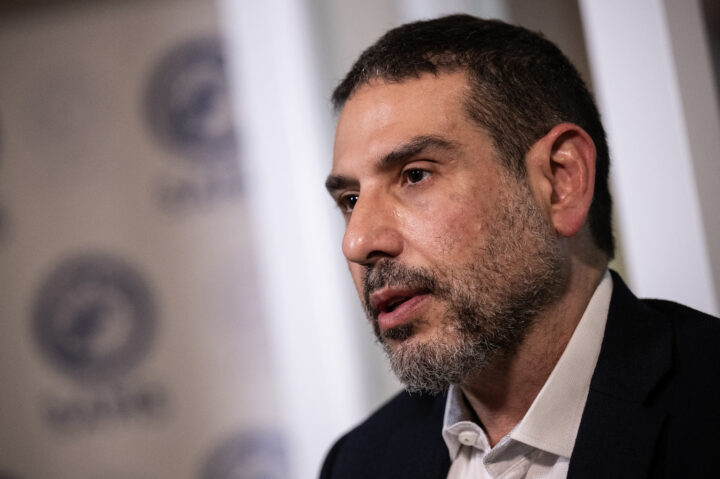
DREW ANGERER/AFP via Getty Images
Dr. Adam Hamawy speaks during an AFP interview after meetings on Capitol Hill, in Washington DC, on June 14, 2024.
Top House Democrats are mostly avoiding questions about Adam Hamawy, the controversial Democratic nominee in New Jersey’s 12th Congressional District, saying they are unfamiliar with his background, including his association with Omar Abdel-Rahman, the terrorist mastermind known as the Blind Sheikh, and his service with a nonprofit organization in Bosnia shuttered as an al-Qaida front group.
A small number of moderate Jewish Democrats have spoken out against Hamawy, expressing concerns about his potential elevation to the House, and frustration with what his and others’ rise signals about the state of the Democratic Party.
House Minority Leader Hakeem Jeffries (D-NY), who congratulated Hamawy on his victory last week — as he traditionally does with most Democratic nominees — sidestepped multiple questions about him in an interview on Fox News’ “The Sunday Briefing” this weekend.
“I haven’t spoken to him, he’s going to have to speak for himself and address these allegations,” Jeffries said in response to a question about Hamawy’s testimony in defense of Abdel-Rahman, before criticizing the administration over the war in Iran and high gas prices.
Asked again, he criticized Republicans for their own controversial comments, and the administration over cost-of-living issues.
Though some Democrats and high-ranking Republicans have raised concerns about Hamawy’s fitness to serve on committees related to national security, Democrats poised to lead some of those committees told Jewish Insider they aren’t familiar with him.
Rep. Greg Meeks (D-NY), the ranking member of the House Foreign Affairs Committee, told JI he hadn’t been following Hamawy’s primary race and hadn’t yet spoken with him.
“I’d have to have a conversation with someone like Bonnie Watson Coleman or somebody that might know him, or tell me a little bit about it before I can say anything in that regard,” Meeks said, referring to the retiring congresswoman whom Hamawy is seeking to replace. “I don’t like to talk about somebody I don’t know, and I’ve not looked at his background or anything else of that nature.”
Rep. Jim Himes (D-CT) declined to comment last week, saying he did not know enough about Hamawy to discuss the situation.
Other Democrats, including Reps. Josh Gottheimer (D-NJ) and Jared Moskowitz (D-FL), have expressed concerns about Hamawy and his election, and Rep. Greg Landsman (D-OH) joined them this week.
“I’m a simple guy, and want leaders that will help us fix this broken economy and keep Americans safe … and who don’t have Nazi tattoos or close ties with convicted terrorists. It’s really not too much to ask,” Landsman told JI.
Rep. Brad Schneider (D-IL) said when asked about Hamawy’s fitness to serve on national security-related committees, “We’ll cross those bridges when we get there.”
“I have concerns about his past associations, and we’ll measure him on what he does, if and when he gets here,” Schneider, a co-chair of the Congressional Jewish Caucus, told JI. “That was a decision the voters of New Jersey made. That’s how our democracy works.”
Hamawy’s campaign has insisted in statements that his “entire career and life have been defined by his patriotism and deep love of this country,” and described his testimony in defense of the Blind Sheikh as his “civic and legal duty,” carried out while Hamawy was a member of the Army.
“At the time, the man in question was one of very few religious figures in what was then a very small Muslim community in New Jersey — he saw him speak in religious settings in his early 20s. Dr. Hamawy condemns that man’s violent rhetoric and actions, and all violence, hatred and terrorism — and he will always. Dr. Hamawy had no contact with this person after they were arrested.”
The campaign has dismissed criticisms of his involvement with Benevolence International, the organization closed down as an al-Qaida front years after he volunteered, as “desperate,” “absurd” and “gross and bigoted.” It has stated that he volunteered to provide medical assistance to victims of the Bosnian genocide, and that Benevolence International was approved at the time by the Bosnian mission to the United States and the United Nations.
‘Anybody that's tied to that should never be elected to Congress, and if he is, I think should never serve on a national security committee,’ Rep. Michael McCaul told JI
DREW ANGERER/AFP via Getty Images
Dr. Adam Hamawy speaks during an AFP interview after meetings on Capitol Hill, in Washington DC, on June 14, 2024.
Some lawmakers are warning that the past terrorist ties of Adam Hamawy, the Democratic nominee in New Jersey’s 12th Congressional District expected to be elected to the House in November, could pose a national security risk and that he should be barred from serving on sensitive committees working on national security issues.
Hamawy was an associate of convicted terrorist mastermind Omar Abdel-Rahman, known as the Blind Sheikh, and testified in Abdel-Rahman’s defense when he was on trial for his involvement in a series of terrorist attacks in New York City. Hamawy also volunteered for the Benevolence International Foundation, a charity operating in Bosnia that was later shuttered as an al-Qaida front.
He also volunteered at the European Hospital in Gaza during Israel’s war with Hamas, denying when he returned that there was any terrorist activity at the hospital or any tunnels underneath it. Israel killed Hamas leader Mohammed Sinwar in a tunnel system under the hospital.
Members of Congress are exempt from usual security clearance vetting procedures applied to other federal officials, and all members are able to access certain House-wide classified briefings.
But members serving on several key committees touching on national security and foreign policy, such as the Foreign Affairs, Armed Services and Intelligence Committees, have more regular access to a much wider range of classified briefings and information. Caucus leadership is responsible for assigning committee posts.
Some of Hamawy’s potential future colleagues — largely Republicans — say that Hamawy should be barred from those committee postings if he’s elected. As a military veteran and having focused much of his campaign on foreign policy issues, Hamawy would ordinarily be a likely candidate for such committee assignments.
Rep. Michael McCaul (R-TX), the former chair of the Foreign Affairs and Homeland Security committees and a former U.S. attorney focused on counterterrorism and national security, told Jewish Insider that Hamawy “should be barred from any national security committee.”
“The Blind Sheikh, Ramsey Youssef, the ‘93 World Trade Center bombing — the original plot was to hit 12 Jewish synagogues simultaneously, symbolic of the 12 tribes of Israel,” McCaul said, “and so anybody that’s tied to that should never be elected to Congress, and if he is, I think should never serve on a national security committee — because then you get access to classified information.”
In a statement to JI, a campaign spokesperson said, “Hamawy’s entire career and life have been defined by his patriotism and deep love of this country,” and emphasized that he was in the military during the time of the Blind Sheikh trial.
“As a witness, he performed his civic and legal duty to testify truthfully under oath and contribute to the system of laws and justice he defended while serving our country in the Army,” the statement, similar to ones the campaign has provided in the past, continued. “At the time, the man in question was one of very few religious figures in what was then a very small Muslim community in New Jersey — he saw him speak in religious settings in his early 20s. Dr. Hamawy condemns that man’s violent rhetoric and actions, and all violence, hatred, and terrorism — and he will always. Dr. Hamawy had no contact with this person after they were arrested.”
The campaign also dismissed reporting on his relationship with the Blind Sheikh as “bad-faith, guilt-by-association attacks” started by a “designated hate [group].”
Rep. Jared Moskowitz (D-FL) said that Hamawy’s eligibility for national security posts “obviously … has to be a conversation we’ll have to have once we get past the general election.”
He also referenced his concerns about state Rep. Chris Rabb, a Democratic nominee in Philadelphia, and said that Democrats should hold Rabb to the same standard as former Rep. Marjorie Taylor Greene (R-GA) — after she shared “false flag” theories about the Marjory Stoneman Douglas High School mass shooting — for sharing a false flag conspiracy theory about the mass shooting at a Hanukkah gathering at Sydney’s Bondi Beach last December.
Rabb has disavowed and condemned the Bondi Beach post shared by his Instagram account, attributing it to a campaign contractor who has since been dismissed.
“We want to win elections, we want to win the House, we want to win the Senate,” Moskowitz said. “But expanding the tent to the point where we’re taking people in that don’t really share our values, I think, is a long-term mistake.”
Rep. Mike Lawler (R-NY) told reporters he has “significant concerns when you have somebody who affirmatively testified for the defense in the 1993 World Trade Center bombing, and volunteered for an organization that was a front for al-Qaida.”
He said that Hamawy’s past “raises significant questions that, frankly, I think he has not adequately addressed,” and that if Hamawy is elected, “there needs to be an investigation into his ties to these incidents and organizations, and that’s something that I don’t think people should take likely.”
Lawler stopped short of saying that Hamawy should be disqualified from service on any national security committee, saying again that there should be a “thorough investigation” and that he “certainly would have significant concerns about him serving on any committee, let alone in Congress.”
Rep. Anna Paulina Luna (R-FL) said on X that “there is no way [Hamawy] can have a security clearance. National security risk.”
House Minority Leader Hakeem Jeffries (D-NY), who congratulated Hamawy on Tuesday evening for his victory — as he traditionally does for Democratic House nominees around the country — told The Free Press on Wednesday that he hasn’t yet had a conversation with Hamawy about his past affiliations, but planned to speak to him some time on Wednesday.
House Speaker Mike Johnson (R-LA) said on X, “Not even ties to terrorists are too extreme for the modern day Democrat Party.”
‘We won’t support a Democrat who doesn’t represent the views and values of the vast majority of American Jews,’ Halie Soifer said
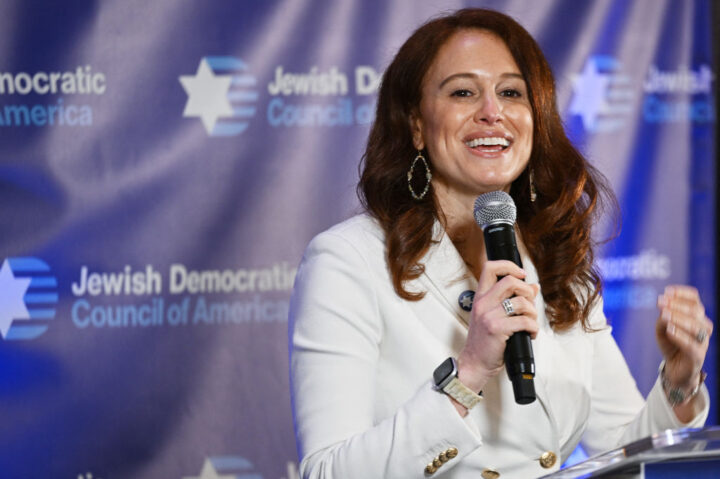
MANDEL NGAN/AFP via Getty Images
Jewish Democratic Council of America CEO Halie Soifer in Washington on May 24, 2023.
The Jewish Democratic Council of America is not ready to endorse Graham Platner, the controversial presumptive Democratic nominee in Maine’s Senate race, said Halie Soifer, the group’s CEO.
“We won’t support a Democrat who doesn’t represent the views and values of the vast majority of American Jews,” Soifer said in a statement. “JDCA has endorsed more than 120 candidates across the country who are fighting for the issues Jewish Americans care about and standing against antisemitism. It’s those many Democrats who have our backs, and we’ll have theirs as they work to defeat Republicans aligned with this White House whose views are antithetical to our values.”
Soifer additionally told The Forward on Thursday that Platner’s record of incendiary past comments and personal controversies are “reasons for concern” about his candidacy, saying that the far-left insurgent would first need to clarify his views to receive possible consideration from the group.
Reached by Jewish Insider on Thursday, Soifer confirmed JDCA’s position on the race but declined to comment further.
JDCA, a leading Jewish Democratic group, typically endorses most Democrats in major federal races, especially closely contested ones like the Senate seat in Maine.
The group had backed Maine Gov. Janet Mills in the June primary to unseat Sen. Susan Collins (R-ME). But Mills, the establishment favorite, said Thursday that she was suspending her campaign due to a lack of financial resources, clearing the way for Platner to secure the nomination in a race viewed by Democratic leaders as key to regaining control of the upper chamber.
Previously, JDCA had expressed criticism of Platner after it was revealed that he had a Nazi tattoo on his chest for nearly two decades. He has since removed the tattoo and claimed he was unaware of its links to Nazism until recently, even as a former acquaintance told JI that he had long known the icon represented a skull-and-crossbones known as a Totenkopf, adopted by an infamous SS unit.
“Hateful rhetoric and Nazi symbols must have no place in the Democratic Party, the Republican Party, or anywhere in our politics,” JDCA said last year after JI’s report. “Under any and all circumstances, it must be unacceptable to glorify Nazis or Nazism. Period.”
Platner’s hostile approach to Israel and demonization of AIPAC have also faced scrutiny among mainstream Jewish leaders at the state and national levels.
He has repeatedly accused Israel of committing genocide in Gaza and called for blocking U.S. aid to the Jewish state. In a past Reddit post recently uncovered by JI, the Marine veteran voiced admiration for Hamas’ tactics in a violent raid into Israel in 2014.
JDCA’s reservations over Platner’s campaign reflect ongoing discomfort among both Democratic and nonpartisan Jewish organizations that are now reckoning with the implications of his popularity in spite of the tattoo and other issues he has weathered.
The Anti-Defamation League as well as Maine’s Jewish federation have also raised concerns about Platner’s tattoo and past comments.
Platner, for his part, has pledged to engage further with the Jewish community, recently hosting a Seder in Maine that included the state chair of J Street, the progressive Israel advocacy group.
A spokesperson for J Street did not immediately respond to a request for comment on Thursday night about whether it would endorse Platner’s campaign.
‘I’m going to have a problem with any candidate — Democrat, Republican or independent — who shares antisemitic and hateful posts on social media,’ the Michigan senator said
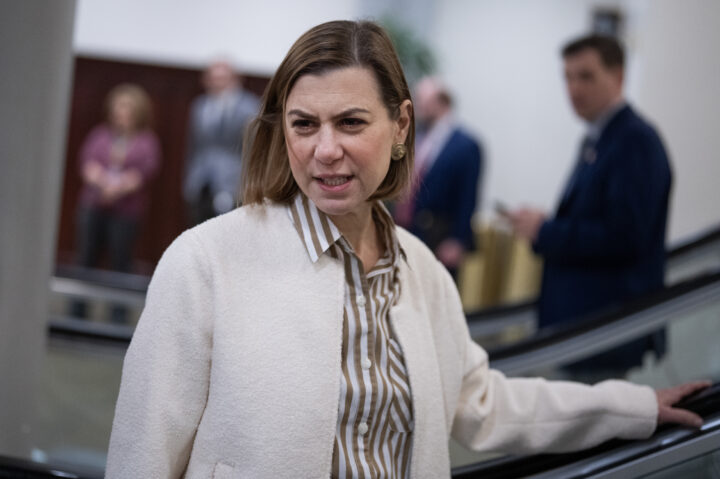
Tom Williams/CQ-Roll Call, Inc via Getty Images
Sen. Elissa Slotkin (D-MI) is seen in the U.S. Capitol on Thursday, March 26, 2026.
Sen. Elissa Slotkin (D-MI) joined other Michigan Democrats in condemning Amir Makled, a Democratic nominee for regent of the University of Michigan, over Makled’s past comments on social media expressing antisemitic sentiments and support for terrorism.
“I’m going to have a problem with any candidate — Democrat, Republican or independent — who shares antisemitic and hateful posts on social media. Especially when they refuse to disavow those comments or show remorse,” Slotkin said in a statement to Jewish Insider on Thursday, in response to a question about Makled.
Makled was nominated for the post at the Michigan Democratic Party convention last weekend, replacing Jewish and pro-Israel regent Jordan Acker, who has been repeatedly harassed and has had his home vandalized by anti-Israel campus activists.
The convention, which also featured aggressive heckling of pro-Israel speakers, has left prominent Jewish Democrats in the state feeling alienated and unmoored from their party.
Rep. Kristen McDonald Rivet (D-MI) similarly criticized Makled, and Sen. Gary Peters (D-MI) more broadly criticized the behavior of activists at the convention.
Mamdani’s pledge, announced at the last general election debate, is a signal of the DSA-backed candidate’s attempt to moderate on the issue of policing
Hiroko Masuike/The New York Times/Bloomberg via Getty Images
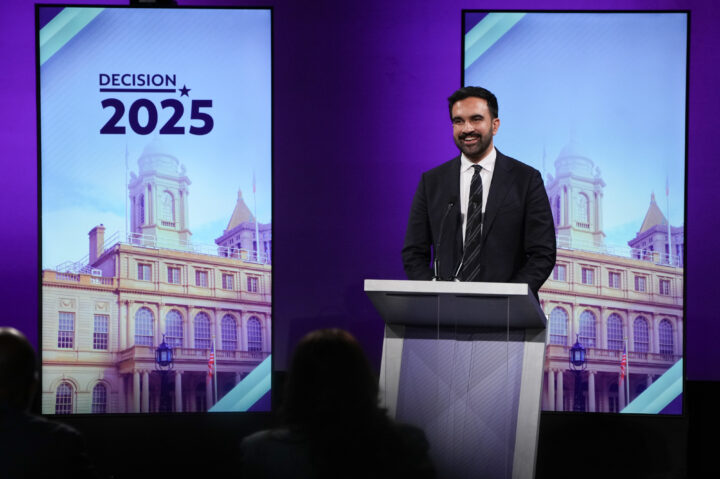
Zohran Mamdani, New York City mayoral candidate, during a mayoral debate in New York, US, on Wednesday, Oct. 22, 2025.
Zohran Mamdani, the Democratic nominee for mayor of New York City, confirmed that he would ask Jessica Tisch to stay on as the city’s police commissioner if elected, ending longstanding speculation over his plans for a key role in his potential administration.
Tisch, appointed last year by outgoing Mayor Eric Adams, “took on a broken status quo, started to deliver accountability, rooting out corruption and reducing crime across the five boroughs,” Mamdani said at the second and final general election debate on Wednesday evening.
“I have said time and again that my litmus test for that position will be excellence, and the alignment will be of that position,” Mamdani added. “And I am confident that under a Mamdani administration, we would continue to deliver on that same mission.”
Mamdani’s choice could assuage concerns among moderate Democrats and other crime-conscious New Yorkers who had been hopeful that he would choose Tisch, a widely respected technocrat who previously led the Department of Sanitation.
Tisch, 44, who is Jewish, has not said whether she would plan to continue in her position if Mamdani is elected on Nov. 4.
Mamdani, a 34-year-old democratic socialist and Queens state assemblyman, has faced scrutiny over his past comments on law enforcement — including support for defunding the police. He has moderated during his mayoral campaign and says he no longer backs such efforts, even as he has pledged to pursue some goals that could potentially fuel tension, such as launching a Department of Community Safety “to ensure that mental health experts” instead of police “are responding to the mental health crisis,” he said at the debate.
Mandani’s opponents, former New York Gov. Andrew Cuomo and Curtis Sliwa, also said they would not seek to replace Tisch, though Sliwa, the Republican nominee, said he did not think she would choose to remain in her role if Cuomo or Mamdani is elected. Cuomo, running as an independent, said he did not believe Mamdani would follow through on his promise.
“His position has been to defund, disband the police, she wouldn’t take that,” Cuomo claimed, saying “their philosophies are totally incongruous.”
Elsewhere in the debate Wednesday, Cuomo and Sliwa ramped up their attacks on Mamdani over his strident opposition to Israel and refusal to condemn calls to “globalize the intifada,” continued sources of concern among Jewish voters.
Cuomo, who has recently escalated his criticism of Mamdani to a more personal level, accused him of stoking “the flames of hatred against Jewish people” during a particularly heated moment at the debate — while Sliwa cast the Democratic frontrunner as an “arsonist who fans the flames of antisemitism.”
Mamdani, playing defense on an issue that represents one of his top vulnerabilities, said that there “is room for disagreement on many positions and many policies,” and pushed back against Sliwa’s claim that he supports “global jihad.”
“I’ve heard from New Yorkers about their fears about antisemitism in this city, and what they deserve is a leader who takes it seriously, who roots it out of these five boroughs, not weaponizes it as a means by which to score political points on a debate stage,” Mamdani said.
The NYC Democrat said he asked Mamdani to speak out against anti-Israel violence but ‘I frankly haven’t really seen him do much on that’
Michael M. Santiago/Getty Images
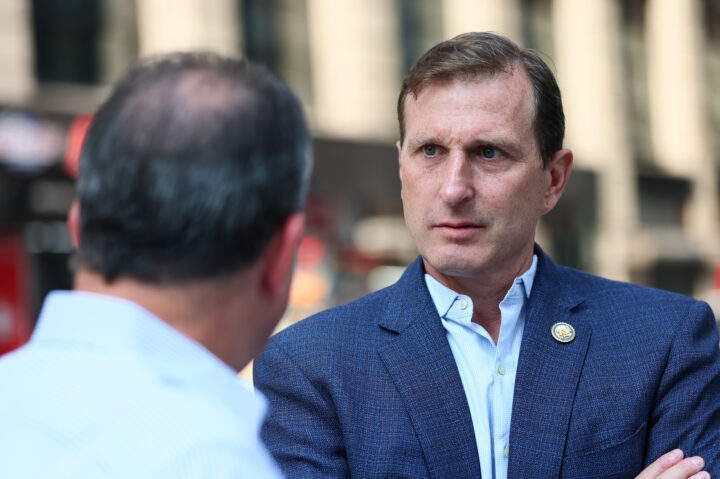
Rep. Dan Goldman (D-NY) outside the Jacob K. Javitz Federal Building on August 07, 2025 in New York City.
Rep. Dan Goldman (D-NY) said on Tuesday, just days before early voting starts in the New York City mayoral race, that he is still not ready to endorse Democratic nominee Zohran Mamdani, as he hasn’t seen the candidate assuage Jewish communal concerns.
Appearing on CNN, Goldman said he wasn’t sure if he would vote for Mamdani or his rival, former New York Gov. Andrew Cuomo, and that he’s “trying to work through” outstanding issues he has with the candidates.
“You know, I’m a Democrat at heart and I believe in the Democratic Party. I am very concerned about some of the rhetoric coming from Zohran Mamdani, and I can tell you as a Jew in New York who was in Israel on Oct. 7, I and many other people are legitimately scared because there has been violence in the name of anti-Israel, anti-Zionism,” said Goldman, a pro-Israel Democrat whose House district, covering Lower Manhattan and a swath of Brooklyn, leans heavily to the left.
“I’ve asked [Mamdani] to speak out on that and to condemn that and I frankly haven’t really seen him do much on that. And I believe, for my personal reasons as well as my professional reasons as a representative of New York City, that it is my duty to make sure that everybody, including the Jewish community, feels safe here, and many in the Jewish community do not feel safe right now,” the congressman continued.
“And I hope that Mr. Mamdani takes that to heart and takes some action to make the Jewish community understand that he will keep us safe and secure,” he concluded.
Goldman is one of several Democratic New York lawmakers who have refused to endorse their party’s candidate for Gracie Mansion, including swing district Reps. Laura Gillen (D-NY) and Tom Suozzi (D-NY) as well as George Latimer (D-NY).
Other prominent New York Democrats including Senate Minority Leader Chuck Schumer and House Minority Leader Hakeem Jeffries have met with Mamdani but have held back endorsements.
Only five New York City Democratic lawmakers in the state’s congressional delegation have endorsed Mamdani: Reps. Alexandria Ocasio-Cortez (D-NY), Jerry Nadler (D-NY), Adriano Espaillat (D-NY),Nydia Velazquez (D-NY) and Yvette Clarke (D-NY).
Even as the Democratic nominee has drawn criticism over his recent meeting with Siraj Wahhaj, political experts say that such backlash is unlikely to influence the outcome of the Nov. 4 election
Angelina Katsanis-Pool/Getty Images
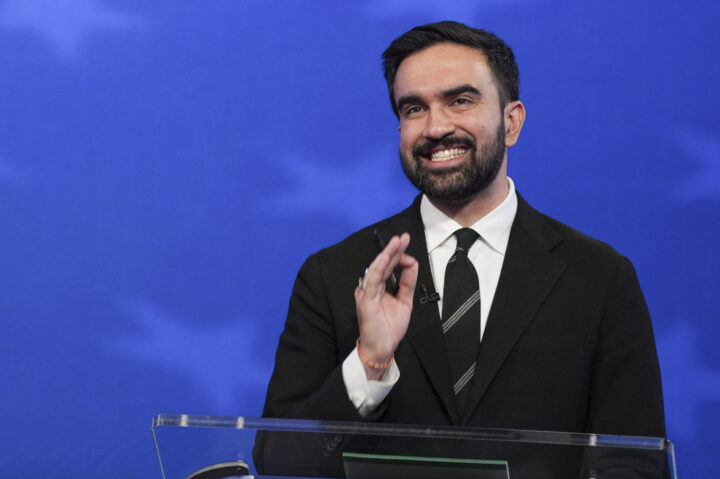
Democratic mayoral nominee Zohran Mamdani speaks during a mayoral debate at Rockefeller Center on October 16, 2025 in New York City.
In previous mayoral elections in New York City, a candidate’s meeting with a controversial imam who was listed as an unindicted co-conspirator in the 1993 World Trade Center bombing — and who has stridently opposed homosexuality and condemned America as “filthy” and “sick,” among other extreme remarks — might be expected to meaningfully dent support for his campaign.
But even as Zohran Mamdani, the Democratic nominee, has drawn criticism over his recent meeting with Siraj Wahhaj, a Brooklyn imam who leads Masjid at-Taqwa in Bedford-Stuyvesant, political experts say that such backlash is unlikely to influence the outcome of the Nov. 4 election.
That Mamdani, a 34-year-old democratic socialist and Queens state assemblyman, appears poised to withstand scrutiny over his relationship with Wahhaj, which he has defended, underscores how dramatically the political environment has changed in New York City — where the emotional resonance of the 9/11 terror attacks has long played a central role in campaigns and elections.
“Dead cops and firefighters don’t seem to matter much these days,” Hank Sheinkopf, a Democratic consultant who is leading an anti-Mamdani super PAC, told Jewish Insider on Monday. “I think it’s a generational question,” he added, noting that “the people who are voting for” Mamdani “weren’t even born on Sept. 11.”
While he said that Mamdani’s meeting “isn’t helpful” and could ultimately push some voters concerned about public safety to instead back one of his rivals — including the Republican nominee, Curtis Sliwa, or former New York Gov. Andrew Cuomo, running on an independent line — “the question is whether they can generate a vote,” according to Sheinkopf.
“That’s not clear yet,” he explained, saying the controversy could be “buried under” Mamdani’s continued focus on affordability, which helped drive his upset over Cuomo in the Democratic primary in June.
Both Cuomo and Sliwa have attacked Mamdani for the meeting, with the former governor zeroing in on Wahhaj’s history of homophobic comments — including remarks in which the imam called homosexuality “a disease.”
Mamdani, who would be the first Muslim mayor of New York City if elected, has dismissed criticism of his Friday meeting with Wahhaj — whom he praised as “one of the nation’s foremost Muslim leaders and a pillar of the Bed-Stuy community for nearly half a century.”
Mamdani claimed over the weekend that Mayor Eric Adams as well as former New York City Mayors Bill de Blasio and Michael Bloomberg had met with the imam or campaigned with him. “The only time it became an issue of national attention was when I met with him, and that’s because of the fact of my faith and because I’m on the precipice of winning this election,” he argued.
Bloomberg, who faced backlash for inviting Wahhaj to a meeting with Muslim leaders in 2009, later said he would not have been likely to include the imam if he was aware of his background, even as the former mayor vowed “to reach out to everybody” during his time in office.
While de Blasio delivered remarks at Masjid at-Taqwa in 2021, it was unclear if he met with Wahhaj while serving as mayor. De Blasio, who has endorsed Mamdani, did not respond to a request for comment from JI on Monday.
For his part, Adams, who is no longer seeking reelection, appeared alongside Wahhaj at an interfaith breakfast in 2015, when he was Brooklyn borough president, though he does not appear to have previously campaigned with the imam, as Mamdani suggested.
“If the assemblymember wants to liken himself to Mayor Adams, perhaps he should also join the mayor in condemning Hamas, denouncing the phrase ‘globalize the intifada,’ and speaking out against the surge of vile antisemitic hate we’ve witnessed across our city and country since Oct. 7,” Kayla Mamelak Altus, a spokesperson for Adams, said in a statement to JI on Monday. “Something tells me he won’t.”
Wahhaj, who could not be reached for comment, was included by federal prosecutors on a list of unindicted co-conspirators in the 1993 World Trade Center bombing. He was never charged and has denied ties to the attack, which killed six people.
Delivering a lecture in Toronto in 1993, Wahhaj speculated that the Mossad, the Israeli national intelligence agency, could have been behind the bombing, according to an online transcript of his remarks. “Can I say the Mossad did it? No. But I’ll say one thing. It has the fingerprints of agencies like the Mossad,” Wahhaj allegedly said.
Despite such comments, the fallout over Mamdani’s meeting with Wahhaj has been relatively limited — a dynamic that one Democratic consultant in New York City attributed in part to “a willingness to move away from traditional allies and embrace radical actors” on both sides of the aisle.
“We are at the point of insanity that a candidate for mayor is meeting with someone with a well-documented history of radicalism and bigotry, including espousing a belief that white people are the devil and associating with violent extremists who’ve committed acts of terrorism, including several of his own children who ran a terrorist training camp,” the consultant, who asked to remain anonymous to speak candidly, told JI.
But ultimately, he added, “the media ecosystem is so fractured that it is very hard this late in the game to introduce new information to truly persuadable voters in a way that trumps their concerns about other issues.”
The Jewish advocacy group slammed Mamdani’s insistence on calling Israel’s war against Hamas a genocide and ‘lack of moral clarity’
Michael M. Santiago/Getty Images
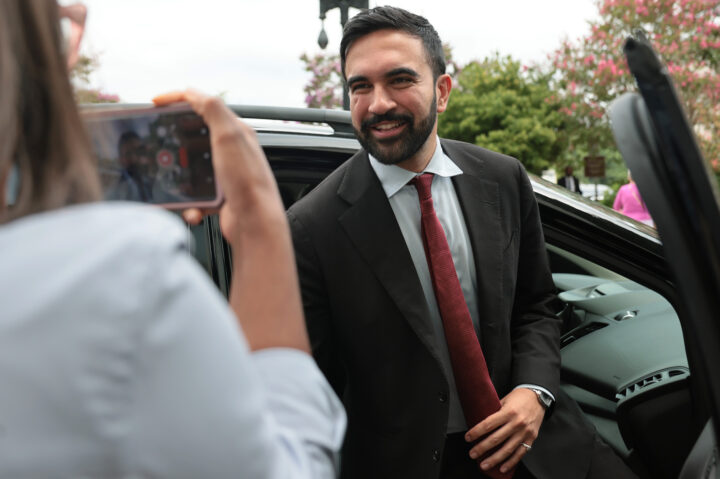
NYC Mayor Zohran Mamdani briefly speaks with reporters as he leaves the Dirksen Senate Office Building on July 16, 2025 in Washington, DC.
The American Jewish Committee raised alarms on Friday about Zohran Mamdani’s “continued use of problematic rhetoric as it relates to Israel and Jews” and called on the Democratic nominee for mayor of New York City to “change course” as he prepares for the Nov. 4 election.
In a lengthy statement, the nonpartisan organization cited, among other things, Mamdani’s repeated claim that Israel has committed genocide in Gaza, which the AJC called “unequivocally false and dangerous.” The charge “has not been proven in any international court” and “gives fodder to those who continue to use Israel’s self-defensive actions as an excuse to threaten and attack Jews,” the group said.
The AJC also criticized Mamdani’s refusal to recognize Israel’s right to exist as a Jewish state, saying that he is upholding an “unacceptable double standard” in his assessment of the region. “Israel is surrounded by Muslim countries,” the group wrote, “yet Mamdani does not continuously suggest that any of those nations should not exist as they are.”
And the organization took issue with what it characterized as Mamdani’s “lack of consistent moral clarity on Hamas,” pointing to a Fox News interview on Wednesday in which he sidestepped a question about whether Hamas should disarm and relinquish its leadership role in Gaza.
Mamdani, a democratic socialist assemblyman who has long been involved in anti-Israel activism, later clarified during the first general election debate on Thursday that Hamas “should lay down” its arms, but he did not share his views on its future role in the conflict.
The AJC, which has also recently highlighted concerns about Mamdani’s refusal to condemn calls to “globalize the intifada,” said in its statement that it feels “compelled to speak out when public figures use rhetoric or endorse policies that harm Jews.”
It urged Mamdani “to engage in dialogue and consultation with organizations and segments of the mainstream New York Jewish community,” with which he has had a tense relationship throughout the campaign and as an elected official in Albany.
“By continuing to prioritize anti-Zionist synagogues and groups, Mamdani ignores the perspectives and concerns of the vast majority of Jewish New Yorkers,” the group said.
Mamdani, who has stepped up his Jewish outreach efforts in recent weeks with limited success, has rejected claims that his views fuel antisemitism and vowed to increase funding to counter hate crimes by 800% if he is elected.
“One of the most meaningful experiences I’ve had over the course of this campaign has been the conversations I’ve had with Jewish New Yorkers,” Mamdani said at the debate on Thursday.
A spokesperson for Mamdani did not respond to a request for comment.
But the NYC mayoral nominee hasn’t spoken out against the streamer’s long history of antisemitic rhetoric
Angelina Katsanis-Pool/Getty Images
Democratic mayoral nominee Zohran Mamdani speaks during a mayoral debate at Rockefeller Center on October 16, 2025 in New York City.
Zohran Mamdani, the Democratic nominee for mayor of New York City, expressed disagreement on Thursday with comments by Hasan Piker, a far-left streamer who has said “America deserved 9/11,” after several months in which the state assembly member had declined to condemn such rhetoric.
“I find the comments that Hasan made on 9/11 to be objectionable and reprehensible,” Mamdani said during the first general election debate on Thursday night, where he traded barbs with former New York Gov. Andrew Cuomo, who is trailing in the polls as he mounts an independent run following his primary loss to Mamdani in June.
Still, Mamdani, a 33-year-old democratic socialist, defended his decision to appear on Piker’s show for an extensive interview during the primary — even as the streamer has otherwise frequently stirred controversy for using antisemitic rhetoric in his commentary on Israel and Jewish issues.
“I also think that part of the reason why Democrats are in the situation that we are in, of being a permanent minority in this country, is we are looking only to speak to journalists and streamers and Americans with whom we agree on every single thing that they say,” Mamdani argued, while making no mention of Piker’s antisemitic comments. “We need to take the case to every person, and I am happy to do that.”
Piker has faced criticism for justifying Hamas’ Oct. 7, 2023, attacks and forcefully denying some of the terror group’s atrocities — including widespread reports of sexual violence. In one notable stream last year, Piker said “it doesn’t matter if rapes f***ing happened on Oct. 7,” while adding that “the Palestinian resistance is not perfect.” He has also described Orthodox Jews as “inbred” and compared Zionists to Nazis, among other slurs seen as antisemitic.
Elsewhere during the debate, Mamdani, an outspoken critic of Israel who was arrested in October 2023 during a ceasefire demonstration outside the Brooklyn home of then-Senate Majority Leader Chuck Schumer (D-NY), declined to confirm that he would not participate in protests if he is elected mayor. “The important thing is to lead from City Hall,” Mamdani said. “That’s what I’ll be doing.”
Mamdani had faced intense backlash before the debate for comments during a Fox News interview released on Wednesday in which he avoided directly answering a question about whether Hamas should disarm and relinquish its leadership role in Gaza. He clarified at the debate that Hamas, as well as “all parties,” “should lay down” their arms but did not comment on its future role in the conflict.
“I’m proud to be one of the first elected officials in the state who called for a ceasefire, and calling for a ceasefire means ceasing fire,” Mamdani said. “That means all parties have to cease fire and put down their weapons. And the reason that we call for that is not only for the end of the genocide, but also an unimpeded access of humanitarian aid.”
He added that “we also have to ensure that [the ceasefire] addresses the conditions that preceded this, conditions like occupation, like the siege and apartheid, and that is what I’m hopeful for.”
Mamdani, who has seen mixed results in his continued outreach to the Jewish community, also once again refused to condemn the phrase “globalize the intifada” — even as he reiterated that it “evokes many painful memories” for Jewish voters and reiterated he will “discourage” its usage.
The self-proclaimed socialist union leader has accused Israel of committing genocide and said she would look to divest city funds from Israel
Campaign website
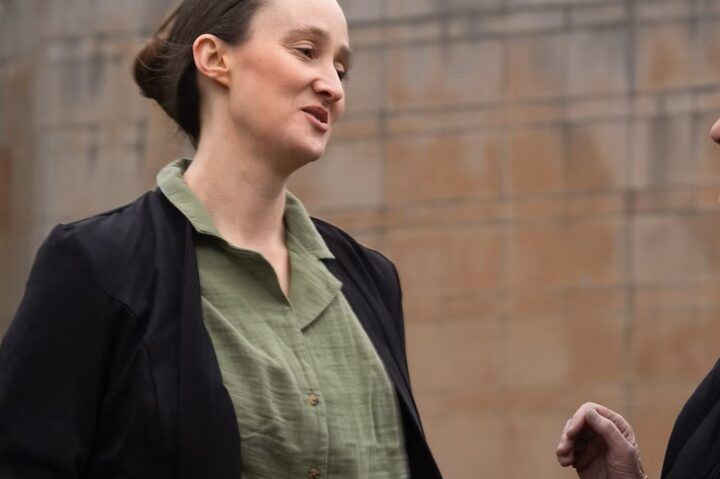
Katie Wilson
As progressives have gained traction in local races across the country, Katie Wilson, a self-described socialist now mounting a formidable bid for mayor of Seattle, has increasingly drawn comparisons to Zohran Mamdani, the far-left Democratic nominee for mayor of New York City whose primary upset in June stunned the national political establishment.
Like Mamdani, a 33-year-old democratic socialist and state assemblyman, Wilson, the co-founder and executive director of Seattle’s Transit Riders Union, took political observers by surprise when she handily led the August “jungle” primary with just over 50% of the vote — defeating the moderate incumbent mayor, Bruce Harrell, by a nearly 10-point margin.
Wilson, in her early 40s, is preparing to face Harrell once again in the Nov. 4 election, where analysts say she is now well-positioned to oust the first-term mayor. Harrell has struggled not only to land on a vision that resonates with voters but to effectively articulate an argument against his upstart challenger, who has focused on a populist message of affordability that Mamdani has also championed throughout his own campaign.
But while her record of commentary on Israel and the war in Gaza is far more limited than Mamdani, who has long been an outspoken critic of the Jewish state, many Jewish leaders in Seattle are expressing concern over Wilson’s statements about the conflict amid what they describe as a lack of outreach from her campaign with just five weeks until the election.
In a handful of recent remarks, Wilson has accused Israel of genocide in Gaza — a characterization that Jewish leaders and community activists have found troubling as voter sympathy for the Jewish state, especially in the progressive Seattle area, has sharply declined.
“I am strongly opposed to the genocide in Gaza,” Wilson said in a comment posted to social media in August. “As mayor of Seattle, my ability to end the violence is limited, but I will do everything I can to end the suffering of Palestinians and guarantee the safety of Muslims, Jews, and people of all faiths and backgrounds in Seattle.”
Meanwhile, Wilson has suggested that she is “open to divestment” if Seattle “has investments that are indirectly supporting Israel’s actions,” according to an email response to a person who asked about her stances on Israel that was posted to social media in July.
Elsewhere in the note, Wilson said that she was “familiar with the ‘end the deadly exchange’ efforts of a few years ago and think that’s something that could be done through executive action,” referring to a movement seeking to prohibit American police officers from training with Israeli law enforcement officials. The American Jewish Committee has accused the campaign of helping to fuel an antisemitic trope suggesting Israel is responsible for American police brutality.
Regina Sassoon Friedland, regional director of the American Jewish Committee’s Seattle office, echoed a range of Jewish community leaders in taking issue with Wilson’s rhetoric on Israel.
“While AJC does not endorse or oppose candidates, it should be noted that claims of genocide against Israel lack factual or legal foundation,” Friedland told Jewish Insider on Tuesday. “Not only are such accusations baseless, but they distort realities on the ground when no mention is made of Hamas, whose announced purpose is annihilating Israel.”
In addition to her comments, some Jewish community leaders say they are discouraged by Wilson’s relationships with anti-Israel activists including Kshama Sawant, a former far-left Seattle city councilmember who has faced accusations of stoking antisemitism. Wilson also claimed an endorsement from CAIR Action, a political advocacy group affiliated with the Council on American-Islamic Relations, whose executive director has drawn condemnation for praising Hamas.
A recently established political action committee called The Kids Table, which seeks to promote “pro-Jewish candidates for state and local office” in Washington state and is led by a group of Jewish millennial activists, claimed that Wilson has “allied herself with vitriolic anti-Jewish candidates” and “talked about focusing city resources on foreign affairs issues, rather than on local ones, including the urgent problem of Jewish safety and security in Seattle.”
“Time and time again we hear deep concern about Katie Wilson’s candidacy,” the group told JI of its conversations with the Jewish community, adding she did not respond to a “candidate questionnaire about antisemitism and extremism” that had been sent to her campaign and was filled out by Harrell.
Even as Wilson has only glancingly weighed in on Israel throughout the race, where strategists say it has not been a prominent issue for many voters, the broader organized Jewish community has otherwise observed a distinct absence of engagement from her campaign.
The Jewish Federation of Greater Seattle, for one, has not heard from her, several members told JI.
Scott Prange, an at-large member of the Jewish Community Relations Council of Greater Seattle, said he was “not personally aware that Wilson has made any outreach to the Jewish community in Seattle.”
“And at a time when, especially in Seattle, antisemitism runs rampant amongst the left in the wake of post-Oct. 7 rhetoric and propaganda,” he told JI on Tuesday, “she has only fanned the flames by echoing hollow narratives about Israeli genocide in Gaza and calling for divestment of any city funds invested in Israel.”
Jack Gottesman, president of Sephardic Bikur Holim Congregation, an Orthodox synagogue in Seattle that includes around 300 families, said he “would welcome the opportunity to meet with Katie Wilson, but to date I have not seen meaningful outreach from her or her campaign to the Jewish community.”
“Jews have been part of Seattle’s fabric for well over 100 years, and it is important that candidates engage respectfully with all communities,” he told JI this week. “Her description of the situation in Gaza as a genocide was a mischaracterization. These are complex issues that demand depth, not slogans. I hope she recognizes the weight of her words.”
Wilson’s campaign did not respond to numerous interview requests from JI over several weeks.
In contrast with Wilson, Harrell, who was elected in 2021, has maintained what Jewish leaders largely called a strong voice in support of Israel and against rising antisemitic violence. Nevet Basker, a co-chair of Washingtonians for a Brighter Future, a separate pro-Israel PAC that has endorsed Harrell, said that the local Jewish community “appreciates” his “clear opposition to antisemitism.”
“We recognize the immense challenges the mayor has faced” and “applaud his commitment to ensure that all Seattle residents and visitors are safe and welcome,” Basker told JI in a statement.
Rob Spitzer, the president of B’nai B’rith International and a vice chair of the Jewish Federation of Greater Seattle, said Harrell “has reached out” and “is generally supported by the community,” while recalling “meetings with him and his police and security team about protecting the Jewish community and our institutions.”
The Kids Table, for its part, countered that Harrell “has failed to meet this moment of crisis for the Jewish community,” noting that “pro-Palestinian protestors blocked the interstate for six hours and weren’t cleared or charged, and ‘kill your local colonizer’ was spraypainted on statues at the mayor’s alma mater, with zero comment from his office.”
Still, the group told JI in a statement, “Wilson’s candidacy, alliances with anti-Jewish figures and organizations, and lack of engagement have many Seattle Jews very worried about the next four years.”
Harrell’s campaign also did not respond to requests from JI for an interview.
While he has sought to connect Wilson to the movement to defund the police, which she says is not her goal, Harrell has avoided commenting on her approach to Israel, underscoring the shifting political dynamics around views that until recently would likely have been seen as too extreme for the Democratic Party but have now become acceptable to many voters.
Despite concerns from Jewish community leaders, Israel “hasn’t been front and center” in the race as a “topic of discussion or debate,” Sandeep Kaushik, a political consultant in Seattle who is not involved in either campaign, told JI.
Kaushik attributed Wilson’s unexpected rise in part to what he called the “Mamdani effect” and said she is the “front-runner,” even as he expects “the general election war is about to start” as pro-Harrell outside spending flows into the race and attacks ramp up in the final weeks.
“I think the mayor is now fighting for his political life,” Kaushik said.
Individuals involved in the race told JI impediments remain to consolidating support behind Andrew Cuomo
Michael M. Santiago/Getty Images
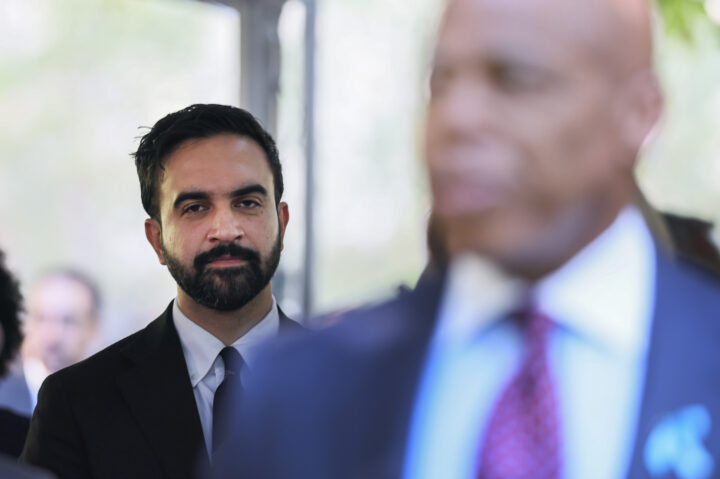
New York City Mayoral Zohran Mamdani (L) and former Mayor Eric Adams attend the annual 9/11 Commemoration Ceremony on September 11, 2025 in New York City.
New York City Mayor Eric Adams’ decision on Sunday to drop out of his race for reelection was met with a mix of tempered hope and continued resignation among political consultants and Jewish community leaders who have long been waiting for an opening to block Zohran Mamdani, the front-runner and Democratic nominee.
In choosing to suspend his campaign for a second term with just five weeks remaining until the Nov. 4 election, Adams, the scandal-scarred mayor who had been running as an independent, may not offer the escape hatch that many Mamdani critics have been hoping for.
Adams, a deeply unpopular mayor whose tenure in office had been marred by a series of damaging corruption scandals and accusations that he had become cozy with the Trump administration, will remain on the ballot. And Curtis Sliwa, the GOP nominee polling ahead of Adams, reiterated on Sunday that he will stay in the race, rejecting calls for him to step aside and help to clear the field for former New York Gov. Andrew Cuomo — who is also running as an independent after badly losing the June Democratic primary.
But some critics of Mamdani, a democratic socialist and Queens state assemblyman leading in the polls, suggested that the consolidated field could now move previously reluctant donors to invest in a late-stage effort to help bolster Cuomo — who had been casting the race as a two-man contest with Mamdani even before Adams ended his campaign.
“Sentiment among some major donors had been that unless the field started to narrow, they were going to keep their powder relatively dry,” Jake Dilemani, a Democratic strategist who was involved in Cuomo’s primary bid, told Jewish Insider. “With Adams out, that dynamic starts to change, pressure will mount on Sliwa to drop his bid, and dollars will follow.”
Hank Sheinkopf, a veteran Democratic strategist who is leading an anti-Mamdani super PAC called Protect the Protectors, said Cuomo “can win only if there are independent committees that are talking about” Mamdani’s far-left positions and “how they are dangerous to New York.”
“Failure to do that means Mamdani will win,” he told JI, while noting Cuomo’s “argument that he is more experienced isn’t working,” demonstrated by his negative voter ratings in polls.
Sheinkopf speculated that new donors could now be energized to open their checkbooks if they are convinced, as he believes, that a Cuomo victory will require outside groups, which have struggled to raise money even as they have begun to place ads in recent weeks, work on chipping away at Mamdani’s relatively favorable polling numbers.
“You can knock Mamdani to 30 or below,” Sheinkopf predicted. Recent surveys have shown Mamdani’s favorability ratings in the mid to high 40s.
Another political consultant who is involved in a separate anti-Mamdani super PAC, speaking on the condition of anonymity to address the current state of the race, said he is “hopeful that the donors who were sitting on the sidelines will now become more active,” but he had no details to share about any new movement on that front.
The consultant acknowledged that Sliwa’s choice to remain in the race, threatening to peel support from Cuomo, “is certainly an impediment, but hopefully not a major one,” suggesting that “Cuomo can get a lot of Sliwa’s vote.”
Chris Coffey, a Democratic consultant who helped to advise Cuomo’s primary campaign, said that the race had been “frozen” until Adams finally dropped out on Sunday. “Both donors and reporters spent three-plus weeks on whether Eric would drop out,” he told JI. “Now he has. It’s still going to be uphill for Cuomo but to have any shot, he needed Eric out and he’s out.”
“If donors and press now turn to Curtis, that won’t help Cuomo,” Coffey continued. “I’d expect to see national and local GOP push folks to Cuomo. That’s a double-edged sword but again, he needs it to have a meaningful shot.”
Eric Levine, a top GOP fundraiser who had been backing Adams’ bid, said that he is now supporting Cuomo and believes that Sliwa “needs to get out” if the former governor has any chance of prevailing in the race.
While he did not anticipate that Sliwa — whose campaign said in a statement on Sunday that he “is the only candidate who can defeat Mamdani” — will likely step aside, Levine called on GOP leadership in New York to urge him to drop out and help clear the field for Cuomo.
“He was a terrible governor, he’s an even worse person and will be a horrible mayor,” Levine said of Cuomo. “But compared to Mamdani,” the choice is easy, he told JI, citing the nominee’s hostile stances toward Israel that have fueled concern among many Jewish community leaders.
“The city is heading for a world of hurt, and any Republican who thinks that it’s a good idea to have Mamdani be the new face of the Democratic Party is too cynical for me,” Levine, a Republican Jewish Coalition board member, said on Sunday.
Cuomo, for his part, praised the mayor’s decision to ultimately drop out of the race, as he had called on Adams to do. “The choice Eric Adams made today was not an easy one, but I believe he is sincere in putting the well-being of New York City ahead of personal ambition,” the former governor said in a statement on Sunday. “We face destructive extremist forces that would devastate our city through incompetence or ignorance, but it is not too late to stop them.”
But while Cuomo’s campaign hopes to gain new backing from Black and Orthodox Jewish voters who were behind Adams, the mayor himself did not offer an endorsement, even if his announcement left open the possibility he could end up taking a side in the race. Adams otherwise warned, in a veiled swipe at Mamdani, that “insidious forces” are now seeking to “advance divisive agendas.”
“Major change is welcome and necessary,” Adams said in his announcement posted to social media on Sunday. “But beware of those who claim the answer is to destroy the very system we built together over generations.”
Leon Goldbenberg, an Orthodox leader in Brooklyn who is an executive board member of the Flatbush Jewish Community Coalition and had been backing Adams, said that he was encouraged by the mayor’s choice to suspend his campaign. “At this point, it’s more of a horse race,” he told JI, predicting Cuomo will see solid support in the Orthodox community as it seeks to register new voters ahead of the election.
“I think that you are going to see a tremendous turnout in the Orthodox community,” Goldenberg said. “Whether it makes a difference or not, I can’t tell you.”
Some activists in the broader organized Jewish community were less confident that the campaign shake-up on Sunday would meaningfully influence the outcome of a race that Mamdani has continued to dominate.
One Jewish leader, speaking on the condition of anonymity to address private discussions, said it was “too soon yet” to conclude if a critical mass of new donors would now be motivated to step up to help oppose Mamdani. “But new conversations are happening.”
Another Jewish leader who fears a Mamdani win, and also spoke on the condition of anonymity, was far less sanguine about Adams’ decision. “It doesn’t make a difference,” the Jewish leader told JI, while referring to such remaining obstacles as Sliwa and the mayor’s name still appearing on voters’ ballots.
A credible effort to beat Mamdani “would require about $10 to $15 million to make a difference,” the Jewish leader estimated. “I just don’t know that we have that chance.”
With that in mind, “the best thing that I’m hoping for is that we can keep him under 50%,” the Jewish leader said of Mamdani, “to make him govern from a minority position and not a mandated position.”
Kolot Chayeinu has drawn criticism for its anti-Israel Hebrew school curriculum, and one of its rabbis meeting with the Iranian president last year
Michael M. Santiago/Getty Images
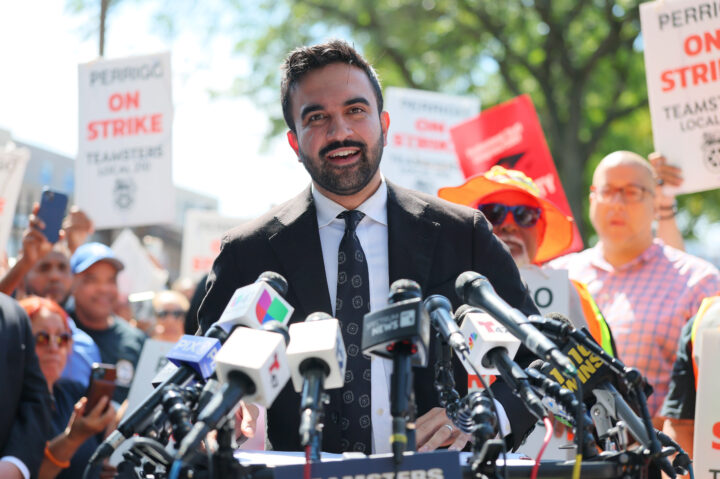
New York City Zohran Mamdani speaks on Sept. 15, 2025 in New York City.
Zohran Mamdani, the Democratic nominee for mayor of New York City, attended his first Rosh Hashanah service on Monday night at a Brooklyn synagogue well-known for its anti-Zionist activism.
The visit to Kolot Chayeinu, a nondenominational synagogue in Park Slope that has drawn controversy over its anti-Zionist orientation, comes as Mamdani is seeking to engage in increased outreach to Jewish voters ahead of the November election.
But the venue choice also underscores his polarizing position in the broader Jewish community — where many Jewish leaders have continued to raise alarms over his anti-Israel policies and refusal to condemn calls to “globalize the intifada,” among other issues.
Mamdani, an outspoken critic of Israel who has identified as anti-Zionist, was warmly received at the Monday service, where he sat in the front row in a mask and a yarmulke beside Brad Lander, the city comptroller who is a member of Kolot Chayeinu.
Lander, a close ally of Mamdani, recently described the congregation, which was one of the first to call for an early ceasefire in October 2023, as a meeting point for anti-Zionist Jews and progressive Zionists like himself.
The synagogue, which maintains an “open tent” policy on Israel and Palestine, has faced criticism for promoting anti-Israel views in its Hebrew school curriculum in the aftermath of Hamas’ Oct. 7, 2023, attacks.
In one particularly controversial lesson, students were instructed to write a letter of apology rebuking their Jewish “ancestors” for taking Palestinian land, fueling concerns among parents who objected to the politicized assignment.
A rabbi at Kolot Chayeinu, Abby Stein, who is a member of the anti-Zionist group Jewish Voice for Peace, also drew scrutiny for attending a meeting in New York City last year with Iranian President Masoud Pezeshkian, days before the Islamic Republic launched a missile attack against Israel.
Mamdani, a 33-year-old democratic socialist and assemblyman from Queens, did not deliver remarks at the Monday evening service. During his sermon, the rabbi accused Israel of committing genocide in Gaza, a claim that Mamdani has frequently made.
Mamdani is now expected to appear at other Jewish institutions during the High Holidays, including a mainstream congregation on Manhattan’s Upper West Side — where he could face a less welcoming audience skeptical of his hostile views toward Israel.
A spokesperson for Mamdani did not respond to a request for comment about his planned outreach to the Jewish community.
Jay Jacobs, who broke with Gov. Kathy Hochul in refusing to back Mamdani, cited the nominee’s hostility to Israel as a key motivating factor

Yuki Iwamura-Pool/Getty Images
Democratic mayoral candidate Zohran Mamdani
Jay Jacobs, the chairman of the New York Democratic Party, said on Thursday he will not endorse Zohran Mamdani for mayor of New York City, notably breaking with Gov. Kathy Hochul, who recently announced her support for the Democratic nominee.
In a statement, Jacobs said he had a “positive conversation” with Mamdani, the 33-year-old democratic socialist and Queens assemblyman, soon after the primary, and dismissed what he called “the fear-mongering around him and his candidacy” as “wrong and a gross over-reaction.”
But while Jacobs said he shared Mamdani’s belief that “America’s greatest problem is the continued growth in income disparity in our nation,” the state party chair noted they “fundamentally disagree” on “how to address it.”
Jacobs, who is Jewish, also cited Mamdani’s staunch opposition to Israel, an issue on which the nominee has recently indicated he has no intention of budging, as a major source of contention.
“Furthermore, as I expressed to him directly, I strongly disagree with his views on the State of Israel, along with certain key policy positions,” Jacobs said of Mamdani, who has vowed to arrest Israeli Prime Minister Benjamin Netanyahu if he is elected and said he would move to terminate a city program to foster partnerships between companies in Israel and New York City, among other positions that have raised concerns among Jewish leaders.
Jacobs did not elaborate on particular policies that Mamdani has proposed, including free bus service, government-run grocery stores, universal childcare and rent freezes, some of which have faced scrutiny from the business and real estate communities.
He also voiced strong objections to the far-left platform of the Democratic Socialists of America, of which Mamdani has long been a member, saying he did not believe the group “represents the principles, values or policies of the Democratic Party.”
“For those reasons I will not be endorsing Mr. Mamdani for mayor of New York City,” Jacob said in his statement.
The decision to withhold his support for Mamdani comes as the mayoral nominee has claimed backing from a growing number of mainstream Democratic leaders in New York, most recently Carl Heastie, the speaker of the state Assembly, a prominent holdout who issued his endorsement on Wednesday — days after Hochul made her announcement last weekend.
Still, some of the state’s top Democratic elected officials, including Senate Minority Leader Chuck Schumer (D-NY) as well as House Minority Leader Hakeem Jeffries (D-NY), have continued to remain on the sidelines, with less than two months until the November election.
In splitting with Hochul, Jacobs, who has long sparred with his party’s left-wing base, joins some lawmakers who have recently said they will not back Mamdani; Reps. Laura Gillen (D-NY) and Tom Suozzi (D-NY), who represent Long Island swing districts targeted by Republicans, have criticized Mamdani’s far-left policies and confirmed this week that they will not be supporting his campaign.
Even as he declined to back Mamdani, the clear front-runner, Jacobs said he would not endorse any other candidates in the mayoral race, according to The New York Times.
Mamdani’s opponents include Mayor Eric Adams, former New York Gov. Andrew Cuomo — both now running as independents — and the GOP nominee, Curtis Sliwa.
A spokesperson for Mamdani did not immediately respond to a request for comment.
The swing-district New York Democrat said he won’t be supporting the far-left nominee for NYC mayor

Lev Radin/Pacific Press/LightRocket via Getty Images)
Rep. Tom Suozzi (D-NY)
Rep. Tom Suozzi (D-NY) announced on Monday that he would not endorse Zohran Mamdani, the Democratic nominee for mayor of New York City.
Suozzi, who represents a Long Island-based swing district on the outskirts of New York City that takes in a slice of Queens, said in an interview with ABC7 that, while he believes Mamdani is “very talented” and “very smart,” he feels the Democratic mayoral candidate’s policies would lead to increased costs for New Yorkers.
“Let me say very clearly: Mamdani is a very talented guy. He’s very smart, he’s very charismatic. … I have nothing against him personally, and I’m sure he’s a good person, but I completely disagree with his ideas. I disagree that we should raise taxes in New York City because people are leaving New York State and New York City as it is,” Suozzi said. “I’m all for making sure wealthy people pay their fair share at the federal level, so that wherever you go in the country you’re still going to have to pay, but not to encourage people to escape New York and go to Florida and go to Texas.”
“He wants to raise the minimum wage in New York. Well, I’m all for giving people higher wages. I like raising the minimum wage, but we need to do it at the national level, not just at the local level, and chase people out,” he added, noting that lawmakers “don’t want to chase people out of New York.”
Suozzi’s announcement comes one day after New York Gov. Kathy Hochul endorsedMamdani’s candidacy, emerging as one of his highest-profile backers.
In a subsequent post on X, Suozzi wrote that, “I will not be endorsing Mamdani. While I share his concern about the issue of affordability, I fundamentally disagree with his proposed solutions. Like the voters I represent, I believe socialism has consistently failed to deliver real, sustainable progress.”
He added that, “People have asked me about the Governor’s decision. I have not discussed this with the Governor and I am not in a position to give the Governor political advice considering the fact that when I ran against her she beat me soundly.”
Poll results continue to underscore how the splintered field is the biggest reason Mamdani is favored
Spencer Platt/Getty Images
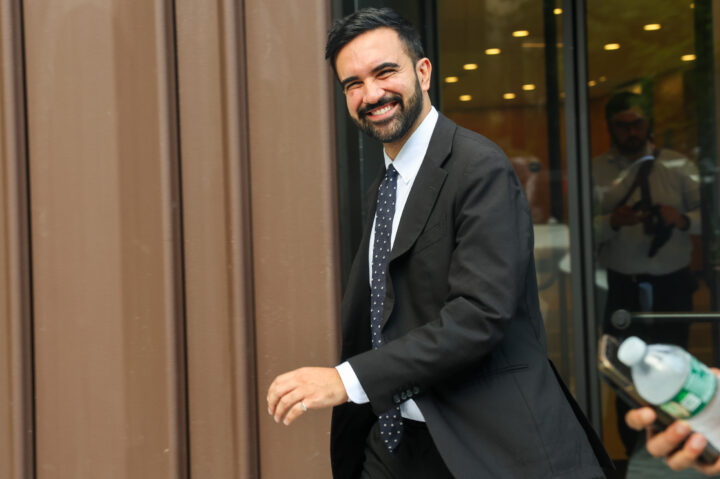
Democratic socialist candidate Zohran Mamdani, who won the Democratic primary for mayor of New York City, attends an endorsement event from the union DC 37 on July 15, 2025, in New York City.
We’re well into September, and the state of play in the New York City mayoral race hasn’t changed much in the last couple months, despite the many eye-catching developments. But a new New York Times/Siena poll released this week showcases an in-depth picture of the city’s electorate — one that is clearly wary of Democratic nominee Zohran Mamdani’s brand of socialism, even as he remains the clear favorite to become the next mayor.
As has always been the case, the divided field of Mamdani opponents is the far-left candidate’s biggest asset. Mamdani leads former New York Gov. Andrew Cuomo by 15 points among registered voters, 41-26%, with all the candidates on the ballot. But in a head-to-head matchup, Cuomo pulls narrowly ahead, 46-45%.
The results continue to underscore how the splintered field is the biggest reason Mamdani is favored. Hardly any of the supporters of Mayor Eric Adams, running as an independent, or Republican nominee Curtis Sliwa would support Mamdani over Cuomo if their candidate dropped out. Indeed, among those not supporting Mamdani, over half (52%) said they would never support him for mayor — higher than any other candidate.
Working in Mamdani’s favor is the relatively respectable favorability rating he holds with New York City voters, especially in comparison to his rivals. Nearly half (49%) of respondents viewed Mamdani favorably, with only 35% viewing him unfavorably. That means that despite holding a record far to the left of past New York City mayors, many voters aren’t (yet) holding that against him. But there’s been no significant outside advertising effort against Mamdani, as you would typically expect in the run-up to a high-stakes contest.
Without any effort to remind voters about his far-left record, it’s no surprise that the fresh-faced political newcomer has a respectable image.
Cuomo, on the other hand, has an underwater favorability rating, with 42% viewing him favorably and 51% viewing him unfavorably — largely a result of the ethical scandal he faced that forced him to resign as governor.
But on the issues, it’s easy to see how Cuomo remains competitive in a one-on-one matchup. Crime is the top issue for New York City voters, with 26% naming it as the most important problem facing voters, slightly ahead of affordability at 24%. One of Mamdani’s biggest vulnerabilities is his long record of public comments supporting defunding the police and others critical of the NYPD.
One of the most notable findings is the decline in support for Israel in New York City, which has the largest Jewish population of any city in the world. By an 18-point margin, more New Yorkers now say they sympathize with the Palestinians than the Israelis — a finding that mirrors the growing partisanship in views towards the Jewish state. While white New Yorkers still favor Israel more (42-34%), Black (54-14%) and Hispanic voters (44-25%) overwhelmingly side with the Palestinians.
Democrat Ghazala Hashmi: ‘As a Muslim, I know what it feels like when an entire community is scapegoated for the actions of a few’
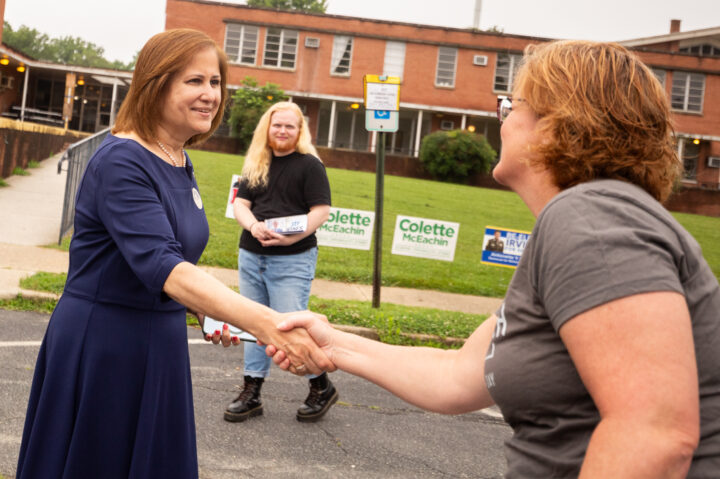
Max Posner for The Washington Post via Getty Images
Ghazala Hashmi, left, Virginia State Senator and Democratic candidate for lieutenant governor meets voters at the MAPS Global polling place in Richmond, Va., on June 17, 2025.
Virginia state Sen. Ghazala Hashmi, the Democratic nominee for lieutenant governor, on Thursday became the latest Virginia politician to weigh in on antisemitic comments by state lawmaker Sam Rasoul. Without naming Rasoul directly, Hashmi appeared to criticize his language, which has been described as antisemitic by several leading Jewish organizations in the state.
“The rise in antisemitism has created real fear in communities across Virginia — and it cannot be ignored or dismissed; instead it must be condemned clearly, consistently and without caveat,” Hashmi wrote in a post on X on Thursday. “As a Muslim, I know what it feels like when an entire community is scapegoated for the actions of a few. No group should be vilified, targeted, or dehumanized. Antisemitism, Islamophobia, racism and all forms of hate have no place in our communities — they are an affront to our shared values.”
As chair of the Virginia Senate’s education committee, she works closely with Rasoul, who chairs the education committee in the House of Delegates. Hashmi was the first Muslim elected to the Virginia state Senate, and Rasoul is one of two Muslim lawmakers in the House. Hashmi faced a public rebuke from the Jewish Community Federation of Richmond last year after hosting a hearing about anti-Israel protests on college campuses, which she had praised publicly.
In a July Instagram post, Rasoul described Zionism as “evil” and said it is a “supremacist ideology created to destroy and conquer everything and everyone in its way.” His rhetoric earned condemnation from former Rep. Abigail Spanberger, the Democratic gubernatorial candidate, and her Republican opponent, Winsome Earle-Sears, as well as Sen. Tim Kaine (D-VA).
Rasoul has stood by his attack against Zionism.
“While there are many who aspire for Zionism to be a safe place for a homeland for Jewish people, the reality is the manifestation of that has produced apartheid — and now, as human rights orgs in Israel have claimed, a genocide in Gaza,” Rasoul told Semafor on Thursday.
Later, Rasoul provided additional commentary to the Virginia Scope, a political newsletter in the state, doubling down on his claims that Zionism has made “the world less safe for my Jewish friends,” as he wrote on Instagram last month.
“The court of public opinion has shifted that this is clearly a genocide, so the default is anyone critical of the genocide must be antisemitic,” Rasoul said. “I will continue working hand-in-hand with our Jewish brothers and sisters who are fundamentally less safe because they have taken antisemitism and unfortunately used it so loosely that when there’s true antisemitism that we must counter, it’s difficult for the public to determine what’s really going on, and so we need to be better stewards and try to defend against all hate.”
One Jewish political leader: ‘No one thinks it’s going to be good for the Jewish community to be hostile and to be in constant war with the next mayor’
Spencer Platt/Getty Images
Democratic socialist candidate Zohran Mamdani, who won the Democratic primary for mayor of New York City, attends an endorsement event from the union DC 37 on July 15, 2025, in New York City.
In recent weeks, a creeping sense of frustration has settled in among many Jewish leaders in New York City as they have reckoned with the dawning reality that no one is stepping up to organize opposition to Zohran Mamdani, the Democratic nominee for mayor. Without a well-funded outside effort, Mamdani faces few obstacles in the general election despite numerous political vulnerabilities.
The complacency comes even as top Democratic leaders in New York have so far declined to endorse Mamdani, whose antagonistic views on Israel and democratic socialist affiliation have engendered criticism. But with a divided field of warring and baggage-laden candidates, Jewish leaders have privately voiced disappointment at the current state of the race.
“Big-money people are talking every week about how we have to do something, but I haven’t seen a real plan,” said one Jewish community leader who spoke on condition of anonymity to discuss private conversations. “People are just grasping,” he added. “There’s a sense of frustration out there and fear of a letdown.”
“You can’t beat somebody with nobody,” another Jewish leader said in assessing Mamdani’s rivals, including incumbent Mayor Eric Adams, former New York Gov. Andrew Cuomo and Curtis Sliwa, the GOP nominee — all of whom have so far resisted pleas to suspend their campaigns in order to avoid splitting the vote.
While some independent expenditure committees are preparing to spend heavily in the race to target Mamdani, an assemblyman from Queens whose far-left policies have provoked anxiety among Jewish New Yorkers, moderate voters and business leaders, the Jewish leader expressed skepticism that such efforts would ultimately “make a difference” as long as the election remains crowded with multiple opponents.
In the Hasidic enclave of Williamsburg, “the rank and file and donors are concerned” about Mamdani, said a source familiar with the situation. “But at the leadership level, people are mostly thinking that it’s a foregone conclusion” that Mamdani will prevail in November. “There’s not much to do and we have to start adapting and have to try to make amends with him and work with him.”
Jim Walden, an attorney, is also running as an independent alongside Adams and Cuomo, who in recent days have exchanged criticism as Mamdani, leading most polls with a plurality of the vote, stayed away from the headlines while celebrating his recent marriage in his birthplace of Uganda.
In the Hasidic enclave of Williamsburg, “the rank and file and donors are concerned” about Mamdani, said a source familiar with the situation. “But at the leadership level, people are mostly thinking that it’s a foregone conclusion” that Mamdani will prevail in November. “There’s not much to do and we have to start adapting and have to try to make amends with him and work with him.”
“No one thinks it’s going to be good for the Jewish community to be hostile and to be in constant war with the next mayor,” the source said on Monday. “For the community’s sake, we have to move on.”
As the anti-Mamdani coalition has struggled to coalesce more than a month after his shocking primary upset, the organized Jewish community is now largely taking a “wait-and-see” approach to the upcoming election, several Jewish activists told Jewish Insider on Monday.
David Greenfield, who leads the Jewish anti-poverty group Met Council and has been a fierce critic of Mamdani, said that many Jewish leaders are “watching closely to determine if he’ll moderate his socialist positions now that he has secured the Democratic nomination.”
“Zohran has floated possibly keeping NYPD Commissioner Jessica Tisch and that has caught the attention of several community leaders,” Greenfield told JI. “Currently, the race is quiet, partly due to Zohran himself being on vacation this month, but we expect it will significantly heat up again after Labor Day.”
A Jewish political activist who was not authorized to speak on the record echoed that assessment, even as he noted that some Jewish community leaders have been seeking to register new voters and working on “community structuring” in advance of the general election.
Still, he speculated that “if the race stays as is, then there will be a quiet shift to have conversations with Mamdani.”
For now, most mainstream Jewish groups remain hesitant to meet privately with Mamdani, according to a Jewish activist familiar with the matter, but the Democratic nominee has stepped up his outreach to Jewish voters and elected officials — while slightly softening his widely criticized defense of the slogan “globalize the intifada,” a phrase that many Jews interpret as a call to antisemitic violence. Mamdani has refused to personally condemn the slogan, but recently said he now discourages its use, marking a reversal from his primary comments as he seeks to grow his coalition.
“We’re planning to get started in August with messaging,” Jeff Leb, a political consultant who is leading a new super PAC called “New Yorkers for a Better Future Mayor 2025,” said on Monday. “I don’t think that people are sleeping on Zohran,” he said of the race. “I just think they’re making sure they have the resources they have to be active. Right now it’s a little bit early.”
Despite his evolution on the phrase, Mamdani remains a staunch opponent of Israel, backing the Boycott, Divestment and Sanctions movement he has indicated he could implement if elected. He has also suggested he would not visit Israel as mayor — defying a long-standing precedent in a place that is home to the largest Jewish population of any city in the world.
There are, to be sure, a range of anti-Mamdani initiatives underway in the Jewish community and beyond — some of which are expected to pick up in the coming weeks as summer begins to wind down after a period of relative inactivity, people involved in the efforts told JI.
Jeff Leb, a political consultant who is leading a new super PAC called “New Yorkers for a Better Future Mayor 2025” that plans to raise at least $20 million to hit Mamdani, told JI the group has in recent weeks held Zoom calls with more than 500 people and secured commitments as it readies attacks “to educate the public on Zohran’s priorities.”
“We’re planning to get started in August with messaging,” Leb said on Monday, noting that the super PAC is currently “candidate-agnostic” and will get behind Adams or Cuomo later in the race when polling indicates who is most favored. “I don’t think that people are sleeping on Zohran,” he said of the race. “I just think they’re making sure they have the resources they have to be active. Right now it’s a little bit early.”
Meanwhile, Eric Levine, a top GOP fundraiser in New York and a board member of the Republican Jewish coalition, is now organizing a fundraiser for Adams on Aug. 13, featuring former New York Gov. David Paterson and several donors from the legal and financial communities, according to an invite he has circulated within his network in recent days.
The Flatbush Jewish Community Coalition, which endorsed Cuomo in the primary but has not made a decision in the general election, recently launched a voter registration drive to boost Jewish turnout in November, Josh Mehlman, the group’s chairman, said on Monday.
The organization is expecting to register “tens of thousands of new voters,” Mehlman confirmed in a statement to JI. “With the political turbulence and antisemitism that unfortunately surrounds us, it is more clear than ever that the importance of every resident registering to vote for the upcoming and future elections will shape the quality of life and security of our communities,” he explained. “Our renewed efforts reflect that urgency.”
“No one wants to be fighting with the guy,” one Jewish leader said of Mamdani, acknowledging his rhetoric on Israel had evolved but not far enough to satisfy his most ardent skeptics. “No one wants to be in this position. But at the same time, I would put the onus on him. He’s the one who’s going to need to make changes.”
Sara Forman, the executive director of the New York Solidarity Network, a local pro-Israel group whose super PAC endorsed Cuomo in the primary, said the organization is now “keeping a close eye on everything that’s happening” in the race “and on its impact on the Jewish community,” while cautioning against “premature” conclusions at this stage of the election.
“Whether the field of candidates is able to coalesce in some way and what that looks like in September is very different from the end of July,” she told JI on Monday.
Privately, many Jewish leaders have fretted about the seemingly disaggregated and inchoate efforts to oppose Mamdani at a pivotal point in the race — as the current field continues to remain unsettled with limited time until the election.
“No one wants to be fighting with the guy,” one Jewish leader said of Mamdani, acknowledging his rhetoric on Israel had evolved but not far enough to satisfy his most ardent skeptics. “No one wants to be in this position. But at the same time, I would put the onus on him. He’s the one who’s going to need to make changes.”
During a private meeting between the NYC mayoral nominee and largely progressive House Democrats on Wednesday, Gottheimer did not raise concerns with Mamdani that he has vocalized elsewhere

Tom Williams/CQ Roll Call via AP Images
Rep. Josh Gottheimer (D-NJ) holds a news conference in the Capitol on Wednesday, December 4, 2019.
Rep. Josh Gottheimer (D-NJ), in a private meeting with House Democrats in Washington on Wednesday, avoided confronting Zohran Mamdani, the far-left Democratic nominee for mayor of New York City, over his controversial defense of calls to “globalize the intifada” and fierce opposition to Israel.
Gottheimer, a moderate Jewish Democrat who is among the most outspoken supporters of Israel in the House, has not been shy about publicly calling out members of his own party when disagreements over Israel and antisemitism have arisen in recent years.
But during the breakfast meeting this week, Gottheimer did not bring up his objections to the 33-year-old democratic socialist, according to a House aide familiar with the matter, even as his views on Israel have raised alarms among Jewish voters and faced pushback from Democratic leaders who have so far withheld endorsements in the New York City mayoral race.
In a statement, Gottheimer reiterated his concerns about Mamdani’s progressive policy proposals and his acceptance of rhetoric that Jewish leaders have condemned as antisemitic. But the New Jersey congressman suggested he was willing to hear from the mayoral nominee about his stunning primary upset that has rattled the political establishment.
“I don’t think higher taxes, anti-job creating socialism, and an acceptance of antisemitic rhetoric is the right direction for America,” Gottheimer told Jewish Insider, echoing comments he shared in an interview with CNBC on Thursday morning and elsewhere in recent weeks. “That said, I am always open to learning how I can reach more people with my commonsense, problem-solving approach.”
He declined to comment further on the meeting to JI on Thursday. “I don’t have anything to say beyond what I put out,” the congressman said.
Later on Thursday, Gottheimer announced he was introducing a bipartisan resolution condemning the phrase “globalize the intifada,” which Mamdani has refused to condemn. The motto chanted frequently at anti-Israel demonstrations is “hate speech, plain and simple,” the congressman wrote in a statement that did not mention Mamdani, arguing such words “incite violence, fuel hate and put Jewish families at risk.”
Still, Gottheimer voiced no such disapproval in the Wednesday breakfast hosted by Rep. Alexandria Ocasio-Cortez (D-NY) — which included several progressive House Democrats and was promoted as a “communication and organizing” session as the party rethinks its messaging strategy ahead of next year’s midterms.
Gottheimer’s reticence to speak out directly during the in-person meeting stands in contrast with his past denunciations of Mamdani, whose defense of the “intifada” phrase — seen by critics as a violent provocation to target Jews — he has called “insane and unacceptable” amid rising antisemitic activity.
The divisive slogan “is a well-known antisemitic chant that calls for the eradication of Israel and violence against Jews,” Gottheimer said in a social media post a week before the primary last month.
“Zohran Mamdani’s pathetic, hateful lies are a blatant slap in the face of the Jewish community,” he added. “He must apologize immediately. I also suggest that he visit the Holocaust Museum in the coming days and learn why these words are so dangerous.”
Even as no discussion of Israel or antisemitism was raised at the Wednesday gathering, top Democrats have continued to signal their hesitation regarding Mamdani’s approach to such issues, particularly his stance on the “intifada” slogan that he has defended repeatedly as an expression of Palestinian rights.
For his part, House Minority Leader Hakeem Jeffries (D-NY), who did not attend the breakfast but is expected to meet with Mamdani in New York City on Friday, has said that the nominee’s comments about the phrase will be a part of their discussion — suggesting that his support is likely contingent on a change in tone.
Mamdani, who has faced questions about the phrase in other meetings this week, has privately indicated he plans to take a more calibrated stance with regard to the matter, a key point of tension as he now works to expand his coalition in a crowded race that includes Mayor Eric Adams and former New York Gov. Andrew Cuomo, both running as independents.
The Democratic mayoral nominee said in a private meeting with business leaders earlier this week that he would “discourage” use of the phrase but still did not go so far as to condemn it himself, according to reports of the closed-door discussion on Tuesday.
Additional reporting contributed by JI senior congressional correspondent Marc Rod
Adams would have to win over most New York City Republicans while remaining competitive with Democrats and winning over independents who weren’t eligible to participate in the Democratic primary
Yuki Iwamura-Pool/Getty Images
Democratic mayoral candidate Zohran Mamdani
Mainstream political and business leaders in New York City, including the organized Jewish community, will soon need to decide whether to coalesce against far-left presumed Democratic mayoral nominee Zohran Mamdani — by rallying behind the candidacy of scandal-plagued Mayor Eric Adams despite his significant political baggage.
Adams, who is running as an independent in the race, appears to be the only alternative candidate capable of putting together a campaign rallying anti-socialists across the city to stop Mamdani. It won’t be easy, given Adams’ own low approval ratings and record of alleged corruption, but the makings of an anti-Mamdani coalition are there — at least on paper.
For Adams to win plurality support in a general election, it would require most Republicans to put partisanship aside and vote for Adams to stop the socialist, and hold onto most of the Black, Jewish voters and moderate Democratic voters who voted in large numbers for former New York Gov. Andrew Cuomo in the primary. Adams benefits from the name recognition of incumbency, and the potential to receive support from outside centrist groups spending on his behalf.
Keeping a bipartisan coalition of that nature will be challenging, especially given the mayor’s own unpopular record. It would require a number of lucky breaks, from Cuomo opting not to run in the general election (he appears to be staying on the ballot without an active campaign) to Republicans effectively nudging their voters to back Adams when there’s a Republican already on the ballot. But if the campaign is less about Adams and more about stopping left-wing radicalism on crime, the economy and antisemitism, it’s not implausible to see a campaign coalescing around a “block socialism, vote Adams” type of message.
Here’s the political math: Adams would have to win over most New York City Republicans — President Donald Trump won 30% of the citywide vote in 2024 — while remaining competitive with Democrats and winning over independents who weren’t eligible to participate in the Democratic primary.
An Emerson College poll conducted amid Mamdani’s surge in late May offers some empirical evidence that such a coalition has an outside shot at victory in a general election, with a broader, more-moderate electorate. The survey found that with Mamdani as the Democratic nominee, he leads with 35%, Republican Curtis Sliwa finishes with 16%, Adams holds 15% and independent Jim Walden tallied 6%.
Put together the Sliwa, Walden and Adams votes, and you’ve got yourself a competitive race.
There’s already a lot of rumbling that Trump administration officials, eager to see Sliwa off the ballot, are looking at offering him a job in the administration to help nudge GOP voters into the Adams column to stop Mamdani. But Sliwa has given every indication so far that he’s not dropping out, which would force Republican leaders to more subtly nudge GOP partisans towards Adams.
The big red flag for anti-Mamdani moderates? Adams’ favorability rating in the same poll was a dismal 19%, with 69% viewing him unfavorably. That said, given the changed nature of the contest, the perception of Adams could change amid the shifting strategic environment. He’s already running a more energetic campaign than Cuomo did in the primary. (And it’s a safer bet to hope Adams’ numbers improve as an anti-Mamdani vehicle than betting on a total outsider with minimal name ID to play that role, as a few business leaders have suggested.)
There is some precedent for mainstream forces working to block a far-left or far-right candidate after an unexpected primary outcome. One of the most recent examples is socialist India Walton’s out-of-nowhere upset against Buffalo Mayor Byron Brown in a 2021 Democratic primary. Many analysts attributed her victory to a left-wing surge; it turned out to be a mirage of a low-turnout election before a broader array of voters really had a chance to scrutinize her record and background. Brown easily won the general election — as a write-in candidate.
There’s also former Sen. Joe Lieberman winning as an independent in 2006 after losing the Democratic primary, with Republicans signaling to their voters to back the senator over the also-ran GOP nominee on the ballot. And there’s the 1991 Louisiana governor’s election where scandal-plagued Democratic Gov. Edwin Edwards beat David Duke, whom Republican voters knowingly nominated. Edwards’ slogan? “Vote for the Crook. It’s Important.”
To be sure, any anti-Mamdani effort will be something of a long shot. Mamdani is now winning support from elected New York Democratic leaders all too willing to accommodate his radical record, and he generated strong turnout in the primary that underscores his natural charisma and strength as a politician. He’s got more starpower than many of the other aforementioned extreme nominees.
But if Jewish leaders believe Mamdani would pose a serious threat to Jewish life and safety in the city if elected, you’d expect they would make every effort to stop his candidacy — especially since there’s a chance, albeit a small one, that his momentum could be stunted as his record draws closer attention.
The Vermont senator has still amassed enough delegates to have an impact on the DNC platform this summer

CNN Democratic Presidential Town Hall with Vermont Senator Bernie Sanders moderated by CNNÕs Chris Cuomo College of Charleston Charleston, South Carolina February 2020.
Sen. Bernie Sanders (I-VT) suffered another setback in his bid to become the Democratic nominee for president on Tuesday, losing badly to former Vice President Joe Biden in the states of Florida, Illinois and Arizona, with 441 combined delegates at stake.
Delegate count: Biden now has an estimated 1,147 pledged delegates of the 1,991 needed, compared to Sanders’s 861. Biden’s lead will grow in the coming days as more delegates are allocated based on state districts.
Graceful exit: On MSNBC, former Sen. Claire McCaskill (D-MO) called on the Vermont senator to withdraw from the presidential race, stressing that he has achieved his goal of assuming a healthy amount of delegates to gain leverage over the drafting process of the Democratic National Committee platform in July. “Bernie’s going to have plenty of delegates and power to influence the platform because we all want to come together,” McCaskill posited. Bakari Sellers also called on Sanders to drop out and help “proceed to the mission at hand, beating Trump.”
Rep. Brad Sherman (D-CA) endorsed Biden yesterday, citing his support for Israel and commitment to peace, among others. “Having served over 23 years on the Foreign Affairs Committee, I know that Joe Biden will have Israel’s back,” Sherman proclaimed.
Bernie’s strategy: Sanders didn’t address supporters after polls closed, and there was no indication that he would end his White House bid. Politico reported earlier this week, citing his supporters, that Sanders is banking on the upcoming primaries to receive enough delegates to satisfy his movement.
Why it matters: Most members of the platform committee are expected to be appointed in accordance with how many pledged delegates each candidate brings to the convention. If Sanders picks up a sizable number of delegates in the upcoming contests, he would increase his chances to appoint more supporters to the remaining slots on the committee, opening the door for more progressive proposals to be adopted or at least debated by the full committee. Last week, after losing a handful of primary states, Sanders maintained that he is winning the debate about the issues that are important for the future of the country.
Please log in if you already have a subscription, or subscribe to access the latest updates.
 Continue with Google
 Continue with Apple