











































The self-proclaimed socialist union leader has accused Israel of committing genocide and said she would look to divest city funds from Israel
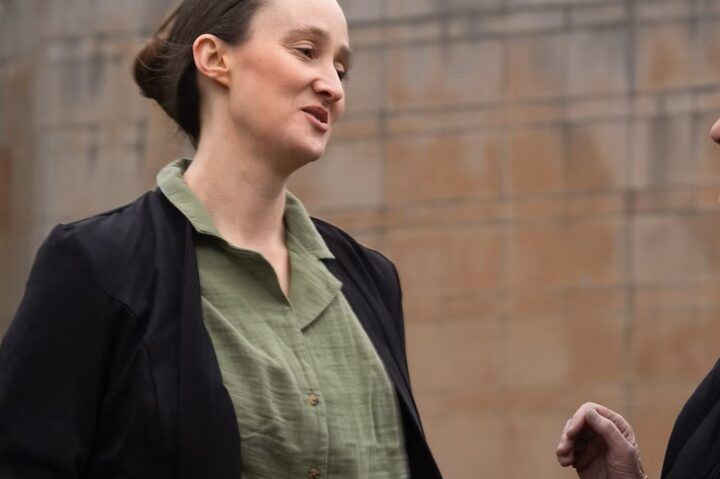
Campaign website
Katie Wilson


 Add JewishInsider on Google
As progressives have gained traction in local races across the country, Katie Wilson, a self-described socialist now mounting a formidable bid for mayor of Seattle, has increasingly drawn comparisons to Zohran Mamdani, the far-left Democratic nominee for mayor of New York City whose primary upset in June stunned the national political establishment.
Like Mamdani, a 33-year-old democratic socialist and state assemblyman, Wilson, the co-founder and executive director of Seattle’s Transit Riders Union, took political observers by surprise when she handily led the August “jungle” primary with just over 50% of the vote — defeating the moderate incumbent mayor, Bruce Harrell, by a nearly 10-point margin.
Wilson, in her early 40s, is preparing to face Harrell once again in the Nov. 4 election, where analysts say she is now well-positioned to oust the first-term mayor. Harrell has struggled not only to land on a vision that resonates with voters but to effectively articulate an argument against his upstart challenger, who has focused on a populist message of affordability that Mamdani has also championed throughout his own campaign.
But while her record of commentary on Israel and the war in Gaza is far more limited than Mamdani, who has long been an outspoken critic of the Jewish state, many Jewish leaders in Seattle are expressing concern over Wilson’s statements about the conflict amid what they describe as a lack of outreach from her campaign with just five weeks until the election.
In a handful of recent remarks, Wilson has accused Israel of genocide in Gaza — a characterization that Jewish leaders and community activists have found troubling as voter sympathy for the Jewish state, especially in the progressive Seattle area, has sharply declined.
“I am strongly opposed to the genocide in Gaza,” Wilson said in a comment posted to social media in August. “As mayor of Seattle, my ability to end the violence is limited, but I will do everything I can to end the suffering of Palestinians and guarantee the safety of Muslims, Jews, and people of all faiths and backgrounds in Seattle.”
Meanwhile, Wilson has suggested that she is “open to divestment” if Seattle “has investments that are indirectly supporting Israel’s actions,” according to an email response to a person who asked about her stances on Israel that was posted to social media in July.
Elsewhere in the note, Wilson said that she was “familiar with the ‘end the deadly exchange’ efforts of a few years ago and think that’s something that could be done through executive action,” referring to a movement seeking to prohibit American police officers from training with Israeli law enforcement officials. The American Jewish Committee has accused the campaign of helping to fuel an antisemitic trope suggesting Israel is responsible for American police brutality.
Regina Sassoon Friedland, regional director of the American Jewish Committee’s Seattle office, echoed a range of Jewish community leaders in taking issue with Wilson’s rhetoric on Israel.
“While AJC does not endorse or oppose candidates, it should be noted that claims of genocide against Israel lack factual or legal foundation,” Friedland told Jewish Insider on Tuesday. “Not only are such accusations baseless, but they distort realities on the ground when no mention is made of Hamas, whose announced purpose is annihilating Israel.”
In addition to her comments, some Jewish community leaders say they are discouraged by Wilson’s relationships with anti-Israel activists including Kshama Sawant, a former far-left Seattle city councilmember who has faced accusations of stoking antisemitism. Wilson also claimed an endorsement from CAIR Action, a political advocacy group affiliated with the Council on American-Islamic Relations, whose executive director has drawn condemnation for praising Hamas.
A recently established political action committee called The Kids Table, which seeks to promote “pro-Jewish candidates for state and local office” in Washington state and is led by a group of Jewish millennial activists, claimed that Wilson has “allied herself with vitriolic anti-Jewish candidates” and “talked about focusing city resources on foreign affairs issues, rather than on local ones, including the urgent problem of Jewish safety and security in Seattle.”
“Time and time again we hear deep concern about Katie Wilson’s candidacy,” the group told JI of its conversations with the Jewish community, adding she did not respond to a “candidate questionnaire about antisemitism and extremism” that had been sent to her campaign and was filled out by Harrell.
Even as Wilson has only glancingly weighed in on Israel throughout the race, where strategists say it has not been a prominent issue for many voters, the broader organized Jewish community has otherwise observed a distinct absence of engagement from her campaign.
The Jewish Federation of Greater Seattle, for one, has not heard from her, several members told JI.
Scott Prange, an at-large member of the Jewish Community Relations Council of Greater Seattle, said he was “not personally aware that Wilson has made any outreach to the Jewish community in Seattle.”
“And at a time when, especially in Seattle, antisemitism runs rampant amongst the left in the wake of post-Oct. 7 rhetoric and propaganda,” he told JI on Tuesday, “she has only fanned the flames by echoing hollow narratives about Israeli genocide in Gaza and calling for divestment of any city funds invested in Israel.”
Jack Gottesman, president of Sephardic Bikur Holim Congregation, an Orthodox synagogue in Seattle that includes around 300 families, said he “would welcome the opportunity to meet with Katie Wilson, but to date I have not seen meaningful outreach from her or her campaign to the Jewish community.”
“Jews have been part of Seattle’s fabric for well over 100 years, and it is important that candidates engage respectfully with all communities,” he told JI this week. “Her description of the situation in Gaza as a genocide was a mischaracterization. These are complex issues that demand depth, not slogans. I hope she recognizes the weight of her words.”
Wilson’s campaign did not respond to numerous interview requests from JI over several weeks.
In contrast with Wilson, Harrell, who was elected in 2021, has maintained what Jewish leaders largely called a strong voice in support of Israel and against rising antisemitic violence. Nevet Basker, a co-chair of Washingtonians for a Brighter Future, a separate pro-Israel PAC that has endorsed Harrell, said that the local Jewish community “appreciates” his “clear opposition to antisemitism.”
“We recognize the immense challenges the mayor has faced” and “applaud his commitment to ensure that all Seattle residents and visitors are safe and welcome,” Basker told JI in a statement.
Rob Spitzer, the president of B’nai B’rith International and a vice chair of the Jewish Federation of Greater Seattle, said Harrell “has reached out” and “is generally supported by the community,” while recalling “meetings with him and his police and security team about protecting the Jewish community and our institutions.”
The Kids Table, for its part, countered that Harrell “has failed to meet this moment of crisis for the Jewish community,” noting that “pro-Palestinian protestors blocked the interstate for six hours and weren’t cleared or charged, and ‘kill your local colonizer’ was spraypainted on statues at the mayor’s alma mater, with zero comment from his office.”
Still, the group told JI in a statement, “Wilson’s candidacy, alliances with anti-Jewish figures and organizations, and lack of engagement have many Seattle Jews very worried about the next four years.”
Harrell’s campaign also did not respond to requests from JI for an interview.
While he has sought to connect Wilson to the movement to defund the police, which she says is not her goal, Harrell has avoided commenting on her approach to Israel, underscoring the shifting political dynamics around views that until recently would likely have been seen as too extreme for the Democratic Party but have now become acceptable to many voters.
Despite concerns from Jewish community leaders, Israel “hasn’t been front and center” in the race as a “topic of discussion or debate,” Sandeep Kaushik, a political consultant in Seattle who is not involved in either campaign, told JI.
Kaushik attributed Wilson’s unexpected rise in part to what he called the “Mamdani effect” and said she is the “front-runner,” even as he expects “the general election war is about to start” as pro-Harrell outside spending flows into the race and attacks ramp up in the final weeks.
“I think the mayor is now fighting for his political life,” Kaushik said.
The top Democratic leaders in New York, over a month after the primary, aren’t supporting Mamdani — but aren’t willing to speak out against him, either
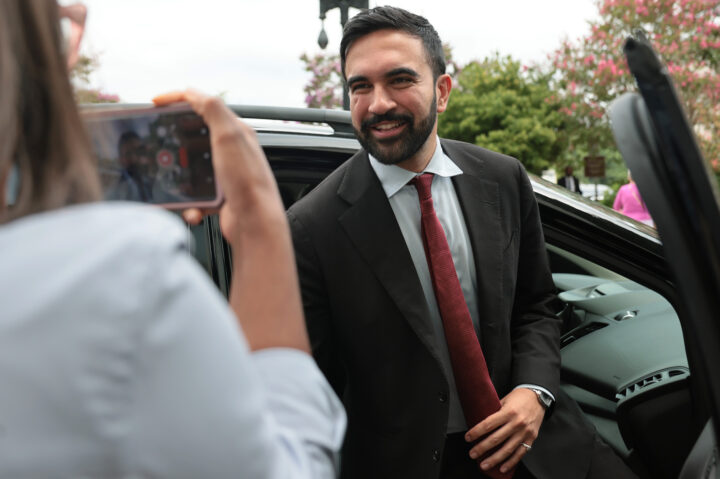
Michael M. Santiago/Getty Images
NYC Mayor Zohran Mamdani briefly speaks with reporters as he leaves the Dirksen Senate Office Building on July 16, 2025 in Washington, DC.
One of the defining features of our politics over the last decade has been the declining power of institutions, combined with the growing influence of individuals acting in their narrow self-interest, frequently at the expense of the public interest.
President Donald Trump’s ability in 2016 to bypass the Republican establishment benefitting from a crowded, self-interested opposition, was one of the seminal moments in our brave new world of individualism over institutionalism. Party institutions, outside-group spending and strident media criticism were no match for the grassroots army that rallied to Trump in that election.
Ten years later, the inability of moderate Democrats and other mainstream institutions to organize any coalition against the campaign of far-left New York City Democratic mayoral nominee Zohran Mamdani looks like the culmination of a dynamic where leaders feel powerless to lead, and are instead simply standing aside, ceding any influence to a cadre of ideological activists within the party.
What’s remarkable about this moment is that the top Democratic leaders in New York, over a month after the primary, aren’t supporting Mamdani — but aren’t willing to speak out against him, either. Senate Minority Leader Chuck Schumer (D-NY), House Minority Leader Hakeem Jeffries (D-NY), New York Gov. Kathy Hochul and Sen. Kirsten Gillibrand (D-NY) have all stayed on the sidelines, reflecting the state of political purgatory that many mainstream leaders are in right now.
There are a handful of Democratic leaders who are speaking out more directly in response to Mamdani’s rise. Pennsylvania Gov. Josh Shapiro, a potential 2028 presidential contender, offered moral clarity in his interview with JI’s Gabby Deutch last week. “When supporters of yours say things that are blatantly antisemitic, you can’t leave room for that to just sit there,” Shapiro said of Mamdani.
Rep. Laura Gillen (D-NY), representing a suburban Long Island district with a sizable Jewish constituency, called Mamdani “a threat to my constituents.” Jeffries, to his credit, has all but conditioned his support for Mamdani to the candidate’s condemnation of “globalize the intifada” rhetoric.
What’s missing is any organized effort to rally behind one of the other Democratic options on the general election ballot in order to consolidate the Mamdani opposition. It’s not for lack of options — with the sitting New York City mayor and the former New York governor on the ballot — even if the alternatives are deeply flawed. Only about half of Democratic voters are lining up behind Mamdani, and he’s polling under 40% in the post-primary polls — an unusually weak position for a Democratic nominee in a deep-blue city.
With Mamdani celebrating his recent marriage in his birthplace of Uganda this past week amid creeping criticism from prominent elected officials, it would have been an opportune time for anti-Mamdani forces to go on offense. But instead, the race is stuck in neutral, with Mayor Eric Adams and former Gov. Andrew Cuomo spending as much time sniping against each other instead of the front-runner.
What’s holding the Mamdani opposition back is a generalized fear of leadership’s ability to make a difference. Would Schumer or Jeffries taking a tougher line against Mamdani significantly move the political needle, or drive the left-wing grassroots against them? Just look at the blowback Gillibrand received for noting in a radio interview that Jewish New Yorkers were alarmed by Mamdani’s public statements on Israel and antisemitic rhetoric.
For Jewish groups, is it worth further antagonizing Mamdani when he remains the favorite to become the city’s next mayor? The fact that a candidate excusing “globalize the intifada” rhetoric was able to comfortably win a Democratic primary — in the place with the largest Jewish population of any city in the world — was a shock to the system.
Coloring all these deliberations is the sense that something has shifted in our body politic — that radicalism isn’t the political turnoff that it once was. But there’s something of a Catch-22 to these internal deliberations: The less willing leaders are to confront the extremes, the more the Overton window shifts to accommodate them.
Synagogue shutdowns, Purim party cancellations and suspension of classes at Jewish schools grow as fear spreads

Ilia Yefimovich/picture-alliance/dpa/AP Images
An Israeli woman under quarantine, after potential exposure to coronavirus, is seen at at a special polling station during the Israeli parliamentary election.
The ongoing spread of the coronavirus across the United States, Israel and Europe is leading to self-quarantine, event cancellations and widespread fear among the Jewish community.
Spreading quickly: A Jewish lawyer in Westchester unwittingly transmitted the disease to nine other friends and family members, bringing the total confirmed cases in New York State to 11. The man remains hospitalized, and his wife, two children and a neighbor have tested positive for coronavirus. A friend of the family has also tested positive, along with his wife and three children.
Shutdowns: The confirmed cases across Westchester led to the self-quarantine of more than 1,000 people, the suspension of activities at the Young Israel of New Rochelle, and the cancellation of classes at SAR Academy through next week and at Yeshiva University temporarily. A Jewish school in Baltimore sent home three students who may have had “indirect contact” with one of the patients. Nefesh B’Nefesh canceled an aliya fair slated for March 15 in New Jersey amid concerns.
No stigmas: Councilmember Mark Levine (D-Manhattan), former chair of the New York City Council Jewish Caucus, tells JI, “Once again Jewish New Yorkers are at the center of a public health crisis. And once again ignorance and prejudice are leading to scapegoating of the community. We need to do everything possible to ensure that coronavirus does not further exacerbate already surging antisemitism and that no group in this city is targeted as a result of this crisis.” Members of the community expressed concerns about being stigmatized due to the outbreak to LoHud.
Holy land: The Israeli Health Ministry is cracking down in an attempt to stop the spread of coronavirus, sending more than 50,000 people into mandatory home quarantine. With at least 15 confirmed cases in Israel, the Health Ministry has ordered anyone returning from France, Spain, Switzerland, Germany and Austria confined to home quarantine for 14 days. This is in an expansion of the restrictions already imposed on those coming from China, Singapore, Thailand, Japan, Hong Kong, Macau, South Korea, and Italy.
Big impact: El Al has laid off 1,000 employees and cut salaries of top management as it struggles with the fallout. Israeli Chief Rabbi David Lau advised Jews yesterday to forego the traditional touching and kissing of the “mezuzah” on doorposts to help prevent the disease’s spread. All IDF soldiers and all health workers in Israel are prohibited from leaving the country at all.
Cancellations: The ministry’s orders also banned any gatherings of more than 5,000 people, and any international conferences, leading to widespread cancellations of concerts, Purim parties, sports games and conferences across Israel. The Jerusalem Marathon, scheduled for March 20, has been postponed, the mayor said Thursday. Most sports games in Israel are now playing to empty stadiums.
Eyeing the U.S.: While there are currently no specific restrictions on travelers from the United States, the ministry said that anyone who attends a conference overseas must also observe a 14-day quarantine. The policy applies to all those returning from March 4 and forward, which could potentially include those at the recent AIPAC policy conference in Washington. AIPAC sent a warning to those at its conference earlier this week that a group of attendees were “potentially in contact” with an individual with confirmed coronavirus, though no attendees have tested positive so far.
NY-Jerusalem: One of the people in Westchester who tested positive for coronavirus visited Israel between the dates February 22-28. The Israeli Health Ministry released a detailed list of the woman’s activities in Jerusalem, including visits to shops, restaurants and travel on public transportation. The ministry ordered that anyone who was on the same El Al flights or visited locations at the same time as the tourist must enter quarantine for 14 days.
Across the pond: A Jewish dentist in London tested positive for the virus yesterday and has been in self-isolation since he returned from a trip to Switzerland via Milan last week.
Please log in if you already have a subscription, or subscribe to access the latest updates.
 Continue with Google
 Continue with Apple