




















































The Senate minority leader was pressed by MS NOW’s Joe Scarborough on his view of the U.S. and Israel’s war achievements

Samuel Corum/Getty Images
Senate Minority Leader Chuck Schumer (D-NY) makes a statement alongside House Minority Leader Hakeem Jeffries (D-NY) outside of the West Wing at the White House on January 17, 2024 in Washington, DC.


 Add JewishInsider on Google
Senate Minority Leader Chuck Schumer (D-NY) did not directly address whether the degradation of Iran’s military infrastructure should be viewed as a positive outcome, instead emphasizing the war’s potential economic and geopolitical consequences.
Over the course of the past week, U.S. officials have indicated that Iran’s military capabilities have been severely weakened. President Donald Trump has described Iran’s military as “decimated,” and Director of National Intelligence Tulsi Gabbard testified at a congressional hearing this past week that the Iranian regime was “largely degraded.”
When asked by MS NOW’s Joe Scarborough on Monday’s edition of “Morning Joe” whether that degradation was a “good thing,” Schumer called the question “premature.”
“You can’t [answer that question] because it’s a premature question,” Schumer said. “What is going to happen in the next several months? Is it worth it? Will the world economy collapse?”
“I can ask that question,” Scarborough replied. “I’m simply asking on the military side: Is it good — regardless of whether we agree with going in or not — is it good that Iran’s military infrastructure has been seriously degraded?”
Schumer again asserted that it could not be answered without understanding the full implications of the current conflict.
“In all due respect, if you ask the American people, if you have the choice of degrading the military structure in Iran, but having gasoline be $6 a gallon and our economy falling into a deep recession where millions lose their job, what do you think?”
Schumer ultimately signaled agreement with that underlying point, while maintaining his broader concerns.
“The fact that the leader [Ayatollah Ali] Khamenei is gone, no one regrets that. The fact that Iran has less ability to create military trouble [is a good thing], no one disputes that. But you have to look at the consequences.”
Schumer argued that Congress would have had a clearer understanding of the potential economic and geopolitical consequences had lawmakers passed one of several war powers resolutions — an effort that has been voted down by House and Senate Republicans with several Democrats joining them on several instances within the past month.
“If Republicans had voted with us on the War Powers Act, all these questions would have been asked ahead of time instead of Donald Trump’s willy-nilly — one day yes, one day no,” Schumer said.
Coons: ‘Having Iran on its back foot and having the Iranian enrichment progress halted is something I'm not going to criticize’
Drew Angerer/Getty Images
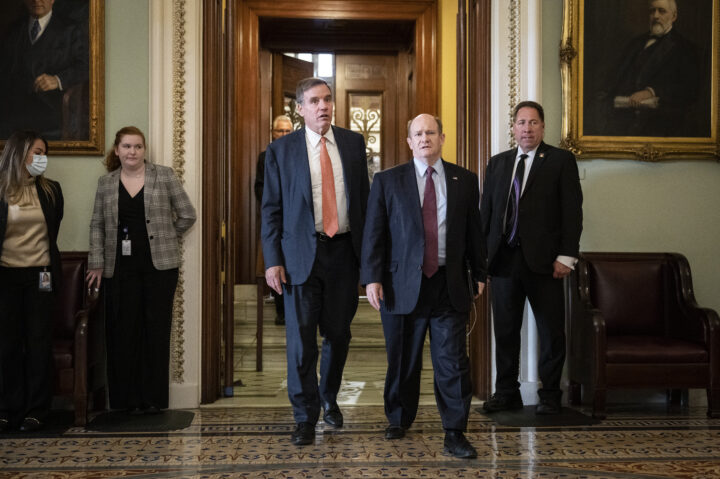
Sen. Mark Warner (D-VA) and Sen. Chris Coons (D-DE) leave the Senate floor and walk to a luncheon with Senate Democrats at the U.S. Capitol on June 15, 2021 in Washington, DC.
ASPEN, Colo. — Sen. Chris Coons (D-DE) said Friday that the U.S. strikes on Iran could ultimately produce a positive outcome, a softening of the Delaware senator’s previous skepticism.
“The strike on Iran is one that I disagreed with because of the process, the lack of consultation with Congress, the partisan way that Republicans were notified at the most senior levels [and]Democrats were not,” Coons said at the Aspen Security Forum.
He said he also had not expected that the administration would be able to avoid significant Iranian retaliation and an escalating conflict.
“I frankly, did not believe that we would end up in the period we seem to be in where a counter-strike by Iran against American soldiers and interests has not yet come,” Coons continued.
But, he said, “if it actually ends up securing a movement towards regional peace and really knocking down Iran’s nuclear enrichment program, it’s a good thing. I mean, having Iran on its back foot and having the Iranian enrichment progress halted is something I’m not going to criticize.”
Coons added that he is concerned that the administration lacks a clear plan for the path forward or the commitment to sustain pressure on Israeli Prime Minister Benjamin Netanyahu to end the war in Gaza and pursue “Saudi-Israeli-Palestinian reconciliation and recognition.”
Sen. Mark Warner (D-VA), speaking alongside Coons, argued that President Donald Trump had overplayed the strikes’ effectiveness and missed the opportunity to capitalize on them.
“I would also grant on the Iran strike that I had the same concerns, and I was Gang of Eight and did not get told,” Warner said, referring to the group of eight senior congressional leaders who are traditionally briefed on important intelligence matters by the executive branch. “In [Trump’s] effort to claim total credit, he turned something that was a success, but by saying within two hours ‘total obliteration’ when we didn’t even try to fully take out all the enriched uranium [storage] sites set a standard that was too high.”
“Setting Iran back dramatically was important,” Warner said. “But then you had everybody trying to kowtow to this level that is unattainable unless you have troops on the ground.”
He said the only way to ensure Iran’s nuclear program won’t continue is to reach a deal to allow nuclear inspectors back into the country, and that he expected Trump was pursuing that path after the strikes, but “it feels like that moment has already passed.”
The two Democratic senators also spoke about their concerns about the upcoming 2026 appropriations process, and Office of Management and Budget Director Russ Vought’s recently reported comments that he wanted to see the process be less bipartisan. They raised concerns that Republicans would seek to walk back bipartisan appropriations deals through recissions down the road.
Warner, the vice chair of the Senate Intelligence Committee, railed against Director of National Intelligence Tusli Gabbard as untrustworthy and “not competent,” accusing her of politicizing the intelligence community and mishandling classified information. He said he believes that close intelligence partners are curtailing their information-sharing with the U.S. due to concerns about Gabbard and the Trump administration.
Addressing the Signalgate scandal, when top administration officials discussed operational plans against the Houthis in Yemen on an unsecured private messaging app, Warner said “the Israeli government was extraordinarily upset” about the incident.
Please log in if you already have a subscription, or subscribe to access the latest updates.
 Continue with Google
 Continue with Apple