
































‘Each individual senator has a tremendous amount of power to disrupt the normal functionings of the Senate,’ Sen. Cory Booker said
Marc Rod
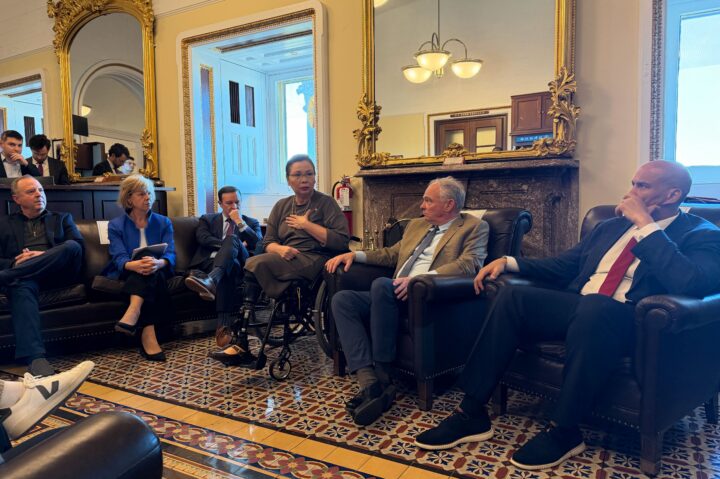
Sens. Cory Booker (D-NJ), Tim Kaine (D-VA), Tammy Duckworth (D-IL), Chris Murphy (D-CT), Tammy Baldwin (D-WI) and Adam Schiff (D-CA) hold a press briefing on Iran war powers resolutions on March 9, 2026.


 Add JewishInsider on Google
A group of six Senate Democrats is threatening to immediately begin obstructing proceedings on the Senate floor in order to force public hearings in the Senate Armed Services Committee and Foreign Relations Committee and debate on the chamber floor on the war in Iran.
Jewish Insider first reported that several of those lawmakers — including Sens. Cory Booker (D-NJ), Tim Kaine (D-VA), Tammy Duckworth (D-IL), Chris Murphy (D-CT), Tammy Baldwin (D-WI) and Adam Schiff (D-CA) — introduced a series of five new war powers resolutions late last week.
The senators indicated in a meeting with reporters on Monday that they plan to force votes on those, and possibly additional, war powers resolutions when they become eligible for votes next week, but that those resolutions are just part of a broader strategy to disrupt normal Senate business in an attempt to force greater public discussion about the war in Iran.
“We’ve had no oversight whatsoever over what the executive is doing, as they’re spending a billion dollars a day. And we have failed to have any real substantive debate or discussion,” Booker said. “We are not going to let business as usual go on in the Senate … we are demanding that the Republican leadership of the Senate hold the adequate hearings and oversight, as well as to allow a debate that brings transparency to this onto the Senate floor.”
Booker declined to discuss their specific plans, but said that the senators would “use the levers that we have,” citing efforts over the years by Republican colleagues to block or slow down Senate procedure to compel votes on various issues.
“Each individual senator has a tremendous amount of power to disrupt the normal functionings of the Senate, as well as certain privileges that we can exercise,” Booker said. “And what we have agreed on right now is that we are not going to let the Senate continue its business as usual.”
Though the war powers resolutions won’t be eligible for Senate floor votes until next week, Booker indicated that the senators plan to begin other obstructionist tactics immediately, unless hearings are announced.
Murphy highlighted that the lawmakers have the ability, should they choose to do so, to “force a vote and debate every single day in the Senate” on the war powers resolutions. But Baldwin indicated that the lawmakers might not force the war powers votes if Republicans do schedule the hearings they request.
Booker said that the group is not necessarily speaking for the entire Senate Democratic caucus.
Murphy asserted that public hearings with administration officials, tasked with defending and explaining the war effort to the public, would only make the operation less popular with the American public. The Democrats also highlighted other costs, including increasing gas prices, associated with the war.
Kaine argued that the question for the Senate and the American people is not whether “Iran [is] a bad actor” or whether “in the abstract, [they have] done terrible things,” it is whether the war is worth risking American lives. Seven U.S. servicemembers have died in the course of the campaign so far.
Murphy and other Senate Democrats had also been pushing for a Senate vote on an authorization for use of military force regarding Iran. But on Monday, the six Democrats involved in this effort said they had ruled out the idea of a Democratic-led AUMF, arguing that the burden is on Republicans and the administration to put forward such a proposal and define its scope.
“They have to tell us and bring evidence to us that this war is worth an AUMF,” Duckworth said. “I personally don’t even want to have the discussion about an AUMF, because they haven’t even gone to the first step yet” of proving the need for the war.
Kaine said that the lawmakers, including Murphy, had “explored the procedural option” of an AUMF, but said that the “burden” to write such a bill should not be on the Democrats “who think this war is a bad idea.”
“It would be too unusual for the opponents to file the AUMF,” he continued. “The proponents are the ones that carry the burden of proof with the American public. They need to file it.”
The six Democrats did not appear to be entirely in agreement about how they would handle a potential request by the administration for supplemental funding to support the war effort or replenish U.S. armaments expended in it.
Kaine said he would withhold judgement on the issue until such a request was presented, explaining, “I want to end the war, I want to protect our troops.”
Schiff argued that the military has “plenty of money” from last year’s reconciliation bill, and also said that a congressional appropriation for a military effort could, legally, be considered an authorization for use of military force.
Should they secure the hearings they seek, the senators said they want to press administration officials on the goals and timeline for the war, the rules of engagement and restrictions imposed on U.S. forces, the circumstances that led to a deadly strike — which some have attributed to the U.S., though the administration disputes this — on a girls’ school, potential plans to support separatist movements inside Iran and the administration’s plans to support and protect Iranian demonstrators should another mass uprising occur.
“My goal is to end this war, to stop wasting millions of dollars and to protect further servicemembers from dying, and I think the way that you do that is by exposing to the public the fact that this is a war of choice, the fact that this president has ignored the law and the Constitution and the people through us, hold him to account,” Baldwin said.
Yifat Tomer-Yerushalmi recently resigned amid allegations of lying about leaking sensitive materials about investigation into abuse at Sde Teiman prison
Oren Ben Hakoon/AP
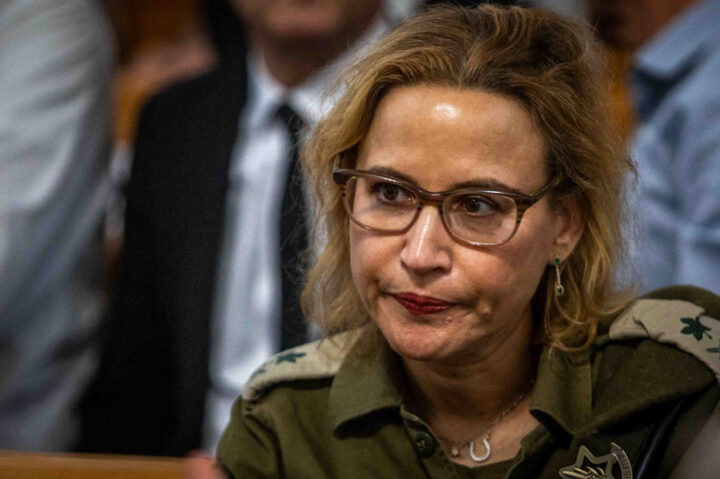
Israel's Military Advocate General Maj. Gen. Yifat Tomer-Yerushalmi, at the supreme court in Jerusalem Tuesday, Oct. 1, 2024.
Former IDF Advocate-General Yifat Tomer-Yerushalmi was arrested on Sunday evening, reportedly on grounds of obstruction of an investigation, after disappearing and leaving behind a note raising concerns of a potential suicide. The arrest came two days after she resigned her post following a determination by police that she had leaked sensitive materials showing alleged abuse of a Palestinian detainee at Israel’s Sde Teiman prison to the media.
Police found Tomer-Yerushalmi’s car at a beach north of Tel Aviv, hours after relatives reported that she was missing. According to Israeli media, she had left a note to her family. The ensuing manhunt involved police, the Israeli Navy, drones with geothermal detection and more.
Tomer-Yerushalmi was arrested after police found her safe, but without her phone, which had last been tracked near her car and then turned off. The disappearance of the phone raised police officers’ concern that she had possibly staged a suicide attempt to cover up the destruction of evidence caused by the disposal of her phone, Ynet reported.
National Security Minister Itamar Ben-Gvir said on Monday that Tomer-Yerhushalmi remains on suicide watch in jail. The Tel Aviv Magistrate’s Court extended her remand until Wednesday.
Tomer-Yerushalmi resigned from the IDF on Friday following her suspension in light of a criminal investigation by police that found that she had leaked surveillance video purportedly showing abuse at the Sde Teiman detention facility, in which terrorists who perpetrated the Oct. 7, 2023 attacks were held, and that members of the MAG corps lied to the High Court of Justice about it.
“I approved the release of material to the media in an attempt to counter the false propaganda directed against the military law authorities,” Tomer-Yerushalmi wrote in her resignation letter. “I bear full responsibility for any material that was released to the media from within the unit.”
Masked military police officers entered the Sde Teiman facility last July, arresting several prison guards for alleged abuse after a doctor found wounds possibly indicating rape of a Palestinian prisoner. Ultimately, five of them were charged this year with abusing the detainee, a Hamas police officer who allegedly attacked a guard who was searching his person, but not with rape. According to the indictment, the soldiers tased the prisoner, kicked him and stepped on him while he was handcuffed, breaking his ribs.
The arrest sparked protests at the detention facility, with demonstrators — including three far-right lawmakers — at one point breaking into Sde Teiman, arguing that the IDF soldiers were being mistreated. The MKs and others on the right have frequently accused the MAG of not protecting IDF soldiers and endangering the hostages. One right-wing commentary outlet called the MAG corps “a chapter of [the International Criminal Court in] the Hague, a hostile body bringing foreign interests into the army” and leading a “campaign against the soldiers.”
In August last year, Israel’s Channel 12 broadcast the video at the center of the scandal, purporting that it showed sexual abuse. The video showed a detainee lying on the floor, while soldiers surrounded him with riot shields, such that their treatment of him could not be seen in the clip. The IDF said the video had been misleadingly edited.
The video was distributed widely by international news organizations as well as on social media.
Following petitions to Israel’s High Court of Justice demanding an investigation, Tomer-Yerushalmi’s deputy, Gal Asael, ordered a probe of the leak by Military Police. A report provided by Asael to the Supreme Court and the Knesset stated that the leak did not come from the MAG corps, but that “hundreds of people were exposed to the materials, and therefore we cannot know who is the leaker.”
Army Radio reported in recent days that Asael has said he did not know the leak came from within the MAG corps. He is not currently a suspect.
Israeli Attorney-General Gali Baharav-Miara approved Asael taking command of the investigation, and backed up his report. In September, the Attorney-General’s Office told the High Court that “there is not even a preliminary indication pointing at the source for transferring the information.” Justice Minister Yariv Levin – who has attempted to fire Baharav-Miara – accused her of conspiring with Tomer-Yerushalmi in the obstruction of justice and said she cannot be involved in the ongoing proceedings relating to this case.
Police arrested former IDF chief prosecutor Matan Solomesh on Sunday night, alleging that he knew about the leak and did not report it.
Senior government figures blasted Tomer-Yerushalmi in public statements in recent days.
At a Cabinet meeting on Sunday, Israeli Prime Minister Benjamin Netanyahu called the incident at Sde Teiman “the most severe public relations attack that the State of Israel has experienced since its establishment,” and said that it “caused immense damage to the image of the State of Israel and the IDF, to our soldiers.”
Israeli Defense Minister Israel Katz accused Tomer-Yerushalmi of a “blood libel against IDF soldiers and preferring the good of [Hamas] terrorists over [the soldiers].”
Katz and IDF Chief of Staff Eyal Zamir have begun the process of finding Tomer-Yerushalmi’s replacement.
By law, the MAG is appointed by the Defense Minister to protect her independence, even though the IDF chief of staff is technically her commanding officer. The MAG is the ultimate authority on what is legal or illegal in the IDF, and has broad discretion over law enforcement matters, including investigations and indictments.
The MAG corps’ independence within the IDF system is often described as the soldiers’ “bulletproof vest,” helping protect them from international courts, which are supposed to respect existing domestic legal proceedings.
Eran Shamir-Borer, the director of the Israel Democracy Institute’s Security and Democracy Center and the former head of the IDF International Law Department in the MAG corps, expressed concern that the ongoing scandal relating to Tomer-Yerushalmi “might have broader implications for Israel’s legal resilience and ability to protect its soldiers and commanders against legal risks overseas.”
“What’s happening now threatens to cast a big shadow over the military’s ability to do this,” he added. “It’s a real earthquake. … A unit of the IDF entrusted with enforcing the law has been very much contaminated.”
At the same time, he stressed that “this should not taint the entire unit, comprised of hundreds of professional legal officers with strong commitment to ensuring Israel’s security and maintaining the rule of law.”
In addition, Shamir-Borer cautioned against public pressure to drop the charges against the soldiers who allegedly abused the Palestinian detainee in Sde Teiman, saying that “the current scandal should not be used as a pretext to further erode the rule of law.”
Shamir-Borer said that Katz and Zamir now have an “enormous task” to “rebuild trust in this unit within Israeli society, but also overseas.”
Please log in if you already have a subscription, or subscribe to access the latest updates.
 Continue with Google
 Continue with Apple