









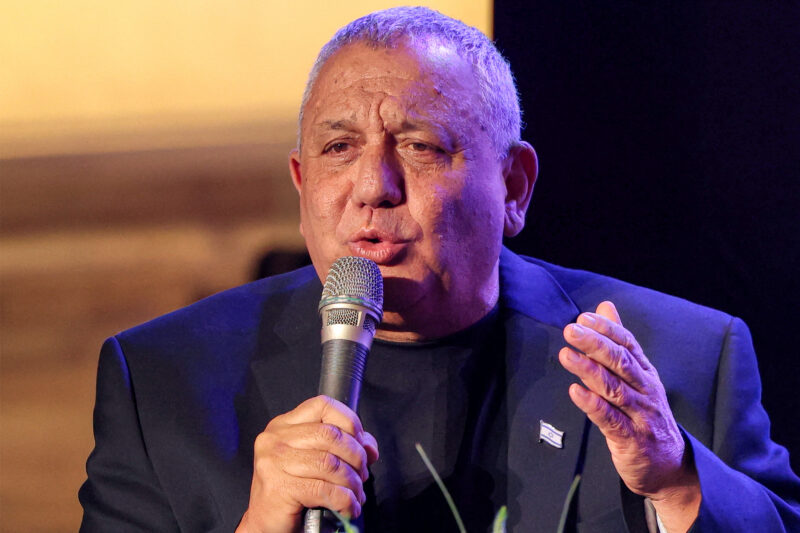

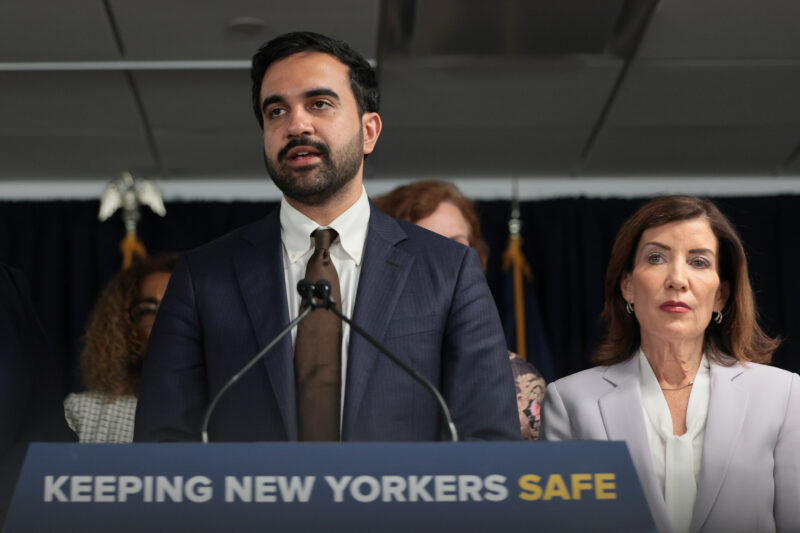





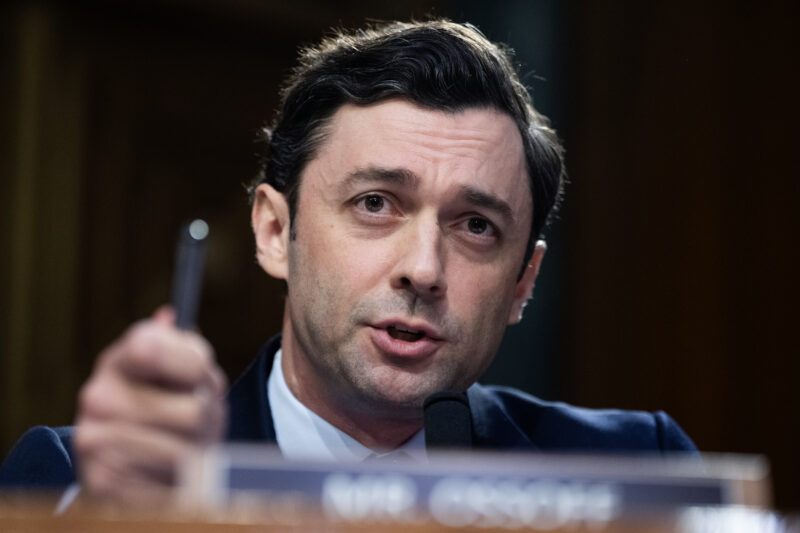

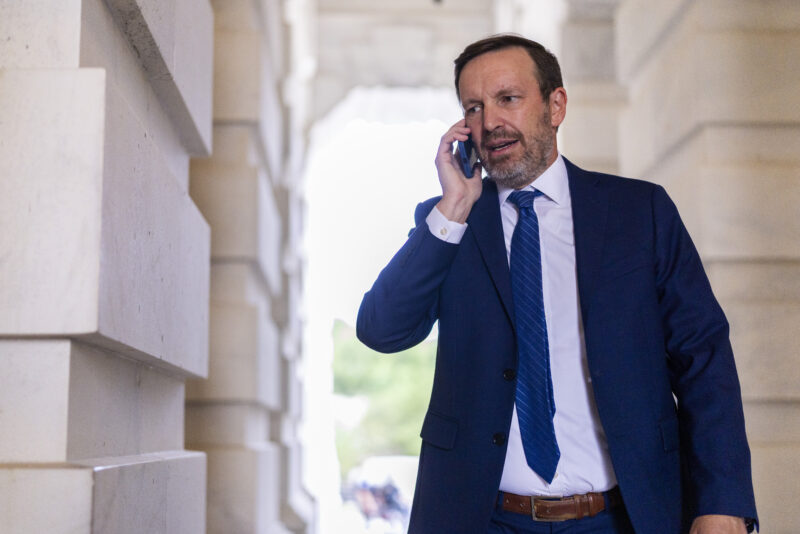

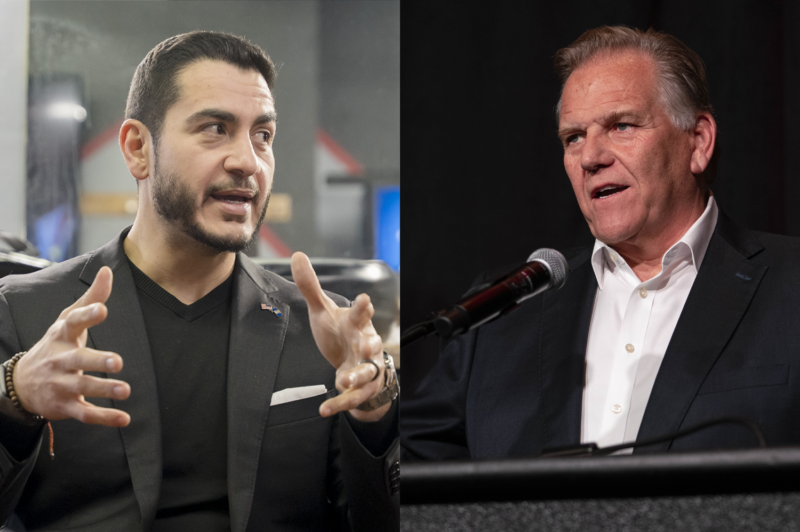
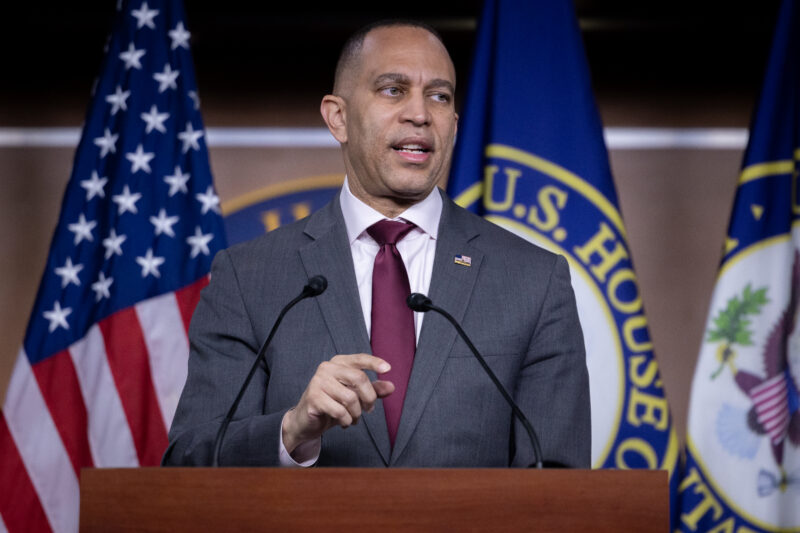











Landsman has been one of the most outspoken pro-Israel Democrats, and is running comfortably ahead in a Trump district around Cincinnati
Tom Williams/CQ-Roll Call, Inc via Getty Images
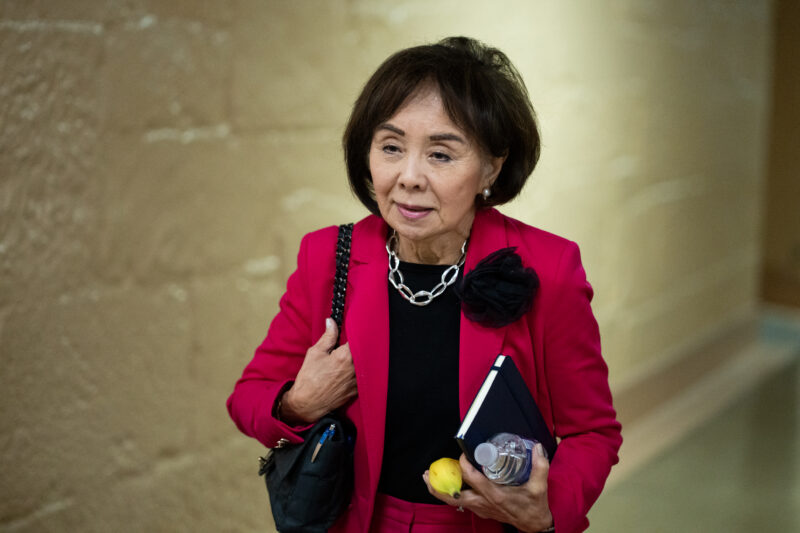
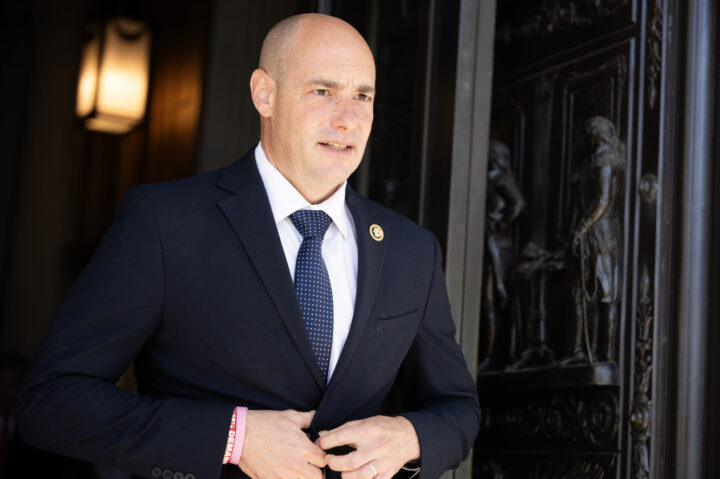
Rep. Greg Landsman (D-OH) leaves the U.S. Capitol after the last votes of the week on Thursday, September 4, 2025.


 Add JewishInsider on Google
The Congressional Leadership Fund, the independent expenditure arm of the House GOP aligned with Speaker Mike Johnson (R-LA), is withdrawing plans for independent spending against Rep. Greg Landsman (D-OH), alongside several other districts the PAC is seen as essentially surrendering to Democrats, according to The New York Times.
Landsman, a moderate Jewish Democrat, is running for reelection in a district the Cook Political Report rates as “lean Democrat,” even though President Donald Trump won the district in 2024.
Landsman has been outspoken in support of Israel and the Jewish community, and was one of the small handful of Democrats who initially supported the war in Iran.
CLF is also reportedly pulling out of Michigan’s 8th Congressional District, held by Rep. Kristen McDonald Rivet (D-MI), another moderate Democrat, as well as the districts currently held by Reps. Tom Kean Jr. (R-NJ), Mariannette Miller-Meeks (R-IA) and Don Bacon (R-NE), who is retiring.
Democrats nominated moderate candidates in all those races.
The group plans to discuss a range of subjects including U.S. allies’ decision to sanction Israel
Aryeh Schwartz/AJC
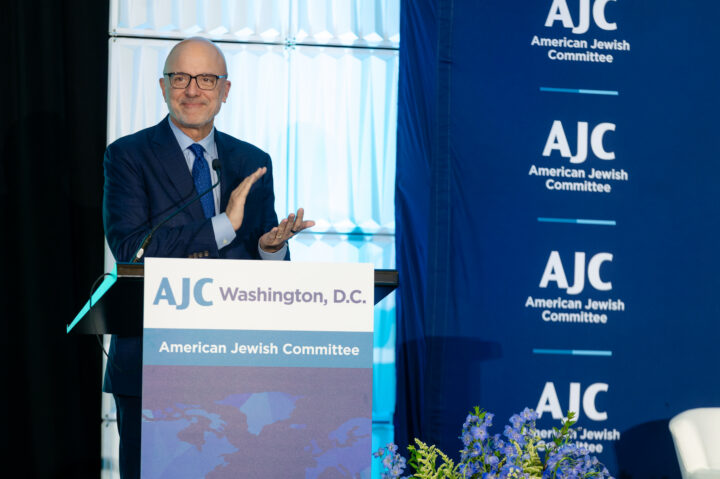
Ted Deutch
This week’s upcoming United Nations General Assembly gathering in New York City will serve as the backdrop for a “diplomatic marathon” by the American Jewish Committee’s leadership to meet with representatives and leaders of more than 50 countries — a tradition the AJC has carried on for decades.
On the agenda are a range of subjects, including confronting close U.S. allies that have recently decided to impose sanctions on what they deem to be Israeli-occupied territories, including West Bank settlements as well as east Jerusalem and the Golan Heights.
“This is an opportunity to have really meaningful conversations with friends who are standing firmly with us and understand the challenges that Israel faces and are supportive,” AJC CEO Ted Deutch said in an interview at the group’s offices in Washington. “And then we’ll have conversations with countries who have been taking challenging positions, and we have very frank conversations as we will this year in particular when we meet with our friends from the U.K. and Canada and Australia and France.”
He argued that those conversations are critical to discuss the countries’ decisions to impose sanctions on what they deem to be occupied territories, a move he said “damages the prospects for peace” and “plays into the hands of extremists who wish to drive a wedge between Israel and her democratic allies.”
“Democratic allies should be coming together, not drifting apart. Israel is a democratic ally of these countries that plays a critical role in the Middle East’s stability,” Deutch said.
He said AJC had similar “difficult conversation[s]” around U.S. allies’ decision to recognize a Palestinian state. “That’s not just meant to be critical, but actually, to help them understand why this is a bad decision.”
In meetings with Germany and other European allies, Deutch said he also plans to discuss the rise of the far-right AfD party and the risk that “rising extremism” across Europe poses to the Jewish community. More broadly, AJC will discuss antisemitism and efforts to fight it and foster Jewish life around the world.
He said that every country that has a Jewish community has a role in making sure that Jewish communities can gather together without fear, but also that the responsibility extends beyond governments alone.
“We also think it’s important for countries to recognize that this is not something that governments can do on their own, that across the country there are roles for each part of society to play in combating antisemitism in ways that don’t just protect Jews but strengthen everyone’s ability to fully participate in those societies … because it’s consistent with who these countries are in maintaining pluralistic democracies,” Deutch added.
He said conversations with global leaders will also touch on issues within the United Nations itself and its bias against Israel. He said that Francesca Albanese, the U.N. special rapporteur for the Palestinian territories who has faced repeated accusations of antisemitism from various nations, “makes a mockery of the system as a whole.”
He said AJC also plans to press countries to designate the Islamic Revolutionary Guard Corps and its proxies as terrorist organizations, and to continue to support both international and country-by-country sanctions on Iran.
“Let’s also continue to remember what Iran represents and why the world should stand against it, and come together around all of the ways that it can,” Deutch said. “While [it is] appropriate for Congress to have that debate [about military action], Iran is a threat and continues to be a threat, we need to continue to remind people of that.”
Deutch said AJC will have “frank conversations” with countries about the situation in Gaza, while also emphasizing that Hamas has not fulfilled its obligation to disarm under the U.S.’ 20-point peace plan, which is a mandatory step for the peace process to move forward.
“We have to shift the focus back to how to make that happen, and it does start with disarming Hamas,” he said. “It shouldn’t be difficult for the world to rally around the idea that this terrorist group that committed the Oct. 7 attacks should no longer be allowed to be an armed organization that poses a threat. We’ve seen what happens when that was allowed in the past.”
But he said it’s also important to provide support and encouragement and express appreciation to those countries that have continued to stand with Israel and the Jewish community. The week will include meetings with various countries across South America, where AJC is working to promote ties with Israel as well as opportunities for expanding and deepening the Abraham Accords.
Deutch said that AJC will be engaging with some states that could join the Abraham Accords, and will emphasize that they face a shared threat from Iran, as has been demonstrated in recent days by the Houthi attacks on Saudi Arabia.
“The Abraham Accords represents the alternative to that, and represents an opportunity for greater security and greater economic integration and more and better opportunities for the people of the region,” Deutch said.
During the UNGA, AJC will also discuss both internally and externally efforts to engage more deeply with Africa, working to provide opportunities for African countries to experience Israeli innovation and technology and see Israel for themselves.
Deutch and AJC additionally plan to push to strengthen the transatlantic alliance and support Ukraine’s defense. AJC will also host a reception with Jewish community members and diplomats, where the group will award Nickolay Mladenov, the high representative of Gaza for the Board of Peace, with the Madeline and Bruce M. Ramer Award for Diplomatic Excellence.
Both at home and abroad, Deutch said that leaders need to understand and call out efforts to deny Israel’s right to exist, and to understand that such rhetoric “put[s] the Jewish community at risk” and that “engaging in age-old antisemitic conspiracy theories” must be confronted.
Efforts by some political actors to bar Jews and supporters of Israel from the “political mainstream … aren’t just calls that affect the Jewish community, that threaten the Jewish community,” but also “undermine our democracy.”
Standing up to that rhetoric “matters to the future and security of democracies around the world,” well beyond the Jewish community itself, he said.
He called on members of Congress and other leaders to show greater courage and leadership in the face of harassment, bullying and threats that have been directed at supporters of Israel in Washington, and which some members say have led their colleagues to soften their support for the Jewish state.
“That’s what the Jewish community has been facing, and for the Jewish community and for supporters of Israel, the response is not to cower. That’s what the antisemites want. What the anti-Israel forces want,” Deutch said.
“For our leaders — I get it. I was a member of Congress. I dealt with people chasing me around with bullhorns, yelling names at me. I understand what that’s like, and I get that there are threats. That should embolden them, embolden members, embolden leaders to stand up against that,” he said. “Members of Congress aren’t mushy about anything, and they shouldn’t be mushy when it comes to standing up against antisemitism and efforts to undermine Israel’s right to exist.”
The second annual Sephardic Rabbinic Conference, backed by the Orthodox Union and UJA-Federation, will bring together around 150 participants from a dozen countries to address leadership gaps and Diaspora institution-building

Getty Images
Some 150 rabbis, communal leaders and young professionals from a dozen countries will convene in Manhattan on Monday and Tuesday for the second annual Sephardic Rabbinic Conference, a gathering aimed at strengthening a Jewish community that organizers say has long operated in a Jewish institutional landscape shaped by Ashkenazi-dominated institutions.
The conference, titled “The Art of Leadership,” will bring together rabbis and rebbetzins from Mexico City to Moscow, Cape Town to Queens, to lead sessions on halachic authority, mental health, pastoral care, connecting to Israel and what organizers describe as the urgent work of building long-lasting Sephardic institutions in the diaspora.
“There’s clearly been a lack of [Sephardic] representation in a lot of mainstream Jewish institutions — in federations, in schools —- a lack of our needs being seen and heard,” said Ethan Marcus, managing director of Sephardic Brotherhood of America and co-organizer of the conference with Avi Garson, co-founder of The Habura, an online and physical Jewish study center. “Whether it’s a Moroccan, Turkish or Spanish Portuguese community, they may differ from what you would say mainstream Ashkenazi communities need,” Marcus told Jewish Insider.
This year’s conference, Marcus asserted, is itself evidence that the status quo is beginning to change: It’s being held at UJA-Federation of New York’s headquarters and backed by a roster of major Jewish institutions, including the Orthodox Union — which hosted last year’s inaugural gathering — the Rabbinical Council of America, World Zionist Organization and KKL-JNF.
“These organizations are stepping up and saying, ‘We want to hear from you and what your unique ideas and needs are, and what you also have to offer the wider Jewish world,’’” said Marcus. “We believe there’s a lot the wider Jewish world can take away from the Sephardic path we’re pushing. This idea of a middle-of-the-road [approach] steeped in Jewish traditions but fully engaged with the challenges and benefits of the modern world. To us that’s very much the Sephardic approach, and it’s something that all Jewish people can benefit from.”
Speakers include Daniel Rosenthal, vice president of government relations at UJA; Ofir Akunis, consul general of Israel in New York; Yaakov Hagoel, chairman of the WZO; and Caroline Bryk, senior director of Jewish day school strategies at Tikvah — alongside dozens of rabbis from across the globe.
Despite making up just an estimated 10% of the American Jewish population, Sephardic and Mizrahi Jews in the U.S. report higher rates of Jewish communal participation, a stronger connection to Israel and are more likely to say that being Jewish is somewhat or very much a part of their daily life compared to Ashkenazi Jews, according to a 2025 report by JIMENA (Jews Indigenous to the Middle East and North Africa).
On Manhattan’s Upper East Side, just blocks from where the conference is being held, the Sephardic community has been steadily establishing itself — anchored by institutions like the Moise Safra Center, the 14-story community center that opened on East 82nd Street in 2018 and marked a demographic shift for the neighborhood.
And yet, Garson had questions — which he laid out in a piece for La Djente, the national magazine of the Sephardic Jewish Brotherhood of America — that ultimately led to the creation of last year’s conference: Where is Sephardic leadership coming from? Where is it being trained? And who is going to lead and represent the community in the years ahead?
“One thing led to the other and we realized we should put everyone together in the same room,” Garson told JI, reflecting on the inaugural gathering, which focused on the theme of education. “We managed to get 40 rabbis and community leaders from six countries. We realized there’s a real deep ongoing desire to connect — for everyone to get together and discuss these issues and collaborate.”
This year’s event, with a focus on leadership, comes as a “turning point in the Sephardic world — where all of these synagogues and people are recognizing we need to work together,” said Marcus. “We can be uniquely our own identities; the Sephardic world is not a monolith. Moroccan Jewish communities, Syrian Jewish communities all have their unique customs and traditions, but there’s a lot more that unites us than divides us. But we don’t have to get rid of our self-identities. Jewish unity doesn’t mean Jewish uniformity.”
That openness extends to the conference’s slate of speakers — not just Sephardic rabbis, but Ashkenazi voices and some from outside the Jewish community entirely. The point, Garson said, is “to bring in good ideas and best practices to help our community, which in turn can help the Jewish community more broadly.”
He traced the notion back to Maimonides, the medieval Sephardic sage known for his intellectual openness, who famously championed: “Hear the truth, whoever speaks it.”
The former ambassador told JI a Netanyahu loss in October’s elections would be a ‘very healthy thing’ for the U.S.-Israel relationship
(Tomer Neuberg/Flash90)
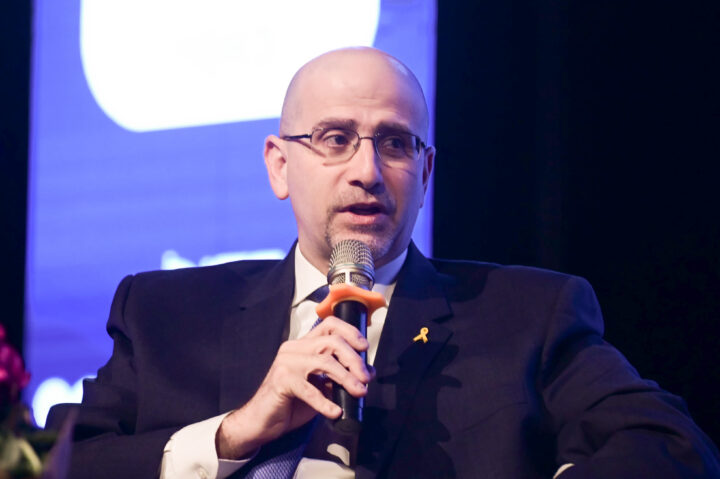
Former US ambassador to Israel Dan Shapiro speaks at a Conference of the Institute for National Security Studies (INSS), in Tel Aviv, on February 25, 2025.
ASPEN, Colo. — Former U.S. Ambassador to Israel Dan Shapiro argued on the sidelines of the Aspen Security Forum last week that without new leadership in Israel — meaning a defeat for Prime Minister Benjamin Netanyahu in Israel’s elections — he does not know how Israel can repair its reputation in the United States.
“I don’t see a path to repairing Israel’s deteriorating standing in the United States on both sides of the aisle without a change of leadership in Israel,” Shapiro told Jewish Insider in an interview, a sentiment he repeated during a panel on Israel and the U.S.-Israel relationship at the conference.
Shapiro said that a “wise Israeli government” would pay attention to its “deteriorating standing in the United States” and that the “Israeli public might want to bear that in mind too as they prepare to go to the polls in October.”
Asked whether he thinks some in the U.S. are pinning broader criticisms of Israel on Netanyahu personally, Shapiro emphasized that there’s “a lot of history and a lot of emotion and a lot of associations with the prime minister,” who is “very present in our media, in our politics.”
Netanyahu, he said, is associated with many of the biggest flashpoints in U.S.-Israel relations including opposition to former President Barack Obama and the 2015 Iran nuclear deal, the wars in Gaza and Iran and the rise of his far-right Cabinet ministers.
“Probably a very healthy thing for the U.S.-Israel relationship would be if 95% of Americans do not know the name of the Israeli prime minister, and that’s a possible outcome out of this election,” Shapiro said. “That doesn’t guarantee it fixes everything by any stretch. There’s work to do, but that’s a different starting point.”
Israel, he continued, won’t be able to placate all of the critics of its continued efforts to defend itself, but he said there are other steps it can take to improve attitudes in the U.S., including cracking down on “the Jewish terror wave against Palestinian civilians in the West Bank,” providing withheld funds to the Palestinian Authority, stopping settlement expansion and moving more assertively to implement the U.S.-led 20-point peace plan for Gaza.
Speaking to JI shortly after more than 100 House Democrats voted to cut off U.S. military aid to Israel, Shapiro said that, while there’s “legitimate ground for concern and for criticism” of Israel’s operations in Gaza, cutting off all $3.3 billion wholesale is not “a very thoughtful way” to address concerns about civilian harm. He also emphasized the responsibility Hamas bears for intentionally endangering Palestinian civilians.
“We have an ongoing U.S. interest in ensuring Israel can defend itself from a lot of very dangerous enemies who are also our enemies,” Shapiro said. “There are much more thoughtful and much more careful and nuanced ways of trying to get at the real problem, which is ensuring that U.S. equipment — which Israel may need, and which we’ve made some commitment to, to defend themselves where they legitimately have a need to do so — is not used in a way that produces unacceptable civilian casualties.”
He said the current debate, at its heart, touches on the fundamental question of whether the U.S.-Israel relationship continues to serve American interests, which he strongly believes it does.
“If we were to see a real deterioration and distancing of the U.S. and Israel, for the long term, we’d find that our own interests and our own ability to defend our own influence and our own ability to defend our interests in the Middle East would be significantly compromised,” Shapiro said.
He said that severing the U.S.-Israel relationship would embolden Iran and its proxies — which are also enemies of America — to undermine the regional defense architecture that the U.S. has spent years building, leading U.S. allies to pull away from the Washington and hedge with Iran.
Shapiro said during the panel that those calling for a total dismantling from the U.S.-Israel relationship should be asked to address that policy’s second-order effects on U.S. interests and American influence in the region.
While Shapiro acknowledged that polling has shown that many in the U.S. have a negative impression of Israel’s conduct in the war in Gaza, he does not necessarily believe that means that most Americans want to see the U.S.-Israel relationship severed entirely.
Shapiro argued to JI that there’s a “broad middle” of the Democratic Party, on both sides of the Israel aid vote, that continues to support Israel’s right to exist and has reasonable conversations about the future of the party. On the extremes, however, there are some, including prominent leaders, who do not believe Israel has a right to exist, which Shapiro called strategically wrong, morally wrong and a political mistake.
“I think we’ll end up losing in the swing areas and swing districts and states if we marry ourselves to that most extreme attitude on this issue,” Shapiro, who served under former President Barack Obama, said, emphasizing that extreme anti-Israel candidates have so far only succeeded in deep-blue districts.
Shapiro predicted that the U.S. looks to be on the path toward ending assistance to Israel, whether that be immediately or over time, depending on negotiations between the two sides over the next memorandum of understanding.
“If there’s going to be an MOU, that should [include] some sort of review process or some sort of consultation process to ensure that [U.S.] standards are met, as well as the regular enforcement of U.S. law and U.S. requirements,” Shapiro said.
He predicted that ending U.S. aid to Israel would also lead to an end to the U.S.’ financial support for the Egyptian and Jordanian militaries — other top recipients of U.S. military financing — which could lead those countries to look elsewhere for military weapons, including U.S. adversaries.
Shapiro was critical of the Trump administration’s approach to the war in Iran — in contrast with his support for the strikes in 2025 on Iran’s nuclear program — describing the administration as stuck in a spiral of repeated threats without a focused or sustained strategy.
He said that the U.S. could plausibly have claimed victory in the first few weeks of the war, but missed the opportunity to do so, and “all the leverage swung over” to Iran once it closed the Strait of Hormuz.
“I knew that to end it would require a very weak deal, and I supported a very weak deal to end a very dumb war. I just didn’t expect the MOU to be as weak as it was,” Shapiro said. “It was absurdly so. It gave away massive sanctions relief even before beginning discussions on the nuclear program. It left Iran with the clear impression that they did have permanent authority to control the strait.”
He said there is no clear end strategy for the conflict now, adding that he generally agrees with the basic strategy laid out at the Security Forum by former Secretary of State Condoleezza Rice — to “let the Iranians stew in the juice of the sanctions.”
On the panel, Shapiro also argued that Vice President JD Vance’s comments on Joe Rogan’s podcast blaming an Israeli influence campaign for undermining the MOU with Iran leaned into antisemitic tropes.
“It was frankly an attempt to cast blame on somebody else for the really unsuccessful MOU following an unsuccessful war and trying to blame it on a third party — who was a party to the war, but not really to the negotiation on the MOU,” Shapiro said. “I really think that was uncalled for.”
House Minority Leader Hakeem Jeffries and Reps. Alexandria Ocasio-Cortez and Greg Casar were noncommittal when pressed by JI

Bill Clark/CQ-Roll Call, Inc via Getty Images
Democratic Caucus Chair Hakeem Jeffries, D-N.Y., right, and Rep. Pete Aguilar, D-Calif., hold their press conference following the House Democrats caucus meetings in the Capitol on Wednesday, July 27, 2022.
Several House Democrats, including in leadership and top progressives, remain divided or notably noncommittal over whether Israel’s right to exist in safety and security should continue to be a policy position of the Democratic Party moving forward.
The official 2024 Democratic Party Platform, released by the DNC for former President Joe Biden and former Vice President Kamala Harris, stated that party leaders “believe a strong, secure, and democratic Israel is vital to the interests of the United States” and that the party’s “commitment to Israel’s security, its qualitative military edge, its right to defend itself … is ironclad.”
However, the Democratic Party has continued to face internal division over how to exercise that support, or to what extent that support should continue to exist at all.
When asked on Tuesday whether support for Israel’s right to exist in safety and security should continue to be an official policy position of the Democrat Party moving forward, House Minority Leader Rep. Hakeem Jeffries (D-NY) was noncommittal and avoided the question.
He instead told Jewish Insider that Democrats are “continuing to focus on driving down the high cost of living, fixing our broken healthcare system and cleaning up corruption in an environment where the Trump cartel is the most corrupt administration in American history.”
Rep. Alexandria Ocasio-Cortez (D-NY) also did not provide a concrete answer, instead telling JI she is “less concerned with slogans” and more interested in “what it would mean in terms of policy.”
“I think what is being litigated, and what has been litigated, is that it’s a vague statement,” Ocasio-Cortez said on whether the Democratic Party should affirm Israel’s right to exist as an official platform position. “I’m less concerned with slogans and more about the United States’ commitment in honoring its own laws and defending and protecting human rights and preventing war, catastrophe and needless death across the board.”
Ocasio-Cortez said that the main “ideal” behind the party’s approach to Israel is that “Palestinians are safe, that Israelis are safe” and that conflict in the region is “de-escalated.”
“I think that when we start litigating phrases that are not attached to the material commitments, then we create a lot of conflict where there doesn’t need to be,” she added.
Rep. Greg Casar (D-TX), who chairs the House Progressive Caucus, said that the party’s position is clear on supporting the safety of Israeli civilians, but argued that there is a difference in providing funds to an Israeli government that some Democrats disagree with.
“Democrats have been very clear — every Democrat I’ve spoken to has been very clear that security, peace and safety for Israeli civilians is a priority and is our position,” Casar said. “It’s just that I don’t think that giving $3.3 billion in weaponry to the Netanyahu regime actually helps with that cause.”
Casar said he believes “deeply in the safety and security of everyday folks in Israel.”
“What I think is at issue here is the human rights violations that have occurred because of decisions by the Israeli government and the Israeli military, and the fact that I think America’s national security interests, as well as, in my view the security interests of everyday people in Israel … are being harmed by Netanyahu’s decisions.”
Meanwhile, other House Democrats expressed strong backing for continued support of Israel. Rep. Pete Aguilar (D-CA), the No. 3 Democrat, who chairs the House Democratic Caucus, said support for Israel’s existence and security should “absolutely” remain part of the Democratic Party platform moving forward.
“I think that supporting a free Jewish state is important for Democrats and it’s important for our country,” Aguilar said. “Israel is a lone democracy in the region.”
“That doesn’t mean that we agree with everything that Israel is doing, and we shouldn’t sign onto a policy statement that says that, and we wouldn’t,” Aguilar continued. “But do they have a right to exist and defend themselves? Yes, but the manner in which they conduct [themselves] that matters a great deal to Democrats.”
Rep. Jamie Raskin (D-MD), similarly said: “Absolutely, of course it should be.” He criticized “right-wing politics and right-wing government” for having “undermined” Israel. “We’ve got to stand up for the democratic forces in Israel and against all of that reactionary politics.”
Rep. Jim McGovern (D-MA) stated that while “everybody [in congress] … all have their own individual opinion” on the subject, he believes that “Israel has a right to exist” and that “[Israel’s] security should be ensured.” Still, the Massachusetts congressman issued sharp criticism of the Jewish state’s handling of the war in Gaza and said the Democratic party platform should “stand loud for human rights.”
“I also believe that what Netanyahu is doing against Palestinians are war crimes and they need to stop,” McGovern said. “So I think we need to, in our party platform, make it clear that we stand loud for human rights, that we are committed to the human rights of every single individual on this planet.”
A Pew Research Center poll published in April of this year found that 8 in 10 Democrats and Democratic-leaning independents responded as having an unfavorable view of Israel. Among Democrats 76% of those 50 years or older hold unfavorable views of Israel, while 84% of Democrats 18-to-49 years old held negative views.
Earlier this year, the DNC referred a resolution on Israel – which would have labeled the Jewish state’s actions in Gaza as a genocide and called for conditioning U.S. military aid to Israel – to a working group on the Middle East.
Isakowitz’s memoir traces his father’s path from Auschwitz to America and his own journey from grief to growth
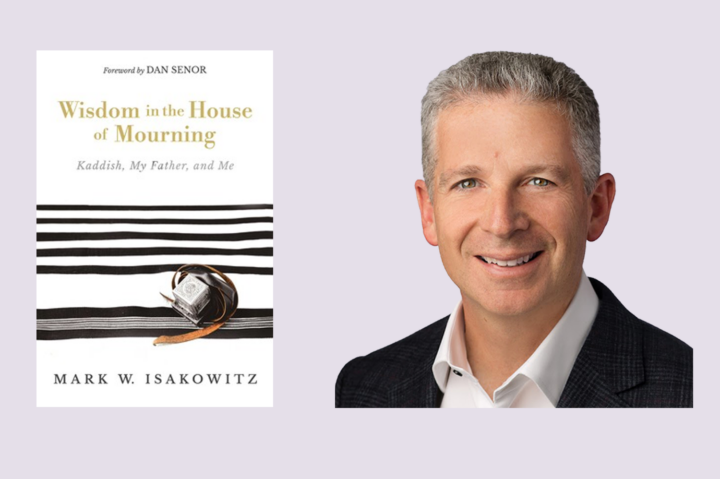
Mark Isakowitz's new book Wisdom in the house of Mourning
On Capitol Hill, it’s usually the senators who publish books, not their staffers.
The office of Sen. Dave McCormick (R-PA) has both: Last year, McCormick authored a book on leadership with his wife, Meta President Dina Powell McCormick. Now, McCormick’s chief of staff, Mark Isakowitz, is gearing up to release a book of his own.
Isakowitz’s book, a memoir, is titled Wisdom in the House of Mourning: Kaddish, My Father, and Me. It tells the story of Isakowitz grappling with the loss of his father, who immigrated to America after surviving Auschwitz, and Isakowitz’s daily practice of reciting the mourner’s prayer at a synagogue in Washington.
The book is described as a “father’s path from Auschwitz to America,” and “a son’s journey from grief to growth.” It will be published in January.
Jewish leaders view Andy Burnham as an ally in the fight against antisemitism, but his expected bid for the premiership is renewing scrutiny of his views on Israel and Labour’s post-Corbyn direction
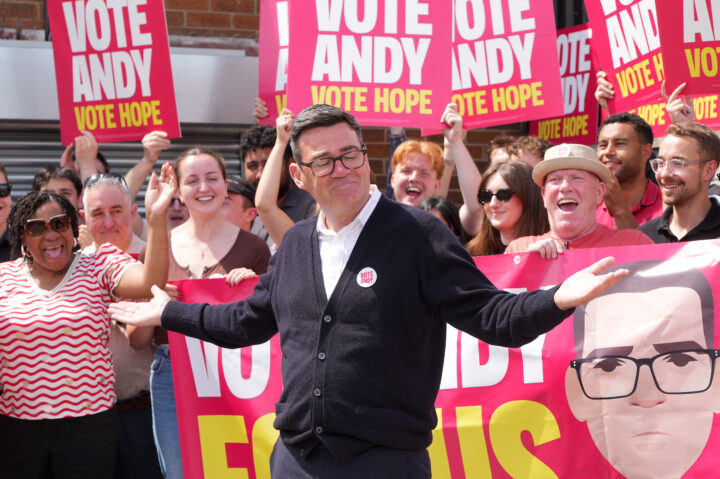
Christopher Furlong/Getty Images
Labour Party MP Andy Burnham greets supporters at the Labour campaign HQ on June 18, 2026 in Ashton-in-Makerfield, England.
British Prime Minister Keir Starmer announced his resignation on Monday, setting up a leadership battle within the Labour Party and raising the question of how his likely successor will deal with one of the issues that brought Starmer to office in the first place: combating antisemitism.
Starmer was elected as leader of the Labour Party in 2020, inheriting a party in disarray after it had faced electoral losses the year before and was navigating an internal crisis over former party leader Jeremy Corbyn’s approach to antisemitism. In his victory speech in April 2020, Starmer pledged to address the deep-seated antisemitism that had led many Jews to exit the party.
Starmer’s successor is likely to be Andy Burnham, a newly sworn-in Labour MP representing a district that includes parts of the Greater Manchester region. He spent the last nine years as mayor of Greater Manchester, the city with the second-largest Jewish community in the U.K. He declared his intent to run for Labour leader on Monday and quickly earned the backing of Wes Streeting, a former health secretary who was rumored to also be considering a run.
In 2019, as Corbyn’s leadership faced an antisemitism scandal, Burnham met with 80 members of the Board of Deputies of British Jews, the community’s largest institutional voice.
“It is inconceivable to me that a party which has prided itself on its record on racism could have become embroiled in an antisemitism crisis,” Burnham said at the meeting. “Racism needs to be dealt with firmly, quickly and decisively. I’m afraid that this hasn’t been the response so far and I hope from this point forward this has been understood.”
He said at the time that he still supported Corbyn, “but that support is not unconditional or unchallenged.”
Jewish community leaders in Manchester have close ties with Burnham, whom they view as an ally. In particular, he earned praise for strongly supporting the community after a terror attack on Manchester’s Heaton Park Hebrew Congregation last year on Yom Kippur, in which two congregants were murdered.
“In the aftermath of the Heaton Park synagogue terrorist attack, which was incidentally my synagogue, he was an incredible support to the community,” Raphi Bloom, director of fundraising and marketing at the Fed, a Jewish social services charity in Manchester, told Jewish Insider. “He has been an excellent friend to the Jewish community.”
Burnham’s record on Israel is relatively short — he has not brought Middle East politics into his mayoralty in the way that some other local leaders have focused on the issue. He spoke at a vigil days after the Oct. 7 attacks in 2023, but he also butted heads with the local Jewish Representative Council when he signed onto a petition calling for a ceasefire less than three weeks later.
“At a moment when we felt isolated and vulnerable, he demonstrated that Greater Manchester’s leadership understood the scale of the tragedy and how it affects Jewish people in the U.K.,” Mark Adlestone, chair of the Manchester JRC, wrote in an op-ed in Britain’s Jewish News on Monday. “However, it would be disingenuous to suggest there have not been times when there have been disagreements. Andy led a call from local authority leaders calling for a ceasefire post 7 October, whilst hostages remained in captivity.”
Burnham also served in Parliament from 2001 to 2017, and when he unsuccessfully ran for Labour Party leader in 2015, he expressed strong support for Israel. “I’ve always been a friend of Israel and the Jewish community — that will never change,” he said at the time, and promised that his first foreign trip as party leader would be to Israel.
But even his supporters in the Jewish community acknowledge that the politics surrounding the issue have changed a great deal since then. While remaining outspoken against antisemitism, Starmer has sought to cut off some arms sales to Israel. In September 2025, the U.K. unilaterally recognized a Palestinian state, and Starmer presided over sanctions against Itamar Ben-Gvir and Bezalel Smotrich, two far-right ministers in Israeli Prime Minister Benjamin Netanyahu’s Ccabinet.
“I think he’ll be strong on antisemitism, on Holocaust education and on tackling Jew hatred, but it remains to be seen about Israel. I don’t think he’ll change the government’s position much, if at all,” said Bloom, who directs the Fed’s My Voice project, which preserves and shares the stories of Holocaust survivors. “We’re not looking at Andy with rose-tinted spectacles when it comes to Israel, and we will deal with that when it happens as a community.”
In the final days of his recent campaign for Parliament, Burnham was asked if Israel’s actions in Gaza amounted to a genocide, a word Starmer declined to use. Burnham similarly declined to answer but hinted that he may be more willing to engage on the issue once he enters Parliament.
“I can’t judge things of that enormity from where I am as mayor of Greater Manchester,” he said. “But I do have concerns about the disproportionate nature of what has happened in terms of the destruction, and there has to be a full process of investigation and accountability.”
Starmer, in an emotional speech announcing his resignation on Monday, touted his record on antisemitism as one of his signature achievements. Jewish communal leaders said they don’t expect Burnham to return to the Corbyn era, but questions remain about his approach to the party’s past fissures over antisemitism and Israel.
“He probably is more to the left than Starmer is, and so perhaps the people that he will surround himself with, some of them will be more to the left of Starmer, and how that plays out for the Jewish community and for Israel is unknown at this stage,” said Bloom. “I’m 100% sure he won’t be reopening the door to Jeremy Corbyn or Corbynistas to come back into the party.”
Ella Rose-Jacobs, national chair of the Jewish Labour Movement, urged Burnham to follow Starmer’s path.
“Keir Starmer did a lot of the institutional work, but any future leader of the party will also need to vanguard and safeguard the process and the progress that has been made. Progress can be backslid,” Rose-Jacobs told JI on Monday. “The thing that I hope for the future government — and obviously there might be another contender in the race, we don’t know that yet — is that it doesn’t import the politics of foreign conflicts to our shores.”
Kay will assume the role on Oct. 5, as Eric Goldstein departs after 12 years atop the country’s largest Jewish federation
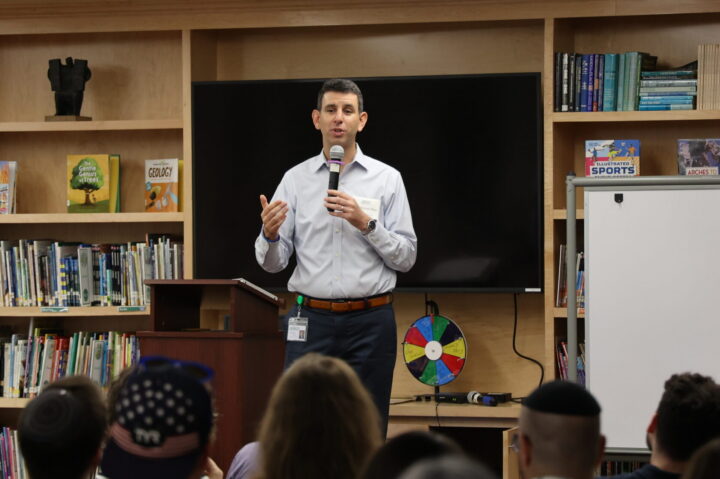
Courtesy
The country’s largest Jewish federation, UJA-Federation of New York, has reached into the day school world to tap its next leader, naming longtime Jewish educator Michael Kay as CEO, Jewish Insider has learned.
In a generational change that signals the growing importance of day schools on the Jewish communal agenda, Kay, who currently serves as head of school at The Leffell School in Westchester County, N.Y., will succeed Eric Goldstein, 66, a former Wall Street lawyer who announced last June that he was stepping down after 12 years in the role. Kay, 46, will enter the position on Oct. 5.
Goldstein steered New York’s Jewish community through a series of crises, including the COVID-19 pandemic, the Oct. 7, 2023, Hamas terror attacks and the surge in antisemitism and multiple wars that followed. Though last year’s announcement set Goldstein’s departure for the end of the fiscal year in June, he will now remain in the role until Oct. 4.
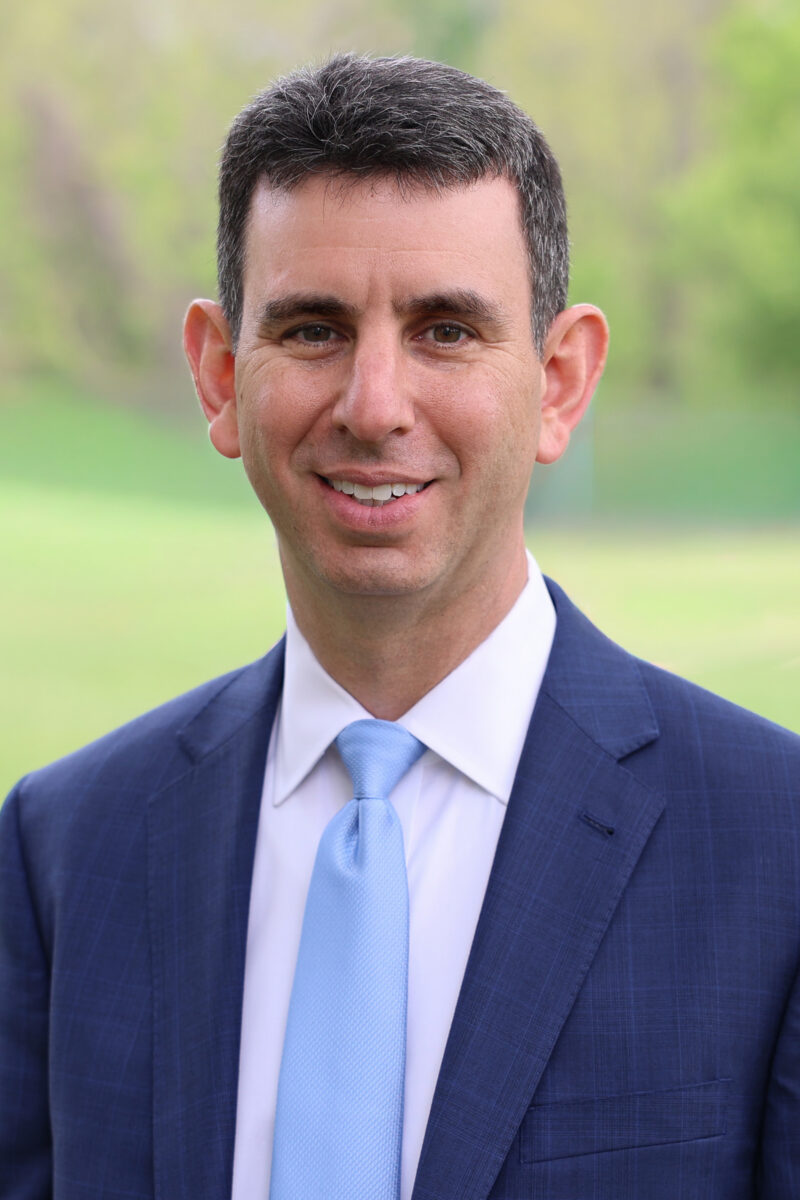
Kay inherits a key leadership position in a complex, often divided New York Jewish community. Over the last three years, new cracks have emerged and old ones have widened within the community in the aftermath of the Oct. 7 attacks. In November, exit polls showed that 33% of Jewish voters cast their ballots for New York City Mayor Zohran Mamdani, an outspoken critic of Israel who has clashed with Jewish leaders and organizations, including UJA-Federation of New York.
Asked how he wants UJA’s relationship with Mamdani to look under his leadership during an interview with Jewish Insider announcing his appointment, Kay emphasized UJA’s commitment to advocating for the well-being of the Jewish community with local officials, “no matter who they are.”
“We have an obligation and a responsibility to work with our local elected officials no matter who they are to ensure that our needs are met and they are accountable for meeting those needs, as I said, well-being, thriving, safety, security,” Kay said. “I start the job in five months, I’m sure that there will be a lot of conversation between now and then with our government relations team about the specific best way to interact with City Hall to achieve that, but we’re not going to lose sight of what those goals are.”
Joining the New York federation after 13 years at the Leffell School, an independent K-12 school with nearly 900 students — formerly a Solomon Schechter school — Kay brings decades of experience in Jewish education to the role.
Prior to Leffell, Kay also served as Upper School principal and director of Judaic studies at the Charles E. Smith Jewish Day School in Rockville, Md., and led Camp Givah, a Jewish summer camp in upstate New York — both pluralistic institutions. He is also an alumnus of the Wexner Graduate Fellowship.
Kay’s appointment comes as Jewish education and day school affordability have become priorities for the Jewish Federations of North America. Recently, the organization has lobbied governors to adopt a federal tax credit that could reduce the financial burden of Jewish day school tuition, marking JFNA’s growing foray into issues of day school affordability and school choice. Earlier this week, New York Gov. Kathy Hochul stated her intention to opt-in to the tax credit.
Asked what he thinks the New York federation should do to advance day school affordability and Jewish education in New York, Kay acknowledged the role of childhood Jewish education in fostering long-term relationships with Judaism, stating that UJA has a responsibility to promote “Jewish engagement in all its forms.”
“I think it’s critically important. We have data showing that students who grow up experiencing Jewish education at a young age are substantially more likely to support Israel on their college campuses, and to take on roles of leadership in the Jewish community,” he said.
Kay is also a senior lay leader and member at Temple Israel Center of White Plains, the egalitarian Conservative congregation that he attends with his wife, Rachel, and their two children.
Announcing his appointment, UJA-Federation highlighted Kay’s work in expanding and strengthening philanthropic support for The Leffell School, including through UJA’s Day School Challenge Fund, and his capabilities as a unifying leader, skilled in bringing people together across differences and partisan divides “through respectful dialogue.”
“It has been the privilege of a lifetime to lead UJA-Federation,” Goldstein said in a statement. “Michael has proven throughout his career an ability to bring the full spectrum of our community together, building trust across differences and harnessing our diversity as a source of strength. That experience will be invaluable to UJA’s next chapter.”
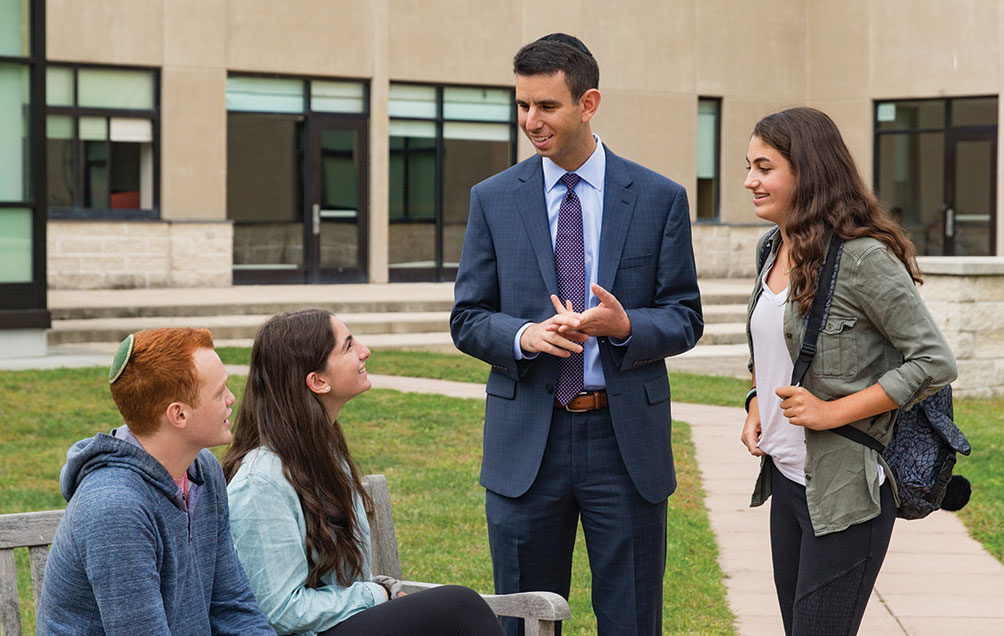
Entering his role the day after the bodies of three kidnapped and slain Israeli teenagers were recovered in the West Bank, Goldstein’s 12-year tenure as CEO of the continent’s largest Jewish federation provided a constant in a particularly tumultuous period for North American Jewry.
Goldstein, whose appointment — as the first Orthodox head of the organization — raised eyebrows within the New York community, led the organization through a period of rising domestic antisemitism. That period was bookended by 2017’s Unite the Right rally in Charlottesville, Va., and the 2018 deadly shooting at Pittsburgh’s Tree of Life Synagogue that killed 11 congregants — and the recent set of deadly attacks on Jewish institutions following the Israel-Hamas war. Under Goldstein, in late 2019, the UJA-Federation of New York and the Jewish Community Relations Council of New York launched the Community Security Initiative, a program designed to protect the Jewish community from violent threats and antisemitic incidents. Since its inception, as threats against the community have continued to mount, the program has grown significantly.
Goldstein also steered the organization both through funding shortfalls during the COVID-19 pandemic, forgoing his own salary for the 2021 fiscal year, and a massive influx of donations for emergency relief after the Oct. 7 attacks.
“We are deeply grateful to Eric S. Goldstein, whose 12 years of leadership leave UJA in a position of strength as we look to the future,” Marc Rowan, the federation’s board chair, said in a statement.
According to the federation, more than 40 candidates were considered for the role, in a search conducted by a 14-member search committee, led by Linda Mirels, the federation’s board president, and supported by global search firm Heidrick & Struggles. Kay’s selection was unanimous.
“Michael is the right leader for this defining moment,” said Rowan. “He is battle-tested — unflappable under pressure and willing to take on the most pressing challenges facing our community, from the safety and security of the Jewish people to the urgent work of strengthening Israel as a Jewish and democratic state.”
At the end of June, Mirels and Rowan, will both conclude their three-year terms. Suzanne Peck and David Wasserman, both of whom served on the search committee, will succeed Rowan and Mirels as president and chair, respectively.
“Michael distinguished himself as a singular and compelling leader — a truly original thinker whose intellect, moral seriousness, and vision for Jewish life set him apart,” said Mirels. “He is an eloquent and persuasive communicator with a long record of inspiring the next generation of proud Jews and Zionists. The work ahead is real — strengthening Jewish identity and pride, deepening commitment to Israel, confronting rising antisemitism, and caring for global Jewry and New Yorkers in need. Michael is the leader our community needs for the work ahead.”
The Al Thanis decided to lash out at Israel rather than the country that launched the attacks on the Gulf state
Karim JAAFAR / AFP via Getty Images
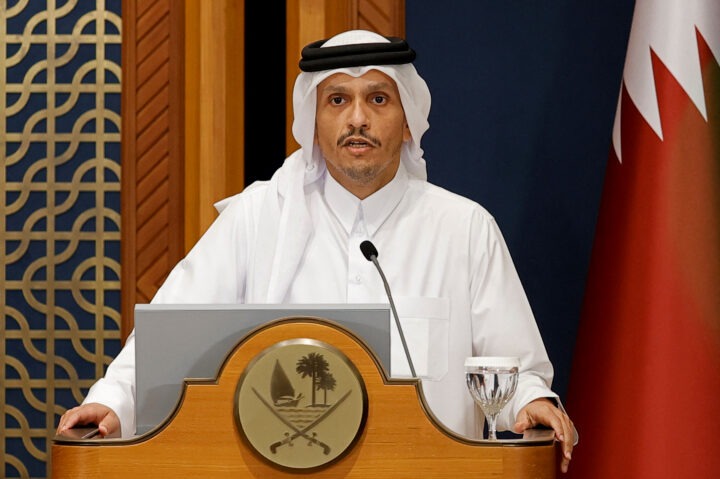
Qatar's Prime Minister and Foreign Minister Sheikh Mohammed bin Abdulrahman Al Thani speaks during a joint press conference with Turkey's Foreign Minister Hakan Fidan, in Doha on March 19, 2026.
Over the last three weeks, Qatar’s leadership has woken up to a reality it had long seemed determined to disprove: that money will only take you so far. And so Doha has fallen back on a longstanding Middle Eastern tradition of blaming Israel for its problems.
Qatar is the top foreign contributor to American universities, World Cup host, patron of the arts and donor of the new Air Force One, and the influence that comes with philanthropy led much of the world to turn a blind eye to the dark side of the Al Thani royal family’s generosity: Funding perhaps the world’s most effective propaganda arm for radical Islam, Al Jazeera, hosting the leaders of Hamas and other terrorist groups, and more.
With a massive real estate portfolio that includes properties in London and Manhattan, its efforts to bail out White House Special Envoy Steve Witkoff in 2023 and 2025, and its work with former lobbyists now in the Trump administration — such as Attorney General Pam Bondi and FBI Director Kash Patel — Doha appeared to have built a winning strategy to ensure its voice was heard in the White House.
Despite public opposition from Qatar and other Gulf states, the U.S., alongside Israel, went to war with Iran. Now, Doha finds itself on the receiving end of attacks from the Islamic Republic. Tehran’s attacks on Qatari gas facilities have led to a loss of 17% of Qatar’s capacity to export liquefied natural gas and an estimated $20 billion loss of annual revenue for the next three to five years, QatarEnergy CEO Saad al-Kaabi told Reuters.
The latest Iranian assault on Doha’s gas industry came after Israel struck the Iranian side of the South Pars gas field, shared with Qatar. In a message that appeared, at least in part, an attempt to appease Doha, President Donald Trump blamed Israel — in mild terms by Trump standards — and said he had no idea about the attack, a claim experts and former Israeli and U.S. officials have said is unlikely to be true. Israeli Prime Minister Benjamin Netanyahu said in a Thursday night press conference that Israel “acted alone” and will respect Trump’s request that Israel not bomb the gas field again.
In addition, Trump threatened that if Iran attacks “a very innocent, in this case, Qatar,” the U.S. will “massively blow up the entirety of the South Pars Gas Field at an amount of strength and power that Iran has never seen or witnessed before.”
Ariel Admoni, a Qatar expert at the Jerusalem Institute for Strategy and Security (JISS), said Trump’s statement shows “great anger” in Doha “expressed through pressure on Trump and a demand to clarify that he wasn’t part of this, in order not to hurt [Qatar’s] image” of being well-connected to the administration.
Realizing that their checkbook diplomacy is no longer enough to get what they want from the Trump administration, the Al Thanis decided to lash out at Israel rather than the country that launched the attacks on the Gulf state.
Qatar continued to triangulate with Iran. Doha expelled Iran’s military and other attaches based in Doha in response to Tehran’s “hostile approach,” but left the Iranian ambassador in place, and hours later, Admoni said, a senior Islamic Revolutionary Guard Corps official was given a favorable interview on Al Jazeera.
Qatari Prime Minister and Foreign Minister Mohammed bin Abdulrahman Al Thani said in a statement to the press alongside Turkish Foreign Minister Hakan Fidan on Thursday that “This war needs to stop immediately. The aggression needs to stop immediately. Because everyone knows who the main beneficiary of this war is, and [who is] dragging the whole region into this conflict.”
Fidan was less subtle in his remarks, adding: “It should be especially noted that the primary responsible party for this war, which has drawn our region into an unprecedented crisis, is Israel.”
Former Qatari Prime Minister Hamad bin Jassim bin Jaber Al-Thani (known as HBJ) asserted in an X post that even after Iran’s assault on Qatari gas facilities, Israel is the enemy and Iran is simply misguided: “What Israel wants, unfortunately, is coming to pass … leaving us in a scene of regional war or a confrontation between the two sides of the Gulf.”
To Iran, HBJ wrote: “We have never been your enemy … What you are doing now does not deter the enemy; rather, it serves him, achieves his goals. … I previously warned of the consequences of such acts that serve only Israel alone.”
According to Admoni, HBJ is known to speak frankly and “say things that the official government can’t say … and therefore can be seen as a test balloon.”
“The fact that the message right after the attack is anger at Israel,” Admoni said, “shows how there is no desire in Qatar to make moves against Iran.”
While Qatar is beginning to “see the limitations of their strategy,” Admoni said, “in the end, they will continue to use their leverage on Trump and probably demand compensation, possibly in the form of more [missile] interceptors. They realize that Trump is one thing, but they cannot give up on the U.S. entirely and will want to ensure that when Trump leaves, they will maintain their standing in the U.S.”
Fatemeh Ardeshir-Larijani, who was employed by Emory's medical school, is the daughter of the secretary of Iran’s Supreme Council for National Security
Jessica McGowan/Getty Images
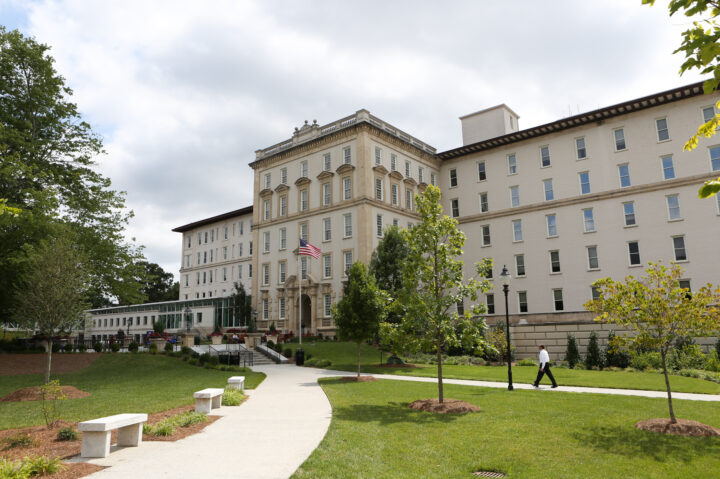
Emory University Hospital is seen on August 1, 2014 in Atlanta, Georgia.
After a doctor who is the daughter of a senior Iranian government official departed from Emory University’s medical school, the professor who serves as head of Emory’s faculty leadership council criticized the school for letting her go, Jewish Insider has learned.
Noelle McAfee, a professor in Emory’s philosophy department, sent a scathing e-mail to the university and School of Medicine faculty expressing concern that the school’s dismissal of Fatemeh Ardeshir-Larijani, the daughter of the secretary of Iran’s Supreme Council for National Security, was a politically motivated firing.
McAfee, who was arrested in April 2024 for her participation in a campus anti-Israel encampment, said faculty members have expressed to her that Ardeshir-Larijani’s departure is “an act of unbecoming of our tolerant, free, academic community.”
“It’s extremely disappointing to see that our leadership here at Emory are consistently caving to political pressure and never taking the side of faculty,” McAfee wrote, quoting an anonymous faculty member, expressing concern that Ardeshir-Larijani, whose father is responsible for the Islamic Republic’s national security, didn’t receive due process.
On Jan. 19, demonstrators gathered outside Emory’s Winship Cancer Institute to protest the university’s employment of Ardeshir-Larijani.
But McAfee claimed that many faculty members were outraged over the loss of Ardeshir-Larijani to the medical school staff. (In an email to medical school faculty, Emory School of Medicine Dean Sandra Wong did not specify whether Ardeshir-Larijani, who was an assistant professor in the Department of Hematology and Medical Oncology at the medical school, was fired or quit.)
McAfee wrote that faculty also told her, “This is creating an actively hostile work environment here at Emory… motivated by a desire to minimize political pressure on Emory to ensure continuance of federal funding” and “it’s extremely disappointing to see that our leadership here at Emory are consistently caving to political political pressure and never taking the side of faculty.”
In a statement to JI, McAfee said her email was “not weighing in on an employment matter one way or another.”
In 2024, Emory School of Medicine fired another oncologist, Professor Abeer AbouYabis, due to her social media posts glorifying Hamas in the aftermath of the Oct. 7, 2023, terrorist attacks. The school’s University Senate Committee for Open Expression submitted an investigation report at the time, stating that “AbouYabis’s Open Expression rights likely were violated.”
Emory University did not respond to a request for comment from JI inquiring whether the school was aware of Ardeshir-Larijani’s familial ties when it hired her.
As political activists reflect on Mellman’s life, several Jewish Democrats told JI that his clear-eyed support for Israel — and his ability to articulate its strategic importance to Democrats — will leave a lasting impact on the party

Tom Williams/Roll Call/Getty Images
Mark Mellman
In the wake of Mark Mellman’s death last week, the longtime Democratic pollster is being remembered for his leadership of Democratic Majority for Israel, an advocacy group he helped launch in 2019 to counter a growing hostility toward Israel on the left, a value proposition that proved prescient.
But his role leading the group, in what turned out to be the capstone to his decades-long career, was serendipitous — and almost didn’t happen.
The group’s founding board members “reached out to Mark for advice on who we should hire,” one of the board members, speaking anonymously to discuss the details of the group’s founding, told Jewish Insider. “And Mark said, ‘I’ll do it.’ We went, ‘OK.’ We weren’t expecting that.”
San Francisco Democratic fundraiser Sam Lauter, a former AIPAC activist who has been involved with DMFI from the beginning, said Mellman’s role atop DMFI gave the group “instant credibility.” Weeks later, Mellman was weighing in on a series of tweets from then-freshman Rep. Ilhan Omar (D-MN) that trafficked in antisemitic tropes.
As political activists reflect on Mellman’s life, several Jewish Democrats told JI that his clear-eyed support for Israel — and his ability to articulate its strategic importance to Democrats — will leave a lasting impact on the party.
“He really worked hard to help candidates understand why the U.S.-Israel relationship was so important, why it was important to the United States [and] why it was important to support that relationship,” said former Rep. Kathy Manning (D-NC), who became DMFI’s board chair this year. “I think he brought clarity to that discussion whenever he had it, and he was unequivocal about it. I think that helped a lot of people think about how you talk about the relationship to people who don’t necessarily understand it or don’t support it.”
While Mellman, who died at 70 last Thursday of pancreatic cancer, has long been involved in Jewish causes and conducted research for Jewish groups, that only became his bread-and-butter in the final years of his life. Over a decades-long career as a leading pollster, he helped elect prominent Democrats across the country.
“As someone who has come up through Jewish Democratic politics professionally over the past two decades, there’s no bigger giant in the field,” said Aaron Keyak, who most recently served in the Biden administration as deputy antisemitism special envoy.
Mellman worked for 30 U.S. senators and over two dozen members of Congress, and he advised Israeli politician Yair Lapid and his Yesh Atid party. Nate Silver, the founder of the polling website FiveThirtyEight, once called Mellman the most accurate pollster in the country. Mellman was the chief pollster for John Kerry’s presidential campaign against George W. Bush in 2004.
According to those who knew him, he never wavered on his core values. He spoke publicly about turning down requests from Democrats who didn’t align with his positions in support of abortion access and gun control. Most of all, he stuck to his support for Israel.
“He’s as blue of a Democrat as anyone, and also understands that just because you identify as a member of the Democratic Party doesn’t mean you need to support everything all Democrats do, or even specific candidates that are nominated by the party,” said Keyak. “He’s someone who is true to his convictions in a time when far too many in Washington, D.C., shape their policy beliefs based off of the individual politician that the party has nominated.”
Last year, Mellman and DMFI invested heavily to challenge anti-Israel Democratic incumbents Jamaal Bowman (D-NY) and Cori Bush (D-MO). The group’s efforts prevailed.
“Success in this profession and in this industry is not an easy place to achieve, and very few people achieve it and hold on to their integrity and their ethics and just still be a mensch,” Lauter said. “Accompanying all the ability that he had, Mark was a mensch.”
Jasmine Naamou and Tarek Naemo, a Florida couple advocating closer U.S.–Syria ties, have courted lawmakers including Sen. Jeanne Shaheen, Rep. Joe Wilson and even House Speaker Mike Johnson as they promote Damascus in D.C.
X/Syrian American Alliance for Peace & Prosperity
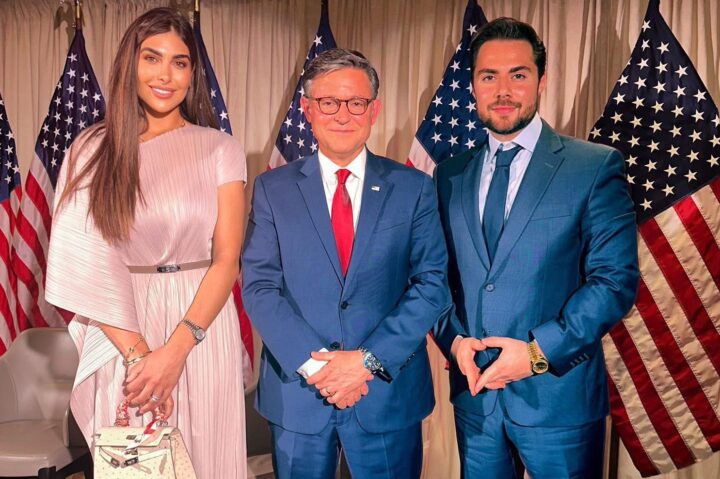
asmine Naamou and Tarek Naemo meet with House Speaker Mike Johnson (R-LA), June, 10, 2025
The fall of Bashar al-Assad’s brutal regime in Syria last December happened slowly, and then all at once — leaving a region reeling from whiplash and a country digging itself out from the rubble, now under the leadership of a former militia head who cut his teeth as an Al-Qaida terrorist.
This week, that leader, Syrian President Ahmad al-Sharaa, is coming to Washington, the first time a Syrian president has ever been invited to the White House.
Alongside al-Sharaa’s rise in Damascus has been a flurry of activity in Washington, as lawmakers tried to make sense of a country that one day was considered a rogue nation locked in protracted civil war and the next was viewed as a free state on the path to stability.
Two people in particular have become fixtures on Capitol Hill, pushing the message that Washington should lift sanctions on Damascus and build stronger ties with Syria: Jasmine Naamou and Tarek Naemo, a married couple who live in Daytona Beach, Fla., with a knack for social media self-promotion and a willingness to strike up a conversation with anyone.
On the eve of al-Sharaa’s meeting with President Donald Trump, the couple arranged a meeting with the Syrian leader and Rep. Brian Mast (R-FL), chair of the House Foreign Affairs Committee.
Naamou and Naemo first came to Capitol Hill this year as activists with the Syrian American Alliance for Peace and Prosperity, a nonprofit that emerged early this year to advocate for closer ties between the U.S. and Syria, though Naamou said she doesn’t work directly with them anymore. The organization arranged meetings for Syria’s foreign minister in New York this year, and in April it brought two members of Congress — Reps. Cory Mills (R-FL) and Marlin Stutzman (R-IN) — to Syria for the first visit by U.S. officials in years. Naamou and Naemo were on the trip with them.

Mills and Stutzman’s visit preceded a more senior delegation, with Sen. Jeanne Shaheen (D-NH), the top Democrat on the Senate Foreign Relations Committee, and Rep. Joe Wilson (R-SC), who has held several senior foreign policy roles, visiting the country together.
All of those lawmakers have met with either Naamou or Naemo this year, documented with slick photos shared on the couple’s Instagram accounts. Naamou has 319,000 followers, and a pinned photo with House Speaker Mike Johnson (R-LA); Naemo has 2.2 million followers and flaunts photos with the Saudi investment minister and Turkey’s ambassador to Syria — plus an image of him holding a rifle and sitting on a golf cart with Wilson. He refers to Wilson as “my dearest friend.”

Naamou spoke to Jewish Insider on Friday ahead of al-Sharaa’s visit to preview what she hopes the Syrian leader will discuss with Trump, with normalization with Israel high on the list.
“We want regional stability. Israel’s a neighbor. They’re a friend of America. We want them to be friends of Syria. We want to normalize relations,” said Naamou, who was driving to the airport, bound for Washington to be there for al-Sharaa’s visit. She also expressed hope for a U.S. security presence in Syria: “I believe they’re moving in the right direction of getting that security agreement in place. From what I’ve heard, they are in discussions of having a U.S. air base in Damascus to help with those security discussions between Syria and Israel. So I really do see the steps moving in the right direction.”
Ahead of his visit, the United Nations lifted sanctions on al-Sharaa, a move that followed a similar executive order by Trump in June. “President Trump is committed to supporting a Syria that is stable, unified and at peace with itself and its neighbors,” the White House said at the time.
Naamou and her husband both work in real estate in central Florida, though they also have ties to a Saudi sovereign wealth fund, according to Intelligence Online, a publication focused on diplomacy. Naamou said investment is a focus of their advocacy to American officials.
“They’re also going to have discussions on reintegrating investments in Syria because President Trump, when he went over to Saudi Arabia on his Middle East trip, he had announced the whole cessation of sanctions,” said Naamou.

Florida oceanside city become such fixtures on Capitol Hill? Naamou, who is 30, dates her own advocacy to her college days at the University of Florida, where she studied international relations and political science because of what was happening in Syria. She said the political relationships started back home in Florida, too.
“I live in Volusia County, and it’s a relatively small county, and everyone kind of knows each other,” she said. “You just go to events, and you meet people, and things happen, and you discuss things, and then you find things in common.”
They’ve also met with Reps. Byron Donalds (R-FL), who is running for governor of Florida; Anna Paulina Luna (R-FL); Maxine Waters (D-CA) and Abe Hamadeh (R-AZ), who is the child of Syrian immigrants.
“I see huge bipartisan support now,” Naamou said. “We like to term Syria as a swing state. Syria is multi-layered. Syria is one of the only countries in the Middle East that is so complex. You have all three Abrahamic religions present in Syria. You have all different types of ethnicities present. And so Syria is very key in the region, because it can be swung either way.”
“Either way,” in this case, means West or East — bringing Syria into the U.S.-led Western world, or into the Russia-Iran-China orbit.
“They want the U.S., and they want to acclimate here with our values,” said Naamou, who was born in Michigan to a Syrian father. She described the rapid changes in Syria as a “snowball effect.”
“I’ve never seen, when a regime has fallen, such a fast paced amount of change happen in such a short period of time,” said Naamou. She wants to see it continue: all sanctions lifted, American investment, closer ties.
“I’m hoping that we see a larger acceptance of Syria in general,” she said. “I’m hoping that we’re able to somehow, in any way, reshape the narrative into a positive light.”
The Reform leader told JI the Jewish community ‘has an obligation to counter’ the normalization of anti-Zionist views on the left
Screenshot
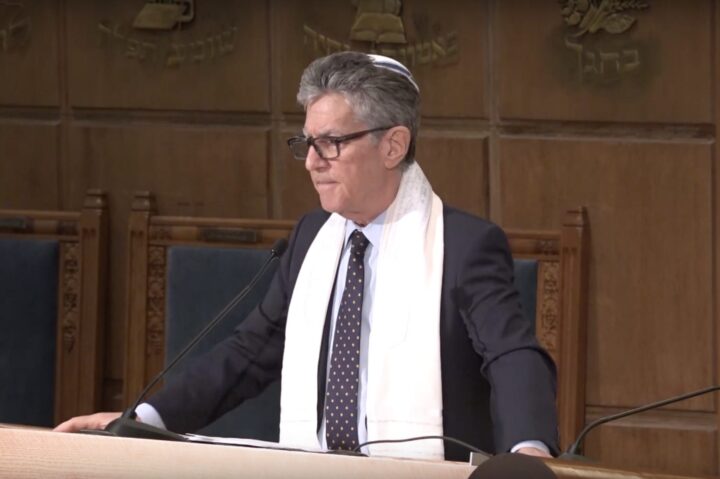
Rabbi Ammiel Hirsch speaks at the Stephen Wise Free Synagogue in New York City on Feb. 28, 2025
As the New York City mayoral race nears its end, Manhattan Rabbi Ammiel Hirsch has a message for his colleagues: It’s not too late to provide “leadership and clarity of perspective” to voters to oppose Democratic nominee Zohran Mamdani, citing the candidate’s hostility towards Israel and refusal to recognize it as a Jewish state.
Hirsch, a prominent and notable moderate pro-Israel voice within the progressive-minded Reform movement isn’t surprised by polling showing Mamdani leading his opponents, former New York Gov. Andrew Cuomo, who is running as an independent, and Republican Curtis Sliwa, among unaffiliated and Reform Jews, who skew overwhelmingly liberal.
But Hirsch, the senior rabbi of the Stephen Wise Free Synagogue, expressed frustration with the lack of organized effort among Jewish leaders to oppose Mamdani, whose affiliation with the Democratic Socialists of America (DSA) and antagonistic views on Israel — including his refusal to condemn the term “globalize the intifada” — have generated private and public criticism.
In an interview with Jewish Insider on Wednesday, Hirsch, who has led the Upper West Side congregation for the past 20 years, said there is still time for left-wing Jewish leaders to find their voice. Even without initiatives and statements from the Reform movement, progressive Jewish leaders can still “make a difference” by “laying out the stakes” — even as early voting begins this Saturday.
Hirsch recently released an online video message, addressing Mamdani directly. “I do not speak for all Jews, but I do represent the views of the large majority of the New York Jewish community, which is increasingly concerned with your statements about Israel and the Jewish people,” the rabbi said. “Your opposition to Israel is not centered on policies, you reject the very existence of Israel as a Jewish state … I urge you to reconsider your long-held rejection of Israel’s right to exist. Be a uniter and a peacemaker.”
Following Hirsch’s video, other Jewish leaders began to follow his lead. Rabbi Elliot Cosgrove of the Conservative Park Avenue Synagogue on Manhattan’s Upper East Side said in an address to his congregation last Saturday, “Mamdani’s distinction between accepting Jews and denying a Jewish state is not merely a rhetorical sleight of hand or political naïveté — though it is to be clear both of those — his doing so is to traffic in the most dangerous of tropes.”
On Wednesday, more than 600 rabbis from around the country signed on to an open letter, “A Rabbinic Call to Action: Defending the Jewish Future,” spearheaded by The Jewish Majority.
“As rabbis from across the United States committed to the security and prosperity of the Jewish people, we are writing in our personal capacities to declare that we cannot remain silent in the face of rising anti-Zionism and its political normalization throughout our nation,” the letter states.
“When public figures like New York mayoral candidate Zohran Mamdani refuse to condemn violent slogans, deny Israel’s legitimacy, and accuse the Jewish state of genocide, they, in the words of Rabbi Ammiel Hirsch, ‘Delegitimize the Jewish community and encourage and exacerbate hostility toward Judaism and Jews.’”
Hirsch, who serves as president of the New York Board of Rabbis, sat down with JI to discuss the current moment, one that he called “an obligation — it’s the call of history — for Jewish leaders to stand up” ahead of the Nov. 4 election.
Jewish Insider: You’ve been raising your voice against Mamdani, but with voting starting this weekend, do you think other Jewish leaders who have just started speaking out took too long?
Ammiel Hirsch: The Jewish world has very serious self-reflection to do in the aftermath of the Oct. 7, 2023, terrorist attacks. Everything has changed and the future will be different than what it was going to be pre-Oct. 7. The American Jewish community has substantial — in some respects unprecedented — challenges in the years to come.
The kind of antisemitism we are seeing now and likely to see in the future is different and more widespread than anything anyone alive has experienced. Our relationship with Israel has to be reassessed and reevaluated. How we teach our young people has to be reassessed and evaluated and the nature of the American Jewish community itself — we are seeing a deep polarization that should have taken everybody by surprise. During crunch time, when Israel was under real existential threat, we didn’t expect this kind of polarization around the idea of the existence of Israel.
Everything needs to be reevaluated. I concluded over the last two years that certain things I was perhaps willing to overlook in favor of other values and interests need to be looked at more carefully now. I’m not prepared to overlook candidates for public office who express fundamental anti-Zionism. We need to draw the line on anti-Zionism because it disenfranchises and delegitimizes Judaism itself. It leads to an intensification of antisemitism.
JI: Are you surprised there hasn’t been more of an organized effort among the Jewish community to challenge Mamdani since he won the primary in June? Has the Jewish world met the moment?
AH: We’ve been slow to respond to widespread, pervasive, global anti-Zionism and we’ve been slow inside the Jewish community in countering Jewish voices who are anti-Zionist. We, the mainstream of the Jewish community, have an obligation to counter that ideology. If it’s not countered, it intensifies and exacerbates the problem and that relates to public candidates as well. It’s imperative for the American Jewish community to stand up and express the kinds of views that I expressed. I think more are doing so. It is a responsibility at this historic moment in time for Jewish leadership to do so.
It would have been better had it been earlier, but it’s welcome — and imperative — at any time. It does make a difference and I urge everybody, especially those in Jewish leadership, to lay out the stakes. I say this as a Jewish leader, but I’m a New Yorker and U.S. citizen as well and care about the well-being of the city and country. It goes way beyond the well-being of the Jewish community.
Judaism has a lot to say about poverty, economics, immigration, the death penalty — all of those issues are important as well. But specifically on the anti-Zionism issue, it goes to the very existence and future of the Jewish people. Anti-Zionism means dismantling the place where half of the world’s Jews live. That’s the intention of the anti-Zionist enemies of Israel and Zohran Mamdani is giving them ideological and communal support. It’s an obligation — it’s the call of history — for Jewish leaders to stand up at this moment of Jewish history. Our people need leadership and clarity of perspective from their leaders. They’re thirsting for Jewish leaders to clarify what is in the best interest of the Jewish people and what is in the best interest of our values. Not to do that is to fail at this inflection point of American and world Jewish history. I’m heartened that more American Jewish leaders are speaking up now, but not enough.
JI: What do you make of the recent IRS reversal allowing rabbis and other clergy members to make political endorsements from the pulpit? One of the most recent examples being by another prominent New York City rabbi, Elliot Cosgrove, who heads the Park Avenue Synagogue. He decried Mamdani in a speech to his congregation last Shabbat, saying he believes the front-runner “poses a danger to the security of the New York Jewish community.”
AH: For me, I uphold the Johnson Amendment [a 1954 provision in the U.S. tax code that prohibits all 501(c)(3) nonprofit organizations from endorsing or opposing political candidates], no matter what the IRS decided to enforce. I do not endorse political parties or candidates. I speak about policies, which are directly relevant to our roles as rabbis and Jewish leaders. Policies reflect public morality. I’m not going to become partisan. It’s wrong on principle, because we receive tax relief status on the basis of our commitment to being nonpartisan. It weakens us because it unnecessarily splits the community and runs the risk of making synagogues into political centers. I try very carefully to speak about general policies and not endorse parties or candidates. That’s why my message was in the form that it was [speaking to Mamdani directly].
In my message, I was turning to the candidate himself. I didn’t tell people what my political preferences were or how they should vote. My message was that anti-Zionism endangers the Jewish community.
JI: Polls that look at Reform, Conservative and Orthodox voters have found Reform Jews are more supportive of Mamdani — why do you think that is? You’ve authored several essays, both before and after Oct. 7, about why the Reform movement is more inclined towards criticizing Israel than other branches of Judaism. Is that a driving factor here for support for Mamdani?
AH: The more liberal a person is the more likely they are to resonate and support liberal candidates, so it’s not surprising to me. The Reform movement started in North America as a religious movement that negated the centrality of Jewish peoplehood, so of course they were going to resonate more to universal values, not as an expression of Jewish peoplehood values, but the negation of it. Part of that still exists and the more years go by that Jews do not perceive an existential threat against the Jewish community, the more they return to that inclination towards universalism — that Jewish peoplehood is the problem. I’ve called that out for years now and I think that does play a role. It’s why I feel so strongly that I need to speak out.
I do not consider anti-Zionism to be a liberal position, it’s illiberal and I think many people are confused. Zionism is the liberation movement of the Jewish people, that’s a liberal philosophy.
JI: Would you like to see the Union for Reform Judaism come out with an official statement against Mamdani?
AH: I don’t participate in the decisions of the URJ. As I said, I believe it’s important for every Jewish leader to speak up at this inflection point of American Jewish history, so I would welcome it from everybody across the board.
I’ve seen some very good statements from our Orthodox colleagues. We need to unite as much as possible. There is room for debate and disputation, it’s part of Judaism, but at this critical moment in Jewish history we should seek to lay aside for another day controversies that distract us from the main objective that we have, which is to counter antisemitism and a form of anti-Zionism that constitutes antisemitism.
All of us need to unite on that because we’re a small minority and the task is monumental. If we don’t voice a common position, then what happens is we give an impression that the Jewish community is split on the very essence of the contemporary Jewish experience, which is the centrality of Jewish peoplehood and support of the Jewish state. We give the impression that the small minority of Jews, who are very noisy, constitute a much bigger component of Judaism than they really are. That’s another reason we need to counter this loudly.
In our movement, which is the most liberal of affiliated American Jews, there are some anti-Zionist voices but the overwhelming majority of the Reform movement is pro-Israel and considers Israel to be a component of their own Jewish identity.
JI: What are some ways in which you would encourage synagogues and Jewish institutions to engage with Mamdani if he is elected mayor?
AH: If he becomes mayor, he will have been elected fair and square. Then we’ll have to try our best to work with him where we can and oppose him when we must.
Given that this anti-Zionist philosophy is mainstream, it is imperative for American Jewish leaders to stand up, push back. People will vote how they vote and whoever wins will reflect the will of the people and then we’ll have to work within those constraints.
OU Executive VP Rabbi Hauer unexpectedly passed of a heart attack earlier this week
Screenshot/Youtube
Rabbi Moshe Hauer
Rabbi Moshe Hauer, the executive vice president of the Orthodox Union, died suddenly on Monday evening after suffering a heart attack, his organization said. He was 60.
Jewish communal leaders remembered Hauer as a friend, a bridge-builder, a faithful and committed leader and a source of wise counsel.
Hauer had served in his role at the OU since May 2020, acting as the organization’s professional and rabbinic leader and primary spokesperson, as well as helping to lead the organization’s outreach to U.S. administration officials and lawmakers.
“Rabbi Hauer was a true talmid chacham, a master teacher and communicator, the voice of Torah to the Orthodox community and the voice of Orthodoxy to the world. He personified what it means to be a Torah Jew and took nothing more seriously than his role of sharing the joy of Jewish life with our community and beyond,” OU President Mitchel Aeder and Chief Operating Officer Rabbi Josh Joseph said in a joint statement.
“Rabbi Hauer’s leadership was marked by unwavering dedication, deep compassion, and a vision rooted in faith in Hashem, integrity, and love for Klal Yisrael,” Aeder and Joseph continued. “Whether through his inspiring words, thoughtful counsel, powerful advocacy, or quiet acts of kindness, Rabbi Hauer uplifted those around him and made an impact on every person he encountered.”
Prior to his role at the OU, Hauer served for more than 26 years as the lead rabbi at Bnai Jacob Shaarei Zion Congregation in Baltimore.
William Daroff, the CEO of the Conference of Presidents of Major American Jewish Organizations, told Jewish Insider he was “shattered by the sudden passing of my dear friend and partner, Rabbi Moshe Hauer.”
“We just spoke this past Friday and texted on Monday, when he was overflowing with joy at the miracle of the hostages’ freedom and the unmistakable hand of Hashem in it. Rabbi Hauer was a trusted advisor, cherished colleague, and wise counselor to me, a bridge-builder whose faith, humility, and moral clarity inspired all who knew him. His loss leaves a deep void for all who loved and learned from him,” Daroff continued.
“He was a wise and thoughtful leader for so many dimensions of the OU’s activities — That included his partnership with me in advocacy,” Nathan Diament, the OU’s executive director of public policy, told JI. “Rabbi Hauer deeply believed in the imperative for the Orthodox community to be fully and proactively engaged with the world at large — not isolated from it. And for us to work to better society by advancing Torah values. In fact, the last time I was with him in person was just a couple of weeks ago — we met with senators and senior White House officials to discuss key issues and values.”
Israeli President Isaac Herzog mourned Hauer as “a true leader and teacher in the Jewish world,” in a post on X.
“Each and every conversation I was privileged to have with him was so very meangiful [sic] and showed his warmth and kindness, and his unwavering love for Torah, Israel, Zionism, and the Jewish people,” Herzog wrote.
Despite ideological and theological differences, Hauer maintained friendships and partnerships with Jewish leaders across the ideological spectrum and rejected claims that progressive and liberal Jews were “self-hating,” telling eJewishPhilanthropy last year that he “bristle[s] and object[s]” to the canard.
Sheila Katz, the CEO of the National Council of Jewish Women, said in a Facebook post, “Some leaders shape institutions. Others shape hearts. Rabbi Moshe Hauer did both.”
“After October 7, we found ourselves advocating side by side at the Department of Education and Department of Justice, in Congress, in the White House, and in the Knesset, determined to show what Jewish unity could look like,” Katz said. “It wasn’t unity for its own sake, but unity in service of the Jewish people, to advocate together for Jewish women, for the Orthodox community, and for all of us. Him, an Orthodox male rabbi. Me, a Reform Jewish progressive woman. Together, we were an unlikely duo that came together to advocate against antisemitism, to promote safety in Israel, and for the return of the hostages.”
“I’m grateful he lived to see all the living hostages come home. But I’m heartbroken that we won’t get to be with him for all that’s next, for the rebuilding, the hope, and the unity he modeled so powerfully,” Katz continued. “All we can do is continue to build a better world with love, and with Jewish life and wisdom, to honor the memory of our dear friend, Rabbi Hauer.”
Hauer was ordained at Ner Israel in Maryland and received a graduate degree from Johns Hopkins University.
According to the OU, during his time at Bnai Jacob Shaarei Zion he “was active in local communal leadership in many areas, with an emphasis on education, children-at-risk, and social service organizations serving the Jewish community… led a leadership training program for rabbis and communal leaders, and was a founding editor of the online journal Klal Perspectives.”
eJewishPhilanthropy‘s Judah Ari Gross contributed to this report.
The two university chancellors have been speaking out against ‘creeping politicization’ on college campuses

GETTY IMAGES
Three people with backpacks on sidewalk in front of the campus administrative building on sunny day moving away.
By the time a group of activists attempted to erect an encampment at Washington University in St. Louis in late April 2024, Andrew D. Martin, the chancellor of the university, had already carefully considered how he would respond. It was a benefit, he said recently, of being “in the middle of the country,” far from the national media that ceaselessly covered the anti-Israel encampments at Columbia University and other high-profile campuses.
Campus police arrested more than 100 people, the vast majority of whom had no ties to the university, and the encampment was shut down. Faculty, staff and student leaders all spoke out against university leadership for bringing in the police. But Martin saw it as an opportunity to enforce university rules and avoid the chaos playing out elsewhere.
“We take a very strong pro-free speech approach,” Martin, a political scientist, told Jewish Insider in an interview last month. “But we also have restrictions which are based on time, place and manner. And for us, it was really clear, and we made it very clear to the campus community. Look, you can protest all you want. … But you can’t take over our buildings, you can’t deface our property and you also can’t set up an encampment.”
Since then, Martin has teamed up with Daniel Diermeier, the chancellor of Vanderbilt University, in something of an informal pact — a joint effort to promote principled leadership in higher education, presenting their two schools as a refreshing counterweight to the dysfunction plaguing higher-ranked competitors like Harvard and Columbia. Both campuses largely steered clear of major antisemitic incidents in that intense spring semester in 2024. (The period has not been without criticism for Diermeier, either; he faced pushback from some faculty and students after canceling a vote on an anti-Israel boycott resolution.)
This February, Diermeier and Martin wrote a joint op-ed in The Chronicle of Higher Education calling on other universities to reject “creeping politicization.”
“The universities we oversee have drawn a line against politicization so that we can continue contributing to the nation’s competitiveness and strength abroad, and to stability and prosperity here at home. All American research universities should do the same,” Diermeier and Martin wrote.
Published just days after President Donald Trump took office with the promise of scrutinizing elite liberal universities, the article was an attempt at setting out a marker, signaling to Trump and potential applicants that Vanderbilt and WashU haven’t lost focus like so many other universities who have found themselves in crisis mode since the Oct. 7 attacks in 2023.
Both schools were committed to institutional neutrality — a position that has now been adopted by more than 100 American universities, including Harvard, Stanford, Columbia and Syracuse — well before Oct. 7 and its aftermath led other university administrators to conclude it is in their interests to not weigh in on complex political and social causes.
“Whether it’s fossil fuel divestment or Ukraine or other things, we’re just not going to engage. Our faculty have strong views on those issues, as do our students. It’s their job to be advocates. It’s our job to create a playing field, if you will, for them to have those views,” said Martin.
Diermeier said universities that had not adopted a stance of principled neutrality were susceptible to “competitive lobbying,” where students demand a response on one side or another.
“We saw this in gory detail after Oct. 7, where you had one group who wanted to say, ‘Well, you need to denounce Israel of genocide,’ and the other one said, ‘No, you have to support Israel,’” Diermeier told JI in June. “It ripped many university campuses apart. And we were very, very clear from the beginning that we are committed to institutional neutrality. We will not divest from companies that have ties to Israel. We will not denounce Israel’s ‘genocide.’ We will not boycott products that are associated with Israel in any way, shape or form.”
It comes down to the role of a university — and whether it is up to university administrators to pick a side. Doing so, the chancellors argued, undermines trust in their institutions. (Others take a different position, like Ora Pescovitz, president of Oakland University, a small public university in Michigan: “A president’s voice is precious,” she told JI last year.)
“There’s a certain arrogance for us, that we think that if, like, Harvard speaks, that somehow an issue is settled,” said Diermeier, a political scientist and management scholar. “What is the purpose of the university? What we’re very clear on is that universities are about the creation and dissemination of knowledge through research and education and related activities. They are not in the business of becoming partisans in any type of political or ideological battle.”
Many universities are still navigating the post-Oct. 7 maelstrom, trying to handle competing concerns from students, parents, alumni and faculty — all while facing civil rights investigations by the federal government. In March, Education Secretary Linda McMahon wrote a letter to 60 schools under investigation for antisemitic discrimination, including Harvard, Yale, Northwestern, Stanford and Princeton.
“I think people that visit us see the difference, and they say this is a great place for Jewish families and for Jewish students to thrive, and we’re very proud of that,” said Diermeier. “We want to be a place where every member of our community can thrive. And right now, in the current environment, I think the contrast between what’s happening at other universities and what’s happening at Vanderbilt is visible for people.”
Vanderbilt and WashU were not on the list. That presents an opening for them to reach Jewish students with concerns about what they’re seeing elsewhere, particularly as the Jewish student populations at many top universities have shrunk. According to Hillel International, just 7% of Harvard’s undergraduates are Jewish, compared to 14% at Vanderbilt and 22% at WashU.
“The Jewish community at Washington University is very robust. Our students are comfortable and proud living out their Jewish identity on our campus, and have been able to do so for generations. And we’ll make sure that they’re able to do this over generations to come,” said Martin. WashU implemented a new transfer program soon after Oct. 7 to allow students to transfer for the spring semester, rather than waiting until the following fall. Several Jewish students took advantage of it after facing antisemitism on their old campuses.
WashU’s appeal to Jewish students is not new; it has for years been tagged with the nickname “WashJew.” And more than two decades ago, Vanderbilt’s former chancellor said that targeting Jewish students was an explicit part of the university’s bid to better compete with Ivy League schools. Diermeier seeks to continue that push.
“I think people that visit us see the difference, and they say this is a great place for Jewish families and for Jewish students to thrive, and we’re very proud of that,” said Diermeier. “We want to be a place where every member of our community can thrive. And right now, in the current environment, I think the contrast between what’s happening at other universities and what’s happening at Vanderbilt is visible for people.”
“It became clear to Daniel [Diermeier] and me that we’re never going to be able to have the sustained federal support or, for that matter, state support of our institutions, without broad support of the American people, and that the American people, in some respect, lost faith in us because of places where we have diverged from those important core principles,” said Martin. “That was amplified by the events of Oct. 7, or what happened after Oct. 7.”
Martin and Diermeier see themselves and their institutions as the stewards of a forward-looking case for higher education at a time when the institution is under attack, both from Washington and from Americans, whose trust in higher education has plummeted. Nearly 6 in 10 Americans said in 2015 that they have a great deal or quite a lot of confidence in U.S. higher education, according to Gallup. In 2024, that number was 36%. Among Republicans, the number dropped from 56% to 20% in nine years. Among Democrats, the decrease was milder — but still present, moving from 68% to 56%.
Oct. 7 only sharpened that distrust, Martin said. Regaining that confidence, he argued, is imperative to saving the institution of higher education — and staving off federal funding threats from Trump.
“It became clear to Daniel [Diermeier] and me that we’re never going to be able to have the sustained federal support or, for that matter, state support of our institutions, without broad support of the American people, and that the American people, in some respect, lost faith in us because of places where we have diverged from those important core principles,” said Martin. “That was amplified by the events of Oct. 7, or what happened after Oct. 7.”
It’s not just about values. It’s a savvy political move. After all, both Vanderbilt and WashU would be in trouble if federal research dollars stopped flowing to the schools, or if Trump made the call that they could not admit international students, as is the case with Harvard.
When asked about his approach to the Trump administration, Diermeier repeatedly declined to answer questions about the matter on the record.
Martin acknowledged that he is concerned.
“I’m worried about everything coming out of Washington, whether that’s legislative action or actions of the administration, around endowment excise tax, federal research funding, the ability to have federal financial aid, the ability to admit international students. All of those things are up for grabs,” Martin said.
But what WashU and Vanderbilt are willing to do is acknowledge that there are big problems in American academia. In other words, they’re saying that Trump’s got a point.
“Here are two institutions that are willing to stand in the public square and say, American higher education has lost its way in some respects,” said Martin. “We’re great institutions, and we’re committed to working to ensure that our institutions and higher education writ large will do better in the future.”
Manning's statement comes ahead of a weekend vote on several anti-Israel party resolutions

Former Rep. Kathy Manning speaks during a rally of Jewish voters for Vice President Kamala Harris (Photo by DOMINIC GWINN/Middle East Images/AFP via Getty Images)
Former Rep. Kathy Manning (D-NC), now the board chair of Democratic Majority for Israel, blasted the North Carolina Democratic Party (NCDP) leadership for what she described as allowing anti-Israel rhetoric and antisemitism within the state party, in a statement first shared with Jewish Insider.
Manning’s statement comes ahead of anticipated North Carolina Democratic Party Executive Committee votes this weekend on a resolution calling for an arms embargo on Israel and accusing it of apartheid and genocide — along with a resolution drawing equivalence between Israel and Hamas, saying both committed “terrorism” and have taken “hostages” and calling for the U.S. to exert influence to remove Israeli officials from power, among several others.
“Time and time again, the Jewish Caucus of North Carolina has attempted to unify and collaborate with the leadership of the North Carolina Democratic Party, which seems unwilling or unable to reciprocate. Instead, Party Chair Anderson Clayton and First Vice Chair Jonah Garson have continued to tolerate extreme anti-Israel rhetoric and antisemitism from within the party on social media, in executive committee meetings, and even in the exclusion of Jewish members from Interfaith Caucus meetings,” Manning said in her statement.
“DMFI condemns the continued tolerance of bad faith actors within the NCDP, and we stand with the Jewish Caucus in urging all members of the NCDP State Executive Committee to vote for unity tomorrow,” she continued.
Clayton responded in a statement, “Running a big tent party means having many different view points. I have long maintained that there is a big difference between valid criticisms of the Israeli Government and antisemitism and have made abundantly clear that there is no place for antisemitism in our party.”
State party resolutions are generated at the local level, and voted up from precincts, to county to congressional district party groups, before being considered by the party’s Resolutions Committee, which votes on sending resolutions to the State Executive Committee for a final vote.
The resolution votes are the latest development in the ongoing tensions between Jewish Democrats in North Carolina and the state party. The state party, in 2023, voted against recognizing the NCDP Jewish Caucus, a vote condemned by senior leaders in the state, including now-Gov. Josh Stein.
The party has also repeatedly been roiled by heated fights over Israel policy in its state party platform. Party leadership members, including the chair of the NCDP’s Interfaith Caucus, expressed support for the Oct. 7, 2023 Hamas attack on Israel in the days following those atrocities.
The NC Jewish Caucus said in a statement that it has been trying for months to work “in good faith with party leaders to promote a balanced, inclusive approach to complex international issues” but “those efforts have been met with resistance throughout the party’s resolutions process.”
The statement called the resolutions, particularly the Israel arms embargo, “troubling” and accused the party’s Resolutions Committee of focusing “on only a select few issues, chief among them matters regarding Israel.”
“I’m deeply disappointed that a vocal minority within our party continues to sow division,” Caucus President Lisa Jewel said. “At a time when antisemitic incidents are on the rise across the state, double the national average according to recent data, the Jewish Caucus has repeatedly called for unity, yet the Resolutions Committee chose to focus on wedge issues that, ultimately, would result in harm to our friends and family.”
She urged the party leadership to “reaffirm party unity, refocus on electability, and reject virtue signaling distractions that divide us at the expense of progress,” and pointed blame toward the Interfaith Caucus as the driving force behind anti-Israel advocacy within the state party.
Though the issues at play in the upcoming votes aren’t new for the NCDP, the votes come at a time when Jewish Democrats nationwide are feeling politically homeless and alarmed by the growing acceptance of antisemitism and anti-Israel extremism — trends underscored by Zohran Mamdani’s nomination as the Democratic standard bearer in the New York City mayoral race.
The North Carolina Democratic Party did not immediately respond to a request for comment.
‘If we’re paying a maximal price, we should get maximal achievements,’ an Israeli security source told JI

GPO
Israeli Prime Minister Benjamin Netanyahu and Defense Minister Israel Katz direct Operation Rising Lion.
Israel’s leadership is concerned that international pressure may force the IDF to stop striking Iran before its mission is complete, an Israeli security source told Jewish Insider on Sunday.
The source spoke a day after President Donald Trump wrote in a Truth Social post that “this war in Israel-Iran should end,” and continued to express hope that a deal could be reached between Washington and Tehran, even as the next round of negotiations between the U.S. and Iran over Tehran’s nuclear program was postponed.
The president’s remarks came two days after Israel began targeting Iranian nuclear and military sites and Tehran retaliated by striking sites across Israel, including residential areas.
“We want the U.S. to understand our point of view,” the source said. “The goal is for Iran not to have capabilities that endanger the State of Israel and its existence.”
“If we’re paying a maximal price” — 13 fatalities, 380 injured in 22 missile impact sites as of Sunday morning — “we should get maximal achievements. That is the approach,” the source added, saying that Iran’s nuclear program should be destroyed and not “wounded.”
The official aim of Operation Rising Lions, authorized by Israel’s Security Cabinet on Thursday night, is to damage Iran’s nuclear and ballistic missile programs.
The goal did not include toppling the Iranian mullahs’ regime, in part because Israel would be unlikely to have “international legitimacy” to do so, the Israeli source said. In addition, the cabinet did not say its goal was the total elimination of Iran’s nuclear program, because it wanted to set attainable goals.
Plus, Baraka's bounce alarms N.J. Jewish leaders

Win McNamee/Getty Images
U.S. President Donald J. Trump and Emir of Qatar Tamim bin Hamad al Thani attend a signing ceremony at the Amiri Diwan, the official workplace of the emir, on May 14, 2025, in Doha, Qatar.
Good Thursday morning.
In today’s Daily Kickoff, we look at Newark Mayor Ras Baraka’s rising poll numbers in the final days before New Jersey’s Democratic gubernatorial primary, and look at how Jews in Australia and Canada are reacting to recent liberal party electoral victories in both countries. We also talk to experts about how Israel is viewing the White House’s warming relations with Syria, and report on a bipartisan, bicameral call to the Trump administration to prioritize hostage-release efforts. Also in today’s Daily Kickoff: Sen. Lindsey Graham, Josh Kushner and Sarah Abramson.
What We’re Watching
- President Donald Trump arrived in the United Arab Emirates today as he continues on his multi-country Middle East trip.
- The Senate Armed Services Committee is convening a hearing this morning on foreign military sales.
- Also this morning, the Senate Foreign Relations Committee is holding nomination hearings for Joel Rayburn to be assistant secretary of state for Near Eastern affairs and Chris Pratt to be assistant secretary of state for political-military affairs.
- Politico is hosting its Security Summit today in Washington. Speakers include: former National Security Advisors John Bolton and Jake Sullivan, the White House’s Seb Gorka, Sens. Deb Fischer (R-NE), Mark Kelly (D-AZ), Eric Schmitt (R-MO) and Reps. Mike Lawler (R-NY), Michael McCaul (R-TX), Raja Krishnamoorthi (D-IL), Rick Crawford (R-AR), Jim Himes (D-CT), Anne Neuberger, former deputy national security advisor for cyber and emerging technologies, and the Foundation for Defense of Democracies’ Craig Singleton.
What You Should Know
A QUICK WORD WITH JI’S MELISSA WEISS
On his first presidential visit to the Gulf nation eight years ago, Trump called Qatar “a funder of terrorism at a very high level.” Last night in Doha, the president praised Qatari Emir Sheikh Tamim bin Hamad al-Thani as an “outstanding man.”
It’s a remarkable turnaround that underscores Doha’s efforts to use its financial largesse to build goodwill and position itself as a global player.
Doha, which a decade ago was ostracized in the region and on the global stage but has since regained its standing, has in recent years served as an intermediary between the West and malign actors (some of which, like Hamas, it financially supports). Earlier this week, al-Thani acknowledged Qatar’s “long outreach” that has included diplomatic efforts in the Russia-Ukraine war, Rwanda, the Democratic Republic of the Congo and Afghanistan.
And at a state dinner given in Trump’s honor last night in Doha, the president asked al-Thani to “help me with the Iran situation.” (American negotiators reportedly presented Iran with a nuclear agreement proposal during the latest round of talks over the weekend.) As Trump left Qatar today, the White House announced that it had secured deals with the country worth $243.5 billion.
While the current and previous administrations have welcomed Qatar’s efforts (specifically with assistance in negotiations over the Israel-Hamas war), Capitol Hill is taking a more measured — and cautious — approach to the Gulf nation, potentially setting up clashes with the White House.
Sen. John Kennedy (R-LA), who earlier this week had hedged when asked about Qatar’s intention to gift a luxury jet to Trump, took a harder line against Doha days later, saying he trusts Qatar “like I trust a rest stop bathroom.” Senate Majority Leader John Thune (R-SD) said on Tuesday that the potential gift “will attract very serious questions.”
Qatar has long flexed its economic power and vast wealth to spread controlled messaging (as it does with its Al Jazeera network and affiliated channels), exert influence abroad (as it does with its deep-pocketed funding of American universities), avoid punishment for vast human rights abuses (as it did with the construction of the World Cup facilities) and mend frayed relations (as it did with its reentry into the Gulf Cooperation Council). Yesterday, The Free Press’ Jay Solomon and Frannie Block published an 8,600-word piece examining Qatar’s efforts to gain influence across American society.
Doha’s yearslong efforts have even won over some Republican legislators. Following the announcement yesterday that Qatar had inked an agreement to purchase up to 210 Boeing 787s and 777X aircraft — the largest purchase in the aviation manufacturer’s history — Sen. Lindsey Graham (R-SC) praised the deal, calling it a “game changer” and noting Boeing’s factory in Charleston. “Qatar Airways’ purchase will ensure the Charleston plant has work for many years to come … I appreciate our allies in Qatar for making this investment in Boeing aircraft and I appreciate everything the Trump Administration has done to make this possible,” Graham posted on X.
But more telling of Qatar’s efforts to boost its image is Sen. Roger Marshall’s (R-KS) 180 on Doha. Six years ago, Marshall blasted Qatar’s “well-documented support for terrorism and extremist groups [that] have fueled violence, civil war and bloodshed.” But in a Senate Health, Education, Labor and Pensions Committee hearing on campus antisemitism in March, Marshall denied that documented antisemitic incidents had occurred on campuses that have received Qatari funding and called the Gulf nation “a great ally to America.”
What happened in the intervening years? In 2023, Marshall visited Qatar, where he met with the emir. The following year, the senator met with Qatar’s prime minister in Washington, leading a meeting with a group of Republican senators. In addition, disclosures through the Foreign Agents Registration Act first obtained by the Washington Examiner indicate repeated outreach from lobbyists for Doha to Marshall’s longtime chief of staff, including an invitation to a March 2022 trip to Qatar.
Successive administrations and Capitol Hill have largely looked away from Qatar’s vast influence network. With the world focused on crises around the world, as well as more pressing concerns over Russia, China and Iran, it has been easy for concerns about Qatari influence to fall by the wayside. Doha’s evolution from regional pariah to global power broker reveals an ugly truth about politics: that enough patience and resources can restore the standing of dangerous entities. In the coming weeks and months, the White House and Capitol Hill may be forced to reckon with the true price of that partnership.
ELECTION JITTERS

With less than a month until New Jersey’s June 10 gubernatorial primary, Jewish community leaders are now confronting the unexpected rise of a far-left Democrat whose campaign is surging even as he has faced scrutiny over his record of commentary on key issues including Israel and antisemitism. Ras Baraka, the longtime mayor of Newark, drew national headlines last week after he was arrested by federal agents on trespassing charges at an immigration detention facility where he had been protesting, in a made-for-TV moment caught on video. The high-profile confrontation has helped to propel Baraka, an outspoken progressive who until recently had been seen as a long shot, to the top of a crowded primary field. A new internal poll commissioned by his campaign showed the Newark mayor closing in on Rep. Mikie Sherrill (D-NJ), the establishment favorite, who led by just four points and claimed only 21% of the vote, Jewish Insider’s Matthew Kassel reports.
Community concerns: That Baraka is positioned to pull off a potential upset in the Democratic primary, where a relatively small plurality of the vote could secure his nomination, has raised alarms among some Jewish leaders in the state who have voiced concerns about the mayor’s past praise of Louis Farrakhan, the virulently antisemitic Nation of Islam leader, and his condemnation of Israel’s war in Gaza, among other issues. But as the primary draws closer, Jewish leaders acknowledge that they have not yet developed a playbook to counter Baraka’s ascendance, pointing to a broader pattern of organizational confusion in a state home to a sizable, diverse and politically active Jewish community. “I find the organizing very lacking right now,” one Jewish activist in New Jersey told JI on Wednesday, even as she described “grave concerns” among Jewish community members who have found Baraka’s rhetoric “over the top.”
Bonus: Former Anti-Defamation League National Director Abe Foxman endorsed Rep. Josh Gottheimer (D-NJ) in the Democratic primary.
DAMASCUS DEALINGS

Lifting all U.S. sanctions on Syria risks bolstering a jihadist regime, Israeli analysts warned after President Donald Trump’s announcement in Saudi Arabia on Tuesday. After announcing the removal of sanctions, Trump met the following day in the capital city of Riyadh, with Syrian President Ahmed al-Sharaa, the former head of Al-Qaida in Syria whose nom de guerre was Ahmed al-Jolani. Trump urged al-Sharaa to join the Abraham Accords, and in doing so, recognize and normalize relations with Israel, Jewish Insider’s Lahav Harkov reports.
Israel on the outside: Carmit Valensi and Amal Hayek, researchers at INSS, wrote in a paper provided to JI before publication that “from the Israeli angle, the developments raise many concerns. The Syrian case is an additional expression of Trump’s independent moves that do not necessarily take Israeli interests into consideration.” In addition, Trump’s actions vis-a-vis Syria “show the increased weight given to Turkey and Syria in designing the regional order,” they wrote.
A different view: But Maj.-Gen (res). Amos Yadlin, the former IDF military intelligence chief, argued against the Israeli establishment view, which, he told JI’s Gabby Deutch, “decided not to give [al-Sharaa] a chance.” Yadlin supported Israel’s destruction of the Syrian military, but not its continued presence and strikes on its neighbor to the northeast. “The fact that [former Syrian President Bashar] Assad is gone is good for Israel, and now we have a new person that we don’t really know whether he is an Al-Qaida terrorist or if he is a new leader for Syria that will take it to a different relationship with its neighbors and a different Syria,” Yadlin said.
community concerns

In Australia, the much-publicized video of anti-Israel protesters shouting “where’s the Jew?” soon after Oct. 7 was not an anomaly but rather the beginning of a rapid increase in antisemitism in this country whose small but proud Jewish community had previously taken pride in Australia’s welcoming, pluralistic nature. Now, Australian Jews are making sense of a recent election in which the center-left Labor Party that has governed throughout the aftermath of Oct. 7 and the war in Gaza was reelected, giving Prime Minister Anthony Albanese — whose ties to the Jewish community have come under strain — another term in office. Meanwhile in Canada, which also has a sizable Jewish vote and a record of growing antisemitism, another left-learning party recently notched an even more unexpected victory. For Jewish community leaders in both countries, the recent elections present an opportunity to rebuild ties that have frayed. But it won’t be easy, with wounds still raw and antisemitism still elevated, Jewish Insider’s Gabby Deutch reports.
Looking ahead: “Some mistakes were made, and there were some oversights made, but we certainly think that there’s a willingness to make some improvements and to do what they can to improve the lives of Jewish people here in Australia,” said Naomi Levin, CEO of the Jewish Community Council of Victoria, which includes Melbourne, of the Australian government. “We didn’t have the leadership that we needed to crack down on it. Now it’s very hard to go back. Once that genie is out of the bottle, it’s very hard to put it back in.”
UNITED FRONT

Nearly all Senate Republicans sent a letter to President Donald Trump on Wednesday urging him only to agree to a nuclear deal with Iran that requires the full dismantlement of Tehran’s nuclear program. Eighty percent of House Republicans — 177 lawmakers — signed onto a nearly identical letter, Jewish Insider’s Emily Jacobs and Marc Rod report.
Red lines: The Senate letter, led by Sens. Pete Ricketts (R-NE) and Ted Cruz (R-TX) and co-signed by every Republican senator except Sen. Rand Paul (R-KY), calls on the Trump administration to follow through on their “explicit warnings” that Tehran “must permanently give up any capacity for enrichment.” The House version of the letter was led by Rep. August Pfluger (R-TX), the chairman of the Republican Study Committee, the largest conservative caucus in the House. The letters, drafts of which were first reported by JI last week, serve as a clear message to the president from congressional Republicans of their expectations that a new nuclear deal with Iran must cut off its nuclear enrichment capabilities permanently, amid inconsistent public messaging from the administration on the subject. The letters frame the appeal as a message of support for Trump’s position on the issue.
EXCLUSIVE

New resolutions introduced Wednesday in the Senate by Sens. Jacky Rosen (D-NV) and Todd Young (R-IN) and in the House by Reps. Haley Stevens (D-MI) and French Hill (R-AR) condemn Hamas’ hostage-taking and other malign activities and urge the administration to focus on freeing the 58 remaining hostages being held in Gaza, Jewish Insider’s Marc Rod reports.
Keeping focus: The introduction of the resolutions coincides with President Donald Trump’s visit to the Middle East and comes days after Hamas released Israeli American hostage Edan Alexander following direct talks with the United States, in which Israel was not involved. The resolution “applauds the Administration for securing the release of Edan Alexander and calls on the White House to continue taking all possible steps to secure the release of all the hostages held captive by Hamas.”
AGREE TO DISAGREE

Sen. Lindsey Graham (R-SC) expressed concern on Wednesday about continued Houthi attacks on Israel despite the U.S. ceasefire deal with the group, suggesting that President Donald Trump’s desire to quickly find resolutions to conflicts may not be conducive to U.S. interests, Jewish Insider’s Marc Rod reports. It’s the second time in two days the close Trump ally has appeared to put distance between himself and the president on foreign policy issues.
What he said: “I am very sad and disappointed to hear that after all the efforts to deal with the Houthis, they are still shooting ballistic missiles at our friends in Israel,” Graham said in a post on X. “I appreciate President Trump trying to pursue peace on multiple fronts, however we must hold bad actors accountable when they defy these efforts.” He said he expects Israel may take action against Iran directly in response to the strikes.
Worthy Reads
From Tee to Negotiating Table: In The Atlantic, Isaac Stanley-Becker spotlights Middle East envoy Steve Witkoff – of whose existence Stanley-Becker said “few people outside New York real-estate circles knew” prior to this year — as the White House official leads American teams navigating a series of international conflicts and crises. “[Secretary of State Marco] Rubio came into his role with one enormous disadvantage: He wasn’t a friend of Trump’s. Witkoff very much is. The two men have known each for 40 years. He is a regular at the president’s many golf clubs. Witkoff followed Trump into real-estate investing, a pursuit that made them both billionaires. He has been by Trump’s side through bankruptcy, two divorces, two impeachments, two assassination attempts, and two inaugurations. Now Trump has asked his friend to solve many of the world’s most dangerous problems, problems that have defeated generations of American presidents and diplomats.” [TheAtlantic]
The Trump Doctrine: The Free Press’ Eli Lake considers how President Donald Trump’s approach to global politics differs from traditional thinking. “As Trump sees it, how a government is organized internally — whether it’s a liberal democratic republic or a repressive police state — is irrelevant to America’s national interests. What matters is how that state behaves. If Iran sponsors terrorism and pursues a nuclear weapon, then Trump will use at least economic coercion to punish Iran’s adventurism. So long as Saudi Arabia and its ruling family are willing to invest in America’s economy and act as a stabilizing force in the region, then who cares if it is an undemocratic monarchy accused of murdering its critics abroad? … Trump is partially correct to survey the regime change wars in Iraq and Afghanistan and ask why these countries’ capitals pale in comparison to Abu Dhabi and Riyadh. But he’s wrong to suggest that Iraqis or Afghans were better off living under the tyrannies the U.S. systems replaced. In the case of Afghanistan, the country is back to living under the Taliban and the results are predictably horrendous.” [FreePress]
The Road Less Traveled: The Wall Street Journal’s Ben Cohen profiles AirBnb founder Brian Chesky as the company expands beyond stays and experiences to offer a range of services. “The son of two social workers, Chesky grew up in Niskayuna, New York, tinkering with his sneakers and hockey equipment. As he got older, he asked Santa for poorly designed toys so he could take a crack at improving them. By the time he was 11, he was asking neighbors if he could redesign their backyard decks. (‘No one commissioned me,’ he says.) As a teenager, he convinced his father to buy Disney stock so he could get his hands on the company’s annual reports to study architectural renderings of theme parks. After graduating from the Rhode Island School of Design, he took a job in Los Angeles as an industrial designer. Inspired by Walt Disney taking a chance and moving to Hollywood nearly a century earlier, Chesky moved to San Francisco and lived with his RISD buddy Joe Gebbia. … With a design conference coming to town, they realized other broke designers would need a place to crash, so they bought three air beds and welcomed their first guests. Chesky still has the receipt — a memento of the best $55 he ever spent. Before long, Chesky, Gebbia and Nathan Blecharczyk started a company they called AirBed & Breakfast. [WSJ]
Word on the Street
President Donald Trump, speaking in Doha, Qatar, suggested turning the Gaza Strip into a “freedom zone,” saying, “I’d be proud to have the United States have it, take it, make it a freedom zone”…
The National Security Council is expected to be overhauled in the coming days, including staff reductions and a restructuring of decision-making processes, amid a broader weakening of the department under the Trump administration…
Several top Biden and Obama administration foreign policy advisors, including suspended Iran envoy Rob Malley, backhandedly praised Trump’s willingness to bypass Israel in his Middle East diplomacy, in interviews with Axios; “It’s hard not to be simultaneously terrified at the thought of the damage he can cause with such power, and awed by his willingness to brazenly shatter so many harmful taboos,” Malley said…
Former Obama Deputy National Security Advisor Ben Rhodes also reacted to Trump’s Middle East policy in the Axios story: “I don’t like Trump’s motivations for lots of things he does but one thing you will say is he’s not tied to this constant fear of some bad faith right-wing attacks or stupid Blob-type, ‘we don’t do this, we must leverage the sanctions for blah blah blah.’ No! Sometimes you just have to try something different”…
The State Department announced sanctions on individuals and entities in China and Hong Kong tied to Iran’s ballistic-missile program…
Axios looks at Sen. Tom Cotton’s (R-AR) efforts to exert public pressure on the White House to reject an Iranian nuclear deal that allows Tehran to continue enriching uranium…
Speaking at a House Homeland Security Committee hearing, Rep. Tim Kennedy (D-NY) criticized the administration’s budget proposal to strip funding from programs designed to combat domestic violent extremism and accused the administration of ignoring the issue and “making excuses for domestic terrorists.” He invoked the white supremacist Buffalo supermarket shooting that took place three years ago yesterday…
The House of Representatives voted 421-1 on a resolution in favor of honoring Jewish American Heritage Month and calling on elected leaders to combat antisemitism, with only Rep. Thomas Massie (R-KY) voting against it…
Ronald Lauder, president of the World Jewish Congress and a prolific Jewish philanthropist and GOP donor, appeared among other guests at the Lusail Palace in Doha, Qatar, on Wednesday to greet Trump and Qatari Emir Tamim bin Hamad Al Thani, Jewish Insider’s Danielle Cohen reports…
A former Michigan National Guardsman accused of plotting to carry out a mass-shooting attack on a Detroit-area Army base was arrested by federal agents…
One of the first white South Africans to enter the U.S. through a refugee program was found to have made antisemitic posts on social media; Charl Kleinhaus said one of the posts, calling Jews “untrustworthy” and “a dangerous group,” was a mistake…
Josh Kushner’s Thrive Capital told investors it made a $522 million profit from its investment in Carvana…
Harvard President Alan Garber is taking a voluntary 25% pay cut for the upcoming fiscal year, as the school faces fiscal challenges in the wake of the Trump administration’s federal funding cuts to Harvard…
The Georgetown University researcher arrested by immigration authorities in March and held in a detention center was released following a judge’s order…
A spokesperson for NYU issued an apology following an incident at the Gallatin School’s commencement ceremony earlier this week in which a student speaker condemned “the genocide and atrocities in Gaza”…
The Department of Health and Human Services opened an investigation into Northwestern University’s handling of campus antisemitism; the Evanston, Ill., school was already facing a Department of Education investigation as well as a congressional inquiry on the issue…
The California Department of Education said that a Northern California school district mishandled a complaint that had alleged that a teacher had suggested there were “too many Jews in the district”…
A pregnant Israeli woman en route to a hospital to give birth was shot and killed in a terror attack in the West Bank on Wednesday night; the baby is in serious condition after doctors performed a cesarean section…
The newly created Gaza Aid Foundation said that Israel will resume aid to the enclave after a two-month freeze…
The Atlantic spotlights the challenges facing Syrian President Ahmed al-Sharaa five months after he led the overthrow of the Assad regime and assumed power in the war-torn country…
Sarah Abramson was named the next CEO of OneTable, succeeding Aliza Kline; Abramson will assume the position in August,eJewishPhilanthropy’s Judah Ari Gross reports…
Physicist Richard Garwin, who played a key role in the creation of the hydrogen bomb, died at 97…
Paul Strassmann, who as a teenager was a Resistance fighter in Nazi Europe and would go on to become an IT whiz in the corporate world, died at 96…
Pic of the Day

Israeli Minister of Foreign Affairs Gideon Sa’ar visited Israel’s pavilion at the World Expo in Osaka, Japan, on Thursday.
Birthdays

Owner/President of the NFL’s Minnesota Vikings, he is the chairman of the Board of Governors of The Jewish Agency for Israel, Mark Wilf turns 63…
Principal of Queens-based Muss Development, Joshua Lawrence Muss turns 84… Chairman emeritus of The Raoul Wallenberg Committee of the United States, Rachel Oestreicher Bernheim turns 82… Chairman of the Religious Zionists of America, he was born in a DP camp as a child of Holocaust survivors, Martin Oliner turns 78… Retired major general in the IDF, he served as Israel’s national security advisor and is now a senior fellow at the Jerusalem Institute for Strategic Studies, Yaakov Amidror turns 77… Israeli diplomat who served as Israel’s ambassador to the Holy See, Mordechay Lewy turns 77… CEO of Emigrant Bank, real estate developer, financier and philanthropist, Howard Philip Milstein turns 74… Professor of pathology and genetics at the Albert Einstein College of Medicine, he is the author of Legacy: A Genetic History of the Jewish People, Harry Ostrer turns 74… Professor of Jewish studies at Dartmouth College, she is the daughter of Abraham Joshua Heschel, Susannah Heschel turns 69… Owner of Midnight Music Management and one of the founders of The Happy Minyan in Los Angeles, Stuart Wax… Associate editor and columnist at the Washington Post until two months ago, Ruth Allyn Marcus turns 67… Five-time Emmy Award-winning journalist, producer, filmmaker and Latin media marketing entrepreneur, Giselle Fernandez turns 64… First lady of Israel, Michal Herzog turns 64… Founding rabbi of Kehilat Rayim Ahuvim in NYC and a member of the Talmud faculty at Yeshivat Maharat, Adam Mintz turns 64… Former member of the Nevada Assembly, she served as secretary of the National Association of Jewish Legislators, Ellen Barre Spiegel turns 63… Director, screenwriter and former film critic, Rod Lurie turns 63… Actor and filmmaker known for his collaborations with George Clooney, Grant Heslov turns 62… Vice chancellor of Brown University, she is the founder of Reeves Advisory, Pamela Ress Reeves… Actor and comedian, David Krumholtz turns 47… Executive director in the Office of Crime Victim Services at the Wisconsin Department of Justice, Shira Rosenthal Phelps… Noam Finger turns 47… Director of the center for civics, education and opportunity at the Ronald Reagan Presidential Foundation & Institute, Daniel M. Rothschild… Actress best known for her role as Tony Soprano’s daughter, Meadow, Jamie-Lynn Sigler turns 44… Pulitzer Prize-winning reporter and author, Eli Eric Saslow turns 43… Senior editor at Vogue, Chloe F. Schama… Director of career services at Georgetown’s McDonough School of Business, Lisa Dubler… Rochelle Wilner… Ofir Richman…
The Los Angeles mayor said the early days of COVID-19 ‘felt like we were walking through the valley of the shadow of death’

Eric Garcetti
Eric Garcetti has been praying more than usual lately.
The 49-year-old Democratic mayor of Los Angeles — who now takes part in a bi-weekly prayer session with local religious leaders — currently finds himself knee-deep in the most consequential moment of his political career as he works to confront the coronavirus pandemic, which has claimed more than 2,000 lives in the broader Los Angeles area.
Not that Garcetti is relying on just prayer. He was faster than most leaders across the country in shutting down his city — issuing a stay-at-home order in mid-March.
Before the pandemic, Garcetti had been wrestling with another intractable issue: homelessness. But according to Raphael Sonenshein, executive director of the Pat Brown Institute for Public Affairs at California State University, Los Angeles, the mayor’s response to the coronavirus has been on point.
“This crisis has given him an opportunity to really display a lot of leadership, and I think he’s done it very effectively,” said Sonenshein.
Garcetti — whose second and final term ends in 2022 — was seen as a contender for the Democratic presidential nomination until he announced that he wouldn’t run in early 2019. That calculation seems to have served him well. He now serves as a national co-chair on former Vice President Joe Biden’s presidential campaign, and is one of four members to sit on Biden’s vice presidential search committee.
“He has some options to be a major player in the Democratic Party nationally in whatever role he chooses or is available to him,” Sonenshein said of Garcetti’s post-mayoral prospects.
In the meantime, however, Garcetti is focused on the present moment. He spoke with Jewish Insider in a phone conversation on Wednesday morning, as the city was easing its shelter-in-place restrictions and — in a limited capacity — opening up retail businesses, drive-ins and houses of worship.
The interview has been edited and condensed for clarity.
Jewish Insider: You’re in the process of opening up retail businesses and drive-ins in Los Angeles. How do you think that will play out?
Eric Garcetti: There’s a couple things that I think we’ve learned. We’re not moving beyond COVID-19, but we’re learning to live with it. And we’re getting smarter. I think people really want to live in the white or the black, completely shut down or completely open, and it’s much more complicated. And unfortunately, it’s the reality that we’re all living in this gray, where nothing was ever fully closed down, and probably we won’t get back to a fully opened up, do-whatever-you want-world for a long time. And one of the things we had confidence in Los Angeles — we’ve seen steady cases, but that’s because we’re expanding testing all the time. But our positive rate has gone way down, our infection rate has gone way down, our hospital admissions have gone down, and our capacity remains very strong that we can’t strangle our economy to death. There’s real suffering that’s caused by COVID-19 and people getting sick, but there’s real suffering for workers and small businesses that feel like they’ll never come back.
And so we had the confidence, through the permission from the state of California, that once we hit these thresholds, to take some steps forward, and the reality is with retail, we never stopped shopping. We just allowed you to get your pants at Target instead of at the local store. And now we have the capacity to help those stores get open, do it safely, monitor them and start rebuilding local wealth, local jobs and some local Main Street prosperity again. So we announced that last night, and today is the first day that all retail establishments are open for in-person shopping. Drive-through theaters are easy, those are safe by definition. But we’re looking at the next steps, whether that’s going to be, in the coming days, limited percentages at our restaurants, our offices — and we also opened up houses of worship but for either 25% or no more than 100, whichever number is lower.
And one of the things I’ve said is, just because we say you can doesn’t mean you have to — either as the people who run these places or the people who go to them. So let’s get it right, let’s learn how to do it safe, and let’s make sure that we are, again, learning how to live with COVID-19 rather than saying we’ve beaten it.
JI: In terms of opening up houses of worship, will you be attending services at the IKAR synagogue, where you’re a member?
Garcetti: I’m a member of both IKAR and Wilshire Boulevard Temple. Not anytime soon, and they don’t have plans immediately to open. I think they’re smartly using their discretion. We’ve seen this around the world. Political leaders declare victory — I opened up restaurants — and then most restaurateurs can’t make any money and most customers are saying I don’t want to go to restaurants yet. So we really should steer away from politics on these things, and we should make really sensible decisions. We need to increasingly rely on people’s good judgment, which is a tough thing, I think, for leaders, and even for some of the public to trust, right? But we aren’t a police state in America, I’m not going to turn my city into one, and I always say, look, enforcement is the last step, and only in rare cases, where people are truly endangering people’s lives. We have to educate and encourage where we can, engineer spaces and build a culture where we all own this.
It’s the only way 350 million people will keep each other safe. There aren’t enough government workers, there aren’t strong enough laws to be able to mandate that, nor do we want those trade-offs. That said, I don’t think that that’s a pipe dream anymore. I’ve watched my city do that. There’s no way we could have saved as many lives as we did simply because we had cops out there on the street enforcing it. We did this out of an act of love, that people started wearing masks — the first big city to embrace that — that we stayed away from our senior centers. We couldn’t have had a guard at every single one. That we just used our head and our heart and our guts to do the right things. The only caveat I’d say, now, is don’t let up. Don’t become lazy. Don’t let the things we’ve earned through our good behavior lead us to bad behavior.

Los Angeles Mayor Eric Garcetti has his temperature taken during a screening at the Los Angeles Jewish Home in Reseda, California, on May 19, 2020. (Hans Gutknecht/The Orange County Register via AP)
JI: Looking back on the past couple of months, are there any days in particular that have been more difficult for you, on a personal level, as you’ve dealt with this crisis?
Garcetti: In the earliest days, it was some of the most devastating days I’ve experienced, both as mayor and as a human being. When I looked at the projections early on, we looked at maybe 5,000-20,000 deaths in L.A. County. It was almost too much to contain. It did, though, help guide the courage that we collectively had in Los Angeles to take actions really early, to step out when there were vacuums in leadership on everything from face masks, even how we described what people needed to do — safer at home instead of shelter in place is a small example of that — to stand-up testing when we don’t even have a health department in the city of L.A. That’s run by our county. And to be the first big city to offer universal testing for free with or without symptoms.
I kind of look back at this and realize that, what somebody once told me is, as leaders, we’re not defined by what we set out to do and how well we do them. We’re defined by what we don’t expect to happen and how well we react to them. And I also just learned a lot about informal leadership — talking to my city every single night and realizing that that was a moment to hear from them, and for them to hear from me, and for us to to build a stronger kind of civic and spiritual culture.
That helped me get through those tough moments, because when I spoke about L.A. love, it was what I was trying to tap into and find, and I saw all around me. It’s really easy to read all the bad news and the deaths and the suffering, and to be totally kind of drowned by that. But I also have seen so many acts of generosity and of love and of coming together — many times more than those tragic moments. So, it was early on looking at those numbers, but it’s been throughout, you know, talking to a police officer who loses his wife who is perfectly healthy in her 30s and leaves behind their two young kids. It’s talking to an immigrant who got no help from Washington, D.C., is starving and doesn’t know if they’ll be homeless.
These things are every single day, and for those who are relatively well off, but inconvenienced, I think people really need to get out there and hear how deep the suffering is right now economically for people across America.
JI: Has your faith figured into dealing with this crisis?
Garcetti: I used to pray every night going to sleep, and maybe I slipped a little bit before this. But I never formally kind of prayed as much as I have now. At the beginning of this, my wife — who probably generously describes herself as agnostic — nevertheless reached out to Rabbi Sharon Brous at IKAR, Rabbi Steve Leder at Wilshire Boulevard, but also some other religious leaders who have been close friends: Jon Bruno, who is the Episcopalian Bishop, and Bishop O’Donnell from the Catholic Church and a Muslim leader who leads a Jewish-Muslim interfaith project here, and a couple pastors from the African-American tradition.
And every day, we pray. We’re now doing it twice a week, but for, I don’t know, six or seven weeks, we prayed every weekday together. It would just be 15 minutes. But I don’t know if I could have gotten through my days without that. It was early on that Rabbi Leder led the prayer and talked about, you know, Psalm 23 — something we’ve all heard hundreds of times at funerals — and it felt like we were walking through the valley of the shadow of death. He emphasized that we are walking through it, and the way that a shadow is only there because of light. I’ve shared some of those moments even in my addresses at night, in a way that I probably hadn’t done very publicly in my life before.
So it’s absolutely strengthened me, and I asked them, finally, could I lead one prayer one day? They said OK, Rabbi Sharon asked if I would do it this past weekend because I had just put a prayer together based on Numbers, which to me was a perfect metaphor for what we’re walking through as well. And so this Saturday I had my debut. It was a commentary on Numbers. It was how this space in between is what we’re living in. We’re not in Egypt and we’re not in the promised land, but also just kind of in depth a little bit about how even in Numbers itself, most of it is the first year and the last year, and the 38 years in between barely gets a mention. And so we have to figure out a way to not only comfortably live in this in-between, but embrace it.
JI: Are those Zoom calls, or are you doing them in person?
Garcetti: No, just a conference call. We don’t want to see what we’re wearing, probably pajamas and robes or whatever.
JI: Is there anything that you miss most about pre-pandemic life in Los Angeles?
Garcetti: I miss my city and I miss my people. I mean, being mayor is a tough job, but it’s one that I love, and one of the things I love about it is just a chance to hear the stories of all my people and hear them face-to-face, to visit them in their community, or to talk about somebody’s lost hope on the streets and help them get into housing, or going to a graduation and speaking to students who have made it through a tough school. I just miss my city. I was just asked by a journalist a couple hours ago, ‘Well, you’re out and about, you have a different experience than everybody else has.’ But I’ve been out maybe five or six times for press visits to publicize testing centers or this, that and the other. But for 70 days, I’ve been going back and forth between a very limited group of people at City Hall and my family at home. And that’s it. So, I think like all of us, I miss what we have.

Garcetti gives a speech in Los Angeles in 2014. (Flickr)
JI: What measures are you taking in Los Angeles to ensure that people can vote safely in the November election?
Garcetti: In Los Angeles, the county controls that and it goes through the state. But I’ve been part of a coalition of cities around the country that are helping to make sure people are registered, to get out the vote and to pre-register young people. I worked with Billie Eilish before the crisis, for instance, to get as many high school students to register to vote at a time, because you can register when you’re 17 here in preparation, and the winning campus got a Billie Eilish concert, which is pretty amazing. So we try to do as many creative things as we can. We’re trying to make sure that our census workers are reminding people that it’s an election year and a census here. And in California, we’re going to have mail-in ballots for everybody. The governor’s moved forward with that, too, so we feel pretty strong and secure out here in California.
And I don’t even get this: mail-in ballots usually help Republicans and they’re fighting it. And Democrats usually do better with in-person voting, and Republicans are trying to force that to happen in places like Wisconsin. So it just makes no sense. We should put politics aside and really educate people about how to vote and how to do that safely. So we’re going to continue to push that through a lot of public education that we’re doing, and a lot of helping people sign up to get their ballots and to turn them in.
JI: You’re also a national co-chair on Joe Biden’s presidential campaign, and you sit on his vice presidential selection committee. Have you been able to focus on that, as much as you would have liked to, amid this pandemic?
Garcetti: Mostly I’m 95% of the time focused on my city. With no evening events happening, when I get home and I’m done with my day, I do try to give an hour or so each day to the campaign, and I’ve been very honored to not only be one of the first two co-chairs of the entire campaign — and I think there’s five of us now total, I might be the only Jewish one — but also one of the four folks that the vice president has asked to help him find a vice president. So I’m certainly fulfilling my duties there, and I’m all information in and no information out on that process because it’s a process that’s personal for Joe Biden to find the right person, which I know he will.
But both as a Latino and as a Jew, I kind of, in the back of my head, also have that sense of responsibility of making sure those values of my communities inform that work. And especially when you see things like the antisemitism that’s ticked up and conspiracy theories about COVID-19 that seem to be enabled by this White House — or whether it’s the way that immigrants were left behind in the legislation that moved forward, or even the children of immigrants who are full citizens who got no money unlike every other American citizen — I think both of those perspectives inform my work on the campaign a lot too.
JI: Everything is uncertain now, but what do you think Los Angeles will look like a year from now?
Garcetti: It’ll be very fragile, but I hope it will also be a moment of ambition and hope as well. I’ve said we can’t just react and respond, nor can we have as our end goal just reopening and rebuilding. We have to reimagine, because I want to bring back everything I loved about my city and my country when this pandemic is over. But there’s a lot of things that aren’t good enough with what normal was — whether it’s homelessness, whether it’s the health disparities by community, whether it’s the way the economy is leaving too many people behind or the climate emergency.
I gave a state of the city address four weeks ago now. Talk about a tense moment to give a state-of-your city address because usually it’s like, the state of L.A. is strong and it’s like, no, I think I did use the word fragile. But I said this is a time to reimagine and not just to return. And so, I hope that, a year from now or whatever we’re looking at — hey, wasn’t it amazing when we closed some streets to be able to walk? Maybe we can keep those closed. I hope it’s a moment we can say, African Americans shouldn’t die at 50% more than other communities because of pre-existing health conditions. Let’s fix that. I hope we can look at education and say, hey, long before we realize not everybody has a laptop and an internet connection, it’s time to fix our schools. And that we can look at things like maybe our place in the world is engaged with each other and not isolated from one another.
So I hope those lessons of love, those lessons of mutuality and those lessons of justice aren’t lost when this crisis is, ‘over,’ because there are a lot of crises that predate this that will continue the day we declare victory.
JI: Looking ahead, past your mayorship, do you have any thoughts about what’s next for you?
Garcetti: No, I don’t at this point. I mean, that’s not the usual coy answer. Somebody asked me that too, like, are you going to join the administration if [Biden] wins? I’m like, I have no frickin’ idea. I have to save my city right now. I take this job incredibly seriously. I didn’t run for president even though it was something that was a possibility because I kind of felt like my obligation and my love was here. You don’t just go to the next thing. I’ve always been kind of a late decider on those sorts of things. And it has to be true in the moment that you’re in. So I don’t, and I have the gift of two and a half more years as mayor, and these may be the most critical days of our life.
Please log in if you already have a subscription, or subscribe to access the latest updates.
 Continue with Google
 Continue with Apple