






































Airwallex and Andreessen Horowitz brought 12 Israeli founders to New York to build relationships, pitch investors and learn from their American counterparts

Courtesy
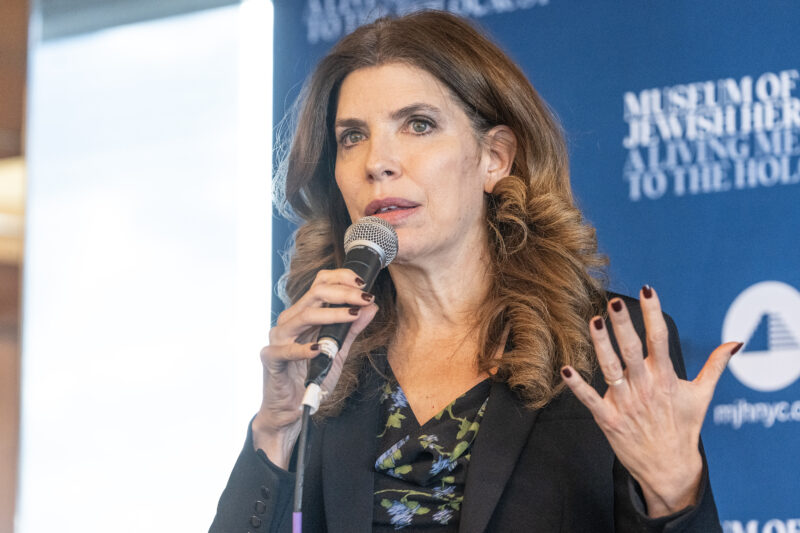
Fusion hosts a New York Tech Week 2026 event.


 Add JewishInsider on Google
There’s a mantra in the Israeli startup world that its founders are months behind their American counterparts. New York Tech Week gave them a chance to close that gap, according to investors who descended on Manhattan last week.
Michael Morgenstern, head of startups at financial technology platform Airwallex, which teamed up with Andreessen Horowitz — one of the world’s leading venture capital firms — to bring a delegation of Israeli founders to tech week for the first time, told Jewish Insider that VCs are looking to see more AI products come out of Israel, which historically has been security focused.
“It would be interesting to see an AI lab out of Israel,” he said. “Why haven’t we seen an OpenAI or Claude, something of that status, coming out of the Israeli ecosystem? It makes me wonder if we are stagnating as an ecosystem. So exposing the Israeli market to what’s going on on the ground gives Israeli entrepreneurs the chance to get months ahead.”
“The mantra in the Israeli startup market right now is that Israeli founders and entrepreneurs are nine months behind the Americans,” he continued. “So if we can fly them here, make sure that people with low budgets — that will soon have high budgets — come to the U.S. and get on the ground, they’re going to get back to Israel with a whole new set of insights that are going to prepare them and be on par with the American companies versus the ones in Tel Aviv.”
“So it’s a very strategic play for them to come, get the experience and do the pitches. Ultimately, the U.S. is the ultimate market for most Israeli founders so if we can be the corridor at Airwallex and I can be the shepherd, it’s a delight to do so,” he said.
The 12 Israeli founders included in the delegation said they felt widely embraced at last week’s New York Tech Week, overwhelmingly saying that they felt no need to hide their roots.
“I feel I can be openly Israeli in the U.S. — specifically at tech week,” Aviv Shamny, founder of Limy AI, an Israeli startup that helps brands and products show up on AI search engines, told JI. “I didn’t feel any antisemitism at all at tech week.”
Shamny, who recently moved to the U.S. from Israel to grow his company — and served in combat following the Oct. 7, 2023, terrorist attacks — said the idea for his startup “came to me in the trenches of war.” For the past year, Limy has been part of A16Z Speedrun, an elite, highly competitive 12-week startup accelerator program operated by Andreessen Horowitz.
“People are really hustling,” said Morgenstern. “Last week was Boston tech week, next week is London. New York is the primo one. People are enjoying it. It’s decentralized as there’s what feels like thousands of events all over the city for every stage and profile.”
Morgenstern led several events throughout the week, including taking founders who recently moved to New York in a helicopter to give them their first tour of Manhattan. “We did a pitch in the air called ‘Up in the Air with Airwallex,’” he said, adding that amid historic rates of antisemitism, “I’ve only heard positive things from Israelis meeting with non-Israelis.”
The Israeli delegation consisted of entrepreneurs launching new startups — many of whom declined to speak with JI due to their companies’ stealth status.
“It was a very selective process,” said Morgenstern. “There were hundreds, if not thousands, of applications. Andreessen Horowitz picked the founders, and we’re strategic partners with them. We’re the ones supporting the founders with their banking and corporate operations. This is the first time we’ve done this and we plan on doing it again.”
Much of the A16Z delegation is composed of deeper infrastructure companies, working on AI tools, cybercompanies, fintech and defensetech.
“Historically, cyber is what Israelis have been known for, but it’s interesting to see the early-stages people try to zig when everyone’s zagging and look a little different to stand out,” said Morgenstern. “So an Israeli founder doing a consumer company, selling to individuals is very unique. Healthcare and fintech also. We’re also seeing some big rounds happening. A lot of Israeli teams are raising $10, $20, $30 million-plus out of stealth mode. It’s interesting they don’t want anyone to know what they’re doing, but at the same time they’re raising a lot of money and growing their balance sheet. From my seat in the VC land, I see an incredible demand and the resilience of Israelis right now is showing why they’re such an investable asset.”
“Generally, Andreessen Horowitz has a unique stance,” said Shamny, who was not part of the A16Z delegation since the firm has already invested in his company.
“On one hand, they don’t take sides, they take the side of innovation. They see Israel as one of the main innovation hubs and are really doubling down on it. We’ve been getting positive feedback from the firm. I do think this contributes to us being able to position ourselves as still the startup nation, regardless of all the antisemitism going on in the world. I think the war — regardless of what is wrong and what is right — has been impactful on Israel’s presence and what people think about us as Israelis. Andressen’s push toward Israeli innovation has been helpful in positioning ourselves.”
“As Israelis we are very proud to take part in this unique group of people and companies. It’s fun to be a part of.”
Yair Vardi, an Israeli American venture capitalist and founding partner of Fusion, Israel’s leading pre-seed fund, produced several events during tech week.
“I didn’t see reluctance to work with Israelis this week,” Vardi told JI. “On the contrary, New York is the home to over 400 Israeli startups. In the last few years, New York has become even more attractive for Israeli startups. I don’t see that changing even with politics. New York is home for the stock exchange and many Fortune 500 companies and a big Jewish community. [Israelis] aren’t happy with the new mayor [Zohran Mamdani], but I don’t think it pushes them not to come. This week we saw the numerous delegations coming out of Israel [including the one from] A16Z. I’ve attended a dozen events with Israeli entrepreneurs, from cybersecurity to legal and finance,” said Vardi.
A jam-packed week of networking ended with a Friday night Shabbat dinner organized by Brex and Tech Tribe, a New York-based community for Jews in tech and digital media, part of the Chabad Young Professionals network, founded by Rabbi Mordechai Lightstone.
“We try to create a Jewish community for people who work in startups and try to give them the tools and skills they need for what they create,” Lightstone told JI. “We constantly have conversations around the intersection of technology and Judaism; can you ask halachic questions to ChatGPT instead of a rabbi, those types of things.”
“New York Tech Week is something that has grown over the past couple years in general,” he said. “The city is booming with excitement and energy, much more than previous years.”
“Jews in tech have woken up and realized they have to really represent it, to go out there and say I’m Jewish, I have Jewish values and I’m proud of it. In the past three years we’ve seen a lot of that, and this week has been an expression of that,” said Lightstone, who hosted the first Tech Week Shabbat dinner just weeks after the Oct. 7 attacks. “At the time, it was a very cathartic experience for everybody to be together and feel comfortable when people were very on edge and felt they couldn’t speak in the workplace,” he said.
“There have been incidents of antisemitism in tech since Oct. 7, especially in the big companies. They didn’t always handle antisemitism well. They’re very careful with [diversity, equity and inclusion], but when it came to Jews [they] were lacking,” continued Lightstone.
About 100 VCs and founders attended the Shabbat in downtown Manhattan, which Lightstone called an opportunity for an “un-networking experience to connect and unwind from the week.” Guests were served arak and whiskey made by the Israeli startup Verstill, which utilizes AI technology in its spirits creation and maturation process, and Israel’s Jezreel Winery sponsored the wine. American Friends of Reichman University co-sponsored the meal.
Ahead of the dinner, Noga Sapir, the founder of a mental health startup called Reflect, who came from Israel for her first New York Tech Week, told JI the week was “great.”
“I’m fundraising right now so I’ve been looking at the events where founders and fundraisers meet,” she said. “I did have concerns [coming as an Israeli] but I was completely embraced. There has not been one person that when I told I’m Israeli didn’t say that’s amazing and awesome. I think because Israel is such a powerhouse for tech companies, people in the startup environment have come to expect an Israeli presence.”
‘I’m not an investment advisor, but you can see that if you were not in Israel in the past two years, you probably missed out, if Israel was not part of your portfolio,’ Seffy Zinger, chair of the Israel Securities Authority, told JI

Patrick T. Fallon / AFP via Getty Images
Laurence D. Fink (R), co-founder, chairman and CEO of BlackRock, speaks next to Milken Institute chairman Michael Milken during the 29th annual Milken Institute Global Conference at the Beverly Hilton in Beverly Hills, California on May 5, 2026.
LOS ANGELES — The Israeli financiers, investors and entrepreneurs who attended last week’s Milken Institute Global Conference in Beverly Hills almost couldn’t make it. Just weeks earlier, after all, the country’s airspace had been largely closed as war raged with Iran.
But aside from their slight fear that the fragile ceasefire would fall apart and leave them stranded in the United States, the Israelis who participated in the marquee conference of global finance brought an upbeat attitude about Israel’s economy, even two-and-a-half years into near-constant war that began with Hamas’ Oct. 7, 2023, attacks.
“When the war began, I think none of us — none of the regulators in Israel, and almost none of the players or the investors in Israel — thought or believed that after two-and-a-half years of war, Israel would show such growth, such resilience,” Seffy Zinger, chair of the Israel Securities Authority, told Jewish Insider in an interview. (The ISA is Israel’s equivalent of the U.S. Securities and Exchange Commission.)
Zinger was at Milken to spread the message that global financiers should consider investing in the Israeli economy, and in particular the Tel Aviv Stock Exchange, despite the doom-and-gloom headlines about the Middle East.
“I’m not an investment advisor, but you can see that if you were not in Israel in the past two years, you probably missed out, if Israel was not part of your portfolio. So I think Israel is becoming a very interesting place economically,” he said.
The shift away from Israel in American politics did not appear to be reflected at this gathering of global business elites: Natti Ginor, a managing director at Jefferies and the bank’s head of Israel investment banking, pitched Israel at the conference as a financial capital in the Middle East. Blackstone’s Tel Aviv-based senior managing director, Yifat Oron, was also there talking about her work leading the firm’s investments in Israel.
“When we are talking to investors and the big players, what I see is a lot of interest in Israel, and I think the economy and the numbers speak for themselves,” said Zinger.
Dror Barak traveled to Los Angeles from Israel to meet developers and investors from across the Middle East, including Saudi Arabia, the United Arab Emirates and the Palestinian territories. He is the founder of Align Capital, an infrastructure-focused private equity firm that is working on projects related to IMEC, the India-Middle East-Europe Economic Corridor — a planned project meant to further economic cooperation across wide swathes of the world. Its development has stalled since the Oct. 7 terror attacks and the ensuing war, but behind the scenes, progress is being made.
“The war, I don’t like to say it, but with all the bad things it also pushed us toward a new era of cooperation,” Barak told JI last week. “The war made us on the same side. It’s the first time in history that we, the UAE [and] Saudi are on the same side. We are all against, publicly or less publicly, Iran. With the United States, of course. So this is a very, very, very dramatic thing, and it’s changed dramatically the nature of our relationship.” IMEC has been floated as an alternative for global shipping amid turbulence in the Strait of Hormuz.
Barak acknowledges that Israel’s reputation has suffered: “Yes, it’s an issue,” he said. But he argued that the work of investing in cross-regional infrastructure must happen, even if the geopolitical situation remains unresolved.
“I’m not waiting for the American public to dedicate my direction, and I’m not waiting for [Israeli Prime Minister Benjamin Netanyahu] or [President Donald Trump] to do some peace,” said Barak. “We promote Arabs and Jews working together. So everywhere that you are looking, I think that we are doing the right thing — the right thing for Israel, the right thing for the region and the right thing for the global politics that want to support the right forces.”
Last year was a banner one for Israeli startups, and the country’s GDP rebounded last year after slowing in 2023 and 2024. But challenges remain. Bentzion Levinson, founder and CEO of Heven AeroTech, an American company with a large Israeli workforce, said there were times that more than one-third of his employees were out of the office doing reserve duty in the Israeli military.
“To this day, we have an average of 10 to 20% of our employees in reserves, around the clock. So I think it’s a challenge. But challenges build strength,” Levinson told JI in Los Angeles. His company’s creation of pioneering long-range stealth drones has driven contracts with the U.S. military and earned a unicorn valuation.
“A lot of things are taking a toll on families [and the] personal, but I think people are strong and they realize that there’s no other choice,” said Levinson. “I think it’s gonna be a decade of significant growth in Israel, especially in the defense tech world … it’s a challenge, but I think the Israeli people can overcome it.”
Zinger, the ISA chair, was attending Milken with his chief of staff, who spent nearly 400 days serving in the reserves after Oct. 7. Responsibilities got juggled; some days the staffer would work three days and do reserve duty for two days. There was no choice but to adapt. And that flexibility, Zinger argued, is part of why Israel’s economy has performed better than anyone expected during the war.
“I think this is part of the strength of the Israeli community and society, exactly these kinds of things, and of course, without that strength, the performance that we see could not have happened,” said Zinger. “It’s something that I think we learn how to live with.”
The four-day convening is billed as a way for global leaders to address some of the world’s biggest challenges
Taylor Hill/FilmMagic
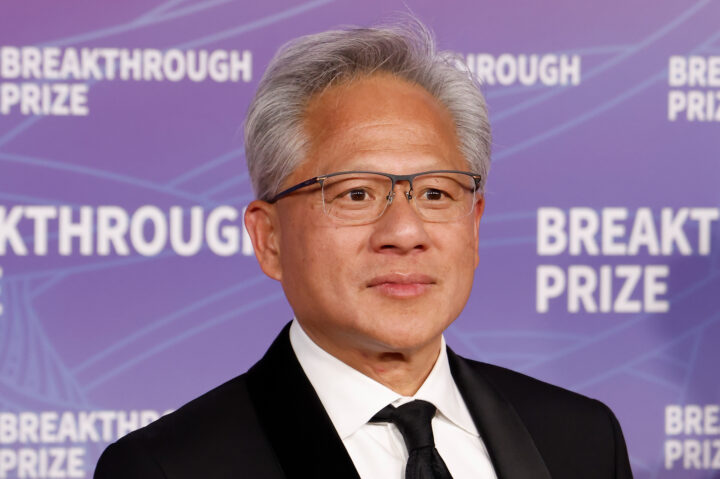
Jensen Huang attends the 12th Breakthrough Prize Ceremony at Barker Hangar on April 18, 2026 in Santa Monica, California.
A who’s who of global decision-makers is gathering today at the iconic Beverly Hilton hotel in Los Angeles for this year’s annual Milken Institute Global Conference. Investors, philanthropists and business executives from around the world will hobnob with pro athletes, movie stars and politicians.
The four-day convening is billed as a way for global leaders to address some of the world’s biggest challenges. According to event organizers, this year’s conference is focused on building “a more sustainable, equitable and resilient future” in the face of “recent disruption and innovation.” In other words: What are the most powerful innovators in the world going to do about artificial intelligence?
AI is shaping up to be the buzzword at Milken, just like it is everywhere else right now. Govs. Ron DeSantis of Florida and Gretchen Whitmer of Michigan will each be talking on Monday about developing a competitive workforce. Sens. Bill Hagerty (R-TN) and Mark Warner (D-VA) will speak on a panel with Alphabet President Ruth Porat and Meta President Dina Powell McCormick about disruptions to the American workforce. Perhaps the most anticipated speaker of the day is Nvidia CEO Jensen Huang.
The events at Milken are a mix of utilitarian, educational and enlightening. Practical panel discussions about investing take place next to addresses from world leaders and politicians; conversations about philosophy occur alongside sessions about medical breakthroughs. (Rabbi David Wolpe and the actor Kelsey Grammer are speaking about the meaning of faith today.)
Milken attendees will have the opportunity on Monday to hear from Nobel Peace Prize-winner Maria Corina Machado, the Venezuelan opposition leader, as well as U.S. Ambassador to the United Nations Mike Waltz and Rafael Grossi, director-general of the International Atomic Energy Agency.
Many Israelis who work in tech are attending amid a period of relative calm in Israel during a ceasefire with Iran. A closed-door session today about ties between Silicon Valley, Washington and the Middle East features UAE Ambassador to the U.S. Yousef Al Otaiba, Israeli-born Silicon Valley investor Elad Gil, Abu Dhabi department of health chair Mansoor Ibrahim Al Mansoori and Jacob Helberg, the U.S. under secretary of state for economic affairs.
At a moment of geopolitical tumult and economic uncertainty, the Milken conference presents an opportunity to listen in on some of the conversations that could drive policy and shape economic outcomes. We’ll be paying close attention.
The gathering also included the state’s two leading Democrats, Gov. Josh Shapiro and Sen. John Fetterman, and President Donald Trump
Jeff Swensen/Getty Images
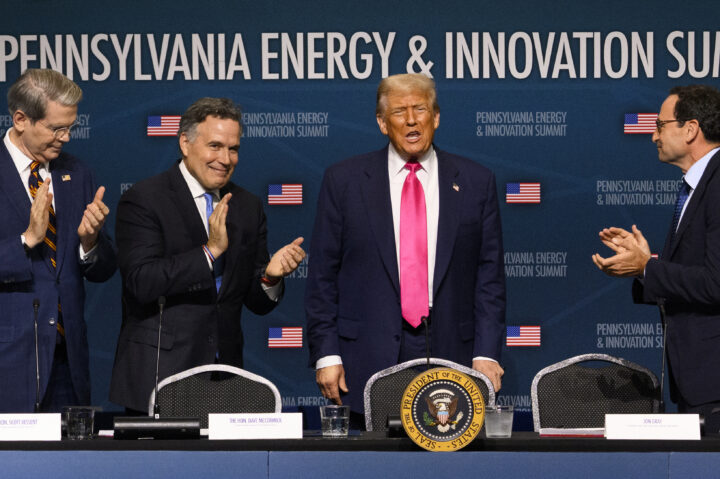
President Donald Trump (C) arrives to speak to guests and investors at the inaugural Pennsylvania Energy and Innovation Summit at Carnegie Mellon University on July 15, 2025 in Pittsburgh, Pennsylvania.
PITTSBURGH — Pennsylvania’s top lawmakers put up a united front on Tuesday to emphasize to the hundreds of tech and energy investors at Sen. Dave McCormick’s (R-PA) inaugural innovation summit the benefits of working with states that embrace bipartisanship and the national security imperatives of investing domestically.
The Pennsylvania Energy and Innovation Summit brought top tech and energy executives to Carnegie Mellon University’s campus, home to one of the world’s most advanced AI programs. Tuesday’s gathering also included the state’s two leading Democrats, Gov. Josh Shapiro and Sen. John Fetterman (D-PA), and President Donald Trump, all of whom praised the conference as a strategic way to promote U.S. investment to the scores of foreign and American leaders in attendance.
Amazon Web Services’ $20 billion investment last month in three computing and AI campuses in the Keystone State was “an indicator of all that we can be when we harness the new things that we have going for us, and when we have government and the private sector working together, not at odds, and when we pull in our educational institutions … in a way that really helps move Pennsylvania forward,” Shapiro said during a panel discussion with McCormick and AWS CEO Matt Garman.
While McCormick and Shapiro acknowledged their political differences, they said they agreed that their state should be on the forefront of the technological innovation and investment happening in the United States. They also said they share the view that a unified team of statewide leaders is more appealing to outside investors and businesses than an assortment that’s at odds with each other.
“I look at this moment as a business guy, and so I say one of two things: If I’m a business guy, what do I want?” McCormick asked. “I want to come to a place that has all those ingredients and has uniform political leadership. … If you’re a CEO and you want to invest a bunch of money and you come in and sit down, you meet the governor and he’s talking bad about me and saying that I’m full of it, and vice versa, that makes you not want to invest, right? So we need to be aligned at all levels.”
“The governor and I are of different parties, we have plenty of differences, but on this, we agree. Sen. Fetterman was at our dinner last night. On this, we agree that we need to be at the crossroads of the energy revolution, the AI revolution. To have a leadership position, we need to show a unified front at the local level, at the state level, at the national level. That’s the only way to win,” McCormick continued.
The conversation, which took place as hundreds of AI and energy firms courted investors at tables around the Jared L. Cohon University Center on Carnegie Mellon’s campus, followed panel discussions from senior tech and finance executives about winning the race for AI and energy domination domestically and the benefits of investing in the Keystone State.
Shapiro and McCormick separately said that they view Pennsylvania as a purple state that requires bipartisan cooperation to push any legislation across the finish line.
“As a candidate, I promised I would get things done, and in Pennsylvania, you can’t get things done unless you’re able to work with people who you disagree with on certain things and find areas of common agreement,” McCormick said. “We can agree that we’ve got to have great jobs in Pennsylvania, we’ve got to take advantage of our energy resources, like there is so much to agree on. So I think this is a particularly special moment for Pennsylvania.”
Shapiro noted that his first two years as governor took place under a Republican state Senate, forcing him to reach across the aisle and find common ground on areas such as economic and education policy, before noting that he still takes issue with major GOP policy priorities such as Trump’s budget reconciliation bill.
“The last two years, I was the only governor in the entire country with a divided legislature. Senate led by Republicans, a House led by Democrats. This year, I think there’s one or two other governors with the same. For me to get any bill to my desk requires votes from the Republican Party and the Democratic Party. And I think if you enter every discussion focusing on your differences, you’ll never get anything done,” Shapiro said.
“We’re honest about differing on the bill that was just passed, the reconciliation bill that was just passed last week,” he added of his disagreements with McCormick. “But we also understand how critically important it is to grow our economy in Pennsylvania, this unique moment that we are in.”
Fetterman, who returned to Washington on Tuesday for Senate business, told Jewish Insider in a statement that he was fully supportive of the summit and the unity push by McCormick and Shapiro.
“Party aside, we’re all in – on Pennsylvania’s best interests,” Fetterman told JI, adding that he sent his “congratulations to Sen. McCormick for putting this tremendous event together for Pennsylvania’s future.”
McCormick later highlighted in his discussion with Shapiro and Garman the need for Pennsylvania and the U.S. to keep up with the rest of the world in economic development.
“If you travel around the world, if you go to the Middle East, if you go to other places, the pace of change is extraordinary. And it’s gonna require a level of urgency that I don’t think most people in this room have probably had in the past about this moment, particularly in Pennsylvania. And so that urgency, we need to grab the moment,” the senator said.
In response, Shapiro pointed out that one of McCormick’s top takeaways from his recent visit to the Middle East was the potential for U.S. investments from new partners.
“The senator, and I think Dina [Powell McCormick] as well, went to the Middle East a month or two ago, and we talked right when he came back. One of the things you were most jazzed up about, I thought, were the investments that folks in the Middle East shared with you that they wanted to make in America and how you were pitching Pennsylvania as part of that,” Shapiro said.
“This is a global race for both energy dominance and AI dominance. We need home-grown Pennsylvanians to be doing this work, and we need investment from all across the country and all across the globe. We do not want China to beat us in this AI race. This is one of the most important national security questions we have, and so if the senator and others can bring investment from around the globe to right here in Pennsylvania,” he continued.
During the president’s roundtable discussion with McCormick, leading executives and several members of his Cabinet, Trump touted the $5.1 trillion in domestic investments he claimed to have secured on his last visit to the Middle East while cheering the $90 billion in committed U.S. projects announced at the summit.
“Today’s commitments are ensuring that the future is going to be designed, built and made right here in Pittsburgh and I have to say right here in the United States of America,” Trump said.
Interior Secretary Doug Burgum described the president’s “vision of energy dominance” as the “foundation of this golden age for America.”
“You identified that there were a couple of threats to our country. One was Iran having a nuclear weapon. The other was losing the AI arms race to China. You took care of one of those a few weeks ago. You’re helping to take care of the other one here,” Burgum said of Trump’s agenda, prompting a smile from the president.
McCormick then noted that Trump’s attendance at the summit helped boost interest from industry leaders and investors alike. “I really believe, Mr. President, based on you being here, we’re going to look back on this day and say that this was a real, seminal moment in the history of our Commonwealth and maybe in the history of our country,” he told the president.
Trump then remarked that while McCormick had initially only asked him to make a brief appearance at the gathering, he decided to stay for longer once he saw the industry leaders on the high-profile guest list.
“When I saw the people gathered, I said, ‘I’m not leaving. I want to learn something.’ And I have learned something. This is the smartest group of talent, probably, that you’ve ever had in terms of energy and even finance, [that you’ve] ever had in one room,” Trump remarked to the crowd.
Please log in if you already have a subscription, or subscribe to access the latest updates.
 Continue with Google
 Continue with Apple