



























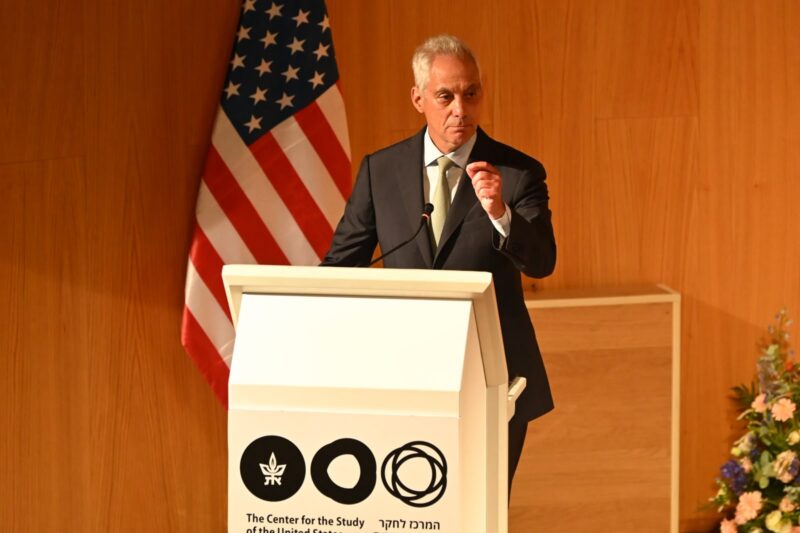





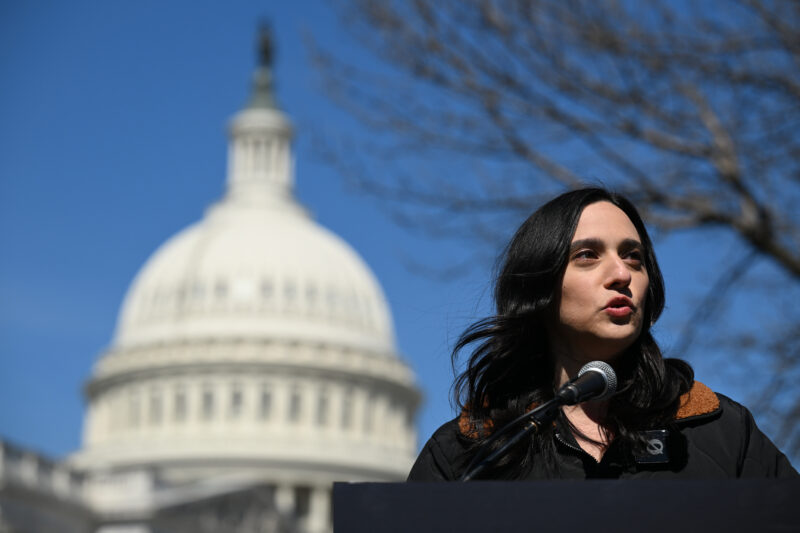
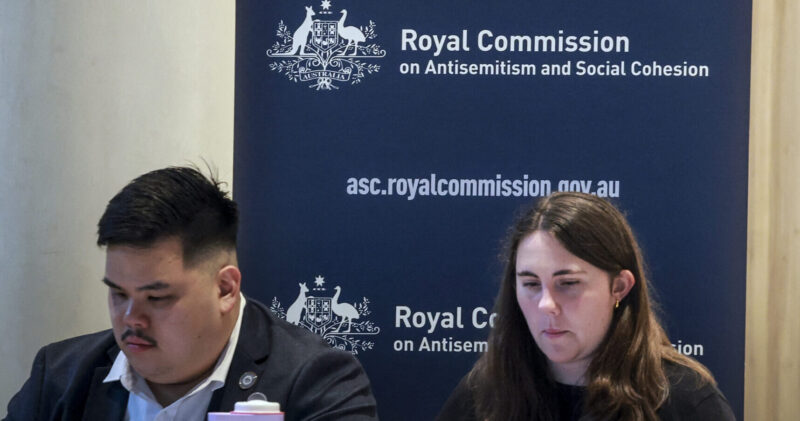


















Emmanuel Nahshon, the coordinator for combatting academic boycotts on behalf of the Israeli Association of Universities, speaks to JI about the challenges Israeli academia is facing in the shadow of the Gaza war

Shlomi Amsalem/GPO
Emmanuel Nahshon


 Add JewishInsider on Google
As nearly a dozen countries announced plans to recognize a Palestinian state in the last week, the European Union debated exerting an additional form of leverage on Israel, in the form of suspending its participation in Brussels’ flagship scientific research and innovation program.
Earlier last week, the European Commission proposed a partial suspension of Israel’s participation in Horizon Europe — a 95.5 billion Euro ($109.2 billion) program that covers all areas of science and technology and has contributed significantly to Israeli academia and its tech sector — in response to what Brussels called a “severe” humanitarian situation in Gaza, which it views as having been insufficiently addressed by the daily humanitarian pauses this week.
The commission proposed to no longer allow Israeli entities to work with the European Innovation Council’s accelerator, which an Israeli diplomatic source estimated would lead to damages of about 10 million Euros ($11.4 mn.) to Israeli startups in the program, but none to research projects.
The motion did not receive the qualified majority in the European Union Council, and therefore Israel remains a full partner in Horizon Europe. Germany and Italy reportedly blocked the suspension, and Tuesday’s meeting on the matter ended without a decision. The European Council presidency said after the meeting that it plans to continue talks about the matter. The Israeli diplomatic source said some countries wanted to continue monitoring the humanitarian situation in Gaza before reaching a decision.
The scare from Brussels came at a difficult time for Israeli academia, which has been facing overt and more subtle forms of boycotts, Emmanuel Nahshon, the coordinator for combatting academic boycotts on behalf of the Israeli Association of Universities, told Jewish Insider in an interview on Wednesday.
Nahshon, a former ambassador and deputy director of Israel’s Foreign Ministry, who resigned last year in protest against the government, spoke about the challenges Israeli academia is facing in the shadow of the war in Gaza.
The interview has been condensed and edited for clarity.
Jewish Insider: What did you think about the outcome of the European Council’s discussion on partially suspending Israel from Horizon Europe?
Emmanuel Nahshon: They decided not to decide at the EU level, because we still have Germany and Italy blocking a possible majority against Israel, but even the Germans are telling us that this cannot go on. It’s an expression of the increasing isolation of Israel, given the unending war in Gaza, which has become more and more difficult to explain … It creates a bleak picture.
I’m very happy that sanctions on Israel in Horizon Europe did not work out this time, but unfortunately, it will happen next time.
JI: Can you explain why Horizon Europe is so important?
EN: It’s a fund budgeted by the EU and its member states, a multi-year fund for six to seven years, and its purpose is to fund joint research and development projects. Israel is one of the few non-EU countries that have been invited to participate … starting in the mid-1990s. It has been extremely successful.
European funds are extremely important because they create partnerships and networks and this is part of what has made Israel the innovation hub that it is.
Israel has one of the highest rates of return on investment and are welcome partners in top-level projects of the EU. By cutting us out of those projects, it will really punish Israeli innovation and the Israeli economy.
It’s not only about academic cooperation — it goes way beyond that. These are projects that are translated into concrete innovations for the welfare of humanity.
JI: What kinds of challenges is Israeli academia facing from anti-Israel elements abroad?
EN: Immediately after Oct. 7 [2023 Hamas attacks on Israel], there were mostly student protests, encampments, violent protests – those are almost non-existent now. It has shifted in the last year to something else, institutional boycotts.
Universities have decided to cut ties with Israel, as have professional associations – medical, psychology, historians, mathematicians. It’s much more dangerous. We now have countries in which the majority of universities have no contact with Israel. In Belgium and the Netherlands over 80% of universities have severed all contacts with Israeli universities, as have most in Spain and Italy. It’s beginning in Switzerland, in Geneva and Lausanne.
It’s a slippery slope. The more it happens, the more it is bound to happen. Universities copy one another.
On top of that, we have the silent, covert boycott. It’s like Voldemort [from Harry Potter], no one is saying its name, but it is there and we feel it all the bloody time. Israeli lecturers are not invited to international events anymore; articles are rejected; Israelis are not invited to take part in science and research consortia, etc.
If it continues for a year or two, we may face dire consequences.
JI: What would those consequences be?
EN: It’s the slow strangling of the Israeli academic world. We cannot function without contact with the outside world. Israel is too small a country to be able to have its own, internal academic world. We need contact with …the Ivy League and Western European universities.
On top of it, there is a phenomenon that began before the war, because of the so-called judicial reform, and that is Israeli academics leaving Israel. This is a brain drain that is noticeable and catastrophic. We are talking about tens of thousands of Israeli academics choosing to make their lives elsewhere. It began in early 2023 and the war made it worse.
JI: The Israeli Association of Universities (known in Israel by the Hebrew acronym VERA) hired you about a year ago to combat the academic boycott. What have you been doing?
EN: We have been working very hard on two levels. The first was to create internal coordination between different Israeli universities so we can speak the same language in the fight together. We did one thing that has been extremely useful, which is to create a common database. Now, on a regular basis, we have information coming from all the Israeli universities regarding boycott attempts and events. This is super useful, because now we know how many took place.
JI: How many?
EN: By last count there were over 800 boycott events since last summer. Some are smaller, some are bigger.
[Nahshon provided JI with a presentation given by VERA to the Knesset Education Committee in May, which said that this year they received an average of 50 boycott reports per month — double that of the previous year. Broken down by country, the number of reports about the U.S., Canada and Holland more than doubled, Spain went up 125% and England increased by 55%. A third of the complaints from North America were about the suspension of individual collaborations between Israeli scientists and their colleagues, while 18% were about difficulty in publishing, and 18% were about not being invited to lecture or participate in conferences. In Europe, nearly a third of the complaints were about institutions ending their cooperation with Israelis.]
Boycotts are complex. It’s a bit like sexual harassment. People do not always want to say they’ve been the victim, so we have to encourage people. Now, more and more [academics] are reporting and we have a fuller picture of the situation.
JI: What do you do after receiving the reports?
EN: We do work all over the world on the legal, political and public relations fronts. We emply the services of a law firm in Brussels that is helping us tremendously, because a lot of institutional boycott cases violate European laws.
For example, if universities want to kick Israeli researchers out of Horizon Europe [grantee] projects, that is against European law … We have had many successes in which they immediately stop the boycott.
Politically, we want to encourage our friends to pass legislation against boycotts, like the ones that exist in the U.S.
There are so many lies directed at Israeli universities that have nothing to do with reality, such as calling them apartheid or saying that Israeli academia teaches the military how to occupy or how to kill.
This effort is very new, very young. We need more budgets to function; it’s challenging. I have addressed the government without much success. We are looking for partners and funds, and we do the best we can with the limited means we have.
JI: The Weizmann Institute, one of Israel’s leading scientific institutions, was hit by an Iranian missile last month, which destroyed 45 labs. Are they going to have a hard time recovering because of international boycotts?
EN: I don’t think it will be a problem [raising funds for the recovery] because so many have expressed solidarity with the Weizmann Institute. They have so many friends around the world.
The problem is that the government is not fulfilling its mission. It should be the role of the Israeli government to commit to financing it, instead of fundraising … Israeli academia is not a priority for this government because it is identified with the more liberal wing of Israeli politics.
Weizmann will be fine, but the problem is of a more general nature. I quote the head of VERA Daniel Chamovitz, who said that “you can see that the Iranians put higher education and Israeli research at the center of their launch map” — apparently the Iranians understand better than the Israeli government that academia is a top priority. They aimed at Weizmann and the Soroka Hospital [in Beersheba, a teaching hospital] for exactly that reason.
The BIRD Health Act builds on the existing Binational Industrial Research and Development Foundation program by allocating funding for joint healthcare innovation
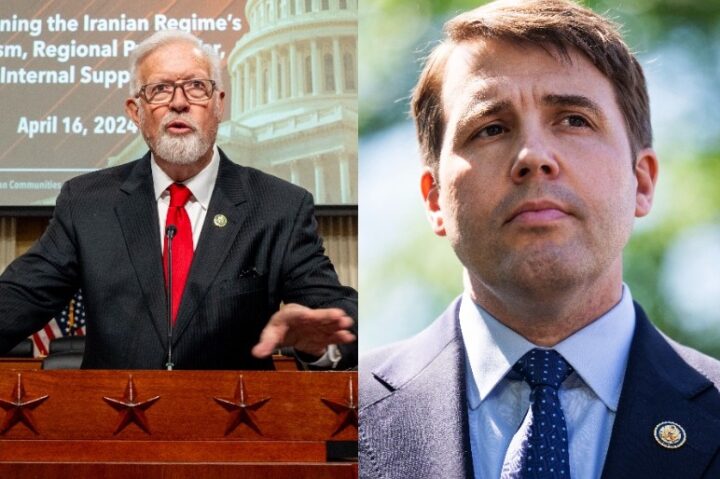
Andrew Harnik/Getty Images/Tom Williams/CQ-Roll Call, Inc via Getty Images
Reps. Randy Weber (R-TX) and Chris Pappas (D-NH)
A new bipartisan House bill set to be introduced on Wednesday aims to expand U.S.-Israeli research and development cooperative programs in the medical field.
The BIRD Health Act, led by Reps. Randy Weber (R-TX) and Chris Pappas (D-NH), builds on the long-running Binational Industrial Research and Development Foundation program.
Around a third of BIRD projects in the past decade have been related to the health-care sector, and the U.S. and Israel have pursued growing cooperation in the field in recent years. The bill would further formalize those efforts by establishing a new $10 million annual funding stream and joint management structure between the Department of Health and Human Services and the Israeli Ministry of Health specifically focused on supporting such projects.
It would support research and development between institutions and companies in both countries, including startups, as well as health systems, telemedicine, disease prevention efforts and biological product manufacturing.
“The United States and Israel share one of the strongest, most enduring alliances in the world, and it just makes sense to join forces in advancing life-saving health technologies that benefit both our nations,” Weber said in a statement. “The BIRD Health Act of 2025 builds on our shared strengths to support cutting-edge medical innovation, strengthen supply chains, and improve health outcomes for American families.”
“U.S. and Israeli doctors, scientists, and researchers are leading the world in groundbreaking medical advancements, including regenerative medicine, disease prevention, and cancer research,” Pappas said in a statement. “The health technology and innovation program created through this bipartisan legislation will strengthen the bilateral partnership between the U.S. and Israel to address emerging health issues, develop innovative solutions, and save lives.”
The gathering also included the state’s two leading Democrats, Gov. Josh Shapiro and Sen. John Fetterman, and President Donald Trump
Jeff Swensen/Getty Images
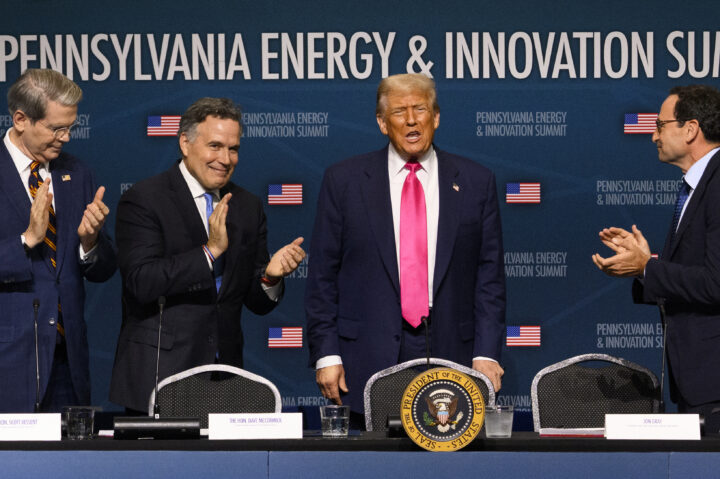
President Donald Trump (C) arrives to speak to guests and investors at the inaugural Pennsylvania Energy and Innovation Summit at Carnegie Mellon University on July 15, 2025 in Pittsburgh, Pennsylvania.
PITTSBURGH — Pennsylvania’s top lawmakers put up a united front on Tuesday to emphasize to the hundreds of tech and energy investors at Sen. Dave McCormick’s (R-PA) inaugural innovation summit the benefits of working with states that embrace bipartisanship and the national security imperatives of investing domestically.
The Pennsylvania Energy and Innovation Summit brought top tech and energy executives to Carnegie Mellon University’s campus, home to one of the world’s most advanced AI programs. Tuesday’s gathering also included the state’s two leading Democrats, Gov. Josh Shapiro and Sen. John Fetterman (D-PA), and President Donald Trump, all of whom praised the conference as a strategic way to promote U.S. investment to the scores of foreign and American leaders in attendance.
Amazon Web Services’ $20 billion investment last month in three computing and AI campuses in the Keystone State was “an indicator of all that we can be when we harness the new things that we have going for us, and when we have government and the private sector working together, not at odds, and when we pull in our educational institutions … in a way that really helps move Pennsylvania forward,” Shapiro said during a panel discussion with McCormick and AWS CEO Matt Garman.
While McCormick and Shapiro acknowledged their political differences, they said they agreed that their state should be on the forefront of the technological innovation and investment happening in the United States. They also said they share the view that a unified team of statewide leaders is more appealing to outside investors and businesses than an assortment that’s at odds with each other.
“I look at this moment as a business guy, and so I say one of two things: If I’m a business guy, what do I want?” McCormick asked. “I want to come to a place that has all those ingredients and has uniform political leadership. … If you’re a CEO and you want to invest a bunch of money and you come in and sit down, you meet the governor and he’s talking bad about me and saying that I’m full of it, and vice versa, that makes you not want to invest, right? So we need to be aligned at all levels.”
“The governor and I are of different parties, we have plenty of differences, but on this, we agree. Sen. Fetterman was at our dinner last night. On this, we agree that we need to be at the crossroads of the energy revolution, the AI revolution. To have a leadership position, we need to show a unified front at the local level, at the state level, at the national level. That’s the only way to win,” McCormick continued.
The conversation, which took place as hundreds of AI and energy firms courted investors at tables around the Jared L. Cohon University Center on Carnegie Mellon’s campus, followed panel discussions from senior tech and finance executives about winning the race for AI and energy domination domestically and the benefits of investing in the Keystone State.
Shapiro and McCormick separately said that they view Pennsylvania as a purple state that requires bipartisan cooperation to push any legislation across the finish line.
“As a candidate, I promised I would get things done, and in Pennsylvania, you can’t get things done unless you’re able to work with people who you disagree with on certain things and find areas of common agreement,” McCormick said. “We can agree that we’ve got to have great jobs in Pennsylvania, we’ve got to take advantage of our energy resources, like there is so much to agree on. So I think this is a particularly special moment for Pennsylvania.”
Shapiro noted that his first two years as governor took place under a Republican state Senate, forcing him to reach across the aisle and find common ground on areas such as economic and education policy, before noting that he still takes issue with major GOP policy priorities such as Trump’s budget reconciliation bill.
“The last two years, I was the only governor in the entire country with a divided legislature. Senate led by Republicans, a House led by Democrats. This year, I think there’s one or two other governors with the same. For me to get any bill to my desk requires votes from the Republican Party and the Democratic Party. And I think if you enter every discussion focusing on your differences, you’ll never get anything done,” Shapiro said.
“We’re honest about differing on the bill that was just passed, the reconciliation bill that was just passed last week,” he added of his disagreements with McCormick. “But we also understand how critically important it is to grow our economy in Pennsylvania, this unique moment that we are in.”
Fetterman, who returned to Washington on Tuesday for Senate business, told Jewish Insider in a statement that he was fully supportive of the summit and the unity push by McCormick and Shapiro.
“Party aside, we’re all in – on Pennsylvania’s best interests,” Fetterman told JI, adding that he sent his “congratulations to Sen. McCormick for putting this tremendous event together for Pennsylvania’s future.”
McCormick later highlighted in his discussion with Shapiro and Garman the need for Pennsylvania and the U.S. to keep up with the rest of the world in economic development.
“If you travel around the world, if you go to the Middle East, if you go to other places, the pace of change is extraordinary. And it’s gonna require a level of urgency that I don’t think most people in this room have probably had in the past about this moment, particularly in Pennsylvania. And so that urgency, we need to grab the moment,” the senator said.
In response, Shapiro pointed out that one of McCormick’s top takeaways from his recent visit to the Middle East was the potential for U.S. investments from new partners.
“The senator, and I think Dina [Powell McCormick] as well, went to the Middle East a month or two ago, and we talked right when he came back. One of the things you were most jazzed up about, I thought, were the investments that folks in the Middle East shared with you that they wanted to make in America and how you were pitching Pennsylvania as part of that,” Shapiro said.
“This is a global race for both energy dominance and AI dominance. We need home-grown Pennsylvanians to be doing this work, and we need investment from all across the country and all across the globe. We do not want China to beat us in this AI race. This is one of the most important national security questions we have, and so if the senator and others can bring investment from around the globe to right here in Pennsylvania,” he continued.
During the president’s roundtable discussion with McCormick, leading executives and several members of his Cabinet, Trump touted the $5.1 trillion in domestic investments he claimed to have secured on his last visit to the Middle East while cheering the $90 billion in committed U.S. projects announced at the summit.
“Today’s commitments are ensuring that the future is going to be designed, built and made right here in Pittsburgh and I have to say right here in the United States of America,” Trump said.
Interior Secretary Doug Burgum described the president’s “vision of energy dominance” as the “foundation of this golden age for America.”
“You identified that there were a couple of threats to our country. One was Iran having a nuclear weapon. The other was losing the AI arms race to China. You took care of one of those a few weeks ago. You’re helping to take care of the other one here,” Burgum said of Trump’s agenda, prompting a smile from the president.
McCormick then noted that Trump’s attendance at the summit helped boost interest from industry leaders and investors alike. “I really believe, Mr. President, based on you being here, we’re going to look back on this day and say that this was a real, seminal moment in the history of our Commonwealth and maybe in the history of our country,” he told the president.
Trump then remarked that while McCormick had initially only asked him to make a brief appearance at the gathering, he decided to stay for longer once he saw the industry leaders on the high-profile guest list.
“When I saw the people gathered, I said, ‘I’m not leaving. I want to learn something.’ And I have learned something. This is the smartest group of talent, probably, that you’ve ever had in terms of energy and even finance, [that you’ve] ever had in one room,” Trump remarked to the crowd.
Please log in if you already have a subscription, or subscribe to access the latest updates.
 Continue with Google
 Continue with Apple