










































Rep. Madeleine Dean described the Gaza Humanitarian Foundation as a ‘death trap for starving Palestinians’

DIRK WAEM/BELGA MAG/AFP via Getty Images
The UNRWA logo is seen on the vest of an employee during a visit to the Jabal El Hussein refugee camp of UNRWA, , part of a diplomatic mission to Israel and the Palestinian territories, in Amman, Jordan, Wednesday 15 May 2024.


 Add JewishInsider on Google
Democratic members of the House Appropriations Committee criticized Republican-led efforts to dismantle the United Nations Relief and Works Agency in the House’s draft 2026 budget bill for the State Department and other foreign programs.
The exchanges underscore the continued support among some prominent Democrats for restoring the U.S. relationship with the scandal-plagued UNRWA, more than a year after U.S. aid to the group was first halted following allegations that UNRWA staff participated in the Oct. 7, 2023 attacks on Israel. The budget bill includes a continued ban on aid to the agency and calls on the State Department to put together a plan to replace it.
Rep. Rosa DeLauro (D-CT), the top Democrat on the committee, pushed for the restoration of support to UNRWA.
“The bill scapegoats our international partners, U.N. agencies and NGOs that deliver life saving aid to the most vulnerable people around the globe,” DeLauro said. “Organizations like UNRWA will be destroyed, leaving children and families in Gaza and other places around the world to starve and to die.”
DeLauro also pushed back on provisions in the bill that would withhold funding from the U.N. Secretariat until the U.N. and U.S. government take certain steps to pursue accountability for UNRWA members involved in the Oct. 7 attacks.
“I do not believe the language matches the intent,” she argued. “The provision is overly broad. It penalizes important U.N. entities until specific actions are taken by the United States government. This makes no sense.”
She argued that a provision demanding that the U.N. waive immunity for U.N. employees involved in the attack is unnecessary.
“U.N. immunity is already waived in cases where it would impede the course of justice or where someone has committed human rights violations or engaged in or supported acts of terrorism,” DeLauro said. “We all want justice for the horrific attacks on both Americans and our friends in Israel and indeed, the Justice Department has a task force already investigating this issue. We should work together to address this in a manner that achieves true justice.”
Reps. Madeleine Dean (D-PA) and Bonnie Watson Coleman (D-NJ) introduced an amendment that would halt future U.S. aid to the Gaza Humanitarian Foundation until the State Department transmits to Congress all evidence provided by Israel and all U.S. assessments about the diversion of United Nations humanitarian aid by Hamas in Gaza.
It would also require the State Department to report to Congress on deaths at or near GHF distribution sites and plans to minimize such deaths, as well as on fraud and antiterrorism safeguards, before any further aid is provided to the GHF.
Dean accused the GHF of “violating core humanitarian principles” and described the system as a “death trap for starving Palestinians,” urging the U.S. to return to previous U.N. and NGO-run distribution systems.
She said she’s been shown no proof that Hamas had diverted aid provided under previous distribution systems, though she said that it “could be” doing so.
Dean claimed that “not a single refugee was gunned down as they attempted desperately to retrieve aid for their family with UNRWA or [the] World Food [Program] or other U.N. programs” and alleged that “more than 1,000 Gazans have been killed — shot and killed — by the IDF by trying to simply get food” at GHF sites. Israel has denied claims that it is targeting aid recipients at GHF sites, and some reports of such activity have been disproven.
Dean withdrew her amendment without requesting a vote.
Dean and Watson Coleman introduced another amendment to encourage the State Department to continue to support the East Jerusalem Hospital Network, which the committee rejected by a party line 35-26 vote.
Rep. Mario Díaz-Balart (R-FL) argued against the amendment, saying that no provisions of law would otherwise prohibit aid to the hospital network and that the decision should be left to Secretary of State Marco Rubio to assess where and how humanitarian funding would be best spent.
As part of an amendment package, committee Republicans called for an additional $2 million to be provided in the coming year for the implementation, enforcement and renewal of sanctions on Iran.
The amendment package also included language expressing concern about the Muslim Brotherhood, and requesting a report to Congress on how the State Department is countering “the threats posed” by the group, including visa restrictions.
The amendment package was adopted by a 34-27 vote.
Democrats more broadly criticized Republicans for the significant cuts the bill would enact on the State Department and U.S. foreign aid programs formerly run through the U.S. Agency for International Development.
The BIRD Health Act builds on the existing Binational Industrial Research and Development Foundation program by allocating funding for joint healthcare innovation
Andrew Harnik/Getty Images/Tom Williams/CQ-Roll Call, Inc via Getty Images
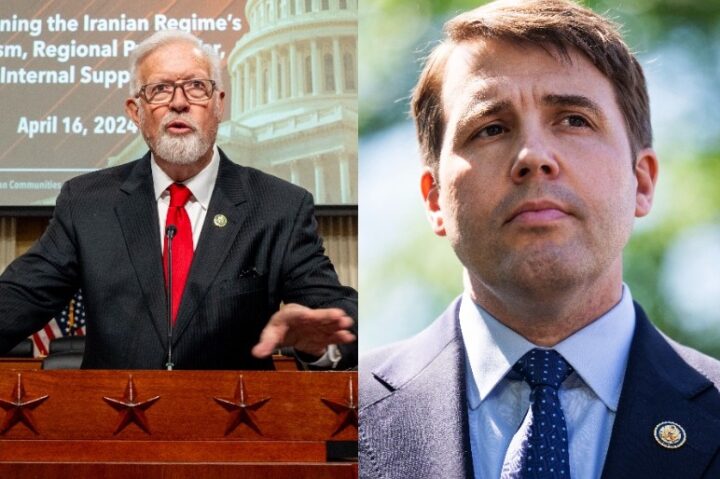
Reps. Randy Weber (R-TX) and Chris Pappas (D-NH)
A new bipartisan House bill set to be introduced on Wednesday aims to expand U.S.-Israeli research and development cooperative programs in the medical field.
The BIRD Health Act, led by Reps. Randy Weber (R-TX) and Chris Pappas (D-NH), builds on the long-running Binational Industrial Research and Development Foundation program.
Around a third of BIRD projects in the past decade have been related to the health-care sector, and the U.S. and Israel have pursued growing cooperation in the field in recent years. The bill would further formalize those efforts by establishing a new $10 million annual funding stream and joint management structure between the Department of Health and Human Services and the Israeli Ministry of Health specifically focused on supporting such projects.
It would support research and development between institutions and companies in both countries, including startups, as well as health systems, telemedicine, disease prevention efforts and biological product manufacturing.
“The United States and Israel share one of the strongest, most enduring alliances in the world, and it just makes sense to join forces in advancing life-saving health technologies that benefit both our nations,” Weber said in a statement. “The BIRD Health Act of 2025 builds on our shared strengths to support cutting-edge medical innovation, strengthen supply chains, and improve health outcomes for American families.”
“U.S. and Israeli doctors, scientists, and researchers are leading the world in groundbreaking medical advancements, including regenerative medicine, disease prevention, and cancer research,” Pappas said in a statement. “The health technology and innovation program created through this bipartisan legislation will strengthen the bilateral partnership between the U.S. and Israel to address emerging health issues, develop innovative solutions, and save lives.”
The bill takes a new tack at a previously attempted move by first designating Muslim Brotherhood branches individually

Salah Malkawi/Getty Images
Jordanian police close the entrance of a Muslim Brotherhood headquarter after the announcement of banning the society in the country on April 23, 2025 in Amman, Jordan.
A bipartisan House bill set to be introduced on Tuesday aims to designate the Muslim Brotherhood as a terrorist organization, a step forward for an effort that saw renewed interest following the terrorist attack in Boulder, Colo., targeting Jews advocating for the release of hostages in Gaza by a man who appeared to have expressed support for the group years earlier.
Similar efforts have been pursued at multiple points in the past, but the latest legislation has been updated significantly and focuses on the various branches of the Muslim Brotherhood responsible for terrorism.
The bill, led by Reps. Mario Díaz-Balart (R-FL) and Jared Moskowitz (D-FL), notes that Hamas is a Muslim Brotherhood affiliate that has long been designated as a Foreign Terrorist Organization by the U.S. and that receives material support from the Muslim Brotherhood. It also highlights the destabilization efforts by other Muslim Brotherhood branches in various Arab partner countries of the U.S.
The bill is co-sponsored by Reps. Randy Fine (R-FL), Chuck Fleischmann (R-TN), John Rutherford (R-FL), Andy Barr (R-KY) and Mike Bost (R-IL).
“Today, I once again introduced legislation to designate the Muslim Brotherhood as a foreign terrorist organization,” Díaz-Balart said in a statement. “The global Muslim Brotherhood has numerous regional branches, including terrorist organizations such as Hamas, and spreads violence and instability throughout the Middle East. For this reason, it is crucial to U.S. national security interests that we prohibit U.S. dollars from enabling the Muslim Brotherhood’s dangerous activities, and that we ensure Muslim Brotherhood members are blocked from entering the United States.”
“This important legislation gives the Trump Administration the additional authority it needs to protect Americans, and our closest allies, from this insidious threat,” he continued.
Moskowitz said in a statement, “The Muslim Brotherhood has a documented history of promoting terrorism against the United States, our allies, and our society.”
“Countries such as Bahrain, Egypt, Austria, Jordan, Saudi Arabia, UAE, and France have already taken important steps to investigate and crack down on the Muslim Brotherhood and its affiliates. The U.S. government has to have the authority to crack down on the serious threats posed by this group as well,” Moskowitz continued. “That’s why I’m joining Rep. Diaz-Balart and Sen. Cruz to introduce the Muslim Brotherhood Terrorist Designation Act. This bill builds on my call for an investigation into designating the Muslim Brotherhood a Foreign Terrorist Organization, and it ensures we are taking crucial steps to protect our national security.”
Sen. Ted Cruz (R-TX) introduced companion legislation in the Senate on Monday.
The legislation instructs the secretary of state to identify all branches of the Muslim Brotherhood operating globally and provide a determination of whether each of those branches meets the requirements for designation as a foreign terrorist organization.
The legislation would use those determinations to designate the global Muslim Brotherhood organization as a terrorist group, in light of its support for those branches.
The bill also pursues three methods of designating the group as a foreign terrorist organization: by revising the Anti-Terrorism Act, which was initially targeted at the Palestine Liberation Organization, to include the Muslim Brotherhood, by seeking State Department designation as a Foreign Terrorist Organization and seeking Treasury Department designation as a Specially Designated Global Terrorist group.
The three designations grant the federal government various sanctions authorities and bar Americans from supporting the groups. The bill would also make Muslim Brotherhood members ineligible for entry into the United States and could impose financial sanctions on them.
Previous efforts to designate the group focused on the entire Muslim Brotherhood, rather than starting by targeting specific branches, and only pursued FTO designation.
A fact sheet by the legislation’s sponsors states that the previous “top-down … strategy failed because not all MB branches are currently violent and would therefore meet the criteria for designation.” It described this new approach as “bottom-up,” and similar to the approach the Trump administration took to designate the Islamic Revolutionary Guard Corps as a terrorist group — citing its support for the Quds Force, which was designated as a terrorist group.
Fine has separately introduced legislation to designate the Council on American Islamic Relations as a terrorist group.
Rep. Lawler: ‘I am committed to strengthening our relationships with regional partners and putting our ally Israel in the best position possible to do the same’

Kevin Carter/Getty Images
The U.S. Capitol Building is seen at sunset on May 31, 2025 in Washington, DC.
Rep. Mike Lawler (R-NY) introduced bipartisan legislation on Thursday that would expedite arms sales to U.S. partners that normalize relations with Israel and work with the U.S. in its efforts to counter Iran and its terrorist proxies.
The Abraham Accords Defense Against Terror Act would “narrow the timeline for congressional consideration after arms sales are accepted, while maintaining existing eligibility criteria for arms sales themselves,” according to a press release on the bill. The legislation would provide “the same preferential treatment that our NATO allies receive” to eligible countries.
Reps. Jared Moskowitz (D-FL), Ryan Zinke (R-MT), Don Davis (D-NC), Bryan Steil (R-WI), Don Bacon (R-NE), Michael Baumgartner (R-WA), Buddy Carter (R-GA), Jeff Crank (R-CO), Chuck Edwards (R-NC), Brian Fitzpatrick (R-PA), Brad Finstad (R-MN), Chuck Fleischmann (R-TN), Andrew Garbarino (R-NY), Josh Gottheimer (D-NJ), Abe Hamadeh (R-AZ), Dave Kustoff (R-TN), Anna Paulina Luna (R-FL), Michael McCaul (R-TX), Mark Messmer (R-IN), Zach Nunn (R-IA), John Rose (R-TN), Maria Salazar (R-FL), Pete Stauber (R-MN), Elise Stefanik (R-NY) and Joe Wilson (R-SC) signed on to the bill as co-sponsors.
“This legislation will … [provide] greater benefits to our Abraham Accords and counterterrorism partners. It represents a key step toward implementation of the Abraham Accords and turning shared diplomatic commitments into real-world cooperation. Lastly, it sends a strong message to adversaries: the United States and its allies will not allow Iran’s proxies to destabilize the region unchecked,” Lawler, who chairs the House Foreign Affairs subcommittee on the Middle East and North Africa, said in a statement.
He continued, “I am committed to strengthening our relationships with regional partners and putting our ally Israel in the best position possible to do the same. There is no question that fostering deeper security relationships is key here.”
“The Abraham Accords have been a historic model for peace between Israel and its neighbors, and we should be doing everything we can to expand it and bring more states into the fold,” Moskowitz said.
“This common-sense bill builds on the progress of the Abraham Accords to incentivize others to normalize relations with Israel and cooperate against the threat of Iran and Iranian proxies, safeguarding our ally Israel’s very right to exist in the process,” he added.
Efforts to expedite arms sales to U.S. partners has been a long-term priority for lawmakers and administrations on a bipartisan basis, and the House currently has a dedicated task force on overhauling the military sales process.
“There are too many bureaucratic barriers that prevent us from assisting our closest allies in global security,” Zinke, who chairs that task force, said in a statement. “This bill strengthens the ties forged by the Abraham Accords by ensuring our partners have expedited access to the tools they need to stand against Iran and its terrorist proxies. Israel is one of our closest and most vital allies, and peace through strength is the only way to secure the region and protect American interests.”
Please log in if you already have a subscription, or subscribe to access the latest updates.
 Continue with Google
 Continue with Apple