











































In an address in Washington, the opposition leader sketched a coalition with Bennett and Eisenkot that would mend U.S. and European ties, harden Israel's line on Iran and shift tone on Gaza
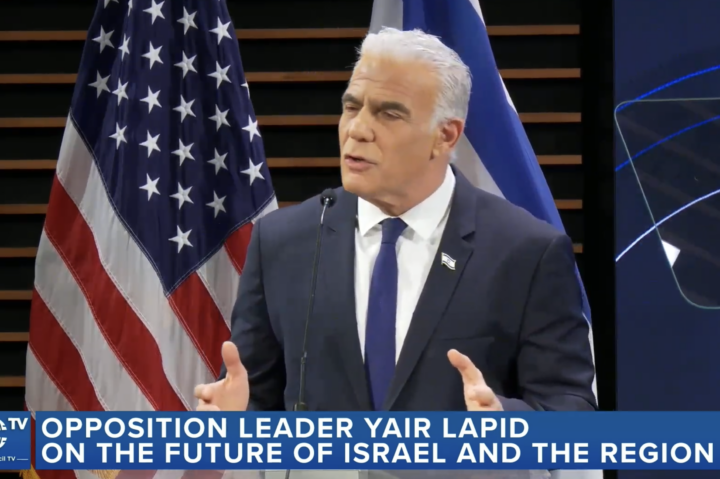
Screenshot
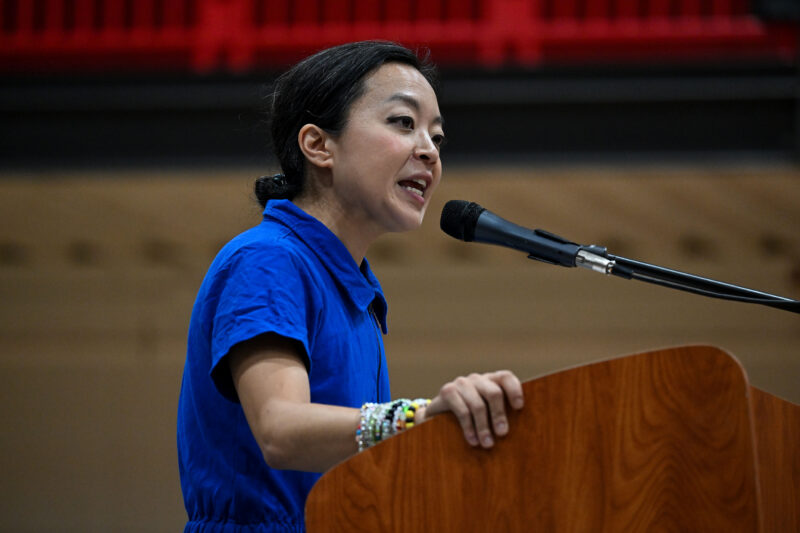
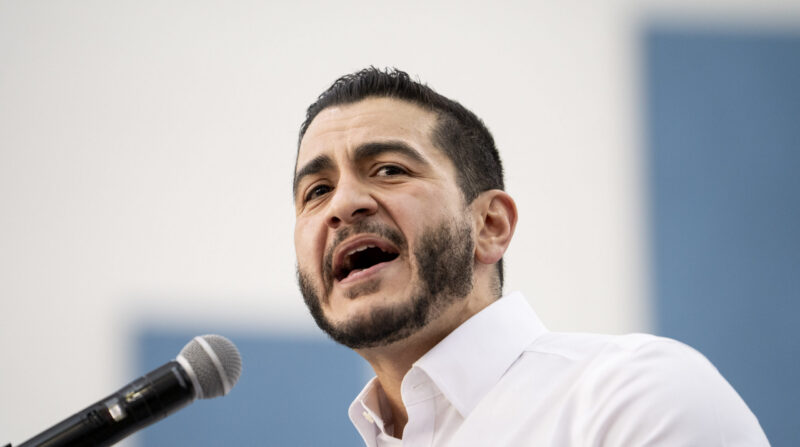
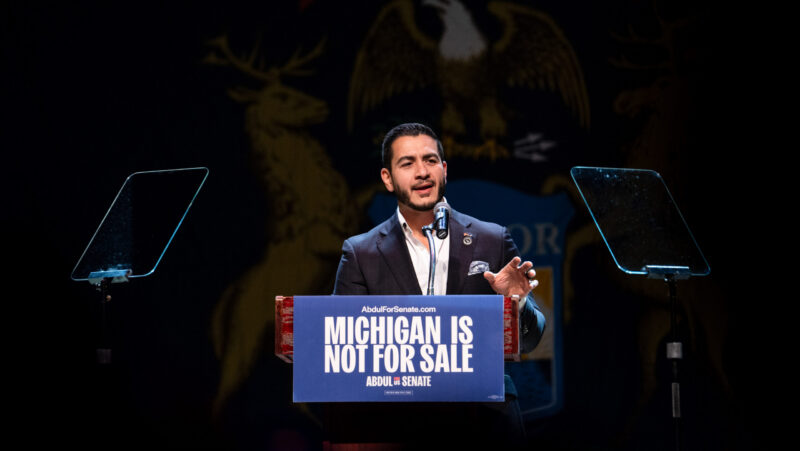
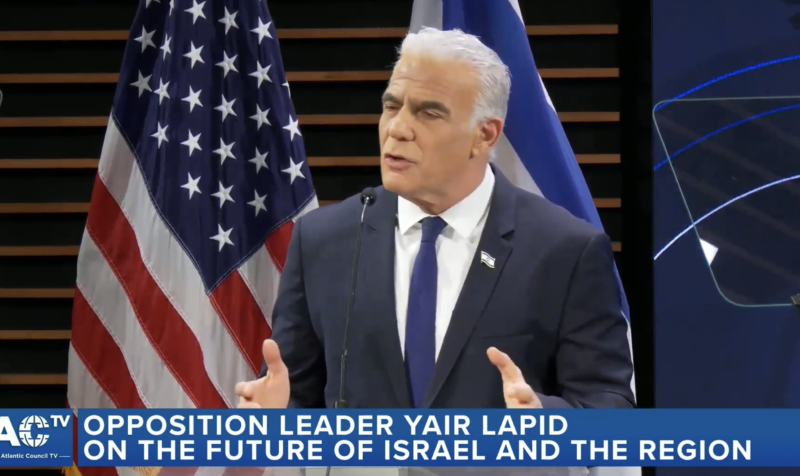
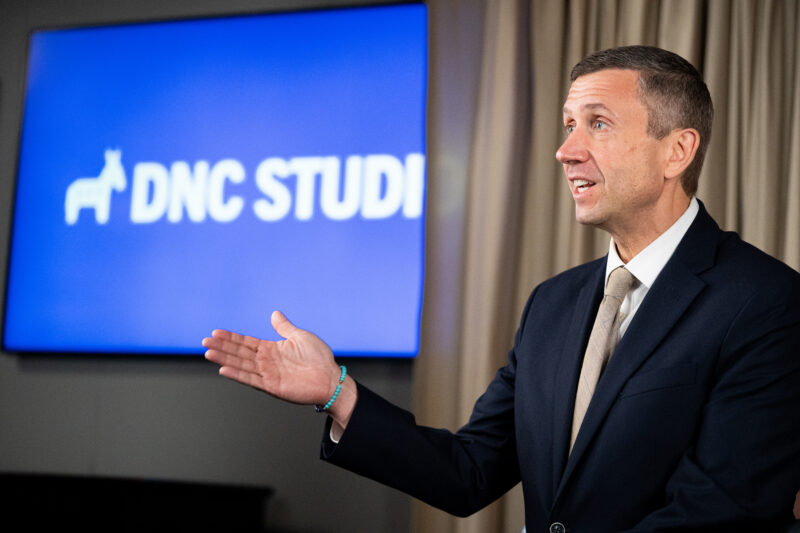
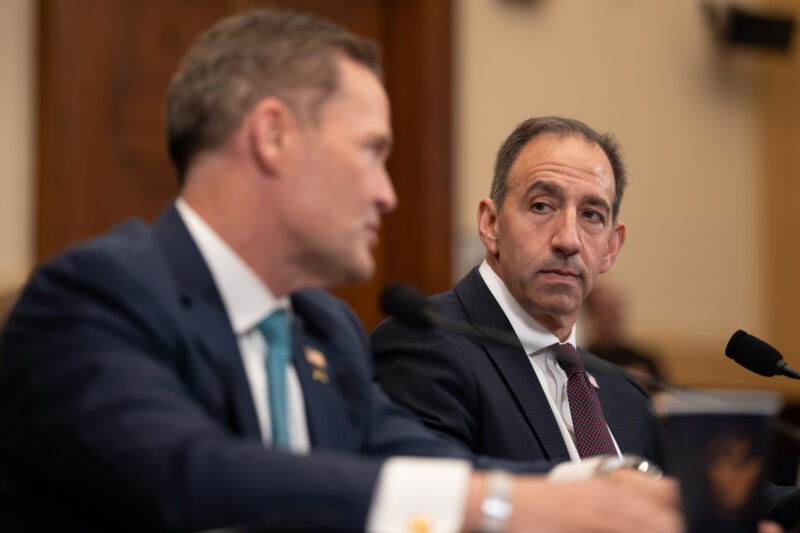
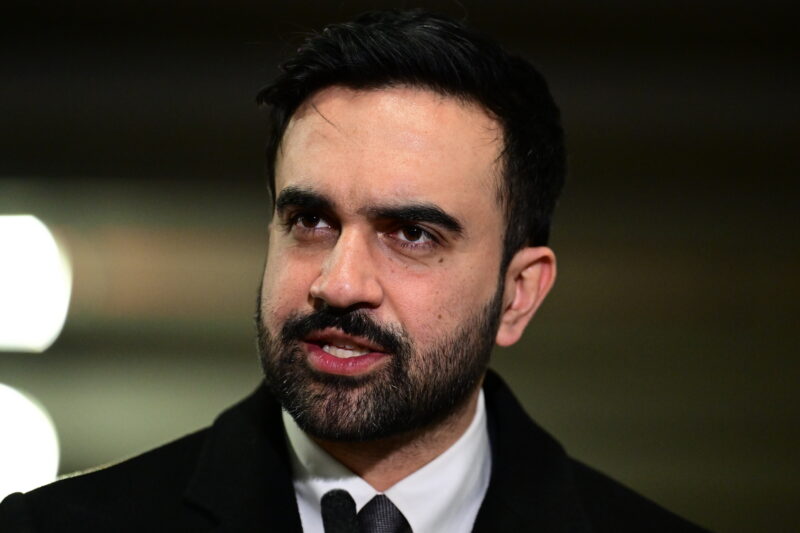
Israeli Opposition Leader Yair Lapid speaks at the Atlantic Council in Washington, July 27, 2026


 Add JewishInsider on Google
Addressing one of the leading foreign policy think tanks in the United States, former Israeli Prime Minister Yair Lapid presented his case on Monday for Israel’s diplomatic future should his opposition bloc form the country’s next government after the upcoming elections.
Speaking at the Atlantic Council in Washington, Lapid argued that Israel is increasingly isolated diplomatically and feuding with its allies — which he blamed primarily on Prime Minister Benjamin Netanyahu and his coalition — and he recommended that Jerusalem adopt a more measured and bipartisan approach going forward.
Lapid is visiting Washington this week, concurrent with Netanyahu; both of them are set to attend the funeral of Sen. Lindsey Graham (R-SC) on Tuesday.
Lapid said that a new government, primarily made up of current opposition members, would remove officials who advocate for nuking Gaza or who mock detained activists. He said the government should also apologize for the accidental deaths of children in war and express greater empathy more generally, as well as deploy police and soldiers to address what he characterized as Jewish terrorism in the West Bank.
He also said that Israel can’t act on the world stage with the same impunity that the United States can, that it needs to listen to its friends around the world instead of writing them off, should never fund digital influence operations against American leaders, should stay out of American partisan politics and must rebuild its relationships with Europe.
“Iran is an enemy. Hezbollah is an enemy. Hamas is an enemy,” Lapid said. “France is not the enemy. Sweden is not the enemy. [Sens.] Elizabeth Warren [D-MA], Jon Ossoff [D-GA] and Tim Kaine [D-VA] are not the enemy. The Democratic Party is not the enemy. [Vice President] JD Vance is not the enemy.”
He said that the next Israeli government should communicate to the U.S. and the world that “this was a crazy period, but it is over” and, going forward, “stay out of American politics,” as well as “firmly encourage” both AIPAC and J Street to move away from partisanship.
“To be pro-Israel is to be bipartisan to build a broad coalition of support. Do not boycott people who dislike us. Insist on meeting them and presenting our case,” Lapid said.
Military capabilities and tactics, he continued, cannot stand apart from Israel’s place in the world, its relationship with the United States and its economic situation. Military strikes must come with “a moral, legal and strategic framework that Israel can defend with confidence,” with the ultimate goal of peace, rather than perpetual conflict, he continued.
Lapid asserted that the U.S.-Israel relationship had been damaged primarily by Netanyahu, describing his government as responsible for nearly all of the issues in the relationship. He suggested that the relationship would turn around with the opening provided by a new government.
He claimed that Israelis will vote accordingly in the upcoming elections, realizing that Netanyahu is damaging Israel’s international relations.
Lapid did not substantively address how the unity party led by himself and former Prime Minister Naftali Bennett would approach an increasingly likely situation in which Gadi Eisenkot leads the largest opposition party after the election. Instead, he suggested Eisenkot would be the defense minister in a coalition government with Bennett as prime minister and Lapid as foreign minister.
Bennett and Lapid announced in April that they had decided to merge their parties and run as a joint party called “Together,” led by Bennett.
Though Lapid’s previous governing coalition included the Arab party Ra’am, he predicted that his bloc would not need the support of Arab parties to form a government after the next election and claimed that MK Mansour Abbas, who leads Ra’am, “seems to understand this better than some of my Jewish friends, the fact that maybe it’s time for a coalition that will be made only of Zionist parties.”
But he said that such a government would address the needs of Arab citizens and address “Jewish racism against peaceful Arab citizens of Israel.”
Lapid said Israel should pursue direct negotiations with as many regional states as possible, including Lebanon, Syria and Saudi Arabia and leverage various regional forums to pursue greater ties and to isolate Iran.
He also said that Israel should work with the Palestinian Authority, arguing that doing so doesn’t necessitate recognizing a Palestinian state or ignoring issues inside the PA.
“It was almost ridiculous to me the fact that the current government was … incapable to admit the fact that they’re doing business with the Palestinian Authority — as they do in the West Bank and as they do in Gaza now,” Lapid said.
He said Israel will, over time, need to work to make Gaza livable, and that the Israeli government’s failure to show empathy over the situation in Gaza had “destroyed our international stature in huge groups” as well as stymied necessary and honest conversations in Israel about the costs of the war. But he rejected the idea that the war in Gaza had been a genocide.
Lapid took a hard line toward the Haredim, saying that they should not receive financial support if they do not serve in the military, that their schools should not receive government support if they do not provide a basic education and that they should not receive public assistance if they do not work.
“When you live in a democracy, you don’t only have rights; you also have duties, and these have to do with each other,” Lapid said.
Lapid also sought to position himself in a more hawkish stance on Iran than the current government, arguing that Israel should have, as early as 2024, bombed Iranian energy facilities, including Kharg Island. He said he still supports such a course of action.
He acknowledged that such an approach would carry political and economic pain for the United States ahead of the midterms, but said that it would be the “right thing to do in the long term” and would lead the Iranian regime to collapse.
Though he praised Saudi Crown Prince Mohammed bin Salman and expressed hope for expanding the Abraham Accords, Lapid raised serious concerns over the Trump administration’s recent deal with Saudi Arabia that would allow nuclear enrichment on Saudi soil — an effort that Trump, after signing the deal, conditioned on the Gulf state joining the Abraham Accords.
Lapid said he’d clashed with Graham, who worked for years to secure normalization between Israel and Saudi Arabia, over the subject, calling it “unacceptable” and “a huge mistake.”
A Saudi enrichment program, Lapid warned, would prompt a nuclear proliferation race throughout the Middle East and beyond. And he said any Saudi-U.S. deal should include Israel as well.
Lapid, once one of the Israeli leaders more amenable to the idea of a two-state solution, said that the Hamas-led Oct. 7, 2023, attacks on Israel and the support for them in the West Bank had changed his view of the situation. He said that any Palestinian state under the current circumstances would immediately become a launching pad for Hamas.
“Politics or policies are not a zero-sum game. There are so many things we can do in order to improve the lives of everybody, of Palestinians, of Israelis, of the security of everybody,” Lapid continued.
Lapid said that the pilot effort to turn over territory in Lebanon to the Lebanese Armed Forces to disarm Hezbollah is a strong idea in concept, but requires that Hezbollah actually be disarmed. He said Israel should continue to fight Hezbollah as necessary but also pursue diplomatic efforts with the Lebanese government.
He declined to back a full Israeli withdrawal from southern Lebanon, saying that Israel should not withdraw from areas where it knows Hezbollah would immediately return to because the terrorist group had been preparing to carry out an Oct. 7-style attack on northern Israel.
He also said he was disappointed that Syrian President Ahmad al-Sharaa had begun discussing reclaiming the Golan Heights from Israel, explaining that he’d initially seen the new Syrian government as “an opportunity to solve a problem that looked unsolvable for a long time.”
Hagar Hajjar Chemali, who is half Jewish and half Christian, thinks she has a shot at helping break through the deep sectarianism that has led to distrust both within Lebanon and towards Israel

Courtesy
Hagar Hajjar Chemali
Hagar Hajjar Chemali is an American by accident — quite literally — of birth.
Her parents left their native Lebanon in 1981 as a civil war raged in the country. Chemali’s father, Hadi, had been kidnapped by a political group, and the young couple quickly left the country once he was released, with plans to move to Milan. While visiting friends in Greenwich, Conn., Chemali’s mother, Mirella, began experiencing pregnancy complications and chose to wait out the final months of her pregnancy there. Soon after, Chemali was born, followed quickly by a son. The family never left.
So began Chemali’s American story, the result of a potent combination of determination and coincidence. That’s the story of Chemali’s professional journey, too: a mix of persistence and being in the right place at the right time. She spent the first decade of her career helping steer U.S. foreign policy on the Middle East in the Bush and Obama administrations, ultimately becoming the spokesperson for former U.S. Ambassador to the United Nations Samantha Power. She spent the next decade as a consultant and communications expert, appearing regularly on cable news and a YouTube channel where she produces an occasionally satirical show explaining American foreign policy.
Now Chemali, 44, faces her biggest and most personal assignment yet: creating an unofficial backchannel to boost the ongoing peace talks between Lebanon and Israel, the first time that officials from the two countries have sat for direct talks since 1983. And Chemali, who is half Jewish and half Christian, thinks she has a shot at helping break through the deep sectarianism that has led to distrust both within Lebanon and towards Israel.
The deal between the U.S. and Iran that was announced on Sunday may complicate Chemali’s efforts. Iran’s attempt to link its own negotiations with the U.S. to developments in Lebanon could potentially complicate efforts to advance Israeli-Lebanese peace, and Iranian state media said on Sunday that Lebanon would be part of the new deal. Details remain scarce.
“It’s about the art of the possible. Lebanese-Israeli peace is not particularly easy to achieve,” said Daniel Glaser, a former assistant Treasury secretary for terrorist financing and financial crimes. He hired Chemali for her first job at the Treasury Department. “What’s going to get it done is the ability to understand what’s possible, and how to get to that possible within the U.S. system, within Israel and the Israeli system, within Lebanon and the infinitely complicated Lebanese system. There’s not a lot of people that have the ability to do that more than Hagar.”
In April, she announced the creation of an organization called LIPA, the Lebanon-Israel Peace Alliance. It’s a vessel for advocacy by Chemali and a cadre of Israeli, Lebanese and American foreign policy experts she colloquially describes as the “peace crew” — many do not yet want to publicize their involvement with the effort — who are working to keep the pressure on the U.S. government to help broker a deal between Lebanon and Israel.
The group has been collaborating since early last year, soon after Israel and Lebanon reached a ceasefire in late 2024 that ended the fighting between Israel and Hezbollah that began when the Iranian-backed group launched missiles at Israel on Oct. 8, 2023. The effort gained traction amid a broader shift in Lebanon: Hezbollah was weakened by the death of its longtime leader, Secretary-General Hassan Nasrallah, and newly elected Lebanese President Joseph Aoun moved to reassert state authority over Hezbollah’s power and influence.
“She was one of the very first people that said to me that I should go for peace,” said Morgan Ortagus, who served as deputy Middle East special envoy at the beginning of the Trump administration. Ortagus and Chemali have been friends since they worked in the Treasury Department together nearly 20 years ago. “I said, ‘Really, do you think they’re ready?’ And she was emphatic that she thought that it was the time to go for peace.”
The work of Chemali’s burgeoning “peace crew” solidified in March, at a dinner soon after the Iran war started. The geopolitical time crunch of a fast-moving war spurred the group to come up with a name to formalize the informal diplomacy they had been pursuing for more than a year.
“All this work actually helped bring the Israelis and the Lebanese governments to hold direct talks in Washington,” said Hanin Ghaddar, a senior fellow studying Lebanon at The Washington Institute for Near East Policy. “I don’t think this would have been possible without the whole year of work on the narrative and the policy and the recommendations and the shift on the ground, that this is where Lebanon and Israel finally decided, ‘Let’s do this.’”
After the U.S. and Iran agreed to a ceasefire in early April, Israeli Prime Minister Benjamin Netanyahu announced that Israel would open direct negotiations with Lebanon. It was the moment for which Chemali had yearned for over 18 months — or, perhaps, a whole lifetime. In the aftermath of the first round of talks, LIPA was launched in the way so many projects are: via a somewhat haphazard post on X. Chemali did not want to lose her chance at creating momentum for a window for peace that might soon close. She has not returned to Lebanon in 15 years due to security risks.
“As a comms person, I would never advise a rollout this way. This is like the opposite of what you do before a rollout. You have all your ducks in a row when you roll anything out,” Chemali told Jewish Insider in a recent interview at a Washington cafe. “We wanted to come out there and be like, we have an organization that exists that is there to support this process.”
For Chemali, the effort is a culmination of her own professional arc, as well as the choices her parents made in building a life here. Her family might be Lebanese, but this effort is all-American — something she can do because of where she was born and the circumstances that allowed her to rise to a public, senior government role without having to worry about the strict sectarian divisions that govern Lebanese society and the country’s government.
But there was a piece of Chemali’s story that was missing, something that now makes her uniquely positioned to serve as a convener of Lebanese and Israelis here in the U.S.
“She’s half-Jewish and half-Christian,” said Hussain Abdul-Hussain, a Lebanese-Iraqi researcher at the Foundation for Defense of Democracies. “She has the highest pedigree for someone to be working on this issue.”
Chemali did not know about her Jewish roots when she was growing up. Her father is a Maronite Christian, a Catholic sect with deep roots in the Levant. The family attended a nondenominational church in Connecticut. When Chemali was 11 or 12, her mother revealed a secret she had kept since her children were born: She was Jewish.
“I think she just couldn’t take it anymore. She was just like, ‘Actually, I’m Jewish,’” Chemali recalled. “My brother and me, being raised in the United States, we were like, ‘That is so cool. Does that mean we get Hanukkah gifts?’”
Her mother, Mirella, grew up in Wadi Abu Jamil, Beirut’s Jewish neighborhood. She attended a Catholic school at the urging of the family of her late father. The nuns at her school would tell Mirella that “she had evil in her blood because she was Jewish,” according to Chemali. “So [her family] practiced Judaism in secret at home.”
The revelation from her mother intrigued Chemali. Why didn’t she tell them sooner? Mostly Chemali ignored it, until she came to Washington during the George W. Bush administration. She joined the Treasury Department in 2006, in the newly created Office of Terrorist Financing and Financial Crimes, where many of her colleagues were Jewish. They started inviting her to Shabbat dinners and Jewish holidays. Chemali learned more about Judaism, and began to feel proud of that part of her identity. When she moved back to Greenwich, she asked her mom to teach her more about her family’s traditions.
“I told my mom, ‘These traditions die with you. You didn’t raise me with these traditions. I only know what I know from books and from going with friends to their houses for events,’” Chemali said. So her mom bought a menorah, and they lit candles together for Hanukkah.
“She starts singing in Hebrew, and I was like, ‘Who is this woman who sings in Hebrew?’ As far as I knew, she speaks a lot of languages — actually, she speaks five languages — but Hebrew was not one of them,” said Chemali.
Chemali has not abandoned the Christian faith she was raised with, even as she grapples with her identity.
“What I tell people of where I am at the moment, but it is always an evolution, is that I am of Christian faith and feel very much a Jew,” said Chemali. “I always tell people I’m a member of every tribe.”
Lebanon is so beset by tribal division that different government positions are reserved for people from different religious sects: the president is required to be a Maronite Christian, the prime minister is a Sunni Muslim and the speaker of parliament is a Shia Muslim. Chemali has refused to diminish any part of her identity, even as her home country all but demands she pick a side.
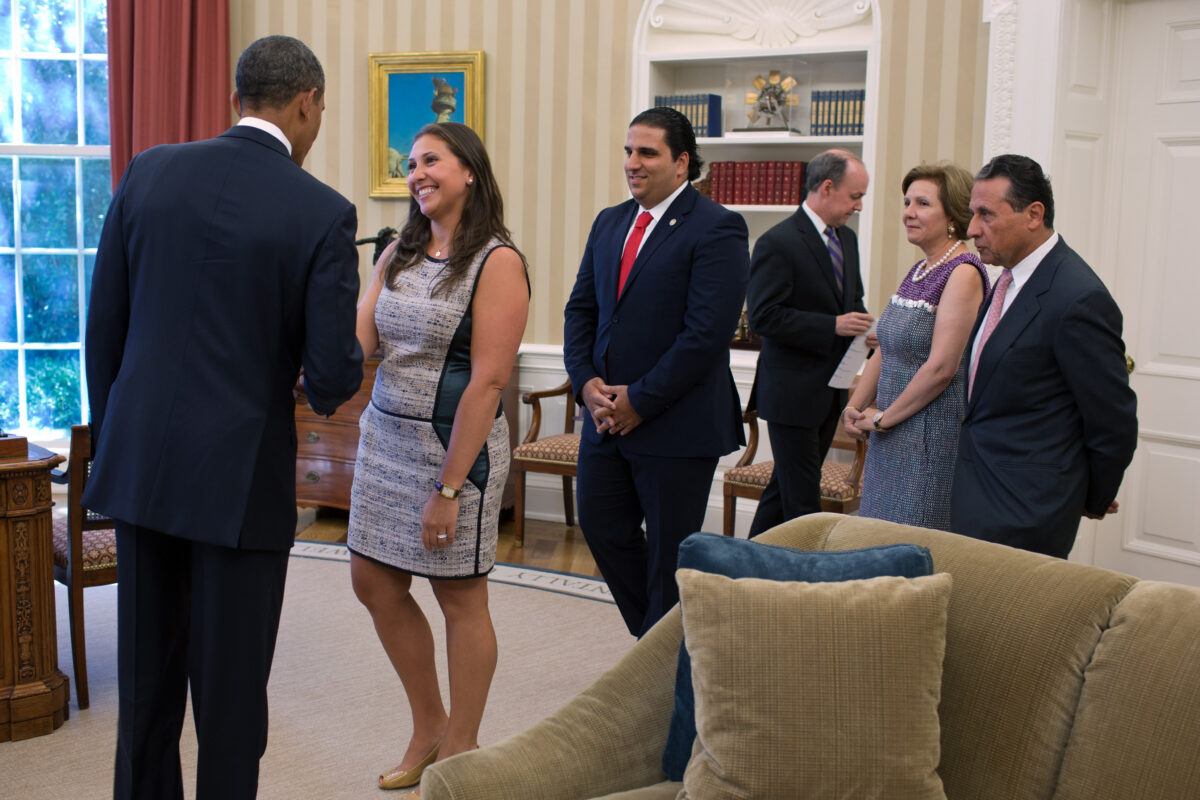
“She’s someone who can actually speak to everyone. She’s not there to take sides,” said Ghaddar. “She really sees the whole picture, and I think that’s what this kind of initiative really needs. It’s someone who has a stake in everyone and everything.”
Chemali retains the idealism that so many lose after decades in Washington. She described herself as a “Lebanese Zionist,” a position she said she has stuck by even amid the polarization that crept into her family after Oct. 7.
“This is the thing that sets me apart from the rest of my family. There’s a chunk of my family that unfriended me on social media after Oct. 7 because of my statements — and by the way, my statements are not like, ‘Yeah, go into Gaza and get ‘em.’ That’s not what I’m saying. My statements were more posting about the hostages,” said Chemali. “There’s one chunk of my family from Syria on my dad’s side that, straight up, they will lecture me at any opportunity they have. I view them as brainwashed, to be perfectly honest, and they probably view me as brainwashed.”
Chemali recalled a trip to Lebanon during her time as the National Security Council’s director for Lebanon and Syria in the Obama administration. A Lebanese friend advised her not to share that she’s Jewish.
“I was like, ‘Look, that’s not how I operate,’” said Chemali. “First, I really make sure religion doesn’t come up in my government work, because I don’t want anyone ever accusing me of seeing something through a religious lens. But secondly, if it comes up, I don’t hide. That’s not how I roll, ever.”
Still, she understands that not everyone can be as visible as she is. Chemali gave up her Lebanese citizenship before entering the U.S. government, but ordinary Lebanese people face steep prison sentences simply for talking to Israelis because of the country’s anti-normalization laws. Free from these restrictions, Chemali has recently taken to setting up discreet dinners between Lebanese and Israelis in Washington.
“We are trying to come up with creative ways to work around these laws,” she said. “We have to pick locations where nobody will see them or recognize them, so it makes it much more difficult.”
One of LIPA’s priorities is urging the U.S. to pressure Lebanon to repeal those laws. Chemali holds meetings with members of Congress on both the left and right. She talks to contacts at the State and Treasury Departments regularly, advocating for new sanctions on Hezbollah. She’s a fixture in Foggy Bottom and at wonky Middle East conferences, on cable news and in cafes, all from her home base in Connecticut.
“The ideal is a warm peace where you have thriving business relations, and that’s how our efforts are geared, toward that vision,” said Chemali. “That will hopefully undermine Hezbollah’s presence.”
After a new round of talks early this month, the governments of Lebanon, Israel and the U.S. released a joint statement in which Lebanon’s army agreed to create “pilot zones” where it will exert control and ban Hezbollah, the Iran-backed militia that uses southern Lebanon as a base to attack Israel. The diplomats will meet again later this month, and military representatives from each country will hold their own parallel track. The talks are testing the Lebanese government’s appetite for taking a stand against the militia. Meanwhile, Israel and Hezbollah continue to trade blows even as the talks proceed.
That negotiations are happening at all reflects unprecedented discontent within Lebanon toward Hezbollah. Until now, Lebanon’s leaders have been unable or unwilling to exert the strength needed to push back on Hezbollah’s grip over the country’s politics. Earlier this month, Aoun, the country’s president, took the unusual step of criticizing Iran, Hezbollah’s primary backer: “It’s not your country, it’s our country,” he told CNN.
Former U.S. Ambassador to Israel Dan Shapiro called the peace talks a “tremendous opportunity” for both countries.
“Maybe more for Lebanon than for Israel, because it really would mean breaking free from the handcuffs of Hezbollah and Iran,” said Shapiro. He hired Chemali for her job at the Obama White House and said he is encouraged by her efforts with LIPA.
“Having a strong advocacy body in the United States perhaps buttressed by those in Europe and elsewhere in the region is important fuel to that process,” said Shapiro. “She’s got just endless energy and creativity and a real commitment.”
The biggest challenge is that Lebanon’s leadership does not control Hezbollah. Peace between Israel and Lebanon would still be momentous even without dealing with Hezbollah, but it would leave the most intractable issue unresolved.
“It’s not the elephant in the room, because they all talk about it. But the crux of this is Hezbollah and Hezbollah’s weapons, and it’s not just the disarmament of them, it’s ensuring that they’re never able to rearm again,” said Chemali.
Washington is easily distracted; Trump is no exception. For Chemali, who is not directly involved in the talks, perhaps the most urgent task is to make sure the people in the room do not move on. She needs to remind them that the Lebanon-Israel file remains important, and worth pursuing — and that it should not be subsumed up by negotiations between the U.S. and Iran.
“We keep our fingers crossed, we advocate, we speak up, publish op-eds, you name it. Go on interviews, whatever it takes, just to make sure that things keep on going in the peace direction,” said FDD’s Abdul-Hussain, who is friends with Chemali but is not formally collaborating with her. “People like us, who are not governments, who are just regular people, we have a bigger margin. We have a lot of freedom to move. We have a lot of freedom to explain things, or to oppose things.”
But even in the perpetually explosive Middle East, where the talks could easily fall apart, Chemali believes something fundamental has changed.
“No matter what happens with the talks, there’s a reason I have hope,” she said. “Because you see this taboo in Lebanon has broken.”
Plus, bipartisan push for Jewish American Security Act

Jeffrey Dean/Bloomberg via Getty Images
Representative Thomas Massie, a Republican from Kentucky, speaks during a campaign event ahead of a primary election at Veterans Memorial Park in Vanceburg, Kentucky, US, on Monday, May 18, 2026.
Good Wednesday morning.
In today’s Daily Kickoff, we break down the results of yesterday’s critical primaries, including Rep. Thomas Massie’s loss in Kentucky and Chris Rabb’s win in PA-03, and report on the introduction by Sens. Jacky Rosen and James Lankford of the Jewish American Security Act. We look at how Democratic officials speaking at the Center for American Progress’ convening on Tuesday sidestepped discussions about Israel even as it held multiple sessions on the Middle East, and cover a new report from Israel’s Institute for National Security Studies warning about the effects of the erosion of American Jewish support for Israel on the relationship between Washington and Jerusalem. Also in today’s Daily Kickoff: Mahmoud Ahmadinejad, Nick Valensi and Israeli Foreign Minister Gideon Sa’ar.
Today’s Daily Kickoff was curated by JI Executive Editor Melissa Weiss and Israel Editor Tamara Zieve, with assists from Danielle Cohen-Kanik and Marc Rod. Have a tip? Email us here.
What We’re Watching
- The House of Representatives is expected to vote today on the Iran war powers resolution sponsored by Rep. Greg Meeks (D-NY), the ranking Democrat on the House Foreign Affairs Committee. The vote comes a day after Sen. Bill Cassidy (R-LA), who last week fell short in his reelection bid after President Donald Trump endorsed an opponent, flipped his vote to advance a similar Democratic-led measure in the Senate. More below.
- The House Education Committee’s subcommittee on Health, Employment, Labor, and Pensions is holding a hearing this morning on antisemitism in the healthcare field, with the Louis D. Brandeis Center for Human Rights Under Law’s Deena Margolies, Dr. Jacob Agronin, Bend the Arc CEO Jamie Beran and American Jewish Medical Association CEO Eveline Shekhman set to testify. Read more here.
- Former Rep. Tom Malinowski (D-NJ) is among those slated to speak at a hearing being convened this morning by the House Foreign Affairs Committee on the State Department’s budget request for its adjacent entities.
- The House Judiciary Committee is holding a hearing on the Southern Poverty Law Center in a session titled “The Southern Poverty Law Center: Manufacturing Hate.”
- Elsewhere in Washington this morning, the Jewish Federations of North America, Conference of Presidents of Major American Jewish Organizations, Combat Antisemitism Movement and the Weitzman National Museum of American Jewish History are hosting a congressional breakfast to celebrate Jewish American Heritage Month. Sam Salz, who in 2022 became one of the only Orthodox Jews to play Division I college football when he walked on to Texas A&M’s team, will give the breakfast’s keynote address.
- Down Pennsylvania Ave., the Hudson Institute is holding an event with Sarah Rogers, the under secretary of state for public diplomacy, on modernizing public diplomacy to address global challenges. Sen. Eric Schmitt (R-MO) is slated to give introductory remarks at the event.
- The Federalist Society is hosting its inaugural Legislative Branch Summit today in Washington.
- In Israel, the Knesset unanimously advanced a bill to dissolve the body, which if passed would automatically trigger elections, which are slated to take place no later than October 27. The bill will still need to go through several more readings and votes before it is passed.
What You Should Know
A QUICK WORD WITH JI’S JOSH KRAUSHAAR
Pro-Israel and Republican Jewish groups helped oust one of their leading GOP antagonists on Tuesday night, aligning with President Donald Trump to defeat Rep.Thomas Massie (R-KY) in the most expensive House primary in recent memory.
Ed Gallrein, a military veteran and farmer recruited by the Trump White House to challenge Massie, decisively defeated the congressman by 10 points, 55-45%. Massie, a libertarian lawmaker who long cast lonely Republican votes against Israel funding and resolutions condemning antisemitism, increasingly trafficked in bigoted rhetoric in the closing weeks of the campaign.
In his concession speech, Massie continued his antisemitic vitriol against his opponent, telling the crowd: “I had to call my opponent and concede, and it took a while to find Ed Gallrein in Tel Aviv.” Even though Trump’s outspoken opposition was the leading factor behind his demise, he routinely blamed Jewish and pro-Israel donors like Miriam Adelson for costing him his seat and insinuated that Israel was buying seats in Congress.
Massie first drew the ire of Trump for voting against his “big beautiful” reconciliation bill last year, and the anger was exacerbated by his work with Democrats to force the Department of Justice to release all of the files involving Jeffrey Epstein.
Outside groups, including a Trump-aligned super PAC (MAGA KY) and those affiliated with the Republican Jewish Coalition, AIPAC and Christians United for Israel, spent aggressively with ads and billboards attacking Massie over his record, with several pointing out his opposition to Israel and Trump’s foreign policy.
Massie’s defeat also underscores Trump’s strong and continued support within the party, with his endorsements in primaries almost always translating into his candidate’s victory. His opposition to Sen. Bill Cassidy (R-LA) led to his defeat last week, and he successfully ousted most of the Indiana GOP state senators who opposed his redistricting efforts.
POLICY PRIORITIES
Rosen, Lankford introduce bill championed by Jewish leaders to address antisemitism
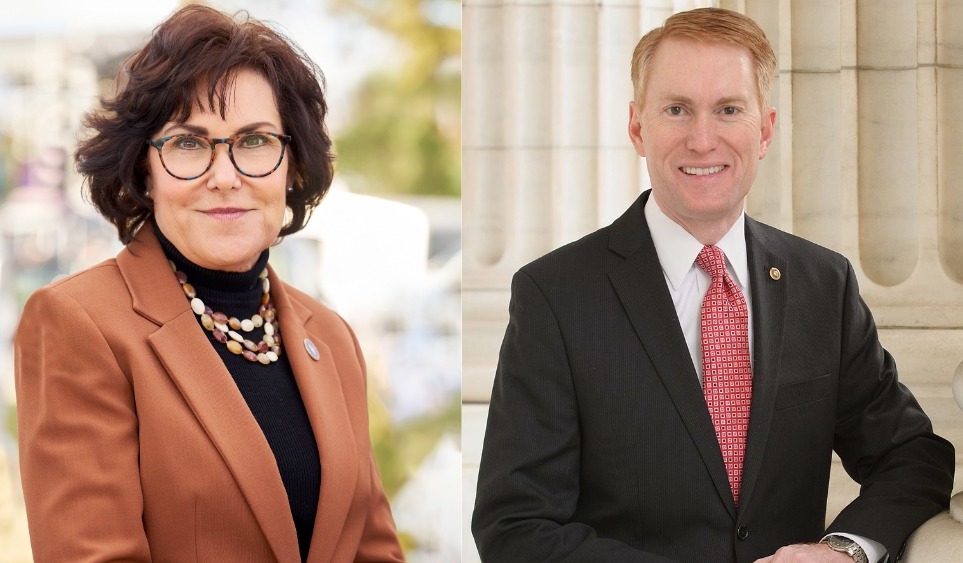
Sens. Jacky Rosen (D-NV) and James Lankford (R-OK) on Tuesday introduced the Jewish American Security Act, a broad new effort by the lawmakers, who co-chair the Senate antisemitism task force, to address antisemitism across multiple sectors of American society, Jewish Insider’s Marc Rod reports. Similar legislation is also expected to be introduced in the House.
About the bill: The bill contains various provisions aimed at increasing security for Jewish communities through additional funding and federal resources. Key provisions include: additional security assistance and improvements to security grant programs for Jewish communities; addressing antisemitism on college campuses through new federal oversight measures including a federal official to handle campus antisemitism; and addressing the spread of antisemitism online by requiring new transparency reports from social media companies, among a range of related steps in each category.
EIGHTH TIME’S THE CHARM
Cassidy joins Democrats in passing procedural vote aiming to restrict Trump’s war against Iran
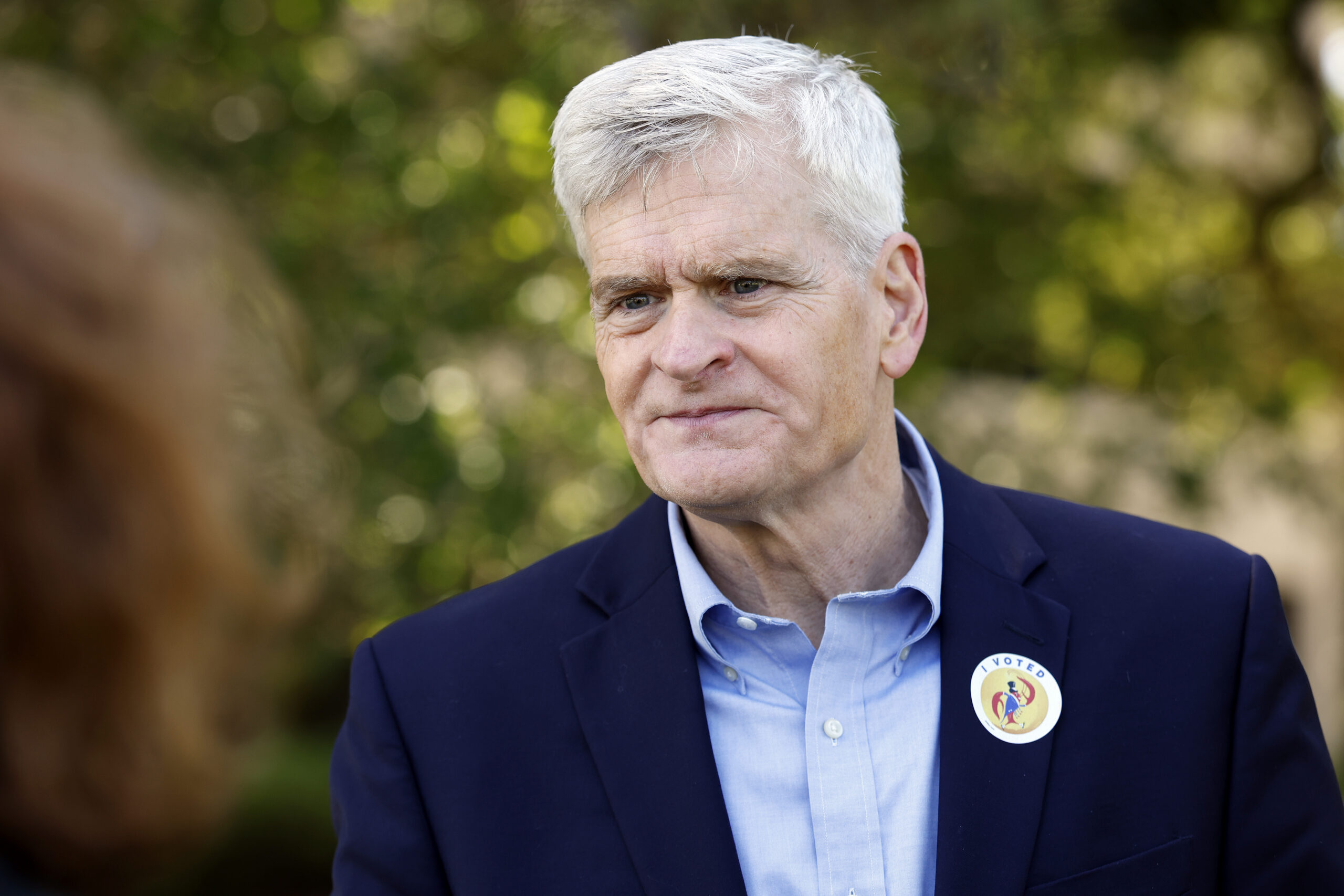
Sen. Bill Cassidy (R-LA) joined with Democrats to vote for a procedural motion advancing legislation that would end U.S. military operations against Iran, allowing the war powers resolution to move forward on Democrats’ eighth such attempt since the war began, Jewish Insider’s Marc Rod reports.
State of play: Cassidy, who last week fell short in his reelection primary effort against a Trump-backed challenger, joined three other Republicans — Sens. Susan Collins (R-ME), Lisa Murkowski (R-AK) and Rand Paul (R-KY) — in voting for the procedural motion, which was approved by a 50-47 vote. Sen. John Fetterman (D-PA) voted against the motion. The passage of the motion will now tee up further debate on and an additional vote on the resolution itself, at a time to be determined.
Money messages: Treasury Secretary Scott Bessent called on U.S. allies on Tuesday to “step up” and join Washington in taking aggressive economic action against Iran and its broader terrorism financing networks, JI’s Matthew Shea reports.
LEAVING FINGERPRINTS
Secretive GOP-linked super PAC Lead Left boosting antisemitic Dem candidate in Texas
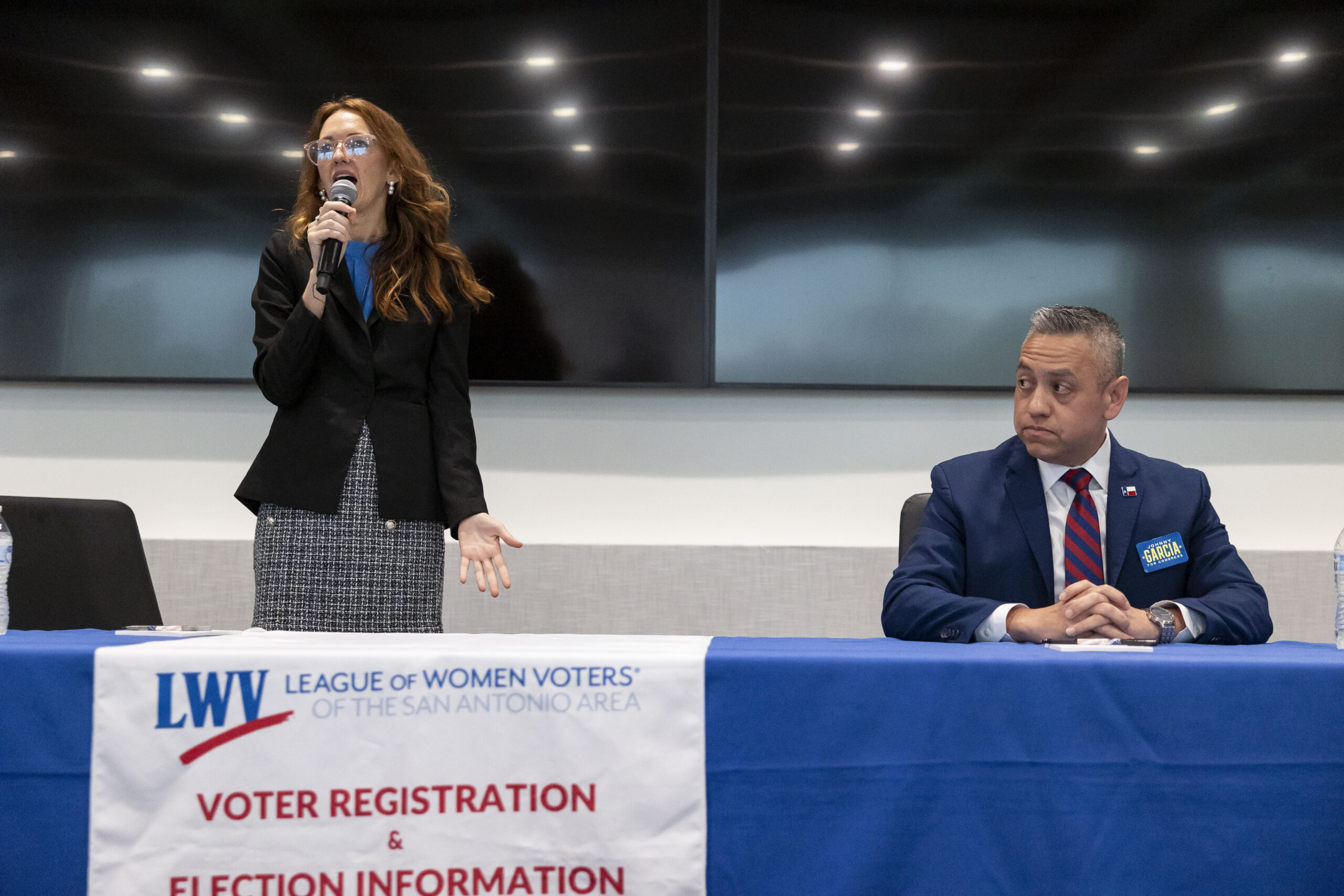
A newly launched super PAC with ties to Republicans has spent nearly half a million dollars to help boost a Democrat running for a competitive open House seat in Texas who is facing growing bipartisan furor over a series of virulently antisemitic social media remarks, Jewish Insider’s Matthew Kassel reports.
Boosting Galindo: Lead Left PAC, the GOP-linked group, has been aggressively promoting Maureen Galindo, a fringe San Antonio activist who finished first in the primary and has said that Jews “own Hollywood” and “worship the synagogue of Satan.” Last week, she said that, if elected, she would turn a local immigration detention center “into a prison for American Zionists and former ICE officers for human trafficking,” while adding, “It will also be a castration processing center for pedophiles which will probably be most of the Zionists.”
Bonus: Rep. Alexandria Ocasio-Cortez (D-NY) slammed Galindo’s comments, saying that “bigoted garbage and antisemitism should be nowhere near our politics” and suggesting that the “donors behind the Republican super PAC funding her should be exposed.”
MENDING FENCES
Israeli think tank warns erosion of American Jewish support could weaken U.S.-Israel alliance

A new study from the Tel Aviv University-affiliated Institute of National Security Studies warns that American Jews’ ties with Israel have weakened in recent years, and Israeli leaders do not seem to care enough about how these shifting attitudes might affect Israel’s national security. If Israel ignores the growing distance with the American Jewish community, the country could face long-term consequences, authors Ted Sasson and Avishay Ben Sasson-Gordis argue, Jewish Insider’s Gabby Deutch reports.
Words of warning: “An American Jewish community that is less supportive of Israel would leave Israel more isolated globally, less capable of extending soft power, and less confident in its role as the nation-state of the Jewish people,” Sasson, a Middlebury College professor and INSS scholar, and Ben Sasson-Gordis, director of the Israel-United States Research Field at INSS, write.
DEM DISCUSSIONS
Center-left think tank’s conference avoids the elephant in the room: Israel
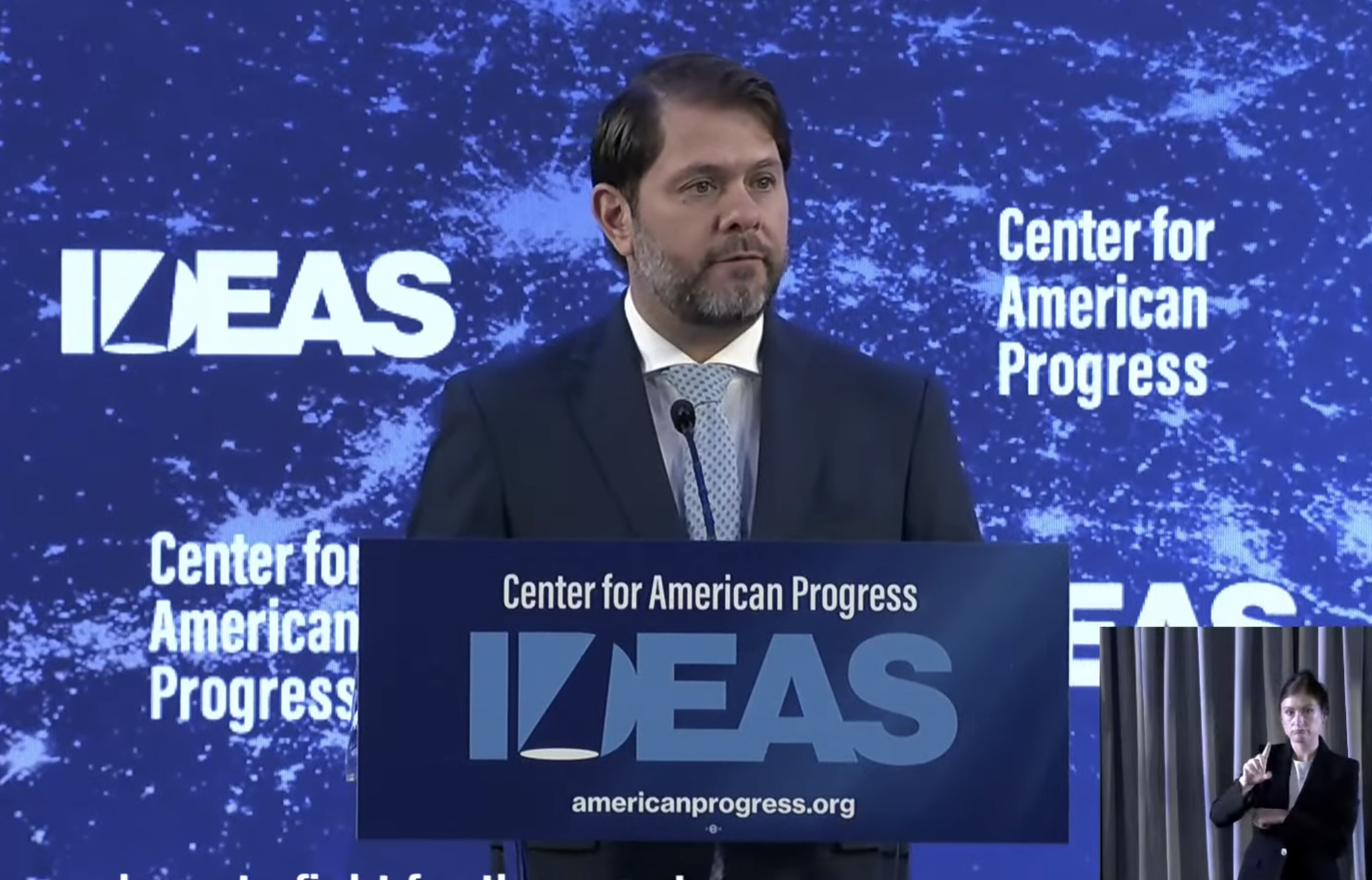
On Tuesday, more than a dozen Democrats pitched their vision for America to a roomfull of liberal donors, staffers and funders at the Center for American Progress’ IDEAS Conference, a convening that pledged to bring together “the broad center-left’s leading thinkers and doers” to offer ideas on a range of policy topics. American foreign policy was one of those topics. In the two sessions on national security, each of which devoted significant discussion to the Middle East, one topic was notably absent: Israel, Jewish Insider’s Gabby Deutch reports.
Iran war opposition: Sen. Ruben Gallego (D-AZ) kicked off the gathering with an address billed as “National Security Ideas for the Future.” He cited his own experiences as a member of the Marine Corps who served in Iraq, arguing that the war in Iran is misguided and harming Americans. ”I’m here today because right now our country is in danger. Will this president continue to drag America into another endless Middle East war?” Gallego said. “This is a war that wasn’t planned, wasn’t authorized and is not making us safer. [Donald] Trump got his war, and working families got stuck with the bill every day.”
FLOURISHING FRIENDSHIPS
Iran war is leading to stronger alliance between Israel, India and the UAE, experts say
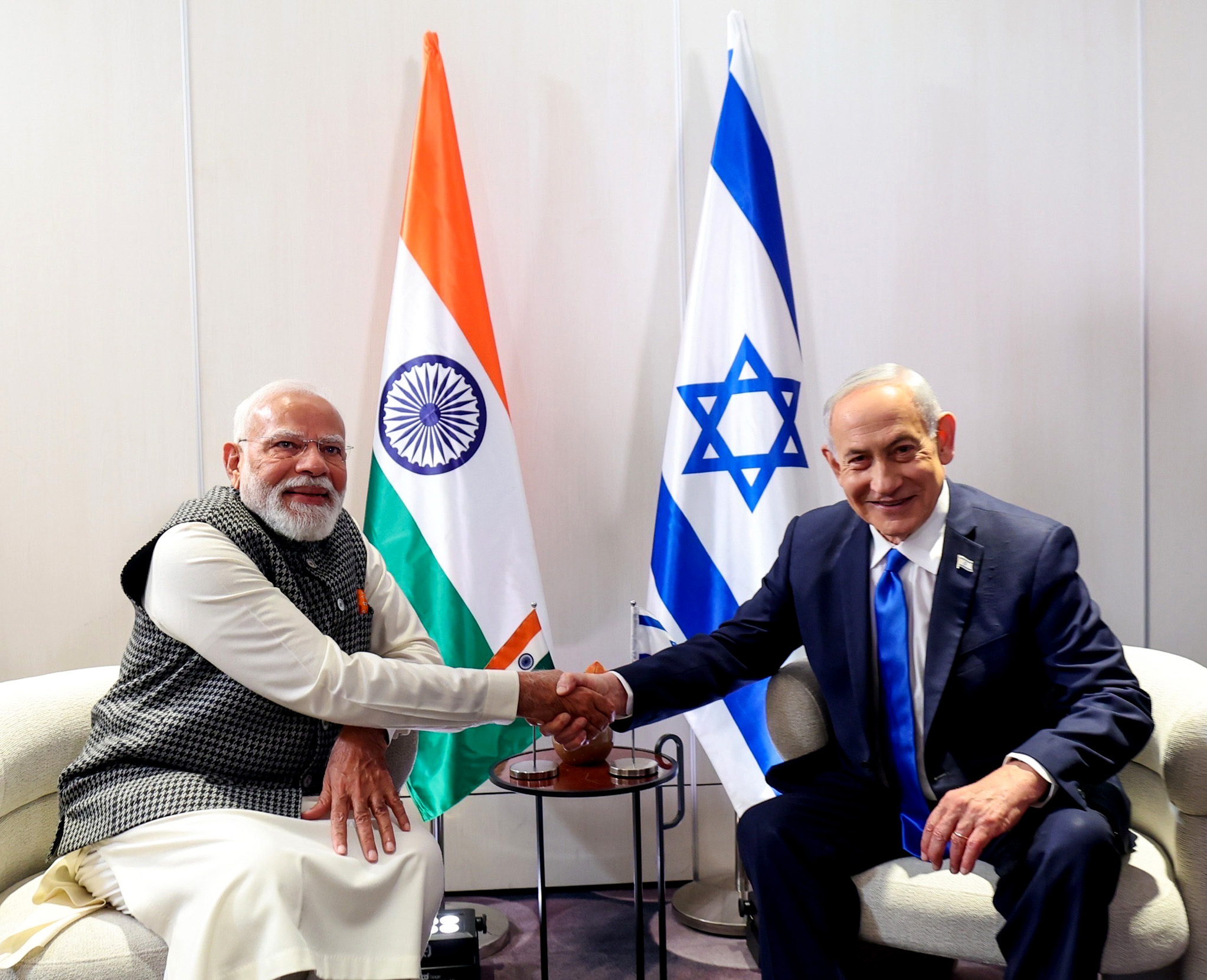
While some geopolitical relationships have been tested by the Iran war, others have been strengthened: Emerging alignments between Israel, the United Arab Emirates and India are creating new opportunities for cooperation among three countries increasingly bound by shared defense and economic interests, experts told Jewish Insider’s Matthew Shea reports.
Overlapping interests: On Friday, India and the UAE agreed on the framework for a strategic defense partnership, a step that could deepen ties between New Delhi and Abu Dhabi amid the regional fallout from the war. Hussain Abdul-Hussain, a research fellow at the Foundation for Defense of Democracies, told JI that the partnership also extends to Israel, which has remained a key ally of both countries. He said the emerging alignment is rooted in overlapping economic and strategic interests and shared adversaries.
Worthy Reads
Narrative War: Days after The New York Times’ Nicholas Kristof published a piece alleging numerous abuses of Palestinian prisoners by Israeli security officials, Kristof’s colleague on the Opinion desk, Bret Stephens, observes the documented history of news outlets publishing falsehoods about Israel without basic fact-checking. “The common thread in these and many other stories is that they all involve strenuous, if ultimately embarrassed, efforts to prove that Israelis deliberately seek to kill the innocent and maim the vulnerable, apparently for no other reason than gratuitous cruelty. This isn’t a matter of reporters’ impartially trying to expose wrongdoing wherever they find it — if that were the case, the errors wouldn’t invariably lean in the same ideological direction. It isn’t speaking truth to power. It’s feeding narratives to the credulous.” [NYTimes]
Drawing Down Aid: In The Wall Street Journal, the American Enterprise Institute’s Daniel Samet argues in favor of winding down U.S. aid to Israel, calling it a “political liability” that could affect the future of the relationship between the countries. “Military aid to Israel, which Washington began supplying in significant amounts during the 1960s, has been a sound investment. The U.S. has financed a reliable ally that fights and wins wars against America’s enemies. Yet Israel no longer commands the affection of the American people as widely as it once did. Ending military assistance is a political imperative in changing times.” [WSJ]
Word on the Street
U.S. forces in the Indian Ocean seized an Iran-linked oil tanker that had been under U.S. sanctions since March; the vessel was believed to be carrying upwards of a million barrels of crude oil that was loaded earlier this year from Iran’s Kharg Island…
The New York Times reports on an Israeli-developed plan, backed by the U.S., for former Iranian President Mahmoud Ahmadinejad, who was under house arrest in Tehran, to be installed as the leader of Iran; the plan reportedly fell apart after the hard-liner was injured on the first day of the war in a strike intended to free him from house arrest and, per the Times, “became disillusioned with the regime change plan”…
Ahmadinejad biographer and Israeli analyst Meir Javedanfar dismissed the report, calling it “a disinformation campaign initiated by those that tried to assassinate him”; Javedanfar said that the “disinformation is being used to create chaos within the ranks of the Islamic Republic of Iran” following what he described as “an assassination attempt gone wrong”…
Iranian state media reported that Tehran had offered a new proposal to the U.S. that would include the withdrawal of U.S. troops from areas near Iran, an end to hostilities targeting both Iran and Hezbollah in Lebanon and reparations for damages the regime sustained in the recent war…
The United Arab Emirates said that three drones that targeted the country’s nuclear power plant over the weekend originated from Iraq, deepening speculation that Iran, which backs militias in the country, was behind the attack…
The Wall Street Journal spotlights the challenges facing Kuwait following the closure of the Strait of Hormuz that has halted the Gulf state’s ability to ship crude oil…
President Donald Trump endorsed Texas Attorney General Ken Paxton’s primary challenge against Sen. John Cornyn (R-TX) on Tuesday, dealing a significant blow to Cornyn’s bid for a fifth term, Jewish Insider’s Emily Jacobs reports…
Former CIA officer Amaryllis Fox Kennedy, an ally of Director of National Intelligence Tulsi Gabbard, is departing her senior roles at the Office of the Director of National Intelligence and the Office of Management and Budget to return to the private sector…
The Senate passed a resolution honoring Jewish American Heritage Month by unanimous consent…
Rep. Ro Khanna (D-CA), responding to Rep. Thomas Massie’s (R-KY) primary defeat, said that Massie “lost because he had the guts to stand up to the Epstein class and against the war”; the California Democrat, who is mulling a 2028 presidential bid, said he welcomed “voters who feel rejected by Trump,” pledging to “build a movement to stand for Team America”…
The South Carolina Statehouse approved a new congressional map that would eliminate the district represented by Rep. Jim Clyburn (D-SC), the state’s only Democratic district; the new map will next head to the state Senate for a vote…
New York City Mayor Zohran Mamdani has in recent days held a series of meetings and listening sessions with Wall Street executives, including JPMorgan Chase CEO Jamie Dimon and Goldman Sachs CEO David Solomon, after Mamdani angered business leaders by filming a video outside the home of Citadel’s Ken Griffin in which the mayor announced a plan to tax second homes in the city…
Police in New York are investigating the death of a Jewish bakery owner and former Hatzolah volunteer whose body was found in the Queens neighborhood of Flushing after he was shot in the neck and back…
The Strokes announced that guitarist Nick Valensi, who is Jewish, won’t be participating in the band’s upcoming summer tour, weeks after Strokes frontman Julian Casablancas said on the “SubwayTakes” web series that “American Zionists get the benefits of white privileged people, but talk like they are Black people during slavery”…
Mohamed Hagi, Somaliland‘s newly arrived ambassador to Israel, announced that Hargeisa planned to open its embassy in the country in Jerusalem…
Israeli Finance Minister Bezalel Smotrich claimed that the International Criminal Court was seeking a warrant for his arrest; the ICC would not comment on the claim, saying that requests for warrants are confidential…
In what he said was a response to the ICC’s request for a warrant, Smotrich threatened to evict residents of the West Bank Bedouin village of Khan al-Ahmar…
Comedy writer Barry Blaustein, a longtime collaborator of comedian Eddie Murphy who worked on the screenplays of “Coming to America” and “The Nutty Professor,” died at 71…
Pic of the Day

Israeli Foreign Minister Gideon Sa’ar, who is in Prague this week for meetings with senior officials, announced the launch of the Israel-Czech Republic Business Forum alongside his Czech counterpart, Petr Macinka.
Birthdays

Emmy Award-winning singer and songwriter, Rachel Platten turns 45…
CEO at Kings’ Care – A Safe Place, operator of multiple drug and alcohol rehabilitation and treatment centers, Ilene Leiter… Canadian businesswoman and elected official, she served in the Ontario Assembly and in the Canadian House of Commons, Elinor Caplan turns 82… Former member of the New York State Assembly until 2020, representing the 97th Assembly District in Rockland County, Ellen Jaffee turns 82… Former member of the U.S. House of Representatives (D-CT) for 20 years, he was born in a DP camp in Germany after WWII, Sam Gejdenson turns 78… Chagrin Falls, Ohio, attorney, Robert Charles Rosenfeld… CEO emeritus of the Jewish Community Relations Council of New York, Michael S. Miller… Seamstress and weaver, Bernice Ann Penn Venable… Retired in 2022 as a federal judge for the Southern District of Texas, she is now a mediator and arbitrator, Judge Nancy Ellen Friedman Atlas turns 77… Five-time Emmy Award-winning producer and writer who has worked on “Saturday Night Live,” PBS’ “Great Performances” and “It’s Garry Shandling’s Show,” Alan Zweibel turns 76… U.S. Sen. Mike Crapo (R-ID) turns 75… Former director of international affairs, policy and planning at the Conference of Presidents of Major American Jewish Organizations, following 12 years at the ADL, Michael Alan Salberg… Professor at Tulane, he was president of the Aspen Institute, CEO of CNN and managing editor of Time, Walter Isaacson turns 74… Born in upstate New York as Michael Scott Bornstein, former Israeli ambassador to the U.S. and then member of the Knesset, Michael Oren turns 71… Actor and singer, known for her work in musical theater, Judy Kuhn turns 68… CEO and founder of Abrams Media, chief legal analyst for ABC News and the founder of Mediaite, Dan Abrams turns 60… NYC location scout and unit production manager for feature films, TV and commercials, David Brotsky… Co-founder and CEO of Breitbart News, Larry Solov turns 58… Senior advisor at Majority Democrats, Ami Copeland… French singer and actor, at 13 she became the youngest singer to ever reach No. 1 in the French charts, Elsa Lunghini turns 53… Co-president of Major League Baseball’s Tampa Bay Rays, Matthew Silverman turns 50… Principal of public policy at Amazon, Philip Justin “PJ” Hoffman… Program officer of Jewish life at the Michigan-based William Davidson Foundation, Vadim Avshalumov… Founder and CEO of Berkeley, California-based Caribou Biosciences, a genome engineering company, Rachel Haurwitz, Ph.D…. Senior director of government relations and strategy for the ADL, Lauren D. Wolman… Executive communications leader, Susan Sloan… VP of digital advocacy at McGuireWoods Consulting, Josh Canter… Beauty pageant winner who was awarded the title of Miss Israel 2014, Doron Matalon turns 33… Master of public policy candidate at Oxford University, Aylon Berger turns 26… Conservative political activist, he is a survivor of the Marjory Stoneman Douglas High School shooting, Kyle Kashuv turns 25…
The prime minister’s governing coalition is struggling to stay intact to pass 2026 budget amid shifting political priorities

GIL COHEN-MAGEN/POOL/AFP via Getty Images
Israeli Prime Minister Benjamin Netanyahu (L) and Finance Minister Bezalel Smotrich (2nd R) arrive for a cabinet meeting at the Bible Lands Museum in Jerusalem on June 5, 2024.
The war against Iran may have united the vast majority of Israelis who support its aims, but much of the governing coalition’s prewar political obstacles still have to be resolved by the end of the month — including the passing of a state budget for the current year and a Haredi conscription law — or else an early election will automatically be called.
The coalition failed to pass a 2026 budget by Dec. 31, a regular occurrence in Israel, due to several policy disputes. By law, if the Dec. 31 deadline is not met, it may be extended to the end of March. However, if the Knesset does not pass a budget by the end of March, the law states that the body will automatically dissolve, with an election held 90 days later.
The Knesset is slated to go into recess on March 24, but it appears increasingly likely that the legislature will stay in session, with efforts to finalize the budget continuing until hours before Passover, which begins on the evening of April 1.
If Israeli Prime Minister Benjamin Netanyahu and his coalition succeed in approving a budget, the official election date would be set for Oct. 26, though the parties could choose to hold it on an earlier date.
Some Israeli media have reported that Netanyahu would prefer to hold the election before Rosh Hashanah (Sept. 12) and the subsequent three weeks of Jewish holidays; other analysts have said he would not want an election after Oct. 7, because the date will serve as a reminder of his government’s failure to prevent Hamas’ 2023 terror attack.
If the coalition does not succeed in passing a budget, the election will be held at the end of June, and Netanyahu’s Likud party will have to launch a campaign, potentially as the war with Iran is still ongoing.
Before the war, the biggest political challenge for Netanyahu’s government related to issues surrounding Haredi military service.
The Haredi exemption from the mandatory IDF draft was canceled by the High Court of Justice in 2023, just prior to the Hamas attacks — and shortly before Israelis became acutely aware of the IDF’s urgent manpower needs. Since then, the government has been embroiled in legal and legislative disputes over how many young Haredi men to conscript and what penalties should be imposed on those who refuse to serve.
With the issue unresolved, both Haredi parties quit their Cabinet posts last year, though Shas and parts of United Torah Judaism mostly continued voting with the coalition in the Knesset. Still, the parties demanded that a bill reducing penalties for not serving in the IDF be passed before they supported the budget.
While the head of the Knesset Foreign Affairs and Defense Committee, Netanyahu loyalist Boaz Bismuth, led the effort to draft legislation that the Haredi parties would agree to — the proposal would institute relatively low enlistment quotas and lessen and defer most penalties for refusing to serve — enough members of Knesset from other coalition parties opposed it that it was unclear that Bismuth’s bill would get enough votes to pass.
Last week, Netanyahu and Finance Minister Bezalel Smotrich announced that coalition parties agreed to put aside all controversial legislation, including the Haredi draft bill, as well as a reform led by Smotrich to further privatize the dairy sector, which faced significant opposition within Likud. The Haredi parties were reportedly incentivized to drop their insistence on passing the bill when Smotrich and Netanyahu agreed to meet their other budgetary demands.
Dropping the Haredi draft bill means that the status quo remains: The IDF is legally required to send draft notices to all Haredi men aged 18-26, though they do not have to send them all at once, and the government must stop funding yeshivas for young men who are required by law to draft. Yet the government does not plan to enforce the law while the war against Iran is ongoing, Cabinet Secretary Yossi Fuchs told the High Court on Thursday.
Attorney General Gali Baharav-Miara flagged some Haredi budgetary demands as illegal, leading the parties to threaten once again to vote against the state budget unless the same amount of funding is diverted to places that Baharav-Miara would not reject. That dispute delayed a vote on increasing the wartime defense budget that had been set for Monday.
At the same time, National Security Minister Itamar Ben-Gvir and his Otzma Yehudit party have yet to drop their most controversial proposal, the death penalty for terrorists, which they continue to demand be passed before the budget vote. Otzma has followed through on past threats to vote against the coalition or absent themselves from key votes if their demands are not met.
Ben-Gvir posted a video on X on Wednesday, in which an off-camera voice said, “I heard the Iranians say that you’re dead.” Standing in front of a gallows with a plaque with Israel’s anthem, a memorial to Jewish underground fighters who were hanged by the British Mandatory government, Ben-Gvir said: “I am dying to execute terrorists. Death penalty for terrorists.”
One of its branches is banned for Hamas ties. The other sits in the Knesset
AHMAD GHARABLI/AFP via Getty Images
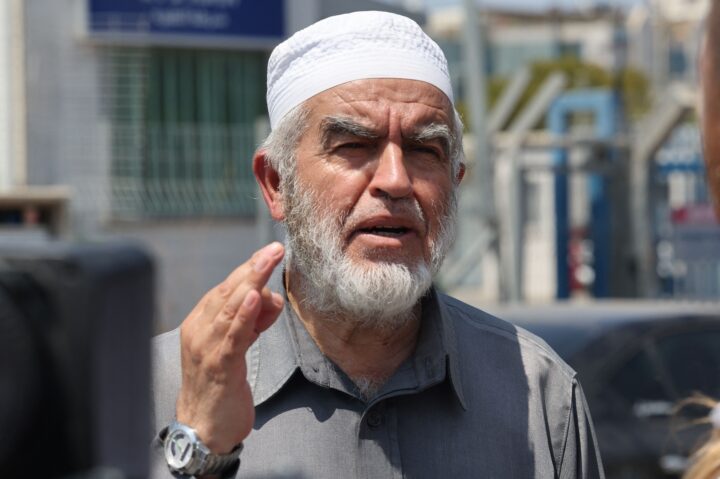
Sheikh Raed Salah, leader of the radical northern branch of the Islamic Movement in Israel, speaks on August 23, 2023, outside a police station during the funeral of the director-general of the Arab city of Tira in Israel, who was gunned down on August 21 evening.
While Congress is working on a bill to designate the Muslim Brotherhood a terrorist organization in the U.S., and the Islamist group is banned from Egypt, Syria, Saudi Arabia, the United Arab Emirates and beyond, the group’s status in Israel is much more complicated.
The matter drew renewed attention this week after Mansour Abbas, the leader of the Ra’am party in the Knesset, an ideological offshoot of the Muslim Brotherhood, declined to call for the eradication of Hamas on Israeli radio.
In an interview with Israeli public broadcaster KAN, Abbas mostly lamented the high rate of crime and gun violence in Israeli-Arab society, but when he mentioned Gaza, the interviewer, Asaf Liberman, asked whether he sees Hamas as part of the enclave’s future.
“Palestinian society needs to pick its leadership and go on a new path towards peace and reconciliation,” Abbas responded.
Liberman twice repeated his question and sharpened it: “Does Hamas need to be destroyed?”
Abbas added that an international force must enter Gaza and after an interim period a security force of the Palestinian Authority would be trained, but after being pressed to make his position on Hamas clear, he said the interview was beginning to feel like an “interrogation,” and pointed out that he had gone on air to talk about domestic issues facing Arab Israelis. “If you want to talk about crime, fine, if not, bye,” he said, before hanging up.
Abbas has previously condemned Hamas’ Oct. 7 attacks, calling them unjustifiable and inhumane, and called for the release of the hostages. The other reporter who conducted the interview, Suleiman Maswadeh, later noted that Abbas and his family had recently received death threats, and hinted that was the reason the Knesset member avoided repeating his previously articulated position — which Maswadeh said does not include a future for Hamas in the governance of Gaza.
In 2021, the Ra’am party became the first Arab party in 50 years to join an Israeli governing coalition, which was celebrated by many in Israel and abroad as a milestone for coexistence, while the Israeli right criticized the 2021-2022 government for what it characterized as working with the Muslim Brotherhood.
Monday’s interview sparked headlines and analysis in right-leaning Israeli media and comments by politicians on the right about the viability of center and left-wing parties once again forming a coalition with Ra’am to oust Prime Minister Benjamin Netanyahu, when Ra’am’s leader would not say that he is for eradicating Hamas.
“The Muslim Brotherhood is a very generic term,” said Michael Milshtein, head of the Palestinian Studies Forum at the Moshe Dayan Center at Tel Aviv University. “It’s not membership in an organization; it’s a denomination. Mansour Abbas is the Muslim Brotherhood. Raed Salah, his rival, is also the Muslim Brotherhood. Hamas is the Muslim Brotherhood. [Turkish President Recep Tayyip] Erdogan is the Muslim Brotherhood.”
The historic and recent connections between Hamas and Ra’am, both of which were founded by adherents of the Muslim Brotherhood, shed light on the nuances of the international Sunni Islamist movement and its status in Israel.
Michael Milshtein, head of the Palestinian Studies Forum at the Moshe Dayan Center at Tel Aviv University, emphasized, in an interview with Jewish Insider on Wednesday, that the Muslim Brotherhood is an ideology aiming to make Muslim societies more religious, and is not one centralized organization spanning the Muslim world.
“The Muslim Brotherhood is a very generic term,” Milshtein said. “It’s not membership in an organization; it’s a denomination. Mansour Abbas is the Muslim Brotherhood. Raed Salah, his rival, is also the Muslim Brotherhood. Hamas is the Muslim Brotherhood. [Turkish President Recep Tayyip] Erdogan is the Muslim Brotherhood.”
Muslim Brotherhood founder Hasan al-Banna’s brother, Abd al-Rahman al-Banna, founded the group’s branch in Mandatory Palestine in 1935; its leaders included Mufti of Jerusalem Hajj Amin al-Husseini, who incited the deadly Hebron riots against Jews in 1929 and collaborated with Hitler, and Izz al-Din al-Qassam, leader of the 1935 Arab Revolt against the British and namesake of Hamas’ short-range Qassam rockets.
Gaza-based Sheikh Ahmad Yasin formed the Muslim Brotherhood-inspired Hamas in the 1980s. Sheikh Abdullah Nimar Darwish founded the Islamic Movement in Israel in 1971, which also espoused Muslim Brotherhood ideology.
In 1979, Darwish founded an underground group in Israel called The Family of Jihad with a goal of establishing an Islamic state. However, after his arrest and conviction for involvement in killing an accused collaborator and membership of a terrorist organization, he renounced violence and decided to promote Islamism within the confines of Israeli law.
Fissures began in the Islamic Movement in Israel after the Oslo Accords, with the northern branch, led by Sheikh Raed Salah, opposing it, while the southern branch supported it. The two parts of the movement officially split when the southern branch ran for the Knesset in 1996 as Ra’am, and Salah advocated boycotting national elections.
The leaders of the northern branch were arrested in 2003 for aiding Hamas and in 2015, the branch was banned, after the police and Shin Bet demonstrated that it had close ties to Hamas and the Muslim Brotherhood, and received funds from groups affiliated with Hamas.
Darwish, however, continued to be the spiritual leader of the Islamic Movement’s southern branch and said he was committed to obeying the laws of Israel. He engaged in interfaith dialogue events, often with former Labor lawmaker Rabbi Michael Melchior, and spoke out against Holocaust denial.
While Islamic Movement Southern Branch leaders have met with Hamas leaders and taken part in mediation efforts between the Palestinian Authority and Hamas, in 2022, then-leader of Hamas Yahya Sinwar declared Mansour Abbas a traitor for joining the governing coalition and saying Israel is a Jewish state. Abbas has said that his decision to join the governing coalition in 2021 came from the values he “absorbed from the legacy of Sheikh Abdullah Nimr Darwish.”
As such, the more radical of the two major offshoots of the Muslim Brotherhood is outlawed in Israel.
Yet, more recently, the Islamic Movement Southern Branch has come under scrutiny for its own possible ties to Hamas.
In the decades since its establishment, the Islamic Movement has faced repeated crackdowns on its charities. The Islamic Relief Committee, founded in 1987 with the stated goal to help the needy in the West Bank and Gaza, was shut down by Israeli authorities in 1995 for aiding Hamas members’ families, the first in a series of such actions.
“Israel’s anti-terrorism law and the whole discipline has been to focus on specific organizations and declaring them as terrorist organizations because of their goals, because of the means that they use, rather than focusing on an idea, which the Muslim Brotherhood really is,” Lt.-Col. (res.) Maurice Hirsch, the former director of the IDF Prosecution for Judea and Samaria, told JI.
In July, the Israeli Justice Ministry unit dealing with nonprofit organizations found grounds to shut down “Aid 48,” a charity affiliated with Ra’am, on suspicion of providing funding to terrorist organizations. “Aid 48” is the Islamic Movement Southern Branch’s main charity. According to an investigation by the ministry, in 2020-2021, the organization transferred NIS 2 million to a charity in Hebron that Israel had declared in 2012 to be part of a terrorist organization; in 2023, “Aid 48” worked with three such Palestinian charities; in 2020, the organization gave NIS 933,000 to a Turkish organization run by Hamas members, which funneled money to the terrorist organization.
Lt.-Col. (res.) Maurice Hirsch, the former director of the IDF Prosecution for Judea and Samaria, currently the director of the Initiative for Palestinian Authority Accountability and Reform in the Jerusalem Center for Public Affairs, explained to JI that Israeli law makes it easier to crack down on smaller subgroups than an umbrella term like the Muslim Brotherhood.
“Israel’s anti-terrorism law and the whole discipline has been to focus on specific organizations and declaring them as terrorist organizations because of their goals, because of the means that they use, rather than focusing on an idea, which the Muslim Brotherhood really is,” he said on the sidelines of a JCFA conference last week.
In order to declare the Muslim Brotherhood a terrorist organization, “you have to break it down into intelligence,” Hirsch said, adding that the authorities would have to determine who they are seeking to arrest and what money and possibly weapons need to be seized.
Hirsch recounted taking part in the Israeli Security Cabinet meeting in 2015 when the government decided to outlaw the Islamic Movement Northern Branch.
“Some of the questions that were asked were, what is the next step? Who do we operate against now? It was a bit clearer than the entire Muslim Brotherhood, but even then there was a question,” he said.
“I would be very careful because, at its core, the Muslim Brotherhood is a movement that aims to change society. They have a lot of social organizations. It’s very different from Islamic Jihad or ISIS, who are not interested in social activism,” said Milshtein, adding that the Muslim Brotherhood ideology is up for interpretation by its adherents.
When it comes to the southern branch, Hirsch, who has worked with the “Choosing Life” organization of relatives of victims of terror whose lawsuit led to the shuttering of “Aid 48,” argued that “there is a clear connection between Ra’am and funding Hamas … That connection was there all along. It’s partly ideological and partly the idea of the Muslim Brotherhood in its different constellations, including in Israel.”
Milshtein acknowledged that there have been cases of leaders of “Aid 48” meeting with Hamas leaders and funding going to Hamas ahead of its invasion of Israel on Oct. 7, 2023, but said that Abbas “took care of” those responsible when he learned of the incidents.
“I would be very careful because, at its core, the Muslim Brotherhood is a movement that aims to change society. They have a lot of social organizations. It’s very different from Islamic Jihad or ISIS, who are not interested in social activism,” he said, adding that the Muslim Brotherhood ideology is up for interpretation by its adherents.
“If you ask Mansour Abbas, there is no problem with being part of the Muslim Brotherhood and part of the government in a state that defines itself as Jewish,” he said. “If you ask Hamas, they want jihad against Israel.”
‘This government will be defined both by the attack on October 7th and by the prosecution of the two-year, seven-front, war that followed,’ Dermer wrote in his resignation letter to the prime minister

State Department photo by Michael Gross
Ron Dermer in May 2019 (Michael Gross/State Department)
Israel’s influential minister of strategic affairs, Ron Dermer, resigned from his post on Tuesday, three years after assuming the role.
“This government will be defined both by the attack on October 7th and by the prosecution of the two-year, seven-front, war that followed,” Dermer, widely regarded as Prime Minister Benjamin Netanyahu’s closest advisor, wrote in his resignation letter.
Israeli media had reported for months that Dermer’s departure was expected.
Dermer noted that he had initially promised his family to work in the position for two years only, but extended his tenure twice, with their blessing, “first to work with you [Netanyahu] to remove the existential threat posed by Iran’s military nuclear capability and second to end the war in Gaza on Israel’s terms and bring our hostages home.”
Dermer has led Israel’s ceasefire and hostage-release negotiations since February. He is expected to stay on as Netanyahu’s envoy to continue handling the future of the Gaza portfolio, political sources recently told Jewish Insider. U.S.-born and a former Israeli ambassador to Washington, Dermer has long played a central role in managing Israel’s relationship with the U.S.
“What the future holds for me, I do not know. But I do know this: No matter what I do, I will continue to do my part to help secure the future of the Jewish people,” Dermer said.
Jewish Insider’s Lahav Harkov contributed to this report.
In a letter to Secretary of State Marco Rubio, the bipartisan group suggested leveraging U.S. assistance to Colombia to push for action
(Photo by Alexi J. Rosenfeld/Getty Images)
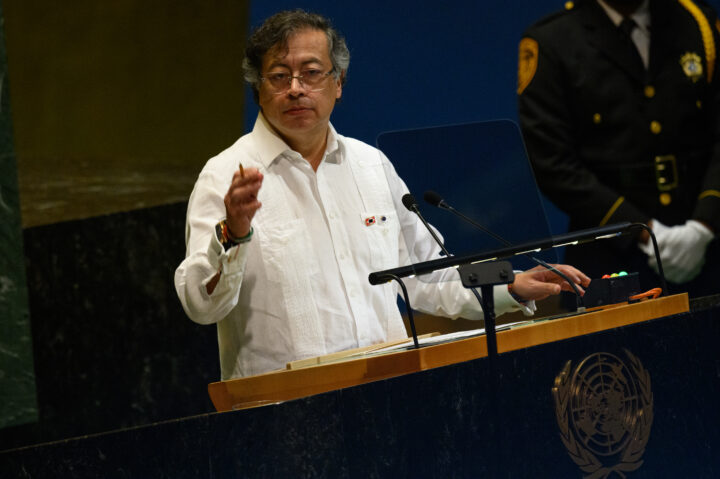
President of Colombia Gustavo Petro speaks during the 80th session of the UN’s General Assembly (UNGA) on September 23, 2025 in New York City.
A bipartisan group of 18 House members is urging the State Department to pressure Colombia’s government to change course on what the lawmakers described as a dangerous pattern of antisemitic rhetoric and policies by government officials, including the country’s president.
“As U.S.-Colombia relations continue to be strained by numerous issues, including the increasingly troubling antisemitic rhetoric and discriminatory policies from Colombian President Gustavo Petro, which are directly threatening the safety and well-being of Colombia’s Jewish community, we write to urge the administration to consider even stronger actions, including leveraging U.S. assistance to push for meaningful change in President Petro and his government,” the lawmakers, led by Reps. Jared Moskowitz (D-FL) and Maria Elvira Salazar (R-FL), said in a letter sent on Monday to Secretary of State Marco Rubio.
The lawmakers said that Petro’s antisemitic comments on social media and anti-Israel posture “have contributed to an increasingly hostile environment for Colombian Jews,” raising particular concern about the appointment of Richard Gamboa, “a self-proclaimed ‘rabbi’ with anti-Zionist views and dubious credentials who lacks ties with Colombia’s Jewish institutions,” to be the Ministry of Interior’s director of religious affairs.
The letter characterizes Gamboa’s appointment as “a deliberate provocation aimed at legitimizing antisemitic perspectives within government institutions” and a “calculated effort by President Petro to normalize anti-Jewish hatred for political gains.”
“There is genuine concern that Mr. Gamboa will continue to accelerate the deteriorating situation facing Colombian Jewry,” the letter continues.
Gamboa, the lawmakers, noted, has gone on antisemitic “tirades” on social media, writing, “Zionists ARE NOT JEWS,” “true rabbis are not Zionists,” and “The full weight of the law should fall upon … defenders of a genocidal regime that usurps and profanes the name of Judaism.”
They also pointed to media reports that indicate that the government may seek to use Gamboa as its official liaison to the Jewish community, sidelining the Confederation of Jewish Communities of Colombia.
The letter was co-signed by Reps. Laura Gillen (D-NY), Buddy Carter (R-GA), Josh Gottheimer (D-NJ), Gary Palmer (R-AL), Mike Lawler (R-NY), Pat Harrigan (R-NC), Chuck Fleischmann (R-TN), Debbie Wasserman Schultz (D-FL), Pete Stauber (R-MN), Brad Schneider (D-IL), Frederica Wilson (D-FL), Don Bacon (R-NE), Lois Frankel (D-FL), Haley Stevens (D-MI), Ted Lieu (D-CA) and Tom Kean Jr. (R-NJ).
Carter and Stevens are running for the Senate in Georgia and Michigan, respectively.
The American Jewish Committee supported the effort and “remains deeply concerned by the antisemitic rhetoric and discriminatory policies emanating from Colombian President Gustavo Petro and his Administration, which poses a direct threat to the safety and well-being of Colombia’s Jewish community,” Dina Siegel Vann, the director of AJC’s Arthur and Rochelle Belfer Institute for Latino and Latin American Affairs, said in a statement.
“These actions by the highest levels of government in Colombia must not become normalized,” Siegel Vann continued. “We commend Representatives Jared Moskowitz (D-FL) and María Salazar (R-FL) for their principled leadership in urging Secretary of State Marco Rubio to make clear to President Petro that his government’s continued provocations and embrace of antisemitic rhetoric and policies are inconsistent with our shared values and interests.”
Petro has a long history of anti-Israel and antisemitic comments and accused the Jewish state of genocide, severing ties last year. He declined to condemn the Oct. 7, 2023, Hamas attacks on Israel, instead comparing Israel to the Nazi regime — something he has done for years, including prior to his time in office.
Speaking at the Eradicate Hate Global Summit on rising political violence, Shapiro called for ‘peaceful and respectful dialogue’
BRENDAN SMIALOWSKI/AFP via Getty Images
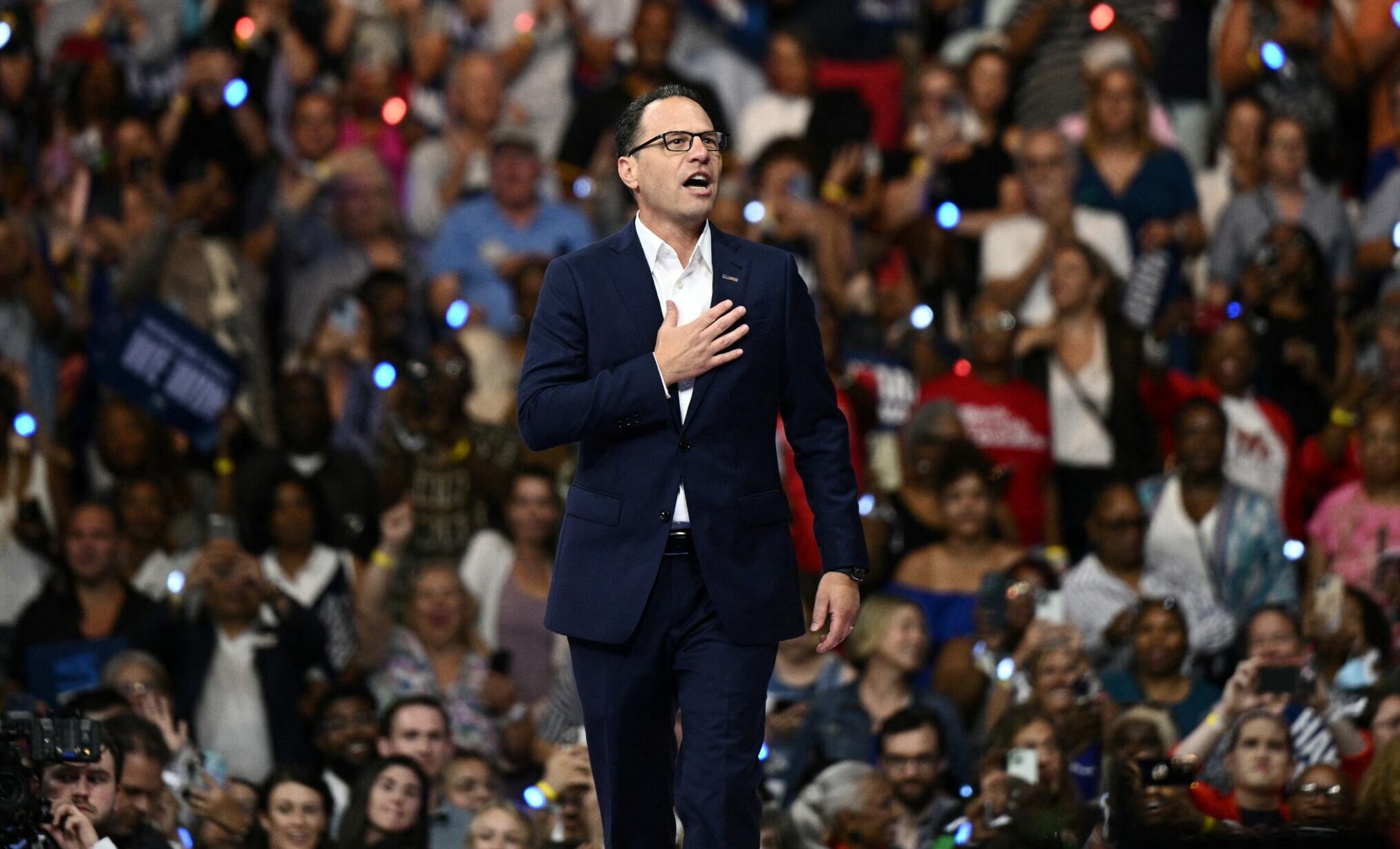
Pennsylvania Governor Josh Shapiro speaks before Democratic presidential candidate Kamala Harris in Philadelphia, Pennsylvania, August 6, 2024.
Amid an alarming rise in political violence, Pennsylvania Gov. Josh Shapiro said Tuesday that the way to combat extremism and division is by bringing people together and restoring their faith in the government — a civic-minded strategy that included some thinly veiled swipes at President Donald Trump and the hardline rhetoric he has adopted since conservative activist Charlie Kirk was killed in Utah last week.
Shapiro and his family survived an April arson attack that damaged the governor’s residence in Harrisburg while they slept, hours after hosting a Passover Seder there. The alleged arsonist acted to protest Shapiro’s stance toward the Palestinians, according to a police search warrant.
“I believe we have a responsibility to be clear and unequivocal in calling out all forms of political violence, making clear it is all wrong,” Shapiro said in a keynote address at the Eradicate Hate Global Summit, a Pittsburgh conference created in the aftermath of the 2018 mass shooting at the Tree of Life synagogue. “Unfortunately some, from the dark corners of the internet all the way to the Oval Office, want to cherry pick which instances of political violence they want to condemn.”
Shapiro called for dialogue and a rejection of the demands for revenge that have permeated social media since Kirk’s murder last week. The speech did not name Trump, although Shapiro called for Trump to act with “moral clarity” in a post on X on Monday.
Widely rumored to be considering a 2028 presidential run, the speech offered Shapiro a chance to deliver a wide-ranging speech to a national audience.
“We need to create more opportunities for peaceful and respectful dialogue, respecting each other’s fundamental rights as Americans,” said Shapiro. “Prosecuting constitutionally protected speech will only further erode our freedoms, deepen the mistrust. That is un-American.” Attorney General Pam Bondi said on Monday that the U.S. would be “targeting” hate speech, which she said was different from free speech — a statement she attempted to walk back a day later after facing bipartisan pushback.
There is a better way, Shapiro added: “That better way is the Pennsylvania way.”
“Those who stoke division will want to have us believe words are important, but we also need action,” said Shapiro. “We need to make sure people are safe here in Pennsylvania and all across America, safe to exercise their fundamental rights and freedoms, whether they’re debating on a college campus, praying at a synagogue or church or spending time at home with loved ones.”
Americans should do more to address hate online, and to teach people to better distinguish “fact from fiction” on the internet, argued Shapiro. But more than that, he said, they need to see and trust that the government actually can make their lives better.
“There’s a deeper issue at the root of this dangerous rise of political violence. Too many people don’t believe that our institutions and the people in them can solve problems anymore. They feel alone, ignored, shut out by a government that isn’t working for them,” said Shapiro. “It leads to a belief among some that the only way they can address their problems is through violence.”
The ways to prove otherwise, Shapiro said, are simple — helping people get driver’s licenses quickly, giving kids free breakfast at school and “building a government that works for Pennsylvanians and gets stuff done.”
Shapiro leaned on Jewish teachings in his speech, referring as he often does to how his faith underpins his public service.
During a speech at the Eradicate Hate Global Summit in Pittsburgh, Pennsylvania Gov. @JoshShapiroPA shared the story of an 82-year-old Christian chaplain of a local fire department, who gave Shapiro and his family a letter signed by each member of their department after an April… pic.twitter.com/jqTD9U7S3U
— Jewish Insider (@J_Insider) September 16, 2025
“My faith has taught me that no one is required to complete the task, but neither are we free to refrain from it. It means that each of us has a responsibility to get off the sidelines, get in the game and do our part,” Shapiro said.
After the attack on the governor’s mansion, Pennsylvanians “were united in speaking and acting with moral clarity, making clear that hatred and violence has no place here in Pennsylvania,” said Shapiro.
He shared the story of the 82-year-old Christian chaplain of a local fire department, who gave Shapiro and his family a letter signed by each member of their department. On the back, the chaplain had written by hand what he said was the most important blessing in his life, from the Book of Numbers.
May the Lord bless you and keep you. May the Lord make His face shine upon you and be gracious to you. May the Lord turn His face toward you and give you peace.
“I wept when I read that prayer that he wrote,” said Shapiro, who recalls then telling the chaplain that he recites that prayer — known as the Priestly Blessing in Judaism — to his children each night. He then proceeded to do so in Hebrew, and offered his own benediction about the power the prayer holds for a nation reeling from violence.
Yivarechecha Adonai v’yishmerecha. Ya’er Adonai panav eilecha v’chuneka. Yisa Adonai panav eilecha v’yasem l’cha shalom.
“Those are words of healing, words of hopefulness to me,” said Shapiro. “They are also words that again remind us of our shared humanity.”
Journalist Jabar Al-Harmi deleted his threatening tweet after drawing controversy
KARIM JAAFAR/AFP via Getty Images
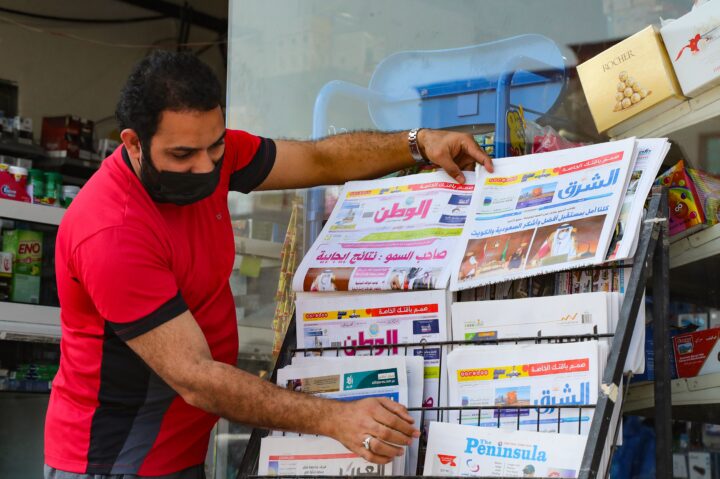
A man arranges newspapers on a stand outside a shop in Doha on Jan 6, 2021.
The editor-in-chief of Qatar’s pro-government newspaper Al Sharq called on Hamas “heroes” to kidnap more IDF soldiers in a since-deleted tweet.
“If success is not achieved this time in capturing Zionist soldiers at the hands of the heroes of #AlQassamBrigades, then the second, third, and fourth attempts will succeed, God willing, by adding new rats to the tally held by the heroes of the Brigades,” Qatari journalist Jabar Al-Harmi wrote in Arabic last week, adding that the “heroes” of Al-Qasam “sent a number of Zionist soldiers to hell” by storming an IDF military site in southern Gaza. Those that weren’t killed were “sent to worldly torment with permanent disabilities and impairments, and others to mental and psychological institutions.”
Al-Harmi continued, “Blessed be the hands of the heroes. And may the hands of the vile criminal outcasts be paralyzed.”
Al Sharq, which is published in Doha by a privately held media company founded and owned by Sheikh Khalid bin Thani Al Thani, a member of the Qatari ruling family, is one of the four leading private daily Arabic newspapers in Qatar, all of which have a pro-government bent.
Ghaith Al-Omari, a senior fellow in The Washington Institute for Near East Policy’s Irwin Levy Family Program in the U.S.-Israel Strategic Relationship, told Jewish Insider that the tweet is “not surprising” and comes amid widespread praise for Hamas in Qatari media.
“The Qatari media landscape is rife with statements, selective reporting and editorials that support Hamas,” said Al-Omari, former executive director of the American Task Force on Palestine. “Under the guise of supporting the Palestinian people, many Qatari media outlets have been a key vehicle for amplifying Hamas propaganda.”
The ability to try to authenticate a statistic by attributing it to an official government source, while knowing that the source is unreliable, can serve as the basis for an inaccurate narrative with wide-ranging effects
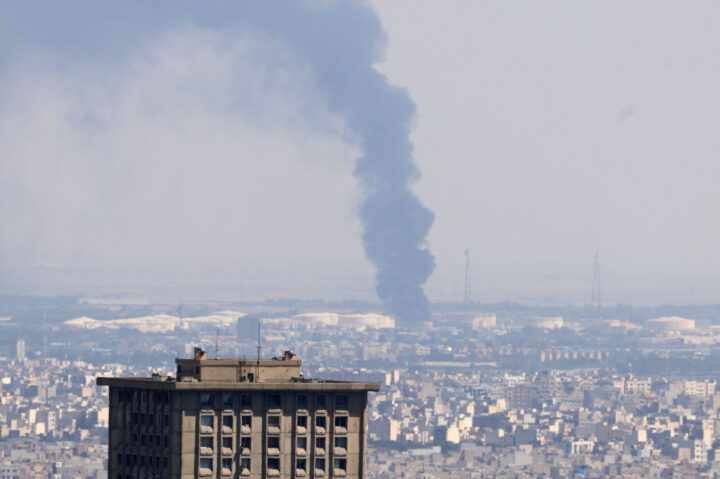
ATTA KENARE/AFP via Getty Images
Smoke billows in the distance from an oil refinery following an Israeli strike on the Iranian capital Tehran on June 17, 2025.
On Thursday, NBC News reported a claim from Iran’s Ministry of Health that “over 2,500 injured people were treated in public and university hospitals, with 1,600 discharged and about 500 still hospitalized.” Earlier this week, CBS News reported 224 Iranians were dead from Israeli airstrikes, also attributed to Iran’s Ministry of Health.
There is no free press in Iran, and journalists have been arrested and imprisoned simply for practicing journalism in the Islamic Republic. There is no real way to verify the Iranian Health Ministry’s numbers, and so many journalists report them, unscrupulously.
In a fast-paced, constantly evolving news environment, accuracy is paramount. The ability to try to authenticate a statistic by attributing it to an official government source, while knowing that the source is unreliable, can serve as the basis for an inaccurate narrative with wide-ranging effects.
Take, for example, the Al-Alhi Hospital incident in October 2023, when the most widely read Western media outlets reported on an Israeli strike on a Gaza hospital, later confirmed to have been a misfired Palestinian Islamic Jihad rocket. In the aftermath of the hospital incident — which many outlets, including The New York Times, had to walk back — Jordanian King Abdullah II canceled an in-person summit with President Joe Biden in Amman, potentially altering the course of the conflict.
“Israel strikes Iranian state TV, warns people to evacuate Tehran after accusing Iran of targeting civilians,” was a CBS News headline on Monday evening. Hours prior, an Iranian ballistic missile salvo targeted dozens of locations across the country — with one missile landing in the heart of a residential area of Tel Aviv.
Further missing in reports of fatalities in the region is the identity of those killed. Take, for example, an Israeli attack in December on the port of Hodeidah and Sana’a airport in Yemen, both utilized by the Houthis. “At least four people were killed and 21 others injured in the attack,” according to the New York Times report on the strike, filed by journalists in Israel and the United Arab Emirates who cited Yemeni state-run media and the country’s Ministry of Health.
Why were those people at a Houthi port known for serving as a point of transfer for Iranian weapons? Were those who were killed Houthi officials? Were they engaged in activity that posed an active and immediate threat to Israelis? The reader will never know anything beyond that the numbers provided by the Houthi-run Health Ministry in Yemen “could not be independently verified.”
It’s a regular occurrence in Israel-related reporting, where reports on West Bank clashes fail to mention when those killed are members of Hamas, Palestinian Islamic Jihad or one of the many armed militant groups operating in the territory.
More than 20 months after Hamas terrorists tore through southern Israel, raping, burning and killing people and destroying obstacles in their way, foreign reporters in the region continue to use casualty figures from the terror group’s Gaza Ministry of Health, noting only that the group doesn’t distinguish between civilians and combatants.
Concerns over the reliance on the Hamas-run Gaza Health Ministry were so severe that American legislators passed — on a bipartisan basis — an amendment to last year’s State, Foreign Operations and Related Programs Appropriations bill barring the State Department from using the health ministry’s statistics. Read our report here.
An ABC News report from earlier this week on violence near humanitarian aid distribution sites in Gaza leads with the headline “More than 30 killed at controversial foundation’s aid distribution sites in Gaza: Health officials,” giving an air of legitimacy to the claim — even though a reader would have to move down to the story before learning that those health officials came from the “Hamas-run Gaza Ministry of Health.” And nowhere in the story does ABC News note that the Gaza Health Ministry doesn’t distinguish between civilians and combatants.
The inclination to publish talking points and statistics from terror groups and regimes incentivizes a playbook for malign actors — from Iran to the Houthis and Hamas — to provide misleading casualty figures for the media to carry that lack the intricacies and nuances necessary in such reporting.
And in this new media reality, misinformation and malign actors — already benefiting from sympathetic media organizations — thrive.
Haredim have said they would support the bill to dissolve Knesset in preliminary vote on Wednesday amid IDF draft exemption disputes

Amir Levy/Getty Images
Israeli Prime Minister Benjamin Netanyahu speaks at the Israeli parliament during a new government sworn in discussion at the Israeli parliament on December 29, 2022 in Jerusalem, Israel.
The Knesset is set to hold a preliminary vote on Wednesday to trigger an early election — and crucial partners in Israeli Prime Minister Benjamin Netanyahu’s coalition are threatening to support it.
For the past week, Haredi parties have said they would vote in favor of legislation that would dissolve the Knesset and schedule an election for this fall. The parties, Shas and United Torah Judaism, are threatening to jump ship because the coalition has not passed a law to continue the long-standing exemption for full-time yeshiva students from IDF conscription.
Without Shas and UTJ, Netanyahu’s coalition would be left with 50 members, far short of the 61-seat majority he needs to keep his government afloat.
As such, Netanyahu and his allies have been frantically trying to negotiate a compromise that will keep the Haredi parties in the fold.
Past laws exempting young Haredi men from military service have expired and a new one has not been passed, leading the High Court of Justice to order the government last year to actively conscript them.
Knesset Foreign Affairs and Defense Committee Chairman Yuli Edelstein, who is responsible for ushering a bill to a vote that would codify the status of young Haredi men and set rising enlistment targets for the coming years, has said he will not move it forward unless it includes significant penalties for yeshiva students who refuse to serve. These reportedly include canceling daycare and housing subsidies and bans on leaving the country and receiving a driver’s license before age 29.
Likud and other parties leading Israel over the past half-century allowed the Haredi exemption to continue out of political expedience. But that position has become politically and militarily untenable in the more than 600 days since the war in Gaza began and hundreds of thousands of Israelis have been called for reserve duty, with some serving for hundreds of days.
In addition to Edelstein, several other coalition lawmakers and Cabinet ministers have similarly said they will not support a bill that would continue to allow the vast majority of Haredi men between the ages of 18-24 to decline IDF service without sanctions.
Those sanctions are a red line for the Haredi parties, for whom maintaining their communities’ practice of yearslong full-time yeshiva study has become a key political issue. As such, the parties’ spiritual leaders instructed their politicians to force new elections if penalties for avoiding IDF service are put in place.
While the gaps between the sides are significant and the disputes are serious, Netanyahu has managed to keep coalitions afloat in seemingly hopeless political situations before.
Several factors are working to his advantage. Most significantly,the Haredim are not likely to find themselves in a better situation after a new election. Opposition parties are even more opposed to yeshiva students’ exemption from the draft than those currently in power, and they favor more liberal policies on other religion and state issues that are important to Haredim.
As such, the best an election can do for the Haredim is to buy time, hope the war will end and bet that public pressure to draft their young voters will abate. One senior Shas rabbi predicted that the current coalition parties will “come crawling” back to the Haredi parties after an election.
The leading rabbi of one of the Hasidic sects within United Torah Judaism, Belz, opposes holding an election during wartime, and his representative, Jerusalem Affairs Minister Meir Porush, has also been working to try to stop the dissolution of the Knesset.
In addition, the vote on Wednesday is a preliminary one, which means that in order for the Knesset to call an election, three more votes on the matter would be necessary. While it would be possible to go through the whole process in a day, Netanyahu and his coalition would likely drag out those votes for as long as possible, at least past July 23, when the Knesset’s long summer recess begins.
If the bill is voted down, it cannot be brought to a vote again for six months, though a different party could put forward a similar bill days later.
If the law passes, an election would have to be held after a minimum of 90 days and no more than five months after the Knesset is dissolved.
During that time, a caretaker government would comprise the current Cabinet members, who would still be led by Netanyahu. There are few limits in Israeli law to what a caretaker government can do, and the High Court has been inconsistent about the kinds of decisions a government can make after the Knesset is dispersed.
The Oklahoma senator also relayed a message from his trip to Iraq that Iran is not budging on its insistence on maintaining nuclear enrichment capacity

Andrew Harnik/Getty Images
Sen. James Lankford (R-OK) speaks during a news conference on Capitol Hill on May 1, 2024 in Washington, DC.
Following a visit to the Middle East, Sen. James Lankford (R-OK) said he’s very “optimistic” about the future of Lebanon under its new government, describing the country’s leaders as serious about centralizing power and demilitarizing Hezbollah.
Lankford and Sen. Angus King (I-ME) traveled last week to Baghdad and Erbil in Iraq, Beirut and Amman, Jordan. Lankford continued on to Jerusalem while the Maine senator went on to Turkey.
Lankford, in an interview with Jewish Insider in his Senate office on Thursday, said that he also heard from Iraqi partners that Tehran is not budging on its commitment to uranium enrichment and that regional leaders are supportive of sanctions relief for Syria.
Lankford pointed to reforms in banking rules to help allow for international investment and concerted action by the Lebanese government and Lebanese Armed Forces against Hezbollah as reasons for optimism.
“The Lebanese Armed Forces and the president were very clear: ‘We will be the defender of Lebanon. There’s not two armies, there’s one army,’” Lankford said. “They are working to demilitarize Hezbollah and to be able to make sure that they are the one army … I think there’s real progress and real opportunity.”
He said the LAF has undertaken hundreds of operations to move into and take over Hezbollah strongholds — which he said had been confirmed by U.S. military leadership — and Lebanese leaders were clear that they plan to continue to advance, seize weapons in Palestinian refugee areas and ultimately move into the Beqaa Valley, where many Hezbollah fighters have fled.
“[Lebanese leaders] don’t want to be at war with Israel and they don’t want to have two militaries in their country,” Lankford emphasized. “They want to be Lebanon and have peaceful relationships with their neighbors.”
At the same time, he said that the prospect of normalization between Lebanon and Israel floated by some Trump administration officials appears further off. He said the issue came up in his discussions, but that Israel’s military presence inside Lebanon is a “sticking point” for Lebanon’s leadership.
“The Lebanese leadership is saying, for Israel, ‘We understand that you’re wanting to be able to have some leverage here to be able to get us to do our work. We are doing our work. This is our country, you need to back across the Blue Line,’” Lankford said, referring to the border between the Golan Heights and Lebanon. “What we all understand is that boundary, and they’re working to be able to solidify that. And I believe they’re very close.”
He said that on both the Israeli and Lebanese sides, officials volunteered their “overwhelming support” for Morgan Ortagus, the Trump administration’s deputy Middle East envoy, who sources said will depart her post soon. Lankford said that regional leaders viewed Ortagus as an “honest broker, someone who is legitimately working to try to get to a resolution in the area.”
He said that discussions about Iran’s nuclear program were a primary focus for many in the region, adding that he “heard loud and clear” from leaders in Iraq who have been in close contact with Tehran that Iran is not budging on its insistence on maintaining enrichment capacity.
“[Leaders in Iraq] said, ‘All they want is peaceful [enrichment] purposes and [Iran is] hopeful that they’re going to keep that and they’re hopeful for the negotiations,’” Lankford said. “And I just said, ‘I’m not in the negotiations but I could tell you, there’s not an interest in having a uranium enrichment program in Iran at all.’”
Asked about recent reports that the U.S. has put forward proposals that would allow Iran to continue enriching, either in an interim capacity or as part of a regional consortium, Lankford said that Iran’s centrifuges cannot continue operating.
He also said, in response to comments by Secretary of State Marco Rubio that Iranian proxy terrorism and ballistic missile development are not part of the ongoing talks, that the proxies and missiles are central to the U.S.’ issues with Iran, and “it all needs to be addressed.”
Lankford added that Iran cannot be allowed to continue developing a missile capable of delivering a nuclear weapon while it continues to enrich uranium.
“I can remember saying [in 2015] that the problem with JCPOA is that they can continue to do their weapons development towards a weapon that can deliver a nuclear weapon, while they have time to be able to [do] more study,” Lankford said. “So it provides them the two things they need, money and time, and they don’t have to slow down their weapons development.”
Lankford said that, throughout the region, he heard support for sanctions relief for the new leadership in Syria to allow the fledgling government a chance to coalesce.
“There’s also cautious skepticism about the new leadership there, to say they need to have a chance, but they need to pull together a government that respects the rights of the minority,” Lankford said. “Everybody was focused in on, how do you get a unified Syria so it’s not split up? With so much diversity in Syria, how do you actually make that work?”
He said he hadn’t discussed the prospect of sanctions relief directly with Israeli leaders, but said that Israeli leaders are very wary of Turkish influence in Syria, and of Ankara effectively attempting to annex the country.
“That’s a real threat if the Turks decide they’re just going to keep moving south and dominate that, the Israelis are not comfortable with that at all,” Lankford said. “Syria needs to be Syria, and not Turkey South, and the prime minister [Benjamin Netanyahu] was very, very clear about that.”
He said that the president of Iraq’s Kurdistan region, Nechirvan Barzani, said he’s encouraging Syrian Kurds to focus their attention on the new Syrian government in Damascus and on establishing themselves as “part of the new Syria, not a separate entity … and that’s not going to happen if they just stay to the east and don’t actually go engage with the new government.”
Lankford said Israeli leaders were “skeptical” that a ceasefire and hostage-release deal with Hamas, as pushed by the Trump administration, is achievable, and said Israeli leaders told him they plan to continue military operations until Hamas agrees to release the hostages, though he said all parties involved want to see a ceasefire and hostage release.
“[Hamas] could turn over the hostages at any moment and they’ve chosen not to do that, and so we’re going to go get our hostages,” he said, characterizing Israeli leaders’ position on the issue, adding that Hamas cannot remain in power.
He said that Israel is also focused on eliminating remaining Hamas fighters and weapons and said that Israel still has “a long way to go in the tunnels,” but is working to create “safe areas for people to live free of Hamas” and receive food aid.
The Gaza Humanitarian Foundation, the new U.S. and Israeli-backed aid delivery mechanism in Gaza, began operations while Lankford was in Israel, and he said that it was achieving its desired results in getting food to Palestinians free of Hamas control.
Low turnout predicted with fewer parties, greater apathy and an uncertain future

Oded Balilty/AP
People walk by election campaign billboards showing Israeli Prime Minister Benjamin Netanyahu alongside the Blue and White party leaders in Tel Aviv in April.
It will have been just 161 days — five months, one week and one day — between Israel’s last national election and the one slated for Tuesday. For the first time in the country’s history, nobody was able to form a government after April’s vote, and a redo election was called. What has changed over the past five months and what remains the same? What are the likely outcomes of this week’s election — and could a third round be a possibility?
It’s unlikely that many Israelis have changed their political views over the past five months. Indeed, polls show that Prime Minister Benjamin Netanyahu’s Likud and Benny Gantz’s Blue and White are once again running neck-and-neck to become the largest party in the next Knesset. In April, they each garnered 35 seats, and the final polls published before the redo election showed them each poised to receive between 30-33 seats.
The overall party landscape is relatively similar as well, though there have been a few changes. Moshe Kahlon’s Kulanu merged with Likud. Naftali Bennett and Ayelet Shaked’s New Right Party — which didn’t pass the 3.25% electoral threshold in April — has joined back up with Jewish Home to form Yamina, this time excluding the far-right Jewish Power Party. Amir Peretz replaced Avi Gabbay as Labor head and merged with Orly Levy’s Gesher, which also missed the threshold earlier this year. The Arab parties reformed their merged Joint List, and Moshe Feiglin’s failed Zehut dropped out after cutting a deal with Netanyahu. Former Prime Minister Ehud Barak reentered politics and joined up with Meretz and renegade Labor MK Stav Shaffir to form the Democratic Union.
And while in April, a record 47 parties registered for the election, this time just 31 will be on the ballot. More than 350,000 votes — 8.4% of all ballots — were thrown out earlier this year after being cast for parties that fell beneath the threshold. With the number of competing parties dropping, that figure is likely to fall as well.
But perhaps the biggest change between the two elections is voter apathy. Israelis are largely sick and tired of the politicking, the campaigning and the money wasted in restaging the election. Anecdotally, many Israelis have indicated they will stay home from the polls come Tuesday, and voter turnout is predicted to drop significantly from April’s 68%. That drop in turnout is expected to strengthen the haredi parties, whose constituents tend to vote out of a sense of religious obligation — so much so that Yisrael Beytenu’s Avigdor Lieberman has been pushing for mandatory voting legislation to help counter the ultra-Orthodox voting edge.
In a twist of irony, while Lieberman is largely responsible for the redo election, and the do-over vote is unpopular, the former defense minister himself appears poised to benefit. In the April vote Yisrael Beytenu received 5 seats, but the latest polls show it getting 8-11 in next week’s election.
Lieberman heads one of the few parties that has not promised to join either Likud or Blue and White in a governing coalition. Instead, he has vowed to join the two parties together in a unity government that includes Yisrael Beytenu and leaves the haredi parties in the opposition.
By 10 p.m. on Tuesday evening, Israelis will have completed voting in their second national election of 2019. Exit polls will be published immediately, but official results will only begin trickling in overnight. Counting of the “double envelope” votes — from soldiers, prisoners and hospital patients — likely won’t be complete until Wednesday evening or Thursday morning.
Once the seats alloted to each party are finalized, party leaders will begin to meet with President Reuven Rivlin and recommend someone who will be tasked with forming a coalition. That person gets 28 days — plus a potential extension — to fashion a 61-seat majority government.
What are the likely outcomes?
The final polls published before the election show that both Netanyahu and Gantz are likely to struggle to build a coalition. Unless the right-wing and haredi parties vastly outperform the polls, Netanyahu will likely try once again to convince Lieberman to join a coalition with the ultra-Orthodox parties, which is exactly what he refused to do in April.
And unless the left-wing parties and Blue and White significantly surpass polling expectations, Gantz won’t be able to form a government either. Even with the support of the Arab parties — something Blue and White has dismissed and many of the Joint List members have derided — Gantz will be unable to form a coalition without Lieberman, who will never sit with the Arab factions.
Lieberman — who former Israeli Ambassador to the U.S. Michael Oren dubbed the potential kingmaker and the kingslayer in The Atlantic last month — appears to hold all the cards. And he has vowed to push Likud and Blue and White to sit together in a unity government. Likud has vociferously sworn against such a move, and Blue and White leaders have said they will never sit with Netanyahu. Speculation has also run rampant that somehow Netanyahu will be forced out of the Likud leadership, and a new party leader will agree to a unity coalition. That rumor spurred Netanyahu to force 40 members of the party to swear a loyalty pledge to him last month.
No matter the outcome, the normally quiet news period in Israel over the High Holidays will instead be dominated by headlines over coalition engineering. The only thing that appears clear ahead of the vote is that some — if not all — of the parties will be breaking their campaign promises.
And if no government is able to be built at all once more? That’s right — a third election.
Please log in if you already have a subscription, or subscribe to access the latest updates.
 Continue with Google
 Continue with Apple