












































The 41 signatories to the letter — including three Republicans and 38 Democrats — mark the highest number of lawmakers to make such a request

Emily Elconin/Getty Images
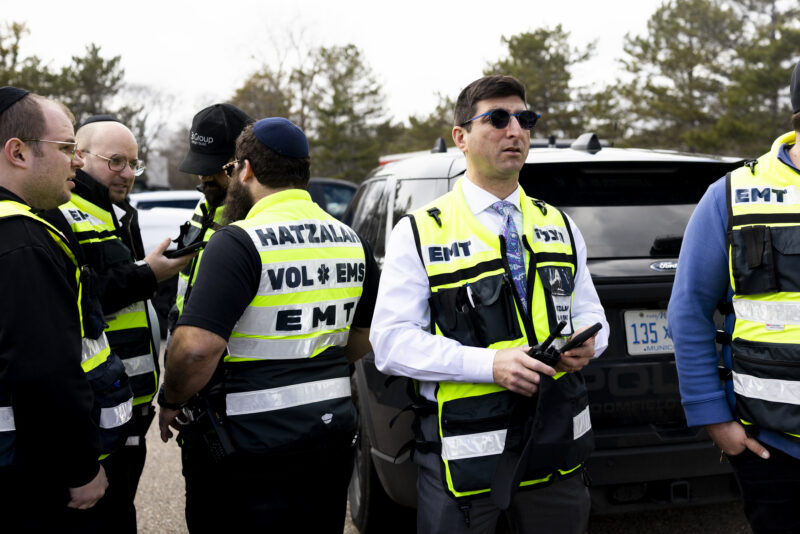
Law enforcement respond near Temple Israel following reports of an active shooter on March 12, 2026 in West Bloomfield, Mich.


 Add JewishInsider on Google
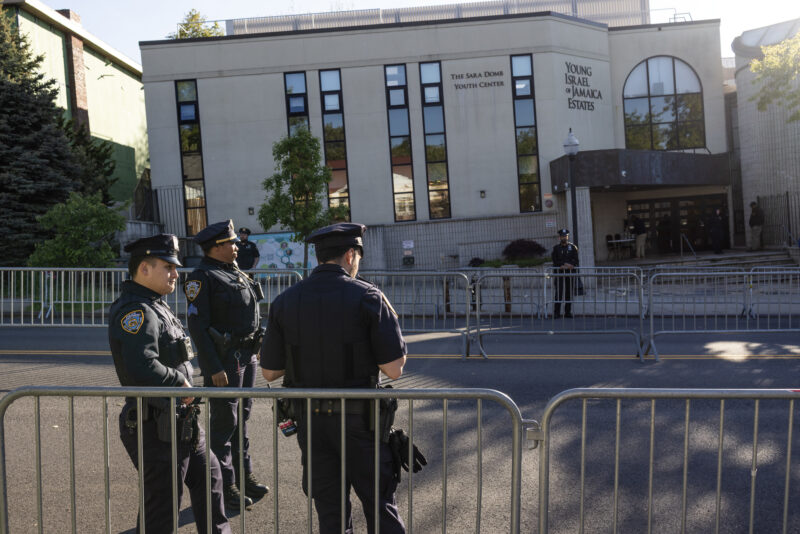
Saying that funding to protect synagogues and other religious-based nonprofits “has not kept pace to meet the moment,” 41 senators — almost entirely Democrats — wrote to leaders of the Senate Appropriations Committee urging members to provide $750 million in funding for the Nonprofit Security Grant Program in 2027.
That figure amounts to a substantial increase in funding over current levels, as well as over Senate lawmakers’ request from last year.
The program was funded in 2025 at $274.5 million, which has not yet been disbursed, and the still-stalled 2026 Homeland Security funding bill includes $300 million for the program. Yet, in 2024, the program fulfilled just 43% of requests, even with additional funding provided through a national security supplemental bill that year. Jewish and interfaith groups, as well as House lawmakers, have been pushing for up to $1 billion for the program.
Last year, 33 senators requested $500 million for the program, a record-high request at the time. This year’s request represents a new high-water mark, both in terms of the funding requested and the number of lawmakers who signed the bipartisan letter in support.
“The threat of violence is unfortunately increasing at places of worship across our country at alarming rates. In the past few years, there has been an increase in hoax bomb threats and attacks against houses of worship that are intended to interrupt services and intimidate worshippers. In particular, there has been an increase in antisemitic incidents across the country following the October 7th attack on Israel,” the senators wrote. “Nationwide, there have been countless acts of violence against religious communities.”
The lawmakers also urged the Appropriations Committee to “maintain separate line-items for this program,” amid reports that the administration has been pushing to convert Federal Emergency Management Agency grant programs, under which NSGP falls, into a broad state-by-state block grant.
The administration also called for cuts to non-emergency FEMA grants, a category that includes NSGP, without making any specific line-item request for the NSGP.
“[F]unding has not kept pace to meet the moment,” the lawmakers added, highlighting a litany of attacks on religious institutions and the funding shortages in 2024.
The letter was led by Sens. Kirsten Gillibrand (D-NY), James Lankford (R-OK), Gary Peters (D-MI) and Jacky Rosen (D-NV). Only two Republicans other than Lankford joined the effort: Sens. Kevin Cramer (R-ND) and Josh Hawley (R-MO).
“As we continue to work with Congress to secure Jewish communities, the bipartisan consensus in the Senate around $750 million for the Nonprofit Security Grant Program is a monumental step toward our community’s $1 billion goal,” Eric Fingerhut, the CEO of the Jewish Federations of North America, said. “At a time of rising antisemitism and an escalating security crisis facing vulnerable communities across the country, demand continues to far outpace available funding.”
Fingerhut said that JFNA plans to bring Jewish activists from across the country to lobby Congress on the issue next month “and urge them to act with urgency and resolve to ensure at-risk institutions have the resources they need before the next incident, not after.”
Lauren Wolman, the Anti-Defamation League’s senior director of government relations and strategy, said, “At a time of sustained and evolving threats, this program remains a critical lifeline for houses of worship and nonprofit institutions working to protect their communities. Demand continues to far outpace available resources, and we urge Congress to ensure funding levels reflect the reality on the ground.”
Nathan Diament, the executive director of the Orthodox Union Advocacy Center, said, “The need for increased NSGP funding remains critical. We are thankful to the large bipartisan group of Senators who signed onto this letter.”
“OU Advocacy will keep pressing on all fronts to deliver the funding our Shuls and schools need to stay safe,” Diament continued.
Rep. Madeleine Dean described the Gaza Humanitarian Foundation as a ‘death trap for starving Palestinians’

DIRK WAEM/BELGA MAG/AFP via Getty Images
The UNRWA logo is seen on the vest of an employee during a visit to the Jabal El Hussein refugee camp of UNRWA, , part of a diplomatic mission to Israel and the Palestinian territories, in Amman, Jordan, Wednesday 15 May 2024.
Democratic members of the House Appropriations Committee criticized Republican-led efforts to dismantle the United Nations Relief and Works Agency in the House’s draft 2026 budget bill for the State Department and other foreign programs.
The exchanges underscore the continued support among some prominent Democrats for restoring the U.S. relationship with the scandal-plagued UNRWA, more than a year after U.S. aid to the group was first halted following allegations that UNRWA staff participated in the Oct. 7, 2023 attacks on Israel. The budget bill includes a continued ban on aid to the agency and calls on the State Department to put together a plan to replace it.
Rep. Rosa DeLauro (D-CT), the top Democrat on the committee, pushed for the restoration of support to UNRWA.
“The bill scapegoats our international partners, U.N. agencies and NGOs that deliver life saving aid to the most vulnerable people around the globe,” DeLauro said. “Organizations like UNRWA will be destroyed, leaving children and families in Gaza and other places around the world to starve and to die.”
DeLauro also pushed back on provisions in the bill that would withhold funding from the U.N. Secretariat until the U.N. and U.S. government take certain steps to pursue accountability for UNRWA members involved in the Oct. 7 attacks.
“I do not believe the language matches the intent,” she argued. “The provision is overly broad. It penalizes important U.N. entities until specific actions are taken by the United States government. This makes no sense.”
She argued that a provision demanding that the U.N. waive immunity for U.N. employees involved in the attack is unnecessary.
“U.N. immunity is already waived in cases where it would impede the course of justice or where someone has committed human rights violations or engaged in or supported acts of terrorism,” DeLauro said. “We all want justice for the horrific attacks on both Americans and our friends in Israel and indeed, the Justice Department has a task force already investigating this issue. We should work together to address this in a manner that achieves true justice.”
Reps. Madeleine Dean (D-PA) and Bonnie Watson Coleman (D-NJ) introduced an amendment that would halt future U.S. aid to the Gaza Humanitarian Foundation until the State Department transmits to Congress all evidence provided by Israel and all U.S. assessments about the diversion of United Nations humanitarian aid by Hamas in Gaza.
It would also require the State Department to report to Congress on deaths at or near GHF distribution sites and plans to minimize such deaths, as well as on fraud and antiterrorism safeguards, before any further aid is provided to the GHF.
Dean accused the GHF of “violating core humanitarian principles” and described the system as a “death trap for starving Palestinians,” urging the U.S. to return to previous U.N. and NGO-run distribution systems.
She said she’s been shown no proof that Hamas had diverted aid provided under previous distribution systems, though she said that it “could be” doing so.
Dean claimed that “not a single refugee was gunned down as they attempted desperately to retrieve aid for their family with UNRWA or [the] World Food [Program] or other U.N. programs” and alleged that “more than 1,000 Gazans have been killed — shot and killed — by the IDF by trying to simply get food” at GHF sites. Israel has denied claims that it is targeting aid recipients at GHF sites, and some reports of such activity have been disproven.
Dean withdrew her amendment without requesting a vote.
Dean and Watson Coleman introduced another amendment to encourage the State Department to continue to support the East Jerusalem Hospital Network, which the committee rejected by a party line 35-26 vote.
Rep. Mario Díaz-Balart (R-FL) argued against the amendment, saying that no provisions of law would otherwise prohibit aid to the hospital network and that the decision should be left to Secretary of State Marco Rubio to assess where and how humanitarian funding would be best spent.
As part of an amendment package, committee Republicans called for an additional $2 million to be provided in the coming year for the implementation, enforcement and renewal of sanctions on Iran.
The amendment package also included language expressing concern about the Muslim Brotherhood, and requesting a report to Congress on how the State Department is countering “the threats posed” by the group, including visa restrictions.
The amendment package was adopted by a 34-27 vote.
Democrats more broadly criticized Republicans for the significant cuts the bill would enact on the State Department and U.S. foreign aid programs formerly run through the U.S. Agency for International Development.
The bipartisan group wrote in their letter: ‘Failure to confront this pernicious ideology harms not only Jewish medical professionals, students, and patients but threatens to destroy the very foundations of our healthcare system’

Nathan Howard/Getty Images
The U.S. Capitol is seen on June 13, 2024 in Washington, DC.
A bipartisan group of House lawmakers is urging colleagues to take steps to address antisemitism in the health care field in the 2026 appropriations process for the Department of Health and Human Services and related agencies.
In a letter sent Wednesday, the lawmakers called on the leaders of the Subcommittee on Labor, Health and Human Services, Education and Related Agencies to demand reports from HHS on the rise of antisemitism in health care.
“Failure to confront this pernicious ideology harms not only Jewish medical professionals, students, and patients but threatens to destroy the very foundations of our healthcare system,” the letter reads. “Dangerous rhetoric from individuals in positions of influence raises fears among Jewish and Israeli students, families, and patients about whether they will receive equitable and compassionate care. Antisemitic hate and bigotry put Jewish patients at risk and undermine the ethical foundations of medicine, where commitment to the patient should be paramount.”
The lawmakers argued that there is growing evidence of a “dangerous erosion of the professional standards that define graduate medical training” and said that medical schools must enforce codes of conduct to prevent antisemitism.
The letter highlights that the vast majority of Jewish medical professionals experienced antisemitism in the year after the Oct. 7, 2023 Hamas attacks, and points to specific incidents which the lawmakers argue have “directly compromised patient care.”
It also highlights issues in medical schools that they say constitute a “dangerous erosion of the professional standards that define graduate medical training” and issues in the mental health field including therapists promoting the view that Zionism is a mental illness and who have blacklisted Jewish patients and providers.
The letter urges the lawmakers, in their 2026 funding bill, to instruct HHS to provide a comprehensive report to Congress on antisemitism and civil rights violations in health care and medical schools, arguing that a lack of comprehensive data makes it difficult to tackle the problem.
It also requests a report on all civil rights complaints in health care and medical schools submitted to HHS in the past two years, including spelling out which cases included antisemitism, and how the complaints were addressed.
The letter was signed by Reps. Buddy Carter (R-GA), Dan Goldman (D-NY), Mike Lawler (R-NY), Greg Landsman (D-OH), Troy Balderson (R-OH), Brad Sherman (D-CA), Brian Fitzpatrick (R-PA), Tim Kennedy (D-NY), Haley Stevens (D-MI), Tom Suozzi (D-NY), Don Bacon (R-NE), Shelia Cherfilus-McCormick (D-FL), Sarah Elfreth (D-MD), Mike Carey (R-OH), Laura Friedman (D-CA) and Jared Moskowitz (D-FL).
“Far too many Jewish health professionals and graduate students face pervasive antisemitism that often goes unaddressed by the very institutions entrusted with their safety and wellbeing,” Rachel Dembo, the senior manager of government relations and engagement for the Jewish Federations of North America said in a statement.
“It’s alarming that today’s current and future providers are encountering environments where antisemitism is treated as acceptable — and where it can even distort or impact clinical care,” Dembo continued. “Compassion cannot coexist with discrimination and bigotry. Jewish Federations of North America are committed to ensuring clinical care is safe and fair for all — because bias can never be part of any patient’s treatment plan.”
Lauren Wolman, the director of government relations at the Anti-Defamation League, said in a statement, “We commend bipartisan Members of Congress for sounding the alarm on this disturbing trend, and we urge the Appropriations Committee to act.”
“From hospitals to medical schools — the mission of medicine is to heal, not to harm. Antisemitic discrimination in clinical and educational environments violates that fundamental principle,” Wolman added. “Providers, students, and patients deserve an environment rooted in equity, dignity, and safety — free from antisemitism and hate.”
Please log in if you already have a subscription, or subscribe to access the latest updates.
 Continue with Google
 Continue with Apple