






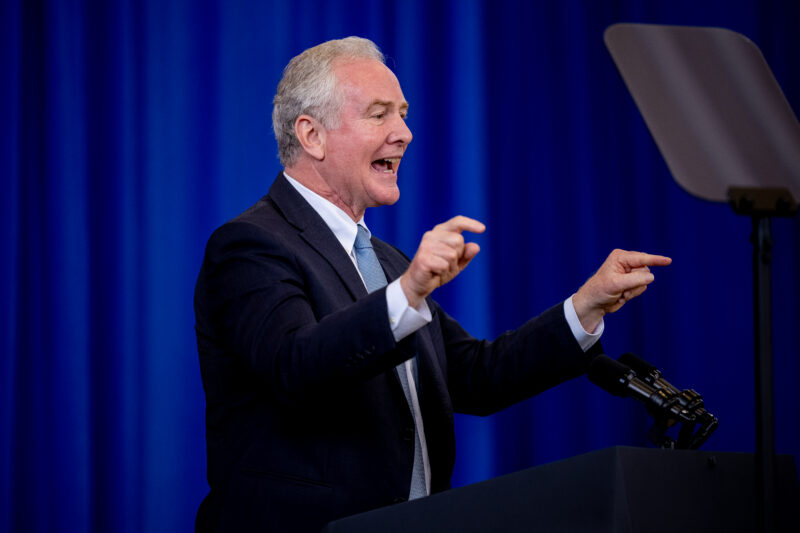


















































Kenyan McDuffie did not name his rivals, though Janeese Lewis George recently said she would avoid events ‘promoting Zionism’
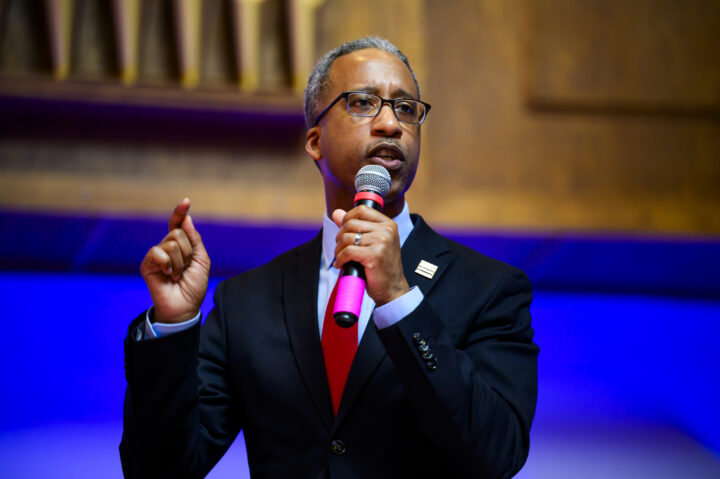
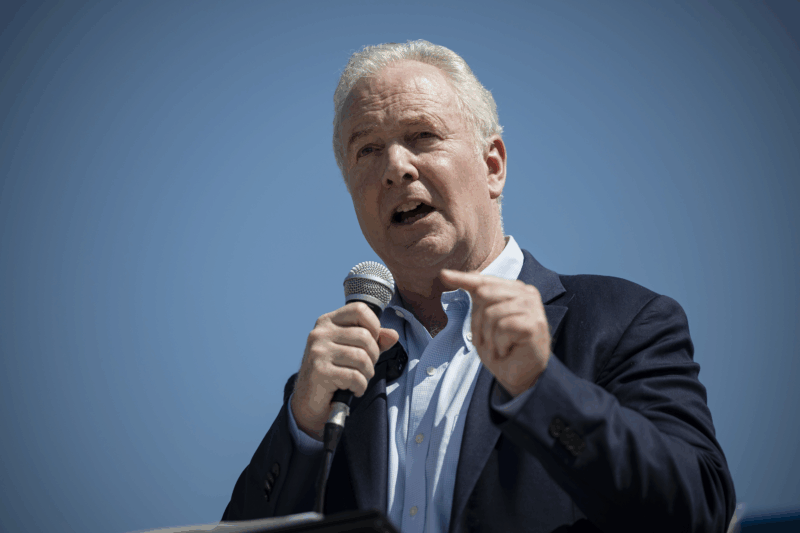
Pete Kiehart for The Washington Post via Getty Images
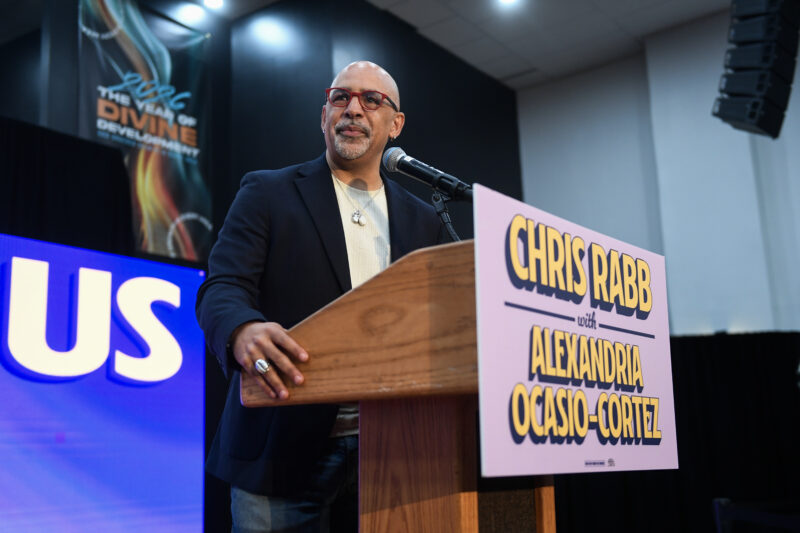
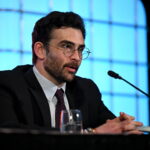
Mayoral candidate Kenyan McDuffie speaks during the Free DC candidate forum on March 14, 2026 in Washington, DC.


 Add JewishInsider on Google
Washington, D.C., mayoral candidate Kenyan McDuffie criticized his Democratic primary opponents for pledging to avoid campaigning with elements of the Jewish community — an apparent jab at Democratic Socialists of America-endorsed rival Janeese Lewis George, who is facing backlash from Jewish leaders over her pledge to boycott events she described as promoting Zionism.
“Recent reporting has raised serious concerns about how some candidates for office in DC have pledged not to engage with the majority of Jewish organizations in exchange for political support,” McDuffie wrote in a campaign email on Tuesday. “That is wrong. Full stop.”
McDuffie did not mention Lewis George or any specific candidates in his email.
Lewis George, who earned the endorsement of the Metro D.C. chapter of Democratic Socialists of America, wrote in a DSA questionnaire that she would not attend events focused on “promoting Zionism and apartheid.” She met last week with rabbis and local Jewish leaders who were concerned about her posture toward the Jewish community, Jewish Insider reported on Monday.
She privately apologized for her responses and blamed them on a staff member, but has not expressed that sentiment publicly.
“There is no place in this city for shutting out any community — especially in pursuit of political gain,” McDuffie wrote. “Not antisemitism. Not Islamophobia. Not racism. Not sexism.”
The DSA questionnaire also asked candidates to refrain from affiliating with the Israeli government and “Zionist lobby groups.” In her responses, Lewis George defended her appearance at a Jewish Community Relations Council of Greater Washington meeting in December, but said she was there to talk about immigration enforcement.
She said she did not align with JCRC’s stance on Israel and Zionism, and that she disagrees with the organization’s “definition of anti-semitism that criminalizes dissent, and their attacks on activists.”
“Leadership matters in moments like this,” wrote McDuffie. “As your next mayor, I will bring people together across lines of difference. I will engage every community in this city, especially when it is not easy or politically convenient.”
Washington, McDuffie said, “must be a city where every resident — regardless of faith, race, gender, or identity — feels safe, respected and heard.”
Plus, media misdirection over AIPAC money

Shauna Clinton/Sportsfile for Web Summit Qatar via Getty Images
Hasan Piker during day two of Web Summit Qatar 2026 at the Doha Exhibition and Convention Center in Doha, Qatar.
This P.M. edition is reserved for our premium subscribers — offering a forward-focused read on what we’re tracking now and what’s coming next. Please don’t hesitate to share your thoughts and feedback by replying to this email.
📡On Our Radar
Notable developments and interesting tidbits we’re tracking
Rumblings of a potential peace summit between Washington and Tehran have begun — sources told Axios that the U.S. and several mediating countries are waiting for Iran to respond to a proposal for peace talks this Thursday, while President Donald Trump reposted a message from Pakistan offering to “be the host to facilitate meaningful and conclusive talks”…
Trump told reporters in the Oval Office this afternoon that “we’re dealing with the right people” in Iran because they “gave us a present, and the present arrived today. It was a very big present worth a tremendous amount of money,” but would only tease that it was “oil and gas related.” Asked if he is negotiating over who will control the Strait of Hormuz, Trump said, “No … we’ll have control of anything we want”…
Saudi Crown Prince Mohammed bin Salman has encouraged Trump to continue the campaign against Iran and push towards toppling the regime, The New York Times reports, believing that Iran’s threat to the Gulf will only be removed through the transition of its government and not if the war results in a failed state. MBS has reportedly argued in favor of striking Iran’s energy infrastructure and putting U.S. troops on the ground…
The Pentagon is expected to announce the deployment of about 3,000 soldiers from the military’s 82nd Airborne Division to participate in the campaign against Iran, The Wall Street Journal reports, a move that opens the possibilities for boots on the ground, as the division is trained to parachute into hostile territory…
Israeli Defense Minister Israel Katz said today that the IDF will now maintain control over a security zone south of the Litani River in Lebanon and prevent the return of Lebanese residents who have been evacuated from the area “until the security of northern [Israeli] residents is assured”…
Lebanese Minister of Foreign Affairs Youssef Raggi declared Iran’s ambassador to Beirut persona non grata and expelled him from the country, as Iranian proxy Hezbollah continues to fire on Israel against the Lebanese government’s orders.
Shortly after, an Iranian ballistic missile was launched towards Beirut for the first time — it was reportedly intercepted by a “foreign naval vessel,” presumably the U.S., though fragments struck Lebanese towns…
Secretary of State Marco Rubio is being dispatched to France later this week to discuss the Iran war, among other issues, with the U.S.’ G7 allies, including Britain, Canada, France, Germany, Italy and Japan, countries that have all declined to participate in the war effort…
Majed al-Ansari, spokesperson for the Qatari foreign ministry, said today that Qatar is not involved in mediating any U.S.-Iran negotiations, a shift for the country that has traditionally played the part of go-between. Al-Ansari said there has been no communication between Doha and Tehran since a phone call early in the conflict when Qatar made clear its anger with Iranian strikes on its territory…
Politico reports that several 2028 Democratic presidential hopefuls said they wouldn’t or haven’t taken money from AIPAC, including Sen. Cory Booker (D-NJ), California Gov. Gavin Newsom, Sen. Ruben Gallego (D-AZ), Kentucky Gov. Andy Beshear, Illinois Gov. JB Pritzker, Pennsylvania Gov. Josh Shapiro, Sen. Elissa Slotkin (D-MI) and former Chicago Mayor Rahm Emanuel.
But while framing the statements as rejections of AIPAC and Israel, the outlet buried or declined to mention Booker’s rebuke of the Democratic Party’s singling out of the pro-Israel group, several respondents’ inability to accept funds from AIPAC since it only participates in congressional elections and Newsom’s own about-face on Israel, where in the same publication he walked back critical comments he’s made and said he’s “proud to support the state.”
AIPAC said in response that it has “never given to a presidential campaign” and that “singling out and excluding millions of pro-Israel Democrats” who are AIPAC members “is wrong and undemocratic”…
Michael Sacks — a prominent Democratic donor and supporter of former President Barack Obama who chaired the 2024 Democratic National Convention host committee — denounced Democratic criticism of AIPAC as a “thinly disguised effort to make support for Israel politically toxic in the Democratic Party, to chase Jews and their allies out of our big tent coalition.”
Sacks wrote in the Chicago Tribune, “Real leadership recognizes that we can hold complicated views about the Israeli government and still refuse to make Jewish identity and pro-Israel sentiment a political disqualifier in our party. We can defend the big tent when it is inconvenient, not just when it is easy”…
Jonathan Cowan, president of the moderate Democratic think tank Third Way, condemned far-left Michigan Senate candidate Abdul El-Sayed for his upcoming rallies with antisemitic streamer Hasan Piker, Jewish Insider’s Danielle Cohen-Kanik reports.
“It is morally repugnant and strategically self-defeating for Democrats like Abdul El-Sayed and Members of Congress like Summer Lee to cozy up to antisemitic extremists like Hasan Piker,” Cowan said in a statement. “Anyone eager to campaign with Hasan Piker is, at best, comfortable overlooking his antisemitic and anti-American extremism and, at worst, endorsing it”…
El-Sayed stood by his controversial statement about the shooting attack at Temple Israel in suburban Detroit earlier this month, in which he condemned the attack but blamed Israel’s military campaign in Lebanon for the perpetrator’s actions (the attacker’s brother was a Hezbollah commander).
The statement “was a risk,” El-Sayed said on an internal campaign call, per Punchbowl News, “but leadership is being willing to say the thing if you believe it to be true that nobody else is going to say”…
⏩ Tomorrow’s Agenda, Today
An early look at tomorrow’s storylines and schedule to keep you a step ahead
Keep an eye out in Jewish Insider for coverage of another war powers resolution expected to receive a vote this evening in the Senate.
President Donald Trump will give the keynote speech at the National Republican Congressional Committee’s annual President’s Dinner in Washington.
The House Homeland Security Committee will hold a hearing assessing the impact of the Department of Homeland Security shutdown, as lawmakers make progress on negotiations to fund the agency.
D.C. councilmember and mayoral candidate Janeese Lewis George will rally alongside other members of the Democratic Socialists of America including Squad-member Rep. Rashida Tlaib (D-MI), days after Lewis George held a private meeting with Jewish leaders to apologize for saying in a DSA questionnaire she would boycott events “promoting Zionism” and avoid the “Zionist lobby.”
Scholar of Jewish literature Ruth Wisse will deliver the annual Jefferson Lecture in the Humanities, the highest honor the federal government gives for intellectual achievement in the humanities, at the Kennedy Center in Washington.
The FII PRIORITY Summit, a high-profile investment and policy conference, will kick off in Miami, with speakers over the rest of the week including Trump; Donald Trump Jr.; Jared Kushner; White House Special Envoy Steve Witkoff; Dina Powell McCormick, president of Meta; Saudi Ambassador to the U.S. Princess Reema Bandar Al Saud; former Treasury Secretary Steve Mnuchin; Massad Boulos, senior White House advisor on the Middle East; and many more.
The Conservative Political Action Conference, known as CPAC, also begins tomorrow in Dallas.
The Jewish Book Council will hold the 75th National Jewish Book Awards Gala, hosted by entertainer Jonah Platt, at Temple Emanu-El in New York City.
SECOND ACT

PAIN TO POWER
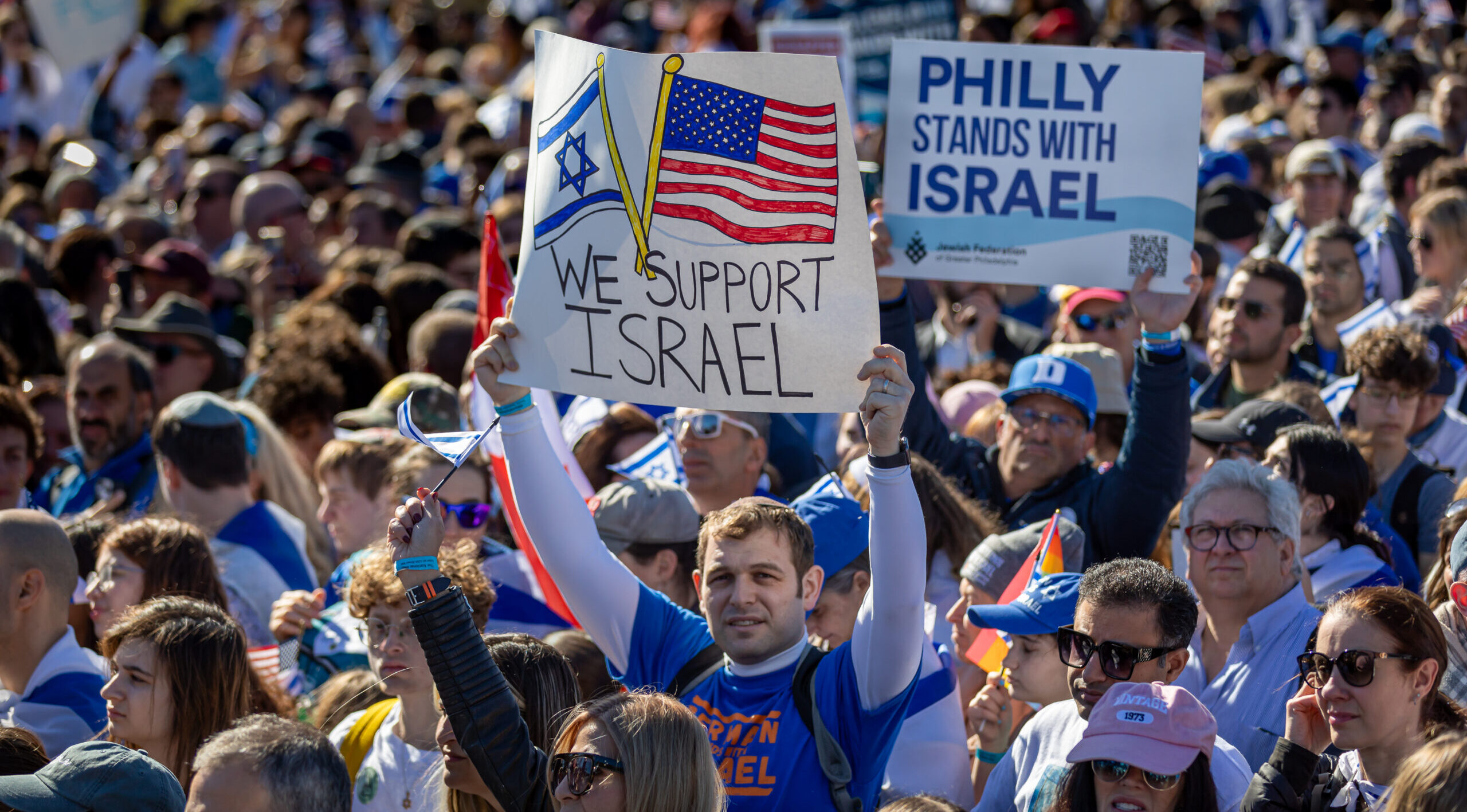
In the wake of Oct. 7, some in the Jewish community turned to faith, philanthropy or federal advocacy. Others set their sights closer to home, organizing to shape school boards and influence city councils
Owens and Kent are set to speak at a far-right Catholic advocacy gala, while one Catholic leader called to ‘reject the conspiracies … against our Jewish brothers and sisters’
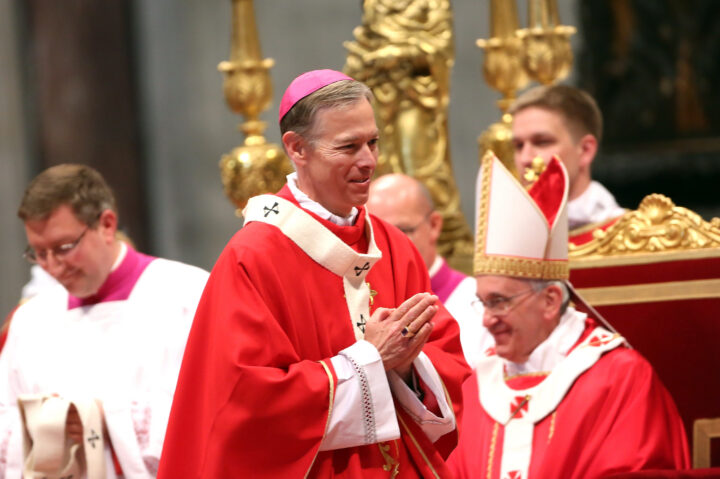
Franco Origlia/Getty Images
Archbishop of Portland Alexander King Sample receives the Pallium from Pope Francis during the Solemnity of Saint Peter and Paul at Vatican Basilica on June 29, 2013 in Vatican City, Vatican.
In the 24 hours before a fringe Catholic political group planned to host a gala in Washington honoring a number of public figures who have faced accusations of antisemitism, several prominent members of the American Catholic Church stated unequivocally that antisemitism is not a part of their religious doctrine.
“The Jewish community is attacked at a far higher rate than any other religious group in the United States. If we Catholics, in truly living out the Gospel, are to defend religious freedom with integrity, we must clearly speak out against antisemitism,” Archbishop Alexander K. Sample, the archbishop of Portland, Ore., said in a video posted by the U.S. Conference of Catholic Bishops on Wednesday.
Sample is the chairman of the religious liberty commission at the USCCB, the membership organization of current and retired Catholic bishops in the United States. The video was timed with the upcoming Easter holiday, which Sample said has “at times been the occasion for outbursts of hatred and even violence against Jews” by Catholics who collectively hold the Jews responsible for the crucifixion of Jesus.
“As Catholics, we are called to walk in the truth and so to reject the conspiracies and lies that lead to harassment and even violence against our Jewish brothers and sisters,” said Sample.
On Thursday morning, Vince Haley, the director of the White House Domestic Policy Council, delivered greetings from President Donald Trump at the annual National Catholic Prayer Breakfast in Washington. Haley, who is Catholic, wrapped up his own remarks with a call for Catholics to take a stand against antisemitism.
American Catholics have a responsibility, Haley said, “to render assistance to and speak out tirelessly in defense of our beloved Jewish neighbors and fellow citizens in the face of rising attacks and the tidal wave of hatred that is being manufactured against them.”
“Hatred toward Jewish people is ugly, despicable, an affront to the Sacred Heart of Jesus, and surely an occasion of terrible grief for our Jewish mother, Mary,” Haley continued. “And such evil should be condemned loudly and often by all people of goodwill, especially us.”
Neither Haley nor Sample mentioned the Catholic Prayer for America Gala, an event being hosted on Thursday night in Washington by Catholics for Catholics, a far-right political advocacy organization with a mission of targeting Catholic politicians who they deem to be insufficiently supportive of their perspective on church doctrine.
But the gala raised eyebrows across Washington when the organization announced just hours after Joe Kent resigned as director of the National Counterterrorism Center in protest of Trump’s policy toward Iran earlier this week that Kent would speak at the event.
Kent, who has a history of ties to far-right extremists and sought the support of antisemitic influencer Nick Fuentes during a 2022 congressional run, claimed that the U.S. was driven into war by “Israel and its powerful American lobby.”
The event’s lineup already featured a who’s who of right-wing media personalities who have faced accusations of antisemitism.
Carrie Prejean Boller, a former beauty pageant contestant who was fired from the White House Religious Liberty Commission Task Force in February after a disruptive anti-Zionist tirade at a public hearing, will be speaking. She was invited soon after the blow-up at the hearing, and in the weeks since she has doubled down on posting antisemitic content online.
At the Religious Liberty Commission hearing, Prejean Boller came to the defense of the far-right influencer Candace Owens, who since parting with the Daily Wire in 2024 has become a reliably antisemitic voice on social media. Owens will also be speaking at the Catholics for Catholics event, along with Michael Flynn, who served as national security advisor for the first 22 days of Trump’s first term.
‘But when you have hope you have to act. Even when you don’t have hope, you have to act,’ Bob Milgrim, father of Sarah Milgrim, said at ADL’s Never is Now

Courtesy
Bob and Nancy Milgrim speak at ADL's Never is Now on March 17, 2026.
Ten months after his daughter, Israeli Embassy employee Sarah Milgrim, was shot dead alongside her boyfriend and colleague, Yaron Lischinsky, outside the Capital Jewish Museum in Washington, Bob Milgrim said he feels a “deeper connection to the Jewish community [than] we ever felt before.”
On Tuesday evening, at the conclusion of the Anti-Defamation League’s Never is Now conference in Manhattan, Milgrim was joined in conversation with his wife, Nancy Milgrim, and CBS News reporter Jonah Kaplan. In June, Kaplan conducted the family’s first interview after Sarah was killed.
The support from the Jewish community since Sarah’s death, when she was shot by a gunman who allegedly shouted “Free Palestine” while leaving an event for young diplomats and Jewish professionals hosted by the American Jewish Committee last May, has been “totally overwhelming in a positive way,” said Bob Milgrim.
The Milgrims spoke days after another Jewish community was rocked by an antisemitic attack last week, in which an assailant drove a truck filled with explosives into Temple Israel in West Bloomfield Township, Mich., one of the largest Reform synagogues in the country, while 140 children were inside. Security guards prevented any casualties in the attempted terrorist attack.
Two months earlier, an antisemitic arsonist heavily damaged Beth Israel Congregation, the only synagogue in Jackson, Miss.
“It’s very easy to lose hope with what’s happening, especially with what happened at Temple Israel … and Mississippi,” said Milgrim. “There’s no end to it. But when you have hope you have to act. Even when you don’t have hope, you have to act.”
Addressing high school and college students in the audience, Milgrim said Sarah was one of only about 15 Jewish students at the high school she attended in Kansas. Drawing on Sarah’s involvement in the Jewish student union while in high school, he said, “you’ve got to be out there and let them know we’re no different from anybody else and we all want to coexist in peace.”
Milgrim reflected on an incident during Sarah’s senior year when swastikas were painted on the school building. When interviewed by a TV reporter, who asked her what the punishment for the perpetrator should be, Sarah said they “should be told to be more tolerant and nicer.”
“She didn’t want revenge, she saw the good in all people,” said Milgrim.
“Sarah was very proud to be Jewish and she didn’t shy away from letting people know she was Jewish,” added Nancy Milgrim. “I encourage you all to try to feel proud of who you are and let people know all the good of being Jewish.”
As the Milgrims continue to say the mourner’s prayer of Kaddish every morning, when the weather permits, while watching the sun rise at a park in their neighborhood —- alongside Sarah’s dog, Andy, and a virtual minyan —- Bob Milgrim said he “knows that we have family everywhere.”
“It’s more than a connection, it’s family. And that’s a beautiful experience that’s helped us get through this.”
Sarah’s work, which included a stint at Teach2Peace, an organization dedicated to building peace between Palestinians and Israelis, should inspire others “to do the things she was doing, reaching out to others who are not like you, inviting the stranger into your home, learning about other cultures and sharing your Jewish culture with them,” said Nancy. “If you can choose to do one thing to make the world a better place, you will be doing something to honor Sarah.”
The Texas senator called Tucker Carlson ‘the single most dangerous demagogue in this country’
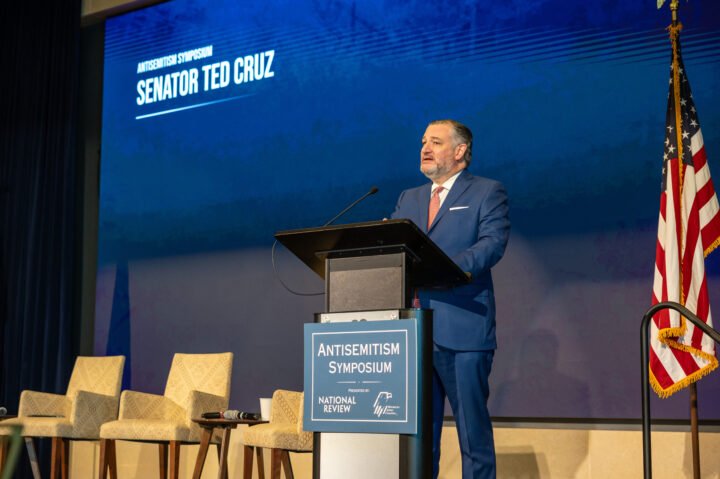
Republican Jewish Coalition
Sen. Ted Cruz (R-TX) speaks at antisemitism symposium in Washington on March 10, 2026.
Antisemitism is rising on the American right, Sen. Ted Cruz (R-TX) warned on Tuesday, expressing concern that efforts to combat it are not doing so quickly or effectively enough.
“I want us to be winning, but I’m not sure it is accurate as a descriptive manner that we are winning right now,” Cruz said at an antisemitism symposium in Washington organized by the Republican Jewish Coalition and the National Review.
Cruz has emerged in recent months as one of the Republican Party’s most vocal critics of right-wing antisemitism. He has targeted influential commentator Tucker Carlson and his strain of isolationist, anti-Israel politics that has in recent months crossed over into overt antisemitism, though Cruz has bemoaned other Republicans’ wariness to criticize Carlson by name.
At the RJC event, Cruz called Carlson “the single most dangerous demagogue in this country.”
But he said that not enough of his colleagues and allies on the right are aware of the extent of the problem.
“I don’t want to wake up in five years and find myself in a country where both major political parties are unambiguously anti-Israel and unapologetically antisemitic, and I think that is a real possibility. If Tucker and his minions prevail, that will happen,” Cruz argued.
Cruz expressed fear that this attitude is not just present but popular among young people on the right, as evidenced by two viral Turning Point USA events last fall where students at Auburn and Ole Miss cheered after deeply anti-Israel questions were asked.
“I worry about the 19-year-olds who say, ‘Oh, that’s what our team believes. That’s who we are.’ Let’s be clear, if you are a young, ambitious Democrat, it is obvious what you should do. You should be viciously anti-Israel,” said Cruz.
He applauded the people who came out to the Museum of the Bible on Tuesday to discuss antisemitism but pointed out that their concern does not reflect how the rest of the country thinks about the issue.
“The fact that this room is persuaded does not mean that the college campus is. It does not mean that the Capitol Hill interns are. It does not mean that the interns at Heritage, at [Conservative Partnership Institute] and every other conservative institution in this country, that they’re persuaded,” said Cruz. “We need to fight and engage it and take on the core premises, because if we lose the next generation, we lose the country.”
Cruz posited that Carlson and other anti-Israel influencers are being paid by foreign nations like Qatar, China and Russia, though he acknowledged that he lacks proof for that theory.
“I don’t believe all of these voices who have suddenly discovered that Israel is the source of all evil, that everything bad in the world was done by the Jews, that America is controlled by the Jews and that radical Islamic terrorists are really nice, wonderful people — I don’t think these people just arrived on this view organically and magically,” said Cruz.
“I think many of these influencers are cashing a check,” he added. “The people in this room could do an enormous service by documenting that. I don’t have the evidence right now to prove it, but Occam’s razor: the simplest explanation is usually the right one.”
J Street members are heading to Capitol Hill on Tuesday to lobby members of Congress to vote in favor of constraining military action in Iran
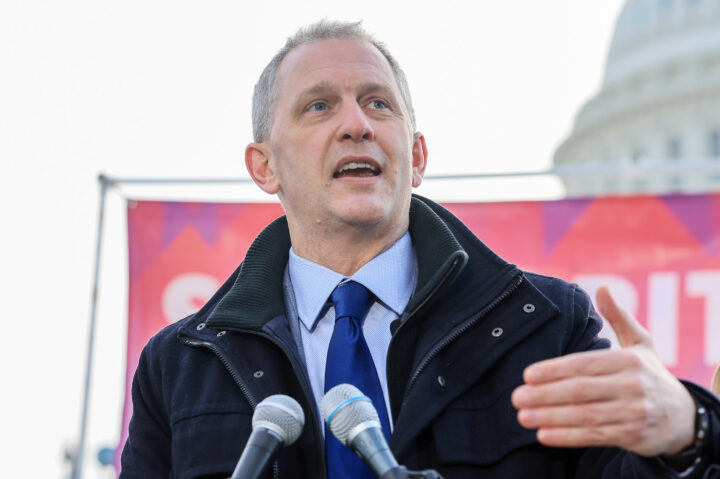
Jemal Countess/Getty Images for Protect Borrowers
Rep. Sean Casten (D-IL) speaks on Capitol Hill on February 09, 2026 in Washington, DC.
Democratic members of Congress addressing J Street’s national convention in Washington on Monday used the occasion to rally support for long-shot resolutions coming before the House and Senate this week that will attempt to end U.S. military strikes against Iran.
“The president’s refusal to pursue consent from Congress, as required by the Constitution, is perhaps his most grievous assault on democracy, and we should not let it stand,” Sen. Chris Murphy (D-CT) said to the 1,500 activists gathered at J Street’s morning plenary.
Rep. Sean Casten (D-IL) told the crowd that he expects to see “very robust, possibly unanimous support” from congressional Democrats on the measures, which would put an immediate end to U.S. operations against Iran.
“I’m not the whip, but certainly the caucus seems to be very on board with asserting their constitutional authority,” Casten said. Even some hawkish Democrats, like Sen. Jacky Rosen (D-NV), are expected to vote in support of the measure, although a handful of Democrats, including Reps. Josh Gottheimer (D-NJ) and Jared Moskowitz (D-FL), have already said they will oppose it.
Casten was speaking alongside Rep. Madeleine Dean (D-PA), both of whom had recently returned from a J Street-sponsored trip to Israel and the West Bank. Dean said President Donald Trump should have used his State of the Union address last week to more directly discuss the coming attacks on Iran.
“Wouldn’t that have been the time, at least by then, to begin messaging to the American people what the vision and the mission was — if he was going to take this extraordinary military action, and of course, to message it to Congress, to say to Congress, ‘I recognize your role’?” Dean said. “We are a constitutional democracy. We are supposed to actually make sure that the people closest to the ground, closest to the people, have some say.”
The war powers resolutions are likely to fail, given Republicans’ control of Congress and their overall support for the military action ordered by Trump over the weekend. Even if passed, they would need two-thirds support to override an inevitable presidential veto.
Sen. Brian Schatz (D-HI) told the audience that even if the war powers resolutions are defeated, Congress still has a role to play in further authorizing U.S. military strikes against Iran.
“Republicans defeating the resolution is not a war authorization. The law is clear: Congress needs to explicitly authorize war through an authorization of the use of military force,” said Schatz. “Congress has a duty not just to check a reckless and lawless president, but also to represent the will of the people. And the people want nothing to do with this.”
On Tuesday, J Street members will go to Capitol Hill to lobby lawmakers to oppose the strikes and to vote in support of the war powers resolutions.
“Elected officials are elected for a reason: to put themselves on the record at important moments, and this is one of those moments,” J Street President Jeremy Ben-Ami told reporters on Monday. “We urge senators and congressmen to vote in favor of a war powers resolution when it comes to the floor.”
URJ’s Rabbi Rick Jacobs: ‘America’s Jewish congregations are diverse, filled with good, moral people who differ on complex issues’

Michael Brochstein/Sipa via AP Images
J Street President Jeremy Ben-Ami speak at the 2022 J Street National Conference held at the Omni Shoreham Hotel in Washington, D.C.
When more than 1,500 people gathered in Washington this weekend for J Street’s national conference, the progressive Israel advocacy group’s first major convening in four years, the gathering was billed as an opportunity to reflect on building regional peace in the Middle East in the aftermath of the Gaza war.
Instead, a major U.S. and Israeli military operation against Iran that began Saturday undercut the group’s pledge to focus on peace between Israelis and Palestinians and came to dominate the discussion. J Street quickly came out against the attacks.
The first speaker on the conference’s main stage on Sunday took an unusual departure from J Street’s dogma on diplomacy by noting that the organization’s positions are not the only ones that should be taken seriously in the Jewish community.
Rabbi Rick Jacobs, the president of the Union for Reform Judaism, kicked off the conference program by noting that J Street’s position, one of stark opposition to the attacks, sits alongside the views of others in the Jewish community who have cheered U.S. and Israeli military strikes seeking to bring about regime change in Iran.
“I’m certain that many in this gathering agree, as a matter of principle and foreign policy, with the J Street statement,” Jacobs said. “Many in our congregations might also agree. But America’s Jewish congregations are diverse, filled with good, moral people who differ on complex issues, as those raised by the Iran attacks.”
J Street’s leaders often make the case that greater nuance and complexity is required within the U.S. Jewish community, particularly making space for left-wing views on Israel within mainstream Jewish groups. Jacobs was making the argument in reverse: that people could also support the attacks in good conscience, and that neither view is superior.
“There are many in our congregations, in the Jewish community at large and in the broader American public who want to seek regime change for the sake of the people of Iran, for eliminating threats to America’s and Israel’s security, and to enhance stability in the region, who may well recognize that war is surely not the remedy for every global conflict, but feel there are times when military force is justified and believe a case can be made,” Jacobs continued.
Later, J Street President Jeremy Ben-Ami clarified where the group stands but said there is room in the organization for people who disagree.
“I made very clear J Street’s adamant and clear opposition to this war. It is a war of choice. It is a war without clear objectives. It is a war without a plan to achieve those unclear objectives. It is a war without constitutionally required congressional approval, and it is a war without public consent,” Ben-Ami said. “It is clear that in this room there is a mix of opinions. Not everyone in J Street would agree with the clear, articulated opposition to the war that I laid out.”
Sen. Chris Van Hollen (D-MD) called the war “dangerous” and said it would make Americans less safe. British human rights lawyer Phillippe Sands compared the attack on Iran to Russia’s invasion of Ukraine. On the other hand, former Israeli Prime Minister Ehud Olmert said Iran “needs to be punished.” In a video message recorded before the attacks began, Yair Golan, the leader of Israel’s liberal Democrats party, said that if war with Iran starts, “let us defeat those who seek our destruction.” Both Olmert and Golan are fierce opponents of Israeli Prime Minister Benjamin Netanyahu.
But while the convention main stage offered some room for nuance on Iran, most speakers were otherwise aligned on J Street’s messaging — that Israel’s government, led by Netanyahu, is not doing enough to make peace with Palestinians or to rein in violent settlers in the West Bank, and that the U.S., meanwhile, is not doing enough to safeguard Palestinians or provide oversight of Israel’s use of its military aid.
“There can’t be a continuing blank check when the Netanyahu government is operating in violation of American law, which they have repeatedly, or in violation of international law,” Van Hollen said.
Later in his speech, Jacobs, the URJ president, said the U.S. Jewish community must also learn to accept diverging opinions on Israel.
“It does not make one love Israel any less to be pained by the loss of life and suffering among innocents, and we must learn how to work amidst difference. Our Jewish community will not be safe only with more cameras and security protocols. Does anti-Zionism spill over into antisemitism? Yes. But not always,” Jacobs said.
J Street also plans to use the conference to spotlight its growing political influence in the Democratic Party, with a fundraiser on Sunday evening for North Carolina Senate candidate Roy Cooper, the former governor. Attendees will also be able to join a phone bank for Evanston, Ill., Mayor Daniel Biss, who is running for Congress in a contentious Democratic primary in Illinois where Israel has become a key issue.
Other congressional speakers slated to address the conference on Monday include Sens. Brian Schatz (D-HI), Chris Murphy (D-CT), Adam Schiff (D-CA) and Tim Kaine (D-VA), as well as Reps. Nancy Pelosi (D-CA), Sean Casten (D-IL), Madeleine Dean (D-PA) and Sara Jacobs (D-CA). The executive director of the House Majority PAC, a Super PAC that supports Democratic congressional candidates, will be at the conference meeting with top J Street donors.
D.C. JCRC CEO Ron Halber called the DSA’s requirements for its backing ‘an antisemitic manifesto’
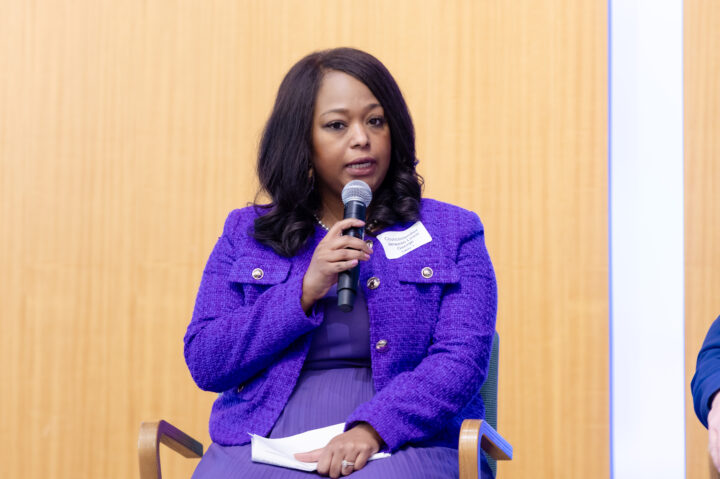
Jewish Community Relations Council of Greater Washington
D.C. City Councilmember Janeese Lewis George speaks at a "Lox and Legislators" breakfast held by the Jewish Community Relations Council of Greater Washington on Dec. 18, 2025
Washington, D.C., mayoral candidate Janeese Lewis George told the Metro D.C. chapter of the Democratic Socialists of America that she will not attend events focused on “promoting Zionism and apartheid,” according to a questionnaire from the group that she filled out prior to earning its endorsement earlier this month.
“I will refrain from going on any political junkets to Israel. I will also not attend events focused on obfuscating the realities of occupation or promoting Zionism and apartheid,” Lewis George wrote in her answers on the questionnaire, which the local DSA group posted to its website. Lewis George described herself as “a proud member of Metro DC DSA.”
The DSA questionnaire asks candidates to publicly support the Boycott, Divestment and Sanctions movement, and to refrain from engaging with “the Israeli government or Zionist lobby groups” — a category that it said includes AIPAC, Democratic Majority for Israel, Christians United for Israel and the more liberal J Street.
It also asks candidates in the region to “oppose legislation that harms Palestinians and supporters of the Palestine solidarity movement,” including legislation promoting the International Holocaust Remembrance Alliance’s working definition of antisemitism, efforts to counter the BDS movement or measures that “send any military or economic resources to Israel.”
Lewis George did not say if she backs the BDS movement but said she supports “the right of all people, including Palestinians, to use nonviolent strategies like boycotts and calls for divestment to build a more just world.” She said D.C. “has no business sending military or economic resources to Israel.”
Lewis George, a D.C. Council member who is running in the open race to replace Mayor Muriel Bowser, defended her appearance at a Jewish Community Relations Council of Greater Washington event in December, where she committed to taking proactive steps to protect the Jewish community.
“In my current role as a councilmember and as mayor, however, I will have to attend events and meet with many people and organizations who do not share my values or with whom I’m not totally aligned,” Lewis George wrote in the questionnaire. “The JCRC legislative breakfast in December was an example. I disagree with the JCRC on a number of issues, including their opposition to using the word ‘genocide’ to describe Israel’s actions in Gaza.”
Lewis George told DSA that she disagrees with JCRC’s “definition of anti-semitism that criminalizes dissent, and their attacks on activists.” At the JCRC event, she gave a speech criticizing antisemitism and pledging to stand by Jewish Washingtonians, although she did not mention that in the DSA questionnaire.
“Attending that JCRC event was not an endorsement of JCRC and does not signal that I agree with their stance on Israel or Zionism. I did not go to the JCRC event to talk about Israel and that was not the focus of the event,” Lewis George wrote. “I went to the event to advocate for an end to ICE collaboration, seek allies in that effort, and build on our shared goal of ending the inhumane treatment of our neighbors who are being taken by ICE.”
Lewis George reiterated her support for George Washington University students who had organized an anti-Israel encampment in the spring of 2024.
“I will continue to stand up against efforts to silence local Pro-Palestinian speech and organizing,” she wrote. “I believe that democracy requires freedom of expression and I oppose the government penalizing anyone for participating in non-violent protest, no matter the subject. People surely disagree on many important issues but I think our community and country are at their best when the government does not stifle dissent.”
Lewis George represents Washington’s Ward 4, which encompasses Upper Northwest D.C. around Rock Creek Park, including the neighborhoods of Shepherd Park, Chevy Chase, Brightwood, Petworth and Sixteenth Street Heights.
JCRC CEO Ron Halber told Jewish Insider on Wednesday that he’s noticed the D.C. DSA chapter has been more active since Zohran Mamdani was elected as mayor of New York City with the backing of DSA in November.
“What we noticed was there’s been an uptick in DSA locally, both in Montgomery County [Maryland] and in D.C., approaching candidates for their endorsement,” Halber said. “They’re basically saying that candidates should not be with any Jewish organization, whether it be a synagogue or a mainstream organization like JCRC, through the criteria they establish. As far as I’m concerned, [the questionnaire] is an antisemitic manifesto. They are making the price of their endorsement the social exclusion of Jews.”
Halber declined to comment on DSA’s endorsement of Lewis George, saying JCRC does not get involved in electoral matters as a nonprofit organization.
Carrie Prejean Boller, a member of the commission and a former Miss California, said she opposes Israel and defended Candace Owens from allegations of antisemitism
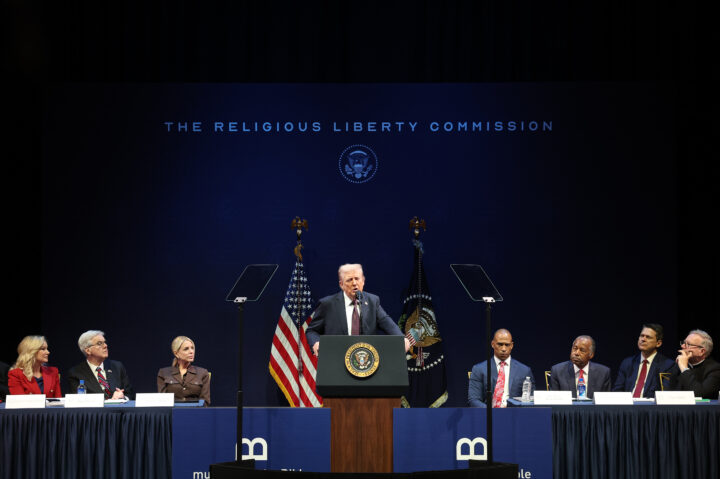
Win McNamee/Getty Images
President Donald Trump speaks at the Museum of the Bible September 8, 2025 in Washington, DC.
When the White House Religious Liberty Commission gathered in Washington on Monday for the body’s first public hearing focused on antisemitism, attendees expected an informative if subdued meeting, meant to gather testimony from Jewish Americans who have faced antisemitism. The commission’s members are tasked with drafting a report with recommendations for President Donald Trump about how to promote religious liberty.
The speakers were mostly conservative, like the 13 members of the commission, which was created by Trump last year.
The conversation was largely friendly, barring one member of the commission, Catholic conservative activist and former Miss California Carrie Prejean Boller, who acted as more of an interrogator. She pushed back on witnesses’ testimony, arguing that they had defined antisemitism too broadly and questioning whether she would be considered an antisemite because she does not support Zionism and because she believes the Jews killed Jesus.
She also defended right-wing influencer Candace Owens from accusations of antisemitism.
“I listen to her daily,” said Prejean Boller, who appeared to be wearing a Palestinian flag pin. “I haven’t heard one thing out of her mouth that I would say is antisemitic.” In 2024, Owens was dropped from a Trump campaign event where she was slated to speak alongside Donald Trump Jr. after the campaign faced backlash for including Owens, who regularly shares antisemitic commentary in social media posts and on her podcast.
The first panel of speakers featured former UCLA law student Yitzy Frankel, who sued the university over its handling of antisemitism during the 2024 encampments; Yeshiva University President Ari Berman; Harvard alum Shabbos Kestenbaum; and former Auburn basketball coach Bruce Pearl. Each of them talked about their experiences of antisemitism — or combating it — in the United States after the Oct. 7, 2023, attacks in Israel.
After nearly an hour and a half, Prejean Boller revealed that she had been counting each mention of Israel in the course of the discussion.
“Since we’ve mentioned Israel a total of 17 times, are you willing to condemn what Israel has done in Gaza?” said Prejean Boller. “You won’t condemn that? Just on the record.”
Prejean Boller insisted that she opposes Israel because of her Catholic faith.
“Catholics do not embrace Zionism, just so you know. So are all Catholics antisemites?” Prejean Boller asked the panel, earning some boos from the audience, a mix of Jewish professionals, Christian activists and members of the Washington Jewish community. “I want to be clear on what the definition of antisemitism is. If I don’t support the political state of Israel, am I an antisemite, yes or no?”
At the end of the first panel, the Religious Liberty Commission’s sole Jewish member, Rabbi Meir Soloveichik of Congregation Shearith Israel in New York, offered a pointed response to Prejean Boller’s commentary about Catholics.
“This is an incredibly diverse country, and the one thing we should be careful about is speaking on behalf of all members of a religious community, even if one is a member of that religious community. I certainly wouldn’t claim to speak for all Jews on all subjects,” said Soloveichik. “We’re not known for agreeing on everything, and that certainly should be said for speaking about Catholics in America.”
Soloveichik then quoted Secretary of State Marco Rubio, “who also happens to be a very devout Catholic,” and who spoke about the Jewish people’s connection to the land of Israel during a visit to Jerusalem last year.
Prejean was a member of Trump’s campaign advisory board in 2020. The next year, she began using social media to rally against COVID-19 mask mandates. “You’re the next Rosa Parks. You’re the next Martin Luther King. This is so important that you stand,” she told a group of girls in 2021, urging them to go to school without masks, according to a video she posted on her Instagram.
At the time, she had 11,000 followers. Now she has 124,000 followers. She is also an advocate against transgender women and girls participating in female sports, and an opponent of same-sex marriage. Recently, she began regularly posting videos from Owens and Tucker Carlson, along with sharp criticism towards Israel. Her biography on the commission’s website lists only her beauty pageant title and a book she authored about it. A White House spokesperson did not respond to a request for comment.
“They mocked her. They censored her. They called her a ‘crazy conspiracy theorist’ simply for asking questions,” Prejean Boller wrote in a recent post about Owens. “I stand with Tucker,” she wrote in another post.
“I would really appreciate it if you would stop calling Candace Owens an antisemite,” Prejean Boller said at the hearing. “She’s not an antisemite. She just doesn’t support Zionism, and that really has to stop.”
Other commission members include Cardinal Timothy Dolan, the former Archbishop of New York; Pastor Paula White, a senior advisor to the White House Faith Office; and Pastor Franklin Graham, president and CEO of the Billy Graham Evangelistic Association and of Samaritan’s Purse. It is chaired by Texas Lt. Gov. Dan Patrick.
The rest of the Monday hearing proceeded as planned: bureaucratic, genial, straightforward. The commission’s membership is mostly Christian, and much of the discussion of antisemitism presented it as a problem for those who believe in Judeo-Christian values, and an issue for Jews and Christians to combat together — with an understanding that the government should be in the business of supporting Americans’ freedom of religion. The event took place at the Museum of the Bible, a private institution established by the evangelical founder of Hobby Lobby.
“I want to thank everyone who is part of this fight,” Housing and Urban Development Secretary Scott Turner said at the start of the event. “It’s a battle that President Trump will continue to wage for Jewish Americans, for Christians, and for all Americans of all faiths whose First Amendment freedoms are under attack. I know it’s fitting that we’re here at the Museum of the Bible. The word of God is powerful, and it’s a powerful reminder of the importance of the First Amendment.”
‘The Prime Minister believes any negotiations must include limitations on ballistic missiles and a halting of the support for the Iranian axis,’ Netanyahu’s office says

Avi Ohayon (GPO) / Handout/Anadolu via Getty Images
Israeli Prime Minister Benjamin Netanyahu makes statements at Ben Gurion Airport ahead of his visit to Washington DC, where he will meet with US President Donald Trump in Tel Aviv, Israel on February 02, 2025.
Israeli Prime Minister Benjamin Netanyahu’s office announced a last-minute trip to Washington on Wednesday to discuss talks between the U.S. and Iran, a day after President Donald Trump praised the negotiations with Tehran.
“The Prime Minister believes any negotiations must include limitations on ballistic missiles and a halting of the support for the Iranian axis,” the statement, sent Saturday night, read.
White House Special Envoy Steve Witkoff and Jared Kushner met with Iranian Foreign Minister Abbas Araghchi in Oman on Friday.
Later Friday, Trump told reporters on Air Force One that the talks had been “very good.”
“Iran looks like it wants to make a deal very badly,” he said. “We have to see what that deal is, but I think Iran wants to make a deal very badly, like they should. Last time, they didn’t want to make a deal, but I think this time they feel differently.”
Asked about Iran’s demand that the talks only be about nuclear weapons, Trump said, “That would be acceptable. One thing, right up front, no nuclear weapons. … They weren’t willing to do that [last year]; now they are willing to do much more.”
The president also said that he is in “no rush” in the negotiations, adding, “If you remember in Venezuela, we waited around for a while.”
Trump indicated that the military threat to Iran still stands: “We have a big armada, a big fleet heading in that direction that will be there soon, so we’ll see how that works out. … If they don’t make a deal, the consequences are very steep.”
Sen. Lindsey Graham (R-SC) expressed skepticism that the negotiations would bring about an acceptable agreement, and called for Congressional review and approval, which the 2015 Iran nuclear deal lacked.
“I hope it can meet our national security objectives and the needs of the people of Iran through diplomacy,” Graham wrote on X. “Given Iran’s behavior regarding deals, it could be a tough sell. However, I am open-minded, understanding [that] any agreement with the Islamic Republic and the United States must come to Congress for review and a vote.”
Meanwhile, in Iran, videos and photos were posted online of Iranians once again protesting the regime using methods other than mass demonstrations, The Wall Street Journal reported, including shouting slogans at funerals, doctors condemning the arrest of colleagues for treating wounded protesters, hosting memorials for wounded protesters and more.
Analysts tell JI that the move ‘is not the behavior Washington can reasonably expect from a partner who would like to be trusted with the F-35’

ASIF HASSAN/AFP via Getty Images
Pakistan's Air Force fighter JF-17 fighter jets fly past during the multinational naval exercise AMAN-25 in the Arabian Sea near Pakistan's port city of Karachi on February 10, 2025, as more than 50 countries participating with ships and observers.
Reports that Saudi Arabia may strike a deal with Pakistan to acquire Chinese-Pakistani JF-17 Thunder fighter jets are raising concerns in Washington, as Riyadh’s potential acquisition of the aircraft signals a continuation of its recent shift in alliances and could complicate its efforts to secure the U.S.’ F-35 jet.
The discussions between Saudi Arabia and Pakistan, first reported by regional outlets, would deepen defense ties between the two longtime partners while easing Karachi’s financial strain by wiping out its $2 billion in loans from the kingdom.
The JF-17, which is widely used by the Pakistani Air Force, was jointly developed by Pakistan and China, and incorporates Chinese electronic systems and a Russian engine.
Grant Rumley, a senior fellow at The Washington Institute for Near East Policy, said the aircraft would offer little operational benefit to Saudi Arabia, which already fields a fleet of U.S.- and European-made fighter jets, and could instead be a sign that Riyadh is aiming to strengthen ties with multiple defense partners.
“I don’t think there’s any military justification for Saudi Arabia purchasing this plane,” Rumley said, noting that the kingdom’s existing F-15s and Eurofighter Typhoons — along with its planned acquisition of the F-35 — would significantly outperform the JF-17. “Saudi understands Pakistan is in a tough economic situation and converting it into JF-17s is a way to alleviate some economic pressure and further intensify or accelerate defense cooperation.”
Rumley added that despite the lack of military advantage from the JF-17, Saudi Arabia’s desire to acquire the fighter jet linked to U.S. adversaries raises concerns about U.S. national security and Riyadh’s political alignment, potentially prompting backlash that could complicate or even derail Riyadh’s procurement of F-35s from the U.S.
“The fact that [the JF-17] has a Russian engine and Chinese avionics means it will very likely be viewed as a security risk if it’s co-located near U.S. forces,” said Rumley, who warned this arrangement could pose a danger to the protection of U.S. intel. “The F-35 is one of the crown jewels of American military equipment. Protecting that proprietary information and capabilities is a top priority across party lines in the U.S. national security apparatus.”
Such a deal could create “undue turbulence” for Saudi Arabia’s acquisition of the F-35, potentially “complicating the discussion” around the deal and even putting it “into jeopardy,” Rumley said.
While experts said it is unlikely Congress would be able to stop an F-35 sale to Riyadh if the White House gives it the green light, they warned the JF-17 talks could provoke internal pushback within the administration, particularly among officials focused on competition with China.
“The Saudis are publicly entertaining this deal because of their dissatisfaction with U.S. policy, their desire to build leverage that brings America around to the Saudi position and, if that fails, to enable Riyadh to develop alternative security ties,” said Jonathan Ruhe, a fellow at the Jewish Institute for National Security of America. “The fact that the Saudis are considering such inferior aircraft, from a less established partner, emphasizes their dislike of how the broader U.S. defense relationship is trending.”
“The China hawks within the U.S. will not look favorably on this type of arrangement in general,” said Rumley. “Buying a fighter jet that’s co-produced with China and has Chinese technologies, as well as Russian technologies, is going to burn through a lot of goodwill with the folks in Washington.”
Jonathan Ruhe, a fellow at the Jewish Institute for National Security of America, said a Saudi deal for the JF-17s could also “throw a major wrench in existing defense cooperation with Riyadh,” framing the reported talks as part of a potential reassessment of the kingdom’s security partnerships.
“The Saudis are publicly entertaining this deal because of their dissatisfaction with U.S. policy, their desire to build leverage that brings America around to the Saudi position and, if that fails, to enable Riyadh to develop alternative security ties,” said Ruhe. “The fact that the Saudis are considering such inferior aircraft, from a less established partner, emphasizes their dislike of how the broader U.S. defense relationship is trending.”
He added that Saudi Arabia has historically used major arms purchases to build political leverage rather than to fill operational gaps, noting that Saudi officials have closely watched Qatar’s use of “checkbook diplomacy” to secure a unilateral U.S. security guarantee last year, even as Riyadh’s own mutual defense treaty discussions stalled.
In recent weeks, observers have noted that Saudi Arabia has increasingly pivoted away from moderation and toward Turkey, Qatar, Iran, and Pakistan, as seen in their actions in Yemen, Sudan, and the horn of Africa, along with attacking the UAE over its relationship with Israel.
“Riyadh’s current security cooperation with China is not the behavior Washington can reasonably expect from a partner who would like to be trusted with the F-35,” said Justin Leopold-Cohen, a senior research analyst at the Foundation for Defense of Democracies, who noted that any deal should be viewed “in the context of Riyadh’s recent naval exercises with China.”
“Saudi Arabia looks at Turkey and Pakistan and sees sort of a middleweight power that is able to exert a ton of influence in the profession of arms and is able to put platforms on the market that drive, not only revenues at home, but is also a pretty effective instrument of national power,” said Rumley. “And they [Saudi Arabia] want that.”
Justin Leopold-Cohen, a senior research analyst at the Foundation for Defense of Democracies, said the reported talks likely reflect Saudi Arabia’s desire to “avoid overreliance” on any single defense partner, though he echoed concerns from the U.S. perspective.
“Riyadh’s current security cooperation with China is not the behavior Washington can reasonably expect from a partner who would like to be trusted with the F-35,” said Leopold-Cohen, who noted that any deal should be viewed “in the context of Riyadh’s recent naval exercises with China.”
However, Rumley argued that such a deal may not necessarily reflect “realignment from a security standpoint,” but could be “more about gaining access to some other technologies.”
“It may be that this is simply a way for Saudi Arabia to get access to these jets, rip them up, or reverse engineer them and take those technologies and use them for their own defense, industrial base development,” said Rumley.
The lawmakers downplayed reports of a serious Gulf rift, with Rep. Brad Sherman calling the increasing disputes between neighbors ‘tactical, not ideological’
BRENDAN SMIALOWSKI/AFP via Getty Images
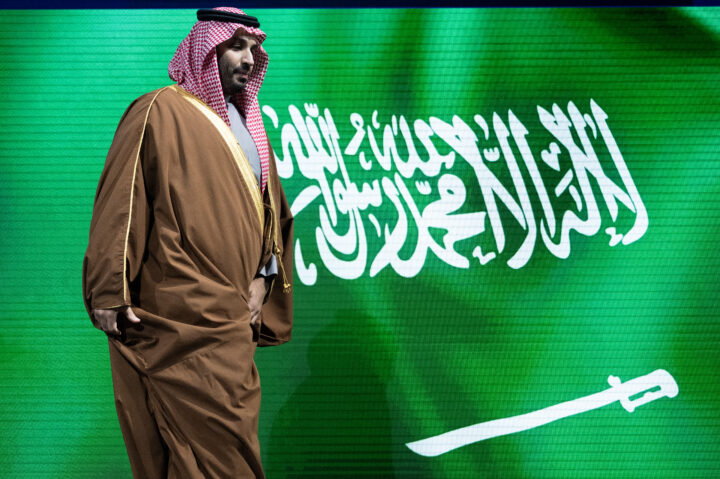
Saudi Arabia Crown Prince Mohammad bin Salman Al Saud walks to his seat after speaking during the US-Saudi Investment Forum at the Kennedy Center November 19, 2025, in Washington, DC.
Lawmakers in Washington are largely downplaying recent developments suggesting that Saudi Arabia is pivoting away from moderation and entertaining more hardline Islamism.
Saudi Arabia and the United Arab Emirates have been at loggerheads in Sudan, Somalia and Yemen — including a recent Saudi airstrike on an Emirati shipment in southern Yemen — prompting questions about Riyadh’s continued interest in acting as a moderating force in the region.
Saudi Arabia has also sided with Muslim Brotherhood-aligned forces in other regional conflicts, is increasing its business ties with Qatar and softening its stance toward other Islamist powers hostile to Israel, among other steps, some analysts say.
Saudi Foreign Minister Prince Faisal bin Farhan Al Saud met with lawmakers on Capitol Hill on Wednesday, who came away from the meeting indicating that potential disputes or shifts in the kingdom had been overstated.
Rep. Brad Sherman (D-CA) — who has been critical of Saudi Arabia in the past — told Jewish Insider that Prince Faisal, in the meeting, sought to directly rebut claims that Saudi Arabia was pivoting away from a position of moderation.
The overall message from Prince Faisal, Sherman said, was “the Saudis claim that they are anti-Brotherhood and that the disputes with the UAE are tactical, not ideological.”
“Just because the Saudis are not Shiite does not mean they’re Zionists. No one should get too carried away. And I’m sure there are elements of the Saudi government that are not nearly anti-[Muslim] Brotherhood as much as they should be,” Sherman said. “That being said, I see a foreign minister who is not Qatar or Turkey.”
“If you’re worried about Israel, you should never put any of the countries we’re talking about here in the ‘don’t worry about it’ category — you’ve got to worry,” he continued. “But the foreign minister went out of his way to say that when it comes to the Brotherhood or Iran, that there’s less reason to worry about Saudi Arabia.”
He said that he expects Saudi Arabia and the UAE to come to an agreement on the anti-Houthi campaign to deconflict the situation — likely one which would see the UAE take a decreased role in Yemen.
Sherman also said he did not see evidence that Saudi Arabia has significantly accelerated or expanded its relationship with Qatar — though he also noted that Saudi-Qatari tensions have gradually eased over the past few years and particularly since the Arab League blockade of Qatar. Saudi Arabia signed a major deal earlier this month to link Riyadh and Doha with a high-speed rail line.
Even so, Sherman said he has other pre-existing concerns about Saudi Arabia, such as its pursuit of a nuclear program and bid to purchase F-35 fighter jets, neither of which was discussed at Wednesday’s meeting.
Rep. Brian Mast (R-FL), the chairman of the House Foreign Affairs Committee, also met with Prince Faisal. He said it was “great” to see the foreign minister and that the group had discussed various issues including Yemen, Sudan and Gaza.
“Saudi Arabia and UAE are very close, right? I mean, that’s an understatement,” Rep. Brian Mast (R-FL), the chairman of the House Foreign Affairs Committee, told JI. “What I’m saying — everybody can have disagreements, spats, misunderstandings about different things, and that relationship is no different, but those two are two very, very close allies.”
“The U.S.-Saudi relationship remains a pillar of U.S. policy in the region,” Mast said in a statement. “I look forward to continuing to build upon our decades-old alliance to help resolve some of the region’s most pressing and complex challenges.”
He dismissed concerns about a potential Saudi repositioning or clash with the UAE.
“Saudi Arabia and UAE are very close, right? I mean, that’s an understatement,” Mast told JI in a brief interview. “What I’m saying — everybody can have disagreements, spats, misunderstandings about different things, and that relationship is no different, but those two are two very, very close allies.”
A congressional source deeply involved in Middle East issues argued that ties between the Sudanese Armed Forces — the faction Saudi Arabia is backing in Sudan — and the Muslim Brotherhood have been overstated and that the Saudi decision to back the SAF is a tactical one rather than an ideological signal of alignment with the Brotherhood. The source said that the Saudis have indicated that they are working to push the Brotherhood elements out of the SAF faction.
And, the source emphasized, both sides in Sudan have committed significant atrocities, further noting that the Trump administration sanctioned the Rapid Support Forces — which successive U.S. governments have found is committing genocide. The source said that Saudi Arabian officials have been clear they do not want the U.S. to sanction the UAE over its alleged support for the RSF, as some in Abu Dhabi heard after Saudi Crown Prince Mohammed bin Salman’s visit.
Regarding the Saudi strike in Yemen, the source said that Saudi Arabia was concerned about anti-Saudi forces approaching its territory and that the shipment the UAE convoy was transporting was being provided to those forces.
Sen. Markwayne Mullin (R-OK) said that there “a lot of concerns” about a Saudi dispute with the UAE in Yemen but that he is not “worried about [the Saudis] repositioning to an extreme point.”
“I don’t think we see that yet. There’s still a lot of conversations going on,” Mullin said. “I think that was just one of those regional things that sometimes we have a lack of understanding — or maybe understand it, but don’t understand it.”
Another lawmaker who has had conversations with individuals in the region said on condition of anonymity that — despite recent headlines — they did not believe that Saudi Arabia was making a fundamental pivot in its posture away from moderation or toward a more extremist Islamist stance.
The lawmaker added that the tensions between the two U.S. partners have been “surprising” but also noted there is a long and complex history between the two countries.
Addressing the Saudi-Emirati tensions, Sen. Pete Ricketts (R-NE), the No. 2 Republican on the Senate Foreign Relations Committee, acknowledged that the two countries had conveyed “different interests,” but did not appear concerned that their differences would alter the Saudis’ view of Iran as the top threat in the region.
“The UAE seems like they’re trying to diversify their sources of support in the region, and that’s a point of some disagreement between the Saudi leadership and UAE leadership,” Sen. John Cornyn (R-TX) told JI.
“I have no insight into what’s going on there, but clearly they’ve got different interests,” Ricketts told JI. “Saudi Arabia’s long-term interest is in a peaceful Middle East where they have allies to offset Iran. Saudi Arabia knows that in the region their worst enemy is Iran, and so they’re going to want allies to push back.”
Sen. John Cornyn (R-TX), who sits on the Senate Intelligence Committee as well as on Foreign Relations, said his primary concern was the UAE’s deepening ties with Russia.
“I mean, the UAE seems like they’re trying to diversify their sources of support in the region, and that’s a point of some disagreement between the Saudi leadership and UAE leadership,” Cornyn told JI.
“What worries me a little bit is UAE talking about allowing the Russians to build a military base there,” he continued. “They seem to be less convinced that they can rely on support from the United States and so they are looking for other friends. That concerns me.”
Sen. John Kennedy (R-LA) attributed the fissures to the situation in Sudan and instability in Yemen that neither country could independently solve, but said he had been informed that the Saudis and Emiratis had addressed their differences.
“Well, Yemen is a mess,” Kennedy said. “The UAE and the Saudis have been allies. Now, they recently got crossways, but I understand they got it worked out. I don’t know what else to say. I mean, Yemen is just, … it’s not a stable country.”
Pressed on the Gulf states having “worked out” their issues, the Louisiana senator responded, “Well, I think that got a lot of it worked out. The Saudis and UAE … they’re crossways in Sudan. They’re not always joined at the hip, so I wasn’t particularly shocked about it, but my understanding is they got it worked out.”
Sen. Mark Warner (D-VA), the ranking member of the Senate Intelligence Committee, said he hadn’t been following all of the developments with Saudi Arabia’s regional posture but had been tracking the conflict in Sudan, where Saudi Arabia and the UAE have been backing opposing sides in the civil war. Warner emphasized that “neither one of them are the good guys,” referring to the UAE-aligned RSF and Saudi-aligned SAF.
“It does bother me, not just where [the Saudis] may be moving, but also just … in terms of bombing [in] Yemen,” Warner added, referring to the Saudi strike.
Warner, who led Intelligence Committee members on a visit to Saudi Arabia to meet with Crown Prince Mohammed bin Salman in 2024, said that the Saudis were, at the time, “anxious to get normalization with Israel,” but the Gaza war interrupted that progress.
And Sen. Richard Blumenthal (D-CT) said the “instability” in the region — including the Saudi-UAE tensions — demonstrates the need for strong congressional oversight of “any agreement that’s reached with any of our potential partners there.
President Donald Trump recently announced a series of deals with Saudi Arabia, including selling the kingdom F-35 fighter jets and naming Riyadh a major non-NATO ally, without making public strides toward Saudi-Israeli normalization.
“And very bluntly, it reemphasizes that our one truly reliable ally in the Middle East is Israel,” Blumenthal continued.
After Israel announced it would recognize the secessionist region, the big question remains whether the United States will follow suit
Shlomi Amsalem, GPO
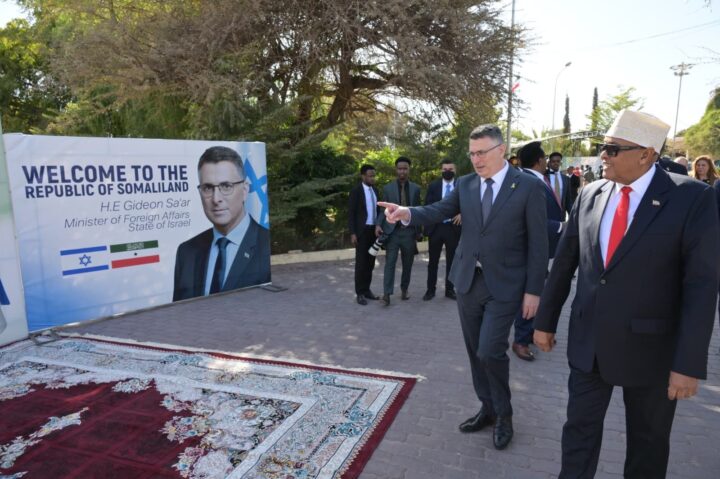
Israeli Foreign Minister Gideon Sa’ar meets with Somaliland President Abdirahman Mohamed Abdullahi in Hargeisa, Somaliland, Jan 6, 2026
When Israel announced the day after Christmas that it would formally recognize Somaliland, making it the first country in the world to announce formal diplomatic relations with the secessionist region in the Horn of Africa, even some of Washington’s foremost foreign policy experts were sheepishly asking the same question: What, exactly, is Somaliland?
There was no single event that led to Israel’s choice to recognize the sovereignty of Somaliland, which announced its independence from Somalia in 1991. The territory has functioned independently for 35 years; nothing in its governance changed last year.
What changed was Israel — and its geopolitical calculus regarding regional security threats.
“The Houthis didn’t used to fire missiles at Israel. That’s new, and Israel’s now trying to respond to a new situation,” said David Makovsky, the Ziegler Distinguished Fellow at The Washington Institute for Near East Policy. “I have no doubt that this was driven by how to try to neutralize a threat from the Houthis that Israel takes very seriously.”
Somaliland sits just across the Gulf of Aden from Yemen, from which the Iran-backed Houthis have fired drones and ballistic missiles at Israel following the Oct. 7 Hamas attacks in 2023. Allying with Somaliland could allow Israel to target the Yemeni militia from much closer range. Israel has also reportedly approached Somaliland about resettling Palestinians from Gaza there, although officials in the country have denied that such conversations took place.
Somaliland also sits in a strategic location south of Djibouti and to the east of Ethiopia, and its coastland is close to where the Indian Ocean and Red Sea meet, making it a prime shipping location.
“No one can ignore the strategic location of Somaliland,” Israel’s ambassador to the United Nations, Danny Danon, told The Wall Street Journal. “The straits are a strategic point.”
Israeli Foreign Minister Gideon Sa’ar visited Hargeisa, Somaliland’s capital, on Tuesday to meet with President Abdirahman Mohamed Abdullahi. It was the first visit by a foreign minister to Somaliland in its more than three decades of existence as a self-governing entity.
The key question is whether Jerusalem’s recognition of Somaliland will prompt similar moves by other nations. Somalia, with which Israel does not have diplomatic nations, has slammed the move. The African Union on Tuesday called for Israel to walk back its recognition, saying the move “represents an unacceptable interference in the internal affairs of a sovereign Member State of the United Nations.”
But even as Israel faces diplomatic pushback even from allied African nations, it has created an opening for Somaliland to press its case internationally.
The region was a separate entity from Somalia beginning in the 19th century, when it was controlled by the British — in contrast to present-day Somalia, which was previously ruled by Italy. Today Somaliland is home to 6 million people, and it has held democratic elections throughout the past two decades.
Washington has not recognized Somaliland, and a State Department spokesperson told Jewish Insider on Tuesday that no such announcement is forthcoming.
“The United States continues to recognize the sovereignty and territorial integrity of the Federal Republic of Somalia, which includes the territory of Somaliland,” the spokesperson said.
But at an emergency United Nations Security Council hearing last week, Tammy Bruce, the U.S. deputy representative to the U.N., defended Israel’s right to conduct diplomacy, and she called out the body’s “persistent double standards” in treating the recognition of Somaliland as different from states that have unilaterally recognized a Palestinian state.
“The Americans are engaging with the country. How quickly they move to recognize Somaliland, I don’t know,” said Max Webb, a Horn of Africa expert who works at Israel Policy Forum. “Somaliland has been a fixture of Republican politics.”
“Israel has the same right to conduct diplomatic relations as any other sovereign state,” said Bruce. “Earlier this year, several countries including members of this council made the unilateral decision to recognize a non-existent Palestinian state, and yet no emergency meeting was called to express this council’s outrage.”
Even though Washington does not recognize Somaliland, the region has a small diplomatic mission in the United States. In December, the top U.S. military official overseeing the Africa Command visited Somaliland and met with Abdullahi, its president.
“The Americans are engaging with the country. How quickly they move to recognize Somaliland, I don’t know,” said Max Webb, a Horn of Africa expert who works at Israel Policy Forum. “Somaliland has been a fixture of Republican politics.”
The conservative Heritage Foundation first called for U.S. recognition of Somaliland in 2021. Sen. Ted Cruz (R-TX) threw his support behind recognition last August, and he said in a post on X on Monday that Somaliland recognition “aligns with America’s security interests.” President Donald Trump told The New York Post in December that he wasn’t yet ready to recognize Somaliland but that he will “study” the issue. “Does anyone know what Somaliland is, really?” Trump said.
Taiwan, which is not a United Nations member state, has a representative office in Somaliland, but it has not formally recognized Somaliland as an independent state. A handful of regional powerhouses, including Ethiopia and the United Arab Emirates, also have strong economic relationships with Somaliland. They have yet to establish full diplomatic ties, although Somaliland and Ethiopia — the second most populous nation in Africa — signed a major memorandum of understanding in 2024. There are larger geopolitical factors at play: Egypt is closely aligned with Somalia, while Egypt and Ethiopia have long been at odds over an Ethiopian hydroelectric project on the Nile River. Turkey and Qatar, both of which are close to Mogadishu, condemned Israel’s actions.
Somalia is a key counterterrorism partner for the U.S., particularly as the Islamist group al-Shabab has grown and become more deadly alongside a Somali affiliate of ISIS. Some worry that U.S. recognition of Somaliland could hamper that coordination.
“Somaliland is on the map,” said Michael Rubin, a senior fellow at the American Enterprise Institute. “People who had never heard of Somaliland a week ago are suddenly reading up on its history and understanding its arguments.”
“I’m sure there are other countries as well beyond the U.S. that worry if they recognize Somaliland, then Somalia will have a full meltdown and will cut off counterterrorism cooperation, for instance, and then al-Shabab will make even further gains,” said Joshua Meservey, a senior fellow at the Hudson Institute who has called for U.S. recognition of Somaliland. “Somalia’s dysfunction almost protects it, in a way, from Somaliland gaining wider recognition.”
Over the past 10 days, no other states have followed Israel’s lead. But a diplomatic crisis has not emerged, at least not yet — and now, Somaliland is part of the global conversation in a serious way for the first time since it declared independence.
“Somaliland is on the map,” said Michael Rubin, a senior fellow at the American Enterprise Institute. “People who had never heard of Somaliland a week ago are suddenly reading up on its history and understanding its arguments.”
Speaking at the White House’s annual Hanukkah party, the president said Congress is ‘becoming antisemitic’

Yuri Gripas/Abaca/Bloomberg via Getty Images
President Donald Trump arrives for a Hanukkah reception in the East Room of the White House in Washington, DC, US, on Tuesday, Dec. 16, 2025.
President Donald Trump warned on Tuesday that Israel and the “Jewish lobby” have lost their influence in Washington and that Congress is “becoming antisemitic,” in a holiday message delivered to attendees at the White House’s annual Hanukkah party.
Trump expressed concern about the shift while delivering remarks from the East Room to a who’s who of lawmakers and prominent Jewish figures ahead of a ceremonial menorah lighting. The president repeatedly cautioned that the Jewish community and its allies “have to be very careful because bad things are happening” to Jewish people and to Israel’s global standing, citing the deadly attack on a Hanukkah event in Sydney, Australia, over the weekend and the denials of Hamas’ Oct. 7, 2023, attacks on Israel.
“You see what goes on in Australia. Or Oct. 7, how about Oct. 7? And then you have people that deny it ever happened. How about the people that deny, like they deny the Holocaust,” Trump said.
In reference to a compilation of footage taken during the Oct. 7 attacks and shown to journalists, legislators and other officials, Trump said, “I saw tape that — I wish I never saw it. Actually, I wish I never saw it. … There’s no denying [what took place on Oct. 7], but then they’ll say, ‘Oh, the tape was a rigged tape. It was a tape that never existed. They made it up. It’s just propaganda.’ I don’t know if they believe it. I don’t think they believe it.”
“You have to be very, very careful. Bad things are happening and we’re not going to let that happen while I’m president,” he continued. “The DOJ and Harmeet [Dhillon, the assistant attorney general for civil rights at the Justice Department], we’re not going to let it happen, but please, please be vigilant and careful because you have some bad people that are now in Congress.”
The president discussed the changes to Israel’s political standing in the U.S. and the growing number of Israel critics on Capitol Hill, noting his late father’s relationship with the Jewish community in New York, something he mentioned throughout the speech. Trump told the crowd how he and his siblings “grew up respecting and loving Jewish people. You know, you don’t even think about it in Brooklyn and Queens.”
“If you go back 10, 12, 15 years ago at the most, the strongest lobby in Washington was the Jewish lobby. It was Israel. That’s no longer true. You have to be very careful,” Trump said. “You have a Congress in particular which is becoming antisemitic. You have AOC [Rep. Alexandria Ocasio-Cortez (D-NY)] plus three, you have those people. [Democratic Rep.] Ilhan Omar, she hates Jewish people. You have to be very careful because there’s been a big change.”
“My father would tell me: The most powerful lobby that there is in this country is the Jewish lobby. It’s the Israeli lobby. It’s not that way anymore. You have a lot of people in your way,” he added. “You have a lot of people that don’t want to help Israel. You have a lot of people in Congress that don’t like Israel. You have a lot of people in Congress that in a way … they hate Israel. They hate Israel.”
Trump admitted that the realignment against Israel and the American Jewish community’s inclusion in domestic politics came as a surprise to him.
“If you would have told me 15 years ago that that was possible, I would have said, there’s no way, there’s no way that’s possible, but it’s happening, and obviously, it’s getting progressively worse,” he explained. “Less so in the Senate, but the Senate’s starting also. You get glimmers, you know? When I’m in the back rooms talking to people, you get glimmers of statements that you say, ‘Whoa, where did that come from?’ So we have to be, we have to be very careful, because bad things are happening.”
Among the members of Congress in the crowd as the president spoke were Reps. Josh Gottheimer (D-NJ), Jared Moskowitz (D-NJ), Paul Gosar (R-AZ), David Kustoff (R-TN), Ronny Jackson (R-TX), Mike Lawler (R-NY), Max Miller (R-OH), Craig Goldman (R-TX) and Randy Fine (R-FL). Administration officials in attendance included Commerce Secretary Howard Lutnick; White House Staff Secretary Will Scharf; Rabbi Yehouda Kaploun, the Trump administration’s nominee to be the State Department special envoy to monitor and combat antisemitism; and Harmeet Dhillon.
GOP megadonor Miriam Adelson; Fox News host Mark Levin; Mort Klein, president of the Zionist Organization of America; Norm Coleman, national chairman of the Republican Jewish Coalition; RJC CEO Matt Brooks; Israeli-American Council CEO Elan Carr; John Catsimatidis, a businessman and talk radio host from New York; far-right commentator Laura Loomer; constitutional scholar Alan Dershowitz; former White House Middle East envoy Jason Greenblatt; Avi Berkowitz, a former White House adviser during the first Trump administration; American Jewish Committee CEO Ted Deutch; former Ohio Treasurer Josh Mandel; journalist Douglas Murray; Chabad’s Yossi Farro; RNC spokeswoman Liz Pipko; talk radio host Sid Rosenberg; rapper Kosha Dillz; and Boca Raton Mayor Scott Singer were spotted at the gathering.
Michael Bornstein and Jerry Wartski, two Holocaust survivors in attendance, watched Trump deliver his remarks from the front of the audience.

Trump invited several guests on stage to offer brief messages of their own, including Adelson, Levin, Rosenberg and Pipko. Adelson, who Trump noted was a top donor in the 2024 cycle, told the crowd she had spoken to Dershowitz during the event about the constitutional viability of Trump seeking a third term. “I said, ‘Alan, I agree with you. Four more years.’ So, we can do it. Think about it,” Adelson told Trump, prompting the room to erupt in applause.
The event, which took place in the East Room amid ongoing construction in the East Wing, came one night after Vice President JD Vance held a Hanukkah gathering at the vice president’s residence at the Naval Observatory. It also came hours after the White House held an afternoon reception for a smaller group of Jewish attendees. Conservative commentator Josh Hammer and former Auburn University men’s basketball coach Bruce Pearl were among those spotted at that gathering.
The band at the evening reception played a mix of orchestra renditions of Hanukkah songs and smooth jazz as guests mingled and admired the blue and white Hanukkah ornaments on the four large Christmas trees in the East Room, two at each entrance.
The menorah lighting was led by Trump, Lutnick, Scharf and Rabbi Levi Shemtov, the executive vice president of American Friends of Lubavitch (Chabad). Trump revealed that he did not realize Scharf was a practicing Jew until hearing him recite the prayer so easily on stage.
“I didn’t know he was that Jewish,” Trump said to Scharf with a smile. “You are seriously Jewish.”
Shemtov thanked Trump for showing “solidarity with the Jewish people and Israel,” telling the president as he stood just off stage, “You don’t just express solidarity. You practice solidarity with the Jewish people. And you practice solidarity with Israel, perhaps in a way we’ve never seen before.”
Trump’s support for the Jewish community, Shemtov said, was “to the extent that many people say and many people believe that you may very well be — even among the friends of Israel and the Jewish people we’ve had — the most, the strongest, the deepest friend that Israel, and the Jewish people have ever had here in the White House.”
Republican consultant Arie Lipnick hosted an afterparty following the official White House reception. Attendees included Kaploun, Shemtov, Fine, Singer, Adam and Ellen Beren, Jewish Federations of North America CEO Eric Fingerhut, CEO of the Conference of Presidents of Major American Jewish Organizations William Daroff, the U.S. Holocaust Memorial Museum’s Rob Garson and Johnathan Burkan, former Deputy Special Envoys to Monitor and Combat Antisemitism Aaron Keyak and Ellie Cohanim, NORPAC NY Chair Trudy Stern, Commerce General Counsel Pierre Gentin and Michael Oved from the White House Council of Economic Advisors.
The top of the green-and-gold virtual invitation to the Hanukkah receptions reads, 'The Golden Noel: Celebrating 50 years of Christmas at the Vice President’s residence.'

(Chip Somodevilla/Getty Images)
Vice President JD Vance participates in the 103rd National Christmas Tree Lighting Ceremony at the White House Ellipse on December 04, 2025 in Washington, DC.
As the holiday season gets underway, Jewish Washington is abuzz with a bipartisan tradition: gossiping about who got invited to the White House Hanukkah party — and how those who did not make the list can still score an invitation.
This year, there’s another conversation as well, in group chats of people who were invited to a Hanukkah party at the Naval Observatory, hosted by Vice President JD Vance: What’s with the Christmas branding on the invitation?
The top of the green-and-gold virtual invitation reads, “The Golden Noel: Celebrating 50 years of Christmas at the Vice President’s residence.” The invitation to President Donald Trump’s White House Hanukkah party, in contrast, looks, well, like a Hanukkah invitation — royal blue background, with white text.
“Would I have preferred something to be a little more Hanukkah-like? Perhaps, but I don’t see it as a very big deal,” said Rabbi Levi Shemtov, executive vice president of American Friends of Lubavitch (Chabad). Shemtov oversees kashrut at the White House Hanukkah celebration, whether it is hosted by a Democrat or a Republican.
Several people who received the invitation told Jewish Insider they found the decoration puzzling. Ultimately, though, they aren’t concerned. Many Jewish Republicans are pleased that Vance is hosting a Hanukkah celebration at all.
“Noticed that as well, but haven’t heard any complaints,” said one Republican who was invited to the party. “I’m happy he’s having one.”
The vice president has faced scrutiny over his recent remarks pushing back on critics of a Young Republican group chat where members praised Adolf Hitler, and for his close ties to Tucker Carlson, even as the popular podcaster has hosted antisemitic guests. Politico reported this week that Vance has been doing outreach to Jewish donors.
The incident calls to mind a prior White House Christmas invitation faux pas. In 2008, First Lady Laura Bush’s press secretary issued an apology after the Hanukkah invitations that year featured an image of a Christmas tree. “Mrs. Bush is apologetic. It is just something that fell through the cracks,” said Sally McDonough, the press secretary, at the time.
A spokesperson for Vance told JI on Thursday that the same branding for the invitations was used for all of the vice president’s holiday parties. “The Vance family is celebrating 50 historic years of Christmas at the Vice President’s Residence. They look forward to welcoming all of their guests,” the spokesperson said.
The Pennsylvania Democratic senator’s criticism of his party drew loud applause from pro-Israel activists

Gabby Deutch
Sen. John Fetterman (D-PA) speaks at a NORPAC advocacy event in Washington on May 20, 2025.
As Sen. John Fetterman (D-PA) faces attacks from the media and fellow lawmakers in the Democratic Party, he hit back at members of his own party on Tuesday in remarks to a group of bipartisan activists in Washington.
Speaking to members of NORPAC, a pro-Israel advocacy organization, Fetterman offered some of his sharpest criticism yet of the Democratic Party’s approach to Israel after the Oct. 7 Hamas attacks.
“Israel and your community deserves much better from my party,” Fetterman said, earning loud applause.
He described how American universities have produced a “monoculture that produced, actually, rampant antisemitism,” and called to address it — but suggested Democrats are not interested in doing so.
“We have to address that. But in my party, you will pay a price,” said Fetterman. “That’s OK. I think that’s what defines character … that you’re going to support things even if it moves against your own political interest.”
Several recent reports have suggested that Fetterman is struggling with mental health challenges, which Fetterman has denied.
Democrats at J Street are pushed on conditioning U.S. aid to Israel

Michael Stokes/Flickr
Bernie Sanders attends a rally at Hahnemann Hospital in Philadelphia on July 15, 2019.
At the annual J Street conference in Washington, Democratic presidential hopefuls were questioned on whether they would condition U.S. aid to Israel on the Jewish state not annexing any part of the West Bank.
In a presidential forum hosted by former Obama administration officials Ben Rhodes and Tommy Vietor, candidates were pressed to express their willingness to take a tougher stance on the U.S.-Israel relationship.
Vermont Senator Bernie Sanders (I-VT) took the hardest line of any of the attending candidates, telling Rhodes and Vietor that Israel will have to “fundamentally change” its relationship with Gaza if it wants continued military aid. Sanders has long been supportive of conditioning U.S. aid to Israel and using it as leverage to change the behavior of Prime Minister Benjamin Netanyahu’s government, which he has repeatedly described as “racist.”
South Bend Mayor Pete Buttigieg told attendees that he would support conditioning U.S aid as a means to discourage Israel from attempting to annex parts of the West Bank. The Democratic hopeful, who visited Israel last year, said the United States needs to “have mechanisms to do this to make sure U.S. taxpayer support for Israel doesn’t turn into U.S. taxpayer support for a move like annexation.” He also argued that “U.S. policy should not be promoting settlement construction because it is incompatible or at best detrimental to what we need to see happen” in the region. Buttigieg added, “you can be committed to the U.S.-Israel alliance without that entailing support for any individual choice of a right-wing government over there.”
Former Secretary of Housing and Urban Development Julian Castro struck a more cautious note. Castro, who served in the cabinet from 2014-2017, would not take the idea of conditioning aid “off the table” but argued that the United States already has a “carrot-and-stick approach.” Castro expressed the hope that “we’re going to have a new [Israeli] government to work with our ally to ensure that there is not unilateral annexation and that we pursue a two-state solution.”
Colorado Senator Michael Bennet echoed Castro’s caution. “I would not rule out” conditioning American aid to Israel, said the two-term senator. However, he was hesitant to embrace it, worried that “if we pick one instrument like that in this town, it very quickly is going to become a partisan litmus test.” The Colorado Democrat also made clear that while he didn’t believe Israel should be building settlements and that the United States should be doing “everything we can to limit settlements,” Bennet also warned that the current Israeli government “basically has a permission slip from [the] Trump administration to do whatever they want.”
Speaking on Sunday, Minnesota Senator Amy Klobuchar (D-MN) dodged the question. “It is not a good idea to negotiate these things right now,” said the Minnesota Democrat. She disagreed with Netanyahu’s September announcement that he would begin to annex settlements on the West Bank if re-elected, calling it “wrong.”
Other candidates submitted videos instead of attending the forum. In her video, Senator Elizabeth Warren (D-MA) said, “If Israel’s government continues with steps to formally annex the West Bank, the U.S. should make clear that none of our aid should be used to support annexation.” In contrast, former Vice President Joe Biden said in a video that Israel should stop “settlement activity which takes us further from peace” and warned about support for the Jewish state becoming “a political football.”
Former Congressman Beto O’Rourke, businessman Andrew Yang and author Marianne Williamson also submitted videos to the liberal group, which advocates a dovish Middle East policy.
Secretary of State John Kerry delivers remarks at the Saban Forum in Washington, DC on December 7, 2013.
SECRETARY KERRY: (Applause.) Thank you. Thank you. Thank you, Tamara, for a very, very generous introduction, and thank you for the great work that you are now doing at the Saban Center at Brookings. And good afternoon to everybody. Welcome to a rather remarkable – I’ve been noticing the numbers of people. I don’t know if you can get the President of the United States as an opening act, but I’ll take it. (Laughter.)
It’s really a pleasure for me and a great honor for me to be here with all of you. And as I’m looking at the faces, particularly in the front row here, and General Allen and others, it’s as if a bunch of us just sort of time warped ourselves from meetings in Jerusalem yesterday, and here we are. (Laughter.) So from yesterday morning in Jerusalem to this afternoon in Washington, it’s a pleasure to be here. Welcome to all of you who have traveled from Israel and from the territories.
It is a very special pleasure to be here with Haim and Cheryl Saban. I am so personally graced by their friendship, and got to know them well during the course of my elected political life. But it’s really nice to be able to come here today and congratulate both of them in person for the incredible work that they have done to further a strong relationship between the United States and Israel. And this forum, as all of you have seen in the last 24 hours, has become an invaluable expression not just of their personal commitment, but of our ability to be able to come together to talk about complicated issues.
It is already the 10th anniversary, and during that short span of time it is safe to say that this has become really the premier venue for U.S.-Israel public dialogue. And I guess it’s no surprise because there is a lot to talk about.
I’m also – I’ll just share with you quickly. Haim and I are about the same age, and when we were each in high school – Haim in Tel Aviv, and me in New England – we both picked up the bass guitar and we dreamed of making it big as rock stars. (Laughter.) If you ever heard the music that my band mates and I made – and you can go on YouTube and actually hear it – you’d know that my first true act of public service was when I stopped playing public gigs. (Laughter.) And maybe that’s why I winded up as – wound up as Secretary of State and Haim became a Hollywood mogul. But from garage band to the present is quite a journey.
I’m looking at this front row here. Mr. Foreign Minister, it’s a pleasure to see you here. You and I will have the privilege of having breakfast tomorrow morning, and I congratulate you again on coming back to these duties, and I look forward to working with you. It’s going to be very, very important. I’m also privileged to see Minister of Justice Tzipi Livni. We’ve become great friends and worked very closely together over time. She took me to Sderot, where I saw those rockets that come out of the Gaza Strip, and we’ve spent many hours together sharing thoughts about the possibilities.
And Mr. Prime Minister, wonderful to see you again, Ehud. Thank you for continuing to be a voice in this process. And Boozhi – I just had a chance to spend some time with Boozhi and the leader of the opposition, as you all know, and having been in the opposition and been in the majority, I know the important role that he plays and will play in the future. And I congratulate him on his victory.
I think I want to also recognize our President of the Brookings – where is Strobe? Somewhere here. Strobe, thank you. Great service, not just here but obviously as former Deputy Secretary of State and many other ways. And I value his counsel. He has come over to help me think about Nagorno-Karabakh and other frozen conflicts. And I’m privileged – we all are privileged to have his continued public input. And Ted Piccone, congratulate you on taking over from Martin while he is now with us working the cause, as you have said. And I am grateful for Martin’s dedication and willingness to do some very, very difficult, time-consuming and patience-requiring work, and I thank him for doing that.
I will share some thoughts with all of you on a number of things here today, and I wish I could stay. There’s nothing I love more than the give and take. I love to take the questions. I know you have plenty of them. And it would serve well probably to be just answering questions. But unfortunately I have to go from here to the Kennedy Center honors, which I preside over this evening. So my time is a little bit limited, and I apologize for that.
As was mentioned by Tamara in her introduction, late last night I got back from my eighth visit to Israel – Mr. Justice Breyer, it is wonderful to see you here. Thank you. A good New Englander, folks – a Red Sox Nation fan and all of that – (laughter) – my eighth visit as Secretary of State. Now, I am not a masochist. (Laughter.) I am undertaking this because I believe in the possibilities. And as many of you know, I have spent almost 30 years in the United States Senate, and I’m proud of my 100 percent voting record for Israel, but I’m proud also that I built up relationships in the Mideast with leaders in Arab countries and elsewhere who learned that they could come to trust me. And I believe that I approach this great challenge with a huge sense of responsibility about building trust and ultimately building a process that will test and provide guarantees to people about this concept called peace.
On this visit, I spent most of the time focused on Israel’s security concerns because for years and years and years, it has been clear to me from every prime minister that unless a prime minister can look the people of Israel in the eye and make it clear to them that he has spoken for Israel’s security to a certainty, you cannot make peace. It is a prerequisite. And for anyone who feels somehow there might be an unfairness in that, all you have to do is look at the history and understand why that’s a fundamental reality. And I mean all of the history.
Every time I visit, I can feel in my gut, and I see it as well as hear it firsthand, just how vulnerable Israel can be and just how important it is for the United States’ commitment to Israel’s security to remain ironclad.
Ours is a commitment that spans decades. In 1973, it was the driving force behind the 32‑day airlift that the United States conducted to deliver vital military assistance to Israel, to the forces, in order to help turn the tide of the Yom Kippur War. About a decade later, our commitment to Israel’s security spurred the U.S.-Israeli development of ballistic missile defense technologies to keep Israelis safe from rockets and missiles. Those systems – and newer technologies – continue to protect Israelis from the range of threats that they still face today.
President Obama and I – and I think you heard this from the President in his Q&A earlier today – remain deeply committed – indeed, determined – to ensuring Israel has the ability to defend itself, by itself. That’s why in fact, by any measurement, President Obama’s administration has done more than any before to make Israel more secure, including: funding Iron Dome, which has saved untold lives by intercepting hundreds of rockets that might otherwise have struck schools, hospitals, or homes; deepening our day-to-day security, our partnership at the military level, at the intel level, on an ongoing basis; negotiating a new, long-term memorandum of understanding to lock in U.S. military assistance for the future; providing access to the most sophisticated U.S. military technology, such as precision munitions, the F-35 Joint Strike Fighter, the V-22 Osprey – which Israel is the only country in the world to receive from the United States; and engaging in extensive training and joint exercises in areas of special operations, missile defense, and search-and-rescue. Unprecedented levels.
These examples and a lot more, should make crystal clear our commitment to preserve Israel’s qualitative military edge, so that Israel can defend itself, by itself, against any threat. And when Israel or if Israel were to come under attack, whether by terrorists on its borders or by an international organization, we will always stand up for Israel’s right to defend itself. And the United States is always particularly prepared to be the first and fastest to Israel’s side in any time of crisis.
Now we approach this challenge believing that Israel has to be strong to make peace – but that peace will also make Israel stronger. And we are convinced that the greatest security will actually come from a two-state solution that brings Israel lasting peace. Shared prosperity throughout the region, good relations among neighbors, peace of mind for the people of Israel and for Palestinians alike – none of this is possible without addressing Israel’s legitimate security concerns, and ensuring that, as a result of peace, Israelis not only feel more secure, but are more secure, not less.
Now that is why security led our agendas in Jerusalem and Ramallah this week. Now, I want to make it clear, we’ve been at this I guess since April, when we announced the resumption of talks, and the months preceding were obviously dedicated to trying to get there. By necessity, we have had to do some groundwork, some due diligence in order to be able to address these legitimate concerns and questions in a way that they have never been addressed before. In Ramallah this week, we engaged in that discussion as well as in Jerusalem. General John Allen – who is sitting right here in the second row – has done extraordinary work. He commanded our coalition forces in Afghanistan; trained up 350,000 troops there, not to mention the tens of thousands in Iraq. This is a man who knows how to build capacity. He recently retired as a four‑star Marine Corps General, and he is one of the best military minds in America. And he has been asked by the President and me and the Secretary of Defense to lead this effort of a security dialogue with the IDF. He is helping us make sure that the border on the Jordan River will be as strong as any in the world, so that there will be no question about the security of the citizens, Israelis and Palestinians, living to the west.
I will tell you point blank, and I’ve read all of the history of these negotiations and I’ve lived part of the history of these negotiations. I was on the lawn when the famous handshake took place. And I’ve had many, many a meeting over the course of time as Chairman of the Foreign Relations Committee and as a Senator. Never before – ever – has the United States conducted such an in-depth analysis of Israel’s security requirements that arise from the potential of a two-state solution. Never.
Understanding the importance of this analysis, we are examining every potential security scenario – something on the border; something in the future; terrorism in the future; a weakness of the Hashemite Kingdom. Whatever it might be. We are coordinating with Jordanians and the Palestinians to create a layered approach that both guarantees Israel’s security and fully respects Palestinian sovereignty. That’s a threading of a needle, but it is a critical threading of a needle that has to happen in order to achieve an agreement.
General Allen is joined by dozens – literally, I think there are about 160 people: military experts, intel experts and others working to analyze this so what we put on the table is deadly serious, real, because these stakes are real. And we have highly qualified defense officials working with dozens of organizations in the United States, including the Office of the Secretary of Defense; the Defense Security and Cooperation Agency; the Defense Threat Reduction Agency; DARPA, which is the Pentagon’s research arm that created the Internet; not to mention the Joint Staff and the United States Army, Navy, Air Force, and Marines. They’re all hard at work, analyzing what began, frankly, back in 2011 as a preliminary analysis was made, and now is becoming state of the art as we ramp it up for this possibility of peace. They’re all hard at work in close consultation with their IDF counterparts. And we will engage in further close evaluation with Shin Bet, with Mossad, with every aspect, and with the Palestinians – and with the Palestinians, which is critical.
We have a separate team assessing Palestinian security needs in the context of statehood. We anticipate that the United States will continue to play a leading role in building – helping to build Palestinian capacity, helping to build their capabilities to maintain law and order; to cooperate in an effective judicial system; to counter terrorism and smuggling; and manage border security, customs, immigration. Needless to say, for a period of time this will obviously involve Israeli participation. It has to. But there also have to be objective standards by which we measure the performance.
The former police commissioner in my hometown of Boston, Ed Davis, who is widely respected in the law enforcement community, was in the West Bank in August offering his strategic counsel. And we will work at this as professionally as anybody has ever done. We will not leave things to chance. There are serious responsibilities that come with statehood, and I have shared that notion with my friends in the West Bank. And they take it seriously. They do. It will take time to train, build, equip, and test Palestinian institutions to ensure that they’re capable of protecting Palestinian citizens – their primary responsibility is that – and also of preventing their territory from being used for attacks on Israel.
Now, I’ve heard all the arguments. We pulled out of Lebanon. Look what we got – we got rockets. We pulled out of Gaza. Look what we got – we got rockets. Well, yeah, we did. But we also didn’t settle any of the issues. Unilateral is not an answer. You’ve got to resolve the fundamentals of this conflict. And if all of you take the time to examine the history of Wye plantation, in Madrid, and Oslo, and all of the efforts before, what happened is they always left the final-status agreement to the future. And that leaves it to mischief, and it leaves it to all the worst forces that can fill a vacuum. It is essential, in my judgment, to reach for a full agreement and to have a framework within which we can try to work for that. After waiting so long for statehood, the Palestinian people deserve effective state institutions. And Israel and Jordan must know that they will have a reliable and responsible neighbor – not a failed state – living between them.
Now, I believe and President Obama believes that strong diplomacy is essential. Make no mistake: security is only one essential part of this equation. Backed by the unquestioned potential of our powerful armed forces and alliances, we have to also engage in strong, smart diplomacy. And that is diplomacy, backed by force, which can achieve outcomes that force alone often cannot actually produce.
Diplomacy, for example, is today succeeding in removing the threat of Syria’s chemical weapons. As the civil war was raging just north of major population centers in Israel, Prime Minister Netanyahu raised with me his concerns about those weapons potentially falling into the hands of Al-Nusrah, al-Qaida, Ahrar al-Sham, or the Iraqi State of the Levant. I mean, this is a real threat – falling into the hands of Hezbollah or any other al-Qaida-affiliated terrorist. And we were growing in our concern of that, and so, incidentally, were the Russians.
We consulted closely with Israel about those contingencies, but, frankly, neither of us had a perfect solution. As much as some yearned for a military strike on Syria – and I’ve heard it all – bombing Syria’s chemical weapons stores would not have effectively removed the threat and it would have entailed enormous risks to innocent civilians. Now at one point that was our option; it was our only option. At best, we believed that we could deter and degrade Syria’s chemical weapons capability through targeted military strikes. And don’t forget, President Obama made his decision and announced publicly that he was ready to take action.
But in the end, it was diplomacy that resulted in a peaceful process of accounting not for some, but of giving us the ability to account for all of these weapons and eliminate these weapons that pose such a threat to Israeli citizens and others in the region. The process to remove and destroy those weapons, I can report to you today, is on track to be completed by the middle of next year. And we, the United States, will provide the capacity to destroy those weapons, and we are working with the Russians to contain them and move them and ship them to take them out of Syria itself, proving that diplomacy can be so powerful, it can defuse the world’s worst weapons.
So that brings us obviously to Iran. We are using diplomacy to fully and verifiably address the threat that is posed by Iran’s nuclear program. It is a real threat. We have always taken it as such. We have no illusions – none whatsoever. Let me restate something that President Obama has made clear since day one, and reiterated again this afternoon: We will not allow Iran to acquire a nuclear weapon. Period. Not now, not ever.
Now, believe me, the United States fully understands that Israel perceives a nuclear Iran as an existential threat. Why? Because it is. And we understand that. And while we may sometimes favor a different tactical choice – tactical – the United States and Israel have always shared the same fundamental strategic goal. As we move forward in this negotiation, we will continue to consult very closely with Israel, as with our other friends and allies in the region and around the world whose input is critical to us in this process.
This week, Prime Minister Netanyahu’s National Security Advisor Yossi Cohen will travel to the United States for direct conversations with our Iran experts, and that will help us to coordinate and shape our positions with respect to a comprehensive agreement going forward. As we enter negotiations for a final, comprehensive agreement, we absolutely do so with our eyes wide open, and, as yet, I have to say, unconvinced that Iran will absolutely make all the decisions, the hard decisions necessary to reach such an agreement. But these negotiations will not be open-ended. And given what we all know of its history – the history of Iran with respect to its nuclear program: a hidden mountainside site; unbelievable numbers of centrifuges; new, faster, speedier, more effective centrifuges, all the things that we know – we have a right to be skeptical, and that’s why this is not about trust, not about words; it’s about actions. It’s about testing the process, testing their commitment. This is about living up to verifiable, transparent, internationally accepted standards, and only diplomacy can get you to the place where you establish what that is.
Now let me make something else clear. I am convinced beyond any doubt that Israel becomes safer the moment this first-step agreement is implemented. Let me repeat that. Israel will be safer the day this begins to be implemented than it was the day before. And I say that because with implementation, we will then sit down with our P5+1 united colleagues and partners, and sit down with Iran, for the comprehensive discussion that Prime Minister Netanyahu has always said he favors. And we will do so, with all due respect, with one important advantage: we will have ensured that Iran’s program will not advance while we negotiate.
As we negotiate, Iran will forfeit its entire stock of 20 percent enriched uranium, which Prime Minister Netanyahu highlighted in his 2012 speech at the United Nations, and which is relatively a short step away from weapons grade.
As we negotiate, Iran will be unable to grow its stock of 3.5 percent enriched uranium, or unable to stockpile or increase the number of centrifuges that are operating at Fordow and Natanz. We will for the first time be able to inspect and go into the workshops and the storage facilities for these items. As we negotiate, international inspectors will have unprecedented access to Iran’s key facilities, which we don’t have today. We will have daily access to Fordow, daily access to Natanz, and regular access to the Arak heavy-water reactor site. And they are required to give us the plans for that site.
As we negotiate, the Arak facility, which is still under construction and which could have provided an alternative path to a bomb, will be prohibited from installing any new components whatsoever, or testing additional fuel. As we negotiate, our Treasury Department will remain absolutely determined to enforce our core sanctions architecture, which has deprived Iran of more than $80 billion in oil revenue since 2012. So in a year and half, we’ve deprived them of $80 billion, and in this deal we’re going to let $4 billion be released? You think that makes a difference, while 25 billion – 15 to 25 billion will be put away, still escrowed, still deprived over the course of these six months? And by the way, none of it happens all in one day; it happens seriatim, sequentially, as the process is implemented. We also have prevented, as you know, access to the international banking system. We will work with our international partners to ensure that that commitment does not waver.
As we negotiated, I’ve personally instructed every bureau at the State Department and each of our missions around the world to remain vigilant for any sign that any sanction is being skirted. And as we negotiate, we will continue to be perfectly clear that, for Iran, the price of noncompliance, of failing to satisfy international concerns about the nuclear program, will be that we immediately ratchet up new sanctions, along with whatever further steps are needed to prevent Iran from acquiring a nuclear weapon, including – as President Obama just made clear – a military option, if that were necessary.
So there shouldn’t be an ounce of doubt. This is a debate we shouldn’t be having. The real question is what’s going to happen with the final agreement. The United States stands squarely behind our Israeli friends and allies in the region and in the world. And the result of all of these steps that we are taking is that Iran’s breakout time, the period required to produce enough weapons-grade material intended for nuclear weapons, will have been increased because of our diplomacy.
Now, we are obviously well aware that even a comprehensive agreement wouldn’t solve all our problems with Iran, and we don’t pretend that they do. It wouldn’t address their support for Hezbollah. It won’t deal with Syria – although it would have some impact, ultimately. It doesn’t deal with other terrorist organizations, or their attempt to destabilize our partners throughout the region. Whatever the outcome of the upcoming negotiations, Iran will still have much work to do. But I am convinced that we have taken a strong first step that has made the world, and Israel, safer, even as we work to solve this problem once and for all.
So once again, I want to emphasize: A careful balance of strength and diplomacy gives us the best chance to reach our common goal, and to do so without having to resort to force.
Now, I want to come back to the peace process for a moment, because there is another existential threat to Israel that diplomacy can far better address than the use of force. And I am referring to the demographic dynamic that makes it impossible for Israel to preserve its future as a democratic, Jewish state without resolving the Israeli-Palestinian conflict in a two-state solution.
Force cannot defeat or defuse the demographic time bomb. Israel’s current state of relative security and prosperity does not change the fact that today’s status quo will not be tomorrow’s or the future’s. The only way to secure Israel’s long-term future and security will be achieved through direct negotiations that separate Palestinians and Israelis, resolve the refugee situation, end all claims, and establish an independent, viable Palestinian state, and achieve recognition of Israel as the homeland of the Jewish people.
Now, President Obama and I are absolutely committed to reaching a final-status agreement that recognizes two states for two peoples, living side-by-side in peace and security. There’s no mystery about what a two-state solution looks like. For many years the broad contours of an eventual solution have been absolutely clear, and they were crystallized for the world in December of 2000 when President Clinton laid down the parameters for a final-status agreement. They were reaffirmed through the Annapolis process during the Bush Administration. A basic framework will have to address all the core issues – borders, security, refugees, Jerusalem, mutual recognition, and an end of claims. And it will have to establish agreed guidelines for subsequent negotiations that will fill out the details in a full-on peace treaty.
This is the stuff of our strong diplomacy when it comes to peacemaking. Now, we, the United States, obviously, cannot nor should we make all the hard decisions – only the leaders themselves, the governments themselves, can do that – but we can serve as the facilitator, the honest broker, and the full partner in an effort to reach agreement. And for all the talk about our disengagement or declining influence in the Middle East – just ask yourself about my eight trips. In the Middle East, the fact is that both parties still look to us to play this role. We are doing so, we are deeply engaged, and we will remain so through thick and thin.
Now, I understand that there are many who are skeptical of whether American diplomacy can achieve this breakthrough to peace. Steps that destroy trust, by the way, like continued settlement activity and incitement, only feed that skepticism on both sides.
But I believe that if you indeed care about Israel, and everybody here does, if you care about its security, if you care about its future, if you care about Palestinians achieving their legitimate aspirations for self-determination, which we do also, we need to believe that peace is possible. And we all need to act on that belief.
Now, after so many decades of disappointments, I’m not a starry-eyed Pollyanna-ish idealist who comes at this and thinks you can just wipe it away and make it happen overnight. I understand it’s difficult. If it were easy, it would have been done. It’s no surprise that skepticism – even cynicism – is widespread. Doubts that peace is possible, regrettably, often blind people to even having a good discussion about all the benefits that peace can bring. I ask you to imagine what a two-state solution will mean for Israel, Palestine, Jordan, and the region. Imagine what it would mean for trade and for tourism – what it would mean for developing technology and talent, and for future generations of Israeli and Palestinian children. Imagine Israel and its neighbors as an economic powerhouse in the region.
It is long past time that the people of this great and ancient part of the world became known for what they can create, and not for the conflicts that they perpetuate. It is long past time that Jerusalem – the crucible of the world’s three great monotheistic religions – becomes known, not as the subject of constant struggle, but as the golden city of peace and unity, embodying the aspirations of Israelis and Palestinians alike.
Peace is possible today because we have courageous leaders who have already taken significant political risks for peace – and the time is approaching when they will have to take even more. They have shown real courage – both President Abbas and Prime Minister Netanyahu. President Abbas has made tough choices and he has stayed the course, despite people in his team saying you ought to get out of here, look at those settlements. They’re making a fool of you. Believe me, that battle’s been going on, because I deal with it every week. And at the same time there’s been Israeli soldiers shot and killed in the West Bank and other acts of incitement.
Prime Minister Netanyahu has made tough choices and just this week he reaffirmed his commitment to a Palestinian state. And he said: “Israel is ready for an historic peace.”
Peace is possible today because the Arab League has also made tough choices, for the first time they came to Washington, they met with me, and they came out and announced for the first time that the new map will look different than the 1967 borders. It will accommodate realities on the ground. The Arab Peace Initiative holds out the possibility of normalizing relations with Israel, and strengthening security in the region. Just think of how much more secure Israel would be if it were integrated into a regional security architecture and surrounded by newfound partners. Think of an end to the unjust but also inexorable campaign to delegitimize Israel in the international community.
The United States has fought these efforts, often alone, at every opportunity, most recently in our successful effort to secure Israel’s entry this week into the Western European and Others Group at the UN in Geneva. And we fought hard for that. But think of the new markets that would open up and the bridges between people that peace would build. Think of the flood of foreign investment and business opportunities that would come to Israel, and how that will change the lives of everyday people throughout the region.
As Stanley Fischer, the former governor of the Bank of Israel, has said: A peace agreement with the Palestinians could boost Israel’s GDP in a short period of time by as much as 6 percent. Israel would also enjoy a normal, peaceful relationship the minute this agreement is signed with 22 Arab nations and 35 Muslim nations – 57 countries in all.
It is not beyond our imagination to envision that a new order could be established in the Middle East, in which countries like Jordan, Morocco, Egypt, Iraq, Saudi Arabia, and the GCC states, a newly independent Palestine, and an internationally recognized Jewish State of Israel join together to promote stability and peace.
Ben Gurion knew from the start that if his young state were to do more than just survive, if Israel were to succeed, it would need more than just strong defenses. He said Israel would need strong ties throughout the Middle East. He wrote as much into Israel’s Declaration of Independence, promoting, quote, “bonds of cooperation” with Israel’s neighbors. That didn’t happen right away, of course. But Israel has always known it’s strongest when it extends its hand in peace, when it is in the high moral ground. That’s why the Declaration of Independence of Israel went on to state from day one that Israel would, quote, “do its share in a common effort for the advancement of the entire Middle East” – the entire Middle East. That was the vision of the founding fathers.
Now, I understand that some think the current upheaval in the region makes this an inopportune time to try for peace. But I happen to agree with what Prime Minister Netanyahu wrote in a rather remarkable open letter to the citizens of Israel, that he wrote at the beginning of these negotiations. He wrote that the dawn of a new era in the region is exactly the right time to recast Israel’s relationships and to change the narrative with a new generation that is starting to make its voice – its voices heard. Recent events have in fact created both the incentives and the opportunities to pursue peace urgently.
So we meet today on the anniversary of Pearl Harbor, a day that reminds us and it reminds the world of the horrible costs that war entails. Like so many Israeli citizens – including many of you here in this room – I wore the uniform of my country, and I’ve seen war. That is part of what makes me such a passionate advocate for peace.
As someone who has been committed to Israel’s struggle for peace and security for 30 years, I also know that diplomacy doesn’t happen without strength. I am proud to see how Israel has used both sides of this coin in order to become a powerful, beautiful country, an amazing country blooming out of the desert, technologies that could be used throughout the region, and how Israel is fighting to keep alive a flame that makes it a light unto nations, to build its first-class defenses and alliances that allow it to negotiate from a position of strength.
We know that diplomacy without strength is blind to the world’s perils. But we also believe that strength without diplomacy is blind to the world’s promise. If diplomacy, backed by the credible threat of military force, can erase the menace of chemical weapons in Syria, if it can prevent the menace of nuclear weapons in Iran, if diplomacy can solve the existential, demographic threat to Israel’s future as both a Jewish and a democratic state – if we can fully address these threats near and far without going to war, Israel, the region and the world will be more secure. And so will the United States.
My friends, as everyone here knows, the world is mourning the loss of a great leader right now, Nelson Mandela. Mandela was a stranger to hate. He rejected recrimination in favor of reconciliation, and he knew the future demands that we move beyond the past. Just think of the lessons that he taught the world, which have special significance at this moment in history: He said, “It always seems impossible until it is done.”
Now all of us who seek peace, and the skeptics who think it can’t be achieved, should bear in mind those words. And as the sun sets on this Sabbath, let me leave you with a favorite line from the Psalms that I understand is recited in the evening prayer service. It is a prayer for overcoming danger, a prayer that we might know, all of us, true security:
“Shelter us in the shadow of Your wings,” the Psalmist wrote, “for You are a protector. … Spread over us the shelter of Your peace.”
Through the grace of God, and hard work here on earth, may all us come to know the shelter of peace. Thank you very much. (Applause.)
Israel’s Washington, DC, embassy is having a rough day with two news reports detailing two unrelated problems. Apparently the US is ‘outraged’ with Israel after Israel backed out of a terror suit involving a Chinese bank. In other news, Israel’s new envoy to the US can’t get himself a diplomatic passport and may be stuck in Israel until the Foreign Ministry strike is sorted out.
US ‘outraged’ after Israel backs out of terror suit
Israeli Ambassador to the US Michael Oren was called back to Israel to take part in an emergency meeting convened this weekend by Prime Minister Benjamin Netanyahu so that Oren could pass on messages sent by the US administration and Congress in the wake of tensions between the two countries.
The tensions and lightening visit stem from the US’s outrage at Israel’s decision to back out of their commitment to a terror prosecution involving a Chinese bank allegedly laundering monies for Hamas so that Netanyahu and his family could embark on their State visit to the country last May.
The case itself is a civil suit filed by Sheryl and Yekutiel Wultz from Florida, whose son Daniel was killed in terror attack in Tel Aviv in 2006 when he was only 16 years old.
According to the suit, the money used by Hamas to undertake the terror attack reached the terrorist group through a money laundering scheme run the Chinese bank in which some $6 million were laundered through trade.
The story has invoked the rage of the White House, a number of US congressmen and Jewish organizations active in the US who were flabbergasted by the decision to back out of a legal battle against the funding of international terror only in an attempt to prevent harm from coming to Netanyahu’s visit.
On Sunday, during the meeting called by Netanyahu, Oren was meant to stress to the additional participants – among them ambassador designate Ron Dermer – that the Americans view with severity Israel’s decision to cave into China’s pressure and prevent testimonies which would legally link Hamas and the Islamic Jihad to the Bank of China.
Oren was also to convey the American shock that Netanyahu, who the Americans call “Mr. Terror” for his zero tolerance approach to terror, would take such decision.
Congress, Oren was indented to say, sees the move as nothing short of betrayal by Israel of the US, both in regards to the international war on terror and in regards to the struggle for hegemonic control raging between the West and the rising eastern powerhouse.
The crux of Oren’s mission was to inform the Israel administration of the US’s intent on advancing legal procedures against the Bank of China; to inform them that if the security officials fail to show up in court they would be subpoenaed; and additional subpoenas would also be filed against Oren, Dermer and National Security Adviser Yaakov Amidror.
Dermer’s Passport Problems
Israel’s newly appointed ambassador to the United States may have to wait a while to get his feet under his new DC desk, as striking Foreign Ministry workers are refusing to process his transfer to Washington, give him a diplomatic passport, or even buy him a ticket for the plane out. Ron Dermer, who was named last week by Prime Minister Benjamin Netanyahu to be the country’s top envoy to the US, is stuck in Israel for the time being while the Foreign Ministry Workers’ Union continues ongoing labor sanctions, the Foreign Ministry confirmed on Monday.
“The strike is still ongoing, so it is entirely natural that we wouldn’t issue a diplomatic passport for someone from the outside,” spokesman Yigal Palmor told The Times of Israel.
The workers, who have gradually stepped up sanctions over the last four months, are protesting wage cuts as well as reductions in the compensation packages offered to partners and spouses of those sent overseas.
Last month workers expanded their protest by halting all consular activities in Israel and abroad. As a result, thousands of Israelis are stranded in foreign countries waiting to obtain renewed passports and visiting business VIPs who require visas had to cancel trips to Israel.
Among those caught in the deadlock is Dermer, who will not receive his diplomatic passport or any other paperwork. Requests to US authorities for special ambassadorial permits have not been made and Dermer has not received the usual preparation courses required before he takes up his new position, Yedioth Ahronoth reported earlier Monday. He has also not been able to meet with staff from the North American offices who are to prepare him for the job.
As a result, Dermer will likely be forced to delay his arrival in Washington beyond the scheduled target date for next month, Yedioth said.
Please log in if you already have a subscription, or subscribe to access the latest updates.
 Continue with Google

 Continue with Apple
