








































The department said universities are ‘hellbent on avoiding public accountability after decades of insatiable greed and disregard for the national interest’
Win McNamee/Getty Images
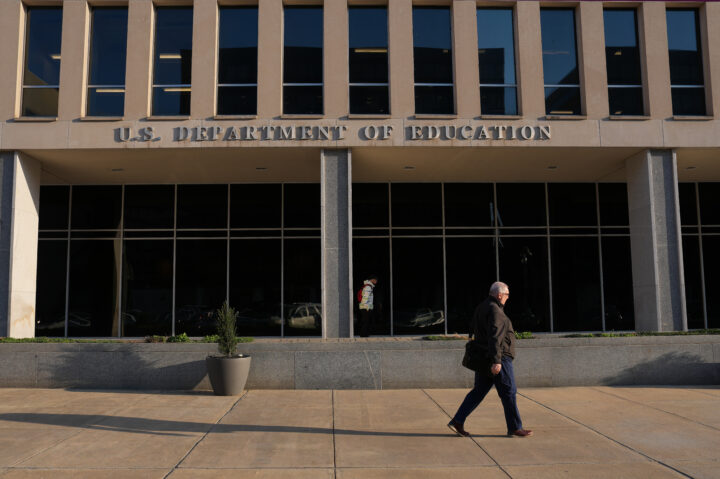
A person walks past the U.S. Department of Education on March 20, 2025 in Washington, DC.


 Add JewishInsider on Google
The Department of Education accused U.S. colleges and universities of attempting to hide their foreign donors from public scrutiny, after the American Association of Universities sued to block the release of a report on foreign donors to U.S. institutions of higher education due out last week.
The department had repeatedly delayed the release of such data under Sec. 117 of the Higher Education Act since this summer, but was poised to release it last Friday, until a federal district court issued a temporary restraining order following a lawsuit by the AAU.
“Now, the ‘premier’ association for American research universities is suing because it is hellbent on avoiding public accountability after decades of insatiable greed and disregard for the national interest,” the Department of Education said in a statement. “Americans deserve transparency about the billions flowing from overseas to U.S. campuses, and we will fight AAU in court to deliver it.”
District of Columbia District Judge Tanya Chutkan temporarily halted the release, expressing concern that the disclosure would expose individual donors to scrutiny in perpetuity, potentially jeopardizing the safety of donors in politically repressive countries.
The AAU has argued that disclosure would “chill the lawful generosity” that supports U.S. campuses, went against past written assurances from the Department of Education to institutions and donors that the information would remain confidential and violated the federal rulemaking process.
“Constitution and Supreme Court precedents protect individuals from compelled public exposure of their charitable associations. Publication would expose donors to harassment, reputational harm, and, in some cases, real danger in their home countries,” the organization said. “It would chill the lawful generosity that supports scholarships, research, and teaching on campuses across the country. And it would signal to every donor and every institution that a federal agency’s written commitment cannot be trusted.”
The Department of Education has not addressed its own reasons for repeatedly delaying the release of the data.
The federal government has previously released top-line data about the amount of foreign funding to U.S. colleges and universities but has not released the specific names of donor organizations, which advocates argue would provide critical transparency about potential malign foreign influence in the United States.
The department said that, in spite of receiving billions in taxpayer funding, universities “were cashing multi-million-dollar checks from malign foreign actors that fund centers and faculty who promote anti-Western ideologies and support partnerships that are designed to export sensitive technology to geopolitical adversaries.”
The department urged Congress to pass the DETERRENT Act, already passed by the House, which would lower the bar for reporting foreign donations and require mandatory reporting for donations from any watch-listed foreign entities or countries such as Iran, China, Russia and North Korea.
Karen Paikin Barall, the chief policy officer of the Louis D. Brandeis Center for Human Rights Under Law, which filed a Freedom of Information Act request in an attempt to force the release of the transparency report amid the department’s delays and threatened its own lawsuit, said her organization is formulating its own response to the temporary restraining order.
She said that Brandeis is considering its legal options to ensure “the public interest” in transparency is represented, and that it wants to see the restraining order lifted. She argued that there are ways to protect concerns about individual privacy while still providing transparency.
“If these institutions are receiving foreign funding, the public has a legitimate interest in understanding those relationships,” Barall said. “And there are potential implications for research security, academic independence, discrimination, foreign influence and campus antisemitism. … This is fundamentally about transparency and the public’s right to know. You can’t follow the money if you don’t know who’s providing it.”
In a fact sheet, the Department of Education also linked foreign funding to the rise of antisemitism on U.S. campuses, citing data from both the department and outside organizations.
The department also accused members of the AAU of failing to report hundreds of millions in foreign donations and of using the lawsuit to hide relationships with foreign entities on U.S. watch lists from lawmakers and the public.
In the fact sheet, the department said it only intended to release the names of foreign entities, not individual foreign donors, denying the AAU’s assertions that the release could threaten individuals, and said it had briefed AAU on such precautions.
The Brandeis Center called the latest delay, the fifth since July, ‘unacceptable and deeply concerning’
Win McNamee/Getty Images
A person walks past the U.S. Department of Education on March 20, 2025 in Washington, DC.
The Department of Education again delayed a report on foreign funding to U.S. colleges and universities, the fifth such delay since mid-July.
The report under Section 117 of the Higher Education Act was expected to be released Friday. The department announced on Friday that it is again postponing the release, which is now slated to occur on Sept. 25.
The Department of Education did not respond to a request for comment.
The Louis D. Brandeis Center for Human Rights Under Law sent a letter and filed a Freedom of Information Act request aiming to force disclosure of the report, the identities of those providing foreign funding and the details of the transactions following the previous delay.
The Brandeis Center blasted the Department over the latest postponement.
“A fifth delay in releasing Section 117 data is unacceptable and deeply concerning. When serious questions are raised about foreign influence on our campuses, Americans deserve to know who is providing this money and whether those financial relationships undermine academic independence, campus policies, compliance with federal law and response to antisemitism,” Karen Paikin Barall, the Brandeis Center’s chief policy officer, said in a statement to Jewish Insider.
She emphasized the need for transparency to understand the relationships between universities and foreign donors and ensure accountability.
“While we commend Secretary [Linda] McMahon for her work to increase transparency around foreign funding, five delays in less than three months have left the American people without critical information,” Barall said. “The Department must release the names of these foreign sources and relevant transaction information as soon as possible.”
The letter from CEO Kenneth Marcus follows a public spat in which Qatar's deputy ambassador accused the group of spreading disinformation about Qatari money in higher education

Bonnie Jo Mount/The Washington Post via Getty Images
Students cross a sky bridge in the temporary campus of Northwestern University in Qater on the Education City campus in Doha, Qatar, on November 2, 2015.
The Louis D. Brandeis Center for Human Rights Under Law wrote to Qatari Ambassador to the U.S. Sheikh Meshal bin Hamad al-Thani on Wednesday amid a back-and-forth online, urging the Qatari Embassy to release a full public accounting of its funding to U.S. colleges and universities.
“There is a straightforward way for the Government of Qatar to demonstrate that public accounts of its activities are inaccurate or misleading: full disclosure,” Brandeis Center CEO Kenneth Marcus said in a letter to Al-Thani. “We therefore respectfully ask Qatar to provide a complete public accounting, to the people and the Congress of the United States, of the funding and other financial support that its government, the Qatar Foundation, and other Qatari governmental or government-controlled entities have provided to U.S. colleges and universities.”
Marcus urged that such a disclosure “should identify the recipients and amounts, disclose the agreements governing the funds, and explain what Qatar expected or received in return for its largesse. This should include any financial, academic, or other benefits, as well as any role in university governance, faculty or administrative appointments, academic programs, curriculum, research, public communications, or the operation of overseas campuses.”
Marcus argued that a public disclosure would “serve Qatar’s stated interest in correcting purported misinformation” and allow Congress, the administration, schools and the public to assess the relationships based on firsthand information.
“Qatar has described its support for U.S. higher education as beneficial to both countries,” Marcus said. “If that is so, complete transparency should strengthen Qatar’s position. If particular public allegations are false, the documents will demonstrate that fact.”
The Qatari embassy did not respond to a request for comment.
The letter follows a public exchange on social media between Marcus and Qatar’s deputy ambassador, Hamad Al-Muftah, who claimed that critics of Qatar are engaged in a “coordinated disinformation campaign” to manipulate data on foreign funding in U.S. higher education — the release of which has been repeatedly postponed by the Department of Education — in order to accuse the Qatar Foundation of malign activities.
“Their goal appears to be eliciting reactions from House Education Republicans and, more broadly, spreading disinformation that serves the interests of their controllers,” Al-Muftah asserted.
He posted a diagram that he claimed outlined a network including the Foundation for Defense of Democracies, Brandeis Center and Jewish Insider, as well as op-eds published in The Wall Street Journal and Chicago Tribune, which he claimed is intending to influence Republicans on the House Education Committee to investigate the Qatar Foundation.
Marcus responded in a thread on X, stating that the diagram “identifies no disinformation.”
“My colleagues have also presented evidence in the [Chicago Tribune] concerning the relationship between Qatari funding, foreign influence and anti-Semitism on U.S. campuses. You may not like their conclusions, but disagreement is not disinformation,” Marcus said, adding that Al-Muftah’s language invoked an antisemitic trope.
Al-Muftah responded that “we have zero intention to hide anything. Everyone is fully cooperating with the appropriate authorities to ensure complete transparency.” He also said that Qatar has “observed instances of data manipulation and the amplification of misleading information,” denying any connection between Qatari funding and protests on college campuses.
“Regarding the accusation of antisemitism, I am unclear about its origin and why it has been brought up,” he continued. “I simply presented the facts and observations regarding those involved.”
Al-Muftah also said that Qatar’s only intention is “to provide world-class education to individuals in the region.”
Al-Muftah told another critic that presenting the aggregate totals of Qatari funding to various universities is “misleading.”
“The overwhelming majority of this funding is for the operation of American university campuses in Qatar,” he said. “It pays for the education of students, faculty, facilities, and the day-to-day costs of running those campuses. It is not a blank check to the universities’ U.S. operations, nor is it evidence that Qatar is funding antisemitism or campus protests in America.”
A long-delayed federal report on foreign spending in education is due out on Friday, unless its release is again postponed, for what would be the fifth time.
The bipartisan bill, backed by most Republicans and 33 Democrats, would strip federal funding from colleges engaged in boycotts against Israel
Leigh Vogel/Getty Images
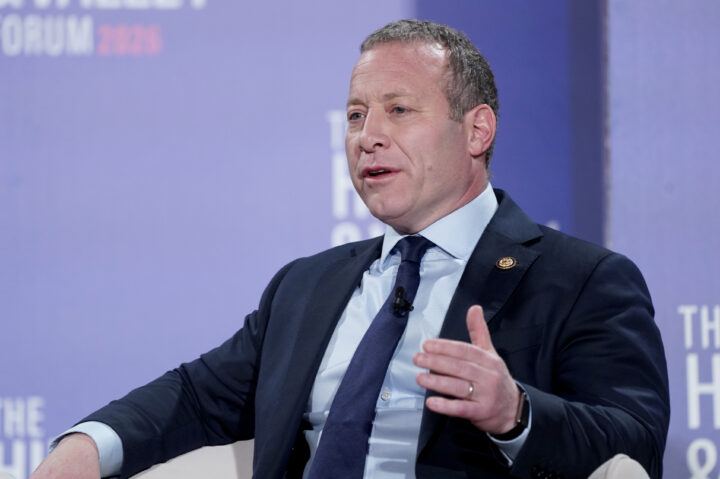
Rep. Josh Gottheimer (D-NJ)
House Democrats overwhelmingly voted against a bill that would strip federal funding from colleges and universities engaged in boycotts of Israel, with just 33 Democrats supporting the measure.
The bill ultimately passed 237-169, with two Republicans voting against the measure along with the majority of House Democrats.
The Protect Economic and Academic Freedom Act, led by Reps. Virginia Foxx (R-NC) and Josh Gottheimer (D-NJ), would make colleges that participate in a “nonexpressive commercial boycott” of Israel ineligible to receive federal student aid funding, requiring them to certify annually that they are not engaged in such boycotts and instructing the Department of Education to annually publish a list of schools that fail to submit such certifications.
The law would apply to boycotts of Israel as a country or to companies and other entities operating under Israeli law, which would include settlements in the West Bank.
The Democrats who supported the bill were Reps. Jake Auchincloss (D-MA), Kathy Castor (D-FL), Gil Cisneros (D-CA), Jim Costa (D-CA), Joe Courtney (D-CT), Henry Cuellar (D-TX), Don Davis (D-NC), Lois Frankel (D-FL), Laura Gillen (D-NY), Jared Golden (D-ME), Vicente Gonzalez (D-TX), Greg Landsman (D-OH), George Latimer (D-NY), Susie Lee (D-NV), John Mannion (D-NY), Jared Moskowitz (D-FL), Donald Norcross (D-NJ), Jimmy Panetta (D-CA), Marie Gluesenkamp Perez (D-WA), Josh Riley (D-NY), Brad Schneider (D-IL), Hillary Scholten (D-MI), Kim Schrier (D-WA), Brad Sherman (D-CA), Darren Soto (D-FL), Haley Stevens (D-MI), Tom Suozzi (D-NY), Shri Thanedar (D-MI), Dina Titus (D-NV), Ritchie Torres (D-NY), Juan Vargas (D-CA), Eugene Vindman (D-VA) and Debbie Wasserman Schultz (D-FL).
Republican Reps. Warren Davidson (R-OH) and Thomas Massie (R-KY) opposed it.
“No student, no professor should be shut out of research, study abroad opportunities, or academic partnerships, or feel unwelcome in the classroom because of where they’re from or what religion they practice,” Gottheimer said in a statement ahead of the vote. “Yet that’s exactly what the boycott-divest-sanction movement seeks to do — targeting one country and one religion: Israel and Judaism.”
He insisted the bill would not impact speech, protest or academic debate, but “simply says that if your university takes federal taxpayer dollars, it can’t discriminate against academic partnerships or investments with one country. That’s it. I urge my colleagues on both sides of the aisle to support this bipartisan bill.”
House Minority Leader Hakeem Jeffries (D-NY) called the bill a “poorly-written Republican bill” that would not oppose the BDS movement but instead “provide Donald Trump with the power to punitively launch political attacks on our colleges and universities.”
He pledged that a Democratic majority would “advance unifying legislation” to combat antisemitism.
Rep. Jerry Nadler (D-NY), a co-chair of the House Jewish Caucus, said that he strongly opposes the Boycott, Divestment and Sanctions movement and believes that it “can veer into antisemitism.”
“But no matter how strongly I oppose the BDS movement, I also believe that those who engage in BDS have a First Amendment right to do so,” Nadler continued, calling the bill a “direct and gross violation of the First Amendment.”
He said it also “treats the entire West Bank as part of Israel, erasing the Green Line and undermining efforts to promote a two-state solution.”
A memo from Rep. Bobby Scott (D-VA), the ranking member of the House Education and Workforce Committee, also urged Democrats to oppose the bill, warning that it could “potentially” restrict schools’ First Amendment rights and that it does not address a currently existing problem. It also notes opposition from J Street and the American Federation of Teachers.
The Jewish Democratic Council of America also opposed the bill, which it said is “an infringement on free speech and undermines efforts toward peace.”
AIPAC and Jewish groups, including the Republican Jewish Coalition and the Louis D. Brandeis Center for Human Rights Under Law, supported the bill.
AIPAC said in a statement, “This legislation helps protect pro-Israel students from discriminatory boycotts and efforts to deny them the ability to study in Israel or learn from Israeli professors, while fully protecting First Amendment rights.”
The RJC noted, “insisting that universities join the BDS lynch mob was the key demand campus protesters confronted university administrators with during the period of antisemitic violence and unrest that swept American campuses after October 7, 2023.”
The bill’s prospects of passing the Senate in the remaining months of the current congressional term are unclear. It has no companion legislation in the Senate and there had not been much public attention on the legislation prior to its passage today in the House.
The study shows how unions are turning away from advocating for higher wages and using their institutions to foment attacks against Israel
ANDREW THOMAS/Middle East Images/AFP via Getty Images
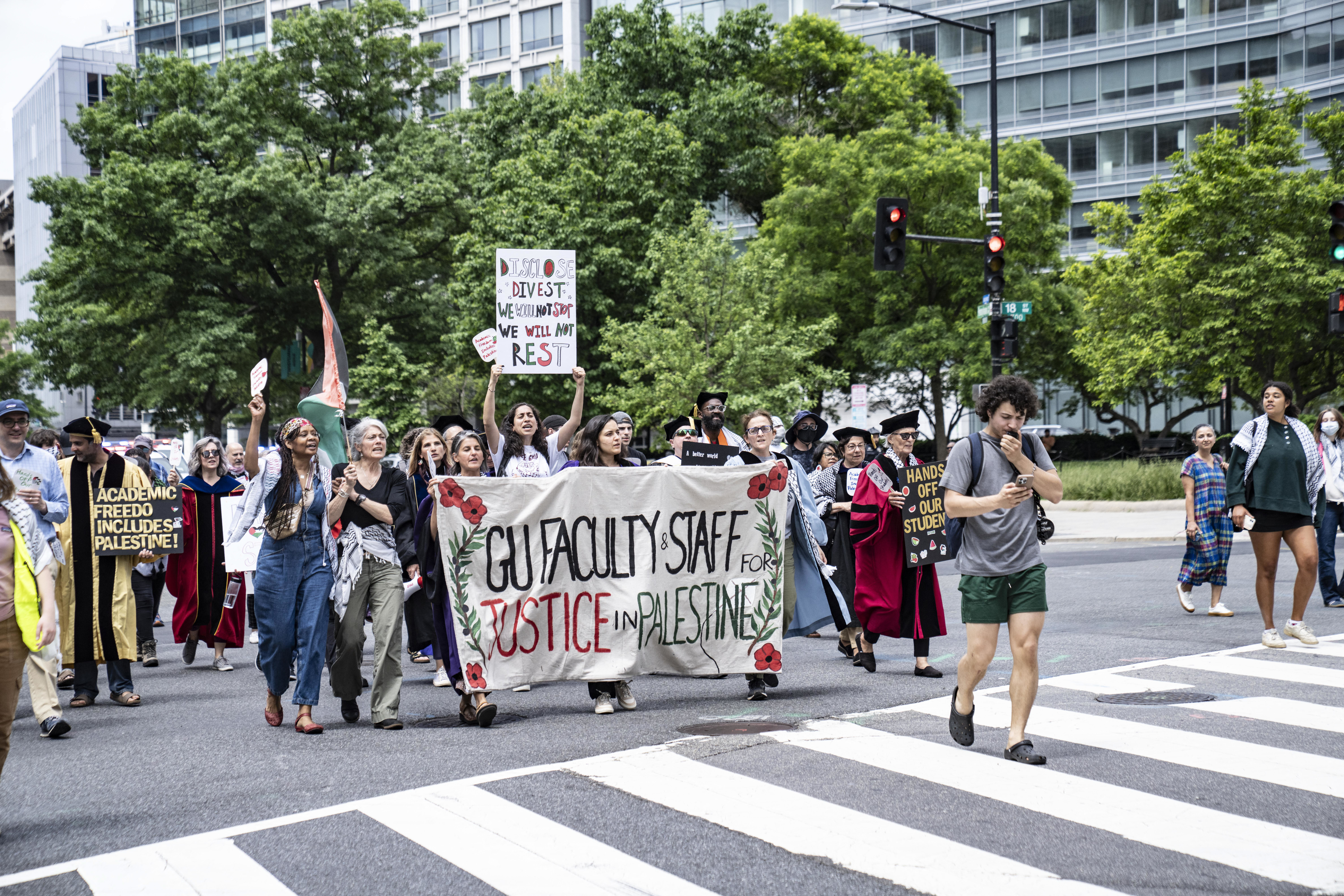
A group of faculty, staff, and students of the George Washington University who had met in the yard where there was a pro-Palestinian encampment last year, in May 8, 2025 in Washington D.C., march to the White House to show that they stand together.
Dysfunctional union governance is leaving some Jewish faculty and graduate students marginalized and unrepresented by the labor organizations meant to advocate for them, a report released Wednesday by the Academic Engagement Network and the Anti-Defamation League documents.
The report, “A Crisis of Representation: Antisemitism and Inclusion in Higher Education Unions,” highlights how activist factions have used low-turnout union elections to push anti-Israel positions without broad member buy-in — often at the expense of Jewish members who say they have faced targeted attacks.
One union member interviewed for the report said, “I no longer feel that the national organization can represent me equally … Union leadership has not addressed antisemitism with any seriousness or clarity.”
Another said they resigned after “the climate in my union local was quickly becoming toxic for Jewish members. … I, myself, was labelled a ‘Zionist’ and ousted from a leadership position.”
The report comes following efforts by several major academic groups to change their bylaws to back academic boycotts of Israel in the aftermath of the Oct. 7, 2023, terrorist attacks and ensuing Gaza war. The American Association of University Professors led this shift in 2024; Since then, the organization hosted a webinar on “scholasticide in Palestine,” while requests from Jewish organizations to include differing perspectives in its programming allegedly went unanswered.
Several graduate student unions have similarly adopted positions hostile to Israel. The report highlights Cornell Graduate Students United, which adopted a statement in 2025 endorsing a boycott of Israeli academic and cultural institutions and affirming Palestinians’ “unequivocal human right to resist oppression by any means necessary,” a statement that many Jewish people see as a call to violence.
The report warns that this trend pulls unions away from their historical orienting goals such as wages and member trust. It recommends steps for union members, leadership and university administrators to improve governance, transparency and member diversity.
“Unions are strongest when all of their members believe they are represented fairly and can participate meaningfully,” said Miriam Elman, executive director of AEN, a network of faculty and staff countering antisemitism on campus. “When Jewish faculty and graduate students feel they must remain silent, disengage, or conceal aspects of their identity in order to participate, unions risk undermining the solidarity and equal representation at the heart of their mission.”
According to several university presidents who gathered last week at the Milken Institute Global Conference in Los Angeles, the task before universities is to win back the trust of skeptical Americans
GETTY IMAGES
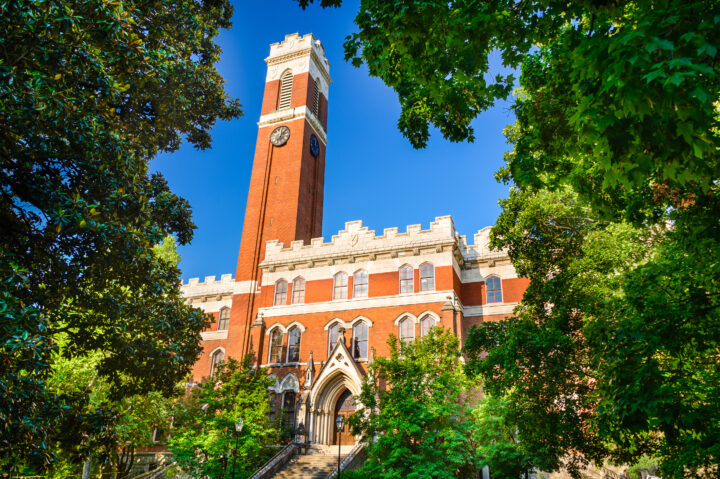
Campus of Vanderbilt Unversity in Nashville, Tennessee.
Over the last two years, the second semester of the academic year at American universities coincided with crisis and chaos.
In 2024, it was anti-Israel encampments overtaking campus quads across the country; last year, it was threats from the Trump administration to slash hundreds of millions of dollars in funding and ban foreign students.
By comparison, the spring of 2026 has been relatively smooth sailing for research universities, even with a bit of hubbub over graduation speakers scrutinized for their stance on Israel and Gaza at a few schools, including the University of Michigan and Georgetown Law.
But it’s not that things have gone back to the pre-Oct. 7, pre-Donald Trump normal. University administrators have just gotten better at managing an ambient sense of friction: Conflict between university leaders and activist faculty and students is still bubbling under the surface, and the threat of funding cuts at the federal level lingers.
According to several university presidents who gathered last week at the Milken Institute Global Conference in Los Angeles, the task before universities is to win back the trust of skeptical Americans.
“The world of higher education, I think, is still in turmoil,” Vanderbilt University Chancellor Daniel Diermeier told Jewish Insider in an interview at the Milken confab. “I think the time when a university does say that’s all overblown and everything is great, that’s over. At least the vast majority of university presidents know that there are challenges, and they want to take them on.”
While the leaders of many elite universities struggled to respond to anti-Israel activism that at times veered into antisemitism and violence, Diermeier was one of a handful of leaders at elite universities in 2023 to speak clearly about what constituted acceptable protest and what violated school rules. He has also been a forceful advocate for institutional neutrality, a position that many of Vanderbilt’s peer institutions — such as Harvard, Stanford and Columbia — have since adopted in the wake of that heady year.
“My sense is that higher education is moving overall,” said Diermeier. “You feel there is momentum there. … It’s gratifying to see that this is happening, and it must happen, because fundamentally we need to regain the trust of the American public.”
For American Jews, the post-Oct. 7 campus chaos has led some to rethink the kind of institution they want to attend.
“As a professor, as an educator, one of the most tragic dimensions of what’s happened on campus is it’s introduced this wedge between American Jews and the university,” Steven Weitzman, director of the Center of Advanced Judaic Studies at the University of Pennsylvania, said at a panel on antisemitism at Milken. “That relationship has been so important for Jewish success and also for the success of the university.”
That wedge has benefitted schools like Vanderbilt and Dartmouth College, each of which have pitched themselves as places where a multiplicity of voices can be found, without the disruptions that have plagued peer institutions.
“We have a culture that is very committed to creating an educational environment where these different voices can be heard, and where you don’t have to justify all the time that you went on a Birthright trip,” said Diermeier.
Dartmouth College President Sian Beilock started at the university in September 2023, and she said she has observed “a more robust, vibrant Jewish presence on our campus” since then. “It feels like something special is happening,” she told JI in an interview at Milken.
Both Beilock and Diermeier touted their cooperation with the campus Chabad and Hillel organizations. Earlier this month, the student government at The New School in New York City voted to defund and sever ties with Hillel over its connections to Israel. (The administration rejected the measure.) Beilock called the development “concerning,” and Diermeier said it is “awful.”
“It would never be tolerated for any other group. It is exactly what’s wrong. At that point, you are violating the fundamental principles of an institution,” Diermeier said. “They are terrible developments and it shows us that we still have a lot of work to do.”
Like Vanderbilt, Dartmouth took on the tumult of the post-Oct. 7 era forcefully and directly. Beilock said she was always clear about the university’s mission in a way that some of her colleagues at other schools were not, though that is beginning to change.
“We’ve called balls and strikes, and I actually think it’s led to a campus where we have some of the most diverse views portrayed on campus in a way that’s more respectful,” Beilock said. “I see a shift in presidents understanding that it’s important to call out the mission of an institution, to be clear about that, and important to ensure that people who are both receiving our education and benefiting from the impact, whether it’s our doctors or discoveries, see the power in what we do.”
In other words: universities need to do a much better job of telling their stories, and not acting like their worth is self-evident. Trust in higher education was higher last year than in 2023 or 2024 — 42%, according to a Gallup poll in 2025, up from 36% — but still down from 57% a decade before. University of Southern California President Beong-Soo Kim said at a Milken panel about the future of higher education that the problems facing the academy connect to a broader loss of public trust.
“There’s a larger breakdown in trust in other institutions, not just higher education, and I think that that’s something important to understand,” Kim said. “I think that there’s an opportunity for partnership among universities, between universities and the government, and the private sector.”
Making change on that front requires humility, a quality that is not always present among elite institutions.
“I think there’s a lot of institutional rigidity to prevent that from happening,” said Eric Gertler, CEO of U.S. News & World Report, which publishes annual college rankings.
Rebuilding that trust runs through Washington, university leaders have begun to realize. Prominent universities are building out satellite campuses — and lobbying shops — in the nation’s capital.
Diermeier and Beilock told JI that they have each decided to engage with Washington more than ever, including by traveling to the city regularly for meetings with members of Congress and administration officials. Vanderbilt and Dartmouth have for now managed to avoid the most severe of the civil rights investigations or funding cuts coming from the Trump administration, but shifts in funding priorities from the federal government still impact the schools.
“I spent a lot of time in D.C. in the last year. I’ve probably been there close to a dozen times, and I plan to continue it. It’s more than I did before, but really important,” Beilock said. “I think we have to be clear to our representatives what the value of the government-university partnership is and how important it is not to lose it. And part of that, to me, is being clear where we can do better.”
The Georgia Solidarity Network and Reps. Esther Panitch and Houston Gaines spearheaded the effort after a report was released documenting Qatari funding of Georgia’s public schools
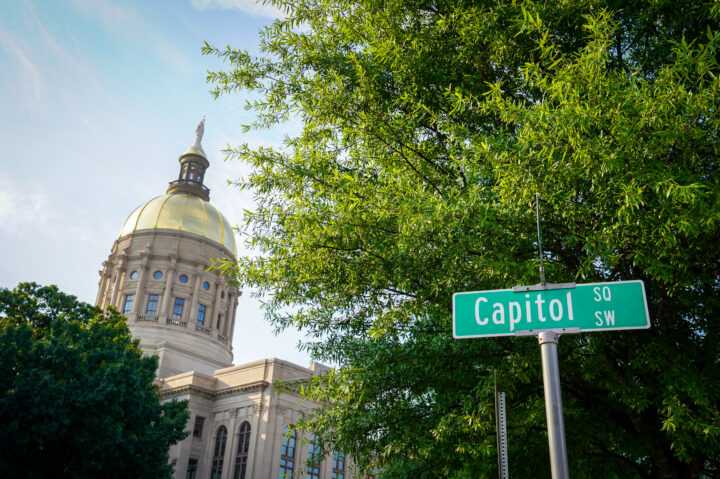
Julia Beverly/Getty Images
The Georgia State Capitol building is seen on July 08, 2025 in Atlanta, Georgia.
Following a report spotlighting Qatari funding in Georgia public schools, the state’s General Assembly became the first in the country to pass legislation requiring the disclosure of foreign government funding in statewide K-12 schools.
The Foreign Funding Transparency and Accountability Act, HB 1379, requires public school districts, public universities and technical colleges to report funding of $10,000 or more from foreign countries or entities, naming specifically Qatar and Saudi Arabia — the two largest foreign funders of American universities.
The bill — which passed both chambers of the Assembly earlier this month and now awaits Republican Gov. Brian Kemp’s signature — was spearheaded by Democratic state Rep. Esther Panitch, the only Jewish member of the Georgia Statehouse, as well as Rep. Houston Gaines and the pro-Israel Georgia Solidarity Network.
In January, the Foundation for Defense of Democracies published a report showing that the Qatari royal family’s U.S. philanthropy arm, Qatar Foundation International, had spent at least $281,000 on education in Georgia — including K-12 teacher trainings, Arabic textbooks for young students and student trips to Qatar.
Panitch told Jewish Insider she tweeted the findings, only to be surprised by a direct and hostile response from the Qatari ambassador to the U.S. and his deputy chief of mission on X, who allegedly told her she was spreading misinformation “like you people always do.”
“Why did they care what a legislator from Georgia thinks? It was weird. I started engaging back and this went on for days,” said Panitch. The back and forth eventually resulted in her involving the FBI. “The moment he responded to me was the moment I knew FDD was on to something right,” she said.
“We were all caught off guard after [the Oct. 7, 2023, terrorist attacks]. I think Qatar had a lot to do with the responses on college campuses. Parents had no idea that some of their kids were being radicalized. I hope we get more answers, but this will definitely help,” continued Panitch.
The Georgia Solidarity Network, a two-year-old bipartisan political action committee supporting pro-Jewish and pro-Israel causes, proposed legislation crafted by co-founder Alli Medof, which Panitch filed a couple weeks after the report’s release.
“We didn’t want to make it loud and attract the attention of people who might object,” Panitch told JI. “I didn’t want Qatar to come in and hire a lobbyist. We went to committees and didn’t get much pushback.”
There was, however, some pushback from colleges and schools “in an operational sense, asking how they are supposed to carry this out,” said Panitch.
The bill also faced scrutiny in the state Senate, according to Panitch, who said some lawmakers “didn’t seem to care that Qatari money had seemingly resulted in teachers saying that [late Hamas leader] Yayha Sinwar was to be commended or that suicide bombing is okay.”
Ultimately, the bill passed the Senate 31-20 and the House 139-16. Kemp has 40 days to sign the bill into state law. If he doesn’t veto it, it goes into law automatically.
“I wouldn’t presume anything” in terms of whether the governor will sign the bill, said Panitch, adding she has not heard anything that implies he would veto it.
A second bill establishing a K-12 statewide Title VI coordinator, also crafted by the Georgia Solidarity Network, simultaneously passed. The bill authorizes the withholding of state funding from institutions that fail to correct violations within 30 days — an enforcement mechanism absent from comparable laws in Tennessee, Oklahoma and California.
The legislative session also secured $3 million in state security funding for the rest of 2026 for nonprofit organizations at elevated risk of attack, with an additional $5 million budgeted for Fiscal Year 2027.
“The Title VI bill was kind of similar because we were also dealing with schools and universities,” Panitch told JI. “There was a part that mentioned antisemitism that we ended up taking out. The preamble still mentions antisemitism but we didn’t want anyone to think this was only for the Jews. It was the Jewish community that brought it forward because we’ve been dealing with this, but essentially it’s a civil rights bill for kids and everyone wants to protect their kids, so it passed, not difficultly.”
Six months ago, foreign funding transparency was “not on the roadmap or priority list” of many Georgia legislators, GSN co-founder David Zalik said. There was already evidence of foreign funding in university systems, he said, but “when we went back to the legislators and showed them documentation [regarding the same for K-12], they were stunned and surprised.”
Following the legislative session, Zalik sees the bill as “a model” for adoption beyond the Peach State.
“Other leaders in other communities reached out,” he told JI. “We crafted new language that other states want to emulate. Georgia is a state that clearly takes this very seriously.”
Medof added, “We’re incredibly proud of the impact this is going to make, and not just on the Jewish community. I think every one of these measures are going to improve the quality of life of students and Georgians. Foreign funding impacts curriculum, ideology, faculty and research [for all students]. It’s not just anti-Jewish or anti-Israel, it’s anti-American ideology that’s coming in. The more we can do to shine a line on that, the better it is for all Georgia students.”
David Schizer was the keynote speaker at the fifth annual ‘Law and Antisemitism’ conference at Yeshiva University Cardozo School of Law
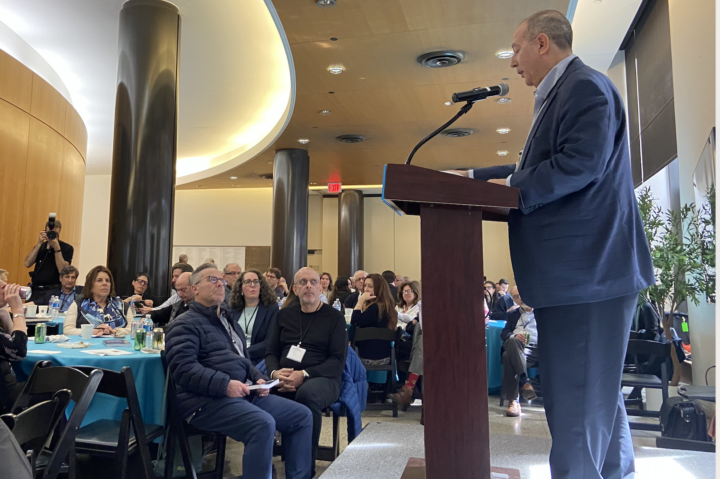
Rona Kaufman
David Schizer delivers keynote address at Law and Antisemitism conference at Cardozo School of Law.
In trying to strike a balance between free expression and anti-discrimination, universities must do a better job at providing a consistent standard, David Schizer, the former dean of Columbia Law School, said during his keynote address at the fifth annual “Law and Antisemitism” conference at Yeshiva University’s Cardozo School of Law.
Many universities have not established any consistent procedures to address Jewish and Israeli students’ complaints about harassment following the Oct. 7, 2023, terrorist attacks, argued Schizer. The law professor served as co-chair of the university’s task force on antisemitism, which was established in response to increased antisemitism on the New York City campus after Oct. 7.
Schizer recommended that universities adopt a universal rule. “The best way to make a decision about one group is with a principle that works for all groups,” he said.
“The rules need to be the same for everyone,” he continued. “This means that if a university takes a step to shield Black or female students from harassment, the university needs to take a comparable step to protect Jewish and Israeli students, and vice versa. Unfortunately, universities have not always been consistent … but after Oct. 7, when Jewish and Israeli students complained, the response was different. Instead of deferring, universities invoked free speech principles. Likewise, instead of condemning this offensive speech, many universities adopted institutional neutrality.”
Schizer told attendees — about 200 practicing attorneys and legal scholars — that inconsistent treatment is not only “wrong,” but “also illegal.”
“Indeed, the most basic way to violate civil rights laws is to single out a protected class for different treatment,” he said.
The two-day conference, which concluded on Monday evening, was renamed this year from “Law vs. Antisemitism” to “Law and Antisemitism.” The change, which was one of several according to organizers, came following heavy criticism of last year’s event. The 2025 conference was held at UCLA and featured several speakers tied to anti-Zionist groups, Jewish Insider was first to report.
Rona Kaufman, the chair of this year’s conference and a participant for the past two years, told JI that this year was “from my perspective, a brand-new conference.”
The co-founders of the original conference — Robert Katz, a professor at Indiana University’s McKinney School of Law, and Diane Klein, an adjunct professor of law at Pepperdine Caruso School of Law and Loyola Law School (Los Angeles) — did not chair this year’s event. Katz remained involved as a speaker, while Klein did not participate.
“Before I agreed to chair this conference, I had parameters. I had no interest in chairing a conference that was going to platform people who make claims that antisemitism is being weaponized or who refuse to center Jewish identity in conversations about antisemitism,” said Kaufman, a law professor at Duquesne University and co-founder of the Center for Jewish Legal Studies.
The conference comes as legal action against universities over antisemitism is intensifying — even as anti-Israel disruptions appear to be quieter on most campuses — with several Jewish groups, such as the Louis D. Brandeis Center for Human Rights Under Law, representing Jewish students in lawsuits against their universities.
Panel topics ranged from various litigation strategies — with speakers including Mark Goldfeder, director of the National Jewish Advocacy Center, and Ken Marcus, chairman of the Brandeis Center — to the legal consequences of sexual violence perpetrated by Hamas on Oct. 7. The latter session was led by Cardozo law professor Michelle Greenberg-Kobrin and virtually from Israel by Cochav Elkayam-Levy, founder and chair of the Civil Commission on Oct. 7 Crimes by Hamas against Women and Children.
The conference was co-sponsored by Academic Engagement Network, Cardozo School of Law, the Center for the Study of Law and Antisemitism and the Center for Jewish Legal Studies. The Anti-Defamation League, which co-sponsored last year’s conference, was a sponsor this year.
Anat Alon-Beck, a Case Western Reserve University associate law professor, was a speaker this year after walking out of a session at last year’s conference because she was “appalled” by “bias and invalidating of all of the antisemitism I’ve been experiencing on campus,” she told JI at the time.
Alon-Beck echoed that there was “no comparison” between this year’s conference and the last.
“It was an empowering experience and an important reminder of the legal community’s responsibility and capacity to stand up against antisemitism in meaningful ways,” she told JI.
“What stood out was the commitment to confronting antisemitism honestly and directly, rather than minimizing or overlooking it.”
At the same time, the legislation cuts funding for the Department of Education’s Office for Civil Rights by nearly $50 million

David Ake/Getty Images
U.S. Department of Education headquarters building in Washington, DC.
The House Appropriations Committee’s proposed funding bill for the Department of Education includes sweeping new provisions cutting off funding for colleges and universities that fail to address campus antisemitism, but would also cut $49 million in funding for the Department of Education’s Office for Civil Rights in 2026.
New language included in the bill states that no federal funding may be provided to institutions of higher education “unless and until such institution adopts a prohibition on antisemitic conduct that creates a hostile environment in violation of Title VI of the Civil Rights Act of 1964 in all documents relating to student or employee conduct.”
The bill also bans funding to schools that have “failed to take administrative action against any student, staff member, or student group that commits acts of antisemitism while utilizing the facilities, grounds, or resources of such institution.”
The former provision would require schools to specifically implement anti-discrimination policies regarding antisemitism as a precondition of federal funding, while the latter could give the Department of Education additional latitude to cut funding to schools that have allowed antisemitic conduct to go unaddressed or unpunished.
At the same time, the bill would provide $91 million in funding for the Office for Civil Rights, down from $140 million provided in several previous years. The Trump administration, in its budget request to Congress, requested the same cut, as it looks to slash the size of the Department of Education while winding down the department.
The Appropriations Committee’s subcommittee on Labor, Health and Human Services, Education and Related Programs voted along party lines to advance the bill to the full committee on Tuesday evening.
The funding proposal sets up a clash with the Senate, which proposed consistent funding at $140 million for the office in its own appropriations legislation, which the Senate Appropriations Committee passed at the end of July. The Senate bill does not include the new language relating to antisemitism.
A large coalition of Jewish community groups across the ideological spectrum previously urged the “highest possible funding” for the Office for Civil Rights, though others in the Jewish community have argued that the office does not require additional funding, instead needing only to better-prioritize resolving antisemitism cases.
House Democrats have frequently pointed to Republicans’ efforts to cut funding for the office as evidence that Republicans are not serious about confronting campus antisemitism. Key Republicans expressed support for the Trump administration’s proposal to cut funding for the office earlier this year.
“The Office for Civil Rights is on the front lines of the fight against rising antisemitism at universities and K-12 schools. It’s absurd to cut their budget when complaints are at an all-time high,” Rep. Debbie Wasserman Schultz (D-FL) said in a statement to Jewish Insider. “Republicans have no interest in the hard work of enforcing protections for Jewish students on campus.”
Lauren Wolman, the senior director of government relations and strategy for the Anti-Defamation League, expressed support for the new provisions on campus antisemitism while warning about the OCR cuts.
“We appreciate the committee’s focus on the crisis of antisemitism in education and commitment to ensuring there are consequences when antisemitism occurs. The Appropriations Committee underscores this point forcefully and urgently,” Wolman said. “But if Congress simultaneously defunds the very office charged with investigating and enforcing Title VI, those consequences may never be realized. Jewish students need real accountability, backed by resources, enforcement, and monitoring.”
A spokesperson for the Jewish Federations of North America said, “This is the first step in a long process of appropriations, and we look forward to working with Congress to ensure that OCR has the resources necessary to effectively fulfill its mission.”
For the dozens of universities facing federal scrutiny for their handling of antisemitism, it’s not clear whether there is anything they can do to escape the wrath of the White House — except, perhaps, agreeing to pricey settlements with the Trump administration
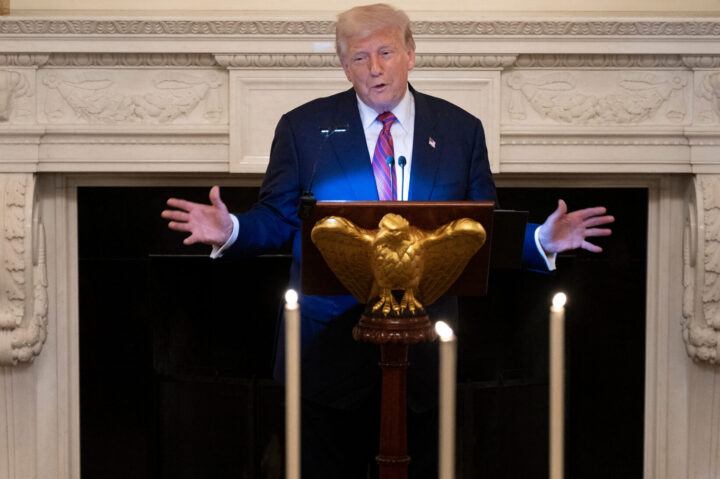
BRENDAN SMIALOWSKI/AFP via Getty Images
US Senator Markwayne Mullin (R-OK) (L) and US Senator John Thune (R-SD) (R) listen as US President Donald Trump speaks during a dinner for Republican US Senators in the State Dining Room of the White House July 18, 2025, in Washington, DC.
Seven months into the second Trump term, it’s clear that many of the country’s top universities are scared of President Donald Trump.
The schools rely on federal funding to power much of the research that has made them into academic powerhouses, so if that funding dries up — a punishment, the Trump administration says, for universities’ failure to deal with antisemitism — their work will be imperiled.
As a result, some universities have taken proactive steps to address antisemitism in the hopes of fending off the ire of the Trump administration. But the White House does not view these actions as good-faith gestures. Instead, the administration is increasingly taking advantage of schools’ acknowledgments of past failings as an admission of guilt — and it is responding in a correspondingly punitive way.
The new chancellor of UCLA took office this year with the stated mission of fighting antisemitism and improving the campus climate following the disastrous 2023-2024 school year that saw violent clashes on the campus. Last month, the university agreed to pay $6 million to settle a lawsuit filed by Jewish students and faculty members who alleged that UCLA permitted antisemitic conduct during the spring 2024 anti-Israel encampment. The chair of the University of California Board of Regents said the settlement was an important step toward fostering “a safe, secure and inclusive environment.”
Yet on the same day UCLA announced the settlement, the Justice Department found UCLA to be in violation of federal civil rights law, stating the school “failed to adequately respond to complaints of severe, pervasive, and objectively offensive harassment and abuse” by Jewish and Israeli students after the Oct. 7, 2023, Hamas terror attacks. And last week, the Trump administration reportedly demanded that UCLA pay an eye-popping $1 billion to settle federal investigations into its handling of antisemitism, race-based admissions policies and transgender issues.
It leaves little incentive for other schools to make reforms to crack down on antisemitism, and risks further polarizing the debate on the subject.
Indeed, Harvard learned a similar lesson earlier this year. In April, the university released a much-delayed report from the school’s task force on antisemitism and anti-Israeli bias, which outlined dozens of instances of antisemitic activity at the school in the year and a half after Oct. 7.
Soon after, the Trump administration relied on the findings in that report to cut another $450 million in grants from the Ivy League university, just days after $2.2 billion in grants were cut. The report “lays bare an appalling reality: Jewish students were subjected to pervasive insults, physical assault, and intimidation, with no meaningful response from Harvard’s leadership,” the leader of the Trump administration’s antisemitism task force wrote at the time.
For the dozens of universities facing federal scrutiny for their handling of antisemitism, it’s not clear whether there is anything they can do to escape the wrath of the White House — except, perhaps, agreeing to pricey settlements with the Trump administration, which Columbia and Brown both did last month. After months of legal maneuvering and negotiating, Harvard may be next: The New York Times reported on Monday that the school is nearing a $500 million agreement with the federal government, to satisfy a demand from Trump that Harvard spend more than double what Columbia agreed to pay.
Ultimately, the end result of all the campus tumult may be that top schools agree to hefty payments demanded by the Trump administration — which may not necessarily correspond with the needed reforms to combat the antisemitism crisis that led the federal government to get involved in the first place.
Columbia’s Hillel director said that the university is on track for a large incoming class of Jewish freshmen next year
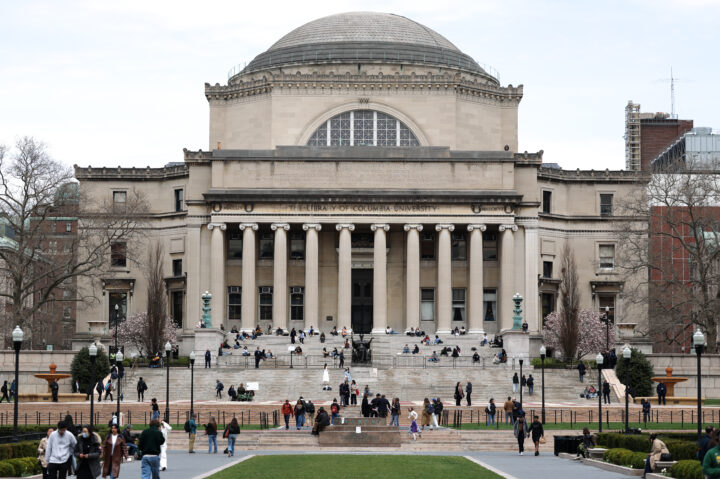
CHARLY TRIBALLEAU/AFP via Getty Images
Students are seen on the campus of Columbia University on April 14, 2025, in New York City.
Earlier this year at a symposium in New York City, Jewish scholars gathered to analyze the recent surge of antisemitism on college campuses and debate whether Jewish students still belong at the country’s elite bastions of higher education.
“I certainly don’t think that we should abandon great citadels of learning or be chased out of them, although to be there takes fortitude that I don’t think should be asked of every student,” Rabbi David Wolpe, a former visiting scholar at Harvard University Divinity School, said during the event’s opening address. “So I’m going to give a selective answer: it depends who.”
Over the next two months, college freshmen will embark on new chapters at universities around the country. Many Jewish students have found appeal in other top schools, such as Vanderbilt in Nashville, Tenn., and Washington University in St. Louis, where administrators were quick to enforce university rules amid rising antisemitism in the aftermath of the Oct. 7, 2023, terrorist attacks, and therefore avoided much of the chaos that played out on other campuses.
But some Jewish students are still seeking admission to the country’s most prestigious schools.
Who are these students making the choice to display the fortitude that Wolpe referenced by attending Columbia and Harvard —- two Ivy League campuses that have been beset by nearly two years of controversy over anti-Israel encampments and classroom disruptions, physical assaults of Jewish students and battles with the federal government, including potential loss of accreditation — over an alleged failure to address antisemitism?
Leah Kreisler, a recent graduate of Winston Churchill High School in Potomac, Md., decided in ninth grade that she wanted to attend Columbia. Kreisler plans to enroll in Columbia’s dual-degree program with the Jewish Theological Seminary and will begin next year, following a gap year in Israel.
Recent events have only reinforced Kreisler’s dream of attending the storied institution. “Columbia has always had a politically charged environment and I honestly think that fits a part of who I am,” she told Jewish Insider. “I like having those kinds of discussions and engaging with people I disagree with. That spirit drew me to the school.”
She’s also hopeful that by the time she arrives at Columbia for the 2026-27 school year, “things will get figured out.” The university is in talks with the federal government to restore the institution’s federal funding, which was slashed in March due to the antisemitic demonstrations that have roiled the campus since Oct. 7.
Still, Kreisler admitted she’s “a little bit scared” to face antisemitism, which she hasn’t directly encountered in her tight-knit D.C. suburb with a sizable Jewish community. “There will probably be people in the streets doing antisemitic things,” she said, noting that she often gets “weird looks from Jewish members of the community” when she shares her plans to attend Columbia.
Laura Hosid runs a private business in Potomac guiding high school students through the college admissions process. She works with many students like Kreisler who are “often willing to overlook [antisemitism] at schools like Harvard and Columbia, if they can get in,” Hosid, who is Jewish, told JI.
“At slightly less selective schools, though, it’s more of a factor,” she said. “Students are willing to look away if there’s too much anti-Israel stuff.”
“Jewish life at Columbia is Dickens-esque: the best of times and the worst of times,” said a Jewish Columbia alum who requested to remain anonymous. “There are real challenges, but at the same time, you can go to Columbia Hillel, the Kraft Center for Jewish Life, and access the most interesting people in the world. Bob Kraft shows up for events,” he said, referencing the billionaire owner of the New England Patriots for whom the center is named.
“I’m certainly not discouraging students if they are interested in schools like Columbia and Harvard,” Hosid continued. “I’m just making sure that they are well aware of what’s going on there and how it compares to what the climate is like at other schools.”
A Jewish Columbia alum who requested to remain anonymous told JI that he still sees his alma mater as “an amazing New York City school with an incredible alumni network.” So he was supportive when his daughter, an incoming Columbia freshman, committed to the university.
“Jewish life at Columbia is Dickens-esque: the best of times and the worst of times,” he said. “There are real challenges, but at the same time, you can go to Columbia Hillel, the Kraft Center for Jewish Life, and access the most interesting people in the world. Bob Kraft shows up for events,” he said, referencing the billionaire owner of the New England Patriots for whom the center is named.
In 1967, Columbia’s student body was 40% Jewish, according to a Jewish Telegraphic Agency report at the time. But even as Jewish enrollment at Columbia has declined since then, it still has one of the highest percentages of Jewish undergraduates in the Ivy League, at an estimated 22%. “The numbers for this year’s incoming class are quite strong,” Brian Cohen, executive director of Columbia Hillel, told JI.
Cohen said that the center’s “top priority is to make sure that every Jewish student feels seen and supported and part of a vibrant Jewish community from the moment they arrive at Columbia University.”
“Everything we hear anecdotally is that the number of applications of Jewishly involved students to Harvard were stable — if not increased — from last year to this year,” said Rabbi Jason Rubenstein, the director of Harvard Hillel.
That’s been Hillel’s goal for years — even before antisemitism reached record highs on campus. But Cohen noted that for the past two academic years, “everything is ramped up.”
“We want to make sure that when we meet students and families face-to-face they already have some idea of who we are and the relationship isn’t starting from square one,” he said, outlining two priorities. “One is that students understand that they are entering into this thriving, diverse Jewish community on campus. [The second is] that, should any problems arise during their time at Columbia, they have trusted resources to go to that are easily accessible and can help support them in navigating the various university processes.”
Rabbi Jason Rubenstein, the director of Harvard Hillel, is similarly spending the summer preparing for a new class of Jewish students. He’s hearing less concern around antisemitism from incoming students and their parents compared to last year. “I think that’s a combination of all of us adjusting our baselines and knowing what we’re getting into, and that last year was calmer on campus than the year before.”
Like Columbia, Harvard has had billions of dollars in federal grants and contracts frozen by the Trump administration. The university filed suit against the government in April, claiming that the cuts violate the First Amendment. A 300-page antisemitism report released by the university in April described “severe problems” that Harvard’s Jewish students have faced in the classroom, on social media and through campus protests.
“Everything we hear anecdotally is that the number of applications of Jewishly involved students to Harvard were stable — if not increased — from last year to this year,” Rubenstein said. Ramaz, a Modern Orthodox Jewish day school in Manhattan, for instance, admitted five students to Harvard the past admissions cycle, with four planning to attend. “That’s the highest in living memory,” Rubenstein said.
One of the Ramaz graduates starting at Harvard this fall is Stella Hiltzik, who grew up hearing “incredible stories” from her mother’s time on the Boston campus. “But it wasn’t until I visited Harvard last year that I decided that was the place I wanted to be,” Hiltzik, whose major is undecided, told JI. She was drawn to Harvard “even despite all of the crazy things happening on campus” after seeing “how supportive, warm and comforting Jewish life on campus is — especially the Chabad. It feels like a sense of home,” Hiltzik said.
“Despite everything going on, when I say I’m going to Harvard, most people are proud of me and supportive,” Hiltzik continued. “But there are some people who ask me, ‘What are you thinking?’ For me, it’s honestly a cool conversation to have, because I get to tell them how I’m excited to be a Jewish voice on campus during these hard times.”
“Despite everything that has happened at Columbia,” Leah Kreisler, a recent graduate of Winston Churchill High School in Potomac, Md., said, “I don’t think that the solution to antisemitism is to remove ourselves from these institutions. That’s been my mentality throughout the college [application] process.”
“Jewish students are not being dissuaded,” Rubenstein said. “Which is a great thing because some people are chanting ‘Zionists are not welcome here’ and the one thing they most want is Jewish students to not come here.”
Students like Hiltzik and Kreisler offer a quiet rebuke to the billionaire alums of the Ivies who have begun to withhold their considerable donations. One Israeli venture capitalist went as far as to try to lure Jewish students attending Ivy League schools to transfer to universities in Israel.
“Despite everything that has happened at Columbia,” Kreisler said, “I don’t think that the solution to antisemitism is to remove ourselves from these institutions. That’s been my mentality throughout the college [application] process.”
“People shouldn’t be afraid to go to any of these schools,” echoed Hiltzik. “At the end of the day, you’re going to get a good education and you’re going to show everyone how cool it is to be a proud Jew. I feel, in a sense, that this is my version of fighting for my people.”
The two university chancellors have been speaking out against ‘creeping politicization’ on college campuses
GETTY IMAGES
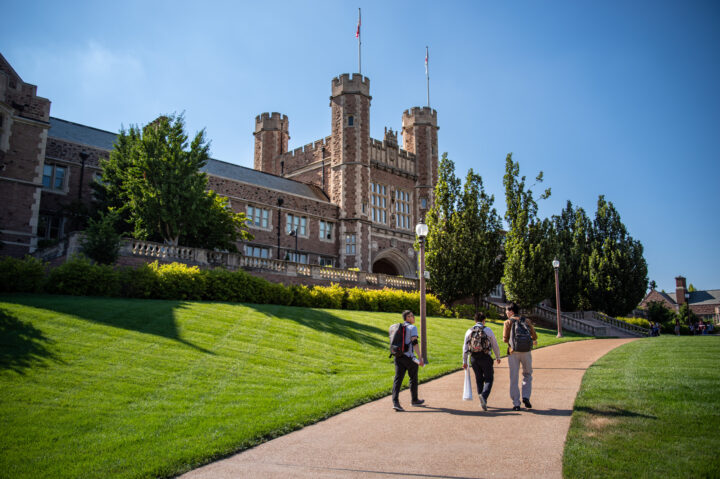
Three people with backpacks on sidewalk in front of the campus administrative building on sunny day moving away.
By the time a group of activists attempted to erect an encampment at Washington University in St. Louis in late April 2024, Andrew D. Martin, the chancellor of the university, had already carefully considered how he would respond. It was a benefit, he said recently, of being “in the middle of the country,” far from the national media that ceaselessly covered the anti-Israel encampments at Columbia University and other high-profile campuses.
Campus police arrested more than 100 people, the vast majority of whom had no ties to the university, and the encampment was shut down. Faculty, staff and student leaders all spoke out against university leadership for bringing in the police. But Martin saw it as an opportunity to enforce university rules and avoid the chaos playing out elsewhere.
“We take a very strong pro-free speech approach,” Martin, a political scientist, told Jewish Insider in an interview last month. “But we also have restrictions which are based on time, place and manner. And for us, it was really clear, and we made it very clear to the campus community. Look, you can protest all you want. … But you can’t take over our buildings, you can’t deface our property and you also can’t set up an encampment.”
Since then, Martin has teamed up with Daniel Diermeier, the chancellor of Vanderbilt University, in something of an informal pact — a joint effort to promote principled leadership in higher education, presenting their two schools as a refreshing counterweight to the dysfunction plaguing higher-ranked competitors like Harvard and Columbia. Both campuses largely steered clear of major antisemitic incidents in that intense spring semester in 2024. (The period has not been without criticism for Diermeier, either; he faced pushback from some faculty and students after canceling a vote on an anti-Israel boycott resolution.)
This February, Diermeier and Martin wrote a joint op-ed in The Chronicle of Higher Education calling on other universities to reject “creeping politicization.”
“The universities we oversee have drawn a line against politicization so that we can continue contributing to the nation’s competitiveness and strength abroad, and to stability and prosperity here at home. All American research universities should do the same,” Diermeier and Martin wrote.
Published just days after President Donald Trump took office with the promise of scrutinizing elite liberal universities, the article was an attempt at setting out a marker, signaling to Trump and potential applicants that Vanderbilt and WashU haven’t lost focus like so many other universities who have found themselves in crisis mode since the Oct. 7 attacks in 2023.
Both schools were committed to institutional neutrality — a position that has now been adopted by more than 100 American universities, including Harvard, Stanford, Columbia and Syracuse — well before Oct. 7 and its aftermath led other university administrators to conclude it is in their interests to not weigh in on complex political and social causes.
“Whether it’s fossil fuel divestment or Ukraine or other things, we’re just not going to engage. Our faculty have strong views on those issues, as do our students. It’s their job to be advocates. It’s our job to create a playing field, if you will, for them to have those views,” said Martin.
Diermeier said universities that had not adopted a stance of principled neutrality were susceptible to “competitive lobbying,” where students demand a response on one side or another.
“We saw this in gory detail after Oct. 7, where you had one group who wanted to say, ‘Well, you need to denounce Israel of genocide,’ and the other one said, ‘No, you have to support Israel,’” Diermeier told JI in June. “It ripped many university campuses apart. And we were very, very clear from the beginning that we are committed to institutional neutrality. We will not divest from companies that have ties to Israel. We will not denounce Israel’s ‘genocide.’ We will not boycott products that are associated with Israel in any way, shape or form.”
It comes down to the role of a university — and whether it is up to university administrators to pick a side. Doing so, the chancellors argued, undermines trust in their institutions. (Others take a different position, like Ora Pescovitz, president of Oakland University, a small public university in Michigan: “A president’s voice is precious,” she told JI last year.)
“There’s a certain arrogance for us, that we think that if, like, Harvard speaks, that somehow an issue is settled,” said Diermeier, a political scientist and management scholar. “What is the purpose of the university? What we’re very clear on is that universities are about the creation and dissemination of knowledge through research and education and related activities. They are not in the business of becoming partisans in any type of political or ideological battle.”
Many universities are still navigating the post-Oct. 7 maelstrom, trying to handle competing concerns from students, parents, alumni and faculty — all while facing civil rights investigations by the federal government. In March, Education Secretary Linda McMahon wrote a letter to 60 schools under investigation for antisemitic discrimination, including Harvard, Yale, Northwestern, Stanford and Princeton.
“I think people that visit us see the difference, and they say this is a great place for Jewish families and for Jewish students to thrive, and we’re very proud of that,” said Diermeier. “We want to be a place where every member of our community can thrive. And right now, in the current environment, I think the contrast between what’s happening at other universities and what’s happening at Vanderbilt is visible for people.”
Vanderbilt and WashU were not on the list. That presents an opening for them to reach Jewish students with concerns about what they’re seeing elsewhere, particularly as the Jewish student populations at many top universities have shrunk. According to Hillel International, just 7% of Harvard’s undergraduates are Jewish, compared to 14% at Vanderbilt and 22% at WashU.
“The Jewish community at Washington University is very robust. Our students are comfortable and proud living out their Jewish identity on our campus, and have been able to do so for generations. And we’ll make sure that they’re able to do this over generations to come,” said Martin. WashU implemented a new transfer program soon after Oct. 7 to allow students to transfer for the spring semester, rather than waiting until the following fall. Several Jewish students took advantage of it after facing antisemitism on their old campuses.
WashU’s appeal to Jewish students is not new; it has for years been tagged with the nickname “WashJew.” And more than two decades ago, Vanderbilt’s former chancellor said that targeting Jewish students was an explicit part of the university’s bid to better compete with Ivy League schools. Diermeier seeks to continue that push.
“I think people that visit us see the difference, and they say this is a great place for Jewish families and for Jewish students to thrive, and we’re very proud of that,” said Diermeier. “We want to be a place where every member of our community can thrive. And right now, in the current environment, I think the contrast between what’s happening at other universities and what’s happening at Vanderbilt is visible for people.”
“It became clear to Daniel [Diermeier] and me that we’re never going to be able to have the sustained federal support or, for that matter, state support of our institutions, without broad support of the American people, and that the American people, in some respect, lost faith in us because of places where we have diverged from those important core principles,” said Martin. “That was amplified by the events of Oct. 7, or what happened after Oct. 7.”
Martin and Diermeier see themselves and their institutions as the stewards of a forward-looking case for higher education at a time when the institution is under attack, both from Washington and from Americans, whose trust in higher education has plummeted. Nearly 6 in 10 Americans said in 2015 that they have a great deal or quite a lot of confidence in U.S. higher education, according to Gallup. In 2024, that number was 36%. Among Republicans, the number dropped from 56% to 20% in nine years. Among Democrats, the decrease was milder — but still present, moving from 68% to 56%.
Oct. 7 only sharpened that distrust, Martin said. Regaining that confidence, he argued, is imperative to saving the institution of higher education — and staving off federal funding threats from Trump.
“It became clear to Daniel [Diermeier] and me that we’re never going to be able to have the sustained federal support or, for that matter, state support of our institutions, without broad support of the American people, and that the American people, in some respect, lost faith in us because of places where we have diverged from those important core principles,” said Martin. “That was amplified by the events of Oct. 7, or what happened after Oct. 7.”
It’s not just about values. It’s a savvy political move. After all, both Vanderbilt and WashU would be in trouble if federal research dollars stopped flowing to the schools, or if Trump made the call that they could not admit international students, as is the case with Harvard.
When asked about his approach to the Trump administration, Diermeier repeatedly declined to answer questions about the matter on the record.
Martin acknowledged that he is concerned.
“I’m worried about everything coming out of Washington, whether that’s legislative action or actions of the administration, around endowment excise tax, federal research funding, the ability to have federal financial aid, the ability to admit international students. All of those things are up for grabs,” Martin said.
But what WashU and Vanderbilt are willing to do is acknowledge that there are big problems in American academia. In other words, they’re saying that Trump’s got a point.
“Here are two institutions that are willing to stand in the public square and say, American higher education has lost its way in some respects,” said Martin. “We’re great institutions, and we’re committed to working to ensure that our institutions and higher education writ large will do better in the future.”
The lawmakers said Trump is ‘using what is a real crisis as a pretext to attack people and institutions who do not agree with [him]’

Kevin Dietsch/Getty Images
Senate Minority Leader Charles Schumer (D-NY) leaves a Senate briefing on China on February 15, 2023 in Washington, DC.
A group of Jewish Senate Democrats accused President Donald Trump of weaponizing antisemitism as a pretext to withhold funding from and punish colleges and universities, moves they said in a letter on Thursday “undermine the work of combating antisemitism” and ultimately make Jewish students “less safe.”
“We are extremely troubled and disturbed by your broad and extra-legal attacks against universities and higher education institutions as well as members of their communities, which seem to go far beyond combatting antisemitism, using what is a real crisis as a pretext to attack people and institutions who do not agree with you,” the lawmakers, including Senate Minority Leader Chuck Schumer (D-NY), antisemitism task force co-chair Sen. Jacky Rosen (D-NV) and Sens. Richard Blumenthal (D-CT), Adam Schiff (D-CA) and Brian Schatz (D-HI) wrote to the president.
“It has become abundantly clear that for this administration, the stated goal of fighting antisemitism — which is needed now more than ever, and for which we stand ready to work in a bipartisan way on real solution — is simply a means to an end to attack our nation’s universities and public schools and their ability to function as multifaceted and vital institutions of higher learning and to protect free speech and the civil liberties of their students and employees,” they continued.
The letter points to Trump’s attacks on Harvard University, including the freezing of billions of dollars in funding and threats to revoke its tax-exempt status, as the most prominent examples of the administration’s efforts, which they say “go far beyond constructive and necessary efforts” to support Jewish students.
They said the administration instead appears to be trying to change “the way the university functions” and impose significant penalties “in ways wholly unrelated to combating antisemitism.” The lawmakers instead accused Trump of trying to undermine or destroy these colleges under the “guise” of antisemitism.
“We strongly support efforts to ensure universities uphold their duty to protect students from unlawful discrimination and harassment, but we reject your administration’s policies of defunding and punishing universities out of spite, as they actually undermine the work of combating antisemitism,” the letter continues, “ultimately only making Jews less safe by pitting Jewish safety against other communities and undermining the freedoms and democratic norms that have allowed Jewish communities, and so many others, to thrive in the United States.”
The letter poses a series of questions to the administration, requesting answers by the end of April, including how the administration has chosen the institutions it has targeted, the specific charges made against Harvard, how the “totally disproportionate” penalties are being assessed, how the administration is deciding what funding to cut and what its legal basis is for threatening Harvard’s tax-exempt status.
The lawmakers particularly raised concerns about the impact of cuts to medical research funding, which they say will affect all students, including Jewish students, and why Harvard’s medical school has been targeted.
They also asked why the administration has significantly cut funding and resources for the Department of Education’s Office for Civil rights and how it plans to work with schools to implement reforms and protections for Jewish students going forward, in light of those cuts.
The letter further asks whether the administration has consulted “a broad range” of Jewish students and organizations on remedies for antisemitism and how it will ensure that funding cuts don’t hurt Jewish students or those uninvolved in or victimized by antisemitic activity.
They additionally inquired about the revocation of visas of foreign students and deportation proceedings and whether such actions are being taken based “solely on their expressed views and speech, which the administration has identified as antisemitic.” They asked whether the administration believes that the First Amendment applies to non-citizens and whether any deported or detained students have been charged with any crimes.
‘We are working with the administration and giving them credit where due and we are offering our thoughtful criticism also, when necessary,’ Deutch told Jewish Insider

Celal Gunes/Anadolu via Getty Images
Ted Deutch, CEO of the American Jewish Committee, testifies about 'The Crisis on Campus: Antisemitism, Radical Faculty, and the Failure of University Leadership" during a US House Committee on Ways and Means hearing on Capitol Hill in Washington, DC, on June 13, 2024.
The Trump administration’s moves to cut billions in federal funding from colleges and universities and detain and deport foreign students have sparked fierce debate in the Jewish community in recent months, and opened fault lines among some who see the actions as necessary to fight antisemitism and others who argue that they’re an overreach.
The American Jewish Committee is trying to take a more nuanced approach, the organization’s CEO Ted Deutch told Jewish Insider in an interview at AJC’s Washington office this week ahead of the group’s annual Global Forum conference, which starts this weekend.
Deutch emphasized that AJC is a “fiercely nonpartisan organization,” which means it must sometimes “hold competing thoughts” so that it can “speak with clarity about what we believe is in the best interests of the Jewish community” and represent “the vast middle of the Jewish community.”
He called that approach not only proper, but necessary.
“There are campuses [where] so many of the challenges should have been addressed by universities, and weren’t. We’ve been clear that it’s really important that the administration, that the president, is making this a priority,” Deutch said. “At the same time, as we’ve said, due process matters and obviously our democratic principles matter as well, we have to be able to both express appreciation and, when necessary, express concern.”
He said that AJC does not and has never taken an all-or-nothing approach to any administration — being either fully supportive or fully opposed to all actions it takes — and that it is continuing to hold fast to that principle: “We are working with the administration and giving them credit where due and we are offering our thoughtful criticism also, when necessary.”
Deutch cited examples from both the Reagan and Obama administrations that he said demonstrated this principle.
“We’re not willing to give up on the idea that, in advocating for the Jewish community, we can continue to leave partisanship out of it, focus on the concerns and needs of the Jewish community and work with an administration as closely as we can to help them succeed in ways that are beneficial to the entirety of the Jewish community,” he said.
In both the revocation of federal funding from universities and the deportation of alleged anti-Israel agitators, Deutch said that due process must be “front and center.”
On federal funding, Deutch noted that there are provisions in federal law that allow for the revocation of funding and said that the prior administration also expressed willingness to slash funding, but that such moves have not actually occurred for decades.
“It’s really important that the funding cuts be done in a way that will have the most impact in addressing the challenges of antisemitism and that other issues not be conflated,” he said.
He added that funding cuts should be used as a tool to ensure that schools make necessary changes to protect Jewish students, such as changes to their protest and student conduct policies, and that funds should be cut in the context of negotiations with universities if they fail to take action.
“When the hammer is dropped before those conversations take place, then people go to their corners,” Deutch said. “What we are advocating for is for every university to do everything that it can to help keep Jewish students safe … It’s how we get them to do it, and making sure that when they make a commitment to act, that they follow through on it — from our perspective, that’s always the focus.”
He also warned that funding cuts motivated by antisemitism could have significant effects in other ways, and potentially take away from discussions about antisemitism.
“When the hammer [of funding cuts] is dropped in a way which winds up cutting life-saving cancer research, that’s when we have concern, which we’ve expressed,” Deutch said.
“When you announce unilaterally that you’re cutting all of the funding, including funding that can help find cures and treatments for disease and funding that has contributed to the global preeminence of American universities in scientific research, then, unfortunately, that becomes the conversation, instead of the necessary conversation that the administration rightfully wants to have about the university’s need to adequately protect Jewish students and all students.”
Deutch also noted that some in the Jewish community are worried that cuts to life-saving research may ultimately produce backlash against the Jewish community.
“It is a concern that can absolutely be ameliorated. This is exactly how we are trying to address this,” Deutch said. “AJC is not jumping in and declaring that we’re on one side or another.”
On the deportations issue, Deutch said, “If [foreign students’] behavior is illegal and they have due process, then they should be deported. But it’s not either-or. All of this matters as we’re tackling these really serious challenges.” He emphasized the need to protect First Amendment free speech rights.
“It’s not, ‘the administration should be as committed as it is to fighting antisemitism’ or ‘should also be committed to ensuring due process and adherence to the Constitution,’” Deutch said. “Both of those things can and have to happen together, and that’s why we’ve been working so hard to make sure that they are.”
The administration has repeatedly made clear that it is not alleging criminal conduct in high-profile deportation cases, instead citing authorities allowing deportations of those deemed to be damaging to U.S. foreign policy interests.
Pressed on that subject, Deutch emphasized that “due process [and] constitutional protections matter here,” and that every individual should have a fair hearing in court.
At the same time, he said that the rhetoric used by some of those facing deportation has been “horrific” and that universities themselves should have stepped in, but did not, “which is why we’re now at this point where the administration has stepped in, rightfully so.”
Deutch and AJC have previously called for additional funding and resources for the Department of Education’s Office for Civil Rights, which the Trump administration has instead slashed. Deutch said that the Trump administration seems to be pursuing a strategy of “fewer cases” being investigated nationwide while “going after universities for bigger remedies.”
AJC is also closely watching the Trump administration’s nuclear talks with Iran. Both AJC and Deutch, who was a Democratic member of Congress at the time, opposed the original 2015 Joint Comprehensive Plan of Action, and Deutch voted against it in the House.
Deutch said that he doesn’t want to make assumptions about what a new Iran deal might entail based on the varying public comments from members of the administration, but said that “the world must agree” on a basic premise Trump has expressed, that “Iran cannot have a nuclear weapon.”
As the negotiations between the U.S. and Iran continue, Deutch said AJC wants to make sure that there is a proper understanding of the current status of Iran’s nuclear program, which Deutch described as geared toward producing a nuclear weapon.
He added that the nuclear talks cannot be divorced from Iran’s support for terrorist proxies that continue to threaten the Jewish community worldwide.
“We’ve all said 1,000 times, but it just feels like it always needs repeating, [and] I know the administration understands this: When a country says that their goal is the destruction of another country … we have to take them at their word in the way that we approach this,” Deutch said. “That’s the message that we’re giving to those who are working on this issue.”
Many campus leaders are now conceding it is easier to give in to protesters than to stand firm against their rule-breaking

Jacek Boczarski/Anadolu via Getty Images
Students and residents camp outside Northwestern University during a pro-Palestinian protest, expressing solidarity with Palestinians with banners in Evanston, Illinois, United States on April 27, 2024.
It’s spring in Cambridge, Mass. — graduation season — which means that large white tents have started to appear on the leafy quads throughout Harvard Square.
Until Tuesday, a different kind of tent was still visible in Harvard Yard: small camping tents housing the stragglers who remained in Harvard’s anti-Israel encampment even after final exams wrapped up several days ago. Last week, Harvard suspended student protesters who refused to abide by campus administrators’ orders to disband the encampment, blocking access to their dorms.
But now, just a week from the start of official university commencement festivities, Harvard has backtracked on its disciplinary action, ahead of the arrival next week of thousands of graduates’ family members, alumni and honorary degree recipients to the Ivy League university. University officials seemed to be saying that Harvard cannot get ready for commencement if Harvard Yard is still gated and locked, accessible only to university affiliates and the handful of people still camped out in protest of Harvard’s alleged “complicity in genocide.”
In making a deal with the protesters, Harvard interim President Alan Garber joined a growing number of leaders at elite universities who are incorporating protesters’ voices into major university investment decisions and allowing student activists to get off with few, if any, repercussions after weeks of disciplinary violations. Harvard’s dean of the faculty of arts and sciences wrote in a Tuesday email that the outcome “deepened” the university’s “commitment to dialogue and to strengthening the bonds that pull us together as a community.”
The path Garber took is now a well-trodden one — remove the threat of disciplinary consequences and allow protesters to meet with university trustees or other senior leaders to pitch them on divesting their schools’ endowments from Israeli businesses, a concession that before last month would have been unthinkable at America’s top universities.
In a matter of days it has become commonplace. Just two years ago, Harvard’s then-president, Lawrence Bacow, responded to the campus newspaper’s endorsement of a boycott of Israel by saying that “any suggestion of targeting or boycotting a particular group because of disagreements over the policies pursued by their governments is antithetical to what we stand for as a university.”
Northwestern University set the tone two weeks ago when President Michael Schill reached an agreement with anti-Israel protesters in exchange for them ending their encampment. Jewish leaders on campus found the agreement so problematic that the seven Jewish members of the university’s antisemitism committee — including Northwestern’s Hillel director, several faculty members and a student — stepped down in protest. Lily Cohen, a Northwestern senior who resigned from the committee, summed up their concerns: “It appears as though breaking the rules gets you somewhere, and trying to do things respectfully and by the books does not.”
Her observation has proven prescient as universities negotiate with anti-Israel protesters who break campus rules while they slow-walk reforms long sought by Jewish students — or even avoid meeting with Jewish community members altogether.
University of Wisconsin-Milwaukee Chancellor Mark Mone signed onto a far-reaching agreement with protesters this week that calls for a cease-fire in the war between Israel and Hamas in Gaza, condemns “genocide” and denounces “scholasticide” in Gaza and cuts off ties between a university-affiliated environmental NGO and two government-owned Israeli water companies. Meanwhile, Hillel Milwaukee said in a statement that Mone has refused to meet with Jewish students since Oct. 7. Where universities fumbled over statements addressing the Oct. 7 attacks last fall in failed bids to satisfy everyone, many campus leaders have now conceded it is easier to give in to protesters than to stand firm against their rule-breaking. (The president of the University of Wisconsin system said he is “disappointed” by UWM’s actions.)
Princeton University and Johns Hopkins University made concessions to encampment leaders this week. At Johns Hopkins, the school pledged to undertake a “timely review” of the matter of divestment, and to conclude student conduct proceedings related to the encampment. Hopkins Justice Collective, the group that organized the protests, characterized the agreement as “a step towards Johns Hopkins’ commitment to divest from the settler colonial state of Israel.”
In a campus-wide email on Monday, Princeton President Christopher Eisgruber said all students must vacate the campus quad where they had organized an anti-Israel encampment. He offered the campus protest leaders an audience with the body that reviews petitions for divestment. Other student groups can also petition for a meeting, he wrote.
Students who were arrested during the course of the protests may have a chance to take part in a so-called “restorative justice” process, whereby the university “would work to minimize the impact of the arrest on the participating students.” If protesters take responsibility for their actions, Eisgruber wrote, the school will conclude all disciplinary processes and allow the protesters to graduate this month.
At many more universities, top administrators — including university presidents — have met with demonstrators, giving them a chance to air their concerns even when they didn’t reach an agreement. University of Chicago administrators held several days of negotiations with encampment leaders before the talks fell apart and police cleared the protesters. The George Washington University President Ellen Granberg met over the weekend with student protesters who lectured her about “structural inequality” at GW and likened the university’s code of conduct to slavery and Jim Crow-era segregation, according to a video recording of the meeting.
College administrators’ negotiations to end the protests might bring a wave of good headlines and promises of quiet at campus commencements, the largest and most high-profile event of the year for most universities. But students haven’t said what they’ll do when school is back in session next year.
By promising meetings with university investment committees, the administrators are almost certainly guaranteeing that campus angst over the war in Gaza will not die down. Brown University President Christina Paxson pledged that protest leaders can meet with the university’s governing body to discuss divestment from companies that operate in Israel — in October, a year after the Hamas attacks that killed more than 1,200 people and ignited the ongoing bloodshed in the Middle East.
Correction: This article was updated to more accurately reflect negotiations between Princeton’s president and the protesters.
Please log in if you already have a subscription, or subscribe to access the latest updates.
 Continue with Google
 Continue with Apple