




































Department of Education accuses colleges and universities of hiding foreign funding ties
The department said universities are ‘hellbent on avoiding public accountability after decades of insatiable greed and disregard for the national interest’
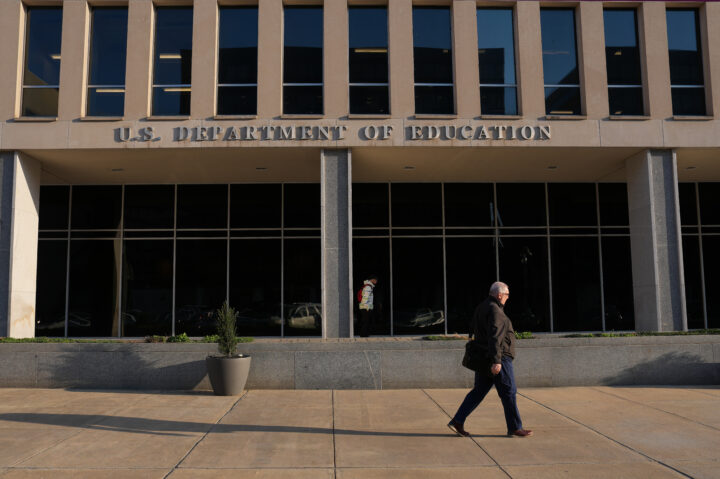
Win McNamee/Getty Images
A person walks past the U.S. Department of Education on March 20, 2025 in Washington, DC.


 Add JewishInsider on Google
The Department of Education accused U.S. colleges and universities of attempting to hide their foreign donors from public scrutiny, after the American Association of Universities sued to block the release of a report on foreign donors to U.S. institutions of higher education due out last week.
The department had repeatedly delayed the release of such data under Sec. 117 of the Higher Education Act since this summer, but was poised to release it last Friday, until a federal district court issued a temporary restraining order following a lawsuit by the AAU.
“Now, the ‘premier’ association for American research universities is suing because it is hellbent on avoiding public accountability after decades of insatiable greed and disregard for the national interest,” the Department of Education said in a statement. “Americans deserve transparency about the billions flowing from overseas to U.S. campuses, and we will fight AAU in court to deliver it.”
District of Columbia District Judge Tanya Chutkan temporarily halted the release, expressing concern that the disclosure would expose individual donors to scrutiny in perpetuity, potentially jeopardizing the safety of donors in politically repressive countries.
The AAU has argued that disclosure would “chill the lawful generosity” that supports U.S. campuses, went against past written assurances from the Department of Education to institutions and donors that the information would remain confidential and violated the federal rulemaking process.
“Constitution and Supreme Court precedents protect individuals from compelled public exposure of their charitable associations. Publication would expose donors to harassment, reputational harm, and, in some cases, real danger in their home countries,” the organization said. “It would chill the lawful generosity that supports scholarships, research, and teaching on campuses across the country. And it would signal to every donor and every institution that a federal agency’s written commitment cannot be trusted.”
The Department of Education has not addressed its own reasons for repeatedly delaying the release of the data.
The federal government has previously released top-line data about the amount of foreign funding to U.S. colleges and universities but has not released the specific names of donor organizations, which advocates argue would provide critical transparency about potential malign foreign influence in the United States.
The department said that, in spite of receiving billions in taxpayer funding, universities “were cashing multi-million-dollar checks from malign foreign actors that fund centers and faculty who promote anti-Western ideologies and support partnerships that are designed to export sensitive technology to geopolitical adversaries.”
The department urged Congress to pass the DETERRENT Act, already passed by the House, which would lower the bar for reporting foreign donations and require mandatory reporting for donations from any watch-listed foreign entities or countries such as Iran, China, Russia and North Korea.
Karen Paikin Barall, the chief policy officer of the Louis D. Brandeis Center for Human Rights Under Law, which filed a Freedom of Information Act request in an attempt to force the release of the transparency report amid the department’s delays and threatened its own lawsuit, said her organization is formulating its own response to the temporary restraining order.
She said that Brandeis is considering its legal options to ensure “the public interest” in transparency is represented, and that it wants to see the restraining order lifted. She argued that there are ways to protect concerns about individual privacy while still providing transparency.
“If these institutions are receiving foreign funding, the public has a legitimate interest in understanding those relationships,” Barall said. “And there are potential implications for research security, academic independence, discrimination, foreign influence and campus antisemitism. … This is fundamentally about transparency and the public’s right to know. You can’t follow the money if you don’t know who’s providing it.”
In a fact sheet, the Department of Education also linked foreign funding to the rise of antisemitism on U.S. campuses, citing data from both the department and outside organizations.
The department also accused members of the AAU of failing to report hundreds of millions in foreign donations and of using the lawsuit to hide relationships with foreign entities on U.S. watch lists from lawmakers and the public.
In the fact sheet, the department said it only intended to release the names of foreign entities, not individual foreign donors, denying the AAU’s assertions that the release could threaten individuals, and said it had briefed AAU on such precautions.
More Stories

FUNDRAISER FALLOUT
Attendee at El-Sayed fundraiser bragged about beating up pro-Israel demonstrator

Daily Kickoff
FlyDubai hero credits TV crash course

Doha’s Darling
Murphy, Qatar’s ‘reliable ally’ in the Senate, huddles with emir and chief Qatari negotiator in Doha

DOHA DEALINGS
Moskowitz challenger visited Qatar in 2024, photographed with Qatari official
NOT ON BOARD
Lansing Mayor Andy Schor, a Jewish Democrat, says he’s not supporting El-Sayed
analysis
Texas Jewish voters at a loss in the state’s hotly contested Senate race
Please log in if you already have a subscription, or subscribe to access the latest updates.
 Continue with Google
 Continue with Apple