






































With negotiations taking place this week, the secretary of state said any agreement would have to address Iran’s missile program, support for proxy terror groups and internal repression, in addition to the nuclear issue
Oliver Contreras / AFP via Getty Images
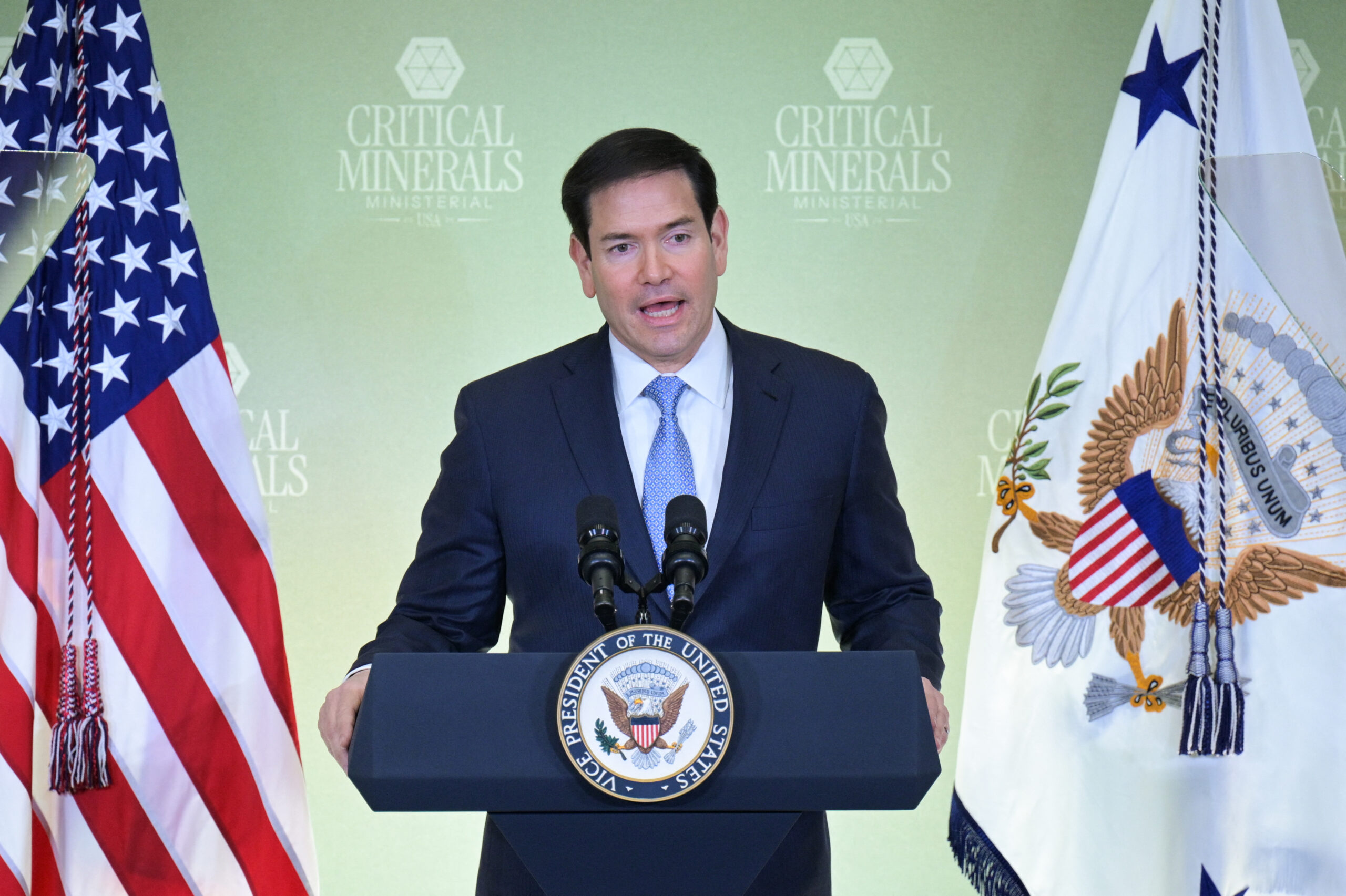
Secretary of State Marco Rubio speaks during the inaugural Critical Minerals Ministerial meeting at the Sate Department in Washington, DC, on February 4, 2026.


 Add JewishInsider on Google
Secretary of State Marco Rubio outlined on Wednesday what the Trump administration views as the minimum requirements for successful nuclear negotiations with Iran, insisting that any deal with Tehran be comprehensive and address its ballistic missile capabilities, support for regional terrorism and repression of its people, in addition to the nuclear issue.
“In order for talks to actually lead to something meaningful, they will have to include certain things,” Rubio said during his remarks at an event on critical minerals supply chains, which Israeli Foreign Minister Gideon Sa’ar attended. “That includes the range of their ballistic missiles, that includes their sponsorship of terrorist organizations across the region, that includes the nuclear program and that includes the treatment of their own people.”
U.S. and Iranian officials are expected to meet Friday for talks aimed at negotiating a new nuclear agreement, with Iranian Foreign Minister Abbas Araghchi and White House Special Envoy Steve Witkoff leading the delegations. While Iran has insisted the discussions be limited strictly to its nuclear program, the United States has pushed to include Tehran’s ballistic missile capabilities and support for regional proxy groups.
Iran has also demanded that the meeting location be moved from Turkey to Oman and that talks take place in a strictly bilateral format, excluding Arab mediators. Rubio acknowledged the shift on Wednesday, saying Washington remains prepared to engage despite the uncertainty.
“The Iranians had agreed to a certain format and for whatever reasons changed in their system,” Rubio said. “We’ll see if we can get back to the right place, but the United States is prepared to meet with them.”
The diplomatic maneuvering has unfolded against a backdrop of heightened military tensions between the two parties in recent days. On Tuesday, a U.S. F-35 fighter jet shot down an Iranian drone aggressively approaching the USS Abraham Lincoln aircraft carrier in the Arabian Sea.
Later that day, Iran’s Islamic Revolutionary Guard Corps (IRGC) deployed two fast-attack boats and a drone towards a U.S.-flagged commercial tanker, the Stena Imperative, in the Strait of Hormuz. U.S. officials said the IRGC appeared to be attempting to potentially seize the vessel before a U.S. missile destroyer intervened and escorted the tanker out of the area.
Israel has voiced skepticism over the prospects of renewed talks. During White House envoy Steve Witkoff’s visit to Israel on Tuesday, Prime Minister Benjamin Netanyahu told him that “Iran proved time after time that its promises cannot be trusted,” according to a statement from the Prime Minister’s Office.
Experts have also questioned whether negotiations with Tehran could lead to a meaningful outcome. Andrea Stricker, a research fellow at the Foundation for Defense of Democracies, previously told Jewish Insider that the Trump administration’s demands that Iran abandon its nuclear program, cap its missile program, halt support for regional proxies and terrorism and stop executing its people are “nonstarters for the regime.”
Should negotiations falter, experts have warned that U.S. military action against Iran remains a possibility. Rubio said that President Donald Trump retains “a number of options” for responding to “future events.”
Rubio also touched on what he described as fundamental differences between the despotic Iranian regime and the Iranian people, underscoring that Washington’s strategy is focused on confronting the regime rather than civilians.
“I remind everybody what I’ve been saying through my entire career in public service: the Iranian people and the Iranian regime are very unalike,” Rubio said. “This is a culture with deep history. I know of no other country where there’s a bigger difference between the people that lead the country and the people who live there.”
He added that the regime’s priorities remain a central obstacle to improving living conditions for Iranians.
“One of the reasons why the Iranian regime cannot provide the people of Iran the quality of life that they deserve is because they’re spending all their money,” Rubio said. “They’re spending all their resources, of what is a rich country, sponsoring terrorism, sponsoring all these proxy groups around the world, exporting, as they call it, a revolution.”
‘Iran cannot have a nuclear bomb and we are hoping to get back to the negotiating table. We will see,’ Trump said

SAUL LOEB/AFP via Getty Images
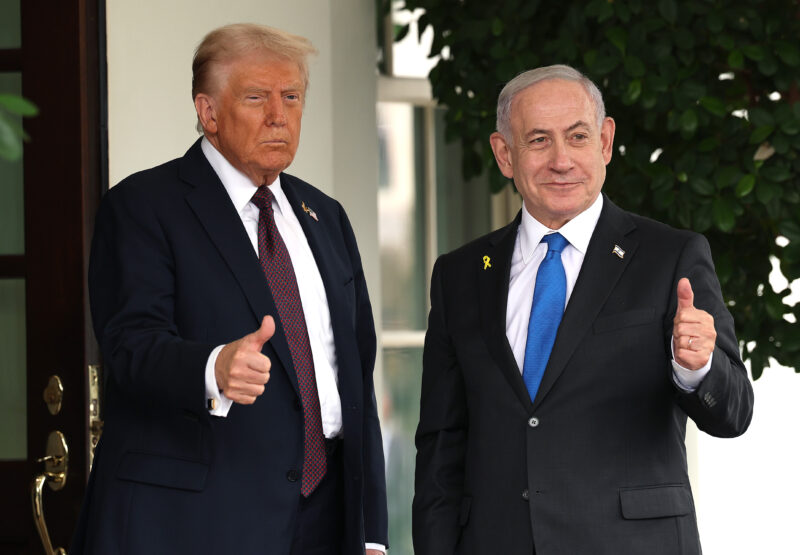
President Donald Trump with Israeli Prime Minister Benjamin Netanyahu during the signing of the Abraham Accords.
President Donald Trump told Fox News anchor Bret Baier on Thursday evening that the United States will defend Israel if Iran retaliates following Israel’s strikes on Iranian nuclear and military targets, and that he still intends to resume nuclear negotiations with Tehran.
“Iran cannot have a nuclear bomb and we are hoping to get back to the negotiating table. We will see. There are several people in leadership that will not be coming back,” Trump said, according to Fox News. U.S. officials are still aiming to continue with nuclear talks in Oman on Sunday, Reuters reported.
Trump was aware of the strikes beforehand, and the administration informed “at least one key Middle Eastern ally” that the strikes were happening, Fox News reported, but did not participate, as previously stated by Secretary of State Marco Rubio.
The president told Fox that U.S. Central Command is on high alert for Iranian retaliatory attacks, and will take action to defend both itself and Israel if Iran retaliates. Rubio, in his initial statement on the attack, had not made explicit whether the U.S. would step in to protect Israel as it had in response to previous ballistic missile barrages targeting Israel in April and October of 2024.
He said the U.S. has also replenished Israel’s stocks of Iron Dome interceptors in recent weeks.
A Jordanian government spokesperson said in a statement that it “has not and will not allow any violation of our airspace or serve as a battleground for conflict,” a potential signal that it will also participate in efforts to intercept potential Iranian attacks, as it did last April.
Plus, Tehrangelenos on Trump's Iran tango

Office of Sen. Lindsey Graham (R-SC)
Sen. Lindsey Graham (R-SC) and Sen. Tom Cotton (R-AR) hold a joint press conference on Iranian nuclear negotiations at the U.S. Capitol on May 8, 2025.
Good Friday morning.
In today’s Daily Kickoff, we talk to members of the Persian American Jewish community about the Trump administration’s nuclear negotiations with Iran, and look at how Jewish interfaith leaders are responding to the selection of Pope Leo XIV, born Robert Francis Prevost in Chicago. We also report on former hostage Emily Damari’s response to the Pulitzer Prize Board’s awarding of its commentary prize to a Palestinian poet who disparaged victims of the Oct. 7, 2023, Hamas terror attacks, and cover bipartisan House pushback to President Donald Trump‘s decision to reach a ceasefire with the Houthis. Also in today’s Daily Kickoff: Judea Pearl, Ambassador Mike Huckabee and Jake Retzlaff.
For less-distracted reading over the weekend, browse this week’s edition of The Weekly Print, a curated print-friendly PDF featuring a selection of recent Jewish Insider and eJewishPhilanthropy stories, including: Israeli presence in Syria ‘a direct lesson of Oct. 7’; Washington Post’s Pulitzer finalist for Gaza coverage slams Israel’s military conduct in one-sided acceptance speech; and In this NJ election, antisemitism could decide the race — while dividing a Jewish community. Print the latest edition here.
What We’re Watching
- Defense Secretary Pete Hegseth’s planned trip to Israel was reportedly scrubbed today. Hegseth had been slated to meet with Prime Minister Benjamin Netanyahu and Defense Minister Israel Katz before joining President Donald Trump, who is traveling to Saudi Arabia, the United Arab Emirates and Qatar next week for his first trip abroad since reentering office.
- The Financial Times Weekend Festival is taking place tomorrow in Washington. Scheduled speakers include former White House Communications Director Anthony Scaramucci, U.K. Ambassador to the U.S. Peter Mandelson, UnHerd’s Sohrab Ahmari, Rev. Johnnie Moore and Steve Bannon.
What You Should Know
A QUICK WORD WITH JI’S HALEY COHEN
It’s not a coincidence that we’ve been focusing on Michigan a lot in these pages. It’s something of a battleground in the domestic politics surrounding antisemitism and the Middle East. Its universities have been among the epicenters of egregiously antisemitic activity. The state’s congressional delegation ranges from a stalwart ally of the state’s Jewish community in Rep. Haley Stevens (D-MI), to Rep. Rashida Tlaib (D-MI), one of the most radical anti-Israel voices in Congress.
So it shouldn’t have come as a surprise that one of the leading officials in the state, Michigan Attorney General Dana Nessel, found herself caught in political purgatory after abruptly dropping charges against seven University of Michigan students arrested for their role in anti-Israel demonstrations. The students were accused of assaulting police officers and engaging in ethnic intimidation.
Nessel, a Democrat, faced attacks from anti-Israel activists for bringing the case in the first place, and was subject to ugly smears that she only brought charges because of her Jewish identity. Tlaib has for months called on Nessel to recuse herself, arguing she only brought the case because of her “bias.”
But after Nessel blamed a local Jewish communal organization for playing a role in dropping the case, she’s been facing friendly fire from many of her erstwhile Jewish allies as well. After she dropped the charges on Monday, she criticized the Ann Arbor Jewish Community Relations Council for writing a letter to the court defending her against accusations of bias, claiming it was inappropriate and may have tainted the case.
In her statement, Nessel maintained the evidence against the suspects was strong, and otherwise would have led to a conviction.
Rabbi Asher Lopatin, director of community relations at the Jewish Federation of Greater Ann Arbor, told Jewish Insider that the organization has not heard from Nessel since releasing its statement. He said the letter was simply meant to “push back against these accusations against Nessel” and there is confusion over why or how it has compromised the case.
It’s fair to ask whether Michigan’s charged intra-Democratic politics also played a role in the decision to drop the charges. Nessel is one of the Democratic Party’s leading officials in the state, and didn’t get a lot of public backing from her colleagues when she first brought the case. The Arab American community in the state is significant — and was mobilized against Nessel — often drowning out the Jewish and more-moderate voices looking for accountability for those engaging in antisemitic activity.
On top of that, President Donald Trump’s aggressive (and arguably illiberal) actions against elite colleges with checkered records on antisemitism have made the enforcement against antisemitic hate crimes a more partisan issue, making it uncomfortable for a Democrat who’s tough on enforcement to stand their ground.
The dropped charges also raise legal questions about the validity of the case to begin with — and whether a new precedent is now set for anti-Israel activity in the state, which has seen a spate of antisemitic incidents since the Oct. 7 terrorist attacks in Israel.
“If the attorney general believes, as she said in her statement, that a reasonable jury would find the defendants guilty of the charges, we worry about the precedent this decision sets,” a spokesperson for the Michigan office of the Anti-Defamation League told JI.
HOLDING OUT HOPE
For Persian Jews, Trump’s Iran policy is personal — and confusing

As nuclear talks between the United States and Iran enter their fourth round this weekend, WhatsApp groups within the Persian Jewish community in the United States are blowing up, as Iranian refugees and their first-generation American children try to decode Trump’s approach to the talks and figure out what to make of all of it. In conversations with Jewish Insider’s Gabby Deutch, several Jewish activists and leaders who were born in Iran or whose families fled the regime described confusion at Trump’s posturing on the issue, holding out hope for a strong deal — and trepidation that he might settle for something weak.
Shifting stance: To Jews whose families fled Iran out of concern for their lives, the prospect of Trump now negotiating with the rogue regime that wanted them dead is confounding, particularly since he took such a tough approach to Iran in his first term. “I think that the Jews from the Middle East, by and large, voted for Trump,” said Rabbi Tarlan Rabizadeh, a rabbi in Los Angeles whose family left Iran shortly after the Islamic Revolution in 1979. “The main reason was because of their support for Israel and hoping that that goes hand in hand, as Persian Jews, with his being hard on Iran, and that’s what he promised. He promised he was going to be tough on Iran. And he keeps saying that, and then floundering.”
PROMISING POPE
American-born pope offers hope of improved Catholic-Jewish relations, religious experts say

The election of Robert Francis Prevost as the first American pope on Thursday marked the beginning of a historic era for the Catholic Church, even as it also raised questions about the direction of Catholic-Jewish relations that had struggled under his predecessor. Prevost, a 69-year-old Augustinian cardinal from Chicago who took the name Leo XIV, brings to his new role no known history of involvement with the Jewish community or record of commentary on Israel and antisemitism, experts told Jewish Insider’s Matthew Kassel.
Positive predictions: Despite his apparent lack of engagement, Jewish leaders and scholars of Catholic-Jewish relations still expressed optimism that Prevost’s rise could help to smooth lingering tensions with the Jewish community — which had risen during the reign of Pope Francis, who died last month at 88. “I think the election of an American pope bodes well for the future of Catholic-Jewish relations,” Noam Marans, director of interreligious affairs for the American Jewish Committee, told JI on Thursday.
NUCLEAR NEWS
Graham, Cotton warn Iran nuclear deal without ‘complete dismantlement’ won’t pass Senate

Sens. Lindsey Graham (R-SC) and Tom Cotton (R-AR) are cautioning that the Senate will not deliver President Donald Trump the 67 votes he needs to ratify a nuclear agreement with Iran if that deal does not require the “complete dismantlement” of Tehran’s current program. The senators issued the warning during a press conference at the Capitol on Thursday promoting their resolution affirming that the only acceptable outcome of U.S. nuclear talks with Iran would be the total dismantlement of its enrichment program, Jewish Insider’s Emily Jacobs reports.
What they said: Asked why the approval of the Senate is necessary when Trump could technically implement a deal without the legislative branch, both senators noted that his agreement would have no guarantee of surviving in future administrations if not ratified by Congress. “If they want the most durable and lasting kind of deal, then they want to bring it to the Senate and have it voted on as a treaty,” Cotton said. Graham noted another requirement of a deal getting congressional support would be its addressing Iran’s missile and terror proxy activities. He said that he told Secretary of State Marco Rubio that “a treaty with Iran in this space is only possible if you get 67 votes …You’re not going to get 67 votes for a treaty regarding their nuclear program unless they deal with the missile program and their terrorism activity. So is it possible? Yes, if Iran changes.”
Taking a stand: Sen. Ted Cruz (R-TX) argued on Thursday that Iran does not need a civilian nuclear energy program — a stance that would support a more stringent position on the ongoing nuclear negotiations than members of the Trump administration have outlined, Jewish Insider’s Marc reports.
pulitzer problems
Emily Damari denounces Pulitzer board for awarding journalist who ridiculed hostages

A former British-Israeli hostage who was held by Hamas in Gaza for 15 months spoke out against the Pulitzer Prize Board on Thursday for bestowing an award to a Palestinian poet who has disparaged victims of the Oct. 7, 2023, attacks and appeared to legitimize the abduction of hostages, among other comments that have stirred controversy, Jewish Insider’s Matthew Kassel reports.
‘Shock and pain’: Emily Damari, who in January was released from Hamas captivity after she was shot and taken from her home in southern Israel on Oct. 7, expressed outrage at the Pulitzer board for honoring Mosab Abu Toha, a Gazan-born writer whose New Yorker magazine essays on the war-torn enclave won the award for commentary. In an anguished statement, Damari, 28, voiced “shock and pain” that Abu Toha had won the award, citing past remarks in which he denigrated Israeli captives abducted by Hamas and questioned their status as hostages, while casting doubt on Israeli findings that a baby and a toddler kidnapped by the terror group were “deliberately” murdered in Gaza with “bare hands.”
EXCLUSIVE
Schneider leads House Dems to call for resumption of aid to Gaza
A group of 25 House Democrats led by Rep. Brad Schneider (D-IL) wrote to President Donald Trump on Friday urging him to call on Israeli Prime Minster Benjamin Netanyahu to resume aid flows into Gaza, Jewish Insider’s Marc Rod reports. The letter follows one from close to 100 House Democrats earlier in the week, backed by J Street, which described Israel’s blockade of aid as a moral failure that would also endanger Israel’s security. The Schneider-led letter is worded in a less strident manner toward Israel, and is framed as supportive of Trump’s own comments and efforts on the issue.
Pressure push: “Israel has the right and obligation to defeat Hamas and rescue the hostages,” the letter reads. “At the same time, it is critical that Israel enables entry of lifesaving humanitarian aid into Gaza. We respectfully urge you to call on Prime Minister Netanyahu to immediately address this humanitarian crisis and promote lasting peace.” The Democratic lawmakers highlighted that stores of food and water in Gaza are running short, and said that it is vital for humanitarian assistance to again get to those in need, even amid the ongoing conflict.
Huckabee presser: U.S. Ambassador to Israel Mike Huckabee said in a press conference in Jerusalem today that a humanitarian aid program to deliver food into Gaza has been launched and he hopes it will start to be implemented soon. Huckabee stressed that Israel will not be involved in distributing the aid but will be involved in security aspects.
SCOOP
Bipartisan House group expresses ‘serious concern’ about U.S.-Houthi deal

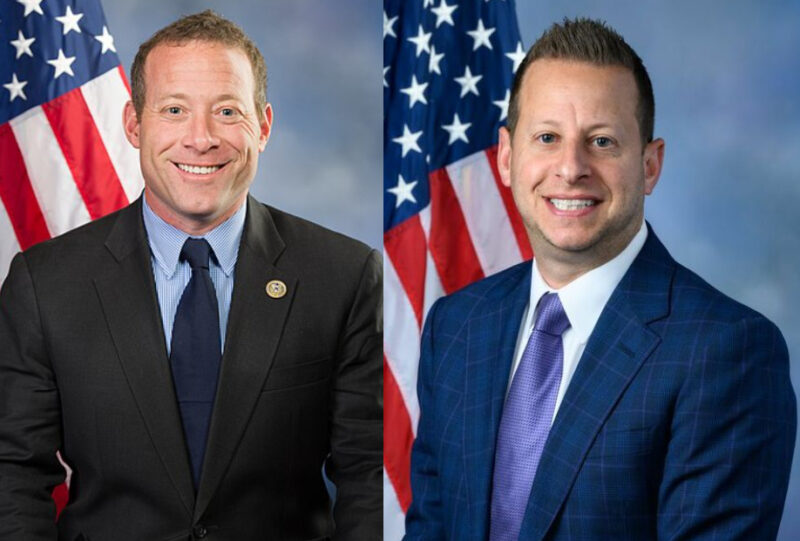
A bipartisan group of House lawmakers blasted the Trump administration over its deal to cease attacks on the Houthis in Yemen, a ceasefire agreement that does not include any provisions requiring the Iran-backed terrorist group to end its attacks on Israel, Jewish Insider’s Marc Rod reports. The letter led by Reps. Josh Gottheimer (D-NJ) and Don Bacon (R-NE) to President Donald Trump and Secretary of State Marco Rubio, who is serving as acting national security advisor, is a new indication of congressional concern about the deal with the Houthis, which was met with skepticism by multiple Senate lawmakers when it was first announced.
Israel exclusion: “We are writing to express our serious concern over the agreement reached on May 6 with the Iranian-backed Houthi forces in Yemen, which halts U.S. strikes against Houthi targets without addressing the threat to Israel. Shortly after the announcement, the Houthis declared their intent to continue targeting Israeli civilians, despite the agreement with the United States,” the letter reads. “This decision leaves Israel dangerously vulnerable and fails to confront the broader threat posed by Iran’s proxy network.”
Envoy weighs in: “The United States isn’t required to get permission from Israel to make some type of arrangement that would get the Houthis from firing on our ships,” U.S. Ambassador to Israel Mike Huckabee said in a clip from an interview with Israel’s Channel 12 set to be aired over the weekend. He added, “There’s 700,000 Americans living in Israel, if the Houthis want to continue doing things to Israel and they hurt an American, then it becomes our business.”
Worthy Reads
Grays’ Anatomy of a Gift: eJewishPhilanthropy’s Judah Ari Gross reports on the recent $125 million gift by Jon and Mindy Gray to Tel Aviv University — the largest in both the school’s history and in the Grays’ giving to Israel causes. “For one of the largest donations ever made to Israeli academia, the ceremony marking the inauguration of the Gray Faculty of Medical and Health Sciences at Tel Aviv University on Thursday morning was an understated affair — at least as understated as an event can be when it’s attended by one of the world’s top hedge fund managers, Blackstone President and COO Jonathan Gray; Israeli President Isaac Herzog and First Lady Michal Herzog; the former U.S. ambassador to Israel, Blackstone Vice Chair Tom Nides; along with some of Israel’s top academics and medical professionals. … ‘We are American Jews who grew up on modest means far from Israel, in Chicago and Philadelphia. But thanks to our families, we have always known where our past was rooted: here in this sacred land, where orange trees were coaxed from the arid desert. Tragically, the unthinkable events of Oct. 7 awakened the need to express that connection in a far more concrete way,’ Jon Gray said, citing his family’s immigration to the United States at the end of the 19th century fleeing persecution in Eastern Europe.” [eJP]
Plan B, For Bomb: Washington Post columnist Marc Thiessen suggests that the U.S. should take military action against Iran if Tehran doesn’t agree to dismantling its nuclear program. “Trump understands the nature of an Iranian regime that has plotted to assassinate American officials on American soil — including him. Like presidents before him, he has pledged that Iran will not be allowed to possess a nuclear weapon. Unlike presidents before him, he is now poised to deliver on that pledge and actually stop them. I don’t believe Trump will agree to a deal with Iran that is weaker than the deal Bush negotiated with Libya. If Trump can convince Iranian officials to allow U.S. military aircraft to land in their country, load up all of their uranium, centrifuges, bomb designs and ballistic missiles, and fly them to Oak Ridge — and agree to cease its support for terrorism — then Trump should sign on the dotted line. If not, then it’s time for Plan B — and for the United States and Israel to, in Trump’s words, ‘bomb the hell out of them.’” [WashPost]
Harvard’s Defiance: In The Wall Street Journal, Roland Fryer, an economics professor at Harvard and senior fellow at the Manhattan Institute, considers the clash between “economic interests and principle” as the university’s battles with the Trump administration. “My hope is that Harvard has realized its past wrongs and will resist these pressures going forward — allowing the university to determine and uphold its own core values. But two other theories would explain Harvard’s recent behavior just as well. One is political bias. Harvard’s leadership leans decidedly to the left and will likely be far friendlier to pressure from that direction. Its spine could thus weaken again once the presidency changes hands. The other explanation is simple economics. Like any institution, Harvard seeks to maximize its utility — prestige, endowment growth, influence. That might mean resisting federal policy that threatens core funding, but yielding quietly on symbolic or lower-stakes issues. Behavior under this explanation is determined not by veritas — truth, Harvard’s motto — but by coldly calculated costs and benefits. … I hope that Harvard’s current defiance is a burning-bush moment: a real commitment to institutional independence and to the search for truth that will last beyond a single presidency. The economist in me worries that it’s only another move in a political chess match — one in which the board tilts depending on who’s in power and which way the wind blows.” [WSJ]
Portnoy’s Complaint: MSNBC columnist and New School professor Natalia Mehlman Petrzela considers how educators can combat antisemitism, following a recent antisemitic incident at a Philadelphia bar that garnered national attention. “Students should learn about Jewish history and identity as an important part of their study of the United States. Social studies curricula should teach about Jews as immigrants, Americans, athletes, artists, entrepreneurs, and as members of a diverse community from many national and ethnic backgrounds who hold a range of views on any given topic, including Israel, and most importantly, as everyday people deserving of respect and full civil rights. Understanding antisemitism is of paramount importance, but it should not be addressed only in response to incidences of Jew hatred, or uniquely in relation to the Holocaust. Rather, antisemitism should be explained as a centuries-old hatred that shape-shifts depending on the historical moment, to be about religion, biology or culture, and as still very much with us. Teaching about Jewish identities and experiences, both of perseverance and success and of facing persistent discrimination, is important to understanding, and improving, our pluralistic society.” [MSNBC]
Word on the Street
President Donald Trump met with Israeli Strategic Affairs Minister Ron Dermer on Thursday during Dermer’s trip to Washington to discuss Gaza and ongoing nuclear talks with Iran…
Judea Pearl, the father of murdered Wall Street Journal reporter Daniel Pearl, clarified reports on Thursday that a terrorist tied to his son’s death had been killed by Indian forces in Pakistan; Pearl said that Abdul Rauf Azhar’s group, Jaish-e-Mohammed, “was not directly involved in the plot to abduct Danny, it was indirectly responsible. Azhar orchestrated the hijacking [of IC-814 in 1999] that led to the release of Omar Sheikh — the man who lured Danny into captivity”…
EPA Administrator Lee Zeldin held a ceremony in his office with Rabbi Levi Shemtov, the executive vice president of American Friends of Lubavitch (Chabad) in Washington, to inscribe letters into The Washington Torah and affix a mezuzah to his office door…
The Trump administration canceled an additional $2.2 billion in grants to Harvard University amid a growing battle between the school and the White House…
Claire Shipman, the acting president of Columbia University, released a five-minute video stridently criticizing the anti-Israel campus activists who disrupted hundreds of students studying in the school’s main library during finals week…
Rep. Buddy Carter (R-GA) launched his Senate campaign challenging Sen. Jon Ossoff (D-GA); Carter is the first Republican to enter the race to unseat Ossoff…
Ivanka Trump made her first public appearance since President Donald Trump took office earlier this year, speaking with Arianna Huffington at the Heartland Summit in Bentonville, Ark., about Planet Harvest, the produce company she co-founded after leaving her White House role in the first Trump administration…
The Washington Post reviews British author Rachel Cockerell’s Melting Point: Family, Memory and the Search for a Promised Land, about her great-grandfather’s efforts to help Russian Jews emigrate to Galveston, Texas, in the early 20th century…
A British art dealer who appeared on the TV show “Bargain Hunt” pleaded guilty to a series of charges tied to his sale of art to a Hezbollah financier in violation of the country’s 2000 Terrorism Act…
Brigham Young University quarterback Jake Retzlaff is in Israel this week for his first trip to the Jewish state; Retzlaff, who is Jewish, is making the trip along with five teammates through an initiative run by Athletes for Israel…
The Adelson Family Foundation made a “transformative” seven-figure gift to the American Friends of Bar-Ilan University to help create the Israeli school’s Adelson Institute for Smart Materials, eJewishPhilanthropy’s Judah Ari Gross reports…
Former World Food Program head David Beasley, who won the Nobel Peace Prize in 2000, is in talks with key stakeholders, including the Trump administration and Israeli government, to lead the Gaza Humanitarian Foundation as the U.S., Israel and a number of aid groups work to address mounting food distribution challenges in Gaza…
The mother of Israeli hostage Tamir Nimrodi said her son, who was serving on the Nahal Oz base when he was taken captive alive by Hamas on Oct. 7, 2023, is one of three hostages whose status is unknown; Israeli Prime Minister Benjamin Netanyahu acknowledged earlier this week that Israel had not had signs of life since early in the war from three of the 24 hostages who were taken captive alive that day…
A Jewish jeweler from the Tunisian island of Djerba was injured in an axe attack days before thousands of Jews from around the world are slated to travel to the city for an annual Lag B’Omer pilgrimage; five people were killed in a terror attack targeting the city’s synagogue, the oldest in Africa, in 2023…
The Walt Disney Co. announced plans to open a theme park on Abu Dhabi’s Yas Island, which CEO Bob Iger said will be “authentically Disney and distinctly Emirati”…
Paul Singer is stepping down as chair of the Manhattan Institute after 17 years in the role, and will be succeeded by former Education Secretary Betsy DeVos…
Pic of the Day

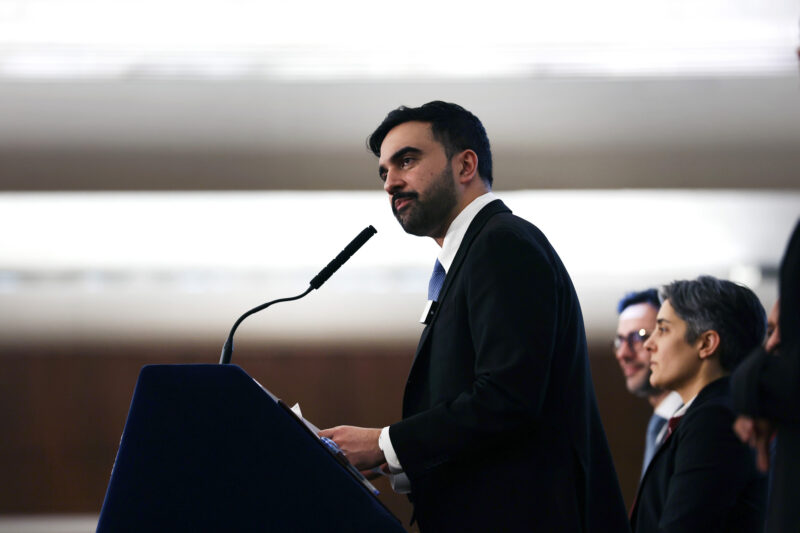
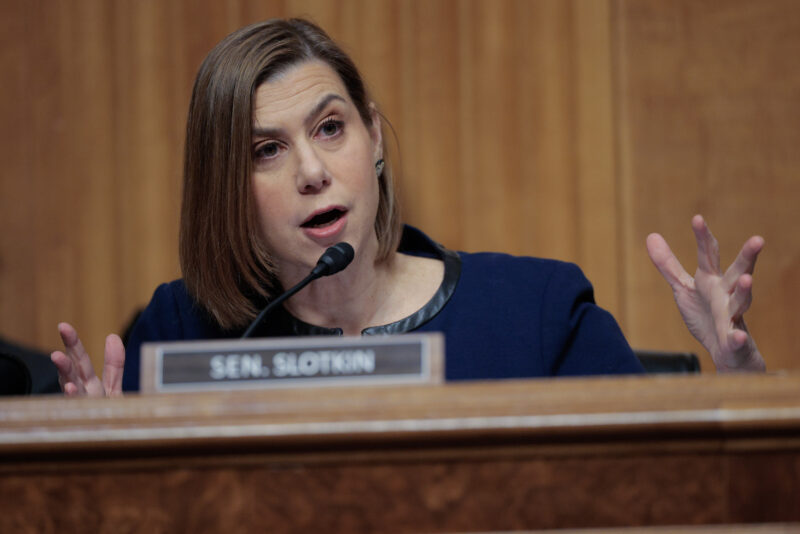
Film director Ziad Doueiri, Forbes Executive Vice President Moira Forbes, staff from Iran International and Axel Springer CEO Mathias Döpfner were honored last night at the America Abroad Media awards in Washington. Döpfner was introduced by Sen. Dave McCormick (R-PA), who called him a “true groundbreaking innovator in the media landscape.”
Attendees at the dinner included U.S. Ambassador to Israel Yechiel Leiter, Deputy Middle East Special Envoy Morgan Ortagus, Brett Ratner, Elliot Ackerman, former Rep. Ed Royce (R-CA), Sara Bloomfield, Jan Bayer, Michael and Sofia Haft and Karim Sadjadpour.
Birthdays

Israeli actress, she appeared in 30 episodes of “Shtisel,” played the lead role in the Netflix miniseries “Unorthodox” and appeared as the Marvel superhero “Sabra” in the newest “Captain America” film, Shira Haas turns 30 on Sunday…
FRIDAY: Holocaust survivor, philanthropist and social activist, she marched in Selma, Ala., with Dr. Martin Luther King, Jr. in 1965, Eva Haller turns 95… Academy Award-winning director, producer and screenwriter, James L. Brooks turns 85… Guitarist and record producer, best known as a member of the rock-pop-jazz group Blood, Sweat & Tears, Steve Katz turns 80… Israeli rabbi who is a co-founder of Yeshivat Har Etzion, Yoel Bin-Nun turns 79… Mashgiach at Ner Israel Rabbinical College, Rabbi Beryl Weisbord turns 78… Winner of the 2013 Nobel Prize in chemistry, Michael Levitt turns 78… Pianist, singer-songwriter and one of the best-selling recording artists of all time, Billy Joel turns 76… Physician in Burlington, Vt., she was the first lady of Vermont from 1991 until 2003 when her husband (Howard Dean) was governor, Judith Steinberg Dean turns 72… Sharon Mallory Doble… Co-founder and board member of PlayMedia Systems, Brian D. Litman… Founding executive director of Chai Mitzvah, The Resource Center for Jewish Engagement, Audrey B. Lichter turns 70… Film director and producer, Barry Avrich turns 62… Staff writer at The Atlantic and author of five books, Mark Leibovich turns 60… Chair of Bain Capital and owner of a minority interest in the Boston Celtics, Jonathan Lavine turns 59… President of global affairs at Meta/Facebook, he was previously the White House deputy chief of staff for policy and a law clerk for Justice Scalia, Joel D. Kaplan turns 56… NYC-based celebrity chiropractor, Arkady Aaron Lipnitsky, DC… and his twin brother, managing director at Baltimore’s Pimlico Capital, Victor “Yaakov” Lipnitsky both turn 52… VP at the Foundation for Defense of Democracies, Lesli Rosenblatt Gillette… Owner of NYC’s Dylan’s Candy Bar, Dylan Lauren turns 51… Executive director of the Richardson Center and former IDF paratrooper, he has negotiated the release of political prisoners worldwide, Michael “Mickey” Bergman turns 49… Deputy assistant secretary in the Department of Veterans Affairs during the Biden administration, Aaron Scheinberg turns 44… Founder and managing member at Revelstoke PLLC, Danielle Elizabeth Friedman… Opinion columnist and podcast host at The New York Times, Ezra Klein turns 41… Jenna Weisbord… Principal at Blackstone Growth Israel, Nathaniel Rosen… Graduate of Harvard Law School, Mikhael Smits…
SATURDAY: Scion of a Hasidic dynasty and leader of the Beth Jehudah congregation in Milwaukee, Rabbi Michel Twerski… and his twin brother, who is a professor at Brooklyn Law School, following a career as dean at Hofstra University School of Law, Aaron Twerski, both turn 86… Real estate developer and principal owner of the NFL’s Miami Dolphins, Stephen M. Ross turns 85… Leading Democratic pollster and political strategist, Stanley Bernard “Stan” Greenberg turns 80… British actress, she is a vocal supporter of Israel, Dame Maureen Lipman turns 79… Israeli businessman and philanthropist, his family founded and owned Israel Discount Bank, Leon Recanati turns 77… Founder and CEO of OPTI Connectivity, Edward Brill… CEO of Medical Reimbursement Data Management in Chapel Hill, N.C., Robert Jameson… American-born Israeli singer, songwriter and music producer, Yehudah Katz turns 74… Claims examiner at Chubb Insurance, David Beck… Anchor for SportsCenter and other programs on ESPN since 1979, Chris “Boomer” Berman turns 70… Former NBA player whose career spanned 18 seasons on 7 teams, Danny Schayes turns 66… U.S. senator (R-MS), Cindy Hyde-Smith turns 66… U.S. senator (R-UT), John Curtis turns 65… Reform rabbi living in Israel, she is the sister of actress Laura Silverman and comedian Sarah Silverman, Susan Silverman turns 62… Brazilian businessman, serial entrepreneur and partner with Donald Trump in Trump Realty Brazil, Ricardo Samuel Goldstein turns 59… Neil Winchel… Attorney general of Colorado, elected in 2018 and reelected in 2022, he is running for governor of Colorado in 2026, Philip Jacob Weiser turns 57… Senior rabbi of Houston’s Congregation Beth Yeshurun, Brian Strauss turns 53… Israeli rock musician, singer-songwriter, music producer and author, Aviv Geffen turns 52… Editor-in-chief, recipe developer, art director and food stylist of Fleishigs, a kosher food magazine, Shifra Klein turns 43… Reporter for the Associated Press based in Israel, Melanie B. Lidman… Video games reporter at Bloomberg News, Jason Schreier turns 38… Manager of government affairs at the American Forest & Paper Association, Fara Klein Sonderling… Associate director of communications in the D.C. office of Pew Research Center, Rachel Weisel Drian… National correspondent for New York magazine, Gabriel Debenedetti… Editorial director at The Record by Recorded Future, Adam Janofsky… Actress who has appeared in many films and television series, Halston Sage (born Halston Jean Schrage) turns 32… Scriptwriter and actress, she is the daughter of Larry David, Cazzie Laurel David turns 31… Mollie Harrison…
SUNDAY: Israeli optical and kinetic artist and sculptor, born Yaacov Gibstein, Yaacov Agam turns 97… Sociologist and author, Pepper Schwartz, Ph.D. turns 80… Israeli social activist focused on issues of women’s and human rights, Iris Stern Levi turns 72… Treasurer and receiver-general of the Commonwealth of Massachusetts, Deborah Beth Goldberg turns 71… Past president and then chairman of AIPAC, Morton Zvi Fridman, MD turns 67… Copy chief at Random House until 2023 and the author of Dreyer’s English: An Utterly Correct Guide to Clarity and Style, Benjamin Dreyer turns 67… Brian Mullen… Howard M. Pollack… CEO of hedge fund Pershing Square Capital Management, William Albert “Bill” Ackman turns 59… Michael Pregent… Member of the California state Senate since 2016, he is a co-chair of the California Legislative Jewish Caucus, Scott Wiener turns 55… Co-founder and president of Omaha Productions, which he started with Peyton Manning, Jamie Horowitz… Filmmaker and podcast host, Dan Trachtenberg turns 44… Deputy chief of staff in the Office of the President at Carnegie Mellon University, Pamela Eichenbaum… Senior cost analyst at the Israeli Ministry of Defense, Michael Jeremy Alexander… PR and brand manager for overseas resource development at Leket Israel, Shira Woolf… Founder and CEO of the digital asset technology company Architect Financial Technologies, Brett Harrison turns 37… Staff writer at Time magazine, Olivia B. Waxman… Manager of paid search and e-commerce at Wavemaker, James Frichner… Paralympic track and field athlete, he is also a motivational speaker and disability rights advocate, Ezra Frech turns 20…
BIRTHWEEK (was yesterday): Founder of Follow Team Israel, David Wiseman…
Please log in if you already have a subscription, or subscribe to access the latest updates.
 Continue with Google
 Continue with Apple