







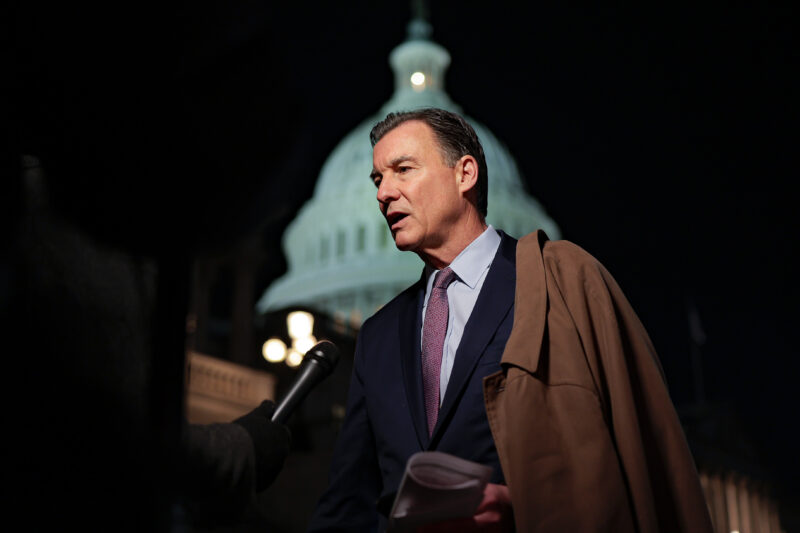


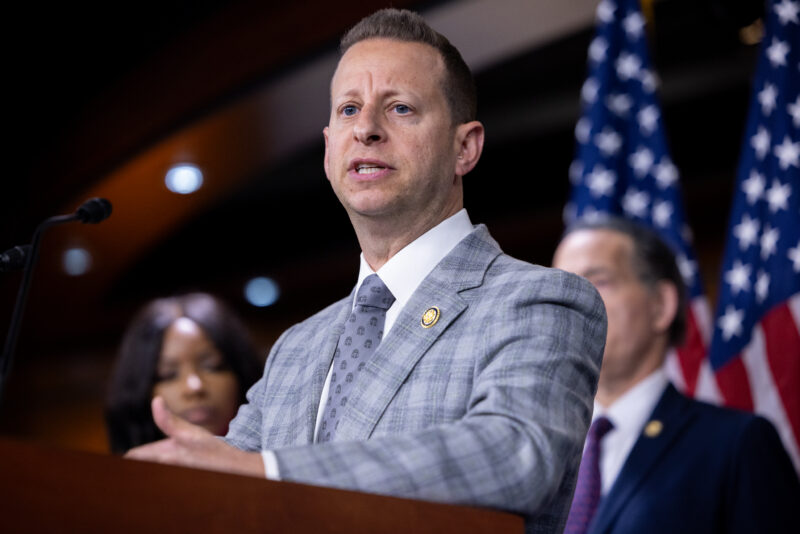



























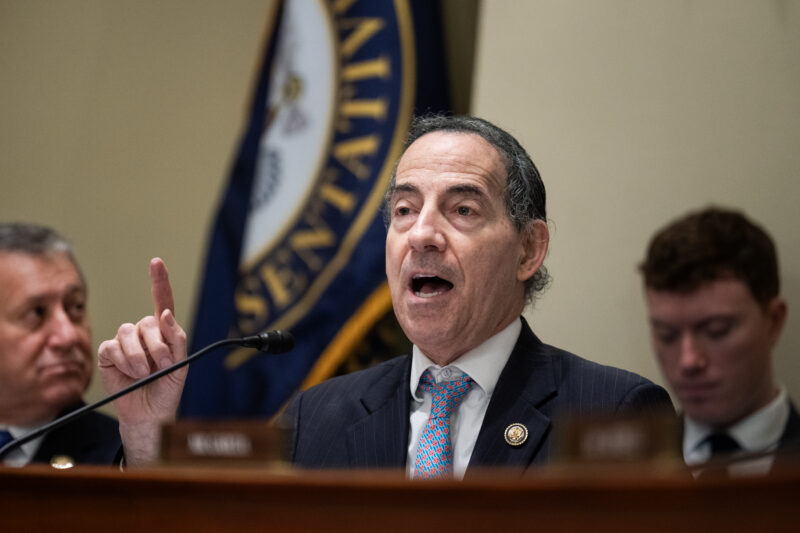





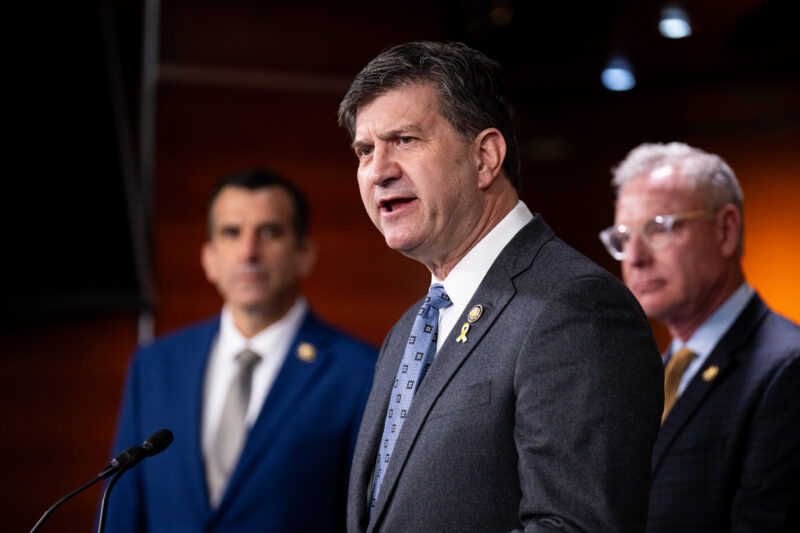









Moulton, who did not directly address Israel policy during the debate, named ending the Iran war as the most important thing that Congress can do in the current moment

Suzanne Kreiter/The Boston Globe via Getty Images
Sen. Ed Markey and Rep. Seth Moulton stand at lecterns ahead of their debate at WWLP-22News on July 8, 2026.


 Add JewishInsider on Google
Sen. Ed Markey (D-MA) touted his early support for efforts to block certain U.S. arms sales to Israel during a Senate debate on Thursday with Rep. Seth Moulton (D-MA), who is challenging the Massachusetts senator for his seat.
“Trump had Netanyahu’s back in his unbelievably unconscionable war against Gaza. And that’s why Bernie Sanders and I and Elizabeth Warren, we were [some] of the first 11 who voted against these 1,000-pound bombs going in against Gaza,” Markey said. “The man has no conscience. He has no wisdom whatsoever. He is endangering the United States, our national security, our standing in the world every single day that he’s allowed to sit in that Oval Office.”
Moulton did not directly address Israel policy during the debate.
Both candidates also focused significant time on condemning the war in Iran and expressing their opposition to it, while jabbing at each other over who has been the more effective opponent of the war.
Moulton named ending the Iran war as the most important thing that Congress can do in the current moment, taking credit for bringing a war powers resolution to the House floor.
Throughout the debate, Markey repeatedly attacked Moulton for voting, months before the start of the war, for a 2026 appropriations bill that included funding for the Defense Department. Moulton responded by repeatedly highlighting Markey’s past support for other defense appropriations bills, including during the Iraq war.
Moulton also criticized Markey for voting to confirm Secretary of State Marco Rubio, accusing him of doing so at the behest of Senate Minority Leader Chuck Schumer (D-NY), and highlighted his own national security experience and background.
Both candidates offered defenses of Diversity, Equity and Inclusion programs that have come under attack by the Trump administration, in part through the administration’s investigations into campus antisemitism.
“We absolutely should defend DEI. That’s part of our DNA. And what the Trump administration is doing is not conducting an honest campaign. They are demonizing universities. They are attacking blue states. They are attacking fundamental American values,” Moulton said. “Any decisions about DEI programs should be left to the institutions themselves,” he continued, praising the “amazing institutions,” including institutions of higher education, in the state.
“We’re only going to be a great nation if we tap the talents of every person in our country. That’s what DEI is all about: diversity and equity and inclusion for everyone, and that is what has made our country great,” Markey said.
The principal apologized to Arab, Lebanese, Muslim and Palestinian students who felt ‘unseen’ following an antisemitism program that used materials from the Blue Square Alliance Against Hate

Photo by Jeffrey Basinger/Newsday RM via Getty Images
School classroom.
A Massachusetts middle school principal apologized to Arab, Lebanese, Muslim and Palestinian students who he claimed “felt unseen” during a lesson on antisemitism.
The Lexington Observer, a local outlet, reported Thursday that Diamond Middle School Principal Johnny Cole was referring to a lesson on antisemitism and his apology was not about a lesson on the Holocaust, as originally interpreted by some Jewish leaders and parents.
Instead, Cole was referencing a lesson on modern antisemitism taught by a third-party Jewish group called TribeTalk. According to the outlet, a dozen families objected to the group using materials from the Blue Square Alliance Against Hate — an advocacy group founded by New England Patriots owner Robert Kraft, who is a supporter of Israel — prompting Cole’s letter. In a message sent to seventh graders via a school portal, a screenshot of which was obtained by Jewish Insider, Cole said the lesson was aimed at teaching the students to recognize hate and to speak out against it, something he called “an important goal.” Cole then apologized after he said some students’ families had expressed that the lesson left them feeling “unseen.”
“Some of you felt like your own history, your identity, or your community was left out or erased. Some of you left that session feeling less safe, not more. We have heard this from families, and we believe you,” Cole wrote.
“We are sorry. Not because the topic was too hard; hard conversations are part of growing up and part of what we do here at Diamond. We are sorry because every one of you deserves to walk into this school and feel that who you are matters — Arab students; Jewish students; Lebanese students; Muslim students; Palestinian students — every student. And in this case, we missed the mark and did not achieve what we hoped to do,” he added.
Cole said that the school was working with teachers and families to “build something better” that “includes all of our communities and all of our histories.”
Local Jewish organizations — some of which also initially thought the letter was referring to a Holocaust lesson — condemned the letter and sought dialogue with school leadership to address the community’s concerns. “We now understand that the letter itself — which, as written, was deeply disturbing and offensive to many members of our Jewish community — was in fact poorly worded and not reflective of the facts and context,” the JCRC said in a statement.
Scott Gladstone, associate director of the American Jewish Committee New England region, told JI he sent an email to Cole on Wednesday morning, offering to talk, and had not received a response as of Wednesday afternoon.
Samantha Joseph, Anti-Defamation League New England regional director told JI, “We’re aware of reports of a concerning response to a Holocaust education program in Lexington, and we’re in contact with community members about the situation.” The Lexington Public School District, which serves roughly 7,000 students across its nine schools, did not respond to requests for comment from JI.
A similar incident occurred earlier this month, according to Teagan Murtagh, an 8th grader at Diamond Middle School, who wrote in a letter to the editor in the Lexington Observer that he was stopped in the hallway by Cole and told not to wear a black sweatshirt printed with a four-line poem: “Save the bees. Plant more trees. Clean the seas. Punch Nazis.” Cole reportedly said some students had complained and felt “threatened” by the sweatshirt.
Last year, Jewish leaders in Massachusetts praised a new report and set of recommendations by The Massachusetts Special Commission on Combating Antisemitism that called for K-12 schools to implement the International Holocaust Remembrance Alliance’s working definition of antisemitism.
This story was updated on June 29 to reflect the lesson’s contents on antisemitism, per The Lexington Observer‘s report.
The report noted a sharp rise of antisemitism in the state’s K-12 schools since the Oct. 7, 2023, Hamas attacks on Israel and acknowledges that there has been significant harm to the mental health of Jewish and Israeli students and families caused by antisemitic incidents. It also noted inconsistencies in how districts respond to concerns around antisemitism, with some responding inadequately and others failing to respond at all.
Moulton turned against the group when it was unable to guarantee him an endorsement upon the launch of his Senate campaign, a source told JI

Anna Moneymaker/Getty Images
Rep. Seth Moulton (D-MA) speaks with a reporter outside of the U.S. Capitol Building on November 16, 2021 in Washington.
Before making public denunciations and rejections of AIPAC an early pillar of his Senate campaign against Sen. Ed Markey (D-MA), Rep. Seth Moulton (D-MA) spent months seeking a promise that the group would endorse him upon the announcement of his Senate campaign, a source familiar with the situation told Jewish Insider.
The source said that Moulton — who has been endorsed by AIPAC in previous races — began courting AIPAC leaders in Massachusetts in the spring this year and then made multiple explicit requests for an endorsement throughout the summer.
AIPAC leaders were ultimately unwilling to provide such a guarantee before the race began, the individual said.
On the second day of his nascent primary campaign, Moulton released an announcement rejecting AIPAC and saying that he would return any donations he had received from its members.
He has continued to hammer the group since then, saying in a recent interview that his break with AIPAC was “a long time coming.”
“AIPAC has made clear to all in Congress that it intends to use its significant resources to influence U.S. elections, and Seth believes that’s all the more reason to engage and push for change from within,” the Moulton campaign said in a statement. “He’s never been afraid to disagree with AIPAC, both privately and in public, but he’s been increasingly and particularly focused on getting them to distance themselves from the Netanyahu government. When it became clear that they would not do so, Seth made the decision to return their contributions.”
The campaign did not deny JI’s reporting that Moulton had made repeated requests for a guarantee of an AIPAC endorsement before announcing his Senate run.
Asked for comment on the situation, AIPAC spokesperson Marshall Wittmann referred JI to the group’s original statement on Moulton’s break with AIPAC. That statement highlighted his past relationship with and requests for an endorsement from the group — though it did not explicitly mention outreach in connection with the Senate campaign.
“Rep. Moulton is abandoning his friends to grab a headline, capitulating to the extremes rather than standing on conviction,” Wittmann’s original statement reads. “His statement comes after years of him repeatedly asking for our endorsement and is a clear message to AIPAC members in Massachusetts, and millions of pro-Israel Democrats nationwide, that he rejects their support and will not stand with them.”
The revelation of Moulton’s recent and unsuccessful efforts to secure a guarantee of AIPAC’s support may cast his rejection of the group in a new light.
Many strategists involved in Massachusetts politics said Moulton’s move is an odd strategic choice for a lawmaker known more as a moderate — especially when running against Markey, who holds a strong progressive record and has a deep well of support among progressive voters.
Moulton’s strategy is “all a little head scratching,” a state Democratic official told JI. In some ways, the official said, Moulton’s campaign mirrors his successful line of attack — focused on a generational and anti-establishment argument — against then-Rep. John Tierney (D-MA) in 2014, whom he unseated.
But, the official continued, “on the face of it, it doesn’t make a whole lot of sense as a political strategy” for Moulton to try to out-flank Markey from the left. “Maybe he sees something other people [don’t], but it’s an odd thing to make as your signature opening move.”
Moulton, the official continued, would probably be more successful once again focusing on a generational argument and “frankly staying far away from issues like Israel,” which is not likely to be a particularly salient issue in the race.
Anthony Cignoli, a longtime Massachusetts political consultant, said that “it’s clear Moulton is looking for the base of voters that he would need in a primary” — a voting population that’s generally to the left of Moulton’s own track record.
“But here you’ve got the long-standing champ of a lot of these issues, Ed Markey, and Moulton is really trying to find a way to muscle in here,” Cignoli said. “These are not issues he has a track record on.”
In the primary, Cignoli said Moulton needs to “reinvent and reintroduce himself” as a more progressive figure. “It’s hard to change in mid-course from his congressional track record … [and] that’s going to take an awful lot of money.”
He said that he thinks many voters, particularly in the Jewish community, will find Moulton’s sudden U-turn on AIPAC to be disingenuous. And he said that Markey is well-known and highly popular among key Democratic primary constituencies, particularly among the progressives who make up the base of the primary electorate.
One leader in the Boston Jewish community told JI that Moulton’s rejection of AIPAC has been largely overlooked outside of a highly engaged constituency of Jewish voters.
But, the leader agreed, Moulton’s strategy does not seem to make much sense. In a head-to-head race, they said, Markey will clearly own the left flank of the electorate. Moulton has “actively and aggressively” sought AIPAC’s endorsement in past races, the leader continued, and it’s not likely that many anti-Israel voters will see his recent turn as authentic.
Moulton’s strong rejection of AIPAC could lead Jewish pro-Israel voters in Massachusetts to give a second look to Markey, local observers say.
Particularly in recent years, Markey has been one of the most vocal and consistent critics of Israel in the Senate. He voted in favor of every resolution to block arms transfers to Israel that has come before the chamber in the past year and faced boos for a call for de-escalation between Israel and Hamas at a Jewish communal gathering immediately after the Oct. 7, 2023, Hamas attacks.
He was also a frequent critic of Israeli policy prior to the war in Gaza.
But despite his record, Markey has a long-running relationship with the state’s Jewish community and has been popular among Jewish Democratic voters during his long career.
“He does have a multi-decade well of support and goodwill. That’s been challenged in recent years … but he’s got a deep well of relationships to call upon and credibility from the past,” the Democratic official said. “That could potentially open an opportunity for new conversations.”
Moulton’s anti-AIPAC blitz is “almost pushing that community into Markey’s arms,” the official continued.
Cignoli said that while Markey may face some challenges in the Jewish community, Moulton appears to be effectively surrendering that territory.
It remains unknown whether other candidates, such as Squad member Rep. Ayanna Pressley (D-MA), will join the race. A Pressley candidacy in particular could prompt Jewish voters to unite around an alternative to block her ascension.
How strong supporters of Israel end up voting remains an open question, the Boston Jewish leader said — highly dependent on the ultimate shape of the race.
The Democratic official said that whether Pressley enters the race is currently one of the most-watched dynamics in Massachusetts politics — “the person that everybody is waiting for is Ayanna” — and that she is believed to be considering a campaign, though time could be running short.
“If Ayanna is in, that definitely changes the calculus for the [pro-]Israel community. Maybe people would rather have Markey at that point,” the official said.
Cignoli was somewhat skeptical that any others would enter the race, given that they’d likely split the anti-incumbent vote with Moulton, potentially to Markey’s benefit, and might struggle to qualify for the ballot.
“Pressley against the incumbent is one thing, but Pressley with another challenger out there who’s aggressive in his election style, campaign style, it makes it more difficult,” Cignoli said. “She would be a more significant candidate [against Markey] but with Moulton in, not as much.”
Pressley, he added, might have a stronger chance of winning a Senate seat if she waits until one of the incumbents retires. She could retain her safe House seat until then, or potentially find herself in line for a House Democratic leadership position, gain a spot in a future Democratic administration or run for another office.
Another potential challenge for Moulton could be locking down the necessary 15% support at the state’s Democratic convention — from local Democratic activists and officials, who are well to the left of the average Democratic voter and not Moulton’s natural constituency — to appear on the ballot next year.
Markey already has sufficient support and Pressley would likely be able to rally it, but “I don’t see where Seth gets his 15% from,” the official said.
Cignoli also said he’s unclear on how Moulton plans to meet that 15% threshold.
Jewish Insider’s Congressional correspondent Emily Jacobs contributed reporting.
AIPAC responds: ‘Rep. Moulton is abandoning his friends to grab a headline, capitulating to the extremes rather than standing on conviction’
Anna Moneymaker/Getty Images
Rep. Seth Moulton (D-MA) speaks with a reporter outside of the U.S. Capitol Building on November 16, 2021 in Washington.
Rep. Seth Moulton (D-MA), who on Wednesday announced a primary challenge to Sen. Ed Markey (D-MA), announced Thursday that he will return donations he has received from AIPAC and will reject further donations from the group.
Massachusetts is a solidly Democratic state but has also a large population of Jewish pro-Israel voters who might be inclined to support the more-moderate Moulton. Though his record on Israel policy is somewhat mixed, Moulton’s record on the issue is more pro-Israel than that of Markey, who is a prominent critic of Israel and has voted repeatedly against weapons transfers to the Jewish state.
“I support Israel’s right to exist, but I’ve also never been afraid to disagree openly with AIPAC when I believe they’re wrong. In recent years, AIPAC has aligned itself too closely with Prime Minister [Benjamin] Netanyahu’s government,” Moulton said in a statement. “I’m a friend of Israel, but not of its current government, and AIPAC’s mission today is to back that government. I don’t support that direction. That’s why I’ve decided to return the donations I’ve received and will not be accepting their support.”
According to campaign finance watchdog group Open Secrets, Moulton received around $43,000 from AIPAC and its supporters in the 2024 election cycle, out of a total of $2.8 million raised. The Boston Globe reported that Moulton plans to return $35,000 in donations from the current election cycle.
AIPAC issued a blistering statement in response to Moulton.
“Rep. Moulton is abandoning his friends to grab a headline, capitulating to the extremes rather than standing on conviction,” spokesperson Marshall Wittmann said in a statement. “His statement comes after years of him repeatedly asking for our endorsement and is a clear message to AIPAC members in Massachusetts, and millions of pro-Israel Democrats nationwide, that he rejects their support and will not stand with them.”
Moulton’s stance echoes those taken by other prominent Democratic candidates across the country seeking to appeal to the progressive Democratic base increasingly hostile to Israel.
Moulton’s changed stance on accepting support from AIPAC is a sign of how even more-moderate Democrats are facing pressure from the party’s activist base to distance themselves from embracing Israel. The Massachusetts congressman had been endorsed by AIPAC prior to declaring his Senate campaign.
“I’m cautiously optimistic that the recent breakthrough in Gaza will move us closer to ending the horrific violence in the region,” Moulton added in the statement. “A political resolution that allows Israelis and Palestinians to live side by side in peace is exactly the kind of framework I’ve been calling for from the beginning.”
Barry Shrage, the longtime former president of the Combine Jewish Philanthropies of Greater Boston and a professor of practice in Brandeis University’s Hornstein Jewish Professional Leadership Program said it’s tough to predict where pro-Israel Jewish voters will land.
“I think a lot of people will remember what Markey has been doing and where Markey was coming from — kind of a leader of the anti-Israel ‘progressive’ Democratic faction,” Shrage said. “But then people are going to want to know, really, what Moulton really thinks.”
“He made a decision that the progressive wing of the Democratic Party is more important to him than the Jewish community — or he thinks that the Jewish community has also turned against Israel, which, by the way is not the case, not in Boston,” Shrage said, of Moulton’s denunciation of AIPAC. “It’s kind of a cop-out for him to say, ‘I disagree with Netanyahu and that’s why I won’t take any AIPAC support.’”
Shrage noted that he saw Markey aligning himself more closely with anti-Israel figures and groups during his 2020 campaign, pointing to an op-ed in which he wrote, “his campaign … has made a concerning shift by welcoming and featuring support from individuals and organizations with highly divisive and polarizing approaches to Israel, our country and our world and all that goes with it, socially, politically, and economically.”
Shrage supported then-Rep. Joe Kennedy (D-MA) against Markey in 2020.
He told JI that Markey’s leftward shift on Israel issues has continued in the ensuing six years, noting that Markey “won the race, in a way, by selling himself” to the left wing of the party.
Moulton has a mixed record on Israel votes, but his foreign policy outlook is more moderate than the sitting senator’s
Al Drago/Bloomberg via Getty Images
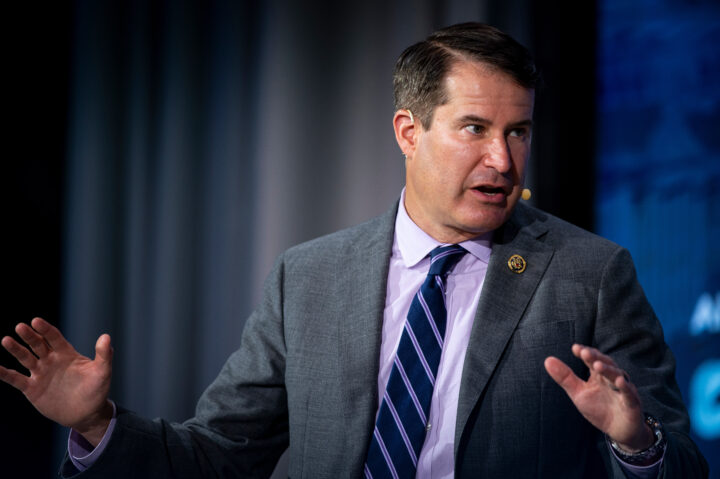
Representative Seth Moulton, a Democrat from Massachusetts, speaks during the US Chamber of Commerce's Global Aerospace Summit in Washington, DC, US, on Wednesday, Sept. 10, 2025.
Rep. Seth Moulton (D-MA) announced on Wednesday that he plans to mount a challenge to Sen. Ed Markey (D-MA), grounding his campaign in an argument for generational change.
“I just don’t believe Sen. Markey should be running for another six-year term at 80 years old,” Moulton said in his Senate race announcement. “Even more, I don’t think someone who’s been in Congress for half a century is the right person to meet this moment and win the future. Sen. Markey is a good man, but it’s time for a new generation of leadership.”
But unlike many of the younger challengers taking on older Democratic incumbents in the current election cycle, Moulton, 46, is generally more moderate, including on foreign policy issues, than Markey, an outspoken progressive. While Moulton has been strongly critical of Israeli operations in Gaza, his record as a whole leans more pro-Israel than Markey’s.
Markey faced a similar challenge from former Rep. Joe Kennedy (D-MA) in 2020 — ahead of the current anti-gerontocracy push in parts of the Democratic Party. Young progressives rallied around Markey, who won the race by 10 points. In that campaign, Kennedy sounded more supportive of Israel than the senator he was attempting to unseat.
A recent Fiscal Alliance Foundation poll of the Senate race found that 63% of Massachusetts voters think Markey should not run for another term. In that same survey, Moulton led Markey, 38-30% among Democratic primary voters.
Markey is a prominent progressive voice in the Senate and voted seven times in the last year in favor of resolutions led by Sen. Bernie Sanders (I-VT) to block various weapons transfers to Israel. He memorably faced boos at a pro-Israel rally just days after the Oct. 7, 2023, attacks when he called for de-escalation between Israel and Hamas.
He also joined a letter accusing Israel of violating U.S. arms sales conditions imposed by the Biden administration, and pushed to incorporate those conditions into the supplemental aid package for Israel and other allies.
Markey called the U.S. strike on Iran’s nuclear program “illegal and unconstitutional” and said the attack “holds dangers for all Americans.”
“This attack may set back but will not stop Iran’s efforts to get a nuclear bomb. The regime can rebuild its program and will now be highly motivated to do so. A diplomatic solution remains the best way to permanently and verifiably prevent Iran from acquiring a nuclear weapon,” Markey continued. “Trump’s illegal actions raise the risk of escalation into a wider regional war with grave risks for U.S. troops and personnel and civilians in the region.”

During a committee markup of the Antisemitism Awareness Act earlier this year, Markey led an amendment opposing the revocations of visas, detentions and deportations of students and faculty based on “protected conduct under the First Amendment,” one of a series of amendments that helped torpedo the bill.
Markey appeared on the streaming show of Hasan Piker, a far-left commentator who has repeatedly faced criticism for antisemitic rhetoric and support for terrorism, during last year’s Democratic National Convention.
While Moulton, a Marine veteran, has been critical of Israel’s war operations in Gaza and called for increased humanitarian aid, he has not backed congressional efforts to condition, withhold or end U.S. aid to Israel since Oct. 7. He voted — with most House lawmakers — in favor of supplemental aid to the Jewish state last year.
After a meeting in May 2024 with then-Israeli Ambassador to the U.S. Michael Herzog, Moulton said he opposed Israel’s plans to launch a full-scale invasion of the southern Gazan city of Rafah and backed President Joe Biden’s threat to withhold weapons if Israel proceeded with that operation. In 2019, prior to the recent war in Gaza, Moulton offered support for a bill that would have placed restrictions on the use of U.S. military aid to Israel.
In July 2025, Moulton said in a statement that it is “a moral imperative for the Netanyahu government to alleviate this suffering” in Gaza and that “Hamas bears primary responsibility, but Israel has the ability and the obligation to help.”
“I want Israel to succeed in defeating Hamas and bringing the hostages home. But that won’t happen if its policies undermine its own mission, and you cannot win a war against terror by allowing civilians to starve,” Moulton continued, citing his own experience serving in Iraq. He said he told the Israeli ambassador directly that “what’s happening in Gaza is unacceptable.”
Weeks after the Oct. 7 attacks, Moulton cautioned Israel against launching an operation in Gaza without a robust plan for what would come after the war.
Moulton voted against several Republican-led measures — which split the Democratic caucus — that would have tightened U.S. sanctions on Iran and limited presidential authority to waive such sanctions, as well as against sanctions on the International Criminal Court.
At the same time, he voted in favor of redesignating the Houthis as a Foreign Terrorist Organization, having previously led a letter to the Biden administration supporting such action, and was a lead co-sponsor of a bill to expand funding for a cooperative counter-tunneling program with Israel.
Moulton stopped short of the blanket condemnation that many Democrats expressed for the U.S. strikes on Iran, saying, “One of the reasons I was reticent to just immediately condemn the strikes is because anything that gets us back to the negotiating table is helpful — that’s where we need to be at the end of the day,” though he said he would not have voted to provide congressional approval for those strikes.
He subsequently accused administration officials of “outright lying about things that we just don’t know yet” for declaring shortly after the strikes that the U.S. had completely “obliterated” Iran’s key nuclear facilities.
On antisemitism, Moulton voted in favor of the Antisemitism Awareness Act, as well as for resolutions describing anti-Zionism as antisemitic, calling for college presidents to resign over their testimony to Congress on campus antisemitism and for a GOP-led resolution condemning the firebombing of a hostage advocacy rally in Boulder, Colo., which also praised Immigration and Customs Enforcement.
Shortly after the Oct. 7 attacks, when a coalition of Harvard University student groups issued a statement condemning and blaming Israel for the event, Moulton, a Harvard alumnus, said that he “cannot recall a moment when I’ve been more embarrassed by my alma mater” and later condemned then-Harvard President Claudine Gay’s comments at a House hearing on antisemitism.
Both Markey and Moulton have supported expanded funding for the Nonprofit Security Grant Program to help protect Jewish and other nonprofit institutions.
The report comes after the Massachusetts Teachers Association was accused of promoting anti-Israel materials to its members

Getty Images
Notebook with a pen on a table in a classroom at a school
Jewish leaders in Massachusetts praised a new report and set of recommendations by a state body that called for K-12 schools to implement the International Holocaust Remembrance Alliance’s working definition of antisemitism.
The Massachusetts Special Commission on Combating Antisemitism voted unanimously on Thursday to approve their recommendations, which in addition to encouraging schools to embrace the IHRA definition, call on districts to implement anti-bias education that includes antisemitism, to establish an Advisory Council on Holocaust and Genocide Education and to develop curricula around Jewish history and identity.
“This is a hugely important moment for Massachusetts,” Jeremy Burton, CEO of the Jewish Community Relations Council of Greater Boston who is also a member of the commission, told Jewish Insider. “These recommendations provide a roadmap for meaningful interventions with clear timelines for follow up and accountability. We certainly welcome it,” said Burton.
The IHRA working definition was officially recognized and endorsed by Massachusetts in 2022 but largely has not been incorporated within school districts.
The report notes a sharp rise of antisemitism in the state’s K-12 schools since the Oct. 7, 2023, Hamas attacks on Israel and acknowledges that there has been significant harm to the mental health of Jewish and Israeli students and families caused by antisemitic incidents. It also notes inconsistencies in how districts respond to concerns around antisemitism, with some responding inadequately and others failing to respond at all.
The vote came as the Massachusetts Teachers Association has been accused of promoting anti-Israel materials for use by its members; in December, a report by the American Jewish Committee’s New England branch found that the union has been actively encouraging members to introduce “overtly political” anti-Israel materials into K-12 classrooms, reducing “a complex struggle between two people” to an “extreme, one-sided narrative.” In March, JI reported on a member of the MTA executive board who is a member of the American Communist Party — a group with direct connections to Hamas and Hezbollah.
“Addressing the issues of antisemitism in K-12 schools is a multifaceted process,” Rob Leikind, the regional director of AJC New England, told JI. “The recommendations of the commission do several things. They flag a problem and provide observations about how the problem manifested itself. The commission is helping to expand awareness about a problem and begin a discussion about how it presents itself in schools. Beyond that, there are recommendations that are going to begin a process of helping teachers, administrators and students recognize what may be antisemitic and things to do about it.”
Leikind said that, particularly since Oct. 7, he has observed that “many people, even those who have extensive contact with Jews, simply don’t understand what makes something antisemitic and don’t really have the tools to begin to discern what may be antisemitic.
“There’s a lot of education that needs to be done and the recommendations start to address that,” he said.
Burton lauded the recommendations for addressing “systemic gaps in responding to antisemitism in K-12 education and establishing standardized protocols for prevention and response.” He said they have been “embraced” by the state.
At Thursday’s hearing, Pedro Martinez, the newly appointed Commissioner of Elementary and Secondary Education in Massachusetts — formerly the head of Chicago public schools — expressed “his appreciation for the recommendations, confirmed his department’s support for the recommendations and committed resources including ‘at least’ one additional staff position to spearhead the Department of Education’s work on antisemitism,” Burton said.
“That’s a fairly significant commitment,” he continued. “It’s not just a document but it’s a document that has the full public embrace and support of a commissioner of education who prioritized his commitment to implement it on his first weeks on the job. That sends a strong signal of allyship and partnership, both with the commission and with the Jewish community.”
“Without ignoring anyone’s concerns about the MTA that are very legitimate, we know we have a partner and ally in our state government in moving forward,” said Burton.
Massachusetts Educators Against Antisemitism called the recommendations “essential for creating a safe and inclusive environment for all students and staff in Massachusetts schools” in a statement and urged state officials and local communities “to ensure these recommendations are not only adopted but are effectively and consistently implemented across the Commonwealth.”
In one incident, a professor accused a student of having a Jewish ‘mind infection’ and harassed another on social media

Scott Eisen/Getty Images
Commencement preparations in front of the Great Dome at Massachusetts Institute of Technology's on April 15, 2025 in Cambridge, Massachusetts.
The Louis D. Brandeis Center for Human Rights Under Law filed suit in federal court in Massachusetts on Wednesday on behalf of two Jewish students, alleging that the university and a tenured professor violated Title VI of the Civil Rights Act of 1964, including harassment on social media and in mass emails.
“This is a textbook example of neglect and indifference,” Kenneth Marcus, founder and chairman of the Brandeis Center, said of the lawsuit, shared exclusively with Jewish Insider. “Not only were several antisemitic incidents conducted at the hands of a professor, but MIT’s administration refused to take action on every single occasion,” said Marcus, who served as U.S. assistant secretary of education in the Bush and Trump administrations.
While the lawsuit, Sussman v. MIT, addresses several antisemitic incidents caused by students, a large portion of the 71-page complaint focuses on alleged antisemitic actions from Michel DeGraff, a tenured linguistics professor.
The complaint states that through the spring and fall of 2024, DeGraff publicly harassed Lior Alon, an Israeli postdoctoral student, for serving in the Israel Defense Forces — posting Alon’s name and image on social media, and tagging Al Jazeera. The professor then published an article in European newspaper Le Monde in which he singled out the Alon by name, writing that the Israeli, “like many other Zionist counter-protesters, participate in well-rehearsed propaganda that erases the anti-Zionist Jewish students and misrepresents them.”
As a result, Alon said he was confronted by strangers in various locations, including his child’s daycare and at the grocery store. Alon emailed MIT President Sally Kornbluth expressing fears for his safety and the safety of his family, and requested that the posts be taken down.
Kornbluth — who is the only one of the three college presidents who testified in a now-infamous December 2023 congressional hearing on campus antisemitism who remains in her position — never responded to Alon’s concerns, according to the lawsuit, and no action was taken.
In November 2024, the complaint states that DeGraff harassed another Jewish student by sending a series of mass emails to his entire department, copying Kornbluth and other administrators, accusing the student of having a Jewish “mind infection” and threatening to use him as a “real-life case study” in a class the professor was teaching.
That same day, flyers were slipped under doors in a dormitory where this student previously lived, targeting him specifically in white lettering on a green band, styled after Hamas headbands, advocating for violence against Jews.
As a result of the harassment, the student left MIT before completing his Ph.D. program.
Other instances of antisemitic harassment detailed in the lawsuit include students occupying buildings and disrupting classes with antisemitic chants, students distributing “terror maps” promoting violence at campus locations deemed Jewish and an individual urinating on the Hillel building.
The Massachusetts school was among the 45 universities against which the Department of Education’s Office for Civil Rights opened Title VI investigations in March.
Wednesday’s lawsuit comes at a time when many elite universities are acquiescing to the Trump administration’s demands to crack down on the rise of antisemitic activity on campus that began in the aftermath of the Oct. 7, 2023, terrorist attacks. MIT, however, joined a lawsuit last month challenging the federal government’s attempt to cut research funding from schools that the administration says have not adequately addressed antisemitism.
Healey visited the Boston-area Jewish restaurant and learning institute to ‘be present in a space that expresses the best of Jewish life’

Gov. Maura Healy on X
Gov. Maura Healey visits Lehrhaus in Somerville, MA on May 23, 2025.
On Thursday morning, as Jews around the world woke to news of an antisemitic attack that left two young people dead in Washington, the team at Lehrhaus, a kosher restaurant near Boston, prepared for another day of service. That night, dozens of people — young and old, Orthodox and secular, Jewish and non-Jewish — stopped by this Jewish tavern and house of learning to gather with community and, of course, to eat delicious food.
Among the guests at the popular Somerville, Mass., restaurant on Thursday night was Gov. Maura Healey, a first-time visitor to a place that has become an institution for Boston’s Jewish community since it opened in 2023. She spent nearly an hour there talking to diners and meeting Lehrhaus’ staff.
“I wanted them to know that I share their heartbreak and outrage over the murders of Sarah Milgrim and Yaron Lischinsky, and that antisemitism has absolutely no place in Massachusetts,” Healey, a Democrat, told Jewish Insider in a statement. “Lehrhaus is a testament to the strength and spirit of the Jewish community in Massachusetts, especially during the most difficult times.”
At a Thursday morning meeting among senior leaders of Boston Jewish organizations, Rabbi Charlie Schwartz, the director of Lehrhaus, suggested that Healey should stop by in the coming days. Jeremy Burton, CEO of the Boston Jewish Community Relations Council, brought the idea to Healey — and within hours, she agreed to visit.
“Maybe not 10 or 15 minutes after Charlie and I spoke, the governor called me sometime before 10 a.m., and we had the kind of chat that we often have at times like this, where she’s expressing her concern, asking about the community, asking about what people are feeling and needing,” Burton said. “One of the things that we talked about was this issue of spaces of Jewish gathering, and this larger question of how to convey that Jews belong and Jews are valued, and Jewish spaces are valued, and it’s safe to gather.”
By the time Healey stopped by, the restaurant was nearly full, with people sampling Jewish cuisine and Jewish-inspired cocktails from around the world. In the library, a class was going on — so packed that Healey had to wave rather than walking in to address the attendees.
“I told her about Lehrhaus, about what we’re doing. I mentioned that we have the best fish and chips in Boston, according to Eater, and she definitely should come back and try them,” said Schwartz.
With Healey’s visit, she came to “just hang out and speak to people, and just be present in a space that expresses the best of Jewish life, even in moments of real tragedy and pain,” Schwartz added.
Like other Jewish institutions, Lehrhaus is well aware of security concerns, and regularly examines its security measures amid antisemitic threats. But it is not the kind of place where guests will find armed guards or metal detectors.
“We understand that as a public-facing tavern and house of learning, where one of our main functionalities is being a bar and restaurant, there’s a different type of security posture that we have to have,” said Schwartz. “The type of security that we have is going to be very different than a museum or a synagogue or an embassy, but will still be present.”
Lehrhaus is planning to open a second location in Washington, but they have not yet announced a timeline for the project.
New Jewish Insider poll gives incumbent Rep. Richard Neal a nine-point advantage over his opponent with less than a week before the primary

Don Treeger/The Republican via AP
Rep. Richard E. Neal (right) bumps elbows with his challenger, Holyoke Mayor Alex B. Morse, before their debate on Aug. 17, 2020.
Rep. Richard Neal (D-MA) leads his progressive challenger, Alex Morse, by nine points ahead of the heavily contested September 1 Democratic primary in Massachusetts’s 1st congressional district, according to a new Jewish Insider poll.
The poll, based on 518 voter surveys conducted by RABA Research on August 23 and 24, puts Neal on relatively comfortable footing with 49% of the vote, placing him outside the ±4.3% margin of error. Morse pulled in 40% of the vote among those surveyed, with 12% of likely voters reporting that they were “not sure” who they would choose.
At the same time, Neal’s failure to clear the 50% threshold could be a sign of trouble for him, as incumbents polling below 50% are often considered at risk of defeat.
In recent weeks, the contentious race has gained national attention as Morse, who is gay, became embroiled in a sexual misconduct scandal that nearly ended his run. But he was vindicated after the allegations put forth in a letter by the College Democrats of Massachusetts appeared to have been part of a scheme to derail Morse’s campaign in coordination with the state’s Democratic Party. Neal has denied any knowledge of such plans.
The controversy seems to have given Morse a boost, said Robert Boatright, a professor in the department of political science at Clark University in Worcester. “A lot of people outside Massachusetts rallied to his side on that, so the story got him more visibility, and my guess would be it helped him more than it hurt him,” he told JI.
“But at the same time, the district is not really favorable to him,” Boatright added, predicting that Neal’s blue-collar base would likely give him an edge next week.
Still, Boatright speculated that left-leaning enthusiasm for another candidate in Massachusetts, Sen. Ed Markey (D-MA) — who is running against a younger challenger, Rep. Joe Kennedy (D-MA), but has been backed by progressives in and outside of the district — could perhaps buoy Morse in his own race.
According to the JI poll, Kennedy leads Markey 44% to 37% among Democratic and independent voters in Massachusetts’s 1st congressional district. Nineteen percent of respondents said they were undecided.
Morse, the 31-year-old Holyoke mayor, entered the race to unseat Neal last summer, riding a progressive grassroots wave that, this election season, has swept away a number of long-serving legislators including Reps. Eliot Engel (D-NY), Dan Lipinski (D-IL) and William Lacy Clay (D-MO).
Among the many issues demonstrating the political divide in the race, Neal and Morse have divergent views on aid to Israel. Morse, who is Jewish, believes the U.S. should condition aid to Israel in order to pressure the Israeli government to change its policies towards the Palestinians. Neal opposes conditioning security assistance to Israel.
According to the poll, a plurality of voters in the district — 48% — think aid to Israel should be conditioned, while 34% want assistance to continue without conditions. Eighteen percent — including 29% of voters who identified as “very liberal” — were not sure or expressed no opinion on the matter.
Morse said he does not support the Boycott, Divestment and Sanctions movement, but opposes efforts to legislate against BDS.
Neal is backed by a number of pro-Israel groups including Pro-Israel America and Democratic Majority for Israel (DMFI), which last week poured more than $100,000 into anti-Morse advertising.
Over the past year, Morse has built a formidable campaign operation, raising more than $1.3 million, according to the latest filings from the Federal Election Commission.
While the polling indicates Morse has been gaining momentum, he’ll still have to overcome the gap if he wants to pull off an upset in the district, which includes a large swath of western and central Massachusetts.
Morse, who is backed by Justice Democrats, picked up another key endorsement on Tuesday from Courage to Change, the political action committee founded by Rep. Alexandria Ocasio-Cortez (D-NY). The endorsement was not reflected in the poll because it occurred after the surveys were conducted.
Neal, who entered Congress in 1989 and serves as the powerful chairman of the tax-writing Ways and Means Committee, has vastly outraised his opponent, raking in nearly $3.8 million in his reelection effort.
Neal, 71, has also benefited from considerable outside spending. In addition to the money spent by DMFI, the American Working Families super PAC poured more than $500,000 in advertising into the race in an effort to boost Neal.
Even if Neal manages to defend his seat, his falling short of 50% in the poll signals a tough political environment for established longtime members of Congress.
“If this were an isolated phenomenon, it wouldn’t be a big deal, but there have been a bunch of these races,” Howard J. Gold, a professor of government at Smith College in Northampton, told JI. “This fits into a really well established and growing pattern, and the old guard, the Democratic establishment, has to be really, really, careful. They can’t rely on politics as it used to be.”
Jacob Kornbluh and Marc Rod contributed to this report.
The former head of Boston’s Jewish Federation has endorsed Joe Kennedy but is staying mum on who he’s backing in Kennedy’s congressional district

Courtesy
The Senate primary matchup in Massachusetts between Rep. Joe Kennedy (D-MA) and Sen. Ed Markey (D-MA) has made for some curious dynamics. While progressive Democrats are throwing their support behind the 74-year-old Markey, a co-author of the Green New Deal who has held elected office for nearly 50 years, the local pro-Israel community has largely rallied behind Kennedy, the 39-year-old political scion who gave up his seat in the state’s 4th congressional district to run against a member of his own party.
In a recent letter, more than 75 Jewish community leaders in Massachusetts endorsed the young congressman over Markey, though the two elected officials seem to share similar views. “At a time when some work overtime to delegitimize Israel, Joe has been unyielding in making Israel’s case to those who may be reluctant to listen to it,” read the letter, which was published earlier this month. “He has never ducked and run when it comes to support for Israel.”
Barry Shrage, a professor in the Hornstein Jewish Professional Leadership Program at Brandeis University and the former president of the Combined Jewish Philanthropies of Greater Boston, was one of those who signed onto the letter, and in a recent interview with Jewish Insider, he explained his reasons for backing Kennedy.
“I support him because I think that, at the end of this particular era of politics, after the next election, we’re going to be trying to figure out who’s going to lead the Democratic Party into the future,” Shrage said. “I’m 73 myself. I’m not against older people. They’re all great. We’re all great. Baby boomers are my favorite. But on the other hand, the future of the Democratic Party, as everyone knows, is not Joe Biden, it’s not [House Speaker Nancy] Pelosi. These are all fine people, but they’re not going to be in a position to actually lead the party. So the question is going to be, ‘Who is going to lead the party?’”
Shrage is worried that the answer to that question could be such left-wing Democrats as Rep. Alexandria Ocasio-Cortez (D-NY), a rising star who has endorsed Markey and whose political views are inhospitable to Israel. “It troubles me,” Shrage said, pointing out that Markey has also been endorsed by a local nonprofit organization, Massachusetts Peace Action, which supports the Boycott, Divestment and Sanctions movement.
Not that Shrage is implying Markey necessarily holds the same views of those who have backed him. “I’m not saying that’s Ed Markey. I’m not,” said Shrage, who added that Markey has a solid record when it comes to Israel. “But I’m saying that all that support from those places makes me concerned.”
“Whether Markey will feel beholden to them or not, I do not know,” Shrage added. “I assume that he will continue to be a supporter of Israel as he has been in the past. But I still worry about the future of the party and maintaining a bipartisan sense of support for Israel.”
“It’s a big deal for me as a Jewish person,” Shrage concluded.
Though Shrage publicly supports Kennedy, he declined to reveal who he would be voting for in the district Kennedy is leaving behind to run for Senate. (He has donated $350 to local legislator Becky Grossman, according to the Federal Election Commission.) The crowded Democratic primary contest includes nine candidates who are vying to represent a portion of southeastern Massachusetts in Congress.
Shrage believes that most of the candidates would do a fine job representing the 4th district, reserving criticism for Ihssane Leckey, a young progressive who has been endorsed by Jewish Voice for Peace and If Not Now Boston. Leckey, Shrage said, “really doesn’t understand the nature of Israel, its political systems, its strengths.”
A recent poll released by Leckey’s campaign put her in third with 11% of the vote, behind Newton City Councilor Jake Auchincloss at 16% and Grossman at 19%. The numbers suggest that some of the contenders could split the vote, giving Leckey the edge in a packed race.
“There’s no way to know how the vote is going to split,” Shrage said. “The best thing we can do is to make sure that people do come out for the candidate of their choice.”
With that in mind, Shrage said he has been doing his part to educate Jewish voters in the district about their options. He has helped distribute letters to synagogues and Jewish organizations exhorting Jewish community members to participate in online forums so they can decide for themselves who they like.
The hope, he explained, is that even if the vote splits, Leckey will fail to garner enough support to advance to the primary.
“What I want the Jewish community to know is that this is an extremely important race that deserves their time, attention and their engagement in order to make the best possible choice and avoid a situation where a district that’s always been balanced, liberal, progressive and also pro-Israel goes in a totally different direction,” Shrage averred. “It would be, what we used to say in Yiddish, a shanda.”
Please log in if you already have a subscription, or subscribe to access the latest updates.
 Continue with Google
 Continue with Apple