













































Major Jewish advocacy organizations told JI that they will continue to push for issues including Nonprofit Security Grant Program funding and combating antisemitism online
Worawat/Adobe Stock
U.S. Capitol Building


 Add JewishInsider on Google
Going into 2026, Jewish community groups say their advocacy priorities for Congress and the federal government remain largely consistent, with a focus across many of the major advocacy organizations on bolstering community security through the Nonprofit Security Grant Program and tackling antisemitism online.
While Congress has increased its attention to Jewish communal issues in the years since the Oct. 7, 2023 Hamas attacks on Israel, including a string of high-profile hearings on antisemitism and several bills passed to support Israel and combat Iran, many key legislative priorities for the Jewish community — including bills on antisemitism and substantial increases to annual security funding for nonprofits — have remained stubbornly intractable.
Highlighting the expansion of congressional scrutiny of unions, academic associations and tech platforms for their fostering of antisemitism, top Anti-Defamation League officials said that advocating for such oversight work will remain a priority in the coming year, particularly in an environment in which it is difficult to pass any legislation, regardless of the subject.
“We’ll continue focusing on tough oversight, on bipartisan legislation and targeted appropriations,” Lauren Wolman, the ADL’s senior director of government relations and strategy, told Jewish Insider. “The big buckets are that we’ll be pushing Congress to confront antisemitism wherever it appears, including within one’s own party; protecting houses of worship with increased security funding; demanding real transparency and accountability from tech platforms; advancing comprehensive federal legislation to counter antisemitism and taking action to ensure that Jewish students are safe on campus.”
Asked about how the organization plans to ensure progress on legislation that has been difficult to achieve in past years, Wolman emphasized that there had been “historic momentum” this year for increased security funding, and said that ADL would “focus on levers that move policy, so oversight, legislation, appropriations” and leverage “the value of transparency, bipartisanship and coalitions.”
Max Sevillia, the ADL’s senior vice president of national affairs, said that the organization will focus on must-pass legislation such as appropriations and the National Defense Authorization Act, and emphasized that “legislating on any issue, including fighting antisemitism, oftentimes, is not a one-session effort. So we don’t give up on our priorities.”
He said that, even if major legislation did not pass this session, the group is “better positioned” to advance key priorities with the additional attention they’ve received since Oct. 7.
Sevillia said that the HEAL Act, examining Holocaust education; the Protecting Students on Campus Act, which aims to facilitate Title VI discrimination complaints; and the Pray Safe Act, which would create a central database of security resources for institutions, will remain priority bills in the new year.
ADL is also supporting the Platform Accountability and Transparency Act (PATA), a bipartisan Senate bill that would require social media companies to share additional data with the public and with researchers, including regarding hate incidents and policies, and how platforms are responding to them.
“Congress really needs to require platforms to provide meaningful transparency into content moderation practices, algorithmic amplification and enforcement of their hate speech policies,” Wolman said.
Wolman said the ADL also continues to pursue a “comprehensive … whole-of-government” package of legislation on antisemitism, a prospect that has remained elusive. The Countering Antisemitism Act, a package along those lines, received bipartisan support in the previous Congress, but ultimately proved unwieldy — facing opposition on both sides of the aisle in both chambers.
Wolman said that ADL will be pressing Congress to focus on college campuses, K-12 education, academic professional associations, health care and technology platforms, including Wikipedia and artificial intelligence, in its oversight capacity and for potential hearings next year.
Sitting down with JI on Capitol Hill earlier this month, American Jewish Committee CEO Ted Deutch said that his organization’s priorities for the remainder of 2025 included urging lawmakers to stand with the Jewish community and attend menorah lightings in the wake of the Sydney, Australia, shooting targeting a Hanukkah celebration on Bondi Beach.
Going into 2026, the group is also focused on pressing lawmakers to tackle antisemitism online, particularly ensuring social media companies are addressing the foreign actors driving much of that content, as well as the antisemitism that has proliferated in AI-generated posts.
The new X policy disclosing users’ locations “confirm[ed] what we all know, which is there is this ongoing effort by malign actors around the world to influence what happens here, to stoke antisemitism, to polarize our community,” Deutch said.
Deutch said that AJC also looks forward to working with Ambassador Yehuda Kaploun, who was confirmed this month as the Trump administration’s special envoy to monitor and combat antisemitism. Additionally, the group is pressing the Department of Justice to take action to address protests that block access to religious institutions. He said AJC is open to supporting new legislation on the subject, if necessary.
In his interview with JI, Deutch also urged Jewish communal organizations to come together around a common agenda, arguing that the current security environment demands a unified message and a coordinated push.
The Jewish Federations of North America will be focused on the six-point security plan laid out by many major Jewish groups following the Capital Jewish Museum shooting earlier this year, which includes massive increases to security grant funding and efforts to address antisemitism online, as well as antisemitism in K-12 and higher education and mental and physical health care spaces; the Holocaust Survivor Assistance Program and social safety net programs such as SNAP and Medicaid.
“I think security and combating antisemitism are top of mind across our community, and that’s clearly reflected in our aggressive work to increase nonprofit security funds, tackle hate on social media, and advance our six-point security plan,” JFNA CEO Eric Fingerhut told JI.
“But we aren’t forgetting other critical issues that we care about, including legislation supporting Holocaust survivors and protect[ing] the most vulnerable in our communities,” Fingerhut continued. “With our new flagship public affairs office up and running, we are also expanding our investment to ensure local Federations come to Washington regularly to strengthen our relationships on the Hill.”
Nathan Diament, the executive director of public policy for the Orthodox Union, said that OU’s priorities will include additional NSGP funding, allocating resources from the Department of Justice for Jewish community security, implementing the Educational Choice for Children Act — legislation passed in this year’s reconciliation bill creating tax credits for educational scholarships — and, like AJC, urging the Department of Justice to “aggressively prosecut[e] those who mount ‘protests’ at Shuls.”
In the pro-Israel space, a source familiar with AIPAC’s plans told JI that the group’s general priorities next year will include expanding U.S.-Israel collaboration in security, technology and economic spaces; supporting U.S. aid to Israel; highlighting the ongoing security threats to Israel, including Iran’s efforts to rebuild its missile arsenal and nuclear program and its support for proxies; and working to achieve Hamas and Hezbollah’s disarmament.
The source said AIPAC will release a more comprehensive agenda early next year.
Some in the Jewish community are raising concerns that grants may be contingent on cooperation with immigration authorities and eliminating diversity, equity and inclusion programs

Brandon Bell/Getty Images
A law enforcement vehicle sits near the Congregation Beth Israel synagogue on January 16, 2022 in Colleyville, Texas.
A series of Jewish community groups, in a joint statement released on Tuesday, urged Jewish organizations to apply for Nonprofit Security Grant Program funding, in spite of ongoing concerns from some in the community about potential new conditions on the funding.
Some in the Jewish community have raised concerns and expressed confusion about language present in some NSGP application materials indicating that grants may be contingent on cooperating with immigration enforcement efforts and eliminating diversity, equity and inclusion programming. The Federal Emergency Management Agency did not respond to a request for comment.
“While we are aware that questions have arisen on the part of certain religious institutions regarding the current year’s program criteria, our organizations strongly urge all eligible institutions to apply for this critical resource,” the Jewish Federations of North America, Conference of Presidents of Major American Jewish Organizations, Anti-Defamation League, Secure Community Network, Community Security Initiative and Community Security Service said in a joint statement.
The groups called the NSGP “an essential lifeline for all synagogues, schools, community centers, and other community institutions, regardless of their denomination” in light of “unprecedented threats to our communal security.”
The groups said they have been “in regular contact with government officials who have affirmed their continued commitment to protecting the safety of all faith-based institutions and the values they hold.”
They also urged organizations with further questions to contact the state-level agencies responsible for administering the NSGP grants.
The meeting was one of Noem’s highest-level sit-downs with Jewish leaders since taking office
Courtesy Secure Community Network
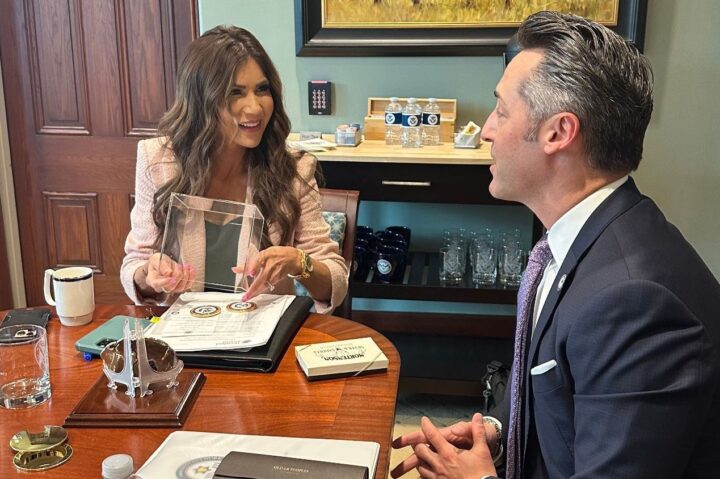
Michael Masters, the CEO of the Secure Community Network, meets with Secretary of Homeland Security Kristi Noem, July 2025.
Michael Masters, the CEO of the Secure Community Network, sat down last week with Secretary of Homeland Security Kristi Noem amid a push from Jewish community groups for additional security resources to address rising levels of antisemitism.
The meeting was among the most high-level sit-downs between Noem and Jewish communal leaders since she took office.
“The secretary is very, very clear in her understanding and commitment to addressing the threat environment, particularly as it pertains to the faith-based community and the Jewish community and deeply understands the issues and concerns facing the community … and the scope of the department in being able to do that,” Masters told Jewish Insider in an interview on Wednesday.
SCN supported Noem during her confirmation process, and Masters said that she “evidenced a clear understanding and appreciation for the importance of this issue,” and called their sit-down “an encouraging sign.”
He also praised the work she’d done in her prior role, as governor of South Dakota, to protect the state’s Jewish community and understand its needs.
Masters said he and Noem discussed the threats facing the Jewish and other faith-based communities and the ways that SCN has worked with DHS in the past.
“So many of these threats are crossing over different faith based communities and historically, the department has been a convener and coordinator and supporter of efforts of the faith-based community to come together to address those as a whole,” Masters said. “And she firmly embraces that, I think, as a public official and as a person.”
The Department of Homeland Security did not respond to a request for comment.
Masters said that leaders across the federal government, including at the FBI, DHS, Department of Justice and the White House, understand that, “you cannot disassociate the safety and security of the Jewish community from the safety and security of the broader faith-based community, or from the domestic, homeland and national security of the United States.”
One priority for Masters in the meeting, he said, was pushing for the release of the application for 2025 Nonprofit Security Grant Program Funding, which opened on Monday.
“That was the focal point, and has been the focal point for many of our conversations,” Masters said, adding that he was “very encouraged” to see the applications open following his meeting and a push from various other Jewish community stakeholders and lawmakers.
“There’s going to be a bunch of follow-up related to the condensed time frame,” he continued, “and then the remainder of the supplemental. We will be able to turn our attention to that once we get through the current push of getting people’s applications in for this year’s awards.”
Organizations applied last year for a tranche of more than $100 million in NSGP funds provided through last year’s national security supplemental funding bill that has yet to be awarded or released.
Another issue Masters said he’d spoken about with Noem was the plan to cut the majority of the DHS’s Intelligence and Analysis (I&A) division’s staff; Masters wrote to Noem directly earlier this month to offer recommended reforms and overhauls for that office.
“We have worked with I&A since its creation,” Masters said. “There are significant efficiencies to be found [but] I&A is the only statutorily authorized entity that has a responsibility and a mission set related to state, local, tribal and territorial law enforcement and private nonprofit sector partners. It needs to do a much better job of servicing those stakeholders and there are dedicated men and women in I&A who have worked to do that.”
He said that Noem has already been working toward some of the same goals he outlined, including sending DHS agents out of headquarters in Washington and into the field to work on critical issues on the ground.
“Many of us who served in law enforcement and the associations that are currently dealing with I&A — and certainly SCN — we support this effort, but it will be a work in progress for some time,” he said, explaining that the office’s mission and mandate has shifted between and during various administrations.
“All of us are committed, from law enforcement and those of us who deal in the security space, to working to support the effort to make sure that I&A can be as effective as it can be, that it is fit for its mission, it’s sized for its mission and that it’s structured in a way that allows it to be effective,” Masters continued.
Masters, along with Anti-Defamation League CEO Jonathan Greenblatt, Jewish Council for Public Affairs CEO Amy Spitalnick and national law enforcement leaders, also attended a private roundtable with members of the House Homeland Security Committee’s Counterterrorism and Intelligence Subcommittee last week.
“For the fourth consecutive year, antisemitic violence and acts of terror have risen in all 50 states. This is not a localized issue—it’s a national crisis,” Rep. August Pfluger (R-TX) said in a statement. “Last week’s roundtable provided an important opportunity to hear directly from law enforcement officials and Jewish community leaders about this alarming surge.”
He said the participants made clear the need for “stronger interagency coordination, enhanced intelligence sharing, targeted training, and robust enforcement.”
He vowed to work with colleagues to take action and address antisemitism.
“Silence in the face of antisemitism is complicity. Hatred and bigotry have no place in America, and every person deserves to live without fear,” he said.
Masters said that the Jewish and law enforcement leaders were “all aligned in the importance of addressing the threat environment facing the Jewish community, in the importance of addressing hate crimes broadly, and in the necessity of strong, consistent, predictable funding for law enforcement.”
He said they’d discussed issues including I&A and the need for strong collaboration and communication to address threats to the Jewish community and the country as a whole.
“I deeply appreciated the opportunity to meet with the committee on the rise in antisemitic violence and the concrete steps necessary to protect our communities,” Spitalnick told JI, adding that she had advocated for NSGP funding to be released.
“There is still significant work to be done to ensure this critical security program is properly funded and the dollars are moved quickly to protect our communities,” she continued. “We also made clear that the crisis of antisemitism and broader extremism requires a whole-of-government and whole-of-society solution — aimed at building resiliency to hate and violence in the first place. Yet too many programs — such as hate crime prevention grants — have been frozen, cut or insufficiently funded at levels that do not match the dire need.”
The DHS Office of Intelligence and Analysis, responsible for a variety of information-sharing functions, plans to shed 75% of its staff
JIM WATSON/AFP via Getty Images
A sign for the US Department of Homeland Security in Washington, DC, March 24, 2025.
Jewish community groups and congressional Democrats are raising concerns about the Department of Homeland Security’s plans to slash 75% of the staff for the department’s Office of Intelligence and Analysis (I&A).
NextGov reported that the cuts — totaling 725 of the office’s 1,000 staff — had been in progress for months but were temporarily paused following the U.S. strikes on Iran’s nuclear facilities, which federal officials warned could prompt domestic attacks.
I&A plays a role in collecting and disseminating to local law enforcement and private partners intelligence to counter threats including terrorism and foreign adversaries. But the office has also come under criticism from various fronts in recent years over alleged domestic surveillance abuses and failures to investigate threats, and faced questions over its scope, capabilities and mission, which have prompted calls for reform.
Top congressional Democrats wrote to the administration last week criticizing the expected cuts.
“Hollowing out the office risks leaving the homeland dangerously exposed to these threats, especially at a time when the FBI’s budget is being substantially reduced,” Sen. Gary Peters (D-MI), the ranking member of Senate Homeland Security and Governmental Affairs Committee, and Reps. Bennie Thompson (D-MS) and Jim Himes (D-CT), the ranking members of the Homeland Security and Intelligence committees, said in a letter to Secretary of Homeland Security Kristi Noem and Director of National Intelligence Tulsi Gabbard.
“Radically reducing I&A’s workforce at headquarters or in the field would create dangerous and unnecessary security gaps and could again leave us in the dark about the threats that lie ahead,” the lawmakers continued.
They emphasized that, despite issues at I&A in the past, it has made progress and fills critical gaps in the intelligence infrastructure.
A coalition of Jewish community groups — the American Jewish Committee, the Anti-Defamation League and the Secure Community Network — wrote to the top lawmakers on the Senate and House Intelligence Committees last week raising similar concerns.
“We are deeply concerned that any wholesale changes to the operations of I&A will have an adverse effect on countering antisemitism and ensuring the safety of the Jewish community in the United States,” the Jewish groups wrote. “With the historic rise in antisemitic incidents and threats both targeting and impacting the American Jewish community, I&A’s role has never been more important.”
The groups highlighted the office’s mission in sharing information with partners, including state and local law enforcement, and said that they “rely on I&A to provide accurate and timely updates on behalf of the intelligence community to inform efforts for our community’s safety and security.”
The groups urged the lawmakers to work to halt changes that would jeopardize Jewish community security.
Michael Masters, SCN’s CEO, wrote separately to Noem on Monday to offer recommendations for the future of I&A, emphasizing, “as the only Intelligence Community entity statutorily mandated to share threat information with state, local, tribal, and territorial (SLTT) partners, and a key information sharing partner of a non-profit entity such as ours, it is critical that we at SCN, as well as our law enforcement partners, have an effective, credible, and efficient partner in DHS I&A.”
Masters said that, while the office is a critical resource, there have been issues with I&A’s output in the past, some of which have impacted the Jewish community: “When we have received information and support from I&A, we have faced issues with the timely and credible nature of the information itself,” Masters said.
He recommended that I&A’s mission be focused in part on collaboration and information-sharing with nonprofits such as SCN and on open-source intelligence collection and coordinating with other federal intelligence agencies.
A DHS spokesperson said in a statement to JI that DHS has identified some roles and programs inside I&A as unnecessary.
“Under President Trump’s leadership, we focused on getting the Department of Homeland Security back to its core mission of prioritizing American safety and enforcing our laws. DHS component leads have identified redundant positions and non-critical programs within the Office of Intelligence and Analysis,” the statement reads. “The Department is actively working to identify other wasteful positions and programs that do not align with DHS’s mission to prioritize American safety and enforce our laws.”
Groups representing state and local law enforcement officials, including the Major Cities Chiefs Association, County Sheriffs of America, the Association of State Criminal Investigative Agencies, the National Fusion Center Association and the National Sheriffs’ Association, have also warned against gutting the office.
“[I&A] is the only component of the U.S. intelligence community with a statutory mandate to share threat information with state and local partners,” a letter from the Major Cities Chiefs Association, County Sheriffs of America and the Association of State Criminal Investigative Agencies, reads. “The current threat landscape makes our partnership with [I&A] more critical than ever. Ongoing Middle East conflicts heighten risks of foreign-directed and homegrown violent extremism, as demonstrated by the recent antisemitic attack in Boulder, Colorado.”
Please log in if you already have a subscription, or subscribe to access the latest updates.
 Continue with Google
 Continue with Apple