

















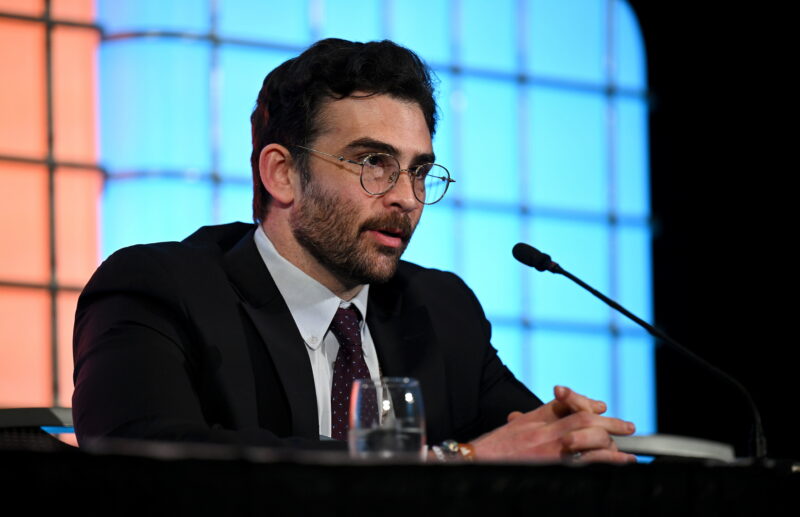








































Ken Marcus argued that reporting requirements have pressured employers to make hiring decisions based on race, rather than encouraging equal treatment


 Add JewishInsider on Google
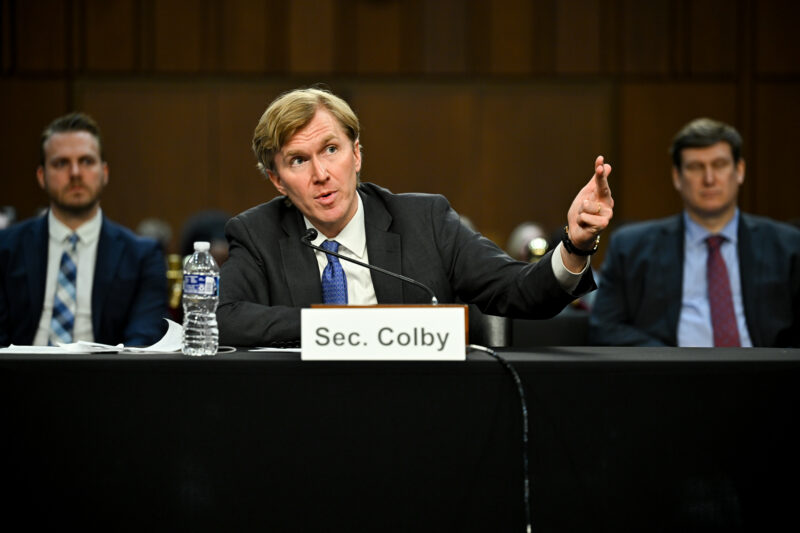
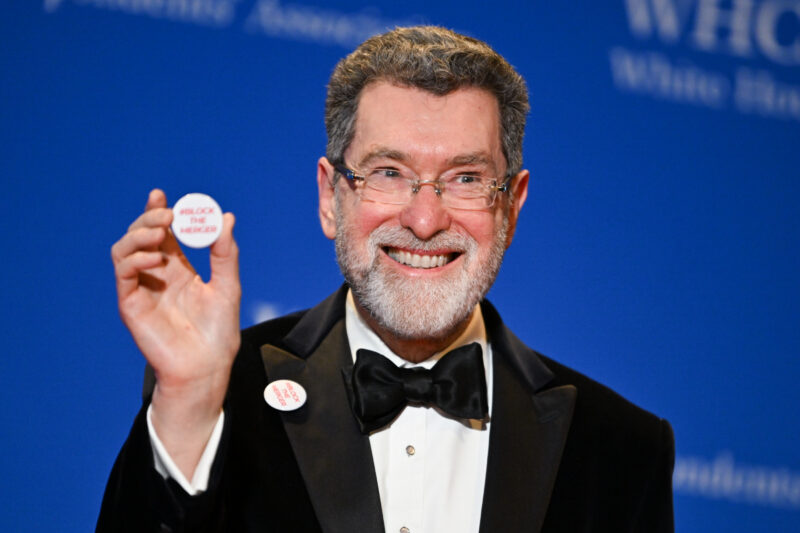
Kenneth Marcus, the president of the Louis D. Brandeis Center for Human Rights Under Law, urged the Equal Employment Opportunity Commission on Tuesday to repeal a longstanding rule requiring large employers to keep and report data on the racial, ethnic and sex makeup of their workforce.
Marcus was one of a slew of speakers who appeared before the commission to testify for and against the rule, which the commission has proposed repealing. He argued that the reporting requirements have resulted in employers feeling pressure to make hiring decisions based on race, rather than encouraging equal treatment.
“The Equal Employment Opportunity Commission should be fighting against discrimination rather than incentivizing employers to get their numbers right in ways that might violate the very laws that the agency was established to enforce,” Marcus said. “The commission should … avoid viewing either the collection or the elimination of demographic data as an end in itself. The proper objective is vigorous enforcement of Title VII against actual discrimination.”
Marcus said the EEOC should be focused on investigating and pursuing claims of discrimination against individuals, rather than monitoring demographic data.
“At the same time, we respectfully urge the commission to make equally clear that the elimination of demographic reporting cannot and should not result in diminished attention to other forms of discrimination, affecting not only Jews but also other groups,” Marcus said. “The measure of our civil rights laws is not whether the government counts members of identity groups. It is whether the government protects everyone equally.”
He said that the Jewish community’s experience “illustrates both the promise and the peril of demographic data collection. … History demonstrates that neither demographic classification nor demographic invisibility has ensured equal treatment. Only vigilant enforcement of the law can do that.”
“History demonstrates that data collection can protect vulnerable communities in some circumstances while exposing them to extraordinary danger in others,” he said.
In the past, Marcus argued, governments including the Nazi regime have used registries and other records to identify Jewish communities for persecution. In other cases, he continued, discrimination against Jews has gone overlooked and unrecognized based on demographic data because Jewish identity does not fit neatly into traditionally recognized demographic categories.
“Aggregate demographic data can therefore obscure rather than illuminate the reality of the discrimination which Jewish workers are facing,” Marcus said, arguing that a recent focus by employers on “demographic frameworks to guide diversity, equity and inclusion initiatives” has led to Jews and antisemitism being ignored, overlooked and stigmatized.
Schools that fail to institute required policies for two years would lose their federal funding
Andrew Harnik/Getty Images & DOMINIC GWINN via Getty Images
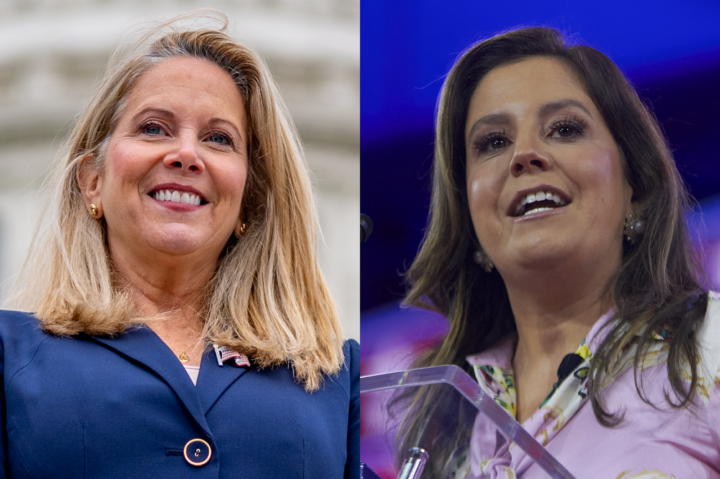
Laura Gillen (D-NY) and Reps. Elise Stefanik (R-NY)
Reps. Elise Stefanik (R-NY) and Laura Gillen (D-NY) this week introduced the Student Protection and University Accountability Act, which aims to compel schools to institute clear policies for addressing antisemitism and other forms of discrimination under Title VI of the Civil Rights Act, or face losing their federal funding if they fail to do so.
The bill requires schools to designate a specified Title VI coordinator and to develop clear procedures for investigating student complaints and publicize those procedures, as well as to publicly display guidance from the Department of Education on Title VI complaints.
The bill also requires schools to provide timely notifications to complainants if an investigation is opened or declined, and on the outcome of such an investigation, as well as create a system for maintaining records of complaints and how they were addressed.
Schools would be required to certify annually to the Department of Education that they are complying with these provisions, and would be ineligible for federal funding if they fail to comply for two years in a row.
The legislation also limits the circumstances under which the Department of Education’s Office for Civil Rights can dismiss Title VI complaints before they are fully investigated, and requires the department to brief Congress monthly on investigations and how it plans to address them.
Some of the bill’s provisions have been included in other antisemitism legislation, including the Jewish American Security Act, a bipartisan and bicameral package of measures to combat antisemitism. Some provisions also mirror regulations around Title IX, which addresses sex-based discrimination on campuses.
“The surge of antisemitism on college campuses since October 7th is shocking and unacceptable,” Gillen said in a statement. “Colleges and universities must be held accountable for enforcing civil rights and protecting all students from harassment and discrimination. I’m proud to co-lead this bipartisan bill to stop antisemitism and all forms of hate on campus.”
Stefanik did not respond to a request for comment.
Nathan Diament, the executive director of the Orthodox Union Advocacy Center, said the bill aims to ensure that antisemitism complaints are taken seriously and addressed.
“We appreciate Reps. Stefanik and Gillen’s leadership and effort to create actionable and enforceable policy surrounding Jewish students’ legally protected rights on campus,” Diament said. “Many university administrations give second-class status to complaints about antisemitism on campus and have ignored, dismissed, or dragged out those complaints with no resolution or accountability.”
“Passing the Student Protection and University Accountability Act will be a critical victory for Jewish students who have faced attacks and for any student experiencing discrimination under Title VI because it will compel university administrators to put proper procedures in place or automatically lose their eligibility for federal funds,” he continued.
A cardiology fellow lamented that his union is engaging in systemic discrimination against Jews and Israelis, while he’s forced by federal law to help fund it
SCREENSHOT
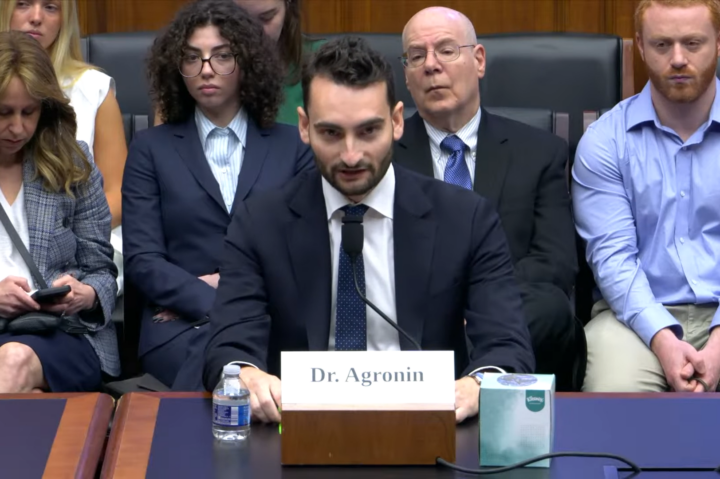
Dr. Jacob Agronin speaks at the House Education & Workforce subcommittee hearing on May 20, 2026.
Speaking at a House Education & Workforce subcommittee hearing on Wednesday, a doctor accused his union of engaging in systemic discrimination against Jewish and Israeli health providers, supporting terrorist sympathizers and making “its obsession with a single geopolitical conflict a defining future of its identity” — all while he’ll be forced by federal law to fund it.
Dr. Jacob Agronin, a cardiology fellow at a major medical institution in Philadelphia, testified alongside several other experts on antisemitism at a hearing focused on anti-Jewish hate in the medical field — which both Jewish medical providers and patients report as a growing problem since Hamas’ Oct. 7, 2023, attacks on Israel.
The hearing focused in particular on the role of healthcare worker unions, such as the Committee of Interns and Residents, of which Agronin is set to be a member, in spreading antisemitism and their failures to stand up for Jewish union members.
CIR has adopted a series of resolutions condemning Israel for genocide and calling for divestment from Israel, including “human capital.” The organization has also offered its institutional support for a physician who expressed support for Hezbollah and for anti-Israel Columbia University activist Mahmoud Khalil.
“CIR has formally recommended that hospitals exclude my Israeli colleagues from employment, and then compels dues from those same colleagues to fund that position,” Agronin said. “If any employer in this country adopted that policy, we would call it what it is: discrimination.”
He said that members of the union feel afraid to speak out. Agronin also emphasized that his salary, which will help fund the union, comes in part from Medicare graduate medical education funding.
Eveline Shekhman, the CEO of the American Jewish Medical Association, said that her organization is encountering a new era in which “Jew hatred hides behind the guise of anti-Zionism.”
“We are seeing calls to fire Jewish doctors, the praising of terrorist groups in and outside of clinical settings, the refusal to treat patients because of their faith, national origin or Zionist identity, and the demand that Jewish colleagues renounce Israel as a condition of workplace acceptance,” Shekhman said. “This is antisemitism, this is discrimination, and it is a distraction. It has no place in medicine.”
Any disruption to the clinical environment can impact patient care, she said.
She added that employees should be able to rely on their unions to support them when their employers fail to do so in such an environment, but that many unions themselves “have created an environment where Jewish professionals no longer feel welcome” and where they are forced to fund such activities with which they disagree.
In addition to CIR, Shekhman said the National Nurses Union has also been advancing anti-Israel activity, including providing a guide for members to bring anti-Zionism into the clinical setting, where Shekhman argued such activity is irrelevant and has no place.
Deena Margolies, an attorney for the Louis D. Brandeis Center for Human Rights Under Law, said that efforts like these from healthcare unions place Jewish and Israeli professionals “in an impossible position: The union that is supposed to represent them is also helping to create the hostile work environment they must endure.”
“Antisemitism can be dressed as labor solidarity or political language, but the effect is the same. Jewish and Israeli healthcare professionals and patients are treated as morally suspect and unable to participate fully yet equally in clinical settings,” she continued.
Agronin told Jewish Insider after the hearing that there is a “fairly silent majority” that opposes the actions the union is taking but is afraid of backlash if they speak out.
Shekhman told JI that she appreciated that all of the lawmakers expressed concern about the trend of antisemitism in healthcare, and said that that is a promising sign of possibilities for progress going forward.
She said that lawmakers’ support can be helpful when working with institutions to address these issues, and said that the hearing can be the first of “a lot more conversations that need to be had.”
Agronin emphasized that “it’s not just a Jewish issue. This is really an issue that affects all Americans.”
“This is discrimination, as it would be for any other group of people by race, sexual orientation, national origin, anything,” he said. “None of us want to be forced to pay even a single dollar to this organization, especially when it … certainly doesn’t serve our interests — actually quite the opposite. So, I’d hope that there’s some solution to have an option for those that want nothing to do with unions.”
Throughout the hearing, Democrats questioned the motivation of the inquiry, accusing Republicans of weaponizing antisemitism as a cudgel against union organizing generally.
“It is irresponsible and unproductive to take the words and actions of a few and broadly categorize labor unions as fostering discrimination,” Rep. Mark DeSaulnier (D-CA), the ranking member of the subcommittee, said.
Jamie Beran, the CEO of the progressive Jewish group Bend the Arc, testified that antisemitism in the healthcare setting is “heartbreaking” and “leaves many Jews feeling isolated and unsure who to trust.” But she also attacked the Trump administration and descriptions of labor unions as institutionally antisemitic.
“The Trump administration is using Jewish safety as a pretext for policies that endanger our neighbors and our democracy, and as a Jewish leader, that angers me,” she continued. “Unions and professional organizations are engaged in the same debates happening across America. These disagreements are not inherently illegal antisemitism or harassment. … [T]o smear the institutions themselves as antisemitic because of what some members say is politically motivated. It’s gross governmental overreach to constitutionally protected speech among adults.”
Beran also condemned the administration for cutting funding for the Department of Health and Human Services’ Office of Civil Rights, and for restricting abortion access.
Shekhman and Agronin insisted to JI after the hearing that the issue should be a nonpartisan one, and that they’re not targeting unions broadly. Shekhman emphasized that it’s a “patient care crisis issue” that impacts all Americans, regardless of their background. And Agronin said he did not believe that similar behavior would be tolerated if other groups were being targeted.
Shekhman said she did not have the opportunity during the hearing to emphasize the “true impact of BDS on healthcare overall” — including a loss of access to research, technology and collaboration across a range of different areas, as well as losing the support of Israeli physicians.
She said that lawmakers and the public may not understand the scope and volume of the problem: in the past two weeks AJMA received 26 incidents of various natures, from a car being vandalized with a swastika in a hospital parking lot to a kippah being knocked off. And, she continued, most of the victims are afraid to discuss the issue publicly.
Agronin said that CIR’s protestations that it is anti-Zionist rather than antisemitic are a ruse, and that “anti-Zionism is 1940s Jew hatred that’s rebranded for the 21st century.”
David Schizer was the keynote speaker at the fifth annual ‘Law and Antisemitism’ conference at Yeshiva University Cardozo School of Law
Rona Kaufman
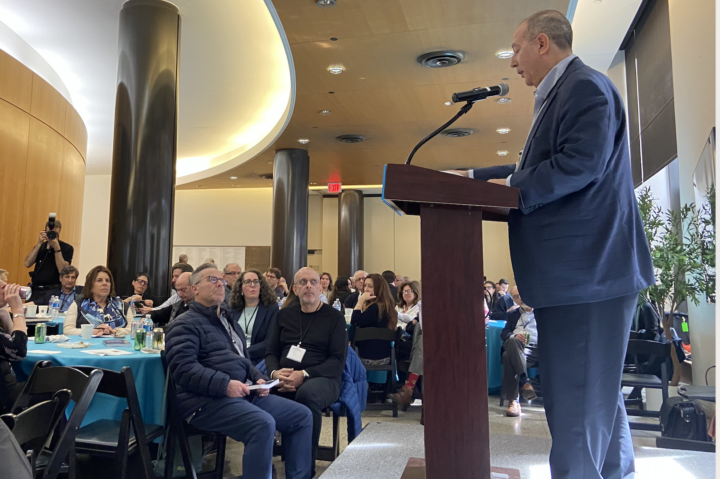
David Schizer delivers keynote address at Law and Antisemitism conference at Cardozo School of Law.
In trying to strike a balance between free expression and anti-discrimination, universities must do a better job at providing a consistent standard, David Schizer, the former dean of Columbia Law School, said during his keynote address at the fifth annual “Law and Antisemitism” conference at Yeshiva University’s Cardozo School of Law.
Many universities have not established any consistent procedures to address Jewish and Israeli students’ complaints about harassment following the Oct. 7, 2023, terrorist attacks, argued Schizer. The law professor served as co-chair of the university’s task force on antisemitism, which was established in response to increased antisemitism on the New York City campus after Oct. 7.
Schizer recommended that universities adopt a universal rule. “The best way to make a decision about one group is with a principle that works for all groups,” he said.
“The rules need to be the same for everyone,” he continued. “This means that if a university takes a step to shield Black or female students from harassment, the university needs to take a comparable step to protect Jewish and Israeli students, and vice versa. Unfortunately, universities have not always been consistent … but after Oct. 7, when Jewish and Israeli students complained, the response was different. Instead of deferring, universities invoked free speech principles. Likewise, instead of condemning this offensive speech, many universities adopted institutional neutrality.”
Schizer told attendees — about 200 practicing attorneys and legal scholars — that inconsistent treatment is not only “wrong,” but “also illegal.”
“Indeed, the most basic way to violate civil rights laws is to single out a protected class for different treatment,” he said.
The two-day conference, which concluded on Monday evening, was renamed this year from “Law vs. Antisemitism” to “Law and Antisemitism.” The change, which was one of several according to organizers, came following heavy criticism of last year’s event. The 2025 conference was held at UCLA and featured several speakers tied to anti-Zionist groups, Jewish Insider was first to report.
Rona Kaufman, the chair of this year’s conference and a participant for the past two years, told JI that this year was “from my perspective, a brand-new conference.”
The co-founders of the original conference — Robert Katz, a professor at Indiana University’s McKinney School of Law, and Diane Klein, an adjunct professor of law at Pepperdine Caruso School of Law and Loyola Law School (Los Angeles) — did not chair this year’s event. Katz remained involved as a speaker, while Klein did not participate.
“Before I agreed to chair this conference, I had parameters. I had no interest in chairing a conference that was going to platform people who make claims that antisemitism is being weaponized or who refuse to center Jewish identity in conversations about antisemitism,” said Kaufman, a law professor at Duquesne University and co-founder of the Center for Jewish Legal Studies.
The conference comes as legal action against universities over antisemitism is intensifying — even as anti-Israel disruptions appear to be quieter on most campuses — with several Jewish groups, such as the Louis D. Brandeis Center for Human Rights Under Law, representing Jewish students in lawsuits against their universities.
Panel topics ranged from various litigation strategies — with speakers including Mark Goldfeder, director of the National Jewish Advocacy Center, and Ken Marcus, chairman of the Brandeis Center — to the legal consequences of sexual violence perpetrated by Hamas on Oct. 7. The latter session was led by Cardozo law professor Michelle Greenberg-Kobrin and virtually from Israel by Cochav Elkayam-Levy, founder and chair of the Civil Commission on Oct. 7 Crimes by Hamas against Women and Children.
The conference was co-sponsored by Academic Engagement Network, Cardozo School of Law, the Center for the Study of Law and Antisemitism and the Center for Jewish Legal Studies. The Anti-Defamation League, which co-sponsored last year’s conference, was a sponsor this year.
Anat Alon-Beck, a Case Western Reserve University associate law professor, was a speaker this year after walking out of a session at last year’s conference because she was “appalled” by “bias and invalidating of all of the antisemitism I’ve been experiencing on campus,” she told JI at the time.
Alon-Beck echoed that there was “no comparison” between this year’s conference and the last.
“It was an empowering experience and an important reminder of the legal community’s responsibility and capacity to stand up against antisemitism in meaningful ways,” she told JI.
“What stood out was the commitment to confronting antisemitism honestly and directly, rather than minimizing or overlooking it.”
The Ivy League school called the EEOC’s request for the personal information of Jewish employees as part of its antisemitism investigation ‘extraordinary and unconstitutional’

Getty Images
Exteriors of University of Pennsylvania (UPenn) located in Philadelphia
A burgeoning legal battle between the University of Pennsylvania and the Equal Employment Opportunity Commission escalated last week when the Ivy League university called the agency’s methods of investigating whether the school permitted an antisemitic work environment “extraordinary and unconstitutional.”
The EEOC subpoenaed the university to turn over lists of Jewish employees and members of Jewish organizations, along with detailed identifying and contact information, saying the information is needed for the agency to contact potential victims of antisemitic discrimination. The university’s president and trustees — with the support of Jewish campus organizations Hillel, Chabad and Meor, as well as the Jewish Federation of Greater Philadelphia — refused to do so.
Handing over those names would disregard “the frightening and well-documented history of governmental entities that undertook efforts to identify and assemble information regarding persons of Jewish ancestry,” the university asserted in a legal filing last Tuesday.
What may appear to be an arcane legal issue illuminates the tension at the heart of the Trump administration’s aggressive approach to combating campus antisemitism, with even some of the victims of that discrimination concerned that the methods of countering it have gone too far. While the EEOC said it is committed to doing whatever it can to investigate antisemitism among faculty and staff of the elite university, Jewish faculty and students see something worrisome.
“We are deeply concerned that the EEOC is now seeking lists of individuals identified as Jewish, including their personal home addresses, phone numbers, and private emails, based solely on their affiliation with Jewish organizations on campus — and without their consent,” Hillel and Meor wrote in a social media post in November. “Across history, the compelled cataloging of Jews has been a source of profound danger, and collection of Jews’ private information carries echoes of the very patterns that made Jewish communities vulnerable for centuries.”
Why does the EEOC, which examines complaints of discrimination and civil rights violations at American workplaces, want Penn to provide the lists of Jewish university affiliates? And why are Jewish faculty members — including some who support the federal government’s efforts to investigate antisemitism at their place of work — urging their employer not to comply?
The dispute dates back to December 2023, when the EEOC pledged to investigate whether Jewish employees at Penn had been subjected “to an unlawful hostile work environment.”
The inquiry was opened the same week that then-Penn President Liz Magill testified before Congress about her handling of antisemitism at the Philadelphia university in the weeks that followed the Oct. 7, 2023, terror attacks in Israel. The investigation continued quietly for nearly two years, overseen by EEOC Commissioner Andrea Lucas, who last year was appointed chair of the agency by President Donald Trump.
It spilled into public view in November when the EEOC filed suit against Penn, seeking to force the university to finally compile and hand over the lists of Jewish faculty members and students that the EEOC said are crucial to its investigation.
The sought-after lists would include the members of all Jewish clubs and student groups, the names of everyone who participated in confidential university listening sessions about antisemitism, faculty members who were criticized and doxxed in a social media post from an anti-Israel student group and all employees and faculty of the Jewish studies program. Karen McDonough, deputy director of the EEOC’s Philadelphia office, said in a legal filing that the university’s refusal to turn over the lists has “severely hampered” the investigation.
Penn disagrees. The university called the demand “not only disconcerting but entirely unnecessary,” pledging instead that it would send a message to all university employees telling them how to get in touch with the EEOC to share instances of antisemitism they experienced or witnessed. The university said it has “cooperated extensively” with the agency by turning over more than 100 documents.
A more typical investigation might involve agency officials interviewing people who issued complaints directly with the agency, then visiting the campus and publicizing their investigation, according to Samuel Bagenstos, a law professor at the University of Michigan with expertise in employment law.
“If there are those claims that should be followed up, they should definitely be followed up, and they should be followed up according to usual investigative practices and not this dragnet of, ‘Let’s compile a list of all the Jews at Penn,’” Bagenstos told Jewish Insider last week. “It’s an incredibly unusual, if not completely unprecedented, request. It’s not tailored at all to any particular allegations of discrimination.”
An EEOC spokesperson did not respond to a request for comment.
The agency appeared to follow a similar playbook last year when it investigated antisemitism among staff at Columbia University and the affiliated Barnard College. Employees from both institutions received text messages from the EEOC on their personal phones asking them to fill out a survey identifying whether they are Jewish or Israeli, and if they have faced antisemitic harassment.
In that case, university officials had agreed to hand over employee data. Columbia’s associate general counsel and deputy general counsel told the Columbia Daily Spectator, the student newspaper, that the university complied with a subpoena to share employee information with the EEOC. But because the dispute ended in July with a settlement — and not with legal action — the EEOC’s methods of information-gathering at Columbia and Barnard never became public. (Columbia agreed to pay $21 million to resolve antisemitism charges.)
The Penn faculty members and employees opposed to the efforts by the federal government to obtain the controversial lists are not saying that the university is free from antisemitism. The Penn Faculty Alliance to Combat Antisemitism, which formed after Oct. 7 in response to rising anti-Jewish antagonism on campus, filed a brief supporting the university, and its members said that while they want to see the EEOC’s efforts to combat antisemitism at Penn continue, they oppose the methods being used by the agency.
“While the Alliance supports the EEOC’s efforts to combat antisemitism at Penn, its members are gravely concerned that the scope of the EEOC subpoena, which effectively seeks full lists of Jewish individuals at Penn and their personal information, invokes the troubling historical persecution of Jews, and threatens the personal security of the Alliance’s members,” the group wrote in a legal filing last week.
As the case moves forward in federal court, Penn and the EEOC are poised to test the boundaries of how far a civil rights investigation can go in the name of protecting a vulnerable group.
The professional organization has faced accusations of being non-responsive to members’ complaints of antisemitism for months, including in a previous letter by Rep. Ritchie Torres

Bill Clark/CQ-Roll Call, Inc via Getty Images
Chairman Tim Walberg (R-MI) attends the House Education and Workforce Committee hearing on "The State of American Education" in the Ryaburn House Office Building on Wednesday, February 5, 2025.
The House Education and Workforce Committee announced on Friday that it’s opening an investigation into antisemitism in the American Psychological Association, a move that follows mounting reports of antisemitism and unaddressed discrimination inside the organization, which represents more than 170,000 individuals in the psychology field and is responsible for the accreditation of psychology professionals.
“The Committee is gravely concerned about antisemitism at the APA,” Committee Chairman Tim Walberg (R-MI) wrote in a letter to APA President Debra Kawahara on Friday informing the organization of the investigation.
“Jewish APA members have reported being harassed and ostracized by their colleagues within the APA and at APA events because of their Jewish identity, their efforts to speak out against antisemitism, and their Zionist beliefs. Members have also stated that their complaints to the association have gone unanswered, raising significant concerns about the APA’s commitment to addressing harassment.”
Walberg’s letter highlights that Jewish members raised a series of concerns about antisemitism in an open letter in February, including antisemitic and pro-Hamas statements in APA listservs and by APA leaders which have gone unaddressed by organization leadership.
According to Jewish Insider’s reporting, that letter went unacknowledged for months, prior to outreach from Rep. Ritchie Torres (D-NY) who called on the APA to address a “persistent and pernicious pattern of antisemitism” in its ranks. And when the APA did organize a Zoom meeting to address the concerns raised, some vocal antisemitic and anti-Israel members and groups were included in the conversation.
The APA also allegedly offered educational credit to members for attending conferences where speakers have expressed antisemitism, supported violence against Jews and Israelis, minimized Jewish suffering and “patholgiz[ed] Jewish people’s connection to their indigenous homeland,” Walberg’s letter states.
“More broadly, the rampant antisemitism in [one] division has led to members resigning,” Walberg wrote.
He also noted that some internal APA groups are attempting to repeal the APA’s adoption of the International Holocaust Remembrance Alliance’s working definition of antisemitism, claiming that antisemitism is being “weaponized” to “silence and punish people of color.”
Walberg’s letter requests the APA provide to the committee a range of internal documentation and communications relating to Jews, antisemitism and the Israeli-Palestinian conflict since Oct. 7, 2023.
Yael Nativ’s application to return as a dance professor was rejected after the department chair told her ‘things are very hot’ at the university since the Oct. 7, 2023, attacks and Gaza war

GETTY IMAGES
This photo was taken from the top of Sather Tower on UC Berkeley campus.
As part of a settlement reached on Wednesday, the University of California, Berkeley acknowledged it discriminated against an Israeli former professor, and offered remedies for the situation, two years after the school disinvited her from teaching a course on Israeli dance, Jewish Insider has learned.
Dance professor Yael Nativ filed a lawsuit against the UC Board of Regents in August, claiming that she was the victim of discrimination under California law. Nativ, a visiting professor who taught a course on contemporary Israeli dance in 2022 and reapplied for the 2024-25 school year, alleged that her application to return was denied due to her Israeli nationality and the climate on campus following the Oct. 7, 2023, terrorist attacks in Israel and ensuing war between Israel and Hamas. Nativ was represented in the suit by the Louis D. Brandeis Center for Human Rights Under Law.
Under the agreement, UC Berkeley Chancellor Rich Lyons issued a personal apology to Nativ. She was also granted $60,000 in monetary damages and was invited by the university to teach the course she “successfully” taught during a previous semester at UC Berkeley — during a semester of her choosing. According to a joint statement from UC Berkeley and the Brandeis Center, “UC Berkeley publicly acknowledges the violation of [its] policy against discrimination with regard to Dr. Nativ and commits to rigorously enforce this policy to prevent recurrence.”
The UC Berkeley Office for the Prevention of Harassment and Discrimination opened an investigation into Nativ’s case last year following her complaint. After a probe that lasted several months, OPHD concluded that she had faced discrimination based on national origin. The recent settlement, however, is the first time the university offered steps to address the mistreatment.
The lawsuit alleges that months after Nativ sent in her application, she received a WhatsApp message from the chair of the department of theater, dance and performance studies, SanSan Kwan, saying she was under pressure from faculty not to bring anybody from Israel or hold courses related to Israel.
“[M]y dept cannot host you for a class next fall. … Things are very hot here right now and many of our grad students are angry. I would be putting the dept and you in a terrible position if you taught here,” Kwan wrote, according to the lawsuit.
“It’s a shame that this [incident] required us to file a lawsuit, because it was a pretty straightforward case of discrimination,” Paul Eckles, senior litigation counsel at the Brandeis Center, told JI. Even though OPHD already ruled in Nativ’s favor, Eckles said there was still a need to “get [the university] to take some action.”
A separate lawsuit against UC Berkeley, also filed by the Brandeis Center on behalf of Jewish groups in November 2023, remains under litigation. That lawsuit alleges that the university violated its own policies and federal civil rights laws by allowing discrimination, harassment and physical violence against Jewish students and faculty. Incidents cited include an attack against a Jewish student draped in an Israeli flag by protesters who struck him with a metal water bottle and the distribution of e-mails to Jewish students calling for their gassing and murder. The complaint, filed in San Francisco federal court, was among the first against a major university after the Oct. 7 attacks and ensuing Israel-Hamas war, with similar discrimination lawsuits following at universities nationwide.
American University Professor Pamela Nadell: ‘The closing off of spaces to Jews today is happening once again’
Pamela Nadell
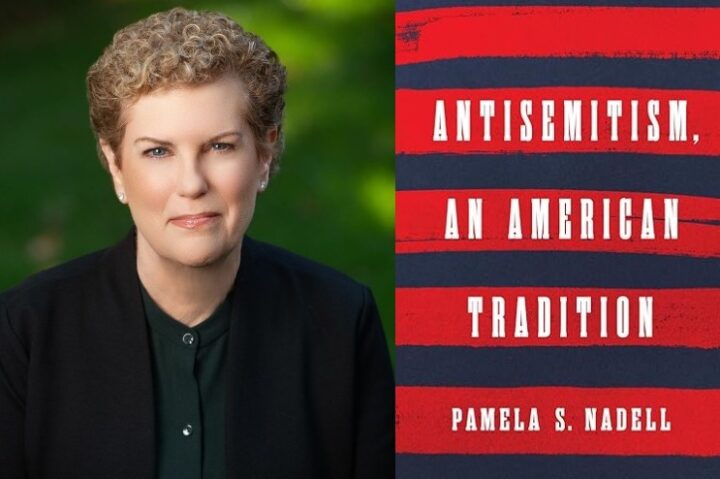
Historian Pamela Nadell is very familiar with the rituals of publishing a book, as she has written nine of them: Secure a release date, present at academic conferences, maybe headline a handful of general-public events. Although she is at the forefront of her field at American University — chair in Women’s and Gender History, director of the Jewish studies program and past president of the Association of Jewish Studies — Nadell knows that success in academia does not often translate to strong book sales.
Things appear to be different for her latest book, Antisemitism: An American Tradition.
Nadell began to understand how much interest a book on antisemitism would generate when her publisher assigned a full-time publicist to promote the book, which will be published on Oct. 14. Nadell is booked at speaking engagements across the country into 2027, starting with an event at the Washington bookstore Politics and Prose this week.
The book that she began researching six years ago will now appear on bookshelves at a time when antisemitism has reached record levels since the Anti-Defamation League began tracking data in 1979.
“I had hoped, frankly, that the subject would be seen as a historic subject by the time [the book] came out into the world,” Nadell told Jewish Insider in a recent interview. “And that’s absolutely not the case.”
Nadell argues in her book that antisemitism is not an aberration in the United States. Instead, she writes, it is intricately woven into the American experience — as American as, say, apple pie.
Jews came from Europe seeking freedom from religious persecution, and while they escaped the pogroms that had haunted them overseas, they did not arrive in a world magically free from antisemitism. She traced the history of anti-Jewish sentiment in America from colonial days to the present, identifying the aftermath of the Civil War as the moment it really gained a foothold in American society.
“America is different [from Europe] in that we never had state sponsored violence against American Jews,” Nadell said. “But the roots of anti-Judaism in America start immediately … the roots of anti-Judaism in America rest on traditional Christian ideas about who the Jews are and what they did to Jesus.”
While antisemitism has always been present in America, the tenor and intensity of it has ebbed and flowed. “We’re in a moment,” she said, “where it’s really bad.”
The reason she is most concerned about the state of antisemitism in America is not just the frequency of antisemitic incidents or the toll of violent attacks on Jews. According to a study published this week by the Anti-Defamation League and Jewish Federations of North America, more than half of American Jews now say antisemitism is a normal part of the Jewish experience.
It’s that doors are once again closing to Jews in a way that reminds her of the quotas, housing covenants and employment restrictions that were baked into American life until the 1950s and 1960s.
“The perception that [antisemitism] was over was because of how much American Jews ascended into American life as those structural barriers fell,” Nadell said. “The doors to corporations opened up, the doors to the colleges opened up. But antisemitism — it’s like it was a nagging factor.”
America is now experiencing another period “where Jewish life once again seems to be constricting,” Nadell argued. “Not in exactly the same ways that it did in those years between World War I and World War II, when there were so many structural limitations. But the closing off of spaces to Jews today is happening once again.”
She pointed to boycotts of Jewish and Zionist writers in the publishing industry, and antisemitic litmus tests appearing in unexpected places like the mental health profession.
“Being told that you have to denounce Israel in order to join a student club? Those students are going to carry those memories forward into their future,” said Nadell.
In recent years, and particularly following the wave of antisemitism that was unleashed after the Oct. 7 attacks two years ago, several Jewish thinkers have posited that the American Jewish community’s best days are behind it. Franklin Foer wrote an Atlantic cover story under the alarming headline, “The Golden Age of American Jews is ending.”
Nadell argues that the notion that there ever was a “golden age” is a myth. “The idea that there was a golden age of Jews in Spain actually emerges during the Dreyfus Affair [in 1894], when things are so terrible in Europe,” she noted. Similarly, Nadell argues that the supposedly now-over golden age for American Jews after the end of quotas and de jure discrimination is not really so straightforward.
“By the time we get to the late ‘60s and on in the 20th century, American Jews feel really secure. The places that used to be closed to us have now opened, and that’s what leads to the perception of the golden age,” said Nadell. “The problem … is the assumption that antisemitism disappeared, but it didn’t.”
Still, Nadell considers herself an optimist. Antisemitism is part of the American fabric. And while that might be a demoralizing conclusion, she views it the other way: Jews have thrived in this country despite antisemitism, and they will continue to do so.
“The reality is that it is part of the normative Jewish experience to experience antisemitism,” said Nadell. “But I think ultimately, American Jews will be okay in the United States.”
Mailman: ‘When you see numbers like that, then you pay attention, and you look, and then you’re able to learn a little bit more, something maybe you wouldn’t normally learn’
Mostafa Bassim/Anadolu via Getty Images
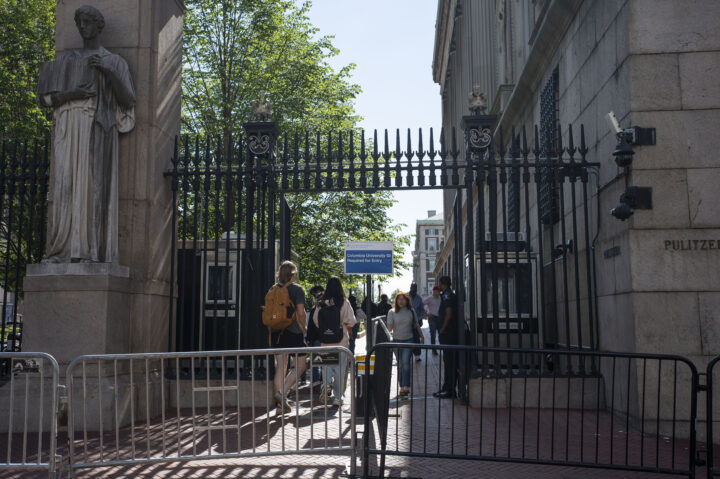
Students enter campus on the first day of the fall semester at Columbia University in New York City, United States on September 2, 2025.
The Trump administration’s settlements with Ivy League universities, negotiated in response to alleged violations of federal civil rights law, are meant primarily as an attention-grabbing measure — a way to get more people to pay attention to President Donald Trump’s aggressive approach to tackling discrimination in higher education, according to an architect of those settlements.
“When you see numbers like that, then you pay attention, and you look, and then you’re able to learn a little bit more, something maybe you wouldn’t normally learn,” May Mailman, a conservative attorney who until last month served as a senior White House strategist, told The New York Times’ Ross Douthat on an episode of his “Interesting Times” podcast that was released on Thursday.
The Trump administration has so far secured a $221 million payment from Columbia and a $50 million commitment from Brown. A deal with Harvard has been under negotiation for months, but no agreement has yet been reached.
These deals have included commitments from the universities on antisemitism policy, race-based hiring and admissions standards and diversity, equity and inclusion programs. What remains unclear is how they will be enforced. But Mailman told Douthat that the optics alone mark a significant achievement for the Trump administration.
“A settlement on its own without a fine might not be taken as seriously by the public or by other universities as when there is a fine,” said Mailman. “These are small dollar figures compared to the amounts that they are getting every year from the federal government and from their donors — but I think it provides a seriousness and a focus on these in ways that promises only wouldn’t.”
The deals have not included a recognition of fault on the part of the universities. But, Mailman added, they convey to the public “a sense of acknowledgment of wrongdoing, not a legal sense but sort of a moral sense of, ‘We’ve taken all this money, and we did it in ways that were not merit based, or they weren’t safe for our students, and so we’re paying a small amount of it back.’”
Douthat engaged Mailman in a conversation about what he called the “very blurry zone of critiques of the policies of the state of Israel and critiques of Zionism,” and suggested that the Trump administration had been “micromanaging” academic departments by asking them to discipline “radical critics of Israel.” Mailman seemed to acknowledge that some of those efforts appear to some as an infringement on free speech.
“I acknowledge that there are some letters that were sent by the antisemitism task force, in some way, that either incorporated the IHRA definition or otherwise were perceived to have been speech codes,” Mailman said, referring to the International Holocaust Remembrance Alliance’s working definition of antisemitism, which some on the left and right have argued marks a threat to free speech.
Still, she added that the deal at Columbia did not create a “speech code.” (Columbia did announce its adoption of the IHRA definition this summer, but that was not formally articulated in its deal with the federal government.)
“The Columbia deal — and I think everyone would acknowledge that Columbia had a major antisemitism problem — but the Columbia deal in no way creates any speech code, whether it be on Israel or anything else,” said Mailman. “It does not — it specifically says that this is not intended to create any First Amendment conflict or otherwise govern speech on Columbia’s campus.”
Among other commitments, the university announced it would refuse to recognize or meet with the anti-Israel student group Columbia University Apartheid Divest

CHARLY TRIBALLEAU/AFP via Getty Images
Students are seen on the campus of Columbia University on April 14, 2025, in New York City.
Columbia University announced on Tuesday it would implement several commitments in an effort to reach a deal with the Trump administration to restore the $400 million in federal funding that was cut by the government in March due to the university’s record dealing with antisemitism.
The steps include the university further incorporating the International Holocaust Remembrance Alliance’s working definition of antisemitism by requiring its Office of Institutional Equity to embrace the definition; appointing a Title VI coordinator to review alleged violations of the Civil Rights Act; requiring antisemitism training for all students, faculty and staff; and refusing to recognize or meet with “Columbia University Apartheid Divest,” a coalition of over 80 university student groups that Instagram banned for promoting violence.
“Our work toward an agreement with the federal government has put a harsh spotlight on many of the difficult issues regarding discrimination and harassment we’ve seen on our campuses,” Claire Shipman, the university’s acting president, said in a statement. “The fact that we’ve faced pressure from the government does not make the problems on our campuses any less real; a significant part of our community has been deeply affected in negative ways.”
Shipman said that “any government agreement we reach is only a starting point for change.”
Brian Cohen, executive director of Columbia’s Hillel, welcomed the steps taken by the university, “including the unequivocal recognition that there is an antisemitism problem on campus and that it has had a tangible impact on Jewish students’ sense of safety and belonging,” he wrote on X.
“I hope this announcement marks the beginning of meaningful and sustained change,” said Cohen.
Columbia was rocked by several high-profile incidents last academic year, including a sit-in in February at its affiliate, Barnard College, where a staff member was assaulted. In May, more than 100 masked anti-Israel demonstrators stormed the university’s main library — disrupting students studying for finals by banging on drums and chanting “Free Palestine.” Still, the university saw relatively fewer anti-Israel disruptions since it first entered into negotiations to restore federal funding.
The slashing of Columbia’s funds marked the first time a university faced a suspension of federal funds since the Title VI of Civil Rights Act of 1964 was implemented six decades ago. Several other elite universities, including Harvard and Cornell, followed suit with billions of dollars stripped by the government due, at least partially, to concerns around antisemitism.
Dr. Shay Laps alleged that his lab supervisor also pressured him to leave the country by falsely claiming he was being investigated by the university

Gabby Deutch
White Plaza, the site of last spring's Gaza encampment at Stanford, on the first Friday of the school year, 2024.
An Israeli chemist who resigned from Stanford University is suing the school after he claims it was complicit in antisemitism that he faced at the school — including the alleged tampering with his lab results, Jewish Insider has learned.
The Brandeis Center for Human Rights Under Law and Los Angeles-based law firm Cohen Williams LLP filed a federal lawsuit on Thursday on behalf of Shay Laps, a Jewish Israeli postdoctoral researcher who was hired by Stanford in April 2024 after being recommended by a Nobel laureate. Laps’ research focused on synthetic and “smart” insulin, aiming to revolutionize diabetes treatment.
According to the lawsuit, after arriving in professor Danny Chou’s Stanford lab, Laps was targeted by a lab staffer who knew that he was a Jewish scientist from Israel. At their first meeting, the suit alleges, the staffer told Laps, the only Israeli in the building, never to speak to her, and later excluded Laps from sitting with her and other staffers during lunch. Laps expressed that the staffer treated other colleagues kindly.
The complaint also names Chou, an associate professor of pediatrics and the lab’s leader and mentor, as a defendant.
The discrimination escalated when, according to Laps, the lab staffer tampered with his research, producing fraudulent results without his knowledge. Laps said that upon the discovery of the alleged sabotage of his experiments, Chou refused to address the issue — and eventually pressured Laps to leave the country by falsely claiming that Stanford’s Title IX Office had alerted Chou to a complaint and formal investigation against Laps and that his immigration status was on the line. Stanford’s Title IX Office later confirmed that there was no complaint or investigation against Laps, according to the suit.
Stanford President Jonathan Levin and the School of Medicine Dean Lloyd Minor disregarded Laps’ attempts for help, the lawsuit alleges. Ultimately, Laps felt he had no choice but to resign.
Talia Nissimyan, a lawyer at Cohen Williams who is representing Laps, said that as Laps “suffered discrimination and retaliation based on his religion, national origin, and ethnicity, the university preferred not to look.”
“Instead, they attempted to bury Dr. Laps’ career, and when that didn’t work, to bully him into rescinding his complaints,” Nissimyan said in a statement. “Stanford succumbed to the rising tide of campus antisemitism and anti-Israeli bias, costing Dr. Laps critical years of his career, and costing the world the potential fruits of his talents.”
Two Dallas therapists filed suit against their former employer for discrimination and retaliation, alleging they were terminated for speaking out against a policy barring discussion of religious opinions

BSIP/UIG Via Getty Images
Models
One November afternoon last year, Jackie Junger and Jacqueline Katz, both therapists at a private practice in Dallas, sat down with their colleagues for their weekly team meeting. This one-hour gathering was a lifeline for the therapists, where they could discuss challenges their clients were facing and receive advice from their fellow practitioners.
When a non-Jewish therapist asked for help better understanding a Jewish client who was “experiencing trauma with everything going on,” Junger and Katz — both Jewish — were eager to offer insight about the surge in antisemitism in the United States, in the hopes of helping their colleague better serve her client. But before Junger, 29, and Katz, 61, could speak, their supervisor, Dr. Dina Hijazi, shut down the conversation.
“I don’t think that’s a good idea, because you’ll get a one-sided response,” Hijazi told the therapists, according to legal filings.
The next day, Hijazi emailed the team and asked them to avoid discussing the “Palestine Israel topic” because she has “great pain” around the issue. But no one had mentioned the events in the Middle East at that meeting. Junger and Katz each responded to Hijazi’s note: Why, they wondered, would it be considered “one-sided” for Jewish therapists to speak about their understanding of antisemitism and Jewish trauma?
Over the next five days, Junger and Katz would see their lives upended after they chose to raise concerns about antisemitism and double standards against Jewish practitioners and clients.
That’s the key allegation at the heart of a federal lawsuit that Junger and Katz filed last month against D2 Counseling and its co-owners, Hijazi and Rev. Daniel Gowan. The two Jewish therapists claim they were discriminated against for objecting to their supervisors’ handling of antisemitism — and that, ultimately, they faced unlawful retaliation when they were fired days later. On the Monday before Thanksgiving, both received identical voicemails letting them know they had been terminated, saying they were no longer a “good fit” for D2. (An attorney representing Hijazi and Gowan declined to respond to detailed questions, citing the ongoing legal proceedings. The account in this article is based on an interview with Katz and Junger, allegations in their lawsuit and information shared by their lawyer.)
The incident was jarring for both Katz and Junger, they told Jewish Insider this week. But the biggest travesty, they said, is not that they lost their jobs: It’s that Jewish clients at their old practice should no longer expect to receive the highest level of care — because of their religion.
“This Jewish client — I don’t know who it is, obviously, I just know that it’s a Jewish client who is genuinely seeking support for something that they’re having trouble with in their life. It’s real trauma. I think most Jews can appreciate that it’s really traumatic, what’s happening,” Junger told JI. “And they’re not allowed to get competent health care. They have no clue.”
*****
This case is only a single incident experienced by just two of the nation’s more than 100,000 licensed therapists. But it comes amid what Jewish mental health professionals in the United States have described as an increasingly hostile professional environment, where denunciations of Israel are expected and outright antisemitism is no longer a taboo, particularly after the Oct. 7, 2023, terror attacks in Israel.
Earlier this year, the state of Illinois formally reprimanded a social worker who had created a blacklist publicly naming “Zionist” therapists. (The clinicians included on the list said it was just a pretext for targeting Jews.)
In May, Rep. Ritchie Torres (D-NY) warned of a “persistent and pernicious pattern of antisemitism” at the American Psychological Association, the preeminent professional organization for psychologists in the U.S.
Empathy is supposed to be the central tenet of the mental health field, but compassion and understanding are not always extended to Jewish therapists — or worse, their clients.
“Our role is really to facilitate the discussion, to honor their feelings, and to create a safe space — to create a space that [clients] can communicate what they’re experiencing internally, without any sort of feeling that, ‘I’m going to be shut down or marginalized or not taken seriously,’” Katz explained.
It was clear to Junger and Katz soon after the Oct. 7 attacks that team conversations about what was happening in the Middle East would be different from other issues they’d been discussing for years.
“We talk about current events a lot because these things affect our clients,” said Katz. The D2 team had talked about the war in Ukraine soon after it started; abortion access following the Supreme Court’s overturning of Roe v. Wade in 2022; and gun control after a mass shooting at a Texas mall in 2023.
A therapist helping a client work through issues with their sexuality might seek advice from a gay co-worker. Past meetings also included discussions of Mormonism and Islam, according to the complaint filed by Katz and Junger. Hijazi led a conversation about how to help clients who were having an emotional reaction to President Donald Trump’s reelection shortly after it occurred, according to the lawsuit.
“It’s very common to seek peer consultation, supervision from someone who has expertise, whether it’s lived experience or clinical experience,” Junger told JI. “If someone, let’s say, had cancer, and I had a client who’s going through cancer, I might reach out and say, ‘Hey, what would be helpful for me to know?’”
Three days after the Oct. 7 attacks, when the D2 team gathered as they do each Tuesday, Hijazi and Gowan did not address the recent terror attacks.
“We were all very shocked that we weren’t going to address the elephant in the room, as it were, and it quickly fell apart because one of my coworkers brought it up. ‘Aren’t we going to talk about what happened? We’re all very upset and suffering here,’” said Katz. “And it was shut down.”
Lesson learned, according to Katz and Junger: Don’t bring up Israel or Gaza again. It wasn’t an overt order, but the palpable discomfort from Hijazi and Gowan kept a lid on future conversations.
Still, Hijazi’s strong reaction to the conversation about antisemitism a year later, in November 2024, surprised Junger and Katz. No one had mentioned Israel or Gaza. But Hijazi followed up with an email requesting that the “Palestine Israel topic” not be discussed.
“I have great pain around this as I know some of you do as well,” Hijazi wrote in the email, which was shared with JI. “In order for me to work and be present with my clients I have asked that this be kept out of the noon meeting.” (What Hijazi did not share is that her family is Palestinian — a fact her daughter discussed in an online blog post viewed by JI, but one Hijazi didn’t mention to colleagues.)
Katz and Junger did not see how a question about the trauma of a Jewish patient in Texas could be extrapolated to extend to the Israeli-Palestinian conflict, nor did they understand why Hijazi chose to shut down future discussions of Jewish trauma. Separately, they each responded with lengthy emails, screenshots of which were included in the lawsuit.
“I believe every single one of us has Jewish clients, and the more we understand, the better we can service our clients,” Junger wrote in her email.
Katz took issue with Hijazi letting her own emotions guide the discussion, a therapist no-no.
“As a managing partner in this practice I think it was essential for you to be able to manage the inquiry without adopting the victim role and personalizing it to your pain,” Katz wrote in another email. “I understand that you were protecting yourself by leaving the room, however the impact was that some of us felt shut down and unheard.”
The matter only escalated from there, playing out like most modern office dramas: over email, leaving a lengthy digital record.
Hijazi banned the expression of “political or religious opinions” in the group meetings, under the rationale of “safety in the workplace.” “Emotional safety for the group,” she wrote, “will always come before personal agendas.”
But Katz and Junger were still unsure what was political about their earlier meeting and decided to press the point about their concern for Jewish clients. “I think your failure to see that this was not a political conversation is a huge blind spot for you,” wrote Katz. Gowan responded by telling her she was “way over the line,” a sentiment Hijazi echoed.
Over that weekend, on Sunday night, Junger chimed in, too. “I would love some clarification, as I am feeling lots of confusion,” she wrote. “Would wanting more clarity on a Black client experiencing racism violate that policy as well? How about talking about a client who is part of the LGBTQ community and experiencing trauma and discrimination? Are we allowed to talk about their lived experience? Or does this rule only apply to Jewish clients?”
That was Junger’s final message to her bosses about the matter. Katz chimed in after, saying she had the same questions.
A day later, they were both fired.
“It was just outrageous behavior on their part, I think, and so punishing, really. You open your mouth here, and this is what happens to you,” said Katz. “If we weren’t Jewish, [the other therapist] wouldn’t have asked us for supervision. If we weren’t Jewish, we wouldn’t have spoken up. If we weren’t Jewish, we wouldn’t have been let go.”
Their contract required D2 to give them 30 days to finish seeing clients. But they were forced to move to a different office, and asked to pay tens of thousands of dollars stemming from a part of the contract with buyout options and a non-compete clause. (They have refused to pay.)
“I knew antisemitism was on the rise, but to have it so blatant in my face in this way was really shocking. It was honestly a little scary,” said Junger.
*****
Winning an employment discrimination suit is not an easy task. But the lawyers at the Lawfare Project and Winston & Strawn representing Katz and Junger are confident that they have a strong case.
“It’s very rare to see a case like this, a discrimination retaliation case like this, where the employer’s actions are so brazen,” said Jaclyn Clark, the Lawfare Project attorney who brought the case. “I strongly suspect that the employer in this instance just thought that they could get away with it … So from my standpoint, beyond just shining a light on the issue of antisemitism in the mental health field, the politicization of Jewish trauma and all of those things, is also to put these smaller employers on warning.”
Orly Lobel, an employment law expert at the University of San Diego who looked over the complaint, described it as “a strong case, since it is all documented with email exchanges and there is no pretextual reason for the termination,” she told JI.
Junger and Katz’s attorneys allege that they faced discrimination as members of a racial minority, leaning on a 1987 Supreme Court ruling as precedent. L. Camille Hébert, a professor at The Ohio State University’s law school, said the race-based argument could be a tougher bar to clear than if the therapists made an argument about religious discrimination. But she noted that the facts laid out in the complaint paint a picture of discrimination.
“If the facts are as alleged, that all subjects were allowed to be addressed in the meetings other than antisemitism, then there might be a cognizable claim of discrimination based on religion. The defense of ‘workplace safety’ seems not to be a particularly strong one,” Hébert said after reviewing the complaint.
*****
Jewish therapists aren’t the only ones worried about antisemitism in the field. People seeking mental health care are, too, and Junger and Katz say they are right to be concerned.
After she was fired by D2, Junger created a list of Jewish therapists in the Dallas area to share with the people in the Jewish community who come to her asking for a referral. Since Oct. 7, she has seen more people seeking out a therapist who understands Jewish issues — and she understands why.
“Maybe a while ago I would have been like, ‘No, it’s a therapist job to [listen]. They’re not political. It’s OK,’” said Junger. “Now I’m like, ‘I get that.’ It makes sense to want to have safety and know that you have a real safe space to be able to process things that are directly impacting us.”
Please log in if you already have a subscription, or subscribe to access the latest updates.
 Continue with Google
 Continue with Apple