




















After resigning from the National Counterterrorism Center over the Iran conflict, Kent used an appearance on Tucker Carlson’s show to level accusations about Israeli influence on U.S. policy
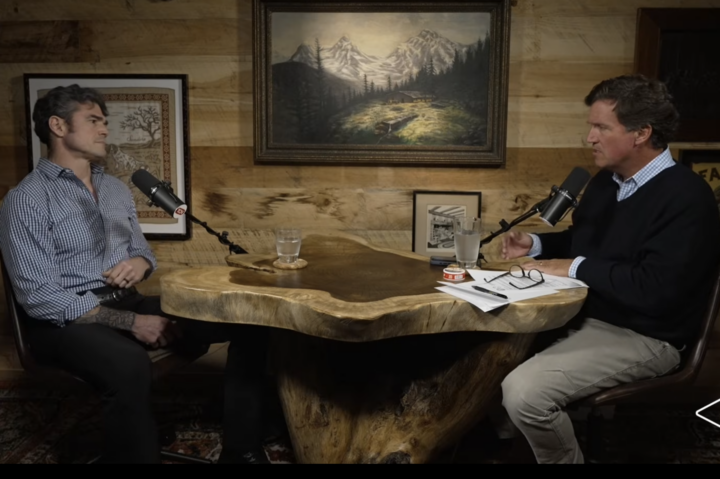
Screenshot


 Add JewishInsider on Google
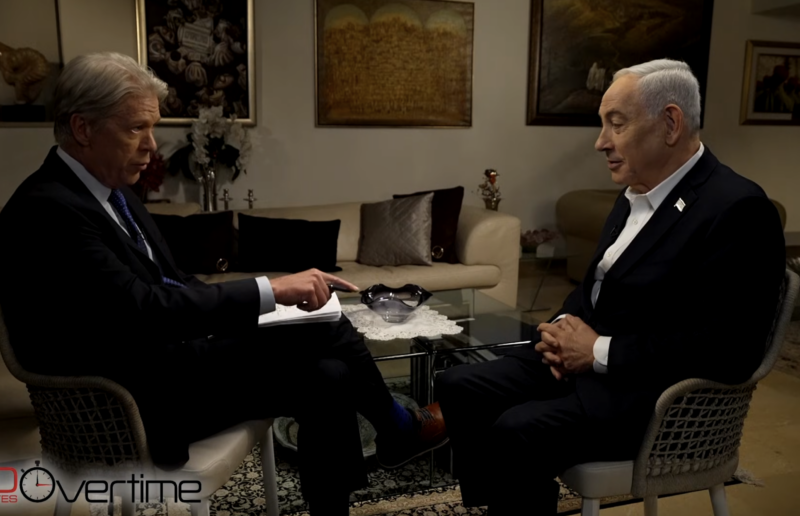
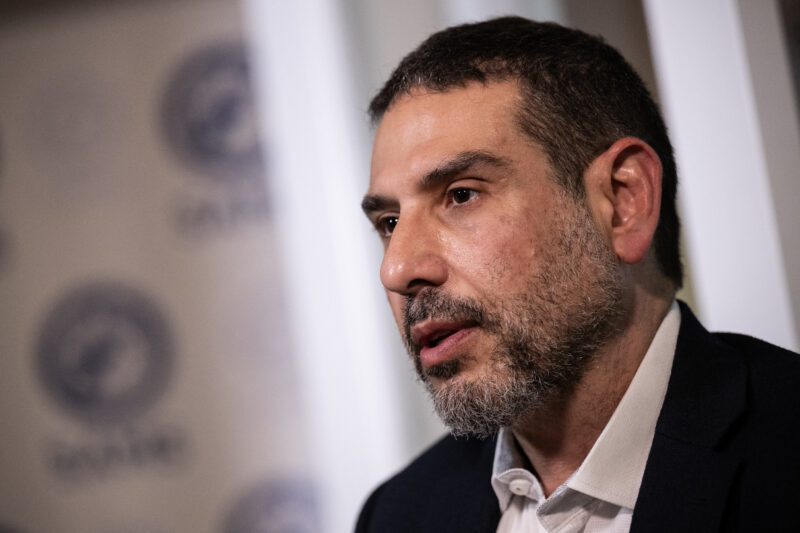
Joe Kent, who resigned earlier this week from his role as director of the National Counterterrorism Center over his opposition to the war in Iran, offered a litany of baseless accusations about Israel while defending the Iranian regime in an appearance on Tucker Carlson’s program on Wednesday.
Kent doubled down in the interview on an allegation made in his resignation statement that Israel coerced the U.S. into the war for its own benefit. As evidence, Kent and Carlson — a friend of Kent’s and a leading critic of the Trump administration’s approach to Iran in the conservative movement — pointed to Secretary of State Marco Rubio saying earlier this month that the “imminent threat” that prompted the U.S. to take action was the foreknowledge that Israel was going to strike, likely resulting in retaliation against American targets by the Iranian regime.
“So, the imminent threat that the secretary of state is describing is not from Iran,” Carlson mused. “It’s from Israel.”
“Exactly,” Kent replied. “And I think this speaks to the broader issue, who is in charge of our policy in the Middle East? Who’s in charge of when we decide to go to war or not?”
Kent argued that the Israelis “felt emboldened that no matter what they did, no matter what situation they put us in, they could go ahead and take this action and we just have to react.”
He suggested that the U.S. could have threatened to cut off Israel’s military aid, including defensive weapons, in order to prevent them from attacking Iran.
“We could have said to the Israelis: ‘No, you will not and if you do, we will take something away from you,'” Kent told Carlson. “It’s fine that we offer defense to Israel but when we’re providing the means for their defense, we get to dictate the terms of when they go on the offensive.”
Kent also raised questions during the interview about possible foreign ties to the assassination of conservative influencer Charlie Kirk last fall. He told Carlson he tried to investigate Kirk’s killing, at a Turning Point USA event at a Utah college, last fall because of the pressure Kirk was facing over backsliding GOP support for Israel, but was blocked by the Justice Department and FBI. Kent said that the last time he saw Kirk was last summer at the White House, and claimed that the final message Kirk gave him was to “stop us from getting into a war with Iran.”
“One of President [Donald] Trump’s closest advisors was vocally advocating for us to not go to war with Iran and for us to rethink, at least, our relationship with the Israelis. And then he’s suddenly publicly assassinated and we’re not allowed to ask any questions about that?” Kent said. “The investigation that I was a part of [with] the National Counterterrorism Center, we were stopped from continuing to investigate. And the FBI will say that they stopped it because they wanted to have everything turned over to the Utah state authorities. Everything is going to trial, it’s very sensitive. But there was still a lot for us to look into that I can’t really get into. There were still linkages for us to investigate that we needed to run down.”
Kent said that while he was “not making any conclusions … Charlie was under a lot of pressure from a lot of pro-Israel donors. And again, we know, because of the text messages that have been made public, that Charlie was advocating to President Trump against this war with Iran.”
On Iran, Kent alleged that the regime and assassinated Supreme Leader Ayatollah Ali Khamenei were not interested in acquiring a nuclear weapon, while acknowledging that Iran’s strategy had been “to not completely abandon the nuclear program.”
He cited Khamenei’s 2003 fatwa on the production or use of nuclear weapons, arguing that there is “zero U.S. intelligence suggesting it’s been lifted or ignored in a way that changes the posture. Iran knows what happens when you openly pursue or acquire nukes or even give them up.”
Kent went on to claim, despite reports to the contrary, that Khamenei was working to keep the regime from becoming a nuclear power.
“I’m no fan of the former supreme leader, Ali Khamenei, however, he was moderating their nuclear program. He was preventing them from getting a nuclear weapon,” Kent said. “If you take him out, if you kill him aggressively, people are going to rally around that regime.”
The former Trump administration official later told Carlson that “a good deal of key decision-makers were not allowed to come and express their opinion” to Trump prior to the start of joint U.S. and Israeli military operations targeting Iran.
“In the lead-up to this last iteration, a good deal of key decision-makers were not allowed to come and express their opinion to the president,” Kent said, arguing that this was a contrast from the “robust debate” that took place ahead of Trump’s decision to strike Iranian nuclear sites last June.
Kent said that efforts by the intelligence community to offer the president a “sanity check” during briefings “were largely stifled in this second iteration.”
“They had that discussion behind closed doors, and there wasn’t a chance for any dissenting voices to come,” Kent said.
Asked about his resignation, Kent told Carlson that he spoke to Trump prior to announcing his decision publicly and said he believes they “departed personally on good terms.”
“I spoke with him before I departed the administration,” Kent said. “It went great. I mean, not the best conversation ever. I told him why I was leaving. He heard me out.”
Kent’s appearance on Carlson’s show came as sources told Semafor that the FBI began investigating Kent weeks ago for allegedly leaking classified information.
The WH and FBI declined to comment when reached by Jewish Insider. The Office of the Director of National Intelligence did not respond to a request for comment on the matter.
Gabbard also said Tehran has the ‘intention to rebuild’ its nuclear capabilities that were ‘obliterated’ in last summer’s strikes
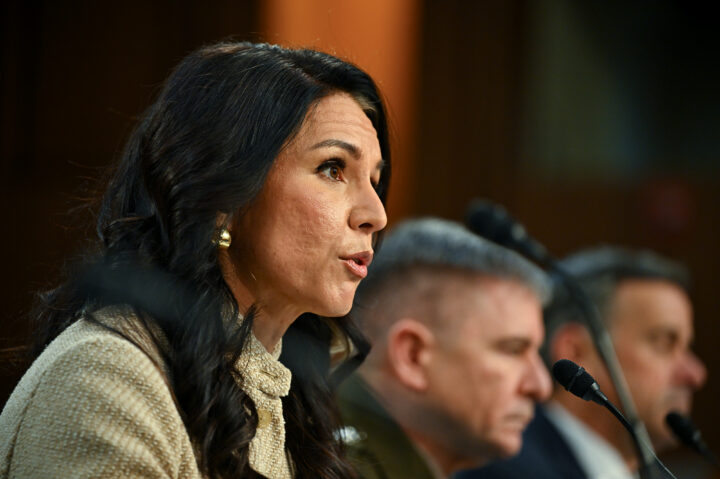
Graeme Sloan/Bloomberg via Getty Images
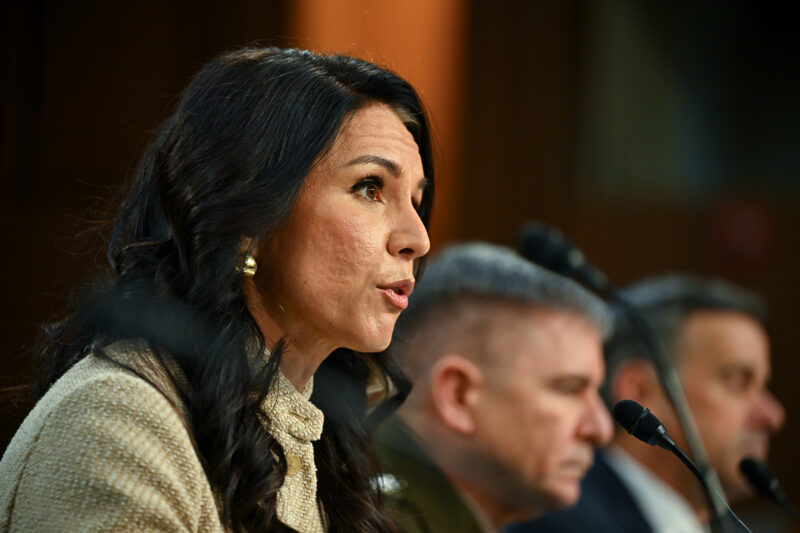
Tulsi Gabbard, director of National Intelligence, speaks during a Senate Intelligence Committee hearing on worldwide threats in Washington, DC, US, on Wednesday, March 18, 2026.
Director of National Intelligence Tulsi Gabbard said that the U.S. and Israeli operations against Iran have largely destroyed Tehran’s “power projection capabilities” in the region, but that the regime remains standing, if weakened.
“The [intelligence community] assesses that Operation Epic Fury is advancing fundamental change in the region that began with Hamas’ attack on Israel on Oct. 7, 2023, and continued with the 12-day war last year, resulting in weakening Iran and its proxies,” Gabbard said at a hearing of the Senate Intelligence Committee on worldwide threats on Wednesday.
“The IC assesses the regime in Iran appears to be intact but largely degraded due to attacks on its leadership and military capabilities,” she continued. “Its conventional military power projection capabilities have largely been destroyed, leaving limited options. Iran’s strategic position has been significantly degraded.”
If the Iranian regime survives the current war, Gabbard said that it would “seek to begin a yearslong effort to rebuild its military, missiles and UAV forces.”
She further said that, if the regime remains standing, internal tensions and resistance to the regime inside Iran are likely to increase as the country’s economy continues to struggle under U.S. and international sanctions.
Gabbard said in her opening statement that Iran “was trying to recover from the severe damage to its nuclear infrastructure sustained during the 12-day war, and continued to refuse to comply with its nuclear obligations” to the International Atomic Energy Agency.
Democratic senators pressed her throughout the hearing on apparent differences between those comments and her written remarks provided to the committee before the hearing, in which Gabbard said that Iran’s nuclear enrichment program was “obliterated” and that it had made “no efforts since then to try to rebuild” its enrichment capacity.
Under questioning, Gabbard affirmed that stance, but said Iran “maintained the intention to rebuild” its nuclear capabilities. She said she had omitted those remarks from her oral testimony for time reasons.
CIA Director John Ratcliffe throughout the hearing appeared to take a more aggressive and assertive stance on Iran than Gabbard, an isolationist and longtime opponent of war with Iran, offering a clear explanation and justification for the U.S. strikes.
Ratcliffe said that Iran was continuing its nuclear and ballistic missile development, and that he disagreed with an assessment by former National Counterterrorism Center Director Joe Kent that Iran did not pose an imminent threat, which Kent alleged in his resignation letter.
“I think Iran has been a constant threat to the United States for an extended period of time, and posed an immediate threat at this time,” Ratcliffe said.
Ratcliffe said that the U.S. operation was “detailed” and “thoughtful” with specific goals to address a long-running and growing threat.
He said that Iran was continuing to build and develop missiles “at alarming rates” such that its offensive capabilities were on track to outpace and overwhelm the U.S.’ ability to build defensive weaponry.
At the same time, Ratcliffe said the U.S. strikes last summer were a “wild success” and that Iran was “unwillinging and incapable” of enriching uranium to 60% purity since those strikes.
Gabbard, meanwhile, repeatedly declined to say whether the intelligence community had assessed Iran to be an imminent threat to the United States, asserting that only the president has the ability to determine whether any threat is imminent, to the frustration of committee Democrats.
In her opening statement, Gabbard also said that Iran’s space launch capabilities would allow it to develop an intercontinental ballistic missile by 2035, if Iran decided to pursue that, though that assessment is pending updates after U.S. military operations.
Sen. Tom Cotton (R-AR), the chair of the Intelligence Committee, suggested in his question that the timeline was much shorter, and that Iran actually could have had an ICBM that could threaten the homeland in six months.
Ratcliffe did not explicitly confirm that timeline, but emphasized that Iran’s missile program was a present and growing threat, which “if left unimpeded … would have the ability to range missiles to the continental U.S.”
“It’s one of the reasons why degrading Iran’s missile production capabilities that is taking place right now in Operation Epic Fury is so important to our national security,” Ratcliffe continued.
Pressed repeatedly by Democrats on whether the intelligence community had warned the President Donald Trump of the likelihood — as previously assessed by intelligence officials — that Iran would attack Gulf states and close the Strait of Hormuz in the event of a war, Gabbard and Ratcliffe both emphasized that the administration was aware of and had taken steps to prepare for those threats, despite comments by Trump that such moves by Iran were unanticipated.
Gabbard also described “the spread of Islamist ideology, in some cases, led by individuals and organizations associated with the Muslim Brotherhood” as “a fundamental threat to freedom and the foundational principles that underpin Western civilization.”
She said that Islamists are using such ideologies to recruit and solicit financial support for terrorism globally, and that such activity has been increasing in Europe.
Gabbard called the Trump administration’s designation of certain Muslim Brotherhood branches as terrorist organizations, “a mechanism to secure Americans.”
Ratcliffe said the CIA is “very focused” on counterterrorism, including the Muslim Brotherhood, and that the administration has had significant success, which he could share further in a classified setting.
In his resignation letter, Kent baselessly claimed Israel tricked President Trump into war with Iran and said U.S. operations in Syria were also 'manufactured by Israel'

AP Photo/Jenny Kane
Former congressional candidate and counterterrorism official Joe Kent speaks during a debate at KATU studios on Monday, Oct. 7, 2024, in Portland, Ore.
Joe Kent, director of the National Counterterrorism Center, resigned from his role on Tuesday over opposition to the war in Iran, baselessly alleging that Israel had coerced the United States into what he characterized as a misguided military conflict.
In a letter to President Donald Trump shared on social media, Kent, a former Green Beret who had reported to Director of National Intelligence Tulsi Gabbard, wrote that he “cannot in good conscience support the ongoing war in Iran,” claiming that the Islamic Republic “posed no imminent threat to our nation, and it is clear that we started this war due to pressure from Israel and its powerful American lobby.”
Kent, a hard-right former congressional candidate in Washington State who has pushed an isolationist foreign policy vision, has previously drawn scrutiny for promoting conspiracy theories, echoing pro-Russia messaging and associating with white supremacists and neo-Nazis, among other controversies.
During a failed House bid in 2022, Kent also said that accepting donations from pro-Israel lobbying groups like AIPAC puts Israel’s “interests ahead of ours” — invoking an antisemitic trope about foreign influence over American politics that is increasingly common on the far right.
Kent’s wife, Heather Kaiser, is a military veteran who has written for The Grayzone, an extremist outlet, authoring articles with its founder Max Blumenthal, a prominent conspiracy theorist who has published sympathetic coverage of Iran and spread misinformation about the Hamas terror attacks of Oct. 7, 2023.
In his letter, Kent claimed that Trump had been tricked into striking Iran by “high-ranking Israeli officials and influential members of the American media” who “deployed a misinformation campaign that wholly undermined” the president’s “America First platform and sowed pro-war sentiments to encourage war with Iran.”
“This echo chamber was used to deceive you into believing that Iran posed an imminent threat to the United States, and that should you strike now, there was a clear path to a swift victory,” Kent wrote to the president. “This was a lie and is the same tactic the Israelis used to draw us into the disastrous Iraq war that cost our nation the lives of thousands of our best men and women. We cannot make this mistake again.”
Kent, who served in Iraq, also claimed his first wife, Shannon Kent, a military cryptologist who died in an ISIS suicide bombing in Syria in 2019, had been killed “in a war manufactured by Israel.” Israel was not a member of the U.S.-led coalition combating ISIS at the time.
“I pray that you will reflect upon what we are doing in Iran, and who we are doing it for,” he concluded, telling the president that he can “reverse course and chart a new path for our nation” or “allow us to slip further toward decline and chaos.”
Karoline Leavitt, the White House press secretary, rejected Kent’s account. “As President Trump has clearly and explicitly stated, he had strong and compelling evidence that Iran was going to attack the United States first,” she wrote in a lengthy social media post.
She called Kent’s claim that Israel had duped Trump into joining the war “an absurd allegation” that “is both insulting and laughable,” arguing that “Trump has been remarkably consistent and has said for DECADES that Iran can NEVER possess a nuclear weapon.”
Speaking to reporters from the Oval Office on Tuesday, Trump said it was a “good thing” that Kent had resigned, calling him “very weak on security.”
“He said that Iran was not a threat. Iran was a threat. Every country realized what a threat Iran was. The question is whether or not they wanted to do something about it,” Trump added. “So when somebody is working with us that says they didn’t think Iran was the threat, we don’t want those people.”
Kent’s comments, which underscored deepening divisions in Trump’s MAGA coalition over the war, also drew criticism from Republican lawmakers.
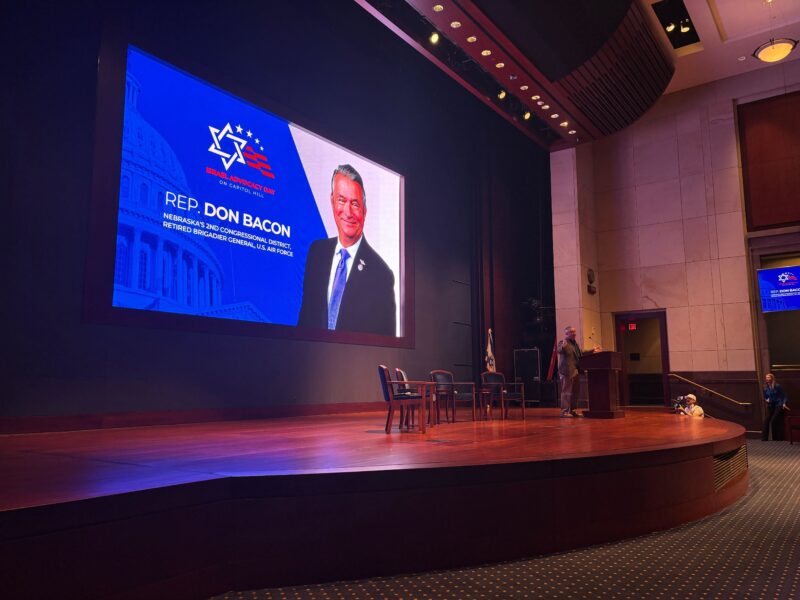
Rep. Don Bacon (R-NE), a leading moderate voice in the House, accused Kent of fueling antisemitism. “Good riddance,” he said of Kent’s departure on social media. “Iran has murdered more than a thousand Americans. Their EFP land mines were the deadliest in Iraq. Anti-Semitism is an evil I detest, and we surely don’t want it in our government.”
House Speaker Mike Johnson (R-LA) said Kent’s claims about Israeli influence were “clearly wrong” and that “there was clearly an imminent threat” to the United States.
Sen. Lindsey Graham (R-SC) and Rep. Mike Lawler (R-NY) also criticized Kent’s letter and said they were glad to see him leave the administration — Lawler called him “a leaker who spent more time undermining our foreign policy than doing his job,” while Graham said, based on his claims, Kent “clearly … did not go to work enough.”
On the other side of the aisle, Sen. Mark Warner (D-VA), vice chairman of the Senate Intelligence Committee, said in a statement that Kent had been “right” to point out “there was no credible evidence of an imminent threat from Iran that would justify” an attack — even as he called Kent’s “record deeply troubling” and believed he “never should have been confirmed” to lead the counterterrorism office.
Meanwhile, Tucker Carlson, a close ally of Kent, praised his decision to resign. “Joe is the bravest man I know, and he can’t be dismissed as a nut,” Carlson told The New York Times on Tuesday.
The FBI director's November 2024 pledge to recuse himself from business with Qatar expired last month

Kayla Bartkowski/Getty Images
Director of the Federal Bureau of Investigation (FBI) Kash Patel
FBI Director Kash Patel signed bilateral security agreements with Qatar on Tuesday, in a move that is drawing renewed scrutiny to potential conflicts of interest surrounding his past lobbying for the Gulf emirate, the details of which he has failed to disclose.
During a meeting in the Qatari capital of Doha, Patel signed two memorandums of understanding with his counterpart “to advance mechanisms of security cooperation and coordinate efforts in training, the exchange of information and capacity-building,” according to Qatari state media.
“This step underscores the depth of the strategic partnership between the State of Qatar and the friendly United States of America, and bolsters our joint efforts in securing the 2026 FIFA World Cup,” Sheikh Khalifa bin Hamad bin Khalifa Al-Thani, the minister of interior and head of the country’s Internal Security Force, who met with Patel on Tuesday, said in a social media post.
Neither Patel’s visit to Doha nor the agreements with Qatar have been publicly announced by the FBI.
The security pacts follow an executive order signed by President Donald Trump in September pledging security guarantees if Qatar comes under attack — even as the Gulf state has faced criticism for hosting Hamas leaders and ties to the Muslim Brotherhood.
Patel, whose brief tenure leading the FBI has been mired in ethics controversies, drew scrutiny during his confirmation over undisclosed consulting for the Qatari government — provoking accusations that he improperly avoided registering as a foreign lobbyist.
Patel, who has said he will keep his consulting firm, Trishul, dormant during his time at the FBI, has not clarified what his contracts with Qatar had entailed.
In an ethics disclosure, Patel stated that he had “provided consulting services for the Embassy of Qatar” as recently as November 2024, and would recuse himself from any government work related to his former client for a period of one year after the work had concluded — unless granted authorization to do otherwise.
While the one-year buffer expired last month, Patel received a waiver in March allowing him to work on Qatar matters weeks after he had been confirmed by the Senate. The document did not specify the nature of his engagement with his former client.
Patel is among several top Trump administration officials who previously lobbied for Qatar, but his work in particular has raised red flags because of unresolved questions stemming from his past engagement with the Gulf state — which he is now more actively courting in spite of continuing ethics concerns.
The FBI did not respond to a request for comment regarding Patel’s visit to Doha on Tuesday.
Speaking at a Senate Judiciary Committee hearing, Patel said he would ‘follow the money’ to find the backers of protests, including those on college campuses
Kayla Bartkowski/Getty Images
Director of the Federal Bureau of Investigation (FBI) Kash Patel
FBI Director Kash Patel said on Tuesday that federal investigators were looking into the funding sources for left-wing groups behind organized protest movements that have resulted in rioting on city streets and civil rights violations on college campuses.
Patel made the comments while appearing before the Senate Judiciary Committee for a marathon oversight hearing, where he faced dozens of questions from Democrats and Republicans about the assassination of conservative influencer Charlie Kirk last week.
Sen. Ted Cruz (R-TX) urged Patel to investigate the financing of far-left groups that the Texas senator said may have influenced the suspected shooter and supported protests in recent years that saw instances of rioting or other illegal activity.
“As I’ve always said, Senator, money doesn’t lie. We’ve been following the money, and that’s what we’re doing, issuing a lawful process to organizations involved with criminal activity because the money has got to come from somewhere,” Patel told Cruz.
Cruz stressed his belief that the bankrolling of these political efforts has led to the riots in major cities and the surge of campus antisemitism in recent years, and the importance of identifying the individuals and organizations responsible.
“I want to encourage you in the course of this investigation, absolutely go after anyone who aided and abetted, but I want to more broadly encourage you: follow the money. The violence we are seeing is not purely organic. There is, I believe, significant money that is spreading dissension, that is spreading violence,” Cruz said.
“Both the Antifa and Black Lives Matter riots of a couple of years ago, and the pro-open borders riots in Los Angeles and other cities of this past year, I believe there was significant money behind those riots. I’m not the only person who noticed at the antisemitic protests and violent protests on college campuses last year, that many of the tents all matched,” he added.
Cruz, who introduced legislation in July to add rioting to the list of predicate offenses under the Racketeer Influenced and Corrupt Organizations (RICO) Act — which targets organized crime — added that he believes the money “should be tracked and prosecuted under RICO.”
Following a series of questions about the suspect’s motive in killing Kirk and reports that others had prior knowledge of the suspect’s plans, Cruz urged Patel to probe the funding sources of Antifa specifically in connection with the shooting, and called on the Trump administration to designate the far-left political movement as a terrorist organization.
“I would encourage the administration to designate Antifa as a terrorist organization and go systematically after Antifa. They’ve committed acts of violence all over the country, and the shell casings [found with the weapon used to kill Kirk] have multiple references to slogans that Antifa has popularized. I believe there is considerable money funding it,” Cruz said.
The Texas senator noted in the context of some online celebration of Kirk’s killing that while free speech remains protected under the First Amendment, violent activity does not.
“Nazis and Klansmen can march in the streets and even though their speeches are bigoted and horrible and racist, the First Amendment protects it. Conduct, however, is not protected by the First Amendment, particularly conduct that is violent,” Cruz said. “Violent conduct — that is threatening to others, that is harassing others, that is injuring or in this case murdering others — is most assuredly not protected by the First Amendment, and so I would encourage you and the FBI to focus on conduct. Now, speech can direct, speech can guide you to those who engaged in conduct.”
Earlier in the hearing, Sen. Lindsey Graham (R-SC) and Patel discussed their shared view that social media is “one of the instruments radicalizing America and inciting violence” and their support for repealing Section 230 of the Communications Decency Act, the legal provision that shields social media platforms from legal liability for the content their users post.
“After the assassination of Charlie Kirk, there seems to be one refrain from everybody, and that’s about the effect of social media,” Graham said. “These companies are taking content that makes you sick, that could get you killed, get you poisoned, and there’s nothing we can do about it under our law … because of Section 230. If your child is being sexually groomed online or bullied online, and you go to the social media company and ask them to take it down [and if] they refuse, you have like zero rights.”
“My belief is based on the data, and the data shows that social media is wildly out of control when it comes to radicalizing,” Patel said.
Graham went on to press Patel about how he would characterize “the state of threats to our homeland by foreign terrorist groups,” which the latter replied to by pointing out that such organizations were working to adapt technologically.
“Foreign terrorist organizations have adapted and started utilizing online platforms and so has the FBI. While they are adapting [and] expanding how they harm our country, we have as well. They have not stopped. There’s been a resurgence [of terrorist threats] in places like West Africa and elsewhere of foreign terrorist organizations and also the newly emboldened drug trafficking organizations in Mexico,” Patel said, adding that addressing this surge was “going to take a whole-of-government approach.”
Patel responded affirmatively when asked if his previous comment could apply to Hezbollah, and concurred with Graham’s assessment that “Hezbollah is involved in not only terrorism but narcoterrorism.”
At another point in the hearing, Senate Judiciary Committee Chairman Chuck Grassley (R-IA) asked Patel if Jeffrey Epstein was “an intelligence asset for the U.S. government or a foreign government.” Online conspiracy theories have alleged, without evidence, that Epstein worked for the Mossad.
“I can only speak to the FBI, as the director of the FBI, and Mr. Epstein was not a source for the FBI,” Patel replied, later vowing to provide Congress with “all records I am legally permitted to do so under the court orders.”
Please log in if you already have a subscription, or subscribe to access the latest updates.
 Continue with Google
 Continue with Apple