














































































Jewish leaders in the area had raised concerns that messaging from Hernandez’s opponent, including calling her an enabler of genocide, was not addressed by Democratic Party leaders
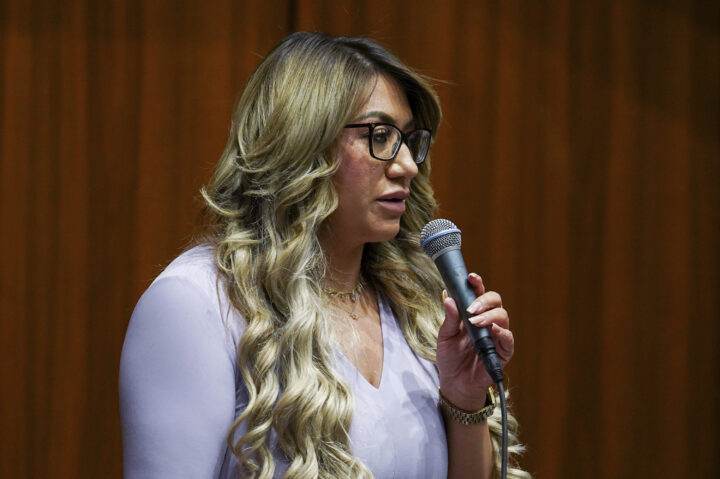
Samantha Chow/AP
State Rep. Alma Hernandez, D-Tucson, speaks during a House session, Wednesday, April 23, 2025, at the state Capitol in Phoenix.


 Add JewishInsider on Google
Alma Hernandez, a Jewish Democratic legislator in Arizona who is known as an outspoken supporter of Israel, claimed victory on Wednesday in a bitterly contested primary for an open state Senate seat in Tucson, hailing the win as a repudiation of the far left.
Hernandez, who is 33 and identifies as a “proud Zionist,” faced off against Rocque Perez, a former Tucson City Council member, whom she accused of using rhetoric that crossed a line into antisemitism with no pushback from the range of elected officials supporting his campaign.
With all votes counted in Arizona’s 20th Legislative District, Hernandez pulled in 54% of the vote share, defeating Perez by 8 points, according to unofficial results on the secretary of state’s website. The election results have yet to be officially certified.
“The voters in my district rejected antisemitism and rejected the DSA’s agenda, and clearly rejected what the mayor, the congresswoman and the county attorney wanted,” Hernandez, a term-limited House member, said in a statement to Jewish Insider, referring to the Democratic Socialists of America. “We proved that elections are won by knocking on doors and talking to voters, not by social media or online outrage and your friends’ endorsements.”
Throughout the campaign, Perez, who had been endorsed by Tucson Mayor Regina Romero, Rep. Adelita Grijalva (D-AZ) and Pima County Attorney Gabriella Cázares-Kelly, among others, had fixated on Hernandez’s pro-Israel views, casting her as having been influenced by “foreign” and “overseas interests” and labeling her an enabler of “genocide” and “bankrolled” by AIPAC, which does not engage in state-level races.
In one fundraising message, Perez asked his supporters to contribute $5 to “unseat a Zionist!”
Jewish leaders in Arizona had raised concerns about Perez’s messaging, saying that his attacks were an example of how rising anti-Zionism on the far left has intersected with antisemitism and is met with silence from Democratic Party leaders.
Before Tuesday’s primary, the Center for Jewish Resilience at Jewish Philanthropies of Southern Arizona, which monitors incidents of antisemitism in the area, distributed a letter to city council members backing Perez that highlighted what the group called his “repeated pattern of public rhetoric” espousing “longstanding antisemitic tropes and narratives.” It did not receive responses.
“It was our hope that these concerns would be taken seriously,” Carina Bien-Willner, the center’s director of public affairs, said in a statement to JI last month.
Perez, who has not yet conceded, did not return a request for comment on Thursday.
Hernandez, whose pro-Israel sentiments and votes with Republicans in the state legislature have fueled tensions with Democrats, said her victory had made “clear that running a campaign centered on attacking a Jewish elected official and making ‘genocide’ the defining issue is not a winning message in Arizona.”
“Despite not being the establishment candidate, we won by staying authentic, working hard and focusing on delivering results,” she told JI.
Hernandez is all but certain to prevail in November in the safe blue seat.
The outcome of Hernandez’s race also represented a counternarrative to broader national voting trends that have seen left-wing populists make inroads in recent congressional primaries across the country, including in Colorado this month and New York last month.
Rep. Greg Stanton (D-AZ) likewise fended off a left-wing challenger in Arizona’s primaries this week, winning a decisive 62% of the vote over Kai Newkirk, who lost by 25 points with most of the results tallied.
“I’ll continue to be unapologetically myself, and I look forward to serving the people of LD20 in the Arizona Senate,” Hernandez said in her statement.
Rocque Perez, a former Tucson city council member, has throughout his campaign fixated to an unusual degree on Hernandez’s pro-Israel views
Samantha Chow/AP
State Rep. Alma Hernandez, D-Tucson, speaks during a House session, Wednesday, April 23, 2025, at the state Capitol in Phoenix.
Alma Hernandez, a Jewish Democrat and Arizona representative now running for an open state Senate seat in Tucson, is raising alarms about rhetoric from her primary opponent that she and other Jewish leaders claim has crossed a line into antisemitism — with no pushback from local elected officials.
Hernandez, who is term-limited in Arizona’s House, has long been an outspoken supporter of Israel and identifies as a “proud Zionist,” fueling tensions with some Democratic colleagues, particularly on the left.
But her left-wing rival in the state’s July 21 primary election, Rocque Perez, a former Tucson city council member, has throughout his campaign fixated to an unusual degree on her pro-Israel views, while using language that Hernandez says promotes antisemitic tropes about dual loyalty and Jewish control of U.S. politics.
“At the end of the day, I consider this guy to be an antisemite, and someone who is so obsessed that this is all he talks about,” Hernandez told Jewish Insider in an interview. “He hasn’t told voters what he would do differently from me. He is just telling voters that I support genocide.”
In fundraising solicitations, campaign literature and online posts, Perez has frequently cast Hernandez as influenced by “foreign” and “overseas interests” in a thinly veiled allusion to Israel, saying that he is vying “to unseat” an “Israel-First Dem tied to big money.”
“Wish I was fooling with y’all, but I don’t think genocide is a joke,” Perez wrote in a characteristic post in April. “If anything, it’s made me even more determined to give Tucson a real choice — someone who isn’t beholden to corporations of allegiances abroad.”
Elsewhere, he has accused Hernandez of being “bankrolled” by AIPAC, the increasingly villainized federal lobbying group whose political arm does not engage in state-level races, where foreign policy is not typically a top issue. In a recent message, meanwhile, he asked his supporters to contribute $5 to “unseat a Zionist!”
“Alma’s record of placing her own political identity above the needs of her district is the true concern,” Perez wrote in the Arizona Daily Star last December, equating Hernandez’s efforts to secure funding for a Holocaust education center in Phoenix to pro-Israel legislative advocacy he dismissed as “largely directed toward international posturing” at the expense of other urgent local challenges.
For Hernandez and Jewish activists in the state who have been troubled by Perez’s messaging, his attacks are a local example of how rising anti-Zionism on the far left has increasingly intersected with antisemitism that has often been met with silence from Democratic Party leaders.
While Perez has won endorsements from several Tucson city council members as well as the county attorney, among others, none have commented on his rhetoric or responded to concerns from Jewish community members. On Tuesday, he said in a post that he had also been endorsed by Rep. Adelita Grijalva (D-AZ) and Tucson Mayor Regina Romero.
Last month, the Center for Jewish Resilience at Jewish Philanthropies of Southern Arizona, which tracks local incidents of antisemitism, sent a letter to city council members supporting Perez, highlighting what the group called his “repeated pattern of public rhetoric” espousing “longstanding antisemitic tropes and narratives.”
The organization, which did not return a request for comment on Tuesday, invited the officials “to speak further” but did not hear back from them, according to Hernandez.
“What is alarming about this cycle is there is this individual who is so out there with his rhetoric and people are just pretending that it’s not a big deal,” said Hernandez, 33. “I have been in office for a total of eight years representing this community. The fact that I’m a Mexican Jew has never been disqualifying for anyone to say, ‘Hey, I can’t support you because of that.’”
Perez’s campaign did not respond to a request for comment.
Erika Neuberg, a Jewish community leader in Arizona who is close to Hernandez, said the “race is exposing” Democratic leaders as unwilling to even acknowledge rhetoric that Jewish voters have found concerning. “You don’t have one Democratic leader looking at this rhetoric and saying this is alarming,” she told JI. “This is an attempt to disenfranchise a segment of the population.”
Andrew Kunsberg, a Jewish Democratic leader in Tucson who is backing Hernandez, said, “When you accuse somebody of being a Zionist, to me, you’re accusing them of being Jewish, and it’s already affected her race.” In canvassing for her campaign recently, he has heard from voters who say they won’t vote for a Zionist, he told JI. “To me, this is not normal.”
Kunsberg said that he has been involved in a range of local legislative races, “but quite frankly, I have never seen anything like it in my entire life.”
“She is running against the most flawed candidate I have ever seen and yet is being supported by almost our entire city council and our county attorney,” he said.
Perez’s backers have continued to stand behind him, even as the 27-year-old has faced unrelated scrutiny over past deleted posts advocating political violence against conservatives, which he has called “material put out without my consent.”
“It just seems that in our Democratic politics, individuals do not care, as we’re seeing with what’s going on with” Graham Platner, Hernandez told JI, referring to Maine’s Democratic Senate nominee. “I mean, the man literally had a Nazi tattoo, and people are like, ‘Oh, he’s fine, he’s great, he’s a progressive.’”
As early voting begins next week, Hernandez, who has clashed with local Democrats for her votes with Republicans in the Legislature, echoed other Jewish supporters in saying she was not certain whether she would prevail in the primary, even as she dismissed Perez as unserious.
“I don’t want to say that I’m completely safe in this election, because I don’t think that anyone is at this point,” she said. “Do I consider him a serious person? Absolutely not. I think he’s a joke.”
But that “doesn’t mean he can’t win an election when he is receiving the support of the establishment,” she added.
“In any other world, I felt like people would be ringing the alarms,” she told JI. “Unfortunately, these folks are encouraging the behavior.”
Sen. John Fetterman asked members of the left, ‘Why can’t you just call it [antisemitism] what it is?’
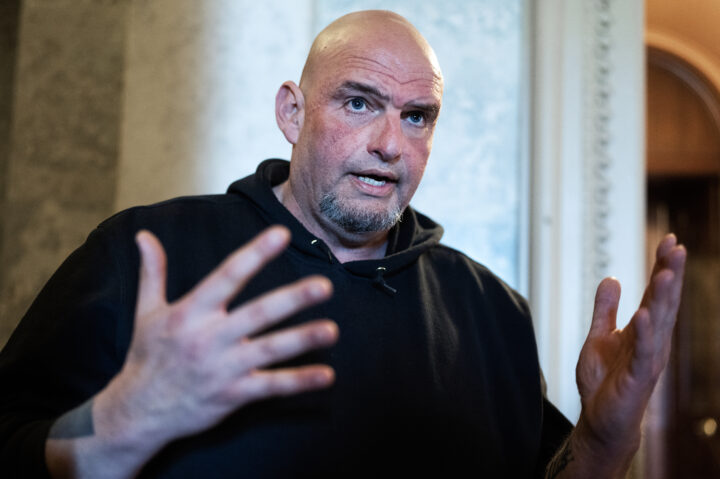
Tom Williams/CQ-Roll Call, Inc via Getty Images
Sen. John Fetterman (D-PA) talks with reporters after the Senate luncheons in the U.S. Capitol on Tuesday, March 11, 2025.
Pro-Israel leaders in the United States on Thursday connected the murder of two Israeli Embassy employees outside the Capital Jewish Museum in Washington to the anti-Israel advocacy seen on the political extremes throughout the country since the Oct. 7, 2023, attacks, characterizing it as a culmination of such rhetoric and, in some cases, the failure of some politicians to denounce it.
The suspected shooter, Elias Rodriguez, shouted “free, free Palestine” and “I did it for Gaza” following the shooting, according to an eyewitness and video from the arrest. He reportedly published a manifesto railing against Israel.
Sen. John Fetterman (D-PA) said that the attack should be a signal to the left that it needs to rethink its rhetoric on Israel and Zionism. He compared the anti-Israel movement in the United States to a “cult” that has been stoked online and is using inherently violent slogans while its members “try to hide behind this idea that it’s free speech to intimidate and terrorize members of the Jewish community.”
He said that too many on the left have failed to call out antisemitism in the anti-Israel movement.
“Why can’t you just call it what it is, and then address and assert the pressure on the aggressor,” which is Hamas,” Fetterman said. “I can’t even imagine having to live with that ever-present antisemitism and what? Why can’t people just acknowledge and call that what it is?”
Fetterman predicted that the same elements of the left that have supported Luigi Mangione, the alleged assassin of UnitedHealthcare CEO Brian Thompson, will also rally behind Rodriguez.
“What part of my party does this come from where it’s like, we try to defend or try to justify assassinating an executive in broad daylight or … somebody [who] guns down” two people at a Jewish event, Fetterman asked incredulously.
Israeli Ambassador Yechiel Leiter connected the shooting to the anti-Israel protests seen on college campuses and elsewhere in the country.
“The point of the matter is that on campuses around this country, where ideas — these are the temples of ideas — where smart ideas, intelligent ideas, moral ideas, truthful ideas, are supposed to be taught, we have useful idiots running around in support of the destruction of Israel,” Leiter said at a press conference.
“This is done in the name of a political agenda to eradicate the State of Israel,” Leiter added. “The State of Israel is now fighting a war on seven fronts. This is the eighth front, a war to demonize, delegitimize, to eradicate the right of the State of Israel to exist.”
He also connected rising global antisemitism to countries like France that have spoken out against Israel and are moving to recognize a Palestinian state.
A coalition of 42 Jewish organizations, in a statement, described the murders as “the direct consequence of rising antisemitic incitement in places such as college campuses, city council meetings, and social media that has normalized hate and emboldened those who wish to do harm.”
William Daroff, the CEO of the Conference of Presidents of Major American Jewish Organizations, said on X, “There is a direct line between demonizing Israel, tolerating antisemitic hate speech in the public square, and violent action.”
“We are now witnessing the deadly consequences of months of relentless antisemitic incitement — amplified by international organizations and political leaders across the globe — since the horrors of October 7,” Daroff said. “This is not a debate over policy; it is the mainstreaming of hatred, and its consequences are measured in blood.”
Rep. Josh Gottheimer (D-NJ) said on X the attack was “the deadly consequence of normalizing Jew-hatred.”
“Since October 7, antisemitic attacks have surged — fueled by violent chants to ‘globalize the intifada’ and slurs like ‘dirty Zionist,’” Gottheimer said.
Rep. Ritchie Torres (D-NY), highlighting a tweet from a local anti-Israel group that praised the attack, said that, “Violence is not a bug but a feature of virulent Anti-Zionism.”
Arizona state Rep. Alma Hernandez called out a series of progressive lawmakers, saying, “spare us the fake outrage.”
“Two Israeli diplomats were murdered in cold blood—and you dare act concerned? Y’all have spent years fueling the hate and antisemitism that’s now exploding across America. Don’t pretend to care,” Hernandez continued, in an X post. “You are constantly surrounded by keffiyehs and “Free Palestine” and have pushed rhetoric that’s radicalized Americans into thinking murdering Jews and harassing them in the streets will somehow “liberate” Palestine and end the so-called genocide. No thanks.”
“We don’t want prayers from politicians who support individuals and organizations that promote this hate and who are being actively supported by said individuals and organizations while they run for office,” Hernandez added.
“You can’t support chants of ‘Globalize the Intifada’ and then be ‘appalled’ when people act it out,” Georgia state Rep. Esther Panitch said on X in response to a statement on the attack from Rep. Ilhan Omar (D-MN) that did not acknowledge that the victims worked for the Israeli embassy and condemned “violence” broadly. Panitch also criticized other progressive Democrats who issued statements on the attack.
Panitch added, “Fascinating that those who campaigned against the Jewish community’s right to define their own experience of antisemitism are the ones who call ‘Globalizing the Intifada’ peaceful protests. The same ones who can’t say the word antisemitism in their posts.”
Jordan Acker, the University of Michigan regent who has been repeatedly targeted with antisemitic harassment and vandalism, drew a direct line between those incidents and demonstrations on the University of Michigan’s campus, and the Wednesday night murders.
“This isn’t protest. It’s a threat. This is what antisemitism looks like — and it’s escalating,” Acker said. “This is part of a terrifying trend: Jews in America being hunted, harassed, and attacked for being visibly Jewish — for existing in public. When we call it antisemitism, we’re told we’re overreacting. That our fear is political. That our pain is inconvenient. We’ve been gaslit for 18 months. Enough.”
He also called out progressives directly, saying “antisemitism isn’t any less dangerous when it comes wrapped in ‘progressive’ language.”
In response to the attack, some of the most prominent far-left critics of Israel on Capitol Hill have offered what many in the Jewish community have seen as half-hearted and inadequate responses.
“My heart breaks for the loved ones of the victims of last night’s attack in D.C. Nobody deserves such terrible violence. Everyone in our communities deserves to live in safety and in peace,” Rep. Rashida Tlaib (D-MI) said, linking to an article highlighting that the victims, Sarah Milgrim and Yaron Lischinsky, were Israeli Embassy workers, but not noting their backgrounds or the circumstances of the shooting in her own post.
Omar noted that the shooting took place at the Capital Jewish Museum but did not acknowledge the victims’ backgrounds and condemned violence broadly.
“I am appalled by the deadly shooting at the Capital Jewish Museum last night. Holding the victims, their families, and loved ones in my thoughts and prayers,” Omar said. “Violence should have no place in our country.”
Please log in if you already have a subscription, or subscribe to access the latest updates.
 Continue with Google

 Continue with Apple