






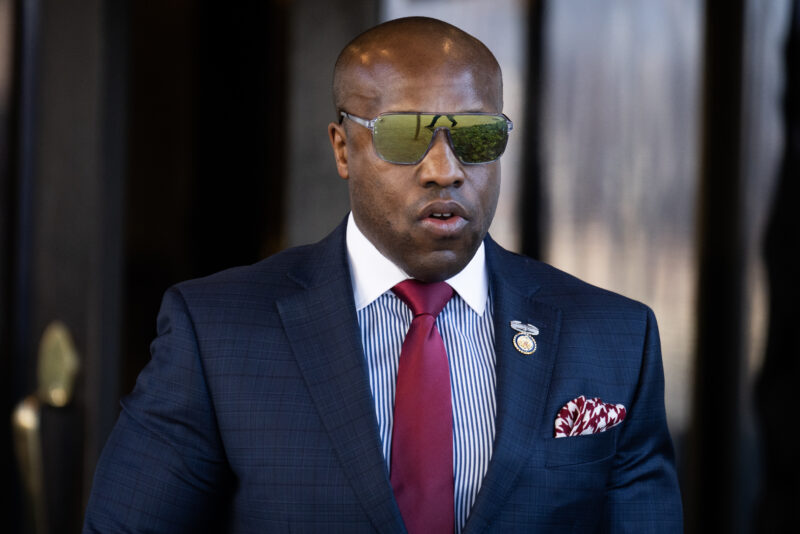
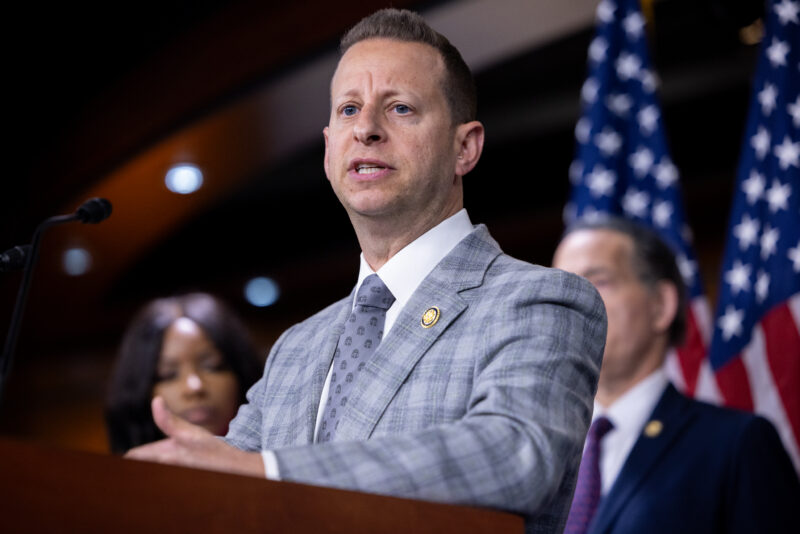
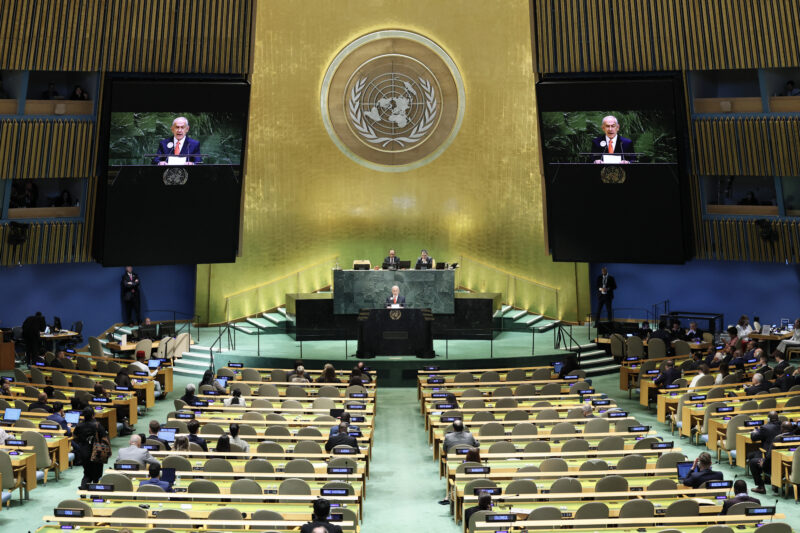



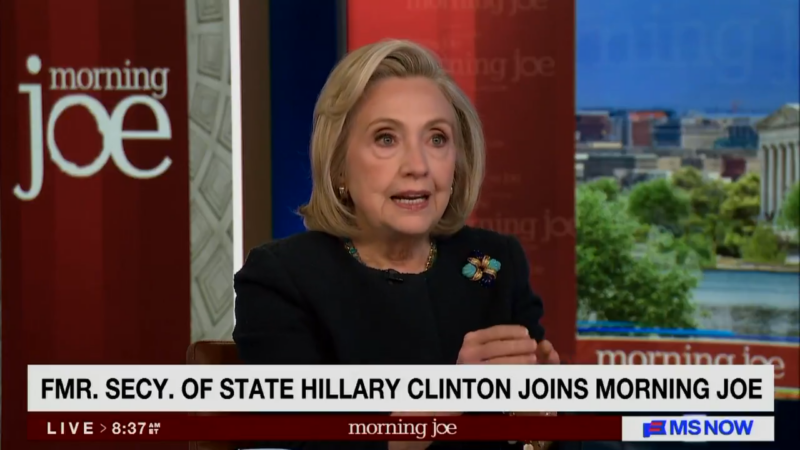










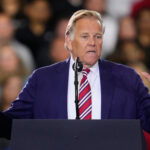

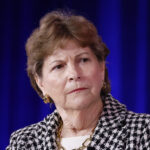

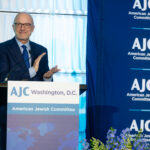

Coverage of social media activity by the wives of Rep. Dan Goldman and Mayor Zohran Mamdani has raised questions about how — and when — the press scrutinizes the families of public officials
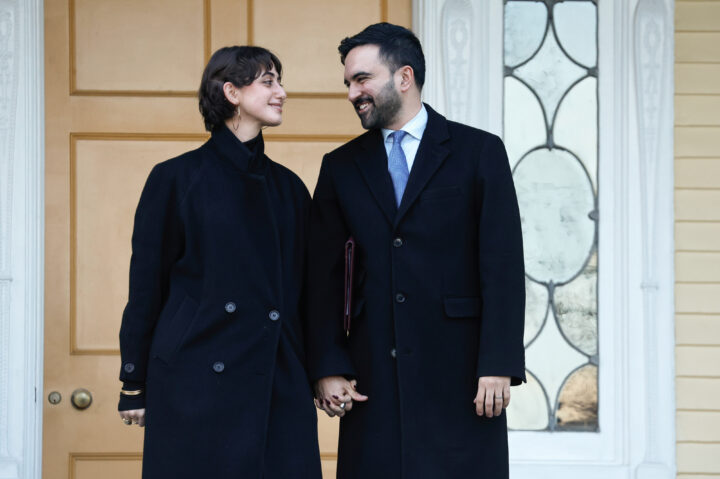
John Lamparski/Bloomberg via Getty Images
Zohran Mamdani, mayor of New York, and his wife Rama Duwaji during a news conference at Gracie Mansion in New York, US, on Monday, Jan. 12, 2026.


 Add JewishInsider on Google
Recent days have offered a tale of two New York public officials’ wives and a revealing look at inconsistent standards from some mainstream media outlets on how they scrutinize the families of elected officials depending on the political viewpoints expressed.
The first was a New York Times story focused on the pro-Israel social media posts of Rep. Dan Goldman’s (D-NY) wife. Under the headline “Congressman Faces Questions About Wife’s Social Media Stances on Israel,” the Times wrote of the instances — believed to be 10 in all — that Corinne Goldman, who served as treasurer on her husband’s campaign, liked posts related to the Israel-Hamas war in the weeks after the Oct. 7, 2023, Hamas terror attacks, including one comparing “Jews for Palestine” to “Chickens for KFC.”
Days later, Jewish Insider uncovered the social media activity of Rama Duwaji, the Syrian-American wife of New York City Mayor Zohran Mamdani, in the days after the attacks. That activity included liking posts that unambiguously celebrated Hamas’ Oct. 7, 2023, attacks — as they were underway — and included still images from the attacks, in which more than 1,200 were killed and 251 taken hostage.
The only Jewish communal official quoted in the Times’ story was Sophie Ellman-Golan, the director of strategic communications at the far-left Jews For Racial & Economic Justice, which endorsed Mamdani in last year’s Democratic mayoral primary.
A day after JI’s report, The Free Press published its own investigation that found Diwaji had liked dozens of additional anti-Israel posts, including one saying Israel was waging a “vile land grab” and another that suggested that the Times, which had done its own investigation into sexual violence on Oct. 7 had “fabricated” a “mass rape” hoax.
In his first public statement addressing JI’s reporting, Mamdani said his wife — who less than a month ago was the subject of a cover profile and photo shoot for The Cut — was a “private person.”
It was a response that was unsatisfactory to some. Deborah Lipstadt, the Biden administration’s special envoy to monitor and combat antisemitism, responded to Mamdani’s statement by rhetorically asking, “But Jessica Tisch has to apologize when her brother says something?” — referring to the NYPD commissioner’s recent apology over her brother’s assertion that Mamdani was an “enemy of the Jewish people.”
The Times, which covered Mamdani’s response, changed its headline on the story at least twice after publication, from “Mamdani Says His Wife’s Views on Gaza Are No One’s Business,” to “Mamdani Defends Wife Amid Criticism of her Support for Palestinian Cause,” eventually landing on “After Social Media Scrutiny, Mamdani Says His Wife Is a ‘Private Person.’”
In response to the second headline, Tel Aviv-based research analyst Daniel Paul Rubenstein wrote on X that he “did not expect to see the New York Times refer to the October 7 Massacre as an expression of the ‘Palestinian Cause’ – but here we are.”
The social media defense of Duwaji from elements of the left was swift, with many arguing that New York City’s first lady — who lives in Gracie Mansion at the taxpayer’s expense — should not be subject to criticism over her views, despite those views including the embrace of terrorism.
In a misdirection, some turned their ire toward Bari Weiss, after CBS News shared a 60-second clip confirming JI’s reporting.
Former Obama administration official Ben Rhodes took to X to say, “There’s a war, high prices, job losses, AI unleashed, and on and on. But Bari Weiss’s CBS is on the case of the NY Mayor’s wife’s likes from years ago. WTF is going on.” Meanwhile, Status’ Natalie Korach dedicated the bulk of Sunday’s newsletter to Weiss and Mamdani, saying that the reporting — though first done by JI — “struck many as peculiar, something that might have appeared on The Free Press, Bari Weiss’ anti-woke and vehemently pro-Israel opinion site.”
One person to keep an eye on is Josh Binderman, who served as Mamdani’s Jewish outreach director during the campaign and transition
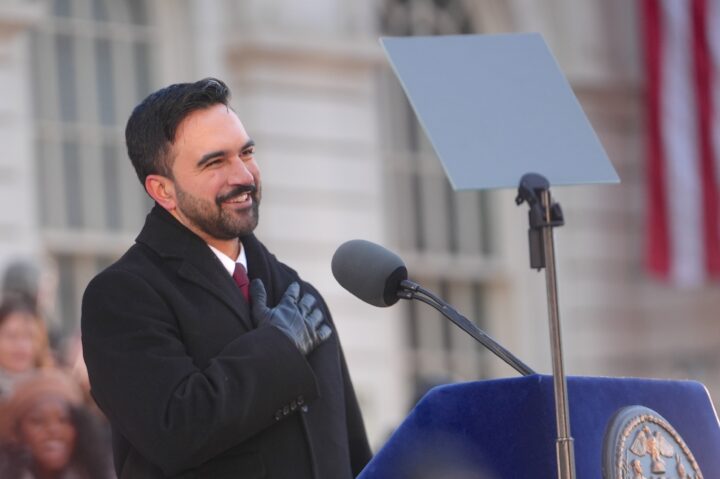
Selcuk Acar/Anadolu via Getty Images
Mayor Zohran Mamdani at his inauguration ceremony at City Hall, Manhattan, New York City, United States on January 1, 2026.
As New York City Mayor Zohran Mamdani draws increased scrutiny for picking some top appointees whose past incendiary social media comments have provoked controversy and raised questions over his vetting process, Jewish community leaders are now watching closely for signs of how the administration will make staffing decisions on key issues connected to Israel and antisemitism.
One person to keep an eye on is Josh Binderman, who served as Mamdani’s Jewish outreach director during the campaign and transition. He has largely maintained a low profile in his time working for the candidate and now mayor, garnering just a small handful of mentions in the press, despite his critical position leading engagement with a community that in many ways remains deeply skeptical of Mamdani’s hostile stances on Israel and commitment to implementing a clear strategy to counter rising antisemitism.
Binderman, most recently a communications manager for New Deal Strategies, an influential progressive consulting firm, served until 2024 as a PAC manager and a senior associate for J Street, the progressive Israel advocacy group, according to his LinkedIn profile.
While Mamdani notably refused to work with the organization when he led a chapter of Students for Justice in Palestine as an undergraduate student at Bowdoin College, the mayor has since developed a friendlier rapport with J Street, which has defended him amid charges that he tapped transition advisors who engaged in anti-Zionist activism that crossed a line into antisemitism.
Mamdani’s decision to employ a former top J Street staffer during the election suggests he could follow a similar approach to key Jewish community posts for his developing administration. If so, it could help to at least dampen some concerns from Jewish leaders who fear the mayor will end up hiring even harder-left members in his coalition such as activists associated with Jewish Voice for Peace, an anti-Israel advocacy group that aggressively promotes boycotts targeting the Jewish state.
It is still an open question, however, how Mamdani will move forward on such issues. His decision last week to revoke two executive orders linked to Israel and antisemitism was widely seen as a discouraging maneuver that eroded goodwill among mainstream Jewish leaders — even as Binderman had reportedly given some advance warning to leaders about the effort before the inauguration.
Mamdani otherwise chose to retain an office to combat antisemitism established by former Mayor Eric Adams. He has not disclosed who will steer the office now, though a person recently in touch with his team told Jewish Insider this week that Phylisa Wisdom, the executive director of New York Jewish Agenda, a progressive Zionist group, was floated as a possible candidate.
For his part, Binderman, who as a student was involved with BBYO, continues to be an unofficial “point person” for Jewish community outreach in the administration, according to one Jewish leader who has heard from him recently. Binderman is still feeling out a potential role in City Hall, according to other Jewish community leaders. He did not return a request for comment from JI.
Dora Pekec, a Mamdani spokesperson, told JI on Tuesday that the mayor’s team would have more to share on related appointments in the coming weeks and that such decisions “are still being worked out.”
Jewish leaders who have engaged with Binderman told JI their interactions with the young Mamdani aide have been largely positive. But they expressed some lingering doubts about his ability to influence the mayor himself. “He does seem eager and willing to help,” said one Orthodox community leader. “He does want to work together.”
“To what extent and how much freedom he has remains to be seen,” the leader explained to JI.
Another Jewish community leader who has spoken with Mamdani’s team echoed that view. Binderman, he told JI, has “always appeared to be level-headed, fair and reasonable. The question is, will the admin listen to his guidance?”
“Only Josh and Ali Najmi,” a top Mamdani advisor who maintains close ties to the Jewish community, “can land the Jewish plane,” the Jewish leader said. “But Zohran has to decide if he wants to land it.”
Aber Kawas, a left-wing Muslim activist, also expressed solidarity with a man convicted of providing support to Al-Qaida
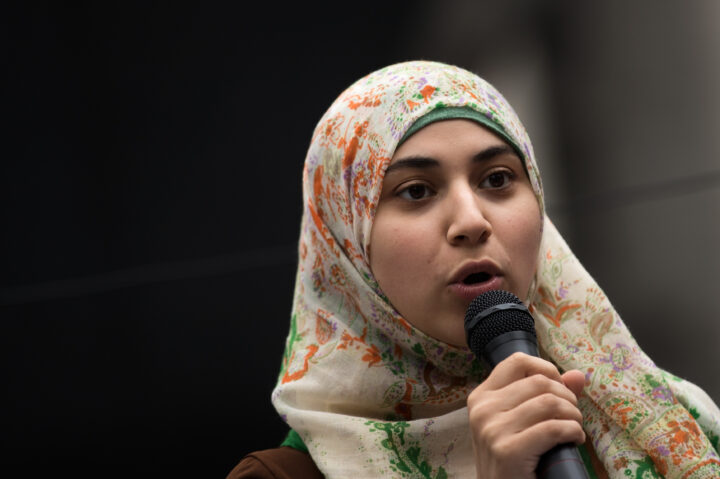
Drew Angerer/Getty Images
Aber Kawas, from the Arab American Association of New York, speaks to members and supporters of the New York Immigration Coalition during a rally for immigration reform in Foley Square, June 28, 2016 in New York City, New York.
Zohran Mamdani, the mayor-elect of New York City, is facing scrutiny for reportedly throwing his support behind a local state Assembly candidate with a record of controversial remarks about 9/11, Israel and other related topics.
Aber Kawas, a Palestinian American activist running for an open Assembly seat in a largely Hispanic Queens district, came under the spotlight this week after several of her past online posts and comments resurfaced.
Mamdani’s decision to privately endorse Kawas, which was reported by The New York Daily News, underscores the depth of his hostility toward Israel, as he flexes his newfound political capital to boost a candidate whose extreme views are already stirring backlash.
In one widely circulated online video clip from 2017, Kawas downplayed the 9/11 attacks and suggested they paled in comparison to what she characterized as a “long trajectory” of capitalism, racism, white supremacy and Islamophobia that “have all been used to colonize lands” and “take resources from other people.”
“The idea that we have to apologize for a terror attack that a couple people did,” she said of 9/11, “and then there is no apologies or reparations for genocides and for slavery, et cetera, is something that I kind of find reprehensible.”
Kawas, who is in her early 30s and has long been active in Arab and Muslim organizing in New York City, also wrote a series of now-deleted blog posts in which she expressed solidarity with a man convicted of providing material support to al-Qaida as well as a group of Hamas-linked Muslim activists known as the Holy Land Five — whom she called “imprisoned heros.”
In another post in 2013, Kawas, commemorating the anniversary of the Nakba recognizing the mass displacement of Palestinians during the founding of Israel in 1948, also lamented “the day that the British Empire gave control of the land of Palestine to European Zionists who created a state based on the ethnic cleansing, murder, displacement, and occupation of millions of indigenous Palestinians in the area.”
Kawas is a supporter of the Boycott, Divestment and Sanctions movement targeting Israel and was involved in efforts to promote failed legislation led by Mamdani that sought to strip Jewish nonprofits of their tax-exempt status, according to a candidate questionnaire solicited by the Democratic Socialists of America, which is reportedly moving to back her campaign.
Elsewhere in the questionnaire, which was shared with Jewish Insider this week, Kawas said she would “refrain from any and all affiliation with the Israeli government and Zionist lobby groups” such as AIPAC and J Street, a left-wing organization that has defended Mamdani.
The DSA did not respond to a request for comment, and Kawas could not be reached on Wednesday.
Mamdani, for his part, shares Kawas’ approach to Israel as a longtime supporter of BDS, which he has indicated he could seek to uphold as mayor. He has previously praised the Holy Land Five in a 2017 rap song that drew criticism during the election. As an undergrad at Bowdoin College, where he founded a chapter of Students for Justice in Palestine, he also ended a brief partnership with J Street U, citing a policy of anti-normalization precluding engagement with groups that support Israel.
While he moderated on a number of issues over the course of his campaign, including a pledge to retain Jessica Tisch as police commissioner that assuaged some concerns among Jewish voters (she announced Wednesday that she had accepted the post), Mamdani has otherwise largely continued to make exceptions for Israel, one of his top issues as a state assemblyman.
This week, for instance, he reiterated a vow to arrest Israeli Prime Minister Benjamin Netanyahu for his alleged war crimes if he steps foot in New York City, a move experts have questioned as legally dubious.
Mamdani’s behind-the-scenes involvement in the Queens Assembly contest represents one of his first efforts to influence a local race since his election. He had also reportedly offered support to Brad Lander, the outgoing city comptroller, in a challenge to Rep. Dan Goldman (D-NY), a pro-Israel incumbent. And he has publicly discouraged Chi Ossé, a far-left city councilman, from mounting a bid to unseat House Minority Leader Hakeem Jeffries (D-NY), saying in an interview Wednesday that “right now is not the time” as he seeks to manage his relationships with top Democrats to advance his affordability agenda.
In the Queens race, Mamdani’s recent engagement has faced skepticism from pro-Israel activists.
“If DSA/Zohran Mamdani want to be the muscle behind the most anti-Israel candidate they can find to represent a majority Latino district with actual problems in Queens, that’s their prerogative,” Sara Forman, who leads New York Solidarity Network, a local pro-Israel group, wrote in a social media post this week. “Choosing to fixate on Israel instead of schools, Trump or ICE is certainly a choice.”
But Mamdani’s push to influence the primary has also raised a possible conflict with the left, as he places himself in opposition to outgoing Assemblywoman Jessica Gonzalez-Rojas, a DSA member running for state Senate who had already endorsed her chief of staff for the seat, which is based in Jackson Heights. Brian Romero, the aide, has vowed to continue with his bid in spite of the split endorsements, setting up an internecine fight that could test Mamdani’s sway as mayor.
A spokesperson for Mamdani did not respond to a request for comment from JI on Wednesday.
For her part, Kawas, who filed to run on Tuesday, is relatively new to the district, local campaign finance records show, and only recently moved back to New York City after studying in South Africa.
Still, a political advisor to Kawas reportedly argued at a recent DSA meeting that her background is best suited for the race as the far left seeks to ramp up its opposition to Israel with Mamdani set to take office.
“We have to actually run a Palestinian Arab in this race because we need to draw the fire of the Israeli lobby, and we have to beat them,” the advisor, Joe Stanton, told attendees at the meeting, according to The Daily News.
In her DSA questionnaire, Kawas echoed that sentiment. “As a Palestinian, it is clear that the majority understands what is happening to our people, and with the groundswell of support and resistance to genocide, we’ve made some headway on particular boycott and divestment campaigns,” she wrote. “But while the tide is turning in some respects (especially with Zohran’s election), the pro-Israel lobby is still dominant.”
“It is urgent that we continue to grow connections across the Palestine movement and the broader left on this terrain,” Kawas wrote, “and this office is the place where I can do that.”
At the event, a Muslim spiritual leader delivered an antisemitic tirade and expressed disgust to be in the same room with Jews
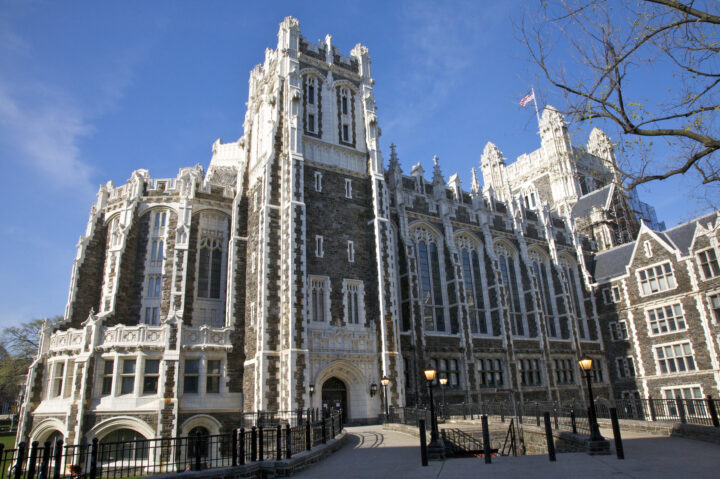
Getty Images
Shepard Hall, City College of the City University of New York (CCNY), Harlem, Washington Heights, New York, NY, USA
The City College of New York is facing scrutiny after a Muslim spiritual leader delivered an antisemitic tirade against a CUNY Hillel director during a university-sponsored interfaith dialogue program last week.
The panel featured CUNY Student Chaplain Joshua Medina; Muslim spiritual leader Abdullah Mady, a 2024 graduate of CCNY; and Ilya Bratman, executive director of Hillel at Baruch College, who became the focus of Mady’s hostile remarks, including an accusation that he is “responsible for the murder of his brothers in Gaza” and “disgust that a Zionist is here.”
Mady’s remarks were condemned on Wednesday by the U.S. Department of Justice and New York Gov. Kathy Hochul, who called it “antisemitism, plain and simple” in a post on X. But the university has not issued a public statement regarding the event, which was held last Thursday, nearly a week ago, and organized by CCNY Division of Student Affairs and Student Life and Leadership Development Office. An Instagram flier advertising the event did not include names of the speakers.
After several requests for comment from Jewish Insider, a university spokesperson said on Wednesday that the school “has zero tolerance for acts of hate or bigotry of any kind” and would “promptly take all necessary and appropriate actions to address any such discrimination and remedy its effects,” but did not respond to further questions, including the name of the Muslim speaker, which JI was able to confirm through sources familiar with the event. The school’s spokesperson also didn’t disclose whether there was any vetting process in the speaker selection.
Miriam Elman, executive director of the Academic Engagement Network, which works to fight campus antisemitism, told JI that the event was particularly egregious because it was hosted by an office of the university, rather than a campus student group.
“Universities can’t always control what comes out of a speaker’s mouth, but a university can distance itself from a guest speaker,” said Elman. “Here you have the university actually implicated in hosting the event. Why was it allowed to proceed with the speaker continuing to harangue and harass with his remarks? Why was that not handled better in the moment?”
“The university should have stood up and removed the offending speaker, but they didn’t do that, and then there’s no acknowledgement of what happened. It’s a pile-on of errors.”
“Speakers come and go but the issue is how university leadership responds,” Elman continued. “They should have immediately released a statement saying they were appalled. The process of this [is problematic] — the university didn’t want to share a name, didn’t want to admit this happened.”
The choice to hide speaker names comes as the interfaith event also drew confusion around its attendance — with only two Jewish students taking part alongside nearly 100 Muslim students.
Bratman, a faculty member of AEN who said he was unaware of Mady’s name during the panel, said the low turnout of Jewish students was due to another event at the university taking place at the same time to mark the anniversary of Kristallnacht.
“But why would you not ensure a diverse community of listeners?” said Elman. “This was supposed to be an interfaith workshop where people came together. It’s a shocking outcome for an event that should have been bringing people together.”
According to an audio recording obtained by JI, Mady told attendees he “came to this event not knowing that I would be sitting next to a Zionist and this is something that I am not going to accept,” he said, referring to Bratman.
“My people are being killed right now,” Mady continued, as he went on to urge students, “If you are a good Muslim, I ask you to exit this room immediately.” According to Bratman, all of the 100 Muslim students in attendance, most wearing keffiyehs, cheered, stood up and exited the event at Mady’s instruction, before the other panelists spoke. The other attendees — about 20 Christians and two Jews, remained. Eventually, Bratman was escorted out by campus security as a safety precaution.
Mady, who graduated in the spring with an undergraduate psychology degree from CCNY, was featured as an exemplary student on the university’s “Masters in Translational Medicine” Instagram page in May.
Mady’s antisemitic statements came after he delivered a 15-minute speech at the start of the event, telling students that Allah was responsible for their grades. He also chanted Arabic prayers and spoke in support of Sharia law, arguing that its severe penalties — including executions for major crimes and amputating “the tips of the hands of a thief” — serve as effective deterrents. “I’m talking about the elite, the filthy rich — those who continue to steal from people today,” he said. “They’re the ones who deserve to have their tips cut off.”
“That’s how interfaith goes at CCNY,” a student who remained in the room can be heard saying in the recording as Muslim students walked out at Mady’s request.
The incident was “not only exclusionary and scary,” Bratman told JI, “but leads to a climate that is antithetical to any kind of education or growth.”
“I am not a victim in this, I have no fear. The victims are the students of this university, and maybe the Muslim students even more than the Jewish students,” he said.
Heba Farouk Mahfouz expressed alignment with Hamas and Hezbollah and dismissed her critics as ‘Zio-Nazis’

Getty Images
Main entrance to the The Washington Post headquarter building located on 15th Street in Washington DC.
A Middle East reporter for The Washington Post is facing scrutiny for online commentary in which she has called Israel an illegal state, openly identified as an anti-Zionist and signaled support for Hamas and Hezbollah, among other posts now raising questions about the objectivity of her coverage on the region.
In an extensive series of social media remarks mostly published between 2012 and 2014, Heba Farouk Mahfouz, a reporter and researcher in the Post’s Cairo bureau whose recent coverage largely focuses on Israel and Hamas, frequently inveighed against Israel, saying it was “not a point of view” but “a fact” that the country is a “colonial, illegal” state. She also described Zionism as “racism,” while dismissing her critics as “Zio-Nazis” — a pejorative deemed by some watchdog groups as antisemitic.
“If my anti-Zionist views hurt your Zio-Nazi feelings, FUCK OFF & SHUT THE FUCK UP!” she wrote in an aggressively worded post in September 2012. “Better, go live in #Israel & see how they’d treat a brown man.”
“Call me a Nazi, call me a terrorist, call me backward, but still, fuck your illegal ‘state’ of #Israel,” she said in another post published the same day.
Elsewhere, Mahfouz claimed that Israel “despises #African #Jews and any dark skinned Jew,” and compared Israel’s treatment of Palestinians to the Holocaust. “‘Never again,’ said the Zionist settler who is killing Palestinians now in a genocide,” she wrote in November 2012, ending her comment with the words “Holocaust” and “Gaza.”
Mahfouz has otherwise expressed alignment with Hamas and Hezbollah, according to translated posts first written in Arabic. While she voiced disapproval of what she called “Hamas’ social suppression of the Palestinians,” Mahfouz wrote in May 2013 that she was “always and forever with the resistance as long as it is against the Zionist entity,” according to one translation.
“With the resistance always and forever,” Mahfouz said in a separate post published the following year. “And with Hamas and Hezbollah if their weapons are against Israel and not against Arabs like them.”
Mahfouz, now 34, began working at the Post in August 2016, according to her LinkedIn profile. Months before, she had publicly identified as “anti-Zionist” on her Twitter page, according to archived screenshots — a description she removed after joining the paper.
A spokesperson for the Post confirmed to Jewish Insider on Monday that the newspaper is “aware of the alleged social media posts and” is “looking into” the matter. The spokesperson added that the paper would provide additional information “should there be a development to share.”
Several posts were first uncovered last week by Eitan Fischberger, a writer and pro-Israel activist. Mahfouz has since locked her X account — though Fischberger and JI preserved many of her posts via screenshots.
Since Hamas’ Oct. 7, 2023, attacks, the Post has sparked backlash for its reporting on Israel and the war in Gaza, which critics have accused of veering into activism and presenting a one-sided picture of the conflict, among other issues. The paper has also dealt with a series of factual errors that have drawn major corrections — contributing to a perception of systemic sloppiness in its Middle East coverage.
Mahfouz’s newly unearthed social media comments underscore how the paper is continuing to navigate such issues, even as its new CEO and publisher, Will Lewis, has reportedly voiced private concerns about coverage he and others have interpreted as suffering from anti-Israel bias.
The Post, meanwhile, has been shedding several top editors and reporters amid internal discontent with changes implemented by its owner, Jeff Bezos, who has faced accusations of seeking to curry favor with President Donald Trump — after taking a more adversarial approach to his first administration.
Since January, Mahfouz’s byline has appeared on 13 Post stories, all of which have been focused on Israel and Gaza.
‘I stand alone in the sense that I've been an advocate for the Jewish community and Israel with no support financially or politically from that community,’ Fulop said comparing himself to Gottheimer and Sherrill

Kyle Mazza / SOPA Images/Sipa USA via AP Images
Jersey City Mayor Steve Fulop during a press conference in Jersey City.
Facing scrutiny and increasing criticism from some in the New Jersey Jewish community, Jersey City Mayor Steve Fulop is suggesting that his top opponents in the state’s Democratic gubernatorial primary aren’t reliable allies against antisemitism and in support of Israel — and is also taking aim at the state’s current governor, accusing him of failing to adequately address the issue.
“When people try to portray me as anything other than a person that understands and supports the Jewish community here, it’s like a laughable accusation, considering my family’s background and my personal trajectory and personal backgrounds,” Fulop told Jewish Insider. “I stand alone in the sense that I’ve been an advocate for the Jewish community and Israel with no support financially or politically from that community. I do it solely because I believe that what I say is on the right side of the issues. That’s not the same place that the congressional candidates are.”
Fulop is facing growing skepticism and frustration over his rejection of legislation to codify the International Holocaust Remembrance Alliance’s working definition of antisemitism and his ties to prominent anti-Israel figures in the state, among other concerns.
Reps. Josh Gottheimer (D-NJ) and Mikie Sherrill (D-NJ) are both running in the race to succeed Gov. Phil Murphy, a Democrat.
“This attack reeks of desperation from a candidate who has failed to gain any traction after more than two years running for governor. But far worse, it politicizes efforts to fight antisemitism and support our ally, Israel,” Sherrill spokesperson Sean Higgins said. “The mayor often misses the mark as he fabricates attacks in an attempt to benefit his political self-interest; this one is particularly craven.”
Gottheimer’s campaign declined to comment.
Gottheimer, who is Jewish, has been among the most active and outspoken lawmakers on antisemitism and Israel, including when it put him at odds with former President Joe Biden. Sherrill has often backed key pro-Israel legislation and other efforts to combat antisemitism.
Though he does not support the IHRA legislation, arguing that it chills criticism of Israel and will actually exacerbate antisemitism, Fulop told Jewish Insider last week he does see room for the state to act in other ways.
He said the state could expand antisemitism and hate education — which he said should start at early ages — and more forcefully enforce the law at institutions of higher education.
“I don’t think Phil Murphy has done a particularly great job around that,” Fulop said.
Fulop asserted that Murphy should have intervened sooner in response to campus antisemitism in New Jersey, saying that the governor had allowed the issue to “fester” and should have had “no tolerance for that sort of stuff.”
Fulop added that Murphy should have been “more assertive” against antisemitism at Rutgers, adding that the state school system should not have made a deal with and concessions to student demonstrators to break up an anti-Israel encampment.
“The reality of the situation is that you had a lot of Jewish students there that felt that they were at risk with physical harm, and no student should feel that way when they attend a university,” Fulop said. “Getting to a place where you are negotiating with a group of students that ultimately made other students feel uncomfortable, I don’t think it’s a productive course of conversation. I don’t think it’s the right approach.”
Murphy did not respond to a request for comment.
Fulop said it would be “hard to argue that these were peaceful protests,” especially at Columbia University in neighboring New York City.
Fulop also highlighted his father’s service in the Golani Brigade during the Six-Day War, his Jewish upbringing and the Tanach quotes in his inauguration speech.
He said he’s supportive of the work of the New Jersey-Israel Commission, and said he’d work to highlight and grow that work, finding new partnership and investment opportunities. He said he’d worked in a similar way in Jersey City, on a smaller scale.
He said he sees opportunities to further connect technology companies and educational institutions in New Jersey and Israel.
Please log in if you already have a subscription, or subscribe to access the latest updates.
 Continue with Google
 Continue with Apple