







Plus, the freshmen of Oct. 7 are seniors now
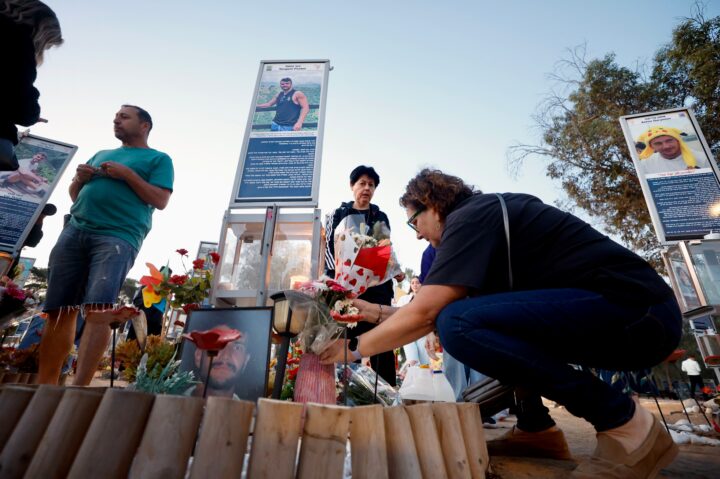
(Jamal Awad/picture-alliance/dpa/AP Images)
07 October 2026, Israel, Re'im: Mourners place flowers beneath portraits of victims during a memorial at the site of the Nova music festival in Re'im.


 Add JewishInsider on Google
Good Wednesday morning.
In today’s Daily Kickoff, we look at how Israel’s security landscape has changed in the three years since the Oct. 7, 2023, Hamas terror attacks, interview former hostages Keith and Aviva Siegel and Shoshan Haran, and talk to Jewish college seniors about how the events of Oct. 7 and ensuing war in Gaza shaped their university experiences. Also in today’s Daily Kickoff: Sen. Chris Coons, Kevin Roberts and Danielle Bernstein.
Today’s Daily Kickoff was curated by JI Executive Editor Melissa Weiss, with assists from Tamara Zieve and Danielle Cohen-Kanik.
Today’s Agenda
Today marks the three-year anniversary of the Hamas-led Oct. 7, 2023, terror attacks. In Israel and around the world, communities will mark the day with solemn ceremonies and memorials. Ceremonies on individual kibbutzim and at the site of the Nova music festival began as early as 6:29 a.m. local time, marking the minute that the attacks began three years ago.
Meanwhile, some will be marking the anniversary by protesting against the Jewish state, including on several college campuses and at New York City Hall, where anti-Israel groups including PAL-Awda, Within Our Lifetime and the youth chapter of the New York City Democratic Socialists of America are promoting a rally with a flyer that features the phrase, “Glory to the martyrs, victory to the resistance.”
Former hostages will be speaking at events marking the day. In Israel, Eli Sharabi is co-hosting a memorial ceremony in Tel Aviv, where he will be joined by other former hostages. In New York, Omer Shem Tov is slated to speak tonight at Yeshiva University, while Or Levy will address a commemoration ceremony on Long Island. Eliya Cohen and his wife, Nova survivor Ziv Abud, are speaking in Boston, and Yosef Chaim Ohana, along with Nova survivor Daniel Sharabi, is speaking at a community memorial in Denver. In France, Omri Miran will speak at the European Union’s official commemoration event.
Speaking at a press conference yesterday alongside New York City Mayor Zohran Mamdani, NYPD Commissioner Jessica Tisch vowed that “Jewish institutions will not be left to protect themselves without a strong partner in the NYPD” amid the demonstrations.
Mamdani, for his part, is slated to attend an Oct. 7 vigil today before meeting with Palestinian New Yorkers, according to his official schedule.
One Thing To Know
ANALYSIS
This year, three years since the Oct. 7, 2023, Hamas-led terror attacks, Israelis are marking the first anniversary in which no hostages remain in Gaza. Daily life has shifted to a new phase: one in which fewer reservists are being called up, Tel Aviv’s Hostages Square sits quiet on Saturday nights and Israelis tuning into the evening news normally see something other than war — usually election coverage.
Israelis now face a reckoning on the heels of last week’s FlyDubai attempted hijacking and ahead of the first election since Israel’s south was invaded by thousands of terrorists. The questions that loomed in the wake of the Oct. 7 attacks regarding the security of Israelis and the key role the government plays in that security are again front and center.
The terror attack on a FlyDubai flight bound for Israel, foiled by a miraculous set of events and the bravery of the Indian captain and Israelis on board, serves as a reminder of the threats that Israelis still face — and of the ways in which the institutions designed to protect them failed their societal covenant to do so.
The Big Reads
lessons learned?
On the third anniversary of the Oct. 7, 2023, Hamas-led terror attacks on Israel, the Jewish state’s borders are more secure, but there are still dangers looming and lessons to be learned, according to military and national security analysts. Dan Diker, president of the Jerusalem Center for Security and Foreign Affairs, told Jewish Insider’s Lahav Harkov on Tuesday that Israel “is in a better place in terms of its security. Kinetically, militarily, in counterterrorism and on the battlefield, we are in a much better place,” he said. “We have defensible borders. That’s an important point. It’s not only in Judea and Samaria [the West Bank], but we have them 10 kilometers deep into Lebanon, security zones in [Syria] up to 20 kilometers, and some strategic depth in Gaza. We have multi-border strategic depth that we need to survive, and a consensus that we’re not going anywhere.”
life after captivity
Keith Siegel was held captive by Hamas for 484 days. Of those, 433 were spent apart from his wife, Aviva, who was taken hostage with him but released after 51 days in captivity. “Every day counts,” he was quick to point out on Tuesday, when he and Aviva met with Jewish Insider’s Melissa Weiss in Tel Aviv ahead of the third anniversary of the Oct. 7 Hamas attacks on Israel. “Maybe every hour.” In part to deal with the trauma of her abduction and ordeal in Gaza, Aviva wrote a book about her experiences, Survived to Tell: A Hostage’s True Story of October 7 and 51 Days in Captivity. “I remember thinking, ‘I have to leave all these words for our grandchildren, because if Keith doesn’t come home, and he might never ever come home alive, that they’ll be able to read the love between us and how amazing Keith was,’” Aviva reflected.
Next chapter: On the third anniversary of the attacks, and with every hostage either returned alive or brought home for burial, Kibbutz Be’eri survivor Shoshan Haran, who was, like the Siegels, taken hostage, is allowing herself to think about what comes next. “This is the first anniversary that we can start looking at the future,” she told JI’s Haley Cohen. Her new memoir, Mission in Captivity: One Woman’s Struggle to Survive and Save Her Family in Gaza, is part of that next chapter — an effort to document what she experienced, mourn what she lost and make her voice heard about the events of Oct. 7 and their aftermath.
campus chronicles
Seven months after Hamas’ Oct. 7, 2023, attacks in Israel, Erica Ho stood beneath a Chabad tent on Harvard’s campus and became a bat mitzvah on her 20th birthday. Growing up in Albuquerque, N.M., with a Chinese father and Jewish mother, Ho lived miles away from the nearest synagogue and felt disconnected from the local Jewish community. For Ho and other members of the college class that arrived on campus just weeks before Oct. 7 — most of whom are now seniors — the three years since have become a defining chapter of their Jewish lives. As the third anniversary of Oct. 7 approached, Jewish Insider’s Haley Cohen spoke with three Jewish students who entered college weeks before the attacks.
The Rundown
education consternation
survey says
speaking out
fundraiser fallout
chesapeake challenge
On Our Radar
● The Live Briefing. Word on the street, clips, podcasts and quick updates — the items we’re tracking all day in our Live Briefing on the app (on Apple and Android) and website.
The White House stood by comments made by President Donald Trump on Monday that Iran could “take out” major California cities, including Los Angeles and San Diego; Trump’s comments prompted condemnation from Gov. Gavin Newsom and other state officials…
Vice President JD Vance said that Iran would have to make a “meaningful” change to its enrichment capacity in order to reach an accord with the U.S. to end the war, adding, “If you don’t want a nuclear weapon, then why do you need 60% enriched fuel? And if you want to show commitment to not building a nuclear weapon, don’t build highly enriched fuel. That’s a very basic threshold issue”…
During Maine’s Senate debate last night, Sen. Susan Collins (R-ME) said she supports continued aid at current levels to Israel, while Democratic challenger Troy Jackson said he does not want “any more offensive weapons going to murder people in Palestine”; he added that he believed that Israeli Prime Minister Benjamin Netanyahu is a “war criminal, but Sen. Collins likes him”…
The Cook Political Report shifted its ratings of three key Senate races — in Kansas, New Hampshire and North Carolina — to further favor Democrats…
Heritage Foundation President Kevin Roberts, who had previously defended far-right commentator Tucker Carlson over his friendly interview with white nationalist Nick Fuentes — prompting a series of resignations from the right-wing think tank — told The New Yorker in an exposé on Heritage that he now believes Carlson is “exacerbating antisemitism in America”…
The Wall Street Journal profiles WeWoreWhat founder Danielle Bernstein, who has amassed a large social media following even as she has courted controversies that have garnered her the tabloid nickname “America’s most hated influencer”…
Politico profiles Berlin mayoral candidate Elif Eralp, whose Left Party has galvanized younger supporters even as it faces antisemitic incidents within the party; media have dubbed Eralp the “Berlin Mamdani,” owing to her progressive politics and campaign style, which were influenced by political consultant and Mamdani advisor Morris Katz, who is also advising Eralp…
The New York Times spotlights former hostages Gali and Ziv Berman, twins from Kibbutz Kfar Aza who were among the last living hostages to be released, as they adjust to life post-captivity…
The Wall Street Journal interviews young Americans who chose to immigrate to Israel following the Oct. 7 attacks…
British Airways is set to resume daily nonstop flights between London and Israel on Oct. 25…
The Iran-backed Houthis in Yemen struck two airports in Saudi Arabia overnight amid a Riyadh-backed effort by Yemen’s internationally recognized government to retake areas claimed by the Houthis…
Counterterrorism officials in the U.K. arrested a seventh man in connection with an investigation into a security incident near the country’s RAF Fairford base, which had been used by the U.S. during its operations against Iran…
Actor Eva Marie Saint, known for her role in “Exodus,” died at 102…
Worthy Reads
Find more Worthy Reads in our Live Briefing via our app (on Apple and Android) and website.
Foreign Influence Peddling: In The Washington Post, Sander Gerber and Eugene Kontorovich argue that the government has a role to play in addressing covert foreign influence operations on social media. “Most of us calibrate our opinions at least in part by watching our neighbors. When a foreign government floods our Instagram feed with counterfeit neighbors, real citizens see a consensus that may not exist — and subconsciously adjust toward it. The deception lies in trying to pass off foreign (and often foreign-based) — and perhaps not even human — messages as apple-pie American.” [WashPost]
Seeing Red Over the Greens: In The Free Press, former U.K. Prime Minister Tony Blair raises concerns about the rise of the country’s Green Party, amid its vote over the weekend in favor of a single Palestinian state. “For most of its history, the Green Party was a party on the margins. Today it is a significant force in British politics. It won its best-ever results in this year’s local elections, and its membership has almost tripled. And it has moved itself, and many of its supporters and sympathizers, from condemnation of Israel’s conduct in the Gaza war to a full-on denial of the State of Israel’s right to exist.” [FreePress]
Coons’ New Tune on Israel: Politico’s Daniella Cheslow looks at Sen. Chris Coons’ (D-DE) political evolution on Israel in the three years since the Oct. 7 attacks as he positions himself to assume control of the Senate Foreign Relations Committee if Democrats flip the Senate. “Coons depicted his approach as providing moral clarity to an ally in an uneasy time. Oct. 7, Coons said, made Israelis ‘dramatically more concerned about security and less willing to tolerate or engage in conversations about a two-state solution or a path towards peace with Palestinians.’” [Politico]
Picture of the Day
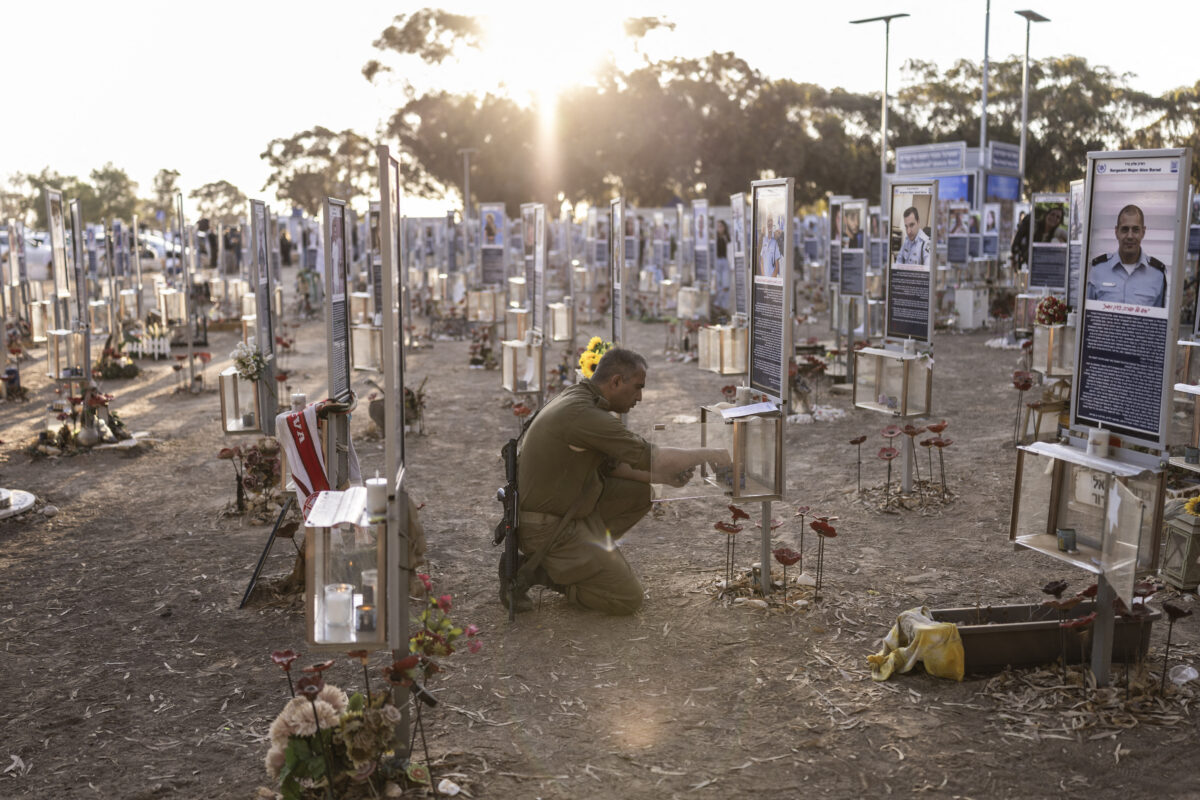
On the third anniversary of the Oct. 7 attacks, an Israeli soldier crouched to light a candle Wednesday morning at the memorial to the victims of the Oct. 7 attacks at the Nova music festival. John Wessels/AFP via Getty Images
Birthdays

Matthew Sklar, composer for musical theater on Broadway and the West End, television and film, turns 53
JOHN NACION/GETTY IMAGES
Robert Ian Kaufelt, former owner of Murray’s Cheese, the nation’s leading purveyor of artisanal cheese, turns 79
Allan Nelkin, retired chairman and CEO of Halco Lighting Technologies
Margery Nyberg, Highland Park, Ill., resident
Barry Curtiss-Lusher, co-founder, chair and former CEO of energy company Nexus BSP, he is a former national chair of the Anti-Defamation League, turns 75
Jill Smith, former chair of the Jewish Foundation for Education of Women and chair of the Prize Committee of the Genesis Prize Foundation, turns 73
Bruce Lawrence Bialosky, founder of the Republican Jewish Coalition of California and a former member of the U.S. Holocaust Memorial Council, turns 73
Ron Vosatka, former deputy director of community security at the Jewish Federation of Palm Beach County
Michael W. Sonnenfeldt, entrepreneur and political activist, he co-founded the Israel Policy Forum in 1993, turns 71
Kenneth L. Marcus, founder and chair of the Louis D. Brandeis Center for Human Rights Under Law, he served as assistant secretary of education in the Trump administration, turns 60
Eli Saulson, president of Detroit’s Imperial Management and a board member of the William Davidson Foundation
Gabriele Corcos, creator, host and producer of “Extra Virgin” on the Cooking Channel, turns 54
Rabbi David-Seth Kirshner, rabbi of Temple Emanu-El in Closter, N.J.
Arie Lipnick, political fundraiser and strategist, advisory board chairman of the Combat Antisemitism Movement
Michael Malchieli, member of the Knesset for the Shas party and former minister of religious affairs, turns 44
Natalie Lascar Lefkowitz, SVP of the leadership institute at AIPAC
Adam Teitelbaum, founder of Level III Industries after holding roles at the Jewish Federations of North America, AIPAC and AEPi
Daniel Mael, CEO of Holbrook, N.Y.-based MW Impressions
Tayla Harris, executive assistant for global client operations at WPP
Barbara Martinez, an original Politico staffer, now a manager of editorial and content strategy for the U.S. Holocaust Memorial Museum
Sam Schear, principal on the real estate team at Korn Ferry
Tamara Harel-Cohen, co-founder and chief growth officer at Riseup
On the third anniversary of the attacks, and weeks before the first election since, a foiled midair hijacking has revived the question of whether Israel's institutions can protect its citizens
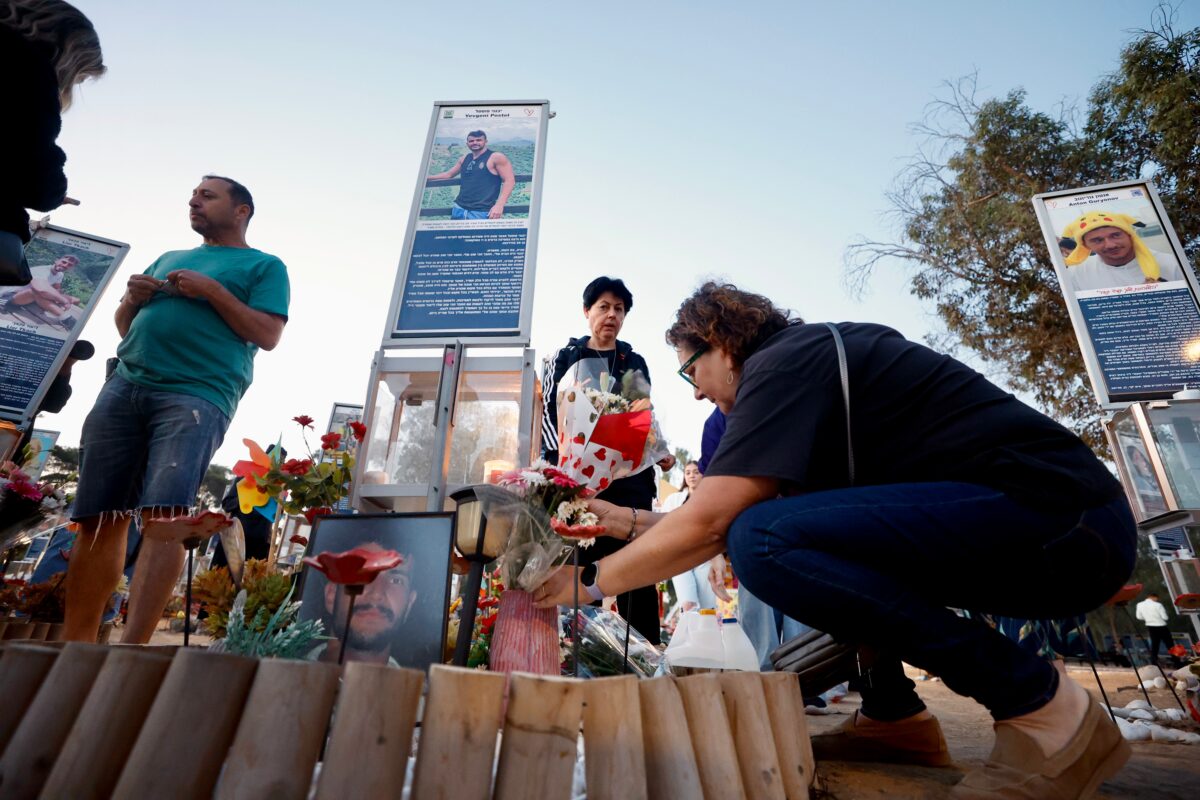
(Jamal Awad/picture-alliance/dpa/AP Images)
07 October 2026, Israel, Re'im: Mourners place flowers beneath portraits of victims during a memorial at the site of the Nova music festival in Re'im.
This year, three years since the Oct. 7, 2023, Hamas-led terror attacks, Israelis are marking the first anniversary in which no hostages remain in Gaza. Daily life has shifted to a new phase: one in which fewer reservists are being called up, Tel Aviv’s Hostages Square sits quiet on Saturday nights and Israelis tuning into the evening news normally see something other than war — usually election coverage.
The threats, too, have shifted. Just over a month after the return of the body of the last remaining hostage in Gaza in January, Israelis faced six weeks of war with Iran, which shuttered schools and businesses and sent many Israelis scrambling — again — to find a way out of the country, some for the duration of the war and some more permanently.
In that year since, many of the pre-Oct. 7 debates in Israeli society have reemerged: judicial reform, Haredi enlistment, cost of living, Israeli Prime Minister Benjamin Netanyahu’s corruption case and the ongoing strife between religious and secular that plays out in myriad ways.
On the heels of last week’s FlyDubai attempted hijacking and ahead of the first election since Israel’s south was invaded by thousands of terrorists — Israelis face a reckoning. The questions that loomed in the wake of the Oct. 7 attacks regarding the security of Israelis and the key role the government plays in that security are again front and center.
The terror attack on a FlyDubai flight bound for Israel, foiled by a miraculous set of events and the bravery of the Indian captain and Israelis on board, serves as a reminder of the threats that Israelis still face — and of the ways in which the institutions designed to protect them failed their societal covenant to do so.
On Oct. 7, 2023, Israelis across the south found themselves vulnerable and defenseless — a particularly jarring feeling for a country that believes itself to be a military superpower in the region. Warnings about potential border threats from both within, and as recently reported, from Arab states in the region, had gone unheeded — in some cases, summarily dismissed by senior military intelligence officers as impossible, only to be proven painfully accurate. Some of the soldiers previously stationed in the Gaza border region had been reassigned to the West Bank to protect settlers during the holiday season.
And in the days and weeks after, it was not the government, but ordinary people, who stepped up. The communications professionals who gathered hostage families into a more coordinated voice. The restaurants that turned into assembly lines, packing meals for displaced Israelis. The therapists who provided grief counseling to survivors. The Jewish federations that provided emergency grants to displaced communities. The Diaspora Jews who paid for plane tickets so Israeli reservists could fly home and join their units. The Zaka volunteers, forensic teams and medical professionals, who took on the grimmest tasks: collecting, identifying, cataloguing and burying the remains of the nearly 1,200 people killed that day.
Not all of these civilian efforts were necessarily effective — amateurs can be expected to make amateurish mistakes — but at a time when survivors and victims were not receiving the governmental help they desperately needed, ordinary people stepped in to fill that void.
Today, a week after the FlyDubai attack, details are emerging about the security lapses — Emirati, Omani and Israeli — that led a co-pilot who had been banned from flying by a previous employer over his extremist, Islamist beliefs to be assigned to a flight to Israel.
As more information is revealed about last week’s midair melee, a similar feeling is emerging: that the government institutions meant to protect citizens fell short, forcing ordinary folks — an Indian captain, a dentist, a plumber with a penchant for watching air-disaster reality TV — to act in extraordinary ways to avert disaster.
Oman Air officials failed to elevate their concerns about Hamam al-Hammami, who was assigned to a desk job and forced to take a reeducation program. FlyDubai appeared not to have contacted Oman, though it did conduct a background check. He was hired by the low-budget airline earlier this year.
Last week, as is standard practice, Emirati officials gave the flight’s manifest to Israeli authorities, whose job is, ostensibly, to make sure that those flying to the Jewish state do not intend to cause harm to the people there, or on board. But Israel’s Tax Authority, which has since 2023 received the lists and put them in a database, did not share the information with the Ministry of Transportation, under whose purview FlyDubai and other foreign carriers rest. The Ministry of Transportation, for its part, says that it did not think it had the ability or authority to vet foreign flight crews.
Netanyahu tasked the National Security Council with appointing an investigator to probe the incident, a move that garnered criticism from former National Security Advisor Eyal Hulata, who said blame for the incident lay in part with the NSC itself, which had in 2024 and 2025 issued warnings that the government had not been adequately vetting the manifests of foreign airlines.
Hulata said that Netanyahu has “the same outlook” on the FlyDubai incident as he did on the Oct. 7 attacks, for which no state commission of inquiry has been established. Netanyahu’s refusal to authorize an official inquest into the Oct. 7 attacks has been a frequent criticism made by, among others, survivors of the attacks, relatives of those killed and Netanyahu’s political opponents.
The most recent annual Democracy Index from the Israel Democracy Institute, released in December 2025, found that the Israeli government, the Knesset and the country’s political parties had the lowest levels of trust among Israeli respondents, falling below the Israeli president, Israel Police and even the media.
Can the Israeli institutions entrusted with protecting the Israeli people actually do so? The FlyDubai attack has resurfaced that question as Israelis prepare to choose their first new government since Oct. 7.
When Israelis head to the polls in 20 days, many will ask themselves not just, “Am I better off now than I was four years ago?” but, “Am I safer now than I was four years ago?” It’s a question that is less about Hamas, Hezbollah, Iran, the Houthis and the many other threats facing Israelis and Jews around the world, and more about the government’s ability to act as a protector. Oct. 7 and the FlyDubai attack prompted ordinary Israelis to fill the voids left by government failure. When voters head to the polls later this month, one question they will have to answer is whether they believe they should still have to.
Three students who arrived on campus weeks before the attacks describe how the past three years reshaped their Jewish identities, through religious observance, community and activism
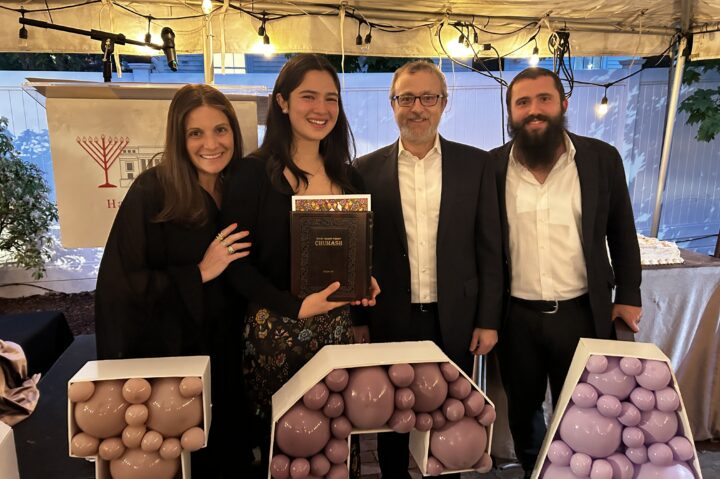
(Courtesy Erica Ho)
Erica Ho celebrates her bat mitzvah at Harvard Chabad
Seven months after Hamas’ Oct. 7, 2023, attacks in Israel, Erica Ho stood beneath a Chabad tent on Harvard’s campus and became a bat mitzvah on her 20th birthday.
Growing up in Albuquerque, N.M., with a Chinese father and Jewish mother, Ho lived miles away from the nearest synagogue and felt disconnected from the local Jewish community. When she arrived at Harvard in September 2023 — never having celebrated a bat mitzvah — she described herself as “technically Jewish.”
For Ho and other members of the college class that arrived on campus just weeks before Oct. 7 — most of whom are now seniors — the three years since have become a defining chapter of their Jewish lives.
As the third anniversary of Oct. 7 approached, Jewish Insider spoke with three Jewish students who entered college weeks before the attacks, expecting the next four years to be defined by the ordinary milestones of young adulthood.
Instead, on campuses from Cambridge to Los Angeles to Washington, D.C., the historic rise in antisemitism and protests over Israel that followed the attacks and the ensuing war in Gaza thrust students into Jewish communities and political fights they had not expected to join — reshaping their college experiences and, in some cases, their plans for life after graduation.
According to Jewish Federations of North America data, college students are a key driver in the nationwide rise of Jewish engagement since the fall of 2023, which the group has dubbed “the surge,” even as reported antisemitic incidents on campuses have also surged.
For Ho, an environmental science and economics major, the transformation began almost immediately after the attacks. A week after Oct. 7, Harvard Chabad held its annual “Shabbat 1,000” dinner, bringing hundreds of students together at a moment when many were unsure whether it was safe to gather publicly as Jews. Ho remembers weighing the risks before deciding to attend.
“There’s a camp that was, ‘This is not the event to sit out,’” she recalled. “If there’s anything to do right now, it’s to gather and show Jewish people are resilient.”
Ho had not come to Harvard looking for a Jewish community. But in the months that followed, she became increasingly involved with Chabad, joining its board as a sophomore and participating in weekly Torah learning. In May 2024, she celebrated her 20th birthday by becoming a bat mitzvah on the Cambridge campus — an experience she describes as a commitment to Judaism for the rest of her life.
Her experience was distinct from that of many Jewish students who came to Harvard with a strong sense of Jewish identity. Because Ho is half Chinese and does not consider herself visibly Jewish, she said she did not personally experience much of the antisemitism that roiled the Ivy League campus and made other students seek out Jewish spaces for safety. Instead, she was drawn in by what she saw as a newfound confidence and solidarity within the Jewish community.
“I think what Chabad, and other Jewish campus communities, did a good job of after Oct. 7 was not retreating into hiding,” she told JI. “I remember there being a huge amount of support and vocalism.” That atmosphere, she said, made Jewish spaces feel “much more vibrant” — and helped give her the confidence to claim an identity she had once barely felt connected to, one she wants to continue pursuing post-graduation.
For Delilah Hirshland, a history and political science major at the University of California, Los Angeles, her path into activism began not with a Jewish gathering but with the shock that came from learning that people she had just met in her first weeks of college justified the attacks on Israel, bringing about a desire to surround herself with like-minded peers instead.
“Oct. 7 happened at the end of my second week here. For those first two weeks before, I spent a lot of time getting to know people in my dorm and people in my majors — very much in the humanities sphere,” she told JI. “After the attacks, the people I had met started to post things saying that Hamas was justified. It was shocking for me. It quickly threw me into this world of Israel activism and Jewish life.”
Hirshland serves as co-president of UCLA’s Students Supporting Israel chapter. “SSI, Hillel events and Jewish life in general have been my main support system over these years,” she said.
“I don’t think I would be involved in Jewish life and Israel advocacy if the attacks didn’t happen. I think about that a lot. I personally became more conscious of my identity and of my beliefs,” Hirshland said, noting that she also saw a shift in the school administration’s attitude towards pro-Israel students.
“At first, they were hesitant to publicly take our side — especially later in freshman year with the encampments. Our new chancellor [Julio Frenk] is very supportive of us,” said Hirshland.
For Jacob Intrator, Oct. 7 and its aftermath ultimately changed the course of his college career, and what comes next.
Intrator arrived at Georgia Tech in fall 2023 with little connection to Jewish campus life. But after Oct. 7, he began reconsidering what he wanted from college and ultimately transferred to Georgetown, a Catholic university where he said, ironically, he found what he had been missing: a Jewish community and, amid increasingly intense battles over Israel, a cause he felt compelled to fight for.
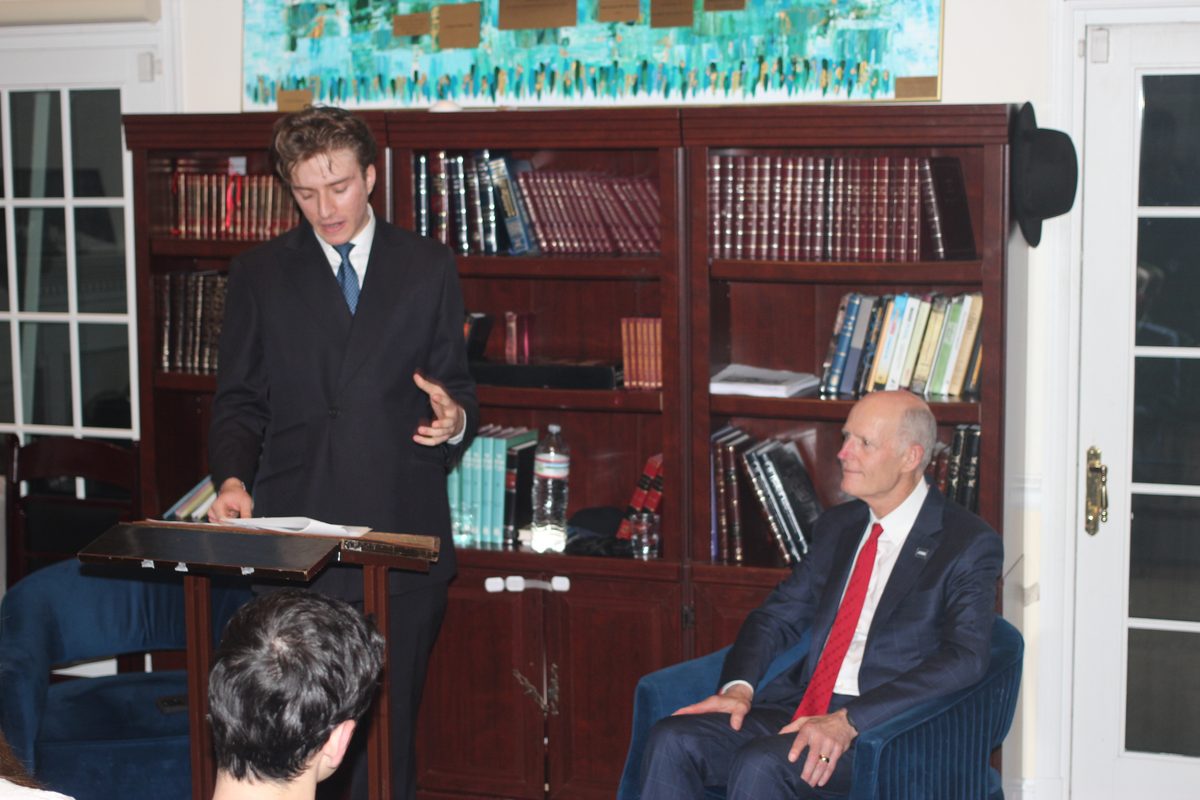
When he arrived at Georgetown in spring 2025, a student government referendum calling for the university to divest from Israel became an early challenge. Intrator, then new to the campus, organized against the referendum, writing to administrators that the measure had been passed in violation of student government rules. The letter attracted the support of members of Congress and ultimately helped spur the university to reject the referendum.
But Intrator didn’t stop there. He became president of the campus chapter of Students Supporting Israel, then ran a slate of candidates for student government, arguing that students who opposed the referendum needed a voice in the body that had passed it. The slate won, and Intrator became vice speaker of student government.
“[My advocacy] really only originated once I got to Georgetown,” Intrator, a government and economics major, told JI. “I saw more passion for pro-Israel politics here, but I’ve also seen a lot of hatred for it, and a lot more antisemitism than I had ever seen before. Unlike when I was at Georgia Tech, here I saw it as my duty to fight for Israel.”
“At Georgia Tech, I was studying engineering. My life now is quite a reversal,” he continued.
Intrator is considering a future in politics, motivated in part by what he sees as a need for younger voices to engage in debates over Israel and antisemitism.
“After I graduate, I have an interest in getting involved in politics outside of college. When you look at polls, you see the numbers in which young Americans are turning against Israel and in many ways against the Jewish people. People complain about having 60-year-old politicians lecturing the 30-year-old generation. They want younger people who understand the problems they have. That’s animating my involvement in politics,” he said.
“I want to be a voice and a platform for my generation.”
For all three students, Oct. 7 became a defining moment in their college careers. The aftermath became about more than responding to a moment of crisis: It pushed them to define their Jewish identities in ways they had not anticipated when they arrived on campus — whether through religious observance, Jewish community or political activism — suggesting that for a generation of Jewish students, the campus upheaval of the last three years may have lasting consequences far after graduation.
Their experiences are part of a broad shift that Rabbi Hirschy Zarchi, who leads Harvard Chabad, has watched unfold on his campus and others since Oct. 7. Students who arrived with varying levels of connection to Judaism, he said, have emerged with a stronger sense of Jewish identity and responsibility.
“In this challenging period for our people and the world, I observed young people deepen their Jewish identity and belonging, and double down on their Jewish pride and responsibility,” Zarchi told JI. “The Jewish future will be led by the young, courageous leaders who have emerged at this time.”
Michael Needham said the 9/11 attacks and Oct. 7 were flashpoints in an ongoing ‘battle between civilization and barbarism,’ at an event commemorating the third anniversary of the Hamas attacks
Marc Rod
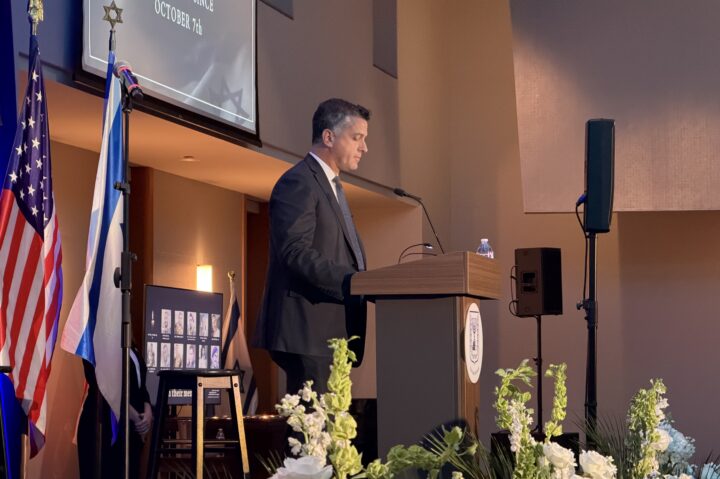
Michael Needham, the deputy U.S. national security advisor, addresses an event organized by the Israeli Embassy in Washington to commemorate the third anniversary of the Oct. 7 Hamas-led terror attacks, Oct. 5, 2026
Michael Needham, the deputy U.S. national security advisor, said on Monday that the Oct. 7, 2023, Hamas-led attacks on Israel and their aftermath are part of a shared civilizational war pitting the United States, Israel and other allies against enemies of the West.
The Oct. 7 attacks were met with praise and “gleeful celebration of inhuman barbarism, savagery and death” both in Gaza and around the world, Needham said in remarks at an event organized by the Israeli Embassy in Washington to commemorate the third anniversary of the attack.
“What was clear then is that each of our countries is locked in a battle between civilization and barbarism,” Needham said. “That the war between the people of Israel and the terrorists of Hamas is a war that is playing out in various forms, here in the United States and in Europe and across the whole of the Western world.”
He said that the 9/11 attacks and Oct. 7 are just a few flashpoints in that ongoing war.
“The question that all of us face is not merely whether we are on the side of civilization; it is what cost are we willing to pay to defend it?” Needham said. “For the people of Israel, this is not a hypothetical question; it is one you have answered in full. In the aftermath of Oct. 7, the people of Israel revealed themselves to be a nation whose citizens were willing to answer the call, to lay down their lives if necessary, when their country needed them.”
Needham described that spirit as the essence of patriotism, to stand up for one’s nation “precisely when it calls on him to sacrifice the things that he holds most dear.”
“The forces of barbarism worship death; they seek it out as an end unto itself. Those who choose to defend civilization may be willing to die for our cause, but it is only because we love and value life that we choose to sacrifice everything to defend it,” Needham said. “Over the last three years, the people of Israel have chosen life to fight and suffer and sacrifice for it, and civilization will continue to prevail so long as our nations are blessed by heroes.”
Needham described Israeli Ambassador to the U.S. Yechiel Leiter — who remains in Israel caring for his son, who was critically injured in an attack last month while serving in the West Bank — and his family as a “living testament” to that spirit of patriotism. Leiter lost another son who was killed in November 2023 while serving in Gaza.
The event, hosted by Washington Hebrew Congregation, also featured a candle lighting by Bureau of Alcohol, Tobacco, Firearms and Explosives Director Robert Cekada, remarks by Israeli Deputy Chief of Mission Nevo Barchad and a former spokesperson for the Israeli Defense Forces, as well as a musical performance by musician Gilad Segev and his group, Project Heroes, which commemorates victims and heroes of Oct. 7.
The audience of several hundred included American Jewish leaders, other administration officials, military officials and international diplomats, among others.
Like Needham, Barchad emphasized that the ideology of Hamas was “glorified even in the free world.” He said that Leiter had been hoping to speak about the way that anti-Israel and antisemitic hate has proliferated through schools, social media, courtrooms, government and more.
“Facts don’t matter anymore,” Barchad said. “Hamas’ attempted genocide was minimized, and immediately Israel stood accused of genocide. Israel is then accused of deliberately starving Gaza, no matter how much humanitarian aid we facilitated into the strip.”
He also emphasized the role that Iran and Hezbollah had played in supporting the Oct. 7 attacks.
“Together with America, our greatest ally, we have worked to dismantle the threat,” Barchad said, adding that going forward, Israel must dismantle terrorist groups rather than attempt to constrain them; must work to reform education in the Palestinian territories to stop indoctrination; and cannot overlook attempts to delegitimize Israel in the United Nations, online, on college campuses and in Congress.
“We now know that many Western leaders do not understand that appealing to their domestic political bases by vilifying Israel threatens their own societies, just as it threatens ours,” he said. “The West and moderate Muslim countries must confront terrorism by pursuing terrorists, designating terrorist organizations, disrupting their funding and prosecuting those who support or enable them.”
But he also said that the attack and the ensuing war have shown the strength of Israelis and the Israeli youth — “the greatest generation of Israelis ever” — and that Israel’s enemies cannot destroy it or its “resolve, courage or resourcefulness.”
The event was scheduled to take place Sept. 30; plans for rescheduling remain unclear
CHANDAN KHANNA/AFP via Getty Images
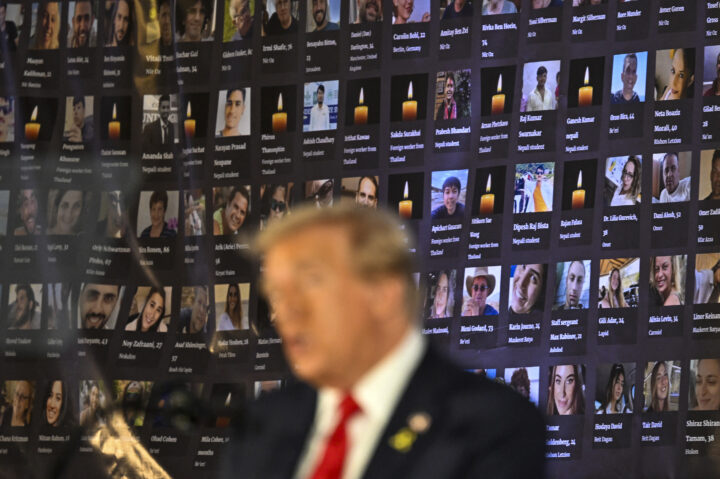
Pictures of Oct. 7 hostages and victims are seen President Donald Trump speaks during a remembrance event to mark the first anniversary of the Hamas attack on Israel at Trump National Doral golf club in Miami, Florida, on October 7, 2024.
The State Department on Monday postponed a memorial event for the Oct. 7, 2023, Hamas attack on Israel that was scheduled for Sept. 30.
The memorial event, organized in collaboration with the American Jewish Committee and at the urging of the families of former American hostages held in Gaza, was set to focus on the 46 Americans killed on Oct. 7 and in Hamas custody in the years following the attack.
The State Department did not immediately respond to a request for comment on the reasons for the delay or when it plans to reschedule the event.
The American Jewish Committee is helping to bring victims to Washington for the Sept. 30 event
CHANDAN KHANNA/AFP via Getty Images
Pictures of Oct. 7 hostages and victims are seen President Donald Trump speaks during a remembrance event to mark the first anniversary of the Hamas attack on Israel at Trump National Doral golf club in Miami, Florida, on October 7, 2024.
The State Department is planning a memorial ceremony for American victims of the Oct. 7, 2023, Hamas attacks on Israel, currently scheduled for Sept. 30.
The event is being planned in collaboration with the American Jewish Committee, which is helping to bring families of the victims to Washington to attend the ceremony in Foggy Bottom, an AJC spokesperson told Jewish Insider.
Ruby Chen, father of Itay Chen, an American citizen killed by Hamas on Oct. 7 whose body was taken hostage in Gaza for more than two years, has been advocating for a memorial for the 46 Americans killed on Oct. 7 and in Hamas custody.
Chen told JI earlier this month that he had been in touch with senior members of the administration about a potential memorial, and that they had expressed support.
Ahmed Fouad Alkhatib, a Gaza native who lost 33 family members in Israeli airstrikes, argues in his new book that Hamas bears primary blame for Palestinian suffering and political stagnation
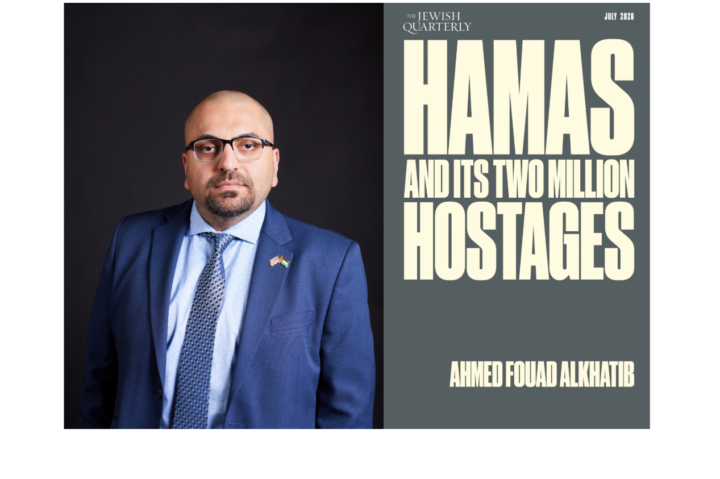
Ahmed Fouad Alkhatib, who lived in the Gaza Strip from the age of 10-15, describes himself as an advocate for the Palestinian people. Since the Oct. 7, 2023, Hamas-led terror attacks in Israel, 33 of Alkhatib’s immediate and extended family members have been killed. But in his latest book, Hamas and Its Two Million Hostages, Alkhatib argues that Hamas — rather than Israel — bears primary responsibility for the suffering and political stagnation of the people of Gaza.
Alkhatib is a resident senior fellow at the Atlantic Council, where he directs Realign for Palestine, a project focused on pragmatic, nonviolent Palestinian advocacy. There, he denounces Hamas and advocates for Palestinian statehood alongside a secure Jewish state.
On Friday, Alkhatib spoke with Jewish Insider about his new book, his experiences growing up in Gaza and his outspoken criticism of Hamas. He also discussed the backlash he has faced from within his own community and why he believes that, ultimately, the terrorist group will have no role in the enclave’s future.
This interview has been condensed and edited for clarity.
Jewish Insider: What inspired you to write Hamas and Its Two Million Hostages, and what does your book add to public debate on this issue that isn’t already out there?
Ahmed Fouad Alkhatib: I wanted to weave in elements of my personal story with Gaza’s contemporary history, and add a human dimension to what I felt was Hamas’ devastating impact on the Palestinian people, their destructive role in setting back the Palestinian national project and the radicalization of the society.
I felt that there’s a consistent gap in the discourse from a Palestinian self-interested point of view. Even though many Palestinians and Arabs and Muslims will tell you privately how devastating Hamas is, there’s a disconnect in the discourse outside of Gaza versus inside Gaza — where you’ll find a ton more willingness to speak out, not just because of the consequences of Oct. 7, but because of the totality of the last 20 years of their rule.
One of the things that’s really frustrating is how there is this persistent narrative that Gazans are all Hamas, Gazans support Hamas. It’s very difficult for the other side, for the Israelis and the pro-Israel folks, to see the humanity of Palestinians because they so fundamentally believe that Gaza is inseparable from Hamas. Nevertheless, I argue and maintain that directly and indirectly, Hamas has taken Gaza captive and is holding 2 million people as hostages.
For the pro-Palestine folks, the goal is to burst the bubble of Hamas, which has been getting normalized since Oct. 7, getting called “resistance” or at best receiving token critique. It’s like a check the box: “Oh, I’m not with Hamas, but let’s keep going on Israel, and Israel this and everything is Israel’s fault.” At its worst, it’s actually been lionizing Hamas — refusing to call for the release of hostages, refusing to acknowledge the pain and suffering they’ve caused for the Palestinian people … Hamas has been a disaster. It has destroyed the seams of the Palestinian society and the fabric, and it’s been part of this devolution.
I also made it a short book deliberately for the average casual reader … I wanted to target a lot of younger audiences … because with the avalanche of new entrants to the scene since [Oct. 7], you have people that quite simply don’t know about Hamas, about the Palestinian people or about Gaza. I believe the theme of this book is that within the imbalance of power dynamics between Israel up here and the Palestinians down here, believe it or not, there is plenty of space for Palestinian agency, responsibility and accountability. That’s not blaming the victims or self-hatred — that’s actually the first step to empowering the Palestinians.
JI: You reflect in the book on your own experiences and those of your family in Gaza. How did these experiences shape the way you approach this book, and how did they shape your understanding of Hamas? Did you find that other Gazans shared your sentiments?
AFA: Well, in some ways, my lived experiences are very central to where I’ve arrived. My family are very devout Muslims and committed Palestinians. My family grew up in a Gaza context, and they were not immune to some of the broader trends. So on one hand the family context was helpful and relevant, and on the other hand it was not necessarily responsible for where I’m at right now because my family was kind of an average lower middle class that engaged in this topic. Very educated, but also not the most politically engaged. Very independent, very willing to stay clear and interested in staying clear from Fatah, from Hamas, from all the other different factions, and I think that was very key.
I remember the hope and optimism of the tail end of the Oslo [Accords] years in the ’90s — flying into Gaza’s airport, these shiny new Palestinian passports, the Palestinian airlines, the cell phones, the industrial zone, the kind of renaissance and the sense of hope and optimism and the march toward statehood. In the midst of all of that, Hamas’ counter-narrative was, “Oh no, the Palestinian Authority and the [Palestine Liberation Organization] sold out, they gave up 78% of historic Palestine, and we are going to bring you something better.”
And I just remember being like, “What’s there that’s better than the opportunity to travel freely, an airport, an incoming seaport, the beginning of the symbol of sovereignty and statehood?” On top of all of that, Hamas said, “We’re going to bring you the whole of Palestine from the river to the sea,” but then said, “Oh, by the way, we need to take this detour so let’s go burn a bar that has liquor, let’s control how women dress, let’s make the society more Islamist.” I distinctly remember [saying to] my parents and my uncles, “This is a detour that has nothing to do with negotiating a better outcome or achieving better results for the Palestinians.”
I tell the story of one time going to a summer camp that turned out to be a Hamas summer camp, and neither my family nor I knew that. I must have been 11, and I just remember being like,
“What is any of this?”
There was a very robust pushback against Hamas and against this trend, but parts of the society ultimately either acquiesced or essentially had no option but to go along because Hamas moved the Overton window — including for the moderate and secular Palestinian Authority and [former PLO and PA leader Yasser] Arafat, who had to accommodate Hamas and incorporate elements of Islamism and resistance culture. That is the theme I try to convey: Hamas slowly and gradually shifted the Overton window of what’s acceptable discourse, not just for itself, but for the entirety of Palestinian society, its national project and its political atmosphere.
JI: You talked to CNN earlier this week about what you described as the “troubling persistence of support” for Hamas among some Palestinian activists and diaspora communities, noting that 44% of American Muslims told Pew Research that they support Hamas. Why does support for Hamas persist in these activist circles, and how do you reverse that trend?
AFA: There are many Palestinians, Palestinian Americans, Muslim Americans and Arab Americans who, when you speak to [them] privately, will tell you that Hamas is a gift to the far right in Israel, that Hamas is gross, that Hamas is disgusting. They don’t want to live under a regime that resembles Hamas — they want to live a normal life. But when you step back in a communal dynamic — whether it be the clergy, elements of the community in academia or parents who are guilt-ridden — you have sociological factors and identity crises that contribute to this trend.
Then there is a much more sinister element: elements of academia, journalism and the “social justice” far left who are not Palestinian or Arab or Muslim, who have concocted a variety of frameworks for how you see these conflicts. They want to map out Israel and Palestine to existing frameworks in domestic discourse around immigration, abortion rights, LGBT issues and Black Lives Matter.
You have modern-day anti-Zionism regularly devolving into antisemitism, and a departure from the broad framework of two peoples, two states. Right now, it is very much so a “river-to-the-sea” eliminationist discourse. Israel is seen as an extension of the United States — whether due to the presence of Ashkenazi Jews that are white-presenting, even though half of Israel are Mizrahi Jews of essentially brown origin and darker origin from Arab lands and from the Middle East, whether it be Israel’s founding being considered a purely European Zionist-led colonial project and not something that has anything to do with Jewish peoplehood and heritage and connection to the land, and so there are just these overly simplistic narratives that are not conducive to productive dialogue.
Part of this support for Hamas is an overcorrection to what people felt was an effort by parts of the pro-Israel community to suppress legitimate critique of Israeli actions. But when the pendulum swung, it didn’t swing toward narrow, targeted advocacy for Palestinian freedom and self-determination next to a safe, secure, recognized Jewish Israel. It swung to, “No, actually, we need resistance to eliminate the Zionist entity.”
Hamas very much so cared about the public relations war and narrative warfare because it thought this level of activism would not only delegitimize Israel, but also coerce Israel into stopping the war. Neither happened. Palestinian suffering was irrelevant to a lot of these communities, because they didn’t react when I and many others in Gaza were saying what was necessary for this suffering to end: closing the page on Hamas taking 2 million people as hostages in its suicidal jihadi nihilism.
JI: Have you faced criticism from within your community for placing so much attention on Hamas in your book rather than Israel, and how are you navigating that?
AFA: It is very frequently that I face critique. People say that I’m obsessed with Hamas, that I’m a nutjob, I’m a Zionist, I’m paid by Israel. Now they’ve shifted to saying that I’m a traitor and a sellout.
I see no shortage of people talking about what Israel has done and what Israel is doing right now in Gaza — including Prime Minister [Benjamin] Netanyahu, whom I acknowledge potentially worsened this situation through direct support for Hamas via Qatari funding. I have no illusions about the fact that Israel bears responsibility in worsening multiple aspects of the discourse, whether it be not empowering the Palestinian Authority, the aggressive expansion of settlements or the recent activities under the current coalition.
My goal is not to simply repeat what people who are even smarter than I am are out there talking about, often speaking in circles to their own choirs. I want to address a gap — and a significant one at that. That gap is that my family and tens of thousands of Palestinians would still be alive had Hamas simply kept its terrorists at home on Oct. 7.
Hamas is treated as an extra on a movie set when it needs to be one of the main antagonists in this whole film. Hamas is a central player in this whole devastation that has befallen Gaza. I see the rightward shift in Israeli society that everybody talks about all the time as inseparable from Hamas and what it did in Gaza and the suicide bombings and what it did to radicalize the Palestinian people in Gaza and in the West Bank.
JI: What do you believe Hamas will look like in the years ahead? Do you believe it is possible for Gaza to have a future without Hamas — and one that is different for both sides of this conflict?
AFA: I don’t believe there can be any coexistence with Hamas. I think they need to be effectively banned from the scene. When people say Hamas can’t be defeated, it absolutely can be defeated. I don’t care about Hamas’ ideology per se. The Nazi ideology lives on all these years. Al-Qaida is alive and well after [Osama] bin Laden. ISIS is alive and well, even though they don’t theoretically control mass territories like they once did.
What I care about is three metrics through which you can judge and assess Hamas’ ability to remain relevant and be defeated: Do they control territory? Do they have an executive force on the ground that can have a monopoly on violence and force and act as an administrative body? And do they control resources — financial, taxation, access to aid and incoming resources, or smuggling? In those three metrics, Hamas has been significantly rolled back.
More likely than not, it is my belief that Hamas is going to be largely irrelevant in Gaza. Hamas is not going to govern like it once did. The days of Hamas reigning supreme and controlling Gaza are over. Hamas may try to remanufacture itself as a political body, as a political entity, but in terms of controlling Gaza like it once did, I see that as incredibly unlikely. Their inventory of weapons and arsenal is very finite. They’re not smuggling weapons like they once did, and a lot of their supplies, workshops and spaces have been destroyed and rolled back. Whether it be through disarmament, Israeli elimination or decay — I think Hamas’ arsenal is going to recede to where it not only no longer constitutes a threat to Israel, but it no longer is adequate to entirely rule the Gaza Strip.
My concern is that Hamas is moving to Turkey. The Turks might be trying to help them reinvent themselves as a political organization. If they enter Palestinian elections, will they then further ruin democratic life? Will they evolve their so-called armed resistance narrative into something that can introduce political stalemate?
Right now, largely speaking, Hamas, Israel, the Board of Peace, the Trump administration and regional and international partners are in agreement over the next steps as far as disarmament, which is a prerequisite to get any kind of withdrawal or reconstruction happening in Gaza. However, now we’re in a space where the disarmament issue is actually logistical in nature. Logistics can make or break a war, a campaign or an effort, and right now, logistically, the disarmament plan is just — it’s not there. It’s not there. That’s what concerns me.
Harris told JI he’s both ‘a believer in the possibility of change’ and has ‘never been more worried in my adult lifetime than I am right now’
David Harris/book cover
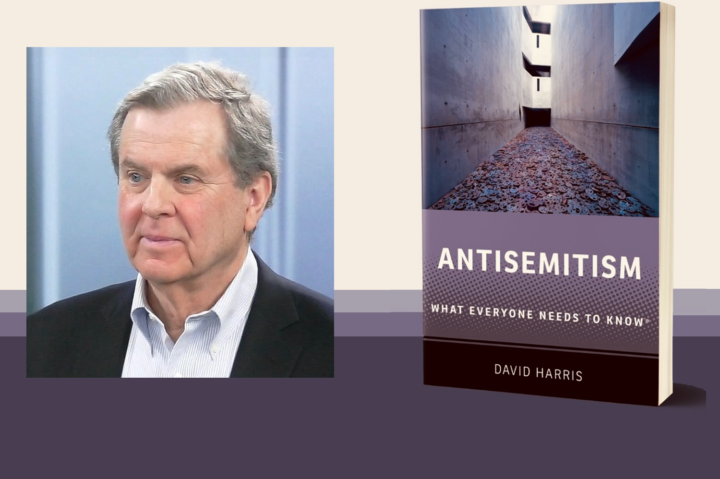
David Harris spent more than three decades leading the American Jewish Committee, where he navigated crises facing the Jewish community and built bipartisan coalitions to advance the group’s mission of supporting Israel and Diaspora Jewry.
His book, Antisemitism: What Everyone Needs to Know, published by Oxford University Press last year, is Harris’ attempt to reach beyond the Jewish community — churches, classrooms and the “average New York Times reader.” His goal, he said, is to turn the “silent majority” into the “loud majority.”
Written in the shadow of the Oct. 7, 2023, Hamas terror attacks in Israel, the book arrived at a moment of surging antisemitism in the U.S. and around the world. It traces antisemitism from its ancient roots through the Holocaust, the Soviet era and its recent resurgence — the explosion on college campuses and beyond after Oct. 7 and the ensuing war in Gaza.
Harris, who quipped that he retired “for about 30 seconds” after serving as AJC’s CEO from 1990–2022, sat down with Jewish Insider on Thursday to discuss the book at a moment in which he said he has “never been more worried” about antisemitism — yet also remains optimistic about the Jewish future.
This interview has been edited for length and clarity.
Jewish Insider: Oxford University Press called you about writing this book in the fall of 2023 — weeks after the Oct. 7 attacks. You write that you were “honored but distressed by the need for such a book.” How much did the aftermath of the attacks reshape the book you thought you were going to write?
David Harris: That call was not directly related to Oct. 7, it was too close to the attacks to even have associated [the rise of] antisemitism with it. Antisemitism was surging [already] in general. They needed a book that would be easily accessible to a high number of people, to be able to reach the average New York Times reader. It was also meant for high school and college classrooms and churches. They understood the emerging problem and this was their contribution.
I wrote the book over the span of close to two years during the post-Oct. 7 period. Two things impacted me: the speed and virulence of which history was turned on its head. The worst day in Israeli and Jewish history since the end of World War II had before our eyes suddenly become directed at Jews, Zionists [and] friends of Israel who were suddenly seen as the perpetrators. Even with my understanding of the subject matter, I was stunned by how quickly and viciously it turned.
Number two is that I kept needing to add to the book because every day brought new events, insights and tragedies. At a certain point the publishers had to remind me this wasn’t a newspaper, we have to close the book at some point. There’s already room for a sequel, unfortunately.
JI: How are you reaching a wider, non-Jewish audience? Does the average American want to read about antisemitism? What has been their reaction to the book?
DH: Because Oxford University Press [is a major publisher], it’s not so easy for people who are otherwise ready to go after a book on antisemitism, such as the one that I wrote, to discredit or marginalize it with accusations like “Harris is a Zionist.” The publisher’s label is enormously important for the book’s credibility and reach.
Jews are also an important part of the audience. I learned from writing the book. Others can learn from reading the book.
I wrote this book with the hope that I’d be able to speak to non-Jewish audiences as well. So when one of the largest Methodist churches in the U.S., in Kansas City, with more than 30,000 worshippers a week, invited me to come speak, I was in my happy place. They invited me to come and could not have been more gracious. The response was very good. There was also a large gathering of interfaith leaders while I was in Kansas City. I want to reach well beyond the Jewish community because antisemitism is not a Jewish problem that can be solved by Jews. We need to engage good people, the silent majority, and help turn them into the loud majority.
It seems to me the larger goal, and this book is only a part of it, is to reach and mobilize the heart of America to understand the situation and the implications not just for Jews but for liberal values for all of us. It may begin with Jews, it never ends with Jews. The people burning the American flag are the very same people trampling on the Israeli flag and threatening Jews.
JI: Where do you see the line between criticism of Israel and antisemitism — and has that line shifted since Oct. 7?
DH: For me, the line has not shifted. It’s just been more revealed. In the book I quote Natan Sharansky, one of my heroes, who wrote a number of years ago there’s “three Ds” to answer that question. When criticism of Israel evolves into delegitimization of Israel, demonizing of Israel and the use of double standards, it’s clear people cannot hide behind their defense of just being critical.
It’s a more elegantly linguistic way of being antisemitic while claiming you’re only anti-Zionist.
JI: The book documents the near-total disappearance of 850,000 Jews from Muslim-majority countries since 1948. Why does that history get so little mainstream attention, and why does it matter now?
DH: It’s a question I know all too well because I’m married to one of those 850,000 Jews and have been for 51 years. I’ve seen this issue play out through my wife’s experience post-expulsion from Libya in 1967 and I’ve seen it play out in my global diplomacy where every time I raise this issue I’m usually met by an eye roll — a complete lack of interest.
One reason is the Palestinians have done an exceptionally good job of making the world believe they are the perpetual refugees and have elevated victimhood to a whole new level. Those 850,000 Jews really determined from the get-go that they were not going to create lifelong victimhood, they were going to build new lives. And they did very successfully, so they didn’t become professional storytellers of their plight and loss.
But my wife says they are triple victims. First, they were expelled or forced to flee their country, their ancestral homeland. Two, the world looked away. Three, there is no trace of a 2,000-plus year history of the Jewish presence in Libyan history today. There is nothing, they’ve been completely wiped out. With the exception of Morocoo, that is true for most of these countries which these refugees had to flee.
JI: There’s a chapter detailing the campus antisemitism surge. Jewish groups told Jewish Insider two months after the Oct. 7 attacks that they were taking an engage-and-influence approach with diversity, equity and inclusion frameworks that have been used to exclude Jews from protected minority status on some campuses, which some attribute to the rise in antisemitism. Then in 2024, the same groups said they were reassessing their embrace of DEI. What is your approach? Is DEI fixable?
DH: For many years Jewish organizations relied on one weapon with campuses, so to speak. That was called reason, sitting down with the president or provost and reasoning with them to help them understand why antisemitism is unacceptable. Clearly, after Oct. 7 that dependence on reason was proven to be totally ineffective in most places.
What instead is more effective is taking the gloves off — lawfare. I particularly applaud the students at Harvard, Penn, George Washington University and other schools who took the lead here. While sitting on campuses, they were suing those campuses for violation of their rights. The organizations that got behind the students, groups like the Lawfare Project and Louis D. Brandeis Center for Human Rights Under Law and law firms that have stepped up pro bono, all deserve huge credit.
I retired for about 30 seconds after I stepped down from my position at AJC. I joined the Institute for the Study of Global Antisemitism and Policy because I thought they were really onto something regarding campuses that no one else that I knew was looking at carefully, long before Oct. 7, and that was foreign funding — where was it coming from? What was its intent? Why were universities in many cases violating American law by not reporting those gifts? Today it’s part of the national discourse to follow the money. These ecosystems directly and indirectly penetrated campuses at many levels, student organizations, faculty and staff, liberal arts, social sciences, Middle East study centers. They penetrated over many years in a very systematic and focused way.
The combination of deep research and the ability to get the research into policymakers, in the university world and the political world together with lawfare are the strategies that I think are most effective.
The students on campus are the frontline warriors of the Jewish people. They deserve the absolute backing of the American Jewish community.
JI: You led AJC for more than 30 years — you’ve seen Jewish organizational leadership up close across decades of crises. How do you assess how today’s Jewish leaders have responded to the post-Oct. 7 surge in antisemitism, and what would you tell them to do differently?
DH: Our community is several steps behind where it should be. We are at war. It’s a war designed to drive a wedge between the U.S. and Israel. It has fueled antisemitism and in many cases attacked and isolated Jews. Unlike in Israel, I don’t see the war mindset, plans and leaders here. I sometimes wonder, if the American Jewish community had been asked to organize D-Day, could the community have actually come together and created a single, comprehensive plan and followed it? I’m not sure. Based on the post-Oct. 7 situation here in this country, I worry we are not where we should be — where we need to be.
JI: You built AJC’s influence partly through bipartisan relationships. Is that model still viable, or does the current political environment force Jewish organizations to choose sides?
DH: It certainly elevates the importance of groups like the Republican Jewish Coalition and the Democratic Majority for Israel. Support for Israel, in both political parties, can obviously no longer be taken for granted. That’s especially true now in the Democratic Party, all the more so after the primary election in New York earlier this week.
But there’s also an emerging cultural war inside the Republican Party. While I operated for nearly 50 years in the nonpartisan space, and positioned AJC as a nonpartisan organization with outreach at the highest level to both parties, today I would say it’s particularly important Jewish groups are operating inside multiple parties in a very partisan way.
It’s clear that we have enormous work to do in the Democratic Party. It was not long ago that [Sens.] Bernie Sanders (I-VT) and Elizabeth Warren (D-MA) were the outliers when it came to Israel and the Middle East. Fast forward a couple of years and they are now the clear majority. Every Jewish organization looking for a Democrat from Washington lines up to invite Sen. John Fetterman (D-PA). If he’s not available, they’re all baffled as to who else to invite from the contingent of Democrats in the U.S. Senate.
The question for the 501(c)(3) groups that are nonpartisan is, what do they bring to the table? In an earlier era, Jews were seen as a very important constituency with many voices, reach and impact. I’m not sure what the power equation is today for nonprofit Jewish organizations and why people in Washington should listen to them as they would have a few years ago.
The challenge for Jewish organizations is how to restore their indispensability to the national conversation. Posting on X, issuing statements, if no one is reading them or thinking about the messaging then what’s been accomplished? There is a huge amount of work to be done. I hope and pray the American Jewish community is up to the task.
JI: After immersing yourself in this history, are you more or less optimistic than when you started?
DH: I could not have spent 50 plus years in global Jewish advocacy without being a believer in the possibility of change for the better. I’ve seen it in my lifetime. I’ve seen the miracle of the rescue of Jews from the Soviet Union and the rescue of Jews from Ethiopia.
I also understand as a Jew I’m commanded to believe in the possibility of a better tomorrow and not to succumb to despair. Having said all of that, I would be totally dishonest if I didn’t tell you that I’ve never been more worried in my adult lifetime than I am right now.
The book details the Tibon family’s experiences on Oct. 7 and examines the history of Israel’s Gaza policy
courtesy
Amir Tibon/The Gates of Gaza
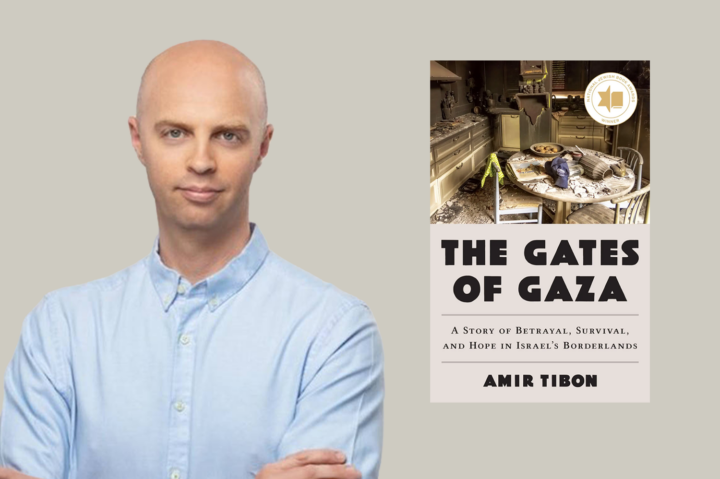
Israeli journalist Amir Tibon was awarded the Sami Rohr Prize for Jewish Literature on Tuesday for The Gates of Gaza: A Story of Betrayal, Survival, and Hope in Israel’s Borderlands, his harrowing account of survival on Oct. 7.
The Gates of Gaza is Tibon’s first-person account of the Oct. 7, 2023, Hamas terror attacks and Israel’s Gaza policies as a resident of the border’s region. On the day of the attack, he, along with his wife and their two young daughters, spent 10 hours hiding in the safe room of their home in Kibbutz Nahal Oz, less than a mile from Gaza, as terrorists rampaged through the community.
In the book, Tibon details efforts by his father, a retired major general in the IDF, traveled from Tel Aviv by car to rescue the family, stopping numerous times along the war to assist others and fight groups of terrorists. The Gates of Gaza intersperses Tibon’s accounting of the day, his parents’ experiences and Israeli government policy regarding Gaza over the years.
“The mission of the Rohr Prize has never been more important,” Tibon, a reporter for Haaretz, said, “as we confront a rising tide of antisemitism around the globe and its unique ripples within the world of books and literature.”
The book also received the 2024 National Jewish Book Award, the Wingate Prize and the Bernstein Prize.
After evacuating the kibbutz, Tibon and his family have lived in northern Israel since the attacks.
The awards ceremony, to be held at the National Library of Israel in Jerusalem on July 28, will mark the 20-year anniversary of the prize, which comes with a $100,000 award.
The Rohr Prize honors emerging contemporary writers whose work shows promising continuing contribution to literature in the Jewish sphere. The award annually alternates between fiction and nonfiction.
Nonfiction authors Laura Hobson Faure, Shaul Kelner and Jordan Salama were on the shortlist of finalists for this year’s prize. Winners from previous years include Sasha Vasilyuk for her novel Your Presence is Mandatory, and Oren Kessler for his Palestine 1936.
Mohamed Abdou also praised the May 2025 assassination of two Israeli Embassy employees outside of the Capital Jewish Museum in Washington

Getty Images
Street view of New York University NYU in Greenwich Village Manhattan.
Mohamed Abdou, a former Columbia University professor terminated for praising Hamas and advocating for jihad following the Oct. 7, 2023, terrorist attacks in Israel, is scheduled to speak at an event organized by New York University students on Tuesday.
According to an Instagram flyer posted by Shut It Down NYU, a non-registered coalition of anti-Israel NYU students, faculty and staff, Abdou’s lecture — titled “The Student Movement is Dead. What Now?” — is the latest in a campus discussion series, the “Death to the Akademy” tour. His talk will evaluate the “successes and failures of the post Al Aqsa Flood [Oct. 7 attacks] student movement for Palestine,” according to the flyer, which features promotional art that depicts keffiyah-clad terrorists holding guns.
“NYU strongly condemns the brazen use of threatening language, as well as the imagery of violence in promotional posts for this event,” Wiley Norvell, senior vice president for university relations and public affairs, told Jewish Insider. “The group sponsoring the event is not an organization affiliated with the university, nor are the event or the invited speaker in any way supported by NYU. We are investigating several potential university policy violations associated with these posts.”
The event post does not identify a location for the event. As of Monday night, it was unclear whether the event will be held on campus or not.
“Let us engage in jihad,” Abdou said in March, addressing Union Theological Seminary students by video. In the clip, he praised the May 2025 assassination of two Israeli Embassy employees outside of the Capital Jewish Museum in Washington. He went on to glorify the gunman, Elias Rodriguez, saying he “took action” against “two Zionists,” and encouraged students to similarly “be a threat.”
Abdou was one of several Columbia University faculty members named by Rep. Elise Stefanik (R-NY) during her April 2024 questioning of then-President Minouche Shafik. Stefanik asked Shafik about Abdou’s position at the university after he posted on social media on Oct. 11, 2023, “I’m with Hamas & Hezbollah & Islamic Jihad.” Shafik responded, “He will never work at Columbia again.”
At Columbia, Abdou — who was active in Columbia’s anti-Israel encampment protesting the Gaza war — taught a class in the Middle East studies department called “Decolonial-Queerness and Abolition in SWAN” in the spring 2024 semester, a graduate-level course on “(neo)colonial/(neo)imperial Euro-American informed modernity,” according to the course description.
“I believe in an Islam that hates America,” Abdou wrote in a Substack piece last summer.
The Oct. 7 mastermind died in ‘heroic’ style, according to Donald Borenstein, director of video for the Mamdani campaign and City Hall

Michael M. Santiago/Getty Images
New York City Democratic mayoral candidate Zohran Mamdani is seen in a supporters mobile phone at his election night watch party on November 4, 2025 in New York City.
The architect of New York City Mayor Zohran Mamdani’s viral video campaign paid homage to the mastermind of the Oct. 7, 2023, Hamas terror attacks in a series of tweets uncovered by Jewish Insider — posts in which the operative asserted that late Hamas military leader Yahya Sinwar “gave his entire life until the end fighting for his people’s liberation.”
Records show Donald Borenstein got paid more than $90,000 last year by the Mamdani campaign for his services as director of video — a role in which, according to his LinkedIn, he served as “primary cinematographer” for the social media imagery that propelled the democratic socialist legislator into Gracie Mansion.
Borenstein’s Instagram indicates he has since assumed the title of “creative director” at City Hall, and he has been credited for official videos promoting the mayor and his agenda. Borenstein was also featured in a recent comedy sketch starring Mamdani and his top staffers that was shared on the official NYC Mayor’s Office YouTube channel.
Yet despite receiving attention from The New York Times and New York Post as a member of Mamdani’s inner circle, Borenstein’s profile online has largely escaped notice so far.
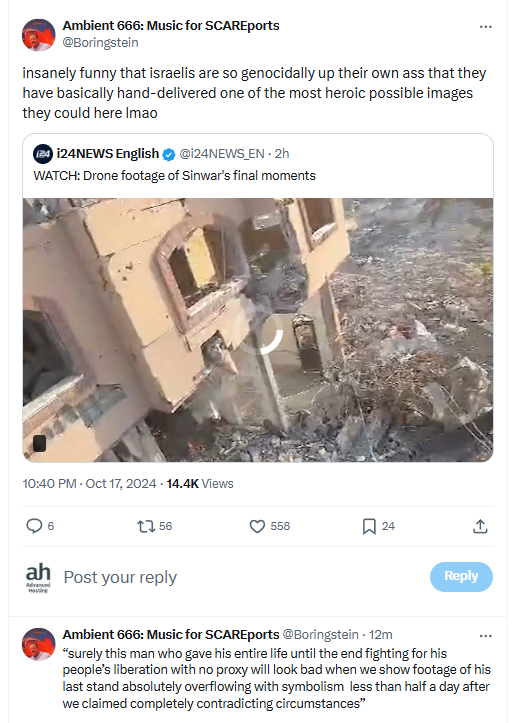
Archives of his X account show that in 2024, a day after Sinwar was killed by the IDF, Borenstein described imagery of his death, captured in Israeli drone footage, as “absolutely overflowing with symbolism.”
“[I]nsanely funny that israelis are so genocidally up their own ass that they have basically hand-delivered one of the most heroic possible images they could here lmao,” Borenstein wrote from his X handle @boringstein on Oct. 17, 2024, and just a few months before Borenstein began working for Mamdani’s campaign.
Borenstein appears to have deleted this tweet, and all others referenced in this story, at some later point, though archived images remain accessible.
Federal Election Commission filings show that a few months before the posts, Borenstein wrapped up work for another politician highly critical of Israel: then-Rep. Jamaal Bowman (D-NY), who was serving out the last few months of his term after he lost his reelection to a primary challenge from Rep. George Latimer (D-NY).
The cinematographer further mocked the Israeli decision to release the video of Sinwar sitting on a couch and tossing a stick at the drone moments before he was killed.
“‘[S]urely this man who gave his entire life until the end fighting for his people’s liberation with no proxy will look bad when we show footage of his last stand,’” Borenstein wrote sarcastically, concluding a third post with the phrase “From the river to the sea,” often understood as calling for the annihilation of the entirety of Israel between the Jordan and the Mediterranean, and three Palestinian flag emojis.
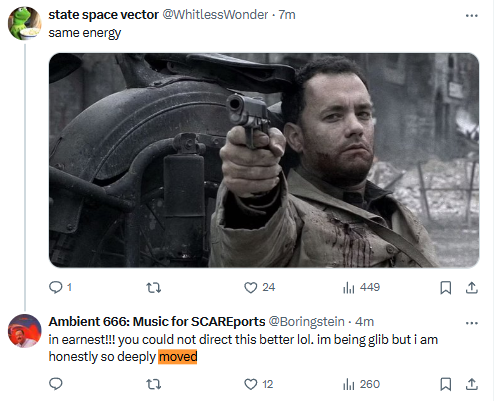
When one reply compared the terrorist with Tom Hanks’ character in the movie “Saving Private Ryan,” the cinematographer responded with enthusiasm.
“[I]n earnest!!! you could not direct this better lol,” Borenstein replied. “[I] am honestly so deeply moved.”
In another since-deleted tweet, Borenstein wrote that “the fascist state of Israel will fall in our lifetimes.”
Neither the video producer nor the Mamdani team responded to questions about the tweets.
Borenstein is one of several figures instrumental in Mamdani’s rise whose social media accounts feature explicit support for Sinwar and the terrorist organization he led, even though the mayor has condemned terrorism personally.
In February, JI reported that the co-founder of the independent “Hot Girls for Zohran” social media and canvassing campaign had also shared multiple pro-Hamas posts. In March, JI reported that Mamdani’s wife Rama Duwaji — whom The Cut described as a “de facto adviser” to the mayor’s campaign — had liked posts on Instagram celebrating the Oct. 7 attacks.
A TIFF board member told the Toronto Sun that the movie ‘will be exhibited as planned and even bigger than originally’

Jeremy Chan/Getty Images
Cameron Bailey speaks on behalf of Toronto International Film Festival on June 14, 2025 in Toronto, Ontario.
The Toronto International Film Festival reversed course on Thursday, deciding to air “The Road Between Us: The Ultimate Rescue,” a documentary about the Oct. 7, 2023, Hamas terror attacks, at its upcoming festival.
TIFF had faced serious backlash from Jewish organizations and Canadian politicians over its initial decision to cancel the screening due to the film’s usage of Hamas footage from the attacks, saying the terror organization had not approved them for use.
TIFF board member John Ruffolo told the Toronto Sun that the organization decided at a board meeting Thursday that the movie “will be exhibited as planned and even bigger than originally.”
The documentary tells the story of retired Israeli general Noam Tibon, who raced from Tel Aviv to rescue his son and two young granddaughters trapped in a safe room in Kibbutz Nahal Oz when Hamas terrorists invaded on Oct. 7.
Another source told the Sun that TIFF President Cameron Bailey and Barry Avrich, the film’s director, were essential to the decision, along with input from philanthropist Heather Reisman and entrepreneur Henry Wolfond, both influential Jewish Canadians.
Councillor Brad Bradford, who had called on TIFF to reverse course, said he was “relieved” by the organization’s decision, “but the fact it was ever pulled — silencing a Canadian filmmaker and granting legal legitimacy to a listed terrorist organization — is deeply troubling. It should not have taken a public outcry to correct this mistake.”
John Ondrasik met with hostage families, injured soldiers and first responders on his first trip to Israel this month

Courtesy
Five for Fighting performs in Hostage Square in Tel Aviv on April 13, 2024.
Three months after Hamas launched its deadly terror attack in Israel, singer John Ondrasik, known by his stage name Five for Fighting, penned the song “OK,” a ballad paying tribute to Israeli resilience in the aftermath of Oct. 7.
More than two decades earlier, in the wake of the Sept. 11, 2001, terror attacks, Ondrasik’s then-recently released “Superman (It’s Not Easy)” became the anthem for Americans reeling from the attacks, and to honor the first responders and victims of the deadliest terror attack on American soil. He would go on to perform the song at The Concert for New York City, held a month after the attacks on the Twin Towers and the Pentagon.
Ondrasik made his first trip to Israel this month, where he met with hostage families, first responders and soldiers who were recovering from injuries sustained while fighting Hamas in Gaza. After playing at a jam session honoring hostage Evyatar David, a musician, Ondrasik was invited to perform at the weekly Saturday night rally in Tel Aviv calling for the release of the remaining 133 hostages. His performance came hours before missiles and drones launched by Iran entered Israeli airspace, setting the country on high alert in the first direct confrontation between Tehran and Jerusalem.
Ondrasik spoke to Jewish Insider about his five-day visit, meetings with Israelis and how the music he created more than two decades ago has taken on new meaning in light of his experiences in Israel.
Jewish Insider: This was your first time in Israel. What expectations did you have before coming here?
John Ondrasik: Well, I heard the food was great. (laughs)
JI: It is!
JO: And that was proven very quickly. Obviously concerning why I was coming, I was anxious and interested about meeting with the hostage families, the troops, perhaps singing. So typically, I would be interested in touristy things, but there was so much to do here. We were so busy. I was really focused on doing whatever I can to support Israel and let them know in so many facets that there were artists and Americans who supported them and stood shoulder-to-shoulder with them. But at the end, I never could have imagined how our trip ended.
JI: We’ll get there, don’t worry. But before we do, talk to me about some of the folks that you met while you were here. Who stuck out to you?
JO: You know, I met some really cool people we can talk about, but it was just the people on the streets that I met. At our first restaurant, the waitress sat down at our table and started talking to us and was so friendly. I’m like, you don’t see that in the United States. And just the difference, talking to 18-year-old girls who are in full army uniform carrying machine guns. That’s something I’ve never done before. But, of course, meeting [former Soviet refusenik] Natan Sharansky is kind of like meeting [Nelson] Mandela, right? [He’s] such a powerful figure, and just spending time with him. … I met one of the leaders of United Hatzalah, and to see what they’ve done and to go into the control room and see what they have built, it’s just another example of Israeli ingenuity that no one else in the world can do.
Of course, the hardest, the most heartbreaking, the most agonizing people I met were the hostage family members. And I actually ended up meeting with three different sets of hostage families, including on my last day, the mother and brother of [Evyatar David, the honoree of the] Thursday night jam session came to the Hostage Forum and I sat with them and talked to some people and there’s no words to explain that. Anything I say would be diminishing their suffering. And so that was, of course, excruciating, but I think it was helpful for them to be able to tell their stories and know that there are some people that are not Jewish and in America advocating for them. I think they were surprised, and I think that telling them how people reacted to my song, and now millions of people in America have now heard about the hostages, and every day were calling for their release. I think that gave them a little bit of solace. So that was probably the most important thing we did. Playing with the troops, that was amazing.
JI: You played with the troops?
JO: Oh, yeah, I went and visited some troops at Sheba [Medical Center]. Three of them had lost their legs. And so we sat there and jammed on guitar and they ended up giving me guitar lessons because they’re so much better than me. They tend to have a pretty more optimistic view. You know, they’re young, they’re teasing each other. They know that they’re gonna have a great life. I actually met with one American IDF soldier who came from Florida, seven or eight years ago. And we spoke a lot about his experience and going door to door instead of just razing buildings, trying to save lives even though his commander was killed and he got shot four times trying to save him. [It was interesting to] hear from their mouths why they have these values that no one in the world wants to talk about. So, meeting with the troops was great. And then meeting the Hostage Family Forum and the people there that put together that thing literally overnight, and really took over the plight of the hostages. The government was way behind them and to see them every day have to deal with this horrible grief, they are heroes in their own right. So I just met amazing people and inspiring people and then I met some artists. I met Idan Raichel. We had a long talk about what’s going on and we have some projects possibly in the works. I met with Danny Sanderson. I met with Gilad Segev.
So I met with artists because we have these projects in the work that was really the main initial reason for my trip but then things got a lot bigger. I feel like I packed in a month of stuff in five days. I just wish I had more time. I would have stayed another week or two, but I have [shows in the U.S].
JI: So you performed on Saturday night at Hostage Square, literally as Iran was launching its missiles and drones at Israel. What was that like? They didn’t come until hours and hours later, but they were firing them off while you were performing. What was that whole experience like?
JO: I have not processed it yet. But I’ll tell you this — I’ve never played a gig where before the show, they make an announcement of what to do during a missile attack and nobody leaves.
JI: Only in Israel.
JO: Only in Israel. I have learned so much about Israel. That alone was surreal. The only experience I can compare that performance with, for me, is when I played the concert for New York after 9/11. At that concert, looking out at the emergency workers, meeting the families, [performing at Hostage Square] was very similar to that, to walk on that stage, to be able to play “Superman,” knowing that was the 9/11 song, and here we are in the Oct. 7 aftermath. To be able to speak to them and say my words, I was honored to do that. To perform “OK,” and to look at 5,000-10,000 people, many in the beginning holding signs of their loved ones, singing back to me — there’s no there’s no words for that. It’s heartbreaking, but it’s also why music can matter in so many ways. To see them crying and singing reminded me of a guy that I saw at the concert for New York who was crying and singing “Superman” at the top of his lungs, and sometimes music provides solace like that and lets people know they’re not alone.
So many in Israel, every interview I did, first of all I said, ‘Where’s everybody else? Where are all the artists? Why is nobody speaking up for us?’ So be able to show them that no, they’re not crazy, they’re not alone, there are artists who understand that Israel is fighting the good fight, and that people recognize that. [Performing at Hostage Square was], probably with the concert in New York, the most significant, important thing I’ve ever done as a musician, and then to walk off stage, kind of with that mindset of ‘wow,’ to be greeted by all the hostage families and hug them and take pictures with them. And then be told that we have to be in our hotel 11, by a safe room because there’s gonna be a missile attack.
My Israeli friends were like, ‘Well, let’s just go get dinner first.’ I’m like, ‘No, I’m going to the hotel!’ So we go to the hotel, they’re all drinking and eating dinner. It’s 10:30 and I go to my room and then they launched the missiles. Look, I had brought my son. And my wife was very reluctant to bring him, but she allowed him to come. And so I was scared. I was scared, especially when they launched the ballistic missiles. My wife is calling me crying, everybody from the States is reaching out. And so I was like everybody, I’m human. I had my bag packed for the safe room, we knew where it was, we were ready to go. I had my son with me and then we’re sitting there, then I actually connected with Fox News and ended up going on Fox News from Tel Aviv.
I’ve always wanted to do my best [Fox News reporter] Trey Yingst impersonation, so it’s 3 in the morning in Tel Aviv, I’m outside my window, things are kind of slowing down. And I’m on Fox News talking about it. And I thought it was going to be over, but then we saw that Jerusalem interceptions so like, wow, it’s still coming this way. And in the meantime, I’m trying to get a flight, which nobody could get flights [because] everybody’s panicking. But that was the most surreal, insane, important, inspiring 12 hours of my life and I’ll never forget it. I’ll never recover from it, but I’m so grateful. I’m still grateful at the end of the day that I was there. I was so grateful that I was there to experience that, to experience the people. And then the next day I went into the Mediterranean Sea and got stung by jellyfish.
JI: It’s early for that. You already got stung?
JO: I found out in Israel that the thing that is more dangerous than Iran is jellyfish.
JI: What is the main message that you want to communicate to your friends back home, to your neighbors, colleagues, to other people in the industry about your time here?
JO: I’m already doing it. I’ve gotten a lot of press inquiries, and I’m doing radio and television. And I like to tell people about the fortitude of Israeli people, but people know that. I like to tell them about the courage, the innovation of the Israeli people, but people know that. But what I really was moved by was in this dark time, in this horrible time in Israel, everybody finds a way to have joy within the fear. And that’s what I took from Israel with me. And I guess it makes sense because Jewish people have been dealing with this for millennia. But to see it firsthand and to see people dealing with these really hard things and, you know, the day that everybody says Iran’s going to attack, everybody’s at the beach and everybody’s playing volleyball and running, and living their lives and [having] dates at dinner. We could not get a seat at a restaurant on that Friday. I was just really moved by how Israelis live life and appreciate life. And I think that’s why they have joy. I guess they’re ranked fifth happiest in the world. And I understand it, because when you’re always at risk of being bombed or [being targeted by a] suicide bomber, you have a sense of, ‘I gotta live today. I’m gonna live today.’
I wrote a song called “100 Years,” which is all about that. I don’t think I ever really lived it, but seeing them, they lived that. I can’t wait to bring my wife back and my daughter, when things get a little safer, and let them share the experience, you know, go to the Western Wall in Jerusalem and leave a prayer note and all that stuff. So that’s what I’m telling people and I’m also doing a lot of press here to keep the focus on the hostages and really try to be a strong voice for Israel as much as I can.
Please log in if you already have a subscription, or subscribe to access the latest updates.
 Continue with Google

 Continue with Apple